54
This work is licensed under Creative Commons Attribution 4.0 International License.
Prevalence of Hyponatremia in an Elderly Population: A Case Study
Shubhangi Mathur1, Girisha Maheshwari2, Dr. R. K. Kapoor3 and Dr. Pammi Gauba41Student (M.tech), Department of Biotechnology, Jaypee Institute of Information Technology, A-10, Sector 62, Noida, INDIA
2
Student (M.tech), Department of Biotechnology, Jaypee Institute of Information Technology, A-10, Sector 62, Noida, INDIA
3Head, Department of Biochemistry, B L Kapur Hospital, New Delhi, INDIA 4
Professor and Head, Department of Biotechnology, Jaypee Institute of Information Technology, A-10, Sector 62, Noida, INDIA
4Corresponding Author: [email protected]
ABSTRACT
Hyponatremia is the most frequent electrolyte disorder both in hospitalized and outdoor patients. Elderly patients represent a high-risk group for the occurrence of hyponatremia because age is a strong independent risk factor for hyponatremia. Decreased serum sodium concentration is a rather frequent electrolyte disorder in the elderly population because of the presence of factors contributing to increased antidiuretic hormone, the frequent prescription of drugs associated with hyponatremia and also because of other mechanisms such as the “tea and toast” syndrome[1]. Hyponatremia in elderly subjects is mainly caused by drugs (more frequently thiazides and antidepressants), the syndrome of inappropriate antidiuretic hormone secretion (SIAD) or endocrinopathies; however, hyponatremia is multi-factorial in a significant proportion of patients. Special attention is needed in the elderly population to exclude endocrinopathies as a cause of hyponatremia before establishing the diagnosis of SIAD, which then requires a stepped diagnostic approach to reveal its underlying cause. Hyponatremia is an important and common electrolyte abnormality that can be seen in isolation or, as most often is the case, as a complication of other medical illnesses (eg, heart failure, liver failure, renal failure, pneumonia). The normal serum sodium level in the body is 135-145 mEq/L. Therefore, hyponatremia is defined as a serum sodium level of less than 135 mEq/L. This research is based on the prevalence of hyponatremia in an elderly population. This study indicates an increase in patients of hyponatremia above 60 years of age. This study also tells the increase in number of patients having hyponatremia as well as abnormal creatinine levels.
Keywords- Creatinine, Hyponatremia, Patients, Sodium.
I.
INTRODUCTION
Hyponatremia occurs when the concentration of sodium in body falls below135 mEq/L2. Sodium is an electrolyte that helps to regulate the amount of water that’s in and around cells. In hyponatremia, one or more factors-ranging from an underlying medical condition to drinking too much water-cause the sodium in body to become diluted[1]. When this happens, water level in
body rises and cells begins to swell. Sodium helps in maintaining normal blood pressure, supports the work of the nerves and muscles, and regulates the body’s fluid balance. Sodium is the most important electrolyte involved in the maintenance of blood volume; therefore, adequate levels of sodium in the blood are needed to maintain the supply of oxygen to the kidneys.
Causes of Hyponatremia
Many possible conditions and lifestyle factors can lead to hyponatremia, which includes some medications, like water pills, antidepressants and pain medication. These medications can interfere with the normal hormonal and kidney processes that keeps sodium concentration within the healthy normal range. Congestive heart failure and certain diseases affect the kidneys or liver and can cause fluids to accumulate in body, which dilutes the sodium in body, lowering its overall level. Kidney failure is one of the major reasons for Hyponatremia. Creatinine is a waste product produced by muscles from the breakdown of a compound which abnormally goes high during Hyponatremia[1]. Syndrome of inappropriate anti-diuretic hormone (SIADH) causes retention of water instead of excreting it. Chronic to severe vomiting or diarrhea and dehydration also cause the body to lose electrolytes, like sodium. Hormonal changes like, adrenal gland insufficiency (Addison’s disease) affects adrenal glands ability to produce hormones that help maintain balance of sodium, potassium and water.
Risk Factors
Factors which can increase the risk of Hyponatremia are age-related changes, taking certain medications and greater likelihood of developing chronic diseases like congestive heart failure and cirrhosis of liver, nephrotic syndrome and chronic kidney disease that alters the body’s sodium balance[2]. Certain drugs like thiazide, diuretics as well as some antidepressants increase the risk of hyponatremia. In addition, the recreational drug ecstasy has been linked to fatal cases of hyponatremia[3].
55
This work is licensed under Creative Commons Attribution 4.0 International License.
Types of Hyponatremia
Water and sodium imbalance can occur in three ways which are Hypervolemic Hyponatremia, Hypovolemic Hyponatremia and Euvolemic Hyponatremia[4]. Hypervolemic Hyponatremia is increase in water and sodium content, and can be caused by kidney failure, heart failure or liver failure. Hypovolemic Hyponatremiais decrease in total body water with greater decrease in total body sodium[5]. Euvolemic Hyponatremia can be caused by excessive sweating or diarrhea without replenishing loss of fluid electrolytesis the increase in total body water level but no change in sodium content. It can be caused by chronic health conditions or certain medications[6]. In this study,
we are focusing on Hypovolemic Hyponatremia since it is the most prevalent type among elderly population. Among hospitalized patients, 15-20% is reported to have a serum sodium level of < 135 mEq/L.
II.
MATERIALS AND METHODS
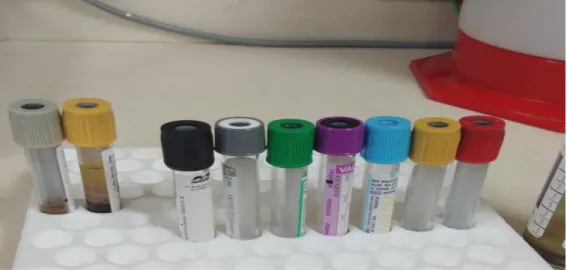
The blood samples of 138 patients of the age > 60 years were collected in the tubes and were send for testing. The results of the samples were evaluated on the basis of creatinine concentration, sodium levels, age and sex.
Figure 1: Blood collection tubes
III.
RESULTS
25 out of 46 male patients were found to be suffering from Hyponatremia. These patients had normal
creatinine but low sodium levels (Table 1).Their creatinine ranged from 0.70-1.30 which is a normal range but their sodium content was found to be low and ranged from 125-135.
56
This work is licensed under Creative Commons Attribution 4.0 International License.
Table 1: Male patients having normal creatinine levels and low sodium levelsSL. NO Age Gender CREATININE:MALE-(0.70-1.30) SODIUM(136-145)
1 61 MALE 0.72 135 2 62 MALE 0.89 134 3 72 MALE 1.04 132 4 67 MALE 0.75 133 5 62 MALE 1 125 6 70 MALE 0.88 134 7 75 MALE 1.27 131 8 68 MALE 1.06 125 9 73 MALE 0.93 133 10 81 MALE 0.79 112 11 67 MALE 1 133 12 77 MALE 1.28 134 13 70 MALE 0.89 134 14 61 MALE 0.72 135 15 75 MALE 0.81 130 16 62 MALE 0.57 126 17 65 MALE 1.3 135 18 80 MALE 1.14 132 19 61 MALE 0.82 128 20 74 MALE 0.74 118 21 66 MALE 1 133 22 72 MALE 1.07 135 23 80 MALE 1.14 135 24 62 MALE 0.74 135 25 66 MALE 0.78 131
14 out of 22 females were found to be suffering from hyponatremia. These female patients had normal creatinine but low sodium levels (Table 2). Their creatinine ranged from 0.40-1.20 which is a normal range
for females but their sodium content was found to be low and it ranged from 124-134.
Table 2: Female patients having normal creatinine levels and low sodium levels
SL. NO AGE GENDER CREATININE: FEMALE(0.40-1.20) SODIUM(136-145)
1 85 FEMALE 0.88 134 2 62 FEMALE 0.5 133 3 88 FEMALE 0.88 131 4 69 FEMALE 0.86 134 5 84 FEMALE 0.69 126 6 82 FEMALE 0.99 129 7 61 FEMALE 0.35 134 8 68 FEMALE 0.55 131 9 75 FEMALE 0.93 124 10 67 FEMALE 1.02 131 11 65 FEMALE 0.72 133 12 67 FEMALE 0.78 131 13 62 FEMALE 0.96 131 14 71 FEMALE 0.61 132
57
This work is licensed under Creative Commons Attribution 4.0 International License.
15 out of 46 males were found to be sufferingfrom Hyponatremia. These male patients had high creatinine and low sodium levels (Table 3). Their
creatinine ranged from 1.31-5.56 which is higher than the normal levels of creatinine. Whereas, their sodium ranged from 114-135, that is lower than the normal levels. Table 3: Male patients having high creatinine levels and low sodium levels
SL. NO AGE(YRS) GENDER CREATININE:MALE-(0.70-1.30) SODIUM(136-145)
1 75 MALE 2.39 114 2 93 MALE 1.77 135 4 69 MALE 5.56 135 5 71 MALE 2.82 133 6 66 MALE 2.44 134 7 67 MALE 1.73 124 8 75 MALE 1.36 132 9 80 MALE 1.74 130 10 63 MALE 1.63 135 11 71 MALE 5.02 131 12 74 MALE 3.3 133 13 70 MALE 1.31 135 14 75 MALE 1.72 130 15 74 MALE 1.35 127
8 out of 22 females were found to be suffering from Hyponatremia. These female patients had high creatinine and low sodium levels (Table 4). Their creatinine ranged from 1.28-10.18 which is higher than
the normal levels of creatinine. Whereas, their sodium ranged from 129-134, that is lower than the normal levels of sodium.
Table 4: Female patients having high creatinine levels and low sodium levels
SL. NO AGE(YRS) GENDER CREATININE: FEMALE(0.40-1.20) SODIUM(136-145)
1 65 FEMALE 1.48 129 2 65 FEMALE 1.28 131 3 74 FEMALE 2.82 133 4 62 FEMALE 10.18 133 5 78 FEMALE 1.81 134 6 91 FEMALE 1.22 131 7 81 FEMALE 1.35 134 8 67 FEMALE 6.81 129
6 out of 46 males were found to be suffering from Hyponatremia. These male patients had low creatinine and low sodium levels (Table 5). Their creatinine ranged from 0.22-0.68 which is lower than the
normal levels of creatinine. Whereas, their sodium ranged from 130-135, that is lower than the normal levels of sodium.
Table 5: Male patients having low creatinine levels and low sodium levels
SL.NO AGE(YRS) GENDER CREATININE:MALE-(0.70-1.30) SODIUM(136-145)
1 70 MALE 0.22 132 2 64 MALE 0.58 135 3 80 MALE 0.62 130 4 64 MALE 0.35 132 5 61 MALE 0.61 133 6 70 MALE 0.68 132
58
This work is licensed under Creative Commons Attribution 4.0 International License.
In all, out of 138 patients analyzed, 68 patientswere found to be suffering from hyponatremia. Therefore, from the data analyzed, it can be seen that around 50% of the population that are above 60 years of age suffers from hyponatremia. Also from the data, it can be seen that out of 138 patients, there are around 30 patients who had abnormal creatinine as well as sodium levels which shows that kidney disease can one of the major reasons for Hyponatremia. Further, from the data, it was seen that there were 46 male and 22 female patients that suffer from hyponatremia and hence we can say that, male patients are more prone to hyponatremia than female.
IV.
CONCLUSION AND DISCUSSION
Based on the results, we can say that hyponatremia is the most common electrolyte imbalance encountered in clinical practice[7]. As we can see from the results, prevalence of hyponatremia is known to increase in elderly patients where it is observed in almost half of acute geriatric admissions. The study indicated that there were 34% male and 16% females of total population who suffered from Hyponatremia. Therefore, it can be seen that there were almost 50% of the total population who suffered from Hyponatremia. Older people have an increased predisposition to hyponatremia due to degenerate physiology, multiple co-morbidities and poly-pharmacy[8]. It is also observed that due to abnormal levels of creatinine in kidney, the condition of hyponatremia in elderly population has become more prevalent. This may be because of one of the most important factor that is frequent prescription of drugs such as thiazides or antidepressants which can be associated with hyponatremia[9]. Thus, changes associated with aging and lack of mobility may facilitate the development of hyponatremia in elderly patients[10]. These patients are also at a higher risk of the complications of hyponatremia such as brain injury, associated with significant morbidity and mortality. Severe hyponatremia, if unrecognized in its first stages and left untreated, has a high rate of mortality; for this reason, an accurate clinical assessment must be made[11]. It can also lead to osteoporosis, abnormal gait patterns, cognitive impairment, bone demineralization, respiratory failure, non-cardiogenic pulmonary edema, falls, and fractures[12]. Even mild hyponatremia is considered a risk factor for falls in elderly people. Mortality has ranged from 6.7 to 51% among hospitalized patients who are suffering from Hyponatremia. In a study of patients with a mean age of 72 years, 22.5% had repeated serum sodium determinations of less than 135 mEq/L[13].
V.
FUTURE WORK
The early diagnostic is necessary to reduce fatality. This should include a history and physical examination with specific attention to cardiac, cancer,
pulmonary, surgical, endocrine, gastrointestinal, neurologic, and renal histories[14]. Diuretics, carbamazepine, and selective serotonin reuptake inhibitors can cause Hyponatremia; therefore, medications should be reviewed. Symptoms of hyponatremia depend on its severity and on the rate of sodium decline. Gradual decreases in sodium usually result in minimal symptoms, whereas rapid decreases can result in severe symptoms[15].Polydipsia, muscle cramps, headaches, falls, confusion, altered mental status, obtundation and coma may indicate the need for acute intervention[16].
ACKNOWLEDGEMENT
The authors would like to thank Jaypee Institute of Information Technology, Noida and BLK Super Specialty Hospital, New Delhi for their support.
REFERENCES
[1] Ashouri and O. S. (1986). Severe diuretic-induced hyponatremia in the elderly: a series of eight patients.
Archives of Internal Medicine, 146(7), 1355-1357. [2] Brouns, S. H. A, Dortmans, M. K, Jonkers, F. S, Lambooij., et al. (2014). Hyponatraemia in elderly emergency department patients: a marker of frailty. Neth J Med., 72(6), 311-317.
[3] Chawla, A., Sterns, R.H., Nigwekar, S.U. and Cappuccio, J.D. (2011). Mortality and serum sodium: do patients die from or with hyponatremia? Clinical Journal of the American Society of Nephrology, 6(5), 960-965. [4] Chua, M., Hoyle, G. E. and Soiza, R. L. (2007). Prognostic implications of hyponatremia in elderly hospitalized patients. Archives of Gerontology and Geriatrics, 45(3), 253-258.
[5] Cumming, K., Hoyle, G. E., Hutchison, J. D., andSoiza, R. L. (2014). Prevalence, incidence and etiology of hyponatremia in elderly patients with fragility fractures. PLoS One, 9(2), 72-78.
[6] De Vita MV, Gardenswartz MH, Konecky A, et al. (1990). Incidence and etiology of hyponatremia in an intensive care unit. Clin Nephrol, 34(4), 163-166.
[7] Filippatos, T. D., Makri, A., Elisaf, M. S., et al. (1997). Hyponatremia in the elderly: challenges and solutions. Clinical Interventions in Aging, 10(9), 56-60. [8] Gankam Kengne F, Andres C, Sattar L, Melot C, Decaux G. (2008). Mild hyponatremia and risk of
fracture in the ambulatory elderly. QJM: An International
Journal of Medicine, 101(7), 583-588.
[9] Gross P. (2001). Treatment of severe hyponatremia.
Kidney Int., 60(6), 24-27.
[10] Hawkins and R.C. (2017). Age and gender as risk factors for hyponatremia and hypernatremia.
Clinicachimica Acta., 337(1-2), 169-172.
[11] Ioannou, P, Stavroulaki, M, Mavrikaki, Papakitsou, &Panagiotakis., et al.(2018). A case of severe
59
This work is licensed under Creative Commons Attribution 4.0 International License.
hyponatremia due to linezolid induced SIADH. Journalof Clinical Pharmacy and Therapeutics, 43(3), 434-436. [12] Kimelman N, Albert SG. (1984).
Phenothiazine-induced hyponatremia in the elderly. Gerontology, 30(2),
132-136.
[13] Michael F. Michelis. (2009). Disorders of Serum Sodium Concentrationin the Elderly Patient. In: Division of Nephrology. Lenox Hill Hospital, New York, NEW YORK. Available at : https://www.asn-online.org/education/distancelearning/curricula/geriatrics/ Chapter16.pdf
[14] Miller M, Morley JE, Rubenstein LZ. (1995).
Hyponatremia in a nursing home population. Journal of
the American Geriatrics Society, 43(12). 1410-1413.
[15] Terzian C, Frye EB, Piotrowski ZH. (1994).
Admission hyponatremia in the elderly. Journal of
General Internal Medicine, 9(2), 89-91.
[16] Upadhyay A, Jaber BL, Madias NE. (2006).
Incidence and prevalence of hyponatremia. The American
Journal of Medicine, 119(7), 30-35.
[17] Weatherall and M. (2004). The risk of hyponatremia in older adults using desmopressin for nocturia: a systematic review and Meta analysis. Neurourology and Urodynamics: Official Journal of the International Continence Society, 23(4), 302-305.
[18] Zietse, R., van der Lubbe, N., & Hoorn, E. J. (2009). Current and future treatment options in SIADH.
Clinical Kidney Journal, 2(suppl 3), iii12–iii19. https://doi.org/10.1093/ndtplus/sfp154