Adoption of Computer Assisted Audit Tools and
Techniques (CAATTs) by Internal Auditors: Current
issues in the UK
Nurmazilah Mahzan and Andrew Lymer1
Birmingham Business School
Abstract
Adoption of Computer Assisted Audit Techniques and Tools (CAATTs) has not only become a beneficial choice for some businesses, but has become a fundamental part of many audit methodologies. (CICA, 1994; Progrob, Isenberg, 1999; Paukowits, 2000; Hudson, 1998). However, little is known about the adoption process for these tools. This research posits that further knowledge about the motivations for successful adoption of CAATTs may be contained in general literature on IT adoption activity. It also argues this could be usefully supplemented to address wider implementation and operational issues by better understanding of existing practices of internal audit departments who use CAATTs extensively to illustrate best practice in this field that others could benefit from. This paper therefore reviews, then makes use of, current theories that are seeking to better understand IT adoption processes (in particular, the most recent unified theory called the Unified Theory of Acceptance and Use of Technology - UTAUT) and explores the application of this theory to the specialized domain of CAATTs adoption for internal audit. This is undertaken initially using a survey instrument to collect quantitative data on the potential applicability of this theory. Building on the results of this survey, a series of ten mini-case studies is then used to add qualitative depth to the survey results.
Using a combination of these two approaches, a model of successful CAATTs adoption by internal auditors is then proposed. This resulting model is comprised of four dimensions covering the issues of; factors influencing motivation, best practices of implementation, performance measurement criteria and challenges that can become barriers to successful implementation.
This paper details the theoretical foundations used for the development of this model, details the empirics used to explore the motivational theory for adoption, presents the resulting model and illustrates the validation performed on the model.
Keywords: Internal Audit, CAATTs
1
Draft paper submitted for BAA Annual Conference, Blackpool, April 2008. Please do not quote without permission of the authors. Correspondence address: Andrew Lymer, Birmingham Business School, University of Birmingham, Edgbaston, Birmingham, B15 2TT, [email protected]
Adoption of Computer Assisted Audit Tools and
Techniques (CAATTs) by Internal Auditors
1. Introduction and Motivations
CAATTs are computer tools and techniques that an auditor (external or internal) uses as part of their audit procedures to process data of audit significance contained in an entity’s information systems (Singleton, 2003). Recent literature (for example, Grand 2001) has shown that the types of CAATTs embraced by internal auditors are classified to include the following groups: electronic working papers, fraud detection, information retrieval and analysis, network security ,continuous monitoring, audit reporting, database of audit history, computer based training, electronic commerce and internet security .
The usage of CAATTs by internal auditors is not new, but has evolved over time as the proliferation of information technology usage has developed in businesses (Ramamoorthi, 2004). The pervasive nature of information technology, the favourable economic and functional versatility of modern computing technology and the globally open and competitive market forces that drive the rate of technological evolution are together creating an era of profound change in the market place for audit automation (Berry, 2003; Bhimani, 1996; Abdel Hamed & Sweet, 1999). While auditors have been partially successful in using existing technologies to automate elements of their functions, the businesses in which they work are also undergoing significant change themselves (Elliot, 2002). Many organisations have opted to utilise sophisticated information technologies for developing their business process support as well as improving their information processing activities (Ramamoorthi, 2004). This increases the need for CAATTs in such businesses to allow auditors to continue to be able to perform their review and monitoring tasks effectively, as well as to play key roles in the process of innovation in these businesses more generally.
The developments in IT themselves are also set against the background of major changes in corporate reporting practices and internal control management and assessment related to key legislation and regulation changes including Sarbanes-Oxley Act issues in the USA and similar developments elsewhere in the world, including the wider adoption of the Combined Code and the Turnbull Report in the UK.
Many of these business environment changes are having strong influence on the development of the internal and external audit and assurance industry (Lavine, 2002; AICPA/CICA, 2001; Gosh, 1998; Erickson, 1996). Auditors’ methodologies need to keep up with the auditee business’ governance and reporting changes in order to ensure the effectiveness and efficiencies of the audit function can be maintained. Wider use of CAATTs has been widely touted as an important response to these changes (e.g. see Ramamoorthi, 2004; Debreceny & Gray, 2003; ISACA, 1999; Paukouwits, 1998). However, only a limited number of academic studies have been conducted that seek to aid wider understanding of the issues of CAATTs adoption – and fewer still that particularly focus on their adoption by internal auditors (e.g. Debreceny et al., 2003; Rezaee et al., 2002; Vasarhelyi, 2002; Cash et al., 1997; Vasarhelyi & Harper, 1991). There is therefore a case for further studies to be undertaken to provide a better understanding of the motivations for, and constraints on, the use of CAATTs in internal audit departments. This research attempts to provide further insight on these issues.
This research proposes a model for internal auditors’ use in examining the motivational criteria for CAATTs adoption, based on theory testing for academic literature on IT adoptions, and the wider application of CAATTs in their businesses once adopted. The model presented proposes four dimensions of the adoption and review process it argues both the literature and empirics illustrate as being critical to both successful adoption of CAATTs initially, and subsequent development of its use. These dimensions are; motivations for CAATTs adoption, best practices during CAATTs implementation, and challenges in adoption and performance measurement indicators post-implementation.
In the next section of this paper the prior literature on CAATTs adoption and use is explored further before then outlining the justification for use of wider IT adoption theories as the foundation for a model to aid understanding of the motivations for CAATTs adoption. Section 3 then outlines the four research questions explored in this research that together form the four dimensions of the resulting practical CAATTs adoption and use model proposed from this research. Section 4 elaborates on the application of the theoretical IT adoption model used to explore adoption motivations (research question 1). Section 5 initially outlines the qualitative analysis undertaken on a survey applied to determine general CAATTs use in the UK domain during the period up to mid 2006. It also details some qualitative work subsequently undertaken based on the results of this survey work using a series of mini-case studies in the UK and Malaysia. Together these two pieces of work enabled the researchers to test the applicability of the theoretical model on IT adoption motivations to address research question 1, and the wider implementation and use issues of CAATTs currently by internal auditors in the UK to address research questions 2-4. These results are explored in section 6 which concludes with the presentation of the model on CAATTs adoption and use. Section 7 offers some conclusions and implications for this research before the final section discusses limitations to this work.
The key contributions of this paper are:
o the provision of new data on current UK situation for CAATTs use in internal audit functions where very little had been previously known;
o application and testing of general IT adoption theories in the CAATTs and internal audit setting;
o an academic approach to better understanding of CAATTs use in the UK by internal auditors where previously only limited professional body surveys have been applied;
o development of a practical ‘best practice’ model to guide future adoption and planned implementation of CAATTs in internal audit settings in the UK (with some claimed general applications for a wider geographical domain) to aid both businesses wishing to make greater use of CAATTs in their internal audit
functions, and software developers, consultants and the related professional bodies who seek to foster an improved environment for these developments to occur within.
2. Literature Review
Previous studies have been conducted into CAATTs development and application by both internal and external auditors that will form the basis for this research. This includes previously documented cases showing why CAATTs were adopted in particular cases (for example, see, Neuron, 2003; Paukowits, 2000; Progob & Isenberg, 1999; and Hudson, 1998).
While academic research on this topic is very limited, there have been a number of surveys carried out by professional bodies to which auditors belong, outlining CAATTs usage in practice across a variety of industries. However, this work, even though limited in its scope generally is further limited by its geographical focus – the USA - with very little documentation on the use of CAATTs outside North America.
The insights that are available to us relating to internal auditors in particular to date, as the focus of this study, come from the results of the Institute of Internal Auditors (IIA) USA surveys, conducted annually since 1995, in which a range (albeit limited) of CAATTs related information is routinely collected and therefore some history of development practices of these technologies are being captured. However, such systematic review of even basic information of usage does not exist outside the USA. In the UK/Ireland the IIA conducted their first survey touching on CAATTs usage at the end of 2002. The results of this study were released in May 2003 (IIA UK, 2003). The respondents to the survey were 65 heads of Internal Audit from organisations throughout the UK. This survey revealed hesitation amongst those overseeing internal audit departments in the UK related to automation development. The key reason cited for this was that they perceived there was a lack of software available in the market that met their
needs as internal auditors. The survey suggested that some software packages were too ‘cramping’ in their requirements to be directly applicable to working audit methodologies in the businesses that evaluated them – requiring too big a change in the methodologies used to justify the costs for the benefits to be accrued. However, more than 40% of respondents suggested that they would be willing to adopt an amended audit approach if they could find a package, or packages, that otherwise met their needs. This suggests scope for wider automation to occur in the future if the right conditions for their adoption could be understood, and communicated to software developers.
Neither of these previous sets of surveys has addressed in any practically useful detail the early stages of CAATTs adoption processes, particularly the specific motivations for initially exploring and building a business case for adoption of CAATTs, and the limiting factors to wider adoption. They primarily report on detail of applications in place at the time of the survey being undertaken. Therefore, the information necessary to provide the next step forward in wider adoption for many other businesses is not currently widely available either in the professional or academic literature.
There have been only a limited number of academic studies conducted on CAATTs and none that focus on adoption in detail employing the otherwise well known, and widely tested, IT adoption theories to explore motivations for adopting CAATTs. This research has, however, drawn on examples from previous studies related to auditing and technology adoption in the process of choosing suitable constructs for investigating these motivations (for example Bedard et al, 2003; Curtis and Payne, 2006). In addition, reviews were also made of articles studying TAM in a professional context (for example Andersen, 1997; Hu et al, 1999; Chismar and Patton, 2003). The nature of the work performed by internal auditors is within the professional domain hence it is important to identify factors salient to their work.
3. Research Questions
On the basis of this literature review, there are four major questions addressed in this research creating therefore the four dimensions of the resulting model:
1) What are the factors influencing motivations in CAATTs adoption by internal auditors? (RQ1)
2) What are the best practices for implementing CAATTs successfully by internal auditors? (RQ2)
3) What are the challenges or barriers to implementing CAATTs successfully by internal auditors, (RQ3) and
4) What are the methods used by internal auditors to evaluate performance on the success of CAATTs implementation? (RQ4)
These research questions will be explored in the following sections and then collected together to form the proposed CAATTs adoption and use model presented in section 6.
4. Theoretical framework to study motivations for CAATTs
adoption.
4.1 Theoretical foundations
The theoretical base underlying RQ1 is the model of technology adoption known as Unified Theory of Acceptance and Use of Technology (UTAUT). UTAUT is a unified model of IT acceptance by individuals that was developed by Venkatesh et al (2003) after reviewing, comparing and testing eight competing theories in this field of research that researchers have been working with for a number of years in seeking to find general factors that influence users when making technology adoption choices across a variety of domains. These models originate in psychology studies and have been adapted, by a series of successive research projects, to IT adoption decisions.
The eight models reviewed, compared and tested are; the Technology Acceptance Model (TAM), Theory of Reasoned Action (TRA), Theory of Planned Behaviour (TPB), the motivational model (MM), Innovation Diffusion Theory (IDT), Model of Personal
Computer Utilization (MPCU), the Social Cognitive Theory (SCT) and a model combining TAM and TPB.
The review and comparison undertaken by Venkatesh et al (2003) illustrated that there are five limitations the eight extant models, which are related to:
1. Technology being studied: Venkatesh et al observed that the type of technologies studied in the models studied have been relatively simple and individual oriented type of information technologies. In the development of UTAUT, they focus on complex and sophisticated organizational technologies, which they argued that this type of technology is the focus of managerial concern;
2. Participants: Venkatesh et al argued that in many settings for prior models, the participants are students. They tried to overcome these limitations by focusing on participants in non-academic settings;
3. Timing: Venkatesh et al argued that most of the tests of the eight models were conducted after the participants’ acceptance or rejection decision rather than during the active adoption decision-making process. UTAUT took a different approach by studying the adoption process through various stages of experience with a new technology from the time of initial introduction to stages of greater experience;
4. Nature of measurement: It was argued by Venkatesh et al that prior studies employed limited comparisons such as cross-sectional or between subjects’ comparisons. Their study tracked participants through various stages of experience with new technology and compares all models on all participants; and 5. Voluntary vs. mandatory contexts: Except for TRA (Hartwick and Barki, 1994)
and TAM2 (Venkatesh and Davis, 2000), other models and model comparisons studies were conducted in voluntary usage context. Research by Venkatesh et al. (2003) examines both voluntary and mandatory settings.
As all the above factors also reflect the nature of real CAATTs adoption decisions in internal audit settings, there appeared to be a match that could be applicable in applying this model to the research question on motivations.
Hence, having reviewed, examined and tested the eight competing models, Venkatesh et al developed UTAUT based upon conceptual end empirical similarities across the models (see figure 1).
Figure 1: UTAUT proposed by Venkatesh et al (2003)
There are four major elements (termed ‘constructs’) that appeared to be significant direct determinants of intention or usage in one or more of the individual models according to Venkatesh et al. (2003). They were performance expectancy (PE), effort expectancy (EE), social influence (SI) and facilitating conditions (FC).2 Venkatesh et al. grouped the various constructs from eight different models and developed these four categories of major constructs that captured the key elements of the various sub-constructs from the other models.
2
Performance expectancy is the degree to which an individual believes that using the system they are considering adopting will help him or her to attain gains in task performance. Effort expectancy refers to the degree of ease the adopter associates with the use of the system they are considering using. Social influence, in turn, refers to the degree to which the individual perceives that important others believe he or she should use the new technology they are considering and facilitating conditions is defined as the degree to which an individual believes that an organisational and technical infrastructure exists to support use of the technology they are considering adopting.
EE
SI
FC
Gender Age Experience Voluntariness of Use
Behavioural Intention
Use behaviour PE
In addition, Venkatesh et al. (2003) proposed that these four major constructs are moderated by four key ‘moderators’ (gender, age, voluntariness and experience).
The proposed theory (UTAUT) was then empirically validated using data from four organisations over a six-month period and found to outperform the eight individual models in explaining adoption activity for various technologies compared to these other models (Venkatesh et al, 2003). The model presented by Venkatesh et al (2003) is extracted in Figure 1 illustrating how the four major constructs they distilled from prior literature, and the four facilitating factors, impact on use behaviour directly, or via behavioural intentions to use as an interim step prior to actual use behaviour.
In addition to using these constructs proposed by UTAUT, our research also proposes another construct, the effect of externalities, to address the issue (that may be unique to this kind of domain we argue) of the impact of the extent audit clients use of technology for data processing on the auditors’ audit technology. This extra construct is proposed based on examination of the literature available (e.g. Javnrin & Bierstaker, 2005; ISACA, 1999), on motivational factors for CAATTs adoption, which the researchers believe, may not be adequately emphasised by the wider general UTAUT model as a key construct in this context.
The remainder of this section explores each of the constructs from UTAUT as are proposed for testing in this study to illustrate their theoretical application to our model development.
4.2 Performance Expectancy
Auditing standards and guidelines clearly suggest that usage of technology tools could help to enhance efficiency and effectiveness of internal auditor’s work (e.g. see IIA standard 1220.A2). In addition, other literature on CAATTs has shown that internal auditors adopt CAATTs to be able to perform various functions such as to test program controls (e.g. see Progob & Isenberg, 1999), to gain better understanding of their client IT controls (Neuron, 2003), to facilitate risk assessment during planning processes
(Paukowits, 2000) and to improve the efficiency of audit testing (Hudson, 1998). As such, it seems clear that CAATTs are perceived to be potentially an important tool for internal auditors in the performance of their audit work. This perception is consistent with perceived usefulness as included in the Performance Expectancy construct in UTAUT, which refers to the extent to which an individual believes that his or her use of the technology will enhance job performance (Davies, 1989).
4.2. Effort Expectancy
UTAUT’s effort expectancy construct, addressing perceived ease of use, is also tested in this study. UTAUT suggested that there was a direct (positive) effect of perceived ease of use via effort expectancy on behavioural intention (Venkatesh et al., 2003). All other things being equal, UTAUT would suggest that there is a higher likelihood that internal auditors would adopt CAATTs when they are easy to use and therefore do not have to undergo a difficult learning curve to make use of CAATTs.
Despite apparent support for this construct in UTAUT, Hu et al. (1999) concluded from their study that among knowledge workers no amount of ease of use would compensate for low perception of systems usefulness. Their investigation of physician’s acceptance of telemedicine revealed that as the level of knowledge of professionals differ significantly from other subjects of prior research (students, clerical staff etc) then their ability to assimilate new technology would be quicker (Hu et al, 1999). Therefore, ease of use was found to have no significant effect on attitude and perceived usefulness in the Hu study of technology adoption. However, Bedard et al. (2002), in looking more directly at auditors as professionals, found otherwise. Their results showed that ease of use perceptions were in fact important among a group of highly experienced auditors (Bedard et al., 2002) thus potentially supporting the use of this construct in modelling technology adoptions by auditors. Bedard et al.’s research examined the effect of technological and task knowledge on the basic TAM relationships. The positive relationship between task knowledge and ease of use implies that even individuals with requisite computer skills may consider a system difficult to use if they are uncertain about their proficiency with
tasks that need to be performed using the system. In later research, Bedard et al. (2003) found that the perception of ease of use can be shifted with the effect of training.
Therefore, in this study, the effect of ease of use and training on CAATTs adoption by internal auditors is examined in seeking further confirmation of their applicability to auditor adoption decisions.
4.3. Facilitating Conditions and Social Influence
Facilitating conditions and social influence are the other two major constructs that are proposed by UTAUT. In the context of CAATTs adoption by internal auditors, the facilitating conditions that can impact on their motivations to adopt CAATTs are the adequacy of information on what CAATTs can do, support from vendors or software providers as well as support from top management in their organisations (CICA, 1994). In the context of social influence, this study seeks to understand if any influence of image and normative belief towards intention to adopt CAATTs exists in this adoption domain, as found elsewhere by other UTAUT users. For example, the decision whether to adopt CAATTs or not, may be influenced by the Head of Internal Audit in the organisation or fellow auditors within their firm or from other professional contacts.
4.4. Effect of Externalities
The construct of effect of externalities is introduced in this research as an additional element of the study, despite not being a major construct in UTAUT, to attempt to explore the potential issue of the impact of the extent audit clients use technology for data processing. This is an issue, it has been argued, that is salient to the auditing field specifically that may not be relevant in other technology adoption studies. The internal auditors’ scope of work depends on factors such as audit objectives, the clients’ business and technology environment as well as applicable auditing standards. Auditors’ use of technology has evolved over the decades in response to the evolutionary impact of
technological changes in business environments. Failure to keep abreast with those changes would render the work of internal auditors’ inefficient and therefore it is considered appropriate to test the importance of an additional construct in this study to explore the potential impact of this feature of the auditing domain.
An analysis of adoption literature revealed that there are very few studies that have been conducted to examine the effect of externalities (for example, Janvrin & Bierstaker, 2005; Kauffman et al, 2000). Several auditing studies (albeit of external auditors) have identified that changes in clients’ IT strategies (externality) produced an impact on auditors’ assessment of clients’ risks (Javnrin & Bierstaker, 2005; Sutton and Hampton 2003; Chang and Hwang 2003; Johnstone, 2000; Bell et al, 1997). The outcomes of these studies proposed that external auditors respond appropriately by acquiring or updating their IT usage for use in their audit processes. Therefore, this study proposed that internal auditors’ adoption of CAATTs was also likely to be influenced by the extent of technology usage of clients or auditees (these typically, of course, being other departments within their organisation that are subject to internal audit). For instance, auditing a client that operates electronic commerce transactions with voluminous data would require usage of effective audit tools such as data extraction and analysis software to ensure the audit process can be completed efficiently and effectively.
5. Data Collection and Analysis
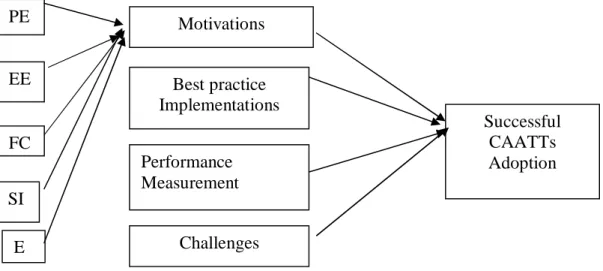
The relationships of the UTAUT constructs exploring motivations for CAATTs adoption (RQ1) and the other three research questions (RQ2-4) can therefore be captured in the following figure (figure 2):
Figure 2: Theoretical View of Studying Motivations for Successful CAATTs Adoption
A mixed method approach is adopted in this research in order to explore the research questions. This, it was believed, would help to increase the validity of findings (Mark and Shortland, 1987) and to assist in convergence of data findings (Mathieson, 1988).
In this research, qualitative based case studies were chosen as the major data collection medium (consistent with findings of Choudrie et al, 2005) while a quantitative based survey method was also used initially to explore the applicability of the theoretical adoption model and also provide general information on factors that influence motivations and then further to enable a framework of suitable topics to be developed across all four research questions for detailed exploration during the case study stage of the research. PE EE FC SI E Motivations Best practice Implementations Performance Measurement Challenges Successful CAATTs Adoption
5.1 Quantitative data
A survey instrument was distributed to a number of groups; members of Institute of Internal auditors in UK and Ireland, the ACL user group, IDEA user group and clients of Data Services UK Ltd (the key UK consulting company specialising on audit software implementation). Since the data to be analysed came from a different group of samples, they are first recorded within their own groups and responses from IIA members across these samples are picked up, collated and merged in one single file to enable combined analysis of just IIA members within the whole data set. The sample size analysed therefore is 46 members of IIA UK.3 A summary of survey responses from all the groups is presented in table 1 below
.
IIA UK
and Ireland ACL User Data Services IDEA User Total Responses received 11 34 25 25 95 Member of IIA UK (responses used for analysis) 11 9 14 12 46 (responses selected for analyses) Non members of IIA UK 0 28 10 13 514
The survey instrument used collected data on all four research questions with the aim of providing a foundation from which the qualitative work could be developed. This included, in particular, a series of questions related to their motivations for adopting and using CAATTS to provide data for the analysis of UTAUT constructs as a possible model of explanation of the motivations of internal auditors to adopt CAATTs (e.g. RQ 1) but also covered details of current CAATTS usage, questions on how CAATTS were
3
Each response received was from a unique IIA member determined by our collection method ensuring no-one filled out multiple responses. IIA-UK currently has approximately 8,000 members
(http://www.iia.org.uk) including both student and affiliate memberships.
4
Analysis of the 51 non-IIA members is not provided here. This group represented wider backgrounds and experiences with no common features across the whole group other than a current job function in IA (i.e. lack of common professional training having been completed to an externally authorised standard as is required for IIA membership).
implemented and evaluated, what problems were faced in using CAATTs in practice (ie covering RQ 2-4).
In respect of RQ 1, our analysis of previous research on IT Adoption (e.g. Davies et al. 1989; Moore and Benbasat, 1991; Karahanna, 1999; Davies & Venkatesh, 2000) has shown that the UTAUT related constructs are commonly explored in quantitative data by using factor analysis and Partial Least Square analysis (an alternative to covariance based structured equation modelling). However, the latter is unsuitable for this study due to the sample sizes obtained from the limited survey undertaken. In addition, the quantitative data from the surveys was to be used in a complementary way to the qualitative data from the case studies. Therefore this study uses two statistical techniques considered suitable for these purposes; descriptive unilateral analysis and principal component factor analysis, in providing analysis on the survey data.
Section 6 provides details of how these results were analysed.
5.2 Qualitative data
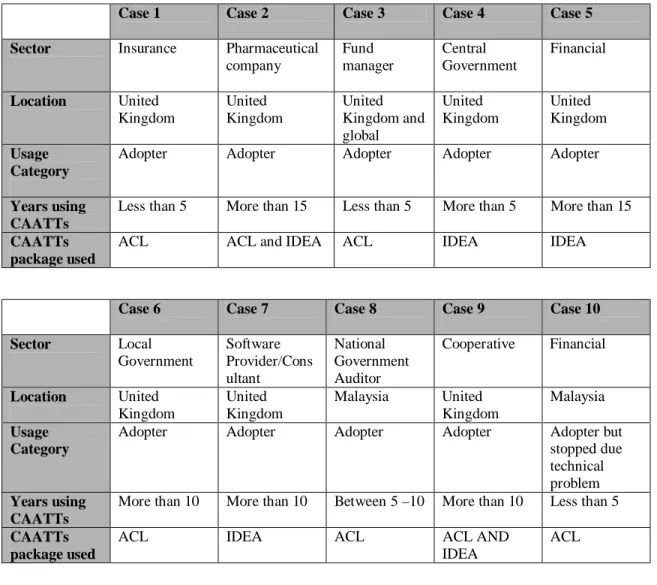
The mini-case studies comprised of 8 internal auditors from different organisations in the UK and 2 internal auditors from Malaysia. Cases were selected based on leads from survey respondents as successfully adopting entities (only respondents who were both successful and significant users were chosen) but selected to represent different kinds of industries to enable some spread of coverage of CAATTs use to be included. Two comparative cases were selected from outside the UK (taken from Malaysia) to offer some, albeit very limited, international comparison information. The profile of the case study respondents is described in table 2:
Table 2 : General summary of case studies respondents’ profile
Case study data was collected during 2006 in face-to-face interviews with key individuals in each case study company (in each case CAATTs experts in those businesses and also other senior internal audit staff where possible). Each interview was recorded and subsequently transcribed. Transcripts were supplied to each interviewee for their comments and amended accordingly for factual inaccuracies. Supplementary documentation was also provided by participants as additional data sources for the case analysis. This typically included written policies and procedures, training guides and related internal documentation.
Case 1 Case 2 Case 3 Case 4 Case 5 Sector Insurance Pharmaceutical
company Fund manager Central Government Financial Location United Kingdom United Kingdom United Kingdom and global United Kingdom United Kingdom Usage Category
Adopter Adopter Adopter Adopter Adopter
Years using CAATTs
Less than 5 More than 15 Less than 5 More than 5 More than 15
CAATTs package used
ACL ACL and IDEA ACL IDEA IDEA
Case 6 Case 7 Case 8 Case 9 Case 10 Sector Local Government Software Provider/Cons ultant National Government Auditor Cooperative Financial Location United Kingdom United Kingdom Malaysia United Kingdom Malaysia Usage Category
Adopter Adopter Adopter Adopter Adopter but stopped due technical problem
Years using CAATTs
More than 10 More than 10 Between 5 –10 More than 10 Less than 5
CAATTs package used
ACL IDEA ACL ACL AND
IDEA
The case studies are analysed using the following stages as recommended by Yin (2003): a. Pattern matching and analysis based on theoretical propositions
The theoretical propositions underlying RQ1 are based on UTAUT. This study therefore proposed that internal auditors are motivated to adopt CAATTs due to performance expectance, facilitating conditions, effort expectancy, social influence and externalities. These constructs are adapted from UTAUT and used as guidance while carrying out the data analysis.
A pattern matching technique was applied in the analysis of the collected and transcribed case data, and supplementary documentation. Pattern matching is a method where a pattern of results from the data collected is matched with a pattern predicted from previous knowledge or research (Gibbs, 2002). The advantage of this method is to help strengthen internal validity if the pattern coincides with a predicted one (Yin, 2003).
Ryan et al (2002) explain that for the pattern matching model of explanation, no general laws are used transcending across the social system. However, regularities may exist within the system, or within the larger system of which it is a part.
In this study the transcripts were first condensed to focus on each research question. A textual analysis was then undertaken and the results were categorized according to the five motivation constructs (see figure 2 above). Analysis on the transcripts demonstrated that the first three constructs of performance expectancy (supported mainly by descriptions of benefits), effect of externalities (supported by descriptions of external influence on CAATTs adoption) and facilitating conditions (supported descriptions of the availability of CAATTs expert and
support from management). However, the findings of this analysis did not appear to strongly support the existence of social influence and effort expectancy.
b. Identifying rival explanations
The second general analytical strategy proposed by Yin (2003) is to define and test possible rival explanations. Testing of rival explanations can be conducted in two situations; first when there are pre-existing propositions to be tested against the data, or second, without the pre-existing propositions.
During the process of analysing data from the mini-case studies, particular attention was given to possible existence of any kinds of rival explanations. The rival explanations are further probed by getting more information (for example asking further questions of respondents or using supplementary data provided by the interviewees) to enable decisions to be made as to whether to reject, or not, rival explanations possibly indicated in the case data.
c. Feedback on the proposed model of successful CAATTs adoption by internal auditors
Getting feedback from the respondents is a key way to assess the validity of the research findings (Kvale, 1996, p242). In this study, feedback is collected from the case study respondents, and randomly selected survey respondents, on the resulting model developed from the research findings. Feedback from the case study respondents was obtained through follow up email correspondence and telephone calls while feedback from selected survey respondents are obtained during an ACL user conference held in September 2007 in UK. In this latter case, a questionnaire was developed and distributed after a presentation of the
research findings was provided. The feedback was analysed using similar analysis techniques described above.5
d. Integrating evidence
The final process of the mini-case study analysis stage was to integrate all the necessary evidence to answer the research questions. As far as possible, efforts were taken to fulfil the criteria in producing high quality analysis (Yin, 2003) outlined by Yin as follows:
i. Ensure that all evidence are taken into consideration; ii. Address all major possible rival explanations;
iii. The analysis should address most significant aspects of the case study; and
iv. Apply and relate the researchers’ own prior knowledge that is relevant to the case study.
The following section further develops the results found in the quantitative and qualitative data analysis processes.
6. Research Findings
The results of the uni-variate analysis on the survey results of the 46 respondees analysed can be summarised as follows:6
• Generally most respondents use the type of CAATTs within the definition of general audit software (data extraction and analysis tools such as ACL, IDEA and more generic spreadsheet applications) with little evidence of more advanced
5
It is acknowledged that this feedback would not represent a comprehensive, non biased, validation of the model, however, it is used as an indicative gauge of the extent this model can be replicated to other contexts of a similar nature. Further validation of this model is however, required for wider generalised application to be claimable. This is the subject of current further work being undertaken.
6
Due to the small numbers of responses received, these findings cannot be generalised to represent the internal audit population in the UK. However, these findings provide a general overview of the current UK position on CAATTS usage by internal auditors prior to carrying out work on the mini-case studies to aid the interpretation of the case studies findings.
CAATTs being widely used in the UK at present (e.g. continuous audit tools, embedded audit models etc);
• Two important staff that were involved during the process of selecting audit tools and techniques are the representative of IT departments and the Chief Audit Executive;
• Three top factors that influence the respondents’ decision whether to continue or not to continue using CAATTs are the ability to train employees on the software usage, compatibility of the software with other departments’ systems and the ability of software to meet the data manipulation needs of the audit department; • The results also demonstrate that approximately 60% of the respondents are
utilising less than 10% of their billable time (time counted in budgeted hours worked) on using CAATTs;
• Over the past 2 years, 37% of respondents recorded an increase in CAATTs usage of less than 10% and 30% recorded increases between 10% and 50%.
This section next presents tests carried out for the purpose of analyzing factors that influence internal auditors’ motivation to adopt CAATTs. The results comprised of tests carried out on the quantitative data including Cronbach’s Alpha and Factor Analysis. The measurement scales (questions) are developed based on the constructs adapted from UTAUT. The questions were designed in Likert-scale style. Subsequently, similar constructs are used in presenting the results of the case studies.
a) Cronbach’s Alpha
Prior to conducting factor analysis on the data, it was considered useful to check the reliability of the scale used to confirm that the scale used consistently reflect the scale they are measuring (Field, 2005). The most common measure of scale reliability is Cronbach’s Alpha. This test is run on the quantitative data and the result of Cronbach’s Alpha demonstrates an alpha of 0.955. The result of 0.955 is acceptable within a normal context of statistical test where the general guideline says that alpha value above 0.8 indicates good reliability (Field, 2005).
b) Kaiser Meyer Olkin (KMO) and Bartlett’s Test of Sphericity
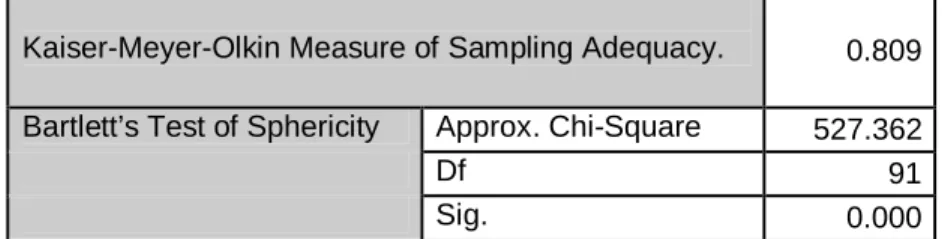
These tests tell us about appropriateness of running factor analysis on this data. The former measures sampling adequacy7 while the latter is a test of sphericity8. The KMO statistic varies between 0 and 1. Kaiser (1974) as quoted in Field (2005) recommends accepting values greater than 0.5 as barely acceptable9. Furthermore values between 0.5 and 0.7 are considered mediocre while values between 0.8 and 0.9 are good values. Finally, values above 0.9 are considered excellent. Another condition to assess the appropriateness of running factor analysis is to ensure that Bartlett’s test of sphericity is significant (that is p<0.05) (Field, 2005).
Table 3 presents the results of the statistical test which support the use of factor analysis
Table 3: Results of KMO and Bartlett’s test of sphericity
Kaiser-Meyer-Olkin Measure of Sampling Adequacy. 0.809
Bartlett’s Test of Sphericity Approx. Chi-Square 527.362
Df 91
Sig. 0.000
c) Factor Analysis
On the basis of the acceptable result reported above we were able to proceed with factor analysis. In TAM studies factor analysis has been used to determine the validity of the
7
Representing the ratio of squared correlation between variables to the squared partial relation between variables
8
Bartlett’s test of sphericity is a test statistic used to examine the hypothesis that the group variances are the same (i.e. variance- covariance matrix are equal) and dependent variables are uncorrelated in the population. In other words, it measures the null hypothesis that the original correlation is an identity matrix for details refers to Field (2005).
9
Values below this indicate that more data needs to be collected and rethink is required as to what variables to be included (Field, 2005).
constructs (e.g. Karahanna et al, 1999; Hu et al, 1999;Moore and Benbasat, 1991). The same approach is therefore adopted in this study. The common factors identified in this analysis were then used to inform the analysis of the qualitative part of this research.
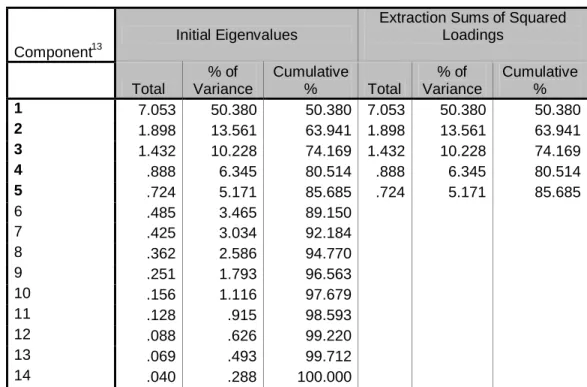
Factor analysis was run on the 46 samples. The extraction method used is Principal Component Analysis (PCA) with Varimax10 rotation method as suggested by Field (2005). In running factor analysis, not all factors are retained in the analysis. References need to be made to the eigenvalue11 and scree plot12 of the data. Field (2005) explained that Kaiser (1960) recommended retaining all factors with eigenvalue greater than 1. This recommendation is known as Kaiser’s Criterion. Further Field (2005) explained that as opposed to Kaiser (1960), Jolliffe (1972, 1986) recommended an alternative option of retaining all factors with eigenvalues more than 0.7; describing Kaiser’s Criterion as too strict (Field, 2003). It was further commented by Field (2003) that Kaiser’s Criterion is accurate when the sample size exceeds 250. Using this argument and considering the small sample size of quantitative data of this research, an eigenvalue of 0.7 is used to identify the number of factors at this stage of analysis. Table 4 below presents how the 14 components were grouped to five factors based on selection criteria of an eigenvalue greater than 0.7. This preliminary analysis resulted in solution of 5 factors selected for further analysis.
10
As described in (Field 2003), SPSS has three methods of orthogonal rotation (varimax, quartimax and equamax) and two methods of oblique rotation (direct oblimin and promax). Oblique rotation is more complex because it permits correlation between factors. For orthogonal rotation, Field (2003) suggested Varimax which can produce more interpretable clusters of factors as compared to quartimax and equamax.
11
Eigenvalues are used to calculate eigenvectors, the elements of which provide the loading of a particular variable on a particular factor (Field, 2003).
12
Table 4: Total variance explained
Component13
Initial Eigenvalues
Extraction Sums of Squared Loadings Total % of Variance Cumulative % Total % of Variance Cumulative % 1 7.053 50.380 50.380 7.053 50.380 50.380 2 1.898 13.561 63.941 1.898 13.561 63.941 3 1.432 10.228 74.169 1.432 10.228 74.169 4 .888 6.345 80.514 .888 6.345 80.514 5 .724 5.171 85.685 .724 5.171 85.685 6 .485 3.465 89.150 7 .425 3.034 92.184 8 .362 2.586 94.770 9 .251 1.793 96.563 10 .156 1.116 97.679 11 .128 .915 98.593 12 .088 .626 99.220 13 .069 .493 99.712 14 .040 .288 100.000
Extraction Method: Principal Component Analysis.
In addition to analysis of eigenvalue, an inspection of the scree plot can also give a useful insight to the relative importance of each factor. Typically in scree plot there would be a few factors with higher eigenvalues and many factors with relatively lower eigenvalues (field, 2003). Figure 4 presents the scree plot derived for the study of motivation.
13
These components represent scales listed in table 6. These scales were part of of the questions asked in the survey instrument.
Figure 4: Scree plot 14 13 12 11 10 9 8 7 6 5 4 3 2 1 Component Number 8 6 4 2 0 E ig en va lu e Scree Plot
In Field (2005), it was explained that Cattel (1996) suggested that the cut-off point for selecting factors should be at the inflexion point of the curve. As can be seen in figure 4, the clearest point of inflexion would be at component (factor) number 2 and subsequently the graph starts to tail off. However, it is decided that factor 3, 4 and 5 should be retained for further investigation consistent with the results of the eigenvalue analysis shown in table 4.
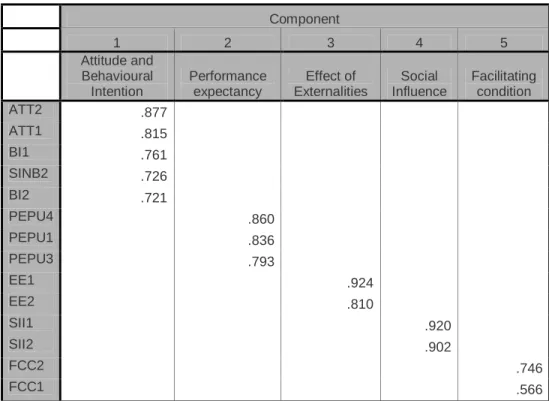
The above factors are further tested with the varimax rotation method. The factor rotation matrix will group the scales, which are most highly loaded (correlated) with the first factor and arranged in descending order to their size of correlation. Next, scales which load strongly with the second factor will be clustered to form the second factor, and the process will continue for all the five factors. The result of the rotated solution is presented in table 5.
Table 5: Rotated component matrix on factors influencing motivation to adopt CAATTs Component 1 2 3 4 5 Attitude and Behavioural Intention Performance expectancy Effect of Externalities Social Influence Facilitating condition ATT2 .877 ATT1 .815 BI1 .761 SINB2 .726 BI2 .721 PEPU4 .860 PEPU1 .836 PEPU3 .793 EE1 .924 EE2 .810 SII1 .920 SII2 .902 FCC2 .746 FCC1 .566
Extraction Method: Principal Component Analysis.
Rotation Method: Varimax with Kaiser Normalization. Rotation converged in 7 iterations.
The results in the above table indicate that all the scales exhibit factor loading14 above 0.5. Normally, researchers accept a loading of an absolute value of more than 0.3 to be important (Field, 2003). In the circumstances where the scale has an acceptable loading on more than one factor, one of these loadings can be reduced to the factor with the highest value. In this study, FCC2 load on factor 2 (0.566) and factor 1 (0.543). Therefore, the loading on factor 3 is eliminated because the value is much lower than factor 1.
14
A factor loading is a correlation coefficient showing how much weight is assigned to that factor. The higher the loading, the more that scale (or variable) belongs to that factor (Vaus, 2002).
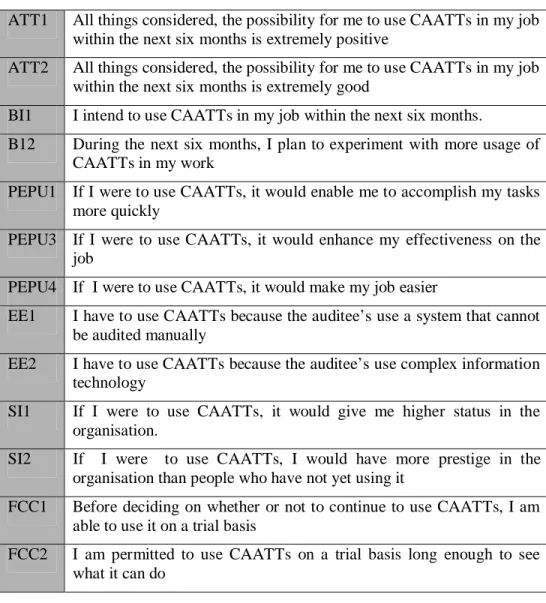
Table 6: Scales for factor analysis
ATT1 All things considered, the possibility for me to use CAATTs in my job
within the next six months is extremely positive
ATT2 All things considered, the possibility for me to use CAATTs in my job
within the next six months is extremely good
BI1 I intend to use CAATTs in my job within the next six months.
B12 During the next six months, I plan to experiment with more usage of
CAATTs in my work
PEPU1 If I were to use CAATTs, it would enable me to accomplish my tasks more quickly
PEPU3 If I were to use CAATTs, it would enhance my effectiveness on the job
PEPU4 If I were to use CAATTs, it would make my job easier
EE1 I have to use CAATTs because the auditee’s use a system that cannot
be audited manually
EE2 I have to use CAATTs because the auditee’s use complex information
technology
SI1 If I were to use CAATTs, it would give me higher status in the
organisation.
SI2 If I were to use CAATTs, I would have more prestige in the
organisation than people who have not yet using it
FCC1 Before deciding on whether or not to continue to use CAATTs, I am
able to use it on a trial basis
FCC2 I am permitted to use CAATTs on a trial basis long enough to see
what it can do
Four of the UTAUT constructs (performance expectancy, effect of externalities, social influence and facilitating conditions) are supported by the results of factor analysis in table 5, the fifth, effort expectancy, is not. From table 6, the scales listed under factor 1 comprised of scales related to attitude (ATT1, ATT2), normative belief (SINB2) and behavioural intention (BI1 and BI2). Therefore, the scales grouped under Factor 1 can be described as behavioural intention. The second factor is loaded by three scales, which are PEPU1, PEPU3, and PEPU4. These scales represent the construct performance expectancy. Next, two scales (EE1 and EE2) loaded on factor three. These scales relate to
the effect of externalities construct. The scales SII1 and SII2, which represent the construct of social influence, load into the fourth factor. The fifth factor relates to the construct facilitating condition. Two scales that load on this factor are FCC1 and FCC2.
The results of the survey therefore demonstrate that two constructs from UTAUT where found to directly influence the internal auditors motivation to adopt CAATTs, namely performance (PE) expectancy and facilitating conditions (FCC). The further construct suggested for this study (effect of externalities - EE) was demonstrated to be an important success factor in the findings of the quantitative research. However, the UTAUT construct social influence was only found in the results of the factor analysis on the survey data (i.e. it was not in evidence in the case study analysis). The fourth UTAUT construct, effort expectancy, was not found to be a factor influencing internal auditors’ motivation to adopt CAATTs.
These latter findings are consistent with findings from Hu et al (1999) in his study of physician’s acceptance of telemedicine technology, which found that perceived usefulness is supported in their findings while perceived ease of use was found to have no significant effect on physician’s intention to adopt this technology. A possible explanation of these findings is that internal auditors are professionals (similar to physicians) who work within a specialised knowledge domain and possess high levels of professional qualifications15. Therefore, they are more likely to be independent of social/peer influence in their decision whether to adopt CAATTs or not.
In addition, the description given by Succi and Walter (1999) of certain characteristics of knowledge workers (i.e. their ability to work without supervision, the use of peer review for evaluation of work and the underlying knowledge- oriented task that they completed) distinguished them from other IT users, and support the findings that internal auditors are not strongly influenced by social pressure.
15
70% of the respondents to the survey have at least Bachelor’s degree and most are members of at least one professional body
However, contrary to these findings, Bedard et al (2002), in their study of highly experienced external auditors’ acceptance of electronic work systems, found that ‘ease of use’ perceptions are important among this group of highly experienced auditors. It was found, however, that in their study, the respondents were less familiar with the system being examined, which was just being introduced to the specific audit firm examined. In this research however, respondents are adopters who have at least five years knowledge of the system in question. This point is further discussed in Bedard et al (2002), who proposed that firms implementing a complex electronic work system should focus on training in order to encourage system acceptance and overcome potential ease of use concerns. This research presented similar points from the findings for best practice implementation where training is also found to be an important factor to ensure successful implementation despite wider ‘ease of use’ factors not being found to be relevant.16
Due to lack of support from the findings of the case studies, social influence is not included in our model as one of the key factors influencing motivations to successfully adopt CAATTs. It was discussed in previous research (e.g. see Venkatesh and Davis, 2000) that constructs related to social influence have been found not to be significant in voluntary contexts but behave significantly within mandatory settings. In all cases in this study, CAATTs usage is voluntary, even though professional standards prescribe that CAATTs should be used by the internal auditors in ensuring that they deliver due professional care (see ISACA, 1999). There is a lack of enforcement and monitoring of compliance to this prescription of use leaving internal auditors to make context specific decisions on adoption. Also, membership of professional bodies, such as the IIA, is not mandatory for all internal auditors in practice. Therefore, it is in keeping with prior studies, and current professional context, that the effect of social influence is not present within the context of these cases. Should the adoption of CAATTs be made mandatory, either by internal or external parties, the social influence construct may then play a greater role in influencing CAATTs adoption.
16
Further strengthened by findings in Agarwal and Prasad (1999) which confirms that training brings positive effect on perceived usefulness.
Having explained motivation elements found to be present in this research from the theory used (UTAUT), the model next presents 10 implementation best practices that can assist successful CAATTs adoption. These factors are distilled from textual analysis of the mini-case studies. They are:
I. CAATTs Champions and expert users should exist or be developed in the organisation.
II. Support from the management on the overall adoption process. III. Enthusiasm and commitment of adopters
IV. Cooperation from other departments
V. Ability to demonstrate the benefits of the adoption to stakeholders (management and other department).
VI. Good understanding of the host system to facilitate data access. VII. Ability to download data.
VIII. Training provided on CAATTs usage. IX. User Manual for CAATTs implementation.
X. Regular Usage of CAATTs.
There are three post-adoption considerations presented in the model under the dimension of performance measurement – also distilled from textual analysis of the mini-case studies. First adopters can measure the success of the adoption by looking at the improved audit coverage. For example, they can identify new tests that are carried out using CAATTs. Secondly, performance can also be evaluated through the feedback received from stakeholders. Results of the case studies demonstrated that operation departments are motivated to use CAATTs after internal auditors present reports and recommendations to improve their work processes derived from their use of CAATTs. Next, specific resource savings may be quantified by looking at the financial savings due to the reports generated by using CAATTs. For example, reports on duplicate unpaid invoices can avoid double payments of the same invoice.
Finally, the model identifies possible challenges that potential adopters have to address in order to mitigate risk of failures in the adoption process. These again are specifically distilled from the case studies. One of these challenges is technical complexity. Findings
across all cases revealed that the biggest barrier to CAATTs implementation is to resolve technical issues such as the preparation of data for interrogation and analysis. A typical auditor with an accountancy background may not possess adequate knowledge, skills and experience to download data from the host system. It requires technical IT skills and knowledge to do this. Data from the host system may be stored in various forms. Once data are downloaded it may need to be converted into a format and language understandable by the audit software. This can be a daunting task if auditors do not have the necessary technical knowledge.
The other key successful adoption challenge identified in the case analysis is the attitude of the potential users – i.e. the internal auditors. Respondents commented that management can be positive about CAATTs adoption, and other implementation best practices can be in place, but internal auditors may be the ones not willing to change the way audits are performed. They are complacent with the manual auditing technique and not willing to explore CAATTs usage presenting a significant challenge to CAATTs adoption in practice.
A number of other barriers mentioned in prior literature on CAATTs (including the cost of hardware, cost of training and data security) that were not found to be significant in this study. One possible explanation of this may be the timing of the prior literature, which was published in the mid-1990s. Cost considerations may no longer represent the same challenges currently due to availability of cheaper versions of CAATTs resulting from constant upgrade and refinement by CAATTs providers and also wider trends in technology cost reductions, training costs and improvements in practice of, and understanding of, data security.
Figure: 3 MODEL FOR SUCCESSFUL CAATTS ADOPTION
CAATTs ADOPTION
IMPLEMENTATION BEST PRACTICE
• CAATTs Champion and expert user
• Support from the management
• Enthusiasm and commitment
• Cooperation from other departments
• Ability to demonstrate the benefits
• Good understanding of the host system
• Ability to download data
• Training • User Manual • Regular Usage MOTIVATION • Performance Expectancy • Effect of Externalities • Facilitating Conditions CHALLENGES • Technical Complexity
• Attitude of the auditors
PERFORMANCE MEASUREMENT
• Improvement in Audit Coverage
• Feedback from stakeholder
• Resource savings
Post adoption Pre- adoption
Implementation phase
7. Conclusions, Contributions and Research Implications
7.1 Conclusion
This research constitutes an attempt to obtain integrated knowledge of the factors that contribute to successful CAATTs adoption by internal auditors. It concluded that the four dimensions proposed in the model of successful adoption (i.e. motivations for CAATTs adoption, best practices for implementation, challenges faced in the adoption process and methods for performance evaluation) are well supported by the findings from the quantitative and qualitative data, hence the factors outlined in each dimension can be used as guidance when discussing issues on CAATTs implementation. While these factors may not be exhaustive due to limitations of this research (discussed in section 8 below), they were drawn from the results of the survey analysis and 10 mini-case studies conducted as a part of this study.
There are several implications that result from the findings of this research: academic contributions to the literature n this field, implications also exist for professional practice, for professional bodies/industry regulators and implications for CAATTs solution providers. Each of these is addressed in more details below:
7.2 Academic Contributions
The present study contributes to the extension of UTAUT to another specialised domain; the internal audit domain (in the UK primarily but which is also, by extension and given the globally similar practices of this profession, probably applicable more widely). Since UTAUT was introduced in 2003 (Venkatesh et al, 2003), there have been a limited number of studies (for example, Curtis and Payne, 2006; Jones et al, 2005) that extend the basic theory proposed for wider IT adoption domains, but none that have as yet examined the internal audit community.
This study has utilised a pattern matching technique in analyzing the data from a series of min-case studies and found that facts from the cases provide support for two constructs from UTAUT (performance expectancy and facilitating conditions) and also support an additional construct proposed for this study on externalities. The work on extending theory application through case studies is consistent with explanation by Ryan et al (2002) and Yin (2003) and is carefully applied in this research.
This study also found that the other two constructs of effort expectancy and social influence were not supported by the cases. This contributes to further explanation of the impact of certain attributes of knowledge workers previously found by Hu et al (1999), Succi and Walter (1999) and Bedard et al (2002). Consistent with extant literature discussed earlier, this study posits that the constructs of effort expectancy and social influence are not supported by these cases because internal auditors are knowledge workers operating in a voluntary decision domain when making adoption decisions on CAATTs. Hence they can make an independent decision on whether to use CAATTs or not within these settings. With regards to effort expectancy, the interviewees used for each of the mini-case studies were CAATTs expert users, and hence the decision to adopt CAATTs was not influenced by the effort expectancy construct.
Since this is the first study of its kind, this research provided the initial attempt at the applications of UTAUT to the internal audit domain. Subsequent work is needed to determine if similar results would also be found in a mandatory situation or with non-expert decision makers.
7.3 Implications for professional bodies and professional practice
No model currently exists in either the research or professional literature on CAATTs adoption by internal or external (or even IT-specialist) auditors. The model of successful CAATTs adoption by internal auditors presented in this study could be used as a guide for CAATTs adoption not only by internal auditors but also by other operating departments
within an adopting firm. While the factors listed under in the model may not all be relevant to all organisations (e.g. after taking into consideration of the different operating conditions faced) given the model’s specific focus on internal audit use of CAATTs, however, those factors are likely to be useful as the preliminary considerations for adoption.
An interim step in developing greater general understanding of CAATTs potential may be to look again at CAATTs training for auditors as part of the professional development pre- and post-qualification, greater emphasis on specialised qualifications in these areas and improved working relationships with software providers, to continue the process of developments of CAATTs’ usefulness and cost effectiveness in practice.
Given the strong professional nature of the auditor industry, but weak social influence aspects of adoption currently, it could argued from the results of this research that continued developments in these areas are unlikely to develop at necessary speeds to maintain audit procedure links with underlying technology changes in the wider business practice without further professional intervention in this area to support these developments.
7.4 Implications for professional bodies and industry regulators
The discussion in the research findings section argued that a possible reason that social influence was not found to be important in our model as one of the key factors influencing motivations to adopt CAATTs is that it was not mandatory for internal auditors to use these tools. The argument was made based on the findings from Venkatesh and Davis (2000), where social influence on IT adoption was found not to be significant in voluntary contexts but to significantly influence adoption decisions within mandatory settings.
The above findings could give implications for the greater regulatory enforcing of CAATTs usage for internal auditors. Even though existing standards by the IIA, IAASB and ISACA provide recommendations and guidance on the use of CAATTs, the decision to use CAATTs in practice is subject to the prerogative of the auditors. However, CAATTs usage remains low in general, as our survey results revealed, and regulators may need to take the view that a stronger recommendation, and more direct regulatory intervention in adoption decisions, is going to be necessary to ensure auditors develop wider use of CAATTs. Such mandating of internal decisions is, of course, difficult to achieve in practice and is unlikely to be easily deliverable as simple mandates to use these tools are not easily enforceable, however, other regulatory action to push forward these tools as best practice illustrations could be helpful in overcoming the lack of social influence achieving this effect.
7.5 Implications for solution providers
CAATTs solution providers, such as audit software vendors, should also be interested in the model presented in this study as they could be in the position to provide assistance to current and potential internal auditor clients to address each of the factors influencing motivation and challenges to CAATTs adoption in order to attract more customers, and to grow wider usage of these tools amongst current users. Better understanding of the important constraining characteristics, as illustrated by this research, will help target these developer efforts to the maximum effect. This may in fact, be a more direct and effectively way of achieving wider usage of these tools without the problematic route of regulatory intervention as discussed in the previous point above.
In parallel to these efforts, software solution developers could further facilitate their existing customers by providing support for best practices implementation and also supplementing information on how to gauge the benefits derived from CAATTs adoption.