Maine Department of Health and Human Services
Office of Substance Abuse
Strategic Prevention Plan
Prevention Team Vision
A public untouched by substance abuse.
Mission Statement
To prevent and reduce substance abuse
and related problems by providing
leadership, education and support to
communities and institutions
throughout Maine.
Foreword
In 2010, the Maine Office of Substance Abuse Prevention Team undertook a strategic planning process that resulted in the Strategic Prevention Plan 2010-2013. In 2012, the plan was updated through a State Prevention Enhancement grant planning process and resulted in this Strategic Prevention Plan 2013-2018. This document includes the initial three-year plan that has been amended and updated to reflect current events and that has been expanded to result in a five-year plan.
A close review of the table of contents is recommended to gain a greater understanding of this document; there is a purposeful design and flow, very much like the building of a house. The following pages will guide the reader through the foundational building blocks of substance abuse prevention services of the Maine Office of Substance Abuse (OSA). This document provides definitions from “substance abuse prevention” to “evidence based strategies and programs” to the guiding principles and best practices that the OSA staff uses every day and which have been incorporated over the years so that it is “just the way we do our work.” The History section gives a snapshot of how the Prevention Services have grown, developed, and sustained over the years through collaborative efforts with OSA’s local, state, and national partners and stakeholders. The section on OSA Strategic Planning Process and Overview describes the process that resulted in the three-year strategic plan and the further planning that resulted in this five-year plan. There is also a description of how data collection and research is conducted and used in decision-making, or a commonly used term in OSA, “data driven decision making.” The compilation of this information leads to the Goals and Objectives. Additional supporting information is in the appendixes as marked. Finally, it is important to acknowledge that the work that the Office of Substance Abuse conducts on behalf of the citizens of Maine could not be done without the contributors mentioned in this document and the many others who support this work.
Table of Contents
EXECUTIVE SUMMARY ... i
Office of Substance Abuse Structure ... 1
Prevention Revenue ... 1
Contracts and Expenditures ... 1
History ... 2
Current Grants and Programs ... 3
Definition of Prevention ... 7
Prevention Categories ... 7
Types of Environmental Strategies ... 8
Evidence-Based Programs, Practices and Strategies ... 9
Guiding Principles of Substance Abuse Prevention ... 10
Costs of Substance Abuse ... 11
OSA Strategic Planning Process Overview ... 11
Data Analysis ... 13
Needs and Gaps ... 16
Proposed Future of Prevention, Targeted Initiatives, Programming, and Funding Needs ... 17
Priorities ... 19
Goals and Objectives ... 19
State Prevention Enhancement ... 25
Strategic Plan Monitoring and Review ... 37
Appendices ... 39
A. OSA Organization Chart ... 39
B. Acronyms and Definitions ... 41
C. Principles of Effectiveness ... 41
D. Identifying and Selecting Evidence-Based Interventions ... 49
E. Stakeholders ... 55
F. SWOT Analysis ... 57
G. Assessment of Coordination of Services ... 59
H. Assessment of Training and Technical Assistance ... 77
I. Assessment of Data Collection, Analysis and Reporting ... 91
J. Assessment of Performance Measurement and Evaluation ... 103
K. Supporting Documents: Cultural Competency ... 123
L. Supporting Documents: Grant-Writing Competencies ... 141
Executive Summary
The Maine Office of Substance Abuse (OSA) is the single state administrative authority responsible for the planning, development, implementation, regulation, and evaluation of substance abuse services. OSA provides leadership in substance abuse prevention, intervention, treatment, and recovery. Its goal is to enhance the health and safety of Maine citizens through the reduction of the overall impact of substance use, abuse, and dependency.
The OSA Prevention Team developed this Strategic Prevention Plan 2013-2018 in conjunction with input from the OSA Prevention Advisory Board and with funding from a State Prevention Enhancement (SPE) grant from the Substance Abuse and Mental Health Services
Administration. This five-year plan builds on the Strategic Prevention Plan 2010-2013, providing continuity with past work and planning for future successes.
Collaboration
The OSA Prevention Team works in partnership with many state agencies, and the SPE planning process provided opportunities to discuss current activities and possibilities for future
collaboration. OSA partners with the Maine Attorney General’s Office and divisions within the Departments of Education, Labor, Public Safety, Corrections, and Health and Human Services. The OSA Prevention Team relies on federal and state funds to implement its strategic plan and works primarily through the public health infrastructure’s Healthy Maine Partnerships to implement strategies at the local level.
Funding
Considerable expansion of the prevention infrastructure at the state and local levels began in 2002 with funding from the US Center for Substance Abuse Prevention’s State Incentive Grant, followed by the State Strategic Prevention Framework State Incentive Grant (SPF SIG) in 2004. Ongoing support from the Substance Abuse Prevention and Treatment Block Grant allows for continued implementation of strategies beyond the SPF SIG funding, which ended in 2010. Funds from the Enforcing Underage Drinking Laws grant support work with law enforcement as well. The OSA Prevention Team seeks other sources of funding that align with the priorities and goals identified in this plan.
Strategies
OSA understands that substance abuse exists within the context of a larger environment and must be addressed using evidence-based strategies that address policy, enforcement, access and availability. OSA’s focus on environmental prevention strategies benefits and complements other, more traditional substance abuse prevention strategies. Environmental strategies
include policy, enforcement, education, communications and collaboration strategies.
Priorities
OSA’s prevention work is data driven, and OSA uses key data sources such as the Maine Youth Drug and Alcohol Use Survey, the Maine Integrated Youth Health Survey, Community
Epidemiology Surveillance Network, the Treatment Data System, the Higher Education Alcohol Prevention Partnership, National Survey on Drug Use and Health, Behavioral Risk Factor Surveillance System, and the Youth Risk Behavior Surveillance System. OSA selects evidence-based interventions, and uses its resources efficiently to implement a limited number of interventions statewide to provide consistency across the state.
Based on data analyses and an evaluation of the SPF SIG process, OSA has identified the underage population and the population of 18 to 25 year olds as the priority populations for prevention interventions. More specifically,
• For the underage population the areas of focus will include: any underage alcohol
use, binge drinking, high-risk alcohol use, marijuana use, prescription drug misuse, and inhalant abuse.
• For the 18 to 25 year old population, the areas of focus will include: binge and/or
high-risk alcohol use, prescription drug misuse, and marijuana use. This will include focusing on both the college and workplace environments.
Goals
The goals in this plan are based on recommendations resulting from the evaluation of Maine’s SPF SIG process and focus on the priority populations and on two broad themes: infrastructure, and workforce development/technical assistance.
In the area of infrastructure development, this plan includes goals which follow naturally from the SPF SIG process:
• Increase OSA’s capacity to support implementation of quality evidence based
programming and best practices by stakeholders and implementers across Maine.
• Increase collaboration with special populations, other state agencies/offices, and
local stakeholders.
• Promote awareness to key stakeholders and communities about the impact of
substance abuse in Maine and OSA’s work to prevent and reduce substance abuse and related problems.
• Improve, enhance, and expand OSA’s capacity to make data-driven decisions and
quality improvement.
Recognizing the substance use patterns among youth and young adults, goals that specifically target the priority populations are:
• Reduce use of marijuana among Mainers, with emphasis on teens and young adults.
OSA recognizes the importance of embedding cultural competency throughout the agency and its programs, and understands the need to increase capacity in Maine in this area. OSA’s goal around cultural competency is:
• Develop ways to incorporate cultural competency into substance abuse prevention
programming.
Accomplishing OSA’s workforce development goals is critical to the success of prevention in Maine. Building a Certified Prevention Specialist program will expand interest in the field of prevention by building a career path in prevention; enhance skills and performance among prevention providers across the state; and expand prevention initiatives into other professions. This will be another opportunity for professionals across disciplines to take advantage of
opportunities for cross training. Workforce development goals are:
• Develop a workforce that is proficient in effective substance abuse prevention.
• Implement a statewide prevention certification system for Maine based on
International Certification and Reciprocity Consortium standards.
• Ensure prevention providers statewide have access to credible training on evidence
based programs, policies and practices, understand the need to use data and understand the value of evaluation.
In the area of technical assistance, OSA has identified the following goals:
• Improve data quality, accessibility and usefulness for process measures.
• Disseminate outcomes.
• Meet all data reporting requirements
• Include cost and benefit analyses routinely in performance measurement and
evaluation
• Link process measures to outcomes to gauge program effectiveness.
• Expand capacity to engage in evaluation at the state and local levels.
Gaps
The Prevention Team identified the need for consistent and adequate funding through the HMP infrastructure, and the need to support primary prevention in schools. Funding for both of these areas has been significantly reduced in recent years. In addition, OSA recognizes the need for consistent education and messaging statewide that increases the perception of harm and the knowledge of the costs associated with alcohol and drug use.
Summary
This plan provides a road map for substance abuse prevention in Maine. Environmental policies are the primary strategies that will be used along the way to prevent and reduce substance abuse, particularly among youth and young adults. In addition, education and raising awareness about behavioral health and the stigma associated with substance abuse and treatment are keys to creating and sustaining future successes.
Office of Substance Abuse Structure
The Maine Office of Substance Abuse (OSA) is the single state administrative authority responsible for the planning, development, implementation, regulation, and evaluation of substance abuse services. The Office provides leadership in substance abuse prevention, intervention, treatment, and recovery. Its goal is to enhance the health and safety of Maine citizens through the reduction of the overall impact of substance use, abuse, and dependency. The Prevention Team is one of four teams within OSA. Other teams that complete the Office are Intervention Services, Treatment and Recovery Services, and Data and Research. Each team consists of a manager and staff who implement various projects based on data, research, requirements of funders and legislative directives. The organization chart for OSA is in Appendix A and a list of acronyms and definitions that may be useful to the reader is in Appendix B.
Prevention Revenue
State legislative designation, awards won by competitive bid, and population based formula grants at the federal level fund Maine state prevention services. Existing funders of prevention initiatives include:
• State of Maine General Fund
• State of Maine Fund for a Healthy Maine
• Substance Abuse Mental Health Services Administration’s (SAMHSA) Substance Abuse
Prevention and Treatment Block Grant (SAPTBG)
• U.S. Department of Education (via Memorandum of Understanding with Maine
Department of Education)
• Building State Capacities Grant
• State Epidemiological Outcomes Workgroup grant
• Office of Juvenile Justice and Delinquency Prevention (OJJDP), Enforcing Underage
Drinking Laws (EUDL) – Block Grant and Discretionary Grant
The Prevention Team diligently seeks additional resources and opportunities to fund initiatives identified in the strategic plan.
Contracts and Expenditures
Through the Strategic Prevention Framework State Incentive Grant (SPF SIG), a substance abuse prevention platform was established in the newly emerging statewide public health
infrastructure. From this platform prevention contracts can be issued to community coalitions across the state, thereby making the most of an administrative cost savings at the local and state levels. OSA contracts with additional community-based prevention providers for services targeting specific populations. Independent sub-contractors are retained to support prevention initiatives with services such as media campaigns, evaluation, and data collection.
Funding is disseminated by a pre-identified proposal or application process. OSA uses an outcome-based funding model for grantee contracts in which contracted agencies are required to demonstrate progress toward achievement of proposed outcomes. All contracts are
monitored through required quarterly progress narrative and fiscal reports.
History
In 1989, the Maine Substance Abuse Prevention and Treatment Act established the Office of Substance Abuse, which was in the Executive Department and directly responsible to the Governor. Its mandate included the adoption of an integrated and comprehensive approach to substance abuse and the establishment of a single administrative unit within state government (5 MRSA, 2004). In the fall of 1991, OSA was given increased responsibility for training, the Driver Education and Evaluation Program (DEEP), and the Maine Alcohol and Drug Abuse Clearinghouse from the Department of Human Services. OSA coordinated Clearinghouse activities with the Resource Center that was located in the Department of Education (5 MRSA, Ch 521). In 1993, the Legislature gave OSA responsibility to administer all state substance abuse programs, including those previously run by the Departments of Education, Corrections, and Mental Health/Mental Retardation. In 1994, all substance abuse programs were consolidated within the Office of Substance Abuse. The Division of Alcohol and Drug Education within the Department of Education (DOE) was moved to OSA. OSA created the Prevention and Education Division. Drug Free Schools and Communities Act personnel and programs were moved to OSA (under a Memorandum of Understanding with DOE). The Clearinghouse and Resource Center became the Information and Resource Center. OSA was given responsibility to prevent youth access to tobacco products through federal regulation.
In 1995, OSA was moved from the Executive Branch of state government into the Department of Mental Health, Mental Retardation and Substance Abuse Services (DMHMRSAS). OSA was created as a distinct unit within the DMHMRSAS and as the sole agency responsible for
administering the “Maine Substance Abuse Prevention and Treatment Act” (5 MRSA, 2004). In 2000, OSA received $5.7 million by legislative designation from the Tobacco Settlement funds, also known as the Fund for a Healthy Maine.
In October 2000, First Lady Mary Herman led a Town Hall Meeting in Gardiner to kick off the Governor's Spouse’s initiative “Leadership to Keep Children Alcohol Free.” At this same event, the Maine Underage Drinking Task Force released its report and recommendations. In January 2001, OSA received a $400,000 Underage Drinking Discretionary Grant from the Office of Juvenile Justice and Delinquency Prevention (OJJDP) to fund nine community coalitions in their
program that provides funding to six Maine colleges for development of effective strategies to reduce and prevent underage and high-risk drinking.
Also in 2002, the US Center for Substance Abuse Prevention awarded Maine a $9 million, three-year State Incentive Grant for prevention. Eighty-five percent of the money was awarded to community nonprofit organizations to implement evidence based prevention programming. This grant focused on the selection of programming that had been evaluated for effectiveness when implemented with fidelity.
In 2004 Maine was awarded a $15 million, five-year Strategic Prevention Framework State Incentive Grant (SPF SIG) to build Maine’s prevention infrastructure and implement environmental strategies based on data. The SPF SIG required a five-step process of assessment, capacity building, planning, implementation, and evaluation.
In January 2006, Substance Abuse Prevention and Treatment Block Grant dollars were granted to prevention programs around the state and for the first time OSA required that each grantee implement at least one environmental strategy.
In the fall of 2007, implementation of the SPF SIG began. These environmental strategy dollars were braided with funds from the Maine Center for Disease Control and Prevention (MCDC) and the Maine DOE into the Healthy Maine Partnership Request for Proposals. The funds were kept distinct to track outcomes associated with each funding source.
In February 2009 a portion of Substance Abuse Prevention and Treatment Block Grant (SAPTBG) prevention dollars were put out to bid for two projects, the Youth Substance Abuse Prevention Program (YSAPP) and the Student Intervention and Reintegration Program (SIRP). YSAPP applicants were given a choice of evidence-based programming to select for implementation. Programs funded through the YSAPP were CAST (Coping and Support Training), LifeSkills Training, Lions Quest, Project Alert, and Project Success. Funding for these projects ended in June 2012.
Current Grants and Programs
Healthy Maine Partnerships
At the State level, the Healthy Maine Partnerships (HMPs) are a collaboration of partners from MCDC, OSA and DOE working together to promote health throughout Maine. These statewide partners support 27 local HMPs with training, technical assistance, evaluation, program development, and media help in order to reach the communities at the local level.
SPF SIG funds for HMP grantees began September 1, 2007 and ended July 30, 2010. As of that
In an ongoing effort to support the new public health infrastructure and to sustain and further the work of substance abuse prevention in Maine, OSA provides HMPs the opportunity to apply for additional funds to enhance work on OSA’s HMP Minimum Common Program (OSA HMP MCP) Objectives. OSA allocated $640,000 annually from the SAPT Block Grant to support this HMP work. This allocation was divided equally among the eight Public Health Districts ($80,000 annually per district). Each district’s allocation was then divided equally among local HMPs. OSA contracted with the HMPs for additional work on specific strategies through June 30, 2010. This contract funded HMPs to:
• Expand implementation of predetermined substance abuse objectives and strategies to
more communities in their local services area, and/or
• Accomplish more outputs within the towns they are currently working with on specific
strategies; and/or
• Reach the “monitor and evaluate” process step in all towns within their local service
area for a specific objective through the work of selected strategies.
Safe and Drug-free Schools and Communities Act grantees
For school year 2008-09, Safe and Drug-free Schools and Communities Act (SDFSCA) grants funded 25 different model prevention programs in Maine. Additionally, in the past few years many districts have started to use their own local funds to implement substance abuse and violence prevention model programs.
Effective July 1, 2010 Congress de-funded Title IV-A (the SDFSCA Program) of the Elementary & Secondary Education Act. OSA’s Prevention Staff will continue to look for ways to maintain, if not build the relationships with the schools across Maine; continue and strengthen the relationship with the Maine DOE; and continue to support substance abuse prevention in schools by providing education, resources, and technical assistance.
Enforcing Underage Drinking Laws Grant
Maine’s strategy for reducing underage drinking has focused much energy in recent years on increasing the effectiveness of enforcement of the underage drinking laws and on reducing both retail and social access to alcohol by minors. OSA has taken both a localized and statewide approach, combining grants from the Enforcing Underage Drinking Laws (EUDL) Grant to
community coalitions, colleges, and county sheriff’s departments with statewide strategies such as undercover compliance checks, the Card ME Program, and Project Sticker Shock. The results demonstrate a substantial increase in enforcement efforts where grant funds have been available at the local level. In addition, data show a decrease statewide in how easy youth
Compliance Checks
OSA works closely with Department of Public Safety to ensure a cost effective means of assuring holders of liquor licenses comply with underage access laws. The Bureau of Liquor Licensing within the State Police was established when the Bureau of Liquor Enforcement was abolished, but it lacked the resources to conduct compliance inspections. OSA provides EUDL funding through a contract with the Maine Sheriff’s Association to perform these services, as well as mini grants to local law enforcement agencies.
Drug-Free Workplace Program
The Drug-Free Workplace Program works collaboratively with the Department of Labor, MCDC and other key stakeholders to address the effects of substance abuse in the workplace. The goals of the program are:
• To reduce workplace accidents, death, injury, disability and health care costs due to
substance abuse;
• To reduce employee substance use and stress; and
• To improve responsible attitudes towards drinking and social support for drinking
reduction; increase employee knowledge and use of healthier stress reduction
techniques; and enhance help-seeking behaviors by encouraging the use of employee assistance programs or community service providers.
Products of this program include WorkAlert, an online resource for employers wishing to develop a drug-free workplace policy and Healthy Maine Works (HMW). HMW is a web-based wellness tool that uses evidence based strategies and resources to address targeted health risk factors. Resistance to address substance abuse is reduced by including substance abuse
prevention in a wellness model.
Youth Substance Abuse Prevention Program
The Youth Substance Abuse Prevention Program funds 10 organizations to implement
evidence-based model programs in schools or through youth-serving organizations across the state. Model programs selected for this initiative are: Lions Quest, CAST (Coping and Support Training), LifeSkills Training, Project SUCCESS, and Project Alert. Funding for this initiative ended June 30, 2012.
Student Intervention and Reintegration Program
SIRP is an evidence based youth diversion program which is being implemented in five organizations across the state.
Prescription Monitoring Program Promotion
Each public health district was funded to promote the Prescription Monitoring Program. Participants met regularly to develop promotional materials and strategize about how promotion would be delivered. This initiative ended June 30, 2012.
Maine Youth Action Network
OSA contracts with the Maine Youth Action Network to develop strategies and supports oriented toward substance abuse prevention among youth.
Alcoholscreening.org
OSA contracts with Boston University to provide a Maine specific online screening tool which refers participants to assessment and treatment.
Maine Alliance for Prevention of Substance Abuse
The mission of the Maine Alliance to Prevent Substance Abuse (MAPSA) is to build a unified statewide voice for substance abuse prevention. MAPSA members are a diverse group of prevention specialists, service providers, community coalition members and individuals with an interest in and a commitment to substance abuse prevention.
MAPSA works with members, allies and key stakeholders to assess and strengthen Maine’s infrastructure for substance abuse prevention by:
• Sharing information on the need for and benefit of consistent funding for substance
abuse prevention;
• Supporting a climate where Maine communities are empowered to address substance
abuse issues;
• Demonstrating that substance abuse prevention should be a statewide public health
priority;
• Providing a network for members to identify and take action on common issues;
• Sharing current research, best practices, publications and resources; and
• Identifying opportunities for state and federal resources.
AdCare
AdCare Educational Institute of Maine, Inc. is a private, non-profit organization located in Augusta. The agency works to enhance both service system development and workforce development. It provides services through funding from OSA and other funders in the areas of prevention, intervention, treatment and recovery for the substance abuse field and other allied public health fields. The Institute accomplishes its mission by providing education, training, consultation, and technical assistance to organizations and individuals on public health issues related to substance abuse. AdCare staff has expertise in a wide range of areas, including policy development, program planning, and delivery of clinical services.
Synar
personnel to conduct inspections of 100% of all licensed retailers open and available to youth. States and U.S. jurisdictions must report annually to SAMHSA on their retailer violation rates, which represent the percentage of inspected retail outlets that sold tobacco products to a customer under the age of 18. OSA contributes SAPT Block Grant Funding as a requirement of the Block Grant. Maine continues to keep its non-compliance rate at under 10%.
Definition of Prevention
The Maine Office of Substance Abuse has adopted the definition of prevention established by the Maine Coordinated School Health Program. “Prevention is the active, assertive process of creating conditions that promote well-being.” Substance abuse prevention means keeping the many problems related to the use and abuse of substances from occurring.
OSA’s approach to substance abuse prevention is constructed upon research-based concepts, tools, skills, and strategies that reduce the risk of alcohol and other drug related problems. Substance abuse is not solely an individual problem to be addressed with strategies targeting individuals. Rather substance abuse exists within the context of a larger environment and must be addressed by evidence based strategies of policy, enforcement, access and availability. Examining community norms that are favorable to substance abuse and changing those norms is critical to the success of prevention work. OSA’s environmental prevention strategies benefit and complement other, more traditional, substance abuse prevention strategies.
Prevention Categories
Prevention initiatives implemented by OSA staff and through OSA grantees align with the Institute of Medicine’s categorical definitions listed below.
Universal
These interventions are targeted and are beneficial to the general public or a general population. Two subcategories further define universal interventions:
• Universal Indirect provides information to a whole population who has not been identified as at risk of having or developing problems. Interventions include media activities, community policy development, posters, pamphlets, and internet activities. Interventions in this category are commonly referred to as environmental strategies.
• Universal Direct interventions target a group within the general public who has not been identified as having an increased risk for behavioral health issues and share a common connection to an identifiable group. Interventions include health education for all students, after school programming, staff training, parenting class, and community workshops.
Selective
This category of prevention interventionstargets individuals or a population subgroup whose
risk of developing mental or substance abuse disorders is significantly higher than average (prior to the diagnosis of the disorder). Examples of interventions include group counseling and social/emotional skills training for youth in low-income housing developments, and a clinician-facilitated group discussion that provides education and support to families with parental depression.
Indicated
These interventions target individuals at high risk who have minimal but detectable signs or
symptoms of mental illness or substance abuse problems (prior to a DSM IV diagnosis1).
Examples include programs for high school students who are experiencing problem behaviors such as truancy, failing academic grades, juvenile depression, suicidal ideation, and early signs of substance abuse.
Types of Environmental Strategies
OSA utilizes effective environmental strategies delivered in multiple domains and at multiple dosages for a comprehensive prevention approach.
Policy Strategies
Perhaps the most potent strategies for preventing, reducing, or eliminating substance abuse are the creation, promotion and enforcement of policies and norms designed to change the environments in which people live and work. Policies include laws, rules, and regulations that serve to control availability and abuse of alcohol, tobacco, and other drugs through 1) pricing; 2) deterrence for using or incentives for not using; 3) restrictions on availability; and 4)
restrictions on use. Policies also codify norms about substance use and specify sanctions for violations. Governments (municipal, state, and federal levels), public agencies (e.g., police departments, school systems), and private organizations and businesses (e.g., Health
Maintenance Organizations, hospitality establishments, convenience stores) are all institutions which can impact people’s decisions about using substances.
Enforcement Strategies
Consistent enforcement and reinforcement are needed to enhance the effectiveness of existing policies as well as new policies regarding substance abuse. Police officers, in particular, are important to enforcement and should be represented on community advisory boards, health task forces, or school and community coalitions. Police, however, are not the only key; community members are critical to the enforcement of policies and norms in a community.
members play an important role in combination with police and others in the law enforcement and judicial fields.
Education Strategies
Instructional approaches that combine social and thinking skills are effective ways of enhancing individual abilities, attitudes, and behaviors around substance abuse and other kinds of
delinquent behavior. These methods tend to be far more effective at changing behavior than educational programs that focus simply on imparting knowledge about substances and the adverse effects of substance abuse, or on programs that focus on bolstering self-esteem. Instructional programs are typically found in schools and in some after-school programs, but may also be found in worksites; they may educate a group about a new policy or create awareness about an issue. Some instructional programs have been important, necessary, and effective at imparting knowledge, developing skills, and changing some behaviors; however, most are insufficient to produce far reaching and long lasting change if they are the only strategy employed.
Communications Strategies
Communications strategies may influence community norms as well as increase public
awareness about specific issues and problems related to substance abuse, attract community support for other program efforts, reinforce other program components, and keep the public informed about program progress. Communications strategies include: public education; social marketing campaigns that apply marketing principles to the design and implementation of communication campaigns; media advocacy approaches that encourage various media outlets to change the way they portray substance use issues in order to influence policy changes; and media literacy programs that educate people to be critical of what they see and read in the media.
Collaboration Strategies
While not directly affecting the use of tobacco, alcohol, and other drugs, collaborative efforts have been shown to be effective in raising awareness about substance abuse. This is especially true for community coalition building and interagency collaboration. Coordination of
prevention and treatment services stretch resources for a broader prevention impact and cost savings.
OSA acknowledges that policy, enforcement and education must go hand-in-hand to be effective, and OSA directs grantees to adhere to this model.
Evidence-Based Programs, Practices and Strategies
Evidence-based (or science-based) substance abuse prevention programs are those programs that have positive evaluation results and have been reviewed by experts in the field. Science-based programs have sound research methodology and have proven that program effects were clearly linked to the program itself and not to some other causal factor. The Center for
Substance Abuse Prevention maintains a registry of evidence based prevention programs that
can be found a
OSA turns to the US Department of Education’s Principles of Effectiveness found in Appendix C, and utilizes SAMHSA’s definition of evidence-based strategies to help guide which initiatives will be funded in Maine. The definition, criteria, and process for approval of strategies can be found in Appendix D. The document is also available on the OSA website at:
Guiding Principles of Substance Abuse Prevention
1. Effective substance abuse prevention is comprehensive and incorporates multiple
strategies in multiple domains over extended periods of time. The domains refer to areas where prevention work occurs. These include peer/individual, family, school, work place, community and society settings.
2. A combination of Universal Indirect, Universal Direct, Selective, and Indicated
interventions provides a comprehensive approach
3. Prevention specialists must possess a set of core competencies and a commitment to
lifelong learning, and they must stay current with the rapidly evolving knowledge and skill base in this field.
4. Substance abuse prevention shares many elements with other fields of prevention and
health promotion (e.g., juvenile delinquency prevention; adolescent suicide prevention; tobacco prevention; and mental, emotional and behavioral health promotion).
Collaboration and cross training across the prevention spectrum maximizes human and material resources.
5. Substance abuse prevention is an active contributing partner supporting Maine’s public
health infrastructure.
6. A continuum of services that encompasses substance abuse prevention, intervention,
treatment, and recovery must be available.
7. All sectors of the community, including parents and youth, are needed in successful
prevention work. Members of the education, law enforcement, public health, and health care communities are critical partners in promoting mental and emotional health and preventing behavior disorders.
8. Prevention efforts must be grounded in needs assessment data, backed by current
research, and evaluated for effectiveness.
9. Prevention strategies must address all people across the life span and must be relevant
b. Build prevention capacity;
c. Develop a strategic plan;
d. Implement effective prevention programs, policies and practices; and
e. Evaluate outcomes.
11.Programs and initiatives should be executed with cultural competence and inclusivity
when working with populations of diverse cultures and identities.
Costs of Substance Abuse
Substance abuse is implicated in most of society’s ills. Drug abuse and addiction have negative consequences for individuals and for society. The costs of substance abuse include loss of productivity and health, crime, family disintegration, loss of employment, failure in school, domestic violence, and child abuse. Substance abuse is a factor in the four leading causes of death for youth: accidents (including motor vehicle fatalities), suicide, homicide, and
unintentional injuries.
The cost of substance use compounds the burden on society when it results in treatment and special considerations needed for children who were drug exposed during pregnancy. The total cost of substance abuse to Maine people is staggering; investing in prevention can reduce the burden that society must bear. The National Institutes on Drug Abuse estimate that for every dollar spent in prevention, four to five dollars is saved in costs for drug abuse treatment and
counseling2. SAMHSA’s Substance Abuse Prevention Dollars and Cents: A Cost-Benefit Analysis
showed that effective school-based programs pay for themselves and more.3 For every dollar
spent on these programs, an average of $18 dollars per student would be saved over their lifetime of the student.
OSA Strategic Planning Process Overview
The Maine Office of Substance Abuse Prevention Team developed this Strategic Prevention Plan to contribute to meeting the overall mission of OSA as well as specific outcomes in the prevention arena. The prevention planning process is inclusive of community and state level stakeholders and takes into consideration the many needs and issues relating to equity,
capacity and gaps in service throughout the state. The Prevention Team developed a three-year strategic plan, that was revised and enhanced in 2012 and resulted in a five-year strategic plan and that provides a road map to lead substance abuse prevention towards set goals and focuses statewide prevention efforts on data-driven priorities. Evidence-based strategies were
2 National Institutes on Drug Abuse, National Institutes of Health, Preventing Drug Use Among Children and
Adolescents: A Research-Based Guide, NIH Publication No 97-4212, March 1997.
3 Miller T. & Hendrie, D. (2008). Substance Abuse Prevention Dollars and Cents: A Cost-Benefit Analysis. DHHS Pub. No. (SMA) 07-4298. Rockville, MD: Center for Substance Abuse Prevention, Substance Abuse and Mental Health Services Administration.
selected to meet goals and objectives and will be implemented by the State and by community coalitions. Given that resources (financial, staff, and other) are limited, careful thought, based on data and research, must be given to the allocation of these resources. The plan will align primary stakeholder groups’ prevention efforts and resources with the identified priority areas and will guide prevention decision-making and policy development at the state, public health district, and coalition levels.
The Strategic Prevention Plan 2011-2013 was developed with the help of an outside facilitator through a series of planning days. A comprehensive group of stakeholders was provided data and research and were engaged in discussion and an analysis of Strengths, Weaknesses, Opportunities and Threats (SWOT) to help determine the direction of the plan. The list of stakeholders who participated in the face-to-face meetings is in Appendix E and the SWOT analysis in its entirety is in Appendix F. The Prevention Team draws from the expertise of the Community Epidemiology Surveillance Network (CESN), the State Epidemiology Outcomes Workgroup (SEOW), as well as on data from other state agencies to guide prevention programming and ensure integration and inclusion in the prevention of compounding
conditions. The Prevention Team continued to review data to make informed decisions about substance priorities, including age ranges, and target populations. A draft of the plan was then disseminated to the key stakeholders for their feedback and input.
The Prevention Team developed the Strategic Prevention Plan 2013-2018 in conjunction with input from the OSA Prevention Advisory Board and with funding from a State Prevention Enhancement (SPE) grant from SAMHSA. This five-year plan focused specifically on developing four “mini plans” which in turn formed the basis for the following assessments:
• Coordination of Services (Appendix G)
• Training and Technical Assistance (Appendix H)
• Data Collection, Analysis and Reporting (Appendix I)
• Performance Measurement and Evaluation (Appendix J).
Recommendations in the “mini plans” were incorporated into the final goals, objectives and
milestones in theStrategic Prevention Plan 2013-2018.
The SPE grants support States in strengthening and enhancing their current prevention infrastructure. In Maine, OSA developed SPE planning objectives based on recommendations
resulting from the evaluation of Maine’s SPF SIG process.4 Those objectives focus on two broad
themes: infrastructure, and workforce development/technical assistance. The Prevention Team convened the OSA Prevention Advisory Board, which provided valuable input into the planning process. Advisory Board members participated in development and review of the mini plans,
Data Analysis
Data resources used for the analysis and development of the strategic plan include: the Maine Youth Drug and Alcohol Use Survey (MYDAUS), Maine Integrated Youth Health Survey (MIYHS), Community Epidemiology Surveillance Network (CESN), Treatment Data System (TDS), HEAPP Data, National Survey on Drug Use and Health (NSDUH), Behavioral Risk Factor Surveillance System (BRFSS), Youth Risk Behavior Surveillance System (YRBSS) and the SPF-SIG Evaluation. A more in-depth analysis of the data than is provided here is available in the latest CESN report online at
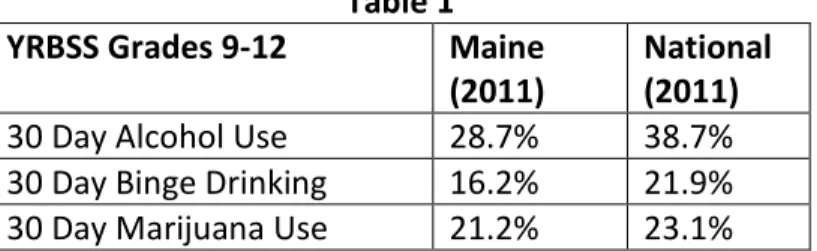
According to YRBSS data, alcohol is the drug of choice for both youth and adults across the country and in Maine. YRBSS data cannot be compared to MIYHS data, so in order to compare Maine to the nation, OSA uses the YRBSS. Table 1 shows Maine data compared to national data. In 2011, 38.7% of high school students across the nation had at least one drink in the 30 days prior to the survey compared to 28.7% of Maine high school students. As for binge drinking, 21.9% of high school students in the nation consumed five or more drinks of alcohol in a row within a couple of hours on at least one day during the past 30 days, this was compared to 16.2% for Maine high school students. The percentage of high school students having used marijuana in the 30 days prior to the survey is very similar at 23.1% nationally and 21.2% in Maine.
Table 1
YRBSS Grades 9-12 Maine
(2011)
National (2011)
30 Day Alcohol Use 28.7% 38.7%
30 Day Binge Drinking 16.2% 21.9%
30 Day Marijuana Use 21.2% 23.1%
BRFSS data shown in Table 2 from 2010 show that Maine is close to the national average when it comes to 30 day alcohol use for adults ages 18 to 24 at 48.7% and 48.3%, respectively. Maine also has a similar rate of binge drinking (males having five or more drinks on one occasion, females having four or more drinks on one occasion) as the nation, 21.9% versus 22.1%. The same holds true for heavy drinking (adult men having more than two drinks per day and adult women having more than one drink per day) with Maine’s percentage of 18 to 24 year olds at 4.7% and the United States at 5.2%. This is a vast improvement over the 2009 rates, when Maine’s rates were much higher than the nation’s.
Table 2
2010 BRFSS Ages 18-24 Maine National
30 Day Alcohol Use 48.7% 48.3%
Binge Drinking (Alcohol) 21.9% 22.1%
Local situation and trends
As stated above, alcohol is the drug of choice in Maine. As Chart 1 below demonstrates, the 2011 MIYHS survey results show that 28% of Maine high school students had used alcohol in the 30 days prior to the survey. This is followed by 22.1% having used marijuana in the past 30 days.
Chart 2 shows lifetime alcohol use rates of 59.4% for high school students. Lifetime rates for other drugs are 36.4% for marijuana, 33.7% for cigarettes and 14.6% for prescription drugs.
Chart 1 Source: MIYHS, 2011. Chart 2 28.0% 22.1% 15.5% 7.1% 4.5% 0% 5% 10% 15% 20% 25% 30%
Alcohol Marijuana Cigarettes Presrcription
Drugs
Inhalants Past month Substance use among grades 9-12, 2011 MIYHS
59.4% 36.4% 33.7% 14.6% 11.9% 8.2% 7.3% 6.7% 5.7% 4.9% 4.4% 0% 20% 40% 60% 80% 100%
Lifetime substance use among grades 9-12 2011 MIYHS
The 2011 MIYHS data shown in Chart 3 below reveal that substance use rates tend to have the largest increases between eighth and ninth grades. There are also large increases in binge drinking and 30-day marijuana use when students move from 11th to 12th and from 10th to
11th grade. A deeper analysis of the data shows that beginning in ninth grade about half (46%)
of the students who reported having drank in the past 30 days also report having binge drank. Approximately 55% of tenth graders, 60% of eleventh graders, and 66% of twelfth graders who reported having consumed alcohol in the past 30 days also reported binge drinking.
Chart 3
Source: MIYHS, 2011.
According to the 2010 BRFSS survey, 57% of adults in Maine consumed at least one alcoholic drink in the past 30 days, 14.5% binge drank (five drinks in one occasion), and 6.9% used alcohol heavily (more than one or two alcoholic drinks per day). Adults between the ages of 21 to 29 have the highest rates of binge drinking, at 29%.
The Treatment Data System (TDS) collects data regarding admissions and discharges for substance abuse treatment. Chart 4 below shows that TDS data from 2011 indicate that the most common substance for which primary treatment was sought was alcohol (39%), followed by synthetic opioids (32%). Marijuana was the leading substance for which secondary
treatment was sought, followed by synthetic opiates.
8th grade 9th grade 10th grade 11th grade 12th grade
30 day alcohol 7.8% 18.0% 24.8% 30.7% 38.0% Binge Drink 3.1% 9.3% 14.3% 18.9% 25.4% 30 day marijuana 5.1% 14.8% 20.0% 24.9% 28.9% 0% 10% 20% 30% 40%
Chart 4
Source: TDS, 2011.
Needs and Gaps
While existing funding has been used to address many needs, Maine’s prevention infrastructure is still in its infancy and many issues in equity, capacity, and gaps in services still need to be addressed. A map that illustrates the public health infrastructure and the 27 Healthy Maine Partnerships funded by the state can be found a The Prevention Team identified the following needs and gaps:
• Need: consistent and adequate funding via the HMP infrastructure
Gap: SPF SIG funding for HMPs ended in 2010
• Need: consistent messaging statewide
• Need: support of primary prevention in the schools
Gap: loss of SDFS funding and minimal other funding
• Need: clear education/messaging that increases the perception of harm and costs associated with use.
39% 32% 10% 9% 4% 5% 2% 13% 28% 31% 7% 10% 5% 6% 0% 10% 20% 30% 40% 50%
Percentage of primary and secondary admissions by substance, TDS 2011
Proposed Future of Prevention, Targeted Initiatives,
Programming, and Funding Needs
Based on the data analysis and identification of needs and gaps in 2010, the Prevention Team identified the areas below for future programming and funding needs. The SPE planning process then built on these, and developed additional recommendations and objectives. The targeted initiatives, programming and funding needs and the related priorities, goals and objectives from the 2010 planning process are presented below, followed by additional recommendations and objectives from the 2011-2012 planning process.
Workforce Development
While a prior workforce development assessment showed a semi stable prevention workforce with many years of experience, the need for prevention specialists to gather and analyze data and to conduct evaluation emerged as areas where professional development is needed. The infusion of SPF SIG funding statewide revealed that filling positions with knowledgeable Prevention Specialists has been difficult in several areas of the state (particularly more rural areas). In addition, a career ladder for people wishing to make a lifelong commitment to prevention needs to be created to help retain knowledgeable and competent Prevention
Specialists. Working towards a certification program for Prevention Specialists will be important to help move Maine in a positive direction.
The identification of core competencies for prevention workers and cross training with other related disciplines would allow for the most efficient use of training dollars. Creating linkages with the community college system and universities would further legitimize the field and provide a structured training mechanism. In addition, university linkages could provide the necessary evaluation expertise needed to document the effectiveness of prevention programming.
School personnel need to be provided opportunities to learn about substance abuse and its effect on school climate and academic performance. As new people enter the field, “substance abuse 101” needs to be available and seen as valuable. Providing teachers with a basic
understanding of the signs, symptoms, and risk factors of substance use is a necessary component to catch substance use early. Teachers and other school staff are most often the first people to notice the signs that a student may be in difficulty, and increasing their familiarity with the signs and symptoms of abuse would allow for earlier intervention. Other ideas include utilizing Screening and Brief Intervention as a Universal or Selected prevention strategy, and pre-service training for teachers, health professionals, social workers, and other professionals in understanding substance use, abuse, and dependence.
Policies
• Underage drinking policies need to be examined and recommendations for
strengthening enforcement and/or creating new laws should be explored.
• The voices of youth and parents should be an integral part of prevention planning.
• Examination of best practices in price and promotion strategies needs to continue.
Prevention data
• Data system should be refined to meet needs of prevention providers, State, and
Federal funders.
• Needs, as shown by the CESN report and workgroup utilizing MIYHS, BRFSS, and other
data, should continue to be the basis for funding decisions and program strategies.
Interdepartmental and intergovernmental initiatives
• Collaborative efforts that maximize resources (e.g. Maine Youth Suicide Prevention
Program, underage drinking prevention efforts, coordination with Healthy Maine Partnerships, MIYHS survey, substance abuse prevention in the workplace, Coordinated School Health Program) should continue.
• Other possibilities for interdepartmental collaboration should be explored.
• Collaborative efforts with the Native American Indian Tribes located in Maine to further
prevention efforts in their communities should be continued.
• Possibilities for cross state and regional collaboration efforts should be explored.
Outreach to schools
• OSA should work with school health coordinators to ensure that substance abuse
prevention is addressed in comprehensive school health education programs.
• OSA should serve as a resource on such topics as model policies and procedures, model
programs, and working with parents.
• The Information and Resource Center’s collection of materials for school audiences
should be expanded.
• OSA should continue to develop relationships with alternative education programs and
work with the Maine DOE Truancy, Dropout, Alternative and Homeless Education Coordinator.
• Pre-service training should be provided for teachers, health professionals, social workers
and other professionals on substance use, abuse, and dependence.
Funding for continuation of the following priorities:
• The Higher Education Alcohol Prevention Project
• Public education, including OSA prevention media campaigns
Funding for the development of the following:
• Evaluation of promising Maine programs for designation as NREPP program.
• District/local prevention specialists; coordinators to work with coalitions, schools, and
other groups to better understand substance abuse prevention, their local data and how to plan and evaluate their efforts.
• Development and dissemination of Maine specific resource materials.
• Effective RBS system, including the Card ME Program.
• Statewide screening and brief intervention program.
Priorities
The priority populations that are to be targeted include the underage population and the population of 18 to 25 year olds.
For the underage population the areas of focus will include: any underage alcohol use, binge drinking, high-risk alcohol use, marijuana use, prescription drug misuse, and inhalant abuse. For the 18 to 25 year old population, the areas of focus will include: binge and/or high-risk alcohol use, prescription drug misuse, and marijuana use. This will include focusing on both the college and workplace environments.
Goals and Objectives
Program Initiatives
Goal: Increase OSA’s capacity to support implementation of quality evidence based programming and best practices by stakeholders and implementers across Maine.
Objectives:
1. Promote and enhance utilization of evidence based interventions (i.e., SBIRT)
in appropriate settings (healthcare, courts/judicial).
2. Increase the number of evidence based/best practices available to substance
abuse preventionists across the state, that take into account risk and
protective factors that cut across related mental, emotional, and behavioral disorders.
3. Create and implement a comprehensive Drug Free Workplace Program.
i. Across all workplaces in Maine
ii. Emphasis for the 18 to 25-year old workforce
4. Sustain effective evidenced based law enforcement practices (i.e., party
patrols and compliance checks) to reduce underage drinking.
5. Improve school climate through the implementation of evidence-based
programming on substance abuse prevention to impact student health, wellness, safety and success.
Collaboration
Goal: Increase collaboration with special populations, other state agencies/offices, and local stakeholders.
Objectives:
1. Enhance programs by identifying and collaborating with key stakeholders
who share common interests (i.e., law enforcement, DOE, courts).
2. Partner with agencies/offices or stakeholders on grant applications.
3. Collaborate with behavioral health, including substance abuse, other state
offices, mental health providers and primary care providers to create cross-training opportunities.
4. Participate on state-level boards and committees where substance abuse
issues are relevant.
5. Partner with representatives from various special populations to explore
potential program initiatives and to provide consultation on substance abuse prevention (tribes, military, behavioral health entities, etc.)
Public Awareness
Goal: Promote awareness to key stakeholders and communities about the impact of substance abuse in Maine and OSA’s work to prevent and reduce substance abuse and related problems.
Objectives:
1. Create media campaigns to raise awareness about alcohol and drugs
i. Counter-advertising and social norming messages;
ii. Increase information about Maine laws to the public.
2. Create and disseminate information about how substance abuse affects
everyone in Maine – both cost and impact.
3. Promote the work of OSA as well as the resources available.
4. To increase outside agencies’ awareness and understanding of substance
abuse-related initiatives or issues.
5. Promote underage drinking as a public health issue with the same urgency as
any other health condition.
Data and Evaluation
Goal: Improve, enhance, and expand OSA’s capacity to make data-driven decisions and quality improvement.
3. Increase accountability for prevention and early identification activities through uniform reporting:
i. Utilize KIT to track progress of OSA grantees.
4. Increase access to data sources relevant to Maine people (i.e., behavioral
health, military, tribal).
Workforce Development
Goal: Develop a workforce that is proficient in effective substance abuse prevention.
Objectives:
1. Implement a system of prevention credentialing opportunities in Maine.
2. Improve availability and accessibility of education and training opportunities
for evidence based programming for stakeholders (including primary care physicians, ER docs, and mental health providers).
3. Work with Professional Development Workgroups to coordinate and provide
training and education for prevention providers around core competencies.
4. Increase the number of cross-training opportunities available for prevention
providers and mental health workers across a variety of disciplines.
5. Increase training opportunities for teachers on behavioral health as a
student health, safety, and success issue.
6. Develop and provide training on risk/protective factors, risk-reduction and
intervention programs for a variety of groups. (Substance Abuse and Mental Health for groups such as: parents, young adults in transition, LGBTQ, drop-outs, elderly, military).
Marijuana Use
Goal 1: Reduce use of marijuana among Mainers, with emphasis on teens and young adults.
Sub goal: Reduce the availability of illicit marijuana and related products which support production or use.
Objectives:
1. Increase public's readiness to recognize and to reduce the visibility of
products, symbols, and terms which are pro-marijuana.
2. Increase communities' readiness to implement retail control strategies to
address sales of marijuana related products.
3. Educate the public about how to use nuisance abatement strategies to
Sub-goal: Inform the public about the risks and harm of marijuana use. Objectives:
1. Educate parents about the effects of marijuana use on teens and young
adults.
2. Increase education opportunities for teachers and counselors about
marijuana research findings, including the risk of early onset of marijuana use.
3. Educate the public about the laws (state and federal) relating to marijuana.
Prescription Drug Use/Abuse
Goal 1: Reduce use of prescription drugs among Mainers, with emphasis on teens and young adults.
Sub goal: Reduce the retail availability of prescriptions drugs (over prescribing, doctor shopping).
Objectives:
1. Increase training opportunities around the Prescription Monitoring Program
(PMP) for prescribers/dispensers.
2. Increase awareness among prevention providers and other partners around
the PMP and prescription drug abuse.
3. Increase the number of prescribers/dispensers registered to use the PMP.
Sub goal: Improve awareness around safe storage and disposal of prescription medication. Objective:
1. Increase the public's awareness around safe storage and safe disposal of
prescription medication.
Sub goal: Reduce the number of prescription drugs diverted in the State of Maine. Objectives:
1. Increase law enforcement's and other prevention providers’ awareness
around prescription drug diversion and signs of impairment.
2. Increase the public's awareness around prescription drug use/risks and
diversion through the expansion of the Parent Media Campaign.
3. Increase the number of schools who review and update their school policy to
Objective:
1. Increase the public's awareness around the dangers of prescription drug
misuse.
Sub goal: Improve awareness around individual/family factors that impact prescription drug use.
Objective:
1. Increase parental awareness about the dangers of prescription drug misuse.
Alcohol use/abuse: Underage and Binge Drinking
Goal 1: Reduce underage drinking and binge drinking among Mainers, with emphasis on teens and young adults.
Sub goal: Reduce the retail availability of alcohol for underage and binge drinking. Objectives:
1. Improve liquor licensees' knowledge and skill around responsible beverage
sales/service (RBS) practices.
2. Enhance capacity to monitor and educate stakeholders about how alcohol
outlet setting and quantity may impact underage and binge drinking behaviors.
3. Reduce people under 21 years of age's possession and use of fraudulent IDs
(fake IDs) to gain access to alcohol for underage drinking.
Sub goal: Reduce the economic availability of alcohol for underage and binge drinking. Objective:
1. Enhance public awareness of how low alcohol pricing can influence behaviors
of price sensitive underage and binge drinkers.
Sub goal: Reduce underage and binge drinkers' access to alcohol from social sources such as peers, family, and community members.
Objectives:
1. Reduce underage drinkers' ability to access alcohol from older siblings/peers
who are of legal drinking age.
2. Reduce people's willingness to allow illegal consumption (both underage and
consumption by visibly intoxicated persons) to occur at places under their control. (such as: homes, land, camps, vehicles, etc.).
3. Reduce youth access to alcohol from people they do not have a relationship
with.
Sub goal: Increase the effective enforcement of Maine's liquor laws and the utilization of clear and consistent consequences so as to deter underage and binge drinking.
Objectives:
1. Increase the existence of clear and consistent consequences for underage
drinking violations or visible intoxication in systems which interact with youth and young adults (such as family, school, community, courts).
2. Enhance law enforcement's capacity & readiness to enforce Maine liquor
laws related to underage and binge drinking.
Sub goal: Reduce marketing and media messages which promote underage and binge drinking. Objectives:
1. Improve awareness of and capacity to address marketing and media
messages which promote underage and binge drinking.
2. Increase awareness of regulations/ laws related to limiting alcohol
promotions which impact underage and binge drinking.
Sub goal: Reduce norms which perpetuate underage and binge drinking as behaviors which are normal, safe, and acceptable.
Objectives:
1. Reduce perception that drinking illegally and/or excessively is a rite of
passage that is “part of growing up.”
2. Reduce adults' perceptions that young people are going to drink (and drink
to excess) anyway, so they are powerless to try to stop it.
3. Decrease public misperception that “Everyone is drinking” and/or “Everyone
is drinking to excess frequently.”
4. Reduce parents/families who model binge or illegal alcohol use.
5. Reduce cultural messages and practices which encourage high-risk drinking
when there are events or triggers (holidays, celebrations, athletic events, hard day/week).
6. Reduce parents who say that they are ok with teens drinking at a home
because it is safer than them drinking elsewhere.
Sub goal: Increase people's perceived risk of underage and binge drinking so as to reduce their likelihood of engaging in the behavior.
Objectives:
1. Increase public perception of getting caught for violating Maine liquor laws
related to underage and binge drinking.
Objectives:
1. Increase public knowledge of predisposition to alcohol issues (i.e. those with
adverse childhood experiences, co-occurring, and genetics) so as to inform drinking choices.
2. Increase public knowledge of basic alcohol information (such as: knowledge
of how alcohol interacts with body, risk reduction strategies, BAC, standard drink, genetic factors, etc.).
State Prevention Enhancement
In 2012, OSA completed a planning process to strengthen and enhance Maine’s current prevention infrastructure to support more strategic, comprehensive systems of community-oriented care. OSA staff led the planning process, with valuable input and guidance from the multi-sector OSA Prevention Advisory Board. At the direction of the Advisory Board, the planning process was informed by the Institute of Medicine’s developmental framework for
prevention and health promotion.5
The Prevention Team consulted with Advisory Board members individually, in work groups designed to utilize resources and time efficiently, and at five board meetings where the planning process and draft documents were discussed in detail. Advisory Board members provided input at meetings, via phone and email, and through an online survey, all with the aim of gaining an understanding of ways in which OSA prevention planning could enhance other planning processes, further coordination across agencies and utilize scarce resources most efficiently.
This strategic planning process and resulting plan align with other strategic planning activities in Maine, which presents opportunities to support and expand efforts to utilize resources
efficiently.
• Healthy Maine 2020: The resulting goals and objectives align with Healthy Maine 2020
objectives to reduce past-year non-medical use of prescription drugs, to increase the proportion of adolescents never using substances, and to reduce the proportion of persons engaging in binge drinking of alcoholic beverages.
• Youth suicide prevention. OSA’s strategic plan aligns with the Maine Youth Suicide Prevention Program Plan goals to develop and implement strategies to reduce the stigma associated with being a consumer of behavioral health services for families and youth and increase help-seeking behaviors; and to improve access to and community
linkages with mental health, substance abuse and suicide prevention services.6
5 National Research Council and Institute of Medicine. (2009). Preventing Mental, Emotional, and Behavioral
Disorders Among young People: Progress and Possibilities. Washington DC: The National Academies Press.