Should the Cloud Computing Definition include a Big Data perspective?
INTRODUCTION
Vaquero et al. (2008) list more than twenty existing Cloud Computing definitions in their paper, and conclude by proposing an additional one. At this rate, we will have a confusing number of definitions before long! This is typical of the inflated expectations of a recent technology, as the cycle of hype surrounding it reaches a peak. At this stage, it is important to step back and try to see Cloud Computing for what it really is. This is exactly what the ISO/JTC1/SC38 committee proposes to accomplish in the next few years. Working Group 3 was specifically created to look at normalizing Cloud Computing terminology.
Looking at the original idea of the term Cloud Computing, a key question was raised, why so many definitions exist for such simple words. The basic concepts expressed by the term are quite simple. The word computing refers to any activity that involves computer processing or storage (Shackelford, Mc Gettrick et al.,2006). A computer manipulates and stores data, which commonly reside on the hard drive of a computer, or in other hardware such as NAS (network-attached storage), commodity hardware (affordable and readily available hardware), the mainframe, etc. The hard drive can store anything, including structured data, unstructured data, software, databases, etc. In Cloud Computing terminology, these capabilities are designed as services, and these services are offered services in a cloud, anywhere on earth. In other words, its location does not matter.
This term also refers to networked computers, among which processing power is distributed.
Where the confusion begins, and so many different definitions are generated, is if those definitions try to include: 1) different perspectives (i.e. Infrastructure versus Software Engineering); 2) too many technical details; 3) a specific technology point of view. For example some definition includes concepts like billing features, type of access, security issues, ownership of data, and even quality features associated with the technology. Since these concepts vary depending on the technology and can evolve, the definition of Cloud Computing can become broader and fuzzier over time.
One of the leading proposals for an internationally accepted definition of Cloud Computing has been proposed by the National Institute of Standards and Technology (NIST):
“Cloud computing is a model for enabling convenient, on-demand network access to a shared pool of configurable computing resources (e.g. networks, servers, storage, applications, and services) that can be rapidly provisioned and released with minimal management effort or service provider interaction.” This cloud model promotes availability, and is composed of five essential characteristics,
three service models, and four deployment models. This proposal implies that the terminology of those essential characteristics, service models, and deployment models must also be precisely defined.
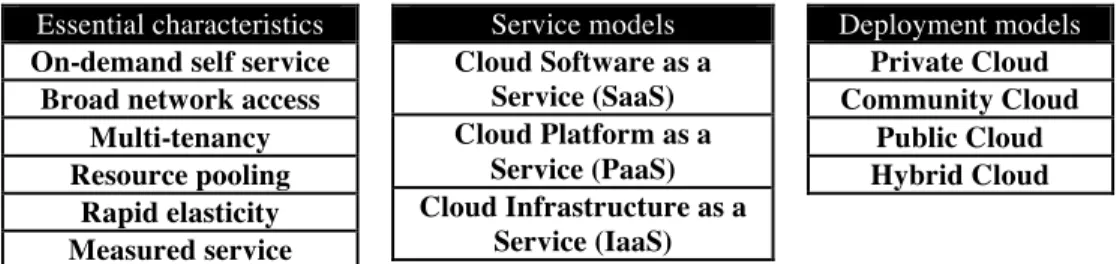
Table 1 shows how these three concepts are defined in the NIST proposal:
Essential characteristics On-demand self service
Broad network access Multi-tenancy Resource pooling Rapid elasticity Measured service Service models Cloud Software as a Service (SaaS) Cloud Platform as a Service (PaaS) Cloud Infrastructure as a Service (IaaS) Deployment models Private Cloud Community Cloud Public Cloud Hybrid Cloud
Table 1 –NIST Cloud Computing definition The above definition was initially intended to serve
as a means for broad comparisons of cloud services and deployment strategies, and to provide a baseline for discussion – from what Cloud Computing is, to how best to use it.
This first serious proposal raises a key issue. Cloud Computing is complex, especially considering the nature of its components. Defining it comprehensively requires that every essential characteristic, service model, and deployment model be well defined and that these elements do not change over time. Since change is likely to happen in this
field, a simplified version could be offered and can be expected to withstand the test of time.
To better understand what characteristics should be part of the definition of Cloud Computing, or left out of it, we propose looking at a well known and well defined concept, and see how its definition deals with characteristics that aren’t explicitly mentioned, but are implied. This may help us improve the proposed NIST definition.
BACKGROUND
ISO Joint Technical Committee 1, Subcommittee 38 (ISO/JTC/SC38) is focused on Distributed Application Platforms and services (DAPS) including a working group (WG) for each subject:
1. (WG1) Web services
2. (WG2) Service Oriented Architecture 3. (WG3) Cloud Computing
WG3 is responsible for Identify, develop, and maintain JTC 1 deliverables in the field of Cloud Computing and is working with many standards developing organizations (SDO’s), such as the National Institute of Standards and Technology (NIST) towards a standard definition of the term Cloud Computing. The first serious draft of Cloud Computing was to use the current definition of the SDO NIST. Currently, these organizations are facing a major challenge, owing to the existence of multiple industry definitions due to a specific focus of each organization and a lack of consensus concerning the essential/optional characteristics that should be reflected in the definition. The main objective of this paper is to consolidate different point of view without creating a new one. To achieve this goal, we will debate on two major points of view: IT infrastructure and Software Engineer rather starting a new definition without a specific focus and use concepts contained in the definition of a familiar object, a car. to keep our focus in essential characteristics when we propose amending the current NIST essential and optional characteristics. This proposal represents a step on the journey towards a clearer definition of the term, and is part of a Canadian contribution to ISO/JTC1/SC38, Working Group 3 on Cloud Computing.
THE CAR ANALOGY
The automobile, which is referred to as a car today, is defined by F.G. Fowler and H.W. Fowler (1976) as ‘a wheeled motor vehicle used for transporting passengers, which also carries its own engine or
motor.’ Most existing definitions agree on the following car characteristic: ‘The car is designed to run primarily on roads, to have seating for one to 8 people, and to be constructed principally for the transport of people rather than goods.’
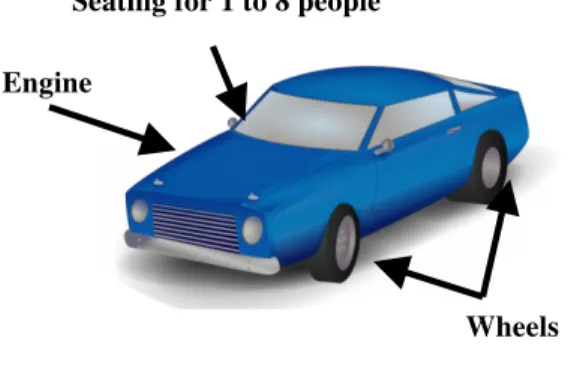
Analyzing the above definition in connection with the challenge of defining Cloud Computing, we note that the car as described by the Fowlers did not include any options, such as air conditioner, warranty, equipment’s features, financing modes, etc. The definition is restricted to the car’s essential characteristics, such as wheels, motor, and seats for transporting people, as shown in Figure 1. Could this analogy be extended to simplify the definition of Cloud Computing?
Figure 1 – Illustration of the essential characteristics of a car based on its definition As with the car, by identifying the essential and optional characteristics of Cloud Computing, we could, for example, study why organizations have recently converted existing applications to Cloud Computing technology, and, in particular, why they did not use another competing or existing technology instead. This would help us identify optional characteristics that could be left as optional characteristics in the proposed NIST definition.
COMMON
FACTORS
OBSERVED
WHEN
MIGRATING
TO
CLOUD
COMPUTING
After looking at many software engineering case studies that have been published involving the migration by organizations of their applications to Cloud Computing technology, with the aim of continuing to serve their growing customer base well. In this study, we are looking for the factors that are common to all these organizations in the migration process based on their answers to the following questions: What problems had they been
Wheels
Seating for 1 to 8 people
Engine
experiencing with their current technology? What limitations forced them to migrate? What essential characteristic were they looking for in a Cloud Computing technology?
Vendors like Google, Amazon, and others claim that their Cloud Computing technology provides them with many advantages, like scalability, maintainability, performance, and reliability. Cloud Computing technologies have been designed for growth, low latency, and robustness against failures (Dean, 2009). Cost is also an important issue. For example, a great deal of attention has been paid to the low cost of running the Google server hardware, with its built-in batteries, which eliminate the need for a huge, centralized uninterrupted power supply (UPS), and their customized 12-volt power supplies that deliver energy efficiency.
Let’s discuss first, the requirements for migrating to Cloud Computing technology. In the case of YouTube, the challenge mostly had to do with scalability and performance, since keeping up with website growth was a day-to-day issue for them before the company was bought by Google and their technology was migrated to Google proprietary technology (Bigtable). Bigtable is a non relational, high performance database that is fault tolerant over large sets of data, which solves the famous YouTube thumbnails issue as described by Cordes (2007). Twitter describes how they scaled horizontally using Cloud Computing technologies (Higginbotham, 2011) and how they have managed to make their service 10,000 times faster than it was before (Blaine Cook, 2009). According to database pioneer Michael Stonebreaker (2011), Facebook is currently stuck with its current technology, especially its relational database, which is rapidly growing to 4,000 shards and becoming extremely complex to manage. Database sharding is a partitioning scheme for large databases across a number of servers, enabling new levels of database performance and scalability (CodeFutures, 2011). Stonebreaker adds that this is fairly common practice, especially among startups that start small and grow to epic proportions, and use Web-based applications where users can upload whatever they want. Most of the case studies found involve organizations that offer or use services that had to move to Cloud Computing because of scalability, performance, or maintainability issues. When forced to migrate out of an existing technology, organizations look carefully at all the possible alternatives. Target technologies are typically assessed for each of the key non functional requirements: scalability, maintainability, performance, and reliability. As Stonebreaker (2011)
points out, relational database technology is struggling to scale to handle petabyte-sized tables where No-SQL technology is an increasingly attractive solution.
These software engineering case studies reveals that Cloud Computing is not only concerned with hosting software elsewhere, but also with networking computers to distribute processing power in newer ways.
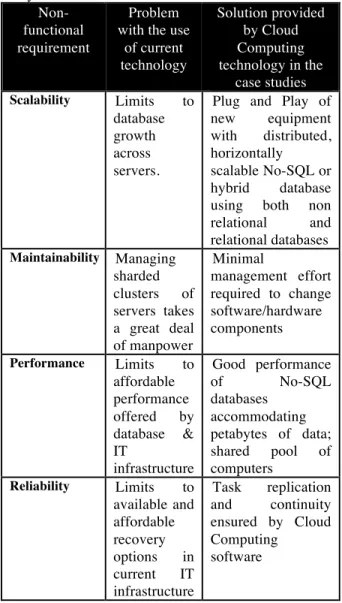
Non-functional requirement
Problem with the use
of current technology Solution provided by Cloud Computing technology in the case studies Scalability Limits to database growth across servers.
Plug and Play of new equipment with distributed, horizontally scalable No-SQL or hybrid database using both non relational and relational databases Maintainability Managing sharded clusters of servers takes a great deal of manpower Minimal management effort required to change software/hardware components Performance Limits to affordable performance offered by database & IT infrastructure Good performance of No-SQL databases accommodating petabytes of data; shared pool of computers Reliability Limits to available and affordable recovery options in current IT infrastructure Task replication and continuity ensured by Cloud Computing software
Table 2 – Essential characteristics of Cloud Computing derived from case studies
The case studies found in the literature highlight the problems faced with the use of current technology.
Table 2 presents the essential characteristic that was key in the decision to migrate to Cloud Computing technology for each non functional requirement that presented a serious problem.
ESSENTIAL VS. OPTIONAL CLOUD
COMPUTING CHARACTERISTICS
We saw in section 2 that the definition of a car includes only its essential characteristics, and none of the optional ones. In a car, an option can be purchased and added to the base product, and so is not considered part of its definition. Options are typically similar for a type of vehicle, a vendor, or in the car industry as a whole. Could it be possible to use the same approach with Cloud Computing to improve its definition? Table 3 displays our attempt to draw a parallel between the definition of a car and that of Cloud Computing, including the smallest possible set of essential characteristics.Car definition Proposed Cloud Computing definition A car is a wheeled motor vehicle used for transporting passengers. Cloud Computing is an approach to IT designed to deliver services reliably.
A car
incorporates its own engine or motor.
Cloud Computing operates on a scalable and shared pool of resources that can be rapidly and elastically provisioned. These resources are perceived to be exclusive when consumed by multiple Cloud Computing tenants.
A car is designed primarily to run on roads.
Cloud Computing is designed primarily to be delivered over a network.
A car has seating for 1 to 8 people.
Cloud Computing ensures good performance, even with petabytes of data.
A car is constructed principally for the transport of people rather than goods.
Cloud Computing is designed principally to serve a growing and theoretically unlimited number of users.
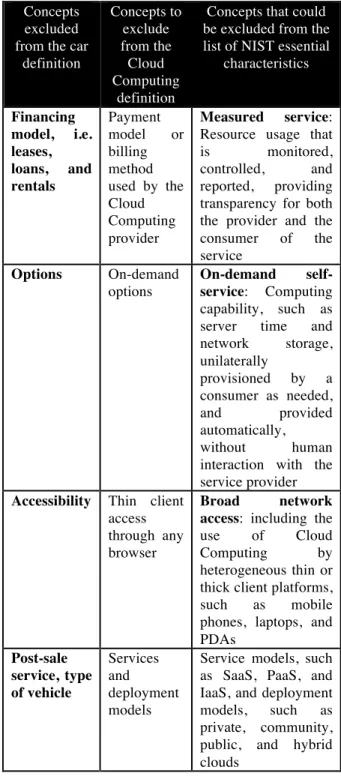
Table 3– Our Car vs. Cloud Computing analogy for a reduced set of essential characteristics The same analogy could be applied for optional characteristics, as presented in Table 4. In some cases, optional characteristics maybe required by the client, and their selection depends on what the organization is looking for, as it migrates its applications to Cloud Computing. In this paper, optional characteristics are distinguished from required characteristics only from the perspective of
whether or not they are included in the main definition of Cloud Computing. Table 4 also identifies the concepts included in the NIST definition that could be left as optional characteristics from the main definition.
Concepts excluded from the car
definition Concepts to exclude from the Cloud Computing definition
Concepts that could be excluded from the list of NIST essential
characteristics Financing model, i.e. leases, loans, and rentals Payment model or billing method used by the Cloud Computing provider Measured service: Resource usage that is monitored, controlled, and reported, providing transparency for both the provider and the consumer of the service Options On-demand options On-demand self-service: Computing capability, such as server time and network storage, unilaterally provisioned by a consumer as needed, and provided automatically, without human interaction with the service provider Accessibility Thin client
access through any browser
Broad network access: including the use of Cloud
Computing by
heterogeneous thin or thick client platforms, such as mobile phones, laptops, and PDAs Post-sale service, type of vehicle Services and deployment models
Service models, such as SaaS, PaaS, and IaaS, and deployment models, such as private, community, public, and hybrid clouds
Table 4 – Our Car vs. Cloud Computing analogy for optional characteristics
Table 3 and Table 4 are an attempt to separate out what could be the essential Cloud Computing characteristics. Revisiting the NIST Cloud Computing definition, we note that some of the proposed essential characteristics may be not essential, based on the car analogy and the content of the case studies illustrated in Table 2. For example, the broad network access presented in the NIST definition that introduces the notions of the thick client and the thin client (mobile phone, laptop, PDA) could be optional for many organizations, as their needs may not be focused on the way they access a cloud service. It goes without saying that service access can evolve over time, as new devices appear and gain in popularity. In contrast, scalability seems to be a common expectation that organizations have of Cloud Computing services, as described in Table 2, and so it should be kept in the main definition.
FUTURE RESEARCH DIRECTIONS
Cloud Computing is a new and emerging trend, defining such a new term is hard, given the obvious gap found in the literature. The definition given by SG1 and other SDO’s such as NIST are a good starting point. More work on improving, consolidating point of views is needed to render the definition more able to withstand the test of time. In future work, we will try to close the gap between the vision of SC7, system engineering, and that of SC38 which is focussed on computer engineering.CONCLUSION
Efforts are underway, in ISO/JTC1Subcommittee 38, to arrive at internationally accepted definitions of Cloud Computing and its terminology. This paper attempts to take an arm’s length view of the NIST definition of Cloud Computing, using the car analogy to assess its essential and optional characteristics. As a result of this endeavor, we have kept three key elements and plan to debate the exclusion of the others, based on whether or not they with stand the test of time.
References
Vaquero, L. M., Rodero-Merino, L., Caceres, J., & Lindner, M. (2008). A break in the clouds: towards a cloud definition. SIGCOMM Comput. Commun. Rev., pp. 50-55.
Shackelford, R., McGettrick, A., Sloan, R., Topi, H., Davies, G., Kamali, R., et al. (2006). Computing Curricula 2005: The Overview Report. Paper presented at the Proceedings of the 37th SIGCSE technical symposium on Computer science education.
Fowler and H.W. Fowler (1976). Pocket Oxford Dictionary. London: Oxford University Press. ISBN 0-19-861113-7
Dean, J. (2009). Designs, Lessons and Advice from Building Large Distributed Systems, LADIS 2009, The 3rd ACM SIGOPS International Workshop on Large Scale Distributed Systems and Middleware, Retrieved January 12, 2011 from
http://www.cs.cornell.edu/projects/ladis2009/talks/de an-keynote-ladis2009.pdf
Cordes, K. (2007). YouTube scalability Talk. Retrieved August 11, 2012 from
http://kylecordes.com/2007/youtube-scalability.
Higginbotham, S. (2011). Once Again, See How Twitter Scales. Retrieved August 15, 2011 from
http://gigaom.com/cloud/once-again-see-how-twitter-scales/.
Blaine C. (2009). Scaling Twitter: Making Twitter 10000 Percent Faster. Retrieved August 20, 2012 from
http://highscalability.com/scaling-twitter-making-twitter-10000-percent-faster.
Harris, D. (2011). Facebook trapped in MySQL ‘fate worse than death’. Retrieved August 6, 2011 from
http://gigaom.com/cloud/facebook-trapped-in-mysql-fate-worse-than-death/.
CodeFutures. (2011). Database Sharding. dbshards. Retrieved August 8, 2012 from
http://www.codefutures.com/database-sharding/
KEYTERMS & DEFINITIONS
Cloud Computing: The term Cloud Computing is divided into two words; the word computing refers to any activity that involves computer processing or storage, a computer manipulates and stores data, which commonly reside on the hard drive of a computer, or in other hardware such as NAS (network-attached storage), commodity hardware (affordable and readily available hardware), the mainframe, etc. The hard drive can store anything, including structured data, unstructured data, software, databases, etc. In Cloud Computing terminology, these capabilities are designed as services, and these services are offered services in a cloud, anywhere on earth. In other words, its location does not matter. This term also refers to networked computers, among which processing power is distributed. Distribution is a key element in Cloud Computing to enable processing large set data’s.
Definition: A definition of a term is a description that best explains what the term means. A definition includes only related and mandatory description, optional fields maybe be explain under a separate section. A definition is an explanation that doesn’t change with time, in other words, given a definition of a term in technology area for example, it does not change with the evolution of the technology.
Cloud Service: A cloud service can be software or hardware offered over a network, usually internet but could be also over a private network when dealing with private cloud. Many services emerge with the cloud computing paradigm such as Software as a service, Infrastructure as a Service, Platform as a service and so one. A more generic abbreviation for services offered in the Cloud is referred to as XaaS where X represents the service offered in the Cloud.
Essential Characteristic: An essential characteristic in the context of this article is an element that could not be excluded from the main definition of a concept. When excluded, the definition is altered and could either be a none complete definition or may refer to another concept.
Optional Characteristic: Complete opposite of the essential characteristics. An optional can be removed from the main definition of a term without affecting the definition and usually preferable to be mentioned outside the main definition under a separate section in a text.
Cloud Computing Technology: Cloud Computing technology is the technology that best enable Cloud Computing paradigm. Cloud Computing technology can evolve or changed over time but not the definition of Cloud Computing.
Analogy: Analogy in this article is a way to explain a point of view, not a demonstration or a deduction. It is a way of explaining a point of view by looking at a simpler example.