Fast Digit-Index Permutations
DOROTHY BOLLMAN\ JAIME SEGUEL\ AND JOHN FE02 1Department of Mathematics, University of Puerto Rico, Mayaguez, PR 006812Computer Research Group, Lawrence Livermore National Laboratory, Livermore, CA 94550
ABSTRACT
We introduce a tensor sum which is useful for the design and analysis of digit-index permutations (DIPs) algorithms. Using this operation we obtain a new high-performance algorithm for the family of DIPs. We discuss an implementation in the applicative lan-guage Sisal and show how different choices of parameters yield different DIPs. The efficiency of the special case of digit reversal is illustrated with performance results on a Cray C-90. © 1996 John Wiley & Sons, Inc.
1 INTRODUCTION
Kronecker's matrix product is a powerful tool for designing and adapting fast Fourier transform (FFT) algorithms to different multiprocessing en vi-ronments [6, 9, 10]. This is especially true for implementations in an applicative language. Start-ing with an FFT algorithm expressed in tensor no-tation, one can use the laws of tensor algebra to obtain tensor formulas that take into account a given architecture and are easily translated into the language. The Kronecker product also provides a unifying framework for seemingly different FFT algorithms. Cnder Kronecker's formulation, for in-stance, Pease's parallel algorithm and the Korn-Lambiote vector FFT are simple variants of the original Cooley-Tukey FFT. In [2] the authors have exploited these ideas to obtain a high-perfor-mance FFT written in the applicative language Sisal.
The Cooley- Tukey FFT, as well as the Pease
Received April 1995 Revised .Tune 1995
© 1996 John Wilev & Sons, Inc.
Scientific Programming. Vol. 5. pp. 137-1':16 (1996) CCC 1038-924"1/96/020137 -10
and the Korn-Lambiote algorithms, consists of a "combine" phase and a separate "ordering" phase in which the components of a vector need to be written in bit-reversed order. An efficient way to implement bit reversal on a vector machine such as a Cray is by computing a vector index of bit-reversed indices and then using gather/ scatter to effect the reordering. Programmers have used various algorithms to compute the index vector; however, the development of these algo-rithms has been somewhat ad hoc and there is no general tool comparable to the Kronecker product, which is so useful for the combine phase, for designing and analyzing bit-reversal al-gorithms.
In this article we develop a tensor sum whose role in the ordering phase is similar to the role of the tensor product in the combine phase. Just as the tensor product serves as a unifying framework for the combine phase of various FFT algorithms, the tensor sum serves as a unifying framework for digit-reversal algorithms. We show how different known digit-reversal algorithms can be expressed in terms of the tensor sum. This observation allows us to obtain a new algorithm for the general class of digit-index permutations (DIPs) whose parallel-time complexity is O(log log n). We give a Sisal implementation for this
138 BOLLMAJ\;. SEGUEL A'\ID FEO
algorithm and illustrate how different choices of parameters yield different members of the DIP family.
The results presented here provide a complete set of tools for designing, modifying. and imple-menting radix-r FFT permutations in a functional language such as Sisal. In other work, which will appear, the authors exploit the tensor product to develop a similar set of tools for the combine phases of radix-r FFTs. In this latter work we show that there are just four basic functions, in the sense that the combine phase of each of the radix-r FFTs can be expressed as the composition of some of the basic functions. The totality of these results allows us to develop high -performance Sisal imple-mentations for the entire family of radix-r FFTs.
2 AN OVERVIEW OF SISAL
Sisal (Streams and Iteration in a Single-Assign-ment Language) is an applicative language devel-oped primarily by Lawrence Livermore 1\;ational Laboratory and Colorado State Cniversity for large-scale scientific programming. It is a "single-assignment" language-a name can receive a value only once in each name scope. Sisal has been successively implemented on shared memory machines such as the Cray family and work is cur-rently underway to implement it on distributed memory machines.
Sisal is a very convenient language for prototyp-ing, developprototyp-ing, and evaluating parallel algorithms since it allows the programmer to write programs that are very dose to their original mathematical formulations. One can program and test individual functions and compose them with the guarantee of not introducing race conditions and side effects. Furthermore, there is growing evidence
[:3]
that Sisal can perform on a par with traditional lan-guages such as Fortran.The authors [2, 5] have successively used Sisal to develop FFTs that outperform their Fortran counterparts on Crays. We express the algorithms developed in this work in Sisal, not only because these algorithms complement the ideas in [2], but also because the use of Sisal greatly simplifies the expression of these algorithms as opposed to an imperative language such as Fortran.
In this section we present only sufficient detail of the language to understand the algorithms pre-sented in this work. A much more complete and very readable account of Sisal is given in [8].
SiRal comments begin with a % character and continue to the end of the line. The most important data type in Sisal for the ideas considered here is the array which is a one-dimensional collection of homogeneous values indexed by simple integer expressions. Multiple dimensional arrays are arrays of arrays. The size of an array is dynamic. Array operations include array construction, re-placement, selection, and operations to redefine the lower bound, array_setl(A,lo), to add a new element at the beginning of the array, array_ addi(A,v), and to add a new element at the end of the array, array_addh(A,v).
There are two types ofloop expressions in Sisal: for initial and for. The former is an iterative con-struct having four parts: initialization, body, test, and returns clause. The initialization clause is the loop's first iteration and defines loop constants and the initial values of all loop carried names. The body redefines the values of all loop-carried names. The values of the names on the previous iteration can be accessed as old name, Thus, the
for initial expression supports iteration while pre-serving single-assignment semantics. The test clause may be either while Boolean expression
or until Boolean expression. The test clause can
appear either before or after the body. The returns clause determines the value of the for initial ex-pression. The returns clause has various forms, including: returns value of expression that
re-turns the expression's value on the last iteration; returns array of expression that returns an array
of the expression's value on each iteration: and returns value of catenate expression that returns
the catenation of the arrays defined by expression.
The syntax of a for expression has three parts: generatoc body, and returns clause. An instance of the body is executed for every element in the "generator." The generator can have the form for
name in lo, hi that specifies that name takes on the
values lo to hi, inclusive, and an instance of the
body is executed for each value. Another useful form of the generator is for name in array_name.
Here, name takes on the values of the array's
ele-ments, and an instance of the body is executed for each element.
The semantics of the for expression are such that the loop bodies are data independent and may be executed in parallel. The reduction operations specified in the returns clause are implemented determinantly by the run-time system. The for ex-pression is the major source of parallelism and vectorization in Sisal programs on most commer-cial computer systems.
3 A TENSOR ADDITION
We shall develop a tensor addition whose role in the ordering phase of an FFT is similar to the tensor product in the combine phase. Although occa-sional references to tensor products can be found in early work on FFTs, it is only in the last several years [6, 9, 10] that its importance to FFTs, ecially in matching specific FFT algorithms to spe-cific architectures, has been fully appreciated. Here we remark only briefly on its role.
Let A = [ ak11 and B be matrices of arbitrary
sizes. The tensor product of A by B is defined to be the block matrix
Different sparse-matrix factorizations of the
N-point discrete Fourier transform (OFT) matrix Fv,
formed by different Kronecker product decompo-sitions, yield different computational schemes for the OFT. The main use of these Kronecker factors in matching algorithms and architectures comes from the identity A
®
B = (A®
I")(Im ®B) whereI, is the s X s identity matrix, and A and B are
m X m and n X n matrices, respectively. The factor
Im
®
B is then regarded as m parallel multiplica-tions of B on n-point vectors, while the factorA
®
In is regarded as A multiplying a set of m-point vectors in a pipeline of length n. Theso-called commutation formula P(nm, n)(A
®
B)P(nm, m) = B ®A, where P(nm, s) is the stride
s permutation, allows the change from a parallel to a pipelined interpretation and vice versa. For example, the decomposition F22, = (F2,
®
I2,)T(I2,
® F
2,)P(22r, 2r), where Tis a diagonal matrixof the so-called "twiddle factors," is turned into a parallel algorithm by commuting the leftmost fac-tor. The same formula can be turned into a vector algorithm by commuting the rightmost factor. Kro-necker formulation thus provides a mathematical framework for FFT dataflow modification and identification of core operations.
We shall see that our tensor sum is a very natural companion to the tensor product. We define the
tensor sum u EEl v of u and v as follows:
For any scalars u and v, define u E9 v = u
+
v.For any vector u = [a0 , a1 , . . . , ar_1] and any
scalar v define u E9 v = v EEl u = [a0
+
v, a 1+
v,. . . ' ar-1
+
v ].For any vectors u = [ a0 , a1 , . . ' ar-1l and v =
[!3o,
131, · · · , !3s-1J
defineFAST DIGIT-ll\'DEX PERMlJTATIO:'IJS 139
For our purposes here, we assume that all of the scalars in the definition are integers.
The subvectors u E9
/3;
in the above definition can be computed in parallel. On a vector machine each of these operations is a vector operation. An implementation in Sisal istype OneDim = array[integer]
function oplus(u, v: OneDim returns OneDim) for comp __ v in v returns value of catenate
for comp __ u in u
returns array of comp __ u + comp __ v
end for end for end function
It is easy to see that the tensor sum satisfies:
Associativity: v EEl (u EEl z) = (v EB u) E9 z for all vectors or scalars v, u, and z.
Distributivity: a(v E9 u) = au E9 au, for v and u
vectors or scalars and a scalar
Identi~y: v E9 0 = 0 E9 v = v for all vector or scalar v.
Also, the tensor sum is:
Noninvertible: unless both terms are scalars.
Noncommutative: unless one of the terms is a scalar.
For Uo' . . . 'uk-1' vectors in cr, we use the no-tation
k-1
EB
u, = u0 EEl · · · EEl uk- 1 (2) i=OFor any nonnegative integer r, let Vr = [0, 1, ·
r - 1]. As an example of this notation, note that
V3 EEl 3V3 EEl 9V:1 = [0, 1, 2] EEl [0, 3, 6] EB [0, 9, 18]
In general,
(3) and by induction on k we have
V; = r0VrE9 r1VrE9 · · · EB rk-1Vr (4)
4 DIPs
We shall sometimes describe permutations in terms of cyclic permutations, which are
permuta-140 BOLLMAN, SEGUEL, AND FEO
tions of the form p(a1 ) = a2 , p(a2 ) = a3 , • · ·
p(am-tl = am, p(am) = a1 . Such a permutation is
denoted by the cycle (a1 , a2 , • • • , am). By a well-known result from elementary group theory, every permutation can he written as a product of disjoint cycles (i.e., no two cycles alter the same symbol).
Letp: Nk~ Nk be a fixed but arbitrary
permuta-tion, where for any positive integer k, Nk denotes
the set {0, 1, 2, · · · , k - 1}. The permutation defined by
P: (5)
is said to be the DIP on Nrk induced by p. Thus, the image of an integer j E Nrk is obtained by
ex-pressing j in base r and using p to permute the base r digits of j.
The following result provides the basis for a ge-neric algorithm for the DIPs:
Theorem. Let P be a DIP on N/ induced by p:
Nk~Nk. Then
(7)
Proof. We show that P(j) is equal to thej-th ele-ment of
EB7==-d
,-P(i)vr.
Let us first define what wemean by the antilexicographical order on a Carte-sian product of ordered sets. For any ordered set
A, the antilexicographical order on A is the order on A. If A and B are ordered sets with respective cardinalities m and n, and if a; and b; are the i-th
elements of A andB, respectively, then the antilexi-cographical order on A X B is defined as follows: The first element of A X B is (a1 , b1). If (an bs) is
the i-th element, where 1 :S: i
<
mn, then the i+
1-th element is (ar+l, bs) if r<
m and is (a1, bs+!)if r = m. The antilexicographical order on Xj'!, 1A;
where each A; is an ordered set is the antilexico-graphical order on (Xj'!,11A;) X Am and where we
identify each ((e1 , . . . , em_1), em) with (e;,
... , em>·
For any vectors u1 = [u1[0], u1[1], · · · , u1
[r-1]],) = 0, . . . , k - 1, thej-th component of
EB7=o
u; is uo()o) + i1 ()1) + · · · + uk_ 1) where()o ,)1 , . . . ,)k- 1) is thej-th element in the
antilexi-cographical order of
xf::d
Nr. Thus, the. h f ffik-1 I')V .
j-t component o W;=O rPJ r IS
k-1 k-l
L
rP(i)VrVJ =L
J/p(i) = P(j) Di=O i=O
It is shown in [ 1] that the set of all DIPs on
Nrk is precisely the group of permutations
gener-ated by the generalized "shuffles," i.e., permuta-tions GS;,r; induced by the cycles e;
=
(i, i+
1,. . , , k- 1 ). Thus, a permutation on Nrk is a DIP
if and only if it can be expressed as a product of
GSrk./s. In actual practice, the most convenient
description of a DIP onNrk is in terms of the
permu-tation p on Nk that induces it. In what follows we
examine some examples of DIPs of special interest and give their vector representations based on Equation 7.
Example 1. Digit Reversal
These are perhaps the best known DIPs. Such a permutation R/ : N/ ~ Nrk, is induced by
p(i) = k - i - 1, 0::::; i::::; k - 1. (8)
In terms of Equation 7, digit reversal on Vrk is
ex-pressed as
(9) For example, digit reversal for r = 3, k = 2 is induced by the permutation (0, 1) and its vector representation is
R3 2(V.32 = 3[0, 1, 2] EB [0, 1, 2] (10)
= [0,3,6, 1,4, 7,2,5,8] (11)
An important special case arises when r = 2, i.e., "bit reversal," which we denote simply by B k.
Example 2. Stride Permutations
A stride-r; on Nrk is induced by a left cyclic shift
of length ion Nk. We consider some special cases
in the examples that follow. Example 3. Even-Odd Sort
This is the stride 2 permutation, Ek, on N2k. Thus, Ek groups all even indices and all odd indices and is induced by (0, 1, 2, · · · , k- 1 ). By the theorem we have,
For example, E3 is induced by (0, 1, 2) and its vector representation is E3(V23 = 2[0, 1] E9 2 2[0, 1] EB [0, 1] = [0, 2, 4, 6, 1, 3, 5, 7] (13) (14)
Example 4. Perfect Shuffles
These are the permutations Srk or stride-rk-l per-mutations, which are induced by the left cyclic shifts (0, k - 1, k - 2, · · ·, 1). Thus
S k(Vk) = rk-l V E9 V E9 rV E9 · · · E9 rk-2V (15)
r r r r r r·
For example, if r = 2 and k = 3, then 58 is induced by (0, 2, 1) and
S23(V8 ) = 22[0, 1J E9 [0, 1] E9 2[0, 1J (16) = [0, 4, 1, 5, 2, 6, 3, 7J (17) Example 5. Matrix Transpositions
Given an m X n matrix A which is stored in row major order (as in Sisal), the transpose of A can be regarded as a stride-n permutation on Vm,. For
square matrices of order, say, n, transposition can be represented as the DIP on N,2 induced by the
permutation (0, 1 ). Thus,
Transpose(V,z) = nV, E9 V, (18) For example, if
[aiO, 01
a[O, 1] a[O, 2Jal0,3]
a[1, OJ a[1, 1] a[1, 2J a[1, 3JA=
a[2, 1J a[2, 2J a[2, 3J · (19) a[2, OJ
a[3, OJ a[3, 1] a[3, 2] a[3, 3]
(20) then the one-dimensional array a occupied by A
can be envisioned by [ a[OJ a[4J a[8J a[12] a[1] a[5l a[9J a[l3J a[2J a[6] a[10J a[14J a[3]
l
a[7l a[11] a[15J (21)The first row of A is indexed by V-t, the second by V4 EB 4, and, in general, thej-th row is indexed by
V4 E9 4). So, V" is associated with the rows while
4V4 is associated with the columns. Thus. although
V4 E9 4V"* is a one-dimensional indexing vector, it
preserves, by means of the tensor sum decomposi-tion, the two-dimensional features of the original array. The indexing set 4V-+ E9
V,
of the transpose can also be interpreted as a two-dimensional in-dexing set by associating 4v4
with rows andv4
with columns. The resulting array is thenFAST DIGIT-INDEX PERMUTATIONS 141
[ a[OJ a[1] a[2] a[3] a[4J a[5] a[6] a[7J the transpose of A. a[8J a[9J a[10] a[11] a[12]] a[13] a[14J a[15]
Example 6. A DIP for 2D-FFTs
(22)
From its definition it follows that the 2D-DFT of size Jl!/ X L can be computed in terms of one-dimensional transforms, as follows:
Step 1. Compute the L-point transforms of each of theM rows
Step 2. Compute the i\-1-point transforms of each of the L columns of the result of Equation 1. Assuming that xis stored in row major order, as in Sisal, a common approach to this problem is to perform a transpose after Step 1, then again compute transforms of rows, and then another transpose.
An efficient way to effect the transposes in the above method would be to combine them with the ordering phases of Steps 1 and 2. For example, suppose that the Gentleman-Sande algorithm (where digit reversal follows the combine phase) is used to compute the row transforms. Then the four separate permutations, two row-wise digit rever-sals and two transposes, could be replaced by two single DIPs, each consisting of the composition of row-wise digit reversal with transposition.
For example, if M = 22 = 4 and L = 23 = 8,
then row-wise bit reversal is represented by the permutation on N2 0 which is induced by (0, 2)(1 )(3)(4) on N,-,, while the transposition of a 4 X
8 matrix is represented by the permutation on N2 0 which is induced by (0, 3, 1, 4, 2) on N5 . The
DIP representing the composition of row-wise bit reversal and transposition of the 1VI X L matrix is then the permutation P1 on N2 3 induced by (0, 3,
1, 4, 2)(0, 2) = (0, 3, 1, 4)(2). Similarly, the DIP representing the composition of row-wise bit rever-sal and transposition of the L X M transpose is the permutation P2 on N2o, which is induced by (0, 2,
4, 1, 3)(0, 1) =(0, 2, 4)(1, 3). Thus, the vector representations for the two DIPs needed for com-puting the two-dimensional 4 X 8 FFT by the above method are
142 BOLLMAN, SEGliEL, A:"J'D FEO
5 ALGORITHM DESIGN
Several algorithms for computing Bk( V2k) have been
designed. Among them, the better known are the "Double-Add-One" (DAO) and Elster's algorithm (EA) [ 4]. Both algorithms, as well as their general-izations to Rrk, can be interpreted as simple vari-ants of Equation 7. For this purpose let us first observe that
a(u E9 v) = au E9 au (25) for any scalar a. The distributivity of E9 allows the
"Horner-like" nesting of (7). This nested compu-tation of Bk(V.2k) constitutes the DAO algorithm. For example, since
B4(V16 ) = 23[0, 1] E9 22[0, 1] E9 2[0, 1] E9 2°[0, 1] = 2(2(2[0, 1] E9 [0, 1]) E9 [0, 1]) E9 [0, 1] we have B4 = 2(2[0, 2, 1, 3] E9 [0, 1])E9 [0, 1]
=
2[0, 4, 2, 6, 1, 5, 3, 7] E9 [0, 1] [0, 8, 4, 12, 2, 10, 6, 14, 1, 9, 5 .. 13, 3, 11,7,15]. In general,and Bk(V2k) can be computed ink - 1 sequential
steps. The maximum number of scalar operations occurs in the last step and is 2k-t
+
2k-t = n.EA, in turn, is based on associating to the left in Equation 7. For example, since
B4(V16 ) = 23[0, 1] E9 22[0, 1] E9 2[0, 1] E9 2°[0, 1] (([0, 8] E9 [0, 4]) E9 [0, 2]) EB [0, 1] we have B4 = ([0, 8, 4, 12] E9 [0, 2]) E9 [0, 1] [0, 8, 4, 12, 2, 10, 6, 14] E9 [0, 1] [0, 8, 4, 12, 2, 10, 6, 14, 1, 9, 5, 13, 3, 11, 7, 15].
Let us compare these algorithms within the PRAM framework. We assume that such a model
consists of p processors connected to a shared
random access memory Af. The input for an algorithm is assumed to be in some designated memory cells and the output is to be placed in some other designated cells. All processors run the same program. Each time step has three phases: The read phase in which each processor may read from a memory cell, the computation phase in which each processor does a computa-tion, and the write phase in which each processor may write to a memory cell. w·e assume the "CREW" model which allows concurrent reads but only exclusive writes. The parallel complexity or parallel time is the total number of steps executed, expressed, as a function of n, to a
solve a problem of size n.
A PRAM can compute u E9 v in one time step and using rs processors, where r and s are the
respective sizes of u and v, as follows: Let u
=
[ a0 , a1 , . . . , ar_1 ] and v =
[/3
0 ,/3
1 , . . . ,f3s-tl·
For each i = 1, . . . , s, each of rprocessors Pu reads an a1, j = 0, 1, . . . , r
-1 and
/3;,
and each of the rs processors p iJ then adds its a1 and/3;
and writes its result in a distinct memorv cell.It is easy to see that both DAO and EA require O(log n) parallel steps and O(n) processors. How-ever, by performing successive pairwise sums in Equation 7, we can asymptotically reduce the complexity to ( O(log log n ), O(n)) much in the
same way that the parallel time of computing an associative sum of n = 2k elements is reduced
from O(n) to O(log n) in the familiar prefix sums
algorithm. For example,
B-1 = 2:~[0, 1] E9 22[0, 1] EB 21[0, 1] EB 2°[0, 1]
([0, 8] EB [0, 4]) EB ([0, 2] E9 [0, 1]) [0, 8, 4, 12] EB [0, 2, L 3]
[0. 8, 4, 12, 2, 10, 6, 14, 1, 9, 5, 13, 3, 11, 7, 15].
Hence, the pairwise computation of Equation 7 can be represented by a tree of height llog k
1
where each node represents a (tensor addition) time step. This gives an algorithm of parallel com-plexity O(log k)
=
O(log log n), where n=
rk. Themaximum number of processors used, which oc-curs in the last step, is n.
One of the problems of implementing the O(log log n)-parallel time algorithm is the representation of the variable number of vectors in each of the iterative steps. One possibility is to represent each
FAST DIGIT-INDEX PERMUTATIONS 143
such set of vectors by their concatenation, but this vector is of variable length. Furthermore, keeping track of the indices of the components of the indi-vidual vectors within the large vectors is very diffi-cult. This problem can be completely eliminated in Sisal by representing the set of vectors by a dynamically sized array of dynamically sized arrays.
function digit__reversal(r,k: integer returns OneDim)
6 SISAL IMPLEMENTATIONS
let p in for i in 0, k - 1 returns array of k end for T(r,k,p) end let end function i - 1For a perfect shuffle or stride rk-l we need to com-The following Sisal function T ("tree") computes
the tensor sum (7) by repeated pairwise applica-tions of EB. We assume the data type OneDim as
previously defined.
p ute p = [k - 1 0 1 · · · ~ ~ ~ , k - 2]· 0
function shuffle(r,k: integer returns OneDim)
let
type
TwoDim
=array[OneDim]function
T(r,k:
integer; p:vector
returns
OneDim)
for initial
j :
=
k;%
The rows of Bj are the initial terms of the tree
Bj : = for
c
in p crossi
in 0,r -
1returns array of
exp(r,c)
*
i
end for while j> 1 repeat
j (old j
+
1) /2;%
The following expression executes
atree reduction
%
of the rows of Bj under the oplus reduction
Bj
: = f o r i in 0, (old j / 2 ) - 1returns array of
oplus(old Bj[2
*
i], old Bj[2*
i+
1])end for
II
%catenate on odd row if it exists
if odd(old j) then
array [0: old Bj [old j - 1]]
else
array TwoDim [ end if
returns value of Bj[O] end for
end function
The function T provides a generic algorithm for computing the vector representation of any DIP P
in parallel time 0(/og log n), n = rk. One only needs to correctly supply the values of the permutation
p on Nk that induces P. For digit reversal we use
P = [k - 1 ') k - 2 · · · 1 OJ ·
'
') ., . in p for i in 1, k - 1 returns array of i - 1 end for T(r, k, array_addl (p, k - 1)) end let end function144 BOLLMAN, SEGUEL AND FEO To obtain "even-odd" sort we need p
·, k - 1, OJ:
[1, 2,
function even__odd(r,k: integer returns OneDim)
let in p : = for i in 0, k - 2 returns array of i + 1 end for T(r,k,array__addh(p,O)) end let end function 7 DIGIT REVERSAL
We thus see that the function T constitutes a O(log log n) parallel time algorithm for the whole family of DIPs. In particular, we obtain a digit-reversal algorithm, which we term "tree-digit-reversal" ("TDR") by computing T with p(i) = rk-', i = 1,
2, . . . 'k.
In previous work [7] we developed another O(log log n) time algorithm, ''recursive divide and con-quer" ("RDC") for computing digit reversal. We conclude with a comparison between these two al-gorithms.
It follows from Equation 7 that
(27)
k. . k
+
1 where k1 = k2 = 2'f k 1s even and k1 = - 2- andk2 = k ;
1
if k is odd. Algorithm RDC results by
repeated application of this recurrence. For exam-ple, R2 :, = B:; can be computed in the following
three steps:
B2 = 21 · B1 t£JB1
B:3 = 22 . B 1 (£! Bz
B0 = 2:3 • B
2 tfJ B:,
In general, R,.k can be computed by applying
recurrence (27) flog k
l
times. Thus, RDC has the same parallel complexity and uses the same num-ber of processors as TDR. However, RDC uses slightly fewer scalar operations than TDR. This is because RDC makes use of the fact that in each of the sequential steps the vectors rk1R,.k2 and Rhcan be obtained from the previous step. This is true even in case k1 of= k2 since rk1Rh consists of the first rk2 components of rk2Rh .
Let us examine the relationship between the number NmR(n) of scalar operations used by TDR and the number NR0c(n) used by RDC in a little more detail. This is easiest to see when k is a power
of 2, say k = 2m. The computation done by TDR can be visualized by a complete binary tree T of height m where each node represents a tensor sum.
]"'~;umbering the levels 0, 1, · · · , m - 1 from leaves to root, on level i TDR computes 2m-i tensor sums of vectors, each of length r2
'-1• Thus m
i\TTDR
=
2:
2m-ir2'i=l
(28)
On the other hand, RDC computes the product of a scalar by a vector of length
r~';=:
and just one tensor sum of vectors of length r:... on each level of the tree and hencem
1\T " ' ( 2'-l ·i)
1 VRDC = L..J r
+
r (29)i=l
It is straightforward to show that for fixed r, both
NTDR and NRDC are O(n). The exact values are very
nearly equal. For example, .
NmR(316) = 2:"> · 32 + 22 · 322 + 2 · 32:1 + 324 = 43066890, whereas NRnd316) = (32 + 3) + (322 + 32 ) + (32J + 322)
+
(324+
321) = 43060026Actually, we could reduce the number of scalar operations used in both RDC and TDR. This is because each application of the tensor sum in each of the algorithms involves vectors whose first com-ponents are zero. For two such vectors of length
r, we could save r operations alone by just noting
that U (£! [0, V1. ' ' ' , Vr-il = [u, U tfJ V1, ' ' .
U (£! Vr-il·
Taking advantage of this economy requires a slightly more complicated version of the Sisal func-tion oplus. However, such a change has little no-ticeable effect.
First, the change has very little effect on the total number of scalar operations needed. Recalculating Equations 28 and 29 we obtain
N~DR
=f
2"'-;rz;-1- 1)i=l
and m \ .'I " " 2 1 1 .RDC = Li r (31) i~l
N~DR is still slightly greater than N~m:, but the
difference is even smaller than the difference
be-tween NTDR and NRDC:. For example, N!mR =
43053456 and N~Dc = 43053372.
Second, and most importantly, experiments confirm that this change has virtually no effect on the running times of either RDC or TDR nor doei'i it have any noticeable effect on EA.
The following Sisal function implements RDC. We have eliminated recursion by using a function
ks to precompute vectors that give the values of k1
and k2 , respectively.
function rdc(r,k: integer returns OneDim)
for initial
i - lg(k, 2);
k1, k2 - ks(k,i);
v : = for i in 0, r - 1
returns array of i end for
while i > 1 repeat
i old i - 1;
x exp(r,k2[old i ] ) ;
u for vi in old v
returns array of x
*
vi end for;v array_setl(oplus(u, old v),O)
returns value of v
end for end function
8 PERFORMANCE
TDR and RDC are both excellent parallel algo-rithms. The last step (i = m in Equations 28 and
29) comprises almost all the work. In the experi-ments we ran. 99'Yo of the execution tirne was spent on the last step in function oplus. The overhead of the tree reduction and rnanagernent of the data structures is inconsequential.
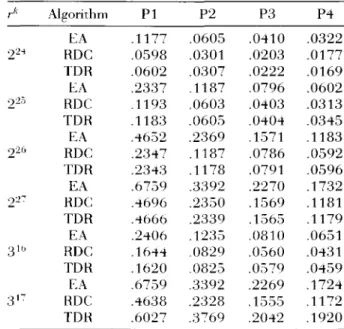
Table 1 gives the execution times in ,;econds for the Elster (EA). TDR. and RDC algorithms on a 16-processor Cray C-90 with 2GB of main mem-ory. For r = 2. TDR and RDC are approximately twice as fast as EA .. and the speedup for all thn-~e
algorithms is nearly linear. RDC is slightly faster than TDR .. but the difference is insignificant. Both algorithms execute approximately 285 million in-teger operations per second per processor. Since the Sisal version of TDR comprises a triply-nested for exprei'ision.
FAST DIGIT-I~DEX PERMUTATIONS 145
Table 1. Performance Execution Times on C-90
k r Algorithm EA RDC TDR EA RDC TDR EA RDC TDR EA RDC TDR EA RDC TDR EA RDC TDR P1 .1177 .0598 .0602 .2337 .1193 .1183 .4652 .2347 .2:H3 .6759 .4696 .4666 .2406 .1644 .1620 .67.59 .4638 .6027 P2 .0605 .0301 .0307 .1187 .0603 .0605 .2369 .1187 .1178 .3392 .2350 .2339 .1235 .0829 .0825 .3392 .2328 .3769 P3 .0410 .0203 .0222 .0796 .0403 .0404 .1571 .0786 .0791 .2270 .1569 .1565 .0810 .0560 .0579 .2269 .1555 .2042 P4 .0322 .0177 .0169 .0602 .0313 .0345 .1183 .0592 .0596 .1732 .1181 .1179 .0651 .0431 .04.59 .1724 .1172 .1920
for each pair of row in Bj
for each element in the second row of the pair
for each element in the.first row of the pair
and there is only one pair of rows on the last step, we compiled the code with the -n2 flag to force
the compiler to parallelize the first two levels of the nested expression. Note that the Cray Sisal compiler always vectorizes the innermost for ex-pression or slices thereof.
For r = 3, performance of the three algorithms is similar tor= 2: however, TDR performs poorly for ~31'. The algorithm's poor speedup on two and four processors for this data size is an effect of static loop slicing. For k = 17. the algorithm builds five instances of the Bj array with 17, 9, 5. 3. and 2 rows. respectively. On the last step, the first row has 316 and the second row has three elements. Since we instructed the compiler to parallelize only the firi'it two levels of the triply-nested for expression, concurrency is realized only across the three elements of the seeond row; thus. the code suffers from poor load balance on two processors and insufficient parallelism on four processors. "~e ean improve the performance by in,;tructing the compiler to parallelize all three levels, but the correct general solution to this problem is for the Sisal compiler to support dvnamic loop slicing.
146
BOLLMAN, SEGCEL, Al'\D FEO9 SUMMARY AND CONCLUSIONS
We have defined a vector operation, tensor sum, that plays a very important role in the design and analysis of DIPs and in particular in digit-reversal permutations. We derived a new O(log log n) paral-lel-time algorithm for the family of DIPs and devel-oped a Sisal implementation for this algorithm. Different choices of the parameter p of the Sisal function T give different DIPs. For the special case of bit-reversal (TDR with r
=
2) we showed that on a Cray C-90 our algorithm runs up to twice as fast than that of Elster's bit-reversal algorithm and differs only very slightly from the authors' RDC al-gorithm.Work is currently underway to apply the meth-ods presented here to a more general class of permutations which include mixed-radix digit-reversal permutations and prime-factor FFT permutations.
ACKNOWLEDGMENTS
Supported in part by the Computational Mathe-matics Group of Puerto Rico EP -SCoR ll grant and by NSF grant HRD-9450448 (D.B., J.S.) and by the Lawrence Livermore National Laboratory un-der DOE contract W-7 405-ENG-48 and the De-partment of Energy Technology Transfer Initiative (J.F.) The authors thank Cray Research Incorpo-rated for the dedicated computer time they pro-vided in support of this work.
REFERENCES
[ 1] D. Bollman, ''Digit-index permutations," Con-gressus Numerantium, voL 91, pp. 213-217,
1992.
D. Bollman, F. Sanmiguel, and J. Segue!, "Imple-menting FFTs in Sisal," Proceedings of the Sec-ond Sisal Users' Conference, San Diego, 1992,
pp. 56-62.
[3] D. Cann. "Retire Fortran? A debate rekindled,"
Comm. ACM. vol. .30, pp. 31-89, 1992.
[4] A. C. Elster. "Fast bit-reversal algorithms," in
Proceedings of the International Conference on Acoustic, Speech and Signal Processing, IEEE,
1989,pp. 1099-1102.
J. Feo and D. Cann, "Developing a high-perfor-mance FFT algorithm in Sisal for a vector super-computer," in Proceedings of the Third Sisal Us-er's Conference, San Diego, 1993, p. 164-171.
[6] J. Johnson, R. Johnson. D. Rodriguez, and R. Tol-mierL "A methodology for designing, modifying and implementing Fourier transfonn algorithms on various architectures," Circuits, S_ystems Sig-nal Processing. vol. 9, pp. 449-500, 1990.
J. Segue! and D. Bollman, "Fast digit-reversal al-gorithms on a shared-memory machine," Parallel Comput., vol. 20, pp. 9:3-99, 1994.
[8] S. SkedielewskL "Sisal,'' in Parallel Functional Languages and Compilers, B. Szymanski, Ed.
l\'ew York: ACM Press, 1991, pp. 105-157. R. Tolimeri, M. An, and C. Lu. Algorithms for Discrete Fourier Transforms and Convolution.
New York: Springer-Verlag, 1989.
[10] C. Van Loan, Computational Frameworks for the Fast Fourier Transform. Philadelphia: SIAM,
Submit your manuscripts at
http://www.hindawi.com
Computer Games Technology International Journal of
Hindawi Publishing Corporation
http://www.hindawi.com Volume 2014
Hindawi Publishing Corporation
http://www.hindawi.com Volume 2014 Distributed Sensor Networks International Journal of Advances in
Fuzzy
Systems
Hindawi Publishing Corporation
http://www.hindawi.com Volume 2014
International Journal of
Reconfigurable Computing
Hindawi Publishing Corporation
http://www.hindawi.com Volume 2014
Hindawi Publishing Corporation
http://www.hindawi.com Volume 2014
Applied
Computational
Intelligence and Soft
Computing
Advances inArtificial
Intelligence
Hindawi Publishing Corporation http://www.hindawi.com Volume 2014 Advances in Software EngineeringHindawi Publishing Corporation
http://www.hindawi.com Volume 2014
Hindawi Publishing Corporation
http://www.hindawi.com Volume 2014
Electrical and Computer Engineering
Journal of
Journal of
Computer Networks and Communications
Hindawi Publishing Corporation
http://www.hindawi.com Volume 2014 Hindawi Publishing Corporation
http://www.hindawi.com Volume 2014
Advances in
Multimedia
International Journal of
Biomedical Imaging
Hindawi Publishing Corporation
http://www.hindawi.com Volume 2014
Artificial
Neural Systems
Advances in
Hindawi Publishing Corporation
http://www.hindawi.com Volume 2014
Robotics
Journal ofHindawi Publishing Corporation
http://www.hindawi.com Volume 2014 Hindawi Publishing Corporationhttp://www.hindawi.com Volume 2014
Computational Intelligence and Neuroscience
Industrial EngineeringJournal of Hindawi Publishing Corporation
http://www.hindawi.com Volume 2014
Modelling & Simulation in Engineering
Hindawi Publishing Corporation
http://www.hindawi.com Volume 2014
The Scientific
World Journal
Hindawi Publishing Corporation
http://www.hindawi.com Volume 2014
Hindawi Publishing Corporation
http://www.hindawi.com Volume 2014 Human-Computer Interaction Advances in
Computer EngineeringAdvances in
Hindawi Publishing Corporation