Learning Category- and Instance-Aware Pixel
Embedding for Fast Panoptic Segmentation
Naiyu Gao,
Student Member, IEEE,
Yanhu Shan,
Member, IEEE,
Xin Zhao,
Member, IEEE,
and Kaiqi Huang,
Senior Member, IEEE
Abstract—Panoptic segmentation (PS) is a complex scene understanding task that requires providing high-quality segmen-tation for boththingobjects andstuff regions. Previous methods handle these two classes with semantic and instance segmentation modules separately, following with heuristic fusion or additional modules to resolve the conflicts between the two outputs. This work simplifies this pipeline of PS by consistently modeling the two classes with a novel PS framework, which extends a detection model with an extra module to predict category- and instance-aware pixel embedding (CIAE). CIAE is a novel pixel-wise embedding feature that encodes both semantic-classification and instance-distinction information. At the inference process, PS results are simply derived by assigning each pixel to a detected instance or astuffclass according to the learned embedding. Our method not only shows fast inference speed but also the first one-stage method to achieve comparable performance to two-one-stage methods on the challenging COCO benchmark.
Index Terms—Panoptic Segmentation, Pixel Embedding.
I. INTRODUCTION
S
CENE parsing is an important vision task and serves as the basis of many practical applications, including autonomous driving, robotics, and image editing. The recently proposed panoptic segmentation (PS) task [1] requires de-termining the semantic category of each pixel in an input image while identifying and segmenting each object instance. Moreover, PS segments both amorphous uncountable regions (stuff) and countable objects (thing), which provides more complete scene information when comparing with semantic segmentation or instance segmentation.A straight forward solution for panoptic segmentation is to deal stuff and thing classes with semantic segmentation and instance segmentation branches, respectively, as in the existing methods [2]–[5]. The semantic segmentation branch outputs pixel-level semantic classification, while the instance segmentation branch detects instances and produces pixel-level instance-distinction. After that, the outputs from two Naiyu Gao and Xin Zhao are with the Center for Research on Intelligent System and Engineering, Institute of Automation, Chinese Academy of Sciences, Beijing 100190, China, and also with the School of Artificial Intelligence, University of Chinese Academy of Sciences, Beijing 100049, China (e-mail: [email protected]; [email protected]).
Yanhu Shan is with Horizon Robotics, Beijing 100000, China (e-mail: [email protected]).
Kaiqi Huang is with the Center for Research on Intelligent System and Engineering and National Laboratory of Pattern Recognition, Institute of Automation, Chinese Academy of Sciences, Beijing 100190, China, and also with the School of Artificial Intelligence, the University of Chinese Academy of Sciences, Beijing 100049, China, and the CAS Center for Excellence in Brain Science and Intelligence Technology, 100190 (e-mail: [email protected]).
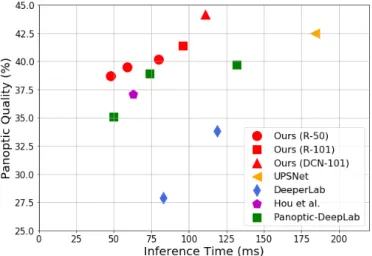
Fig. 1. Speed-accuracy trade-offon the COCO validation set for recent panoptic segmentation methods. Inference times of our method and UP-SNet [5] are tested with NVIDIA 2080Ti GPU. Inference times of other methods [6], [9], [10] are tested with Tesla V100 GPU. Our method shows advantages in both speed and accuracy.
branches are fused to get PS results, where heuristic rules or additional modules are developed to handle the conflicts between the two outputs. However, this complex pipeline brings heavy computation complexity and memory footprint, especially for the two-stage methods, where time-consuming instance segmentation modules are employed. Recently, one-stage methods [6]–[10] are developed, where the distinction information is provided with pixel-level instance-sensitive features. Although having advantages in efficiency, existing one-stage methods fail to achieve comparable perfor-mance to two-stage approaches.
Instead of modelingthing andstuff classes separately and handling the conflicts at the later fusing process, this work proposes to consistently model the two classes to simplify the whole pipeline. Specifically, we propose a novel PS framework that extends a one-stage detection model with an additional module to predict category- and instance-aware pixel em-bedding (CIAE), which encodes cues for both pixel-wise semantic-classification and instance-distinction. Different from the original instance-aware pixel embedding (IAE) [11]–[13], CIAE is specifically designed to map each pixel into a feature space where cues about semantic-classifying and instance-differentiating are modeled simultaneously. Concretely, the feature space is divided into category-specific sub-spaces by the learned category-aware query embeddings, and the
respectively. After that, query embeddings for each instance and stuff class are obtained. The former is derived from the predicted embedding map based on where the instance is generated, while the latter is a learned memory embedding. Finally, the PS result is obtained by calculating the similarity between pixel embeddings and each query embedding, which is simply implemented as matrix multiplication.
Thanks to the consistency of modeling, our method not only simplifies the PS pipeline but also gains advantages in end-to-end learning and achieves good performance. Experiments on the challenging COCO [14] dataset demonstrate the benefits of our method. As shown in Fig. 1, our model surpasses all one-stage methods in both accuracy and inference speed. We are also the first one-stage method to achieve comparable performance to two-stage methods on the COCO dataset.
Our contributions are summarized as the following:
• This work proposes the concept of category- and instance-aware pixel embedding (CIAE), which cap-tures cues about semantic-classification and instance-distinction simultaneously to consistently models count-able thing objects and uncountable stuff regions. The pipeline of panoptic segmentation is thus much simpli-fied.
• This work shows pixel-level semantic-classification and
instance-distinction can be jointly modeled, instead of employing semantic segmentation and instance segmen-tation modules respectively.
• This work proposes a novel one-stage panoptic segmen-tation framework by incorporating the proposed CIAE with a one-stage detector. On the COCO benchmark, the proposed model surpasses all one-stage methods in both accuracy and inference speed and is the first one-stage method that achieves comparable performance against time-consuming two-stage methods.
II. RELATEDWORK A. Instance Segmentation
Instance segmentation requires to detect and segment each object instance in an image. Recent methods can be divided into two categories: two-stage and one-stage methods. The first two-stage instance segmentation method Mask R-CNN [15] extends the two-stage detector Faster R-CNN [16] by adding a mask predicting branch. The following works [17]–[20] pro-mote Mask R-CNN with advanced feature aggregation or mask prediction heads. These two-stage methods are showing great performance, but the feature re-pooling and re-sampling oper-ations cause large computational overhead and greatly reduce efficiency. The one-stage methods are also developed for the instance segmentation task. Some one-stage methods [21]–[24]
Our method is inspired by the pixel embedding based meth-ods [11]–[13] but differs in many aspects. Firstly, the learned pixel embeddings in previous works are only distinguishable to object instances but agnostic to semantic categories. How-ever, in our method, the learned pixel embedding encodes both instance-distinction and semantic category information. Secondly, this work proposes to learn pixel embeddings with the triplet loss to query embeddings, which is quite dif-ferent from previous methods [11]–[13]. Importantly, time-consuming clustering algorithms like mean-shift [32] or K-means [33] are employed in previous methods [11]–[13] to group pixels. However, in our method, instances are proposed with the detection module and pixels are simply assigned by calculating the similarity between pixel embeddings and each query embedding.
B. Panoptic Segmentation
Panoptic segmentation requires to assign a semantic label and an instance id for each pixel in an image. Pixels with the same label and id belong to the same object. The instance id is ignored forstuff labels. Most state-of-the-art methods employ semantic segmentation and instance segmentation modules to tackle this problem, following with fusion steps to merge the two outputs. OANet [3] proposes the Spatial Ranking module to resolve the occlusion between predicted instance masks. Panoptic-FPN [2] extends Mask R-CNN [15] with a semantic segmentation branch. AUNet [4] introduces attention modules to promote the performance of stuff classes with information from thethingbranch. A parameter-free panoptic head is proposed in UPSNet [5] to resolves the conflicts in the fusion process by predicting an extra ‘unknown’ class. Porzi et al. [34] propose a segmentation head to integrate the multi-scale features from FPN [35] with contextual information provided by a light-weight, DeepLab-inspired module [36]. AdaptIS [37] generates instance masks from point proposals. Recently, OCFusion [38], BGRNet [39] and BANet [40] propose to improve results with instance occlusion estimation and bidirectional feature aggregation. Li et al. [41] exploit a pairwise instance affinity operation for end-to-end learning. In these methods, the pixel-level semantic classification is provided with semantic segmentation branch as pixel-wise classification scores, and the pixel-level instance-distinction is provided with instance segmentation branch as foreground masks. The instance segmentation branches are mostly two-stage models like Mask R-CNN [15], which shows good per-formance but is inefficient and memory-consuming. Heuristic rules or additional models are also required to tackle the conflicts in the fusion process, which limits the accuracy and efficiency of the whole system.
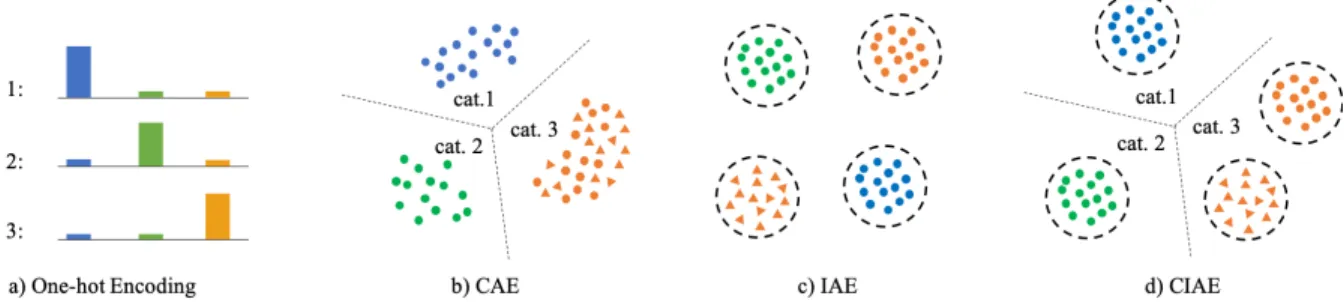
Fig. 2. Illustration of different pixel embeddings. In b) c) and d), each pixel is mapped into a point in a feature space, and points with the same color are with the same semantic category; points with the same color and shape are from the same instance. a) One-hot encoding for classification, which can be regarded as a special case of CAE. b) CAE (category-aware embedding) maps each pixel into a specific sub-space according to its semantic category. c) IAE (instance-aware embedding) maps pixels closer to pixels from the same instance than to pixels from different instances. d) CIAE (category- and instance-aware embedding) maps each pixel into the category-specific sub-space while pixels from different instances are distinguishable. In practice, the embedding features are distributed on a hypersphere and the cosine similarity is employed. Best viewed in color and zoom.
Instead of employing two-stage instance segmentation mod-ules like Mask R-CNN [15], some other works attempt to solve panoptic segmentation in a one-stage manner, where the instance-distinction information is provided with pixel-level instance-sensitive features. DeeperLab [6] proposes to solve panoptic segmentation by predicting key-point and multi-range offset heat-maps, following with a grouping process [42]. SSAP [7] proposes to distinguish instances with pixel-pair affinity [29] pyramid and graph-partition method [43]. Panoptic-DeepLab [9] predicts instance centers as well as the offset from each pixel to its corresponding center. PCV [8] emerges instances from pixel consensus on centroid locations and group pixels with back-projection. Hou et al. [10] reuse the predictions from dense object detection with a global self-attention mechanism. Although showing advantages in effi-ciency, existing one-stage methods can not achieve comparable accuracy to state-of-the-art methods.
Unlike previous methods model pixel-level semantic-classification and instance-distinction separately, this work proposes category- and instance-aware pixel embedding to encode the two pixel-level features jointly and resolve the conflicts of thingandstuff classes at the modeling stage.
III. CATEGORY-ANDINSTANCE-AWAREPIXEL EMBEDDING
In this section, we show how to jointly model pixel-level semantic-classification and instance-distinction with category-and instance-aware pixel embedding (CIAE) category-and introduce the CIAE-loss for learning the pixel embeddings.
A. Problem Formulation
Drawing inspiration from instance-aware pixel embed-ding [11]–[13] (IAE), our CIAE is specifically designed. The original IAE is learned to distinguish different instances. Concretely, each pixel is mapped to a feature space. According to the learned pixel embedding, pixels belong to the same instance are close to each other and pixels belong to different instances are separated with a large margin, as shown in Figure 2(c). However, the learned IAE is category-agnostic. Similarly, we refer to pixel embeddings that can determine semantic categories but are ignorant of instances as category-aware pixel embeddings (CAE). As shown in Figure2(b), CAE
can be realized by mapping pixels into a category-specific sub-space. One-hot encoding for classification can be regarded as a special case of CAE, where the sub-spaces are pre-defined. CIAE is the combination of CAE and IAE, which maps each pixel into the category-specific sub-space while pixels from different instances are distinguishable, as shown in Figure2(d). In this way, both semantic classification and object distinction are achieved with a single embedding map.
Given the embedding map P, pi andpj represent the em-beddings for pixelsiandj. In practice, the pixel embeddings are distributed on a hypersphere after L2 normalization:
L2 norm(pi) = pi
kpik2
. (1) The distance between the two embeddings is measured with cosine similarity:
Dcosine(pi, pj) = 1−
pi·pj
kpik · kpjk
. (2) Assuming the class numbers for thing and stuff classes are
Cth andCst, respectively. The number of thing instances is
Nth.ci ∈ {0,1, . . . , Cst−1, . . . , Cst+Cth−1}represents the semantic category of pixeli. Meanwhile,si∈ {0,1, . . . , Cst− 1, . . . , Cst+Nth−1} represents the segment id of pixel i. Pixels belong to the same stuff class or thing instance are with the same segment id. Note that si and ci are the same for pixels ofstuff classes.
B. CIAE-Loss
In this part, we describe the CIAE-loss for learning CIAE. Unlike previous works [11]–[13] on IAE learning embeddings with exact sampled pixels, this work proposes to learn CIAE by optimizing the distances from each pixel embedding to the mean embeddings of segments. Concretely, the mean embeddings are calculated as the mean directions of pixel em-beddings in each segment, following with L2 normalization:
mkc =L2 norm X ci=k pi, (3) mks=L2 norm X si=k pi . (4) Ms={mks|k= 0,1, . . . , Cst+Nth−1}andMc ={mkc|k= 0,1, . . . , Cst+Cth−1} are mean embeddings for instance
P3 P2 ℎ𝑖 × 𝑤𝑖 × 𝐷 Proposal Head 4× →L2 norm Pixel embedding𝑃 conv 2× H/4 × 𝑊/4 × 𝐷 H × 𝑊 × 𝐷 H/4 × 𝑊/4 × 256 conv Input Image Backbone 𝑃11 𝑃1
Fig. 3. Network structure of our proposed method.HandW are the height and width of the input image. P2 to P7 denote the feature maps of each FPN level. P3 to P7 are fed into a shared proposal head to predict bounding box classification, center-ness, coordinates and embeddings. Features from P2 to P5 are fused as the semantic segmentation branch in Panoptic-FPN [2] to predict pixel embeddings.⊕represents element-wise sum. Best viewed in color and zoom.
and category id maps, respectively. In order to suppress noise, the mean embeddings are calculated with the embedding map before L2 normalization.
In order to encode CIAE, each pixel embedding is sup-posed to be close to the correct category and instance mean embedding simultaneously. To this end, two triplet losses are developed to learn the pixel embeddings with Ms and Mc as query embeddings, respectively. Given query embeddings, each pixel corresponds to one of them. UsingMc as example,
di
pos anddikneg are defined as:
dipos=Dcosine(pi, Mci), (5) dikneg= Dcosine(pi, Mk) if k6=ci, 0 if k=ci. (6) Given query embeddings M, the embedding loss Lemb is obtained by:
l0embik = max{dipos−dikneg+margin, 0}, (7)
likemb=−log (1− l 0ik emb 2 +margin), (8) Lemb(P, M) = 1 N X i |M| X k I[likemb> τK]·lembik . (9)
I[x] = 1 if x is true and 0 otherwise. The threshold τK is set in a way that only the pixels with top-K highest losses are selected. We set K to 5 in experiments. By calculating two losses LCAE and LIAE, the pixel embeddings learn to be closer to the corresponding instance and category query embeddings simultaneously:
LCAE=Lemb(P, Mc), (10)
LIAE=Lemb(P, Ms). (11)
Finally, CIAE-loss is calculated as:
LCIAE =LCAE+α∗LIAE. (12)
αis set to 2 to balance the training losses, and we set 5 times loss for pixels with thingclasses inLIAE.
C. Category-Aware Memory Embeddings
Unlike one-hot encoding for classification pre-defining sub-spaces, this work proposes to determine the sub-spaces with learnable category-aware query embeddings.
In order to map pixels into category-specific sub-spaces, during the learning process, the pixel embeddings are supposed to be distinguishable from all other classes instead of only the other classes that included in the mini-batch. To this end, the query embedding of each semantic category is slowly updated during the whole learning process as a memory embedding. Specifically, assuming there are T iterations in total. M1 is randomly initialized in the first iteration. In the
t-th iteration, the mean embeddings Mc of classes that exist in the current mini-batch are firstly obtained. After that, we obtain an increasing updating momentum:
λt= 1−0.0001∗(1−t/T)3 (13) and update the memory embeddings with:
Mt=L2 norm
λt∗Mt−1+ (1−λt)∗Mc
. (14) In experiments, both Mc and stuff query embeddings in Ms are replaced with Mt to calculate the CIAE-loss in Eq. 12. In this way, the memory embeddings of semantic categories divide the feature space into category-specific sub-spaces. When learning to be closer to each corresponding memory embedding, the pixel embeddings are better located in target sub-spaces.
a) Image
Panoptic segmentation from detections and pixel embeddings
×
b) Instance Proposals
d) Query Embeddings!(#,$%&'%()×+ e) Panoptic Segmentation
c) Embedding Map-.×/×+
argmax … Query embeddingfor each proposal
(derive from the embedding map) Query embedding for each stuff class (memory embedding)
…
Fig. 4. Panoptic segmentation from pixel embeddings.Panoptic segmentation result is obtained from the pixel embedding map and detected instance proposals (after NMS) by calculating the cosine similarity between pixel embeddings and the query embeddings. Query embeddings consist of query embedding for eachstuffclass and instance proposal. The former is the memory embedding for eachstuffclass and the later is derived from the embedding map, according to where each proposal is generated. c) is the visualization result of the learned embedding map with PCA dimensionality reduction. Best viewed in color and zoom.
IV. FASTPANOPTICSEGMENTATIONFRAMEWORK A. Network Architecture
The proposed panoptic segmentation framework consists of two branches, one for locating instances, the other for predict-ing pixel-wise embeddpredict-ing features. As shown in Figure 3, to locate instances, the feature maps from P3 to P7 FPN levels are fed to a shared proposal head. Meanwhile, features from P2 to P5 are utilized to predict the pixel embeddings. Proposal head The proposal head for instance locat-ing is developed from the state-of-the-art one-stage detector FCOS [26]. Note that it can also be replaced with other detectors [25], [44], [45]. As shown in Figure3, two branches that consist of four convolutional layers are added after the FPN feature map for classification and regression, respectively. After that, the box classification is predicted from the clas-sification branch while the center-ness, box regression, and embeddings are predicted from the regression branch. Unlike FCOS [26], which defines all inner regions of bounding boxes as training data for center-ness and box-regression, in our method, location (x,y) is considered positive only if it falls into a ground-truth mask. Unlike box classification, center-ness, and box regression, box embedding is not supervised directly during training. The box embedding output is used to guide the pixel embedding branch, thereby enforcing the objective feature.
Embedding branch The features from P2 to P5 are uti-lized to predict pixel-wise embeddings, which are with the resolutions of 1/4, 1/8, 1/16, and 1/32, respectively. We employ the feature aggregation strategy similar to the semantic segmentation branch in Panoptic-FPN [2], where features from P2 to P5 are progressively up-sampled with several 3 ×3
convolution, group normalization [46], ReLU, and2×bilinear up-sampling (discarded for P2) operators. The up-sampled feature maps are at the same 1/4 scale, which are then element-wise summed. In order to better encode spatial cues, CoordConv [47] is employed for the convolutions in P5. After that, an embedding map P0 is predicted with a convolution. Instead of output the embedding map directly, we propose to enhance the multi-scale objective information by fusing box embedding predictions from each FPN level. Concretely, box embeddings from proposal heads are up-sampled and element-wise summed, following with a convolution to produce P00. Finally, the element-wise sum ofP0 and P00, following with 4× bilinear up-sampling and L2 normalization is utilized to predict the embedding map P. Unless specified, our model predicts 32-dim embedding maps in practice.
Training loss The total training loss is calculated as:
L=Lcenterness+Lclass+Lreg+LCIAE. (15)
LCIAE is defined in Eq. 12. Lcenterness, Lclass, and Lreg denote the losses for center-ness, box classification, and re-gression respectively. Similar to FCOS [26], Sigmoid Focal loss [45], Binary Cross Entropy (BCE) loss, and IoU loss [48] are employed respectively.
B. Filtering Strategy
In this work, instance differentiating is achieved through learning category- and instance-aware pixel embeddings. When optimized with the training loss described as Eq.12, the network learns to make each pixel embedding distinguishable from that of other instances. Previous works [11], [12] have shown the network can be roughly trained for distinguishing
tively. Moreover, in the training phase, the ground truth boxes are expanded to 1.5 times to increase the training data and enhance the robustness of imperfect predictions.
C. Inference Process
At the inference time, the PS result is derived by assigning each pixel to a detected instance or a stuff class according to the learned embedding. As shown in Figure 4, given the learned embedding mapP and the detected instance proposals after NMS, the image is segmented by comparing the similar-ity between pixel embeddings P and query embeddingsV.
As illustrated in Figure 4(d), query embeddings consist of query embedding for each stuff class and each instance proposal. We use the learned memory embedding MT as the query embeddings for stuff classes, which is consistent with the training process. As for the query embedding for each proposal, we simply derive it from the embedding map, according to where each proposal is generated. Specifically, if the proposed instance is detected from the location (x, y), then we use Px,y as the query embedding. Cosine distance is employed to measure the similarity. Since the norm of both pixel embeddings and query embeddings are 1, the cosine similarity can be simply calculated by matrix multiplication:
P×VT =S. (16) Each pixel is then assigned to the instance proposal (or stuff class) with the highest similarity. After that, the semantic cate-gory of instance segments can be provided by the learned pixel embedding or box classification branch. The former can be realized by calculating the similarities between each proposal query embedding and category-aware memory embeddings of thing classes. These two approaches are compared through experiments in Table II (detailed in Subsection V-D). For simplicity and accuracy, we finally determine the semantic category of each instance segment with the box classification result and merge the thing classes as a single class when learning CIAE. Moreover, stuff regions with a size smaller than 4096 are avoided.
V. EXPERIMENTS A. Dataset
Our experiments are conducted on the large-scale object de-tection and segmentation dataset COCO [14], which contains 118K and 5K images for training and validation, respectively. The labels consist of 53stuff classes and 80thingclasses that contain instance level annotation. We finally submit the result of test-dev split (20K images) to the COCO 2019 panoptic segmentation evaluation server.
TABLE II
INFLUENCE OF DETERMINING INSTANCE CATEGORY WITH EMBEDDING MAP OR DETECTOR. ‘SPEC.’MEANS TO LEARN SPECIFIC THING CLASSES. ‘MERGE’MEANS TO MERGE THING CLASSES AS A SINGLE CLASS. ‘NONE’
MEANS TO ABANDON THE CATEGORY INFORMATION OF THING CLASSES. Embedding Detector Inf. from PQ (%) PQth(%) PQst(%) mIoU (%) Spec. Spec. Embedding 36.7 40.7 30.4 48.8 Spec. Spec. Detector 37.7 42.6 30.4 49.9 Spec. Merge Embedding 35.5 39.4 29.6 47.5 Merge Spec. Detector 37.9 42.5 30.9 48.5 None Spec. Detector 37.1 41.8 30.1 48.4
B. Metric
The results are evaluated with the standard Panoptic Quality (PQ) metric introduced by Kirillov et al. [1]. PQ can be further divided into the multiplication of Segmentation Quality (SQ) term and Recognition Quality (RQ) term to evaluate segmentation and recognition performances, respectively. The formulation of PQ is: PQ = P p,g∈T PIoU(p, g) |T P| | {z } Segmentation Quality (SQ) × |T P| |T P|+1 2|F P|+ 1 2|F N| | {z } Recognition Quality (RQ) , (17)
where IoU(p, g) represents the intersection-over-union be-tween the predicted segment p and ground truth segment
g. T P, F N, and F P represent matched pairs of segments (IoU(p, g) > 0.5), unmatched ground truth segments, and unmatched predicted segments, respectively. PQ, SQ, and RQ of boththingandstuff classes are reported in this manuscript.
C. Implementation details
Our experiments are implemented with PyTorch [49] and trained with 8 NVIDIA 2080Ti GPUs. The inference time is measured on 1 NVIDIA 2080Ti GPU with batch size as 1.
Unless specified, ResNet-50 [50] with FPN [35] is utilized as our backbone network. The same hyper-parameters with RetinaNet [45] are utilized. Specifically, our network is trained for 90K iterations with stochastic gradient descent (SGD) and the mini-batch is set to 16. The learning rate is initialized to 0.01 and multiplies a factor of 0.1 at the 60K and 80K iterations, respectively. Weight decay and momentum are set as 1e−4and 0.9, respectively. The backbone network is initialized with the ImageNet [51] pre-trained weights and the newly added layers are initialized as in RetinaNet [45]. Unless specified, we resize the shorter side of the input images to 800 for both training and testing.
Image
w/o
Fusing
w/
Fusing
Fig. 5. Visualization of predictions with or without fusing box embeddings. Fusing box embeddings to the embedding branch helps to produce more smooth and complete instance segments. Best viewed in color and zoom.
TABLE III
INFLUENCE OF EMPLOYINGCOORDCONV AND FUSING BOX EMBEDDINGS TO THE EMBEDDING BRANCH.
CoordConv Box Embedding PQ (%) PQth(%) PQst(%)
37.1 41.8 30.0
X 37.5 42.3 30.2
X 37.8 42.5 30.8
X X 37.9 42.5 30.9
TABLE IV
ORACLE PERFORMANCE. GROUND TRUTH BOUNDING BOXES AND MASKS ARE EMPLOYED. QUERY EMBEDDING FOR EACH INSTANCE IS
CALCULATED AS THE MEAN EMBEDDING.
Backbone Oracle PQ (%) PQth(%) PQst(%) ResNet-50-FPN 37.9 42.5 30.9 ResNet-50-FPN X 59.2 75.8 34.1 ResNet-101-FPN 40.8 45.4 33.8 ResNet-101-FPN X 60.0 76.2 35.7 D. Ablation Experiments
Consistently modelingstuff classesThe proposed PS frame-work models thing andstuff classes consistently with CIAE. To demonstrate the benefits, we conduct an experiment to segmentstuff classes with an additional semantic segmentation branch, where an H/4 ×W/4×(N st + 1) tensor (thing classes are merged as a single class) is predicted in parallel with P0 and supervised with the standard cross-entropy loss. The results are shown in Table I. Similar performances are achieved in mIoU and PQst, however, the performance for PQthis much lower. This is because consistent modeling leads to more precise boundaries, which is especially beneficial for small instances.
Proposal categories from CIAE or detector In this part, we test the difference between providing instance categories through the learned embedding map or the box classification branch. We start by learning specific thing classes with both branches and inferencing with each of them. As shown in the first two rows in Table II, the box classification branch better classifies instance proposals than the embedding map (37.7%
TABLE V
RESULTS OF USING DIFFERENT MEMORY UPDATING MOMENTUM. Momentum PQ (%) PQth(%) PQst(%) 0 fail to converge 0.99 37.5 42.2 30.2 0.999 37.7 42.6 30.3 0.9999 37.9 42.5 30.9 0.99999 37.4 42.1 30.4 TABLE VI
INFLUENCE OF THE FILTERING STRATEGY. THE FIRST ROW SHOWS THE PERFORMANCE OF ABANDONING FILTERING STRATEGY.
Box PQ (%) PQth(%) PQst(%) All 36.6 41.1 29.8 2.0× 37.4 42.1 30.4 1.5× 37.9 42.5 30.9 1.2× 37.8 42.3 30.8 1.0× 36.6 40.8 30.1 TABLE VII
RESULTS OF USING DIFFERENT TRIPLET LOSS MARGINS. Margin PQ (%) PQth(%) PQst(%) 0.30 36.5 39.9 30.9 0.20 37.7 41.9 31.0 0.15 37.9 42.5 30.9 0.10 37.6 42.5 30.2 0.00 28.7 36.2 17.2 TABLE VIII
RESULTS OF USING DIFFERENT EMBEDDING DIMENSIONS. Dim PQ (%) PQth(%) PQst(%)
48 37.9 42.5 31.0
32 37.9 42.5 30.9
24 37.8 42.6 30.6
16 37.3 42.2 30.0
vs.36.7%). After that, the two branches separately mergething classes as a single class and infer from the other. Experiments show that employing a class-agnostic box classifier reduces PQ by 1.2%. However, since the information to be encoded in CIAE is reduced, mergingthingclasses in learning CIAE pro-motes PQstwith 0.5% and obtains slightly better performance. We use this setting as the default because of its accuracy and simplicity. Moreover, we find that if the category information for thing classes is completely abandoned (set LCAE to 0) in CIAE, PQ degrades with 0.8%. This result supports our motivation for encoding pixel-wise semantic-classification and instance-distinction simultaneously.
Box embedding and CoordConv As described in Subsec-tion IV-A, we propose employing CoordConv and fusing the box embeddings from each FPN level to the embedding branch to enhance the objective information. Both quantitative and qualitative analysis of this structure is carried out. The proposed box embedding structure is compared with the one where the box embedding branch is abandoned. In other words,P =f(P0+P00)is replaced with P =f(P0), where
AUNet [4] ResNet-50-FPN 39.6 49.1 25.2 - - -UPSNet [5] ResNet-50-FPN 42.5 48.5 33.4 2080Ti 174? 22?
one-stage
DeeperLab [6] Xception-71 [52] 33.8 - - V100 119 25
SSAP†‡[7] ResNet-101 36.5 - - - -
-Hou et al. [10] ResNet-50-FPN 37.1 41.0 31.3 V100 63 -PCV [8] ResNet-50-FPN 37.5 40.0 33.7 1080Ti 176 -Panoptic-DeepLab [9] Xception-71 39.7 43.9 33.2 V100 132 -Ours-512 ResNet-50-FPN 38.7 43.2 32.8 2080Ti 48 4 Ours-640 ResNet-50-FPN 39.5 44.4 33.1 2080Ti 59 6 Ours-800 ResNet-50-FPN 40.2 45.3 32.3 2080Ti 80 7 Ours-800 ResNet-101-FPN 41.4 46.4 33.9 2080Ti 96 7 Ours-800 ResNet-101-FPN-DCN [53] 44.2 49.2 36.7 2080Ti 111 7 Ours-800 ResNeXt-101-FPN-DCN 45.7 51.2 37.5 2080Ti 176 7
TABLE X
RESULTS ONCOCOTEST-DEV SET.†:METHODS WITH MULTI-SCALE TESTING.‡:METHODS WITH HORIZONTAL FLIPPING.
Method Backbone PQ SQ RQ PQth SQth RQth PQst SQst RQst two-stage Panoptic-FPN [2] ResNet-101-FPN 40.9 - - 48.3 - - 29.7 - -OANet [3] ResNet-101-FPN 41.3 - - 50.4 - - 27.7 - -AdaptIS‡[37] ResNeXt-101-FPN 42.8 - - 50.1 - - 31.8 - -AUNet [4] ResNeXt-152-FPN 46.5 81.0 56.1 55.9 83.7 66.3 32.5 77.0 40.7 UPSNet†[5] ResNet-101-FPN-DCN 46.6 80.5 56.9 53.2 81.5 64.6 36.7 78.9 45.3 one-stage DeeperLab [6] Xception-71 34.3 77.1 43.1 37.5 77.5 46.8 29.6 76.4 37.4 SSAP†‡ [7] ResNet-101 36.9 80.7 44.8 40.1 81.6 48.5 32.0 79.4 39.3 PCV [8] ResNet-50-FPN 37.7 77.8 47.3 40.7 78.7 50.7 33.1 76.3 42.0 Panoptic-DeepLab [9] Xception-71 39.6 - - - -Ours ResNet-50-FPN 40.3 78.1 50.3 45.2 79.7 55.9 32.9 75.8 41.8 Ours ResNet-101-FPN 42.1 78.7 52.3 47.6 80.2 58.5 34.0 76.4 42.9 Ours ResNet-101-FPN-DCN 44.5 80.0 54.6 49.7 81.1 60.6 36.8 78.3 45.7 Ours ResNeXt-101-FPN-DCN 46.3 80.4 56.6 51.8 81.4 63.0 37.9 78.8 46.9
in Table III, fusing box embeddings boosts the performance from 37.1% to 37.8% PQ. Both performances of thing and stuff classes are improved. The visualization results in Figure5 indicate that more smooth and complete instance segments are generated after fusing the box embeddings to the embedding branch.
Oracle performance We test the upper limits of the pro-posed method by employing predicted pixel embeddings and ground-truth (GT) bounding boxes for inference. The query embedding of each instance is derived by calculating the mean embedding within the GT mask. The results are shown in Table IV. Employing GT bounding boxes nearly doubles the performance ofthingclasses, which shows the great potential of the proposed pixel embedding based framework.
Memory updating momentum As described in Subsec-tionIII-C, the category-aware memory embeddings are gradu-ally updated and fingradu-ally employed as query embeddings at the inference process. We set a large momentum value to stabilize
the training process. As shown in TableV, the network learns well with a large momentum value. When the momentum is set to 0, the training loss oscillates and fails to converge. Filtering strategy As described in SubsectionIV-B, this work proposes a box based filtering strategy to eliminate distant instances from optimizing, and the ground truth boxes are expanded during training. As shown in Table VI, expanding the ground truth boxes to 1.5 times achieves the best perfor-mance. The first row shows the performance drops with 1.3% PQ when the filtering strategy is abandoned, which means the similarity to all instance mean embeddings are optimized during training.
Triplet loss margin This work proposes to learn CIAE by optimizing the triplet losses with category and instance query embeddings. Here we test the performances for different margins. Note that the margins in LCAE and LIAE can be different, but we set them the same for simplifying. As shown in TableVII, the model performs best withmargin= 0.15. A
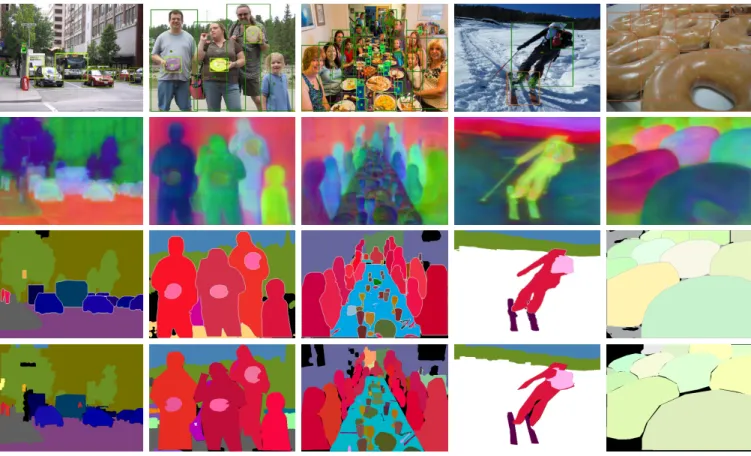
Fig. 6. Visualization of sampled results from COCO validation set. Only single scale inference is used and the model achieves 41.4% PQ while runs at 10 fps. The first row shows detected instances. The second row visualizes the learned embedding map. The third row represents the final panoptic segmentation results. The last row shows the ground truth. Best viewed in color and zoom.
too-large margin makes it difficult to optimize the network, and the learned embeddings lack discrimination when the margin is too small.
Embedding dimension TableVIIIshows the results of using different embedding dimensions. We found the embedding di-mension only slightly affects the performance forstuff classes, and the model works well even trained with 16 dimension embeddings.
E. Comparison to State of the Art
Performance on validation set We summary the accuracy and speed of our method on the COCO validation set in Table IX, where the networks are trained longer (180K it-erations) with scale jitter (shorter image side in [640, 800]). We compare the accuracy and efficiency of our method with the state-of-the-art two-stage and one-stage panoptic segmen-tation algorithms. For inference time, the average end-to-end inference time over the whole validation set is reported. The fusing time for obtaining the final PS result from multiple outputs (in our method: instance proposals and embedding map) is also reported, which is included in the inference time. Our method outperforms all the one-stage methods in both accuracy and inference speed. We are also the first one-stage method that achieves comparable performance against time-consuming two-stage methods.
Performance on test-dev set The comparison with state-of-the-art methods for panoptic segmentation on the COCO test-dev set are summarized in Table X. The results of our
method are predicted with a single model and single inference. No augmentations such as horizontal flipping or multi-scale testing were adopted.
F. Visual Results
The sampled results from the COCO validation set are visualized in Figure 6. The first row shows the predicted instance proposals and where they are generated. The second row visualizes the learned embedding map after PCA dimen-sionality reduction. The third row presents the final panoptic segmentation results. The last row shows the ground truth. Only single scale inference is used and the model achieves 41.4% PQ while runs at 10 fps.
VI. CONCLUSION
In this paper, we have introduced a novel one-stage panop-tic segmentation method that consistently models thing and stuff classes. Our method is based on incorporating a one-stage detector with the proposed category- and instance-aware pixel embedding (CIAE). CIAE is a pixel-wise embedding feature that encodes both semantic-classification and instance-distinction information. The panoptic segmentation result is simply predicted by assigning each pixel to a detected instance or a stuff class according to the learned embedding. Our method runs at a fast speed and is also the first one-stage method that achieves comparable performance against two-stage methods on the challenging COCO benchmark.
REFERENCES
[1] A. Kirillov, K. He, R. Girshick, C. Rother, and P. Dollar, “Panoptic segmentation,” inCVPR, 2019. 1,6
[2] A. Kirillov, R. Girshick, K. He, and P. Dollar, “Panoptic feature pyramid networks,” inCVPR, 2019.1,2,4,5,8
[3] H. Liu, C. Peng, C. Yu, J. Wang, X. Liu, G. Yu, and W. Jiang, “An end-to-end network for panoptic segmentation,” inCVPR, 2019.1,2,8
[4] Y. Li, X. Chen, Z. Zhu, L. Xie, G. Huang, D. Du, and X. Wang, “Attention-guided unified network for panoptic segmentation,” inCVPR, 2019.1,2,8
[5] Y. Xiong, R. Liao, H. Zhao, R. Hu, M. Bai, E. Yumer, and R. Urtasun, “UPSNet: A unified panoptic segmentation network,” inCVPR, 2019.
1,2,8
[6] T.-J. Yang, M. D. Collins, Y. Zhu, J.-J. Hwang, T. Liu, X. Zhang, V. Sze, G. Papandreou, and L.-C. Chen, “DeeperLab: Single-shot image parser,”
arXiv:1902.05093, 2019. 1,3,8
[7] N. Gao, Y. Shan, Y. Wang, X. Zhao, Y. Yu, M. Yang, and K. Huang, “SSAP: Single-shot instance segmentation with affinity pyramid,” in
ICCV, 2019. 1,2,3,8
[8] H. Wang, R. Luo, M. Maire, and G. Shakhnarovich, “Pixel consensus voting for panoptic segmentation,” inCVPR, 2020. 1,3,8
[9] B. Cheng, M. D. Collins, Y. Zhu, T. Liu, T. S. Huang, H. Adam, and L.-C. Chen, “Panoptic-DeepLab: A simple, strong, and fast baseline for bottom-up panoptic segmentation,” inCVPR, 2020.1,3,8
[10] R. Hou, J. Li, A. Bhargava, A. Raventos, V. Guizilini, C. Fang, J. Lynch, and A. Gaidon, “Real-time panoptic segmentation from dense detections,” inCVPR, 2020. 1,3,8
[11] B. D. Brabandere, D. Neven, and L. V. Gool, “Semantic instance segmentation with a discriminative loss function,” arXiv:1708.02551, 2017.1,2,3,5
[12] A. Fathi, Z. Wojna, V. Rathod, P. Wang, H. O. Song, S. Guadarrama, and K. P. Murphy, “Semantic instance segmentation via deep metric learning,”arXiv:1703.10277, 2017. 1,2,3,5
[13] S. Kong and C. C. Fowlkes, “Recurrent pixel embedding for instance grouping,” inCVPR, 2018. 1,2,3
[14] T. Lin, M. Maire, S. J. Belongie, J. Hays, P. Perona, D. Ramanan, P. Dollar, and C. L. Zitnick, “Microsoft COCO: Common objects in context,” inECCV, 2014.2,6
[15] K. He, G. Gkioxari, P. Dollar, and R. Girshick, “Mask r-cnn,” inICCV, 2017.2,3
[16] S. Ren, K. He, R. Girshick, and J. Sun, “Faster R-CNN: Towards real-time object detection with region proposal networks,” inNIPS, 2015.
2
[17] S. Liu, L. Qi, H. Qin, J. Shi, and J. Jia, “Path aggregation network for instance segmentation,” inCVPR, 2018.2
[18] L. Chen, A. Hermans, G. Papandreou, F. Schroff, P. Wang, and H. Adam, “MaskLab: Instance segmentation by refining object detection with semantic and direction features,” inCVPR, 2018.2
[19] Z. Huang, L. Huang, Y. Gong, C. Huang, and X. Wang, “Mask scoring r-cnn,” inCVPR, 2019.2
[20] K. Chen, W. Ouyang, C. C. Loy, D. Lin, J. Pang, J. Wang, Y. Xiong, X. Li, S. Sun, W. Feng et al., “Hybrid task cascade for instance segmentation,” inCVPR, 2019. 2
[21] W. Xu, H. Wang, F. Qi, and C. Lu, “Explicit shape encoding for real-time instance segmentation,” inICCV, 2019.2
[22] E. Xie, P. Sun, X. Song, W. Wang, X. Liu, D. Liang, C. Shen, and P. Luo, “PolarMask: Single shot instance segmentation with polar representation,” inCVPR, June 2020.2
[23] D. Bolya, C. Zhou, F. Xiao, and Y. J. Lee, “YOLACT: Real-time instance segmentation,” inICCV, 2019.2
[24] X. Chen, R. Girshick, K. He, and P. Dollar, “TensorMask: A foundation for dense object segmentation,” inICCV, 2019.2
[25] J. Redmon and A. Farhadi, “YOLO9000: Better, faster, stronger,” in
CVPR, 2017.2,5
2018. 2
[31] D. Neven, B. D. Brabandere, M. Proesmans, and L. V. Gool, “Instance segmentation by jointly optimizing spatial embeddings and clustering bandwidth,” inCVPR, 2019.2
[32] K. Fukunaga and L. Hostetler, “The estimation of the gradient of a density function, with applications in pattern recognition,” IEEE Transactions on Information Theory, vol. 21, no. 1, pp. 32–40, 1975.2
[33] D. Arthur and S. Vassilvitskii, “k-Means++: The advantages of carefull seeding,” inSymposiumon on Discrete algorithms, 2007.2
[34] L. Porzi, S. R. Bulo, A. Colovic, and P. Kontschieder, “Seamless scene segmentation,” inCVPR, 2019. 2
[35] T. Lin, P. Dollar, R. Girshick, K. He, B. Hariharan, and S. Belongie, “Feature pyramid networks for object detection,” inCVPR, 2017.2,6
[36] L. Chen, G. Papandreou, I. Kokkinos, K. P. Murphy, and A. L. Yuille, “DeepLab: Semantic image segmentation with deep convolutional nets, atrous convolution, and fully connected crfs,”TPAMI, vol. 40, no. 4, 2018. 2
[37] K. Sofiiuk, O. Barinova, and A. Konushin, “AdaptIS: Adaptive instance selection network,” inICCV, 2019. 2,8
[38] J. Lazarow, K. Lee, K. Shi, and Z. Tu, “Learning instance occlusion for panoptic segmentation,” inCVPR. 2
[39] Y. Wu, G. Zhang, Y. Gao, X. Deng, K. Gong, X. Liang, and L. Lin, “Bidirectional graph reasoning network for panoptic segmentation,” in
CVPR. 2
[40] Y. Chen, G. Lin, S. Li, O. Bourahla, Y. Wu, F. Wang, J. Feng, M. Xu, and X. Li, “Banet: Bidirectional aggregation network with occlusion handling for panoptic segmentation,” inCVPR. 2
[41] Q. Li, X. Qi, and P. H. Torr, “Unifying training and inference for panoptic segmentation,” inCVPR. 2
[42] G. Papandreou, T. Zhu, L.-C. Chen, S. Gidaris, J. Tompson, and K. Mur-phy, “PersonLab: Person pose estimation and instance segmentation with a bottom-up, part-based, geometric embedding model,” inECCV, 2018.
3
[43] M. Keuper, E. Levinkov, N. Bonneel, G. Lavoue, T. Brox, and B. Andres, “Efficient decomposition of image and mesh graphs by lifted multicuts,” inICCV, 2015. 3
[44] W. Liu, D. Anguelov, D. Erhan, C. Szegedy, S. E. Reed, C. Fu, and A. C. Berg, “SSD: Single shot multibox detector,” inECCV, 2016. 5
[45] T. Lin, P. Goyal, R. B. Girshick, K. He, and P. Dollar, “Focal loss for dense object detection,” inICCV, 2017. 5,6
[46] Y. Wu and K. He, “Group normalization.” inECCV, 2018. 5
[47] R. Liu, J. Lehman, P. Molino, F. P. Such, E. Frank, A. Sergeev, and J. Yosinski, “An intriguing failing of convolutional neural networks and the coordconv solution,” inNIPS, 2018. 5
[48] J. Yu, Y. Jiang, Z. Wang, Z. Cao, and T. S. Huang, “UnitBox: An advanced object detection network,” inACM Multimedia, 2016. 5
[49] B. Steiner, Z. Devito, S. Chintala, S. Gross, A. Paszke, F. Massa, A. Lerer, G. Chanan, Z. Lin, E. Yanget al., “Pytorch: An imperative style, high-performance deep learning library,” inNIPS, 2019.6
[50] K. He, X. Zhang, S. Ren, and J. Sun, “Deep residual learning for image recognition,” inCVPR, 2016.6
[51] J. Deng, W. Dong, R. Socher, L.-J. Li, K. Li, and L. Fei-Fei, “Imagenet: A large-scale hierarchical image database,” inCVPR, 2009. 6
[52] F. Chollet, “Xception: Deep learning with depthwise separable convo-lutions,” inCVPR, 2017.8
[53] J. Dai, H. Qi, Y. Xiong, Y. Li, G. Zhang, H. Hu, and Y. Wei, “Deformable convolutional networks,” inICCV, 2017.8