NIST Special Publication 800-88
Revision 1
Guidelines for Media Sanitization
Richard Kissel
Andrew Regenscheid
Matthew Scholl
Kevin Stine
This publication is available free of charge from: http://dx.doi.org/10.6028/NIST.SP.800-88r1
NIST Special Publication 800-88
Revision 1
Guidelines for Media Sanitization
Richard Kissel Andrew Regenscheid Matthew Scholl Kevin Stine Computer Security Division Information Technology Laboratory
This publication is available free of charge from: http://dx.doi.org/10.6028/NIST.SP.800-88r1
December 2014
U.S. Department of Commerce Penny Pritzker, Secretary
National Institute of Standards and Technology Willie May, Acting Under Secretary of Commerce for Standards and Technology and Acting Director
Authority
This publication has been developed by NIST in accordance with its statutory responsibilities under the Federal Information Security Management Act of 2002 (FISMA), 44 U.S.C. § 3541 et seq., Public Law 107-347. NIST is responsible for developing information security standards and guidelines, including minimum requirements for Federal information systems, but such standards and guidelines shall not apply to national security systems without the express approval of appropriate Federal officials exercising policy authority over such systems. This guideline is consistent with the requirements of the Office of Management and Budget (OMB) Circular A-130, Section 8b(3), Securing Agency Information Systems, as analyzed in Circular A-130, Appendix IV: Analysis of Key Sections. Supplemental information is provided in Circular A-130, Appendix III, Security of Federal Automated Information Resources.
Nothing in this publication should be taken to contradict the standards and guidelines made mandatory and binding on Federal agencies by the Secretary of Commerce under statutory authority. Nor should these guidelines be interpreted as altering or superseding the existing authorities of the Secretary of Commerce, Director of the OMB, or any other Federal official. This publication may be used by nongovernmental organizations on a voluntary basis and is not subject to copyright in the United States. Attribution would, however, be appreciated by NIST.
National Institute of Standards and Technology Special Publication 800-88 Revision 1
Natl. Inst. Stand. Technol. Spec. Publ. 800-88 Revision 1, 64 pages (December 2014) CODEN: NSPUE2
This publication is available free of charge from: http://dx.doi.org/10.6028/NIST.SP.800-88r1
Certain commercial entities, equipment, or materials may be identified in this document in order to describe an experimental procedure or concept adequately. Such identification is not intended to imply recommendation or endorsement by NIST, nor is it intended to imply that the entities, materials, or equipment are necessarily the best available for the purpose.
There may be references in this publication to other publications currently under development by NIST in accordance with its assigned statutory responsibilities. The information in this publication, including concepts and methodologies, may be used by Federal agencies even before the completion of such companion publications. Thus, until each publication is completed, current requirements, guidelines, and procedures, where they exist, remain operative. For planning and transition purposes, Federal agencies may wish to closely follow the development of these new publications by NIST.
Organizations are encouraged to review all draft publications during public comment periods and provide feedback to NIST. All NIST Computer Security Division publications, other than the ones noted above, are available at http://csrc.nist.gov/publications.
Comments on this publication may be submitted to:
National Institute of Standards and Technology
Attn: Computer Security Division, Information Technology Laboratory 100 Bureau Drive (Mail Stop 8930) Gaithersburg, MD 20899-8930
Email: [email protected]
Reports on Computer Systems Technology
The Information Technology Laboratory (ITL) at the National Institute of Standards and Technology (NIST) promotes the U.S. economy and public welfare by providing technical leadership for the Nation’s measurement and standards infrastructure. ITL develops tests, test methods, reference data, proof of concept implementations, and technical analyses to advance the development and productive use of information technology. ITL’s responsibilities include the development of management, administrative, technical, and physical standards and guidelines for the cost-effective security and privacy of other than national security-related information in Federal information systems. The Special Publication 800-series reports on ITL’s research, guidelines, and outreach efforts in information system security, and its collaborative activities with industry, government, and academic organizations.
Abstract
Media sanitization refers to a process that renders access to target data on the media infeasible for a given level of effort. This guide will assist organizations and system owners in making practical sanitization decisions based on the categorization of confidentiality of their information.
Keywords
media sanitization; ensuring confidentiality; sanitization tools and methods; media types; mobile devices with storage; crypto erase; secure erase
Acknowledgements
The authors would like to thank Steven Skolochenko and Xing Li for their contributions to the original version of this publication. The authors would also like to thank Jim Foti for his exceptional editing skills and thorough review of this document – his work made this a much better document. Kudos to each of the individuals and organizations who provided comments on this revision. It is a more accurate and usable document due to their contributions.
Executive Summary
The modern storage environment is rapidly evolving. Data may pass through multiple organizations, systems, and storage media in its lifetime. The pervasive nature of data propagation is only increasing as the Internet and data storage systems move towards a distributed cloud-based architecture. As a result, more parties than ever are responsible for effectively sanitizing media and the potential is substantial for sensitive data to be collected and retained on the media. This responsibility is not limited to those organizations that are the originators or final resting places of sensitive data, but also intermediaries who transiently store or process the information along the way. The efficient and effective management of information from inception through disposition is the responsibility of all those who have handled the data. The application of sophisticated access controls and encryption help reduce the likelihood that an attacker can gain direct access to sensitive information. As a result, parties attempting to obtain sensitive information may seek to focus their efforts on alternative access means such as retrieving residual data on media that has left an organization without sufficient sanitization effort having been applied. Consequently, the application of effective sanitization techniques and tracking of storage media are critical aspects of ensuring that sensitive data is effectively
protected by an organization against unauthorized disclosure. Protection of information is paramount. That information may be on paper, optical, electronic or magnetic media. An organization may choose to dispose of media by charitable donation, internal or external transfer, or by recycling it in accordance with applicable laws and regulations if the media is obsolete or no longer usable. Even internal transfers require increased scrutiny, as legal and ethical obligations make it more important than ever to protect data such as Personally
Identifiable Information (PII). No matter what the final intended destination of the media is, it is important that the organization ensure that no easily re-constructible residual representation of the data is stored on the media after it has left the control of the organization or is no longer going to be protected at the confidentiality categorization of the data stored on the media. Sanitization refers to a process that renders access to target data on the media infeasible for a given level of effort. This guide will assist organizations and system owners in making practical sanitization decisions based on the categorization of confidentiality of their information. It does not, and cannot, specifically address all known types of media; however, the described
sanitization decision process can be applied universally.
Table of Contents
Executive Summary ... iv
1 Introduction ... 1
1.1 Purpose and Scope ... 1
1.2 Audience ... 2
1.3 Assumptions ... 2
1.4 Relationship to Other NIST Documents ... 2
1.5 Document Structure ... 3
2 Background ... 5
2.1 Need for Proper Media Sanitization and Information Disposition ... 5
2.2 Types of Media ... 6
2.3 Trends in Data Storage Media ... 6
2.4 Trends in Sanitization ... 7
2.5 Types of Sanitization ... 8
2.6 Use of Cryptography and Cryptographic Erase ... 9
2.6.1 Do Not Use CE ... 10
2.6.2 Consider Using CE ... 10
2.6.3 Additional CE Considerations ... 11
2.7 Factors Influencing Sanitization and Disposal Decisions ... 11
2.8 Sanitization Scope ... 12
3 Roles and Responsibilities ... 14
3.1 Program Managers/Agency Heads ... 14
3.2 Chief Information Officer (CIO) ... 14
3.3 Information System Owner ... 14
3.4 Information Owner/Steward ... 14
3.5 Senior Agency Information Security Officer (SAISO) ... 15
3.6 System Security Manager/Officer ... 15
3.7 Property Management Officer ... 15
3.8 Records Management Officer ... 15
3.9 Privacy Officer... 15
3.10 Users ... 15
4 Information Sanitization and Disposition Decision Making ... 16
4.1 Information Decisions in the System Life Cycle ... 17
4.2 Determination of Security Categorization ... 18
4.3 Reuse of Media ... 18
4.4 Control of Media... 19
4.5 Data Protection Level ... 19
4.6 Sanitization and Disposal Decision ... 19
4.7 Verify Methods ... 20
4.7.1 Verification of Equipment ... 20
4.7.2 Verification of Personnel Competencies ... 20
4.7.3 Verification of Sanitization Results ... 20
4.8 Documentation ... 22
5 Summary of Sanitization Techniques ... 24
List of Appendices Appendix A— Minimum Sanitization Recommendations ... 26
Appendix B— Glossary ... 41
Appendix C— Tools and Resources ... 46
C.1 NSA Media Destruction Guidance ... 46
C.2 Open Source Tools ... 46
C.3 EPA Information on Electronic Recycling (e-Cycling) ... 47
C.4 Trusted Computing Group Storage Specifications ... 47
C.5 Standards for ATA and SCSI ... 47
C.6 NVM Express Specification ... 48
Appendix D— Cryptographic Erase Device Guidelines ... 49
D.1 Example Statement of Cryptographic Erase Features ... 51
Appendix E— Device-Specific Characteristics of Interest ... 52
Appendix F— Selected Bibliography ... 53
Appendix G— Sample “Certificate of Sanitization” Form ... 56
List of Figures Figure 4-1: Sanitization and Disposition Decision Flow ... 17
List of Tables
Table 5-1: Sanitization Methods ... 24
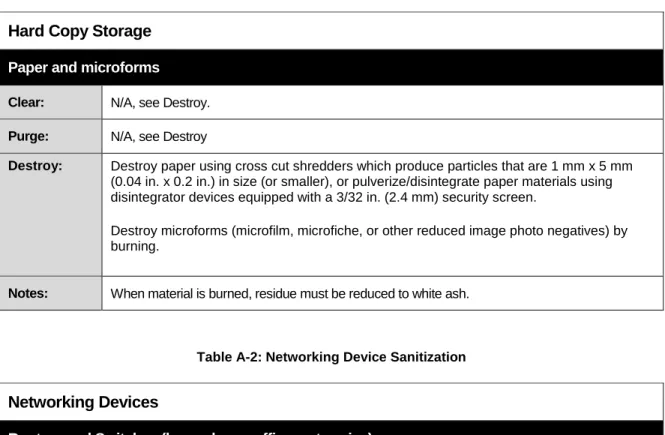
Table A-1: Hard Copy Storage Sanitization ... 27
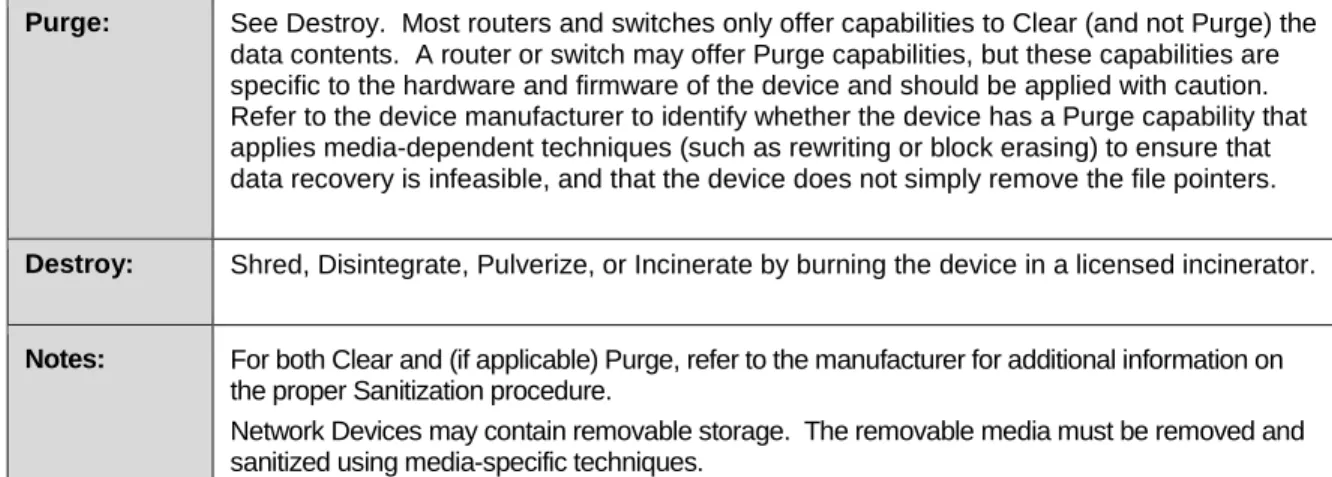
Table A-2: Networking Device Sanitization ... 27
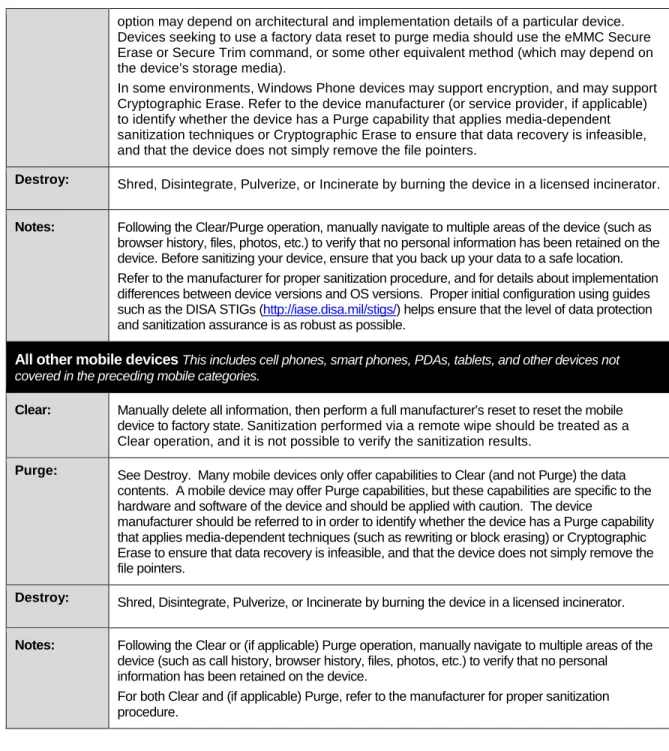
Table A-3: Mobile Device Sanitization ... 28
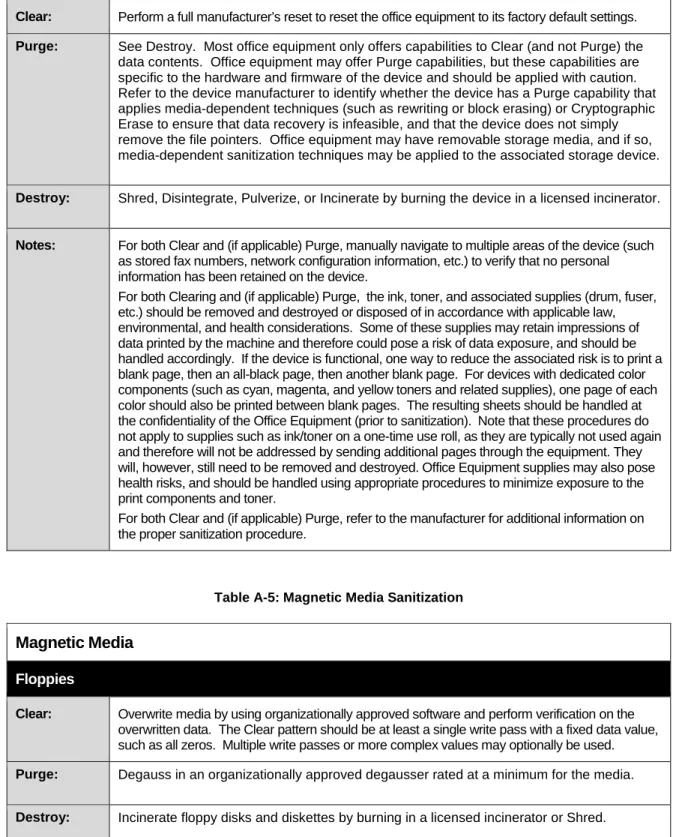
Table A-4: Equipment Sanitization ... 30
Table A-5: Magnetic Media Sanitization ... 31
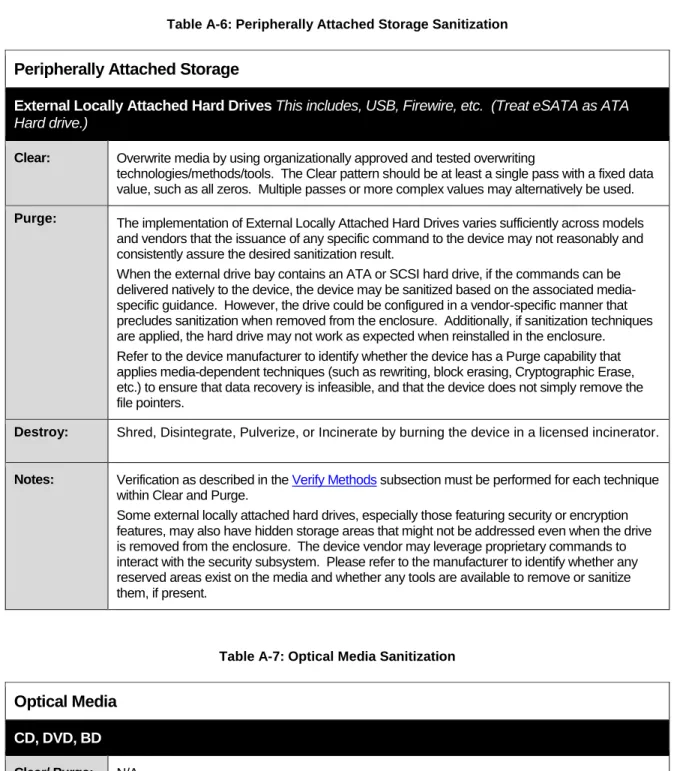
Table A-6: Peripherally Attached Storage Sanitization ... 35
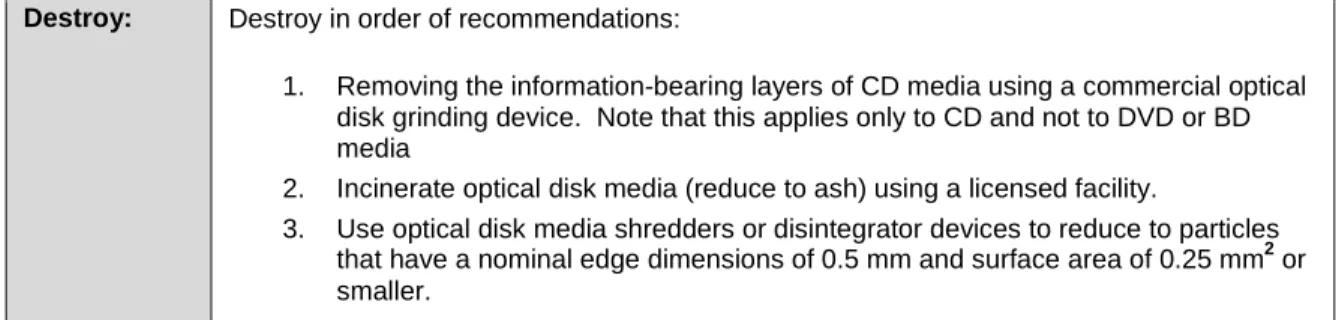
Table A-7: Optical Media Sanitization ... 35
Table A-8: Flash Memory-Based Storage Device Sanitization ... 36
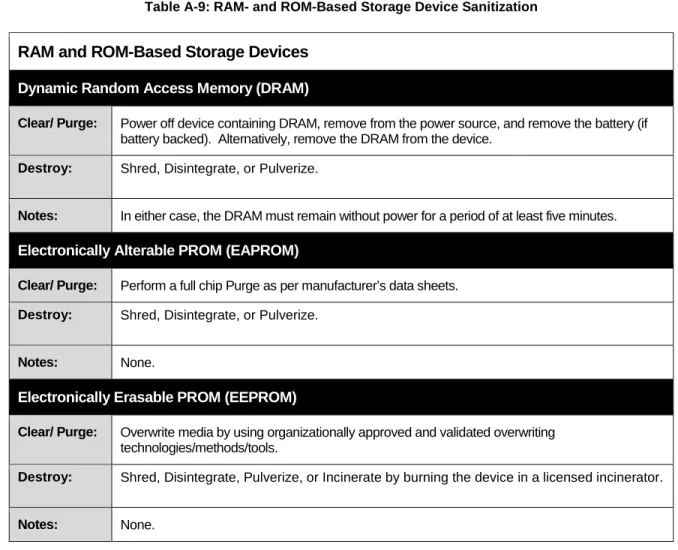
Table A-9: RAM- and ROM-Based Storage Device Sanitization ... 40
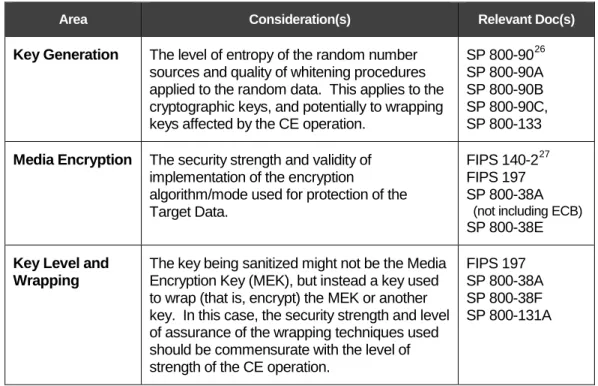
Table D-1: Cryptographic Erase Considerations ... 49
1 Introduction
1.1 Purpose and Scope
The information security concern regarding information disposal and media sanitization resides not in the media but in the recorded information. The issue of media disposal and sanitization is driven by the information placed intentionally or unintentionally on the media. Electronic media used on a system should be assumed to contain information commensurate with the security categorization of the system’s confidentiality. If not handled properly, release of these media could lead to an occurrence of unauthorized disclosure of information. Categorization of an information technology (IT) system in accordance with Federal Information Processing Standard (FIPS) 199, Standards for Security Categorization of Federal Information and Information Systems1, is the critical first step in understanding and managing system information and media. Based on the results of categorization, the system owner should refer to NIST Special
Publication (SP) 800-53 Revision 4, Security and Privacy Controls for Federal Information Systems and Organizations2, which specifies that “the organization sanitizes information system digital media using approved equipment, techniques, and procedures. The organization tracks, documents, and verifies media sanitization and destruction actions and periodically tests sanitization equipment/procedures to ensure correct performance. The organization sanitizes or destroys information system digital media before its disposal or release for reuse outside the organization, to prevent unauthorized individuals from gaining access to and using the information contained on the media.”
This document will assist organizations in implementing a media sanitization program with proper and applicable techniques and controls for sanitization and disposal decisions, considering the security categorization of the associated system’s confidentiality.
The objective of this special publication is to assist with decision making when media require disposal, reuse, or will be leaving the effective control of an organization. Organizations should develop and use local policies and procedures in conjunction with this guide to make effective, risk-based decisions on the ultimate sanitization and/or disposition of media and information. The information in this guide is best applied in the context of current technology and
applications. It also provides guidance for information disposition, sanitization, and control decisions to be made throughout the system life cycle. Forms of media exist that are not
addressed by this guide, and media are yet to be developed and deployed that are not covered by this guide. In those cases, the intent of this guide outlined in the procedures section applies to all forms of media based on the evaluated security categorization of the system’s confidentiality according to FIPS 199.
1
Federal Information Processing Standards (FIPS) Publication 199 Standards for Security Categorization of Federal Information and Information Systems, February 2004, 13 pp. http://csrc.nist.gov/publications/PubsFIPS.html#199. 2
NIST Special Publication (SP) 800-53 Revision 4, Security and Privacy Controls for Federal Information Systems and Organizations, April 2013 (includes updates as of January 15, 2014), 460 pp. http://dx.doi.org/10.6028/NIST.SP.800-53r4.
Before any media are sanitized, system owners are strongly advised to consult with designated officials with privacy responsibilities (e.g., Privacy Officers), Freedom of Information Act (FOIA) officers, and the local records retention office. This consultation is to ensure compliance with record retention regulations and requirements in the Federal Records Act. In addition, organizational management should also be consulted to ensure that historical information is captured and maintained where required by business needs. This should be ongoing, as controls may have to be adjusted as the system and its environment changes.
1.2 Audience
Protecting the confidentiality of information should be a concern for everyone, from federal agencies and businesses to home users. Recognizing that interconnections and information exchange are critical in the delivery of government services, this guide can be used to assist in deciding what processes to use for sanitization or disposal.
1.3 Assumptions
The premise of this guide is that organizations are able to correctly identify the appropriate information categories, confidentiality impact levels, and location of the information. Ideally, this activity is accomplished in the earliest phase of the system life cycle.3 This critical initial step is outside the scope of this document, but without this identification, the organization will, in all likelihood, lose control of some media containing sensitive information.
This guide does not claim to cover all possible media that an organization could use to store information, nor does it attempt to forecast the future media that may be developed during the effective life of this guide. Users are expected to make sanitization and disposal decisions based on the security categorization of the information contained on the media.
1.4 Relationship to Other NIST Documents
The following NIST documents, including FIPS and Special Publications, are directly related to this document:
FIPS 199 and NIST SP 800-60 Revision 1, Guide for Mapping Types of Information and Information Systems to Security Categories4, provide guidance for establishing the security categorization for a system’s confidentiality. This categorization will impact the level of assurance an organization should require in making sanitization decisions.
3
NIST SP 800-64 Revision 2, Security Considerations in the Systems Development Life Cycle, October 2008, 67 pp.
http://csrc.nist.gov/publications/PubsSPs.html#800-64.
4
NIST SP 800-60 Revision 1, Guide for Mapping Types of Information and Information Systems to Security Categories, August 2008, 2 vols. http://csrc.nist.gov/publications/PubsSPs.html#800-60.
FIPS 200, Minimum Security Requirements for Federal Information and Information Systems5, sets a base of security requirements that requires organizations to have a media sanitization program.
FIPS 140-2, Security Requirements for Cryptographic Modules6, establishes a standard for cryptographic modules used by the U.S. Government.
NIST SP 800-53 Revision 4 provides minimum recommended security controls, including sanitization, for Federal systems based on their overall system security categorization.
NIST SP 800-53A Revision 1, Guide for Assessing the Security Controls in Federal Information Systems and Organizations: Building Effective Security Assessment Plans7, provides guidance for assessing security controls, including sanitization, for federal systems based on their overall system security categorization.
NIST SP 800-111, Guide to Storage Encryption Technologies for End User Devices8, provides guidance for selecting and using storage encryption technologies.
NIST SP 800-122, Guide to Protecting the Confidentiality of Personally Identifiable Information (PII)9, provides guidance for protecting the confidentiality of personally identifiable information in information systems.
1.5 Document Structure
The guide is divided into the following sections and appendices:
Section 1 (this section) explains the authority, purpose and scope, audience, assumptions of the document, relationships to other documents, and outlines its structure.
Section 2 presents an overview of the need for sanitization and the basic types of information, sanitization, and media.
5
FIPS 200, Minimum Security Requirements for Federal Information and Information Systems, March 2006, 17 pp.
http://csrc.nist.gov/publications/PubsFIPS.html#200. 6
FIPS 140-2, Security Requirements for Cryptographic Modules, May 25, 2001 (includes change notices through December 3, 2002), 69 pp. http://csrc.nist.gov/publications/PubsFIPS.html#140-2.
7
NIST SP 800-53A Revision 1, Guide for Assessing the Security Controls in Federal Information Systems and Organizations: Building Effective Security Assessment Plans, June 2010, 399 pp. http://csrc.nist.gov/publications/PubsSPs.html#800-53A. 8
NIST SP 800-111, Guide to Storage Encryption Technologies for End User Devices, November 2007, 40 pp.
http://csrc.nist.gov/publications/PubsSPs.html#800-111. 9
NIST SP 800-122, Guide to Protecting the Confidentiality of Personally Identifiable Information (PII), April 2010, 59 pp.
http://csrc.nist.gov/publications/PubsSPs.html#800-122.
Section 3 provides an overview of relevant roles and responsibilities for the management of data throughout its lifecycle.
Section 4 provides the user with a process flow to assist with sanitization decision making.
Section 5 summarizes some general sanitization techniques.
Appendix A specifies the minimum recommended sanitization techniques to Clear, Purge, or Destroy various media. This appendix is used with the decision flow chart provided in Section 4.
Appendix B defines terms used in this guide.
Appendix C lists tools and external resources that can assist with media sanitization.
Appendix D contains considerations for selecting a storage device implementing Cryptographic Erase.
Appendix E identifies a set of device-specific characteristics of interest that users should request from storage device vendors.
Appendix F contains a bibliography of sources and correspondence that was essential in developing this guide.
Appendix G provides a sample certificate of sanitization form for documenting an organization’s sanitization activities.
2 Background
Information disposition and sanitization decisions occur throughout the information system life cycle. Critical factors affecting information disposition and media sanitization are decided at the start of a system’s development. The initial system requirements should include hardware and software specifications as well as interconnections and data flow documents that will assist the system owner in identifying the types of media used in the system. Some storage devices support enhanced commands for sanitization, which may make sanitization easier, faster, and/or more effective. The decision may be even more fundamental, because effective sanitization procedures may not yet have been determined for emerging media types. Without an effective command or interface-based sanitization technique, the only option left may be to destroy the media. In that event, the media cannot be reused by other organizations that might otherwise have been able to benefit from receiving the repurposed storage device.
A determination should be made during the requirements phase about what other types of media will be used to create, capture, or transfer information used by the system. This analysis,
balancing business needs and risk to confidentiality, will formalize the media that will be considered for the system to conform to FIPS 200.
Media sanitization and information disposition activity is usually most intense during the disposal phase of the system life cycle. However, throughout the life of an information system, many types of media, containing data, will be transferred outside the positive control of the organization. This activity may be for maintenance reasons, system upgrades, or during a configuration update.
2.1 Need for Proper Media Sanitization and Information Disposition
Media sanitization is one key element in assuring confidentiality. Confidentiality is defined as “preserving authorized restrictions on information access and disclosure, including means for protecting personal privacy and proprietary information…”10 Additionally, “a loss of
confidentiality is the unauthorized disclosure of information.”11
In order for organizations to have appropriate controls on the information they are responsible for safeguarding, they must properly safeguard used media. An often rich source of illicit information collection is either through dumpster diving for improperly disposed hard copy media, acquisition of improperly sanitized electronic media, or through keyboard and laboratory reconstruction of media sanitized in a manner not commensurate with the confidentiality of its information. Media flows in and out of organizational control through recycle bins in paper form, out to vendors for equipment repairs, and hot swapped into other systems in response to
hardware or software failures. This potential vulnerability can be mitigated through proper understanding of where information is located, what that information is, and how to protect it.
10
“Definitions,” Title 44 U.S.Code, Sec. 3542. 2006 ed. Supp. 5. Available: http://www.gpo.gov/; accessed 7/21/2014. 11
FIPS 199, p.2.
2.2 Types of Media
There are two primary types of media in common use:
Hard Copy. Hard copy media are physical representations of information, most often associated with paper printouts. However, printer and facsimile ribbons, drums, and platens are all examples of hard copy media. The supplies associated with producing paper printouts are often the most uncontrolled. Hard copy materials containing sensitive data that leave an organization without effective sanitization expose a significant
vulnerability to “dumpster divers” and overcurious employees, risking unwanted information disclosures.
Electronic (i.e., “soft copy”). Electronic media are devices containing bits and bytes such as hard drives, random access memory (RAM), read-only memory (ROM), disks, flash memory, memory devices, phones, mobile computing devices, networking devices, office equipment, and many other types listed in Appendix A.
In the future, organizations will be using media types not specifically addressed by this guide. The processes described in this document should guide media sanitization decision making regardless of the type of media in use. To effectively use this guide for all media types, organizations and individuals should focus on the information that could possibly have been recorded on the media, rather than on the media itself.
2.3 Trends in Data Storage Media
Historical efforts to sanitize magnetic media have benefitted from the wide use of a single common type of storage medium implemented relatively similarly across vendors and models. The storage capacity of magnetic media has increased at a relatively constant rate and vendors have modified the technology as necessary to achieve higher capacities. As the technology approaches the superparamagnetic limit, or the limit at which magnetic state can be changed with existing media and recording approaches, additional new approaches and technologies will be necessary in order for storage vendors to produce higher capacity devices.
Alternative technologies such as flash memory-based storage devices, or Solid State Drives (SSDs), have also become prevalent due to falling costs, higher performance, and shock resistance. SSDs have already begun changing the norm in storage technology, and—at least from a sanitization perspective—the change is revolutionary (as opposed to evolutionary). Degaussing, a fundamental way to sanitize magnetic media, no longer applies in most cases for flash memory-based devices. Evolutionary changes in magnetic media will also have potential impacts on sanitization. New storage technologies, and even variations of magnetic storage, that are dramatically different from legacy magnetic media will clearly require sanitization research and require a reinvestigation of sanitization procedures to ensure efficacy.
Both revolutionary and evolutionary changes make sanitization decisions more difficult, as the storage device may not clearly indicate what type of media is used for data storage. The burden falls on the user to accurately determine the media type and apply the associated sanitization procedure.
2.4 Trends in Sanitization
For storage devices containing magnetic media, a single overwrite pass with a fixed pattern such as binary zeros typically hinders recovery of data even if state of the art laboratory techniques are applied to attempt to retrieve the data. One major drawback of relying solely upon the native Read and Write interface for performing the overwrite procedure is that areas not currently mapped to active Logical Block Addressing (LBA) addresses (e.g., defect areas and currently unallocated space) are not addressed. Dedicated sanitize commands support addressing these areas more effectively. The use of such commands results in a tradeoff because although they should more thoroughly address all areas of the media, using these commands also requires trust and assurance from the vendor that the commands have been implemented as expected.
Users who have become accustomed to relying upon overwrite techniques on magnetic media and who have continued to apply these techniques as media types evolved (such as to flash memory-based devices) may be exposing their data to increased risk of unintentional disclosure. Although the host interface (e.g. Advanced Technology Attachment (ATA) or Small Computer System Interface (SCSI)) may be the same (or very similar) across devices with varying
underlying media types, it is critical that the sanitization techniques are carefully matched to the media.
Destructive techniques for some media types may become more difficult or impossible to apply in the future. Traditional techniques such as degaussing (for magnetic media) become more complicated as magnetic media evolves, because some emerging variations of magnetic recording technologies incorporate media with higher coercivity (magnetic force). As a result, existing degaussers may not have sufficient force to effectively degauss such media.
Applying destructive techniques to electronic storage media (e.g., flash memory) is also becoming more challenging, as the necessary particle size for commonly applied grinding techniques goes down proportionally to any increases in flash memory storage density. Flash memory chips already present challenges with occasional damage to grinders due to the hardness of the component materials, and this problem will get worse as grinders attempt to grind the chips into even smaller pieces.
Cryptographic Erase (CE), as described in Section 2.6, is an emerging sanitization technique that can be used in some situations when data is encrypted as it is stored on media. With CE, media sanitization is performed by sanitizing the cryptographic keys used to encrypt the data, as opposed to sanitizing the storage locations on media containing the encrypted data itself. CE techniques are typically capable of sanitizing media very quickly and could support partial sanitization, a technique where a subset of storage media is sanitization. Partial sanitization, sometimes referred to as selective sanitization, has potential applications in cloud computing and mobile devices. However, operational use of CE today presents some challenges. In some cases, it may be difficult to verify that CE has effectively sanitized media. This challenge, and possible approaches, is described in Section 4.7.3. If verification cannot be performed, organizations should use alternative sanitization methods that can be verified, or use CE in combination with a sanitization technique that can be verified.
included in Appendix E. These characteristics can be used to drive the types of questions that media users should ask vendors, but ideally this information would be made readily available by vendors so that it can be easily retrieved by users to facilitate informed risk based sanitization decisions. For example, knowing the coercivity of the media can help a user decide whether or not the available degausser(s) can effectively degauss the media.
2.5 Types of Sanitization
Regarding sanitization, the principal concern is ensuring that data is not unintentionally released. Data is stored on media, which is connected to a system. This guidance focuses on the media sanitization component, which is simply data sanitization applied to a representation of the data as stored on a specific media type. Other potential concern areas exist as part of the system, such as for monitors, which may have sensitive data burned into the screen. Sensitive data stored in areas of the system other than storage media (such as on monitor screens) are not addressed by this document.
When media is repurposed or reaches end of life, the organization executes the system life cycle sanitization decision for the information on the media. For example, a mass-produced
commercial software program contained on a DVD in an unopened package is unlikely to contain confidential data. Therefore, the decision may be made to simply dispose of the media without applying any sanitization technique. Alternatively, an organization is substantially more likely to decide that a hard drive from a system that processed PII needs sanitization prior to Disposal.
Disposal without sanitization should be considered only if information disclosure would have no impact on organizational mission, would not result in damage to organizational assets, and would not result in financial loss or harm to any individuals.
The security categorization of the information, along with internal environmental factors, should drive the decisions on how to deal with the media. The key is to first think in terms of
information confidentiality, then apply considerations based on media type.
In organizations, information exists that is not associated with any categorized system. This information is often hard copy internal communications such as memoranda, white papers, and presentations. Sometimes this information may be considered sensitive. Examples may include internal disciplinary letters, financial or salary negotiations, or strategy meeting minutes. Organizations should label these media with their internal operating confidentiality levels and associate a type of sanitization described in this publication.
Sanitization is a process to render access to target data (the data subject to the sanitization
technique) on the media infeasible for a given level of recovery effort. The level of effort applied when attempting to retrieve data may range widely. For example, a party may attempt simple keyboard attacks without the use of specialized tools, skills, or knowledge of the media
characteristics. On the other end of the spectrum, a party may have extensive capabilities and be able to apply state of the art laboratory techniques.
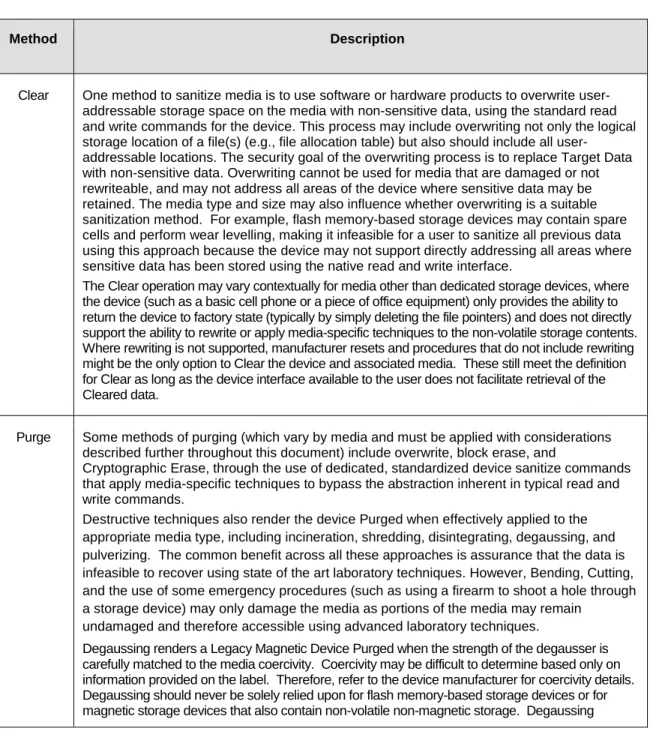
Clear, Purge, and Destroy are actions that can be taken to sanitize media. The categories of sanitization are defined as follows:
Clear applies logical techniques to sanitize data in all user-addressable storage locations for protection against simple non-invasive data recovery techniques; typically applied through the standard Read and Write commands to the storage device, such as by
rewriting with a new value or using a menu option to reset the device to the factory state (where rewriting is not supported).
Purge applies physical or logical techniques that render Target Data recovery infeasible using state of the art laboratory techniques.
Destroy renders Target Data recovery infeasible using state of the art laboratory techniques and results in the subsequent inability to use the media for storage of data.
A more detailed summary of sanitization techniques is provided in Section 5. Sanitization requirements for specific media/device types are provided in Appendix A.
It is suggested that the user of this guide categorize the information, assess the nature of the medium on which it is recorded, assess the risk to confidentiality, and determine the future plans for the media. Then, the organization can choose the appropriate type(s) of sanitization. The selected type(s) should be assessed as to cost, environmental impact, etc., and a decision should be made that best mitigates the risk to confidentiality and best satisfies other constraints imposed on the process.
2.6 Use of Cryptography and Cryptographic Erase
Many storage manufacturers have released storage devices with integrated encryption and access control capabilities, also known as Self-Encrypting Drives (SEDs). SEDs feature always-on encryption that substantially reduces the likelihood that unencrypted data is inadvertently
retained on the device. The end user cannot turn off the encryption capabilitieswhich ensures that all data in the designated areas are encrypted. A significant additional benefit of SEDs is the opportunity to tightly couple the controller and storage media so that the device can directly address the location where any cryptographic keys are stored, whereas solutions that depend only on the abstracted user access interface through software may not be able to directly address those areas.
SEDs typically encrypt all of the user-addressable area, with the potential exception of certain clearly identified areas, such as those dedicated to the storage of pre-boot applications and associated data.
Cryptographic Erase (CE) leverages the encryption of target data by enabling sanitization of the target data’s encryption key. This leaves only the ciphertext remaining on the media, effectively sanitizing the data by preventing read-access.
Without the encryption key used to encrypt the target data, the data is unrecoverable. The level of effort needed to decrypt this information without the encryption key then is the lesser of the
strength of the cryptographic key or the strength of the cryptographic algorithm and mode of operation used to encrypt the data.
If strong cryptography is used, sanitization of the target data is reduced to sanitization of the encryption key(s) used to encrypt the target data. Thus, with CE, sanitization may be performed with high assurance much faster than with other sanitization techniques. The encryption itself acts to sanitize the data, subject to constraints identified in this guidelines document. Federal agencies must use FIPS 140 validated encryption modules12 in order to have assurance that the conditions stated above have been verified for the SED.
Typically, CE can be executed in a fraction of a second. This is especially important as storage devices get larger resulting in other sanitization methods take more time. CE can also be used as a supplement or addition to other sanitization approaches.
2.6.1 When Not To Use CE To Purge Media
Do not use CE to purge media if the encryption was enabled after sensitive data was stored on the device without having been sanitized first.
Do not use CE if it is unknown whether sensitive data was stored on the device without being sanitized prior to encryption.
2.6.2 When to Consider Using CE
Consider using CE when all data intended for CE is encrypted prior to storage on the media (including the data, as well as virtualized copies).
Consider using CE when we know the location(s) on the media where the encryption key is stored (be it the target data's encryption key or an associated wrapping key) and can sanitize those areas using the appropriate media-specific sanitization technique, ensuring the actual location on media where the key is stored is addressed.
Consider using CE when we can know that all copies of the encryption keys used to encrypt the target data are sanitized
Consider using CE when the target data's encryption keys are, themselves, encrypted with one or more wrapping keys and we are confident that we can sanitize the corresponding wrapping keys.
Consider using CE when we are confident of the ability of the user to clearly identifyand use the commands provided by the device to perform the CE operation.
12
NIST maintains lists of validated cryptographic modules (http://csrc.nist.gov/groups/STM/cmvp/validation.html) and cryptographic algorithms (http://csrc.nist.gov/groups/STM/cavp/validation.html).
2.6.3 Additional CE Considerations
If the encryption key exists outside of the storage device (typically due to backup or escrow), there is a possibility that the key could be used in the future to recover data stored on the encrypted media.
CE should only be used as a sanitization method when the organization has confidence that the encryption keys used to encrypt the Target Data have been appropriately protected. Such assurances can be difficult to obtain with software cryptographic modules, such as those used with software-based full disk encryption solutions, as these products typically store cryptographic keys in the file system or other locations on media which are accessible to software. While there may be situations where use of CE with software cryptographic modules is both appropriate and advantageous, such as performing a quick remote wipe on a lost mobile device, unless the organization has confidence in both the protection of the encryption keys, and the destruction of all copies of those keys in the sanitization process, CE should be used in combination with another appropriate sanitization method.
Sanitization using CE should not be trusted on devices that have been backed-up or escrowed the key(s) unless the organization has a high level of confidence about how and where the keys were stored and managed outside the device. Such back-up or escrowed copies of data, credentials, or keys should be the subject of a separate device sanitization policy. That policy should address backups or escrowed copies within the scope of the devices on which they are actually stored.
A list of applicable considerations, and a sample for how vendors could report the mechanisms implemented, is included in Appendix E. Users seeking to implement CE should seek reasonable assurance from the vendor (such as the vendor’s report as described in Appendix E) that the considerations identified here have been addressed and only use FIPS 140 validated cryptographic modules.
2.7 Factors Influencing Sanitization and Disposal Decisions
Several factors should be considered along with the security categorization of the system confidentiality when making sanitization decisions. The cost versus benefit tradeoff of a sanitization process should be understood prior to a final decision. For instance, it may not be cost-effective to degauss inexpensive media such as diskettes. Even though Clear or Purge may be the recommended solution, it may be more cost-effective (considering training, tracking, and verification, etc.) to destroy media rather than use one of the other options. Organizations retain the ability increase the level of sanitization applied if that is reasonable and indicated by an assessment of the existing risk.
Organizations should consider environmental factors including (but not limited to):
What types (e.g., optical non-rewritable, magnetic) and size (e.g., megabyte, gigabyte, and terabyte) of media storage does the organization require to be sanitized?
Will the media be processed in a controlled area?
Should the sanitization process be conducted within the organization or outsourced?
What is the anticipated volume of media to be sanitized by type of media? 13
What is the availability of sanitization equipment and tools?
What is the level of training of personnel with sanitization equipment/tools?
How long will sanitization take?
What is the cost of sanitization when considering tools, training, verification, and re-entering media into the supply stream?
2.8 Sanitization Scope
For most sanitization operations, the target of the operation is all data stored on the media by the user. However, in some cases, there may be a desire or need to sanitize a subset of the media. Partial sanitization comes with some risk, as it may be difficult to verify that sensitive data stored on a portion of the media did not spill over into other areas of the media (e.g., remapped bad blocks). In addition, the dedicated interfaces provided by storage device vendors for sanitization typically operate at the device level, and are not able to be applied to a subset of the media. As a result, partial sanitization usually depends on the typical read and write commands available to the user, which may not be able to bypass any interface abstraction that may be present in order to directly address the media area of concern.
On some storage devices featuring integrated encryption capabilities, CE provides a unique mechanism for supporting some forms of partial sanitization. Some of these devices support the ability to encrypt portions of the data with different encryption keys (e.g., encrypting different partitions with different encryption keys). When the interface supports sanitizing only a subset of the encryption keys, partial sanitization via CE is possible. As with any other sanitization
technique applied to media, the level of assurance depends both upon vendor implementation and on the level of assurance that data was stored only in the areas that are able to be reliably
sanitized. Data may be stored outside these regions either because the user or software on the system moved data outside of the designated area on the media, or because the storage device stored data to the media in a manner not fully understood by the user.
Due to the difficulty in reliably ensuring that partial sanitization effectively addresses all sensitive data, sanitization of the whole device is preferred to partial sanitization whenever possible. Organizations should understand the potential risks to this approach and make appropriate decisions on this technique balancing the factors described earlier in this sectionas
13 NIST SP 800-36, Guide to Selecting Information Technology Security Products, October 2003, 67 pp.
http://csrc.nist.gov/publications/PubsSPs.html#800-36.
well as their business missions and specific use cases. For example, a drive in a datacenter may contain customer data from multiple customers. When one customer discontinues service and another begins storing data on the same media, the organization may choose to apply partial sanitization in order to retain the data of other customers that is also stored on the same storage device on other areas of the media. The organization may choose to apply partial sanitization because the drive remains in the physical possession of the organization, access by the customer is limited to the interface commands, and the organization has trust in the partial sanitization mechanism available for that specific piece of media. In cases where the alternative to partial sanitization is not performing sanitization at all, partial sanitization provides benefits that should be considered.
3 Roles and Responsibilities
3.1 Program Managers/Agency Heads
“Ultimately, responsibility for the success of an organization lies with its senior managers.”14 By establishing an effective information security governance structure, they establish the
organization’s computer security program and its overall program goals, objectives, and priorities in order to support the mission of the organization. Ultimately, the head of the
organization is responsible for ensuring that adequate resources are applied to the program and for ensuring program success. Senior management is responsible for ensuring that the resources are allocated to correctly identify types and locations of information and to ensure that resources are allocated to properly sanitize the information.
The other responsibilities in the remainder of this section are for illustrative purposes and the intent is to ensure that organizations think through the different responsibilities for sanitizing media and assign those responsibilities appropriately.
3.2 Chief Information Officer (CIO)
The CIO15 is charged with promulgating information security policy. A component of this policy is information disposition and media sanitization. The CIO, as the information custodian, is responsible for ensuring that organizational or local sanitization requirements follow the guidelines of this document.
3.3 Information System Owner
The information system owner16 should ensure that maintenance or contractual agreements are in place and are sufficient in protecting the confidentiality of the system media and information commensurate with the impact of disclosure of such information on the organization.
3.4 Information Owner/Steward
The information owner should ensure that appropriate supervision of onsite media maintenance by service providers occurs, when necessary. The information owner is also responsible for ensuring that they fully understand the sensitivity of the information under their control and that the users of the information are aware of its confidentiality and the basic requirements for media sanitization.
14
NIST SP 800-18 Revision 1, Guide for Developing Security Plans for Federal Information Systems, February 2006, 16.
http://csrc.nist.gov/publications/PubsSPs.html#800-18. 15
Per the Information Technology Management Reform Act of 1996 (“Clinger-Cohen Act”; P.L. 104-106 (Division E) 10 Feb. 1996), when an agency has not designated a formal CIO position, FISMA requires the associated responsibilities to be handled by a comparable agency official.
16The role of the information system owner can be interpreted in a variety of ways depending on the particular agency and the system development life-cycle phase of the information system. Some agencies may refer to the information system owners as “program managers” or “business/asset/mission owners”.
3.5 Senior Agency Information Security Officer (SAISO)
The SAISO is responsible for ensuring that the requirements of the information security policy with regard to information disposition and media sanitization are implemented and exercised in a timely and appropriate manner throughout the organization. The SAISO also requires access to the technical basis/personnel to understand and properly implement the sanitization procedures.
3.6 System Security Manager/Officer
Often assisting system management officials in this effort is a system security manager/officer responsible for day-today security implementation/administration duties. Although not normally part of the computer security program management office, this person is responsible for
coordinating the security efforts of a particular system(s). This role is sometimes referred to as the Computer System Security Officer or the Information System Security Officer.
3.7 Property Management Officer
The property management officer is responsible for ensuring that sanitized media and devices that are redistributed within the organization, donated to external entities or destroyed are properly accounted for.
3.8 Records Management Officer
The records management officer is responsible for advising the system and/or data owner or custodian of retention requirements that must be met so the sanitization of media will not destroy records that should be preserved.
3.9 Privacy Officer
The privacy officer is responsible for providing advice regarding the privacy issues surrounding the disposition of privacy information and the media upon which it is recorded.
3.10 Users
Users have the responsibility for knowing and understanding the confidentiality of the information they are using to accomplish their assigned work and ensure proper handling of information.
4 Information Sanitization and Disposition Decision Making
An organization may maintain storage devices with differing levels of confidentiality, and it is important to understand what types of data may be stored on the device in order to apply the techniques that best balance efficiency and efficacy to maintain the confidentiality of the data. Data confidentiality level should be identified using procedures described in FIPS 199.
Additional information is available on mapping information types to security categories in SP 800-60 Revision 1.
While most devices support some form of Clear, not all devices have a reliable Purge
mechanism. For moderate confidentiality data, the media owner may choose to accept the risk of applying Clear techniques to the media, acknowledging that some data may be able to be
retrieved by someone with the time, knowledge, and skills to do so.
Purge (and Clear, where applicable) may be more appropriate than Destroy when factoring in environmental concerns, the desire to reuse the media (either within the organization or by selling or donating the media), the cost of a media or media device, or difficulties in physically Destroying some types of media.
The risk decision should include the potential consequence of disclosure of information retrievable from the media, the cost of information retrieval and its efficacy, and the cost of sanitization and its efficacy. Additionally, the length of time the data will remain sensitive should also be considered. These values may vary between different environments.
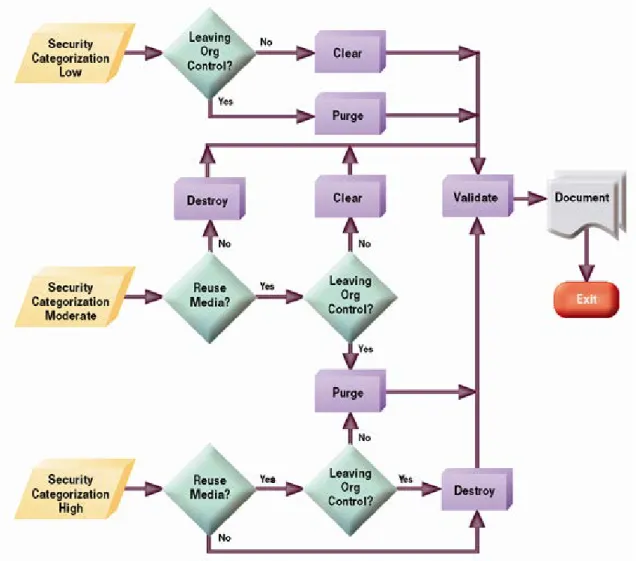
Organizations can use Figure 4-1 with the descriptions in this section to assist them in making sanitization decisions that are commensurate with the security categorization of the
confidentiality of information contained on their media. The decision process is based on the confidentiality of the information, not the type of media. Once organizations decide what type of sanitization is best for their individual case, then the media type will influence the technique used to achieve this sanitization goal.
Figure 4-1: Sanitization and Disposition Decision Flow
4.1 Information Decisions in the System Life Cycle
The need for, and methods to conduct, media sanitization should be identified and developed before arriving at the Disposal phase in the system life cycle. At the start of system development, when the initial system security plan is developed17, media sanitization controls are developed, documented, and deployed. One of the key decisions that will affect the ability to conduct sanitization is choosing what media are going to be used within the system. Although this is
17
NIST SP 800-18 Revision 1, p.19.
mostly a business decision, system owners must understand early on that this decision affects the types of resources needed for sanitization throughout the rest of the system life cycle.
An organization may ask a product vendor for assistance in identifying storage media that may contain sensitive data. This information is typically documented in a ‘statement of volatility’. The statement may be used to support decisions about which equipment to purchase, based on the ease or difficulty of sanitization. While volatility statements are useful, caution should be applied in comparing statements across vendors because vendors may state volatility details differently.
Organizations should take care in identifying media for sanitization. Many items used will contain multiple forms of media that may require different methods of sanitization. For example, a desktop computer may contain a hard drive, motherboard, RAM, and ROM, and mobile
devices contain on-board volatile memory as well as nonvolatile removable memory. The increasing availability of rapidly applicable techniques, such as Cryptographic Erase, provides opportunities for organizations to reduce the risk of inadvertent disclosure by
combining sanitization technologies and techniques. For example, an organization could choose to apply Cryptographic Erase at a user’s desktop before removing the media to send it to be ‘formally’ sanitized at the sanitization facility, in order to reduce risk and exposure.
4.2 Determination of Security Categorization
Early in the system life cycle, a system is categorized using the guidance found in FIPS 199, NIST SP 800-60 Rev. 1, or CNSSI 125318, including the security categorization for the system’s confidentiality. This security categorization is revisited at least every three years (or when significant change occurs within the system) and revalidated throughout the system’s life, and any necessary changes to the confidentiality category can be made. Once the security
categorization is completed, the system owner can then design a sanitization process that will ensure adequate protection of the system’s information.
Much information is not associated with a specific system but is associated with internal business communications, usually on paper. Organizations should label these media with their internal operating confidentiality levels and associate a type of sanitization described in this publication.
4.3 Reuse of Media
A key decision on sanitization is whether the media are planned for reuse or recycle. Some forms of media are often reused to conserve an organization’s resources.
If media are not intended for reuse either within or outside an organization due to damage or other reason, the simplest and most cost-effective method of control may be Destroy.
18
Committee on National Security Systems (CNSS) Instruction 1253, Security Categorization and Control Selection for National Security Systems, March 27, 2014. https://www.cnss.gov/CNSS/issuances/Instructions.cfm.
4.4 Control of Media
A factor influencing an organizational sanitization decision is who has control and access to the media. This aspect must be considered when media leaves organizational control. Media control may be transferred when media are returned from a leasing agreement or are being donated or resold to be reused outside the organization. The following are examples of media control:
Under Organization Control:
Media being turned over for maintenance are still considered under organization control if contractual agreements are in place with the organization and the maintenance provider specifically provides for the confidentiality of the information.
Maintenance being performed on an organization’s site, under the organization’s supervision, by a maintenance provider is also considered under the control of the organization.
Not Under Organization Control (External Control):
Media that are being exchanged for warranty, cost rebate, or other purposes and where the specific media will not be returned to the organization are considered to be out of organizational control.
4.5 Data Protection Level
Even within an organization, varying data protection policies may be established. For instance, a company may have an engineering department and a sales department. The sales personnel may not have a need for access to the detailed proprietary technical data such as source code and schematics, and the engineers may not have a need to access the PII of the company’s customers. Both might be within the same confidentiality categorization, but contextually different and with different internal and external rules regarding necessary controls. As such, data protection level is a complementary consideration to organizational control. When identifying whether
sanitization is necessary, both the organizational control and data protection level should be considered.
4.6 Sanitization and Disposal Decision
Once an organization completes an assessment of its system confidentiality, determines the need for information sanitization, determines appropriate time frames for sanitization, and determines the types of media used and the media disposition, an effective, risk-based decision can be made on the appropriate and needed level of sanitization. Again, environmental factors and media type might cause the level of sanitization to change. For example, purging paper copies generally does not make sense, so destroying them would be an acceptable alternative.
Upon completion of sanitization decision making, the organization should record the decision and ensure that a process and proper resources are in place to support these decisions. This process is often the most difficult piece of the media sanitization process because it includes not only the act of sanitization but also the verification: capturing decisions and actions, identifying resources, and having critical interfaces with key officials.
4.7 Verify Methods
Verifying the selected information sanitization and disposal process is an essential step in maintaining confidentiality. Two types of verification should be considered. The first is
verification every time sanitization is applied (where applicable, as most Destroy techniques do not support practical verification for each sanitized piece of media). The second is a
representative sampling verification, applied to a selected subset of the media. If possible, the sampling should be executed by personnel who were not part of the original sanitization action. If sampling is done after full verification in cases of low risk tolerance then a different
verification tool than the one used in the original verification should be used.
4.7.1 Verification of Equipment
Verification of the sanitization process is not the only assurance required by the
organization. If the organization is using sanitization tools (e.g., a degausser or a dedicated workstation), then equipment calibration, as well as equipment testing, and scheduled maintenance, is also needed.
4.7.2 Verification of Personnel Competencies
Another key element is the potential training needs and current expertise of personnel conducting the sanitization. Organizations should ensure that equipment operators are competent to perform sanitization functions.
4.7.3 Verification of Sanitization Results
The goal of sanitization verification is to ensure that the target data was effectively sanitized. When supported by the device interface (such as an ATA or SCSI storage device or solid state drive), the highest level of assurance of effective sanitization (outside of a laboratory) is typically achieved by a full reading of all accessible areas to verify that the expected sanitized value is in all addressable locations. A full verification should be performed if time and external factors permit. This manner of verification typically only applies where the device is in an operational state following sanitization so that data can be read and written through the native interface.
If an organization chooses representative sampling then there are three main goals applied to electronic media sanitization verification:
1. Select pseudorandom locations on the media each time the analysis tool is applied. This reduces the likelihood that a sanitization tool that only sanitizes a subset of the media will result in verification success in a situation where sensitive data still remains.
2. Select locations across the addressable space (user addressable and reserved areas). For instance, conceptually break the media up into equally sized subsections. Select a large enough number of subsections so that the media is well-covered. The number of practical subsections depends on the device and addressing scheme. The
addressing is one thousand. Select at least two non-overlapping pseudorandom locations from within each subsection. For example, if one thousand conceptual subsections are chosen, at least two pseudorandom locations in the first thousandth of the media addressing space would be read and verified, at least two pseudorandom locations in the second thousandth of the media addressing space would be read and verified, and so on.
a. In addition to the locations already identified, include the first and last addressable location on the storage device.
3. Each consecutive sample location (except the ones for the first and last addressable location) should cover at least 5 % of the subsection and not overlap the other sample in the subsection. Given two non-overlapping samples, the resulting verification should cover at least 10 % of the media once all subsections have had two samples taken.
Cryptographic Erase has different verification considerations than procedures such as rewriting or block erasing, because the contents of the physical media following
Cryptographic Erase may not be known and therefore cannot be compared to a given value. When Cryptographic Erase is leveraged, there are multiple options for verification, and each uses a quick review of a subset of the media. Each involves a selection of pseudorandom locations to be sampled from across the media.
The first option is to read the pseudorandom locations prior to Cryptographic Erase, and then again following Cryptographic Erase to compare the results. This is likely the most effective verification technique. Another option is to search for strings across the media or looking for files that are in known locations, such as operating system files likely to be stored in a specific area.
The number of locations and size of each sample should take into consideration the risks in transferring the Target Data to the storage media of the machine hosting the sanitization application. As a result, the proportion of the media covered by verification for the Cryptographic Erase technique may be relatively small (or at least lower than the above guidance of 10 % for verification of non-cryptographic sanitization techniques), but should still be applied across a wide range of the addressable area.
However, these techniques may not always be available because the individual performing the sanitization may not have the authentication token needed to access and read the data stored on the drive. If an organization cannot verify that CE effectively sanitized storage media, organizations should employ an alternative sanitization method that can be verified, either in combination with CE or in place of CE.
As part of the sanitization process, in addition to the verification performed on each piece of media following the sanitization operation, a subset of media items should be selected at random for secondary verification using a different verification tool. The secondary verification tool should be from a separate developer. For the secondary verification, a full verification should be performed. At least 20 % of sanitized media (by number of media
items sanitized) should be verified. The secondary verification provides assurance that the primary operation is working as expected.
4.8 Documentation
Following sanitization, a certificate of media disposition should be completed for each piece of electronic media that has been sanitized. A certification of media disposition may be a piece of paper or an electronic record of the action taken. For example, most modern hard drives include bar codes on the label for values such as model and serial numbers. The person performing the sanitization might simply enter the details into a tracking application and scan each bar code as the media is sanitized. Automatic documentation can be important as some systems make physical access to the media very difficult.
The decision regarding whether to complete a certificate of media disposition and how much data to record depends on the confidentiality level of the data on the media. For a large number of devices with data of very low confidentiality, an organization may choose not to complete the certificate.
When fully completed, the certificate should record at least the following details:
Manufacturer
Model
Serial Number
Organizationally Assigned Media or Property Number (if applicable)
Media Type (i.e., magnetic, flash memory, hybrid, etc.)
Media Source (i.e., user or computer the media came from)
Pre-Sanitization Confidentiality Categorization (optional)
Sanitization Description (i.e., Clear, Purge, Destroy)
Method Used (i.e., degauss, overwrite, block erase, crypto erase, etc.)
Tool Used (including version)
Verification Method (i.e., full, quick sampling, etc.)
Post-Sanitization Confidentiality Categorization (optional)
Post-Sanitization Destination (if known)
For Both Sanitization and Verification:
o Position/Title of Person
o Date
o Location
o Phone or Other Contact Information o Signature
Optionally, an organization may choose to record the following (if known):
Data Backup (i.e., if data was backed up, and if so, where)
A sample certificate is included in Appendix G.
If the storage device has been successfully verified and the sanitization results in a lower confidentiality level of the storage device, all markings on the device indicating the previous confidentiality level should be removed. A new marking indicating the updated confidentiality level should be applied, unless the device is leaving the organization and is stored in a location where access is carefully controlled until the device leaves the organization to prevent
reintroduction of sensitive data.
The value of a certification of media disposition depends on the organization’s handling of storage media over the media’s lifecycle. If records are maintained when the media is introduced to the environment, when the media leaves the place it was last used, and when it reaches the sanitization destination, the organization can most effectively identify how well media
sanitization is being applied across the enterprise. If there is a breakdown in tracking at locations other than the sanitization destination, the sanitization records only show that specific media was sanitized and not whether the organization is effectively sanitizing all media that has been introduced into the operating environment.