Architecture description template
for use with ISO/IEC/IEEE 42010:2011
Architecture Description of
<
Architecture Name
>
for
<
System of Interest
>
“Bare bones” edition
version: 2.2
Template prepared by:
Rich Hilliard
[email protected]
Distributed under
Creative Commons Attribution 3.0 Unported License.
For terms of use see:
Using the template
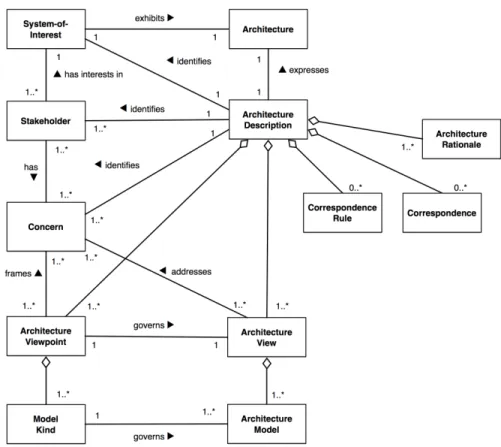
ISO/IEC/IEEE 42010,Systems and software engineering — Architecture de-scription, defines the contents of an architecture description (AD) [5]. Figure1depicts that contents in terms of a UML class diagram.
The AD template in this document defines places for all required informa-tion and offers the user addiinforma-tional guidance on preparing an AD.
An AD may take many forms, not prescribed by the Standard: it could be presented as a document, a set of documents, a collection of models, a model repository, or in some other form – as long as the required content is accessible in some manner. In particular, organization and ordering of required information is not defined by the Standard. Thus, headings and subheadings in this template are merely suggestive – not required.
The template uses a few conventions, as follows.
?“Musts” are items which must be present to satisfy the Standard. Musts are marked like this.
2“Shoulds” are items recommended to be present, but not required by the Standard. Shoulds are marked like this.
Optional items are marked with this:(optional).
<Items>like<this>signal names to be filled-in by a user of the template and used throughout the resulting AD.
License
TheArchitecture Description Templateis copyright c 2012–2014 byRich Hilliard.
Figure 1: Content model of an architecture description
The latest version is always available at:
http://www.iso-architecture.org/42010/templates/.
The template is licensed under a Creative Commons Attribution 3.0 Un-ported License. For terms of use, see:
http://creativecommons.org/licenses/by/3.0/
This license gives you the user the right to share and remix this work to create architecture descriptions. It does not require you to share the results of your usage, but if your use is non-proprietary, we encourage you to share your work with others via the WG42 website
Version history
This template is based on one originally designed for use with IEEE std 1471:2000 [4] and now updated for ISO/IEC/IEEE 42010:2011. The present document is
an enhanced version of the earlier template, with additional guidance, clar-ifications and examples for readers.
rev 2.2 7 October 2014, Moved bibliography from bibtex to biblatex. Released revision with minor formatting fixes.
rev 2.1a June 2012, initial release on 42010 website.
Editions
This is the “bare bones” edition – it contains exactly only information items required by the Standard. Other editions meet the requirements of the Standard and contain additional information used in various documenta-tion approaches (such as [7,1]).
Comments or questions
Contact the authorRich [email protected] comments, suggestions, improvements or questions.
For more information on ISO/IEC/IEEE 42010, visit the website:
http://www.iso-architecture.org/42010/.
Chapter 1
Introduction
This chapter describes introductory information items of the AD, including identifying and supplementary information.
1.1
Identifying information
?Identify the architecture being expressed, such as via an <Architecture Name>, or as appropriate.
? Identify the<System of Interest>for which this is an architecture de-scription.
Following ISO/IEC/IEEE 42010, system (or system-of-interest) is a short-hand for any number of things including man-made systems, software prod-ucts and services, and software-intensive systems including “individual ap-plications, systems in the traditional sense, subsystems, systems of sys-tems, product lines, product families, whole enterprises, and other aggre-gations of interest”.ISO/IEC/IEEE 42010, 4.2
There is also a place for these two information items on the title page.
1.2
Supplementary information
?Provide supplementary information as determined by the project and/or organization.
de-fined by the Standard. Most organizations or projects will have their own requirements.
Examples of identifying and supplementary information include: date of issue and status; authors, reviewers, approving authority, issuing orga-nization; change history; summary; scope; context; glossary; version con-trol information; configuration management information and references. ISO/IEC/IEEE 42010, 5.2
1.3
Other information
Although views and models are the primary form of organization in an ar-chitecture description, an AD may also contain information not part of any architecture view or model.
Examples of types of architecture information that might not be part of any architecture view are:
• system or architecture overview
• reader’s guide to this AD
• results of architecture evaluations
• rationale for key decisions
• view and model correspondences
This section discusses these forms of information: overviews, architecture evaluations and rationale.
1.3.1
Overview
(
optional)
Provide an overview of the architecture being described, its essential points, and a summary of the<System of Interest>.
An Overview could include sections for Purpose, Scope and Context of the architecture.
Provide an overview of the remainder of this AD as a guide for its readers. Recognizing the key role of stakeholders and concerns (see§2) for the tents of the AD, consider Overview(s) organized by stakeholders and/or con-cerns.
1.3.2
Architecture evaluations
?Include results from any evaluations of the<Architecture Name>being documented.
1.3.3
Rationale for key decisions
?An architecture description shall include rationale for each decision con-sidered to be a key architecture decision (perISO/IEC/IEEE 42010, 5.8.2).
Chapter 2
Stakeholders and
concerns
This chapter contains information items for stakeholders of the architec-ture, the stakeholders’ concerns for that architecarchitec-ture, and the traceability of concerns to stakeholders. See also:ISO/IEC/IEEE 42010, 5.3
2.1
Stakeholders
?Identify and describe the stakeholders for the architecture.
Stakeholders may be individuals (e.g., “Joe the CEO”), groups (e.g., “power users of our product”), organizations (e.g., “the Quality Assurance Depart-ment” or “the NSA”) as well as classes of same.
The stakeholders have areas of interest, calledconcerns, that are consid-ered fundamental to the architecture of the system-of-interest. See§2.2.
? The following stakeholders must be considered when preparing an AD. When applicable to the <System of Interest>, they must be identified in the architecture description: users, operators, acquirers, owners, suppliers, developers, builders and maintainers.
These names are not required to be used; stakeholder names should be chosen as appropriate to the<System of Interest>, the project and/or orga-nization.
2.2
Concerns
?Identify the concerns considered fundamental to the architecture of<System of Interest>.
?Consider the following concerns, and include them in the AD when appli-cable:
• What are the purpose(s) of the system-of-interest?
• What is the suitability of the architecture for achieving the system-of-interest’s purpose(s)?
• How feasible is it to construct and deploy the system-of-interest?
• What are the potential risks and impacts of the system-of-interest to its stakeholders throughout its life cycle?
• How is the system-of-interest to be maintained and evolved?
These concern statements are not required to be used; concern statements should be chosen as appropriate to the<System of Interest>, the project and/or organization.
For further guidance on concerns, see§3.3.1.
2.3
Concern–Stakeholder Traceability
?Associate each identified concern from§2.2 with the identified stakehold-ers from§2.1 having that concern.
This association can be recorded via a simple table or other depiction.
Table 2.1: Example showing association of stakeholders to concerns in an AD
Stakeholder 1 Stakeholder 2 Stakeholder 3 . . .
Concern 1 – x x . . .
Concern 2 x – x . . .
Concern 3 – x x . . .
Chapter 3
Viewpoints+
An AD contains multiple architecture views; each view adheres to the con-ventions of anarchitecture viewpoint. This chapter describes the require-ments on documenting viewpoints for an AD.
?Include a specification for each architecture viewpoint used in this AD. ?Viewpoints must be chosen for the AD such that each identified concern from§2.2 is framed by at least one viewpoint.
?Provide a rationale for each viewpoint used.
Rationale could include discussion in terms of its stakeholders, the con-cerns framed by the viewpoint, relevance of its model kinds and modeling conventions.
? Each architecture viewpoint used in the AD must be specified in accor-dance with the provisions ofISO/IEC/IEEE 42010, 7.
A detailed template for specifying viewpoints in accordance with the Stan-dard is included in §3.1below.
NOTE:The latest version of the viewpoint template can be found at
http://www.iso-architecture.org/42010/templates/.
Repeat and fill-in viewpoint template as needed for each viewpoint used in the AD. An AD contains one or more architecture views and an architecture viewpoint defi-nition for each view. There is no required ordering of the views or viewpoints within an AD. Readers of the AD will need to refer to the viewpoint specifications to under-stand the subject of a view, its notations, models and the modeling conventions used. Given a set of views (vi) and their viewpoints (VPi), the architect might consider the following possible arrangements:
• Viewpoints, first:VPi, followed by the views:vi
• Interleaved views with their viewpoints:vi,VPi,vj,VPj, . . .
• Views up front:viwith the viewpoints deferred to appendices,VPi
3.1
<
Viewpoint Name
>
?Provide the name for the viewpoint.
If there are any synonyms or other common names by which this viewpoint is known or used, record them here.
3.2
Overview
Provide an abstract or brief overview of the viewpoint. Describe the viewpoint’s key features.
3.3
Concerns and stakeholders
Architects looking for an architecture viewpoint suitable for their purposes often use the identified concerns and typical stakeholders to guide them in their search. Therefore it is important (and required by the Standard) to document the concerns and stakeholders for which a viewpoint is intended.
3.3.1
Concerns
?Provide a listing of architecture-relevant concerns to be framed by this architec-ture viewpoint perISO/IEC/IEEE 42010, 7a.
Describe each concern.
Concerns name “areas of interest” in a system.
NOTE:Following ISO/IEC/IEEE 42010,systemis a shorthand for any number of things including man-made systems, software products and services, and software-intensive systems such as “individual applications, systems in the traditional sense, subsystems, systems of systems, product lines, product families, whole enterprises, and other aggregations of interest”.
Concerns may be very general (e.g.,Reliability) or quite specific (e.g., How does the system handle network latency?).
Concerns identified in this section are critical information for an architect because they help her decide when this viewpoint will be useful.
When used in an architecture description, the viewpoint becomes a “contract” be-tween the architect and stakeholders that these concerns will be addressed in the view resulting from this viewpoint.
It can be helpful to express concernsin the form of questionsthat views resulting from that viewpoint will be able to answer. E.g.,
• How does the system manage faults?
• What services does the system provide?
NOTE:“In the form of a question” is inspired by the television quiz show, Jeopardy! ISO/IEC/IEEE 42010, 5.3contains a candidate list of concerns that must be consid-ered when producing an architecture description. These can be considconsid-ered here for their relevance to the viewpoint being specified:
• What are the purpose(s) of the system-of-interest?
• What is the suitability of the architecture for achieving the system-of-interest’s purpose(s)?
• How feasible is it to construct and deploy the system-of-interest?
• What are the potential risks and impacts of the system-of-interest to its stake-holders throughout its life cycle?
• How is the system-of-interest to be maintained and evolved? See also:ISO/IEC/IEEE 42010, 4.2.3.
3.3.2
Typical stakeholders
?Provide a listing of the typical stakeholders of a system who are in the potential audience for views of this kind, perISO/IEC/IEEE 42010, 7b.
Typical stakeholders would include those likely to read such views and/or those who need to use the results of this view for another task.
Stakeholders to consider include:
• users of a system; • operators of a system; • acquirers of a system; • owners of a system; • suppliers of a system; • developers of a system; • builders of a system; • maintainers of a system.
3.3.3
“Anti-concerns”
(
optional)
It may be helpful to architects and stakeholders to document the kinds of issues for which this viewpoint isnot appropriate or not particularly useful.
Identifying the “concerns” of a given notation or approach may be a good anti-dote for certain overly used models and notations.
3.4
Model kinds+
?Identify each model kind used in the viewpoint perISO/IEC/IEEE 42010, 7c. In the Standard, each architecture view consists of multiple architecture models. Each model is governed by amodel kindwhich establishes the notations, conven-tions and rules for models of that type. See: ISO/IEC/IEEE 42010, 4.2.5, 5.5 and 5.6.
Repeat the next section for each model kind listed here the viewpoint being speci-fied.
3.5
<
Model Kind Name
>
?Identify the model kind.
3.5.1
<
Model Kind Name
>
conventions
?Describe the conventions for models of this kind.
Conventions include languages, notations, modeling techniques, analytical methods and other operations. These are key modeling resources that the model kind makes available to architects and determine the vocabularies for constructing models of the kind and therefore, how those models are interpreted and used.
It can be useful to separate these conventions into alanguage part: in terms of a metamodel or specification of notation to be used and aprocess part: to describe modeling techniques used to create the models and methods which can be used on the models that result. These include operations on models of the model kind. The remainder of this section focuses on the language part. The next section focuses on the process part.
The Standard does not prescribehowmodeling conventions are to be documented. The conventions could be defined:
I) by reference to an existing notation or language (such as SADT, UML or an archi-tecture description language such as ArchiMate or SysML) or to an existing technique (such asM/M/4queues);
II) by presenting a metamodel defining its core constructs; III) via a template for users to fill in;
IV) by some combination of these methods or in some other manner. Further guidance on methods I) through III) is provided below.
Sometimes conventions are applicable across more than one model kind – it is not necessary to provide a separate set of conventions, a metamodel, notations, or oper-ations for each, when a single specification is adequate.
I) Model kind languages or notations(optional)
Identify or define the notation used in models of the kind.
Identify an existing notation or model language or define one that can be used for models of this model kind. Describe its syntax, semantics, tool support, as needed.
II) Model kind metamodel(optional)
A metamodel presents the AD elements that constitute the vocabulary of a model kind, and their rules of combination. There are different ways of representing meta-models (such as UML class diagrams, OWL, eCore). The metamodel should present: entities What are the major sorts of conceptual elements that are present in
mod-els of this kind?
attributes What properties do entities possess in models of this kind?
relationships What relations are defined among entities in models of this kind? constraints What constraints are there on entities, attributes and/or relationships
and their combinations in models of this kind?
NOTE: Metamodel constraints should not be confused with architecture constraints that apply to the subject being modeled, not the notations used.
In the terms of the Standard, entities, attributes, relationships areAD elementsper
ISO/IEC/IEEE 42010, 3.4, 4.2.5 and 5.7.
In theViews-and-Beyondapproach [1], each viewtype (which is similar to a view-point) is specified by a set of elements, properties, and relations (which correspond to entities, attributes and relationships here, respectively).
When a viewpoint specifies multiple model kinds it can be useful to specify a single viewpoint metamodel unifying the definition of the model kinds and the expression
of correspondence rules. When defining an architecture framework, it may be help-ful to use a single metamodel to express multiple, related viewpoints and model kinds.
III) Model kind templates(optional)
Provide a template or form specifying the format and/or content of models of this model kind.
3.5.2
<
Model Kind Name
>
operations
(
optional)
Specify operations defined on models of this kind.See§3.6for further guidance.
3.5.3
<
Model Kind Name
>
correspondence rules
?Document any correspondence rules associated with the model kind. See§3.7for further guidance.
3.6
Operations on views
Operations define the methods to be applied to views and their models. Types of operations include:
construction methods are the means by which views are constructed under this viewpoint. These operations could be in the form of process guidance (how to start, what to do next); or work product guidance (templates for views of this type). Construction techniques may also be heuristic: identifying styles, patterns, or other idioms to apply in the synthesis of the view.
interpretation methods which guide readers to understanding and interpreting architecture views and their models.
analysis methods are used to check, reason about, transform, predict, and eval-uate architectural results from this view, including operations which refer to model correspondence rules.
implementation methods are the means by which to design and build systems using this view.
Another approach to categorizing operations is from Finkelstein et al. [2]. The
work planfor a viewpoint defines 4 kinds of actions (on the view representations):
specification;check actionswhich contains the actions available to the developer to check the consistency of the specification;viewpoint actionswhich create new view-points as development proceeds; guide actionswhich provide the developer with guidance on what to do and when.
3.7
Correspondence rules
?Document any correspondence rules defined by this viewpoint or its model kinds. Usually, these rules will be across models or across views since, constraints within a model kind will have been specified as part of the conventions of that model kind. See:ISO/IEC/IEEE 42010, 4.2.6 and 5.7
3.8
Examples
(
optional)
Provide helpful examples of use of the viewpoint for the reader (architects and other stakeholders).
3.9
Notes
(
optional)
Provide any additional information that users of the viewpoint may need or find helpful.
3.10
Sources
?Identify sources for this architecture viewpoint, if any, including author, history, bibliographic references, prior art, perISO/IEC/IEEE 42010, 7e.
Chapter 4
Views+
Much of the material in an AD is presented through its architecture views. Each view follows the conventions of its governing viewpoint. A view is made up of archi-tecture models.
?Include an architecture view for each viewpoint selected in§3.
Repeat and complete the following section for each architecture view in the AD.
4.1
View:
<
View Name
>
?Give the architecture view a<View Name>.
?Provide any identifying and supplementary information about<View Name>. The details of this information will be as specified by the organization and/or project. See§1for examples of identifying and supplementary information.
Views have their own identifying and supplementary information distinct from ADs because they may be developed and evolve separately over the lifetime of a project. ?Identify the viewpoint governing this view from among those identified in§3. See also:ISO/IEC/IEEE 42010, 5.5
4.1.1
Models+
An architecture view is composed of one or more architecture models.
?The models must address all of the concerns framed by the view’s governing view-point and cover the whole system from that viewview-point.
Repeat the section below for each model.
4.1.2
<
Model Name
>
?Each architecture model shall include version identification as specified by the organization and/or project.
?Each architecture model shall identify its governing model kind and adhere to the conventions of that model kind from§3.5.
SeeISO/IEC/IEEE 42010, 5.4.
An architecture model may be a part of more than one architecture view. This enables sharing of details and addressing distinct but related concerns without redundancy. Other uses of multiple models: aspect-oriented style of architecture description: architecture models shared across architecture views can be used to express architectural perspectives [7] and architecture textures [6]. Architecture models can be used as containers for applying architecture patterns or architec-ture styles to express fundamental schemes (such as layers, three-tier, peer-to-peer, model-view-controller) within architecture views.
4.1.3
Known Issues with View
? Document any discrepancies between the view and its viewpoint conventions. Each architecture view must adhere to the conventions of its governing architec-ture viewpoint.
Known issues could include: inconsistencies, items to be completed, open or unre-solved issues, exceptions and deviations from the conventions established by the viewpoint. Open issues can lead to decisions to be made. Exceptions and deviations can be documented as decision outcomes and rationale.
Chapter 5
Consistency and
correspondences
This chapter describes consistency requirements, recording of known inconsisten-cies in an AD, and the use and documentation of correspondences and correspon-dence rules.
5.1
Known inconsistencies
?Record any known inconsistencies in the AD.
Although consistent ADs obviously are to be preferred, it is sometimes infeasible or impractical to resolve all inconsistencies for reasons of time, effort, or insufficient information.
2An architecture description should include an analysis of consistency of its archi-tecture models and its views.
5.2
Correspondences in the AD
?Identify each correspondence in the AD and its participating AD elements. Iden-tify any correspondence rules governing
Correspondences are used to express, record, enforce and analyze consistency be-tween models, views and other AD elements within an architecture description, between ADs, or between an AD and other forms of documentation.
model kinds and models, decisions and rationales. Constructs introduced by view-points and model kinds are also AD elements.
Correspondences are n-ary mathematical relations. Correspondences can be de-picted via tables, via links, or via other forms of association (such as in UML).
5.3
Correspondence rules
?Identify each correspondence rule applying to the AD.
Correspondence rules can be introduced by the AD, by one of its viewpoints, or from an architecture framework or architecture description language being used. ?For each identified correspondence rule, record whether the rule holds (is satisfied) or otherwise record all known violations.
Appendix A
Architecture decisions
and rationale
It is not required by the Standard to capture architecture decisions. This section describes recommendations (“shoulds”) for their recording.
A.1
Decisions
2Provide evidence of consideration of alternatives and the rationale for the choices made.
2Record architecture decisions considered to be key to the architecture of<System of Interest>.
Areas to consider to selecting key decisions include those:
• affecting key stakeholders or many stakeholders
• essential to project planning and management
• expensive to enforce or implement
• highly sensitive to changes or costly to change
• involving intricate or non-obvious reasoning
• pertaining to architecturally significant requirements
• requiring major expenditures of time or effort to make
• resulting in capital expenditures or indirect costs
2When recording decisions, the following information items should be considered:
• statement of the decision
• correspondences or linkages concerns to which it pertains
• owner of the decision
• correspondences or linkages to affected AD elements
• rationale linked to the decision
• forces and constraints on the decision
• assumptions influencing the decision
• considered alternatives and their potential consequences
See [3] and references there for various approaches to documenting decisions com-patible with the Standard.
Bibliography
Clements, Paul C. et al. Documenting Software Architectures: views and beyond. 2nd. Addison Wesley, 2010.
Finkelstein, A. et al. “Viewpoints: a framework for integrating multiple per-spectives in system development”. In:International Journal of Software Engineering and Knowledge Engineering2.1 (Mar. 1992), pp. 31–57. Heesch, Uwe van, Paris Avgeriou, and Rich Hilliard. “A Documentation
Framework for Architecture Decisions”. In:The Journal of Systems & Software85.4 (Apr. 2012), pp. 795–820.DOI:10.1016/j.jss.2011. 10.017.
IEEE Std 1471, IEEE Recommended Practice for Architectural Description of Software-Intensive Systems. Oct. 2000.
ISO/IEC/IEEE 42010, Systems and software engineering — Architecture description. Dec. 2011, pp. 1–46.
Ran, Alexander. “ARES Conceptual Framework for Software Architecture”. In: Software Architecture for Product Families Principles and Practice. Ed. by M. Jazayeri, A. Ran, and F. van der Linden. Addison-Wesley, 2000, pp. 1–29.
Rozanski, Nick and E´oin Woods.Software Systems Architecture: Working With Stakeholders Using Viewpoints and Perspectives. 2nd. Addison Wes-ley, 2011.
Contents
Using the template i
License . . . i Version History . . . 1 Template editions . . . 1 Comments . . . 1 1 Introduction 2 1.1 Identifying information . . . 2 1.2 Supplementary information . . . 2 1.3 Other information . . . 3 1.3.1 Overview(optional) . . . 3 1.3.2 Architecture evaluations . . . 4
1.3.3 Rationale for key decisions . . . 4
2 Stakeholders and concerns 5 2.1 Stakeholders . . . 5 2.2 Concerns . . . 6 2.3 Concern–Stakeholder Traceability. . . 6 3 Viewpoints+ 7 3.1 <Viewpoint Name> . . . 8 3.2 Overview . . . 8
3.3 Concerns and stakeholders . . . 8
3.3.1 Concerns . . . 8
3.3.2 Typical stakeholders. . . 9
3.3.3 “Anti-concerns”(optional) . . . 10
3.4 Model kinds+ . . . 10
3.5 <Model Kind Name> . . . 10
3.5.1 <Model Kind Name>conventions . . . 10
I) Model kind languages or notations(optional) . . . 11
II) Model kind metamodel(optional) . . . 11
III) Model kind templates(optional) . . . 12
3.5.2 <Model Kind Name>operations(optional). . . 12
3.5.3 <Model Kind Name>correspondence rules . . . 12
3.6 Operations on views . . . 12 3.7 Correspondence rules . . . 13 3.8 Examples(optional) . . . 13 3.9 Notes(optional) . . . 13 3.10 Sources . . . 13 4 Views+ 14 4.1 View:<View Name> . . . 14
4.1.1 Models+ . . . 14
4.1.2 <Model-Name> . . . 15
4.1.3 Known Issues with View . . . 15
5 Consistency and correspondences 16 5.1 Known inconsistencies . . . 16
5.2 Correspondences in the AD . . . 16
5.3 Correspondence rules . . . 17