Sharing The
Sharing The
T
he need for enhancements andintegration within your deci-sion support environment is growing exponentially. Functionality is becoming more fluid and intricate as the business processes evolve to support new and more dynamic busi-ness intelligence (BI) and customer relationship management (CRM) applications. Ultimately, this inte-gration and expansion will encom-pass the remaining stovepipe systems and business processes.
To successfully facilitate this evolution, organizations need an enterprise-wide, coherent infra-structure that brings every producer and consumer of information together in a reliable, accurate, con-sistent and timely manner. Such an infrastructure must embrace and enlist the diverse sources of enter-prise information. It must leverage the vast investment in unstructured data residing in document manage-ment systems, internal and external Web sites, operational systems, news feeds, groupware and e-mail, as well as the traditional structured data sources of data warehouses, data marts and operational data stores (ODSs). All information
cre-ated, consumed, exchanged and
destroyed within the enterprise should be available throughout this infrastructure.
Given the size, scope and com-plexity of such an infrastructure, it must conform to a sound architec-ture or it will quickly become chaotic and costly. The architecture must be flexible enough to
accom-modate rapidly changing technolo-gies, yet be consistent and stable enough to provide a solid pathway for implementations.
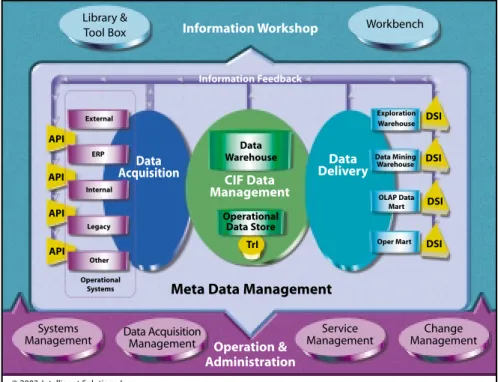
The Corporate Information Factory (CIF) architecture is a proven plan for building and sustaining a successful enterprise data infrastruc-ture (see Figure 1).
The architecture consists of the following components:
■ The CIF Road Map – A logical representation depicting the inter-action and usage of the technologi-cal components of the CIF.
■ Administrative Processes – Processes used to update, maintain and evolve the infrastructure as business utilization evolves.
■ Information Feedback – The sharing mechanism that allows intelligence and knowledge gathered through the user of the CIF to be shared with other data stores, thus making business intelli-gence actionable.
■ Information Workshop – The mechanisms (often Web-based) to acquire, manage and present cus-tomized information to the users of this environment.
The Progression to the
Complete CIF Environment
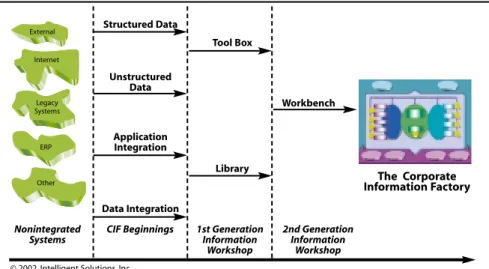
There has been a natural progres-sion in enterprises today toward the complete CIF environment. As an enterprise matures in its information usage, it goes through a series of pre-dictable phases (see Figure 2). The typical progression:
■ At first, there are non-integrated, chaotic operational systems grown organically as the enterprise grows.
■The implementation of the data warehouse, data marts and opera-tional data stores with their associ-ated processes is a truly positive step in the evolution to an inte-grated information infrastructure environment.
■Once the database components of the CIF are in place, the enterprise begins to build the final phase – the information workshop tech-nology – to deliver the right amount of information to the peo-ple who need it, when they need it. This is an evolution in which the first set of requirements con-sists of the development of a tool box and library function, followed by a second requirement, the development of the workbench.
This article focuses on the glue that knits the whole environment together – the information workshop infrastructure. To understand this concept, it’s helpful to describe the components of a mature information workshop environment, and then cover the requirements needed by most enterprises as they evolve to a more mature CIF architecture.
Information Workshop
Many organizations started building their CIF environments with the idea that the ultimate end product was a data mart with a nice front-end tool attached to it. From the success of the first mart, it wasWealth
Wealth
Putting it All Together in the
Corporate Information Factory
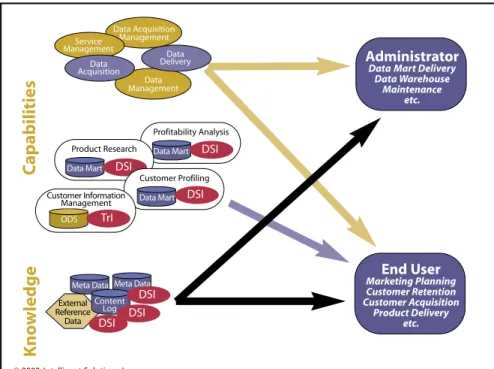
easy to spin out these “point solution capabilities” with little regard to how they fit into the overall busi-ness processes. As a result, the inter-faces into these capabilities and their associated meta data reposito-ries began to resemble the “spider-web” architecture frequently seen in operational systems today (see Figure 3). The users of this environment are given a confusing and complex set of tools, access methods, and bits and pieces of knowledge that they must fit together into their process – and are then required to remember all of the nuances. Furthermore, these business people may not even know the information source or relia-bility. Additionally, they may not understand its meaning or relevancy to their business problem. To com-pound the problem, they may need unstructured data (forecasts, busi-ness plans, strategic plans, e-mail messages, etc.) that may be regis-tered in the environment but not easily accessible or understandable. An analogy for this situation is the common garage. If your garage is like mine, there is little order to the location of tools and reference manuals. To perform a task such as building a bookshelf may require a fair bit of preparation. First, you collect the reference manual(s), or meta data. In this case, perhaps it is the do-it-yourself pamphlet you picked up at the hardware store. After you peruse the instructions, you need to collect the various tools, or capabilities (e.g., hammer, saw, nails, wood and measuring tape). After you complete the bookshelf, you return the tools and pamphlets to the garage, but probably not where you found them. Thus, for the next project (for instance, fixing the leaking sink), you must repeat the whole process.
When developing a new sales campaign, business people follow a similar process. They must first determine what tools they need, what meta data they need and how to fit everything into the process of developing and implementing the new campaign. They will need access to the campaign analysis data
mart, reports from sales channel analysis and product profitability mart, as well as a current view of customers from the ODS. They will also need the meta data stating when the reports were run, the defi-nition of a calculation and an expla-nation of the models used. If they decide to do something else, such as develop a new demographic profile for a sales channel, they must start from scratch again – finding the tools and meta data for that process.
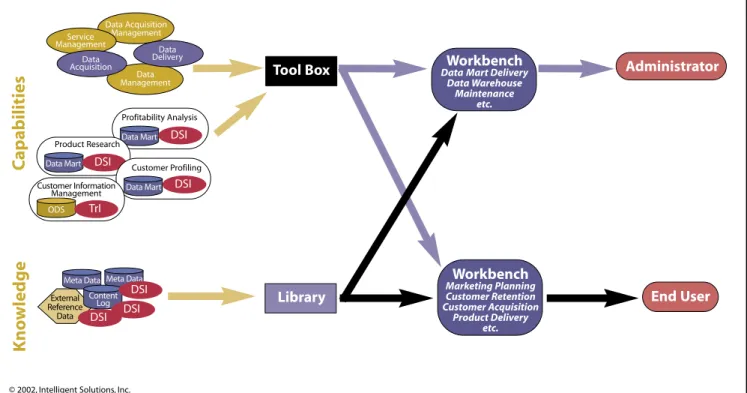
In contrast, the infrastructure of a well-integrated information environ-ment (i.e., information workshop) includes:
■Capabilities and facilities organized as tools into a tool box.
■ Knowledge and meta data organ-ized into a library.
■A workbench to bring together the proper tools and knowledge to create the marketing plans or customer care strategies by utilizing the tool box and library.
The information workshop con-sists of the user interface mecha-nisms, providing a single point of access for the enterprise user includ-ing publication, subscription and
notification of capabilities; single sign-on; query; and/or navigational interfaces into the CIF components (e.g., meta data, operational data store, data marts and data ware-house). Essentially, the information workshop provides the user with seamless integration to all of the capabilities and knowledge generated from the CIF in one easy-to-access mechanism. This interface is charac-terized by the integration of the business community and business processes with the capabilities and knowledge developed through the CIF. The distinguishing characteris-tic of the information workshop is the assimilation of CIF functionality into the business processes of the enterprise. This requires a business model and nomenclature that repre-sents the specific enterprise using it.
It is this degree of integration into the business process that makes the CIF a truly strategic and integral part of the overall CRM business process. Figure 4 illus-trates how these information work-shop components align CIF capabili-ties, facilities and knowledge to support the business community and the IT staff.
Library & Tool Box
Systems Management
Service Management
Change Management Data Acquisition
Management
Workbench
Information Workshop
Operation & Administration Information Feedback
Data Warehouse CIF Data Management
Data Delivery Data
Acquisition
Operational Data Store
Exploration Warehouse External
ERP
Internal
Legacy
Other Operational
Systems
DSI API
API
API
API
DSI
DSI
DSI Data Mining
Warehouse
OLAP Data Mart
Oper Mart
Meta Data Management TrI
© 2002, Intelligent Solutions, Inc.
Tool Box
The tool box provides a place to register business intelligence and business management capabilities as they evolve within the CIF. Organization of these capabilities into the tool box promotes reuse and thus improves end-user produc-tivity. In the garage example, we could simplify the search for tools by organizing them on a pegboard (with those nice white outlines of the tools to let the user know which tool goes where). In the CIF, we need a form of business information directory that permits the registra-tion of new or improved tools (applications), reports and capabili-ties as they are developed and pres-ents these to the users in an easily accessible manner.
Some capabilities are common to most companies and belong in the tool box. The following are sample capa-bilities for both the business commu-nity and the CIF administrative staff supporting the environment:
Profitability Analysis provides end
users with the ability to measure cus-tomer profitability by time, location, market segment, product, demo-graphics, etc.
Pattern Recognition provides end
users with the ability to recognize trends in the data that may be indicative of market opportunities, fraud, etc.
Customer View provides end users
with access to detailed customer information. This information is generally used to support interaction with the customer and includes cus-tomer purchases, addresses, recent contact history and other pieces of per-tinent information.
Capacity Planning provides the CIF
administrator with information to determine how fast the data files are growing and when new disk space is needed to accurately determine capac-ity needs.
Performance Tuning provides the
CIF administrator with information on the usage of the environment (who is using the data, when they use it and query efficiency) and any per-formance issues.
These tools can be organized in a fashion similar to the garage peg-board. For example, you can estab-lish a pubestab-lish-and-subscribe mecha-nism to distribute reports to the appropriate personnel. You can organize reports by particular capa-bility (e.g., all campaign analysis reports can be bundled under one heading in the publish-and-subscribe mechanism).
Library
The library provides the busi-ness community and CIF adminis-trators with valuable information that guides their use of tools and materials in the CIF. In our garage, we can organize all the reference manuals and booklets on a
book-shelf. For your CIF environment, you can begin by integrating busi-ness and technical meta data, and collecting and making available white papers on tool evaluations, strategic plans and business cases for the CIF. Again, a mature library will provide the logical categorization of any informational object within a framework that is searchable and can be explored, queried and modified as the business process or practice demands. The library must evolve as new and different pieces of meta data become available.
Most of this information is indigenous to the CIF (e.g., meta data, DSS results) but may also be foreign, as in the case of a company directory or other informal pieces of information. Therefore, the library must be able to handle both the structured data found within the classic CIF and the unstructured data such as that found in informal data warehouses (e-mails, notes and other forms of important but unstructured data).
For example, when creating a new campaign, the library would be used to:
■View the inventory of existing work done in this area (e.g., reports, capabilities, results of previous campaigns).
■Assess existing data for its applica-bility in creating a new capaapplica-bility.
■Catalog new requirements, data and capabilities.
The navigation of the library should be similar to surfing the Internet. The user enters a string such as “campaign analysis” and receives a list of references, reports and data marts to access as well as other pieces of pertinent information on cam-paigns. These reference areas can be classified into:
Dictionary – provides a definition
for “campaign analysis.” This defi-nition will include a short and long description, object type (e.g., data, tool, report) and alias references where appropriate. It may also contain references to information outside of
Structured Data
Unstructured Data
Application Integration
Data Integration
The Corporate Information Factory
Nonintegrated
Systems CIF Beginnings 1st GenerationInformation Workshop
2nd Generation Information
Workshop
© 2002, Intelligent Solutions, Inc. Other
ERP Legacy Systems Internet External
Tool Box
Library
Workbench
the dictionary (e.g., a see also func-tion), giving functional associations between items.
Encyclopedia – a compendium of
business knowledge, either general or specialized, that combines all sources of meta data and content into a single repository. From here, users can gain great insight about the content of the CIF before performing any activities. The encyclopedia is organized into areas such as:
■ Reports –presenting published
findings of previous analytical activities and observations on which to build. For example, you may want to publish key performance indicator reports such as the fact that 20 percent of your customers
generated 80 percent of your revenues last year, including identification of the “20 percent” group of customers.
■Newsletters and News Flashes –
providing tips, techniques and lessons learned so that everyone can work in the CIF environment more effectively. In addition, this media can be used to quickly alert the CIF public about events that affect their ability to do business. For example, news flashes can
broadcast data quality problems or unscheduled downtime.
These materials contribute to the education process and promote new discoveries. As these discoveries are made, users can publish their findings through the Internet or perhaps via e-mail, thus increasing the base knowledge in the library.
Workbench
The workbench fulfills a strate-gic role within a CIF architecture by presenting the library and tool box in an easy-to-use fashion, tailored to the needs of each business process (e.g., marketing planning, customer care, inventory management and data warehouse administration).
Going back to the garage analogy, life would be wonderful if you could tell the garage that today you would like to perform a woodworking task. Then the garage would configure itself, presenting a fully functional workbench containing the correct tools and reference materials so you could begin work immediately. Once the task was finished, you could tell this “virtual” garage that you now would like to perform a plumbing task. A newly configured workbench
with the correct plumbing tools and materials would appear.
How might the process of deliv-ering a product from the workbench work in our CIF environment? The first step must be to document the business process that will use the CIF capabilities and knowledge. For example, what are the steps to develop a new campaign? The mar-keting person may identify 20 clearly defined steps in this process. We would document the 20-step process in the workbench. Second, we would provide links to the relevant tools (operational data store, one of the data marts created or one of the operational systems) and library ref-erences. Third, we would train end users and deploy the campaign development workbench. It can be that simple. Generally, the imple-mentation of the workbench should be uneventful provided the infra-structure is in place and the necessary tools and library references are available. The biggest challenge will be defining the repeatable business processes and gaining the end-user commitment to follow them.
The Evolution of a CIF
The creation of a mature Corporate Information Factory should be accomplished in a step-wise fashion through an evolution of the infra-structure. Most organizations change their CIF environment as they for-malize their business processes and understand when and where the var-ious applications and databases should be incorporated to support these processes.
Unfortunately, there are few technologies available today that support this mature environment. My advice is to look into future-thinking companies and their portal strategies to find technologies sup-porting this last step. Look for companies that aspire to be “portal-ware” vendors, providing an open business information directory solution that is independent of content source, service component or information workshop user interface. Promising technologies are XML, “digital dash-boards” and maturing portals.
External Reference
Data
Data Acquisition Management
Data Management
© 2002, Intelligent Solutions, Inc.
Administrator Data Mart Delivery
Data Warehouse Maintenance
etc.
End User Marketing Planning Customer Retention Customer Acquisition
Product Delivery etc.
Service Management
Data Delivery Data
Acquisition
DSI Profitability Analysis
Data Mart
DSI Product Research
Data Mart
DSI Customer Profiling
Data Mart Meta Data Meta Data
Content Log
TrI
DSI DSI DSI
ODS
Customer Information Management
C
apabilities
Kno
w
ledge
Once you have process integra-tion, you achieve process automation through strong collaboration, work-flow and knowledge management for the mass capabilities. In the future, we could imagine the advent of intelligent agent technology that could remove the drudgery of cer-tain tasks or act as a knowledge helper to provide your business community with context-sensitive information. For example, your intelligent agent could perform the following function: “I noticed that you are interested in ABC’s Web site. Do you want me to regularly monitor it for changes? Also, if they announce anything, do you want a copy of their press release and their stock price?” The information work-shop would not only perform that interaction, but would open all the windows you would need to act on this news – presentation of stock brokerage account, stock purchase window, stock quote window and other pertinent information.
Clearly, the driving force behind information workshops is to overcome a number of old and emerging enter-prise computing and information
retrieval issues. From a user perspective, the foremost value proposition is delivering the right amount of infor-mation to the right people at the right time. Information workshop technolo-gy is designed to overcome the over-abundance of information sources that a consumer is expected to utilize during any one day.
Businesses that want to thrive must be able to dramatically redefine themselves and their approach to their market using technology to become evolutionary enterprises, enabling suc-cess and long-term viability. This means that all employees must have access the to right data at the right time.
In the context of providing access to corporate-wide information for each employee, a significant piece of the CIF is the information workshop. This part of the CIF pro-vides the mechanism to integrate knowledge and tools into an intu-itive, easy-to-use end-user and CIF administrator environment. The components responsible for this are the library and tool box. Building on these components, the workbench integrates the library and tool box into the business process to promote
efficiency through reuse and repeatability. As each workbench is used, information is collected and circulated back through the enter-prise, thus enriching its information content. Over time, this feedback loop will evolve into a knowledge fabric that enables corporations to better understand themselves and the markets they serve.
Information workshops are in the early-adopter phase of the market; today’s technology is not a panacea and many vendors have a slice of the entire picture. Furthermore, the user interface usually may provide an incomplete infrastructure that cannot scale or cope with the size and scope of the business content requirements. Nevertheless, information workshops show great promise for the future. They will, however, require several generational iterations before they truly fulfill their promise.
Claudia Imhoff is the president of Intelligent Solutions, Inc. Imhoff is a popular speaker and inter-nationally recognized expert on the Corporate Information Factory, business intelligence and CRM. She has coauthored four books and more than 40 articles on these topics. She may be reached at [email protected].
External Reference Data
Data Acquisition Management
Data Management
© 2002, Intelligent Solutions, Inc.
Administrator
End User Tool Box Data Mart DeliveryWorkbench
Data Warehouse Maintenance
etc.
Workbench Marketing Planning Customer Retention Customer Acquisition
Product Delivery etc. Library
Service Management
Data Delivery Data
Acquisition
DSI Profitability Analysis
Data Mart
DSI Product Research
Data Mart
DSI Customer Profiling
Data Mart Meta Data Meta Data
Content Log
TrI
DSI DSI DSI
ODS
Customer Information Management