ETSI TS 182 025
V3.3.1
(2011-03)
Technical Specification
Telecommunications and Internet converged Services and
Protocols for Advanced Networking (TISPAN);
Business trunking;
Architecture and functional description
Reference
RTS/TISPAN-02080-NGN-R3 Keywords
architecture, functional, trunking
ETSI
650 Route des Lucioles
F-06921 Sophia Antipolis Cedex - FRANCE Tel.: +33 4 92 94 42 00 Fax: +33 4 93 65 47 16
Siret N° 348 623 562 00017 - NAF 742 C Association à but non lucratif enregistrée à la
Sous-Préfecture de Grasse (06) N° 7803/88
Important notice
Individual copies of the present document can be downloaded from:
http://www.etsi.org
The present document may be made available in more than one electronic version or in print. In any case of existing or perceived difference in contents between such versions, the reference version is the Portable Document Format (PDF). In case of dispute, the reference shall be the printing on ETSI printers of the PDF version kept on a specific network drive
within ETSI Secretariat.
Users of the present document should be aware that the document may be subject to revision or change of status. Information on the current status of this and other ETSI documents is available at
http://portal.etsi.org/tb/status/status.asp
If you find errors in the present document, please send your comment to one of the following services:
http://portal.etsi.org/chaircor/ETSI_support.asp
Copyright Notification
No part may be reproduced except as authorized by written permission. The copyright and the foregoing restriction extend to reproduction in all media.
© European Telecommunications Standards Institute 2011. All rights reserved.
DECTTM, PLUGTESTSTM, UMTSTM, TIPHONTM, the TIPHON logo and the ETSI logo are Trade Marks of ETSI registered for the benefit of its Members.
3GPPTM is a Trade Mark of ETSI registered for the benefit of its Members and of the 3GPP Organizational Partners. LTE™ is a Trade Mark of ETSI currently being registered
for the benefit of its Members and of the 3GPP Organizational Partners.
Contents
Intellectual Property Rights ... 6
Foreword ... 6
1 Scope
... 7
2 References
... 7
2.1 Normative references ... 7
2.2 Informative references ... 9
3 Definitions
and
abbreviations
... 9
3.1 Definitions ... 9
3.2 Abbreviations ... 9
4 Overview
... 10
4.1 General principles... 10
4.2 Access network interconnection ... 10
4.3 Service level layer interconnection ... 11
5 Functional
architecture ... 11
5.1 General ... 11
5.2 Subscription based business trunking ... 12
5.2.1 General ... 12
5.2.2 Used functional entities at the service layer ... 12
5.2.3 Used reference points at the service layer ... 12
5.2.4 Used functional entities at the transport layer ... 12
5.2.5 Used reference points at the transport layer ... 13
5.3 Peering-based business trunking ... 13
5.3.1 General ... 13
5.3.2 Used functional entities at the service layer ... 14
5.3.3 Used reference points at the service layer ... 14
5.3.4 Used functional entities at the transport layer ... 15
5.3.5 Used reference points at the transport layer ... 15
5.4 Session-level virtual leased line ... 15
5.4.1 General ... 15
5.4.2 Used functional entities at the service layer ... 15
5.4.3 Used reference points at the service layer ... 16
5.4.4 Used functional entities at the transport layer ... 16
5.4.5 Used reference points at the transport layer ... 16
5.5 Support for roaming NGCN user ... 16
5.5.1 General ... 16
5.5.2 Used functional entities at the service layer ... 16
5.5.3 Used reference points at the service layer ... 17
5.5.4 Used functional entities at the transport layer ... 17
5.5.5 Used reference points at the transport layer ... 17
5.6 Support for roaming NGN user ... 17
6 Procedures
... 17
6.1 Subscription based business trunking ... 17
6.1.1 Introduction... 17
6.1.2 Identification ... 18
6.1.3 Registration ... 18
6.1.4 Requests originating from an NGCN user entering NGN... 19
6.1.4.1 General ... 19
6.1.4.2 NGCN not considered as privileged sender and not trusted by NGN ... 19
6.1.4.3 NGCN considered as privileged sender and trusted by NGN ... 20
6.1.4.4 NGCN considered as privileged sender and not trusted by NGN ... 21
6.1.5 Requests terminating to an NGCN user leaving NGN ... 21
6.1.5.1 General ... 21
6.1.5.3 NGCN considered as privileged sender and trusted by NGN ... 23
6.1.5.4 NGCN considered as privileged sender and not trusted by NGN ... 23
6.1.6 Business trunking applications ... 23
6.1.6.1 General ... 23
6.1.6.2 Routeing capabilities ... 24
6.1.6.2.1 Overview ... 24
6.1.6.2.2 Break-in ... 24
6.1.6.2.3 Break-out ... 24
6.1.6.2.4 Bulk rerouting ... 24
6.1.6.3 Communication admission control ... 24
6.1.6.4 Anonymous communication rejection... 24
6.1.6.5 Communication barring ... 25
6.1.7 Signalling transparency ... 25
6.1.8 Involvement of functions on the media path ... 25
6.1.8.1 General ... 25
6.1.8.2 DTMF ... 25
6.1.8.3 Codecs ... 25
6.1.9 Handling of the P-Access-Network-Info header ... 26
6.1.10 Emergency calls ... 26
6.1.11 Charging ... 26
6.1.12 Advice of Charge ... 26
6.1.13 NAT traversal ... 27
6.1.14 Private network traffic ... 27
6.1.15 P-CSCF and IP-CAN redundancy ... 27
6.2 Peering-based business trunking ... 28
6.2.1 Introduction... 28
6.2.2 Identification ... 28
6.2.3 Registration ... 28
6.2.4 Requests originating from an NGCN user entering NGN... 28
6.2.4.1 General ... 28
6.2.4.2 NGCN not trusted by NGN ... 29
6.2.4.3 NGCN trusted by NGN ... 29
6.2.5 Requests terminating to an NGCN user leaving NGN ... 29
6.2.5.1 General ... 29
6.2.5.2 NGCN not trusted by NGN ... 30
6.2.5.3 NGCN trusted by NGN ... 30
6.2.6 Business trunking application ... 30
6.2.6.1 General ... 30
6.2.6.2 Routeing related business trunking applications ... 30
6.2.6.3 Communication admission control ... 30
6.2.6.4 Anonymous communication rejection... 30
6.2.6.5 Communication barring ... 30
6.2.7 Signalling transparency ... 31
6.2.8 Involvement of functions on the media path ... 31
6.2.9 Handling of the P-Access-Network-Info header ... 31
6.2.10 Emergency calls ... 31
6.2.11 Charging ... 31
6.2.12 Advice of Charge ... 31
6.2.13 NAT traversal ... 32
6.2.14 Private network traffic ... 32
6.3 Session-level virtual leased line between NGCN sites ... 32
6.3.1 Introduction... 32
6.3.2 Identification ... 32
6.3.3 Registration ... 32
6.3.4 Session originating from a NGCN user entering NGN ... 32
6.3.4.1 General ... 32
6.3.4.2 NGCN not trusted by NGN ... 32
6.3.4.3 NGCN trusted by NGN ... 32
6.3.5 Session terminating to an NGCN user leaving NGN ... 33
6.3.5.1 General ... 33
6.3.5.2 NGCN not trusted by NGN ... 33
6.3.6 Business trunking applications ... 33
6.3.7 Signalling transparency ... 33
6.3.8 Involvement of functions on the media path ... 33
6.3.9 Handing of the P-Access-Network-Info header ... 33
6.3.10 Emergency calls ... 33
6.3.11 Charging ... 33
6.3.12 Advice of Charge ... 33
6.3.13 NAT traversal ... 34
6.3.14 Private network traffic ... 34
6.4 NGCN user roaming into NGN public network ... 34
6.4.1 Introduction... 34
6.4.2 Identification ... 34
6.4.3 Registration ... 34
6.4.4 Requests originating from an NGCN user roaming in NGN ... 34
6.4.5 Requests terminating on an NGCN user roaming in NGN ... 35
6.4.6 Business trunking applications ... 35
6.4.7 Signalling transparency ... 35
6.4.8 Involvement of functions on the media path ... 35
6.4.9 Handing of the P-Access-Network-Info header ... 35
6.4.10 Emergency calls ... 35
6.4.11 Charging ... 35
6.4.12 Advice of Charge ... 35
6.4.13 NAT traversal ... 35
6.4.14 Private network traffic ... 35
7 Use
of
transport functions ... 36
7.1 Use of transport control sublayer ... 36
7.1.1 Use of NASS... 36
7.1.2 Use of RACS ... 36
7.2 Use of transport processing functions ... 36
8 Security... 36
9 Management
... 36
Annex A (informative):
Example signalling flows of business trunking and roaming
arrangements ... 37
A.1 Scope of signalling flows ... 37
A.2 Introduction
... 37
A.3 Signalling
flows
for registration ... 37
A.3.1 Introduction ... 37
A.3.2 Registration of a roaming NGCN UE visiting an NGN/IMS with which the NGCN has a direct roaming agreement ... 37
A.3.2.1 General ... 37
A.3.2.2 Signalling flow for registration of a roaming NGCN UE visiting an NGN/IMS with which the NGCN has a direct roaming agreement ... 38
A.3.2.3 Overview of routing decisions ... 44
A.4 Signalling
flows
for call origination ... 45
A.5 Signalling
flows
for call termination ... 45
Annex B (informative):
Service Level Agreement (SLA) considerations ... 46
Annex C (informative):
Topics for business trunking for a future release ... 47
Annex D (informative):
Bibliography ... 48
Annex E (informative):
Change history ... 49
Intellectual Property Rights
IPRs essential or potentially essential to the present document may have been declared to ETSI. The information pertaining to these essential IPRs, if any, is publicly available for ETSI members and non-members, and can be found in ETSI SR 000 314: "Intellectual Property Rights (IPRs); Essential, or potentially Essential, IPRs notified to ETSI in respect of ETSI standards", which is available from the ETSI Secretariat. Latest updates are available on the ETSI Web server (http://webapp.etsi.org/IPR/home.asp).
Pursuant to the ETSI IPR Policy, no investigation, including IPR searches, has been carried out by ETSI. No guarantee can be given as to the existence of other IPRs not referenced in ETSI SR 000 314 (or the updates on the ETSI Web server) which are, or may be, or may become, essential to the present document.
Foreword
This Technical Specification (TS) has been produced by ETSI Technical Committee Telecommunications and Internet converged Services and Protocols for Advanced Networking (TISPAN).
1 Scope
The present document provides architecture and functional requirements for business trunking for the Next Generation Network.
The present document also specifies the protocol requirements for the NGCN to attach to the NGN (in particular the IM CN subsystem) and also any protocol requirements relation to application servers provided in support of business trunking.
Business trunking is a set of NGN capabilities that may be applied to communications between Next Generation Corporate Networks (NGCN) using the NGN as a transit.
2 References
References are either specific (identified by date of publication and/or edition number or version number) or
non-specific. For specific references, only the cited version applies. For non-specific references, the latest version of the reference document (including any amendments) applies.
Referenced documents which are not found to be publicly available in the expected location might be found at
http://docbox.etsi.org/Reference.
NOTE: While any hyperlinks included in this clause were valid at the time of publication ETSI cannot guarantee their long term validity.
2.1 Normative
references
The following referenced documents are necessary for the application of the present document.
[1] ETSI TS 181 019: "Telecommunications and Internet converged Services and Protocols for Advanced Networking (TISPAN); Business Communication Requirements".
[2] ETSI ES 282 001: "Telecommunications and Internet converged Services and Protocols for Advanced Networking (TISPAN); NGN Functional Architecture".
[3] ETSI ES 282 004: "Telecommunications and Internet converged Services and Protocols for Advanced Networking (TISPAN); NGN Functional Architecture; Network Attachment Sub-System (NASS)".
[4] ETSI ES 282 007: "Telecommunications and Internet converged Services and Protocols for Advanced Networking (TISPAN);IP Multimedia Subsystem (IMS);Functional architecture". [5] Void.
[6] ETSI ES 282 010: "Telecommunications and Internet converged Services and Protocols for Advanced Networking (TISPAN); Charging management [Endorsement of 3GPP TS 32.240 Release 7, 3GPP TS 32.260 Release 7, 3GPP TS 32.297 Release 7, 3GPP TS 32.298 Release 7 and 3GPP TS 32.299 Release 7, modified]".
[7] ETSI TS 182 023: "Telecommunications and Internet converged Services and Protocols for Advanced Networking (TISPAN); Core and enterprise NGN interaction scenarios; Architecture and functional description".
[8] ETSI TS 183 011: "Telecommunications and Internet converged Services and Protocols for Advanced Networking (TISPAN); PSTN/ISDN simulation services: Anonymous Communication Rejection (ACR) and Communication Barring (CB); Protocol specification".
[9] ETSI TS 183 019: "Telecommunications and Internet converged Services and Protocols for Advanced Networking (TISPAN); Network Attachment; User-Network Interface Protocol Definitions".
[10] ETSI TS 124 628: "Digital cellular telecommunications system (Phase 2+); Universal Mobile Telecommunications System (UMTS); LTE; Common Basic Communication procedures using IP Multimedia (IM) Core Network (CN) subsystem; Protocol specification (3GPP TS 24.628)". [11] ETSI ES 283 035: "Telecommunications and Internet converged Services and Protocols for
Advanced Networking (TISPAN); Network Attachment Sub-System (NASS); e2 interface based on the DIAMETER protocol".
[12] ETSI TS 124 647: "Digital cellular telecommunications system (Phase 2+); Universal Mobile Telecommunications System (UMTS); LTE; Advice Of Charge (AOC) using IP Multimedia (IM) Core Network (CN) subsystem (3GPP TS 24.647)".
[13] ETSI TS 129 658: "Digital cellular telecommunications system (Phase 2+); Universal Mobile Telecommunications System (UMTS); LTE; TISPAN; SIP Transfer of IP Multimedia Service Tariff Information; Protocol specification (3GPP TS 29.658)".
[14] ETSI TS 183 065: "Telecommunications and Internet converged Services and Protocols for Advanced Networks (TISPAN); Customer Network Gateway Configuration Function; e3 Interface based upon CWMP".
[15] ETSI TS 185 003: "Telecommunications and Internet converged Services and Protocols for Advanced Networking (TISPAN); Customer Network Gateway (CNG) Architecture and Reference Points".
[16] ETSI TS 187 003: "Telecommunications and Internet converged Services and Protocols for Advanced Networking (TISPAN); NGN Security; Security Architecture".
[17] ETSI TS 123 228: "Digital cellular telecommunications system (Phase 2+); Universal Mobile Telecommunications System (UMTS); LTE; IP Multimedia Subsystem (IMS); Stage 2 (3GPP TS 23.228)".
[18] ETSI TS 124 229: "Digital cellular telecommunications system (Phase 2+); Universal Mobile Telecommunications System (UMTS); LTE; IP multimedia call control protocol based on Session Initiation Protocol (SIP) and Session Description Protocol (SDP); Stage 3
(3GPP TS 24.229 Release 9)".
[19] ETSI TS 133 203: "Digital cellular telecommunications system (Phase 2+); Universal Mobile Telecommunications System (UMTS); LTE; 3G security; Access security for IP-based services (3GPP TS 33.203)".
[20] ECMA TR/96: "Next Generation Corporate Networks (NGCN) - Identification and Routing". [21] IETF RFC 3261 (2002): "SIP: Session Initiation Protocol".
[22] IETF RFC 3324 (2002): "Short Term Requirements for Network Asserted Identity". [23] Void.
[24] IETF RFC 5031 (2008): "A Uniform Resource Name (URN) for Emergency and Other Well-Known Services".
[25] IETF RFC 3263 (2002): "Session Initiation Protocol (SIP): Locating SIP Servers".
[26] IETF RFC 4733 (2006): "RTP Payload for DTMF Digits, Telephony Tones, and Telephony Signals".
[27] ETSI TS 181 005 (V3.3.1): "Telecommunications and Internet converged Services and Protocols for Advanced Networking (TISPAN); Service and Capability Requirements".
[28] ITU-T Recommendation G.711 (1988): "Pulse code modulation (PCM) of voice frequencies". [29] IETF RFC 5626 (2009): "Managing Client-Initiated Connections in the Session Initiation Protocol
2.2 Informative
references
The following referenced documents are not necessary for the application of the present document but they assist the user with regard to a particular subject area.
[i.1] draft-ietf-sipcore-location-conveyance-02 (2010): "Session Initiation Protocol Location Conveyance".
[i.2] draft-vanelburg-dispatch-private-network-ind-00 (2009): "Requirements for explicit private network indication".
[i.3] ETSI TS 123 003: "Digital cellular telecommunications system (Phase 2+); Universal Mobile Telecommunications System (UMTS); Numbering, addressing and identification
(3GPP TS 23.003)".
[i.4] ETSI TS 123 218: "Digital cellular telecommunications system (Phase 2+); Universal Mobile Telecommunications System (UMTS); LTE; IP Multimedia (IM) session handling; IM call model; Stage 2 (3GPP TS 23.218)".
[i.5] ETSI TR 183 069: "Telecommunications and Internet converged Services and Protocols for Advanced Networking (TISPAN); Business Trunking; NGCN-NGN Interfaces Implementation Guide".
[i.6] ETSI TS 129 165: "Digital cellular telecommunications system (Phase 2+); Universal Mobile Telecommunications System (UMTS); LTE; Inter-IMS Network to Network Interface (NNI) (3GPP TS 29.165)".
3 Definitions
and
abbreviations
3.1 Definitions
For the purposes of the present document, the terms and definitions given in TS 181 019 [1], ES 282 004 [3], TS 123 228 [17], TS 123 003 [i.3] and TS 123 218 [i.4] apply.
3.2 Abbreviations
For the purposes of the present document, the following abbreviations apply:
AOR Address Of Record
AS Application Server
B2BUA Back-to-Back User Agent
CNG Customer Network Gateway
CNGCF Customer Network Gateway Control Function CSCF Call Session Control Function
DNS Domain Name System
DSL Digital Subscriber Line
I-CSCF Interrogating CSCF
IP Internet Protocol
IP-CAN IP Connectivity Access Network
LAN Local Area Network
NASS Network Attachment SubSystem
NGCN Next Generation Corporate Network
NGN Next Generation Network
P-CSCF Proxy CSCF
S-CSCF Serving-CSCF SIP Session Initiation Protocol
SLA Service Level Agreement
UE User Equipment
URI Uniform Resource Identifier
4 Overview
4.1 General
principles
Business trunking refers to an architecture where corporate networks appear to the NGN as an NGCN. Although the interface between an NGCN and an NGN is IP-based, this does not preclude the existence of non-IP-based elements within the NGCN but not visible to the NGN. The NGCN appears to the NGN as a black box.
4.2
Access network interconnection
NGCN sites may be connected to any IP-CAN valid for TISPAN NGN using a Customer Network Gateway (CNG), as defined in ES 282 001 [2] or connected to an NGN core network via an edge router of the enterprise.
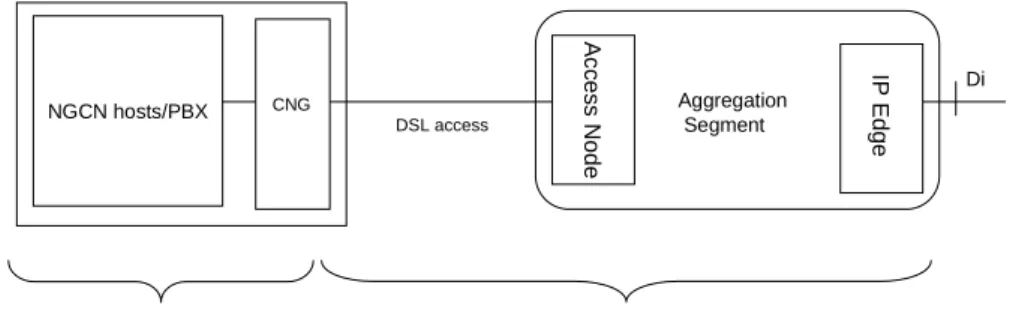
Connection to an IP-CAN includes the case where the NGCN site incorporates a CNG as defined in TS 185 003 [15], connected to a DSL-based access network (figure 4.1) as well as the case where the NGCN site comprises a corporate LAN with one or more edge routers playing the role of a CNG connected to access nodes in the operator's access network (figure 4.2).
NOTE 1: Use of the "SIP Proxy/B2BUA" function within the CNG, as defined in TS 185 003 [15], is not applicable to the present release of the present document.
NOTE 2: Within an NGCN site, the CNG functionality may be collocated with an NGCN host or a stand-alone equipment unit.
Towards an access network, the NGCN site acts as a UE. For further details see clause 7.
Towards the IM CN subsystem, the entry point / exit point entity is dependent on the approach adopted and is described further in clause 6.
An NGCN connects a multiplicity of endpoints to the network, each of which may be an IP device or a legacy phone. The NGN does not need to have any knowledge on the individual endpoints connected to the NGCN.
With the subscription based approach, for each NGCN site, the UPSF stores a single public user identity and a single associated user profile enabling triggering of network-based services beyond those provided by the NGCN itself. A set of telephone numbers and/or SIP URIs are also associated with each NGCN site. The former could be expressed in the form of number ranges and the latter using wildcards in the user or host part.
Ac
ce
ss
No
d
e
IP Edge Di Aggregation
Segment
NGCN site / User Equipement
Operator's Domain
CNG
NGCN hosts/PBX
DSL access
Ac
ce
ss
N
o
d
e
Co
rp
orat
e LA
N
CNG Di
IP
E
dge
LAN Access
Operator's domain NGCN Site / User Equipment
Aggregation Segment NGCN hosts/PBX
Figure 4.2: Corporate LAN access
Identifiers based on private numbers shall be handled in accordance with ECMA TR/96 [20].
4.3
Service level layer interconnection
The service level layer interconnection makes use of IMS. Two main interconnection arrangements are provided: • Interconnection of the NGN and NGCN where the entry point to the IMS is the P-CSCF. This is known as the
subscription-based approach. This is represented by scenario 5 in clause 8.3 of TS 182 023 [7]. In this case each site of the NGCN has a service subscription to the IMS, with an appropriate entry in the UPSF. An AS is used to provide business trunking applications, e.g. those defined in TS 181 019 [1], clause 4.4. If such capabilities are not required, then the AS is not included in any request processing. The service level capabilities of this scenario are described further in clause 6.1.
• Interconnection of the NGN and NGCN where the entry point to the IMS is the IBCF. This is known as the peering-based approach. This is represented by scenario 6 in clause 8.4 of TS 182 023 [7]. In this case there is no dynamic registration to the IMS of individual NGCN-users or NGCN-sites. However, the absence of such dynamic registrations in a UPSF does not preclude the NGN to host enterprise specific data in a UPSF. The service level capabilities of this scenario are described further in clause 6.2.
The second of these arrangements is called the peering-based approach due to the similarity of the arrangement to the mechanism by which the IMS in two NGNs interconnect. The provision of the business trunking applications (e.g. those defined in TS 181 019 [1], clause 4.4) is realized by an intelligent routeing function, which may involve an AS
depending on the actual enterprise specific data.
In none of the arrangements do the private extensions behind the NGCN need their own service subscription within the NGN, since they are owned and managed by the NGCN. The private extensions register with the NGCN, and the NGCN provides the individual services to the private extensions.
An architecturally similar case to the peering-based approach is represented by scenario 3 in clause 7.1 of
TS 182 023 [7]. In this case, SIP requests at one entry point are always routed to the same exit point, and no business trunking applications are provided. The service level capabilities of this scenario are described further in clause 6.3 of the present document. This scenario carries private network traffic only.
5 Functional
architecture
5.1 General
The architectural split of the service layer and transport layer (used in the description below) is defined in ES 282 001 [2].
5.2
Subscription based business trunking
5.2.1 General
This describes the architectural requirements for the connection of a Next Generation Corporate Network site (NGCN site) to the NGN using the P-CSCF as an entry point at the service layer.
Clause 8.3 of TS 182 023 [7] shows the arrangement of the involved functional entities.
5.2.2
Used functional entities at the service layer
The main functional entities from the IMS service layer as specified in ES 282 007 [4] that are used to realise subscription-based business trunking arrangements are as follows:
• P-CSCF; • S-CSCF;
• AS (in case a business trunking application is required);
• UPSF.
NOTE: The above list includes only those entities where specific functionality is applied to realise business communication in this scenario. Entities which otherwise transport, but apply no special processing, e.g. I-CSCF, are not listed.
A description of specific procedures executed to provide subscription-based business trunking can be found in clause 6.1.
5.2.3
Used reference points at the service layer
The main reference points from the IMS service layer as specified in ES 282 007 [4] that are used to realise subscription-based business trunking arrangements are as follows:
• Gm (this reference point forms the point of interconnection between the NGCN site and the NGN at the service layer);
• Mw;
• Cx;
• ISC (in case a business trunking application is required); • Sh (in case a business trunking application is required);
• e2;
• Gq'.
NOTE: The above list includes only those interfaces where specific protocol is applied to realise business communication in this scenario.
5.2.4
Used functional entities at the transport layer
The main functional entities from the transport layer as specified in ES 282 007 [4] that are used to realise subscription-based business trunking arrangements are as follows:
• BGF (whether an I-BGF or a C-BGF performs this function requires further study).
NOTE: The above list includes only those entities where specific functionality is applied to realise business communication in this scenario. Entities which otherwise transport, but apply no special processing, are not listed.
5.2.5
Used reference points at the transport layer
The main reference points from the transport layer as specified in ES 282 007 [4] that are used to realise subscription-based business trunking arrangements are as follows:
• none identified.
NOTE: The above list includes only those interfaces where specific protocol is applied to realise business communication in this scenario.
5.3 Peering-based
business
trunking
5.3.1 General
This describes the architectural requirements for the connection of a Next Generation Corporate Network site (NGCN site) to the NGN using the IBCF as an entry point at the service layer.
Clause 8.4 of TS 182 023 [7] shows the arrangement of the involved functional entities.
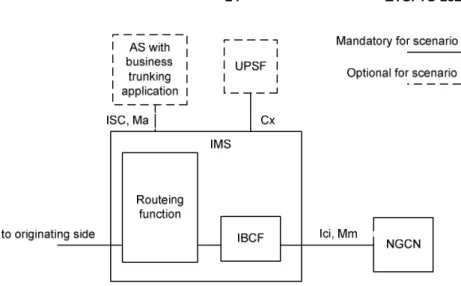
Optionally an AS may be used to provide business trunking applications, e.g. those defined in clause 4.4 of TS 181 019 [1]. Based on an SLA with the NGCN concerned this option is administrated in the related subscriber profile in a UPSF.
Figure 5.1: Originating Side with AS and UPSF
Because the routeing function in the originating scenario has to behave like a CSCF performing originating procedures, the IBCF provokes this by insertion of an originate-indication in the forwarded request (e.g. "orig" parameter in the related Route header field).
Figure 5.2: Terminating Side with AS and UPSF
If business trunking applications are to be provided to the destination NGCN, the CSCF routeing capabilities of the routeing function invoke the AS based on the related NGCN specific data in the UPSF.
5.3.2
Used functional entities at the service layer
The main functional entities from the IMS service layer as specified in ES 282 007 [4] that are used to realise peering-based business trunking arrangements are as follows:
• routeing function; • IBCF;
• if business applications are to be provided (e.g. those defined in clause 4.4 of TS 181 019 [1]):UPSF containing NGCN specific data;
• if business applications are to be provided (e.g. those defined in clause 4.4 of TS 181 019 [1]): AS. The routeing function represents the routeing capabilities available in IMS entities. In basic scenarios the routeing capabilities of the Transit Function defined in TS 123 228 [17], clause 5.19 are sufficient while in more advanced scenarios where Application Servers have to be involved to provide enhanced functionality, the routeing capabilities of one or more CSCF are required.
On the originating side the IBCF is capable of indicating whether an incoming SIP request is to be handled as an originating request by subsequent nodes in the IMS (see TS 123 228 [17], clause 4.14).
NOTE: The above list includes only those entities where specific functionality is applied to realise business communication in this scenario. Entities which otherwise transport, but apply no special processing, e.g. BGCF, are not listed.
A description of specific procedures executed to provide peering-based business trunking can be found in clause 6.2.
5.3.3
Used reference points at the service layer
The main reference points from the IMS service layer as specified in ES 282 007 [4] that are used to realise peering-based business trunking arrangements are as follows:
• e2;
• Gq'; • Ici or Mm;
NOTE 2: If Ici applies then there may be an inconsistency between TS 129 165 [i.6] (3GPP TS 29.165, specifying Ici) and TR 183 069 (Implementors guide for NGCN) [i.5].
• Mx.
• Cx (in case business trunking applications are to be provided); • Sh (in case business trunking applications are to be provided); • ISC or Ma (in case business trunking applications are to be provided).
NOTE 3: The above list includes only those interfaces where specific protocol is applied to realise business communication in this scenario.
5.3.4
Used functional entities at the transport layer
The main functional entities from the transport layer as specified in ES 282 007 [4] that are used to realise peering-based business trunking arrangements are as follows:
• BGF (whether an I-BGF or a C-BGF performs this function requires further study).
NOTE: The above list includes only those entities where specific functionality is applied to realise business communication in this scenario. Entities which otherwise transport, but apply no special processing, are not listed.
5.3.5
Used reference points at the transport layer
The main reference points from the transport layer as specified in ES 282 007 [4] that are used to realise peering-based business trunking arrangements are as follows:
• none identified.
NOTE: The above list includes only those interfaces where specific protocol is applied to realise business communication in this scenario.
5.4
Session-level virtual leased line
5.4.1 General
This describes the architectural requirements for the connection of a Next Generation Corporate Network site (NGCN site) to the NGN using the IBCF as an entry point at the service layer and where only leased line type capabilities are provided.
Clause 7.1 of TS 182 023 [7] shows the arrangement of the involved functional entities.
5.4.2
Used functional entities at the service layer
The main functional entities from the IMS service layer as specified in ES 282 007 [4] that are used to realise session-level virtual leased line arrangements are as follows:
• routeing function; • IBCF.
NOTE: The above list includes only those entities where specific functionality is applied to realise business communication in this scenario. Entities which otherwise transport, but apply no special processing, e.g. I-CSCF, are not listed.
5.4.3
Used reference points at the service layer
The main reference points from the IMS service layer as specified in ES 282 007 [4] that are used to realise session-level virtual leased line arrangements are as follows:
• Mx;
• Ici or Mm;
NOTE 1: If the NGCN network appears as another IMS then Ici applies. Otherwise Mm applies.
NOTE 2: If Ici applies then there may be an inconsistency between TS 129 165 [i.6] (3GPP TS 29.165, specifying Ici) and TR 183 069 (Implementors guide for NGCN) [i.5].
• e2;
• Gq'.
5.4.4
Used functional entities at the transport layer
The main functional entities from the transport layer as specified in ES 282 007 [4] that are used to realise session-level leased line arrangements are as follows:
• BGF (whether an I-BGF or a C-BGF performs this function requires further study).
NOTE: The above list includes only those entities where specific functionality is applied to realise business communication in this scenario. Entities which otherwise transport, but apply no special processing, are not listed.
5.4.5
Used reference points at the transport layer
The main reference points from the transport layer as specified in ES 282 007 [4] that are used to realise session-level virtual leased line arrangements are as follows:
• none identified.
NOTE: The above list includes only those interfaces where specific protocol is applied to realise business communication in this scenario.
5.5
Support for roaming NGCN user
5.5.1 General
This describes the architectural requirements for the connection of a Next Generation Corporate Network site (NGCN site) to the IMS using to allow NGCN users to roam into that IMS.
Clause 9.1 of TS 182 023 [7] shows the arrangement of the involved functional entities.
5.5.2
Used functional entities at the service layer
A list of the main functional entities from the IMS service layer as specified in ES 282 007 [4] used to realise roaming for NGCN users in NGN:
• P-CSCF; • IBCF.
NOTE: The above list includes only those entities where specific functionality is applied to realise business communication in this scenario. Entities which otherwise transport, but apply no special processing, e.g. I-CSCF, are not listed.
A description of specific procedures executed to provide NGCN user roaming into NGN can be found in clause 6.4.
5.5.3
Used reference points at the service layer
A list of the main reference points from the IMS service layer as specified in ES 282 007 [4] used to realise roaming for NGCN users in NGN:
• Gm;
• Mx;
• e2;
• Gq'.
NOTE: The above list includes only those interfaces where specific protocol is applied to realise business communication in this scenario.
5.5.4
Used functional entities at the transport layer
The main functional entities from the transport layer as specified in ES 282 007 [4] that are used to realise NGCN user roaming in NGN arrangements are as follows:
• BGF (whether an I-BGF or a C-BGF performs this function requires further study).
NOTE: The above list includes only those entities where specific functionality is applied to realise business communication in this scenario. Entities which otherwise transport, but apply no special processing, are not listed.
5.5.5
Used reference points at the transport layer
The main reference points from the transport layer as specified in ES 282 007 [4] that are used to realise NGCN user roaming in NGN arrangements are as follows:
• none identified.
NOTE: The above list includes only those interfaces where specific protocol is applied to realise business communication in this scenario.
5.6
Support for roaming NGN user
Not applicable.
6 Procedures
6.1
Subscription based business trunking
6.1.1 Introduction
In addition to the procedures specified in the clause 6.1, the NGCN site shall comply with the requirements identified in TS 124 229 [18], clause 4.1 for a UE.
In addition to the procedures specified in the clause 6.1, all functional IMS entities shall support the procedures appropriate for these entities specified in TS 124 229 [18] and in TS 124 628 [10].
NOTE: Some of the procedures in the referenced documents may not be applicable to an NGCN site. This area is for further study.
6.1.2 Identification
Each NGCN site is allocated a pair of private and public user identities. This public user identity is also known as the NGCN site identifier; this public user identity has to be a valid corporate network user identifier.
NGCN user identifiers are owned and managed by the enterprise. NGCN user identifiers are not stored in the UPSF. To be able to support routeing to NGCN users registered in an NGCN, through the connection with a specific NGCN site, an NGN shall support implicit registration of one or more wildcarded public user identities in addition to the implicit registration of one or more distinct public user identities. The implicitly registered identities associated with the registration of a particular NGCN site shall be determined by agreement between the NGCN and NGN.
NOTE: The wildcarded public user identity consists of a delimited regular expression located in the
telephone-subscriber portion of a tel URI (e.g. tel: +3314529! [0-9]{4}!) or in the user portion of a SIP URI (e.g. sip:!.*[email protected]). The wildcarded public user identity is configured in the UPSF as part of the implicit registration set of the subscription for a corporate network identifier.
A specific public user identifier is referred to as an NGCN user identifier if it matches a distinct public user identifier or a wildcarded public user identifier that is contained in the implicit registration set associated with an NGCN site identifier.
The NGN shall support implicit registration of NGCN user identifiers (specific or wildcarded) where the domain belongs to an enterprise.
For the purpose of processing incoming and outgoing calls the identity of each NGCN user behind an NGCN site is handled as a distinct public user identity possibly within a public user identity range or subdomain.
6.1.3 Registration
Registration of the NGCN site in the IMS is required. Registration shall rely on standard registration procedures for the IM CN subsystem, based on the pair of private user identity and public user identity representing the NGCN site as a whole.
NOTE 1: For NGCN sites that do not support IMS registration procedure, approaches like surrogate registration or configuration can be used as a fallback. The details of such approaches are out of scope of the present document.
Upon successful registration an implicit registration set conforming to the requirements of clause 6.1.2, will be provided from the UPSF to the S-CSCF, the P-CSCF and the UE representing the NGCN site.
As part of the successful registration a security association as required by the access security requirements in
TS 187 003 [16] will be established between the NGCN site and the P-CSCF that the NGCN site used for registration. This security association is used to secure the signalling between the P-CSCF and the NGCN site. Also as the security association is formed based on mutual authentication of the NGCN site and the NGN, requests that the P-CSCF receives over such a security association are known to come from that NGCN site and no other entity.
NOTE 2: Although the term "security association" is often used in relation with IP-sec, in the above paragraph this term is also assumed to apply to equivalent procedures in other security mechanisms as specified in the access security requirements of TS 187 003 [16].
The NGN will need to be configured to understand the presence of an attached NGCN instead of a normal UE. The NGN shall support provisioning of a special "loose route" indication in the user profile if the NGCN site requires loose routing procedures to be applied by the NGN. When available this indication is sent from the UPSF to S-CSCF during registration as a result of performing the Cx Server Assignment procedure.
An NGCN site shall initiate initial registration when one of following events occurs: • The NGCN site attachment point is powercycled.
• The NGCN site attachment point is allocated a new IP address.
• The IP address of the P-CSCF as reported by the DNS has changed and the NGCN site is registered through that P-CSCF.
NOTE 3: The above criteria are applicable for registration through a single P-CSCF and registration through multiple P-CSCFs.
• No response is received to a keep-alive request and the NGCN site is registered through a single P-CSCF. • An initial request fails due to a transport failure of some sort (generally, due to fatal ICMP errors in UDP or
connection failures in TCP), the transaction layer times out without ever having received any response, provisional or final (i.e. timer B or timer F in RFC 3261 [21] fires) and the NGCN site is registered through a single P-CSCF.
NOTE 4: The case where the NGCN site has registered an AOR through multiple P-CSCF instances is addressed in clause 6.1.5.
6.1.4
Requests originating from an NGCN user entering NGN
6.1.4.1 General
The procedures for handling of requests from an NGCN especially applying to identities are very different depending on whether or not the NGCN is part of the same trust domain for asserted identities as the NGN, and if not, whether the NGCN is considered as privileged sender or not. To highlight those differences, three separate clauses below describe the procedure for:
• an NGCN not considered as privileged sender and not trusted by NGN; • an NGCN considered as privileged sender and trusted by NGN; • an NGCN considered as privileged sender and not trusted by NGN.
Trust domain for asserted identity is defined in RFC 3324 [22]. To be meaningful in a particular domain it requires the definition of a Spec(T) that specifies the requirements that all entities in the trust domain need to comply with. The Spec(T) to be used should be covered in the SLA.
INVITE requests sent by an NGCN site may include a P-Early-Media header with the "supported" parameter.
In the event of the P-Early-Media header not being present in an 18x message and a media flow being received, such a media flow is not forwarded in most cases. However, under these circumstances, an NGCN site may, as an NGCN option, forward the received media flow to the end-user and disable any locally generated call progress tones.
NOTE: This behaviour enables managing the case when the NGCN site and/or the remote entity generating early media do not support the P-Early-Media header.
The To header field may contain any URI format. The Request-URI shall be in a format supported by the NGN for the request to be accepted. TS 124 229 [18], clause 5.1.2A.1.2 gives information on the format of the Request-URI. In an outgoing request initiating a dialog or in a target refresh request the Contact header field contains the target URI within the NGCN (which can be different from the public user identities assigned to the NGCN site) for receiving subsequent mid-dialog requests. This URI may also be suitable for receiving future out-of-dialog requests. As an NGCN site may comprise multiple SIP entities, the Record-Route header field may be populated by entities within the NGCN site in a dialog initiating request sent to the NGN.
When internally received by the NGCN attachment point, the Record-Route header field has to be passed on by the attachment point when sending a request to the NGN and the attachment point can also add its own Record-Route header field.
As an NGCN site may comprise multiple SIP entities, the Via header field may be populated by multiple entities within the NGCN site in an outgoing request to the NGN.
6.1.4.2
NGCN not considered as privileged sender and not trusted by NGN
For a request originated in an untrusted NGCN and entering the NGN over the Gm reference point, network policy or a setting in the IMS Subscription for the NGCN site determines whether the procedures specified in TS 124 229 [18] for a privileged sender apply or not.
When the request needs to be presented as originated from a particular NGCN user identified by an NGCN user identifier, the NGCN site can provide the NGCN user identifier in the P-Preferred-Identity header.
NOTE 1: If the P-Preferred-Identity or P-Asserted-Identity header field is not supplied by the NGCN site, the NGCN user identifier can be provided in the From header field.
As aliases are not managed by the NGN, it is up to the NGCN site to provide two P-Preferred-Identity header fields, one containing a SIP URI and the other containing a TEL URI, in order to provide alias identities for the calling party (see TS 181 019 [1]).
If no identity is presented by the NGCN in a P-Preferred-Identity header field, then the P-CSCF will provide a default identity in the P-Asserted-Identity. This identity is the first on the list of URIs present in the P-Associated-URI header field received as part of the registration procedure. It shall exist in the UPSF by agreement between the NGCN and NGN operator, and shall identify an NGCN user who operates with the authority of the NGCN operator (e.g. an attendant).
If the identity is provided in a P-Preferred-Identity header field the P-CSCF checks whether this identity is part of the implicit registration set and if so the P-Preferred-Identity will be removed and its value copied into the
P-Asserted-Identity that will be used within the NGN. When this identity is not part of the implicit registration set, a present P-Preferred-Identity will be removed and the P-CSCF will provide a default identity in the P-Asserted-Identity and if the NGCN site is considered a privileged sender in the P-Served-User. The default identity is the first identity on the list of URIs present in the P-Associated-URI header field received as part of the registration procedure.
A P-Asserted-Identity header field will be discarded if received, as specified in TS 124 229 [18], clause 5.2.6.3.3. When the S-CSCF receives the request it finds a match between the P-Asserted-Identity and the distinct or wildcarded public user identities as in the implicit registration set of the NGCN site's profile. This allows the S-CSCF to perform its actions based on the service profile of the NGCN site; this includes the optional link in of an AS over ISC, for example to provide additional services to the enterprise.
NOTE 2: The above procedures do not preclude that the NGN may host a service on behalf of the NGCN that may perform further translations on the P-Asserted-Identity header field. For example in order to cope with NGCN sites that do not deliver the NGCN user identifier in a P-Preferred-Identity header field or a P-Asserted-Identity header field, an AS playing the role of a business trunking application on the
originating side can decide to override the P-Asserted-Identity with the contents of the From header field, if consistent with the range of identities assigned to the NGCN or NGCN site and with the policy agreed between the NGN operator and the enterprise. If the From header field contained a SIP URI, the AS can also include a second P-Asserted-Identity header field with a TEL URI if possible. This enables the NGCN user identifier to be sent to the destination in the form of an asserted identity.
If the Privacy header field with value "id" is received in a request from the NGCN site, the P-CSCF retains the header field when passing on the request.
The NGCN site may receive a connected party identity that is not privacy-restricted in the P-Asserted-Identity header field in an 18x or 2xx final response depending on NGN policy.
6.1.4.3
NGCN considered as privileged sender and trusted by NGN
For a request originated in a trusted NGCN and entering the NGN over the Gm reference point, the procedures specified in TS 124 229 [18] for a privileged sender apply.
When the request needs to be presented as originated from a particular NGCN user, the NGCN site can provide the NGCN user identifier in the P-Preferred-Identity header field or in the P-Asserted-Identity header field.
As aliases are not managed by the NGN, it is up to the NGCN site to provide two Asserted-Identity header fields, one containing a SIP URI and the other containing a TEL URI, in order to provide alias identities for the calling party (see TS 181 019 [1]).
When a P-Preferred-Identity is received and is part of the implicit registration set, the P-Served-User is set to the P-Preferred-Identity.
When no P-Preferred-Identity is received or when a received P-Preferred-Identity is not part of the implicit registration set, the P-CSCF includes a P-Served-User header field set to the default identity received in the P-Associated-URI header field during registration.
If one or two P-Asserted-Identity are received from the NGCN site, the P-CSCF passes them on unchanged..
If no P-Asserted-identity is received the P-CSCF includes a P-Asserted-Identity header field with a value copied from the P-Served-User.
If the Privacy header field with value "id" is received in a request from the NGCN site, the P-CSCF retains the header field when passing on the request.
NOTE 1: The above procedures do not preclude that the NGN may host a service on behalf of the NGCN that may perform further translations on the P-Asserted-Identity header field. For example in order to cope with NGCN sites that do not deliver the NGCN user identifier in a P-Preferred-Identity or P-Asserted-Identity header field, an AS playing the role of a business trunking application on the originating side can decide to override the P-Asserted-Identity with the contents of the From header field, if consistent with the range of identities assigned to the NGCN or NGCN site and with the policy agreed between the NGN operator and the enterprise. If the From header field contained a SIP URI, the AS can also include a second P-Asserted-Identity header field with a TEL URI if possible. This enables the NGCN user identifier to be sent to the destination in the form of an asserted identity.
The NGCN site may receive a connected party identity in the P-Asserted-Identity header field in an 18x or 2xx final response. The identity will be accompanied by a Privacy header field set to "id" if its presentation is restricted.
NOTE 2: In 3GPP Release 9, the P-CSCF has no information whether the Privacy Header with value "id" can be passed on or not, so this capability will be a network policy. 3GPP Release 10 has added support for policy download to P-CSCF, but it does not yet include policies related to Privacy header.
6.1.4.4
NGCN considered as privileged sender and not trusted by NGN
If the NGCN site is considered as privileged sender the procedures of clause 6.1.4.3 for the handling of requests shall apply. This means that the P-CSCF will pass on a P-Asserted-Identity unchanged if received in a request from the NGCN site. The NGCN site profile shall contain appropriate filter criteria to ensure that the identity in the P-Asserted-Identity header field will be verified by an Application Server.
The NGCN site may receive a connected party identity that is not privacy-restricted in the P-Asserted-Identity header field in an 18x or 2xx final response depending on NGN policy.
6.1.5
Requests terminating to an NGCN user leaving NGN
6.1.5.1 General
The procedures for handling of requests to and responses from an NGCN especially applying to identities are very different depending on whether the NGCN is part of the same trust domain for asserted identities as the NGN or not. To highlight those differences three separate clauses below describe the procedure for:
• an NGCN not considered as privileged sender and not trusted by NGN; • an NGCN considered as privileged sender and trusted by NGN; • an NGCN considered as privileged sender and not trusted by NGN.
Trust domain for asserted identity is defined in RFC 3324 [22]. To be meaningful in a particular domain it requires the definition of a Spec(T) that specifies the requirements that all entities in the trust domain need to comply with. The Spec(T) to be used should be covered in the SLA.
When an initial request for a new dialog or a request for a standalone transaction addressed to an NGCN site identifier or an NGCN user identifier in the Request-URI arrives at the I-CSCF, then I-CSCF performs a location request to UPSF to locate the S-CSCF where to forward the request to. The UPSF finds a match between the Request-URI and the registered NGCN site identifier or an implicitly registered distinct or wildcarded public user identity that belongs to the service profile of an NGCN site. The UPSF returns information about a particular S-CSCF allocated to that specific NGCN site service profile.
When the S-CSCF receives the request it finds a match between the Request-URI and the NGCN site identifier or the distinct or wildcarded public user identity as in the implicit registration set of the NGCN site service profile. This allows the S-CSCF to perform its actions based on the service profile for the NGCN site. This includes the optional link in of AS over ISC, for example to provide additional services to an enterprise. When the S-CSCF is ready to forward the request to the NGCN via the P-CSCF and a "loose-route" indication has been received from the UPSF during registration (see clause 6.1.3), it retains the received NGCN user identifier (including any URI parameters) in the Request-URI, then it adds to the Route header field the contents of the Path header as stored during registration as well as the registered Contact address. This will ensure that the request is first routed to the P-CSCF assigned during registration and that the P-CSCF can forward the request over the Gm reference point towards the NGCN site. The NGCN site can then use the Request-URI to forward the request further in the NGCN or it can use it to select an extension to forward the call to.
The above procedure assumes specific population rules applicable when a special indication stored in the user profile is received from the UPSF. In such cases, the S-CSCF retains the received target identity in the Request-URI and, if the NGCN site has not registered using RFC 5626 [29], adds the Contact address (stripping out the Display name field if any) to the Route header field (as the last field value). If the NGCN site has not registered using RFC 5626 [29], after removing its own address, the P-CSCF uses the topmost Route header field (which happens to be the Contact address) to identify the security association (or equivalent in case no security association was established) and route the request according to RFC 3261 [21]. If the NGCN site has registered using RFC 5626 [29] the P-CSCF will use the procedures defined in RFC 5626 [29] to forward the request over the Gm reference point towards the NGCN site.
NGCN sites that have implicitly registered a TEL URI are required to accept a Request-URI in the form of a TEL URI when the loose route indicator is set in their network profile.
If no loose-route indicator is configured in the NGCN site profile the Request-URI of a SIP request received from the NGN will contain the registered contact of the NGCN site, and the public user identity of the actual destination inside the NGCN is conveyed in the P-Called-Party-ID header field.
NOTE 1: The non-loose-route procedure may not be adequate for NGCN URIs that are not within the range of identities assigned to the NGCN site, e.g. private GRUUs. This issue requires further study.
In a 2xx final response to an incoming dialog initiating or target refresh request the Contact header field contains the target URI within the NGCN (which can be different from the public user identities assigned to the NGCN site) for receiving subsequent mid-dialog requests. This URI may also be suitable for receiving future out-of-dialog requests. As an NGCN site may comprise multiple SIP entities, the Max-Breadth header field can prevent loops by limiting forking within the NGCN site.
NOTE 2: The Max-Breadth header field may be passed on to the NGN, e.g. if the call is diverted back into the NGN.As an NGCN site may comprise multiple SIP entities, the Max-Forwards header field can prevent loops by limiting the number of nodes that can forward the request within the NGCN site.
As an NGCN site may comprise multiple SIP entities, the Record-Route header field may have been populated by entities within the NGCN site in a response to a dialog initiating request received from the NGN.
When received by the NGCN attachment point in a request from the NGN, the Record-Route header field has to be passed on by the attachment point and the attachment point can also add its own Record-Route header field.
As an NGCN site may comprise multiple SIP entities, the Route header field may contain additional URIs addressing nodes within the NGCN site in a request received from the NGN.
NOTE 3: The NGN may know the route set within the NGCN site from a Record-Route received earlier on the same dialog, through configuration, or from a Path header field received during registration.
6.1.5.2
NGCN not considered as privileged sender and not trusted by NGN
For a request terminated in an untrusted NGCN and leaving the NGN over the Gm reference point, network policy or a setting in the IMS Subscription for the NGCN site determines whether the procedures specified in TS 124 229 [18] for a privileged sender apply or not.
The NGCN site may receive a calling party identity that is not privacy-restricted in the P-Asserted-Identity header field in a request from the NGN, depending on NGN policy.
If the Privacy header field with value "id" is received in a response, the P-CSCF retains it when passing on the response. For a response originating in the NGCN the P-CSCF provides the saved public user identity from the P-Called-Party-ID header field that was received in the request, plus the display name if previously stored during registration for the NGCN site (see clause 6.1.4.1) in the Identity header field. The S-CSCF will add a second P-Asserted-Identity header field if possible.
6.1.5.3
NGCN considered as privileged sender and trusted by NGN
For a request terminated in a trusted NGCN and leaving the NGN over the Gm reference point, the procedures specified in TS 124 229 [18] for a privileged sender apply.
The NGCN site may receive a calling party identity in the P-Asserted-Identity header field in a request from the NGN. The identity will be accompanied by a Privacy header field set to "id" if its presentation is restricted.
NOTE 1: In 3GPP Release 9, the P-CSCF has no information whether the Privacy Header with value "id" can be passed on or not, so this capability will be a network policy. 3GPP Release 10 has added support for policy download to P-CSCF, but it does not yet include policies related to Privacy header.
If a P-Asserted-Identity header field is present in the response from the NGCN, the P-CSCF shall retain this identity when passing on the response. As aliases are not managed by the NGN, it is up to the NGCN site to provide two P-Asserted-Identity header fields, one containing a SIP URI and the other containing a TEL URI, in order to provide alias identities for the calling party (see TS 181 019 [1]).
NOTE 2: If there is no P-Asserted-Identity in the response, the P-CSCF will not add one.
If the Privacy header field with value "id" is received in a response, the P-CSCF retains it when passing on the response.
6.1.5.4
NGCN considered as privileged sender and not trusted by NGN
The NGCN site may receive a calling party identity that is not privacy-restricted in the P-Asserted-Identity header field in a request from the NGN, depending on NGN policy.
Clause 6.1.5.3 for the handling of responses shall apply. This means that the P-CSCF will pass on a P-Asserted-Identity unchanged if received in a response from the NGCN site. The NGCN site profile shall contain appropriate filter criteria to ensure that an Application Server will be included in the path of a dialog initiating or stand-alone request in order to verify the identity in the P-Asserted-Identity header field in the response.
6.1.6 Business
trunking
applications
6.1.6.1 General
Business trunking applications are deployed on an AS. In case a such services are offered to a specific enterprise the initial filter criteria of the service profile of a connected NGCN site needs to be configured so that the S-CSCF that serves the NGCN site invokes the AS that hosts the business trunking application.
The intent of this clause is not to specify the detail of the individual applications, but only to indicate some specific impacts on the protocol.
TS 181 019 [1] defines the business trunking application, this clause specifies protocol impact of the different applications.
6.1.6.2 Routeing
capabilities
6.1.6.2.1 Overview
Not applicable.
6.1.6.2.2 Break-in
When break-in service is enabled for a specific NGCN site, a business trunking application converts incoming public network traffic to private network traffic if the conditions agreed between the enterprise and the NGN operator indicate this.
To convert public network traffic to private network traffic the break-in service shall insert a P-Private-Network-Indication header field as specified in draft-vanelburg-sipping-private-network-indication [i.2] with a private network identifier as expressed in the SLA between the enterprise and the NGN operator, in the initial request for a dialog or standalone request for a transaction.
To allow this service to be provided it needs to be ensured that the business trunking application offering this service will be inserted in the signalling path of sessions originating from and terminating to the served NGCN site.
6.1.6.2.3 Break-out
When break-out is enabled for a specific NGCN site, a business trunking application converts outgoing private network traffic to public network traffic if the conditions agreed between the enterprise and the NGN operator indicate this. To convert private network traffic to public network traffic the break-out service shall remove P-Private-Network-Indication header field as specified in draft-vanelburg-sipping-private-network-indication [i.2], from the initial request for a dialog or standalone request for a transaction.
To allow this service to be provided it needs to be ensured that the business trunking application offering this service will be inserted in the signalling path of sessions originating from and terminating to the served NGCN site.
6.1.6.2.4 Bulk
rerouting
When bulk rerouting is enabled for a specific NGCN site, a terminating business trunking application forwards incoming public or private network traffic to a specified destination if the conditions agreed between the enterprise and the NGN operator indicate this.
The NGN operator defines the set of rules or policies under which this should occur, and the NGCN operator should be able to configure the capability within those rules and policies.
To allow this service to be provided it needs to be ensured that the business trunking application offering this service will be inserted in the signalling path of sessions terminating to the served NGCN site.
6.1.6.3 Communication
admission
control
When communication admission control is enabled a business trunking application serving an NGCN site executes the NGN operator defined set of rules or policies under which communication admission control applies, and the NGCN operator should be able to configure the capability within those rules and policies.
To allow this service to be provided it needs to be ensured that the business trunking application offering this service will be inserted in the signalling path of sessions originating from and terminating to the served NGCN site.
6.1.6.4
Anonymous communication rejection
When anonymous communication rejection is enabled a terminating business trunking application serving an NGCN site providing this service shall implement the procedure as specified in TS 183 011 [8], clause 4.5.2.6.2.
To allow this service to be provided it needs to be ensured that the business trunking application offering this service will be inserted in the signalling path of sessions terminating to the served NGCN site.
6.1.6.5 Communication
barring
When communication barring is enabled, a terminating business trunking application shall reject incoming calls when the evaluation of the NGCN site specific incoming communication barring rules indicates so. The definition of the communication barring rules is out of scope of the present document.
When the communication barring application rejects a communication, it shall do so by implementing the protocol procedure for rejecting a communication as specified in TS 183 011 [8], clause 4.5.2.6.1, excluding the communication barring rule aspect of that procedure.
To allow this service to be provided it needs to be ensured that the business trunking application offering this service will be inserted in the signalling path of sessions terminating to the served NGCN site.
6.1.7 Signalling
transparency
For private network traffic, an NGN shall be capable of transparent exchange of signalling elements that an
RFC 3261 [21] SIP proxy is not allowed to add, remove or modify, subject to the exception listed below, and shall be capable of being tolerant of and passing on without modification any signalling extension that is not supported. The exception is any information that needs to be changed to accomplish NAT traversal, i.e. IP addresses and ports in SDP. In particular, an NGN shall be capable of passing on a request, part of which is cryptographically signed (e.g. using the Identity header field), without removing or invalidating that signature. Whether such transparency is provided and to what degree is a matter for agreement between the NGN operator(s) and enterprise(s) concerned. This applies to any functional entity on the signalling path, including P-CSCF, S-CSCF, IBCF and AS.
NOTE: This is not intended to prevent intervention by an AS when needed to carry out specific services as agreed between operators or as negotiated by signalling.
6.1.8
Involvement of functions on the media path
6.1.8.1 General
For private network traffic, entities on the signalling path shall be capable of avoiding the insertion of functions into the media path that intervene above the transport layer, unless explicitly required by contractual arrangement between the NGN operator and the NGCN operator, explicitly requested through signalling, or in order to meet regulatory
requirements. Examples of intervention that is prohibited (when exceptions do not apply) include transcoding, language translation, recording, re-encrypting and re-signing.
6.1.8.2 DTMF
As specified in TS 124 229 [18], an NGCN site shall include the MIME subtype "telephone-event" in the media description in the SDP for audio media flows that support both audio codec and DTMF payloads in RTP packets as described in RFC 4733 [26].
If the MIME subtype "telephone-event" is not supported by the remote party, the NGCN site should be able to send and receive DTMF in the media flow using a suitable audio codec negotiated in the offer/answer exchange.
6.1.8.3 Codecs
TS 181 005 [27] specifies principles for the use of codecs in the NGN. Specifically TS 181 005 [27] mandates that the "NGN shall allow end to end negotiation of any codec between NGN entities (terminal, network elements)". Although no direct requirement is placed on entities within the NGCN; by merit of the fact that SIP is used as the protocol for the interconnect it is clear that the NGCN-NGN interconnection interface shall allow end to end negotiation of any codec between NGCN and NGCN/NGN entities.
If the NGCN supports narrow band voice services then, as specified in TS 181 005 [27], in order to enable interworking for narrow band voice services for public traffic, the NGCN shall be capable of sending and receiving