Milwaukee Parental Choice Program
Prepared by
Russ Kava
Wisconsin Legislative Fiscal Bureau
One East Main, Suite 301
Milwaukee Parental Choice Program
The Milwaukee parental choice program was established in 1989 Act 336. Under this program, state funds are used to pay for the cost of children from low-income families in the City of Milwaukee to attend, at no charge, private schools located in the city. Pupils began attending private schools under the program in 1990-91.
This paper provides information on the following aspects of the choice program: (1) the major statutory provisions governing the program; (2) pupil participation; (3) program funding; and (4) the results of evaluations of the program that were authorized by statute. Appendix I to this paper describes the legal challenges to the program during its early history.
Program Requirements
The following section describes the major statutory provisions governing the Milwaukee parental choice program.
Limits on Pupil Eligibility. Participation is limited to pupils in grades kindergarten through twelve who reside in the City of Milwaukee. To be eligible to attend a choice school for the first time, a pupil's total family income must not exceed 175% of the federal poverty level. A pupil attending a school in the choice program remains eligible to participate in the program if his or her family income is less than 220% of the federal poverty level. A sibling of a pupil attending a choice school is initially eligible to participate in the choice program if his or her family income is under 220% of the federal poverty level. A pupil who leaves the program would need to meet the family income requirement of 175% of the federal poverty level to
re-enter the program, unless the pupil has a sibling still in the program, in which case the 220% threshold would apply.
For new students in 2010-11, 175% of the federal poverty level is $26,186 for a family of two; $32,908 for a family of three; and $6,722 for each additional family member above three. For continuing students and siblings, 220% of the federal poverty level is $32,918 for a family of two; $41,368 for a family of three; and $8,450 for each additional family member above three.
Admission and Selection Procedures. The State Superintendent of Public Instruction is required to annually inform families in Milwaukee of the private schools participating in the program. Applications must be submitted to the private schools on a form provided by the State Superintendent. Within 60 days after receipt of the application, the school must notify an applicant, in writing, whether the pupil has been accepted.
A choice school may reject an applicant only if it has reached its maximum general capacity or seating capacity. The school must notify the appli-cant in writing and the notice must include the rea-son why it cannot admit the applicant. If a private school rejects an applicant due to a lack of space, the pupil may transfer his or her application to an-other participating private school that has space available.
The State Superintendent must ensure that the private school accepts pupils on a random basis. This requirement has been interpreted to mean that if a school is oversubscribed in a particular grade, random selection is required in that grade. Pupils continuing in that choice program school and their siblings may be given preference by the school. In addition, siblings of pupils accepted on a random
basis into the program can be given preference in admission by the school.
A pupil assignment council composed of one representative from each participating private school makes annual recommendations on how to achieve balanced pupil representation in the program.
Enrollment Limit. No more than 22,500 full-time equivalent (FTE) pupils may participate in the program. Whenever the State Superintendent de-termines that the limit has been reached, he or she must issue an order prohibiting participating choice schools from accepting additional pupils until he or she determines that the number of pu-pils attending choice schools has fallen below the limit. He or she must then issue an order notifying participating schools that they may begin accepting additional pupils. After an order has been issued, first priority for accepting new pupils must be given to pupils attending a choice school under the program. Second priority must be given to the sib-lings of choice pupils, and third priority must be given to pupils selected at random under a proce-dure established by the Department of Public In-struction (DPI) by administrative rule. This priority list would take precedence over the provision re-quiring the State Superintendent to ensure that choice schools accept pupils on a random basis.
Requirements of the Private Schools. A number of legal requirements are placed on schools that participate in the choice program.
General Compliance. The participating schools
must meet all state health and safety laws or codes applicable to public schools and a number of federal laws and regulations which apply to both public and private schools. At the time the private school files a notice of intent to participate in the program, the school must agree to comply with federal law that prohibits discrimination on the basis of race, color, or national origin.
Pupil Achievement Standards. Each private school
is required to meet at least one of the following
standards in order to continue to be eligible to participate in the program in the following school year:
1. At least 70% of the pupils in the program
advance one grade level each year.
2. The school's average attendance rate for pupils in the program is at least 90%.
3. At least 80% of the pupils in the program
demonstrate significant academic progress.
4. At least 70% of the families of pupils in the
program meet parent involvement criteria established by the school.
The determination of whether a school meets at least one of the standards is made by the State Superintendent.
Religious Activity. A school participating in the
choice program cannot require a choice pupil to participate in any religious activity in the school if the pupil's parent or guardian submits a written request to the pupil's teacher or the school's princi-pal that the pupil be exempt from such activities.
Financial Requirements. Each private school is
subject to uniform accounting standards established by DPI.
By August 1 before the first school year a new school participates in the program, or by May 1 if the school begins participating in the program during summer school, each school participating in the program must submit to DPI:
1. A copy of the school's current certificate of
occupancy issued by the City. If the school moves to a new location, the school must submit a copy of the new certificate of occupancy issued by the City to DPI before students attend school at the new location and before the next membership count date (either the third Friday in September or the second Friday in January). By law, a temporary certificate of occupancy does not meet this
requirement.
2. Evidence of financial viability, as prescribed by DPI in administrative rule. Under rules promulgated by DPI, financial viability is defined as the ability of a school to pay for goods and services, make debt payments, and pay other obligations as they come due.
3. Proof that the school's administrator has participated in a fiscal management training program approved by DPI.
Annually, by September 1 following a school year in which a school participated in the choice program, the school must submit to DPI:
1. An independent financial audit of the school conducted by a certified public accountant, accompanied by the auditor's statement that the report is free of material misstatements and fairly presents the school's operating and debt service cost per pupil related to educational programming. The audit is statutorily limited in scope to those records that are necessary for DPI to make payments to choice schools.
2. Evidence of sound fiscal practices, as prescribed by DPI by rule. Under DPI rules, this can include such actions as preparing a budget for the ensuing fiscal year, making payments within a specified time frame, making payments to employees based on written agreements specifying compensation and payment dates, and maintaining an adequate system of internal financial controls.
Staff Credentials. With certain exceptions,
begin-ning in the 2010-11 school year, all teachers and administrators in a school participating in the choice program are required to have a bachelor’s degree from an accredited institution of higher education. For the purposes of this requirement, a teacher is defined as a person who has primary responsibility for the academic instruction of pu-pils. An administrator is defined as the superin-tendent, supervising principal, executive director, or other person who acts as the administrative
head of the school.
If a teacher employed by a choice school on July 1, 2010, had been teaching for at least the five consecutive years prior to July 1, 2010, he or she can apply to DPI for a temporary, nonrenewable waiver from the bachelor's degree requirement. On the waiver application, the teacher must submit a plan for satisfying the degree requirement, indicating the name of the accredited institution of higher education at which the teacher will pursue a bachelor's degree and the anticipated date on which the teacher expects to complete the degree. Waivers are not valid after July 31, 2015. DPI is required to promulgate rules to implement the waiver provisions, including the form of the waiver application and the process by which the applications will be reviewed.
Neither a teacher in a choice school who teaches only courses in rabbinical studies, nor an administrator of a choice school that prepares and trains pupils in rabbinical studies, is required to have a bachelor's degree.
Any teacher's aide employed by a choice school is required to have graduated from high school, been granted a declaration of equivalency of high school graduation, or been issued a general educa-tion development certificate of high school equiva-lency, beginning with the 2010-11 school year.
School Accreditation. A choice school must
ei-ther: (a) have been approved for scholarship fund-ing in the 2005-06 school year by Partners Advanc-ing Values in Education (PAVE), a nonprofit foun-dation that works to provide educational opportu-nities in Milwaukee by providing scholarship funding to students and capital improvement funding and program development for schools; or (b) achieve accreditation by December 31 of the third school year following the first school year that begins after June 30, 2006, in which it partici-pates in the choice program. The statutorily-recognized accrediting agencies are the Wisconsin North Central Association, the Wisconsin Religious and Independent Schools Accreditation, the
Inde-pendent Schools Association of the Central States, the Archdiocese of Milwaukee, or any other or-ganization recognized by the National Council for Private School Accreditation.
If a school did not participate in the choice program during the 2005-06 school year, or if a school participated in the program in 2005-06 but did not participate in 2006-07, and the school is not accredited by one of the organizations or approved by PAVE, that school must apply for accreditation by December 31 of the school year in which it enters or re-enters the choice program.
If, during the accrediting process, an accredit-ing agency determines that a school does not meet all of the current law requirements for a private school, the accrediting agency must report that failure to DPI. Under current law, an institution is considered a private school if its education pro-gram meets the following criteria: (a) the primary purpose of the program is to provide private or religious-based education; (b) the program is pri-vately controlled; (c) the program provides at least 875 hours of instruction each school year; (d) the program provides a sequentially progressive cur-riculum of fundamental instruction in reading, language arts, mathematics, social studies, science, and health; (e) the program is not operated or insti-tuted for the purpose of avoiding or circumventing the compulsory school attendance requirement; and (f) the pupils in the institution's educational program, in the ordinary course of events, return annually to the homes of their parents or guardians for not less than two months of summer vacation, or the institution is licensed as a child welfare agency.
A requirement for preaccreditation was placed on new schools in the choice program by 2009 Act 28. Under this requirement, a school that is a first-time participant in the choice program and that is not accredited must obtain preaccreditation from the Institute for the Transformation of Learning (ITL) at Marquette University by August 1 before the first school term of participation in the pro-gram, or by May 1 if the school begins
participat-ing in the program durparticipat-ing summer school.
Preaccreditation is defined as the review and approval of an educational plan. This review in-cludes consideration of whether the school submit-ting the plan meets the statutory requirements of a private school. By law, the fact that a school has obtained preaccreditation does not require an ac-creditation organization to accredit the private school. If ITL determines during the preaccredita-tion process that a school does not meet the statu-tory requirements of a private school, ITL must report that information to DPI. An accredited school is not required to obtain preaccreditation as a prerequisite to providing instruction to
addi-tional grades or in an addiaddi-tional or new school.
Prior to Act 28, ITL was included in the list of statutory accrediting agencies. Act 28 specified that a school cannot apply for accreditation from ITL after June 30, 2009, but that any school that applied for accreditation from ITL before that date can complete the process with ITL and seek renewal of accreditation from ITL.
Pupil Testing. Under 2009 Act 28, choice schools
must administer the 4th
, 8th
, and 10th
grade knowledge and concepts examination (WKCE) adopted or approved by the State Superintendent to all pupils in those grades attending the school through the choice program. Choice schools are
also required to administer the 3rd grade
standardized reading test developed by DPI to all choice pupils in that grade. Choice schools must also administer all tests in reading, mathematics, and science that are required for public school pupils under the federal No Child Left Behind Act (NCLB) to all choice pupils in the relevant grades. NCLB currently requires that all students be tested
in reading and math each year in 3rd through 8th
grades and once in high school, and in science once each in elementary, middle, and high school. Choice schools are also authorized to administer additional standardized tests to choice pupils.
Under Act 28, a choice school must excuse a pupil from taking the WKCE if the pupil's parent
or guardian requests it. Choice schools must in-clude special education pupils in these assessments and provide appropriate accommodations and al-ternate assessments where necessary and as indi-cated in a pupil's individualized education pro-gram. A choice school, in accordance with criteria established by the State Superintendent, may de-termine not to administer an examination to a lim-ited-English speaking pupil, may permit the pupil to be examined in his or her native language, or may modify the format and administration of an examination for such pupils.
Academic Standards. Beginning in the 2010-11
school year, choice schools must adopt pupil aca-demic standards in mathematics, science, reading and writing, geography, and history. Academic standards include content, performance, and profi-ciency standards that specify what students should know and be able to do, how students will demon-strate they are meeting a standard, and how well students must perform in a given subject area. Schools may adopt the pupil academic standards issued by the Governor as Executive Order #326, dated January 13, 1998.
Pupil Promotion. A choice school must adopt a
written policy specifying criteria for promoting
choice pupils from 4th to 5th grade and from 8th to 9th
grade. The criteria must include: (a) the pupil's
score on the 4th and 8th grade WKCE, unless the
pu-pil has been excused from taking the examination; (b) the pupil's academic performance; (c) teacher recommendations, which must be based solely on the pupil's academic performance; and (d) any other academic criteria specified by the school. Be-ginning on September 1, 2010, a choice school is prohibited from promoting a choice pupil from the
4th to 5th grade and 8th to 9th grade unless the pupil
satisfies the criteria specified in the school's policy. A choice school must also develop a policy specifying the criteria for granting a high school diploma to a choice pupil. The criteria must in-clude the pupil's academic performance and teacher recommendations. Beginning on
Septem-ber 1, 2010, a choice school is prohibited from granting a high school diploma to a choice pupil unless the pupil has satisfied the criteria specified in the school's policy. A choice school must issue a diploma to a choice pupil who satisfactorily com-pletes the course of instruction and any other re-quirements necessary for high school graduation. Choice schools must ensure that an accrediting agency reviews and reports to DPI on the school's compliance with the requirement to issue high school diplomas to choice pupils who complete the necessary requirements. An accrediting agency may determine compliance by examining an ap-propriate sample of pupil records.
Hours of Pupil Instruction. Beginning in the
2010-11 school year, a school participating in the choice program must annually provide at least 1,050 hours of direct pupil instruction in grades 1 to 6 and at least 1,137 hours of direct pupil instruction in grades 7 to 12. These requirements currently apply to public school districts. Under current law, private schools not participating in the choice program are required to provide at least 875 hours of instruction each school year for each grade.
Intent to Participate and Auditor Fee. Choice
schools must notify the State Superintendent of their intent to participate in the program and the number of students for which the school has space by Febru-ary 1 of the prior school year. Under 2009 Act 28, a choice school must pay an annual, nonrefundable fee to DPI with its notice of intent to participate in the program. DPI is required to set the fee in ad-ministrative rule at an amount such that the total fee revenue covers the costs of employing one full-time auditor to evaluate the financial information submitted to the Department by schools participat-ing in the choice program. For the 2010-11 school year, the fee was $1,317; it will be $878 in 2011-12. Fee revenue is deposited in a program revenue ap-propriation, which is budgeted at $92,900 in 2010-11.
Required Meetings. Beginning in the 2010-11
schedule two meetings at which members of the governing body of the school will be present and at which pupils and the parents or guardians of pupils applying to attend the school or attending the school may meet and communicate with the members of the governing body. Within 30 days after the start of the school term, schools must notify DPI in writing of the scheduled meeting dates and, at least 30 days before the scheduled meeting date, must notify in writing each pupil or the parent or guardian of each minor pupil applying to attend the school or attending the school of the meeting date, time, and place.
Visitor Policy. Beginning in the 2010-11 school
year, choice schools must develop a written policy governing visitors and visits to the school.
Pupil Records. Choice schools are required to
maintain progress records for each pupil attending the school under the choice program while the pupil attends the school and for at least five years after the pupil ceases to attend the school. Choice schools must ensure that an accrediting agency reviews and reports to DPI on the school's compliance with this requirement. An accrediting agency may determine compliance by examining an appropriate sample of pupil records.
If a choice school ceases operating, it must im-mediately transfer all of the progress records of choice pupils to the Milwaukee Public Schools (MPS) and send written notice of this transfer to each pupil, or to the parent or guardian of a minor pupil. If the school that ceases operation is affili-ated with an organization that will maintain the progress records of each choice pupil who attended the school for at least five years after the school ceases operation, the school may instead transfer a pupil’s records to that organization, rather than MPS, if the pupil or the parent or guardian of a mi-nor pupil consents in writing to the release of the progress records to the affiliated organization. The school must send a signed written notice from each pupil or the parent or guardian of each minor pupil who consents to the transfer of progress records
under this provision to DPI. The written notice must include the name, phone number, mailing address, and other relevant contact information of the organization that will maintain the progress records, and a declaration by the affiliated organi-zation that the organiorgani-zation agrees to maintain the progress records for at least five years after the school ceases operation.
Choice schools are required to provide a choice pupil or the parent or guardian of a choice pupil with a copy of the pupil's progress records upon request.
If a choice school receives written notice that a pupil intends to enroll or has enrolled in another school or school district, the school must transfer to that school or school district within five days all pupil records for a specific pupil.
Provision of Information. Beginning in the
2010-11 school year, each school participating in the choice program must provide to each pupil, or the parent or guardian of each minor pupil, who applies to attend the school all of the following information:
a. the name, address, and telephone number
of the school and the name of one or more contact persons at the school;
b. a list of the names of the members of the school's governing body and of the school's shareholders, if any;
c. a notice stating whether the school is an
organization operated for profit or not for profit, and, if the school is a nonprofit organization, a copy of the certificate issued under section 501(c)(3) of the Internal Revenue Code verifying the school's status;
d. a copy of the appeals process used if the school rejects the applicant;
school specifying the criteria for granting a high school diploma;
f. a copy of the non-harassment policy used
by the school and the procedures for reporting and obtaining relief from harassment;
g. a copy of the suspension and expulsion policies and procedures used by the school and the procedures for appealing a suspension or expul-sion;
h. a copy of the policy used by the school for
accepting or denying the transfer of credits earned by a choice pupil for the satisfactory completion of coursework at another school; and
i. a copy of the written policy developed by
the school governing visitors and visits to the school.
A choice school must also provide the material specified above and the following information to DPI by August 1 of each year:
a. the number of pupils enrolled in the school
through the choice program in the previous school year;
b. the number of pupils enrolled in the school
but not participating in the choice program in the previous school year;
c. for each of the previous five school years
in which the school has participated in the choice program, all of the following information:
(1) the number of pupils who were enrolled in the school under the choice program and not under
the choice program in the 4th grade and the number
of those pupils who advanced from 4th to 5th grade;
(2) the number of pupils who were enrolled in the school under the choice program and not under
the choice program in the 8th grade and the number
of those pupils who advanced from 8th to 9th grade;
(3) the number of pupils who were enrolled in the school under the choice program and not under
the choice program in the 12th grade and the
num-ber of those pupils who graduated from the school; and
(4) pupil scores on required standardized tests administered in the previous school year, to the extent permitted under the federal Family Educational Rights and Privacy Act.
d. a copy of the academic standards adopted by the school; and
Choice schools must provide all of the above information to any minor pupil, or to the parent or guardian of any minor pupil, who is attending or who applies to attend the school.
Choice schools must also provide to DPI a signed statement from each individual who is a member of the school's governing body verifying that fact.
Indoor Environmental Quality. Under 2009 Act
96, schools participating in the choice program will be required to develop and implement a plan for maintaining environmental quality in the school. Under Act 96, a task force was created and charged with making recommendations to DPI for devel-opment of a model management plan, training re-quirements, and model specifications for indoor environmental quality in schools. DPI staff antici-pate that the task force will submit its recommen-dations in early 2011. DPI will be required to de-velop a model management plan and practices by
the first day of the 12th month beginning after the
month in which the task force submits its recom-mendations.
Choice schools will be required to develop a plan for maintaining indoor environmental quality
in the school by the first day of the 3rd month
be-ginning after the month in which DPI establishes the model management plan or by October 1 of a school’s first year in the choice program, which-ever is later. Schools are required to implement the
plan by the first day of the 12th month beginning
management plan or by the beginning of a school’s second year in the choice program, whichever is later. Choice schools will be required to provide a copy of the plan to any person upon request.
Removal of Schools from the Program. The State Superintendent can issue an order immediately terminating a school's participation in the choice program if he or she determines that conditions at the school present an imminent threat to the health or safety of pupils.
The State Superintendent may issue an order barring a school from participating in the program in the current school year if he or she determines that the school has done any of the following: 1. Failed to meet at least one of the four standards mentioned above by the date specified by DPI rule (currently June 30 of each year).
2. Failed to provide the notice of intent to participate and pay the auditor fee by February 1.
3. Misrepresented information relating to the
certificate of occupancy, evidence of financial vi-ability, or proof of attendance at the fiscal man-agement training required of new schools, or fail-ure to provide that information by the date re-quired.
4. Failed to provide the independent finan-cial audit or evidence of sound fiscal practices. 5. Failed to refund to the state any overpayment made by the date specified by DPI rule (generally within 45 or 60 days of notification). 6. Failed to comply with the provision regarding pupil participation in religious activities.
7. Failed to adopt pupil academic standards.
8. Failed to schedule and provide notice for
two required meetings.
9. F
ailed to develop a written visitor policy. 10. Failed to ensure that teacher’s aides havethe required educational credentials.
11. Failed to provide any of the information listed above to a pupil or a parent or guardian of a minor pupil who is attending or who applies to attend the school.
12. Failed to administer the 3rd grade reading
test to choice pupils.
13. Failed to issue a diploma to a choice pupil who satisfactorily completes the requirements necessary for high school graduation, or to ensure that an accrediting agency review the school's compliance with this provision.
14. Failed to comply with the various provisions regarding pupil records (excluding the five-day records transfer provision for choice pupils enrolling another school or school district).
If the State Superintendent determines that any of the following have occurred, he or she may issue an order barring a choice school from participating in the program in the subsequent school year:
1. A school that is required to seek
accredita-tion by December 31 of the school year in which it enters or re-enters the choice program has not done so.
2. A school's application for accreditation had been denied by an accrediting organization.
3. A school has not achieved accreditation by
December 31 of the third school year following the first school year that begins after June 30, 2006, in which it participates in the program.
Whenever the State Superintendent issues an order barring a school from participating in the program, he or she must immediately notify the parent or guardian of each pupil attending the school. In addition, the State Superintendent may withhold payment from a parent or guardian if the school attended by the child of the parent or guard-ian violates the section of law [s. 119.23] governing the program.
In 2009-10, 7 schools were removed from the program and 39 were unable to enter the program due to the various accountability provisions.
Responsibilities of the Milwaukee Public Schools (MPS). The only statutory requirement imposed on MPS is to provide transportation to program participants, but only to the extent transportation is required to be provided for other private school pupils under current law. MPS is eligible to receive state categorical aids for pupils who are transported at MPS's expense.
Program Participation
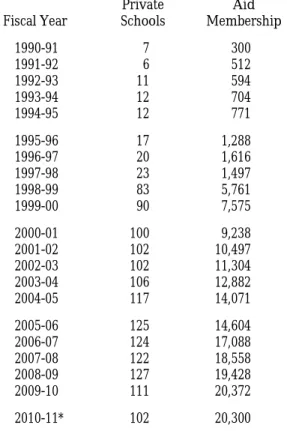
Table 1 shows overall participation in the pro-gram since its beginning in 1990-91. The number of private schools in the program has increased from seven in 1990-91 to a peak of 127 in 2008-09. The
number of schools declined in each of the subse-quent years. Aid membership in the program has increased from 300 to approximately 20,300. The largest increase occurred in 1998-99, with the Wis-consin Supreme Court ruling that allowed sectar-ian schools to participate in the program.
A listing of the private schools participating in the program in 2010-11 and the September and summer school pupil headcount and FTE data for each school is shown in Appendix II. The head-count and FTE data is unaudited and is therefore subject to revision. The aid membership on which payments are made also includes the January, 2011, FTE count, which is not yet available, and therefore not shown in Appendix II.
Program Funding
The following section summarizes statutory provisions regarding payments made under the choice program as well as the various funding mechanisms used in the history of the program, focusing on recent funding changes.
Choice Payments. The State Superintendent is required to pay the parent or guardian of a pupil enrolled in a private school under the choice pro-gram from a separate, general purpose revenue (GPR) sum sufficient appropriation established for this purpose. This payment is made in four equal installments in September, November, February, and May of each school year and the checks are sent to the private school. The parent or guardian is required to restrictively endorse the check for the use of the private school. Under 2009 Act 28, the per pupil payment for the choice program in 2009-10 and 202009-10-11 is equal to the lesser of $6,442 or the private school’s operating and debt service cost per pupil related to educational programming, as de-termined by DPI. Beginning in 2011-12, the maxi-mum amount paid per pupil in a given year will equal the maximum amount in the previous school
Table 1: Participation in the Choice Program
Private Aid
Fiscal Year Schools Membership
1990-91 7 300
1991-92 6 512
1992-93 11 594
1993-94 12 704
1994-95 12 771
1995-96 17 1,288
1996-97 20 1,616
1997-98 23 1,497
1998-99 83 5,761
1999-00 90 7,575
2000-01 100 9,238
2001-02 102 10,497
2002-03 102 11,304
2003-04 106 12,882
2004-05 117 14,071
2005-06 125 14,604
2006-07 124 17,088
2007-08 122 18,558
2008-09 127 19,428
2009-10 111 20,372
2010-11* 102 20,300
year adjusted by the percentage change, if non-negative, in the general school aids appropriation from the previous school year to the current school year.
The State Superintendent is also required to pay the parent or guardian of a choice pupil enrolled in a choice school for summer classroom or labora-tory periods for necessary academic purposes. An-nually, by October 15, each choice school is re-quired to file a report with DPI stating the FTE number of pupils enrolled in summer programs who were attending the school on the second Fri-day of January of the school term immediately pre-ceding that summer or whose applications had been accepted for attendance at the private school in the school term immediately following that summer. The summer school payment is deter-mined by multiplying the FTE summer choice membership by 40% of the per pupil payment amount under the choice program. The State Su-perintendent can include the entire summer school payment in one of the quarterly installments or apportion the amount among several quarterly in-stallments.
Under 2009 Act 28, if a choice school closes after the third Friday in September in a given school year, MPS receives the state's share of any choice payments for that school year that have not yet been paid to the choice school on behalf of that pupil if the pupil enrolls in MPS in that year. The payment equals the choice per pupil amount (a maximum of $6,442 in 2010-11) times the state's share of that payment (61.6% in 2010-11) times 25% for each of the remaining installment payments for that pupil. Payments are made from a sum sufficient appropriation from the general fund for this purpose. No funding was paid to MPS under this provision in 2009-10.
Past Laws Governing Choice Payments. Prior to 1999 Act 9, payments were equal to the lesser of the school's per pupil cost or the average equaliza-tion aid per pupil received by MPS. In Act 9, the payment was modified to equal the lesser of the
school's per pupil cost or the amount paid per pu-pil in the previous school year plus the per pupu-pil revenue limit increase provided to school districts in that school year. Under 2003 Act 33, the index-ing mechanism described above, under which the maximum per pupil payment amount is adjusted by the percentage increase in the general schools aids appropriation, was established. This mecha-nism was used until 2009-10, when the maximum payment amount was set in statute.
Choice Funding. The choice program has al-ways been funded from a separate sum sufficient appropriation. During the time of state two-thirds funding from 1996-97 to 2002-03, that appropria-tion was statutorily excluded from the definiappropria-tions of state school aids and partial school revenues for purposes of calculating the two-thirds funding goal.
Although changes were made to choice pro-gram funding prior to 1999 Act 9, the same basic mechanism for funding the program was in place from 1990-91 through 1998-99. Prior to Act 9, MPS was, with certain exceptions, generally able to count the number of pupils participating in the choice program in its membership for revenue limit and general school aids purposes. Equaliza-tion aid for MPS was reduced by the average equalization aid per member received by MPS times the number of eligible pupils attending pri-vate schools participating under the choice pro-gram. In addition, the State Superintendent was required to ensure that equalization aid paid to other school districts was neither reduced nor in-creased as a result of the payments to choice schools or the MPS aid reduction. Further, the State Superintendent was required to ensure that the amount of the aid reduction to MPS lapse to the general fund, thus fully offsetting the cost of the program.
Under 1999 Act 9, the definition of membership was changed to completely exclude pupils enrolled in a choice school from being counted in MPS' membership. Also under Act 9, the incidence of the aid reduction was changed. Rather than the full
reduction coming from MPS' aid, the reduction was made by reducing the general school aids for which MPS was eligible by one-half of the reduc-tion, while the general school aids for which all the other school districts in the state were eligible to be paid was reduced proportionately by an amount totaling the other half. A school district's revenue limit calculation was not affected by the choice re-duction. Thus, a district could increase its property tax levy to offset any aid reduction made related to the choice program. Because this property tax levy was included in partial school revenues under the two-thirds funding calculation, total funding for general school aids was increased by two-thirds of the amount of the choice lapse, which partially off-set the statewide reduction amount.
While the choice program was funded from a separate appropriation that was excluded from the definition of state school aids and partial school revenues for the purpose of calculating two-thirds funding, the provisions requiring the general school aids reduction and allowing districts to levy to offset the aid reduction caused the estimated cost of the choice program to increase partial school revenues. This effective inclusion of the es-timated costs of the choice program in partial school revenues resulted in a higher funding level for general school aids than there would otherwise have been in the absence of the aid reduction and levy offset provisions. For some districts, the addi-tional aid received under the equalization aid for-mula was greater than the initial choice reduction. Other districts did not receive enough additional aid to offset the choice reduction.
Under 2001 Act 16, the general school aid re-duction for non-MPS school districts was deleted. As a result, 1999-00 and 2000-01 were the only years districts other than MPS had their general aid reduced for the choice program. Act 16 required that general aid for MPS in each year be reduced by an amount equal to 45% of the total cost of the choice program, which is comparable to the net reduction incurred by MPS under prior law. The amount levied by MPS to offset the choice reduc-tion was not counted in partial school revenues,
meaning no additional general school aid was gen-erated by this choice levy for distribution to all dis-tricts under the equalization aid formula. This pro-vision resulted in the general fund paying for 55% of the choice program and MPS for 45%. Other than MPS, all school districts' aid payments and property tax levies are not affected by the current choice program funding structure. The elimination of the state's two-thirds funding commitment in 2003 Act 33 did not affect the 55% general fund / 45% MPS funding split for the program.
Under 2007 Act 20, a separate aid program was created to provide aid to districts with high poverty. This aid is generally based on district enrollment and the number of pupils in a district eligible for free or reduced-price lunch. By law, any aid MPS receives from this program must be used to offset the choice levy attributable to the reduction in general school aid.
Choice funding was further modified in 2009 Act 28. The reduction to the general aid for MPS equal to 45% of the estimated cost of the choice program was maintained, but split into two sepa-rate amounts. The reduction is equal to the sum of: (a) 41.6% of the cost of the choice program in 2009-10 and 38.4% of the cost of the program in 202009-10-11 and each year thereafter; and (b) 3.4% of the cost of the program in 2009-10 and 6.6% of the cost of the program in the 2010−11 and each year thereafter. DPI is required to annually inform the MPS Board in writing of the result of the calculation under (b), and to annually pay the City of Milwaukee the amount under (b) from the general school aids ap-propriation using the same payment schedule as for equalization aids. The City must use the amount under (b) to defray the choice program levy it raises on behalf of MPS. These funds are considered state aid for revenue limit purposes.
Thus, while aid to MPS is still initially reduced by an amount equal to 45% of the estimated cost of the choice program, the state general fund assumes a greater share of the program’s cost than the remaining 55% through both high poverty aid and City choice levy aid. The result of these two aid
payments is that final MPS aid reduction for the choice program is less than 45% of the program’s cost.
In the October 15, 2010, general school aids dis-tribution, DPI uses an estimate of $130.8 million for the total cost of the choice program in 2010-11. As a result, the general aid that would otherwise be paid to MPS will be reduced by $58.8 million to partially fund the choice program. In 2010-11, MPS will receive $9.7 million in high poverty aid and $8.6 million in aid from the City to reduce the choice levy. After consideration of those aid pay-ments, the net aid reduction for MPS related to the choice program is $40.5 million, which represents 6.3% of the district's estimated 2010-11 aid eligibil-ity, and 31% of the cost of the choice program. The state's general fund bears the remaining $90.3 mil-lion cost of the choice program. As a result, the net funding split for the choice program in 2010-11 is 69% state general fund/31% MPS.
Table 2 summarizes state funding for the choice program since its inception. Total funding for the program has increased from $0.7 million in 1990-91 to an estimated $130.8 million in 2010-11. The per pupil amount and aid reductions shown in the ta-ble are those determined under the relevant statu-tory provisions that applied in the indicated year. The total state payment and aid reduction figures are based on the October general aid distributions prepared by DPI. The final figures may have been adjusted based on final choice participation and aid eligibility data. Finally, it should be noted that the choice program funding data in Table 2 reflect only the amount and incidence of the aid reduction from the general school aids appropriation. The interactions of the choice program with the reve-nue limit and equalization aid formulas and the state's two-thirds funding of partial school reve-nues described earlier are not addressed in Table 2.
Program Evaluation
Under 1989 Act 336, the State Superintendent was authorized to conduct evaluations of the choice program. This authority was repealed in 1995 Act 27. Five reports were prepared for DPI by Professor John Witte of UW-Madison evaluating the first five years (1990-91 through 1994-95) of the program. In general, the evaluations concluded that: (a) the program had accomplished the pur-pose of making alternative school choices available to low-income families whose children were not succeeding in school; (b) parents were very satis-fied with the program and have been highly in-volved in their children's education with atten-dance rates comparable to the MPS average for elementary schools; (c) the attrition rate in the pro-gram declined during the first four years and lev-eled off in the fifth year, but in the last two years evaluated, was comparable to pupil mobility rates in MPS; and (d) when test scores were controlled for gender, race, income, grade, and prior achievement, there was no systematic evidence that choice students do either better or worse than MPS students on achievement tests.
As required by 1989 Act 336, the Legislative Audit Bureau (LAB) released an evaluation of the choice program in February, 1995. LAB agreed with Professor Witte's conclusions regarding pa-rental satisfaction with, and involvement in, the program, attendance rates for choice pupils, and attrition rates. However, the Audit Bureau found that his conclusions regarding comparative aca-demic performance were stronger than could be supported by the limited data available due to fac-tors such as pupil attrition and small sample sizes. The LAB concluded that no conclusions could be drawn.
ab le 2: S tat e Fu n d in g of t h e M il w au k ee P ar en tal C h oi ce P rog ra m Al l O the r D is tri ct s o ic e MPS Perce n t P rogr am G ener al A id H igh C it y Cho ic e N et A id T o tal o f E ac h A id P er P u p il A id E st im ate R edu ct io n P o v er ty A id L ev y A id R edu ct io n N et P er cen t R edu ct io n D is tri ct 's M em b er sh ip A m o u n t (i n Mi ll ion s) (i n Mi ll ion s) (i n Mi ll ion s) (i n M il li o ns ) (i n Mi ll ion s) o f A id (i n Mi ll ion s) A id 90 -9 1 30 0 $2, 446 $0. 7 $0. 7 $0. 7 0. 3% 99 1-92 512 2, 643 1. 4 1. 4 1. 4 0. 5 99 2-93 594 2, 745 1. 6 1. 6 1. 6 0. 6 99 3-94 704 2, 985 2. 1 2. 1 2. 1 0. 7 99 4-95 771 3, 209 2. 5 2. 5 2. 5 0. 8 99 5-96 1, 288 3, 667 4. 6 4. 6 4. 6 1. 2 99 6-97 1, 616 4, 373 7. 1 7. 1 7. 1 1. 6 99 7-98 1, 497 4, 696 7. 0 7. 0 7. 0 1. 5 99 8-99 5, 761 4, 894 28 .7 28 .7 28 .7 5. 6 99 9-00 7, 575 5, 106 39 .1 19 .5 19 .5 3. 4 $19 .5 0. 6% 00 0-01 9, 238 5, 326 49 .0 24 .5 24 .5 4. 1 24 .5 0. 7 00 1-02 10 ,49 7 5, 553 59 .4 26 .7 26 .7 4. 4 00 2-03 11 ,30 4 5, 783 65 .6 29 .5 29 .5 4. 7 00 3-04 12 ,88 2 5, 882 76 .2 34 .3 34 .3 5. 3 00 4-05 14 ,07 1 5, 943 87 .4 39 .3 39 .3 6. 0 00 5-06 14 ,60 4 6, 351 93 .7 42 .2 42 .2 6. 2 00 6-07 17 ,08 8 6, 501 110 .5 49 .7 49 .7 7. 2 00 7-08 18 ,55 8 6, 501 120 .3 54 .1 $7 .4 46 .7 7. 0 00 8-09 19 ,42 8 6, 607 128 .8 58 .0 9. 9 48 .1 7. 4 00 9-10 20 ,37 2 6, 442 130 .1 58 .5 9. 7 $4 .4 44 .4 6. 9 01 0-11 * 20 ,30 0 6, 442 130 .8 58 .8 9. 7 8. 6 40 .5 6. 3 * P relim ina ry.
In the 1995 evaluation, the Audit Bureau indicated that the program had not had a substantial fiscal effect on MPS for two reasons. First, the program had not diverted a large number of students from MPS and had only reduced the increase in MPS enrollment since the program began. Second, the loss of revenue experienced by MPS did not appear to have impeded the district's ability to fund edu-cational activities for other students during the pe-riod covered by the LAB evaluation. Choice pay-ments never equaled more than 0.8% of the dis-trict's equalization aids during the period covered by the LAB evaluation.
As required by 1995 Act 27, the Audit Bureau released a second evaluation of the program in February, 2000. LAB surveyed participating fami-lies about the choice program, and found that most respondents heard about the program through in-formal sources such as friends or relatives, and that most selected choice schools based on perceived educational quality. Of the choice schools sur-veyed, LAB determined that nearly three-quarters could be classified as religious. While the Audit Bureau noted that the performance of students in MPS and choice schools could not easily be com-pared given that not all schools administer the same standardized testing, nearly 90% of the choice schools that responded to the Audit Bureau sur-veys submitted to at least one form of independent quality review or performance measurement and that all schools reported compliance with the statu-tory performance standards that were selected. With respect to the possible negative fiscal effects of the choice program on MPS, the Audit Bureau noted that a full cost-benefit analysis of the program would require making assumptions about the choice program. LAB noted, however, that while total revenue received by MPS was not sig-nificantly affected by the choice program, costs to MPS property taxpayers were higher than they would have been in the absence of the choice pro-gram, given that MPS could increase its property tax levy to offset lost equalization aid. The Audit Bureau also noted that, in the context of state funding of two-thirds of partial school revenues in
place at the time of evaluation, total state aid to MPS had increased, while total property taxes had decreased since the start of the choice program.
Another framework for evaluation of the choice program was established in 2005 Act 125. Under that act, annually from 2006 through 2011, choice schools are required to provide the scores of all standardized tests that it administers to the School Choice Demonstration Project (SCDP), a national collaboration of researchers designing school choice program evaluations which is currently based at the University of Arkansas. The Audit Bu-reau is required to review and analyze the stan-dardized test score data received from the SCDP. Based on its review, LAB is required to report to the Legislature annually from 2007 to 2011 on: (a) the results of standardized tests administered by choice schools; (b) the scores of a representative sample of choice pupils on the WKCE adminis-tered in the 4th, 8th, and 10th grades and the Wis-consin reading comprehension test administered in the 3rd grade; and (c) the scores of a comparable group of MPS students on the WKCE and reading comprehension tests. As part of its evaluation, the SCDP also anticipates assessing numerous aspects of the choice program over the five years, such as the effects of the program on K-12 finance, the demographics of the City, school-level racial inte-gration, and the identity of religious schools.
The SCDP released reports on choice testing in February of 2008, March of 2009, and April of 2010. For its April, 2010 report on descriptive test score data, the SCDP received information from 113 choice schools that administered a nationally-normed standardized test or the WKCE to choice pupils in 2008-09 in the 4th, 8th, and 10th grades. On nationally-normed tests, the performance of choice pupils in those three grades averaged
be-tween the 30th and 40th percentiles nationally in
reading, math, and science. The average percentile
scores for the 4th and 8th grades were slightly higher
than those from the National Assessment of Educa-tional Progress (NAEP) for low-income students in large cities in the U.S. On the WKCE, 4th grade choice pupils scored somewhat lower than
low-income 4th grade MPS pupils. In 8th grade, how-ever, choice pupils scored somewhat higher than low-income MPS pupils. Because these are only descriptive comparisons, researchers from the SCDP noted that the data could not be used to draw any conclusions about the effectiveness of the choice program compared to MPS, which requires data from the longitudinal study.
To conduct the longitudinal study, researchers from the SCDP reported on the methods that were used to generate comparable panels of students from choice schools and MPS schools for which to compare WKCE results. Researchers from the SCDP began the longitudinal study by constructing samples of 2,727 students each in grades 3 through 9 from the choice program and from MPS matched to the choice sample on achievement level and demographics. Researchers from the SCDP indi-cated in the report that the sample size was judged to be large enough to produce statistically-significant results over five years after anticipated student attrition. In the April, 2010, report, re-searchers concluded that there were generally few statistically significant differences in achievement growth in reading or math between the students
the choice and the MPS samples after two years. Researchers also discussed issues relating to stu-dent attrition, noting that the number of missing cases from both samples in the third year was less than they had initially anticipated.
The Audit Bureau issued its reports on the test-ing data in September of 2008, August of 2009, and August of 2010. In the August, 2010, report, LAB indicated that it reviewed the data submitted by the SCDP and generally confirmed test score aver-ages and related analyses reported by the SCDP. LAB indicated that they were not able to review average pupil test scores at individual choice schools because of confidentiality concerns raised by the SCDP. The Audit Bureau also noted ana-lytical challenges acknowledged by researchers in the longitudinal study, specifically with the treat-ment of scores for pupils who transfer between MPS and the choice program and with ongoing pupil attrition. LAB asserted that pupil attrition will likely pose a significant challenge to research-ers, noting, for example, that only 40 percent of the 2,727 pupils in the original sample of choice pupils remained in choice schools after the third year.
APPENDIX I
Legal Challenges to the Choice Program
Once the choice program was enacted in 1990, its legality was immediately challenged. In May, 1990, the State Supreme Court was petitioned by several teacher, administrator, and parent groups and the Milwaukee branch of the NAACP to re-view the program. The petitioners argued that the program was unconstitutional because it violated: (1) the doctrine that public funds may be expended for only public purposes because the program "contains no educational controls, measures or standards of accountability;" (2) the state constitu-tional requirement that schools be as uniform as practicable; and (3) the state constitutional provi-sion prohibiting the Legislature from passing a private or local provision as part of a multi-subject bill.
Although the State Supreme Court denied the request, six private schools in Milwaukee and several pupils and their parents wishing to participate in the program brought an action before the Circuit Court of Dane County (Davis v. Grover) seeking to compel the State Superintendent to immediately implement the program and to prohibit the State Superintendent from imposing any requirements on participating schools beyond those already specified in the parental choice law. The parties who previously requested the Supreme Court to review the program joined as intervenors in the Circuit Court action asking again that the law be declared unconstitutional.
In August, 1990, the Circuit Court ruled that the program was not unconstitutional. With regard to the public purpose challenge, the Court concluded that education is a public purpose and that the choice program is the Legislature's attempt "to im-prove the quality of education to the benefit of the entire state." Further, the Court held that the legis-lation "has sufficient accountability and control to maintain its public purpose." With regard to the
uniformity clause challenge, the Court reasoned that the private schools participating in the pro-gram do not become public school districts even though they accept public school students and are, therefore, not required to meet the statutory stan-dards required of public school districts. Finally, the Court dismissed the local/private bill challenge by concluding that the legislation is intended to have "a direct and immediate effect on a specific statewide concern or interest" and, therefore, is "neither a local nor a private law."
In addition, the Circuit Court ruled that while the State Superintendent has the authority to en-sure that participating schools meet the require-ments both of the parental choice law and of other state and federal provisions, "he may not insist on compliance in a manner more onerous or demand-ing than that insisted upon for other participatdemand-ing programs and public schools." The Circuit Court opinion also agreed with the U.S. Department of Education that the private schools in the program were not required to comply with federal and state laws regarding education for children with dis-abilities. While the private schools may not deny qualified students with disabilities access to their programs, the responsibility to offer them a free and appropriate education still rests with MPS. In November, 1990, the Court of Appeals re-versed the Circuit Court decision and declared the program unconstitutional by concluding that it was a local/private provision passed as part of a multi-subject bill. The Court of Appeals did not address the other two constitutional challenges previously dismissed by the Circuit Court. In March, 1992, the State Supreme Court, by a 4-3 vote, reversed the Court of Appeals decision and ruled that the choice program was not unconstitu-tional.
Initially, only nonsectarian private schools could participate in the program. In 1995 Act 27, the choice program was expanded to include sec-tarian schools and a number of other changes were made to the program. The Act 27 changes were challenged in court and a preliminary injunction prohibiting implementation of the Act 27 changes to the program was issued by the Dane County Circuit Court. An original action for removal of the case from the Circuit Court was brought before the Wisconsin Supreme Court and, on March 29, 1996, the Supreme Court issued a decision stating that it was evenly divided on the issues. As a result, the matter was returned to the Circuit Court and the preliminary injunction was continued.
On August 15, 1996, the Dane County Circuit Court made permanent the injunction relating to the expansion of the program to sectarian schools, but lifted the injunction as to nonsectarian schools, which allowed the provisions of Act 27 to take effect for nonsectarian schools in 1996-97.
On January 15, 1997, the Dane County Circuit Court issued a ruling that found that the Act 27 expansion of the program to sectarian schools vio-lated Article I, Sec. 18 of the Wisconsin Constitu-tion (prohibiting state support for religious socie-ties) and the public purpose doctrine. The pro-gram, as it relates to nonsectarian schools, was de-termined to be constitutional. However, the Court found that the Act 27 provisions relating to the program were a local or private bill in violation of Article IV, Sec. 18 of the state Constitution. Under a stipulation before the Court, the program contin-ued to operate, as modified by Act 27, for nonsec-tarian schools in 1996-97 and 1997-98.
On August 22, 1997, a majority of the Court of Appeals concluded that the Act 27 expansion of the
choice program to sectarian schools was invalid under Article I, Sec. 18 of the Wisconsin Constitu-tion because it directed payments of money from the state treasury for the benefit of religious socie-ties. On June 10, 1998, the Wisconsin Supreme Court reversed the decision of the Court of Ap-peals and upheld the constitutionality of the amended choice program (Jackson v. Benson). In accordance with this ruling, the injunction barring the implementation of the amended choice pro-gram was dissolved and the propro-gram expansion to sectarian schools took effect in 1998-99. On No-vember 9, 1998, the U.S. Supreme Court declined, without comment, to hear an appeal stemming from the Wisconsin Supreme Court decision.
While the U.S. Supreme Court declined to hear an appeal on the Wisconsin case, on June 27, 2002, the Court upheld the constitutionality of the Ohio Pilot Project Scholarship Program in Zelman v. Simmons-Harris. Under the Ohio program consid-ered in the case, families in the Cleveland School District were provided tuition aid to attend par-ticipating public or private schools of the parent's choosing and tutorial aid for students who choose to remain enrolled in public school. Sectarian and nonsectarian schools in the Cleveland School Dis-trict and public schools in adjacent disDis-tricts were allowed to participate, and aid was distributed based on the financial need of the parents and the educational option chosen for the student. The Court held that the Ohio program did not violate the Establishment Clause of the First Amendment of the U.S. Constitution because it was enacted for a valid secular purpose, is neutral with respect to religion, permits participation of various types of schools, and provides assistance directly to a broad class of citizens who direct aid to sectarian schools as a result of their independent and private choice.
APPENDIX II
Milwaukee Parental Choice Program Headcount and FTE 2010-11 School Year
Summer
3rd
Friday in September School
School Name Headcount FTE FTE
Alston's Preparatory Academy 78 70.0 6.0
Atlas Preparatory Academy, Inc. 966 930.0
Atonement Lutheran School 147 139.8 2.0
Believers in Christ Christian Academy 190 181.2 5.0
Blessed Sacrament School 121 114.0
Blessed Savior Catholic School 688 655.5 7.0
Calvary's Christian Academy 48 42.4
Carter's Christian Academy, Inc. 103 100.2 4.0
Carter School of Excellence 18 13.6
Catholic East Elementary 104 100.8
CEO Leadership Academy 182 182.0 5.0
Ceria M. Travis Academy, Inc. 659 646.2
Child Development Center of St. Joseph 60 43.6
Christ Memorial Lutheran School 83 78.0
Christ St. Peter Lutheran School 185 177.4 1.0
Christian Faith Academy of Higher Learning 147 139.4
Clara Mohammed School 203 195.4 6.0
Concordia University School 218 208.4
CrossTrainers Academy 127 119.8
Daughters of the Father Christian Academy 64 61.6
Destiny High School 253 253.0
Divine Savior Holy Angels High School 55 55.0
Dr. Brenda Noach Choice School 62 59.2
Early View Academy of Excellence 330 321.2
Eastbrook Academy 152 143.1 5.0
Emmaus Lutheran School 235 223.0
Family Montessori School 32 28.0
Garden Homes Lutheran School 214 204.0 3.0
Greater Holy Temple Christian Academy 734 701.6
Hickman Academy Preparatory School 407 392.2
Holy Redeemer Christian Academy 429 423.0
Holy Wisdom Academy 264 245.2 9.0
HOPE Christian School: Prima 259 247.0 1.0
HOPE Christian School: Fortis 276 268.0
Summer 3rd
Friday in September School
School Name Headcount FTE FTE
Institute of Technology and Academics, Inc. 213 203.8
Jared C. Bruce Academy 203 194.6
Kindergarten Plus 86 68.8
Learning Bridges Kingdom Academy, Inc. 14 11.5
LifeSkills Academy 76 72.8 5.0
Lutheran Special School & Education Services 18 18.0
Malaika Early Learning Center 40 30.4
Marquette University High School 31 31.0
Messmer High School/Messmer Preparatory Catholic School 982 963.0 17.0
Mills Christian Academy 45 45.0
Milwaukee Lutheran High School 339 339.0 3.0
Milwaukee Montessori School 9 9.0
Milwaukee Seventh Day Adventist School 75 75.0
Montessori School of Garden Homes 24 24.0
Mother of Good Counsel School 154 149.5
Mount Calvary Lutheran School 167 160.5
Mount Lebanon Lutheran School 171 160.5 2.0
Mustard Seed International School 30 27.2
New Testament Christian Academy 88 85.0 4.0
Northwest Catholic 259 248.0
Northwest Lutheran School 213 206.2
Notre Dame Middle School 118 118.0 7.0
Oklahoma Avenue Lutheran School 34 30.5
Our Lady Queen of Peace 155 147.0
Parklawn Christian Leadership Academy 197 189.8
Pius XI High School 167 167.0
Prince of Peace/Principe de Paz 475 451.8
Right Step Inc. 226 226.0
Risen Savior Lutheran School 219 209.0 7.0
Saint Adalbert School 474 457.2
Saint Anthony School 1,476 1,422.0 58.0
Saint Catherine School 141 134.2
Saint Charles Borromeo School 45 42.5
Saint Coletta Day School of Milwaukee 9 9.0
Saint Gregory the Great Parish School 111 104.5
Saint Joan Antida High School 270 270.0
Saint John Kanty School 167 158.2
Saint John's Lutheran School 62 60.5
Saint Josaphat Parish School 205 197.0
Summer 3rd
Friday in September School
School Name Headcount FTE FTE
Saint Marcus Lutheran School 376 355.6 15.0
Saint Margaret Mary School 179 164.0
Saint Martini Lutheran School 216 205.6
Saint Peter-Immanuel Lutheran School 162 156.8
Saint Philip's Lutheran School 106 101.0
Saint Rafael the Archangel School 357 340.2
Saint Roman Parish School 115 108.5
Saint Rose and St. Leo Catholic School 395 374.5
Saint Sebastian School 102 99.0 1.0
Saint Thomas Aquinas Academy 71 68.5
Saint Vincent Pallotti Catholic School 122 115.0
Salam School 573 558.0 22.0
Sharon Junior Academy 51 49.5
Sherman Park Lutheran School/Preschool 169 153.4
Siloah Lutheran School 216 208.0
Tamarack Waldorf School 154 147.2
Texas Bufkin Christian Academy 136 128.5
The AppleCrest Preparatory Leadership Academy 21 18.6
The Margaret Howard Christian Leadership Institute 107 100.6
Travis Technology High School 208 208.0
Victory Christian Academy 89 85.0
Washington DuBois Christian Leadership Academy 168 161.2 6.0
Whole Village Institute 10 8.4
Wisconsin Lutheran High School 268 268.0 2.0
Word of Life Evangelical Lutheran School 43 41.0
Yeshiva Elementary School 142 136.4
Young Minds Preparatory School 197 190.6 _____
Total (Unaudited Numbers) * 20,996 20,189.4 203.0
*The aid membership on which choice program payments are made is equal to the average number of FTE pupils enrolled on the third Friday in September and the second Friday in January, plus the summer school FTE.