No-frills technology
Siemens Cerberus ECO
Siemens Building Technologies (SBT) entered the build-ing technology market in 1998. Since then the company has specialized in products for building comfort, electronic security, and fire safety. They are available as both stand-alone items and complete solutions for major building com-plexes such as airports and power plants. The Fire Safety & Security Products division generated sales of approximately ¤6.3 billion in 2007 and just met the Group target of 14–16 percent for return on capital employed. The prod-uct portfolio of this division includes fire alarms and smoke detectors that can be mounted on ceilings and walls, infor-mation and water management systems, and management panels that incorporate information from all areas of a building. In emergencies, central contingency measures can be initiated from these points. SBT has established a prod-uct range in this area under the brand name Sinteso – it is the acknowledged leading system solution in terms of qual-ity in business-to-business markets. Sales activities focus on Western Europe and the United States. Up until a few years ago, the company also received orders from institutions in other countries, including institutions in China. In these cases, responsibility for sales lay with local companies estab-lished by Siemens as cross-divisional units in more than 190 countries worldwide. These local companies were also responsible for providing after-sales service for fire detec-tion products. Sinteso generated the lion’s share of its profits
Cop yright material fr om www .palgra veconnect.com - licensed to npg - P algra veConnect - 2016-06-30
48
Counter strategies
from these services, particularly maintenance, repair, and the spare parts business.
For decades, SBT’s main competitors on this market were American companies such as General Electric, UTC, and Honeywell. From 2000 onward, however, the market sit-uation changed. Economic growth in the BRIC countries led to the construction of a large number of new industrial and commercial buildings, particularly in China. The result-ing growth in demand for buildresult-ing technology led to the development of regional suppliers as competitors. One such rival was the then independent Chinese manufacturer GST. Although the products of these local manufacturers were inferior in terms of technology and quality, they nonethe-less met national safety regulations. What is more, they were up to 50–60 percent cheaper. Naturally, SBT started to worry that in just a few years these new local com-petitors would grow into companies that – after an initial phase of regional concentration – would expand into the international markets.
In 2007, the SBT management team decided to do some-thing to combat the threat that this development posed to their business. The plan was to launch a new product line in China that could compete with regional suppliers in terms of price and performance. It was with this aim in mind that SBT founded a business unit in Beijing, China. Local engineers who were familiar with the specific Chinese requirements were hired to develop the products. Only in the very beginning were these Chinese employees supported by more experienced colleagues from the European head-quarters in Zug, Switzerland. After that, responsibility for developing a product range in line with the local market requirements remained with the colleagues in China. The same setup was also applied later to production and the entire product management, including marketing.
The new Chinese product range was designed to meet only basic local requirements. The smoke detectors could detect
10.1057/9780230362956preview - Counter Strategies in Global Markets, Edited by Olaf Ploetner
Cop yright material fr om www .palgra veconnect.com - licensed to npg - P algra veConnect - 2016-06-30
fire, trigger alarms, and initiate extinguishing measures. Compared to Sinteso products, however, the Chinese man-agement panel offered only a limited overview of the various rooms in a building and false alarms could not always be avoided. In contrast to the Sinteso system, expanding the Chinese equivalent also required a large amount of time, effort, and money. These differences to the Sinteso products were due in part to the ambitious cost targets set for the new Chinese product range. They also represented, how-ever, a conscious decision to create quality differentiation between these products and establish Sinteso as a provider of premium solutions.
In coming up with a designation for the new product line, SBT drew on the name of a well-known Swiss company that SBT had taken over a few years earlier – Cerberus AG. The marketing strategists at SBT discovered that Cerberus was a brand known outside Europe that enjoyed a good reputation. Therefore, they branded the new products for the Chinese market as Siemens Cerberus ECO. This was how the business entity originated; today it has around 400 employees.
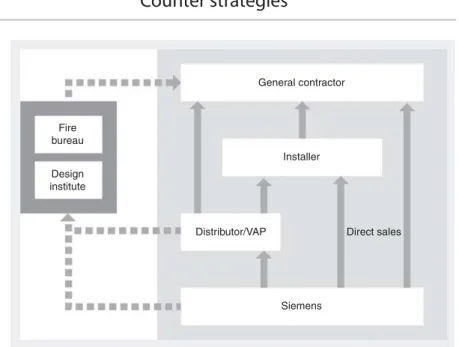
Having decided to limit the sale of Cerberus ECO prod-ucts to China in the first instance, the SBT management team chose not to employ the existing direct sales force via its national company, Siemens China Ltd. in Beijing. This decision was based on the fact that the Cerberus ECO products were to be sold primarily in cities in the western provinces of China, an area in which Siemens China Ltd. had little representation. Instead, SBT pre-ferred to use the more extensive sales channels of small Chinese distributors and value-added partners (VAPs) to address installers serving general contractors in the build-ing business (see Figure 3.1). SBT held product train-ing courses for the employees of the distributors and VAPs, providing information on sales, maintenance, and repair. Cop yright material fr om www .palgra veconnect.com - licensed to npg - P algra veConnect - 2016-06-30
50
Counter strategies
Fire bureau
Installer
Distributor/VAP Direct sales General contractor
Siemens Design
institute
Figure 3.1 Distribution structure for Cerberus ECO in China
Source: Compiled by the author (according to Siemens AG)
The Cerberus ECO business met initial expectations in terms of both revenue and results. At the end of 2010, around 250,000 fire detectors were sold in China. Neverthe-less, there were some pricing issues that had to be resolved in the first few years. The prices customers were willing to pay had to be aligned with the market position of the new brand, as well as with the profit expectations of SBT and its Chinese sales partners. Ultimately, the strategy proved such a success that SBT started to consider whether it made sense to market these Chinese fire detection products in other countries, too. This idea gained momentum in the spring of 2010 when SBT’s US competitor UTC announced that it was taking over the Chinese manufacturer GST. In 2010, SBT started selling Cerberus ECO products in Indonesia and Vietnam. In 2010, plans to launch the range in Brazil and Russia were also being considered.
At first glance, the development of the Cerberus business may not seem as spectacular as the development of ZPMC illustrated in Chapter 1. This may be because the global
10.1057/9780230362956preview - Counter Strategies in Global Markets, Edited by Olaf Ploetner
Cop yright material fr om www .palgra veconnect.com - licensed to npg - P algra veConnect - 2016-06-30
You are viewing this book in preview mode, which allows selected pages to be viewed without a current Palgrave Connect subscription. Pages beyond this point are only available to subscribing institutions. If you would like access the full book for your institution please:
Contact your librarian directly in order to request access, or; Use our Library Recommendation Form to recommend this book to your library
(http://www.palgraveconnect.com/pc/connect/info/recommend.html), or;
Use the 'Purchase' button above to buy a copy of the title from
http://www.palgrave.com or an approved 3rd party.
If you believe you should have subscriber access to the full book please check you are accessing Palgrave Connect from within your institution's network, or you may need to login via our Institution / Athens Login page: (http://www.palgraveconnect.com/pc/nams/svc/institutelogin?
target=/index.html).
Please respect intellectual property rights
This material is copyright and its use is restricted by our standard site license terms and conditions (see
http://www.palgraveconnect.com/pc/connect/info/terms_conditions.html). If you plan to copy, distribute or share in any format including, for the avoidance of doubt, posting on websites, you need the express prior permission of Palgrave Macmillan. To request permission please contact