2012-2014
TABLE OF CONTENTS
Academic Calendar . . . .2
Locations . . . .4
Message from the Chancellor . . . .6
Student Information . . . .7
The Colleges . . . .17
Clinton Community College . . . .18
Muscatine Community College . . . .20
Scott Community College . . . .22
Continuing Education . . . .24
Business & Industry Center . . . .25
Economic Development . . . .26
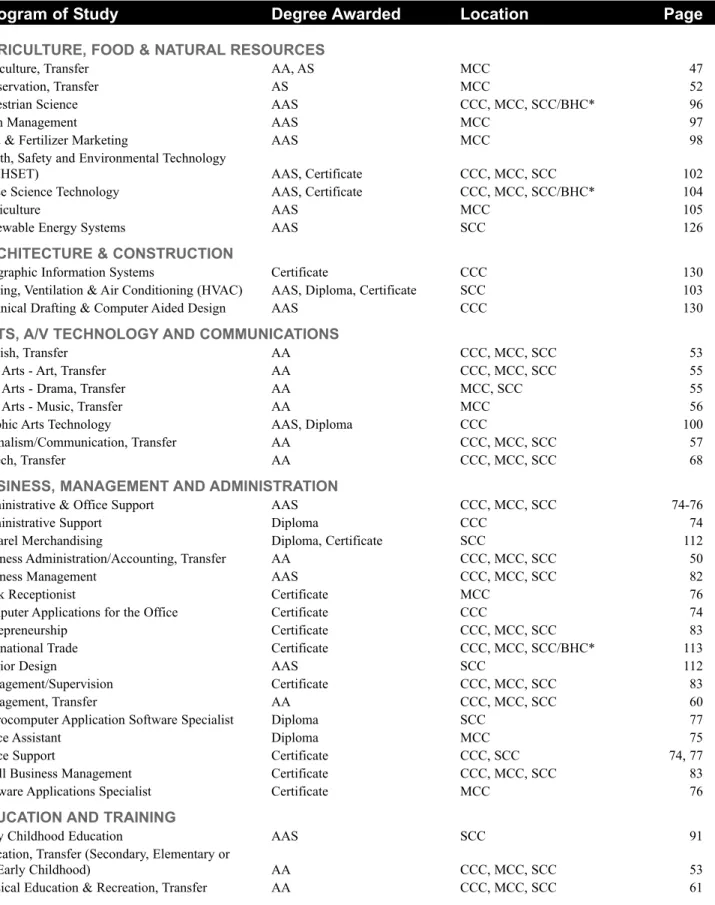
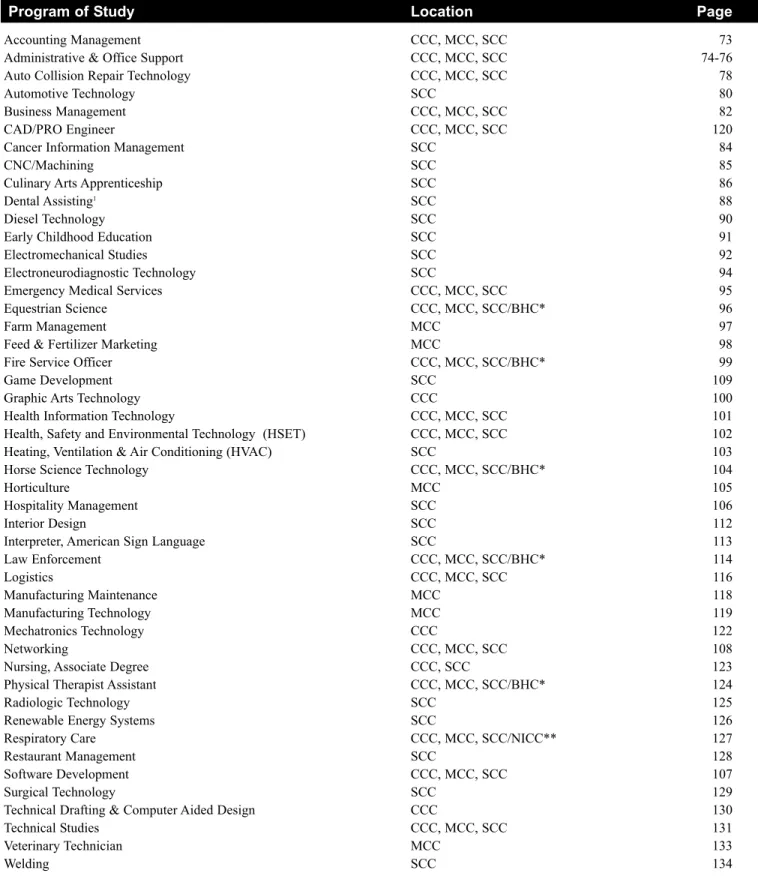
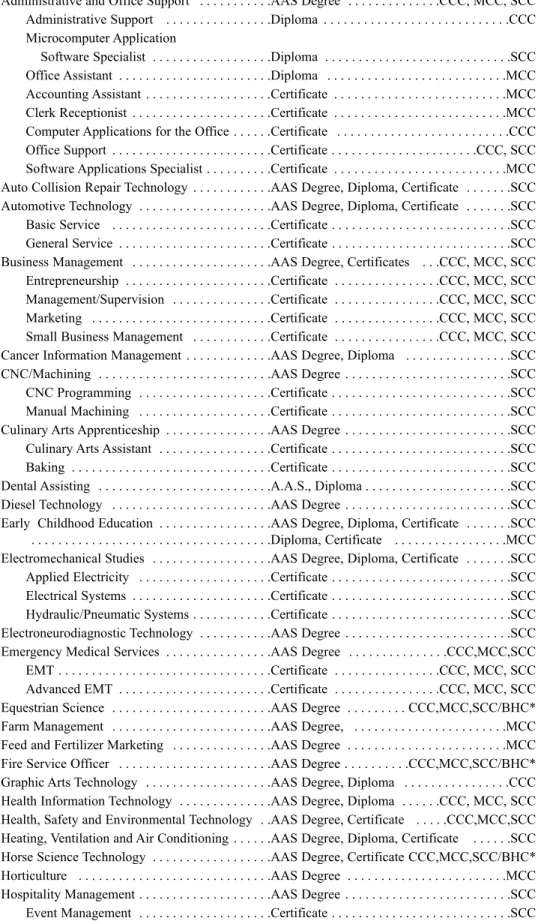
Programs of Study . . . .27
By Career Cluster . . . .28
By Degree Awarded . . . .32
By Alphabetical Order . . . .36
Arts and Sciences/A.A & A.S. . . . .39
Concentration Listing . . . .40
General Education Requirements . . . .41
Concentration Descriptions . . . .47
Career Technology/A.A.S., Diploma, Certificate . . . .69
Career Technology Listing . . . .70
General Education Requirements . . . .72
Program Descriptions . . . .73
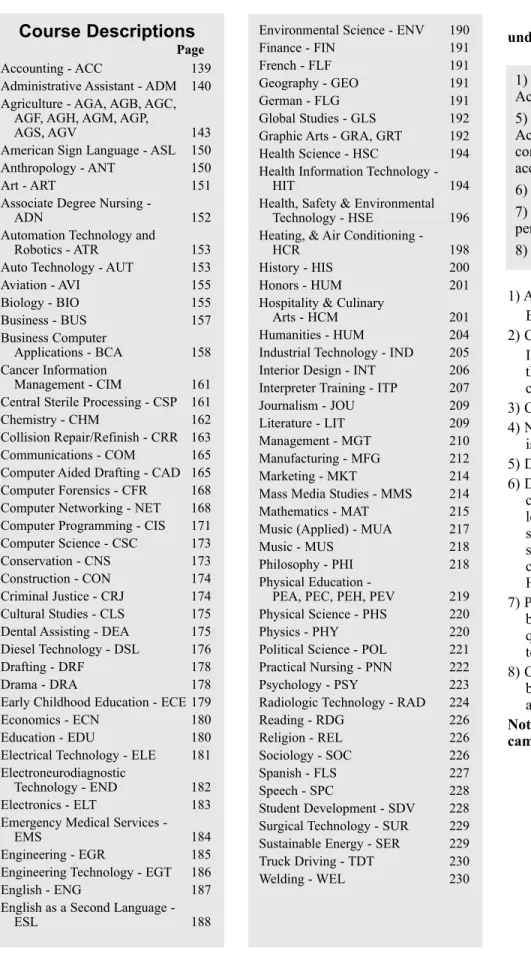
Course Descriptions . . . .137
Faculty and Staff . . . .233
Index
. . . .247
The information in this catalog applies to Clinton, Muscatine and Scott Community Colleges for the 2012-2014 academic years and is current as of the date of publication. The District reserves the right to change any of the programs without prior notice, but will make reasonable efforts to notify students of changes. Please consult the Admissions Office or your advisor before making academic decisions.
ACADEMIC CALENDAR
Summer Term 2013
June 3 Summer Tuition and Fees DueFirst Four Week & Eight Week Summer Sessions
June 3 First Four Week & Eight Week Summer Sessions Begin
June 4 Last Day for 75% Tuition Refund/To Add Classes to First Four Week & Eight Week Summer Sessions Begin
June 7 Last Day for 50% Tuition Refund/For Book Exchange or Return for First Four Week & Eight Week Summer Sessions
June 21 Last Day to Withdraw from First Four Week Session June 28 First Four Week Session End
July 1 First Four Week Session Grades Due by 5 p.m. July 4 College CLOSED
July 19 Last Day to Withdraw from Eight Week Session July 26 Eight Week Session Ends
July 29 Eight Week Session Grades Due by 5 p.m.
Second Four Week Session
July 1 Second Four Week Session Begins
July 2 Last Day for 75% Tuition Refund/To Add Second Four Week Classes July 4 College CLOSED
July 5 Last Day for 50% Tuition Refund/For Book Exchange or Return for
Second Four Week Classes
July 19 Last Day to Withdraw from Second Four Week Classes July 26 Second Four Week Session Ends
July 29 Second Four Week Session Grades Due by 5 p.m.
Fall Semester 2012
August 13 Fall Tuition and Fees Due August 27 Fall Classes Begin
August 28 Last Day for 75% Tuition Refund/To Add Fall First Eight Week Classes August 31 Fall 2012 Graduation Applications Due
August 31 Last Day for 50% Tuition Refund for First Eight Week classes August 31 Last Day for 75% Tuition Refund/To Add Fall 16 Week Classes September 3 Labor Day (College Closed)
September 7 Last Day for 50% Tuition Refund for 16 Week Classes/For Book Exchange or Return for First Eight & 16 Week Classes September 28 District Staff Development Day - No Classes
October 12 Last Day to Withdraw from First Eight Week Classes October 19 Mid-Term
October 19 First Eight Week Classes End October 22 Second Eight Week Classes Begin
October 23 Last Day for 75% Tuition Refund/To Add Fall Second Eight Week Classes
October 26 Last Day for 50% Tuition Refund/For Book Exchange or Return for Second Eight Week Classes
November 6 Advising Day
November 21 - 23 Thanksgiving (College CLOSED) November 30 Last Day to Withdraw from 16 Week Classes December 11 Last Day to Withdraw from Second Eight Week Classes December 13, 14, & 17 Final Exams
December 18 Fall Term Ends December 18 Grades Due by 5 p.m.
Spring Semester 2013
January 2 Spring Tuition and Fees Due January 14 Spring Classes BeginJanuary 15 Last Day for 75% Tuition Refund/To Add First Eight Week Classes January 18 Spring/Summer 2013 Graduation Applications Due
January 18 Last Day for 50% Tuition Refund for First Eight Week Classes January 18 Last Day for 75% Tuition Refund/To Add Spring 16 Week Classes January 21 Martin Luther King Day -- College CLOSED
January 25 Last Day for 50% Tuition Refund for 16 Week Classes/For Book Exchange or Return for First Eight & 16 Week Classes February 15 District Staff Development Day - No Classes March 1 Last Day to Withdraw from First Eight Week Classes March 8 Mid-Term
March 8 First Eight Week Classes End March 11 - 16 Spring Break
March 18 Second Eight Week Classes Begin
March 19 Last Day for 75% Tuition Refund/To Add Spring Second Eight Week Classes
March 22 Last Day for 50% Tuition Refund for Second Eight Week Classes April 9 Advising Day
April 29 Last Day to Withdraw from 16 Week Classes May 8 Last Day to Withdraw from Second Eight Week Classes May 10, 13 & 14 Final Exams
May 13 Commencement-Clinton Community College 6:00pm May 14 Commencement-Muscatine Community College 7:00pm May 15 Commencement-Scott Community College 6:00pm May 15 Spring Term Ends
May 15 Grades Due by 5 p.m.
Fall Semester 2013
August 12 Fall Tuition and Fees Due August 26 Fall Classes BeginAugust 27 Last Day for 75% Tuition Refund/To Add Fall First Eight Week Classes
August 30 Fall 2013 Graduation Applications Due
August 30 Last Day for 50% Tuition Refund for First Eight Week classes August 30 Last Day for 75% Tuition Refund/To Add Fall 16 Week Classes September 2 Labor Day (College Closed)
September 6 Last Day for 50% Tuition Refund for 16 Week Classes/For Book Exchange or Return for First Eight & 16 Week Classes September 27 District Staff Development Day - No classes
October 11 Last Day to Withdraw from First Eight Week Classes October 18 Mid-Term
October 18 First Eight Week Classes End October 21 Second Eight Week Classes Begin
October 22 Last Day for 75% Tuition Refund/To Add Fall Second Eight Week Classes
October 25 Last Day for 50% Tuition Refund/For Book Exchange or Return for Second Eight Week Classes
November 5 Advising Day
November 26 Last Day to Withdraw from 16 Week Classes November 27 - 29 Thanksgiving (College CLOSED)
December 10 Last Day to Withdraw from Second Eight Week Classes December 12, 13 & 16 Final Exams
December 17 Fall Term Ends December 17 Grades Due by 5 p.m.
Spring Semester 2014
January 12 Spring Tuition and Fees Due January 13 Spring Classes BeginJanuary 14 Last Day for 75% Tuition Refund/To Add First Eight Week Classes January 17 Spring/Summer 2014 Graduation Applications Due
January 17 Last Day for 50% Tuition Refund for First Eight Week Classes January 17 Last Day for 75% Tuition Refund/To Add Spring 16 Week Classes January 20 Martin Luther King Day -- College CLOSED
January 24 Last Day for 50% Tuition Refund for 16 Week Classes/For Book Exchange or Return for First Eight & 16 Week Classes February 14 District Staff Development Day - No classes February 28 Last Day to Withdraw from First Eight Week Classes March 7 Mid-Term
March 7 First Eight Week Classes End March 10 - 15 Spring Break
March 17 Second Eight Week Classes Begin
March 18 Last Day for 75% Tuition Refund/To Add Spring Second Eight Week Classes
March 21 Last Day for 50% Tuition Refund for Second Eight Week Classes April 8 Advising Day
April 28 Last Day to Withdraw from 16 Week Classes May 7 Last Day to Withdraw from Second Eight Week Classes May 9, 12 & 13 Final Exams
May 12 Commencement-Clinton Community College 6:00pm May 13 Commencement-Muscatine Community College 7:00pm May 14 Commencement-Scott Community College 6:00pm May 14 Spring Term Ends
May 14 Grades Due by 5 p.m.
May 26 Memorial Day - College CLOSED
Summer Term 2014
June 2 Summer Tuition and Fees DueFirst Four Week & Eight Week Summer Sessions
June 2 First Four Week & Eight Week Summer Sessions Begin June 3 Last Day for 75% Tuition Refund/To Add Classes to First Four
Week & Eight Week Summer Sessions Begin
June 6 Last Day for 50% Tuition Refund/For Book Exchange or Return for First Four Week & Eight Week Summer Sessions
June 20 Last Day to Withdraw from First Four Week Session June 27 First Four Week Session End
June 30 First Four Week Session Grades Due by 5 p.m. July 4 College CLOSED
July 18 Last Day to Withdraw from Eight Week Session July 25 Eight Week Session Ends
July 28 Eight Week Session Grades Due by 5 p.m.
Second Four Week Session
June 30 Second Four Week Session Begins
July 1 Last Day for 75% Tuition Refund/To Add Second Four Week Classes
July 4 College CLOSED
July 7 Last Day for 50% Tuition Refund/For Book Exchange or Return for Second Four Week Classes
July 18 Last Day to Withdraw from Second Four Week Classes July 25 Second Four Week Session Ends
July 28 Second Four Week Session Grades Due by 5 p.m.
LOCATIONS
ATTENDANCE SITES
Clinton Community College
Maquoketa Center
501 West Washington Street Maquoketa, IA 52060 563-652-5000
Clinton Community College
Technology Center
1951 Manufacturing Drive Clinton, IA 52732 *1-800-637-0559 563-244-7010
John T. Blong Technology Center
8500 Hillandale Road Davenport, IA 52806 1-800-895-0811 563-441-4360Muscatine Agricultural
Learning Center
3200 Lucas Street Muscatine, IA 52761 563-263-2645Scott Community College/
Kahl Educational Center
326 West Third Street Davenport, IA 52801 1-800-895-0811 563-336-5200EICC Administrative Offices/
Scott Community College
Urban Center
306 West River Drive Davenport, IA 52801 1-800-462-3255 563-336-3300
Scott Community College
West Davenport Center
2950 Fairmount Street Davenport, IA 52806 1-800-895-0811 563-326-5319Wilton Center
1215 Cypress Wilton, IA 52778 1-800-477-5002 563-732-2038New student information
toll free (from anywhere):
1-888-336-3907
* Toll free for calls made within area code 563
MAIN CAMPUSES
Clinton Community College
1000 Lincoln Boulevard • Clinton, IA 52732
*1-800-637-0559 • 563-244-7001
Muscatine Community College
152 Colorado Street • Muscatine, IA 52761
1-800-351-4669 • 563-288-6001
Scott Community College
500 Belmont Road • Bettendorf, IA 52722
1-800-895-0811 • 563-441-4001
* Please Print
EEAAS
STTEER
RN
N IIO
OW
WAA C
CO
OM
MM
MU
UN
NIITTYY C
CO
OLLLLEEG
GEES
S
* Fill out Completely
S
SAAM
MP
PLLEE C
CO
OU
UR
RS
SEE S
SC
CH
HEED
DU
ULLIIN
NG
G C
CAAR
RD
D
Today’s Date _______________
Name ____________________________________________ Social Security # ____________________________
(last) (first) (middle)
Address ____________________________________________ Concentration/Program _____________ Code # _______
____________________________________________ Semester/Year ___________________________________
(city) (state) (zip) (For which you are scheduling) New Student r
Telephone Number (________) ________________________ Assessed _____________________
Returning Student rEmail Address _______________________________________
C
CO
OM
MP
PU
UTTEER
R #
#
C
CAATTAALLO
OG
G #
#
C
CO
OU
UR
RS
SEE N
NAAM
MEE
TTIIM
MEE
D
DAAYY B
BLLD
DG
G//R
RO
OO
OM
M S
SEEM
M.. H
HR
RS
S
TOTAL SEMESTER HOURS
__________________________________ STUDENT SIGNATURE
__________________________________ ADVISOR SIGNATURE
Students who withdraw from the class(es) and complete the necessary procedure will be entitled to a refund of tuition according to the following schedule:
75% Refund - prior to the end of the first week of classes (2nd class day of summer and short-term sessions)
50% Refund - prior to the end of the second week of classes (5th class day of summer and short-term sessions)
Students who are receiving financial assistance and completely withdraw are subject to the current refund policy regarding the return of funds to the applicable programs.
Any changes made to your original schedule may affect your Promissory Note plan. Contact the Business Office for details.
A Message from the Chancellor
Welcome to the Eastern Iowa Community
Colleges. I am pleased you have chosen Clinton,
Muscatine and Scott Community Colleges as your
partners in furthering your education.
We have a long tradition of excellence and
commitment to the success of our students. We
continue to invest in our facilities and support
resources to serve you better - something you can
see when you visit our campuses and facilities.
We have updated our classrooms, technology and
hands-on learning labs to make our campuses great
places to learn. We've also designed new course delivery methods because we
understand that each of you has unique needs and learning styles.
What may not be as visibly apparent is our passionate commitment to help you
achieve your goals. Whatever program you choose, we are focused on helping
you earn your degree or certificate, and to ensuring your success in transfer or the
world of work. Our faculty and staff are dedicated to your future success. Our
goal is to help you get ahead in whatever career or field of study you choose.
We're here to help you as you begin your college journey. I encourage you to
visit our website at www.eicc.edu for more information - including "virtual tours"
of our campuses. Please call on us for assistance with class registration, financial
aid planning, career guidance, campus life questions or with any other questions
you might have.
Again, thank you for choosing the Eastern Iowa Community Colleges.
Sincerely,
Don Doucette
Chancellor
Accreditation
Quality Vision
Mission
Statement
WELCOME TO YOUR COMMUNITY COLLEGE
Eastern Iowa Community Colleges delivers quality education and services to strengthen our community. Our mission is accomplished by: • Excelling in teaching and
learning
• Identifying future needs • Preparing tomorrow’s
workforce
• Promoting lifelong learning • Fostering innovation • Valuing diversity • Committing to global
sustainability
• Ensuring accessibility for all
EICC is committed to meeting or exceeding customer needs and expectations through Continuous Quality Improvement.
EICC is accredited by the Higher Learning Commission of the North Central
Association of Colleges and Schools. The HLC address is 30 North LaSalle Street, Suite 2400, Chicago, Illinois 60602-2504. Phone: (800)621-7440 / (312) 263-0456
FAX: (312) 263-7462 EICC is an Academic Quality Improvement Program (AQIP) college. Accreditation means our programs meet or exceed the standards for academic excellence set for every public and private college in the 19-state North Central region. The colleges are approved by the Iowa Department of Education and the Board of Regents. Individual programs are accredited by associations within their respective fields.
Student
STUDENT INFORMATION
ADMISSIONS
General Policy
Eastern Iowa Community Colleges believe in equal educational opportunities for all qualified individuals, regardless of race, color, creed, sex, marital status, religion, ancestry, national origin, sexual orientation, age, or handicap or disability in the educational programs and activities it operates. The colleges reserve the right to deny admission, admission or re-enrollment to anyone who may pose a risk to the best interests of the college community.
Clinton, Muscatine and Scott Community Colleges have an open admission policy, which means that anyone over 16 years of age may apply, even without a high school diploma. Admission to the college does not automatically guarantee admission to all programs of study; you will need to meet the specific
requirements for your chosen program. The colleges reserve the right to guide our placement based on assessment interviews and past academic experience.
You may take up to eleven credit hours without providing transcripts from high school or other colleges you have attended, submitting ACT scores or taking the COMPASS Assessment. But to be officially admitted to a degree or certificate program, you must meet the total admission requirements of the college and the program.
Concurrent Enrollments
You may enroll in classes at more than one of our colleges or at one of our colleges and any other institution. If you are receiving financial aid, you must notify the financial aid officers at all institutions in which you are enrolled.High School Students
Eligible high school students may be accepted for admission to EICC under Iowa's Senior Year Plus. Approval by your high school is mandatory before you may be accepted under this program. EICC offers the opportunity for high school students to enroll in credit classes. High school applicants requesting admission must:1. Complete an Admission Application
2. Students must submit the written approval form signed by a
parent/guardian and the high school counselor or principal.
3. Complete COMPASS Assessment testing or submit ACT scores. Course placement will be mandatory based on COMPASS or ACT scores.
4. Meet with EICC advisor/high school counselor prior to registration.
Pre-High School
Students-Special Status Admission
EICC will consider the admission of a Pre-High School student to credit classes as long as the student is currently enrolled in public or private schools. Enrollment may be considered as enrichment, but is not intended to substitute for the public or private school experience.Students may apply to the college for "special status" consideration for admittance.
Completion of all the steps below is necessary before an admission decision and enrolling a student who is not at least a freshman in high school is determined. 1. Complete an Admission Application 2. Students must provide a current copy
of a signed permission agreement by the appropriate school system and the authorizing parent or guardian. Such documentation must be provided to the Dean of Student Development prior to admission to the College.
3. Prior to admission, an applicant who does not have a high school diploma will be required to demonstrate that they possess specific pre-requisite skills by taking the COMPASS Assessment or submitting ACT scores.
4. The College reserves the right to limit the number to two courses and which type of courses a student may take. Additionally the student will be required to meet with a college advisor when selecting courses for registration. "Special Status" admissions must be approved by the Dean of Student Development.
Home School
Students-Special Status Admissions
EICC will consider the admission of a student to credit classes who are not attending a public or private school, and are currently enrolled as home school students. Students may apply to the college for special status consideration for admittance. Enrollment may beconsidered as enrichment to the home school program, but is not intended to substitute for the home school experience. The following policies and procedures will apply to the enrollment of home school students:
1. Complete an Admission Application 2. Students who are home schooled must
provide a current copy of a signed home school permission agreement between the appropriate school system and the authorizing parent or guardian. Such documentation must be provided to the Dean of Student Development prior to admission to the College. 3. Prior to admission, an applicant who
does not have a high school diploma will be required to demonstrate that they possess specific pre-requisite skills by taking the COMPASS Assessment or submitting ACT scores.
4. The College reserves the right to limit the number of courses and which type of courses a student may take. Additionally the student will be required to meet with a college advisor when selecting courses for registration. "Special Status" admissions must be approved by the Dean of Student Development.
Application Procedures
To apply for admission to Clinton, Muscatine or Scott Community College, you will need to:1. Submit an application for admission. If you are applying to more than one EICC college, you only need to submit one application.
2. Send official transcripts from any other college you have attended, if you have previous college credit. Direct your requests for evaluation of transfer credit to the College Registrar. 3. Provide assessment scores from ACT,
or COMPASS (computerized testing) taken within the last five years. Please contact the Admissions Office for
STUDENT INFORMATION
International Student
Admissions
In addition to following application procedures, International students will need to supply:
1. Provide evidence of proficiency in the English language (in the form of Test of English as a Foreign Language, TOEFL; EICC schools require a score of 500 or better on the paper test, 173 on the CBT, 61 on the IBT).
2. A complete Statement of Financial Support. Forms are available from the Admissions Office.
If you do not qualify for admission as an international student under these requirements, contact the Admissions Office. You may be admitted to ESL (English as a Second Language) classes for credit.
Re-enrollment
To be re-admitted, you must meet all applicable admission requirements. You may be re-admitted to a Career and Technical Education program subject to availability of space in the program and an evaluation of your previous progress.
Transfer Credit
From Other Colleges to EICC
We accept transfer credit from colleges and universities accredited by the North Central Association of Schools or its regional affiliates. Credit for equivalent courses will be accepted to satisfy specific course requirements for graduation. The transfer credit you receive may vary depending on the academic program you choose, and college registrars will decide on elective credit or course substitutions on an individual basis. Transfer credit will be recorded on your EICC transcript after you have requested a transcript evaluation. Transfer grades are not used in your EICC grade point average.From Career and Technical to Arts
and Sciences Programs
If you earn credit in career and technical courses at EICC or other accredited institutions, a maximum of 16 hours of that credit may be accepted as elective credit for an Arts and Sciences degree. See the College Registrar for complete details.
We reserve the right to refuse credit earned more than 10 years before your proposed program completion date. All credit you earn at one of our colleges will transfer to another EICC college, with the limitations outlined above.
Admission on
Restricted Status
If you have been dismissed from another institution or were not in good standing when you left, you still may be admitted on restricted status. The college may limit your class load and course selection if you want to enroll for more than six credits while you are on restricted status. We may also require supplemental assessment, counseling and other forms of assistance to help promote your academic success.
Special Student Admission
Veterans
All of our programs are approved by the Iowa Department of Education for veterans benefits for students eligible under the GI and Post 9/11 Bills. If you are a veteran of the Armed Forces, National Guard or Reserve, contact the College Registrar early in the application process to certify your status and benefits. If you have earned credit through civilian or military education, the College Registrar may evaluate that credit for transfer evaluation.
To receive educational assistance from the Veterans Administration, you must meet "pursuit of education and academic standards" established by the VA and college policy. You are responsible for knowing and following policies that apply to you as a veteran. For information about these policies, including pursuit of education, satisfactory progress,
If you are the widow, widower or child of a veteran, you may also be eligible for educational benefits. The College Registrar can help answer your questions.
Military Personnel
We are a Servicemembers Opportunity College (SOC) and participate in the Concurrent Admissions Program (ConAP). This program allows enlistees to enroll in college at the same time they are serving in the military.
Residency Status for Military
Personnel and Veterans
Active duty military personnel and military service veterans residing within a 50 mile radius of an EICC college, as well as their spouses and dependent children, are considered to be Iowa residents for admission, tuition and fee purposes.Senior Citizens
If you are 62 years or older and live in our service area, you may register for credit courses on a space available basis at a cost of $10.00 per credit hour plus fees. Special registration for seniors is the first five days of classes.
Audit or CEU
You may choose to audit a credit course if space is available in the class. To audit a class, register as usual; tuition and fees will be the same as if you were taking the course for credit. You won't receive credit for the course, but your transcript will reflect the audit with an "N" grade. Participation in class activities is expected, but you won't have to take exams. Some credit courses may also be taken for non-credit Continuing Education Units (CEUs). You cannot receive financial aid if you choose to audit a class.
STUDENT INFORMATION
REGISTRATION
Registration Procedures
To enroll in classes you may meet with an advisor and complete the appropriate forms, or log on to www.eicc.edu and follow the ebridge link to enroll online. Students may enroll in a maximum of 11 hours before meeting with an advisor.Early Registration
Early registration allows you to choose courses and establish your schedule for the next term if your tuition and fees are paid by the designated due date. For some programs, a non-refundable fee (which will be applied toward tuition) may be required when you register or are admitted.
Late Registration
You will have a better selection of courses and class times if you register early. Late registration is during the first week of class for 16-week sessions. Late registration for summer or shortened sessions is during the first two class meetings.
Changing Your Registration
Adding a Class
To add a class you may meet with an advisor and complete the appropriate form or log on to Campus Cruiser and follow the ebridge link to add the class. Classes may be added during the first week of classes for a full semester class. Summer or short term sessions have two days to add a class.
Dropping a Class
To drop a class you may meet with an advisor and complete the appropriate form or log on to Campus Cruiser and follow the ebridge link to drop the class. You may drop a class with a grade of “W” until two weeks prior to the first day of final examinations for a full semester class. You have one week prior to the end of the term during the summer or short term sessions. This process may also be done via ebridge within the last dates to withdraw for the course. Failure to follow the above procedures will result in your earned grade for the course.
Withdrawing from College
You may meet with an advisor and complete the appropriate form or log on to Campus Cruiser and follow the ebridge link to withdraw from all of your classes. NOTE: Check the Tuition and Fees Refund policy for a possible refund.
Course Repeats
Courses must be taken within EICC to be considered repeat courses. The grade and credits earned in the most recent course repeat will be used to calculate your grade point average and will be applied to your degree or program requirements. Once a degree is awarded, if you choose to repeat a course both grades will be calculated in your GPA.
Academic Load
A full-time academic load is 12-18 credit hours per term. You are considered a part-time student if you take 11 or fewer credit hours.
If you'd like to take more than 18 credits in the fall or spring terms or more than 12 credits during the summer term, you'll need permission from the Dean of Student Development. Usually the Dean will grant permission only to students who maintain a 3.0 cumulative GPA and plan to carry no more than 21 credit hours. If you are enrolled in a program that requires more than 18 credit hours per term, you may register without special permission.
Class Attendance
Faculty members determine attendance requirements for their classes. As a student, you are responsible for knowing and following class attendance guidelines.
Graduation
Applications for graduation are due by the fifth day of classes of the semester in which you plan to graduate. For summer graduates, the applications are due by the fifth day of classes of the spring semester. You are responsible for making sure that all of your financial obligations to the college are paid before you can graduate.
EDUCATIONAL
COSTS
We work hard to provide the highest quality instruction at the lowest possible cost. Costs at Clinton, Muscatine or Scott Community College will vary based on your state of residence, fees, books and materials for your program. All costs are subject to change. Please contact the Business Office for a current tuition and fee schedule.
Tuition
Tuition is based on residence and class load. For non-Iowa residents, tuition is 1.5 times the rate for Iowa residents.
Books and Supplies
Your costs will vary depending on the program you choose, but you should expect this to be a significant expense. Career and Technical Education programs may also require tools or uniforms. Contact the college bookstore or the Admissions Office for more detailed information.
Transcript Recording Fees
The college charges $9 per credit hour to record credit you have earned through tests and other types of non-traditional credit. For example, if you take a CLEP test and earn three hours of credit in English, you would pay $27 to have that credit recorded on your transcript.Early Registration Fee
Early registration is required for many career and technical programs. A non-refundable fee, which will be applied to your tuition, may be required to guarantee your registration.Tuition Refunds
If you withdraw from the college, be sure to complete the necessary withdrawal forms to make sure you do not jeopardize your academic standing. If you are eligible for a refund, tuition dollars will be refunded according to the following scale:
Courses that are 16 weeks in length: 100% Prior to the beginning of the
term
Federal Assistance
Federal Pell Grant - a federally funded program based on financial need and enrollment status. Students must not have a bachelor’s or higher degree.
Federal Supplemental Educational Opportunity Grant - a federally funded program administered by the colleges; priority must be given to Pell Grant recipients with the lowest family contribution. Students must not have a bachelor’s or higher degree. Funding is limited.
Federal College Work Study -Federally funded part-time employment opportunities that allow students to work at an EICC site or at designated off campus locations. Students working at off campus locations will have the opportunity to work in community service positions or at elementary schools through the America Reads/America Counts programs. The amount a student may earn is based on financial need. Funding is limited.
William D. Ford Direct Loan Program
-long-term, low interest loans available to students and parents. These are also known as Federal Stafford Loans
(Subsidized and Unsubsidized) and Federal Parent Loans for Undergraduate Students (PLUS). To apply, complete a Master Promissory Note (MPN), a Loan Authorization Form (LAF), and an Entrance Counseling Form. Links to these applications are available online at www.eicc.edu/staffordloanapp.
STUDENT INFORMATION
Courses that meet for one week or less:100% Prior to the official start date of the course*
No refund after the course has begun For all other courses:
100% Prior to official start date of the session*
75% During the first two days of the session*
50% During the third through fifth day of the session*
*See Registration Center for specific course dates.
If classes are cancelled by the college, tuition and fees will be refunded. The same refund policy applies to official withdrawal from individual courses. Your refund will be the appropriate percentage between the tuition for your new load and the tuition for your original load. If you are officially enrolled and receiving Title IV funds (federal financial aid such as SEOG, Pell Grant, Stafford and/or PLUS loans), your refund will be determined using the return of Title IV Funds calculation. Contact the Financial Aid Office for details. Contact the Business Office or College Registrar for refund deadlines for short-term programs.
RESIDENCY
You are considered an Iowa resident for tuition purposes if your legal residence is in Iowa and you have lived in the state for no less than 90 days prior to the start of the term for which residency is being
requested. You are responsible for proving your in-state status. If you would like to apply to be reclassified from non-resident to resident status, fill out a Request for Residency Status form in the College Registrar's office and provide the following support documents: rent receipts, or evidence of ownership of property in Iowa, and two of the following documents: Iowa income tax return, Iowa vehicle
registration, Iowa driver's license, Iowa voter registration card. The request for residency status must be filed prior to the end of the first week of classes during the
If you are reclassified as a resident, that reclassification becomes effective immediately and does not cover any term for which you previously have been enrolled. International students cannot establish residency while studying in this country on a temporary student visa. Contact the Admissions Office or College Registrar for more information.
STUDENT HEALTH
INSURANCE
We encourage you to have health/accident insurance, and optional insurance coverage is available. If you choose to buy student health insurance, see the Dean of Student Development for the form. Any medical costs for treatment of illness or accident which are not covered by personal insurance are your responsibility.
FINANCIAL AID
Your college education is an investment in your future. We are pleased to provide financial assistance to students who might otherwise not be able to attend college. If you are in need of financial assistance to attend school, please contact the Financial Aid Office. No student should ever withdraw from school for financial reasons without first talking to our financial aid staff to see if help is available. Financial aid programs are constantly being reviewed by the state and federal government. The outline below is meant to be a general overview. Please contact the Financial Aid Office for more information.
General Policy
If you previously attended, or are currently attending, another institution you must notify the Financial Aid Office. You cannot receive financial aid from two institutions during the same semester. For specific information about satisfactory academic progress or other financial aid policies, see the current student handbook or contact the Financial Aid Office. To apply for federal and state financial aid, all students must complete a Free
Courses that satisfy specific requirements for A.A. concentration areas are listed on pages 47-68.
1.
You may choose to demonstrate proficiency in computer skills.
2. A maximum of 16 credit hours of
career and technical credit may be accepted as electives.
3. A maximum of four credit hours of
Student Development courses may be counted toward the A.A. degree.
4. All course work for the A.A. degree
must be numbered at the 100 level or higher.
Associate in Science (A.S.)
Degree
To earn an Associate in Science degree, you must complete at least 62 credit hours with a 2.0 GPA or better. The minimum general education requirements for the Associate in Science degree is listed below.
Area Credits Communications
Written Composition . . . .6 Speech . . . .3 Arts and Humanities . . . .6
Literature Humanities Arts
Cultural/Historical Perspectives . . . . .3 Western Perspectives
International Perspectives & Language
Social Science . . . .3 Economics or Political Science Psychology or Sociology
Mathematics & Natural Sciences . . .24 Life Sciences Physical Sciences Mathematics Computer Skills Demonstrate Proficiency Concentration Courses and Electives (1,2,3) . . . .17 TOTAL . . . .62
Courses that satisfy requirements for specific A.S. concentration areas are listed on pages 47-68.
1. A maximum of 16 credit hours of
career and technical credit may be accepted as electives.
2. A maximum of four credit hours of
Student Development courses may be counted toward the A.S. degree.
GRADUATION
AND GENERAL
EDUCATION
REQUIREMENTS
At Clinton, Muscatine and Scott Community Colleges, you can earn a degree, diploma or certificate. The Associate in Arts and Associate in Science degrees are designed for transfer to four-year colleges and universities, while the Associate in Applied Science degree will prepare you to enter a specific
occupational field.
Associate in Arts (A.A.)
Degree
To earn an Associate in Arts degree, you must complete at least 62 credit hours with a 2.0 GPA or better. The minimum general education requirements for the Associate in Arts degree are listed below.
Area Credits
Communications
Written Composition . . . .6 Speech . . . .3 Arts and Humanities
Literature . . . .3 Humanities . . . .3 Arts . . . .3 Cultural/Historical Perspectives Western Perspectives . . . 3 International Perspectives & Language . . . .3 Social Science
Economics or Political Science . .3 Psychology or Sociology . . . .3 Natural Sciences Life Sciences . . . .4 Physical Sciences . . . .3-4 Mathematics . . . .3 Computer Skills (1) . . . .3 Concentration Courses and
Electives (2,3,4) . . . .18-19
TOTAL . . . .62
STUDENT INFORMATION
State Assistance
Iowa Vocational - Technical Tuition Grant - a state-funded grant for Iowa residents enrolled in Iowa community college vocational-technical programs who show financial need and meet the state's priority deadline.
Iowa Grant -grants to Iowa residents who attend Iowa colleges and universities and who demonstrate exceptional financial need. Funding is limited.
All Iowa Opportunity Scholarship- a state funded scholarship program available to Iowa residents who begin their initial enrollment at an eligible college or university within two years of graduation from high school. Students must file a FAFSA application and the Iowa Financial Aid application by the state's priority deadlines.
All Iowa Opportunity Foster Care Grant- grants available to Iowa residents who resided in a foster care living arrangement as defined by the Iowa College Student Aid Commission. Students must file a FAFSA application and the Iowa Financial Aid application by the state's priority deadlines.
Education and Training Voucher (ETV) Grant- grants available to Iowa residents aging out of the Iowa foster care system. Students must file a FAFSA application and the Iowa Financial Aid application by the state's priority deadlines.
Veterans Educational Benefits
-financial assistance for veterans of the Armed Forces, National Guard or Reserves, or widows, widowers and children of disabled or deceased veterans. Contact your Commanding Officer or the College Registrar for eligibility and application information.
EICC Programs
EICC Tuition Grant - funded by EICC, assists students who meet certain criteria. Funding is limited.
College Foundation Scholarships -each college provides scholarships from local resources. Contact the Financial Aid or Foundation Office for information.
Other Forms of Assistance - many employers or area organizations (civic, ethnic, religious, etc.) offer financial
Associate in Science in
Pre-Engineering (A.S.) Degree
The Associate in Science in Pre-Engineering degree is offered to address the unique needs of students who plan to transfer to a 4-year university or college and pursue a B.S. in engineering. To earn this degree, you must complete at least 62 credit hours with a 2.0 GPA or better. The minimum general education requirements for the Associate in Science in Pre-Engineering degree is listed below. Area Credits CommunicationsWritten Composition . . . .6 Speech . . . .3 Arts and Humanities . . . .0 - 9
Literature Humanities Arts
Cultural/Historical Perspectives . . .0 - 9 Western Perspectives
International Perspectives & Language
Social Science . . . .3 Economics or Political Science Psychology or Sociology Natural Sciences . . . .18 - 20 Life Sciences Physical Sciences Mathematics . . . .21 Mathematics Computer Skills . . . .3 - 6 Electives (1,2,3) . . . .0 - 11 TOTAL . . . .62 1.
A maximum of 11 credit hours of vocational-technical credit may be accepted as electives.
2. A maximum of four credit hours of
Student Development courses may be counted toward the A.S. degree.
3. All course work for the A.S. degree
must be numbered at the 100 level or higher.
Associate in Applied Science
(A.A.S.) Degree
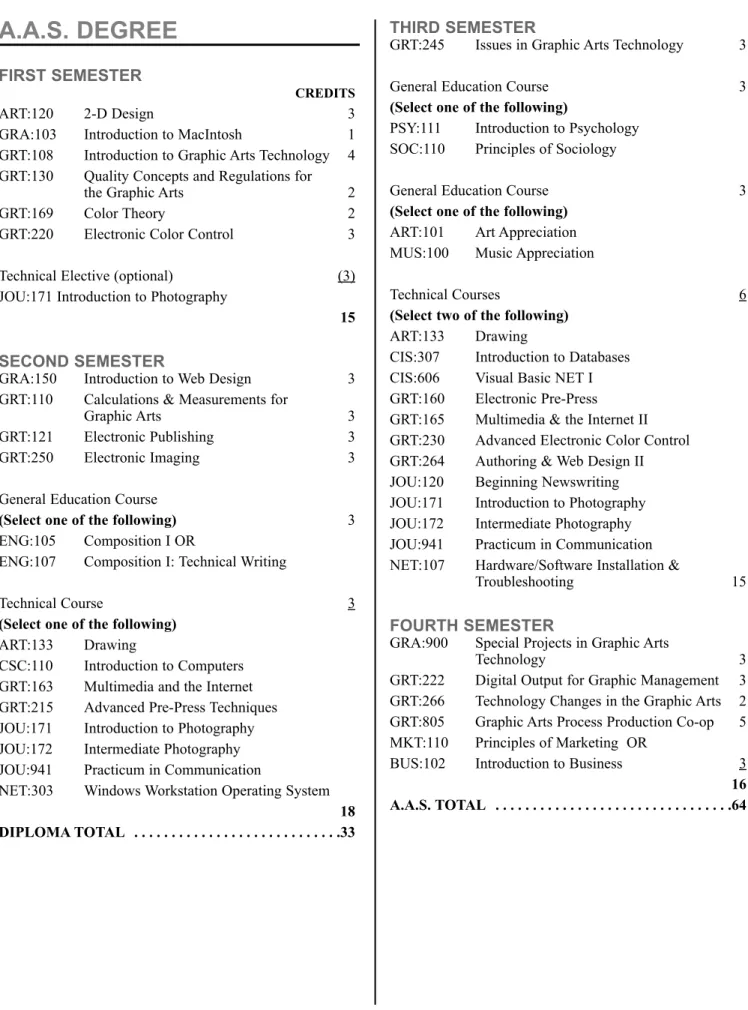
To earn an Associate in Applied Science (A.A.S.) degree, a student must complete the general educational and technical competency requirements of a two-year technical program with a GPA of 2.0 or better in your award major. These programs are designed to prepare you for skilled employment in your chosen area; they are not designed for transfer to a four-year college or university. A.A.S. degree requirements include a minimum of 12 credit hours of general education, including one course each in
Communications, Humanities or Social Sciences, and Math or Science. A.A.S. degrees vary by program in the number of credit hours required for completion and range between 62-86 total credits. All course work must be at the 100 level or above.
Diploma Programs
Diplomas are awarded to students who successfully complete a program with fewer than 49 but more than 31 credit hours and maintain a GPA of 2.0 or better in your award major. These programs will prepare you for entry-level
employment in a specific field. Diploma programs emphasize technical skills and related general education courses that will give you the skills necessary to succeed in the working world.
Minimum general education requirements for a diploma include three credit hours in Communications and 3 credit hours in Social Sciences, Humanities, Math or Science. All course work must be at the 100 level or above. See specific
requirements listed for your program later in this catalog.
Certificate Programs
When you successfully complete a designated program with fewer than 32 credit hours with a GPA of 2.0 or better in your award major, you will earn a Certificate of Completion. TheCertificate means you have the minimum competence in your chosen area. All course work must be at the 100 level or above. See specific requirements listed
ACADEMIC
REQUIREMENTS
Academic Standing
At the end of each term your instructors will assign grades to assess your performance and encourage you to do your best work. The college will determine term and cumulative grade point averages (GPA) and record those on a grade record you may access online. GPA is determined using this formula: A 4.00 x number of credit hours of
A credit received
A- 3.67 x number of credit hours of A- credit received
B+ 3.33 x number of credit hours of B+ credit received
B 3.00 x number of credit hours of B credit received
B- 2.67 x number of credit hours of B- credit received
C+ 2.33 x number of credit hours of C+ credit received
C 2.00 x number of credit hours of C credit received
C- 1.67 x number of credit hours of C- credit received
D+ 1.33 x number of credit hours of D+ credit received
D 1.00 x number of credit hours of D credit received
D- 0.67 x number of credit hours of D- credit received
F 0.00 x number of credit hours of F credit received
To determine the GPA, divide your total grade points by the number of your total credit hours. A cumulative GPA of 2.0 in your award major is required to earn any degree, diploma or certificate.
If you receive Veterans Educational Benefits or other types of financial aid, you must meet any academic progress and attendance requirements determined by college policy and the agency that has granted your financial assistance.
Grading and Transcript
Designations
Types of Credit
Any credit you receive in an Arts and Sciences course with a course number of 100 or above is considered transferable. Credit received in vocational-technical courses with course numbers 100 or above is generally not transferable, although some four-year colleges and universities may choose to award credit. Credit from courses numbered below 100 is generally not transferable, nor is credit for continuing education contact hours or continuing education units (CEUs).
Credit Transfer
Clinton, Muscatine and Scott Community Colleges are accredited by the Higher Learning Commission of the North Central Association, the same organization that accredits the major colleges and universities in the United States, so your Arts and Sciences credits from here will normally transfer to any of these institutions. Your A.A. degree from an EICC college will satisfy the general education requirements at many four-year institutions.
Articulation
We have articulation agreements with local high schools and regional four-year colleges and universities so that you are assured of being prepared to transfer successfully. If you are planning to transfer to a four-year institution, talk to your academic advisor and the transfer admissions office of the college you plan to attend to make sure you meet all the requirements for transferring your course work from EICC.
Transfer Guarantee
Our Transfer Guarantee is a written contract completed at the beginning of your academic career at Clinton, Muscatine or Scott Community College. It outlines your plan of transfer and provides a tuition refund for any credits in your Associate in Arts degree that will not transfer to any of seven participating colleges and universities. These institutions are Iowa State University, Iowa Wesleyan College, Ashford University, St. Ambrose University, University of Iowa, University of Northern Iowa, and Western Illinois University. Talk to the Dean of Student Development for more details, or go to Campus Cruiser.Marking System
A excellent performance
B above average performance
C average performance
D below average performance
F failure, no credit granted or grade points awarded, but credits attempted are figured into GPA as zeroes. "F" grades are given for poor performance, poor attendance, failure to officially withdraw or failure to meet makeup requirements for an Incomplete grade.
I failure to complete required work due to justifiable extenuating circumstances. An "I" grade means you have asked for and received permission from your instructor to complete the required course work no later than mid-term of the following academic term, not including summer sessions. Failure to complete the work in that time frame will result in an "F" grade.
W official withdrawal from a course. To qualify for a "W" grade, you must complete the withdrawal form two weeks prior to the first day of final exams. Contact the College Registrar for summer and short-term withdrawal dates. If you leave a course without officially
withdrawing, you will receive an "F" or the grade that reflects your course performance.
N audit. Audit is a "no credit/no pass" grade that you can use for several purposes: you may choose it during registration instead of a course grade or in place of withdrawal with instructor permission if you are already enrolled in a course; OR the college may award the "N" grade to students in developmental courses who do not make sufficient progress to move into credit courses. When you audit a course, you and your instructor will agree on your attendance and participation in class activities. The audit option is offered only on a space-available basis. You must complete the audit form by the end of the 10th day prior to the first day of final exams.
P given when you pass a course and earn credit without grade points being awarded. Courses transferred into EICC with a "P" grade are considered to be credit without being calculated into your GPA.
X course has been repeated.
O Fresh Start grade
R Course has been repeated. This notation will be listed in the column to the right of the grade. The term GPA will not reflect a course repeat. This will be reflected in the cumulative GPA.
Prerequisite Course Grade
Recommendation
Faculty members recommend a minimum grade of C in all prerequisite courses. Please consult your advisor or department chair if you receive a D in a prerequisite course.
Satisfactory Progress
We encourage you to maintain satisfactory academic progress while a student at EICC. The minimum satisfactory academic progress is a cumulative grade point average of 2.00. At any point in your career that your cumulative grade point average falls below 2.00, you may be placed on academic probation. A counselor or academic advisor will help you develop a plan of action to improve your grades. That plan may include a restriction on the number of credit hours you may take, and additional assistance and otherdevelopmental requirements. If you are an official full-time student after the add-drop period and on financial aid, you must successfully complete at least eight credit hours of credit. If you are enrolled for six to eleven credit hours, you will need to successfully complete at least six credit hours. You may be placed on academic probation if you do not meet these requirements.
When the requirements of your program are higher than the minimum standards listed here, your program requirements will apply. It is your responsibility to know and follow your program requirements.
If, at the end of your probationary term, you are unable to meet the minimum standards, we may recommend additional corrective steps or academic suspension. After a one-term absence for academic suspension (not including the summer session), you may be re-admitted on probation.
Joint Admission
EICC has signed Joint Admission Agreements or Admission Partnership Programs with the University of Iowa, Iowa State University, St. Ambrose University, Iowa Wesleyan College, Palmer College of Chiropractic, University of Northern Iowa, Western Illinois University and Trinity College of Nursing and Health Sciences. By applying for joint admission, you may be admitted to both EICC and the transfer institution at the same time. Advisors from both colleges will help you plan your course work to ensure a smooth transfer process. For more information, see the Dean of Student Development.
Class Standing
Freshmen are students who have completed no more than 29 credit hours; students with 30 to 62 credits are classified as sophomores.
Academic Honors
Each term we recognize students who have achieved outstanding academic success. If you complete six or more credit hours during a term with a 4.0 GPA, you'll be named to the President's List; the Dean's List includes students with a 3.5 or better GPA for six or more credit hours during a term. Incomplete or blank grades at the time lists are calculated will disqualify you from the list.
Honor Graduates
Honor Graduates are those with a final cumulative GPA of 3.5 or better for all course work completed toward graduation.Incomplete Grades
Incomplete grades (I) are given for work that is not completed during an academic term due to justifiable extenuating circumstances. To qualify for an "I" grade, you will need to sign an
Incomplete Contract Agreement with the
class instructor and submit it to the College Registrar. Work must be completed and turned in to the instructor no later than mid-term of the following semester (not including summer sessions). Courses not completed by that time will receive an "F" grade.
Withdrawal from College
If you need to withdraw from the college for any reason, please see the Student Services office for the appropriate paperwork. Deadlines and conditions for withdrawal are the same as those for withdrawal from an individual course (see Addition of and Withdrawal from Courses section).Be sure to follow the proper procedures when withdrawing or you may forfeit your rights to any refund to which you may be entitled and receive grades of "F" in your courses.
Catalog Requirements
You may choose to graduate under the requirements of any EICC catalog from the preceding five years as long as you were enrolled under that catalog and have been continuously enrolled in the college. (Continuous enrollment means you have earned credit during each academic year.) However, it is best to graduate under the most current catalog requirements, especially if you plan to transfer to a four-year college or you are enrolled in a program requiring specialized accreditation.Fresh Start
If you are a student returning to EICC to pursue a degree or diploma after an absence of three or more consecutive years, you may request permission to remove one or more
entire academic terms from future degree and GPA considerations. Contact the Dean of Student Development for additional information.
Graduation GPA and
Residency Requirements
You are considered a candidate for graduation when you have completed specific course requirements for an A.A. or A.S. degree with a minimum cumulative GPA of 2.0 or better. You are considered a candidate for graduation when you have completed specific course requirements for an A.A.S. degree, diploma or certificate with a minimum GPA of 2.0 in the award major. Sixteen of your final 32 credit hours or half of the final 50 percent of credit hours-whichever is the lesser number - must be taken at Clinton, Muscatine or Scott Community College.
Credit for Prior Learning
You may have gained knowledge from work, military or life experiences that could be considered for college credit. Contact the college's Prior Learning Coordinator for more information concerning Credit for Prior Learning.Alternative Delivery
Clinton, Muscatine and Scott Community Colleges offer many options for course delivery. Visit www.eicc.edu for information about these options. Our colleges also offer opportunities for study abroad. Please contact the Student Development Department or your advisor for more information.
Student Handbook
For additional information about policies, procedures and services at Clinton, Muscatine and Scott Community Colleges, please refer to the online Student Handbook at
www.eicc.edu/students/help/handbook. The Handbook includes information on student rights and responsibilities, student conduct and discipline policies, academic policies and appeal processes, financial aid policies, campus security and more.
STUDENT INFORMATION
Student Learning Assessment
In addition to traditional classroom assessments such as grades, you may be asked to participate in program assessments throughout your college experience. While faculty use classroom assessment to determine an individual student's progress in a course, the District uses other tools to measure theeffectiveness of its programs. Examples of program assessment include the Collegiate Assessment of Academic Proficiency (CAAP) and vocational-technical program pre- and post-tests of critical employment skills. You will receive your academic testing results. You may also be surveyed regarding your satisfaction level with college programs and services through the Student Satisfaction Inventory (SSI), Student Perception of Teaching (SPOT) surveys and graduate/alumni surveys. These assessments help the District target areas to improve student services and also ensure the colleges comply with state and Higher Learning Commission/AQIP accreditation requirements.
Online Voter
Registration
www.sos.state.ia.us/elections
CONFIDENTIALITY
OF STUDENT
RECORDS
Our faculty and staff use records to meet the needs of individual students and help develop ways to improve programs, services and academic success. Student records are regarded as confidential. EICC will not provide names and addresses to outside agencies for commercial use or any information about academic records without your written consent or under specific guidelines set out in the Family Educational Rights and Privacy Act of 1974.
The college may release the following types of information to the public as the college sees fit, keeping in mind the privacy of the student and the totality of the surrounding circumstances: name, address, telephone listing, e-mail address, date and place of birth, major field of study, participation in officially recognized activities and sports, weight and height of members of athletic teams, dates of attendance, academic honor rolls, degrees and awards received, full-time/part-time status, most recent previous school or institution attended by the student and photograph and likeness, artwork, or writing.
Any student objecting to the public release of such information must file a written objection with the
Registrar’s Office within 30 calendar days of the beginning of the term in which he or she first enrolls during that year. It is necessary for the student to renew his or her objection at the beginning of each school year. A student wishing to review the entire district policy on student rights may request the district policy from the Dean of Student Development. Please consult your current online Student Handbook for more detailed information about confidentiality of student records.
College
CLINTON COMMUNITY COLLEGE
THE COMMUNITY
Clinton is located in the extreme eastern part of Iowa, 157 miles west of Chicago. The picturesque Mississippi River town was originally called New York, but was renamed in 1885 after DeWitt Clinton, a former governor of New York.
Clinton offers many recreational facilities including five beautiful parks, swimming pools, beaches along the river and nearby lakes. It also has many softball diamonds and tennis courts, two golf courses and a modern baseball park. Clinton is home to the Class A professional baseball Clinton Lumber Kings.
The community's public library offers services via two community locations, and the fine arts are well-represented through the Clinton Community Concert Association, the Clinton Symphony Orchestra Association, the Clinton Showboat professional theatre, Gateway Contemporary Ballet and the Clinton Art Association.
THE COLLEGE
Clinton Community College offers many college transfer programs and career technology options. The college's faculty offer quality, personalized education with a student-instructor ratio of just 20 to 1. Over 90 percent of the college's arts and sciences faculty have earned either their master's or doctorate degree.
Approximately two-thirds of Clinton Community College students are enrolled on a part-time basis, and the college has a large number of both traditional and non-traditional students. The average age of the student body is 27.
CCC Alumni Association
Clinton Community College maintains a strong Alumni Association. Almost 80 percent of the college's graduates continue to live in Iowa, with an additional 10 percent living in nearby Illinois communities such as Fulton, Savanna, Thomson and Morrison.
The Alumni Association is an active supporter of the college and hosts many annual events such as the Student Leader Luncheon and the Outstanding Awards that highlight those that give outstanding
Association supports four different scholarships for CCC students ranging from $200 to a full-time Alumni Honor Scholarship.
To become a member of the CCC Alumni Association, or for more information, visit the Web Site at www.eicc.edu/ccc/sharar/alumni/index.html
STUDENT
PROGRAMS
Intercollegiate and
Intramural Athletics
Clinton Community College is a member of the National Junior College Athletic Association (NJCAA). The college has men's basketball and women's volleyball teams. Competition and eligibility are governed by the Iowa College Conference Athletic Codes and the NJCAA. To participate, a student must be doing passing work at all times in at least 12 credit hours of course work, must have passed 12 credits of course work in the previous semester of college attendance and maintain a minimum 2.0 GPA. To be eligible for a second session of competition, a student must pass 24 credit hours with a minimum 2.0 GPA. Contact the Athletic Director with questions.
The college also offers student intramural programs throughout the year.
Clubs and Organizations
Students are invited to join the many clubs and organizations at Clinton Community College. Club information is available in the Student Development office.
Phi Theta Kappa
Phi Theta Kappa is the international honor society for two-year college students. Phi Theta Kappa recognizes and encourages the academic achievement of community college students and provides opportunities for individual growth and development through participation in honors, leadership, service and fellowship programming. Students invited to join must have accumulated a minimum of 12 credit hours and have a cumulative 3.5 or higher GPA.
Student Senate
The Student Senate plans the yearly social calendar and all college activities. Organizations chartered by the Student Senate are journalism, nursing, graphic arts, computers, Phi Theta Kappa, and fine arts/drama. The Senate also supports a tutoring program that provides academic and computer assistance to students through one-on-one tutoring.
Student Newspaper
The Gallery is published throughout the academic year and includes college news as well as community and national news. Students are invited to become a part of this publication. Activities include newswriting, photography, layout, editing and advertising.
STUDENT
SERVICES
Housing
A list of community housing is available in the Admissions Office.
Library
The Clinton College library provides access to quality information sources in traditional and electronic formats to support the information needs of students, staff, and community patrons. Through the college's participation in RiverShare Libraries, patrons have access to over 2 million items available in area academic and public libraries. The library Web site is www.eicc.edu/library and our phone number is 563-244-7046.
Career Services
The college's staff offers interest assessments and career services in setting educational and career goals, assistance in preparing for a job search and help in finding a job. Advisors are also available to help students identify concerns, make important educational decisions, adjust to college, improve personal relationships and set goals.
CLINTON COMMUNITY COLLEGE
Success Center
The Success Center provides resources for students who need individual assistance to brush up, catch up or accelerate their skills to achieve college success. Peer tutoring is available free of charge for registered students in reading, grammar, basic math, writing skills and current college courses. Computers with internet and other audio/visual equipment are available in the Success Center for student use.
Student Success
CCC offers classes to help students learn time management and study skills and to achieve their maximum potential. Check the schedule or ask your advisor for more information.
Internet
Internet access, including the World Wide Web, is available to students, staff and faculty at several campus computer lab locations. There is also wireless access in each of the college buildings. The college's Web Site includes an online credit class schedule database, general college information and links to other EICC sites. The address is:
www.eicc.edu.