213
INFLUENCE OF CULTIVAR CHARACTERISTICS OF MUSCAT TABLE
GRAPEVINE CULTIVARS
(
VITIS VINIFERA L
.) ON GRAPE BRANDY COMPOSITION AND QUALITY
Saša Matijašević1, Zoran Bešlić1, Zoran Pržić1, Dragoljub Žunić1
, Slavica Todić1,Nebojša Marković1,Zorica Ranković-Vasić1, Bratislav Ćirković2
, Vera Vukosavljević3,Dušica Ćirković4
, 5Mersija Delić 1Faculty of Agriculture, University of Belgrade, Nemanjina 6, 11080 Zemun, Serbia 2 Faculty of Agriculture, University of Priština, Jelene Anžujske bb, 38228 Zubin potok 3Faculty of Agronomy, University of Kragujevac, Cara Dušana 34, 32000 Čačak 4 College of Agriculture and Food technology, Ćirila i Metodija 1,18400 Prokuplje 5Faculty of Agriculture and Food Sciences, University of Sarajevo, Bosnia and Herzegovina
Key words : cultivar, grapevine brendy, higher alcohols, Esters, Aldehydes.
ABSTRACT
The goal of this paper has been to examine influence of a cultivar on the quality of a grape brandy produced from the muscat table cultivars: Demir kapija, Early muscat, Radmilovački muskat, Banatski muskat, Muscat Hamburg, Smederevski muskat, Italy and Afuz-ali. In terms of the content of methyl alcohol as well as of the total evaporable ingredients, grape brandies made of the fermented grape mash of investigated cultivars meet the prescribed standards stipulated by the Rulebook on the Quality of Alcoholic Beverages.
INTRODUCTION
Grape brandy, „lozovača“ or „lozova rakija“, was produced by means of fermentation and distillation of the whole, non-squeezed mash of noble grapevine cultivars
Vitis vinifera L. (Paunović and Nikićević, 1988). Grape brandy quality depends on many
factors, but primarily on cultivar characteristics of grape, the grape processing manner, the alcoholic fermentation process as well as on the implemented distillation procedure (Versini et al., 1993, Nikićević et al., 2000, Mojmir, W., Berovič, M., 2001, Sanja Radeka et al., 2008).
Water and ethanol are basic ingredients, apart from them, grape brandy also contains many other ingredients, the concentration of which mainly depends upon the cultivar, that is on the raw material content and the technological procedure implemented (fermentation manner, distillation procedure etc.). Pursuant to the Rulebook on the Quality of Alcoholic Beverages and other requirements (”The Official Gazette of Serbia and Montenegro“, no. 24/2004) grape brandy is to containn at least 40 %v/v of alcohol (ethanol). The methanol content should be restricted from 1 to 4 g/l a.a., while the concentration of evaporable ingredients (other than ethanol and methanol) should be 1180 mg/l a.a.
Almost all alcoholic beverages contain methanol. According to Peinado et al. (2004), it is generated by the ensyme hydrolysis of pectin metoxy groups during the fermentation, while its content depends upon the maceration degree of solid berry part. Since methanol is toxic, its concentration with spirit drinks is limited by regulations. The upper limit of methanol concentration in grape marc spirits is 1530 mg / 100 ml ethanol, according to Luiz Silva et al. (1996).
214
beverage quality (Soufleros et al., 2004). According to Luiz Silva et al. (1996), aldehides are to be found in distilled beverages, and they are regarded to indicate spontaneous oxidation or the activity of undesirable contaminating germs. Paunović i Đurišić (1981) point out that a higher share of aldehides of 250 mg/l a.a. adversely influences the grape brandy aroma and taste.
MATERIAL AND METHODS
Examinations have been carried out in grapevine table cultivar collection nurseries, at the experimental estate Radmilovac of the Faculty of Agriculture in Zemun. During the experiment, the nursery was eight years old. Examinations lasted for 3 years (2007 /09).
The brandy production technological procedure was unified and implemented as follows: grape was harvested fully ripe (ripeness was determined through the sugar accumulation dynamic monitoring). 10 kg of grape were sampled from each cultivar. After the harvest, grape was disintegrated (pressed) and stems separated. Fermentation was carried out in plastic containers of 20 litres, using the standard procedure, that is within the autochtone microflora without sulphuring. Fermentation was carried out at the temperature
of 20 oC with the immersed cap. After the alcoholic fermentation, the fermented mash was
distilled using a simple brass charante-type device. The fermented mash was distilled without separating the first brandy, in order to provide maximum transfer of aromatic ingredients to the raw crude distillate. Soft grape brandies were produced by distillation. They were also re-distilled by the charante-type device of the volume of 5 liters in order to produce double-distilled brandy. During the second distillation, the first fraction of distillate was separated at the amount of 1 % of the initial quantity of the raw crude distillate. Accumulation of the middle fraction was carried out until the average concentration (in the mass) decreased to the minimum 65 % vol.
The produced distilled grape brandies were put to gradual harmonization for 3 weeks, after which gradual grape brandy adjustment or diluting was carried out until the final alcoholic strength of 45 % vol. was achieved. After that, the quantitative chemical analysis of the final grape brandies were carried out. The usual analytical methods stipulated by the Rulebook on the Alcoholic Beverage Sampling and Performance of Chemical and Physical Analyses (The Official Gazette of the Republic of Serbia no. 401-23/2004) were used in order to determine the quantitative chemical composition of the produced grape brandies.
Experimental data of the three-year examination of grape brandies were processed within the statistical package STATISTIKA (version 6.0) through implementation of multivariate analysis of variance (MANOVA).
RESULTS AND DISCUSSION
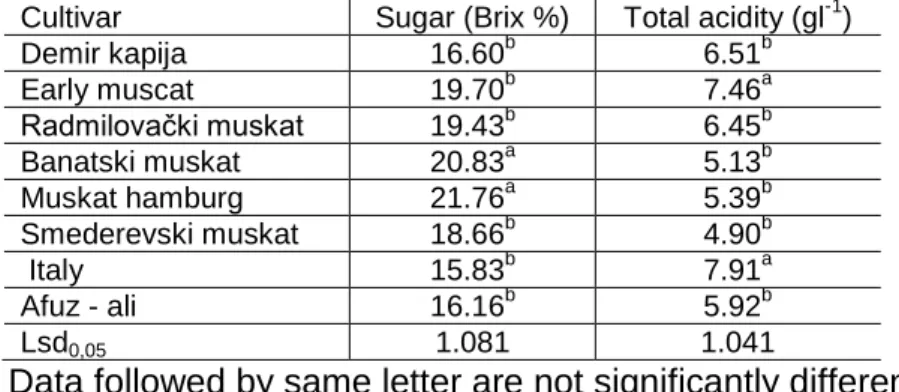
Results of the average grape quality expressed through the sugar content and total acids in the examined table cultivars are presented in table 1.
215
Table 1. Average values of the grape must quality expressed through the sugar content (Brix%) and total acids (gl-1) of muscat table cultivars of grapevine (Vitis vinifera L.)
Cultivar Sugar (Brix %) Total acidity (gl-1) Demir kapija 16.60b 6.51b Early muscat 19.70b 7.46a Radmilovački muskat 19.43b 6.45b Banatski muskat 20.83a 5.13b Muskat hamburg 21.76a 5.39b Smederevski muskat 18.66b 4.90b Italy 15.83b 7.91a Afuz - ali 16.16b 5.92b
Lsd0,05 1.081 1.041
Data followed by same letter are not significantly different
The produced distilled brandies of the average alcoholic strength from 44.8 to 45.2 vol % have not shown considerable differences concerning the methanol content, the concentration of which has in average been the highest within the distilled brandy of cultivar Muscat Hamburg (0.1146 vol %), which is statistically much higher than within the distilled brandies of the majority of other cultivars except for the ones of cultivar Radmilovački muskat (table 2). The methanol content in grape brandies of all examined cultivars is somewhat smaller when compared to the values stipulated by Paunović and Đurišić (1981) and they comply with the results provided by Nikićević and associates (1996). Differences in the methanol content within the examined distilled brandies may be due to the influence of a cultivar (Petrović et al., 1996), as well as due to the circumstances of fermentation and distillation itself (Da Porto et al., 2004).
Average concentration of the total higher alcohols have been from 0.114 vol % with the grape brandy made of cultivar Afuz-ali to 0.1593 vol % with the grape brandy made of cultivar Demir kapija, which has had considerably higher content of the total higher alcohols than the brandies made of other examined cultivars. Average values of the total higher alcoholss content are somewhat smaller or within the limits stipulated by other authors (Nikićević et al., 1996, 2000; Da Porto et al., 2004; Peinado et al., 2004). The grape brandy made of cultivar Afuz-ali has had the lowest content of total acids (282 mg/l a.a.), while the grape brandy of cultivar Banatski muskat has had the highest value of the relevant indicator (2735.00 mg/l a.a.), which is considerably higher content when compared to the distilled brandies of other cultivars. Such a high content of total acids may be explained by inadequate procedures within the fermentation process, since within other samples there have been no such differences among the examined cultivars. Results of other authors also indicate relevant differences in the content of total acids of grape brandies. Paunović and Đurišić (1981) point out great differences in the content of total acids with grape brandies.
216
Table 2. Average values of basic ingredient concentrations within the grape brandies made of the examined muscat table cultivars (vol %; mg/L a.a.) (Vitis vinifera L.)
CULTIVAR
Alcohol (vol%)
Methanol (vol%)
Higher alcohols
(vol%)
Total acidity (mg/l a.a)
Esters (mg/l a.a)
Aldehydes (mg/l a.a)
Total extract
(g/l)
TotalSO2 (mg/l)
Demir kapija 45.0ab 0.0454a 0.1593e 762.33ab 4497.33ab 189.790bc 0.183c 5.119ab
Early Muscat 45.1ab 0.0663ab 0.1263cd 2292.33ab 5600.00bc 226.173d 0.163b 4.693a
Radmilovački muskat
45.2b 0.0926cd 0.1305d 2435.33ab 5509.33bc 225.963d 0.180c 5.760b
Banatski muskat
44.9a 0.0704bc 0.1209bcd 2735.00b 5646.33c 217.120d 0.163b 4.480a
Muscat Hamburg
45,0ab 0.1146d 0.1302cd 315.33a 4367.33a 184.003b 0.180c 5.119ab
Smederevski muskat
45.0ab 0.0770bc 0.1192ab 2148.00ab 6007.00c 213.770cd 0.153ab 5.119ab
Italy 45.2b 0.0795bc 0.1206bcd 749.00ab 5266.00abc 218.46d 0.153ab 5.119ab
Afuz-ali 44.8a 0.0827bc 0.1144a 282.00a 4232.33a 143.393a 0.143a 5.119ab
Lsd0,05 0.25483 0.02297 0.011159 2283.02 1113.26 24.2102 0.01368 0.71506
Data followed by same letter are not significantly different
The ester content has considerably increased with particular samples of distilled brandies probably due to distillation within the acidic environment, since grape brandies made of particular cultivars have had considerably higher content of acids than other cultivars (Nikićević, 2000). The total aldehyde average content concerning the examination period has been from 143.393 mg/l a.a (Afuz-ali) to 226.173 mg/l a.a (Early Muscat). The grape brandy produced from cultivar Afuz-ali has statistically had considerably lower average concentration of total aldehydes than the rest of the cultivars. The aldehyde content with other cultivars has complied with the quality standards stipulated by the Rulebook on the Quality of Alcoholic Beverages.
During the examination period, the total extract with all distilled brandies has
fluctuated from 0.143 to 0.183 g/l, while the total SO2 has been from 4.693 to 5.760 mg/l.
The total extract and total SO2 content has complied with the prescribed standards
stipulated by the Rulebook on the Quality of Alcoholic Beverages.
CONCLUSION
In terms of the content of methyl alcohol as well as of the total evaporable ingredients, grape brandies made of the fermented grape mash of cultivars Demir kapija, Early Muscat, Radmilovački muskat, Banatski muskat, Muscat Hamburg, Smederevski muskat, Italy and Afuz-ali, meet the prescribed standards stipulated by the Rulebook on the Quality of Alcoholic Beverages. In terms of their chemical composition, grape brandies made of cultivars Demir kapija and Muscat Hamburg have considerably differed from grape brandies made of the rest of the cultivars.
BIBLIOGRAPHY
Da Porto, C., Cortella, G., Freschet, G., (2004) : Preliminary study on a cooling practice of grape pomace during storage on an industrial scale. Ital. J. Food Sci. N.1, vol 16, p. 87 – 95.
Versini, G., Dalla Serra, A., Falcetti, M., Sferlazzo, G., (1993) : Role of clone, vintage year and period of harvesting on the aromatic potential of the Chardonnay grape. Vitis, Vol. 32., No 2, abstract p. 58.
217
Mamede E.O. Maria, Cardello, M.A.B. Helena, Pastore, M. Gláucia., (2005): Evaluation of an aroma similar to that of sparkling wine : Sensory and gas chromatography analyses of fermented grape musts. Food Chemistry 89., pp. 63 – 68.
Nikićević, N., Tešević, V., Cilić, M., Stanković, Lj., (1996) : Sorta vinove loze i način izvođenja alkoholne fermentacije kao faktor kvaliteta lozovače. Zbornik radova Savetovanja „Savremeni trendovi u proizvodnji alkoholnih i bezalkoholnih pića“, str., 251 – 266., Beograd.
Nikićević, N., Jović, S., Sivčev Branislava, (2000): Ispitivanje pogodnosti proizvodnje alkoholnih pića na bazi grožđa od nekih novostvorenih sorti vinove loze. Zbornik radova. V Savetovanje industrije alkoholnih i bezalkoholnih pića i sirćeta. Str. 123 – 130. Vrnjačka Banja.
Paunović, R., Đurišić Biljana, (1981): Prilog izučavanju načina proizvodnje i svojstva rakije lozovače. Vinogradarstvo i vinarstvo, br. 35-36., str. 89 – 100. Beograd.
Paunović, R., Nikićević, N., (1988) : Uticaj sorte vinove loze na sastav i svojstva rakije lozovače. Savremena poljoprivreda, Vol. 36, br. 1 – 2., str. 67 – 75.
Peinado, A. R., Moreno, A. J., Muňoz, D., Medina, M., Moreno, J., (2004): Gas Chromatographic Quantification of Major Volatile Compounds and Polyols in Wine by Direct Injection. Journal of Agricultural and Food Chemistry, n. 52, p. 6389 – 6393.
Radeka Sanja, Stanka Herjavec, Peršurić, Đ., Lukić, I., Barbara Sladonja., (2008). Effect of different maceration treatments on free and bound varietal aroma compounds in wine of Vitis vinifera L. cv. Malvazija istarska bijela. Food tehnol. biotehnol. 46 (1) 86 – 92.
Soufleros, H.E., Ageliki S. Mygdalia, Natskoulis, P., (2004): Characterization and safety evaluation of the traditional Greek fruit distillate «Mouro» by flavor compounds and mineral analysis. Journal Food Chemistry, p. 625 – 636.