Evaluation of Primal-Dual Splitting Algorithm for MRI Reconstruction Using
Spatio-Temporal Structure Tensor and
L
1-2Norm
Mia Rizkinia
*and Masahiro Okuda
1. Department of Electrical Engineering, Faculty of Engineering, Universitas Indonesia, Depok 16424, Indonesia 2. Faculty of Environmental Engineering, The University of Kitakyushu, Kitakyushu 808-0135, Japan
*
e-mail:[email protected]
Abstract
Magnetic resonance imaging (MRI) is an essential medical imaging technique which is widely used for medical research and diagnosis. Dynamic MRI provides the observed object visualization through time and results in a spatio-temporal signal. The image sequences often contain redundant information in both spatial and spatio-temporal domains. To utilize this characteristic, we propose a spatio-temporal reconstruction approach based on compressive sensing theory. We apply spatio-temporal structure tensor using nuclear norm, in addition to the wavelet sparsity regularization. The spatio-temporal structure tensor is a matrix that consists of gradient components of the MRI data w.r.t the spatial and temporal domains. For the wavelet sparsity, we use L1 – L2 instead of L1 norm. We propose the algorithm using
primal-dual splitting (PDS) approach to solve the convex optimization problem. In the experiment, we investigate the potential benefit of adding the two regularizations to the compressive sensing problem. The algorithm is compared with PDS-based algorithm using conventional regularizations, i.e., wavelet sparsity and total variation. Our proposed algorithm performs superior results in terms of reconstruction accuracy and visual quality.
Abstrak
Rekonstruksi Compressive Sensing MRI menggunakan Spatial-Temporal Structure Tensor melalui Metode Primal-Dual Splitting. Magnetic resonance imaging (MRI) merupakan sebuah tehnik penting dalam pencitraan medis yang digunakan luas untuk penelitian dan diagnosa medis. Dynamic MRI menyediakan visualisasi objek yang diamati terhadap waktu dan menghasilkan sinyal spasial-temporal. Dengan memanfaatkan karakteristik ini, kami mengajukan sebuah pendekatan rekonstruksi spasial-temporal berdasarkan pada teori compressive sensing. Kami menerapkan spatio-temporal structure tensor menggunakan nuclear norm, selain regularisasi wavelet sparsity. Spatio-temporal structure tensor adalah sebuah matriks yang terdiri atas komponen gradien dari data MRI berkenaan dengan domain spasial dan temporal. Untuk wavelet sparsity, kami menggunakan L1 – L2 daripada L1 norm. Kami mengajukan
algoritma menggunakan pendekatan primal-dual splitting (PDS) untuk menyelesaikan masalah optimisasi convex. Dalam eksperimen, kami menginvestigasi potensi kelebihan penambahan kedua regularisasi ke masalah compressive sensing. Algoritma ini dibandingkan dengan algoritma PDS yang menggunakan regularisasi konvensional yaitu, wavelet sparsity dan total variation. Algoritma yang kami tawarkan menunjukkan hasil yang superior dalam hal akurasi rekonstruksi dan kualitas visual citra.
Keywords: dynamic MRI, compressed sensing, MRI reconstruction, spatio-temporal structure tensor, L1 – L2
1.
Introduction
Magnetic resonance imaging (MRI) is a non-invasive medical imaging tool that aims to visualize the anatomical and functional observation of internal body. However, it has a limitation in the scanning speed which is an inherently slow data acquisition process.
The image reconstruction can be achieved from randomly undersampled data using an appropriate nonlinear approach, if the image is assumed having a sparse representation in transform domain. Therefore, the quality of the reconstruction results will depend on the sampling ratio and the chosen nonlinear reconstruction algorithm. One common approach to meet the sparse representation is by using wavelet transform as the transform domain [5]. Then, it is followed by methods that use curvelet transform [6], as well as new priors in addition to the wavelet domain sparsity [7]–[9]. The use of the image gradient as the transform domain is also common in MRI reconstruction, such as the minimization of L1 norm of
the image gradient, which is known as total variation (TV). The minimization of L1 norm is also used to
impose the sparse characteristic of the data in a particular domain, thus it forms a sparsity term in the minimization problem.
In last few years, several CS methods for dynamic MRI reconstruction have been proposed. Huang et al. [10] introduced the real time dynamic MRI reconstruction with TV prior. However, the sparsity in temporal dimension is not taken into account. Ulas et al. [11] improves the method by adding the low-rank property of global spatio-temporal signal to the problem via nuclear norm minimization. Montesinos et al. [12] extended the Split Bregman formulation in CS-MRI to minimize the TV in both domains. The research is conducted on self-gated cine sequences.
Dynamic MRI provides information in both spatial and temporal domains. It scans the object through time, so that the sequences usually provide redundant information in both domains due to the slow changes of the same object during the acquisition time. In this case, the sparsity is not only in the spatial domain, but also in temporal domain, since the consecutively acquired images are highly correlated.
In this paper, we propose a new CS-MRI method for dynamic MRI that takes the gradient components both in the spectral and spatial domains into account. It allows to penalize variations in both domains to exploit the spatial-temporal correlations. The nuclear norm of the gradient components' structure tensor is imposed to the optimization problem. In addition, we preserve the use of wavelet-domain sparsity by applying the difference of L1 and L2 norms (L1 – L2) [13]. The
optimization problem is solved by primal dual splitting (PDS) method [14]–[15], which is shown to be an effective algorithm in solving convex optimization problems that include operator matrices. We extend the PDS formulation to minimize the structure tensor of spatial-temporal gradient components and the wavelet domain. To evaluate the performance of our proposed
regularizations, i.e., wavelet sparsity and total variation, used with compressive sensing approach solved by PDS algorithm.
2.
Methods
Compressed sensing theory. Let x denotes the reconstructed image in a complex vector, denotes the the linear operator that transforms the image from the pixel representation into a sparse representation, represents the undersampling Fourier operator, and represents the measured k-space, CS techique formulates the following constrained optimization problem:
min ‖ ‖ s. t. (1)
where is the data fidelity term that enforces data consistency, and is the noise variance which can be caused by field strength, RF pulses, RF coil, voxel volume, or receiver bandwidth [16]. The can be expressed as the product of a full Fourier operator and a matrix S ( = S ). The S selects elements of k-space that will be sampled or preserved.
Proposed optimization problem. For dynamic MRI reconstruction, to find the reconstructed image , we propose solving the following optimization problem, where the wavelet domain sparsity and the spatial-temporal structure tensor terms are added to Eq. (1)
min λ‖ ‖ ‖ ‖∗
s. t (2)
where the first term represents the difference of and norms ( ) [13, 17–19] of the sparsity term in Eq.(1), and the second term represents the spatio-temporal structure tensor regularization (STST), with n is the index of local block, K is the number of local block, is an operator that forms the input matrix into the temporal structure tensor, and is a spatio-temporal gradient filter matrix (D = [ ; ; ]). Parameter λ and are constant penalty weighting parameters for the and the STST constraints, respectively.
We further reformulate Eq. (2) into the following uncontrained problem:
min 1
2 λ‖ ‖ ‖ ‖∗
To solve the problem in 3, we use PDS method [14–15, 20–22] that solves convex optimization problems with the basic form:
min (4)
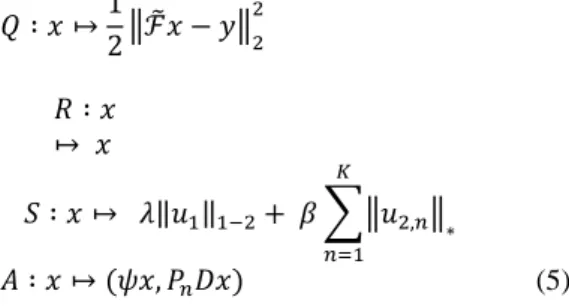
where is a differentiable convex function, are possibly nonsmooth convex functions with computable proximity operator, and A is a linear operator. Function is commonly in the form of range constraint, while S has a linear operator inside its function. Hence, we define , , , and A of our problem to apply the PDS as follows
∶ ↦1 2
∶ ↦
∶ ↦ ‖ ‖ , ∗
∶ ↦ , (5)
where u , denotes the -th local block of u .
The proposed PDS algorithm to solve the problem in Eq. (3) is shown in Algorithm 1. The proximity operator of the is defined in [13, 17] as
prox ‖ . ‖ arg min‖ ‖ ‖ ‖
‖ ‖ (6)
The closed-form solution of prox ‖ . ‖ u is characterized in the following statements
1) When ‖ ‖ , ‖ ‖
‖ ‖ .
2) When ‖ ‖ , is an optimal solution if and only if it satisfies 0 if | | , ‖ ‖ , and 0 for all .
3) When 1 ‖ ‖ , is an optimal solution if and only if it is a 1-sparse vector satisfying 0 if | | ‖ ‖ , ‖ ‖ ‖ ‖ 1 , and 0 for all .
4) When ‖ ‖ 1 , 0.
where , , and ∙, denotes the soft thresholding function ⟼ | | , 0. In the experiment, we set the 1.
The proximity operator of the nuclear norm in the line 9 is obtained by applying the singular value decomposition (SVD) to the input matrix and followed by thresholding the singular values:
prox ‖ . ‖∗ USV’,
S diag , 0 , ⋯ , , 0 , (7)
where is the number of sequences (temporal dimension).
3.
Simulation and Results
To evaluate performance of the proposed regularization, which is STST combined with L1-2 norm, we develop
the program based on PDS optimization algorithm and compare the results with those of other regularizations, i.e., L1 and TV regularization, solved using PDS as well.
Two in-vivo datasets are used in the experiment namely, Cardiac Perfusion and Cine [23–25]. Each pixel value is normalized to [0, 1]. The block size of the local region in the block processing of the nuclear norm of STST is 5 × 5 with no overlap for all pixels. As for the other parameters in experiment are set to the values that yield the optimal performance. For evaluation metrics, we use Root Mean Square Error (RMSE) and Peak Signal-to-Noise Ratio (PSNR) as shown in Eq. (8) and Eq. (9), where the lower the RMSE value, the better the performance means, and the higher the PSNR value, the better the performance means.
∑ , , (8)
10. (9)
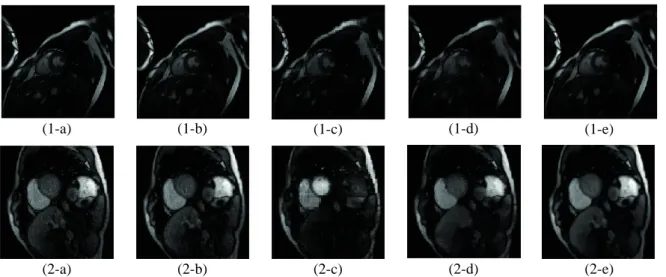
The quantitative results of the experiment with the two data are depicted in Table 1, and the reconstructed images from the methods are shown in Figure 1. From Table 1, one can see that among the compared regularizations solved using PDS, our proposed one obtains the highest PSNR and lowest RMSE representing the best performance. For the qualitative analysis, Figure 1 shows that our method results in clearer images than those resulted from other methods. It also shows that our resultant images have smoother texture compared to those of others, while having sharp edges.
Tabel 1. Result Comparison
Data Name
RMSE/ PSNR
TV Ours
Perfusion 0.0544/
24.3218
0.0482/ 26.7615
0.0291/
48.1402
Cine 0.0461/
25.3484
0.0420/ 26.8075
0.0154/
(1-a) (1-b) (1-c) (1-d) (1-e)
(2-a) (2-b) (2-c) (2-d) (2-e)
Figure 1. Reconstructed Images and Original Image for (row 1) Cine and (row 2) Perfusion Data. From Left to Right: (a) Original Data, (b) Full Sampling Reconstruction, Compressed Sensing Using (c) , (d) TV, and (e) Our Proposed Regularization
4.
Discussion
The experiment results show that STST which we proposed with PDS algorithm yields the best results compared with the others. The advantages offered by our proposed method are due to the involvement of the three-dimensional structure tensor, i.e., spatial and temporal dimensions. As for the selection of PDS as the solver algorithm is more about the ease and suitability of the regularization characteristic that we proposed, which is the use of operator matrix. One can test the STST regularization with another algorithm, such as ADMM.
When comparing resultant images of any methods, the reference image that acts as the original image is typically obtained from the existing method which is implemented in the MRI modality in hospitals or health centres. Thus, the values of RMSE and PSNR are relatively measured and compared to the result of one method instead of the ground truth image. For more objective performance evaluation, one topic of research may be raised which predict reconstruction performance in the absence of ground truth. This could be one of future works.
Another topic for future works may lay on reducing the computation time by selecting another optimization algorithm to solve our convex optimization problem. PDS are selected in this research since it gives benefit, in term of computation, to solve regularizations with operator matrices. However, many researchers have proposed this kind of task using another algorithm such as, ADMM.
5.
Conclusion
We proposed a regularization based on spatio-temporal structured tensor combined with L1-2 and solved the
respective objective function using PDS optimization algorithm, to reconstruct MRI images. The performance of our method is compared with that of method that exploits conventional regularizations. All the methods use PDS in solving each optimization problems. The results show that our method yields the best results in term of qualitative and quantitative analysis.
References
[1] G. Oliveri, M. Salucci, N. Anselmi, A. Massa, IEEE Antennas Propagation Mag. 59/5 (2017) 34. [2] S. Qaisar, R.M. Bilal, W. Iqbal, M. Naureen, S.
Lee, J. Comm. Netw. 15/5 (2014) 443.
[3] E.J. Candes, M.B. Wakin, IEEE Signal Proc. Mag. 25/2 (2008) 21.
[4] M. Lustig, D.L. Donoho, J.M. Santos, J.M. Pauly, IEEE Signal Proc. Mag. 25/2 (2008) 72.
[5] C. Chen, J. Huang, Magn. Reson. Imag. 32/10 (2014) 1377.
[6] X. Qu, W. Zhang, D. Guo, C. Cai, S. Chai, Z. Chen, Inver. Problem Sci. Eng, 18/6 (2010) 737. [7] J. Huang, S. Zhang, D. Metaxas, Proc. the 13th Int.
Conf. Med. Imag. Comp. Computer-Assisted Int.: Part I (MICCAI'10), 2010, p.135.
[8] C. Chen, Y. Li, J. Huang, IEEE Trans. Signal Proc. 62/11 (2014) 2803.
[9] R. Otazo, E. Candes, D.K. Sodickson, Magn. Reson. Med. 73/3 (2015) 1125.
[11]C. Ulas, P.A. Gómez, J.I. Sperl, C. Preibisch, B.H. Menze, Proc. IEEE 13th Int. Sym. on Biomed. Imag. (ISBI), 2016, p.306.
[12]P. Montesinos, J.F.P.J. Abascal, L. Cussó, J.J. Vaquero, M. Desco, Magn. Reson. Med. 72/2 (2013) 369.
[13]Y. Lou, M. Yan, J. Sci. Comput. 74/2 (2018) 767. [14]L. Condat, J. Optim. Theory Appl. 158/2 (2013)
460.
[15]P.L. Combettes, J.C. Pesquet, Fixed-Point Algorithm. Inver. Prob. Sci. Eng. Springer, 2011, p.185.
[16]S. Vaishali, K.K. Rao, G.V.S. Rao, Int. Conf. Sig. Proc. Comm. Eng. Sys. (SPACES), 2015, p. 363. [17]Y. Lou, S. Osher, J. Xin, Adv. Int. Syst. Comput.
359 (2015) 169.
[18]Y. Lou, T. Zeng, Stanley J. Osher, Jack Xin, SIAM J. Imag. Sci. 8/3 (2015) 1798.
[19]W. Wang, J. Wang, Z. Zhang, IEEE Signal Proc. Lett. 24/3 (2017) 304.
[20]R. Kurihara, S. Ono, K. Shirai, M. Okuda, 25th Eur. Signal Proc. Conf. (EUSIPCO), 2017, pp.488. [21]A. Chambolle. T. Pock, J. Math. Imag. Vis. 40/1
(2010) 120.
[22]P.L Combettes, J.C. Pesquet, Set-Valued Variation Anal. 20/2 (2012) 307.
[23]C. Chen, Y. Li, L. Axel, J. Huang, Magn. Reson. Imag. 34 (2016) 473.
[24]R. Otazo, D. Kim, L. Axel, D.K. Sodickson, Magn. Reson. Med. 64/3 (2010) 767.
[25]R. Otazo, L. Feng, H. Chandarana, T. Block, L. Axel, D.K. Sodickson, Proc. Int. Symp. Biomed. Imag., 2012, p.980.