605 | P a g e
A Study of Psychological Well-being of Adolescents in
Relation to School Environment and Place of living
Bilal Ahmad Bhat*
*Senior Research Fellow, Department of Education, A M U, Aligarh.
Abstract
In the present age of stress and strain, the science of well-being tries to focuses on what makes an individual to flourish. It studies how human assets rather than deficits are contributing toward goodness of an individual, is a promising new area of research. Advances in understanding the behavioral, biological, and social pathways to well-being will benefit individuals, organizations, and society. The life of individuals particularly the students spend in their schools, coming from different places of living, needs to be studied to have the vision of influence on psychological well-being of students. The study was carried on a sample of 519 senior secondary school students from different senior secondary schools of Kulgam and Anantnag districts of Kashmir valley. The sample was drawn by using multi stage stratified sampling technique. The data obtained from these students were then analyzed by using appropriate statistical techniques with the help of SPSS version 22. The paper analyzes the influence of school environment and the effect of place of living and type of school on the psychological well-being of senior secondary school students. It also makes some suggestions, keeping the findings of the study in mind to enhance the psychological well being of our budding human resource.
Keywords:
Psychological Well-Being, School Environment, place of living and Senior Secondary
School Students.
Introduction
Research on well-being is very limited on the students at school level (Rodgers & Bachman, 1988 [1]). Similarly,
there has been minuscule research, which focuses comparisons of psychological well-being among different
adolescent groups (e.g., place of living). There are an estimated 1.2 billion young people aged 10–19 in the world,
comprising the largest generation of adolescents in history (UNICEF, 2002 [2]). India too is the country with
majority of population living in their teen ages.
WHO estimates that among every five young people under the age of 18, one young person experiences some form
of developmental, emotional or behavioral problem, and one in every eight experiences a mental disorder (Currie, et
al. 2009/2010 [3]). International studies have shown that physical activity in youth has decreased over time
(Brettschneider & Naul, 2007; [4] Knuth & Hallal, 2009; [5] & Ghaffari, Sharifirad, Malekmakan & Hassanzadeh,
606 | P a g e
low and middle income countries (World Health Organization, 2010 [7]). Consequently children and adolescentsbelonging to different categories like socio-economic, demographic groups are thought to be more “vulnerable” for
disparities that will impact their health and well-being (USDHHS, 2013 [8]). In addition to this, mental illness has
been estimated by 2020 to become a 15% of the global burden of diseases (Biddle & Mutrie, 2008 [9]). Thus, it is
becoming a significant public health problem everywhere. Some of the internationally and particularly in Kashmir
(conflict Prone Area), leading mental health problems are depression, anxiety and eating disorders especially among
the young individuals (Viner & Booy, 2005; [10] & Ayub, Irfan, Naeem, & Blackwood, 2012 [11]).
From a broad perspective, the measurement and promotion of school going children’s well-being is a desirable
social and political objective (Diener, Lucas, Schimmack & Helliwell, 2009; [12] & Van, Park & Jones, 2001 [13]).
Psychological well-being of adolescents means being content and satisfied with life and understanding an
abundance of positive emotions, when joined with the absence of psychopathology, is linked with greatest academic
function, social skills and support and physical health, being a stage that lays strong foundation for future
personality and a critical period during human development in which life goals, values, direction and purpose in life
are created (Savage Jessica, 2011; [14] Berman, Weems & Stickle, 2006 [15] ), guaranteeing psychological
well-being of adolescents is a socio-psychological necessity. A growing number of longitudinal studies confirm the
power of well-being scales to predict outcomes, for example, longevity, physical health, quality of life, criminality,
drug and alcohol use, employment, earnings and pro-social behavior (e.g. volunteering) (WHO, 2009 [16] ).
Moreover, the ever evading nature of complexities typical to their phase of development, researches into factors
contributing to adolescent psychological well-being was always intimidating task for scientific community. For any
genuine approach for ensuring psychological well-being of a group, exploration into demographic correlates and
predictors of psychological well-being by tracing the environmental, physiological or neurological underpinnings is
not sufficient (Helen, et al. 2012 [17] ). Psychological distress is something strongly correlated with physical
morbidity, reduced quality and duration of life and increased use of health service (Lahey, 2009 [18]). At the same
time, there is no guarantee that both psychological well-being and psychological distress will not occur together in a
personality. According to one study positive psychological factors may have such a strong relationship with health
as negative ones and extend to which these psychological states are independent of each other may vary according to
the external and internal environmental challenges people face and researches will need to make choices about the
value of measuring both (Helen, et al. 2012 [17]). However, no particular study in Kashmir has been noticed to
assess the association between general levels of physical activity and psychological well-being in adolescents.
The purpose of this research is to provide a broad picture of the psychological well-being of school adolescents and
607 | P a g e
Objectives
The objectives of the study were:-
1. To study the difference in the psychological well-being of senior secondary students based on the place of living.
2. To study the difference in the psychological well-being of senior secondary students based on the type of school.
3. To find out the relationship between the psychological well-being and school environment of senior secondary
school students.
Null Hypotheses
As per the objectives of the study, following null hypotheses were framed for statistical testing:-
Ho.1 There is no significant difference in senior secondary students’ psychological well-being based on the place of living.
Ho.2 There is no significant difference in senior secondary students’ psychological well-being based on the type of
school.
Ho.3 There is no significant correlation/relationship between the psychological well-being and school environment
of senior secondary school students.
Methodology
The survey type of study which falls under the broad descriptive method was used to get the required data for
analysis.
Population
All the senior secondary school students of Kashmir valley affiliated to the Jammu and Kashmir Board of School
Education (JKBOSE) was the population of the study.
Sample
For the present study, 519 senior secondary school students were selected from the Kulgam and Anantnag districts
of Kashmir valley, from the schools affiliated to the Jammu and Kashmir Board of School Education (JKBOSE).
The subjects were selected by using Multistage stratified random sampling technique. The criteria of stratification
were type of school and place of living. The different stages for sample selection were the selection of districts,
educational zones, schools and finally the teachers who were stratified on the basis of nature of teaching subject.
Tools for Data Collection
The tools of data collection were Psychological Well-Being Scale (PWBS) developed by Dr. Devendra Singh
Sisodia and Ms. Pooja Choudhary (2012) [18] and School Environment Inventory (SEI) developed by Dr. Karuna
608 | P a g e
Analysis and Interpretation of Data
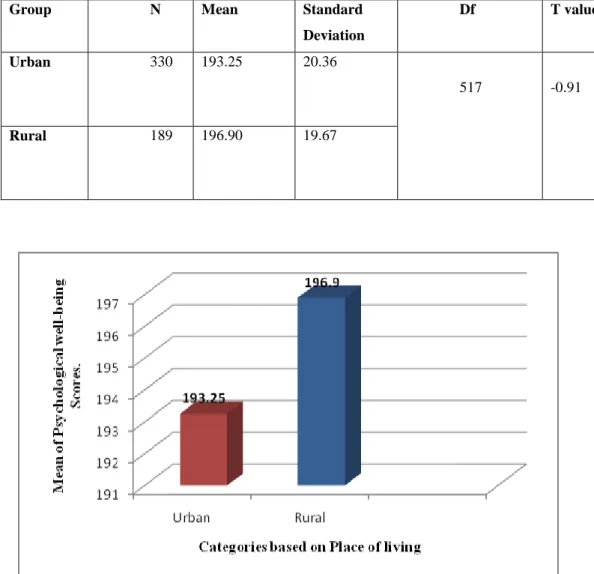
Table 1: Table showing significance of mean difference between rural and urban school students on
psychological well-being
Group N Mean Standard
Deviation
Df T value
Urban 330 193.25 20.36
517
-0.91
Rural 189 196.90 19.67
Figure 1: comparison of psychological well-being of senior secondary school students based of place
of living.
From Table 1. It shows Comparison of psychological well-being of rural and urban adolescent school students of
Kashmir. It is clear from table 1 that rural students have higher (196.9) mean score than urban students (193.25) in
609 | P a g e
= -0.91, 517 df, p < 0.05). It indicates that urban students possessed high psychological well-being as compared torural students (See figure 1). Therefore, the null hypothesis 1 stands rejected.
Table 2: Table showing significance of mean difference between private and Govt. school
students on psychological well-being.
Figure 2: comparison of psychological well-being of senior secondary school students based
on type of school.
From Table 2. It shows Comparison of psychological well-being of private and govt. adolescent school
students of Kashmir. It is clear from table 2 that govt. adolescents had slightly higher (194.36) mean score in
psychological well-being scale compared to (194.15) private adolescents, which was found to be statistically
insignificant using independent samples t-test (t = -0.108, 517 df, p > 0.05). It can be said that there exists no
significant difference between the private and govt. adolescents under study on psychological well-being measure
(See figure 2). Therefore, the null hypothesis 2 stands accepted.
Group N Mean Standard
Deviation
Df T value
Private 143 194.15 20.53 517 -0.108
610 | P a g e
Table 3: Table showing correlation between psychological well-being and school
environment of senior secondary school students.
Results in Table 3 show that, very low positive relationship was found between psychological well-being
and school environment of students, which was found to be statistically insignificant (0.019, p > 0.05). Therefore,
the null hypothesis 3 stands accepted.
Findings of the Study
Through this study following main findings has been found:
A significant difference was found between rural and urban students on the psychological well-being, with rural
students having higher psychological well-being than urban students.
An insignificant difference has been found between the private and government school students in their
psychological well-being.
There exists an insignificant very low positive correlation between the psychological well-being and school
environment of senior secondary school students.
Discussion
Regarding the difference in the psychological well-being of government and private school students, it was found
that there is no significant difference in their mean scores. The finding is supported by Rapheal and Paul (2014)
[20] who found that type of school is of no value in influencing the psychological well-being of government and
private school students. It is also shown by previous research that government students have significantly higher
overt anxiety than their counterparts in private school. Depicting that students in government schools have the
higher stress of academic pressure than private students but this may be because; private students have that school
climate where they are taught to be more prudent in their expression of emotions.
The significance of rural and urban student’s regarding psychological well-being was found that the students from
the rural area have higher psychological well-being than urban students. The result is corroborated by (Dey et al.,
2014; [21] Kaur & Singh, 2016; [22] Gangopadhyay & Sikdar, 2016 [23] ). According to Alves and Rodrigues
(2010), [24] there is an association between living in big cities of world and risk of psychological distress among the Psychological well-being Psychological well-being School
Environment
s
Sig.
1 0.019 .
611 | P a g e
people. For them, this is due to the presence of factors such as stress and coping with everyday adversecircumstances of their environment, weakened social support, difficulty in accessing essential goods and less healthy
lifestyles, present in the urban centers. Such factors are also reported by Albuquerque, Martins, and Neves (2008)
[25] in a study on well-being in rural and urban contexts. They point out that despite the rural context, in recent
decades; no longer being exclusively agrarian it is still associated with being a pleasant and healthy place to live,
where interpersonal relationships are closer and lasting, thus favoring a greater emotional stability and an
improvement of personal well-being. The urban environment, however, is commonly marked by unstable
relationships that generate, on many subjects, more volatile bonds, which, associated with higher rates of violence
and stress, for instance, help to make life in this context, especially for those living in the peripheries marked by
misery, to be evaluated by its residents as less satisfactory than in the rural environment. The family and community
relationships are present more in the rural context (Góis, 2005; [26] Ximenes & Moura Jr., 2013 [27]) are important
to cope with adverse situations peculiar to the poverty context and when strengthened, usually favor well-being and
mental health (Prezza & Costantini, 1998 [28]).
Suggestion
From the present study it is been found that the students with rural background were found to be better in
psychological well-being than urban students. Hence, it can be implied that the environment of urban settings make
them stressful and on the other hand it affects their academic achievement in science negatively. So, it is suggested
that avenues should be created for urban students for their recreation and realization of their potential. The schools
with urban catering, in particular, have a significant role in this direction. They should make the environments of
their schools as stress less as possible, making students realize their potential. It may be the reason that students in
urban areas are higher in number than rural areas with the hope of finding, that type of environment which may help
in relieving their stress and make them realize of their strengths and weaknesses.
References
[1] Rodgers, W. L, & Bachman, J G. (1988). The subjective well-being of young adults, trends and relationships.
In: Research Report Series. Ann Arbor, University of Michigan, United State, pp.: 49–73.
[2] UNICEF (2002). Adolescence. A Time that Matters. In: The State of the World’s Children. Washington DC: The
United Nations Children’s Fund; New York, pp. 75–77.
[3] Currie, C, et al. (2009/2010). Social Determinants of health and well-being among young people, health
behaviorinschool-agedchildren(HSBC)
612 | P a g e
[4] Brettschneider, W. D., & Naul, R. (2007). Obesity in Europe: young people’s physical activity and sedentarylifestyles. In: Sport Sciences International, obesity in Europe, young people’s physical activity and sedentary
lifestyles. Peter Lang, Germany, pp.: 7–26.
[5] Knuth, A. G., & Hallal, P. C. (2009). Temporal trends in physical activity: a systematic review. J Phys Act Health, (6): 548–559.
[6]Ghaffari, M., Sharifirad, G., Malekmakan, E., & Hassanzadeh, A. (2013). Effect of educational intervention on
physical activity-related knowledge, attitude and behavior of among first-grade students of male high
schools. Educ Health Promot, 2 ( 1): 4.
[7] World Health Organization (2010). Physical Inactivity: A Global Public Health Problem. Available
from: http://www.who.int/dietphysicalactivity/factsheet_inactivity/en/index.html
[8]USDHHS (2013). Healthy People 2020. Public health infrastructure; Washington, DC: Available
from: www.healthypeople.gov/2020/topicsobjectives2020/overview.aspx?topicid=35
[9]Biddle, S. J. H., & Mutrie, N. (2008). Psychology of physical activity: Determinants, well-being and
interventions. 2nd ed Routledge, London and New York, pp.: 18–74.
[10]Viner, R., & Booy, R. (2005). ABC of adolescence: Epidemiology of health and illness. British Med J, 330(7488), 411–414.
[11]Ayub, M., Irfan, M., Naeem, F., & Blackwood, D. (2012). Major depression in a large family in Pakistan: no
relationship to inbreeding, economic status or rural living. J Pak Psychiatr Soc, 9 (1): 37–43.
[12]Diener, Lucas, Schimmack, Helliwell J. (2009). Well-being for public policy Oxford. Oxford University
Press, 39 ( 4): 391–406.
[13]Van, O. S. J, Park, S. B. G, & Jones, P. B. (2001). Neuroticism, life events and mental health. Evidence for
person–environment correlation. British J Psychiatr, 178 (40): 72–77.
[14]Savage, Jessica A. Increasing adolescents’ subjective well-being: Effects of a positive psychology intervention
in comparison to the effects of therapeutic alliance, youth factors, and expectancy for change [Graduate
thesis]. University of South Florida, USA: 2011.
[15]Berman, S. L., Weems, C. F., & Stickle, T. R. (2006). Existential anxiety in adolescents. Prevalence, structure,
association with psychological symptoms and identity. J Youth Adol, 35 ( 3): 303–310
[16]World Health Organization (2010). Physical Inactivity: A Global Public Health Problem. Available
from: http://www.who.int/dietphysicalactivity/factsheet_inactivity/en/index.html
[17]Helen, R., Tiffany, K., Gill, A., Taylor, W., & Rhiannon, M. P. (2012). Psychological well-being and
613 | P a g e
[18]Sisodia, D. S. & Choudhary, P. (2012). Manual for Psychological Well-Being Scale. Agra, India: NationalPsychological Corporation.
[19]Misra, K. S. (2012). Manual for School Environment Inventory. Agra, India: National Psychological Corporation.
[20]Rapheal, J., & Paul, V. (2014). Psychological well-being and anxiety among adolescents analysis along
wellness: Illness Continuum. International Journal of Innovative Research and Development, 3(1), 395-401. [21]Dey, B. K., Rahman, A., Bairagi, A., & Roy, K. (2014). Stress and anger of rural and urban
adolescents. Psychology, 5(03), 177-184.
[22]Kaur, A., & Singh, A. (2016). A comparative study of psychological well-being of school students of Punjab
state. Indian Journal of Health and Wellbeing , 7(10), 991-995.
[23]Gangopadhyay, M., & Sikdar, D. (2016). Effect of personal values on psychological well-being of urban and
rural youth. International Journal of Home Science, 2(2): 370-373.
[24]Alves, A. A. M., & Rodrigues, N. F. R. (2010). Determinantes sociais e econômicos da Saúde Mental. [Social
and economic determinants of mental health]. Revista Portuguesa de Saúde Pública, 28(2), 127–131. http://doi:10.1016/ s0870-9025(10)70003-1
[25]Albuquerque, F. J. B., Martins, C. R., & Neves, M. T. S. (2008). Bem-estar subjetivo emocional e coping em
adultos de baixa renda de ambientes urbano e rural. [Subjective well-being and coping in adults with low
income in urban and rural environments]. Estudos de Psicologia (Campinas), 25(4), 509–516. http://doi:10.1590/s0103-166x2008000400005
[26]Góis, C. W. L. (2005). Psicologia comunitária: Atividade e consciência. [Community psychology: Activity and conscience]. Fortaleza, Brazil: Publicações Instituto Paulo Freire
[27]Ximenes, V. M., & Moura Jr, J. F. (2013). Psicologia Comunitária e comunidades rurais do Ceará: caminhos,
práticas e vivências em extensão universitária. Psicologia e contextos rurais, 1, 453-476.
[28]Prezza, M., & Costantini, S. (1998). Sense of community and life satisfaction: Investigation in three different