Compressed Sensing Based Computed Tomography Image
Reconstruction
Fareedha N P, Sangeetha M K
Computer Science & engineering(MTech), Assistant Professor Thejus Engineering College
Trissur, India
[email protected], [email protected]
Abstract— In computed tomography (CT), an important objective is to reduce radiation dose without degrading image quality. The radiation exposure from CT scan will make severe problem in humans. This has high risk in the case of children and female. The higher exposure will lead to leukemia, cancer etc. So that low dose CT image reconstruction is the main concern now days. We have to reconstruct the image which gives better image quality from limited number of projection. Compressed sensing enables the radiation dose to be reduced by producing diagnostic images from a limited no of projections. According to compressed sensing theory the signal or image can be reconstructed from the fewer samples and the sparse representation is the main objective behind it. The images are not sparse in nature, so some sparsifying transform is used for make the image to sparse. The object to be reconstructed scanned under sensors and several forward projections are takes place. In low dose CT we consider only smaller number of projections. From these projections the images are reconstructed. The CT image reconstruction is an ill-posed problem. That means solving underdetermined system of equations. This system solve the reconstruction problem using compressed sensing. This system chooses the noiselet as measurement matrix and haar wavelet as representation basis. The incoherence between measurement matrix and the representation basis is the one main property of compressive sensing. This incoherence will make the image reconstruction.
Keywords—Computed tomography, Compressed sensing
I. INTRODUCTION
In biomedical imaging system, the Computer tomography has a significant role. CT could be excellent imaging modality which provides accurate anatomic data. Computed tomography, unremarkably called as a CT or CAT scan, is a diagnostic medical test that, like ancient x-rays, produces multiple images of the inside of the body. The cross-sectional pictures generated throughout a CT scan will be reformatted in multiple planes, and may even generate three-dimensional images. These pictures will be viewed on a computer monitor, printed on film or transferred to a CD or DVD. CT images of internal organs, bones, soft tissue and blood vessels usually give a lot of information than
traditional x-rays, significantly of soft tissues and blood vessels. Using specialized instrumentation and experience to make and interpret CT scans of the body, radiologists can a lot of easily diagnose problems such as cancer, cardiovascular disease, infectious disease, appendicitis, trauma and musculoskeletal disorders.
Computed tomography imaging involves data acquisition, image reconstruction, and image display. Image reconstruction from projection is a special class of image restoration problems where a two dimensional object is reconstructed from several projections. The object is scanned under a one X-ray spectrum. Many projections are obtained. These projections are super imposed together to get the reconstructed image. There are many reconstruction techniques are used for obtaining quality images.
CT imaging is one of the quickest and most accurate tools for examining the chest, abdomen and pelvis because it provides detailed, cross-sectional views of all types of tissue. It used to examine patients with injuries from trauma such as a motor vehicle accident. It performed on patients with acute symptoms such as chest or abdominal pain or difficulty breathing. It is often the best method for detecting many different cancers, such as lymphoma and cancers of the lung, liver, kidney, ovary and pancreas since the image allows a physician to confirm the presence of a tumor, measure its size, identify its precise location and determine the extent of its involvement with other nearby tissue. It is an examination that plays a significant role in the detection, diagnosis and treatment of vascular diseases that can lead to stroke, kidney failure or even death. CT is commonly used to assess for pulmonary embolism (a blood clot in the lung vessels) as well as for aortic aneurysms. It is invaluable in diagnosing and treating spinal problems and injuries to the hands, feet and other skeletal structures because it can clearly show even very small bones as well as surrounding tissues such as muscle and blood vessels.
increasing risk of developing cancer. Higher the exposure better quality image will be obtained. When increasing the radiation dose will lead to leukemia, brain tumors. The risk of radiation exposure severely influenced by age and gender. According to clinical study the risk of cancer higher in children and in female. Each year about 1.6 million children in the USA get CT scan to the head and abdomen and about 1500 of those will die later in life from radiation in induced cancer[1].
The primary challenge in the CT scan is how to reduce the radiation exposure. There are two ways to reduce the radiation dose. The first one is to lower the X-ray radiation dose that means dos level mAs. But it will degrade the image quality because the detector received the insufficient number of X-ray photons. The noise and artifacts will be higher in the reconstructed image. The second way is to reduce the number of projections needed. The radiation dose is proportional to number of projections.
II. IMAGE RECONSTRUCTION BACKGROUND
Image reconstruction from projections means solving the system of equation[2]
P
Ax
Let
x
be the matrix consists of intensities of image and Pthe number of projections collected by scanner. Let A be the system matrix which depends on projection number and angles.wi,j
r,q denotes the entries of thematrix A and ( ji, )refers to the pixel location and indices( qr, ) refer to projection and angle numbers
respectively. wi,j
r,q is the weighting factor thatrepresents the contribution of the ( ji, )th pixel to the
) ,
( qr th X-ray line integral
.
III. COMPRESSED SENSING BACKGROUND
According to Nyquist-Shannon sampling theorem to recover a signal exactly we need to sample with at least twice its frequency. According to standard image reconstruction theory, when the number of view angles does not satisfy the Shannon/Nyquist sampling theorem, aliasing artifacts will spread out in the reconstructed images.
Compressed sensing accurately recover sparsity of a signal from few samples than traditionally required one. To possible this recovery there are two conditions:
Sparsity
Incoherence.
The fraction of non-zero elements over the total number of elements over the total number of elements in a matrix is called sparsity. The incoherence is the statistics used to examine the relation between signals. For a pair of orthobasis (,), where is used for sensing an object and is used as represent basis[3]. The coherence between these two parameters is given by: (,) nmax|,|. Coherence measures the large correlation between and . The compressive sensing deals with low coherence pairs.
IV. GENERAL FRAMEWORK
The problem of few sample CT image reconstruction actually leads to an underdetermined system of linear equations. Based on the idea of sparsity based compressed sensing an image can be completely reconstructed with a high probability with far less samples than required by conventional Nyquist-Shannon sampling theorem. The medical images are not sparse in nature. If the image has sparse/compressible representation in a transform domain, such that most entries of the vector are zero or close to zero.
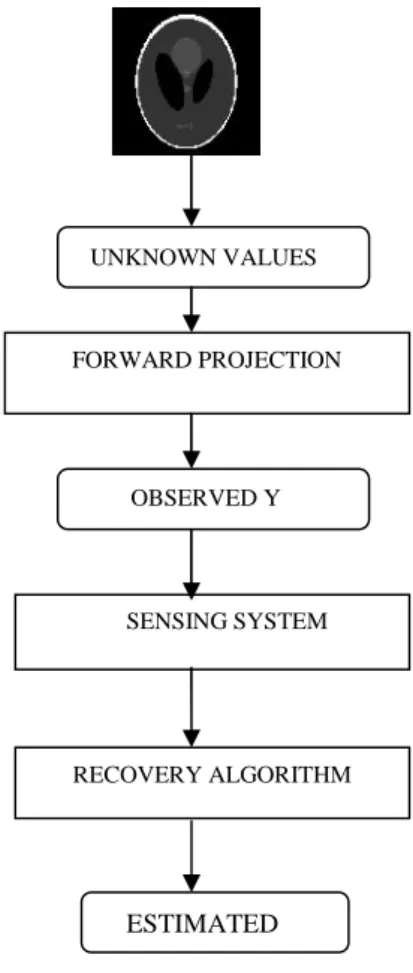
Fig. 1. Architecture.
The input to the system is the object to be reconstructed. The cross section of the object to be reconstructed considered as a squared grid in each cell
UNKNOWN VALUES
FORWARD PROJECTION
OBSERVED Y
SENSING SYSTEM
RECOVERY ALGORITHM
the function f(x,y) is constant. Let xij denotes the
constant value of f(x,y) in the ijth pixel with
. ,..., 2 , 1
,j n
i . So X be the matrix consists of intensities of the image which is the unknown.
Fig. 2. A square grid on the image
A. Forward Projection
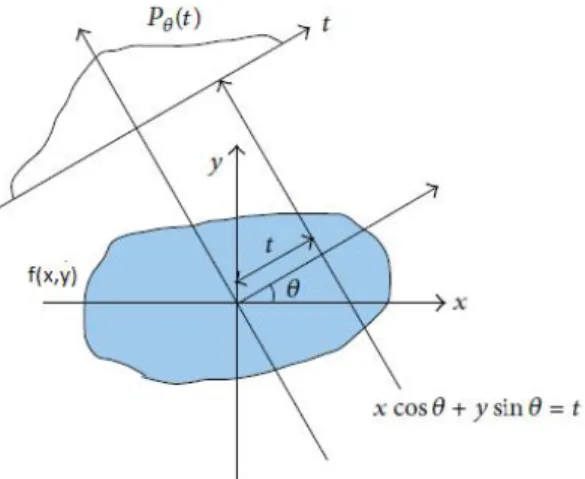
A projection of two dimensional functions is a set of line integral [4]
.
Fig. 3. A projection throughf(x,y)at an angle
To form projections from a sample image generally use two geometries: Parallel geometry and fan-beam geometry.
B. Sensing System
The images are not sparse in nature. So for making an image to sparse some sparsifying transform is used. The representation basis is the mathematical way of getting the signal into sparse domain. Many wavelet transforms are used as. But here Haar transform used.
The compressed sensing reconstruction means solving the underdetermined system of equations [5].
x
y s.t yAx (2)
Where
y
is the line integral values,x
be the vectorized target image and as the sensing matrix which allows to recoverx
.The sensing matrix calculated via random measurements, transformation or combination of two. Typical measurement matrix
- Gaussian Random matrix - Bernoulli’s Random matrix - Partial Fourier matrix
There are some restrictions on sensing matrix: Null space property, Restricted Isometric Property. The restricted isometric property characterizes matrices which are nearly orthonormal at least when operating on sparse vectors.
By using sparsified transform the vectorized target image represented as sparse.
x s (3)
So
x
will be obtained as x~s. Therefore,s
y
~
(4)
Which meansys, where ~. When the matrix
has restricted isometric property then it is possible to recover k largest coefficients ins
. The Restricted Isometric Property closely related to an incoherency property between and, where the rows of do not provide sparse representation of the columns of and vice versa.Coherence measures the large correlation between and. The compressive sensing deals with low coherence pairs. The noiselets are used as sensing matrix here which is low coherence with Haar transform basis [6]. The properties of Haar transforms are:
Simple and computationally efficient approach for analyzing the local aspects of a signal.
No need of multiplication. It requires only additions and there are many elements with zero value in the Haar matrix. So the computation time is short.
Input and output length is same. The length should be power of two.
It can be used to analyze localized feature of a signal. Due to orthogonal property of the Haar function, the frequency components of input signal can be analyzed.
coupled with the existence of a fast transform has resulted in their interest and use as a sampling basis in compressive sampling. The noiselets are:
Maximally incoherent to the Haar basis
Fast algorithm for their implementation.
Thus, they have been employed in compressive sampling to sample signals that are sparse in the Haar domain
C. Recovery Algorithms
Recovery algorithms provide accurate signal estimation in an efficient manner. yx is an underdetermined linear system of equations and the main problem is how to solve it. If there is not any prior knowledge or any constraint imposed on the representation solution x, that problem is ill-posed problem and will never have a unique solution. That is, it is impossible to utilize to uniquely represent the probe sample y using the measurement matrix. To alleviate this difficulty it is feasible to impose an appropriate regularizer constraint or regularizer function on representation solution x. Thus sparse representation method demands that the obtained representation solution should be sparse. The meaning of sparse or sparsity refers to the condition that when linear combination of measurement matrix is exploited to represent the probe sample, many of the coefficient should be zero or very close to zero and few of the entries in the representation solution are differentially large.
Recovery algorithms are two categories: Based on convex optimization and greedy algorithms.
Convex Optimization is a minimization problem subject to a number of constraints where the functions are convex. An convex function on an open set has no more than one minimum. The recovery procedure searches for the
s
with the smallestl
0 norm consistentwith the observed
y
.0
||
||
min
arg
ˆ
s
s
s.t
s
y
(5)
This optimization will recover k-sparse signal with
high probability. But solving using
l
0 norm is anondeterministic polynomial (NP) hard problem.
Optimization based on the
l
1 norm can exactly recover k-sparse signals and closely approximate compressible signals with high probability using onlyk N ck
M log independent and identically distributed
Gaussian measurements. The
l
1norm of a vector x is the sum of absolute values of the elements of x and isdefined as
N
i i
x x
1 1 | |
||
|| .The basis pursuit applies a
convex relaxation to the
l
0norm problem resulting in on1
l
norm optimization1
||
||
min
arg
ˆ
s
s
s.t
s
y
(6)
Basis pursuit is considered to have polynomial complexity. It is solvable in polynomial time using linear programming. Greedy algorithms iteratively make decisions based on some locally optimal solution. One of the simplest greedy algorithms suitable for the sparse signal approximation problem is orthogonal matching pursuit. This method can often perform faster than due to its simplicity. It iteratively computes the local optimum solutions in the hope that there will lead to the global optimum solutions. The algorithm determines the column of
which is more correlated with y or which contributes to y most. This is repeated again by comparing the correlation between columns of
with the signal residual until it reaches some slopping criterion defined by user.V. CONCLUSION
The radiation exposure from CT scan will make severe problem in humans. This has high risk in the case of children and female. The higher exposure will lead to leukemia, cancer etc. So that low dose CT image reconstruction is the main concern now days. We have to reconstruct the image which gives better quality from limited number of projection. According to compressive sensing theory the signal or image can be reconstructed from the few samples and the sparse representation is the main objective behind that. The images are not sparse in nature, so some sparsifying transform is used for make the image to sparse.
The CT image reconstruction is an ill-posed problem. Solving the under determined system is the image reconstruction problem. This system will solve the reconstruction problem using compressed sensing. This system chooses the noiselet as measurement matrix and haar wavelet as representation basis. The incoherence between measurement matrix and the representation basis is the one main property of compressive sensing. This incoherence will make the image reconstruction. The recovery algorithm used for
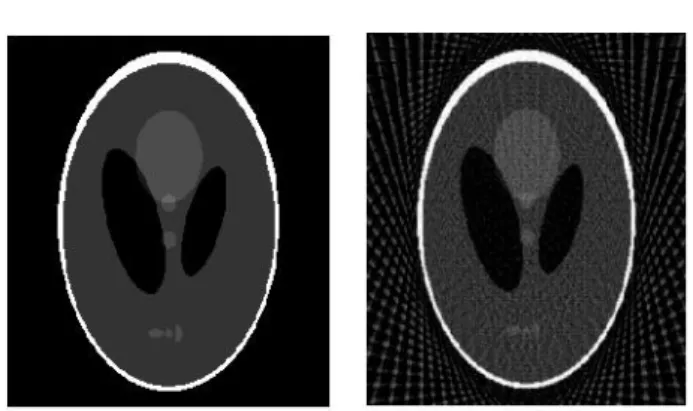
Fig. 4. Shepp-Logan Head Phantom and reconstructed from 36 projections
ACKNOWLEDGMENT
My endevore stands incompleate without dedicting my gratitude to everyone who has contribted a lot towards the succesful completion of the project work. I am indebted to god almighty for blessing me with his grace and taking the endeavor to a succesful completipn,Iam greatful to Dr. K. Ssatheesh Kimar, Principal of Thejus Engineering collage and Prof. Saju P John, Head of Computer Scince & Engineering Department and Asst Pro. Sangeetha M K for their moral support and encouragement.
REFERENCES
[1] M. S. Pearce, J. A. Salotti, M. P. Little et al,“Radiation exposure
from CT scans in childhood and subsequent risk of leukaemia
and brain tumours: a retrospective cohort study,” The Lancet,vol.
380, no. 9840, pp. 499–505, 2012.
[2] Richard Gordon, Robert Bender And Gabor T.
Herman,”Algebraic Reconstruction Techniques (ART) for
Three-dimensional Electron Microscopy and
X-rayPhotography”.
[3] Zheng Zhang, Yong Xu, Jian Yang, Xueiong Li, David Zhang,
“A Survey of Sparse Representation: Algorithms and Applications”, IEEE Access,2015.
[4] G. Herman, Fundamentals of Computerized
Tomography:”Image Reconstruction From Projections.”,
Springer VerlagVol 11, 2009.
[5] Emmanuel J Candes and Michael B Wakin. “An Introduction To Compressive Sampling”. IEEE Signal Processing Magazine.March 2008.
[6] Tomas Tuma, Paul Hurley.”On the incoherence of noiselet and