STUDIES REGARDING THE FRAUDULENT PRACTICES AND OTHER
NONCONFORMITIES ENCOUNTERED IN THE WINES MARKETED IN
DOLJ COUNTY DURING THE PERIOD 2006-2014
VLADU CRISTINA EMANUELA(1), SĂVESCU PETRE(2)
(1)The Ministry of Agriculture and Rural Development, The General Direction of Control, Anti-fraud and Inspections. The County Department of Inspection, Verification and Control, Dolj, Ion Maiorescu, no. 4, Romania,[email protected]
(2)University of Craiova, Faculty of Agronomy,[email protected]
Coprresponding author: [email protected]
Keywords: falsifications, nonconformities, official control
ABSTRACT
The aim of the study is to analyse: the types of nonconformities existing in the wines displayed for marketing, the number of wine samples with detected additions that are not allowed, the geographic area that they come from and the evolution of nonconformities during the studied period.
The analysis of the wines existing in the commercial network of Dolj County during the period 2006-2014 highlights nonconformities and falsifications of the wines through the dilution of the wine with water, non-vinous addition of alcohol, through hiding some faults or alterations of the wine, through additions and the use of any practices that are illegal according to the current wine law.
INTRODUCTION
According to current wine legislation, falsifications represent the addition of alcohol and water in wine, the change of the composition of stum and wines or the concealing of some defects or alterations of the wine by adding substances forbidden by current wine legislation, the failure to comply with the limits of the ratio glucose/fructose, the use of flavouring substances, synthetic sweeteners or colorants, the acidification/deacidification of the wines over the limits provided in the law or the preparation of the wines from other raw materials than the legal ones.
During the modern era, falsifications vary from the addition of alcohol to the addition of products that endanger the consumers’ health, especially colorants, preservatives, etc. (Constantin Banu et al., 2013)
Most of the cases, falsifications do not harm wine’s innocuity, but it distorts its characteristics and affects consumer’s image and trust in the naturalness of the product (Bulancea Mircea, Gabriela Râpeanu, 2009).
Evaluation of wines’ naturalness is made by analysis of physical and chemical parameters in agreement with the requirements of the legal standards of these products and the information on the product’s label (Vicol Constanţa, 2011).
In order to obtain consumer’s trust, authenticity, as a component part of the quality, it should be certain and certified (Stoian Viorel, 2001, Popa A, 2012).
or Origin Designation (DOC) white and red, having different quality depending upon the sugar content, obtained by wine producers, natural and legal persons in Romanian vineyards.
Also, in a lower percentage, import wines or from inter-community trade intended for marketing in Dolj County.
The official control of physical, chemical and organoleptic parameters in wines sampled by I.S.C.T.V. inspectors from different economic agents who carry out wine marketing – bulk and bottled- in Dolj County was carried out in one of the five approved laboratories of the Ministry of Agriculture and Rural Development, which meet the general criteria for operation of testing laboratories established by the ISO/CEI 17025 standard, nominated in Annex 1 of Order no. 272 of December 9th, 2010.
The presence of non-vinous alcohol and water was determined through an isotopic analysis performed by the Laboratory of mass spectrometry, chromatography and ion physics within the National Institute for Research and Development of Isotopic and Molecular Technologies, Cluj-Napoca.
RESULTS AND DISCUSSIONS
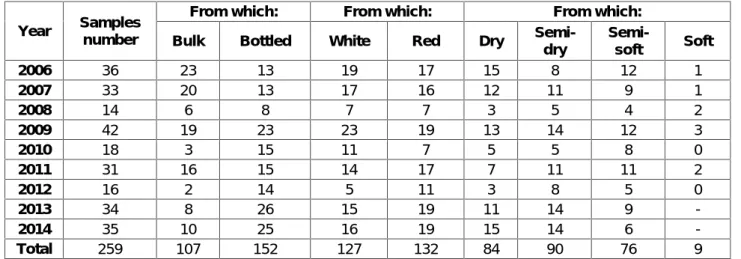
From 259 samples of wine taken, 107 samples were of bulk wine, approved for sale in authorised stores which sell bulk wine according to H. G. 1134 since 2002 and, from 2010, The 224 art fro 2010, the rest of the 101 samples were samples of bottled wine. Concerning the proportion of samples analysed depending on the color of the wine, it was about 50%, i.e. 127 samples of white wine and 152 samples of red wine (Table 1).
Table 1
Analysed samples situation according to the year of sampling and analysis, marketing, form and sugar content
Year Samples
number
From which: From which: From which:
Bulk Bottled White Red Dry
Semi-dry
Semi-soft Soft
2006 36 23 13 19 17 15 8 12 1
2007 33 20 13 17 16 12 11 9 1
2008 14 6 8 7 7 3 5 4 2
2009 42 19 23 23 19 13 14 12 3
2010 18 3 15 11 7 5 5 8 0
2011 31 16 15 14 17 7 11 11 2
2012 16 2 14 5 11 3 8 5 0
2013 34 8 26 15 19 11 14 9
-2014 35 10 25 16 19 15 14 6
-Total 259 107 152 127 132 84 90 76 9
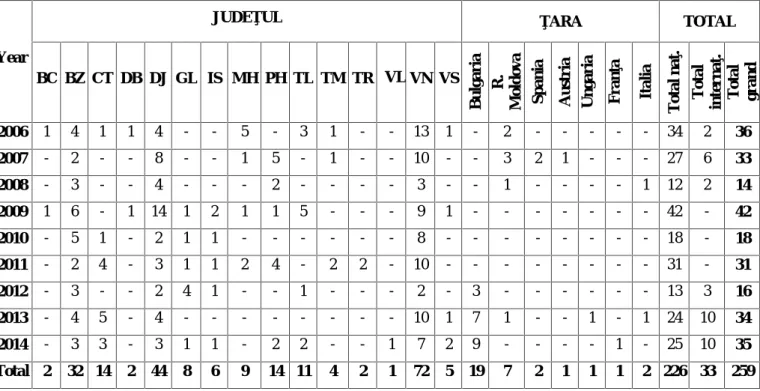
Table 2
The situation of the analysed samples depending on the county or country where they have been produced and/or imported
Year
JUDEŢUL ŢARA TOTAL
BC BZ CT DB DJ GL IS MH PH TL TM TR VL VN VS
B u lg a ria R. M o ld o v a S p a n ia Au st ria Un g a ria F ra n ţa It a lia T o ta l n a ţ. T o ta l in te rn a ţ. T o ta l g ra n d
2006 1 4 1 1 4 - - 5 - 3 1 - - 13 1 - 2 - - - 34 2 36
2007 - 2 - - 8 - - 1 5 - 1 - - 10 - - 3 2 1 - - - 27 6 33
2008 - 3 - - 4 - - - 2 - - - - 3 - - 1 - - - - 1 12 2 14
2009 1 6 - 1 14 1 2 1 1 5 - - - 9 1 - - - 42 - 42
2010 - 5 1 - 2 1 1 - - - 8 - - - 18 - 18
2011 - 2 4 - 3 1 1 2 4 - 2 2 - 10 - - - 31 - 31
2012 - 3 - - 2 4 1 - - 1 - - - 2 - 3 - - - 13 3 16
2013 - 4 5 - 4 - - - 10 1 7 1 - - 1 - 1 24 10 34
2014 - 3 3 - 3 1 1 - 2 2 - - 1 7 2 9 - - - - 1 - 25 10 35
Total 2 32 14 2 44 8 6 9 14 11 4 2 1 72 5 19 7 2 1 1 1 2 226 33 259
From 259 wine samples , bottled or bulk , there were submitted to analysis a number of 33 wine samples coming from intra-community trade or imported, their percentage was pretty small, 12,74%, but enough, taking into account their share on the Romanian market.
Following the analysis of 259 wine samples in terms of organoleptic and physicochemical, and izotopic, there were discovered various nonconformities in a number of 100 samples, these representing a percentage of 38% of the total analyzed samples, the biggest share being represented by the addition of citric acid, colorants and sweeteners in wine, together with non-vinous alcohol and water (Fig. 1).
100 150 200 250 300
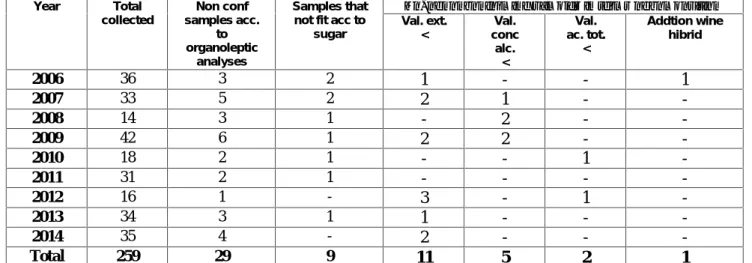
samples were identified various deposits of protean or tartaric nature, nonspecific colors or odors especially due to oxidation or to the production of wine in conditions of poor hygiene, and in 19 samples were identified composition problems, namely: the value of extract, alcohol, total acidity was less than the minimum allowed by wine law in force (Table 3).
Also, in a single wine sample, from the Republic of Moldova, was identified the presence of malvidin diglucoside exceeding the maximum allowable limit of 15 mg/l for red wines, which is forbidden by Romanian regulations that expressly provide in art. 23 of G.D. 769/2010 that „wine resulting by processing directly producing hybrid grapes is intended exclusively for family consumption, obtaining alcohol of vinous origin and wine vinegar”.
Table 3
The situation of non-compliant samples from the prganoleptic and compositional collected in 2006-2014 from commercial network in Dolj county
Year Total collected
Non conf samples acc.
to organoleptic
analyses
Samples that not fit acc to
sugar
No. of nonconforming samples in terms of composition
Val. ext. <
Val. conc
alc. <
Val. ac. tot.
<
Addtion wine hibrid
2006 36 3 2 1 - - 1
2007 33 5 2 2 1 -
-2008 14 3 1 - 2 -
-2009 42 6 1 2 2 -
-2010 18 2 1 - - 1
-2011 31 2 1 - - -
-2012 16 1 - 3 - 1
-2013 34 3 1 1 - -
-2014 35 4 - 2 - -
-Total 259 29 9 11 5 2 1
In terms of unpermitted additions, unfortunately, wine along with many other types of food, has been the target of forger acts.
Of the 259 wine samples analyzed it was found that 43 were subjected to falsifications.
The fraudulent practices met in wines subjected to analyses during 2006-2014 were: citric acid addition - 13 samples, water and ethanol addition - 7 samples, sweeteners addition 6 samples, colorants addition - 6 samples, water addition - 6 samples, ethanol addition - 3 samples, water, ethanol and sweeteners addition - 2 samples.
Table 4
The situation of wine samples identified with different unpermitted aditions
Year Total
collected
Total fraud samples
No. of samples with detected additions that are not allowed (falsfied)
Colorsants addition
Sugar addition
Citic acid addition
Water addtion
Etanol addition
Water end etanol addition
Sugar, water
end etanol addition
2006 36 14 4 1 7 2 - -
-2007 33 2 - - 2 - - -
-2008 14 - - -
-2009 42 6 - 4 1 1 - -
-2010 18 1 - - 1 - - -
-2011 31 - - -
-2012 16 2 - - 2 - - -
-2013 34 11 1 - - 1 3 6
-2014 35 7 1 1 - 2 - 1 2
Total 259 43 6 6 13 6 3 7 2
The addition of colorants manifested more intensely in 2006 when 4 samples were discovered and during 2013 - 2014 when the highlight made using the official wool test method led to the discovery of another 2 wine samples with addition of synthetic colorants, one in 2013 and one in 2014.
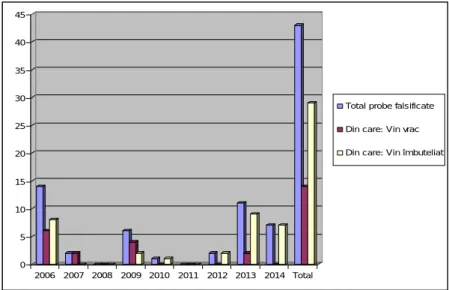
During the 9-year study was found that the number of samples from counterfeited bottled wine is double compared to the samples from counterfeited bulk wine (Fig. 2).
Fig. 2 The situation of wine samples identified as falsified depending on packing manner 0
5 10 15 20 25 30 35 40 45
2006 2007 2008 2009 2010 2011 2012 2013 2014 Total
Total probe falsificate
Din care: Vin vrac
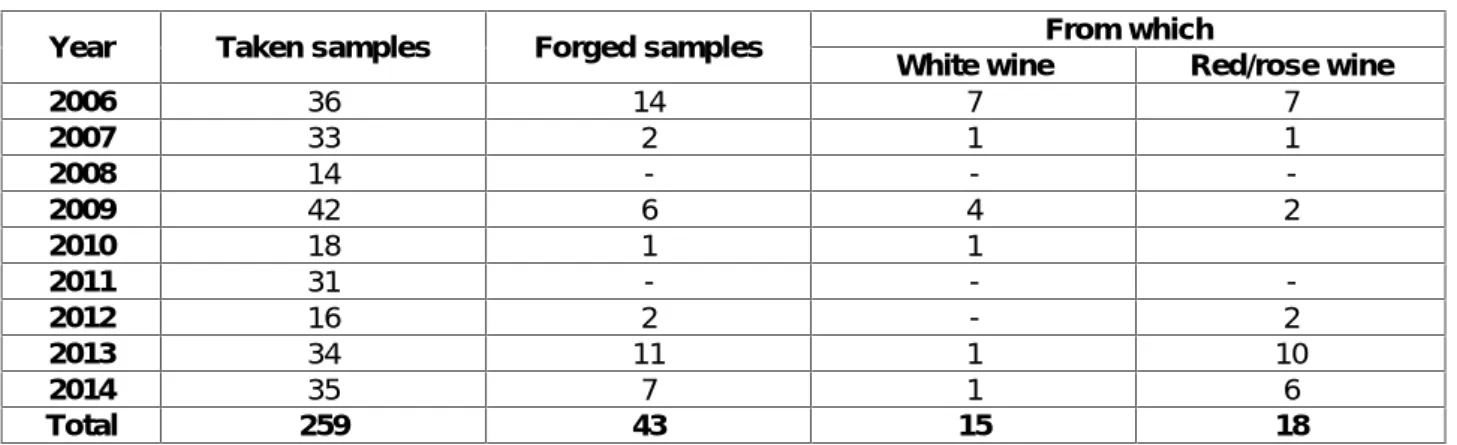
Wine sample situation detected counterfeit depending on color
Year Taken samples Forged samples From which
White wine Red/rose wine
2006 36 14 7 7
2007 33 2 1 1
2008 14 - -
-2009 42 6 4 2
2010 18 1 1
2011 31 - -
-2012 16 2 - 2
2013 34 11 1 10
2014 35 7 1 6
Total 259 43 15 18
From 43 samples of counterfeit/forged wine, it was found a greater number of fraud related to the dry wines 25 samples, followed by demi-dry wine 12 samples and 6 samples of semi-soft wine (Table 6).
Table 6
Wine sample situation detected counterfeit depending on sugar content
Year Samples no Forged samples From which
Dry wine Semi-dry wine Semi soft wine
2006 36 14 9 4 1
2007 33 2 - - 2
2008 14 - - -
-2009 42 6 2 2 2
2010 18 1 - 1
-2011 31 - - -
-2012 16 2 1 1
-2013 34 11 8 2 1
2014 35 7 5 2
-Total 259 43 25 12 6
In terms of unpermitted additions, unfortunately, wine along with many other types of food, has been the target of forger acts.
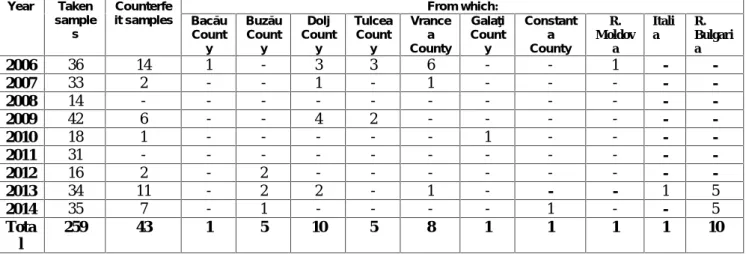
The distribution of the 45 samples of counterfeit wine, in the nine years of study, according to the origin of county of the producer or bottler, it highlights Dolj county and Vrancea county with 10 and 8 samples wine, followed very close by Tulcea, 5 samples (Table 7).
Table 7
Wine samples distribution detected counterfeit according to the origin county Year Taken
sample s
Counterfe it samples
From which:
Bacău Count
y
Buzău Count
y
Dolj Count
y
Tulcea Count
y
Vrance a County
Galaţi Count
y
Constant a County
R. Moldov
a
Itali a
R. Bulgari a
2006 36 14 1 - 3 3 6 - - 1 -
-2007 33 2 - - 1 - 1 - - - -
-2008 14 - - - -
-2009 42 6 - - 4 2 - - - - -
-2010 18 1 - - - 1 - - -
-2011 31 - - - -
-2012 16 2 - 2 - - - -
-2013 34 11 - 2 2 - 1 - - - 1 5
2014 35 7 - 1 - - - - 1 - - 5
Tota l
259 43 1 5 10 5 8 1 1 1 1 10
CONCLUSIONS
Unhappily, wine, as almost all the products intended for commerce, was the target of actions of falsification and counterfeit.
After the analysis of the 259 wine samples from the organoleptic, physical and chemical points of view, we identified deviations from the current legal provisions with a number of 100 samples, these representing 38% of all the analysed samples.
Of the 257 wine samples 43 samples had forbidden additions, their percent being of about 16.
Among the most frequent fraudulent practices used in commercialized wines in Dolj County are: the addition of citric acid over the maximum limit – 13 samples, the addition of natural or artificial sweeteners – 6 samples, the addition of coloured substances – 6 samples and the addition of water - 6 samples, with addition of etanol - 3 samples and the addition of water, etanol end sweeteners – 2 samples.
The counties with most falsified wines are: Dolj, Vrancea and Tulcea, which also have the widest areas of vineyard.
The analysis of wines in the commercial network, performed during the study, i.e. during 2006-2012, showed a progressive reduction in the number of counterfeit wine samples by 2012 (Vladu Cristina – Emanuela, 2013).
During 2013-2014 there is an alarming increase of counterfeited wines on the market, mostly coming from the Republic of Bulgaria.
The risk of wine counterfeit/substitution could be eliminated if the Romanian consumer would acquire a minimum knowledge of appreciating wine, and producers, bottlers, dealers and control bodies alike would acquire the culture of discipline at work, and also rigor and need for compliance.
BIBLIOGRAPHY
wineyards from Moldova, Doctoral Thesis, Dunarea de Jos University "Galati.
6. Vladu Cristina - Emanuela, 2013– Study on falsification and the types of falsifications detected in the wine in Dolj commercial network, Annals of the University of Craiova – Agriculture, Montanology, Cadastre Series, Vol. XLIII
* 2002, Law No. 244 of wineyard and wine in the common organisation of the market in wine of 27 April 2002, Official Gazette of Romania, part I, no. 333/20th May 2002.
**2015, Law No. 164 of wineyard and wine in the common organisation of the market in wine of 30thof June 2015, Official Gazette of Romania, part I, no. 472/30thof June 2015. *** 2002, 769 decree from 28thof July 2010 approving the methodological Norms of the law on wineyard and wine. 244/02, Official Gazette of Romania, part I, no. 798/4th November 2002.
**** 2008, the Minister of Agriculture no. 224 of 7 April 2008 approving the Methodological Norms regarding the conditions of retail table bulk wine.