Volume 4, Issue 3, March 2015
Optical Interference Filters Transmission
Performance Efficiency Under Temperature
Variations Effects
Ahmed Nabih Zaki Rashed
1*,
Abd El-Naser A. Mohamed
2, and Abdo Said Abdo
31,2,3
Electronics and Electrical Communications Engineering Department Faculty of Electronic Engineering, Menouf 32951, Menoufia University, EGYPT
*E-mail: [email protected]
Abstract— This paper has presented optical interference filters transmission performance under thermal temperature effects. Different materials are deeply studied to show the best for optical filtering.
Index Terms— Optical filtering, Transmission modulation depth, Optical density, Filter correction and Optical transmission regions.
I.INTRODUCTION
Optical filters are devices which selectively transmit light of certain properties while blocking (absorbing) the reminder. In general they’re sensitive to light of particular wavelengths (and in consequence color) or range of wavelengths. This property makes optical filters often used in many industrial applications. In many branches of industry source emitting intense non-visible radiation (for example white hot metal or glass) has to be monitored. Optical filters are often used for such applications. In such cases infrared (IR) or heat absorbing filters are used in order to block mid infrared wavelengths (thermal radiation) but allow visible light to be transmitted. Additionally, neutral density filters are often used in order to reduce the intensity of light by reflecting or absorbing a portion of it [1, 2]. As a light beam passes through a transparent or translucent material (filter), part of its electromagnetic radiation is absorbed. The amount absorbed electromagnetic radiation depends on [3]: the wavelength; the amount of the absorbing material in the radiation path (filter thickness); the absorption coefficient of the material at that wavelength. Systems with greatly improved optical filters, i.e., filters that provide sub angstrom spectral resolution, rapid wavelength tuning, low wavefront distortion (for imaging), and high throughput, will be needed. The challenge in remote sensing
is to provide rugged, easily used [4], relatively inexpensive devices that can project an image of contaminant concentrations on a screen and record measurements for long-term research. The challenge in optical communications is to integrate extremely inexpensive and rapidly tunable devices into existing systems [5-7].
II. Filter Model Analysis
The intensity of an incident beam drops exponentially as it passes through the absorber. This is often expressed as the following [5, 8-10]:
t F Pe
T (1)
Where αλ is the filter absorption coefficient at wavelength λ, t is the filter thickness, and P is the filter correction factor which can be defined as the following formula [5, 11- 13]:
, 1 1 1 1 2 1 4 2 n n n n P (2)
Therefore filter correction factor percentage is given by the following expression [5]:
, % 100 1 1 1 1 2 1 (%) 4 2 x n n n n P (3)
Where n is the refractive index of the filter glass relative to air which can be expressed with schott glass formula as: n A0A12A22A34A46A58 (4)
Where the coefficients for BK7 glass, Silicon dioxide (SiO2), Magnesium fluoride (Mg F2) are adjusted and recast as shown in Table 1.
Table 1. Schott coefficients for different materials based optical filters [1, 3, 5, 14, 15].
Coefficients Different materials based Optical filters
BK7 glass Silicon dioxide
(SiO2)
Magnesium fluoride (Mg F2)
A0 1.265 (T/T0) 0.633 (T/T0) 0.48755 (T/T0)
A1 0.01442 (T/T0)2 0.06 (T/T0)2 0.04338 (T/T0)2
A2 1.0032 (T/T0) 0.5178 (T/T0) 0.39875 (T/T0)
A3 0.0082 (T/T0)2 0.106 (T/T0)2 0.0946 (T/T0)2
A4 0.0543 (T/T0) 1.765 (T/T0) 2.312 (T/T0)
A5 41.82 (T/T0)2 55.742 (T/T0)2 60.706 (T/T0)2
The filter absorption coefficient as a function of optical signal wavelength and filter refractive index is [16]:
,10 0.0458 2
n
e
n
cm-1 (5)
The reflection loss R is also dependent on the wavelength and can be calculated as follows [14]:
2 1 1 n n R (6)
As well as the optical density is the attenuation level also called blocking level which is given by [5, 15]:
F T
AL 10log 1
Volume 4, Issue 3, March 2015
As optical density increases, the amount of light blocked by the filter (by reflection and/or absorption) increases. The most important point to note is that optical density is additive. As well as the transmission modulation depth (TMD) is given by [5, 16]:
P P TMD
1 1 log
10 10 , dB (8)
The optical filtering signal quality, Q can be expressed as a function of operating optical signal wavelength λ and filter full width at half maximum as the following formula [5, 17]:
FWHM
Q (9)
Where FWHM is the full width at half maximum which is applied to such phenomena as the duration of pulse waveforms and the spectral width of sources used for optical communications and the resolution of spectrometers and can be estimated as the following formula [5, 18]:
f BW
FWHM 0.635/ (10)
Where BWf is the transmitted signal bandwidth with non return to zero coding (NRZ) which is given by [5, 19]:
7 . 0
f
BW (11)
Where τ is the total pulse broadening through optical filter which can be given by:
Lf Dm (12)
Where Lf is the filter length, Δλ is the spectral linewidth of the optical source in nm, and Dm is the material dispersion coefficient based optical filter which can be estimated by:
,
2 2
d n d
c
Dm (13)
Where c is the speed of light (3x10⁸ m/sec), d2n/dλ2 is the second derivative of filter material refractive index with respect to operating optical signal wavelength λ. Therefore, bit error rate (BER) is considered an important figure of merit for optical signal filtration; all designs are based to adhere to that quality. BER in optical communication system is calculated by the following equation [5, 20]:
2 5
.
0 erfc Q
BER (14)
As well as the filter delay time can be estimated by the following equation [5, 18]:
c L n f
(15)
III.SIMULATION RESULTS AND PERFORMANCE EVALUATION
Wavelength selective optical filters have been deeply investigated in the ultra violet, visible and near infrared spectrum regions to enhance it performance operation characteristics such as signal filtration quality, filter optical density, filter free spectral range, filter correction factor, and filter transmission modulation depth over wide range of the affecting operating parameters as shown in Table 2.
Table 2. Operating parameters for wavelength selective optical filters [3, 5, 7, 12, 16].
Operating parameter Symbol Value
Operating optical signal wavelength in Near infrared region λ 1550 nm
Room temperature T0 25 °C
Filter thickness t 0.2 ≤ t, mm ≤ 1
Ambient temperature T 25 ≤ T, °C ≤ 75
Spectral linewidth of the optical source Δλ 0.1 nm
Filter length Lf 20 mm
Based on the modeling equations analysis of advanced glass and plastic optical filters over wide range of the operating parameters, and the series of the Figs. (1-17), the following features are assured:
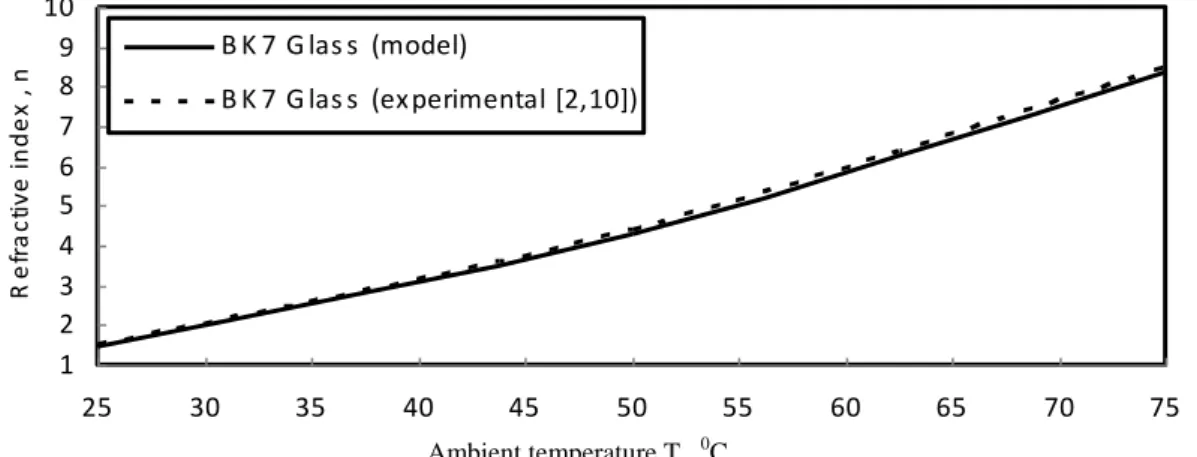
i) As shown in Figs. (1-3) have assured that refractive index for different optical filters under study decreases with increasing ambient temperature. Our proposed model have indicated a complete agreement with the experiment results. ii)Fig. 4 has indicated that filter signal quality factor
decreases with increasing ambient temperature. It is observed that BK7 glass based optical filters has presented the highest signal quality factor in comparison with other materials based optical filters under the same operating conditions.
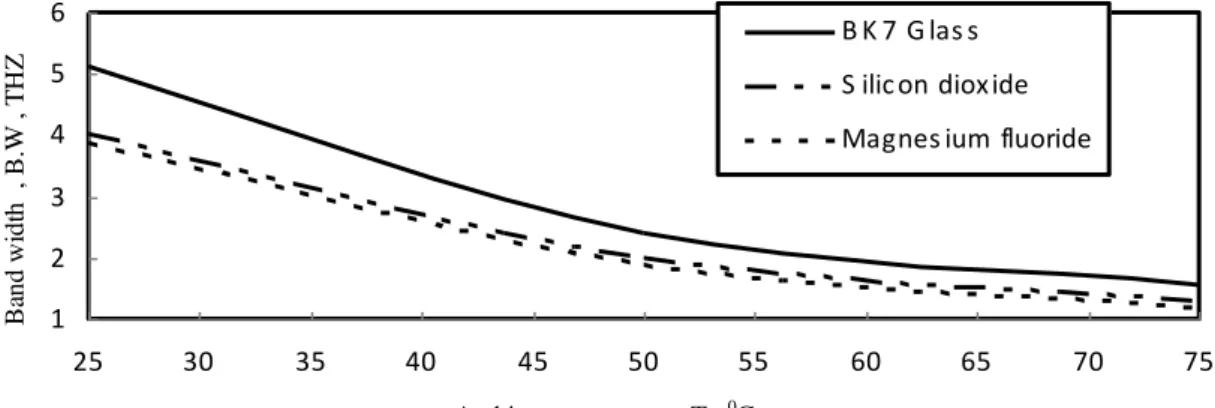
iii)As shown in Fig. 5 has assured that filter bandwidth decreases with increasing ambient temperature. It is observed that BK7 glass based optical filters has presented the highest filter bandwidth in comparison with other materials based optical filters under the same operating conditions.
iv)As shown in Fig. 6 has assured that filter full width at half maximum decreases with increasing ambient temperature.
It is indicated that BK7 glass based optical filters has presented the highest filter full width at half maximum in comparison with other materials based optical filters under the same operating conditions.
v) Fig. 7 has indicated that filter reflection loss increases with increasing ambient temperature. It is observed that BK7 glass based optical filters has presented the lowest filter reflection loss in comparison with other materials based optical filters under the same operating conditions. vi)As shown in Fig. 8 has assured that filter correlation factor
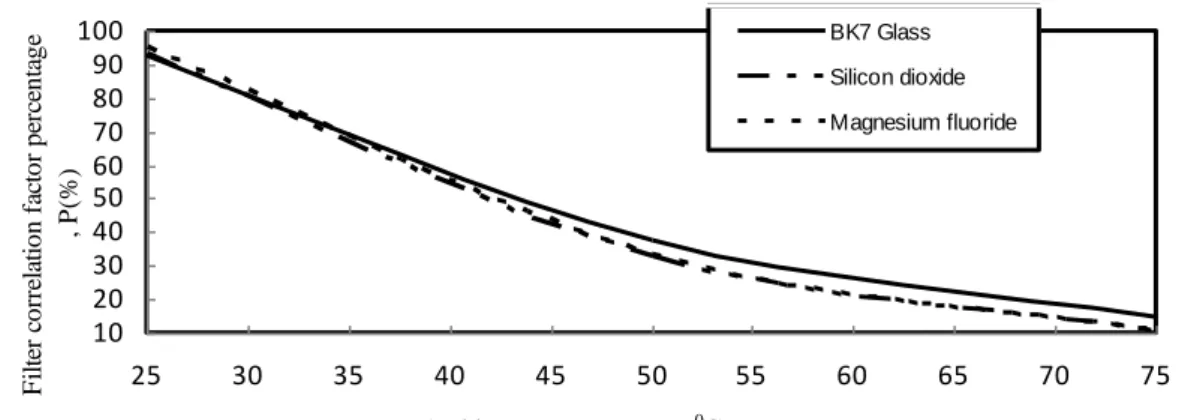
decreases with increasing ambient temperature. It is indicated that BK7 glass based optical filters has presented the highest filter correlation factor in comparison with other materials based optical filters under the same operating conditions.
vii) Fig. 9 has demonstrated that filter bit error rate increases with increasing ambient temperature. It is observed that BK7 glass based optical filters has presented the lowest filter bit error rate in comparison with other materials based optical filters under the same operating conditions.
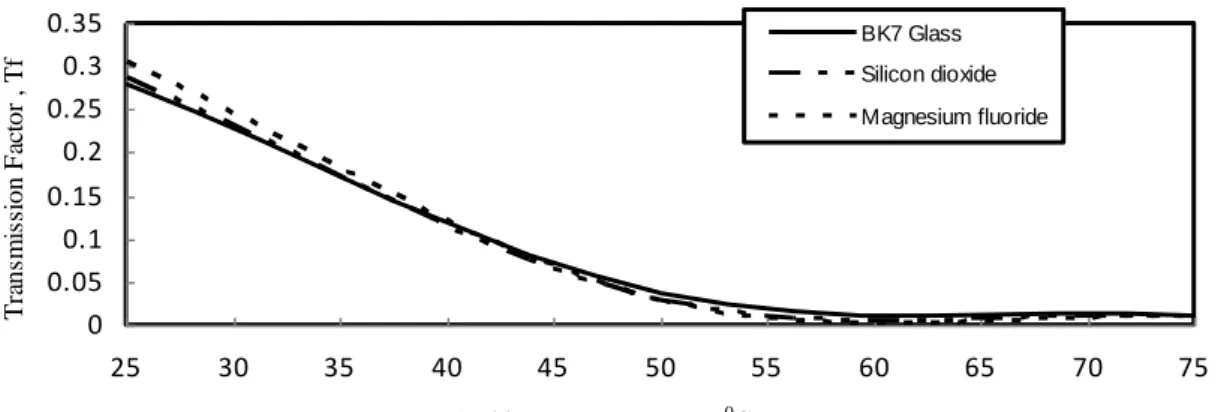
Volume 4, Issue 3, March 2015 filter thickness. It is observed that BK7 glass based optical
filters has presented the highest filter transmission in comparison with other materials based optical filters under the same operating conditions.
ix)Fig. 13. has demonstrated that filter modulation depth decreases with increasing both ambient temperature and filter thickness. It is observed that BK7 glass based optical filters has presented the highest filter modulation depth in comparison with other materials based optical filters under the same operating conditions.
x) Fig. 14 has indicated that filter delay time increases with increasing ambient temperature. It is observed that BK7
glass based optical filters has presented the lowest filter delay time in comparison with other materials based optical filters under the same operating conditions.
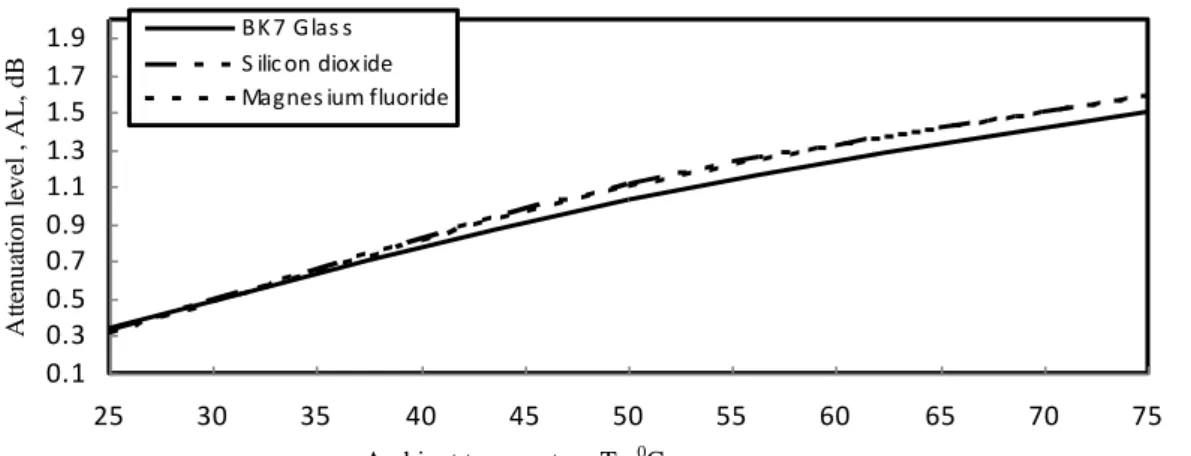
xi)Figs. (15-17) have assured that filter attenuation level increases with increasing both ambient temperature and filter thickness. It is observed that BK7 glass based optical filters has presented the lowest filter attenuation level in comparison with other materials based optical filters under the same operating conditions.
1 2 3 4 5 6 7 8 9 10
25 30 35 40 45 50 55 60 65 70 75
R
e
fr
a
ct
iv
e
in
d
e
x
, n
B K 7 G las s (model)
B K 7 G las s (ex perimental [2,10])
Ambient temperature T , 0C
Fig.1. Refractive index variations of BK7 glass filter with ambient temperature variations for both our proposed model and their experimental data under the assumed set of the operating parameters.
1 3 5 7 9 11
25 30 35 40 45 50 55 60 65 70 75
R
e
fr
a
ct
iv
e
in
d
e
x
, n
S ilic on diox ide (model)
S ilic on diox ide (ex perimental [2,10])
Ambient temperature T , 0C
Fig. 2. Refractive index variations of silicon dioxide filter with ambient temperature variations for both our proposed model and their experimental data under the assumed set of the operating parameters.
0 2 4 6 8 10
25 30 35 40 45 50 55 60 65 70 75
R
e
fr
a
ct
iv
e
in
d
e
x
, n
Magnes ium fluoride (model)
Magnes ium fluoride (ex perimental [2,10])
Ambient temperature T , 0C
Volume 4, Issue 3, March 2015
4 6 8 10 12
25 30 35 40 45 50 55 60 65 70 75
S
ign
al
q
ua
li
ty
, Q
,
dB
B K 7 G las s
S ilic on diox ide Magnes ium fluoride
Ambient temperature T , 0C
Fig.4. Signal quality factor in relation to ambient temperature for different optical filters under the assumed set of the operating parameters.
1 2 3 4 5 6
25 30 35 40 45 50 55 60 65 70 75
B
and
w
idt
h
,
B
.W
,
T
H
Z
B K 7 G las s
S ilic on diox ide
Magnes ium fluoride
Ambient temperature T , 0C
Fig.5. Band width in relation to ambient temperature for different optical filters under the assumed set of the operating parameters.
0.5 1 1.5 2 2.5 3 3.5
25 30 35 40 45 50 55 60 65 70 75
F
W
H
M
,
T
H
Z
B K 7 G las s F W HM
S ilic on diox ide
Magnes ium fluoride
Ambient temperature T , 0C
Fig. 6. Full width at half maximum in relation to ambient temperature for different optical filters under the assumed set of the operating parameters.
0 0.1 0.2 0.3 0.4 0.5 0.6 0.7
25 30 35 40 45 50 55 60 65 70 75
R
efl
ec
ti
on
l
os
s ,
R
B K 7 G las s
S ilic on diox ide
Magnes ium fluoride
Ambient temperature T , 0C
Volume 4, Issue 3, March 2015
10 20 30 40 50 60 70 80 90 100
25 30 35 40 45 50 55 60 65 70 75
F
il
te
r c
or
re
la
ti
on
fa
ct
or
p
erc
ent
age
, P
(%
)
BK7 Glass
Silicon dioxide
Magnesium fluoride
Ambient temperature T , 0C
Fig. 8. Filter correction factor percentage in relation to ambient temperature for different optical filters under the assumed set of the operating parameters.
1.5 2.5 3.5 4.5 5.5 6.5 7.5
25 30 35 40 45 50 55 60 65 70 75
BK7 Glass BER
Silicon dioxide
Magnesium fluoride
Ambient temperature T , 0C
Fig. 9. Bit error rate in relation to ambient temperature for different optical filters under the assumed set of the operating parameters.
0 0.1 0.2 0.3 0.4 0.5 0.6 0.7 0.8
25 30 35 40 45 50 55 60 65 70 75
T
ra
ns
m
is
si
on
F
ac
tor
,
T
f
BK7 Glass
Silicon dioxide
Magnesium fluoride
Ambient temperature T , 0C
Fig.10. Transmission factor with filter thickness 0.2 mm in relation to ambient temperature for different optical filters under the assumed set of the operating parameters.
0 0.1 0.2 0.3 0.4 0.5
25 30 35 40 45 50 55 60 65 70 75
T
ra
ns
m
is
si
on
F
ac
tor
,
T
f BK7 Glass
Silicon dioxide
Magnesium fluoride
Ambient temperature T , 0C
Fig.11. Transmission factor with filter thickness 0.6 mm in relation to ambient temperature for different optical filters under the assumed set of the operating parameters.
Bit
e
rro
r
ra
te,
BER
x
1
0
Volume 4, Issue 3, March 2015
0 0.05 0.1 0.15 0.2 0.25 0.3 0.35
25 30 35 40 45 50 55 60 65 70 75
T
ra
ns
m
is
si
on
F
ac
tor
,
T
f
BK7 Glass
Silicon dioxide
Magnesium fluoride
Ambient temperature T , 0C
Fig.12. Transmission factor with filter thickness 1 mm in relation to ambient temperature for different optical filters under the assumed set of the operating parameters.
1 2 3 4 5 6 7 8 9 10
25 30 35 40 45 50 55 60 65 70 75
T
ra
ns
m
is
si
on
m
od
ul
at
ion
d
ept
h
, T
M
D
,
dB
BK7 Glass
Silicon dioxide
Magnesium fluoride
Ambient temperature T , 0C
Fig. 13. Transmission modulation depth in relation to ambient temperature for different optical filters under the assumed set of the operating parameters.
1 2 3 4 5 6 7 8 9
25 30 35 40 45 50 55 60 65 70 75
BK7 Glass
Silicon dioxide
Magnesium fluoride
Ambient temperature T , 0C
Fig. 14. Filter delay time in relation to ambient temperature for different optical filters under the assumed set of the operating parameters.
1 2.5 4 5.5 7 8.5 10 11.5
25 30 35 40 45 50 55 60 65 70 75
A
tt
enu
at
ion
l
eve
l ,
A
L
, d
B BK7 Glass
Silicon dioxide
Magnesium fluoride
Ambient temperature T , 0C
Fig. 15. Attenuation level with filter thickness 0.2 mm in relation to ambient temperature for different optical filters under the assumed set of the operating parameters.
F
il
ter d
elay
ti
m
e,
γ,
μs
Volume 4, Issue 3, March 2015
0.1 0.3 0.5 0.7 0.9 1.1 1.3 1.5 1.7 1.9
25 30 35 40 45 50 55 60 65 70 75
A
tt
enu
at
ion
l
eve
l ,
A
L
, d
B
BK 7 Glas s S ilic on diox ide Magnes ium fluoride
Ambient temperature T , 0C
Fig. 16. Attenuation level with filter thickness 0.6 mm in relation to ambient temperature for different optical filters under the assumed set of the operating parameters.
0.1 0.3 0.5 0.7 0.9 1.1 1.3 1.5 1.7 1.9 2.1
25 30 35 40 45 50 55 60 65 70 75
A
tt
enu
at
ion
l
eve
l ,
A
L
, d
B
BK7 Glass
Silicon dioxide
Magnesium fluoride
Ambient temperature T , 0C
Fig. 17. Attenuation level with filter thickness 1µm in relation to ambient temperature for different optical filters under the assumed set of the operating parameters.
IV.CONCLUSIONS
In a summary, we have deeply investigated the optical signal filtering processing for signal quality testing in optical fiber communication systems. It is theoretically found that the harmful high thermal and increased filter thickness effects on the optical filter transmission performance efficiency. As well as it is observed that BK7 glass optical filter has presented the highest signal quality, signal transmission , filter correlation factor, transmission modulation depth and filter bandwidth and the lowest filter bit error, filter delay time, reflection loss, and filter attenuation level. Thus BK7 glass optical filter is the best candidate for optical filters among proposed optical filters under study under the same thermal effects and third window transmission spectral operating conditions, It is indicated that the dramatic thermal effects on the optical filter transmission performance efficiency.
REFERENCES
[1] A. Melloni and M. Martinelli, “Synthesis of Direct Coupled Resonators Bandpass Filters for WDM Systems,” J. Lightw. Technol., Vol. 20, No. 2, pp. 296–303, 2002.
[2] V. Van, “Circuit Based Method for Synthesizing Serially Coupled Microring Filters,” J. Lightw. Technol., Vol. 24, No. 7, pp. 2912– 2919, Jul. 2006.
[3] Ilya D. Vugmeyster, “Development of a terahertz time-domain spectrometer optimized at 5-8 THz and the study of surface polaritons in NiO-SrTiO3 nano-composite ceramics,” Ph.D. Thesis, 2013
[4] B. E. Little, S. T. Chu, P. P. Absil, J. V. Hryniewicz, F. G. Johnson, F. Seiferth, D. Gill, V. Van, O. King, and M. Trakalo, “Very High
Order Microring Resonator Filters for WDM Applications,” IEEE Photon. Technol. Lett., Vol. 16, No. 10, pp. 2263–2265, Oct. 2004. [5] Ahmed Nabih Zaki Rashed, Mohamed A. Metwae'e, “Optical
Filters Dimensions and Thermal Operation Conditions Impact on Its Transmission Considerations in Near Infrared (NIR) Optical Spectrum Transmission Region,” Optoelectronics and Advanced Materials Journal– Rapid Communications, Vol. 8, No. 3-4, p. 175 – 184, March-April 2014.
[6] Abd El-Naser A. Mohammed, Mohamed A. metawe’e, Ahmed Nabih Zaki Rashed, and Amina E. M. El-Nabawy “Unguided Nonlinear Optical Laser Pulses Propagate in Waters With Soliton Transmission Technique,” International Journal of Multidisciplinary Sciences and Engineering (IJMSE), Vol. 2, No. 1, pp. 1-10, March 2011.
[7] U. C.Mueller, H. Baier, T. Zeh, M. S.Mueller, and A.W. Koch, “Vibration and Shape Control in Optmechanical Systems Using Distributed Fiber Optic Bragg Grating Sensors,” Journal of Vibration and Control, Vol. 16, No. 4, pp. 539–553, 2010.
[8] S. Van Damme, B. Boons, J. Vlekken, J. Bentell, and J. Vermeiren, “Dynamic Fiber Optic Strain Measurements and Aliasing Suppression With A PDA Based Spectrometer,” Measurement Science and Technology, Vol. 18, No. 10, pp. 3263–3266, 2007. [9] G. D. Boreman, Infrared Antennas & Frequency Selective
Surfaces,CREOL, Ph. D. Thesis, 2011.
[10] B. Voisiat, A. Biciunas, I. Kasalynas, and G. Raciukaitis, “Bandpass filters for THz spectral range fabricated by laser ablation,” Applied Physics A, Vol. 104, No. 3, pp. 953–958, 2011. [11] S. Ivanova and F. Pell´e, “Strong 1.53 μm to NIR-VIS-UV
upconversion in Er-doped Fluoride Glass for High Efficiency Solar Cells,” Journal of the Optical Society of America B, Vol. 26, No. 10, pp. 1930–1938, 2009.
Volume 4, Issue 3, March 2015 Opt Soc Am A Opt Image Sci Vis, Vol. 29, No. 2, pp. 223-232,
2012.
[13] Jordan G, et al: The dimensionality of color vision in carriers of anomalous trichromacy. J Vis Vol. 10, No. 8, pp. 12-18, 2010. [14] Webster MA: Adaptation and visual coding. J Vis, Vol. 11, No. 5,
2011.
[15] K. Kawase, T. Shibuya, S. Hayashi, K. Suizu, “THz imaging techniques for nondestructive inspections”, pp. 510-518, 2010. [16] F. J. Garcia-Vidal, L. Martin-Moreno, T. W. Ebbesen and L.
Kuipers, “Light passing through subwavelength apertures,” Rev. Mod. Phys., Vol. 82, pp. 729-787, 2010.
[17] M. Syuhaimi bin Ab-Rahman, K. B. Kheng, I. Yusof, L. X. Loong and N. Hoong “Verification of the analytical equation for power penalty measurement in OXADM device,” Scientific Research and Essays Vol. 6, No. 32, pp. 6707-6716, 23 Dec. 2011.
[18] Ade, P. A. R., et al., “A Review of Metal Mesh Filters,” Proc. SPIE, (2006).
[19] Onaka, T., et al., “The Infrared Camera (IRC) for AKARI Design and Imaging Performance,” PASJ, Vol. 59, No. 2, pp. 401- 410, 2007.
[20] B. Barua “Evaluate The Performance Of Optical Cross Connect Based On Fiber Bragg Grating Under Different Bit Rate,” International Journal of Computer Science & Information Technology (IJCSIT), Vol. 3, No. 5, pp. 123-136, Oct. 2011.
Author's Profile
Dr. Ahmed Nabih Zaki Rashed was born in
Menouf city, Menoufia State, Egypt country in 23 July, 1976. Received the B.Sc., M.Sc., and Ph.D. scientific degrees in the Electronics and Electrical Communications Engineering Department from Faculty of Electronic Engineering, Menoufia University in 1999, 2005, and 2010 respectively. Currently, his job carrier is a scientific lecturer in
Electronics and Electrical Communications
Engineering Department, Faculty of Electronic Engineering, Menoufia university, Menouf. His scientific master science thesis has focused on polymer fibers in optical access communication systems. Moreover his scientific Ph. D. thesis has focused on recent applications in linear or nonlinear passive or active in optical networks. His interesting research mainly focuses on transmission capacity, a data rate product and long transmission distances of passive and active optical communication networks, wireless communication, radio over fiber communication systems, and optical network security and management. He has published many high scientific research papers in high quality and technical international journals in the field of advanced communication systems, optoelectronic devices, and passive optical access communication networks. His areas of interest and experience in optical communication systems, advanced optical communication networks, wireless optical access networks, analog communication systems, optical filters and Sensors. As well as he is editorial board member in high academic scientific International research Journals. Moreover he is a reviewer member in high impact scientific research international journals in the field of electronics, electrical communication systems, optoelectronics, information technology and advanced optical communication systems and networks. His personal electronic mail ID (E-mail:[email protected]). His published paper under the title
"High reliability optical interconnections for short range applications in high performance optical communication systems"
![Table 1. Schott coefficients for different materials based optical filters [1, 3, 5, 14, 15]](https://thumb-us.123doks.com/thumbv2/123dok_us/8085632.2142391/1.892.209.800.889.1083/table-schott-coefficients-different-materials-based-optical-filters.webp)
![Table 2. Operating parameters for wavelength selective optical filters [3, 5, 7, 12, 16]](https://thumb-us.123doks.com/thumbv2/123dok_us/8085632.2142391/2.892.164.731.638.824/table-operating-parameters-wavelength-selective-optical-filters.webp)