Cloud Studies: The Visible Invisible
Mary Jacobus
Clouds have long been objects of fascination, although their taxonomy was only established by early nineteenth-century meteorologists. For aestheti-cians and art historians, clouds also raise questions about painting’s illu-sionistic uses of space. In John Constable’s painting, clouds represent an “organ of sentiment”; his cloud sketches are exercises in representing space, mass, and mood. The poet John Clare also uses clouds to represent states of mind for which he lacked a language. Natural observation in Con-stable and Clare has different valances: for Clare, observation represents a form of defence against impingement; for Constable, “the man of the clouds,” the science of cloud-watching gives rise to thought. The material-ity of clouds (bearing dust and pollution) is a feature of nineteenth-century climatic accounts. Merleau-Ponty’s phenomenology offers a contemporary theory of clouds as embodied and related seeing. Constable’s cloud-sketches suggest that clouds are not just objects, but a form of cognition.
A cloud is a visible aggregate of minute particles of water suspended in the atmosphere.
Thomas Forster1
Cloud is a body without a surface but not without sub-stance. . . . Although it has no surface, cloud is visible.
Hubert Damisch2
C
louds have always fascinated sky-watchers: forming, spreading,massing, dissipating in streaks and wisps; glowing at sunrise or sunset; processing lazily or purposively across the sky. Weighty and substantial bodies of minute droplets, they mysteriously combine visi-bility and volume without surface. Are clouds objects? Are they phenome-219
na? The story of the “invention” of clouds has recently been told by Richard Hamblyn, and the rise in the popularity of cloud-spotting suggests that they
hold more than meets the eye (Pretor-Pinney; Day).3 The principles of
cloud-formation were first understood in the early nineteenth century, when Luke Howard produced his classification of clouds as part of the embryon-ic science of meteorology. Driven by the turbulence of high altitude winds and storms, bearing moisture or volcanic dust, clouds - we now know - form part of a global weather-system. For artists and poets of the Romantic peri-od, they also provided a metaphor for mobility and transformation. Shelley found in clouds a swift-moving image of constancy-in-change - “I change but I cannot die” (“The Cloud” l.76). But he was a scientist as well as a po-et, and his cloud-behavior was based on the taxonomy of Luke Howard’s
early nineteenth-centuryEssay on the Modification of the Clouds(Hamblyn
215-16). The sky was more than a poetic workshop - it was a mobile labo-ratory for the study of air-borne bodies of water.
Clouds draw the eye upward: to movement, distance, height; to the dy-namics of space and the overarching sky. For most of us, they provoke ideas about both transcendence and inwardness. When we look up, we lose our-selves. Clouds are associated with cosmology, but also with inner states. It is this combination of indeterminacy, space, and interiority that particularly interests me. Clouds, I want to argue, make us think not only about form and vacancy, mobility and change, but also about the peculiar realm of affectiv-ity that we call “mood.” Whether we feel uplifted or depressed, we tend to take the ups and downs of internal states for granted; so much so that we scarcely notice them. Mood is like the weather, changing and unformed, yet always with us. In classical landscape painting, weather and mood converge on the drama of the sky. A cerulean sky spells calm; dark clouds indicate tempestuous events or passions. But in temperate climates, we most often experience an in-between state that is subject to subtle fluctuations of brightness and shadow, transparency and opacity. Englishness, and espe-cially English landscape, has everything to do with changeable weather and the presence of atmospheric moisture - with updrafts and downpours, bursts of sunshine, sudden rain-showers, clouds and mists. For cloud painters like Constable, this environment formed what his first biographer called “a
tory of his affections” at once embodied and transient: “no two days are a-like, nor even two hours” (Leslie 288, 273; qtd. in Haughton 73). It is no ac-cident that the most detailed study of Constable’s cloud-studies is by a
me-teorologist, John Thornes.4
The object of keen meteorological observation during the Romantic pe-riod, clouds paradoxically serve to abolish the representational realm alto-gether. Goethe, in the series of poems inspired by his reading of Howard’s
early nineteenth-century classification of clouds, wrote: “Ich muss das alles
mit Augen fassen, / Will sich aber niht recht denken lassen” (“All of this I have to take in with my eyes, / But it will not let itself be grasped by thought”) (Badt 10, 13; Hamblyn 205-12). Goethe’s clouds offer a way to represent the mind to itself; however minutely or evocatively described, they (like the mind) evade the grasp of thought. The sky extends the mental sublime beyond itself as a form of nubific sublime. In the landscape of Kant’s sublime, nature represents the mind by analogy, while also manifest-ing that it has a mind of its own. Wordsworth’s poetry works on us because we recognize in his cloud-landscapes a similar representation - at once nat-ural and transcendental - of how there is always more than the mind can
grasp in nature, as well as in the imagination (just as in The Prelude, a sea
of cloud usurps on a real sea). Looked at from the point of view of a more recent taxonomy, clouds may verge on the aesthetic of indeterminacy known as l’informe (a potent invention of twentieth-century modernism) - on chaos and shapelessness (Bois and Krauss). They thus lend themselves to being thought about in the philosophic domain that the phenomenologist Merleau-Ponty calls “the visible invisible.” Clouds are confusing, not so much be-cause they mix elements, or constantly change shape, but bebe-cause they chal-lenge the phenomenology of the visible.
What Forster (the nineteenth-century cloud-scientist who most directly influenced Constable) called “the nubific principle” can also be read as a principle of painting (Thornes 76; Forster 31). Viewed as a signifier, clouds have given rise to at least one counter-history of painting. Hubert Damisch’s
study, A Theory of /Cloud/(1972), makes /cloud/the sign of painting’s
par-adoxical combination of the ephemeral and the material. Above all, it
nals the escape of painting from the dominance of perspective and its his-torical transformation; the problem of surface became the problem of
illu-sion. By the use of two forward slashes, Damisch transforms /cloud /into an
index or signifier, rather than a word denoting “cloud” in any descriptive or figurative sense (14-15). Enslaved to linear perspective (so Damisch ar-gues), painting seeks another way of representing visual experience. /Cloud/, whether rendered as the absence of sky or as deceptive trompe l’oeil, poses an alternative to the linear order. It becomes a sign of all that painting has to overcome. Instead of organizing the limits of a flat surface, the illusionistic clouds of the painted baroque cupola overflow their archi-tectural frame (4-7). Correggio, according to Damisch, was the first to con-struct his pictures from the point of view of a Kantian subject for whom space is a constitutive aspect of consciousness (11).
Damisch’s semiotic analysis of pictorial production takes the theme and
texture of /cloud/as an indexical case-study for the development of
paint-ing, making /cloud/the defining problematic of painting from the baroque
to the present day. This “pictorial” or “painterly” space - what he calls “a free and unlimited depth, considered as a luminous and aerial substance” -is opposed to a modern-ist emphas-is on linear style, with its flatness and
overlapping forms (11). /Cloud/ is the sign of the volume repressed by
mod-ern painting’s fixation on the flatness of the representational surface. Its semiotics challenge the insistence of twentieth-century modernism on the representation of painterly space. Clouds round out pictorial space instead of flattening it; they point to the organization of the pictorial as a dialectic
of surface and depth. /Cloud/negates solidity and shape. Nebulous and
in-definite, it signals an indeterminate volume, defying the medium and
restor-ing paintrestor-ing to the realm of illusion. But /cloud/also contains the paradox
of form which signifies itself (29).
It may be a stretch to connect the vertiginous spaces of Correggio’s painting and Constable’s scientifically-informed naturalistic cloud studies, with their particularities of time, date, and weather conditions. But this con-nection is crucial to Damisch’s argument, and it informs mine. The painter-ly aspect of Constable’s clouds may serve as a reminder that even the most local and descriptive of painters can simultaneously strive for the dynamics of abstraction. Whether inspired by the flat Suffolk landscapes of his rural childhood, where his father was a prosperous miller (and both wind and wa-ter powered the mills), or by the views from airy Hampstead Heath over-looking London, where he spent his professional life, Constable had read
the Modification of Clouds). His cloud studies record the formation and transformation of clouds in response to the air, wind, and sky for which Hampstead’s height above the city provided a perfect viewing-point. But like Monet’s water-lilies, the series of Hampstead cloud-studies that Con-stable painted during 1821-22 can be understood as a painter’s reflections on problems of depth, space, and form. His records of transient weather-effects involve a painterly immersion, but in air rather than water. Clouds are notoriously hard to draw, not only because they change and move, but be-cause of their technical demands. Their challenge to anti-graphic techniques and media, and their association with the brush, makes them a theme espe-cially suited to ink wash, water-color, and oil sketches. Cloud-studies re-quire attentiveness to subtle gradations of color and volume, along with swift, fluid, confident execution.
Clouds are to outline as color is to drawing: like Rothko’s fields of color, they oppose line. Cloud-sketches also resemble the early nineteenth-century Romantic lyric - they record the moment as a rapid or slow-moving succession of feelings and thoughts. Clouds mount, mass, tower, or darken. They provide a barometer of feeling. As Constable famously wrote in a let-ter to his friend and patron the Rev. John Fisher in October 1821 (the peri-od of his Hampstead cloud-studies), “painting is but another word for
feel-ing.” In the same letter, he added that the sky is not “a ‘White Sheet’ drawn
behind the Objects”(like the backdrop to a painted scene), but rather “the ‘key note’ - the standard of ‘Scale’ and the chief ‘Organ of Sentiment’”
(Beckett, John Constable’s Correspondence VI76-78; Thornes 280). Clouds,
for Constable, were a source of feeling and perception, an “Organ of
senti-ment”(heart or lungs) as much as meteorological phenomena. If painting is another name for feeling, and the sky an organ of sentiment, then his cloud-sketches are less a notation of changing weather-effects than a series of Ro-mantic lyrics: exhalations and exclamations, meditations and reflections, at-tached to a specific location and moment in time. Constable’s skies may sometimes lend themselves to allegory, as in the rain-cloud and rainbow over Salisbury Cathedral, or the storm-clouds that lower dramatically over Old Sarum (Thornes 142-46). But more often, they evoke fleeting states of mind, feeling, and atmosphere. As they mount or move across the sky, clouds become a language for inner activity: darkening here, lightening there, here an ascent, there a fraying or an accumulation of intensity; a pas-sage of calm before a storm, or a glimpse of cerulean sky.
shadow across a landscape. Clouds have a directional tendency, traveling on what are known to meteorologists as “streets.” Constable’s cloud-sketches catch something as indefinable yet ever-present as our own internal weather-tendency and mobility. How better to register the constantly shifting relation between perception and feeling, embodied consciousness and underlying emotional states? The sky, then, functions both as an organ of sentiment, and as a form of free-association - as both visibility and invisibility, form and l’informe; but above all as a mode of perception. But clouds also carry a ma-terial freight along with their aesthetic and emotional connotations. We shouldn’t lose sight of the great nineteenth-century changes - at once scien-tific and industrial - that formed clouds as we know them. Before coming back to Constable, I want to turn to his early nineteenth-century contempo-rary: the Northamptonshire laborer-poet, John Clare - famous for his poetry of detailed natural observation, for his madness, and for his long confinement in mental institutions. Clare, I want to suggest, not only observed nature minutely; he saw more than he knew, and perhaps knew more than he could see. This is especially evident when it comes to Clare’s clouds.
“Under a Cloud”
& we often see clouds which we identify by their curling up from the orison in separate masses as gass clouds which ascend into the middle sky & then join the quiet journey other clouds & are lost in the same colour.
John Clare, Northborough Oct./Nov. 18415
John Clare, here adrift on a cloud journey, also experienced his depressions
as being “under a cloud.”6 In what is probably his single most famous
poem, the anguished “I am” of 1844, he describes himself as “like vapours tost / . . . Into the living sea of waking dreams” (ll.6-8; Robinson and Pow-ell 2: 396). A near contemporary of the contrastingly upwardly mobile and professionally successful Constable, Clare shared with him an acute
attune-5. Grainger 337.
ment to changing weather and seasons; so much so that his depressions were apparently acerbated in spring and autumn by the seasonal affective disor-der known as SAD (Bate 412-13). His poetry spans the Romantic period, with its impulse towards natural description and its evocation of inner states, and the arrival of the high Victorian age with its realism, its scientific im-pulse, and its emphasis on the individual’s relation to society. His exquisite sensitivity to the sights and sounds of rural England - birds and their nests, the changing seasons, rural pursuits and occasions - reflects a two-fold tax-onomic impulse. Recording natural phenomena such as weather variations was part of a growing movement to catalogue the environment that engaged both professional and amateur or local naturalists during the early nine-teenth century (Jankovic; Anderson). But Clare’s poetry also responds to the fact that the countryside was undergoing rapid change, under the double pressures of nineteenth-century agricultural capitalism, enclosure, and ur-banization, as poorly paid agricultural laborers migrated to the new indus-trial and commercial centers. By the 1840s, the rural idyll had already be-come a nostalgic past for many urban immigrants, and even for agricultural workers like Clare who remained on the land.
Clare can be read as a social observer despite himself, as well as a close observer of the natural phenomena of early nineteenth-century rural Eng-land - recording what John Barrell has called “the dark side of the Eng-landscape” (The Dark Side of the Landscape). But, as Barrell has argued elsewhere, en-closure does not entirely explain Clare’s alienated vision or his myopic and
self-protective focus (The Idea of Landscape 109, 189-210). Clare lived on
the margins of a London literary world that brought him notoriety and sales, but ultimately failed to provide his family with a steady income, exposing him to the fluctuations of literary taste (Haughton, Phillips and Summerfield
4-5). His early volumes - Poems Descriptive of Rural Life and Scenery
(1820), The Village Minstrel and Other Poems (1821), The Shepherd’s
Calendar(1827), and The Rural Muse(1835) - established him in the tradi-tion of self-taught “ploughman” poets such as Robert Burns and Robert Bloomfield (a poet illustrated by Constable). But these rural poets had be-come less fashionable by the 1830s, the period that coincided with Clare’s increasing destitution and depression. Arguably, both he and his poetry had already become an anachronism, awaiting discovery by twentieth-century writers such as Seamus Heaney, Tom Paulin, and Ian Sinclair, for whom he became a poet’s poet and naturalist, as well as a proto-environmentalist. Economic circumstances (not just bad weather) may have exacerbated both Clare’s illness and his fixation on Lord Byron, the aristocratic
sider and alter ego whose Childe Harold and Don Juan he hectically rewrote in 1841, the year of his flight from Dr. Allen’s asylum in Essex.
Clare’s acute sensitivity to his surroundings - Northamptonshire hedgerows, fields, flowers, and birds - included England’s moist climate and changeable skies. Weather is necessarily an object of minute observation to anyone who works on the land. He too may have known Forster’s book, giv-en his observations on atmospheric phgiv-enomgiv-ena (Grainger 94n, 147n). But Clare, no less than Constable, uses weather as an internal barometer to reg-ister minute shifts in mood and feeling for which he had no other language, and for which the trappings of Byronic melancholy provided a clumsy sub-stitute. Observing nature offered the resources of a finely calibrated
vocab-ulary quite unlike the borrowed rhetoric of his Child Harold, with its “Hues
of Hopeless Agony,” or the uninflected Regency shorthand - “blue devils” and “black melancholy” - by which he refers to his depressions in letters (Porter 259-60). The language of journeying clouds provided an alternative means to record precarious emotional states, as well as minute changes in himself, via his surroundings. The alternation of sun and shower, settling and flight (typically the nesting and alarmed flight of birds) underpin the re-current rhythms of Clare’s poetry. His perspective is pedestrian: that of someone looking down as he walks, then up, skyward: “The grass below -above the vaulted sky” (“I am” l.18; Robinson and Powell 2: 396). But as John Barrell suggests, his penchant for minute particularity was also a draw-back, functioning as a defense against other forms of encroachment from outside: “[Clare] is happy to look into the distance only if it is empty, if there is nothing there; and if there is a thing there, it destroys for Clare the illu-sion of space and depth, because it makes him want to examine it, in its
par-ticularity and detail, and thus he focuses on it too sharply” (The Dark Side
145-46). Barrell’s perceptive comment suggests how the sky, with its empti-ness, provides a temporary refuge from Clare’s obsessively detailed close-up seeing. This is what another poet, John Ashbery, in “For John Clare,” calls “The feeling that the sky might be in the back of someone’s mind” (a “Clabbered sky”) (103). Space and depth are impinged upon, close-up and spreading out in tension: “There is so much to be seen everywhere that it’s like not getting used to it . . . There ought to be room for more things, for a spreading out” (103). The so much to be seen is too much.
(feet and eyes on the ground) whose gift for observation places him, along with Constable, in the tradition of natural-history writers such as Gilbert White of Selborne. Rather, I want to catch Clare flat on his back, looking up at the sky - and at the clouds. In 1841, temporarily free from the asylum, Clare wrote that whereas close-cropped grass made him melancholy, “pieces of greensward . . . smooth & green as a bowling green” made him as happy as if he was “rambling in Paradise” (Grainger 336). In “The Mead-ow Grass,” written ten years previously, he takes a rest - a joyous, ecstatic rest, in the month of May: “I have no power / To tell the joys I feel & see” (ll.3-4; Robinson, Powell and Dawson 3: 505-8). It is springtime, and what he feels and sees are grassy meadows, “So sunny level & so green” (l.6). The grass is “waving ancle high” (l.7) inviting him to “drop [him] down / & feel delight to be alone” (ll.9-10). But the down-drop (like that of a lark plummeting to its nest) is also a kind of uplift. He is simultaneously borne up by his own sky-ward look, raised out of himself by joy that is “half a stranger” to him. We experience a preternaturally bright side of the land-scape - a buoyancy which nonetheless contains wistful undertones:
That happy sky with here & there A little cloud that would express By the slow motions that they wear They live with peace & quietness I think so as I see them glide
Thoughts earthly tumult cant destroy So calm so soft so smooth they ride Im sure their errands must be joy (ll.17-24)
The grammatical non-sequitur (“They live with peace & quietness / . . . Thoughts earthly tumult cant destroy”) suggests a cloudscape impervious to the tumult that beset Clare at other times and in other moods. The sky is the upswing, cushioning the alternating rhythms, not of pedestrianism, but of e-lation and depression: “The sky is all serene & mild . . . ” (l.25).
being seen” (180). The sky provides a relief from focused seeing and being seen, as well as a language for undirected states of thought and feeling. Clouds may move in “streets,” but they don’t flee or pursue as Clare himself had often fled or felt himself pursued. This space is “Entirely out of troubles way” (l.38), and “Strife comes but in the songs / Of birds half frantic in their glee” (ll.33-34). The light “Seems more than any common scene,” unreal and transfiguring, like Wordsworth’s “light that never was on sea or land” (“Ele-giac Stanzas” l.15). Clare’s vision of a “nature” (Nature) luxuriant and self-delighting - “Left to herself & solitude” (l.46) - surely personifies his own temporarily un-regarded and un-regarding state. Nature lacks the troubling consciousness that disturbs the scene, as distinct from the poet’s own.
The intruder here is the alienating aspect of consciousness which haunts Clare’s poetry: striving, care-ridden, manifested by the burden of too much seeing. We might call it the compulsion to observe: “I seem myself the only one / Intruding on her happy mood” (ll.47-48). Observing, noticing, looking, all characterize this over-alert and intrusive self-consciousness. A more relaxed and long-sighted form of observation is made temporarily possible by states of mind (calm rather than agitated) that contrast with the polar opposite of a “clouded mind”:
I feel so calm I seem to find A world I never felt before & heaven fills my clouded mind As though it would be dull no more An endless sunshine glows around A meadow like a waveless sea Glows green in many a level ground A very paradise to me (ll.73-80)
Here the clouds that “live with peace & quietness” relieve a mind rendered “dull” (depressed, in nineteenth-century parlance) by the weather that the poem allows us to glimpse as the dark side of Clare’s internal landscape.
Clare’s clouds can also approach the nubific sublime. Another poem of the same period, “A Beautiful Sunset in November,” rivals the sunsets of his contemporary, Constable, for whom they were similarly freighted with e-motional and atmospheric meanings:
Behind the distant spire the sun Sinks beautiful - & rolled
& now an orange splendour comes & looses all the blue
Again a grove of roses bloom & splendid is the view
Now crimson lines awhile remain & cut new mountains high
They leave us when we look again & all is like the sky
Yes that bar that stretched for miles & through such splendid crowds Of hills is gone like favours smiles
& turned to common clouds (Robinson, Powell and Dawson 3: 575-76)
The closing stanza has a dying fall, beyond mere disappointment or the cliché of habitual disillusion. “Common clouds” - clouds that are no longer cloud-mountains, peaks of gold, blooming like roses, crimson and splendid - belong to a world that fades into the light of common day. Or, as Clare wrote while suffering from a “confounded lethargy of low spirits,” depres-sion “at times makes me feel as if my senses had a mind to leave me” (Porter 259). This is how clouds appear when sunset fades. It is like being aban-doned by one’s senses.
eruptions) is recorded in a Constable sketch where smoky clouds are also visible (Morris 61 and catalogue no. 33; Thornes 212-13 and Plate 90) (Figure 1). Nothing makes it clearer that we live in a global climate system. Clare may well have known - as Constable almost certainly did, since the effects of volcanic eruptions were well-documented at the time - that his own rural skies were colored by volcanic dust.
Manic-depressive rhythms and atmospheric pollution converge in the baroque folds of Clare’s clouds. His poetry allows us to glimpse not only a rural idyll already in the process of erosion, but the start of a much longer journey from one kind of landscape - or skyscape - to another altogether: that of twentieth-century environmental protest. Ian Sinclair, walking the route of Clare’s Journey out of Essex, follows a map that is disfigured by modern motorways and bypasses, made noisy by thundering lorries, fetid with polluted streams, its tracks and paths blocked by the obstacles of mod-ern transportation systems and industrialized agriculture (Sinclair 2005). Clare returns to us as the poet persecuted not only by the so (too) much to
be seen, by rural enclosure, or by the economics of the book-trade, but by the modern transport revolution and the unforeseen effects of unchecked carbon emission.
“The Man of Clouds”
You can never be nubilous - I am the man of clouds.
John Constable to John Fisher, Nov. 18237
John Ruskin, in Modern Painters (1856), suggests that if a name were
needed to characterize modern (by which he means nineteenth-century) landscape painting, it would be “the service of clouds” (Cook and Wed-derburn 5: 133). Ruskin’s disquisition on “cloud beauty” is partly mysti-cal - “Between the heaven and man came the cloud. His life being partly as the falling leaf and partly as the flying vapour” (133) - but he also of-fers a meditation on the mysterious aspects of cloud phenomena. At once material and immaterial, Ruskinian clouds have a way of “mixing some-thing and nosome-thing” that for him requires explanation (137). The atmos-phere (transparent or opaque, blue when rain is imminent) causes him to question the nature of air itself, about which we know nothing: is it water that makes the air blue? Why are the furthest clouds the most crimson? And so on (139). Clouds are for him - lacking knowledge of the great cloud-systems that encircle the globe - the great unknown: “lastly, all these questions respecting substance, and aspect, and shape, and line, and division, are involved with others as inscrutable, concerning action. The curves in which clouds move are unknown: - nay, the very method of their motion, or apparent motion, how far it is by change of place, how far by appearances in one place and vanishing from another” (140-41). Clouds have to do with both scientific speculation and mystery; but - as for Goethe before him - they tend to make his mind spread away, into the stratosphere of visionary prose.
Ruskin’s addiction to line and design, however, runs contrary to the very indeterminacy of cloud formations about which he himself speculates in such exalted terms. Words provided him with a better medium than line.
Paradoxically, the prose of Modern Paintersis dedicated both to the
taxon-omy of clouds and to the difficulty of defining them. There may be only two species - massive and striated - but in the same breath Ruskin suggests (in an embellished cliché) that clouds are “fleecy”: “The fleece may be so
bright as to look like flying thistle-down, or so diffused as to show no visi-ble outline at all. Still if it is all of one common texture, like a handful of wool, or a wreath of smoke, I call it massive” (144). Ruskin records his ob-servation of smoke-polluted London where two out of three sunrises are now obscured, then obsessively counts the ranks of cirrus on a purple ground: “the average number was 60 in each row, rather more than less” (146). But what follows is figurative: “Flocks of Admetus under Apollo’s keeping”; Apollo, banished from heaven, tended the flocks of Admetus
(147n.). Clouds are sheep, or else skilled mechanical workers, lace-makers
and spinners at their machines: “Busy workers they must be, that twine the braiding of them all to the horizon” - “Looped lace as it were, richest point - invisible threads fastening embroidered cloud to cloud” (148). Ruskin’s metaphors are laboriously spun out of the technologies of nineteenth-century industrial production.
The industrial arts enter in the form of a footnote in which Ruskin at-tacks the use of the brush in sketching clouds, insisting that “a dark pencil, which will lay shade with its side and draw lines with its point, is the best instrument” (150n). The translation of pencil sketches into something more permanent involves either delicate and expensive engraving or “the finer and uncloudlike touches of the pen” (150n). This is Benjamin’s work of art in the age of mechanical reproduction. The most powerful cloud-painter for Ruskin was, of course, not Constable, but Turner - “this power,” he says “coming from his constant habit of drawing skies, like everything else, with the pencil point” (156). Ruskin gives his readers the embroidered sublime (embroidered by his own pen and by his interest in modern engraving
tech-nology). The illustrated cloudscapes of Modern Painters are typically
Constable’s cloud-studies belong to a very different tradition. Looking back to the huge skies of Dutch landscape painting, his painting is also in-flected by the great artists of the past (Titian, Salvator, Claude) while si-multaneously imbued with a Romantic aesthetic of direct observation from nature (Lambert 119). These strands combine a classical approach to land-scape, where visual pictorialism goes hand in hand with pastoral activity, and a Romantic individualism that emphasizes the artist’s subjective feel-ings; truth lies both in the universality of landscape, and in the artist’s first-hand seeing (96, 76). But Constable too can be seen as a modern painter (al-though not for Ruskin), shaped by the early nineteenth-century emphasis on scientific observation. Just as he meticulously records the working scenes and water technologies of the Stour valley, from which his family earned
their prosperity, he was a proto-scientist who made his “Obtrusive” skies the
so-called “keynote” of his paintings (Beckett, John Constable’s
Correspon-dence VI77), backing up his keen interest in weather-effects with studies in nineteenth-century meteorology. We know, for instance, that Constable read
and annotated the second edition of Thomas Forster’s Researches about
At-mospheric Phenomena (1815), a popularization and extension of Luke
Howard’s 1804 Essay on the Modification of the Clouds (Thornes 68-80;
Morris 123). This is the nubilous Constable, or self-professed “man of
clouds” (Beckett, John Constable’s Correspondence VI142). In addition, he
may well have read Howard’s collection of meteorological data in The
Cli-mate of London(1818-20), published just before the intensive period of his Hampstead cloud sketches of 1821-22, with their careful meteorological an-notations (Thornes 117). Constable’s interest in composition and his refusal
to make his sky simply “a ‘White sheet drawn behind the Objects’” speak,
in a different sense, to the materiality of his clouds - to their compositional role in the landscape paintings by which he made his living. As Constable wrote, clouds were “a very material part of [his] composition” (Beckett, John Constable’s Correspondence VI 76-77; Thornes 278-80). Clouds are both a form of scientific “matter,” and the material of his painting.
and instability of the sky attainable by means of a scientific regime, or tax-onomy, much as Ruskin had attempted by means of metaphor and line. This regime was at once material and aesthetic. Clouds are not solid but they are (literally) heavy, because of their water-content. For the painter they are both visible and three-dimensional, forming a system of depth and move-ment, light and shadow, illusion and perspective. The depiction of clouds in-volves sophisticated solutions to problems involving the representation of space and volume - as well as the skill to capture transient effects, whether in their own right, or as studies or notations for future paintings. Constable preferred clouds in motion, on windy days, as his meticulous annotations of his Hampstead cloud-sketches of 1921-22 show. But he was not simply writing a cloud-journal for his own artistic purposes. Perhaps there is another way to think about the tension between competing views of Constable’s art (at once universal and particular; classical and Romantic, scientific and sub-jective). For Constable himself, his cloud studies formed part of a global skyscape. Even temperate skies were lined with the sublime.
Constable drew a line in the margin of his copy of the second edition of
Forster’s Researches about Atmospheric Phaenomena, against his prefatory
remark that whereas the botanist and naturalist must confine their observa-tions to specific habitats, the meteorologist takes the entire world as habitat - a form of the meteorological sublime. Here is Forster:
But on the barren mountain’s rugged vortex, in the uniform gloom of the desert, or on the trackless surface of the ocean, we may view the interesting electrical operations which are going on above, manifest-ed in the formation and changes of the clouds, which bear water in huge masses from place to place, or throw it down in torrents on the earth and waters; occasionally creating whirlwinds and water spouts; or producing the brilliant phaenomena of meteors and of lightening; and constantly ornamenting the sky with the picturesque imagery of coloured clouds and golden haze. The atmosphere and its phaenome-na are everywhere, and thunder rolls, and rainbows glitter in all con-ceivable situations, and we may view them whether it may be our lot to dwell in the frozen countries of polar ice, in the mild climates of the temperate zone, or in the parched regions which lay more imme-diately under the path of the sun. (vi-viii)
specificity - the temporality and locality - emphasized by his cloud-sketches is part of a larger atmospheric picture in which the temperate zone is linked to the tropics. Water-bearing clouds are aspects of a climatic system just as regional effects form part of a global weather map. The artist’s eye may be on the clouds of Hampstead or the windy skies of Suffolk, but cloud-formations are distributed across the globe: “The atmosphere and its phaenomena are everywhere.”
“What a glorious morning is this for clouds.” So wrote Constable in 1833 to the London bookseller from whom he probably acquired Forster’s
work (Beckett,John Constable’s Correspondence IV146). Whether or not
his interest in clouds was inflected by his meteorological studies, Consta-ble’s cloud sketches of 1821 are usually inscribed with time, date and weath-er as if they wweath-ere scientific journal entries, in the mannweath-er of Howard’s data
on the climate of London: “Septr 24th
. . . 10 o’clock morning wind S.W. warm & fine till afternoon, when it rained and wind got more to the north” (Thornes 230, Plate 100) (Figure 4). “Noon 27 Sept very bright after rain
Figure 5. John Constable, Cloud Study: Horizon of Trees,27 September, 1821. Courtesy of theRoyal Academy of Arts, London.
Figure 6. John Constable, Cloud Study,28 September, 1821. Courtesy of the Yale Center for British Art, Paul Mellon Collection,
wind West” (Thornes 235, Plate 103) (Figure 5). “Sep. 28 1821 Noon - look-ing North West windy from the S.W. large bright clouds flylook-ing rather fast very stormy night followed” (Thornes 238, Plate 105) (Figure 6). Constable usually records, as a minimum, the details of time, date, and wind direction, and often specific aspects of cloud behavior or weather. Sometimes he records the temperature or the colour of the sky, along with a brief comment on the overall aesthetic effect (“fine and grand”). The aesthetics of clouds, however, are inseparable from the range and tonality of their colour, and the degree to which Constable’s studies provide an impression, whether of speed, direction, mass, or colour. Beyond developing his expertise and pro-viding the raw material for larger landscape studies - the ambitious six-footers for The Royal Academy through which he made his reputation and his living - what did Constable, as artist rather than a scientist, find so fas-cinating about clouds?
Could it be that what drew Constable to study clouds was the oppor-tunity they provided not simply for capturing rapidly changing weather
effects, or representations of objects in space (clouds, or /clouds/), but a
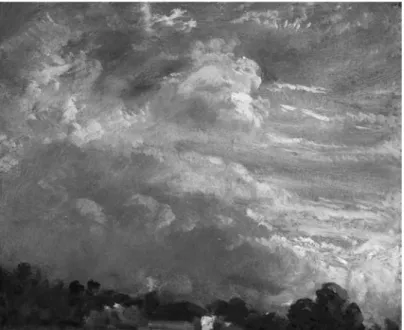
representation of thought itself? The spaces of Constable’s cloud-studies are replete rather than vacant. One thinks, without discomfort, of Ash-bery’s “feeling that the sky might be in the back of someone’s mind” (“For John Clare” 103). Unlike Clare’s, the sky of Constable’s cloud-studies is like a mind filled by and interested in its own thoughts - a mind in con-tact with itself through what it sees. Let’s look more closely. Four birds
tumbling in a windy sky, with just a band of blue horizon at the foot of
the paper, creates a sense of windy height and tumbling movement (
stra-tocumulus) while still being anchored securely to the ground (Figure 6).
Subtle gradations of light and dark offer a vista of massing clouds (
Figur
e 7. John Constable,
Cloud Study
,
27
August, 1822. Courtesy of the T
ate Gallery
Figur
e 8. John Constable,
Study of Cumulus Clouds,
21 September
, 1822.
Courtesy of the Y
ale Center for British
Art, Paul Mellon Collection, USA
/ The Bridgeman
Art Library
.
pressure, on the other hand, produces a sense of lightness and buoyancy rather than elation. Communicating a weather-related sense of mood, as well as describing cloud-phenomena, Constable’s cloud-studies resem-ble what Wordsworth called “Moods of [his] own mind”: lyrics lightly tied to the specificity of time, place, and occasion - the fleeting thoughts or emotions of the moment, or the hour, passed out of doors, arising spontaneously, susceptible to the chances of breeze and location. Con-stable’s clouds, read as a sequence, represent the passage of moods, thoughts, and feelings as they follow one another through the mind. His cloud-studies are the equivalent of lyric poems, and cloud-forms are his stanzas.
Constable never delivered his planned lectures on the science of painting the sky and his “observations on skies and clouds” have not sur-vived (Leslie 241). But in his lectures on landscape, he argued that land-scape painting “is a science and should be pursued as an inquiry into the
laws of nature” (Beckett, John Constable’s Discourses69). He continues:
“Why, then, may no landscape be considered as a branch of natural phi-losophy, of which pictures are but the experiments” (69). Constable was a philosopher in the sense of being interested in the forms of knowledge associated with perception. In another lecture on Dutch landscape
paint-ing, he wrote: “We see nothing truly till we understand it,” quoting these
lines: “It is the Soul that sees; the outward eyes / Present the object, but the Mind descries” (64). This famous remark suggests that Constable had more in mind than meteorology - that for him, seeing was a mode of cog-nition: “the Mind descries.” Where Wordsworth - who can be descriptive too - tends to lose himself and landscape in an inward look (seeing into the life of things), Constable’s is always an embodied consciousness, firmly rooted in space and time. In his painting, perception is seldom transcendental, although it may be dramatic and even allegorical. Ob-serving and understanding the sky relates to its function as an “organ of feeling,” a palpitating organ that makes landscape live and breathe. This is what “observation” meant to him. Here Constable has something in common with the twentieth-century phenomenologist, Maurice
Merleau-Ponty, whose unfinished and posthumously published The Visible and the
“Space Where the Heart Feels”
the space of modern painting is “space which the heart feels,” space in which we too are located, space which is close to us and to which we are organically connected.
Maurice Merleau-Ponty8
Merleau-Ponty insists that “at the horizon of all these visions or quasi-visions it is the world itself I inhabit, the natural world and the historical world . . . as if my vision of the world itself were formed from a certain point
of the world” (The Visible and the Invisible5-7). In this, he is a materialist.
We know what we know from the evidence of our sight and touch. We are
always embodied. The Visible and the Invisiblesets out to define the folded,
chiastic nature of this dual mode of perception. What Merleau-Ponty means by the invisible is not a transcendental or mystical realm, but rather the point at which one is linked to the world by what one cannot perceive: that is, one-self in the act of perception. The body perceives, yet effaces itone-self in per-ceiving. The analogy he invokes is that of the blind spot in the eye that marks the place where the eye is linked to the optical nerves, what he calls the punctum caecum of consciousness (248). Philosophy is distinct from a conception of objective science, Merleau-Ponty argues, since philosophers believe themselves to be implicated in the questions asked. The physicist who is situated physically, as an observer, or the psychologist who self-situates in the socio-historical world, have both abandoned the idea of an ab-solute knowledge: they are part of the world they observe and to which they belong. In the same way, Merleau-Ponty insists, philosophers “enjoin a rad-ical examination of our belongingness to the world before science” (27). And again, “Our eyes are no longer the subjects of vision; they have joined the numbers of things seen” (29). In a lucid account of his ideas delivered in lectures on the radio during the late 1940s, Merleau-Ponty contrasts the peaceful world of classical perspective that stretches to infinity - Poussin’s world, for instance - with the successive snapshots of perception that, in his words, “recapture and reproduce before our very eyes the birth of the land-scape. They have been reluctant to settle for an analytical overview and have
striven to recapture the feel of perceptual experience itself” (The World of
Perception 53-54). Merleau-Ponty’s subject here is space, and the painter he has in mind is not Constable but Cézanne. This space of modern painting,
he notes (quoting Jean Paulhan), is no longer that of the absolute observer, but “‘space which the heart feels,’ space in which we too are located, and with which we are organically connected” (54).
Merleau-Ponty identifies philosophy with “a disclosure of the
‘un-known,’” which is “the attitude of reflection at its best” (The Visible and the
In-visible181). What interests him is the passage from perception to reflection or thought: “With the conversion to reflection, perceiving and imagining are now
only two modes of thinking” (29). Embodied perception has the potential to
be-come a mode of thinking, as well as a mode of identity: “I am a knowing” - his pregnant phrase - replaces the Cartesian “I think therefore I am.” Being, for him, is the basis for knowing, not thinking for existence (32). Like Merleau-Ponty, and in marked contrast to Clare’s alienated “I am,” Constable too offers us a mode of knowing that is related and shared. It involves what Merleau-Pon-ty defines as “the intertwining of my life with the other lives, of my body with the visible things, by the intersection of my perceptual field with that of the others” (49). Unlike Clare, who persistently finds his commonalty with birds and animals rather than with people, Constable is a profoundly sociable painter, even when his subject is a sky emptied of humans. The small figures who set off his rural landscapes with their flecks of red, like so many punctuation marks, are the inscription of this sociability - and of visibility. As Merleau-Ponty writes, “A punctuation in the field of red things,” connecting with other reds and with “the field of red garments,” is also “a momentary crystallization of colored being or of visibility” (132). In Constable, the obsessive close-up of Clare’s seeing becomes expansive - yet insists (in Merleau-Ponty’s words) that “our relationship to space is not that of a pure disembodied subject to a distant object but rather that of a being which dwells in space relating to its natural
habitat” (The World of Perception 55). The habitat is relational and has other
lives in it - working or at rest, reaping, sleeping, or leaping.
The look, for Merleau-Ponty, “envelops, palpates, espouses the visible
things” (The Visible and the Invisible133). That enveloping palpation of the
calls an element or incarnate principle (like water, air, earth, fire) “midway between the spatio-temporal individual and the idea” (139). This is his de-scription of the embodied being, or flesh, that occupies the ground-breaking
final chapter of The Visible and the Invisible(“The Intertwining - the
Chi-asmus”). Central to this concept of embodied seeing is the idea of a shared landscape. One’s own landscape exists in the knowledge that there are other landscapes; hence what he calls the “intercorporeality” of vision. Such an idea contests the notion of an isolated or purely subjective and private vision, sometimes thought of as synonymous with Romanticism. When I speak of a landscape to another, writes Merleau-Ponty, “this individual green of the meadow under my eyes invades his vision without quitting my own. I recognize in my green his green” (142). He might have been writing with Constable’s green in mind - or even Clare’s. But where Clare’s meadow is
his own (recovered) paradis vert, free of others and of the complexities of
adult sociability and sexuality, Constable’s companionable vision locates us in the same space with him; a working space as well as a relational one. But as Merleau-Ponty notes, abandoning Cartesian models also makes room for the non-normativity that he calls “knowledge of the natural world riddled
with gaps, which is how poetry creeps in” (The World of Perception 73). In
his own way, Clare - along with Cézanne - occupies that poetic gap. Merleau-Ponty’s definition of vision has provided the starting point for discussions of vision by philosophers and theorists as different as Jacques Lacan on one hand, whose 1964 seminars on the Gaze argue with
Merleau-Ponty’s The Visible and the Invisible, and on the other, Jacques
Derrida, whose Memoirs of the Blind(his 1991 catalogue for an exhibition
of drawings at the Louvre) and posthumously published On Touching
turned inside out under our own eyes - our interiority revealed in our see-ing. Clouds are the realm of the visible invisible, both what we can and what we can’t see; their representation involves the double relation of the work of perception and the work of art, along with our complex, feeling, yet pre-determined relation to both. For Merleau-Ponty, finally, the work of art resembles the object of perception and can be understood as “a to-tality of flesh in which meaning is not free . . . but bound, a prisoner of all
the signs, or details which reveal it to me” (The World of Perception 95).
This tension between the inexhaustible and the bound lies at the heart of the distinct forms of seeing, the signs and details, that are so differently ar-ticulated in Clare’s poetry and Constable’s painting. Whether under a cloud with Clare or drawn to the clouds with Constable, the nubilous man of clouds, we explore the inexhaustible depth of the object-world through eyes at once other and our own.
University of Cambridge United Kingdom
Works Cited
Anderson, Katherine. Predicting the Weather: Victorians and the Science of Meteorolo-gyChicago: Chicago University Press, 2005.
Ashbery, John. Selected Poems. Manchester: Carcanet, 2002.
Badt, Kurt. John Constable’s Clouds. Trans. Stanley Godman. London: Routledge & Kegan Paul, 1950.
Barrell, John. The Dark Side of the Landscape: The Rural Poor in English Painting, 1730-1840. Cambridge: Cambridge University Press, 1980.
---. The Idea of Landscape and the Sense of Place, 1730-1840: An Approach to the Poetry of John Clare. Cambridge: Cambridge University Press, 1972.
Bate, Jonathan. John Clare: A Biography. London: Picador, 2003.
Beckett, R. B., ed. John Constable’s Correspondence IV: Patrons, Dealers, and Fellow Artists. Ipswich: Suffolk Records Society, 1966.
---. John Constable’s Correspondence VI: The Fishers. Ipswich: Suffolk Records Soci-ety, 1968.
---. John Constable’s Discourses. Ipswich: Suffolk Records Society, 1970.
Bois, Yve-Alan, and Rosalind E. Krauss. Formless: A User’s Guide. New York: Zone Books, 1997.
Cook, E. T., and Alexander Wedderburn, eds. The Works of John Ruskin. 39 vols. Lon-don: George Allen, 1903-8.
Damisch, Hubert. A Theory of /Cloud/: Towards a History of Painting. Trans. Janet Lloyd. Stanford, CA: Stanford University Press, 2002.
Day, John A. The Book of Clouds. New York: Sterling Publishing, 2006.
---. On Touching - Jean-Luc Nancy. Trans. Christine Irizarry. Stanford, CA: Stanford University Press, 2005.
Forster, Thomas. Researches about Atmospheric Phaenomena. 2nd
ed. London: Bald-win, Craddock, and Joy, 1815.
Grainger, Margaret. The Natural History Prose Writings of John Clare. Oxford: Claren-don Press, 1983.
Hamblyn, Richard. The Invention of Clouds. London: Picador, 2001.
Haughton, Hugh. “Progress and Rhyme: ‘The Nightingale’s Nest’ and Romantic Poetry.” Haughton, Phillips and Summerfield 51-86.
Haughton, Hugh, Adam Phillips and Geoffrey Summerfield, eds. Clare in Context. Cambridge: Cambridge University Press, 1994.
Howard, Luke. The Climate of London: Deduced from Meteorological Observation. 2 vols. London: W. Phillips, 1818-1820.
---. Essay on the Modification of Clouds. London: J. Taylor, 1804.
Jankovic, Vladimir. Reading the Skies: A Cultural History of English Weather, 1650-1820. Manchester: Manchester University Press, 2000.
Jay, Martin. Downcast Eyes: The Denigration of Vision in Twentieth-Century French Thought. Berkeley: University of California Press, 1993.
Lambert, Ray. John Constable and the Theory of Landscape Painting. Cambridge: Cam-bridge University Press, 2005.
Leslie, C. R. Memoirs of the Life of John Constable, Composed Chiefly of his Letters. Ed. Jonathan Mayne. London: Phaidon Press, 1951.
Merleau-Ponty, Maurice. The Visible and the Invisible. Trans. Alphonso Lingis. Evanston: Northwestern University Press, 1968.
---. The World of Perception. Trans. Oliver Davis. Routledge: London, 2004.
Morris, Edward, ed. Constable’s Clouds. Edinburgh: National Galleries of Scotland, 2000. Phillips, Adam. “The Exposure of John Clare.” Haughton, Phillips and Summerfield
178-88.
Porter, Roy. “‘All madness for writing’: John Clare and the Asylum.” Haughton, Phillips and Summerfield 259-78.
Pretor-Pinney, Gavin. The Cloudspotter’s Guide. London: Hodder & Stoughton, 2006. Robinson, Eric, ed. John Clare’s Autobiographical Writings.Oxford: Oxford
Universi-ty Press, 1983.
Robinson, Eric, and David Powell, eds. The Later Poems of John Clare 1837-1864. 2 vols. Oxford: Clarendon Press, 1984.
Robinson, Eric, David Powell and P. M. S. Dawson, eds. John Clare: Poems of the Mid-dle Period 1822-1837. 4 vols. Oxford: Clarendon Press, 1996-98.
Shelley, Percy Bysshe. The Complete Poetical Works of Percy Bysshe Shelley. Oxford: Oxford University Press, 1952.
Sinclair, Iain. Edge of Orison: In the Traces of John Clare’s Journey out of Essex. Lon-don: Hamish Hamilton, 2005.
Thornes, John E. John Constable’s Skies: A Fusion of Art and Science. Birmingham: University of Birmingham Press, 1999.