THE QUEST FOR ARTIFICIAL INTELLIGENCE
A HISTORY OF IDEAS AND ACHIEVEMENTS
Web Version
Print version published by Cambridge University Press
http://www.cambridge.org/us/0521122937
For Grace McConnell Abbott,
Contents
I
Beginnings
17
1 Dreams and Dreamers 19
2 Clues 27
2.1 From Philosophy and Logic . . . 27
2.2 From Life Itself . . . 33
2.2.1 Neurons and the Brain. . . 34
2.2.2 Psychology and Cognitive Science . . . 37
2.2.3 Evolution . . . 43
2.2.4 Development and Maturation . . . 45
2.2.5 Bionics . . . 46
2.3 From Engineering. . . 46
2.3.1 Automata, Sensing, and Feedback . . . 46
2.3.2 Statistics and Probability . . . 52
2.3.3 The Computer . . . 53
II
Early Explorations: 1950s and 1960s
71
3 Gatherings 73 3.1 Session on Learning Machines . . . 733.2 The Dartmouth Summer Project . . . 77
3.3 Mechanization of Thought Processes . . . 81
4.1 Character Recognition . . . 90
4.2 Neural Networks . . . 92
4.2.1 Perceptrons . . . 92
4.2.2 ADALINES and MADALINES . . . 98
4.2.3 The MINOS Systems at SRI . . . 98
4.3 Statistical Methods . . . 102
4.4 Applications of Pattern Recognition to Aerial Reconnaissance . . 105
5 Early Heuristic Programs 113 5.1 The Logic Theorist and Heuristic Search . . . 113
5.2 Proving Theorems in Geometry . . . 118
5.3 The General Problem Solver. . . 121
5.4 Game-Playing Programs . . . 123
6 Semantic Representations 131 6.1 Solving Geometric Analogy Problems. . . 131
6.2 Storing Information and Answering Questions . . . 134
6.3 Semantic Networks . . . 136
7 Natural Language Processing 141 7.1 Linguistic Levels . . . 141
7.2 Machine Translation . . . 146
7.3 Question Answering . . . 150
8 1960s’ Infrastructure 155 8.1 Programming Languages . . . 155
8.2 Early AI Laboratories . . . 157
8.3 Research Support. . . 160
8.4 All Dressed Up and Places to Go . . . 163
9.2 Recognizing Faces . . . 172
9.3 Computer Vision of Three-Dimensional Solid Objects . . . 173
9.3.1 An Early Vision System . . . 173
9.3.2 The “Summer Vision Project” . . . 175
9.3.3 Image Filtering . . . 176
9.3.4 Processing Line Drawings . . . 181
10 “Hand–Eye” Research 189 10.1 At MIT . . . 189
10.2 At Stanford . . . 190
10.3 In Japan. . . 193
10.4 Edinburgh’s “FREDDY”. . . 193
11 Knowledge Representation and Reasoning 199 11.1 Deductions in Symbolic Logic . . . 200
11.2 The Situation Calculus. . . 202
11.3 Logic Programming . . . 203
11.4 Semantic Networks . . . 205
11.5 Scripts and Frames . . . 207
12 Mobile Robots 213 12.1 Shakey, the SRI Robot . . . 213
12.1.1 A∗: A New Heuristic Search Method . . . 216
12.1.2 Robust Action Execution . . . 221
12.1.3 STRIPS: A New Planning Method . . . 222
12.1.4 Learning and Executing Plans . . . 224
12.1.5 Shakey’s Vision Routines . . . 224
12.1.6 Some Experiments with Shakey . . . 228
12.1.7 Shakey Runs into Funding Troubles . . . 229
12.2 The Stanford Cart . . . 231
13 Progress in Natural Language Processing 237 13.1 Machine Translation . . . 237
13.2.1 SHRDLU . . . 238
13.2.2 LUNAR . . . 243
13.2.3 Augmented Transition Networks . . . 244
13.2.4 GUS . . . 246
14 Game Playing 251 15 The Dendral Project 255 16 Conferences, Books, and Funding 261
IV
Applications and Specializations:
1970s to Early
1980s
265
17 Speech Recognition and Understanding Systems 267 17.1 Speech Processing . . . 26717.2 The Speech Understanding Study Group . . . 270
17.3 The DARPA Speech Understanding Research Program . . . 271
17.3.1 Work at BBN. . . 271
17.3.2 Work at CMU . . . 272
17.3.3 Summary and Impact of the SUR Program . . . 280
17.4 Subsequent Work in Speech Recognition . . . 281
18 Consulting Systems 285 18.1 The SRI Computer-Based Consultant . . . 285
18.2 Expert Systems . . . 291
18.2.1 MYCIN . . . 291
18.2.2 PROSPECTOR . . . 295
18.2.3 Other Expert Systems . . . 300
18.2.4 Expert Companies . . . 303
19 Understanding Queries and Signals 309 19.1 The Setting . . . 309
19.2 Natural Language Access to Computer Systems . . . 313
19.2.2 CHAT-80 . . . 315
19.2.3 Transportable Natural Language Query Systems . . . 318
19.3 HASP/SIAP . . . 319
20 Progress in Computer Vision 327 20.1 Beyond Line-Finding . . . 327
20.1.1 Shape from Shading . . . 327
20.1.2 The 212-D Sketch . . . 329
20.1.3 Intrinsic Images. . . 329
20.2 Finding Objects in Scenes . . . 333
20.2.1 Reasoning about Scenes . . . 333
20.2.2 Using Templates and Models . . . 335
20.3 DARPA’s Image Understanding Program . . . 338
21 Boomtimes 343
V
“New-Generation” Projects
347
22 The Japanese Create a Stir 349 22.1 The Fifth-Generation Computer Systems Project . . . 34922.2 Some Impacts of the Japanese Project . . . 354
22.2.1 The Microelectronics and Computer Technology Corpo-ration . . . 354
22.2.2 The Alvey Program . . . 355
22.2.3 ESPRIT . . . 355
23 DARPA’s Strategic Computing Program 359 23.1 The Strategic Computing Plan . . . 359
23.2 Major Projects . . . 362
23.2.1 The Pilot’s Associate. . . 363
23.2.2 Battle Management Systems . . . 364
23.2.3 Autonomous Vehicles . . . 366
23.3 AI Technology Base . . . 369
23.3.2 Speech Recognition and Natural Language Processing . . 370
23.3.3 Expert Systems. . . 372
23.4 Assessment . . . 373
VI
Entr’acte
379
24 Speed Bumps 381 24.1 Opinions from Various Onlookers . . . 38124.1.1 The Mind Is Not a Machine . . . 381
24.1.2 The Mind Is Not a Computer . . . 383
24.1.3 Differences between Brains and Computers . . . 392
24.1.4 But Should We? . . . 393
24.1.5 Other Opinions . . . 398
24.2 Problems of Scale. . . 399
24.2.1 The Combinatorial Explosion . . . 399
24.2.2 Complexity Theory. . . 401
24.2.3 A Sober Assessment . . . 402
24.3 Acknowledged Shortcomings . . . 406
24.4 The “AI Winter” . . . 408
25 Controversies and Alternative Paradigms 413 25.1 About Logic. . . 413
25.2 Uncertainty . . . 414
25.3 “Kludginess” . . . 416
25.4 About Behavior. . . 417
25.4.1 Behavior-Based Robots . . . 417
25.4.2 Teleo-Reactive Programs . . . 419
25.5 Brain-Style Computation . . . 423
25.5.1 Neural Networks . . . 423
25.5.2 Dynamical Processes . . . 424
25.6 Simulating Evolution . . . 425
VII
The Growing Armamentarium:
From the 1980s
Onward
433
26 Reasoning and Representation 435
26.1 Nonmonotonic or Defeasible Reasoning. . . 435
26.2 Qualitative Reasoning . . . 439
26.3 Semantic Networks . . . 441
26.3.1 Description Logics . . . 441
26.3.2 WordNet . . . 444
26.3.3 Cyc . . . 446
27 Other Approaches to Reasoning and Representation 455 27.1 Solving Constraint Satisfaction Problems . . . 455
27.2 Solving Problems Using Propositional Logic . . . 460
27.2.1 Systematic Methods . . . 461
27.2.2 Local Search Methods . . . 463
27.2.3 Applications of SAT Solvers . . . 466
27.3 Representing Text as Vectors . . . 466
27.4 Latent Semantic Analysis . . . 469
28 Bayesian Networks 475 28.1 Representing Probabilities in Networks. . . 475
28.2 Automatic Construction of Bayesian Networks . . . 482
28.3 Probabilistic Relational Models . . . 486
28.4 Temporal Bayesian Networks . . . 488
29 Machine Learning 495 29.1 Memory-Based Learning . . . 496
29.2 Case-Based Reasoning . . . 498
29.3 Decision Trees. . . 500
29.3.1 Data Mining and Decision Trees . . . 500
29.3.2 Constructing Decision Trees . . . 502
29.4 Neural Networks . . . 507
29.4.2 NETtalk . . . 509
29.4.3 ALVINN. . . 510
29.5 Unsupervised Learning . . . 513
29.6 Reinforcement Learning . . . 515
29.6.1 Learning Optimal Policies . . . 515
29.6.2 TD-GAMMON . . . 522
29.6.3 Other Applications . . . 523
29.7 Enhancements . . . 524
30 Natural Languages and Natural Scenes 533 30.1 Natural Language Processing . . . 533
30.1.1 Grammars and Parsing Algorithms . . . 534
30.1.2 Statistical NLP . . . 535
30.2 Computer Vision . . . 539
30.2.1 Recovering Surface and Depth Information . . . 541
30.2.2 Tracking Moving Objects . . . 544
30.2.3 Hierarchical Models . . . 548
30.2.4 Image Grammars . . . 555
31 Intelligent System Architectures 561 31.1 Computational Architectures . . . 563
31.1.1 Three-Layer Architectures . . . 563
31.1.2 Multilayered Architectures . . . 563
31.1.3 The BDI Architecture . . . 569
31.1.4 Architectures for Groups of Agents . . . 572
31.2 Cognitive Architectures . . . 576
31.2.1 Production Systems . . . 576
31.2.2 ACT-R . . . 578
31.2.3 SOAR . . . 581
VIII
Modern AI: Today and Tomorrow
589
32.1 Games . . . 591
32.1.1 Chess . . . 591
32.1.2 Checkers. . . 595
32.1.3 Other Games . . . 598
32.2 Robot Systems . . . 600
32.2.1 Remote Agent in Deep Space 1 . . . 600
32.2.2 Driverless Automobiles. . . 603
33 Ubiquitous Artificial Intelligence 615 33.1 AI at Home . . . 616
33.2 Advanced Driver Assistance Systems . . . 617
33.3 Route Finding in Maps . . . 618
33.4 You Might Also Like. . . 618
33.5 Computer Games . . . 619
34 Smart Tools 623 34.1 In Medicine . . . 623
34.2 For Scheduling . . . 625
34.3 For Automated Trading . . . 626
34.4 In Business Practices . . . 627
34.5 In Translating Languages . . . 628
34.6 For Automating Invention . . . 628
34.7 For Recognizing Faces . . . 628
35 The Quest Continues 633 35.1 In the Labs . . . 634
35.1.1 Specialized Systems . . . 634
35.1.2 Broadly Applicable Systems . . . 638
35.2 Toward Human-Level Artificial Intelligence . . . 646
35.2.1 Eye on the Prize . . . 646
35.2.2 Controversies . . . 648
35.2.3 How Do We Get It? . . . 649
Preface
Artificial intelligence (AI) may lack an agreed-upon definition, but someone writing about its history must have some kind of definition in mind. For me, artificial intelligence is that activity devoted to making machines intelligent, and intelligence is that quality that enables an entity to function appropriately and with foresight in its environment. According to that definition, lots of things – humans, animals, and some machines – are intelligent. Machines, such as “smart cameras,” and many animals are at the primitive end of the
extended continuum along which entities with various degrees of intelligence are arrayed. At the other end are humans, who are able to reason, achieve goals, understand and generate language, perceive and respond to sensory inputs, prove mathematical theorems, play challenging games, synthesize and summarize information, create art and music, and even write histories. Because “functioning appropriately and with foresight” requires so many different capabilities, depending on the environment, we actually have several continua of intelligences with no particularly sharp discontinuities in any of them. For these reasons, I take a rather generous view of what constitutes AI. That means that my history of the subject will, at times, include some control engineering, some electrical engineering, some statistics, some linguistics, some logic, and some computer science.
There have been other histories of AI, but time marches on, as has AI, so a new history needs to be written. I have participated in the quest for artificial intelligence for fifty years – all of my professional life and nearly all of the life of the field. I thought it would be a good idea for an “insider” to try to tell the story of this quest from its beginnings up to the present time.
somewhat random and doesn’t necessarily indicate prominence in the field.) A third group consists of AI researchers, students, and teachers who would benefit from knowing more about the things AI has tried, what has and hasn’t worked, and good sources for historical and other information. Knowing the history of a field is important for those engaged in it. For one thing, many ideas that were explored and then abandoned might now be viable because of improved technological capabilities. For that group, I include extensive end-of-chapter notes citing source material. The general reader will miss nothing by ignoring these notes. The main text itself mentions Web sites where interesting films, demonstrations, and background can be found. (If links to these sites become broken, readers may still be able to access them using the “Wayback Machine” athttp://www.archive.org.)
The book follows a roughly chronological approach, with some backing and filling. My story may have left out some actors and events, but I hope it is reasonably representative of AI’s main ideas, controversies, successes, and limitations. I focus more on the ideas and their realizations than on the personalities involved. I believe that to appreciate AI’s history, one has to understand, at least in lay terms, something about how AI programs actually work.
If AI is about endowing machines with intelligence, what counts as a machine? To many people, a machine is a rather stolid thing. The word evokes images of gears grinding, steam hissing, and steel parts clanking. Nowadays, however, the computer has greatly expanded our notion of what a machine can be. A functioning computer system contains both hardware and software, and we frequently think of the software itself as a “machine.” For example, we refer to “chess-playing machines” and “machines that learn,” when we actually mean the programs that are doing those things. The distinction between hardware and software has become somewhat blurred because most modern computers have some of their programs built right into their hardware circuitry.
Whatever abilities and knowledge I bring to the writing of this book stem from the support of many people, institutions, and funding agencies. First, my parents, Walter Alfred Nilsson (1907–1991) and Pauline Glerum Nilsson (1910–1998), launched me into life. They provided the right mixture of disdain for mediocrity and excuses (Walter), kind care (Pauline), and praise and encouragement (both). Stanford University is literally and figuratively my
Office of Scientific Research (AFOSR), the U.S. Geological Survey (USGS), the National Science Foundation (NSF), and the National Aeronautics and Space Administration (NASA) all supported various research efforts I was part of during the last fifty years. I owe thanks to all.
To the many people who have helped me with the actual research and writing for this book, including anonymous and not-so-anonymous reviewers, please accept my sincere appreciation together with my apologies for not naming all of you personally in this preface. There are too many of you to list, and I am afraid I might forget to mention someone who might have made some brief but important suggestions. Anyway, you know who you are. You are many of the people whom I mention in the book itself. However, I do want to mention Heather Bergman, of Cambridge University Press, Mykel
Kochenderfer, a former student, and Wolfgang Bibel of the Darmstadt University of Technology. They all read carefully early versions of the entire manuscript and made many helpful suggestions. (Mykel also provided invaluable advice about the LATEX typesetting program.)
I also want to thank the people who invented, developed, and now
manage the Internet, the World Wide Web, and the search engines that helped me in writing this book. Using Stanford’s various site licenses, I could locate and access journal articles, archives, and other material without leaving my desk. (I did have to visit libraries to find books. Publishers, please allow copyrighted books, especially those whose sales have now diminished, to be scanned and made available online. Join the twenty-first century!)
Finally, and most importantly, I thank my wife, Grace, who cheerfully and patiently urged me on.
In 1982, the late Allen Newell, one of the founders of AI, wrote
“Ultimately, we will get real histories of Artificial Intelligence. . . , written with as much objectivity as the historians of science can muster. That time is certainly not yet.”
Part I
Chapter 1
Dreams and Dreamers
The quest for artificial intelligence (AI) begins with dreams – as all quests do. People have long imagined machines with human abilities – automata that move and devices that reason. Human-like machines are described in many stories and are pictured in sculptures, paintings, and drawings.
You may be familiar with many of these, but let me mention a few. The
Iliad of Homer talks about self-propelled chairs called “tripods” and golden “attendants” constructed by Hephaistos, the lame blacksmith god, to help him get around.1∗ And, in the ancient Greek myth as retold by Ovid in his
Metamorphoses, Pygmalian sculpts an ivory statue of a beautiful maiden, Galatea, which Venus brings to life:2
The girl felt the kisses he gave, blushed, and, raising her bashful eyes to the light, saw both her lover and the sky.
The ancient Greek philosopher Aristotle (384–322bce) dreamed of automation also, but apparently he thought it an impossible fantasy – thus making slavery necessary if people were to enjoy leisure. In hisThe Politics, he wrote3
For suppose that every tool we had could perform its task, either at our bidding or itself perceiving the need, and if – like. . . the tripods of Hephaestus, of which the poet [that is, Homer] says that “self-moved they enter the assembly of gods” – shuttles in a loom could fly to and fro and a plucker [the tool used to pluck the strings] play a lyre of their own accord, then master craftsmen would have no need of servants nor masters of slaves.
∗So as not to distract the general reader unnecessarily, numbered notes containing citations
Aristotle might have been surprised to see a Jacquard loom weave of itself or a player piano doing its own playing.
Pursuing his own visionary dreams, Ramon Llull (circa 1235–1316), a Catalan mystic and poet, produced a set of paper discs called theArs Magna
(Great Art), which was intended, among other things, as a debating tool for winning Muslims to the Christian faith through logic and reason. (See Fig. 1.1.) One of his disc assemblies was inscribed with some of the attributes of God, namely goodness, greatness, eternity, power, wisdom, will, virtue, truth, and glory. Rotating the discs appropriately was supposed to produce answers to various theological questions.4
Figure 1.1: Ramon Llull (left) and hisArs Magna(right).
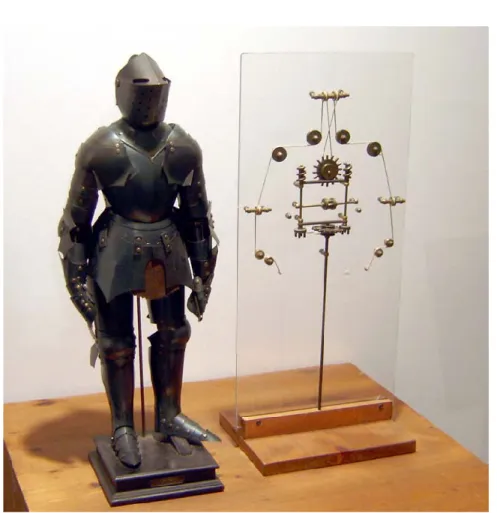
Ahead of his time with inventions (as usual), Leonardo Da Vinci sketched designs for a humanoid robot in the form of a medieval knight around the year 1495. (See Fig. 1.2.) No one knows whether Leonardo or contemporaries tried to build his design. Leonardo’s knight was supposed to be able to sit up, move its arms and head, and open its jaw.5
The Talmud talks about holy persons creating artificial creatures called “golems.” These, like Adam, were usually created from earth. There are stories about rabbis using golems as servants. Like the Sorcerer’s Apprentice, golems were sometimes difficult to control.
In 1651, Thomas Hobbes (1588–1679) published his bookLeviathanabout the social contract and the ideal state. In the introduction Hobbes seems to say that it might be possible to build an “artificial animal.”6
Figure 1.2: Model of a robot knight based on drawings by Leonardo da Vinci.
watch) have an artificial life? For what is the heart, but a spring; and the nerves, but so many strings; and the joints, but so many wheels, giving motion to the whole body. . .
Perhaps for this reason, the science historian George Dyson refers to Hobbes as the “patriarch of artificial intelligence.”7
In addition to fictional artifices, several people constructed actual automata that moved in startlingly lifelike ways.8 The most sophisticated of these was the mechanical duck designed and built by the French inventor and engineer, Jacques de Vaucanson (1709–1782). In 1738, Vaucanson displayed his masterpiece, which could quack, flap its wings, paddle, drink water, and eat and “digest” grain.
My second Machine, orAutomaton, is aDuck, in which I represent the Mechanism of the Intestines which are employed in the
Operations of Eating, Drinking, and Digestion: Wherein the Working of all the Parts necessary for those Actions is exactly imitated. The Duck stretches out its Neck to take Corn out of your Hand; it swallows it, digests it, and discharges it digested by the usual Passage.
There is controversy about whether or not the material “excreted” by the duck came from the corn it swallowed. One of the automates-anciens Web sites10 claims that “In restoring Vaucanson’s duck in 1844, the magician Robert-Houdin discovered that ‘The discharge was prepared in advance: a sort of gruel composed of green-coloured bread crumb . . . ’.”
Leaving digestion aside, Vaucanson’s duck was a remarkable piece of engineering. He was quite aware of that himself. He wrote11
I believe that Persons of Skill and Attention, will see how difficult it has been to make so many different moving Parts in this small
Automaton; as for Example, to make it rise upon its Legs, and throw its Neck to the Right and Left. They will find the different Changes of theFulchrum’sor Centers of Motion: they will also see that what sometimes is a Center of Motion for a moveable Part, another Time becomes moveable on that Part, which Part then becomes fix’d. In a Word, they will be sensible of a prodigious Number of Mechanical Combinations.
This Machine, when once wound up, performs all its different Operations without being touch’d any more.
I forgot to tell you, that theDuckdrinks, plays in the Water with his Bill, and makes a gurgling Noise like a real livingDuck. In short, I have endeavor’d to make it imitate all the Actions of the living Animal, which I have consider’d very attentively.
Unfortunately, only copies of the duck exist. The original was burned in a museum in Nijninovgorod, Russia around 1879. You can watch, ANAS, a modern version, performing athttp://www.automates-anciens.com/video 1/ duck automaton vaucanson 500.wmv.12 It is on exhibit in the Museum of Automatons in Grenoble and was designed and built in 1998 by Fr´ed´eric Vidoni, a creator in mechanical arts. (See Fig. 1.3.)
Figure 1.3: Fr´ed´eric Vidoni’s ANAS, inspired by Vaucanson’s duck. (Photo-graph courtesy of Fr´ed´eric Vidoni.)
A play calledR.U.R.(Rossum’s Universal Robots) was published by Karel ˘
Capek (pronounced CHAH pek), a Czech author and playwright, in 1920. (See Fig. 1.4.) ˘Capek is credited with coining the word “robot,” which in Czech means “forced labor” or “drudgery.” (A “robotnik” is a peasant or serf.)
Web site describing the play,13 “Robots remember everything, and think of nothing new. According to Domin [the factory director] ‘They’d make fine university professors.’ . . . once in a while, a Robot will throw down his work and start gnashing his teeth. The human managers treat such an event as evidence of a product defect, but Helena [who wants to liberate the Robots] prefers to interpret it as a sign of the emerging soul.”
I won’t reveal the ending except to say that ˘Capek did not look eagerly on technology. He believed that work is an essential element of human life. Writing in a 1935 newspaper column (in the third person, which was his habit) he said: “With outright horror, he refuses any responsibility for the thought that machines could take the place of people, or that anything like life, love, or rebellion could ever awaken in their cogwheels. He would regard this somber vision as an unforgivable overvaluation of mechanics or as a severe insult to life.”14
Figure 1.4: A scene from a New York production ofR.U.R.
as a bit bookish.’ ‘Then call them Robots,’ the painter muttered, brush in mouth, and went on painting.”15
The science fiction (and science fact) writer Isaac Asimov wrote many stories about robots. His first collection,I, Robot,consists of nine stories about “positronic” robots.16 Because he was tired of science fiction stories in which robots (such as Frankenstein’s creation) were destructive, Asimov’s robots had “Three Laws of Robotics” hard-wired into their positronic brains. The three laws were the following:
First Law: A robot may not injure a human being, or, through inaction, allow a human being to come to harm.
Second Law: A robot must obey the orders given it by human beings except where such orders would conflict with the First Law. Third Law: A robot must protect its own existence as long as such
protection does not conflict with the First or Second Law.
Asimov later added a “zeroth” law, designed to protect humanity’s interest:17 Zeroth Law: A robot may not injure humanity, or, through inaction, allow
humanity to come to harm.
The quest for artificial intelligence, quixotic or not, begins with dreams like these. But to turn dreams into reality requires usable clues about how to proceed. Fortunately, there were many such clues, as we shall see.
Notes
1.The Iliad of Homer, translated by Richmond Lattimore, p. 386, Chicago: The University of Chicago Press, 1951. (Paperback edition, 1961.) [19]
2.Ovid,Metamorphoses, Book X, pp. 243–297, from an English translation, circa 1850. Seehttp://www.pygmalion.ws/stories/ovid2.htm. [19]
3.Aristotle,The Politics, p. 65, translated by T. A. Sinclair, London: Penguin Books, 1981. [19]
4.See E. Allison Peers,Fool of Love: The Life of Ramon Lull, London: S. C. M. Press, Ltd., 1946. [20]
5.Seehttp://en.wikipedia.org/wiki/Leonardo’s robot. [20]
6.Thomas Hobbes,The Leviathon, paperback edition, Kessinger Publishing, 2004. [20]
7.George B. Dyson,Darwin Among the Machines: The Evolution of Global Intelligence, p. 7, Helix Books, 1997. [21]
8.For a Web site devoted to automata and music boxes, see
http://www.automates-anciens.com/english version/frames/english frames.htm. [21]
Royal-Academy of Sciences at Paris. By M. Vaucanson . . . Together with a description of an artificial duck. . . . .” Translated out of the French original, by J. T. Desaguliers, London, 1742. Available athttp://e3.uci.edu/clients/bjbecker/NatureandArtifice/week5d.html. [21]
10. http://www.automates-anciens.com/english version/automatons-music-boxes/ vaucanson-automatons-androids.php. [22]
11.de Vaucanson, Jacques,op. cit.[22]
12.I thank Prof. Barbara Becker of the University of California at Irvine for telling me about the automates-anciens.com Web sites. [22]
13. http://jerz.setonhill.edu/resources/RUR/index.html. [24]
14.For a translation of the column entitled “The Author of Robots Defends Himself,” see
http://www.depauw.edu/sfs/documents/capek68.htm. [24]
15.From one of a group of Web sites about ˘Capek,
http://Capek.misto.cz/english/robot.html. See alsohttp://Capek.misto.cz/english/. [25]
16.The Isaac Asimov Web site,http://www.asimovonline.com/, claims that “Asimov did not come up with the title, but rather his publisher ‘appropriated’ the title from a short story by Eando Binder that was published in 1939.” [25]
Chapter 2
Clues
Clues about what might be needed to make machines intelligent are scattered abundantly throughout philosophy, logic, biology, psychology, statistics, and engineering. With gradually increasing intensity, people set about to exploit clues from these areas in their separate quests to automate some aspects of intelligence. I begin my story by describing some of these clues and how they inspired some of the first achievements in artificial intelligence.
2.1
From Philosophy and Logic
Although people had reasoned logically for millennia, it was the Greek philosopher Aristotle who first tried to analyze and codify the process. Aristotle identified a type of reasoning he called thesyllogism “. . . in which, certain things being stated, something other than what is stated follows of necessity from their being so.”1
Here is a famous example of one kind of syllogism:2 1. All humans are mortal. (stated)
2. All Greeks are humans. (stated) 3. All Greeks are mortal. (result)
The beauty (and importance for AI) of Aristotle’s contribution has to do with theform of the syllogism. We aren’t restricted to talking about humans, Greeks, or mortality. We could just as well be talking about something else – a result made obvious if we rewrite the syllogism using arbitrary symbols in the place of humans,Greeks, andmortal. Rewriting in this way would produce
2. All C’s are B’s. (stated) 3. All C’s are A. (result)
One can substitute anything one likes forA,B, andC. For example,all athletes are healthy andall soccer players are athletes, and thereforeall soccer players are healthy, and so on. (Of course, the “result” won’t necessarily be true unless the things “stated” are. Garbage in, garbage out!)
Aristotle’s logic provides two clues to how one might automate reasoning. First, patterns of reasoning, such as syllogisms, can be economically
represented asforms ortemplates. These use generic symbols, which can stand for many different concrete instances. Because they can stand for anything, the symbols themselves are unimportant.
Second, after the general symbols are replaced by ones pertaining to a specific problem, one only has to “turn the crank” to get an answer. The use of general symbols and similar kinds of crank-turning are at the heart of all modern AI reasoning programs.
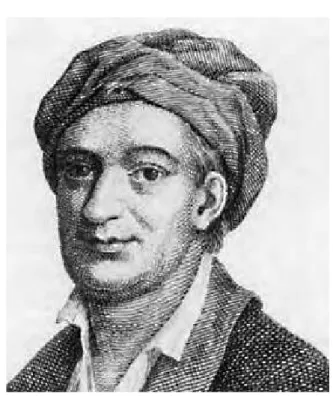
In more modern times, Gottfried Wilhelm Leibniz (1646–1716; Fig. 2.1) was among the first to think about logical reasoning. Leibniz was a German philosopher, mathematician, and logician who, among other things,
co-invented the calculus. (He had lots of arguments with Isaac Newton about that.) But more importantly for our story, he wanted to mechanize reasoning. Leibniz wrote3
It is unworthy of excellent men to lose hours like slaves in the labor of calculation which could safely be regulated to anyone else if machines were used.
and
For if praise is given to the men who have determined the number of regular solids. . . how much better will it be to bring under mathematical laws human reasoning, which is the most excellent and useful thing we have.
Leibniz conceived of and attempted to design a language in which all human knowledge could be formulated – even philosophical and metaphysical knowledge. He speculated that the propositions that constitute knowledge could be built from a smaller number of primitive ones – just as all words can be built from letters in an alphabetic language. Hislingua characteristica or universal language would consist of these primitive propositions, which would comprise analphabet for human thoughts.
Figure 2.1: Gottfried Leibniz.
complex proposition could be obtained from its primitive constituents by multiplying the corresponding numbers together. Further arithmetic operations could then be used to determine whether or not the complex proposition was true or false. This whole process was to be accomplished by a
calculus ratiocinator (calculus of reasoning). Then, when philosophers
disagreed over some problem they could say, “calculemus” (“let us calculate”). They would first pose the problem in thelingua characteristica and then solve it by “turning the crank” on thecalculus ratiocinator.
The main problem in applying this idea was discovering the components of the primitive “alphabet.” However, Leibniz’s work provided important additional clues to how reasoning might be mechanized: Invent an alphabet of simple symbols and the means for combining them into more complex
expressions.
specific problem. Today, we would say that Stanhope’s box was a kind of analog computer.
Figure 2.2: The Stanhope Square Demonstrator, 1805. (Photograph courtesy of Science Museum/SSPL.)
The bookComputing Before Computersgives an example of its operation:4
To solve a numerical syllogism, for example:
Eight of ten A’s are B’s;Four of ten A’s are C’s;
Therefore, at least two B’s are C’s.
Stanhope would push the red slide (representing B) eight units across the window (representing A) and the gray slide
(representing C) four units from the opposite direction. The two units that the slides overlapped represented the minimum number of B’s that were also C’s.
· · ·
In a similar way the Demonstrator could be used to solve a traditional syllogism like:
No M is A;All B is M;Therefore, No B is A.
“The few friends and relatives who received his privately distributed account of the Demonstrator, The Science of Reasoning Clearly Explained Upon New Principles (1800), were advised to remain silent lest ‘some bastard imitation’ precede his intended publication on the subject.”
But no publication appeared until sixty years after Stanhope’s death. Then, the Reverend Robert Harley gained access to Stanhope’s notes and one of his boxes and published an article on what he called “The Stanhope Demonstrator.”5
Contrasted with Llull’s schemes and Leibniz’s hopes, Stanhope built the first logic machine that actually worked – albeit on small problems. Perhaps his work raised confidence that logical reasoning could indeed be mechanized.
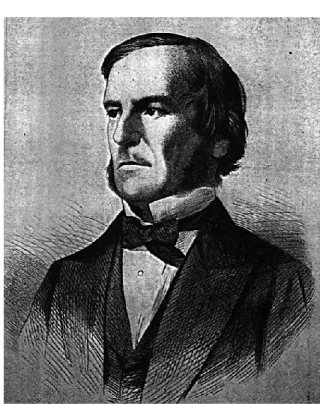
In 1854, the Englishman George Boole (1815–1864; Fig. 2.3) published a book with the title An Investigation of the Laws of Thought on Which Are Founded the Mathematical Theories of Logic and Probabilities.6 Boole’s purpose was (among other things) “to collect. . . some probable intimations concerning the nature and constitution of the human mind.” Boole considered various logical principles of human reasoning and represented them in
mathematical form. For example, his “Proposition IV” states “. . . the principle of contradiction. . . affirms that it is impossible for any being to possess a quality, and at the same time not to possess it. . ..” Boole then wrote this principle as an algebraic equation,
x(1−x) = 0,
in whichxrepresents “any class of objects,” (1−x) represents the “contrary or supplementary class of objects,” and 0 represents a class that “does not exist.”
In Boolean algebra, an outgrowth of Boole’s work, we would say that 0 represents falsehood, and 1 representstruth. Two of the fundamental
operations in logic, namely OR and AND, are represented in Boolean algebra by the operations + and×, respectively. Thus, for example, to represent the statement “either porq or both,” we would writep+q. To represent the statement “pandq,” we would writep×q. Each ofpandqcould be true or false, so we would evaluate the value (truth or falsity) ofp+qand p×qby using definitions for how + and×are used, namely,
1 + 0 = 1,
1×0 = 0,
1 + 1 = 1,
1×1 = 1,
0 + 0 = 0,
and
Figure 2.3: George Boole.
Boolean algebra plays an important role in the design of telephone switching circuits and computers. Although Boole probably could not have envisioned computers, he did realize the importance of his work. In a letter dated January 2, 1851, to George Thomson (later Lord Kelvin) he wrote7
I am now about to set seriously to work upon preparing for the press an account of my theory of Logic and Probabilities which in its present state I look upon as the most valuable if not the only valuable contribution that I have made or am likely to make to Science and the thing by which I would desire if at all to be remembered hereafter. . .
Boole’s work showed that some kinds of logical reasoning could be performed by manipulating equations representing logical propositions – a very important clue about the mechanization of reasoning. An essentially equivalent, but not algebraic, system for manipulating and evaluating
propositions is called the “propositional calculus” (often called “propositional logic”), which, as we shall see, plays a very important role in artificial
intelligence. [Some claim that the Greek Stoic philospher Chrysippus (280–209
One shortcoming of Boole’s logical system, however, was that his propositionsp,q, and so on were “atomic.” They don’t reveal any entities
internalto propositions. For example, if we expressed the proposition “Jack is human” byp, and “Jack is mortal” by q, there is nothing inporq to indicate that the Jack who is human is the very same Jack who is mortal. For that, we need, so to speak, “molecular expressions” that have internal elements.
Toward the end of the nineteenth century, the German mathematician, logician, and philosopher Friedrich Ludwig Gottlob Frege (1848–1925)
invented a system in which propositions, along with their internal components, could be written down in a kind of graphical form. He called his language
Begriffsschrift, which can be translated as “concept writing.” For example, the statement “All persons are mortal” would have been written inBegriffsschrift
something like the diagram in Fig. 2.4.9
Figure 2.4: Expressing “All persons are mortal” in Begriffsschrift. Note that the illustration explicitly represents thexwho is predicated to be a person and that it is the same xwho is then claimed to be mortal. It’s more convenient nowadays for us to represent this statement in the linear form (∀x)P(x)⊃M(x), whose English equivalent is “for allx, ifxis a person, thenx
is mortal.”
Frege’s system was the forerunner of what we now call the “predicate calculus,” another important system in artificial intelligence. It also foreshadows another representational form used in present-day artificial intelligence: semantic networks. Frege’s work provided yet more clues about how to mechanize reasoning processes. At last, sentences expressing
information to be reasoned about could be written in unambiguous, symbolic form.
2.2
From Life Itself
Several aspects of “life” have, in fact, provided important clues about intelligence. Because it is thebrainof an animal that is responsible for converting sensory information into action, it is to be expected that several good ideas can be found in the work of neurophysiologists and
neuroanatomists who study brains and their fundamental components, neurons. Other ideas are provided by the work of psychologists who study (in various ways) intelligent behavior as it is actually happening. And because, after all, it is evolutionary processes that have produced intelligent life, those processes too provide important hints about how to proceed.
2.2.1
Neurons and the Brain
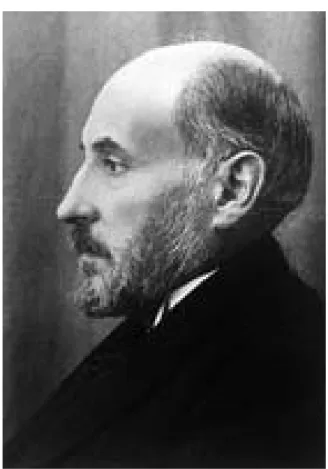
In the late nineteenth and early twentieth centuries, the “neuron doctrine” specified that living cells called “neurons” together with their interconnections were fundamental to what the brain does. One of the people responsible for this suggestion was the Spanish neuroanatomist Santiago Ram´on y Cajal (1852–1934). Cajal (Fig. 2.5) and Camillo Golgi won the Nobel Prize in Physiology or Medicine in 1906 for their work on the structure of the nervous system.
A neuron is a living cell, and the human brain has about ten billion (1010)
of them. Although they come in different forms, typically they consist of a central part called asomaor cell body, incoming fibers calleddendrites, and one or more outgoing fibers calledaxons. The axon of one neuron has
projections calledterminal buttonsthat come very close to one or more of the dendrites of other neurons. The gap between the terminal button of one neuron and a dendrite of another is called asynapse. The size of the gap is about 20 nanometers. Two neurons are illustrated schematically in Fig. 2.6.
Through electrochemical action, a neuron may send out a stream of pulses down its axon. When a pulse arrives at the synapse adjacent to a dendrite of another neuron, it may act to excite or to inhibit electrochemical activity of the other neuron across the synapse. Whether or not this second neuron then “fires” and sends out pulses of its own depends on how many and what kinds of pulses (excitatory or inhibitory) arrive at the synapses of its various incoming dendrites and on the efficiency of those synapses in transmitting electrochemical activity. It is estimated that there are over half a trillion synapses in the human brain. The neuron doctrine claims that the various activities of the brain, including perception and thinking, are the result of all of this neural activity.
Figure 2.5: Ram´on y Cajal.
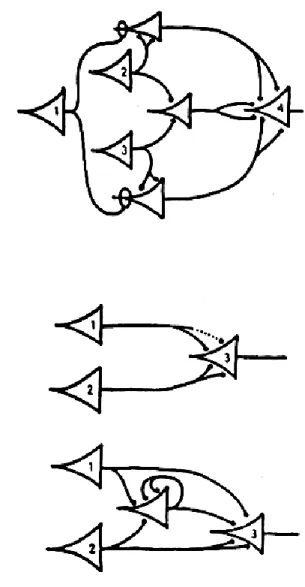
(corresponding, roughly, to dendrites and axons, respectively). Each output can have the value 1 or 0. (To avoid confusing a McCulloch–Pitts neuron with a real neuron, I’ll call the McCulloch–Pitts version, and others like it, a “neural element.”) The neural elements can be connected together into networks such that the output of one neural element is an input to others and so on. Some neural elements are excitatory – their outputs contribute to “firing” any neural elements to which they are connected. Others are
inhibitory – their outputs contribute to inhibiting the firing of neural elements to which they are connected. If the sum of the excitatory inputs less the sum of the inhibitory inputs impinging on a neural element is greater than a certain “threshold,” that neural element fires, sending its output of 1 to all of the neural elements to which it is connected.
Some examples of networks proposed by McCullough and Pitts are shown in Fig. 2.8.
Figure 2.6: Two neurons. (Adapted from Science, Vol. 316, p. 1416, 8 June 2007. Used with permission.)
believed that neurons in the brain were the basic units of thought. In an influential book,11 Hebb suggested that “when an axon of cellAis near enough to exciteBand repeatedly or persistently takes part in firing it, some growth process or metabolic change takes place in one or both cells such that
A’s efficiency, as one of the cells firingB, is increased.” Later, this so-called Hebb rule of change in neural “synaptic strength” was actually observed in experiments with living animals. (In 1965, the neurophysiologist Eric Kandel published results showing that simple forms of learning were associated with synaptic changes in the marine molluskAplysia californica. In 2000, Kandel shared the Nobel Prize in Physiology or Medicine “for their discoveries concerning signal transduction in the nervous system.”)
Figure 2.7: Warren McCulloch.
2.2.2
Psychology and Cognitive Science
Psychology is the science that studies mental processes and behavior. The word is derived from the Greek wordspsyche, meaning breath, spirit, or soul, andlogos, meaning word. One might expect that such a science ought to have much to say that would be of interest to those wanting to create intelligent artifacts. However, until the late nineteenth century, most psychological theorizing depended on the insights of philosophers, writers, and other astute observers of the human scene. (Shakespeare, Tolstoy, and other authors were no slouches when it came to understanding human behavior.)
Figure 2.8: Networks of McCulloch–Pitts neural elements. (Adapted from Fig. 1 of Warren S. McCulloch and Walter Pitts, “A Logical Calculus of Ideas Im-manent in Nervous Activity,”Bulletin of Mathematical Biophysics, Vol. 5, pp. 115–133, 1943.)
researcher was to carefully observe some simple event – one that could be measured as to quality, intensity, or duration – and record his responses to variations of those events.” Although James is now regarded mainly as a philosopher, he is famous for his two-volume bookThe Principles of Psychology, published in 1873 and 1874.
Both Wundt and James attempted to say something abouthowthe brain worked instead of merely cataloging its input–output behavior. The
psychiatrist Sigmund Freud (1856–1939) went further, postulating internal components of the brain, namely, theid, theego, and thesuperego, and how they interacted to affect behavior. He thought one could learn about these components through his unique style of guided introspection called
psychoanalysis.
Attempting to make psychology more scientific and less dependent on subjective introspection, a number of psychologists, most famously B. F. Skinner (1904–1990; Fig. 2.9), began to concentrate solely on what could be objectively measured, namely, specific behavior in reaction to specific stimuli. Thebehavioristsargued that psychology should be a science of behavior, not of the mind. They rejected the idea of trying to identify internal mental states such as beliefs, intentions, desires, and goals.
This development might at first be regarded as a step backward for people wanting to get useful clues about the internal workings of the brain. In criticizing the statistically oriented theories arising from “behaviorism,” Marvin Minsky wrote “Originally intended to avoid the need for ‘meaning,’ [these theories] manage finally only to avoid the possibility of explaining it.”14 Skinner’s work did, however, provide the idea of areinforcingstimulus – one that rewards recent behavior and tends to make it more likely to occur (under similar circumstances) in the future.
Reinforcement learning has become a popular strategy among AI researchers, although it does depend on internal states. Russell Kirsch (circa 1930– ), a computer scientist at the U.S. National Bureau of Standards (now the National Institute for Standards and Technology, NIST), was one of the first to use it. He proposed how an “artificial animal” might use reinforcement to learn good moves in a game. In some 1954 seminar notes he wrote the following:15 “The animal model notes, for each stimulus, what move the opponent next makes, . . . Then, the next time that same stimulus occurs, the animal duplicates the move of the opponent that followed the same stimulus previously. The more the opponent repeats the same move after any given stimulus, the more the animal model becomes ‘conditioned’ to that move.”
Skinner believed that reinforcement learning could even be used to explain verbal behavior in humans. He set forth these ideas in his 1957 book
Verbal Behavior,16 claiming that the laboratory-based principles of selection by consequences can be extended to account for what people say, write, gesture, and think.
Arguing against Skinner’s ideas about language the linguist Noam Chomsky (1928– ; Fig. 2.10), in a review17 of Skinner’s book, wrote that
careful study of this book (and of the research on which it draws) reveals, however, that [Skinner’s] astonishing claims are far from justified. . . . the insights that have been achieved in the
laboratories of the reinforcement theorist, though quite genuine, can be applied to complex human behavior only in the most gross and superficial way, and that speculative attempts to discuss linguistic behavior in these terms alone omit from consideration factors of fundamental importance. . .
How, Chomsky seems to ask, can a person produce a potentially infinite variety of previously unheard and unspoken sentences having arbitrarily complex structure (as indeed they can do) through experience alone? These “factors of fundamental importance” that Skinner omits are, according to Chomsky, linguistic abilities that must be innate – not learned. He suggested that “human beings are somehow specially created to do this, with
Figure 2.10: Noam Chomsky. (Photograph by Don J. Usner.)
grammar” (or developmental mechanisms for creating one) that accounts for much of their ability to learn and use languages.18
memory.
Miller’s paper on “The Magical Number Seven,” was given at a Symposium on Information Theory held from September 10 to 12, 1956, at MIT.20 Chomsky presented an important paper there too. It was entitled “Three Models for the Description of Language,” and in it he proposed a family of rules of syntax he calledphrase-structure grammars.21 It happens that two pioneers in AI research (of whom we’ll hear a lot more later), Allen Newell (1927–1992), then a scientist at the Rand Corporation, and Herbert Simon (1916–2001), a professor at the Carnegie Institute of Technology (now Carnegie Mellon University), gave a paper there also on a computer program that could prove theorems in propositional logic. This symposium, bringing together as it did scientists with these sorts of overlapping interests, is thought to have contributed to the birth ofcognitive science, a new discipline devoted to the study of the mind. Indeed, George Miller wrote22
I went away from the Symposium with a strong conviction, more intuitive than rational, that human experimental psychology, theoretical linguistics, and computer simulation of cognitive processes were all pieces of a larger whole, and that the future would see progressive elaboration and coordination of their shared concerns. . .
In 1960, Miller and colleagues wrote a book proposing a specific internal mechanism responsible for behavior, which they called the TOTE unit (Test–Operate–Test–Exit).23 There is a TOTE unit corresponding to every goal that an agent might have. Using its perceptual abilities, the unit first tests whether or not its goal is satisfied. If so, the unit rests (exits). If not, some operation specific to achieving that goal is performed, and the test for goal achievement is performed again, and so on repetitively until the goal finally is achieved. As a simple example, consider the TOTE unit for driving a nail with a hammer. So long as the nail is not completely driven in (the goal), the hammer is used to strike it (the operation). Pounding stops (the exit) when the goal is finally achieved. It’s difficult to say whether or not this book inspired similar work by artificial intelligence researchers. The idea was apparently “in the air,” because at about the same time, as we shall see later, some early work in AI used very similar ideas. [I can say that my work at SRI with behavior (intermediate-level) programs for the robot, Shakey, and my later work on what I called “teleo-reactive” programs were influenced by Miller’s ideas.]
invented concepts useful for understanding the workings of the mind.
2.2.3
Evolution
That living things evolve gives us two more clues about how to build intelligent artifacts. First, and most ambitiously, the processes of evolution itself – namely, random generation and selective survival – might be simulated on computers to produce the machines we dream about. Second, those paths that evolution followed in producing increasingly intelligent animals can be used as a guide for creating increasingly intelligent artifacts. Start by simulating animals with simple tropisms and proceed along these paths to simulating more complex ones. Both of these strategies have been followed with zest by AI researchers, as we shall see in the following chapters. Here, it will suffice to name just a few initial efforts.
Early attempts to simulate evolution on a computer were undertaken at Princeton’s Institute for Advanced Study by the viral geneticist Nils Aall Barricelli (1912–1993). His 1954 paper described experiments in which numbers migrated and reproduced in a grid.25
Motivated by the success of biological evolution in producing complex organisms, some researchers began thinking about how programs could be evolved rather than written. R. N. Friedberg and his IBM colleagues26 conducted experiments in which, beginning with a population of random computer programs, they attempted to evolve ones that were more successful at performing a simple logical task. In the summary of his 1958 paper, Friedberg wrote that “[m]achines would be more useful if they could learn to perform tasks for which they were not given precise methods. . . . It is proposed that the program of a stored-program computer be gradually improved by a learning procedure which tries many programs and chooses, from the instructions that may occupy a given location, the one most often associated with a successful result.” That is, Friedberg installed instructions from “successful” programs into the programs of the next “generation,” much as how the genes of individuals successful enough to have descendants are installed in those descendants.
Unfortunately, Friedberg’s attempts to evolve programs were not very successful. As Marvin Minsky pointed out,27
The machine [described in the first paper] did learn to solve some extremely simple problems. But it took of the order of 1000 times longer than pure chance would expect. . . .
The second paper goes on to discuss a sequence of
Minsky attributes the poor performance of Friedberg’s methods to the fact that each descendant machine differed very little from its parent, whereas any helpful improvement would require a much larger step in the “space” of possible machines.
Other early work on artificial evolution was more successful. Lawrence Fogel (1928–2007) and colleagues were able to evolve machines that could make predictions of the next element in a sequence.28 Woodrow W. Bledsoe (1921–1995) at Panoramic Research and Hans J. Bremermann (1926–1969) at the University of California, Berkeley, used simulated evolution to solve optimization and mathematical problems, respectively.29 And Ingo Rechenberg (according to one AI researcher) “pioneered the method of artificial evolution to solve complex optimization tasks, such as the design of optimal airplane wings or combustion chambers of rocket nozzles.”30
The first prominent work inspired by biological evolution was John Holland’s development of “genetic algorithms” beginning in the early 1960s. Holland (1929– ), a professor at the University of Michigan, used strings of binary symbols (0’s and 1’s), which he called “chromosomes” in analogy with the genetic material of biological organisms. (Holland says he first came up with the notion while browsing through the Michigan math library’s open stacks in the early 1950s.)31 The encoding of 0’s and 1’s in a chromosome could be interpreted as a solution to some given problem. The idea was to evolve chromosomes that were better and better at solving the problem. Populations of chromosomes were subjected to an evolutionary process in which individual chromosomes underwent “mutations” (changing a component 1 to a 0 and vice versa), and pairs of the most successful chromosomes at each stage of evolution were combined to make a new chromosome. Ultimately, the process would produce a population containing a chromosome (or
chromosomes) that solved the problem.32
Researchers would ultimately come to recognize that all of these
evolutionary methods were elaborations of a very useful mathematical search strategy called “gradient ascent” or “hill climbing.” In these methods, one searches for a local maximum of some function by taking the steepest possible uphill steps. (When searching for a local minimum, the analogous method is called “gradient descent.”)
Rather than attempt to duplicate evolution itself, some researchers preferred to build machines that followed along evolution’s paths toward intelligent life. In the late 1940s and early 1950s, W. Grey Walter
(1910–1977), a British neurophysiologist (born in Kansas City, Missouri), built some machines that behaved like some of life’s most primitive creatures. They were wheeled vehicles to which he gave the taxonomic nameMachina
or away from a light mounted on a sister machine. Their behaviors seemed purposive and often complex and unpredictable, so much so that Walter said they “might be accepted as evidence of some degree of self-awareness.”
Machina speculatrix was the beginning of a long line of increasingly sophisticated “behaving machines” developed by subsequent researchers.
Figure 2.11: Grey Walter (top left), his Machina speculatrix (top right), and its circuit diagram (bottom). (Grey Walter photograph from Hans Moravec,
ROBOT, Chapter 2: Caution! Robot Vehicle!, p. 18, Oxford: Oxford University Press, 1998; “Turtle” photograph courtesy of National Museum of American History, Smithsonian Institution; the circuit diagram is from W. Grey Walter,
The Living Brain, p. 200, London: Gerald Duckworth & Co., Ltd., 1953.)
2.2.4
Development and Maturation
from infancy to adolescence.34 Might these stages provide a set of steps that could guide designers of intelligent artifacts? Start with a machine that is able to do what an infant can do, and then design machines that can mimic the abilities of children at each rung of the ladder. This strategy might be called “ontogenetic” to contrast it with the “phylogenetic” strategy of using simlulated evolution.
Of course, it may be that an infant mind is far too complicated to simulate and the processes of its maturation too difficult to follow. In any case, this particular clue remains to be exploited.
2.2.5
Bionics
At a symposium in 1960, Major Jack E. Steele, of the Aerospace Division of the United States Air Force, used the term “bionics” to describe the field that learns lessons from nature to apply to technology.35
Several bionics and bionics-related meetings were held during the 1960s. At the 1963 Bionics Symposium, Leonard Butsch and Hans Oestreicher wrote “Bionics aims to take advantage of millions of years of evolution of living systems during which they adapted themselves for optimum survival. One of the outstanding successes of evolution is the information processing capability of living systems [the study of which is] one of the principal areas of Bionics research.”36
Today, the word “bionics” is concerned mainly with orthotic and
prosthetic devices, such as artificial cochleas, retinas, and limbs. Nevertheless, as AI researchers continue their quest, the study of living things, their
evolution, and their development may continue to provide useful clues for building intelligent artifacts.
2.3
From Engineering
2.3.1
Automata, Sensing, and Feedback
Machines that move by themselves and even do useful things by themselves have been around for centuries. Perhaps the most common early examples are the “verge-and-foliot” weight-driven clocks. (See Fig. 2.12.) These first appeared in the late Middle Ages in the towers of large Italian cities. The verge-and-foliot mechanism converted the energy of a falling weight into stepped rotational motion, which could be used to move the clock hands. Similar mechanisms were elaborated to control the actions of automata, such as those of the Munich Glockenspiel.
Figure 2.12: A verge-and-foliot mechanism (left) and automata at the Munich Glockenspiel (right).
followed a long history of looms and improved on the “punched card” design of Jacques de Vaucanson’s loom of 1745. (Vaucanson did more than build mechanical ducks.) The punched cards of the Jacquard loom controlled the actions of the shuttles, allowing automatic production of fabric designs. Just a few years after its invention, there were some 10,000 Jacquard looms weaving away in France. The idea of using holes in paper or cards was later adopted by Herman Hollerith for tabulating the 1890 American census data and in player pianos (using perforated rolls instead of cards). The very first factory “robots” of the so-called pick-and-place variety used only modest elaborations of this idea.
It was only necessary to provide these early machines with an external source of energy (a falling weight, a wound-up spring, or humans pumping pedals). Their behavior was otherwise fully automatic, requiring no human guidance. But, they had an important limitation – they did not perceive anything about their environments. (The punched cards that were “read” by the Jacquard loom are considered part of the machine – not part of the environment.) Sensing the environment and then letting what is sensed influence what a machine does is critical to intelligent behavior. Grey Walters’s “tortoises,” for example, had photocells that could detect the presence or absence of light in their environments and act accordingly. Thus, they seem more intelligent than a Jacquard loom or clockwork automata.
Figure 2.13: Reconstruction of a Jacquard loom.
Negative feedback techniques have been used for centuries in mechanical devices. In 270bce, a Greek inventor and barber, Ktesibios of Alexandria, invented a float regulator to keep the water level in a tank feeding a water clock at a constant depth by controlling the water flow into the tank.37 The feedback device was a float valve consisting of a cork at the end of a rod. The cork floated on the water in the tank. When the water level in the tank rose, the cork would rise, causing the rod to turn off the water coming in. When the water level fell, the cork would fall, causing the rod to turn on the water. The water level in modern flush toilets is regulated in much the same way. In 250
bce, Philon of Byzantium used a similar float regulator to keep a constant level of oil in a lamp.38
The English clockmaker John Harrison (1693–1776) used a type of negative feedback control in his clocks. The ambient temperature of a clock affects the length of its balance spring and thus its time-keeping accuracy. Harrison used a bimetallic strip (sometimes a rod), whose curvature depends on temperature. The strip was connected to the balance spring in such a way that it produced offsetting changes in the length of the spring, thus making the clock more independent of its temperature. The strip senses the
temperature and causes the clock to behave differently, and more accurately, than it otherwise would. Today, such bimetallic strips see many uses, notably in thermostats. (Dava Sobel’s 1995 book,Longitude: The True Story of a Lone Genius Who Solved the Greatest Scientific Problem of His Time, recounts the history of Harrison’s efforts to build a prize-winning clock for accurate time-keeping at sea.)
Perhaps the most graphic use of feedback control is the centrifugal flyball governor perfected in 1788 by James Watt for regulating the speed of his steam engine. (See Fig. 2.14.) As the speed of the engine increases, the balls fly outward, which causes a linking mechanism to decrease air flow, which causes the speed to decrease, which causes the balls to fall back inward, which causes the speed to increase, and so on, resulting in an equilibrium speed.
In the early 1940s, Norbert Wiener (1894–1964) and other scientists noted similarities between the properties of feedback control systems in machines and in animals. In particular, inappropriately applied feedback in control circuits led to jerky movements of the system being controlled that were similar to pathological “tremor” in human patients. Arturo Rosenblueth, Norbert Wiener, and Julian Bigelow coined the term “cybernetics” in a 1943 paper. Wiener’s book by that name was published in 1948. The word is related to the word “governor.” (In Latingubernaculummeans helm, and
gubernatormeans helmsman. The Latin derives from the Greekkybernetike, which means the art of steersmanship.39)
Figure 2.14: Watt’s flyball governor.
describe activities related to feedback and control.40
The English psychiatrist W. Ross Ashby (1903–1972; Fig. 2.15) contributed to the field of cybernetics by his study of “ultrastability” and “homeostasis.” According to Ashby, ultrastability is the capacity of a system to reach a stable state under a wide variety of environmental conditions. To illustrate the idea, he built an electromechanical device called the
described later, were motivated in part by the idea of homeostasis.
Figure 2.15: W. Ross Ashby, Warren McCulloch, Grey Walter, and Norbert Wiener at a Meeting in Paris. (From P. de Latil, Thinking by Machine: A Study of Cybernetics, Boston: Houghton, Mifflin, 1957.)
Another source of ideas, loosely associated with cybernetics and bionics, came from studies of “self-organizing systems.” Many unorganized
combinations of simple parts, including combinations of atoms and molecules, respond to energetic “jostling” by falling into stable states in which the parts are organized in more complex assemblies. An online dictionary devoted to cybernetics and systems theory has a nice example: “A chain made out of paper clips suggests that someone has taken the trouble to link paper clips together to make a chain. It is not in the nature of paper clips to make themselves up into a chain. But, if you take a number of paper clips, open them up slightly and then shake them all together in a cocktail shaker, you will find at the end that the clips have organized themselves into short or long chains. The chains are not so neat as chains put together by hand but, nevertheless, they are chains.”41
2.3.2
Statistics and Probability
Because nearly all reasoning and decision making take place in the presence of uncertainty, dealing with uncertainty plays an important role in the
automation of intelligence. Attempts to quantify uncertainty and “the laws of chance” gave rise to statistics and probability theory. What would turn out to be one of the most important results in probability theory, at least for artificial intelligence, is Bayes’s rule, which I’ll define presently in the context of an example. The rule is named for Reverend Thomas Bayes (1702–1761), an English clergyman.43
One of the important applications of Bayes’s rule is in signal detection. Let’s suppose a radio receiver is tuned to a station that after midnight broadcasts (randomly) one of two tones, either toneAor toneB, and on a particular night we want to decide which one is being broadcast. On any given day, we do not know ahead of time which tone is to be broadcast that night, but suppose we do know their probabilities. (For example, it might be that both tones are equally probable.) Can we find out which tone is being broadcast by listening to the signal coming in to the receiver? Well, listening can’t completely resolve the matter because the station is far away, and random noise partially obscures the tone. However, depending on the nature of the obscuring noise, we can often calculate the probability that the actual tone that night isA(or that it is B). Let’s call the signaly and the actual tonex(which can be eitherA orB). The probability thatx=A, given the evidence for it contained in the incoming signal,y, is written asp(x=A|y) and read as “the probability thatxisA, given that the signal isy.” The probability thatx=B, given the same evidence isp(x=B|y).
A reasonable “decision rule” would be to decide in favor of toneAif
p(x=A|y) is larger thanp(x=B|y). Otherwise, decide in favor of toneB. (There is a straightforward adjustment to this rule that takes into account differences in the “costs” of the two possible errors.) The problem in applying this rule is that these two probabilities are not readily calculable, and that is where Bayes’s rule comes in. It allows us to calculate these probabilities in terms of other probabilities that are more easily guessed or otherwise obtainable. Specifically, Bayes’s rule is
p(x|y) =p(y|x)p(x)/p(y).
Using Bayes’s rule, our decision rule can now be reformulated as Decide in favor of toneAifp(y|x=A)p(x=A)/p(y) is greater thanp(y|x=B)p(x=B)/p(y). Otherwise, decide in favor of tone
B.
Decide in favor of toneAifp(y|x=A)p(x=A) is greater than
p(y|x=B)p(x=B). Otherwise, decide in favor of toneB. We assume that we know thea prioriprobabilities of the tones, namely,
p(x=A) andp(x=B), so it remains only for us to calculatep(y|x) for
x=Aandx=B. This expression is called thelikelihoodofy givenx. When the two probabilities,p(x=A) andp(x=B), are equal (that is, when both tones are equally probablea priori), then we can decide in favor of which likelihood is greater. Many decisions that are made in the presence of
uncertainty use this “maximum-likelihood” method . The calculation for these likelihoods depends on how we represent the received signal,y, and on the statistics of the interfering noise.
In my example,y is a radio signal, that is, a voltage varying in time. For computational purposes, this time-varying voltage can be represented by a sequence of samples of its values at appropriately chosen, uniformly spaced time points, sayy(t1),y(t2), . . .y(ti), . . . ,y(tN). When noise alters these values from what they would have been without noise, the probability of the sequence of them (given the cases when the tone is Aand when the tone isB) can be calculated by using the known statistical properties of the noise. I won’t go into the details here except to say that, for many types of noise statistics, these calculations are quite straightforward.
In the twentieth century, scientists and statisticians such as Karl Pearson (1857–1936), Sir Ronald A. Fisher (1890–1962), Abraham Wald (1902–1950), and Jerzey Neyman (1894–1981) were among those who made important contributions to the use of statistical and probabilistic methods in estimating parameters and in making decisions. Their work set the foundation for some of the first engineering applications of Bayes’s rule, such as the one I just
illustrated, namely, deciding which, if any, of two or more electrical signals is present in situations where noise acts to obscure the signals. A paper by the American engineers David Van Meter and David Middleton, which I read as a beginning graduate student in 1955, was my own introduction to these applications.44 For artificial intelligence, these uses of Bayes’s rule provided clues about how to mechanize the perception of both speech sounds and visual images. Beyond perception, Bayes’s rule lies at the center of much other modern work in artificial intelligence.
2.3.3
The Computer
A. Early Computational Devices