Environmental systems
and societies guide
Environmental systems
and societies guide
International Baccalaureate, Baccalauréat International and Bachillerato Internacional are registered trademarks of the International Baccalaureate Organization.
Published June 2015
Updated August 2015, November 2016, October 2017
Published by
International Baccalaureate Organization 15 Route des Morillons
1218 Le Grand-Saconnex Geneva, Switzerland
Represented by
IB Publishing Ltd, Churchillplein 6, The Hague, 2517JW The Netherlands © International Baccalaureate Organization 2015
The International Baccalaureate Organization (known as the IB) offers four high-quality and challenging educational programmes for a worldwide community of schools, aiming to create a better, more peaceful world. This publication is one of a range of materials produced to support these programmes.
The IB may use a variety of sources in its work and checks information to verify accuracy and authenticity, particularly when using community-based knowledge sources such as Wikipedia. The IB respects the principles of intellectual property and makes strenuous efforts to identify and obtain permission before publication from rights holders of all copyright material used. The IB is grateful for permissions received for material used in this publication and will be pleased to correct any errors or omissions at the earliest opportunity.
All rights reserved. No part of this publication may be reproduced, stored in a retrieval system, or transmitted, in any form or by any means, without the prior written permission of the IB, or as expressly permitted by law or by the IB’s own rules and policy. See www.ibo.org/copyright.
IB merchandise and publications can be purchased through the IB store at store.ibo.org.
The International Baccalaureate aims to develop inquiring, knowledgeable and caring young people who help to create a better and more peaceful world through intercultural understanding and respect. To this end the organization works with schools, governments and international organizations to develop challenging programmes of international education and rigorous assessment.
Introduction 1
Purpose of this document 1
The Diploma Programme 2
The nature of environmental systems and societies 6
Approaches to teaching and learning in environmental systems and societies 9 Aims 13
Assessment objectives 14
Assessment objectives in practice 15
Syllabus 16
Syllabus outline 16
Syllabus content 20
Assessment 92
Assessment in the Diploma Programme 92
Assessment outline 95
External assessment 96
Internal assessment 98
Appendices 111
Glossary of command terms 111
Bibliography 113
This publication is intended to guide the planning, teaching and assessment of environmental systems and societies (ESS) in schools. ESS teachers are the primary audience, although it is expected that teachers will use the guide to inform students and parents about the subject.
This guide can be found on the ESS page of the online curriculum centre (OCC) at occ.ibo.org, a password-protected IB website designed to support IB teachers. It can also be purchased from the IB store at store.ibo.org.
Additional resources
Additional publications such as specimen papers and markschemes, teacher support materials (TSMs), subject reports and grade descriptors can also be found on the OCC. Past examination papers as well as markschemes can be purchased from the IB store.
Teachers are encouraged to check the OCC for additional resources created or used by other teachers. Teachers can provide details of useful resources, for example: websites, books, videos, journals or teaching ideas.
Acknowledgment
The IB wishes to thank the educators and associated schools for generously contributing time and resources to the production of this guide.
First assessment 2017
Introduction
The Diploma Programme is a rigorous pre-university course of study designed for students in the 16 to 19 age range. It is a broad-based two-year course that aims to encourage students to be knowledgeable and inquiring, but also caring and compassionate. There is a strong emphasis on encouraging students to develop intercultural understanding, open-mindedness, and the attitudes necessary for them to respect and evaluate a range of points of view.
The Diploma Programme model
The course is presented as six academic areas enclosing a central core (see figure 1). It encourages the concurrent study of a broad range of academic areas. Students study: two modern languages (or a modern language and a classical language); a humanities or social science subject; an experimental science; mathematics; one of the creative arts. It is this comprehensive range of subjects that makes the Diploma Programme a demanding course of study designed to prepare students effectively for university entrance. In each of the academic areas students have flexibility in making their choices, which means they can choose subjects that particularly interest them and that they may wish to study further at university.
Figure 1
The Diploma Programme
Choosing the right combination
Students are required to choose one subject from each of the six academic areas, although they can, instead of an arts subject, choose two subjects from another area. Normally, three subjects (and not more than four) are taken at higher level (HL), and the others are taken at standard level (SL). The IB recommends 240 teaching hours for HL subjects and 150 hours for SL. Subjects at HL are studied in greater depth and breadth than at SL.
At both levels, many skills are developed, especially those of critical thinking and analysis. At the end of the course, students’ abilities are measured by means of external assessment. Many subjects contain some element of coursework assessed by teachers.
The core of the Diploma Programme model
All Diploma Programme students participate in the three elements that make up the core of the model. Theory of knowledge (TOK) is a course that is fundamentally about critical thinking and inquiry into the process of knowing rather than about learning a specific body of knowledge. The TOK course examines the nature of knowledge and how we know what we claim to know. It does this by encouraging students to analyse knowledge claims and explore questions about the construction of knowledge. The task of TOK is to emphasize connections between areas of shared knowledge and link them to personal knowledge in such a way that an individual becomes more aware of his or her own perspectives and how they might differ from others.
Creativity, activity, service (CAS) is at the heart of the Diploma Programme. The emphasis in CAS is on helping students to develop their own identities, in accordance with the ethical principles embodied in the IB mission statement and the IB learner profile. It involves students in a range of activities alongside their academic studies throughout the Diploma Programme. The three strands of CAS are:
Creativity—arts, and other experiences that involve creative thinking Activity—physical exertion contributing to a healthy lifestyle
Service—an unpaid and voluntary exchange that has a learning benefit for the student. Possibly, more than any other component in the Diploma Programme, CAS contributes to the IB’s mission to create a better and more peaceful world through intercultural understanding and respect.
The extended essay, including the world studies extended essay, offers the opportunity for IB students to investigate a topic of special interest, in the form of a 4,000-word piece of independent research. The area of research undertaken is chosen from one of the students’ six Diploma Programme subjects, or in the case of the interdisciplinary world studies essay, two subjects, and acquaints them with the independent research and writing skills expected at university. This leads to a major piece of formally presented, structured writing, in which ideas and findings are communicated in a reasoned and coherent manner, appropriate to the subject or subjects chosen. It is intended to promote high-level research and writing skills, intellectual discovery and creativity. An authentic learning experience, it provides students with an opportunity to engage in personal research on a topic of choice, under the guidance of a supervisor.
Prior learning
Links to the Middle Years Programme
Students who have undertaken Middle Years Programme (MYP) courses in sciences and in individuals and societies will be well prepared for Diploma Programme ESS. The alignment between MYP and Diploma Programme courses allows for a smooth transition for students between programmes.
In the MYP students develop cognitive and procedural skills as well as strong conceptual understandings that support teaching and learning in the Diploma Programme. The 16 key concepts are the big ideas of the MYP that are broad, organizing and powerful. They have relevance within each specific course but also transcend it, having relevance in other subject groups. These key concepts facilitate both disciplinary and interdisciplinary learning by making connections with other subjects. For MYP sciences and MYP individuals and societies, the relevant key concepts are identified in tables 1 and 2.
Aesthetics Change Communication Communities
Connections Creativity Culture Development
Form Global interactions Identity Logic
Perspective Relationships Systems Time, place and space
Table 1
MYP key concepts for the sciences
Aesthetics Change Communication Communities
Connections Creativity Culture Development
Form Global interactions Identity Logic
Perspective Relationships Systems Time, place and space
Table 2
MYP key concepts for individuals and societies
The overlap between some key concepts in these two subject groups in MYP reinforces the position of ESS as an interdisciplinary subject in the Diploma Programme, making the MYP a good foundation for ESS. Courses in the MYP individuals and societies group encompass experimentation and observation, reasoning and argumentation, the use of primary sources, and data that can be used to propose knowledge claims about human existence and behaviour. In this subject group, MYP students begin to evaluate these knowledge claims by assessing validity, reliability, credibility, certainty and individual, as well as cultural, perspectives. There is focus on the development of critical and creative thinking skills that students can apply in a wide variety of areas of interest and careers. The knowledge, skills and attitudes that students develop in individuals and societies provide a meaningful foundation for further study and help to prepare students for work in academia, in non-governmental and governmental organizations, non-profit organizations, and business and industry.
The Diploma Programme
Links to the IB Career-related Programme (CP)
The IB Career-related Programme (CP) incorporates the vision and educational principles of the IB into a unique programme specifically developed for students who wish to engage in career-related learning. The CP’s flexible educational framework allows schools to meet the needs, backgrounds and context of their students. Each school creates its own distinctive version of the CP. The aim of the CP is to provide students with an excellent foundation to support their further studies and specialized training, as well as ensuring their success in the workforce.
An important element of the CP framework is that students are required to study a minimum of two Diploma Programme subjects. ESS is a good choice for one of the Diploma Programme courses. By providing insight into environmental issues and their impact on societies in a broad sense, it can contribute to the appreciation of concepts such as sustainability when applied to careers ranging from construction to agriculture to the food industry and hospitality. An understanding of issues such as energy security and ecological footprints is also increasingly important in all spheres of industry and commerce. ESS can also contribute to a greater understanding of an individual or organization’s role in responding to environmental challenges from a local to a global context, through the career opportunities and choices they make.
Academic honesty
Academic honesty in the Diploma Programme is a set of values and behaviours informed by the attributes of the learner profile. In teaching, learning and assessment, academic honesty serves to promote personal integrity, engender respect for the integrity of others and their work, and ensure that all students have an equal opportunity to demonstrate the knowledge and skills they acquire during their studies.
All coursework—including work submitted for assessment—is to be authentic, based on the student’s individual and original ideas with the ideas and work of others fully acknowledged. Assessment tasks that require teachers to provide guidance to students or that require students to work collaboratively must be completed in full compliance with the detailed guidelines provided by the IB for the relevant subjects. For further information on academic honesty in the IB and the Diploma Programme, please consult the IB publications Academic honesty, The Diploma Programme: From principles into practice and General regulations: Diploma Programme. Specific information regarding academic honesty as it pertains to external and internal assessment components of this Diploma Programme subject can be found in this guide.
Learning diversity and learning support
requirements
Schools must ensure that equal access arrangements and reasonable adjustments are provided to candidates with learning support requirements that are in line with the IB documents Candidates with
assessment access requirements and Learning diversity within the International Baccalaureate programmes:
The nature of environmental systems and societies
ESS is an interdisciplinary group 3 and 4 course that is offered only at standard level (SL). As an interdisciplinary course, ESS is designed to combine the methodology, techniques and knowledge associated with group 4 (sciences) with those associated with group 3 (individuals and societies). Because it is an interdisciplinary course, students can study ESS and have it count as either a group 3 or a group 4 course, or as both. If students choose the latter option, this leaves the opportunity to study an additional subject from any other group, including an additional group 3 or group 4 subject.
ESS is a complex course, requiring a diverse set of skills from its students. It is firmly grounded in both a scientific exploration of environmental systems in their structure and function and in the exploration of cultural, economic, ethical, political, and social interactions of societies with the environment. As a result of studying this course, students will become equipped with the ability to recognize and evaluate the impact of our complex system of societies on the natural world. The interdisciplinary nature of the course requires a broad skill set from students and includes the ability to perform research and investigations and to participate in philosophical discussion. The course requires a systems approach to environmental understanding and problem-solving, and promotes holistic thinking about environmental issues. It is recognized that to understand the environmental issues of the 21st century and suggest suitable management solutions, both the human and environmental aspects must be understood. Students should be encouraged to develop solutions from a personal to a community and to a global scale.
Through the exploration of cause and effect, the course investigates how values interact with choices and actions, resulting in a range of environmental impacts. Students develop an understanding that the connections between environmental systems and societies are diverse, varied and dynamic. The complexity of these interactions challenges those working towards understanding the actions required for effective guardianship of the planet and sustainable and equitable use of shared resources.
Environmental systems and societies and the core
Environmental systems and societies and creativity, activity
and service
CAS enables students to embody the attributes of the IB learner profile in real and practical ways, to grow as unique individuals and to recognize their role in relation to others. Students develop skills, attitudes and dispositions through a variety of individual and group experiences that provide them with opportunities to explore their interests and express their passions, personalities and perspectives. CAS complements a challenging academic programme in a holistic way, providing opportunities for self-determination, collaboration, accomplishment and enjoyment.
The three strands of CAS are:
• creativity—exploring and extending ideas leading to an original or interpretive product or performance
• activity—physical exertion contributing to a healthy lifestyle
The nature of environmental systems and societies
There are strong links between ESS and CAS that both teachers and students can explore. In ESS students actively engage with environmental issues and create innovative solutions where possible. Students could extend their classroom activities into CAS experiences using their learning in purposeful and meaningful ways. All three strands of CAS can be incorporated into experiences that relate to ESS within local, national and global communities.
Examples include:
• creating a campaign to support an initiative within the school that addresses an environmental issue such as reduction of food waste
• taking part in voluntary work that engages with an environmental initiative such as a project to preserve the environment of an endangered species
• working alongside a community organization to tackle the problem of air pollution by promoting and supporting the use of bicycles and access to public transport.
Environmental systems and societies and theory of knowledge
The TOK course (first assessment 2015) engages students in reflection on the nature of knowledge and on how we know what we claim to know. The course identifies eight ways of knowing: language, sense perception, emotion, reason, imagination, faith, intuition and memory. Students explore these means of producing knowledge within the context of various areas of knowledge: mathematics, natural sciences, human sciences, history, the arts, ethics, religious knowledge systems and indigenous knowledge systems. The course also requires students to make comparisons between the different areas of knowledge, reflecting on how knowledge is arrived at in the various disciplines, what the disciplines have in common, and the differences between them.
TOK lessons can support students in their study of ESS, just as the study of ESS can support students in their TOK studies. TOK provides a space for students to engage in stimulating, wider discussions about questions such as what it means for a discipline to be a natural science or a human science, or whether there should be ethical constraints on the pursuit of this knowledge. It also provides an opportunity for students to reflect on the methodologies of ESS as an interdisciplinary subject, and how these compare to the methodologies of other areas of knowledge. It is now widely accepted that researchers utilize not only scientific methods, but a variety of approaches, in order to enhance understanding of the interaction between environmental systems and societies. Scientific disciplines share a common focus on utilizing inductive and deductive reasoning, on the importance of evidence, and so on; but in the ESS course students are also required to use other methods traditionally associated with the human sciences.
In this way there are rich opportunities for students to create links between their ESS and TOK courses. One way in which teachers can help students to make these links to TOK is by drawing students’ attention to knowledge questions that arise from their subject content. Knowledge questions are open-ended questions about knowledge, and can include the following.
• How do we distinguish science from pseudoscience?
• How does a systems approach enhance our understanding of environmental issues? • How does knowledge of environmental systems progress?
• What is the role of imagination and intuition in a systems approach?
• What are the similarities and differences in the methods of gaining knowledge in the natural sciences and in the human sciences?
Examples of relevant knowledge questions are provided within the sub-topics in the “Syllabus content” section of this guide. Teachers can also find suggestions of interesting knowledge questions for discussion in the “Areas of knowledge” chapter of the Theory of knowledge guide. Students should be encouraged to raise and discuss such knowledge questions in both their ESS and TOK classes.
Environmental systems and societies and international-mindedness
Although the ESS course requires the study of environmental systems and societies at a range of scales, from local to global, the teaching of the course should be firmly grounded in the local environment. The syllabus contains many references to “local examples”, and fieldwork may be based on local ecosystems. On a broader scale, the course also leads students to an appreciation of the nature of the international dimension of ESS, since the resolution of the major environmental issues rests heavily upon international relationships and agreements. On an organizational level, many international bodies exist, such as the United Nations Educational, Scientific and Cultural Organization (UNESCO); the United Nations Environment Programme (UNEP); and the World Meteorological Organization (WMO). In addition, there are many international bodies representing every branch of environmental science. ESS teachers and students are encouraged to access the extensive websites and databases of these international organizations and bodies to enhance their appreciation of the international dimension.It is widely accepted that many environmental problems are international in nature and this has led to a global approach to research in many areas such as climate change, biodiversity and population dynamics. The data from such research is shared worldwide and much of this is freely available to students.
The power of scientific knowledge to transform societies is unparalleled. It has the potential to produce great universal benefits, or to reinforce inequalities and cause harm to people and the environment. In line with the IB mission statement, ESS students need to be aware of the moral responsibility to ensure that scientific knowledge and data are available to all countries on an equitable basis, and that countries have the capacity to use this for developing sustainable societies.
Students’ attention should be drawn to sections of the syllabus with links to international-mindedness. Examples of issues relating to international-mindedness are given within sub-topics in the “Syllabus content” section of the guide. Teachers could also use resources found on the teacher resource exchange.
Engaging with sensitive topics
A cornerstone of the ESS course is the idea of environmental value systems (EVSs). Each individual, or group of individuals, will have his or her own EVS arising from his or her beliefs and circumstances. One’s perception of the importance and impact of environmental threats varies according to individual circumstances, cultures and traditions, and is subject to change over time.
Introduction
Approaches to teaching and learning in environmental
systems and societies
Approaches to teaching and learning (ATL) across the Diploma Programme refers to deliberate strategies, skills and attitudes that permeate the teaching and learning environments. These approaches and tools, intrinsically linked with the IB learner profile attributes, enhance student learning and assist student preparation for the Diploma Programme assessment and beyond. The aims of approaches to teaching and learning in the Diploma Programme are to:
• empower teachers as “teachers of learners” as well as “teachers of content”
• empower teachers to create clearer strategies for facilitating learning experiences in which students are more meaningfully engaged in structured inquiry and greater critical and creative thinking • promote both the aims of individual subjects (making them more than course aspirations) and linking
previously isolated knowledge (concurrency of learning)
• encourage students to develop an explicit variety of skills that will equip them to continue to be actively engaged in learning after they leave school, and to help them not only to obtain university admission through better grades, but also to prepare for success during tertiary education and beyond
• enhance further the coherence and relevance of the students’ Diploma Programme experience • allow schools to identify the distinctive nature of an IB Diploma Programme education, with its blend
of idealism and practicality.
The five categories of ATL skills (thinking skills, communication skills, social skills, self-management skills and research skills) along with the six approaches to teaching principles (teaching based on inquiry, teaching focused on conceptual understanding, teaching developed in local and global contexts, teaching focused on effective teamwork and collaboration, teaching differentiated to meet the needs of all learners, and teaching informed by assessment) encompass the key values that underpin IB pedagogy.
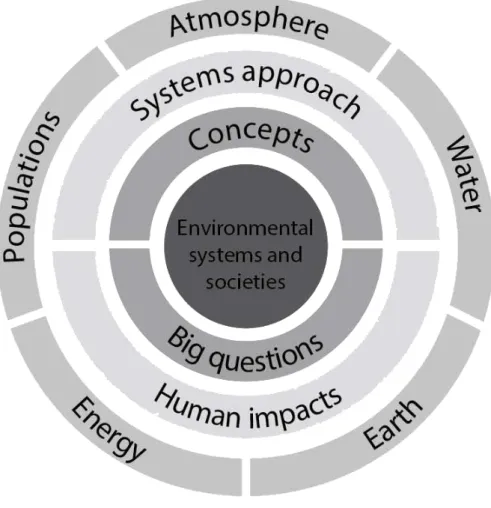
Figure 2
Structure of the ESS course
Concepts and big questions
The central concepts of the ESS course include sustainability, equilibrium, strategy, biodiversity and EVSs. Many of the issues encountered in the course and beyond, such as resource management, pollution, globalization and energy security, are linked to these concepts and so it is important that these issues are emphasized in each context. The big questions, listed at the end of this section, provide a focus for re-examining these concepts in a variety of ways as the course progresses. They can be:
• used to introduce topics
• integrated as the basis for classroom discussions and student assignments • examined retrospectively to review a topic
Approaches to teaching and learning in environmental systems and societies
Systems approach
The systems approach is central to the course and should be employed for a number of reasons. • It facilitates disciplinary and interdisciplinary learning allowing for connections to be made with
other subjects.
• It deepens students’ understanding of complex and dynamic ecosystems. • It allows students to integrate new content into existing knowledge.
The very nature of the environment and how we relate to it demands a holistic treatment. Environmental systems do not function in isolation, but show deep complexity and interaction with other systems to which they connect in a physical and temporal sense. Systems can also be examined at different levels depending on the issue under investigation. For example, an individual lake can be thought of as a system with its own flows and storages, but in a larger context, this lake is one element of a much larger ecosystem that impacts on the environment and communities around it.
The concept of systems has been used in the natural sciences since the 1940s, especially in biology—for example, in the understanding of living organisms in terms of the interactions of the endocrine, nervous and other systems. It is recognized that a reductionist approach of some areas of traditional science inevitably tends to overlook or understate the interactions between such systems, meaning that the “big picture” is missed. A systems approach (which is common to many other disciplines, such as economics, geography, ecology and engineering) emphasizes the ways in which matter, energy and information flow, and integrates the perspectives of different disciplines to better represent the complex nature of the environment. Wherever possible, students should be encouraged to represent the systems they study with models that show the storages and flows, or be given these diagrams to interpret as part of the learning process. Given the nature of the ESS course, stressing the links between syllabus sub-topics in this way is critical and should be considered when planning the delivery of the course. An appreciation of the systems approach can also be transplanted by students from one discipline to another.
In the “Syllabus content” section of this guide, the topics are arranged so that the underlying principles of the systems approach to ESS are addressed in topics 1, 2 and 3. The contexts in which these principles have relevance for the purpose of this course are described in topics 4 to 8. The first three topics are critical in showing the basis of the systems approach to the subject, but it would be advisable to draw on the examples of the later topics from the outset to allow students to develop genuine understanding of this approach.
Holistic evaluation and human impact
Contexts
A genuine appreciation of the overarching concepts and principles of environmental systems is only achievable when the big ideas are set in context. This course therefore requires that students explore the application of these concepts and principles in a wide range of situations. Contexts, founded in atmospheric, terrestrial and aquatic systems, along with the issues of energy and population, have been selected to offer a broad range that may be approached from local to global perspectives. While the guide organizes these contexts into a given framework of sub-topics, teachers are not required to use this structure in their teaching, since these contexts all interact with each other. Depending on each local situation, a different approach to the sub-topics may be more appropriate.
Please refer to the “Structuring a course” section of the Environmental systems and societies teacher support
material for further ideas of possible teaching models.
Big questions
The following big questions are intended as a guide to shape an overall concept-based approach to the delivery of this subject, and to encourage a holistic perspective on the relationship between human societies and natural systems. They have been designed to engender a vision of the overarching principles that are central to the course, and to encourage students to revisit central ideas in different contexts. A. Which strengths and weaknesses of the systems approach and of the use of models have been
revealed through this topic?
B. To what extent have the solutions emerging from this topic been directed at preventing
environmental impacts, limiting the extent of the environmental impacts or restoring systems in which environmental impacts have already occurred?
C. What value systems are at play in the causes and approaches to resolving the issues addressed in this topic? D. How does your personal value system compare with the others you have encountered in the context
of issues raised in this topic?
E. How are the issues addressed in this topic relevant to sustainability or sustainable development? F. In which ways might the solutions explored in this topic alter your predictions for the state of human
societies and the biosphere decades from now?
While these big questions do not in themselves add to the required syllabus content, they identify an approach that will be reflected in more open-ended examination questions. Table 3 shows which big questions have been identified as having particular relevance to each of the topics. This table is not intended to be comprehensive and teachers may find other selections more appropriate.
Big question Possible relevant topics
A 1, 2, 4, 5, 7, 8
B 3, 4, 5, 6, 7, 8
C 1, 3, 7, 8
D 1, 3, 7, 8
E 1, 2, 3, 4, 5, 6, 7, 8
F 3, 4, 5, 6, 7, 8
Table 3
Introduction
Aims
Environmental systems and societies aims
The systems approach provides the core methodology of the ESS course. It is complemented by other influences, such as economic, historical, cultural, sociopolitical and scientific factors, to provide a holistic perspective on environmental issues. During the course, students will look at examples on a variety of scales, from local to global, and in an international context.
The aims of the ESS course are to enable students to:
1. acquire the knowledge and understandings of environmental systems at a variety of scales 2. apply the knowledge, methodologies and skills to analyse environmental systems and issues at a
variety of scales
3. appreciate the dynamic interconnectedness between environmental systems and societies
4. value the combination of personal, local and global perspectives in making informed decisions and taking responsible actions on environmental issues
5. be critically aware that resources are finite, and that these could be inequitably distributed and exploited, and that management of these inequities is the key to sustainability
6. develop awareness of the diversity of environmental value systems
7. develop critical awareness that environmental problems are caused and solved by decisions made by individuals and societies that are based on different areas of knowledge
8. engage with the controversies that surround a variety of environmental issues
Assessment objectives
These objectives reflect how the aims of the ESS course will be assessed. It is the intention of this course that students, in the context of environmental systems and related issues, are able to fulfill the following assessment objectives.
1. Demonstrate knowledge and understanding of relevant: – facts and concepts
– methodologies and techniques – values and attitudes.
2. Apply this knowledge and understanding in the analysis of: – explanations, concepts and theories
– data and models
– case studies in unfamiliar contexts – arguments and value systems.
3. Evaluate, justify and synthesize, as appropriate: – explanations, theories and models – arguments and proposed solutions – methods of fieldwork and investigation – cultural viewpoints and value systems.
4. Engage with investigations of environmental and societal issues at the local and global level through: – evaluating the political, economic and social contexts of issues
– selecting and applying the appropriate research and practical skills necessary to carry out investigations
Introduction
Assessment components Assessment objectives How are the assessment objectives addressed?
Paper 1 Objectives 1–3 Case study
Paper 2 Objectives 1–3 Section A: short answer
questions
Section B: two essays from a choice of four
Internal assessment Objectives 1–4 Individual investigation assessed using markbands
The objectives will be tested in the examinations through the use of the command terms (given in the “Glossary of command terms” section of the guide).
Syllabus outline
Syllabus component Recommended
teaching hours
Core content
Topic 1—Foundations of environmental systems and societies Topic 2—Ecosystems and ecology
Topic 3—Biodiversity and conservation
Topic 4—Water and aquatic food production systems and societies Topic 5—Soil systems and terrestrial food production systems and societies Topic 6—Atmospheric systems and societies
Topic 7—Climate change and energy production Topic 8—Human systems and resource use
120
16 25 13 15 12 10 13 16Practical scheme of work
Practical activities Individual investigation
30
20 10Total teaching hours
150
The recommended teaching time is 150 hours to complete SL courses as stated in article 8.2 of the document General regulations: Diploma Programme.
Practical work
Practical work is an important aspect of the ESS course, whether in the laboratory, classroom, or out in the field. The syllabus not only directly requires the use of field techniques, but many components can only be covered effectively through this approach. Practical work in ESS is an opportunity for students to gain and develop skills and techniques beyond the requirements of the assessment model and should be fully integrated with the teaching of the course.
In line with the IB animal experimentation policy (see the Environmental systems and societies teacher support
material for full details), the following guidelines exist for all practical work undertaken as part of the
Diploma Programme.
• No experiments involving other people will be undertaken without their written consent and their understanding of the nature of the experiment.
Syllabus outline
Mathematical requirements
All Diploma Programme ESS students should be able to:• perform the basic arithmetic functions: addition, subtraction, multiplication and division • carry out calculations involving means, decimals, fractions, percentages, ratios, approximations
and reciprocals
• use standard notation (for example, 3.6 × 10⁶) • use direct and inverse proportion
• solve simple algebraic equations
• plot graphs (with suitable scales and axes) including two variables that show linear and non-linear relationships
• interpret graphs, including the significance of gradients, changes in gradients, intercepts and areas • interpret data presented in various forms (for example, bar charts, histograms and pie charts).
Use of information communication technology
The use of information communication technology (ICT) is encouraged throughout all aspects of the course in relation to both the practical programme and day-to-day classroom activities.
Planning the course
The syllabus as provided in this subject guide is not intended to be in teaching order. Instead it provides detail of what must be covered by the end of the course. A school should develop a scheme of work that best works for its students. For example, the scheme of work could be developed to match available resources, to take into account student prior learning and experience, or in conjunction with other local requirements. However the course is planned, adequate time must be provided for examination revision. Time must also be given for students to reflect on their learning experience and their growth as learners.
Format of the guide
The format of the “Syllabus content” of the guide has been designed to give prominence and focus to teaching and learning in the context of the IB Diploma Programme.
Topics
Topics are numbered—for example, “Topic 6: Atmospheric systems and societies”. With each topic, the relevant big questions (see the section “Approaches to teaching and learning in environmental systems and societies”) are given.
Sub-topics
Each sub-topic begins with “Significant ideas”, which are the overarching principles that define and encapsulate the learning within the sub-topic.
Underneath the “Significant ideas” there are two columns. The first column lists: • “Knowledge and understanding”, which are the main ideas to be addressed
• “Applications and skills”, which outline how the knowledge and understandings can be applied and some of the specific skills that should be developed in relation to the sub-topic.
The contents of the “Significant ideas” section and the contents of the left-hand column are all legitimate items for assessment. In addition, some assessment of international-mindedness, from the content of the right-hand column, will take place as in the previous course.
The second column lists:
• “Guidance”, which gives information about the limits and constraints and the depth of treatment required for teachers
• “International-mindedness”, which, where appropriate, suggests to teachers relevant references to international-mindedness
• “Theory of knowledge”, which provides examples of TOK knowledge questions (see the Theory
of knowledge guide) that can be used to focus students’ thoughts on the preparation of the TOK
prescribed essay
• “Connections”, which identify the links between the sub-topic, other parts of the syllabus and the Diploma Programme in general.
Topic 1: <Title>
1.1 Sub-topic
Significant ideas: A description of the overarching principles and concepts of the sub-topic.
Knowledge and understanding:
• Specifics of the content requirements for each sub-topic.
Applications and skills:
• Details of how students can apply the understandings. For example, these applications could involve discussions of viewpoints or an evaluation of issues and impacts.
Guidance:
• Specifics of, and constraints to, the requirements for the knowledge, understandings, applications and skills. International-mindedness:
• Ideas that teachers can easily integrate into the delivery of their lessons.
Theory of knowledge:
• Examples of TOK knowledge questions. Connections:
Syllabus outline
Environmental systems and societies and the
IB learner profile
The ESS course contributes to the development of the IB learner profile. By following the course, students will have engaged with the attributes of the IB learner profile. For example, the requirements of the internal assessment provide students with opportunities to develop every aspect of the IB learner profile. For each attribute of the learner profile, a number of references from the course are given below.
Learner profile attribute
Environmental systems and societies
Inquirers Aims 1, 2, 5 and 6
Practical work and internal assessment Knowledgeable Aims 1, 2, 3, 5 and 6
International-mindedness links, practical work and internal assessment Thinkers Aims 3, 5, 7 and 8
TOK links, practical work and internal assessment Communicators Aims 2, 8 and 9
External assessment, practical work and internal assessment Principled Aims 4, 7, 8 and 9
Practical work and internal assessment, ethical behaviour/practice
(Ethical practice in the Diploma Programme poster, IB animal experimentation policy),
academic honesty Open-minded Aims 3, 4, 6, 7 and 8
International-mindedness links, practical work and internal assessment
Caring Aims 4, 8 and 9
Practical work and internal assessment, ethical behaviour/practice
(Ethical practice in the Diploma Programme poster, IB animal experimentation policy)
Risk-takers Aims 4, 8 and 9
Practical work and internal assessment Balanced Aims 4, 5, 6 and 7
Practical work and internal assessment Reflective Aims 3, 4, 5, 6, and 7
Syllabus content
Syllabus component Teaching hours
Topic 1: Foundations of environmental systems and societies
1.1 Environmental value systems1.2 Systems and models 1.3 Energy and equilibria 1.4 Sustainability
1.5 Humans and pollution
16
Topic 2: Ecosystems and ecology
2.1 Species and populations2.2 Communities and ecosystems 2.3 Flows of energy and matter 2.4 Biomes, zonation and succession 2.5 Investigating ecosystems
25
Topic 3: Biodiversity and conservation
3.1 An introduction to biodiversity3.2 Origins of biodiversity 3.3 Threats to biodiversity 3.4 Conservation of biodiversity
13
Topic 4: Water and aquatic food production systems and societies
4.1 Introduction to water systems4.2 Access to fresh water
4.3 Aquatic food production systems 4.4 Water pollution
15
Topic 5: Soil systems and terrestrial food production systems and
societies
5.1 Introduction to soil systems
5.2 Terrestrial food production systems and food choices 5.3 Soil degradation and conservation
Syllabus content
Syllabus component Teaching hours
Topic 6: Atmospheric systems and societies
6.1 Introduction to the atmosphere6.2 Stratospheric ozone 6.3 Photochemical smog 6.4 Acid deposition
10
Topic 7: Climate change and energy production
7.1 Energy choices and security7.2 Climate change—causes and impacts 7.3 Climate change—mitigation and adaptation
13
Topic 8: Human systems and resource use
8.1 Human population dynamics8.2 Resource use in society 8.3 Solid domestic waste
8.4 Human population carrying capacity
16
Sy llab us Big q ue st io ns : Th is t op ic m ay b e p ar tic ular ly ap pr op ria te f or c on si de rin g b ig q ue st io ns A , C
, D an
d E . 1. 1: E nvir on m en tal v al ue s yste ms Sig ni fic an t i de as : • H ist or ical ev en ts
, among other influenc
es
, aff
ec
t the dev
elopmen
t of en
vir onmen tal v alue sy st ems (E
VSs) and en
vir onmen tal mo vemen ts . • Ther
e is a wide spec
trum of E
VSs
, each with its o
wn pr
emises and implica
tions . K no wl ed ge a nd u nde rs ta ndi ng : • Sig nifican t hist or ical influenc
es on the dev
elopmen
t of the en
vir onmen tal mo vemen t ha ve c ome fr om lit er atur
e, the media, major en
vir onmen tal disast ers , in ter na tional ag reemen
ts and t
echnolog ical dev elopmen ts . • A n E
VS is a w
or
ldview or par
adig
m tha
t shapes the w
ay an individual
, or
gr
oup of people
, per
ceiv
es and ev
alua tes en vir onmen tal issues , influenc ed b y cultur al , r elig ious , ec
onomic and sociopolitical c
on te xts . • A n E VS migh
t be c
onsider
ed as a sy
st
em in the sense tha
t it ma
y be influenc ed b y educa tion, e xper ienc e, cultur
e and media (inputs), and in
volv
es
a set of in
ter
rela
ted pr
emises
, v
alues and ar
gumen
ts tha
t can gener
at
e
consist
en
t decisions and ev
alua
tions (outputs).
•
Ther
e is a spec
trum of E
VSs , fr om ec oc en tr ic thr ough an thr opoc en tr ic t o technoc en tr ic v alue sy st ems . G uid an ce : • A societ
y is an ar
bitr
ar
y g
roup of individuals who shar
e some c
ommon
char
ac
ter
istics
, such as geog
raphical loca tion, cultur al backg round , hist or ical time fr ame , r elig ious perspec tiv e, v alue sy st
em and so on.
•
A v
ar
iet
y of sig
nifican
t hist
or
ical influenc
es c
ould be c
ov
er
ed
, but with a
minimum of thr
ee in-depth e xamples . P ossible e xamples c ould include: James L ov elock ’s dev elopmen
t of the G
aia h ypothesis; M inama ta disast er ; Rachel C arson ’s book Silent Spring (1962); Da vis Guggenheim ’s documen tar y An Inc on venient T ruth (2006); Cher nob yl disast
er of 1986; F
uk
ushima Daiihi
nuclear disast
er of 2011; whaling; Bhopal disast
er of 1984; Gulf of M
exic
o
oil spill of 2010; Chipko mo
vemen
t; R
io Ear
th Summit 2012 (R
io+20); Ear th Da y; Gr een R ev olution; C openhagen A cc or d; r ec en
t or local ev
en ts of studen t in ter est . •
In the r
ange of hist
or
ical influenc
es selec
ted
, it is beneficial t
o ha
ve both local
and global e
Topic 1: Foundations of environmental systems and societies (16 hours) 1. 1: E nvir on m en tal v al ue s yste ms • A n ec oc en tr ic viewpoin t in teg ra tes social , spir
itual and en
vir
onmen
tal
dimensions in
to a holistic ideal
. I
t puts ec
ology and na
tur
e as c
en
tr
al t
o
humanit
y and emphasiz
es a less ma
ter
ialistic appr
oach t
o lif
e with g
rea
ter
self-sufficienc
y of societies
. A n ec oc en tr ic viewpoin t pr ior itiz es bior igh ts , emphasiz
es the impor
tanc
e of educa
tion and enc
our ages self-r estr ain t in human beha viour . • A n an thr opoc en tr ic viewpoin t ar gues tha
t humans must sustainably manage
the global sy
st
em.
This migh
t be thr
ough the use of tax
es , en vir onmen tal regula
tion and leg
isla
tion. D
eba
te w
ould be enc
our aged t o r each a consensual , pr ag ma tic appr oach t
o solving en
vir onmen tal pr oblems . • A t echnoc en tr ic viewpoin t ar gues tha t t echnolog ical dev elopmen ts can pr
ovide solutions t
o en vir onmen tal pr oblems . T
his is a c
onsequenc
e of a lar
gely
optimistic view of the r
ole humans can pla
y in impr
oving the lot of humanit
y.
Scien
tific r
esear
ch is enc
our
aged in or
der t
o f
or
m policies and t
o understand
ho
w sy
st
ems can be c
on
tr
olled
, manipula
ted or changed t
o solv
e r
esour
ce
depletion. A pr
o-gr
owth agenda is deemed nec
essar y f or societ y’ s impr ov emen t. • Th er e ar e e xtr em es a t e ith er e nd o f t hi s s pe ctr um ( fo r e xamp le , d ee p ec ol ogi st s– ec oc en tr ic t o c or nu co pi an –t ec hn oc en tr ic ), b ut i n p ra ct ic e, E VS s var y gr ea tly d ep en di ng o n c ul tur es an d t im e p er io ds , an d t he y r ar el y f it si mp ly o r p er fe ct ly i nt o an y c la ss ifi ca tio n. • D iffer en t E VS s a sc rib e d iffer en t i nt rin si c v al ue to c om pon en ts o f t he b io sp her e. A pp lic at io ns an d s kil ls : • D isc us s th e v ie w t ha t t he e nv iro nm en t c an ha ve i ts o w n i ntr in si c v al ue . • Ev al ua te th e i mp lic at io ns o f t w o c on tr as tin g E VS s i n t he c on te xt o f gi ve n en vi ron m en ta l i ss ue s. • Jus ti fy , us in g e xamp le s an d e vi de nc e, h ow h is to ric al i nf lu en ce s ha ve s hap ed th e de ve lopm en t o f t he m oder n en vi ron m en ta l m ov em en t • EVSs ar
e individual; ther
e is no
“wr ong ” E VS. • D ur
ing the ESS c
ourse studen
ts should be enc
our
aged t
o dev
elop their o
wn
EVS and t
o be able t
o justify their decisions on en
vir
onmen
tal issues based on
1. 2: S yste ms an d m od els Sig ni fic an t i de as : • A s ys te m s ap pr oa ch c an h el p i n t he s tu dy o f c omp le x e nv iro nm en tal i ss ue s. • Th e u se o f s ys te m s an d m od el s s imp lif ie s i nt er ac tio ns b ut m ay p ro vi
de a m
or e h ol is tic v ie w w ith ou t r ed uc in g i ss ue s t o s in gl e p ro ce ss es . K no wl ed ge a nd u nde rs ta ndi ng : • A s ys te m s ap pr oa ch i
s a w
ay o f v is ual iz in
g a c
omp le x s et o f i nt er ac tio ns w hi ch m ay b e e co lo gi cal o r s oc ie tal . G uid an ce : • A s ys te m s ap pr oa ch s ho ul d b e t ak en f or al l t he t op ic s c ov er ed i n t he ES S c our se . • These in ter ac tions pr oduc
e the emer
gen
t pr
oper
ties of the sy
st em. • Th e c on ce pt o
f a s
ys te m c an b e ap pl ie d a
t a r
an ge o f s cal es . • A s ys te m i s c omp ris ed o f s to ra ge s an d f lo w s. • Th e f lo w s p ro vi de i np ut s an d o utp ut s o f e ne rg y an d m at te r. • Th e f lo w s ar e p ro ce ss es t ha t m ay b e e ith er tr an sf er s ( a c han ge i n l oc at io n) or tr an sf or m at io ns ( a c han ge i n t he c he mi cal na tur
e, a c
han ge i n s ta te o r a chan ge i n e ne rg y) . • In s ys te m di agr am s, s to ra ge s ar e u su al ly r ep re se nt ed a s r ec tan gular b ox es an d f lo w s a s ar ro w s, w ith t he di re ct io n o f e ac h ar ro w i ndi ca tin g t he di re ct io n of e ac h f lo w . T he s iz e o f t he b ox es an d t he ar ro w s m ay b e r ep re se nt at iv e o f th e s iz e/ m agn itu de o f t he s to ra ge o r f lo w . • An o pe n s ys te m e xc han ge s b ot h e ne rg y an d m at te r a cr os s i ts b oun dar y w hi
le a c
lo se d s ys te m e xc han ge s o nl y e ne rg y a cr os s i ts b oun dar y. • An i so la te d s ys te m i
s a h
yp ot he tic al c on ce pt i n w hi ch n ei th er e ne rg y n or m at te r i s e xc han ge d a cr os s t he b oun dar y. • Ec os ys te m s ar e o pe n s ys te m s; c lo se d s ys te m s o nl y e xi st e xp er im en ta lly , al th ou gh t he gl ob al g eo ch emi cal c yc le s ap pr ox im at e t o c lo se d s ys te m s. • Bi os ph er e r ef er s t o t he p ar t o f t he E ar th i nhab ite d b y o rg an is m s t ha t e xt en ds fr om t he up pe r p ar ts o f t he a tm os ph er e t o d ee p w ith in t he E ar th ’s c ru st . • Stu de nt s s ho ul d i nt er pr et gi ve n s ys te m di agr am s an d u se d at a t o p ro du ce th ei r o w n f
or a v
ar ie ty o f e xamp le s, s uc h a s c ar bo n c yc lin g, f oo d p ro du ct io n an d s oi l s ys te m s. • Stu de nt s ar e not e xp ec te d t o k no w an y p ar tic ular s ys te m di agr am s ym bo ls su ch a s t ho se o f O dum o r S ank ey . In te rna ti ona l-m inde dn es s: • Th e u se o f m od el s f ac ili ta te s i nt er na tio nal c ol lab or at io n i n s ci en ce b y re m ov in g lan gu ag e b ar rie rs t ha t m ay e xi st . Th eor y o f k no wl ed ge : • M od el s ar e s imp lif ie d c on str uc tio ns o f r eal ity — in t he c on str uc tio n o
f a m
Topic 1: Foundations of environmental systems and societies (16 hours) 1. 2: S yste ms an d m od els • A m od el i
s a s
imp lif ie d v er si on o f r eal ity an d c an b e u se d t o un de rs tan d h ow a s ys te m w or ks an d t o p re di ct h ow i t w ill r es po nd t o c han ge . • A m od el i ne vi tab ly i nv ol ve s s om e ap pr ox im at io n an d t he re fo re l os s o f a cc ur ac y. A pp lic at io ns an d s kil ls : • Con st ruc t a s ys te m di agr am o
r a m
od
el f
ro
m a gi
ve n s et o f i nf or m at io n. • Ev al ua te th e u se o f m od el s a
s a t
oo
l i
n a gi
1.
3:
E
ne
rg
y an
d e
qu
ilib
ria
Sig
ni
fic
an
t i
de
as
:
•
The la
w
s of ther
modynamics go
ver
n the flo
w of ener
gy in a sy
st
em and the abilit
y t
o do w
or
k.
•
Sy
st
ems can e
xist in alt
er
na
tiv
e stable sta
tes or as equilibr
ia bet
w
een which ther
e ar
e tipping poin
ts
.
•
D
estabilizing positiv
e f
eedback mechanisms will dr
iv
e sy
st
ems t
ow
ar
ds these tipping poin
ts
, wher
eas stabilizing nega
tiv
e f
eedback mechanisms will r
esist
such changes
.
K
no
wl
ed
ge
a
nd
u
nde
rs
ta
ndi
ng
:
•
The first la
w of ther
modynamics is the pr
inciple of c
onser
va
tion of ener
gy
,
which sta
tes tha
t ener
gy in an isola
ted sy
st
em can be tr
ansf
or
med but cannot
be cr
ea
ted or destr
oy
ed
.
•
The pr
inciple of c
onser
va
tion of ener
gy can be modelled b
y the ener
gy
tr
ansf
or
ma
tions along f
ood chains and ener
gy pr
oduc
tion sy
st
ems
.
•
T
he sec
ond la
w of ther
modynamics sta
tes tha
t the en
tr
op
y of a sy
st
em
incr
eases o
ver time
. En
tr
op
y is a measur
e of the amoun
t of disor
der in a
sy
st
em. A
n incr
ease in en
tr
op
y ar
ising fr
om ener
gy tr
ansf
or
ma
tions r
educ
es
the ener
gy a
vailable t
o do w
or
k.
G
uid
an
ce
:
•
The use of e
xamples in this sub
-t
opic is par
ticular
ly impor
tan
t so tha
t the
abstr
ac
t c
onc
epts ha
ve a c
on
te
xt in which t
o be underst
ood
.
•
Emphasis should be plac
ed on the r
ela
tionships bet
w
een r
esilienc
e, stabilit
y,
equilibr
ia and div
ersit
y.
•
A stable equilibr
ium is the c
ondition of a sy
st
em in which ther
e is a t
endenc
y
for it t
o r
etur
n t
o the pr
evious equilibr
ium f
ollo
wing distur
banc
e.
•
A st
eady
-sta
te equilibr
ium is the c
ondition of an open sy
st
em in which ther
e
ar
e no changes o
ver the longer t
er
m, but in which ther
e ma
y be oscilla
tions in
the v
er
y shor
t t
er
Topic 1: Foundations of environmental systems and societies (16 hours) 1. 3: E ne rg y an d e qu ilib ria • The sec ond la
w of ther
modynamics e
xplains the inefficienc
y and decr
ease in
av
ailable ener
gy along a f
ood chain and ener
gy gener ation sy st ems . • A
s an open sy
st
em, an ec
osy
st
em will nor
mally e
xist in a stable equilibr
ium,
either in a st
eady
-sta
te equilibr
ium or in one dev
eloping o
ver time (f
or
example
, suc
cession), and main
tained b
y stabilizing nega
tiv e f eedback loops . • Nega tiv e f
eedback loops (stabilizing) oc
cur when the output of a pr
oc
ess
inhibits or r
ev
erses the oper
ation of the same pr
oc
ess in such a w
ay as t
o reduc e change —it c oun ter ac ts devia tion. • Positiv e f
eedback loops (destabilizing) will t
end t
o amplify changes and dr
iv e the sy st em t ow ar
ds a tipping poin
t wher
e a new equilibr
ium is adopt
ed
.
•
The r
esilienc
e of a sy
st
em, ec
olog
ical or social
, r
ef
ers t
o its t
endenc
y t
o a
void
such tipping poin
ts and main
tain stabilit
y.
•
Div
ersit
y and the siz
e of st
or
ages within sy
st
ems can c
on tr ibut e t o their resilienc
e and aff
ec
t their speed of r
esponse t
o change (time lags).
•
Humans can aff
ec
t the r
esilienc
e of sy
st
ems thr
ough r
educing these st
or ages and div ersit y. • The dela ys in volv
ed in f
eedback loops make it difficult t
o pr
edic
t tipping
poin
ts and add t
o the c
omple
xit
y of modelling sy
st ems . A pp lic at io ns an d s kil ls : • Explain the implica
tions of the la
w
s of ther
modynamics t o ec olog ical sy st ems . • D iscuss resilienc
e in a v
ar
iet
y of sy
st ems . • Ev alua te
the possible c
onsequenc
es of tipping poin
ts
.
•
A tipping poin
t is the minimum amoun
t of change within a sy
st
em tha
t will
destabiliz
e it
, causing it t
o r
each a new equilibr
ium or stable sta
te
.
•
Examples of human impac
ts and possible tipping poin
ts should be e
xplor ed . In te rna ti ona l-m inde dn es s: •
The use of ener
gy in one par
t of the globe ma
y lead t
o a tipping poin
t or time
lag tha
t influenc
es the en
tir e planet ’s ec olog ical equilibr ium. Th eor y o f k no wl ed ge : • The la w
s of ther
modynamics ar
e e
xamples of scien
tific la
w
s—in which
w
ay
s do scien
tific la
w
s diff
er fr
om the la
w
s of human scienc
e subjec ts , such as ec onomics? Con ne ct ion s: • ESS: S yst
ems and models (1.2); c
ommunities and ec
osy st ems (2.2); ter restr ial f ood pr oduc tion sy st
ems and f
ood choic
es (5.2); ener
gy choic es and secur ity (7.1) • DP : P hy sics (t
opic 2 and option B); chemistr
y (t
opics 5, 7 and 15; option C
);
biology (t
opic 6); desig
n t
echnology (t
1. 4: S ust ain ab ilit y Sig ni fic an t i de as : • A ll sy st
ems can be view
ed thr
ough the lens of sustainabilit
y.
•
Sustainable dev
elopmen
t meets the needs of the pr
esen
t without c
ompr
omising the abilit
y of futur
e gener
ations t
o meet their o
wn needs . • En vir onmen tal indica
tors and ec
olog
ical f
ootpr
in
ts can be used t
o assess sustainabilit
y. • En vir onmen tal impac t assessmen ts (EIA s) pla
y an impor
tan
t r
ole in sustainable dev
elopmen t. K no wl ed ge a nd u nde rs ta ndi ng : • Sustainabilit
y is the use and managemen
t of r
esour
ces tha
t allo
w
s full na
tur
al
replac
emen
t of the r
esour
ces e
xploit
ed and full r
ec
ov
er
y of the ec
osy st ems aff ec ted b
y their e
xtr
ac
tion and use
.
•
Na
tur
al capital is a t
er
m used f
or na
tur
al r
esour
ces tha
t can pr
oduc
e a
sustainable na
tur
al inc
ome of goods or ser
vic es . • Na tur al inc
ome is the yield obtained fr
om na tur al r esour ces . • Ec osy st ems ma y pr ovide lif e-suppor ting ser vic
es such as w
at
er
replenishmen
t, flood and er
osion pr
ot
ec
tion, and goods such as timber
,
fisher
ies
, and ag
ricultur al cr ops . • Fac
tors such as biodiv
ersit
y, pollution, popula
tion or clima
te ma
y be used
quan
tita
tiv
ely as en
vir
onmen
tal indica
tors of sustainabilit
y.
These fac
tors
can be applied on a r
ange of scales
, fr
om local t
o global . T he M illennium Ec osy st em A ssessmen t (M A ) ga
ve a scien
tific appr
aisal of the c
ondition
and tr
ends in the w
or
ld
’s ec
osy
st
ems and the ser
vic
es they pr
ovide using en vir onmen tal indica tors
, as w
ell as the scien
tific basis f
or ac
tion t
o c
onser
ve
and use them sustainably
. • EIA s inc or por at
e baseline studies bef
or
e a dev
elopmen
t pr
ojec
t is under
taken.
They assess the en
vir
onmen
tal
, social and ec
onomic impac
ts of the pr
ojec
t,
pr
edic
ting and ev
alua
ting possible impac
ts and suggesting mitiga
tion
str
at
eg
ies f
or the pr
ojec
t.
They ar
e usually f
ollo
w
ed b
y an audit and c
on
tinued
monit
or
ing
. Each c
oun
tr
y or r
eg
ion has diff
er
en
t guidanc
e on the use of EIA
s. G uid an ce : • A sustainabilit
y lens should be used thr
oughout the c
ourse , wher e appr opr ia te . •
EFs can be used t
o g
iv
e studen
ts a sense of their o
wn impac
t a
t the star
t of
the c
ourse and ar
e addr
essed in mor
e detail in t
opic 8.
•
Ther
e is no e
xpec
ta
tion t
o e
xplor
e an EIA in depth, but r
ather t
o f
ocus on the
pr
inciples of their use
. In te rna ti ona l-m inde dn es s: • In ter na
tional summits and c
onf
er
enc
es aim t
o pr oduc e in ter na tional t ools (bodies , tr ea ties , ag reemen ts) tha t addr ess en vir onmen tal issues . • EIA s v ar y acr oss na tional bor ders . Th eor y o f k no wl ed ge : • EIA s inc or por at
e baseline studies bef
or
e a dev
elopmen t pr ojec t is under taken—t o wha t e xt en
t should en
vir
onmen
tal c
onc
er
ns limit our pursuit
of k no wledge? Con ne ct ion s: •
ESS: Human sy
st
ems and r
esour
ce use (t
opic 8)
•
Diploma P
rog
ramme: S
ocial and cultur
al an thr opology ; desig n t echnology (t
opics 2 and 8); geog
raph
y (t
opic 3, options C and G); ec