YM
YM
YM
YM
YM
YM
YM
YM
YM
YM
YM
YM
YM
YM
YM
YM
YM
YM
YM
YM
YM
YM
YM
YM
YM
YM
YMYM
YM
YM
YM
YM
YMYM
YM
YM
YM
YMYM
YM
YM
YM
YM
YM
YM
YM
YM
YM
YM
YM
YM
YM
YM
YM
YM
YM
YM
YM
YM
YM
YM
YM
YM
YM
YM
YM
YM
YM
YM
YM
YM
YM
YM
YM
YM
YM
YM
YM
YM
YM
YM
YM
YM
YM
YM
YM
YM
YM
YM
YM
YM
YM
YM
YM
YM
YM
YM
YM
YM
YM
YM
YM
YM
YM
YM
YM
YM
YM
YM
YM
YM
YM
YM
YM
YM
YM
YM
YM
YM
YM
YM
YM
YM
YM
YM
YM
YM
YM
YM
YM
YM
YM
YM
YM
YM
YM
YM
YM
YMYM
YM
YM
YM
YM
YM
YM
YM
YM
YM
YM
YM
YM
YM
YM
YM
YM
YM
YM
YM
YM YM
YM
YM
YM
YM
YM
YM
YM
YM
YM
YM
YM
YM
YM
YM
YM
YM
YM
YM
YM
YM
YM
YM
YM
YM
YM
YM
YM
YM
YM
YM
YM
YM
YM
YM
YM
YM
YM
YM
YM
YM
YM
YM
YM
YM
YM
YM
YM
YM
YM
YM
YM
YM
YM
YM
YM
YM
YM
YM
YM
YM
YM
YM
YM
YM
YM
YM
YM
YM
YM
YM
YM
YM
YM
YM
YM
YM
YM
YM
YM
YM
YM
YM
YM
YM
YM
YM
YM
YM
YM
YM
YM
YM
YM
YM
YM
YM
YM
YM
YM
YM
YM
YM
YM
YM
YM
YMYM
YM
YM
YM
YM
YM
YM
YM
YM
YM
YM
YM
YM
YM
YM
YM
YM
YM
YM
YM
YM
YM
YM
YM
YM
YM
YM
YM
YM
YM
YM
YM
YM
YM
YM
YM
YM
YM
YM
YM
YM
YM
YM
YM
YM
YM
YM
YM
YM
YM
YM
YM
YM
YM
YM
YM
YM
YM
YM
YM
YM
YM
YM
YM
YM
YM
YM
YM
YM
YM
YM
YM
YM
YM
YM
YM
YM
YM
YM
YM
YM
YM
YM
YM
YM
YM
YM
YM
YM
YM
YM
YM
YM
YM
YM
YM
YM
YM
YM
YM
YM
YM
YM
YM
YM
YM
YM
YM
YM
YM
YM
YM
YM
YM YM
YM
YM
YM
YM
YM
YM
YM
YM
YM
YM
YM
YM
YM
YM
YM
YM
YM
YM
YM
YM
YM
YM
YM
YM
YM
YM
YM
YM
YM
YM
YM
YM
YM
YM
YM
YM
YM
YM
YM
YM
YM
YM
YM
YM
YM
YM
YM
YM
YM
YM
YM
YM
YM
YM
YM
YM
YM
YM
YM
YM
YM
YM
YM
YM
YM
YM
YM
YM
YM
YM
YM
YM
YM
YM
YM
YM
YM
YM
YM
YM
YM
YM
YM
YM
YM
YM
YM
YM
YM
YM
YM
YM
YM
YM
YM
YM
YM
YM
YM
YM
YM
YM
YM
YM
YM
YM
YM
YM
YM
YM
YM
YM
YM
YM
YM
YM
YM
YM
YM
YM
YM
YM
YM
YM
YM
S E N I O R G u i d e b o o k
w w w . y o u n g m a r i n e s . c o m
YM
YM
YM
YM
YM
PREFACE
This guidebook is designed for the Young Marine Sergeant and Young Marine Staff Sergeant. Upon promotion to Gunnery Sergeant you should be given the Advanced Guidebook which will be the final guidebook that you will receive as you progress through your career in the Young Marines. The Advanced Young Marine Guidebook contains additional knowledge as well as other degrees of performing, leading and instructing that will aid you in becoming a leader in your unit as well as in your community.
The complete drill manual with color guard and guidon drill is located in the Training Officers Manual (TOM) and can be found by visiting www.youngmarines.com. Select Adult Leaders, Training and Education, and then scroll down to the TOM.
Upon your completion of this guidebook, you should maintain it in your personal Young Marine Library as reference material in the future.
The proponent of this publication is the Young Marines National Headquarters. Send comments and recommendations to:
National Executive Director
Young Marines National Headquarters
TABLE OF CONTENTS SENIOR YOUNG MARINE GUIDEBOOK
YOUNG MARINES VISION, MISSION, OBJECTIVES,
GUIDING PRINCIPLES, & MOTTO………..PAGE 1
PERFORMANCE OBJECTIVE 1 – CLOSE ORDER DRILL……….SYM-1-1 EO1 – FORM THE PLATOON………. ...SYM-1-4 EO2 - DISMISS THE PLATOON ... ………SYM-1-5 EO3 - COUNT OFF………..SYM-1-6 EO4 - FORM THE COLUMN FROM LINE ...SYM-1-6 EO5 - FORM LINE FROM COLUMN ...SYM-1-7 EO6 - ALIGN THE PLATOON ... SYM-1-7 EO7 - OBTAIN CLOSE INTERVAL FROM NORMAL
INTERVAL IN LINE………...SYM-1-9 EO8 - OBTAIN NORMAL INTERVAL FROM CLOSE
INTERVAL IN LINE...SYM-1-10 EO9 - OBTAIN DOUBLE ARM INTERVAL IN LINE……….SYM-1-10 EO10 –OBTAIN NORMAL INTERVAL FROM DOUBLE
ARM INTERVAL ...SYM-1-11 EO11 –OBTAIN CLOSE INTERVAL IN COLUMN ...SYM-1-11 EO12 – EXTEND TO NORMAL INTERVAL ...SYM-1-13 EO13 – OPEN RANKS ...SYM-1-14 EO14 – CLOSE RANKS ...SYM-1-14 EO15 – FORM FOR PHYSICAL TRAINING ...SYM-1-15 EO16 – CHANGE THE DIRECTION OF A COLUMN ...SYM-1-16 EO17 – MARCH TO THE FLANK ...SYM-1-17 EO18 – MARCH TO THE OBLIQUE ... SYM-1-19 EO19 – MARCH TO THE REAR ... SYM-1-20
PERFORMANCE OBJECTIVE 2 – ESSENTIAL SUBJECTS………..SYM-2-1 EO1 - LIST THE DUTIES AND RESPOSNSIBILITIES
OF A SENIOR YOUNG MARINE ...SYM-2-2 EO2 - DESCRIBE THE RELATIONSHIP BETWEEN THE
UNIT COMMANDER AND SENIOR YM ... SYM-2-3 EO3 - DESCRIBE THE ROLE OF THE MARINE CORPS
LEAGUE TO THE YOUNG MARINES ...SYM-2-3 EO4 - DESCRIBE THE ROLE OF THE UNITED STATES
MARINE CORPS TO THE YOUNG MARINES ...SYM-2-4 EO5 - DESCRIBE THE NATIONAL YOUNG MARINE
ORGANIZATION ... SYM-2-4
PERFORMANCE OBJECTIVE 3 – QUALIFIED FIELD SKILLS ...SYM-3-1 EO1 - DISCUSS SURVIVAL PSYCHOLOGY
PERFORMANCE OBJECTIVE 4 – MAP & COMPASS ...…SYM-4-1 EO1 - MEASURE A GRID BEARING ...SYM-4-5 EO2 - MEASURE A MAGNETIC BEARING ... .SYM-4-10 EO3 - NAVIGATING AT NIGHT ...SYM-4-13 PERFORMANCE OBJECTIVE 5 – DRUG RESISTANCE ...….SYM-5-1
EO1 - HAVE MORE SOPHISTICATED
INFORMATION ABOUT DRUGS ...SYM-5-1 EO2 – MAKE CONNECTIONS BETWEEN DRUG USE
AND ITS CONSEQUENCES FOR THE INDIVIDUAL
AND SOCIETY ...…SYM-5-1 EO3 – EMPHASIZE THAT DRUG USE DOES NOT FIT IN
WITH ESTABLISHINGPRODUCTIVE LIFE GOALS ... SYM-5-2 EO4 – AGE ORIENTED INFORMATION ON DRUG USE ...SYM-5-2 PERFORMANCE OBJECTIVE 6 – PUBLIC SPEAKING ... SYM-6-1 EO1 - LIST THE PRINCIPLES OF INSTRUCTION ...SYM-6-1 EO2 - LIST METHODS OF INSTRUCTION ...SYM-6-4 EO3 - PREPARE A LESSON PLAN ... SYM-6-6 EO4 – ASK QUESTIONS ... SYM-6-8 EO5 – LIST 5 TYPES OF VERBAL SUPPORT ...SYM-6-10 EO6- MAKE A VISUAL AID ...SYM-6-10 PERFORMANCE OBJECTIVE 7 – LEADERSHIP ... SYM-7-1
EO1 - DEFINE THE TERMS LEADERSHIP, MANAGEMENT,
AND COMMAND ...SYM-7-4 EO2 - LIST THE 3 STYLES OF LEADERSHIP ... SYM-7-5 EO3 – PARTICIPATE IN THE FISH PHILOSPHY………SYM-7-8 EO4 - DESCRIBE THE PROCESS OF COMMUNICATION. ...SYM-7-8 EO5 - SUPERVISE A YOUNG MARINE ACTIVITY ... SYM-7-11 EO6 – SOLVE A PROBLEM ... SYM-7-13 EO7 – PERFORM THE DUTIES OF A YOUNG MARINE
PLATOON SERGEANT ...SYM-7-16 EO8 – UNDERSTAND THE DUTIES OF A YOUNG MARINE
PARADE SERGEANT... SYM-7-17 EO9 – PERFORM THE DUTIES OF A YOUNG MARINE
PLATOON LEADER ... SYM-7-17 EO10 – PERFORM THE DUTIES OF A YOUNG MARINE
INSTRUCTOR...SYM-7-18
PERFORMANCE OBJECTIVE 8 – CITIZENSHIP ... SYM-8-1 EO1 - DESCRIBE 3 TYPES OF GOVERNMENT ...SYM-8-3 EO2 - READ THE DECLARATION OF INDEPENDENCE... SYM-8-3 EO3 - READ THE CONSTITUTION OF THE
UNITED STATES ...SYM-8-4 EO4 - DESCRIBE THE STRUCTURE OF THE
PERFORMANCE OBJECTIVE 9 – PHYSICAL FITNESS,
HEALTH AND FIRST AID ...SYM-9-1 EO1 - PURSUE A HEALTHY LIFESTYLE ...SYM-9-3 EO2 – FIRST AID..….………...SYM-9-5 EO3 - RE-QUALIFY IN CPR ... .…SYM-9-17
The Young Marines organization is supported by the following vision, mission, guiding
principles, objectives, and motto. It is not required that you learn them however, they
will come in handy as a reference when speaking about our program.
Vision.
To earn and preserve a reputation as a leader in youth development and drug
demand reduction.
Mission.
The mission of the Young Marines is to positively impact America’s future
by providing quality youth development programs for boys and girls that nurtures and
develops its members into responsible citizens who enjoy and promote a healthy,
drug-free lifestyle.
Guiding Principles.
1. The health, welfare and safety of the Young Marines are paramount.
2. We value our volunteers and will provide them with the tools they need to succeed.
3. We will never forget that this program is for our youth. We will uphold the core
values of Honor, Courage and Commitment.
4. We pledge to the parents to serve as positive role models to their children.
5. We get by giving.
Objectives. The objectives of the Young Marines is to:
• Promote the physical, moral, and mental development of its members
• Advocate a healthy, drug-free lifestyle through continual drug prevention education
• Instill in its members the ideals of honesty, fairness, courage, respect, loyalty,
dependability, attention to duty, love of God, and fidelity to our country and its
institu-tions
• Stimulate an interest in and respect for academic achievement and the history and
traditions of the United States of America
• Promote physical fitness through the conduct of physical activities, including par
-ticipation in athletic events and close order drill
Performance Objective 1: Close Order Drill
Enabling Objectives:
Form the platoon. 1.
Dismiss the platoon. 2.
C o u n t o f f 3.
Form the column from line. 4.
Form line from column. 5.
Align the platoon. 6.
Obtain close interval from normal interval in line. 7.
Obtain normal interval from close interval in line. 8.
Obtain double arm interval in line. 9.
Obtain normal interval from double arm Interval. 10.
Obtain close interval in column. 11.
Extend to normal interval. 12.
Open ranks. 13.
Close ranks. 14.
Form for physical training. 15.
Change the direction of a column. 16.
March to the flank. 17.
March to the oblique. 18.
March to the rear. 19.
1. General.
The first phase of drill has been explained in earlier chapters of this Manual. This a.
section discusses the next phase, platoon drill. In platoon drill, the squad is merged with other squads into a platoon.
A platoon consists of a platoon headquarters and two or more squads. Platoon b.
headquarters consists at a minimum of a platoon commander, a platoon sergeant and a platoon guide. One or more assistants may be designated.
Squads in a platoon are numbered from front to rear in column (when facing the front c.
of the column) and from right to left in line.
The platoon forms in two or more ranks with a 40-inch distance between ranks. d.
Movements in this Guide are described for columns of threes or fours and may be executed by either formation.
The platoon changes interval while in line and counts off in the same manner as the e.
squad. Squad leaders are the base for these movements. The guide moves to the right when interval is taken to the left, and does not count off.
In platoon drill, if all members of the platoon are to execute a movement f.
Unless specified for the platoon to be at close interval, all changes in formation should g.
be executed with normal interval and distance between files and ranks.
The unit leader will march to the left and parallel to the platoon, from a position where he/ h.
she can best control the unit.
1) All commands given by the unit leader while the platoon is halted will be 6 paces in front of the unit and centered on the element.
2. Formations.
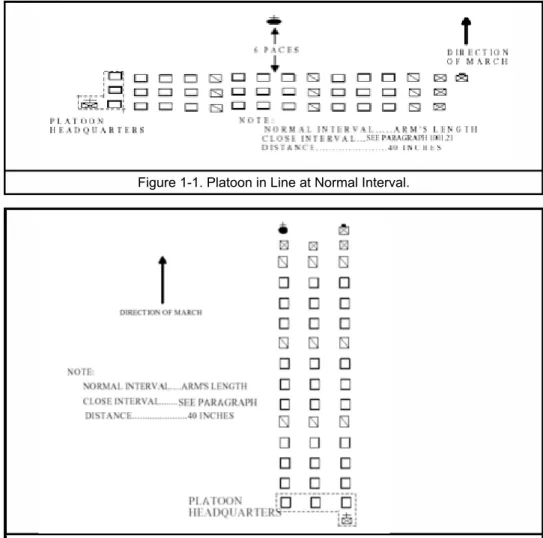
a. Column and line are the two formations for a platoon. (See figures 1-1and 1-2.)
Figure 1-1. Platoon in Line at Normal Interval.
b. The platoon normally forms in line with the squad leaders on the right of their squads and the guide on the right of the first squad leader. (See figure 1-1.) The platoon marches in line for short distances only. The platoon is normally marched in column with the squad leaders in front of their squads and the guide in front of the third (right) squad leader. (See figure 1-2.)
3. Posts of Individuals.
In line, the platoon commander’s stand 6 paces in front of the center of the front rank a.
of the platoon. (See figure 1-1.) In column, the platoon commander marches at the head of the left file of the platoon (see figure 1-2), unless drilling the platoon, in which case he/she would maintain position 6 paces from the platoon.
When the platoon commander is present, the platoon sergeant takes post to the left b.
of the left member of the rear rank when the platoon is in line. When in column, the platoon sergeant follows the last member of the right file (squad). When the platoon commander is not present, the platoon sergeant takes the platoon commander’s post and drills the platoon in the manner prescribed for the platoon commander.
The platoon guide takes post as stated in paragraph 4. c.
Extra members may fall in on the left when the platoon is in line and in the rear when d.
in column. If the squads are evenly filled, the first extra member falls in with the first squad, the second with the third (fourth) squad and then remaining squads. The platoon sergeant will reposition when necessary so as to remain the last person in the last rank.
In this Guide the term “platoon commander,” e.g., the platoon commander then e.
checks the alignment, means the individual drilling the platoon. He/she may be the platoon leader, platoon sergeant, or platoon member drilling the platoon for an inspection or evaluation. Except when marching at the head of a platoon column, the platoon commander must maintain proper distance (6 paces) from the platoon and remain centered on the platoon during all drill movements.
If the platoon were executing a right step, the platoon commander, who is facing 1)
the platoon, would execute a left step in cadence with the platoon in order to maintain proper position. For a left step the platoon commander would execute a right step.
If the platoon were executing a back step, the platoon commander would execute 2)
a half step, in cadence with the platoon in order to maintain proper position.
Movements of the platoon commander during other platoon movements are 3)
explained in the paragraph describing the movement. 4. Rules for the Guide.
In column, when it is desired to guide left or center, the command
b. “GUIDE LEFT” is
given. At this command, the guide and the platoon commander exchange positions. The guide crosses between the platoon commander and the platoon. To return the guide to normal position, “GUIDE RIGHT” is commanded. The guide and platoon commander return to their normal positions with the guide again passing between the platoon commander and the platoon. This movement may be made at a halt or while marching. The base squad or file is the one behind the guide.
The guide does not change position at the command
c. “Dress Left, DRESS.”
When a platoon in line is given the command
d. “Right, FACE,” the platoon guide
executes right face with the platoon. The guide then faces to the right in marching, moves to a position in front of the right squad leader, halts, and executes left face. If a platoon in line is given “Left, FACE,” the guide executes left face with the platoon but does not change position within the platoon.
When a platoon in column is given the command
e. “Column of Files from the Left,”
the guide takes position in front of the left squad leader so as to remain at the head of the column.
When a platoon in column is given the command
f. “Column of Twos from the Left,”
the guide takes position in front of the second squad so as to remain at the head of the right file of the column. These movements are executed by facing left as in marching, moving to the appropriate position, halting, and facing right.
When reforming in a column of threes or fours from a column of files or twos, the g.
guide takes post at his normal position when the movement is completed.
The guide sets the direction and cadence of the march. The leading member of each h.
file is responsible for interval.
1) When a platoon is marching in column and the command “By the Right (Left) Flank, MARCH” or “To the Rear, MARCH” is given, the guide executes the movement with the platoon but does not change relative position except during specific movements of unit drill.
Note: The guide does not count off.
E.O. 1 Form the Platoon.
1. To Form the Platoon. The platoon forms in line at normal interval and distance between files and ranks (see figure 6-IV-1) on the command “FALL IN.” To form at close interval, the command is “At Close Interval, FALL IN,” in which case the platoon forms in line with normal distance between ranks, but with close interval between files. The platoon sergeant or platoon commander forms the platoon as described below. a. Forming the Platoon by the Platoon Sergeant.
either “FALL IN” or “At Close Interval, “FALL IN.” At this command, the guide takes post so that the first rank, when aligned on the guide will be centered on and 3 paces from the platoon sergeant. The squad leader of the first squad falls in to the left of the guide and aligns at normal or close interval. Other squad leaders fall in directly behind the squad leader of the first squad with 40 inches distance between them. The members of the squads fall in and align on their squad leaders at normal or close interval as prescribed in squad drill, except that exact interval is measured only by the front rank. Individuals in the rear ranks gain their interval by covering the corresponding member of the rank in front of them. All personnel fall in at attention and, if armed with the rifle, at the position of order arms.
When a report is appropriate, after all personnel are formed, the platoon 2)
sergeant commands, “REPORT.” Remaining in position, the squad leaders, in sequence from front to rear, salute and report, “All present” or “(Rank and Name) absent.” The platoon sergeant then executes about face. (Note: If the platoon cannot be formed in regularly organized squads prior to forming the platoon, the platoon sergeant calls the roll. Each Marine answers “here,” as their name is called. The platoon sergeant then organizes the platoon into squads and faces the front.)
To receive the platoon, the platoon commander takes post 3 paces in front of the 3)
platoon sergeant, the platoon sergeant salutes and reports, “Sir (Ma am), all present or accounted for” or “Sir (Ma am), (number) absent.” The platoon commander returns the salute and may discuss absentees and issue necessary instructions to the platoon sergeant. The platoon commander then commands the platoon sergeant, “TAKE YOUR POST.” The platoon sergeant marches by the most direct route to a post on the left of the rear rank. The platoon commander then draws sword, if so armed. If the platoon commander does not receive the platoon, the platoon sergeant takes 3 paces forward, faces about and assumes the post and duties of the platoon commander.
b. Forming the Platoon by the Platoon Commander.
When appropriate, the platoon may be formed by the platoon commander rather 1)
than the platoon sergeant. The procedures are the same except that the platoon commander takes post 6 paces in front of the point where the center of the platoon will be, faces that point, and commands “FALL IN” or “At Close Interval, FALL IN.”
The platoon forms on the platoon commander, the platoon sergeant falling in on 2)
the left of the rear rank. The platoon commander then receives the report from the squad leaders.
E.O. 2 Dismiss the Platoon.
1. To Dismiss the Platoon.
The platoon is dismissed only from in line while at attention. a.
Young Marines are dismissed with the command
c. The platoon sergeant usually dismisses the platoon.
E.O. 3 Count Off.
The purpose of this movement is to designate the relative position in ranks of each member of the platoon. It may be executed when the platoon is halted at attention in line or column. When in line the command is “Count, OFF;” when in column the command is
“From Front to Rear, Count, OFF.”
In line, on the command
1. “Count, OFF,” everyone except the guide and squad leaders turn their heads 90 degrees to the right and look to the right. The squad leaders shout ONE. The persons in the file to the left of the squad leaders turn their heads smartly back to the front and at the same time shout TWO. After the file to their right has shouted its number, each subsequent file to the left turn their heads back to the front and shouts the next higher number. Numbers are counted off in quick time cadence.
In column, on the command
2. “From Front to Rear, Count, OFF,” the squad leaders
smartly turn their heads to the right and shout ONE as they return their heads back to the front. Each subsequent rank, having seen the heads in front of them return to the front, turn their heads to the right and shout the next higher number as they bring their heads smartly back to the front. This is carried on in sequence at quick time cadence. The guide does not turn his/her head nor count off. The platoon commander gives the command from a position 6 paces in front and centered on the squad leaders.
E.O. 4 Form Column from Line.
The purpose of this movement is to change the formation from line to column. It may be executed only when halted at normal interval and at attention. The command is “Right, FACE.”
On the command of execution
1. “FACE,” all members of the platoon face to the right, hereby forming a column. The guide moves to his/her position in front of the right squad leader.
The platoon commander may then command any halted movement from his/her 2.
current position, (e.g., facing movements, right/left step; etc.) unless otherwise indicated in this guide.
If the platoon is to march as part of a larger formation the platoon commander takes 3.
post in front of the left file and the guide in front of the right file. (See figure 1-2.) From this position the platoon commander would command, “Forward (Column Right {Left}), MARCH” to cause the platoon to march in column.
(
E.O. 5 Form Line from Column.
The purpose of this movement is to change the formation from a column back to a line. It may be executed when halted at attention and at order arms if armed with rifles. The command is “Left, FACE.”
At the command of execution
1. “FACE,” all members of the platoon face to the left, the platoon commander, if necessary, moves by the most direct route to a post 6 paces front and center of the platoon, and the platoon guide takes post on the right of the front rank.
(
2. Note: When in column, if the platoon is faced to the right it becomes inverted. This should only be done for short adjusting movements.)
E.O. 6 Align the Platoon.
The purpose of these movements is to dress the alignment of the platoon. They may be executed when the platoon is halted at attention in line or column. When in line, the commands are “Dress Right (Left), DRESS” or “At Close Interval, Dress Right (Left), DRESS.” These commands are given only when the platoon is at approximately the same interval as the interval at which the dress is commanded.
1. Dress Right Dress. On the command
a. “Dress Right, DRESS,” everyone except those individuals on the right flank, smartly turn their heads to the right, look, and align themselves. At the same time, everyone except those individuals on the left flank, provide interval by smartly raising their extended left arm to shoulder height and in line with their body. Fingers are extended and joined, thumb along the forefinger, palm down.
As the base of the movement, the guide stands fast and remains looking to the front. b.
The first squad leader looks to the right and aligns on the guide. The other squad leaders cover on the first squad leader and look to the front, ensuring they have a 40-inch distance. All other members position themselves by short steps until their right shoulders touch the fingertips of the person on their right.
The platoon commander, on his/her own command of execution
c. “DRESS,” faces half
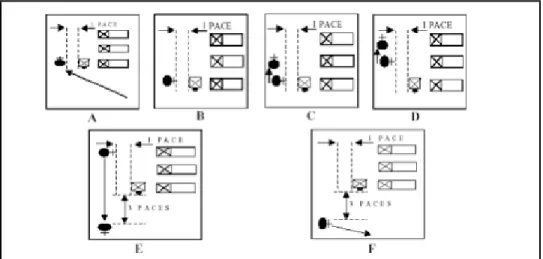
left, as in marching, and proceeds by the most direct route to a position on line with the front rank and 1 pace to the guide’s right (or first squad leader if there is no guide). (See figure 1 -3a.)
At this position, the platoon commander executes a halt while facing rear, and then d.
The commander may execute a series of short side steps to the right or left in order to e.
identify an individual. However, prior to commanding the identified individual to move, the commander will be on line with the rank. After verifying the alignment of the first rank, the platoon commander faces to the left as in marching, and moves to a position on line with the next rank.
The 1 pace interval from the guide is maintained (this results in a 2 pace interval from f.
the second and subsequent squad leaders). The commander halts on line with each succeeding rank, executes right face, and aligns the rank. (See figures 1-3c and d.) After verifying the alignment of the last rank, the platoon commander faces to the right g.
in marching, marches straight to a point 3 paces beyond the front rank, maintaining the 1 pace interval to the guide’s right, halts, (see figure 1 -3e) faces to the left, (see figure 1-3f) and commands “Ready, FRONT”.
h. Immediately after commanding, “Ready, FRONT”;
the platoon commander marches by the most direct route back to a post 6 paces 1)
front and centered on the platoon, halts facing down line or to the front.
all members of the platoon who raised their left arm and turned their head to the 2)
right, will smartly but quietly lower their arm to their side and at the same time turn their head back to the front, assuming the position of attention.
i. When aligning a platoon of well-drilled troops or when there is insufficient time to verify alignment, the platoon commander may command “Ready, FRONT” from his/her normal position (6 paces front and centered), without having verified alignment.
2. At Close Interval Dress Right Dress. This movement is executed in the same manner as dress right dress except for the following: On the command “At Close Interval,
Dress Right, DRESS,” those individuals providing interval will do so by placing the heel of their left hand on their hip with the elbow in line with their body. Fingers are extended and joined and pointing down. Members gaining interval will move by short steps until their right arm is touching the left elbow of the individual to their right.
3. Aligning in Column. The base squad for maintaining alignment while halted or marching in column is normally the third (right) squad. However, when executing a column left, column half left or eyes left alignment is to the first (left) squad. While marching, alignment is maintained by constantly glancing out of the corner of the right (left) eye, without turning the head.
Halted. When halted in column, (except for parades and ceremonies) the platoon is a.
aligned by the command “COVER.” At the command, the base squad leader obtains a 40-inch distance from the guide and covers on him/her. Other squad leaders obtain proper interval from the base squad leader and align toward the base by glancing out of the corner of their right (left) eye without turning their heads. Other members of the base squad obtain a 40-inch distance and covers on the person in front of them. At the same time, the remaining members of the platoon align on the base squad, by glancing out of the corner of their right (left) eye without turning the head and covers on the person in front of them. Only small adjusting steps are taken by platoon members to gain cover and alignment.
Marching. While marching, cover and alignment are constantly maintained by b.
glancing out of the corner of the right (left) eye, without turning the head, to align on the base squad. The command of “COVER” is only given if required.
E.O. 7 Obtain Close Interval from Normal Interval in Line.
The purpose of this movement is to close the interval between files of a platoon in line to 4 inches. It may be executed when the platoon is halted at attention and in line at normal interval. The command is “Close, MARCH.”
The squad leaders are the base of this movement. On the command of execution 1.
“MARCH,” the squad leaders stand fast and place their left hand on their hip to provide interval for the individuals to their left.
At the same time, all other members of the platoon, except for the guide, face to the 2.
right as in marching, march toward the right flank until approximately 4 inches from the person in front of them, halt, and face to the left. They then execute at close interval dress right dress. After aligning and without command, they will smartly lower their left hands and turn their heads to the front as soon as the individual to their left has touched their elbow with his/her right arm and stopped moving. Cover is then obtained without command.
On the command of execution, the guide will step to the left as in marching and close 3.
The platoon commander on his/her own command of execution
4. “MARCH” will step to
the left in marching. He/she marches parallel to the platoon maintaining a distance of 6 paces from the platoon. When approximately on the center of the platoon at close interval the platoon commander halts and faces the platoon. The platoon commander then adjusts to the center of the platoon by taking small steps left, right, forward or back.
E.O. 8 Obtain Normal Interval from Close Interval in Line.
The purpose of this movement is to extend the interval between files of a platoon in line to one arm length. It may be executed when the platoon is halted at attention and in line at close interval. The command is “Extend, MARCH.”
The squad leaders are the base of this movement. On the command of execution 1.
“MARCH,” the squad leaders stand fast and raise their left arms to shoulder height to provide interval for the persons on their left.
At the same time, all other members of the platoon, except for the guide, face to the left 2.
as in marching, march toward the left flank until they have opened approximately a 30-inch distance from the person behind them, halt, and face to the right. They then execute dress right dress. After aligning and without command, they will smartly lower their left arms and turn their heads to the front as soon as the individual to their left has touched their finger tips with his/her right shoulder and stopped moving. Cover is then obtained without command.
On the command of execution, the guide will take one step to the right as in marching, 3.
halt and face to the left. The guide will then execute dress left dress. When aligned on the first squad leader and at the proper interval the guide will return to the position of attention.
The platoon commander on his/her own command of execution
4. “MARCH” will step
to the right in marching. He/she marches parallel to the platoon maintaining a distance of 6 paces from the platoon. When approximately on the center of the platoon at normal interval the platoon commander halts and faces the platoon. The platoon commander then adjusts to the center of the platoon by taking small steps left, right, forward or back.
E.O. 9 Obtain Double Arm Interval in Line.
The purpose of this movement is to extend the interval between the files of a platoon to a double arm distance. It may be executed when the platoon is halted at attention and in line at normal or close interval. The command is “Take Interval to the Left, MARCH.”
The squad leaders are the base of this movement. On the command of execution 1.
“MARCH,” the squad leaders stand fast and raise their left arms to shoulder height, to provide interval for the persons on their left. The first squad leader will also raise his/ her right arm to provide interval for the guide.
as in marching, march toward the left flank until they have opened approximately a 70-inch distance from the person behind them, halt, and face to the right.
They then smartly turn their heads to the right and raise both arms to shoulder 3.
height.Individuals on the left flank will only raise their right arm. After aligning and withoutcommand, they will smartly lower their right arms and turn their heads to the front assoon as they have proper interval. They will lower their left arms when they feel theindividual to their left lower his/her right arm. Cover is then obtained without command.
On the command of execution, the guide will take two steps to the right as in marching, 4.
halt and face to the left. The guide will then execute dress left dress. When aligned on the first squad leader and at the proper interval, the guide will return to the position of attention. When the first squad leader feels the guide lower his/her left arm, the squad leader will lower his/her right arm.
The platoon commander on his/her own command of execution
5. “MARCH” will step to
the right in marching. He/she marches parallel to the platoon maintaining a distance of 6 paces from the platoon. When approximately on the center of the platoon at double arm interval the platoon commander halts and faces the platoon. The platoon commander then adjusts to the center of the platoon by taking small steps left, right, forward or back.
E.O. 10 Obtain Normal Interval from Double Arm Interval.
The purpose of this movement is to decrease the interval between files of a platoon in line from double arm to normal interval. It can only be executed when the platoon is halted at attention and in line at a double arm interval. The command is “Assemble to the Right, MARCH.”
On the command of execution, the interval is reduced in a manner similar to close 1.
march; except that individuals halt approximately 30 inches from each other, face and execute the appropriate dress movement to obtain normal interval.
The platoon commander on his/her own command of execution
2. “MARCH” will step
to the left in marching. He/she marches parallel to the platoon maintaining a distance of 6 paces from the platoon. When approximately on the center of the platoon at normal interval the platoon commander halts and faces the platoon. The platoon commander then adjusts to the center of the platoon by taking small steps left, right, forward or back.
E.O. 11 Obtain Close Interval in Column.
The purpose of this movement is to close the interval between files in a column to 4 inches. It may be executed when halted or marching at normal interval in column. The command is “Close, MARCH.”
two right steps. The next squad to the left will execute four right steps. If there are four squads in the platoon, the first (left) squad will execute six right steps. While side stepping, cover and alignment will be maintained. Steps may be adjusted slightly so that a 4-inch interval is obtained. Upon completion of the designated number of steps, members of the squad will halt and resume the position of attention.
2. When marching and the guide is right, the command of execution “MARCH” is given as the right foot strikes the deck. At this command:
The base (right) squad takes one more 30-inch step with the left foot and then begins a.
to half step. (See figure 1-4.)
The squad to the left of the base squad takes one more 30-inch step to the front with b.
the left foot; execute right oblique toward the base squad for one step and then steps 30-inches back to the original front. The squad then begins to half step.
The next squad to the left takes one more 30-inch step to the front and then executes c.
right oblique toward the base squad for three steps and steps 30 inches back to the original front. The squad then begins to half step.
If there are four squads in the platoon, the first (left) squad would execute the same d.
movements as above except the members would take five steps in the oblique.
Steps in the oblique may be adjusted slightly so that a 4-inch interval is obtained. e.
At the command
f. “Forward, MARCH” all squads resume taking 30-inch steps. If the guide has been shifted to the left or center, the base squad will become the g.
strikes the deck, if guide is left, or on either foot if guide is center. Side steps or oblique movements will be made toward the base squad as appropriate. The platoon commander, on his/her command
h. “MARCH,” oblique the number
ofsteps necessary to remain parallel to the platoon and picks up the half step. The platoon commander picks up a full 30-inch step on his/her command of “Forward, MARCH.”
E.O. 12 Extend to Normal Interval in Column.
The purpose of this movement is to extend the interval between files in a column from close to normal interval. It may be executed when halted or marching in column at close interval. The command is “Extend, MARCH.”
When halted and the guide is right, on the command of execution
1. “MARCH,” members
of the base (right) squad stand fast. Members of the squad next to the base squad will execute two left steps. The next squad to the left will execute four left steps.
If there are four squads in the platoon, the first (left) squad will execute six left steps. 2.
While side stepping, cover and alignment will be maintained. Steps may be adjusted slightly so that one arms interval is obtained between squad leaders. Upon completion of the designated number of steps, members of the squad will halt and resume the position of attention.
When marching and the guide is right, the command of execution
3. “MARCH” is given
as the left foot strikes the deck. At this command:
The base (right) squad takes one more 30-inch step with the right foot and then a.
begins to half step.
The squad next to the base squad takes one more 30-inch step to the front with the b.
right foot, executes left oblique away from the base squad for one step and steps 30 inches back to the original front. The squad then begins to half step.
The next squad to the left takes one more 30-inch step to the front and then executes c.
left oblique away from the base squad for three steps and steps 30 inches back to the original front. The squad then begins to half step.
If there are four squads in the platoon, the first (left) squad would execute the same d.
movements as above except the members would take five steps in the oblique.
Steps in the oblique may be adjusted slightly so that a one-arm interval is obtained e.
between squad leaders. At the command
f. “Forward, MARCH,” all squads resume taking 30-inch steps.
If the guide has been shifted to the left or center, the base squad will become the g.
The platoon commander, on his/her command
h. “MARCH,” oblique the number of
steps necessary to remain 6 paces from the platoon and picks up the half step. The platoon commander picks up a full 30-inch step on his/her command of
“Forward, MARCH.”
E.O. 13 Open Ranks.
The purpose of this movement is to increase the distance between ranks to 70 inches in order to accommodate the movements of an inspection party or to stack arms. It may be executed when halted in line at attention, and at normal or close interval. If armed, rifles will be at order arms. The commands are “At Close Interval, Open Ranks,” “MARCH;” “Ready, FRONT;” and “COVER.”
When at normal interval, on the command of execution
1. “MARCH,” the front rank takes
two 30-inch steps forward, halts, and executes dress right dress. The second rank takes one 30-inch step forward, halts, and executes dress right dress. The third rank stands fast and executes dress right. If there is a fourth rank, it takes two 15-inch back steps, halts, and executes dress right. When at close interval, all ranks will execute at close interval, dress right dress in place of dress right dress.
The platoon commander verifies alignment as for dress right dress, except that he/she 2.
will verify the 70-inch distance between ranks by taking two 30-inch steps and one 10-inch step when moving from one rank to the next. After verifying the alignment of the rear rank, he/she faces to the right in marching, marches 3 paces beyond the front rank, and 1 pace to the guide’s right, halts, faces to the left, and commands
“Ready, FRONT” and “COVER.” The platoon responds to these commands in the same manner as when they are given following dress right dress.
If the platoon is about to be inspected the platoon commander, after the command 3.
“COVER” will take one step to the front so that he/she is 3 paces directly in front of the guide, and then execute a right face. From this position the platoon commander reports the platoon to the inspecting officer.
E.O. 14 Close Ranks.
The purpose of this movement is to decrease the distance between opened ranks to a normal distance (40 inches). It may only be given when the platoon is at attention at open ranks. The command is “Close Ranks, MARCH.” It should be given immediately after the reason for opening ranks is accomplished, and before the platoon is given further drill movements or dismissed.
On the command of execution
1. “MARCH,” the front rank stands fast while the second rank takes one 30-inch step to the front and halts. At the same time, the third rank takes two 30-inch steps to the front and if there is a fourth squad, it takes 3 steps and halts. Each individual maintains cover and alignment while moving. No dressing movements are executed.
a. After the platoon is inspected, the platoon commander returns to a position 3 paces in front of the guide and halts facing to the front. It is from this position that the inspecting officer would critique the inspection. The platoon commander would exchange salutes with the inspection officer and after that officer has departed, the platoon commander would face to the left and then command “Close Ranks, MARCH.”
b. The platoon commander, on the command “MARCH,” then moves to his/her position 6 paces and centered on the platoon.
E.O. 15 Form for Physical Training.
The purpose of the movement is to form the platoon for physical exercise. It may be ex-ecuted when the platoon is halted at attention and in a column of threes or fours at normal interval. The sequence of commands are: “From Front to Rear, Count, OFF;” “Take Interval to the Left, MARCH;” “Arms, DOWN;” and “Even Numbers, To the Right, MOVE.” To reform to a column the commands are “Assemble, MARCH” and “COVER.”
1. The command “From Front to Rear, Count, OFF” is given by the platoon commander in order to designate odd and even ranks. It is executed as prescribed for counting off in column.
2. The next command is “Take Interval to the Left, MARCH.” This movement is different from the movement described in paragraph 13, which is executed when the platoon is in line formation. With the platoon in column, the extended interval is set by designating the number of steps the members of each squad take to the left.
On the command of execution
a. “MARCH,” all members of the squad on the right flank (third squad if it is a three squad platoon, fourth squad if it is a four squad platoon) and the guide, will cover in file, stand fast and each member extends both arms side ways at shoulder height, palms down with fingers extended and joined. This squad forms the base of the movement.
At the same time, the members of each squad to the left of the base squad will face to b.
the left as in marching and take two, four, or six (if it is a four squad platoon) 30-inch steps respectively. Upon completing their designated number of steps, they will halt, execute a right face, will cover in file, stand fast, and extend their arms to the side at shoulder height in the same manner as the right file. If armed with rifles the rifles are carried at trail arms during movement and then raised in the same manner as the right file.
At the command
c. “Arms, DOWN,” the arms are lowered smartly to the side and if armed with rifles the position of order arms is assumed.
numbered members cover and assume the position of attention. Odd numbered members do not move. From this position physical drill may be executed without the danger of collisions between individuals.
4. Upon the completion of physical drill, the command “Assemble, MARCH” is given. On the command of execution, the odd numbered members of the base squad stand fast. Even numbered members of the base squad step left in marching and double time to their positions covered on the odd numbered members of the base squad and the guide will return to a position in front of the base squad leader. At the same time, all other members will face right as in marching and, at a double time cadence, reassemble in column at normal interval and stand fast. The platoon commander would then give the command of “COVER” in order for the platoon to quickly pick up its alignment and cover.
The platoon commander, once the platoon is in column, gives all commands from 5.
position 6 paces in front of, centered on, and facing the column. He/she makes those movements necessary to maintain this position during the execution of the movement(s).
E.O. 16 Change the Direction of a Column.
The purpose of this movement is to change the direction of march of a column. It may be executed when the platoon is halted or marching in column at normal or close interval. The command is “Column Right (Column Left, Column Half Right or Column Half Left), MARCH.”
The base element during the turn is the squad on the flank in the direction of the 1.
turn. The leading member of the base squad, excluding the platoon commander and guide, establishes the pivot for the movement.
When marching, the commands of execution are given on the foot in the direction of 2.
the turn. On the command of execution “MARCH,” the leading member of the base squad takes one more 30-inch step to the front and then pivots 90 degrees to the right (left) on the ball of the left (right) foot. He/she then takes one 30-inch step in the new direction before beginning to half step.
At the same time other members of the leading rank execute a right (left) oblique. They 3.
step in this direction until they are on line with the new line of march (normally two, four and six steps respectively) and then execute a second right (left) oblique.
The original interval is maintained while in the oblique. Stepping out of the second 4.
When halted, at the command of execution
5. “MARCH,” the leading member of the base
squad faces to the right (left) as in marching and takes one 30-inch step in the new direction with the right (left) foot. At the same time other members of the leading rank step off in the right (left) oblique. Members behind the lead rank step off to the front as in forward march. The remainder of the movement is executed the same as in marching.
During column movements, the platoon commander and guide execute either an 6.
oblique or a 90-degree pivot (depending on the direction of the movement) on the command of execution. After completing their turn, they adjust their line of march so that they are in front of the appropriate squad.
For slight changes of direction, the command is
7. “INCLINE TO THE RIGHT (LEFT).”
At that command, the guide changes direction as commanded. This is not a precision movement and is executed only while marching.
E.O. 17 March to the Flank.
The purpose of this movement is to march the platoon to the right or left flank for a short distance. It may be executed from any formation that is marching at quick time or double time cadence. The command is “By the Right (Left) Flank, MARCH.” The command of execution is given as the foot in the direction of the turn strikes the deck.
To execute a right flank when marching at quick time, the command is
1. “By the Right
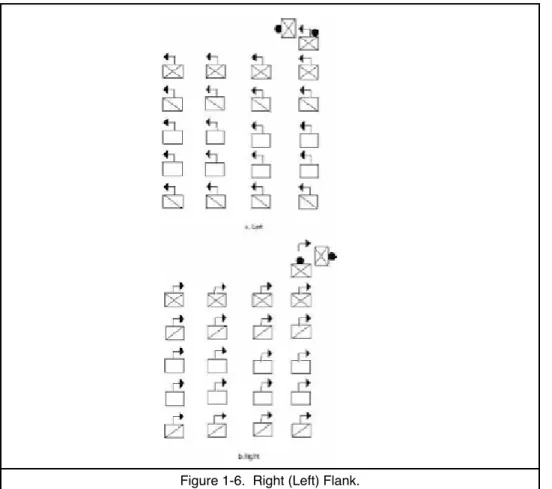
Flank, MARCH.” On the command of execution “MARCH,” everyone takes one more 30-inch step to the front with the left foot and then pivots 90 degrees to the right on the ball of the left foot. Stepping out of the pivot with a 30-inch step, the entire platoon marches in line to the right flank. The platoon commander and guide execute the flanking movement with the platoon, but do not change their position within the platoon. (For the one exception to this, see Unit Drill, paragraph 12.) For the platoon to resume marching in the original direction, the command is “By the Left Flank, MARCH.” To march to the left flank, substitute left for right and right for left in the above sequence. No other command may be given when marching to the flank until the unit has resumed marching to the original front. (See figure 1-6.)
When this movement is executed from a column at close interval, squad(s) to the 2.
a full step as soon as a 40-inch distance has opened between squads. After such a movement, the platoon maintains normal interval until close march is commanded.
When marching at double time, on the command of execution
3. “MARCH,” everyone
takes two more 36-inch steps to the front and then two 6-inch vertical steps in place at double time cadence. While stepping in place, everyone turns 90 degrees toward the direction commanded and then steps off with a 36-inch step in the new direction.
When the platoon executes flank movements from a column at close interval, squad(s) 4.
to the rear of the squad that becomes the leading squad, will take up a half step. They resume a full step as soon as a 40-inch distance has opened between squads. After such a movement, the platoon maintains normal interval until close march is commanded.
E.O. 18 March in the Oblique.
The purpose of this movement is to shift the line of march to the right or left for a short distance and then resume marching in the original direction. It may be executed from any formation that is marching at quick time cadence. The command is “Right (Left) Oblique, MARCH.”
The word oblique is pronounced to rhyme with strike. The command of execution is 1.
given as the foot in the direction of the turn strikes the deck. The command to resume the original direction of march is “Forward, MARCH.” The command of execution is given as the foot toward the original front strikes the deck.
To teach the platoon to march to the oblique, the instructor aligns the unit and has 2.
members face half right (left). The instructor then explains that these positions are maintained when marching to the oblique. Individuals keeping their shoulders parallel to the persons in front and/or adjacent to them achieve this. The individual at the corner of the platoon towards the direction of the oblique is the base of the movement, and must maintain a steady line of march keeping his/her other shoulders blocked perpendicular to the direction of march.
To march the platoon in the right oblique, the command is
3. “Right Oblique, MARCH.”
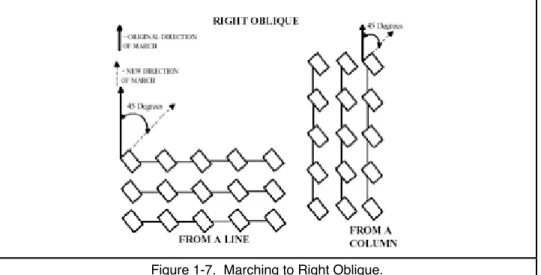
On the command “MARCH,” everyone then takes one more 30-inch step to the front with the left foot and pivots 45 degrees to the right on the ball of the left foot. Stepping out of the pivot with a 30-inch step, the entire platoon marches to the right oblique until given another command. (See figure 1-7.)
For the platoon to resume marching in the original direction, the command is 4.
“Forward, MARCH,” in this case the command of execution will be given as the left foot strikes the deck. Everyone then takes one more step in the oblique direction with the right foot; pivots back to the original front and continue to march. To march to the left oblique, substitute left for right and right for left in the above sequence.
To halt the squad facing in the original direction of march the command is
5. “Platoon,
HALT.” The command of execution “HALT” is given on the left foot when marching to the right oblique, and on the right foot when marching to the left oblique. At the command “HALT,” everyone takes one more step in the oblique direction, pivots to the original front on the toe of the right (left) foot, and places the left (right) foot beside the other at the position of attention.
To temporarily halt the squad in the oblique direction, in order to correct errors, the 6.
command is “In Place, HALT.” The command of execution “HALT” may be given as either foot strikes the deck. At the command of execution “HALT,” the squad halts in two counts as in quick time and remains facing in the oblique direction. The only command that can be given after halting in place is “Resume, MARCH.” At that command the movement continues marching in the oblique direction.
When given half step or mark time while marching in the oblique, the only commands 7.
that may be given are, “Resume, MARCH,” to continue marching with a 30-inch step in the oblique; or “In Place, HALT.” to halt in the oblique in order to correct errors.
E.O. 19 March the Rear.
The purpose of this movement is to march the platoon to the rear for a short distance. It may be executed when halted or marching forward at quick time or double time. The command is “To the Rear, MARCH” it will be given as the right foot strikes the deck.
When halted, on the command of execution
1. “MARCH,” everyone takes one 15-inch
step to the front with the left foot and then pivots 180 degrees toward the right on the balls of both feet. Stepping out of the pivot with a 30-inch step, the entire platoon marches to the rear. For the platoon to resume marching in the original direction, the command “To the Rear, MARCH” is given again. No other command may be given when marching to the rear until the unit has resumed marching to the original front.
When marching at quick time, on the command of execution
2. “MARCH,” everyone
takes one more 15-inch step to the front with the left foot and then pivots 180 degrees toward the right on the balls of both feet. Stepping out of the pivot with a 30-inch step, the entire platoon marches to the rear. For the platoon to resume marching in the original direction, the command “To the Rear, MARCH” is given again. No other command may be given when marching to the rear until the unit has resumed marching to the original front.
When marching at double time, on the command of execution
3. “MARCH,” everyone
PERFORMANCE QUALIFICATION REVIEW Performance Objective 1: Close Order Drill
E.O. No.
Enabling Objective Description and
Performance Requirement Authorized Evaluators Signature 1 Form the platoon.
a.
Can correctly form the platoon.2 Dismiss the platoon.
a.
Can correctly dismiss the platoon.3 Count off.
a.
Can correctly count off in line.b.
Can correctly count off in column.4 Form the column from line.
a.
Can correctly form the column from a line.5 Form line from column.
a.
Can correctly form a line from a column.6 Align the platoon.
a.
Can correctly align the platoon at close interval.b.
Can correctly align the platoon at normal interval.7 Obtain close interval from normal interval in line.
a.
Can correctly obtain close interval from normal interval.8 Obtain normal interval from close interval in line.
a.
Can correctly obtain normal interval from close interval.9 Obtain double arm interval in line.
a.
Can correctly obtain double arm interval in line.10 Obtain normal interval from double arm Interval.
a.
Can correctly obtain normal interval from double arm interval.11 Obtain close interval in column.
a.
Can correctly obtain close interval in column formation.12 Extend to normal interval.
a.
Can correctly extend to normal interval.13 Open ranks.
a.
Can correctly perform open ranks.14 Close Ranks.
a.
Can correctly perform close ranks.PERFORMANCE QUALIFICATION REVIEW
E.O. No.
Enabling Objective Description and
Performance Requirement Authorized Evaluators Signature 16 Change the direction of a column.
a.
Can correctly perform column left while marching in column.b.
Can correctly perform column right while marching in column.17 March to the flank.
a.
Can correctly march the platoon to the flank.18 March to the oblique.
a.
Can correctly march the platoon in the oblique.19 March to the rear.
Performance Objective 2: Essential Subjects
Enabling Objectives:
List the duties and responsibilities of a Senior Young Marine. 1.
Describe the relationship between the Unit Commander and Senior Young 2.
Marines.
Describe the role of the Marine Corps League to the Young Marines. 3.
Describe the role of the United States Marine Corps to the Young Marines 4.
Describe the National Young Marine Organization. 5.
Review
1. History of the Young Marines.
The Young Marines were formed in 1959 by Marine Corps League members of the Brass City Detachment in Waterbury, Connecticut.
By 1960, this unit of Young Marines had grown to over 300 young people and 20 adults. In June of 1962, there were over 1500 boys in some 10 cities and towns, sponsored by various Marine Corps League Detachments, throughout Connecticut.
Steve Zuraw, a member of the Marine Corps League Valley Detachment in Connecticut raised more than $5000.00 to fly an entire Young Marine unit to the League’s National Convention in Kansas City, Missouri, where the League adopted the Young Marines as a National Program.
The official charter of the Young Marines was issued on October 17, 1965.
Chartered as a subsidiary organization of the Marine Corps League, the Young Marines began to function independently in 1974.
In 1975, membership was extended to females.
The Young Marines’ first by-laws were established in 1977 followed by an election of its first governing body. These by-laws were approved in 1978 at the Atlantic City Convention of the Marine Corps League.
In 1980, the organization was granted status as a youth educational organization with a 501(c)3 IRS classification.
In 1993, the United States Marine Corps officially recognized the Young Marines as its focal point for their Youth Drug Demand Reduction efforts. This became the Young Marines primary focus for strengthening our youth. Additional support given by the United States Marine Corps is covered in Marine Corps Order 5000.20.
The Secretary of Defense Fulcrum Shield Award is given annually by the Office of the Deputy Assistant Secretary of Defense for Counter-Narcotics (ODASD(CN)) to recognize the efforts of military-affiliated youth organizations that have successfully assisted in spreading the anti-drug message throughout their community. It focuses heavily on DoD Red Ribbon Activities in which the organization has participated, as well as other Drug Demand Reduction activities the organization has participated during the previous fiscal year. The Young Marines were the first recipients of this prestigious award in 2001.
In 2004 and 2005 a group of Young Marines along with the National Executive Director and a group of veterans of the battle for Iwo Jima, made the journey to this historic location to commemorate the 59th and 60th anniversary of the Marines securing Mount Suribachi. The Young Marines shoulder patch depicts the famed flag raising atop this hill, and the most famous of all military monuments showing this flag raising stands in Arlington National Cemetery. Inscribed on this monument are the words that described each Marine that fought, lived, and died on that island... “Uncommon Valor was a Common Virtue”.
In 2005, several ribbons and awards were added to include the Distinguished Order of Merit (DOM). The new guidebooks were implemented. In December of 2005, the first annual Young Marines Symposium was held in Baltimore, MD. The symposium was composed of the Young Marine of the Year, the 5 Division finalists, and the top perform- ers from Advanced Leadership School. The Young Marines gathered to discuss topics of importance within the Young Marine program and to make recommendations to the National Executive Director.
In 2006, the online registration for the SPACES program was activated and two new adventures were added, the White Mountain Adventure and the Mountain River Adventure. New training material was unveiled at the Adult Leaders Conference to include the Commander’s Manual, the Adjutant’s Manual, the Paymaster Manual and the Activity Guide.
E.O. 1 List the duties and responsibilities of the Senior Young Marine.
1. Definitions.
Duty. Duty is something you must do because of the position you hold. a.
Responsibility. Responsibility is being accountable for what you do. b.
2. Duties and Responsibilities of a Senior Young Marine. As a Senior Young Marine you will be asked to assume greater responsibility. Your unit commander will not ask you to do more than what you are capable of handling, but how much you do and how much responsibility you assume is ultimately up to you. Thus far you have earned your rank along with the privileges and respect of your office. The following is a list of your responsibilities: Remember, this list or any list is not all-inclusive. Many times you will be called upon to use your best judgment. Always do what is right, no matter how tough and you will never fail.