20.1
Chapter 20
Network Layer:
Internet Protocol
20.2
20-1 INTERNETWORKING
20-1 INTERNETWORKING
In this section, we discuss internetworking, connecting
In this section, we discuss internetworking, connecting
networks together to make an internetwork or an
networks together to make an internetwork or an
internet.
internet.
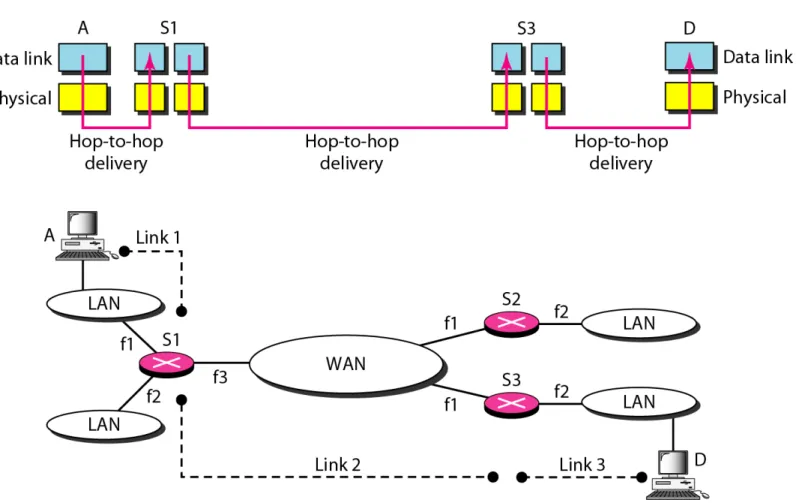
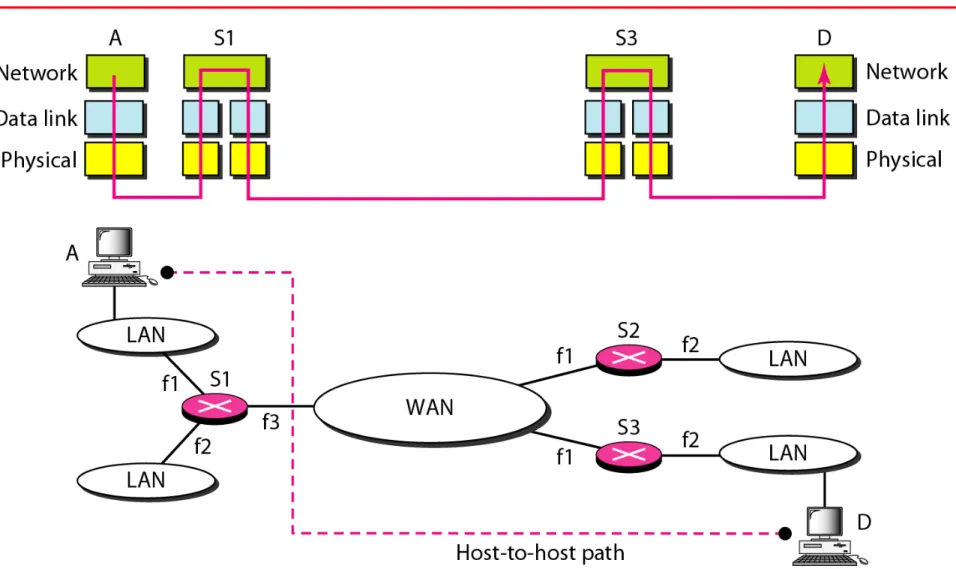
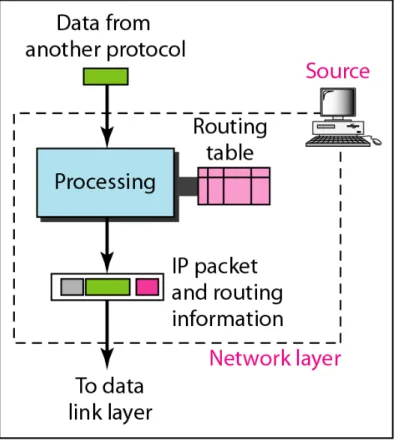
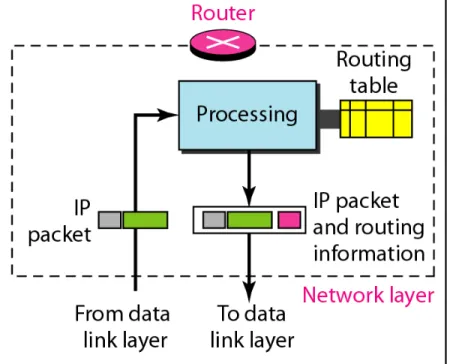
Need for Network Layer
Internet as a Datagram Network
Internet as a Connectionless Network
Topics discussed in this section:
20.3
20.4
20.5
20.6
20.7
Switching at the network layer in the
Internet uses the datagram approach to
packet switching.
20.8
Communication at the network layer in
the Internet is connectionless.
20.9
20-2 IPv4
20-2 IPv4
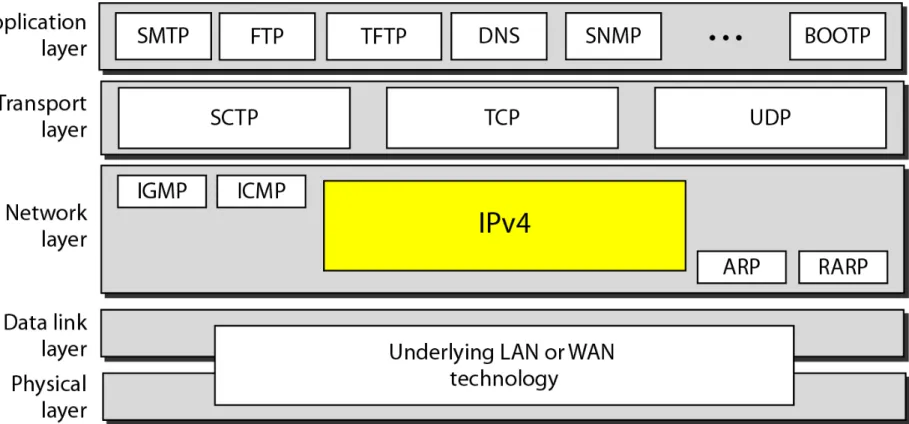
The Internet Protocol version 4 (
The Internet Protocol version 4 (IPv4IPv4) is the delivery ) is the delivery mechanism used by the TCP/IP protocols.
mechanism used by the TCP/IP protocols.
Datagram
Fragmentation Checksum
Options
Topics discussed in this section:
20.10
20.11
20.12
20.13
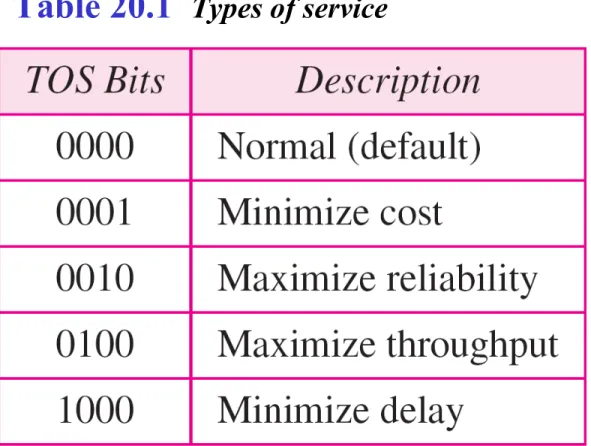
The precedence subfield was part of
version 4, but never used.
20.14
20.15
20.16
20.17
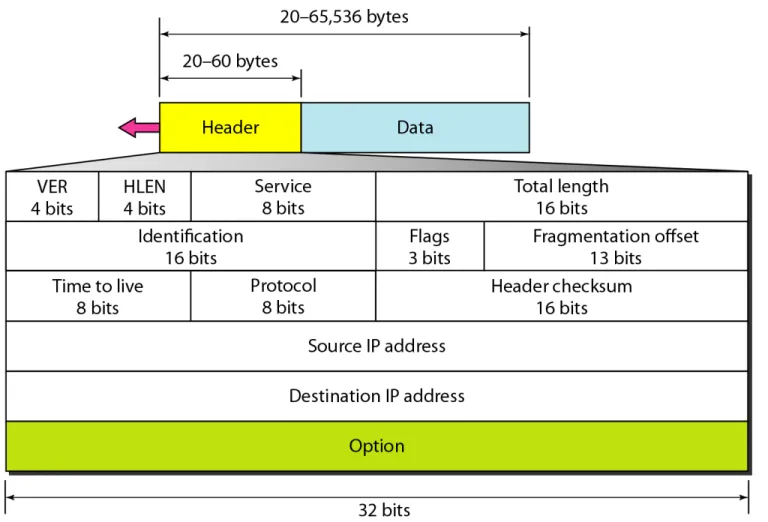
The total length field defines the total
length of the datagram including the
header.
20.18
20.19
20.20
20.21
An IPv4 packet has arrived with the first 8 bits as shown:
01000010
The receiver discards the packet. Why?
Solution
There is an error in this packet. The 4 leftmost bits (0100) show the version, which is correct. The next 4 bits (0010) show an invalid header length (2 × 4 = 8). The minimum number of bytes in the header must be 20. The packet has been corrupted in transmission.
20.22
In an IPv4 packet, the value of HLEN is 1000 in binary. How many bytes of options are being carried by this packet?
Solution
The HLEN value is 8, which means the total number of bytes in the header is 8 × 4, or 32 bytes. The first 20 bytes are the base header, the next 12 bytes are the options.
20.23
In an IPv4 packet, the value of HLEN is 5, and the value of the total length field is 0x0028. How many bytes of data are being carried by this packet?
Solution
The HLEN value is 5, which means the total number of bytes in the header is 5 × 4, or 20 bytes (no options). The total length is 40 bytes, which means the packet is carrying 20 bytes of data (40 − 20).
20.24
An IPv4 packet has arrived with the first few hexadecimal digits as shown.
0x45000028000100000102 . . .
How many hops can this packet travel before being dropped? The data belong to what upper-layer protocol?
Solution
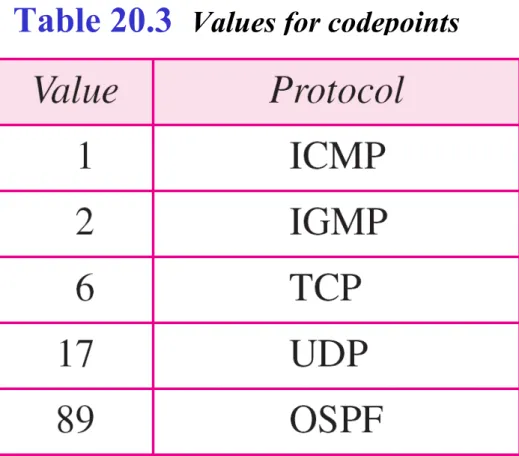
To find the live field, we skip 8 bytes. The time-to-live field is the ninth byte, which is 01. This means the packet can travel only one hop. The protocol field is the next byte (02), which means that the upper-layer protocol is IGMP.
20.25
20.26
20.27
20.28
20.29
20.30
A packet has arrived with an M bit value of 0. Is this the first fragment, the last fragment, or a middle fragment? Do we know if the packet was fragmented?
Solution
If the M bit is 0, it means that there are no more fragments; the fragment is the last one. However, we cannot say if the original packet was fragmented or not. A non-fragmented packet is considered the last fragment.
20.31
A packet has arrived with an M bit value of 1. Is this the first fragment, the last fragment, or a middle fragment? Do we know if the packet was fragmented?
Solution
If the M bit is 1, it means that there is at least one more fragment. This fragment can be the first one or a middle one, but not the last one. We don’t know if it is the first one or a middle one; we need more information (the value of the fragmentation offset).
20.32
A packet has arrived with an M bit value of 1 and a fragmentation offset value of 0. Is this the first fragment, the last fragment, or a middle fragment?
Solution
Because the M bit is 1, it is either the first fragment or a middle one. Because the offset value is 0, it is the first fragment.
20.33
A packet has arrived in which the offset value is 100. What is the number of the first byte? Do we know the number of the last byte?
Solution
To find the number of the first byte, we multiply the offset value by 8. This means that the first byte number is 800. We cannot determine the number of the last byte unless we know the length.
20.34
A packet has arrived in which the offset value is 100, the value of HLEN is 5, and the value of the total length field is 100. What are the numbers of the first byte and the last byte?
Solution
The first byte number is 100 × 8 = 800. The total length is 100 bytes, and the header length is 20 bytes (5 × 4), which means that there are 80 bytes in this datagram. If the first byte number is 800, the last byte number must be 879.
20.35
Figure 20.13 shows an example of a checksum calculation for an IPv4 header without options. The header is divided into 16-bit sections. All the sections are added and the sum is complemented. The result is inserted in the checksum field.
20.36
20.37
20.38
20-3 IPv6
20-3 IPv6
The network layer protocol in the TCP/IP protocol
The network layer protocol in the TCP/IP protocol
suite is currently IPv4. Although IPv4 is well designed,
suite is currently IPv4. Although IPv4 is well designed,
data communication has evolved since the inception of
data communication has evolved since the inception of
IPv4 in the 1970s. IPv4 has some deficiencies that
IPv4 in the 1970s. IPv4 has some deficiencies that
make it unsuitable for the fast-growing Internet.
make it unsuitable for the fast-growing Internet.
Advantages Packet Format
Extension Headers
Topics discussed in this section:
20.39
20.40
20.41
20.42
20.43
20.44
20.45
20.46
20.47
20-4 TRANSITION FROM IPv4 TO IPv6
20-4 TRANSITION FROM IPv4 TO IPv6
Because of the huge number of systems on the
Because of the huge number of systems on the
Internet, the transition from IPv4 to IPv6 cannot
Internet, the transition from IPv4 to IPv6 cannot
happen suddenly. It takes a considerable amount of
happen suddenly. It takes a considerable amount of
time before every system in the Internet can move from
time before every system in the Internet can move from
IPv4 to IPv6. The transition must be smooth to prevent
IPv4 to IPv6. The transition must be smooth to prevent
any problems between IPv4 and IPv6 systems.
any problems between IPv4 and IPv6 systems.
Dual Stack Tunneling
Header Translation
Topics discussed in this section:
20.48
20.49
20.50
20.51
20.52