THE INFLUENCE OF SUGGESTIVE PARENT-CHILD CONVERSATIONS AND INTERVIEWS ON CHILDREN’S MEMORY REPORTS
Taylor Evan Thomas
A dissertation submitted to the faculty at the University of North Carolina at Chapel Hill in partial fulfillment of the requirements for the degree of Doctor of Philosophy in the Department
of Psychology and Neuroscience in the College of Arts and Sciences.
Chapel Hill 2020
ABSTRACT
Taylor Evan Thomas: The Influence of Suggestive Parent-Child Conversations and Interviews on Children’s Memory Reports
(Under the Direction of Peter A. Ornstein)
Within investigations of child sexual abuse and other forms of child maltreatment, interviews with children are often the only sources of information about alleged events. The critical implications of children’s memory reports for the outcome of cases have led researchers to consider the extent to which children can be trusted to provide reliable accounts of events. Empirical work on this topic has demonstrated that under certain circumstances, even young children can accurately remember and report past events; yet, there are numerous factors that can drastically reduce the accuracy of children’s recollections. For example, a substantial amount of research has demonstrated the deleterious effect of suggestive interviewing on children’s
memory reports. However, what is less clear are factors outside of the interview context that may also compromise the accuracy of children’s reports of events that they have experienced. One such factor concerns the information that is imparted to children in the course of conversations with their parents.
interviews after delays of 1- and 2-week delays, as well as during a final neutral interview three weeks after the dig.
ACKNOWLEDGEMENTS
I have received a great deal of support throughout this dissertation project and would like to extend my sincere thanks to my “village.” First, I would like to express my deepest
appreciation to my advisor, Dr. Peter Ornstein. The knowledge that Dr. Ornstein has shared, as well as the mentorship that he has provided, has been instrumental in the completion of this project. His unwavering guidance has also played a crucial role in my development as student and person. Moreover, I would like to thank the members of my dissertation committee, Dr. Jennifer Coffman, Dr. Jean-Louis Gariepy, Dr. Kelly Giovanello, and Dr. Gabrielle Principe for their time and thoughtful feedback. I am especially grateful to Dr. Principe for her early and sustained involvement in the design of this project.
I would also like to extend my gratitude to my family and friends. In particular, I am thankful to my husband, Justin Johnson, and parents, Lori and Ron Thomas, for the sacrifices they have made for me to pursue a graduate degree. I am also thankful to my sisters, Allik Stanley and Ryann Thomas, as well as my friend, Kesha Hudson, for the encouragement, kindness, and humor they have shared with me on this journey. It is my hope to one day pay forward the support that these individuals have so generously given to me.
Finally, I wish to thank those who worked behind the scenes to make this project
TABLE OF CONTENTS
LIST OF TABLES ... xi
LIST OF FIGURES ... xii
INTRODUCTION ... 1
CHILDREN’S MEMORY ... 3
Children’s Memory within Parent-Child Conversations ... 3
Memory Development ... 3
Social-Cultural Theory of Memory Development ... 4
Parents’ Conversational Style ... 4
Summary ... 7
Children’s Memory for Salient Events ... 7
Memory Retention ... 9
Accuracy of Memory Reports ... 9
Summary ... 11
SUGGESTIBILITY OF CHILDREN’S MEMORY ... 12
The Influence of Formal Interviews ... 13
Specific vs. Open-Ended Questions ... 14
Repeated Specific Questions ... 15
Guided Imagery ... 16
Multiple Suggestive Techniques ... 20
Formal Interview Case Study ... 22
Summary ... 22
The Influence of Informal “Interviews” ... 23
Peer Rumor ... 23
Peer Rumor Case Study ... 25
Parent-Child Conversation ... 25
Parent-Child Conversation Case Study ... 28
Summary ... 30
CURRENT STUDY ... 31
METHODS ... 33
Sample ... 33
Project Design ... 34
Procedure ... 34
Staged Event ... 34
Parent-Child Conversation ... 35
Memory Interviews ... 35
Debriefing ... 35
Coding ... 36
Parent-Child Conversation ... 36
Memory Interview ... 37
RESULTS ... 38
Preliminary Analyses ... 39
Aim 1: Parent-Child Conversation ... 39
Number of Parent Utterances ... 39
Number of Parent Utterances about Target Events ... 40
Number of Child Utterances ... 40
Number of Features Recalled by Children ... 40
Accuracy of Children’s Recall of the Target Events ... 41
Aim 2: Children’s Final Interview ... 41
Number of Features Recalled by Children at the Final Interview ... 42
Children’s Recall of Target Events in the Final Interview ... 42
Children’s Open-ended Recall of the Target Events ... 43
Children’s Recall of Details about the Target Events ... 43
Type of Details Recalled about the Target Events ... 44
Aim 3: Children’s Interviews Across Time ... 46
Children’s Recall of Features Across Interviews ... 46
Children’s Recall of Target Events Across Interviews ... 46
Aim 4: Parent-Child Conversation and Children’s Final Interview ... 47
Parents’ Elaboration & Conversations ... 48
Parent-Child Conversations & Children’s Final Interview ... 48
DISSCUSSION ... 49
Aim 1: Parent-Child Conversation ... 51
Aim 2: Children’s Final Interview ... 51
Aim 4: Children’s Final Interview ... 54
Summary ... 55
Limitations ... 56
Implications and Future Directions ... 58
Conclusion ... 62
APPENDIX A: RECRUITMENT LETTER ... 63
APPENDIX B: FEEDBACK FROM PARENTS ... 64
APPENDIX C: INITIAL PILOT STUDY ... 65
APPENDIX D: FOLLOW-UP PILOT STUDY ... 67
APPENDIX E: SCRIPT FOR STAGED EVENT ... 68
APPENDIX F: SUGGESTIVE CONDITION LETTER ... 70
APPENDIX G: MEMORY INTERVIEW ... 71
APPENDIX H: DEBRIEFING LETTER ... 73
LIST OF TABLES
Table 1 – Correlations among Children’s Recall of Targets and Confounding Variables ... 88 Table 2 – Correlations between Parent-Child Conversation
and Children’s Memory Reports at the Final Interview
LIST OF FIGURES
Figure 1 – Project Design ... 81
Figure 2 – Children’s Recall of Target Events in the Final Interview ... 82
Figure 3 – Children’s Recall of Details about Target Events at the Final Interview ... 83
Figure 4 – Children’s Recall of Verbatim Details at the Final Interview ... 84
Figure 5 – Children’s Recall of Constructive Details at the Final Interview ... 85
Figure 6 – Average Number of Features Recalled by Children Across Interviews by Experimental Condition ... 86
INTRODUCTION
Children are involved with the legal system for a variety of reasons, the most common being maltreatment. As reported by the National Child Abuse and Neglect Data System, 3.5 million child protective service referrals were documented in 2017. Of these referrals for abuse or neglect, approximately 570,000 were substantiated and an estimated 29% of these child maltreatment cases reached court (US Department of Health & Human Services, Administration for Children and Families, 2017). Although it is unclear how many of these legal proceedings involved children as witnesses, it is estimated that substantially more than 100,000 children provide testimony each year (Ceci & Bruck 1993). The frequent involvement of children in the legal system and the critical implications of children’s accounts of alleged events that they have experienced or witnessed have raised an important issue concerning the credibility of children’s memory reports. Namely, to what extent can children of different ages provide complete and accurate accounts of events, particularly in situations in which their testimony provides the primary or sole source of evidence?
Principe, 1998). Second, it is important to consider the rich literature on child suggestibility that indicates that even though children’s recall can be accurate for many events, their reports can nonetheless be greatly compromised when they are obtained under suggestive interview conditions. Research in this area focuses on the influence of suggestive interviews that are carried out in formal contexts by forensic practitioners (e.g., police officers, social workers, and lawyers) (Bruck & Ceci, 1999; Bruck, Ceci, & Principe, 2006). It also extends beyond formal contexts to include informal conversations between children and their peers (Principe & Ceci, 2002), as well as their parents (Principe, DiPuppo, & Gammel, 2013; Principe, Trumbull, Garder, Horn, & Dean, 2017; Klemfuss, Rush, & Quas, 2016).
The current study stems from an integration of these two literatures (i.e., research on children’s memory for events, as well as work on child suggestibility). Specifically, this study is designed to examine the extent to which children’s memory for an event is influenced by
suggestions encountered across formal and “informal” (i.e., conversations between parents and children) interview contexts. To date, there is no research that considers the impact of both interviewers and parents’ suggestions on children’s remembering. It is proposed that
encountering false information across settings will cause children to accept the beliefs of both parents and interviewers, even when those beliefs are inconsistent with children’s experiences. This may inadvertently lead children to align their memory reports with the biased information, such that the accuracy of children’s remembering will be the most compromised when they are exposed to suggestions by both interviewers and parents.
To set the stage for an examination of these issues, this document begins with a focused review of empirical work on children’s event memory and child suggestibility. Next, a
interviewers’ and parents’ suggestions on the accuracy of children’s memory reports is provided. Although this study is a laboratory-type investigation, its design is strongly influenced by a consideration of forensic issues. Material from well-known cases in which children serve as witnesses will therefore be interspersed throughout the presentation of relevant literature. By contextualizing this study (as well as those carried out by other psychologists in the field) within this historical framework, I aim to highlight the importance of continued work on matters related to child suggestibility.
CHILDREN’S MEMORY
The emergence of children’s abilities to remember past events occurs in early childhood. Research involving nonverbal measures of memory highlights the remarkable abilities of infants to encode, store, and retrieve information about their previous experiences over long periods of time (DeCasper & Spence, 1986; Rovee-Collier, 1997; Bauer, 1996). As children develop the ability to verbally reference the past, their memory abilities show dramatic changes. These changes have been primarily revealed in two contexts; namely, studies of children’s memory within naturally occurring parent-child conversations (Fivush & Fromhoff, 1988), as well as more formalized explorations of children’s memory for salient events (Baker-Ward, et al., 1993; Ornstein et al., 1998; Murachver et al., 1996). The section that follows is devoted to a discussion of children’s memory displayed in these situations (for an extended treatment, see Ornstein, Haden, & San Souci, 2008; Ornstein, Haden, & Elischberger, 2006).
Children’s Memory within Parent-Child Conversations
Memory Development. Investigations of naturally occurring conversations document
reference everyday routines (e.g., lunch at daycare; reading stories before bed) and recently completed actions (e.g., “All gone” and “Bye bye”) in a fleeting and fragmented manner (Nelson, 1986). Although still infrequent and fragmented, children’s narratives of previous experiences become lengthier by the age of 2 and extend to the more distant past by the time that children are 3 years old (Fivush, Gray, & Fromhoff, 1987). Children’s memory reports continue to become more complex and organized with increases in age; however, it is clear that their early reports are limited in content as well as structure and are almost always structured or
interpretatively framed by their parents (e.g., a child says “dinosaur” and a parent responds, “Yes, you and daddy played with your toy dinosaurs after breakfast this morning, didn’t you? That was fun!”) (Fivush & Fromhoff, 1988).
Social-Cultural Theory of Memory Development. Early parent-child conversations
such as these not only support children’s memory for specific experience, but also serve to facilitate children’s memory remembering in general. For example, scholars have used
Vygotsky’s social-cultural theory of development (Vygotsky, 1978) to argue that children first learn the form and function of remembering, as well as the relevance of personal memories, through talking about the past with their parents. Parents initially provide most of the structure and content during these conversations about past events, allowing children to practice their skills with the support of a proficient conversational partner. Children, in turn, increasingly internalize these skills so that they are eventually able to remember and report information about their personal past with little help from their parents (Fivush, 1991; Fivush, Haden, & Reese, 1996; Nelson & Fivush, 2004).
Parents’ Conversational Style. A primary focus of research on naturally occurring
past event conversations for their children. Consider, for example, the two contrasting conversational styles that parents use to provide information for and elicit details from their children within reminiscing conversations (i.e., high elaborative vs. low elaborative). Parents classified as high-elaborative scaffold conversations in a story story-like manner through their use of open-ended questions (e.g., “What did we do at the zoo?”), close-ended elaborative questions (e.g., “Did you pet the turtle at the zoo?”), elaborative statements (e.g., “We took a break and had a picnic at lunchtime by the bears.”), and evaluations (e.g., “You’re right! The flamingos were pink”). Parents classified as low-elaborative, in comparison, structure dialogues in a test-like manner through their use of close-ended, repeated questioning aimed at eliciting specific responses (Fivush & Fromhoff, 1988). These differences in parents’ conversational style are consistent over time and (Reese, Haden, & Fivush, 1993; Farrant & Reese, 2000) not simply an artifact of “talkativeness,” as revealed by the lack of association between parental
conversational style and volume of speech during free play and shared book-reading activities (Haden & Fivush, 1996; Liable, 2004a, Liable, 2004b).
Longitudinal studies demonstrate that variations in parents’ conversational style are similarly associated with later differences in children’s abilities to remember and report information about past experiences within conversations with parents. Consider, for example, empirical work by Reese and colleagues (1993). In their investigation, parents who were highly elaborative when children were 40 months old had children who reported more unique
information 1 ½ and 2 ½ years later within memory sharing conversations, as compared to children of low-elaborative parents. Over time, the direction of effect was greatest from parent to child, suggesting that parents’ scaffolding of reminiscing conversations, rather than children’s own earlier skills at remembering, drive the development of children’s memory for past events (Reese, Haden, & Fivush, 1993).
The causal role of parents’ conversational style in predicting children’s memory for events is further revealed in numerous experimental studies (e.g., Peterson, Jesso, & McCabe, 1999; Reese & Newcombe, 2007; Valentino, Comas, Nuttall, & Thomas, 2013). To illustrate, Reese and Newcombe (2007) provided parents of 21- to 29-month-old children with training in the use of an elaborative conversational style. These parents received an instructional sheet that listed elaborative techniques (e.g., open-ended questions, close-ended elaborative questions, elaborative statements) and were encouraged to talk with their children more often about past events. Another group of parents did not receive this training and therefore served as a
comparison for evaluating the effects of the training program. On two separate occasions – 2 ½ and 15 months after completing the training – parents discussed past events with their young children, and, in both the short- and long-term, parents who received the training were more elaborative than parents who did not receive guidance in employing an elaborative
information within their conversations than children of untrained parents, regardless of the delay interval (Reese & Newcombe, 2007).
Summary. The research summarized here highlights the rapid changes in children’s
abilities to remember and report the past that occurs across the preschool years (Nelson, 1986; Fivush, Gray, & Fromhoff, 1987), as well as the important causal role that parents’ play in cultivating children’s memory skills (Fivush & Fromhoff, 1988; Reese, Haden, & Fivush, 1993; Reese & Newcombe, 2007). However, the methodologies employed in studies of naturally occurring conversations between parents and children do not enable researchers to objectively assess the content of children’s reports. That is, the past events under investigation are typically undocumented occurrences that have been selected for discussion by parents. Because these events do not permit an independent verification of the facts, little can be known about children’s retention of event-relevant information or the accuracy of their claims. In order to characterize children’s memory in this way, research on children’s memory for salient events is reviewed below.
Children’s Memory for Salient Events
To better understand children’s abilities to produce accurate memory reports over extended periods of time, researchers have examined children’s recollections of specially constructed events (Murachver et al., 1996; McGuigan, & Salmon, 2004). For example,
children’s reports were generally more accurate when they directly experienced the staged event (versus observed or read about it) and when their reports were elicited through verbal recall rather than reenactment (Murachver et al., 1996). These results indicate that, despite being quite good, the accuracy of children’s remembering can be influenced by the nature of their
experiences and the manner of their retrieval.
Other researchers have examined children’s memory for routine visits to the doctor (Baker-Ward et al., 1993; Follmer & Furtado, 1997; Ornstein et al., 1998) and other medical procedures (Merritt, Ornstein, & Spicker, 1994) in order to better understand the accuracy of children’s remembering. Investigations such as these provide a unique platform for
characterizing children’s memory, as the events under consideration (i.e., medical visits involving an adults’ physical touch of a child’s body) are somewhat similar to events about which children are asked to testify (i.e., sexual abuse). Furthermore, the verifiable knowledge of what occurs during each physical examination permits researchers to directly assess children’s retention of event-related information over time, as well as the accuracy of children’s reports (Ornstein, Baker-Ward, Gordon, & Merritt, 1997).
transcribed, and coded for the particular features recalled and the type of probe required for children to retrieve the information (i.e., open-ended vs. specific yes/no questions).
Memory Retention. Results of studies involving this approach are similar to those
involving children’s memory for staged events (Murachver et al., 1996) in that they demonstrate the impressive abilities of young children to remember and report their past experiences;
however, work in this domain also documents age-related differences in children’s retention of event-related information over time. Consider the work of Baker-Ward and colleagues (1993) as an illustration. As part of this study, 3- to 7-year-old children were questioned with open-ended (“Tell me what happened during your check-up.”) and close-ended (“Did the doctor check any parts of your face?”) probes about their physical examination, both immediately after their visit to the doctor and after a delay of 1, 3, or 6 weeks. In response to questioning, children of all ages reported the bulk of their check-ups; however, older children recalled a greater amount of
information and depended less on specific yes/no (versus open-ended) probes than younger children. Moreover, older children were also better than younger children at retaining event-related information in memory over time, such that the amount of forgetting was significant among 3- and 5-year-olds, but not 7-year-olds (Baker-Ward et al., 1993). This developmental trend is further revealed when data are pooled across studies of this type in order to establish retention functions (Follmer & Furtado, 1997).
Accuracy of Memory Reports. Paralleling age-related differences in the retention of
were not included in children’s individual experiences. In response to questions about the extra activities, children’s correct denial rates were impressive (.87, .96, and .99 for 3-, 5-, and 7-year-olds, respectively at the initial interview). Children’s correct denial rates in response to questions about the absent features were diminished but still quite good (.72, .93, and .88 for 3-, 5-, and 7-year-olds, respectively at the initial interview). As can be inferred from the denial rates
referenced above, children’s responses revealed age-related differences in accuracy. That is, in their initial interview, 3-year-old children were more likely than the 5- and 7-year-old children to incorrectly assert that the extra activities and absent features had indeed occurred (Baker-Ward et al., 1993).
Furthermore, research by Ornstein and colleagues demonstrates that under certain conditions the accuracy of older children’s memory can be similarly undermined. Specifically, children can be led provide incorrect information about an event when their experiences conflict with preexisting knowledge and expectations. Consider an experiment by Ornstein and
colleagues (1998) as an illustration. In this experiment, 4- and 6-year-old children took part in a mock physical examination that included some typical features (e.g., listening to the lungs), while omitting other typical features of an examination (e.g., looking in ears, listening the heart, checking knees), and incorporated other atypical, unexpected activities (e.g., measuring head circumference, wrapping bandage on leg, asking child to touch nose). Using a hierarchically structured interview protocol, children were questioned about the typical and atypical features that had been either included or omitted from their physical examination that occurred 12 weeks prior (Ornstein et al., 1998).
children outperformed younger children in their accurate recall of typical features and denial of the atypical, unexpected activities. Nevertheless, older children were simultaneously more likely than younger children to inaccurately include the typical, but omitted features of an examination in their reports. That is, 42% of the 4-year-olds referenced at least one typical but omitted component, whereas 72% of 6-year-olds made this same error (Ornstein et al., 1998). The presence of such intrusions in older children’s reports 12 weeks after their experience demonstrate the impact of expectations on children’s remembering and call attention to the constructive nature of memory.
Summary. Empirical investigations involving children’s memory for salient events
provide a unique and ecologically valid platform for characterizing the development of
children’s remembering (Ornstein et al., 1997). For example, a series of programmatic studies on children’s memory for medical experiences allows for the examination of children’s abilities to retain and accurately report their experiences as a function of age. This work convincingly shows that older children recall a greater amount of information, depend less on specific probes during questioning, and evidence less forgetting over time (Baker-Ward et al., 1993; Follmer & Furtado, 1997). Nonetheless, children of all ages are susceptible to including false information in their reports, particularly when their experiences are inconsistent with their expectations (Ornstein et al., 1998).
Importantly, the research summarized here depicts children’s memory performance under conditions that reflect ideal interviewing practices. Specifically, the questions concerning
contrast, it is believed that work on children’s memory for salient events lies on the opposite end of the continuum of investigations that examine the influence of highly suggestive questioning procedures on children’s remembering (Ornstein, et al., 1997). Therefore, a review of the complementary research literature on child suggestibility is provided next.
SUGGESTIBILITY OF CHILDREN’S MEMORY
Child suggestibility became a topic of general interest approximately 30 years ago after several infamous cases involving children as witnesses (e.g., the Kelly Michaels and McMartin Preschool daycare cases) raised concerns about problematic forensic interviewing practices and their impact on children’s testimony (see Ceci & Bruck, 1993 for a historical review). Since then, researchers have used innovative methodologies to examine the accuracy of children’s memory reports and the various factors that may serve to undermine it. This work convincingly
demonstrates that even young children are able to provide detailed, accurate accounts of past events under some conditions; however, there are also several suggestive influences that can greatly reduce the veracity of children’s recollections.
misled preschoolers were more likely than older children who were similarly misled to select pictures that portrayed the false information (versus the pictures that detailed the original stories) (Ceci, Ross, & Tolgia, 1987). Young children, as such, appear to be particularly vulnerable to the effects of encountering false information about their experiences prior to being interviewed.
Researchers, including Ceci and colleagues, have since recognized the importance of the actual interview context for the accuracy of children’s remembering. Therefore, research in this domain has shifted from examining the ‘misinformation effect’ to focus primarily on the ways in which children’s memory reports are impacted by questioning in formal (e.g., interviews with police, social workers, and lawyers) and informal (e.g., conversations with peers and family members) contexts. These contexts and their influence on the quantity and quality of children’s recollections are explored here. Specifically, a description of how specific features of formal interviews can undermine the accuracy of children’s remembering is provided first. Each description is accompanied by a summary of the existing empirical support. Next, parallel consideration is given to informal conversations and their impact on children’s narratives. To illustrate the relevance of this work to forensic settings, descriptions of each interview context are interspersed with material from well-known cases in which children have served as
witnesses.
The Influence of Formal Interviews
A great deal of research including, case studies (Garven, Wood, Malpass, & Shaw, 1998), laboratory investigations (Poole & White, 1991), and field studies (Cederborg, Orbach,
Bruck and colleagues (Bruck & Ceci, 1999; Bruck, Ceci, & Principe, 2006) is adopted to review the modes of questioning that may contribute to children’s recall of inaccurate information. These include, but are not limited to, interviewers’ (a) reliance on close-ended versus open-ended questions, (b) repetition of close-open-ended questions within and across interviews, (c) use of guided imagery, (d) alteration of the emotional tone of the interview, (e) induction of
stereotypes, and (f) use of multiple suggestive techniques.
Specific versus Open-Ended Questions. In addition to encountering false information
between their experiences and later interviews, children can also be explicitly provided with inaccurate information through interviewers’ use of specific, close-ended (e.g., “Did he take your clothes off”) or force choice questions (e.g., “Did he leave your shirt on or take your shirt off?”) rather than open-ended probes (e.g., “Tell me about what happened.”). The detrimental impact of close-ended questions is likely due, in part, to the power imbalance that exists between children and interviewers. That is, children likely respect formal questioners and recognize them as truthful, credible sources of information. Children, as a result, may often produce answers that are consistent with the false information implied by interviewers’ specific questions, rather providing answers that are reflective of their own understanding of an experienced event or indicating that they do not know.
errors were made in response to close-ended probes. Children’s impaired performance in response to close-ended questioning characterized all age groups (Peterson & Bell, 1996), highlighting the powerful influence of the types of questions used during formal interviews on the accuracy of children’s memory.
Repeated Specific Questions. Another mode of questioning through which the accuracy
of children’s remembering is compromised involves the use of repeated close-ended questions. The harmful influence of repeated close-ended questioning on the accuracy of children’s memory reports is likely attributable to the inferences that children make about repeated open- and close-ended probes. The repetition of open-ended questions is common in everyday conversations and is likely interpreted by children as bid to repeat their original stories; in contrast, the repetition of close-ended questions signals to children an implicit appeal for a different response (Poole & White, 1993). Therefore, although repeated questioning can provide opportunities for rehearsal and the recollection of important information not already mentioned, the most accurate event-related details are likely found in children’s initial, freely recalled narratives of past events.
Children, regardless of age, were more likely to produce false narratives in responses to repeated bids for task-related information in the form of close-ended probes (Memon & Vartoukian, 1996).
Parallel results have also been observed for questioning that is repeated across multiple interviews, as highlighted in a series of investigations carried out by Poole and White (1991; 1993). In these studies, 4-, 6-, and 8-year-old children, as well as adults, witnessed a staged disagreement and were questioned with repeated probes after an immediate, 1-week, and 2-year delay. Consistent with the results of Memon & Vartoukian (1996), children produced less information but were as accurate as adults when answering repeated open-ended questions about their experiences. The youngest children, however, were more likely to change their responses and recall incorrect information when interviewed with repeated close-ended questions (e.g. “Did the man hurt Melanie?”) both within and across the immediate and 1-week interviews (Poole & White, 1991). After a 2-year delay, the youngest children were also more likely to provide speculative answers to questions that cannot be known (i.e., “What did the man do for a living? What was his job?”), as well as to include fewer uncertainty qualifiers in their
descriptions of events (e.g., “I think that…” or “I am not sure but…”) (Poole and White, 1993). Guided Imagery. False information need not be explicitly introduced through the use of
specific questions for an interview to be suggestive. Merely asking children to think about what they might have seen or done has also been demonstrated to lead to the production of inaccurate narratives. The negative impact of guided imagery can be explained, in part, by children’s
they have carried out from those they have merely imaged (Lindsay & Johnson, 1987). Similar results have been found for children’s ability to distinguish actions that they have witnessed from those they only imagined to be performed by others (Lindsay, Johnson, & Kwon, 1991). As such, inducing children to imagine what they might have done or witnessed has the potential to
increase the likelihood of inaccurate recall by children.
Ceci and colleagues (1994) illustrated this phenomenon by asking 3- to 6-year-old children to recall both authentic events nominated by parents (e.g., birthday parties, trip to Disneyworld, minor injuries, and birth of siblings) and fictitious events contrived by
experimenters (i.e., getting a hand stuck in a mousetrap and going on a hot air balloon ride with classmates). Over the course of 7 to 10 interviews, children were instructed to “think real hard” about these events, and by the final interview, a striking 36% of younger children and 32% of older children assented to the false events. Descriptions of false events were rich in detail, as evident in the following narrative (Ceci, Hufman, Smith, & Loftus, 1994, p. 399):
Emotional Tone of Interview. In addition to employing guided imagery, interviewers
can also implicitly influence the accuracy of children’s remembering by altering the emotional tone of the interview. The emotional tone of an interview, for example, may be altered through the provision of support that is not contingent on the types of responses that children provide. As Saywitz and colleagues (2019) describe, high support likely communicates to children that they are cared for, which may reduce children’s perceptions of the hierarchy of power, decrease their expectations of interviewers’ negative reactions to disagreement, encourage different viewpoints, thereby lead to more accurate recall by children. Unsupportive behaviors, on the other hand, may inhibit children from reporting their experiences, promote denial, or foster the unwavering acceptance of interviewers’ suggestions by children (Saywitz, Wells, Larson, & Hobbs, 2019).
Empirical work by Almerigogna and colleagues (2008) demonstrates the effect of
interviewer support on children’s memory reports. In their study, children between the ages of 8- and 11-years old watched a movie clip and were subsequently questioned in either a supportive (e.g., interviewer was friendly and positioned towards the child with an open body posture) or unsupportive (e.g., interviewer was stern and was positioned away from the child with her legs crossed and arms folded) manner. During the interview, children were asked both specific (e.g. “Was there anything on the table?”) and misleading (e.g. “Were there eggs on the table?”)
Stereotypes. Another mode of questioning that impacts the accuracy of children’s
memory reports involves the induction of stereotypes. Stereotypes refer to naïve theories about personal characteristics and likely influence what children come to remember and report about their experiences through the organizational framework that they provide. That is, stereotypes likely structure children’s experiences by directing their attention to expectancies in the
environment, as well as by guiding children in their interpretation of experienced events. In this way, the induction of stereotypes may unknowingly shape children’s recollections by
encouraging them to produce false narratives or supplement their recall with inaccurate, but stereotype-consistent information (Leichtman & Ceci, 1995).
The damaging influence of the induction of stereotypes on the accuracy of children’s remembering can be observed in the work of Leichtman and Ceci (1995). In their study, one half of the preschool aged children were presented with stories on a number of occasions that
depicted an unknown individual, Sam Stone, as a “clumsy” and “bumbling” person.
Subsequently, Sam Stone visited children’s classrooms during story time. The visit was accident-free and consisted of Sam Stone being introduced to the children, commenting on the story, walking around the classroom and departing with a wave. Following his visit, children were interviewed on 4 separate occasions with questions that were either neutral (e.g., “Remember the day that Sam Stone visited your school? Well, I wasn’t there that day and I’d like you to tell me everything that happened when he visited.”) or suggestive (e.g., “When Sam Stone got the bear dirty, did he do it on purpose or was it an accident?” and “Was Sam Stone happy or sad that he got the bear dirty?”) questions.
misdeeds. Suggestive questioning exacerbated the effect of misinformation on the accuracy of children’s reports, such that 46% of the youngest children and 30% of the oldest children who had been probed with misleading questions spontaneously recalled that Sam Stone had carried out one or both of the misdeeds. Children’s false narratives were often strikingly rich in
perceptual embellishments, with one child even recalling that he or she saw Sam Stone soaking the teddy bear in water before scribbling on it with a crayon. The influential role of stereotypes is further revealed in experimental studies that introduce stereotypes within the interview itself (Lepore & Sesco, 1994).
Multiple Suggestive Techniques. The majority of research reviewed here has focused on
the effect of a single suggestive interview technique on the accuracy of children’s remembering. Bruck and colleagues, however, propose that a number of techniques can be combined in one interview as a result of interviewer bias (e.g., Bruck & Ceci, 1999; Bruck, Ceci, & Principe, 2006). Specifically, they argue that the number of suggestive techniques employed in a formal interview varies as a function of the degree of interviewer bias. Interviewers who hold strong preconceived beliefs about alleged events may shape their questioning, although not always deliberately, to maximize disclosures that are aligned with their previously held beliefs. In this way, biased interviewers likely use multiple suggestive techniques in order to gather information or evidence that corroborates, rather than negates, their personal hypotheses about what did or did not occur. The use of multiple suggestive techniques, in turn, is likely to have larger detrimental effects on the accuracy of children’s remembering than the effects documented in studies where only one suggestive technique is used.
stereotype induction on the accuracy of children’s reports), but also in more recent work by Garven and colleagues (Garven, Wood, & Malpass, 2000). In this study, 3- to 6-year-old
children attended a special story time led by “Manny Morales” and were interviewed about their experiences one week later. Half of the children were interviewed with multiple suggestive techniques (e.g., “I want to ask you some questions about the other day when Manny Morales came and read you The Hunchback of Notre Dame. He had on a silly hat didn’t he? Well, I already talked to the big kids and they said that Manny did some bad things. I want to see if you have a good memory like they did. Are you smart enough to remember? Good, because I really need your help.”), whereas the remainder were interviewed with suggestive questions alone (e.g., “I want to ask you about the other day when Manny Morales came and read you The Hunchback of Notre Dame. He had a silly hat didn’t he?”) . All children were also asked eight misleading
questions about things that Manny did not do.
Formal Interview Case Study. The negative influence of suggestive formal interviews
on the accuracy of children’s memory reports can be observed in historical trials involving children as witnesses. For example, in the 1980’s a nursery school teacher, Kelly Michaels, was indicated for and subsequently cleared of 235 counts of sexual offenses against children. Fifty-one children from the nursery school made accusations that included being forced to lick peanut butter off genitals, penetration with foreign objects, and being forced to eat cake made from human excrements; however, the interview excerpts below demonstrate that suggestive
interviewing unfavorably impacted children’s recall of the alleged abuse (Ceci & Bruck, 1995, p. 280):
Interviewer: When Kelly kissed you, did she ever put her tongue in your mouth? Child: No.
Interviewer: Did she ever make you put her tongue in her mouth? Child: No.
Interviewer: Which of the kids had to kiss her vagina? Child: What’s this?
Interviewer: No that’s my toy, my radio box. Which kids had to kiss her vagina? Child: Me.
Summary. Empirical investigations of the formal interview context demonstrate that the
accuracy of children’s remembering can be seriously undermined when interviewers, (a) rely on close-ended versus open-ended questions (Peterson & Bell, 1996), (b) repeat close-ended questions within and across interviews (Memon & Vartoukian, 1996; Poole & White, 1991; Poole & White, 1993), (c) employ guided imagery (Ceci, Hufman, Smith, & Loftus, 1994), (d) alter the emotional tone of the interview (Almerigogna et al., 2007; Saywtiz et al., 2019), (e) induce stereotypes (Leichtman & Ceci, 1995), and (f) use multiple suggestive techniques
limitations inherent in young children’s cognitive abilities (Bruck & Ceci, 1999; Bruck, Ceci, & Principe, 2006). The accuracy of children’s remembering, therefore, largely depends on the skills of their formal interviewers. That is, greater confidence can be placed in children’s memory reports when they are elicited in a neutral manner than when they are obtained through the use of suggestive formal interview approaches.
The Influence of Informal ‘Interviews’
A small, but growing number of researchers have argued that the notion of an interview extends beyond the formal, forensic setting to include everyday informal conversations with social others (Prinicipe & Ceci, 2002; Principe, DiPuppo, & Gammel, 2013). This movement is informed by social theories of remembering that maintain that memory sharing conversations between children and social others (e.g., friends and family members) are a typical and frequent part of children’s everyday social interactions (Reese & Fivush, 2008). Children, as part of the exchanges, encounter others’ versions of past experience, which may or may not be similar to their own. One result of these conversations, given the constructive nature of memory (Bartlett, 1932), is that event-related details provided by children’s conversational partners may
inadvertently inform children’s own reports. Empirical support for the effect of socially
encountered suggestions on the accuracy of children’s remembering is reviewed in detail below. Peer Rumor. The detrimental impact of informal conversations on children’s memory
accidently destroyed a treasure map and broke a rock that contained a secret). Another group of children did not witness the extra activities, but were classmates of those who had (Classmate Condition). It was anticipated that these children would learn about the activities through rumor spreading conversations with their peers. The remaining children did not witness the extra
activities and were not classmates of those who had observed them (Control Condition). Over the course of the following three weeks, children were interviewed on three occasions about the staged event with questions that were either neutral (e.g., “Remember the day that Dr. Diggs visited your classroom? Well, I wasn’t there that day, and I’d like you to tell me everything that happened.”) or suggestive (e.g., “How did Dr. Diggs break the rock, did he step on it or did he drop it?”) questions.
All children were interviewed a fourth and final time in a neural manner, and during this interview their reports differed as a function of their exposure to information about the extra events. Children in the Classmate Condition recalled a higher proportion of the extra events than did children in the Control Condition. This was despite the fact that neither group of children had actually witnessed the added activities, indicating that children’s memory was influenced by conversations with the children who had experienced these events. Furthermore, the effect of peer rumor was amplified when children were exposed to suggestive questioning. Recall of the extra activities by children who had only heard about the events became indistinguishable from the recall of children who had actually witnessed the activities. In fact, children’s false narratives were characterized by more elaborative detail than narratives that were true. For example, one child who had only heard about the activities reported (Principe & Ceci, 2002, p. 18):
The robustness of these findings is revealed in subsequent work in which Principe and her colleagues have similarly found that conversations with peers who have overheard false information about a shared experience (Principe, Kanaya, Ceci, & Singh, 2006; Principe, Tinguely, & Dobkowski, 2007; Principe, Daley, & Kauth, 2010; Principe, Haines, Adkins, & Guiliano, 2010; Principe, Cherson, DiPuppo, & Schindewolf, 2012) or generated false inferences about an experience (Principe, Guiliano, & Root, 2008) can also lead children to inaccurately recall features of an event experienced solely by their peers. Strikingly the effects of peer rumor on children’s remembering are enduring (Principe et al., 2012) and even more powerful than those documented in studies involving children’s exposure to suggestions within formal
interviews (Peterson & Bell, 1996; Memon & Vartoukian, 1996; Poole & White, 1991; Poole & White, 1993; Leichtman & Ceci, 1995; Ceci et al. 1994). This points to peer rumor as a
particularly potent source of suggestibility among young children.
Case Study. The impact of peer rumor on the accuracy of children’s remembering can be
observed in historical trials involving children’s testimony. For example, in addition to being influenced by suggestive questioning by interviewers, children’s narratives within the Kelly Michaels case previously described were also negatively influenced by everyday conversations with peers. Consider the following brief excerpt as an illustration (Ceci & Bruck, 1995, p. 150):
Interviewer: Do you know that [Kelly] did?
Child: She wasn’t supposed to touch somebody’s body. If you want to touch somebody, touch your own.
Interviewer: How do you know about her touching private parts? Is that something that you saw or heard?
Child: Max told me
Parent-Child Conversations. Notably, peers are only part of the conversational milieu
children’s memory through the unwitting provision of false information. Parents’ suggestions, in fact, are likely to be even more influential than suggestions made by other children or peers. For example, Ceci and colleagues (1987) modified their previously described study on the
“misinformation effect” by having either an adult or seven-year-old child present children with a piece of misinformation about a short story (i.e., that Loren had a headache from eating her cereal too fast, when in reality Loren had a stomachache from eating her eggs too fast.). After a
delay of two days, children were again presented with pictures and asked to identify the two that actually appeared in the stories. Children exposed to false information by an adult were less accurate than children exposed to misinformation by another child in their identification of these photos (Ceci, Ross, & Tolgia, 1987).
Despite the potential that conversations with parents have to influence children’s remembering, limited research as focused on this phenomenon (see Principe, DiPuppo, & Gammel, 2013; Principe et al., 2017; Klemfuss, Rush, & Quas, 2016 for exceptions). Empirical work on this topic demonstrates that although parent-child conversations do not immediately influence the accuracy of children’s remembering (Klemfuss, Rush, & Quas, 2016), parents’ suggestions do impact children’s reports after a significant delay. Consider a series of studies by Principe and colleagues (2013; 2017) as an illustration of this long-term effect. In these
whose parents were misled were more likely to explain in rich detail that they had experienced the suggested activity when compared to children whose parents were not misinformed
(Principe, DiPuppo, & Gammel, 2013; Principe et al., 2017).
Moreover, Principe and colleagues have drawn from work on the development of children’s memory to propose that parents’ conversational style is likely associated with the accuracy of children’s memory reports. They argue that highly elaborative conversations – particularly those when parents develop false beliefs about their children’s experiences, as the consequence of misremembering a shared event or encountering inaccurate information about a non-shared event – are especially likely to lead to reports of false information by children. That is, parents’ inaccurate beliefs may impact their questioning during conversations in a manner similar to that of biased interviewers. Misinformed parents, like biased interviewers, may inadvertently structure their questioning to maximize disclosure that are consistent with their previously held beliefs. High-elaborative parents may be especially likely to ask questions and make statements that are consistent with their false beliefs because of their tendency to
contribute new, detailed information to past event conversations. Thus, children of high-elaborative parents may be particularly susceptible to adopting their parents’ suggestions both within parent-child conversations and later independent narratives of events (Principe, DiPuppo, & Gammel, 2013; Principe et al., 2017).
Empirical support for the influence of parents’ conversational style on children’s
conversational style. For example, a high-elaborative parent who had been exposed to false information posed the following series of questions to her child (Principe, DiPuppo, & Gammel, 2013, p. 267):
“Do you remember the magician’s rabbit? The one he tried to pull out of a hat, his top hat, like at Olivia’s birthday part, remember that? Where he reached in, said hocus pocus, something like that, and pulled out that white rabbit? That big fat one with the floppy ears. But at your school, I heard that rabbit wasn’t in the hat. The magician couldn’t find the rabbit. Do you know what happened to it? Did it get loose in your school? Did it hop around? I bet it wouldn’t be hard for it to hop out of that hat. Did you guys catch it and feed it some carrots? Some lettuce? Or maybe your peanut butter and jelly?”
A low-elaborative parent, in contrast, asked her child, “Do you remember the trick where the magician tried to pull the rabbit out of his hat? Did it get loose? Did it? Do you remember? Tell me if you remember” (Principe, DiPuppo, & Gammel, 2013, p. 268). This stark variation in parents’ conversational style was associated with differences in children’s memory reports. Children of high-elaborative parents reported more accurate and unique details about activities experienced during the magic show both within conversations and the later interview, in comparison with children with low-elaborative parents. However, a high-elaborative style was also associated with an increased incidence of children falsely reporting the suggested activity in rich detail (i.e., 80% of children with high-elaborative parents recalled the loose rabbit vs. 40% of children with low-elaborative parents) (Principe, DiPuppo, & Gammel, 2013).
Case Study. Support for the influence of parent-child conversation on the accuracy of
200 families encouraging parent-child discussion of the alleged sexual misconduct. An excerpt from this letter is provided below:
“Records indicate that your child has been or is currently a student at the
preschool. We are asking your assistance in continuing this investigation. Please question your child to see if he or she has been a witness to any crime or if he or she has been a victim. Our investigation indicates that possible criminal acts include: oral sex, folding of genitals, buttock or chest area, and sodomy, possibly committed under the pretense of ‘taking the child’s temperature.’ Also, photos may have been taken of children without their clothing. Any information from your child regarding having ever observed Ray Buckey leave a classroom alone with a child during any nap period, or if they ever observed Ray Buckey tie up a child, is important.”
Parent-child conversations that resulted from this letter led children to produce stories detailing bizarre experiences. For example, children told their parents that in addition to being sexually abused, they saw witches fly, traveled in hot-air balloons, were taken through
underground tunnels, and saw animal sacrifices after which they were made to drink the animals’ blood. After three years of testimony and nine weeks of deliberation by the jury, these
accusations were deemed unfounded and resulted in the dismissal of all charges. Recent revelations support this dismissal and expose parent-child conversations as one factor that led children to produce false accounts of events. Specifically, one of the alleged victims, Kyle Zirpolo, published a recantation in the Lost Angeles Times citing conversations with his parents as a source of his errant testimony. He writes (Zirpolo, 2005):
“My parents asked if the teachers took pictures and played games with us. Games like ‘Naked Movie Star.’ I remember my mom asking me. She would ask if they sang the song, and I didn’t know what she was talking about, so she would sing something like, “Who are you, you’re a naked movie star.” I’m pretty sure that was the first time I ever heard that: from my mom. After she asked me a hundred times, I probably said yeah, I did play that game. My parents were very
The influence of parents on children’s memory reports is not limited to historical trials. To illustrate, Korkman and colleagues (2014) analyzed a sample of recorded conversations between parents and their children that had been delivered to police as evidence for alleged physical and sexual abuse. Analyses of the structure and content of the conversations showed that the parents’ techniques when questioning their children were quite suggestive and consistent with practices used by biased interviewers (Bruck & Ceci, 1999; Bruck, Ceci, & Principe, 2006). Parents relied mostly on suggestive, specific questions and rarely provided children with the opportunity to relay their own accounts of alleged events. In approximately 70% of the
conversations, all new information about the allegation was introduced by parents, rather than by children (Korkman, Juusola, & Santtila, 2014).
Summary. Recent research demonstrates that, in addition to formal forensic interviews,
THE CURRENT STUDY
Research on children’s memory for events demonstrates that young children can be quite skilled at remembering and reporting information about their past experiences (Baker-Ward et al., 1993); however, children of all ages are susceptible to including inaccurate information in their reports (Ornstein et al., 1998). Empirical work on child suggestibility indicates that this is particularly true when children are questioned in a suggestive manner, in both formal (Peterson & Bell, 1996; Memon & Vartoukian, 1996; Poole & White, 1991; Poole & White, 1993; Leichtman & Ceci, 1995; Ceci et al., 1994) and “informal” (Principe & Ceci, 2002; Principe, DiPuppo, & Gammel, 2013; Principe et al., 2017; Klemfuss, Rush, & Quas, 2016) contexts. The present study builds on these two separate, but related bodies of empirical work (i.e., research on children’s memory for events and child suggestibility) by examining if children’s memory for an event is influenced by suggestions across formal (i.e., interviews with police officers, social workers, and lawyers) and “informal” interview (i.e., conversations with parents) contexts.
I am ultimately interested in determining if parents’ suggestions influence children’s remembering, as well as if the effect of parents’ suggestions on children’s reports is amplified by suggestive questioning. It is anticipated that that encountering misinformation across settings may lead children to accept the false beliefs of both parents and interviewers. This may cause children to report information that is consistent with the suggestions made by interviewers and parents, particularly when the staged event is discussed by parents in an elaborative, detailed manner. Specific aims and hypotheses are provided below:
Aim 1: To examine the impact of parents’ suggestions on parents’ and children’s
contributions to the parent-child conversation.
Hypothesis 1: Consistent with prior work by Principe and colleagues
(2013), it is hypothesized that parents’ suggestions will negatively influence the accuracy of children’s reports.
Aim 2: To explore the joint influence of parents’ and interviewers’ suggestions on
children’s memory reports during the final interview.
Hypothesis 2: It is hypothesized that the effect of parents’ suggestions on
children’s memory will be amplified by suggestive interviewing, such that the accuracy of children’s reports in the final interview will be the most compromised when children are exposed to suggestions by both parents and interviewers.
Aim 3: To examine the joint influence of parents’ and interviewers’ suggestions
Hypothesis 2: It is hypothesized that the effect of parents’ and
interviewers’ suggestions on children’s memory will become more pronounced over time.
Aim 4: To characterize the association between parents’ conversational style and
the children’s memory reports in the final interview.
Hypothesis 3: Consistent with previous research on the development of
children’s memory (Fivush & Fromhoff, 1987) and parents as a
contaminant of children’s remembering (Principe, DiPuppo, & Gammel, 2013; Principe et al., 2017), It is hypothesized that parents’ use of a high-elaborative style during conversations about the staged event will be positively associated with the amount of information recalled by children; however, it is anticipated that a highly elaborative style will also be positively associated with children’s inaccurate recall among children whose parents are in the Suggestive Condition.
METHODS
Sample
There were no exclusionary criteria, such that all children enrolled in preschool classes at participating schools were invited to participate in this study. The mean age of children was 4.36 years (SD=.60 years); 63% of the children were male. The mean age of parents was 39.48 years (SD=5.33 years); 82% were mothers. Parents self-identified as 8% Asian or Asian American, 4% African American, 4% Latinx, 81% White, and 3% Mixed. Four families were excluded from analyses because children were absent on the day of the staged event (i.e., archeological dig). Project Design
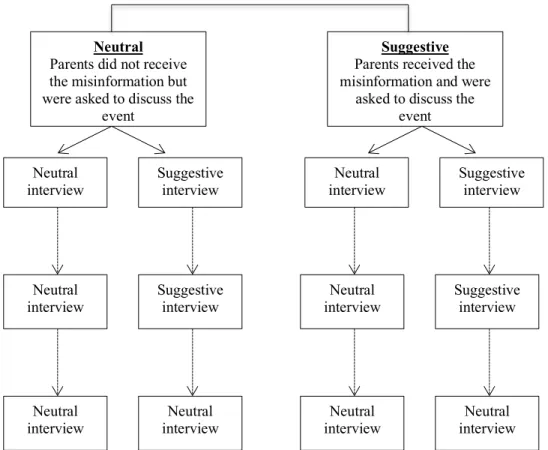
A diagram of the project design1 is presented in Figure 1. The participating children took part in a staged archeological dig at their preschools, and in the week following this experience their parents talked with them about the event. Half of the parents were provided with minor pieces of incorrect information prior to their conversations (Suggestive Condition). The
remaining parents did not receive this additional misleading information (Neutral Condition). All conversations were recorded for analysis. The children were subsequently interviewed about their experience after 1- and 2-week delays in either a neutral or suggestive manner. All children received a final neutral interview after a 3-week delay. Dyads received a $20 gift card and selection of three children’s books for their participation.
Procedure
Staged Event. The participating children took part in the fabricated archeological dig in
groups ranging in size from 4 to 6 children. Using procedures adapted from those developed by Principe and Ceci’s (2002), a fictitious archeologist, Dr. Diggs, assisted the children in using plastic tools to retrieve pretend artifacts (e.g., coins, jewels, dinosaur bones) from blocks
constructed from mortar mix and play sand. Each of the recovered artifacts were labeled,
including two target artifacts – a treasure map and dinosaur egg. Specifically, Dr. Diggs pointed out how special these two artifacts are and warned the children to (a) not spill anything on the map because the ink might smear and render it illegible, and (b) not drop the dinosaur because it might crack. Following the archeological dig, the children helped to place all artifacts in a pretend museum. A script for the staged event is included in Appendix E.
Parent-Child Conversation. Approximately 3 days after the staged event, each parent
received a letter asking him or her to question his or her child about the archeological dig. Each letter contained a brief description of activities. Half of the parents (Suggestive Condition) were also provided with minor pieces of misinformation about the target events (e.g., that Dr. Diggs is clumsy and may have spilled something on a treasure map as well as dropped a dinosaur egg, when in reality she did not do so). In contrast, parents in the Neutral Condition were not provided with this suggestion. All conversations were recorded with digital voice recorders provided to families. The parent letter is included in Appendix F.
Memory Interviews. After 1- and 2-week delays, research assistants used a
hierarchically structured protocol to interview children about the staged event in either a neutral or suggestive manner. Then, after a 3-week delay, unfamiliar research assistants conducted a final neutral interview with all children. These interviews were video recorded. A script for the interview is included in Appendix G.
Debriefing. At the conclusion of the study, parents in the Suggestive Condition received
a letter that outlined the purpose of the study and the procedures used. All questions were
Coding
Parent-Child Conversation. Each parent-child conversation was transcribed verbatim
from audio recordings. The resulting transcripts were coded for the parents’ conversational style and children’s unique memory contributions. Furthermore, the parents’ false descriptions of the target events, as well as the accuracy of children’s memory reports were coded.
Parents’ conversational style was coded on the basis of a structural-functional coding scheme developed by Reese and colleagues (1993). Each parental utterance consisting of a subject-verb proposition was coded for the presence or absence of open-ended questions, yes/no elaborative questions, and elaborative statements. An elaborative score was calculated by
summing the occurrence of each type of elaborative utterance (i.e., open-ended questions, yes/no elaborative questions, and elaborative statements). Elaborations that include information about the target events were noted as indicators of parents’ provision of misinformation to their children (Principe, DiPuppo, & Gammel, 2012).
the target features and events were also summed and coded as accurate (e.g., “Dr. Diggs just held the dinosaur egg), inaccurate (e.g., “Dr. Diggs dropped the dinosaur egg.) or ambiguous (e.g., “It didn’t crack because it is a dinosaur egg.”). Furthermore, children’s responses to
parents’ descriptions of the target events was coded as either acquiescence or denial. Instances of acquiescence necessitate children’s inaccurate agreement with parents’ questions or statements, whereas denials entail the accurate rejection of parents’ misinformed contributions to the conversation.
Two research assistants coded 20% of the parent-child conversation transcripts. For each variable, Cohen’s Kappa was calculated as an indicator of inter-rater reliability. Cohen’s Kappa ranged from .85 for parents’ elaborative score to .94 for the number of dig-related features recalled by children, indicating that inter-rater reliability was strong.
Memory Interviews. Child interviews were transcribed verbatim from video recordings.
Each child utterance consisting of a subject-verb proposition was coded for unique memory information and accuracy (Principe et al., 2013). The number of dig-related features correctly recalled were summed as indicators of children’s memory for the event. The number of target events incorrectly recalled (i.e., Dr. Diggs spilling something on a treasure map and/or dropping
the dinosaur egg) was summed as an indicator of children’s suggestibility. Furthermore, the accuracy of children’s statements was characterized by utterances implying the occurrence of the target events. These statements were classified as verbatim, constructive, or fantastical.
when Dr. Diggs dropped it.”). Fantastic statements contained events that could not have occurred in reality (e.g., “A baby dinosaur crawled out of the egg when it accidently cracked.”).
Two research assistants coded 20% of the interview transcripts. For each variable, Cohen’s Kappa was calculated as an indicator of inter-rater reliability. Cohen’s Kappa ranged from .90 for the number of target events incorrectly recalled to .95 for the number of dig-related features recalled by children, indicating that inter-rater reliability was strong.
RESULTS
Overview
In order to determine if parents’ suggestions permeate their conversations with children, the impact of parent condition (i.e., Neutral vs. Suggestive) on parents’ and children’s
contributions to the parent-child conversation is first examined (Aim 1). Second, consideration is given to children’s memory performance during the final interview. Specifically, the joint
influence of parent (i.e., Neutral vs. Suggestive) and interviewer (i.e., Neutral vs. Suggestive) condition on children’s memory performance during the final interview is examined (Aim 2). Next, consideration is given to children’s memory reports across interviews, such that the impact of (i.e., Neutral vs. Suggestive) and interviewer (i.e., Neutral vs. Suggestive) condition on
children’s memory reports is explored as a function of time (Aim 3). In order to determine if the ways in which parents discuss the past have implications for children’s remembering,
Preliminary Analyses
Prior to conducting the analyses necessary to explore the aims of the study, summarized above, children’s recall of the target events across interviews was examined as a function of potential confounding variables As can be seen in left column of Table 1, the potential confounding variables included child gender, child age, child race, parent age, parent gender, parent race, the confederate who played Dr. Diggs, and the final interviewer. The results indicated that there was no association between children’s memory performance across interviews and any of the potential confounding variables. Therefore, the data were collapsed over these variables for subsequent analysis.
Aim 1: Parent-Child Conversations
The first aim of the study was to characterize the impact of parent condition on parents’ and children’s contributions to the parent-child conversation. All parents were instructed to begin their conversations with children by making a general request (e.g., “Tell me about what
happened during the archeological dig at your school.”). Parents in the Suggestive Condition were also asked to follow up children’s responses to their initial open-ended probe with specific questions about the target events. More specifically, they stated: “I heard that Dr. Diggs was clumsy. Tell me about how Dr. Diggs spilled something on a treasure map.” Then, they added: “I also heard that Dr. Diggs dropped a dinosaur egg. Tell me about how Dr. Diggs dropped a
dinosaur egg.” Below, the impact of parent condition on parents’ and children’s contributions to their conversation about the archeological dig is examined.
Number of Parent Utterances. On average, the parents contributed 61.88 (SD=41.42)
between parents in the Suggestive and Neutral conditions, t(64)=-.27, p=.80. Parent condition, therefore, did not impact the overall “talkativeness” of parents.
Number of Parent Utterances about Target Events. The parents contributed an
average of 8.20 (SD=10.55) utterances about the target events (i.e., subject-verb propositions implying that Dr. Diggs spilled something on the treasure map and dropped a dinosaur egg) to their conversations about the archeological dig. Specifically, parents in the Suggestive Condition made an average of 15.91 (SD=9.63) statements about the target events, whereas parents in the Neutral Condition did not contribute any utterances about the target event, t(64)=-9.63, p<.001. The parent condition manipulation was thus successful.
Number of Child Utterances. The children contributed an average of 51.06 (SD=36.28)
utterances about the archeological dig (e.g., “I used special tools” or “I had a lot of fun with Dr. Diggs”) when talking with their parents. The number of children’s utterances about the staged event did not differ between children whose parents were in the Suggestive versus Neutral Conditions, t(64)=-.01, p=.99. From this, it can be concluded that parent condition did not influence the overall “talkativeness” of children.
Number of Features Recalled by Children. Children recalled an average of 6.37 (SD=