1.4
Isotopes, Radioisotopes, and
Atomic Mass
Every year, doctors worldwide request millions of diagnostic medical tests. These tests involve searching for clues within the human body that will help to prevent or treat various diseases (Figure 1). Radioactive substances are widely used in these diagnostic procedures. For example, iodine-131 can be used to diagnose and treat thyroid cancer, and technetium-99 is used in a variety of diagnostic tests.
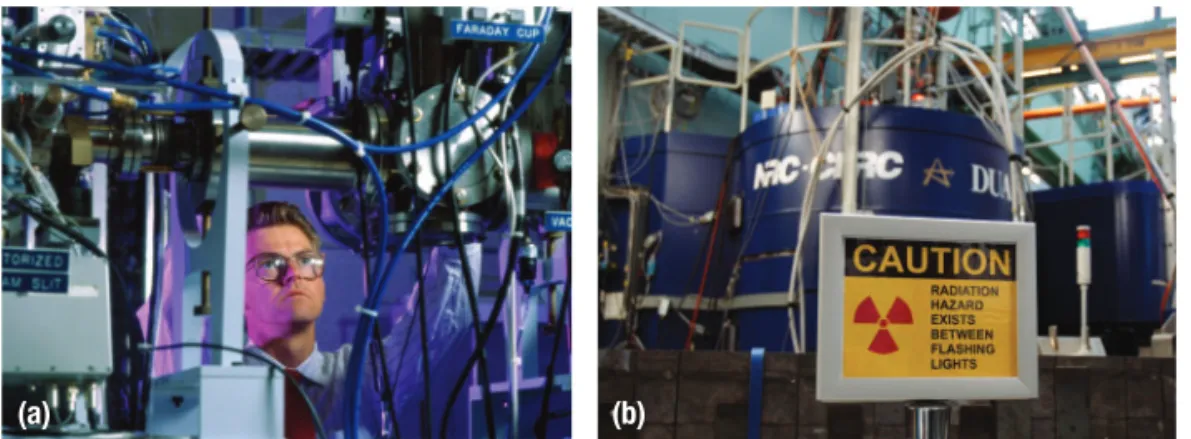
Historically, Canada has played an important role in supplying these critical mate-rials to the world. Chalk River Laboratories, a Canadian nuclear research facility northwest of Ottawa, has provided such materials since its start-up in 1962 (Figure 2). However, these nuclear facilities are aging and recently experienced safety problems. These factors have led to facility closures. Canada’s leadership role in this industry is now in jeopardy.
What are these radioactive substances? Why are they so important for medical procedures? Why is it so difficult to supply them safely? What are their risks and benefits?
Figure 2 (a) Chalk River Laboratories, Ontario (b) The aging nuclear reactor at Chalk River
(a) (b)
Isotopes and Isotopic Abundance
Isotopes are atoms of the same element that have different numbers of neutrons. The name “isotope” is based on Greek words meaning “at the same place.” It was first pro-posed by Margaret Todd, a Scottish physician. Todd was having a conversation with a colleague of Ernest Rutherford’s, Frederick Soddy, about how there seemed to be varia-tions within elements. Soddy adopted the term and went on to prove the existence of isotopes for some elements. He was awarded the Nobel Prize in Chemistry in 1921.
Scientists use mass number—the total number of protons and neutrons in the nucleus—to distinguish between different isotopes for a given element. For example, carbon-12 and carbon-14 are two different isotopes of carbon. Both isotopes have 6 protons and 6 electrons, but they differ in their number of neutrons: carbon-12 has 6 neutrons and carbon-14 has 8 neutrons. You read in Section 1.2 that the atomic mass unit, u, is defined as 121 the mass of a carbon-12 atom. Scientists had to be this
specific because carbon has three naturally existing isotopes, the third one being carbon-13.
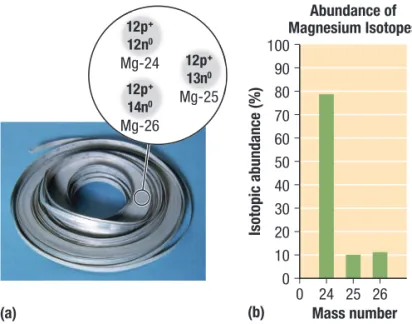
Different elements have different numbers of isotopes. These specific isotopes exist in different relative abundances. For example, natural magnesium is a mixture of three isotopes: magnesium-24, magnesium-25, and magnesium-26 (Figure 3). On average, a sample of natural magnesium consists of 78.7 % magnesium-24, 10.1 %
Radiologists are healthcare professionals who use various imaging technologies to diagnose and treat disease. These technologies make use of radioisotopes. To learn more about radiology as a career,
CAREER LInK
go To nElSon SCiEnCE Figure 1 Medical imaging technologies can help doctors diagnose problems.
Figure 6 A mass spectrometer – + detector plate accelerating plates electron gun (ionizing gun) sample gas ion beam magnet magnet
ion source analyzer detector
Figure 5 A lab technician works at a mass spectrometer.
Th e percentage of an isotope in a sample of an element is known as the isotopic abundance. As an analogy, consider a class made up of 30 students: 16 girls and 14 boys. Th e abundance of girls is 16
30 = 53 % and the abundance of boys is 1430 = 47 %.
Scientists use a special instrument known as a mass spectrometer to identify iso-topes and their respective abundances (Figure 5). Mass spectrometers are very useful in chemistry. Th ey can perform a variety of analyses, such as identifying proteins, detecting atmospheric pollutants, and drug testing in sports. Mass spectrometers have even been sent into space.
A simple type of mass spectrometer is composed of three main sections: the ion source, the analyzer, and the detector (Figure 6). Th e sample is injected into the spectrometer and vaporized by heat. Th e sample is then ionized and accelerated by an electric fi eld. Th e fast-moving ions next pass through a magnetic fi eld, where they are defl ected. Th e magnetic fi eld defl ects smaller isotopes more than larger isotopes. A detector plate senses the relative abundance of each isotope and a computer deter-mines the mass and abundance of each isotope.
Figure 3 Isotopes have different numbers of neutrons and therefore different masses. This model shows two of the isotopes of magnesium.
n0
n0 n0 n0 n0 n0 n0 n0 n0 n0
n0 n0 n0 p n0
n0
Mg-25 nucleus Mg-24 nucleus
p n0 p n0 p n0 p
n0 p
n0 p n0 p n0 p n0 p n0 p
n0 p
p p p p p
p
p p p p p
p
12 p
13 n0 mass 25 u
12 p
12 n0 mass 24 u
mass spectrometer a measuring
instrument used to determine the mass and abundance of isotopes
Radioisotope lab technicians work in a variety of settings, operating many types of instruments and equipment. If this career appeals to you, CAREER LInK
go To nElSon SCiEnCE
isotopic abundance the percentage of a given isotope in a sample of an element
Figure 4 Naturally occurring magnesium contains three isotopes: Mg-24, Mg-25, and Mg-26.
Abundance of Magnesium Isotopes
Isotopic abundance (%)
Mass number 0 40 60 20 10 30 70 50
Radiation and Radioisotopes
As we have seen, some elements have more than one isotope. Some isotopes are stable; others break apart easily. Th e diff erence in stability is due to the composition of their nuclei. For example, oxygen has three naturally occurring isotopes, O-16, O-17, and O-18, all of which are stable. Scientists have been able to make 10 additional isotopes of oxygen, all of which are unstable and emit nuclear radiation.
nuclear Radiation
Radioactive substances spontaneously break apart. Th is disintegration is known as radioactive decay. As some isotopes decay, they emit nuclear radiation in the form of tiny particles or energy. Th e three most common types of nuclear radiation are alpha particles, beta particles, and gamma rays. Each type of nuclear radiation has a diff erent ability to penetrate through matter (Figure 7). An alpha particle, a, has the same struc-ture as the nucleus of a He-4 atom—2 protons and 2 neutrons—and a charge of +2. Alpha particles are blocked by paper. A beta particle,b,is a negatively charged electron
that can pass through paper but not through aluminum. A gamma ray, g, is a form of
high-energy electromagnetic radiation. Gamma rays have no mass and travel at the speed of light. Th ey can penetrate most substances but are blocked by lead.
radioactive decay the spontaneous disintegration of unstable isotopes
nuclear radiation energy or very small particles emitted from the nucleus of a radioisotope as it decays
alpha particle a product of nuclear decay emitted by certain radioisotopes; a positively charged particle with the same structure as the nucleus of a helium atom
beta particle a product of nuclear decay emitted by certain radioisotopes; a negatively charged particle identical to an electron
gamma ray a form of high-energy electromagnetic radiation emitted by certain radioisotopes
radioisotope an isotope that
spontaneously decays to produce two or more smaller nuclei and radiation
radioactive having the potential to emit nuclear radiation upon decay
Radioisotopes
Isotopes that decay to produce nuclear radiation are known as radioisotopes. All of the isotopes of uranium are radioisotopes; there are no stable uranium isotopes. Th is is one of the reasons that governments place so many safeguards and restrictions on any proposed uranium mine. All radioisotopes are radioactive, which means that they all emit radiation as they decay.
Nuclear chemistry is the branch of chemistry that deals with the nucleus and radioactivity. Th e isotopes that are used for medical treatments or diagnostic proce-dures are all radioisotopes. Iodine-131, for example, is a radioisotope of iodine that is used to treat an overactive thyroid gland. Other uses for radioisotopes include smoke detectors (americium-241), food irradiation (cobalt-60), and archaeological dating (carbon-14 and potassium-40).
determining the Atomic Mass of Elements
Look at the periodic table and fi nd the atomic mass for chlorine. It is usually written below the element’s name and, as you will notice, it is not a whole number. Th e atomic mass for chlorine is 35.45 u. What does this number represent? Why is it not a whole number? How does one go about determining this value? How is this value useful? Figure 7 The three types of radiation have different penetrating abilities.
� alpha
� beta
� gamma
paper lead aluminum
Nuclear chemistry is a fascinating and rewarding fi eld of study. If you would like to fi nd out more about the education and work of a nuclear chemist,
CAREER LInK
The Nuts and Bolts of Atomic Mass (p. 42)
You will use a model to represent the isotopes of an element, and calculate its atomic mass.
investigation 1.4.1
Tutorial
1
Calculating Atomic Mass
We can illustrate the difference between non-weighted average and weighted average with a simple example. Imagine that we want to find the average height of a group of eight people: Antonia (who is 150 cm tall), Shirley (170 cm), and Gurpreet (160 cm), plus Ahmed and Ameer (identical twins: 200 cm), and Rachel, Emily, and Elizabeth (identical triplets: 180 cm).
average height5 150 cm1170 cm1160 cm121200 cm2 131180 cm2
8
51420 cm
8
5178 cm (rounded to 3 significant figures) Notice that the following calculation would be incorrect.
average height5 150 cm1170 cm1160 cm1200 cm1180 cm
5
5860 cm
5
5172 cm
Why is this incorrect? Because it does not take into account the fact that there are two people who are 200 cm tall and three people who are 180 cm tall. When you calculate a weighted average, you must account for a greater abundance of people of certain heights.
Consider the actual abundance (as a percentage) of people with different heights. 1
8 (or 12.5 %) of the people are 150, 160, and 170 cm tall; 28 (or 25 %) of the people are 200 cm tall; and 38 (37.5 %) of the people are 180 cm tall. The average could also be determined by the following calculation:
average height 5 12.5 % (150) 1 12.5 % (160) 1 12.5 % (170) 1 25 % (200) 1 37.5 % (180)
5 178 cm
FIndIng THE AToMIC MASS gIvEn ISoToPIC ABUndAnCE
We can use the process above to calculate the weighted average of all the isotopes for a certain element. We must consider both the mass and the abundance of each of the different isotopes of an element. This calculation gives the atomic mass.
When solving problems related to atomic mass, use the GRASS problem-solving format and the general equation for atomic mass:
atomic mass 5 % abundance of isotope 1 (mass of isotope 1) 1
% abundance of isotope 2 (mass of isotope 2) 1 …
Working with Weighted Averages
Whether you realize it or not, you work with weighted averages all the time. Your final mark in a course is usually determined by calculating a weighted average of your semester work (70 %) and your final summative assessment and/or culminating activity (30 %). lEARning TIP
atomic mass the weighted average of the masses of all the naturally occurring isotopes of an element
Sample Problem 1:
Calculating Atomic Mass For 3 Isotopes
Calculate the atomic mass of magnesium. Magnesium-24, magnesium-25, and magnesium-26 have isotopic abundances of 78.7 %, 10.1 %, and 11.2 % respectively. Given: atomic mass and abundance of the 3 isotopes of magnesiumRequired: atomic mass of magnesium Analysis:
atomic mass 5 % abundance of isotope 1 (mass of isotope 1) 1
% abundance of isotope 2 (mass of isotope 2) 1 … Solution:
atomic mass 5 78.7 % (24 u) 1 10.1 % (25 u) 1 11.2 % (26 u) 5 24.3 u
Think about the answer obtained. Confirm that the answer makes sense. Round it to the appropriate number of digits.
Statement: The atomic mass of magnesium is 24.3 u.
Sample Problem 2:
Calculating Atomic Mass For 5 Isotopes
Germanium has the following isotopic composition. Calculate the atomic mass of germanium.
20.5 % Ge-70
27.4 % Ge-72
7.8 % Ge-73
36.5 % Ge-74
7.8 % Ge-76
Given: atomic mass and abundance of the 5 isotopes of germanium Required: atomic mass of germanium
Analysis:
atomic mass 5 % abundance of isotope 1 (mass of isotope 1) +
% abundance of isotope 2 (mass of isotope 2) + … Solution:
atomic mass 5 20.5 % (70 u) 1 27.4 % (72 u) 1 7.8 % (73 u) 1 36.5 % (74 u) 1
7.8 % (76 u)
5 14.35 1 19.73 1 5.69 1 27.01 1 5.93 [extra digits carried]
5 72.71 u
Think about the answer obtained. Confirm that the answer makes sense. Round it to the appropriate number of digits.
Statement: The atomic mass of germanium is 73 u.
Practice
1. Calculate the atomic mass of each of the following elements, given these naturally occurring isotopes and abundances: K/U T/I
(a) Neon: Ne-20 (90.5 %), Ne-21 (0.3 %), Ne-22 (9.2 %) [ans: 20 u]
Home inspectors visit homes and check them for safety and soundness. To fi nd out more about this career, CAREER LInK
go To nElSon SCiEnCE
Radon is a colourless, odourless, radioactive noble gas. It is produced when naturally occurring uranium undergoes radioactive decay. Radon can collect in confi ned areas of the home and contribute to our daily dose of radiation (Figure 8). This radiation increases a person’s risk for lung cancer. Home inspectors will test homes for radon gas.
1. Research the potential sources of radon in a home.
2. Learn more about the geology of your local area and whether the presence of uranium might mean high levels of radon.
A. Do you think there should be more public awareness about radon in homes? If so, suggest methods of promoting this. T/I A
B. In your opinion, should home inspectors test for radon levels in houses on the market? Support your position. T/I A
Radon in the Home
Research
This
Skills: Researching, Analyzing, Evaluating, Defending a Decision, Communicating SKILLS HANDBOOK A5.1
1.4
Questions
1. There are three isotopes of hydrogen: hydrogen-1, hydrogen-2 (known as deuterium), and hydrogen-3 (known as tritium). Create a table listing the number of protons and neutrons in an atom of each of hydrogen’s isotopes. T/I C
2. The atomic mass of chlorine is 35.45 u. Is it possible for any single atom of chlorine to have a mass number of exactly 35.45? Explain. K/U
3. Silver exists in nature as two isotopes: Ag-107 and Ag-109. If the average atomic mass of silver is 107.9 u, which isotope is more abundant? Explain your answer K/U
4. Silicon naturally exists as three isotopes (Table 1). Determine the atomic mass of silicon. T/I
Table 1 Percentage Abundance of Three Silicon Isotopes
Isotope % abundance
Si-28 92.23
Si-29 4.67
Si-30 3.10
5. Imagine an element, X, that has two naturally occurring isotopes. If you know the mass and the percentage abundance of one of the isotopes, how would you determine the percent abundance of the other isotope? Describe your problem-solving process. T/I C
6. The atomic mass of carbon is 12.0107 u. It exists naturally as three isotopes: C-12, C-13, and C-14. Based on your understanding of isotopes and atomic mass, determine which isotope would have the greatest abundance. Explain your choice. T/I C
7. Naturally occurring chlorine consists primarily of two isotopes: Cl-35 and Cl-37. Determine the number of protons, electrons, and neutrons for an atom of each isotope. T/I
8. Distinguish between an isotope and a radioisotope. K/U
9. Potassium naturally consists of 93.10 % K-39 and 6.90 %
10. Research three different careers in which people handle radioisotopes (Figure 9). List safety precautions they take to ensure minimal exposure to radiation. T/I A
Figure 9 Many medical careers involve radioisotopes.
11. In 1951, Canadian scientists developed a revolutionary new medical procedure known as the Cobalt bomb. Research this technology and compare its risks and benefits. T/I A
12. A Geiger counter is a device that is used to detect radiation from radioisotopes. Research how a Geiger counter works and list three specific circumstances in which a Geiger counter would be useful. T/I A
13. The town of Port Hope in Ontario is home to Cameco (previously named Eldorado), a major producer of uranium. In the 1940s, Eldorado supplied weapons-grade uranium to the United States. The radioactive waste from the mine was used as backfill for ravine properties in Port Hope. The town is still dealing with the radioactive contamination today. Investigate the present situation in Port Hope and what Cameco has done to help the situation. T/I A
1.4
Summary
• Elements can exist as a variety of isotopes.
• Isotopes are atoms of the same element that have different numbers of neutrons. • Radioisotopes are unstable isotopes. They spontaneously undergo radioactive
decay. During decay they produce other elements, radiation, and energy. • There are three types of radiation produced during radioactive decay: alpha
radiation, beta radiation, and gamma radiation.