William L Masterton Cecile N. Hurley
http://academic.cengage.com/chemistry/masterton
Edward J. Neth • University of Connecticut
Chapter 5
Outline
• Measurements on Gases
• The Ideal Gas Law
• Gas Law Calculations
• Stoichiometry of Gaseous Reactions
• Gas Mixtures: Partial Pressures and Mole Fractions
• Kinetic Theory of Gases
Introduction to Gases
• Gases have been known to exist since ancient times
• The Greeks considered gases one of the four fundamental elements of nature
• 18th Century
• Lavoisier, Cavendish and Priestley: Air is primarily nitrogen and oxygen, with trace
Current Interest
• Gases in the news
• Ozone depletion in the stratosphere
State Variables
• State variables describe the state of a system under study
• To specify the state of a gas, four quantities must be known
• Volume
• Amount
• Temperature
Volume, Amount and Temperature
• A gas expands uniformly to fill the container in which it is placed
• The volume of the container is the volume of the gas
• Volume may be in liters, mL, or cm3
• The temperature of a gas must be indicated on the Kelvin scale
• Recall that K = °C + 273.15
Pressure
• Pressure is force per unit area
• In the English system, pounds per square inch or psi
The Barometer
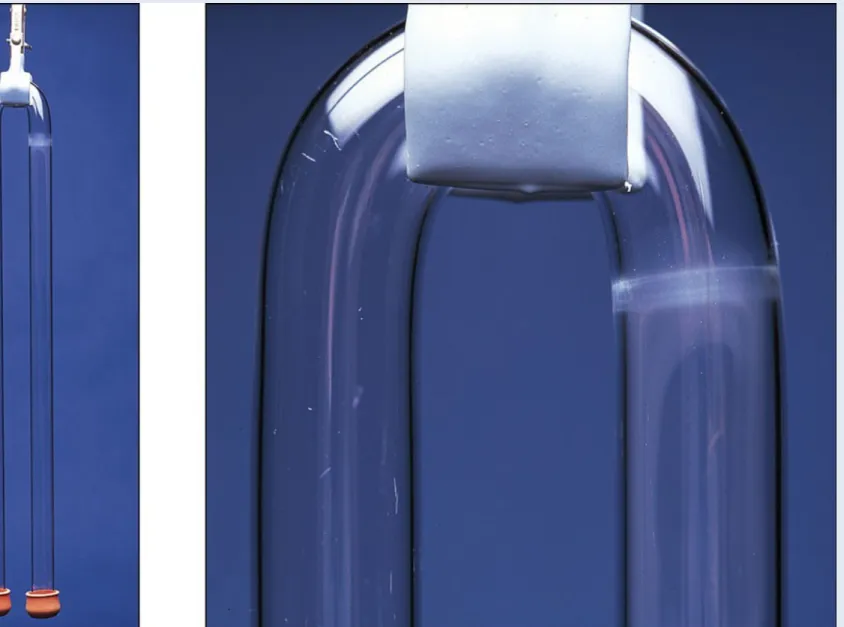
• The barometer measures pressure in terms of the height of a column on liquid mercury
• The atmosphere exerts a force on a pool of mercury, causing it to rise
• One standard atmosphere of pressure is a column of mercury 760 mm high
Gas Pressure Measurement
• The manometer measures gas pressure by differential
• The height of the column of liquid is proportional to the pressure
Other Units of Pressure
• 1 atm = 14.7 psi
• 1 atm = 760 mmHg
• The mmHg is also called the Torr after Torricelli, inventor of the barometer
• SI unit of measurement, the pascal (Pa)
• 1 Pa is the pressure exerted by a 0.1 mm high film of water on the surface beneath it
• The bar = 105 Pa
The Ideal Gas Law
1. Volume is directly proportional to amount
• V = k1n (constant T, P)
2. Volume is directly proportional to absolute temperature
The Ideal Gas Law
3. Volume is inversely proportional to pressure
The Ideal Gas Law
• Collect k1, k2 and k3 into a new constant
• PV = nRT
• R is the gas constant
• Units of R:
Standard Temperature and Pressure
• STP
• 1 atm P
• 273 K
Gas Law Calculations
• Final and initial state problems
• Single-state problems
Final and Initial State Problems
• In this type of problem, a gas undergoes a change from its initial to its final state
Single state problems – Calculating P, V, n or T
• In this type of problem, one of the state variables is not known
• The ideal gas equation can be solved for the unknown
Molar Mass and Density
• Density = mass/volume
• Recall that the molar mass has units of grams (mass) per mole
• Now, look at the ideal gas law:
• The number of moles appears
• Moles, n, can be expressed as mass/MM
Density of Gases
• Density is an extensive property
• Does not depend on the amount of substance
• Density of a gas does depend on
• Pressure
• Temperature
Stoichiometry in Gaseous Reactions
• Gases can participate as reactants or products in any chemical reaction
Gas Mixtures: Partial Pressures and Mole Fractions
• The ideal gas law applies to all gases, so it applies to mixtures of gases as well
• A new term is needed for a mixture of gases
• Partial pressure, the part of the total pressure due to each gas in the mixture
Dalton’s Law of Partial Pressures
• The total pressure of a gas mixture is the sum of the partial pressures of the gases in the mixture
• Consider a mixture of hydrogen and helium:
• P H2 = 2.46 atm
• P He = 3.69 atm
Vapor Pressure
• The vapor pressure of a substance is the pressure of the gaseous form of that substance
• Vapor pressure is an intensive property
Collecting a Gas Over Water
• When a gas is collected over water, the total
Wet Gases
• P H2O is the vapor pressure of water
• P H2O is dependent on temperature
• Consider H2 gas collected over water:
2
2
O
H
H
tot
P
P
Partial Pressure and Mole Fraction
• One can rearrange the Ideal Gas Law for a mixture containing two gases, A and B
Mole Fraction
• The mole fraction of gas A is the number of moles of A divided by the total number of moles of gas in the mixture
Dalton’s Law and Mole Fraction
• The partial pressure of gas A is its mole fraction times the total pressure
tot
A
A
X
P
Kinetic Theory of Gases
The kinetic-molecular model
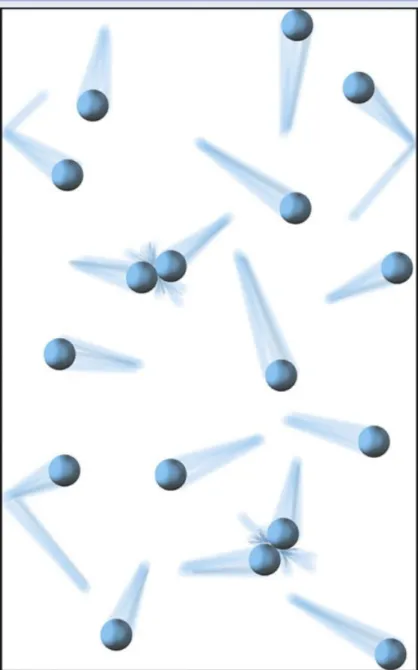
1. Gases are mostly empty space. The total volume of the molecules is small
2. Gas molecules are in constant, random motion 3. Collisions of gas particles are elastic
New Variables
• N, the number of gas particles
• m, the mass of the gas particle
Pressure and the Molecular Model
• Notes:
• N/V is the concentration of gas particles
• mu2 is a measure of the energy of the collisions
Average Kinetic Energy of Translational Motion
• Notes:
• R is the gas constant
• T is the Kelvin temperature
Results from Kinetic Energy of Translational Motion
• At a given temperature, all molecules of all gases have the same average kinetic energy of
translational motion
Average Speed, u
• The average speed is proportional to the square root of the Kelvin temperature
• The average speed is proportional to the inverse of the square root of the molar mass of the gas
Effusion of Gases
• Diffusion
• Gases move through space from a region of high concentration to a region of low concentration
• You can smell an apple pie baking as the particles responsible for the odor diffuse through the room
• Effusion
• Gas particles will escape through a small hole (orifice) in a container
Graham’s Law of Effusion
• The rate at which gas B escapes divided by the rate at which gas A escapes is equal to the square root of the ratio of the molar mass of gas A to gas B
Gaseous Effusion and the Manhattan Project
• Effusion was used to separate U-238 from U-235
• Recall that isotopes have the same chemical properties, and so cannot be separated by chemical means
• The mass of 238UF
6 is heavier than the mass of 235UF6
• Very small difference in mass
• 235UF
Distribution of Molecular Speeds
• At a given temperature, gas particles will have a set of speeds, not a single fixed value for speeds
Distribution of Molecular Speeds
• Plot the fraction of molecules having a given speed vs. the molecular speed
• Curve that results has a maximum in the number of molecules with the given speed
• Most probable speed
• As the temperature increases
• The maximum shifts toward higher speed
Real Gases
• Recall that the molar volume of a gas at STP is 22.4 L from the ideal gas law
• There are deviations from this volume that depend on the gas being studied
Liquefaction of Gases
• All gases can be liquefied
• Lowering the temperature
• Increasing the pressure
• When a gas is liquefied, the attractive forces between gas particles becomes significant
Two Factors for Real Gases
• Two factors are important to real gases
1. The attractive forces between the gas particles 2. The volume of the gas particles
Attractive Forces
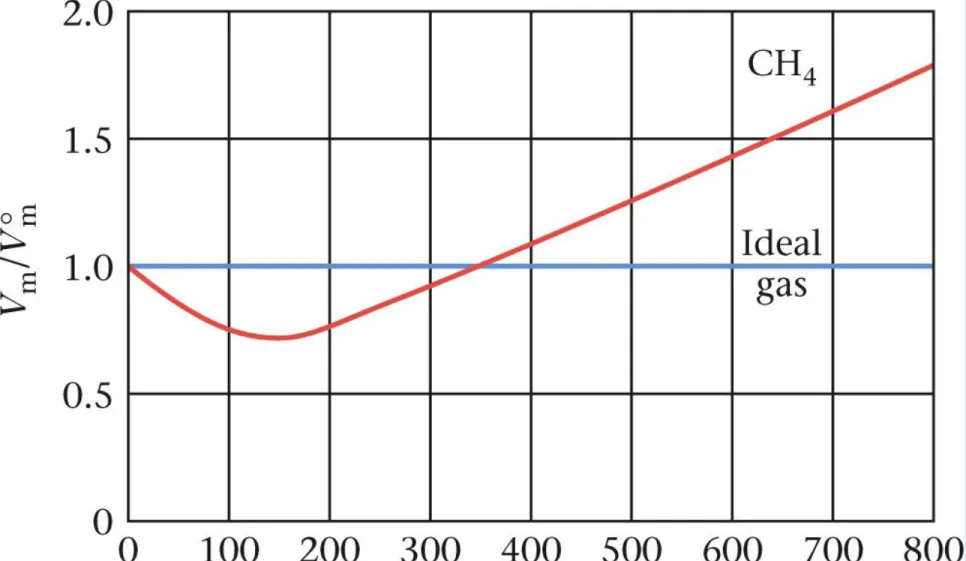
• Note that the observed molar volume for gases is lower than that calculated by the ideal gas law
• The forces between particles pull the particles together
• The volume occupied by the gas is then decreased
Particle Volume
• Consider a plot of the observed molar volume/ideal molar volume for methane vs. pressure
• Up to 150 atm, the deviation from ideality steadily increases
Key Concepts
1. Conversion between P, V, T and n 2. Use of the ideal gas law to:
• Solve initial and final state problems
• Solve single-state problems
• Calculate the density of a gas
• Relate amounts of gases in reactions 3. Use Dalton’s Law
4. Calculate the speed of gas molecules