UN
CO
RR
EC
TE
D
PR
OO
F
DOUBTS AND DOGMATISM IN CONFLICT BEHAVIOUR*
2 SidarthaGordonand AlessandroRiboni
We consider a conflict under incomplete information where two opponents fight to impose their preferred policy. Before the conflict, one opponent (the agent) trusts the information received by his principal. Under some conditions, the principal induces hawkish attitudes in the agent: the agent never doubts the optimality of his preferred policy, conflicts are violent, and bad decisions are sometimes made. Under other conditions, the agent believes that his opponent may be right, even when all evidence indicates that the policy preferred by the opponent is certainly suboptimal. In this case, the agent adopts dovish attitudes and conflicts are less violent.
I believe that we can avoid violence only in so far as we practice this attitude of reasonableness in dealing with one other in social life. [This attitude] may be characterised by a remark like this: I think I am right, but I may be wrong and you may be right.
(Popper, 1963, p. 357)
It is hard to disagree with the view that many ideological conflicts are violent precisely because individuals, often contrary to the evidence, deny that they ‘may be wrong and that [the opponent] may be right’.
The possibility of belief manipulation in conflict situations has received little scrutiny by economists but has been amply documented by the psychological literature. Several studies point out that conflicts are exacerbated when individuals erroneously believe that the opponents’ interests are directly opposed to their own when, in fact, they might be compatible.1 A closely related bias is the hawkish bias (Kahneman and Renshon, 2009), which makes individuals see threats as more dreadful than reality would suggest. Such faulty perceptions are usually the result of distortions in the way individuals search and process information (Pinkley et al., 1995) as well as of propaganda campaigns by governments or other political groups.2
The hawkish bias is not the only bias that is observed in conflict situations. According to the psychological literature, individuals may sometimes underestimate, rather than overestimate, external threats. Such dovish attitudes are often entertained by minority
* Corresponding author: Alessandro Riboni, D!epartement d’Economie,! !Ecole Polytechnique, 91128. Palaiseau Cedex, France. Email: [email protected].
We thank Andrea Galeotti (the Editor) and two anonymous referees for insightful comments. We benefitted from comments by Vincent Boucher, Juan Carillo, Jorge Fernandez, Mike Golosov, Frederic Koessler, Johannes Horner, Massimo Morelli, Andy Skrzypacz, J€ €orgen Weibull and audiences at various seminars. This research was partly carried out while the second author was visiting the Einaudi Institute for Economics and Finance (EIEF) and LUISS in Rome. Their generous hospitality is gratefully acknowledged. The second author has received financial support of the Social Sciences and Humanities Research Council of Canada and Investissements d’Avenir (ANR-11-IDEX-0003/Labex Ecodec/ANR-11-LABX-0047).
1 Such bias is known in the psychological literature as fixed-pie perception, (Bazerman and Neale, 1983;
Thompson and Hastie, 2000). 4
2 For instance, Yanagizawa-Drott (2014) finds a positive effect of hate speech over the radio on casualties
from the genocide in Rwanda in 1994. Gentzkow and Shapiro (2004) investigate the role of media in strengthening an anti-American bias in the Arab population.
1 2 3 4 5 6 7 8 9 10 11 12 13 14 15 16 17 18 19 20 21 22 23 24 25 26 27 28 29 30 31 32 33 34 35 36 37 38 39 40 41 42 43 44 45 46
UN
CO
RR
EC
TE
D
PR
OO
F
groups while coping with oppression from socially or economically dominant groups.3 For instance, various studies argue that especially during slavery, African Americans learned that passivity towards their oppressors was a necessary survival strategy. Similarly, governments may resort to appeasement to defuse conflicts. The most well-known historical example is the appeasement strategy pursued by the British government towards Germany before World War II—a strategy that was justified by the conviction that German territorial aspirations were partly legitimate, as well as by an underestimation of the German threat.4The goal of this article is to investigate under what conditions the participants in a conflict adopt either dovish or hawkish attitudes. This subject matter should be of interest to economists for at least two reasons. First, individuals’ attitudes in a conflict affect the amount of wasted resources in the fight and, consequently, may have consequences on economic development (Collier et al., 2003). Second, to the extent that such attitudes stem from distortions in the way individuals process information, we expect them to be associated with bad policy decisions, which are obviously detrimental to welfare.
We study a game of conflict where two individuals (or two groups of individuals) fight in order to impose their preferred policy. A key assumption is that the preferred policy of one opponent depends on the realised state of nature. There are two possible states: in one state, denoted as state of conflict, the policies that maximise the utilities of both opponents are different, while in the other state, denoted as state of alignment, the opponents’ preferences coincide. Crucially, we assume that the current state is not observable by the two opponents. This implies that the individual with state-dependent preferences cannot beex antecertain about the optimality of the policy that he is trying to impose. Ex ante, he entertains the possibility that the policy preferred by the opponent might be the ‘right’ one.
Before entering the conflict, the individual with state-dependent preferences naively relies on the information provided by an advisor (the principal) who shares his same preferences over policies. The principal (e.g. a parent or political leader) is characterised by an altruism parameter which measures the extent to which he internalises the effort cost exerted by the agent in the conflict. The principal is assumed to be better (although not necessarily perfectly) informed than his agent about the current state. In particular, the principal receives one of two signals: one signal reinforces the prior belief of being in a state of conflict, while the other signal goes against this prior.
Whether or not the principal is truthful depends on two key parameters. First, manipulation of information does not take place when the prior probability of being in a state of conflict is sufficiently low. Since we expect that prior probability to be high in a heterogeneous society, this suggests that truth-telling is more likely in homogenous societies. Second, we show that the principal is truthful when Nature’s signals are more precise.
3
See Lewin (1948) and, more recently, Jost and Thompson (2000). Ferenczi (1949) first studied the phenomenon of ‘identification with the aggressor’ when facing an inescapable threat.
4
See Rock (2000), who discusses this and other more successful cases of appeasement, such as Great Britain’s resolution of territorial disputes with the US from 1896 to 1903.
©2015 Royal Economic Society.
UN
CO
RR
EC
TE
D
PR
OO
F
Whenever manipulation of information occurs, it takes two forms. Under certain parameter values, the principal induces hawkish attitudes in the agent by reinforcing the agent’s belief of being in a state of conflict. As a result, the hawkish agent fights strenuously. For other parameters, the principal induces dovish attitudes in his agent. That is, he sends a message that lowers the agent’s belief of being in a state of conflict. The principal might do so even when the evidence that he has received indicates that the opponent’s preferred policy is certainly not optimal. After a dovish signal, the agent exerts little effort because he entertains the possibility that the policy that the opponent is trying to impose may be optimal.There are three considerations that determine the principal’s choice of message. On one hand, sending a hawkish message induces higher effort. Not surprisingly, the more this motivating effect is valuable to the principal, the lower his altruism parameter is. On the other hand, due to strategic interactions, a dovish message decreases the average effort exerted by both opponents, thus reducing the conflict’s inefficiency. This effect is valuable because the two opponents cannot credibly commit to low effort levels. In contrast to the motivating effect, the more this moderating effect is valuable to the principal, the higher his altruism parameter is. It is important to stress that the moderating effect does not arise because the principal over-internalises the effort exerted by the agent. As will be shown, the moderating effect dominates even when the principal internalises only half of the effort cost exerted by his agent. Finally, the principal also needs to make sure that the message induces the agent to select the correct policy in case of victory, at least in expectation.
In Section 4, we extend the basic model by supposing that the agent can acquire precise information if he conducts autonomous research. With some probability, research is successful and the agent perfectly observes the current state of the world. We show that the principal’s message also affects the agent’s incentives to acquire information that may lead to a revision of his beliefs. Among other findings, we argue that the principal has weak incentives to induce hawkish attitudes when the probability of successful research is high. This result is obtained because information acquired by the agent is valuable to the principal and because hawkish attitudes discourage the agent from acquiring information. Overall, these findings suggest that societies (or groups) that have access to efficient ways of doing research (such as well-supplied libraries, media and a good education system) are less prone to hawkish attitudes.
The remainder of the article is as follows. In Section 1, we analyse the related literature. Section 2 presents the basic setup. In Section 3 we discuss the main results. In Section 4 we suppose that the agent can obtain precise information on his own. Section 5 concludes. For ease of exposition, all proofs are in Appendix A.
1. Review of the Literature
First, this article is related to a growing body of literature that studies the transmission of preferences, beliefs, and social norms (see the survey by Bisin and Verdier, 2011). 5
In Bisin and Verdier (2000, 2001), cultural transmission is the result of interactions inside the family and in the population at large. When parents are able to influence the probability with which children inherit their parents’ preferences, they show that the 1
UN
CO
RR
EC
TE
D
PR
OO
F
distribution of cultural traits in the population converges to a heterogenous distribution.More recently, various papers have looked at intergenerational transmission of norms concerning fertility and female labor supply decisions (Fernandez and Fogli, 2009), of values favoring trust and cooperation (Tabellini, 2008a,b and Algan and Cahuc, 2010), and of preferences regarding patience and work ethic (Doepke and Zilibotti, 2006).
This article is also related to recent literature that deals with various examples of distorted collective understanding of reality, such as anti and pro-redistribution ideologies (B!enabou, 2008, B!enabou and Tirole, 2006), optimism (and over-pessimism) about the value of existing cultural norms (Dessi, 2008), contagious exuberance in organisations (B!enabou, 2013), and no-trust-no-trade equilibria due to pessimistic beliefs about the trustworthiness of others (Guisoet al., 2008). In B!enabou (2008, 2013), the individuals themselves distort their own processing of information. Here instead, we consider a model of indoctrination where one opponent in the conflict is informed by his principal.5 Contrary to Guisoet al. (2008), where parents can perfectly choose the beliefs of their children, indoctrination possibilities are more limited here because the principal can affect the agent’s beliefs only by misreporting the private signal that he has received. In B!enabou (2013), censorship and denial occur because individuals have anticipatory feelings.6In our model, the principal may decide to misreport the truth for a different set of reasons: to motivate his own agent (a similar motive is also present in B!enabou and Tirole, 2002,2006) and, due to strategic interdependence in the game of conflict, to affect the strategy of the opponent. Notice that the latter motive arises in our model also if the principal is perfectly altruistic.7
Finally, we briefly review the vast literature on social conflict. Starting from the classic contributions by Grossman (1991) and Skaperdas (1992), the literature has developed theoretical models to study the determinants of social conflict.8Recently, Caselli and Coleman II (2013)and Esteban and Ray (2008a,b) have focused on the role of ethnic 7
divisions, Besley and Persson (2008a,b) have investigated the economic determinants of social conflict, while Weingast (1997) and Bates (2008) have studied the importance of institutional constraints. It should be noted that in most papers on the subject, the parties in the conflict fight over a given amount of resources (among the exceptions, see Esteban and Ray, 2011). In contrast, we consider a conflict over an ideological dimension, which we expect to be more susceptible to belief manipulation. In Jackson and Morelli (2007), citizens may strategically delegate the leadership of their country to a more hawkish politician in order to extract more transfers from the other country.
5
As discussed in B!enabou and Tirole (2006), a model of indoctrination is formally identical to a model where individuals with imperfect willpower distort the information they have received to affect their effort decision in the future.
6 See the pioneering paper of Akerlof and Dickens (1982), where beliefs affect agents’ utilities through
anticipation of future payoffs. More recently, among others, see Caplin and Leahy (2001).
7 This is different from Carrillo and Mariotti (2000)and B!enabou and Tirole (2002, 2006), where a 6 necessary condition to have strategic ignorance or belief manipulation is to have disagreement between the multiple selves (that is, time-inconsistent preferences). See also the classic model of strategic information transmission of Crawford and Sobel (1982), where the sender has no incentive to misreport if he has the same utility as the receiver.
8 See the surveys of Blattman and Miguel (2010) and Jackson and Morelli (2011).
©2015 Royal Economic Society.
UN
CO
RR
EC
TE
D
PR
OO
F
Baliga and Sjostr€ €om (2012) consider a model of conflict where each opponent has private information about his own cost of waging war. In their model, an extremist group, who is able to observe the type of one opponent, may engage in various acts (such as, a terroristic attack) so as to affect the fighting strategies of both opponents.9 Finally, Anderlini et al. (2010) consider a dynastic game of conflict with private communication across generations and show that destructive wars can be sustained by a sequential equilibrium for some system of beliefs. However, their model is very different from ours along various dimensions. For example, in their setting commu-nication is about past history, which has no direct effect on current payoffs, while in our model it concerns the current state of nature, which directly affects players’ payoffs.2. The Model
Consider a model with three players:A,BandP. IndividualsA(he) andB(she) play a game of conflict. The winner of the conflict is able to impose his or her preferred policy on the loser. The policy is denoted byx, wherex2X. To streamline the analysis, Xincludes only two alternatives:X = {a,b}. The model is sufficiently general to admit various interpretations. For example, it could describe a conflict between two political factions in order to decide the type of economic policy (government intervention versuslaissez faire) or the type of constitution (theocracyversussecular democracy) to adopt in the country.
IndividualAis associated toP. The role ofPis to provide information toAbefore the conflict. IndividualPis assumed to be (more or less) altruistic towardsA. We shall refer toP as the ‘principal’ and toAas the ‘agent.’ Depending on the specific application, the principal can be interpreted in different ways. In a model of intergenerational cultural transmission, we can view P asA’s parent. Alternatively, P could represent a political leader who is able to provide information to A through government-controlled media. Finally, one could think ofPandAas two multiple selves that exist at different times within the same individual.
The utility of individual i, wherei = A,B, is
Uiðci;x;hÞ ¼ $ciþuiðx;hÞ; (1) whereci is the cost of effort exerted in the conflict anduiðx; hÞis a term that depends on policyxand on the current state, denoted by h 2Ω.
There are two possible states of the world: X ¼ fha;hbg. The state is randomly drawn by Nature. In state hb, the preferences of A andBare aligned: the policy that maximises the utility of both individuals is b. In state ha, we assume instead that individuals disagree on the correct policy to implement:A’s preferred policy isa, while B’s preferred policy isb. We will denotehb as the state of alignment andha as the state of conflict. The assumption that individuals with different views may sometimes agree
9 Recent papers have studied communication or information acquisition in models of conflict and
rent-seeking games. For instance, unmediated communication is studied by Denteret al.(2014) in the context of lobbying, by Kovenocket al.(2010) in all-pay auctions, and by Gill (2008) and Gordon (2011) in R&D races. Mediated communication is studied by H€orneret al.(2015)in conflict resolution and by Pavlov (2013) in 8 all-pay auctions.
UN
CO
RR
EC
TE
D
PR
OO
F
seems plausible. For example, in particular conditions an individual who usually supports free-market policies may agree with a left-wing individual about the efficiency of government intervention. The following matrix summarises the preferred policies by each individual in each state:A0soptimal policy B0soptimal policy
hb b b
ha a b
For simplicity, the term uiðx; hÞ is either zero or one: it is equal to one if the appropriate policy for individual i in state h is selected, and zero otherwise. More formally,
uAðb;hbÞ ¼uBðb;hbÞ ¼uAða;haÞ ¼uBðb;haÞ ¼1; uAða;hbÞ ¼uBða;haÞ ¼uAðb;haÞ ¼uBða;hbÞ ¼0:
As mentioned above,P is assumed to be (more or less) altruistic towardsA. His utility is UPðcA;x;hÞ ¼ $/cAþuAðx;hÞ; (2) with 0 ≤/ ≤1. When/ =1, the utility ofPcoincides with the one ofA. When/< 1, the principal does not fully internalise the effort cost exerted by A. However, it is important to note that the principal does not disagree with his agent on the right policy to adopt in each state h.
The prior probability that all players assign to the state of conflicthais denoted byq. We assume thatq 2(1/2, 1): that is,AandBareex antemore likely to be in a state of conflict than in a state of alignment. To some extent,qcan be viewed as a measure of societal heterogeneity. In fact, we expect that two randomly selected individuals from a heterogenous society will disagree on various issues; consequently, we expect that the priorq will be high.
2.1. Timing and Information Structure
There are three periods:t = 0, 1, 2. No discounting is assumed. Att= 0, information transmission fromPtoAtakes place. Att= 1,AandBplay a game of conflict. Att= 2, the winner decides the policy. We now discuss each stage in detail.
At t = 0, P privately observes a signal s 2{a,b} which is (not necessarily fully) informative about the current stateh. Signala(resp. signalb) increases the probability assessment of being in state ha (resp. hb). We assume that signal a is perfectly informative and informs that the state isha:Signalbis noisy and indicates that the state may not be ha and, consequently, that policya might not be optimal.
The thrust of most of the results would not change with a more symmetric information structure. What is important is that one signal goes against the prior and raises the probability thatbmay be optimal, while the other signal reinforces the belief ©2015 Royal Economic Society.
UN
CO
RR
EC
TE
D
PR
OO
F
that a is optimal. The assumption that a is perfectly informative, however, greatly simplifies the algebra.10The conditional probabilities of receiving signalsa andbin statehb are
PrðajhbÞ ¼0and PrðbjhbÞ ¼1: (3) That is, signal a is never received if we are in state hb. In state ha the conditional probabilities are
PrðajhaÞ ¼cand PrðbjhaÞ ¼1$c; (4) where c2(0,1).
Letqs
P denoteP’s posterior probability that the state isha after signals. PrincipalP updates his prior according to Bayes’ Rule:
qbP ¼qð1$cÞ
1$qc &q; (5)
qa
P ¼1: (6)
The parameterccan be viewed as a measure of the signals’ precision. Whenc= 0 the principal’s posterior afterbcoincides withq. Ascgoes to one, signals become perfectly informative.
After observing the signal, P sends a message m to A, where m 2{a,b}.11 The posterior belief of playerA after messagemis denoted byqm
A:
The principal’s message is assumed to be public. Whether or not assuming public communication is appropriate depends on the specific situation the model addresses. One instance in which our assumption is more fitting is when we interpret the message strategy as intergenerational cultural transmission or political propaganda.12
An important assumption of our model is thatA is naive:A believes the signal that P sends. In other words,A does not realise that the principal may not always tell the truth. We also suppose that the naivet!e ofAis known toBand toP. It follows that upon receiving messagem,A’s posterior is equal to (5) whenmis the dovish messageband is equal to (6) whenmis the hawkish messagea.13As discussed in subsection 3.4, some
degree of naivet!e is necessary to enable the principal to mislead the agent into having dovish or hawkish beliefs that are not justified by existing evidence.
In models of cultural transmission, it is generally assumed that parents can easily manipulate their children. For instance, in Doepke and Zilibotti (2006) and Guiso et al. (2008) parents can choose their children’s preferences or priors. In our model the ability of the principal to manipulate the agent’s beliefs is weaker. Recall in fact
10 Without this assumption, the game of conflict would never be symmetric: B would always be the
individual with the highest stakes in the conflict. In online Appendix B, we analyse the reverse information structure in which signala(resp. signalb) is noisy (resp. perfectly informative).
11 Notice that the principal cannot fabricate new evidence: the message space and the signal space
coincide. A similar assumption is also made in B!enabou and Tirole (2006), B!enabou (2008, 2013), and Dessi (2008).
12
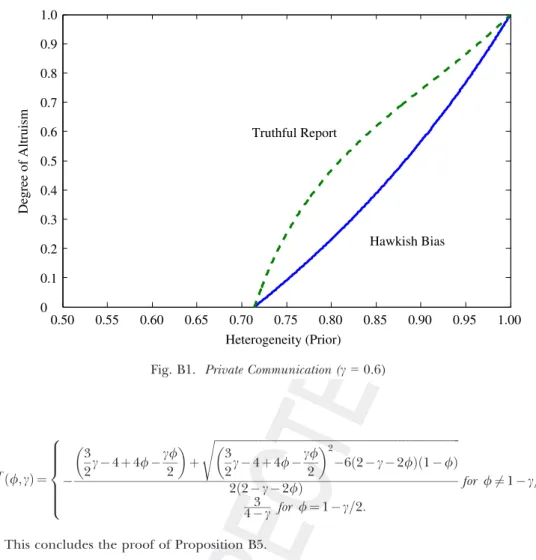
In online Appendix B, we relax the assumption that communication is public. We assume instead that the principal’s messagemis observed only by the agentA, but not byB. Our findings indicate that when communication is private, conflicts are more violent.
13 Complete naivet!e is also allowed, as a special case, in B!enabou and Tirole (2006, p. 710).
UN
CO
RR
EC
TE
D
PR
OO
F
that the principal cannot fabricate new evidence and, consequently, cannot perfectly determine the agent’s beliefs.Naivet!e can be partly justified on the basis of various experimental and behavioural evidence, suggesting that individuals who rely on the advice of others do not fully take into account the incentives of the information provider. For instance, Malmendier and Shanthikumar (2007) find that small investors follow recommen- 9
dations by analysts literally and do not discount any bias due to the analysts’ affiliations. Della Vigna and Kaplan (2007) argue that Fox News viewers underes-timate the bias of the media source and therefore are subject to persuasion. Cai and Wang (2006) test in a controlled laboratory experiment the model by Crawford and 10
Sobel (1982) and find that receivers rely more on the sender’s message compared with what the theory predicts.14
In some contexts, naivet!e seems a more natural assumption than full sophistication. For instance, we expect individuals to be especially naive when P coincides with a national government or a parent. In countries where education (at school and home) is hierarchical and children are not taught to think independently, individuals may be induced to naively trust the messages sent by their government and parents. We show in online Appendix B that the principal prefers to deal with a naive agent rather than with a sophisticated one. He is therefore likely to choose to interact with a naive agent or, whenever possible, he is likely to teach the agent to be naive.15
Finally, note that an implication of our information structure is that a hawkish agent is sure that the state is ha, while a dovish agent entertains the possibility (hence, he doubts) that the state is hb. It is important to stress that the fact that dovishness and hawkishness are associated to, respectively, being uncertain and certain about the current state is a result of our specific setting (and not a general feature).16
2.2. Game of Conflict
Att = 1, we posit the following game of conflict. IndividualsA andB simultaneously choose effort levelscAandcB, wherecA;cB '0:The probability ofiwinning the conflict given the effort decisions of the two opponents is
piðci;c$iÞ ¼
0 if ci\c$i;
1 if ci[c$i;
1
2 if ci ¼c$i: 8
> < >
: (7)
14
Cainet al.(2005) conduct an experiment where individuals must guess the number of coins in a jar by relying on the advice of experts who can inspect the jar. Even when it is common knowledge that experts are paid for how high the subjects’ guess is, they find that individuals do not discount enough to compensate for the experts’ incentive to exaggerate their advice.
15 Using data from the world value survey, Algan and Cahuc (2005) find that when asked what are the
values that children should be taught, there is heterogeneity across countries in the way respondents value the promotion of child independence.
16
A dovish agent is characterised by a lower posterior than a hawkish one (i.e.qb
A&qaA). Whether or not his posterior is more or less centered around 1/2 is not important for our results. On this point, see Appendix A8 where we analyse an alternative information structure implying that hawkish individuals have less accurate beliefs than dovish ones.
©2015 Royal Economic Society.
UN
CO
RR
EC
TE
D
PR
OO
F
That is, the individual that exerts the highest effort wins with probability one. This technology of conflict, which is extremely sensitive to effort differences, turns out to be analytically tractable for our purposes.17Finally, att= 2, the winner of the conflict is able to pick his or her preferred policy.
3. Results
Players maximise their expected utility given their beliefs at that stage and given the strategies of the other players. For the principal, a strategy specifies a message for every signal s. For i = A,B, the effort and the decision strategies specify the effort in the game of conflict and the policy decision in case of victory for every message, respectively.
The model is solved by backward induction, starting from the last period
3.1. Policy Decisions
At t = 2, the decision by B in case she wins the conflict is immediate: B chooses b. Conversely, A picksaonly if his posterior probability of being in a state of conflict is greater than 1/2, which constitutes the threshold of indifference between the two policy decisions. LetDA denote the decision made by A in case of victory:
DA¼ a if q m
A[1=2;
b if qm A&1=2: !
(8)
3.2. The Game of Conflict
At the beginning oft = 1, bothAandBobserve the messagemsent byP. IndividualB knows thatA is naive. Consequently, she is able to inferqm
A:
We now determine the effort decisions att = 1. The type of conflict described by (7) is equivalent to an all-pay auction. Note thatA and Bincur an effort cost that is the same whether they win or lose. The gain from winning is given by the possibility of choosing the most-preferred policy. This possibility is more or less valuable to A depending on his beliefs. More specifically, the gain forA isð2qm
A $1). This value is obtained by subtracting 1 $ qm
A (the expected payoff in case B wins) from qmA (the expected payoff in casea is implemented).
It is well known that the game of conflict analysed here does not have a Nash equilibrium in pure strategies, but does have a unique equilibrium in continuous mixed strategies (Hillman and Riley, 1989). To find out the equilibrium effort levels, two cases must be considered:qm
A&1=2 andqmA [1=2:First, suppose that parameters are such that A believes that the current state is more likely to be hb than ha. It is immediate from (8) thatAhas no incentive to fight:cA ¼ cB ¼ 0 andbis chosen. The
17
In the social conflict literature, this technology of war is considered, for instance, by Jackson and Morelli (2007, ex. 3). This type of contest, known in the literature as an all-pay auction, has also been considered by the lobbying and rent-seeking literature: e.g. Ellingsen (1991), Bayeet al.(1993), and Che and Gale (1998). For a survey of other technologies of conflict, see Garfinkel and Skaperdas (2007).
UN
CO
RR
EC
TE
D
PR
OO
F
second possibility is thatqmA [1=2:In this case, from (8) we obtain thatAandBwant to pursue different policies: a conflict is then inevitable. Let Gið:Þ denote the equilibrium cumulative distribution of individuali’s effort. The expected payoff toA from exerting effortcAis
EUA¼ ½1$GBðcAÞ)ð1$qm
AÞ þGBðcAÞqmA$cA: (9)
To obtain (9), note that with probability GBðcAÞ individual A wins and implements policy a, which gives A an expected payoff equal to qm
A: With complementary probability, B wins and implements b, which gives A an expected payoff equal to 1 $qm
A:We can rewrite (9) as
EUA¼ ð1$qm
AÞ þGBðcAÞ 2qmA$1
" #
$cA: (10)
From expression (10) it is immediate to verify thatAnever exerts an effort level strictly greater than his value of winning, which is given by 2qm
A $ 1:Furthermore, note that A’s maximum effort level goes to zero whenqm
Agoes to 1/2. Intuitively, when the two states become equally likely, Ahas no incentive to enter into a conflict.
Note thatB’s valuation is 1, which is weakly greater thanA’s valuation. This is becauseB knows thatbis the right policy. The expected payoff toBof choosingcBis instead
EUB ¼GAðcBÞ $cB: (11)
The equilibrium of the game of conflict is characterised by the following proposition. The proof, which is provided in Appendix A, follows Hillman and Riley (1989).
PROPOSITION 1. Let message m be given. If 0&qmA&1=2; we have cA ¼ cB ¼ 0 and
policy b is selected. If instead1=2\qm
A&1;in the unique Nash equilibrium, B randomises his effort uniformly on ½0;2qm
A $1). Player A exerts zero effort with probability equal to 2ð1$ qmAÞ. Conditional upon exerting positive effort, A also randomises uniformly on½0;2qm
A $1).
Proposition 1 establishes that in case of conflict, the maximum effort level of both individuals is given by 2qm
A $ 1; the valuation of the lower-valuing individual. Moreover, it states that individualAexerts zero effort with strictly positive probability, which is decreasing in his posterior qm
A. In contrast, individualB (the higher-valuing individual) always enters the conflict. Whenqm
A ¼ 1, the conflict is total: both players enter the conflict with probability one and effort is distributed uniformly on the interval [0,1]. Using the results of Proposition 1, it is easy to compute thatA’s expected perceived payoff is 1 $qm
A. When qmA ¼ 1, individual A exerts maximal effort, the conflict is highly inefficient, andA’s expected payoff is zero. When, instead,qm
A ¼ 1=2,
there is no conflict and A’s expected payoff is 1/2.
It is important to notice that the principal’s message affects the effort levels of both opponents in the conflict. Referring to Proposition 1, for every message m we can compute the expected sum of effort levels of the two opponents at time 1:
EðcAþcB;mÞ ¼ ð2q m
A$1Þ
2
2 þ
2qm
A$1
2 if q
m
A '1=2;
0 if qm
A\1=2:
8 <
: (12)
©2015 Royal Economic Society.
UN
CO
RR
EC
TE
D
PR
OO
F
Observe that (12) is increasing inqmA: hawkish beliefs worsen the escalation of violence in the conflict. Also notice thatA’s expected effort, the first term of (12), is convex and increases very rapidly when qm
A is close to one: conflict is most violent when A andB have the same valuations and more moderate when valuations diverge.
3.3. Payoffs for the Principal
In this subsection, we compute the payoffs toPfor every message and for every signal. We letVPðs;mÞdenote the expected utility of the principal after receiving signalsand after sending messagem.
First, suppose that Nature sends signalaandPis truthful. In this case,AandBplay a total war andP’s expected payoff is
VPða;aÞ ¼ $/ 2þ
1
2: (13)
Second, suppose Nature sends signalabutPsends the false messageb. If the agent’s posterior after messagebis below 1/2, we know from Proposition 1 that there is no conflict andbis chosen. If insteadqbA [1=2, we have thatAenters the conflict with probability 2qbA $1&1. Conditional onAexerting positive effort,A’s expected effort isð2qbA $1Þ=2 and both players have the same probabilities of winning. Therefore, one obtains
VPða;bÞ ¼ $
/$2qbA$1%2
2 þ
2qbA$1 2 ifq
b
A'1=2;
0 ifqbA\1=2: 8
> < >
: (14)
Third, suppose that Nature sends signal b and that P is truthful. When qbA&1=2, policy b is chosen. If instead qbA [1=2, a conflict occurs with positive probability. Compared to (14) the principal now expects to obtain a positive payoff whenA does not fight. Given that the principal has received signal b, his probability assessment of being in statehb is 1 $qbP. Since Pis truthful, we setqbP ¼ qbAand obtain
VPðb;bÞ ¼ $
/ð2qbA$1Þ2
2 þ
2qbA$1
2 þ2ð1$q
b
AÞ2 if qbA '1=2;
1$qbA if qbA\1=2: 8
<
: (15)
Fourth, and finally, supposePreceives signalbbut sends the false messagea. Then, a total conflict arises. WhenAwins,ais chosen and the principal expects a payoff ofqbP. WhenBwins,b is chosen and the principal expects a payoff of 1 $qbP. Therefore,
VPðb;aÞ ¼ $/ 2þ
1
2: (16)
3.4. Message Strategies
We now analyse the information transmission game at t = 0. After computing the payoffs (13)–(16), it is a matter of simple algebra to determine the equilibrium message strategies for all/. First, we will show that there exists a region of parameters where the principal reports his signal in a truthful manner. Second, for other 1
UN
CO
RR
EC
TE
D
PR
OO
F
parameters, we will find that Palways sends message a regardless of the actual signal received. In this case, we say that P induces a hawkish attitude in his agent. Finally, there exists a third region of parameters where Palways sends message b. In this last case, we say thatPinduces a dovish attitude.The considerations that matter in the message decision are the following. First,Phas the incentive to raise the agent’s belief of being in a state of conflict in order to increaseA’s effort. This motivating effect is present in our model because the principal does not fully internalise A’s cost of effort. Second, there is an opposite incentive to makeAbelieve that the state might behb. To understand this moderating effect, recall from Proposition 1 that when the posterior of being in the state of conflict is lower, conflicts are less violent because the equilibrium effort levels of both players decrease due to strategic interactions. This effect is valuable because effort is wasteful and because the two opponents cannot credibly commit to low effort levels. Such a dovish strategy, however, is costly because when the state isha, the agent exits the conflict with positive probability. This implies that policyb, which is suboptimal forAin stateha, is implemented more often. Third, and finally, the principal also needs to make sure that his message inducesAto select the right policy in case of victory, at least in expectation. We emphasise that the moderating effect does not arise because the principal over-internalises the effort exerted by the agent. As we will show in Proposition 2, the moderating effect dominates even when the principal internalises only half of the cost of effort exerted by the agent. To understand this counter-intuitive result, it is instructive to find under what conditions the principal sends the dovish messagebafter observing that the state isha. Using (13) and (14), and supposing thatqbA '1=2, we find thatPprefers sending messagebafter signalarather than being truthful if and only if
2/qbAð1$qbAÞ þ ðqbA$1Þ '0: (17) On one hand, sending messagebmoderates the conflict. The first term of (17) is the principal’s gain of reducingA’s effort. On the other hand, an agent receiving message bdoes not enter the conflict with positive probability. The second term is the cost of implementingbwith higher probability. It is immediate to see that inequality (17) can be satisfied even when/is less than one.18
Theex anteprior of being in a state of conflict plays an important role inP’s message strategy. It is possible to show that when q≤ 1/(2$c), the principal is truthful because sending false messages would induceAto select the wrong policy att = 2 (see Lemma 1 in Appendix A).
To understand this result, suppose thatqis just above 1/2. Note from (5) that after receiving signalb the principal’s posterior would fall below 1/2: the principal would change his view about the optimality of a and start to believe that b is the correct decision. Then,Phas no incentive to send messagea, which would induceAto enter a total conflict with the goal of imposing policya. Similarly, after receiving signalathe principal has no incentive to send the false messageb, sinceAwould incorrectly believe thatbis the right decision and would give up the fight, earning a payoff of zero.
We now state the main result of this article
18 However, (17) does not hold if altruism is too low. More specifically, we need/
'1=ð2qbAÞ. ©2015 Royal Economic Society.
UN
CO
RR
EC
TE
D
PR
OO
F
PROPOSITION2. Let anyc2(0,1) be given.
(i) Suppose that0≤ /< 1/2.For allq&#q;where
#
q¼ 1
2/ð1$cÞ þc; (18)
information transmission is truthful. When insteadq[q#;the principal P reportsb regardless of nature’s signal.
(ii) Suppose that0≤ /< 1/2.For allq&^q;where
^
q¼ 1
2ð1$/Þð1$cÞ þc; (19) information transmission is truthful. When insteadq[q^;the principal P reportsa regardless of nature’s signal.
Proposition 2 states that if/2 (1/2,1], the moderating effect dominates and dovish attitudes are sometimes observed. Instead, when / < 1/2, the motivating effect dominates the moderating one and hawkish attitudes are sometimes observed.19
Consider, for instance, a principal with/close to one. The motivating effect is not very valuable to him because from equations (13) and (16), we know that his expected payoff from a total conflict is close to zero. On the contrary, the moderating effect is present: inducing dovish attitudes is a way to credibly commit the agent to exert low, but positive, effort. Provided that the prior is sufficiently high, sending signal bde-escalates the conflict without inducingA to support policyb. The converse holds true for a principal with low/: his expected payoff from a total conflict is sufficiently large that he always prefers to maximise the probability thatAenters the conflict, even at the cost of inducing a total war. This is why we may observe dovish (resp. hawkish) attitudes when/is high (resp. low).
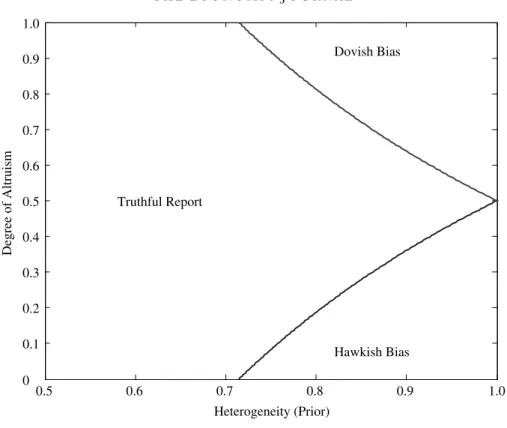
In Figure 1, for a givenc, we draw the parameter regions in the (q,/) space where we observe the three types of equilibria of our model: dovish, hawkish and truthful. As stated in Proposition 2, P sends truthful reports when q is sufficiently low. When insteadqis large, the agent holds either hawkish attitudes (in the lower-right region) or dovish attitudes (in the upper-right region). When q is high, truth-telling is less likely because the principal can affect the effort of the agent (by either motivating or moderating him) without distorting the agent’s decision in case of victory.
Notice that when/ ≃ 1/2, the conditions for the existence of a truthful equilibrium are more likely to be satisfied. In this range, in fact,Pis sufficiently altruistic to avoid a total conflict when Nature’s signal isbbut not too altruistic to prevent a total conflict when Nature’s signal isa.
If signals become more precise, cutoffs q^ and #q increase so that the dovish and hawkish regions shrink. More precision reduces the incentives to manipulate beliefs. This can be appreciated by comparing Figure 1 (wherecis fixed at 0.6) and Figure 2 (where c has been increased to 0.85). When c is high, after a false message the posteriors of the principal and of the agent would likely lie on different sides of 1/2,
19
If the principal over-internalises the effort exerted by the agent (/>1), one can show that the principal induces dovish attitudes when q≥1/(2$c) and he is truthful otherwise.
UN
CO
RR
EC
TE
D
PR
OO
F
the threshold of indifference discussed in subsection 3.1. In this case, the principal tells the truth in order to avoid wrong policy decisions. At the limit, when both signals become perfectly informative, the principal is truthful for all parameter values.
When the agent is assumed to be sophisticated (i.e. Bayesian), it can be shown that a truth-telling equilibrium exists in the same region of parameters described in Figure 1. However, in this region there is another equilibrium in pure communication strategies, where players A and B simply ignore the principal’s message: a babbling equilibrium, which is a common feature of all cheap talk games. Notice that in the lower-right and upper-lower-right regions described in Figure 1, the babbling equilibrium is the unique equilibrium in pure communication strategies. This indicates that some degree of naivet!e is indeed needed to make it possible for the principal to deceive the agent.20
3.5. Incidence and Intensity of Conflicts
Using the results of Propositions 1–2, we now investigate how the degree of societal heterogeneity affects the likelihood that a conflict occurs (or incidence of conflict) and the total effort levels exerted in the conflict. In Figure 3, we summarise the
0.5 0.6 0.7 0.8 0.9 1.0
0 0.1 0.2 0.3 0.4 0.5 0.6 0.7 0.8 0.9 1.0
Heterogeneity (Prior)
Degree of Altruism
Truthful Report
Hawkish Bias Dovish Bias
Fig. 1. Strategies in the (q, /)Space.c=0.6 16
20 The case of full sophistication is solved in online Appendix B. An interesting possibility, which we leave
to future research, would be to consider, as in B!enabou and Tirole (2006), all intermediate cases between complete naivet!e and full sophistication.
Colour
online,
B&W
in
©2015 Royal Economic Society.
UN
CO
RR
EC
TE
D
PR
OO
F
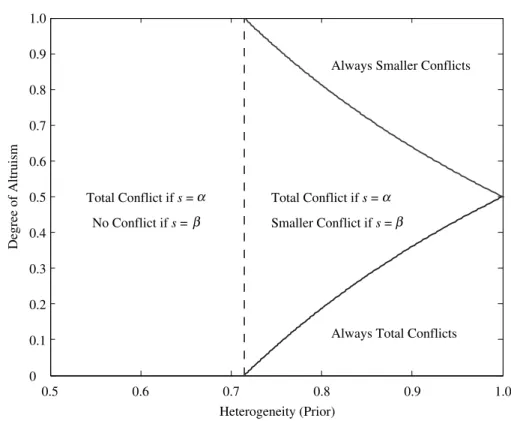
implications of each message strategy on conflict behaviour. The vertical dashed line is drawn at q= 1/(2 $c).
PROPOSITION 3.
(i) The incidence of conflict is increasing in q.
(ii) The intensity of conflicts is weakly increasing inqwhen/ <1/2and non-monotone in qwhen / ≥1/2.
To understand the first part of the proposition, notice that when q is below the vertical dashed line in Figure 3, we know from Lemma 1 thatPis truthful. In this case, conflicts occur only when the principal truthfully sendsa.21When instead qis above the dashed line, qm
A [1=2 for all m: conflicts always occur, regardless of nature’s
signal. Since q is likely to be high in heterogeneous societies, this suggests that the probability that a conflict occurs is lower in homogenous societies. The second part of Proposition 3 establishes that when /≥ 1/2, the intensity of conflicts may not be monotone in q. The latter result occurs because, as described in Proposition 2, individuals in more divided societies may adopt dovish attitudes. This generates a discontinuous drop of total effort whenq is equal toq#.
0.5 0.6 0.7 0.8 0.9 1.0
0 0.1 0.2 0.3 0.4 0.5 0.6 0.7 0.8 0.9 1.0
Heterogeneity (Prior)
Degree of Altruism
Truthful Report
Hawkish Bias Dovish Bias
Fig. 2. Strategies in the (q,/)Space.c=0.85
21
When instead the principal truthfully sends messageb, the agent’s posterior falls below 1/2. In this case, playerAfavoursband no conflict occurs.
Colour
online,
B&W
in
UN
CO
RR
EC
TE
D
PR
OO
F
It is beyond the scope of this article to test the theoretical predictions of our stylised model. However, it is possible to relate our results to some of the findings obtained by the empirical literature on civil and interstate conflicts. One result that emerges from this literature is that the incidence of conflict is positively correlated with ethnic polarisation (Montalvo and Reynal-Querol, 2005). To the extent that ethnic polarisation is a good proxy forq, this result is coherent with the first part of Proposition 4. Various papers have also looked at the relation between ethnicity diversity and the duration of civil wars. The relation found in the data is either positive (Montalvo and Reynal-Querol, 2010) or not monotone. For instance, Collieret al.(2004) show that the duration of a conflict is at its maximum for intermediate values of ethnic fractionalisation. While not perfectly, a conflict’s duration is likely to be related to its intensity. Therefore, these empirical results are not in contradiction with the second part of Proposition 3.22
4. Independent Information Acquisition by the Agent
In Section 3, we have shown that belief manipulation distorts effort decisions, but it does not distort policy making. In fact,A’s decision att = 2 on the basis ofmcoincides
0.5 0.6 0.7 0.8 0.9 1.0
0 0.1 0.2 0.3 0.4 0.5 0.6 0.7 0.8 0.9 1.0
Heterogeneity (Prior)
Degree of Altruism
Total Conflict if s =
No Conflict if s =
Total Conflict if s =
Smaller Conflict if s =
Always Total Conflicts Always Smaller Conflicts
α
β β
α
Fig. 3. Incidence and Intensity of Conflicts,c=0.6
22
Finding an empirical proxy of/is more challenging. One could argue that leaders of full democracies have higher/(on this, see Jackson and Morelli, 2007). In our model, conflict intensity is lowest when/is close to one (see Figure 3). Indeed, there is evidence that full democracies fight less (Maoz and Russett, 1993).
Colour
online,
B&W
in
©2015 Royal Economic Society.
UN
CO
RR
EC
TE
D
PR
OO
F
with the decision thatAwould have made had the true signal been known. This result occurs because the principal does not disagree with the agent on the correct policy to implement in each state. As a result, he does not manipulate information to the point of inducing the wrong policy decision in the final stage.
However, it is reasonable to expect that belief manipulation may also lead to inefficient decision-making. In particular, by inducing very accurate beliefs which are not justified by the evidence, belief manipulation may reduce the agent’s incentives to acquire information. A simple extension of the basic setting allows us to capture this additional cost. We examine the effect of adding the option for agent A to independently acquire public information, i.e. information that is also observed by playerB, after receiving the principal’s message. As in Section 2, we assume thatA is naive and that the message is public.
We study the following game. The timing of events is drawn in Figure 4. As before, at
t = 0 principalP observes signals 2{a,b}and sends a message to A. After receiving message b, the agent is now able to conduct research in order to discover the state. After receiving message a, the agent is certain to be in state ha and no research is
conducted. Research is costless and is not manipulable by A himself (or byP). With probability p2 [0, 1] the research is successful and the state becomes common knowledge. With complementary probability 1 $p, the research is not successful. We assume that the probability of success is independent from the state h. As a result, nothing is learned when the research is not successful. After the research stage,Aand
Bsimultaneously choose their effort levels and the conflict’s winner is able to select his or her preferred policy.
Notice that the setting that we have just described is a generalisation of the basic model of Section 2. Whenp = 0 the model studied in this section coincides with the one studied before: as in the basic model, the agent relies exclusively on the information transmitted by the principal.
The model is solved by backward induction, starting fromt = 2. In the final stage, a player is able to choose his (or her) preferred policy if that player wins the conflict. The agent’s posterior is computed after observingmand the outcome of his research effort (if any). At t= 1, the conflict phase unfolds exactly as in the basic model: the effort strategies of the two opponents are given by Proposition 1.
As we discussed above, at the information acquisition stage we posit that the naive agent does not conduct any research upon receiving message a because he is fully
P Sends
Message A ‘s
Research
A Learns that the State is:
Nothing is Learned π
α β
b θ Total Conflict
Conflict Stage
Total Conflict No Conflict π
1 –
a θ
Fig. 4. Timeline with Autonomous Research
Colour
online,
B&W
in
UN
CO
RR
EC
TE
D
PR
OO
F
convinced that the state is ha. Conversely, we suppose that the agent always acquirescostless information when he receives the noisy message b. In Appendix A (Lemma A1) we show that A is actually indifferent between conducting and not conducting costless research after messageb. The agent’s expected utility of entering the conflict stage is in fact linear in his own posterior belief (it equals 1 $ qm
A), and consequently
the value of public information for the agent is null: as long as this information is shared with B, the agent is indifferent between all information structures before starting the conflict phase. The reason for this is that the value of public information is dissipated in effort. In the working-paper version of this article (Gordon and Riboni, 2014, Section 5), we provide a rationalisation for the assumed research rule. We show that when there is a tiny cost to conduct research and when there is an infinitesimal chance that the two parties are able to avoid the conflict phase,Awould strictly prefer to conduct research after receiving message bbut not after messagea.
When the agent is allowed to acquire information,Pmust take into account that his message will affect the agent’s incentives to conduct research. Compared with the basic model, sending messageawhen Nature’s signal isbhas the following cost: a hawkish message induces the agent to not acquire information. In other terms, besides making the agent hawkish, messageaalso makes him more dogmatic: the agent is more likely to disregard evidence that may induce him to revise his beliefs.
While public information has no value for the agent, in our setting the principal does value information. Formally, this can be shown by noticing that when/< 1, the expected value of the principal is strictly convex in the agent’s belief. This implies that the principal always prefersex antethat more public information is released.23Because hawkish attitudes discourage the agent from acquiring information, this explains why the incentives to induce hawkish attitudes are decreasing in the likelihood that research is successful. To understand this result, consider the extreme casep= 1. It is immediate that when p= 1 the principal has no incentive to send message a when Nature’s signal is b. To show this, we analyse the consequences for P of sending messageband thus inducingAto conduct perfectly revealing research. Notice that if the agent discovers that the state ishb, the principal obtains a payoff equal to 1, which is
strictly greater than the payoff of sending message a. If instead A discovers that the current state isha;Awould fight very hard to imposea. In the latter case, the principal
obtains the same payoff that he would have obtained by sending the false messagea. Therefore, research provides valuable information to the principal and there is never a hawkish equilibrium whenp = 1.
Proposition 4 describes the equilibrium message strategy whenAis able to conduct costless research.
PROPOSITION 4. The parameter space (q,/) is divided into three regions that describe the
equilibrium strategy of the principal: truthful, dovish and hawkish. The boundary between the dovish and the truthful regions does not depend on p and is characterised by part (i) in Proposition2. The incentives to induce hawkish attitudes are decreasing inp. They completely vanish aspgets sufficiently close to1.
23 See Kamenica and Gentzkow (2011).
©2015 Royal Economic Society.
UN
CO
RR
EC
TE
D
PR
OO
F
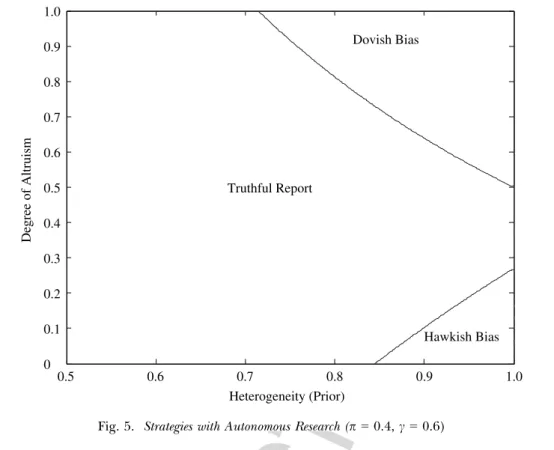
Figure 5 illustrates the message strategies in the (q, /) space for an intermediate value ofp. There exists a hawkish equilibrium when/andpare sufficiently low andq
sufficiently large, but the region of parameter values where the hawkish equilibrium exists is not as large as in Figure 1. The higherp, the smaller the hawkish region. It is interesting to note that the dovish region is not affected by p. In other terms, the region of parameter values where dovish attitudes occur is identical to the one characterised in part (i) of Proposition 2.24 Overall, this suggests that societies that have access to efficient ways of doing research (such as an advanced education system) are more prone to either truth-telling or dovishness rather than to hawkish attitudes. Since inducing hawkish attitudes prevents the agent from conducting potentially successful research, Proposition 4 establishes that in case of victory, the agent may make mistakes that could have been avoided if information had been truthfully transmitted.
Before concluding this Section, it is important to stress that we are not arguing that dogmatism should be necessarily associated to hawkishness. Dogmatism results from having very accurate beliefs which are not justified by existing evidence. Therefore,
0.5 0.6 0.7 0.8 0.9 1.0
0 0.1 0.2 0.3 0.4 0.5 0.6 0.7 0.8 0.9 1.0
Heterogeneity (Prior)
Degree of Altruism
Truthful Report
Hawkish Bias Dovish Bias
Fig. 5. Strategies with Autonomous Research (p =0.4,c=0.6)
24 To see this, notice that allowing research does not change the incentives to sendbin stateh
a. In fact,P’s
expected payoff of sendingband inducingAto conduct research is greater than the payoff of telling the truth if and only if (14) is greater than (13), which is the same condition obtained in the basic model.
Colour
online,
B&W
in
UN
CO
RR
EC
TE
D
PR
OO
F
dovish individuals who incorrectly believe to be in a state of alignment are likely to be as dogmatic as individuals who incorrectly believe to be in a state of conflict. With a different information and payoff structure, we expect that dogmatism might also be associated to dovish attitudes.255. Conclusions
As argued by Popper (1963), conflicts are less violent when individuals entertain the possibility that the opponent may be right. Why is it so difficult to observe this attitude? To answer this question, we study two opponents who participate in a game of conflict. One opponent trusts the information received by his principal.
In our model, the principal wants to affect the agent’s effort in the conflict, but he also cares whether the agent selects the correct policy and he has the right incentives to acquire information.
In the context of our model, information is sometimes manipulated. In some cases, following the message from the principal, the agent never doubts the optimality of his preferred policy, although all available information suggests otherwise. Conflicts are violent because both opponents are motivated to exert high effort. Moreover, we show that the hawkish agent disregards evidence that may induce him to revise his beliefs. In other cases, the agent believes that his opponent may be right even when all the evidence indicates that the policy preferred by the opponent is certainly suboptimal. In this case, dovish attitudes moderate the escalation of violence in the conflict, but the agent often loses.
We show that the manipulation of information (in both directions) is more likely to occur in heterogenous societies and when Nature’s signals are less precise. Hawkish attitudes are less likely to be observed when the agent is able to conduct autonomous research and when the principal’s altruism is low. When instead altruism is high, we obtain that the agent is induced by his principal to be dovish.
Finally, we find that conflicts are more likely in heterogenous societies. However, the intensity of a conflict is not necessarily at its maximum in very heterogeneous societies.
An interesting extension that we leave to future research would be to consider other forms of naivet!e on the part of the agent. For instance, we could suppose that the agent misestimates the precision of the signal received by the principal or is excessively confident about his/her ability to win the conflict. We believe that even in these alternative settings, the actions of the principle would be driven by similar consider-ations. We expect, for instance, that a principal with low altruism would motivate the agent by boosting his overconfidence (a similar motive is described by Charnesset al., 2011), while a more altruistic principal would tend to discourage overconfidence in order to de-escalate the conflict.
25
For instance, when the principal and the agent do not always agree on the right policy to adopt,Pmay induceAto be excessively dovish, thus preventing him from conducting research. However, if we maintain the assumption thatAandPagree on the policy dimension,Pwould not induceAto incorrectly believe thatb is for sure optimal.
©2015 Royal Economic Society.
UN
CO
RR
EC
TE
D
PR
OO
F
Appendix A. Proofs
A.1. Proof of Proposition1
Let messagembe given. Suppose first that 1=2\qm
A\1. We proceed by steps. We first show that the equilibrium expected payoff ofBis strictly positive. To see this, notice thatAnever exerts an effort level higher than his valuation, 2qm
A $1;because he would earn a return below 1$ qmA: This implies thatBcan guarantee for himself a strictly positive payoff by exerting an effort level just above 2qm
A $ 1. We now show that the effort strategies of both players are mixed, with no mass points at a strictly positive effort level. By way of contradiction, suppose that playerjhas a mass point at a particular effortcj [0:Then, the payoff of the other player would increase discontinuously atcj:It then follows that there exists aɛ >0 such that the other player exerts effort on the interval ½cj $e;cj)with zero probability. However, if this were the case, j would increase his payoff by biddingcj $ einstead ofcj:
We now argue that the maximum effort level of the two players is the same. To see this, notice that since the effort strategies are mixed, if one individual has a maximum effort level, the other individual would win with probability one by just exerting that effort level.
Next, we now show that the minimum effort level is zero. By way of contradiction, suppose that an individual has a minimum effort level c 2ð0;2qm
A $ 1). Then the other player would not exert effort in the interval [0,c) because by doing so he would lose with probability one. But this implies that the first individual would rather exert an effort level lower than c. IndividualB’s expected payoff from exerting effortcBis
EUB¼GAðcBÞ $cB; (A.1)
whileA’s expected payoff from exerting effortcAis
EUA¼ ð1$qm
AÞ þGBðcAÞð2qmA$1Þ $cA: (A.2) Noticing thatBmust be indifferent among all the effort levels in the set and recalling that the equilibrium expected payoff forBis strictly positive, we evaluateEUBwhencB ¼ 0:It follows that GAð0Þ[0:
We now show thatBcannot put positive mass at zero. If this were the case, there would be a tie with some positive probability. ButBwould be better off increasing his effort just above zero. This implies thatGBð0Þ ¼ 0 andA’s expected payoff is 1$ qmA:Then,
GBðcAÞ ¼2qmcA
A$1
: (A.3)
WhenB’s effort is 2qm
A $ 1;
EUB¼GAð2qm
A$1Þ $ ð2qmA$1Þ; (A.4)
or
EUB¼1$ ð2qm
A$1Þ: (A.5)
Then,
GAðcBÞ ¼1$ ð2qm
A$1Þ þcB: (A.6)
Whenqm
A ¼ 1 the equilibrium strategies can be obtained by taking the limit of the equilibrium strategies described above. Finally, when qm
A\1=2 it is immediate that the agent does not enter the conflict: cB ¼ cA ¼ 0. Thus, policy b is chosen. This concludes the proof of Proposition 1.
UN
CO
RR
EC
TE
D
PR
OO
F
A.2. Proof Of Proposition2Before proving Proposition 2, we state two Lemmas.
LEMMA 1. Whenq ≤1/(2$c)the principal is truthful for any/
Proof of Lemma 1. Two cases must be considered. First, suppose that nature sends signal b. Using Bayes’ Rule, we obtain that
qbP ¼
qð1$cÞ
1$qþqð1$cÞ: (A.7) If the condition on q in the statement of Lemma 1 is satisfied, this implies that qbP &1=2:
Suppose thatPis truthful and sends messageb. Then, by the naivete assumptionqbAis equal to (A.7). Since qbA&1=2; Aexerts no effort and B picks policy b. The expected payoff to the principal is then
1$qbP'12: (A.8)
Suppose instead that the principal sends the false messagea. In this case, a total conflict arises and, using (16), the principal’s expected payoff would be
$/2þ12; (A.9)
which is lower than 1/2. This implies that a deviation from a truthful report is not profitable when the actual signal is b. Second, suppose that s=a. If the principal sends message ahis expected payoff is
$/2þ12; (A.10)
which is greater than zero, the payoff obtained by sending messagebwhich shiftsqbAbelow 1/2 and thus inducesAto exert no effort. This implies that a deviation from a truthful report is also not profitable when the actual signal isa.
We now prove the first part of Proposition 2. Step 1: Pis truthful when
q&21
$c: (A.11)
See Lemma 1.
Step 2: Pis also truthful when 1 2$c\q&
1
2/ð1$cÞ þc: (A.12) First, suppose thats=band that the principal is truthful. If the condition in the statement of Step 2 is met, qbA [1=2. Then, a conflict arises. The principal’s expected utility of sending a truthful message is given by (15). SinceqbP ¼ q
b
Awhen reporting is truthful, we can rewrite (15) as
ð2qbA$1Þ
1$/ð2qbA$1Þ
2 þ2ð1$q b
AÞ2: (A.13)
To see whetherPhas an incentive to deviate and send messagem=awhen the actual signal isb, we compare (A.13) to (16), the expected utility after the deviation. To show that (16) is lower than (A.13) when the condition in the statement of Step 2 is met, take the derivative of (A.13)
©2015 Royal Economic Society.
UN
CO
RR
EC
TE
D
PR
OO
F
with respect toqbA:$2/ð2qbA$1Þ þ1$4ð1$qbAÞ: (A.14) This derivative can be written as
ð1$2/Þð2qbA$1Þ þ2ðq b
A$1Þ: (A.15)
Knowing that 1'qbA[1=2 and that 1≥/≥1/2, one can verify that the derivative is always negative. Since (16) is equal to (A.13) when qbA ¼ 1;we have proved that (16) is lower than (A.13). Therefore,Phas no incentive to send messageawhens=b.
To conclude the proof of Step 2, we have to show that the principal does not want to deviate even whens=a. The principal utility from truthful reporting is (13) while the utility of sending messagebis (14). One can show that when
qbA& 1
2/; (A.16)
the principal has no incentive to misreport. In fact, whenqbA ¼ 1=ð2/ÞandqaA ¼ 1 expressions (13) and (14) coincide. Between the two roots, (13) is greater than (14). WhenqbA &1=ð2/Þwe have that (13) is lower than (14):Phas no incentive to misreport whens=a. Knowing thatqbAis given by (5), it is easy to show thatqbA&1=ð2/Þif and only if
q&2/ 1
ð1$cÞ þc: (A.17)
Step 3: Psends messagebregardless of nature’s signals when
q[ 1
2/ð1$cÞ þc: (A.18)
Following the algebra of Step 2, we obtain that when the condition in the statement of Step 3 is satisfied,Phas the incentive to send messagebwhen the actual signal isa. When insteads=b the report is truthful. It then follows that regardless of s, P always sends message b. This concludes the proof of part (i) of Proposition 2.
We now prove the second part of Proposition 2. Step 4: Pis truthful when
q& 1
2$c: (A.19)
See Lemma 1.
Step 5: Pis truthful when 1 2$c\q&
1
2ð1$/Þð1$cÞ þc: (A.20) First, suppose thats=b. Since
1
2$c\q; (A.21)
we have that qbA [1=2: Then, a conflict arises. The principal’s expected utility of sending a truthful message is given by (A.13). To see whether Phas an incentive to deviate and send messagem=awhen the actual signal isb, we compute his utility after this deviation. This is given by (16). In comparing (A.13) to (16), one can show that when/<1/2 it may be the case that (16) is greater than (A.13). However, when
qbA& 1
2ð1$/Þ; (A.22)
UN
CO
RR
EC
TE
D
PR
OO
F
Equation (16) is lower than (A.13). Then,Phas no incentive to send messageawhen he receives signalb. Knowing thatqbA is given by (5), it is easy to verify that (A.22) is satisfied if and only ifq&2 1
ð1$/Þð1$cÞ þc: (A.23) Finally, suppose that the actual signal iss=a. The principal’s utility from truthful reporting is (13), while the utility of sending messagebis given by (14). One can show that when/<1/2 the principal has no incentive to misreport.
Step 6: Psends messagearegardless of nature’s signals when
q[ 1
2ð1$/Þð1$cÞ þc; (A.24) This follows from the algebra in Step 5. This concludes the proof of Proposition 2.
A.3. Proof Of Proposition3
Step 1:We show that the incidence of conflict is increasing inq. First, we compute the probability that a conflict occurs:
PrðconflictÞ ¼
cqif q&21 $c; 1if q[ 1
2$c: 8
> > < > > :
(A.25)
To understand (A.25), notice that for allmwe have thatqm
A [1=2 whenq>1/(2$c). This implies that regardless ofP’s message strategy, conflicts always occur whenq >1/(2$c). When instead q≤1/(2$c), one can verify from Proposition 2 thatPis truthful. SinceqbA&1=2, a conflict arises only whenPsends messagea, an event occurring with probabilitycq.
Note that the probability of observing a conflict is obviously increasing inq.
We now move to the proof of the second part of Proposition 3. As a measure of the intensity of conflict, we compute expected total effort by taking expectations over the space of possible signals. Let/(s) denote the probability of observing signals, which can be derived from (3) and (4). Expected total effort as of time 0 is then given by
EðcAþcBÞ ¼/ðbÞEðcAþcB;bÞ þ/ðaÞEðcAþcB;aÞ: (A.26) First, knowing the conditional probabilities (3) and (4), we derive the probabilities of the two signals. /ðbÞ ¼1$cqand/ðaÞ ¼cq: (A.27) From (A.26), (12), and the results of Proposition 2, we write the expression forEðcA þ cBÞwhen /<1/2:
EðcAþcBÞ ¼
cqif q&21 $c; cqþ ð1$cqÞð2qbA$1Þq
b Aif
1
2$c\q&^q; 1 ifq[q^:
8 > > > < > > > :
(A.28)
Using the results of Proposition 2, we write the expression forEðcA þ cBÞwhen/≥ 1/2:
EðcAþcBÞ ¼
cqifq&21 $c; cqþ ð1$cqÞð2qbA$1Þq
b A if
1
2$c\q&q; ð2qbA$1ÞqbAif q[q:
8 > > > > < > > > > :
(A.29)
Step 2:We show thatEðcA þ cBÞis weakly increasing inqwhen/<1/2.
©2015 Royal Economic Society.