PAIRING REENTRANCE IN WARM ROTATING 104Pd NUCLEUS∗
N. Quang Hung
School of Engineering, Tan Tao University
Tan Tao Univ. Avenue, Tan Duc E. City, Duc Hoa, Long An Province, Vietnam
N. Dinh Dang
Theoretical Nuclear Physics Laboratory RIKEN Nishina Center for Accelerator-Based Science
2-1 Hirosawa, Wako City, 351-0198 Saitama, Japan and
Institute for Nuclear Science and Technique, Hanoi, Vietnam
B.K. Agrawal
Theory Division, Saha Institute of Nuclear Physics 1/AF, Bidhan Nagar, Kolkata 700 064, India
V.M. Datar, A. Mitra, D.R. Chakrabarty
Nuclear Physics Division, Bhabha Atomic Research Center Mumbai 40085, India
(Received November 10, 2015)
Pairing reentrance phenomenon in the warm rotating 104Pd nucleus is studied within the Bardeen–Cooper–Schrieffer (BCS)-based approach (the FTBCS1). The theory takes into account the effect of quasiparticle num-ber fluctuations on the pairing field at finite temperature and angular mo-mentum within the pairing model plus non-collective rotation along the symmetry axis. The numerical calculations for the pairing gaps and nu-clear level densities (NLD), of which an anomalous enhancement has been experimentally observed at low excitation energyE∗and high angular mo-mentum J, show that the pairing reentrance is seen in the behavior of pairing gap obtained within the FTBCS1 at lowE and highJ. This leads to the enhancement of the FTBCS1 level densities, in good agreement with the experimental observation. This agreement indicates that the observed enhancement of the NLD might be the first experimental detection of the pairing reentrance in a finite nucleus.
DOI:10.5506/APhysPolBSupp.8.551
PACS numbers: 21.10.Ma, 24.10.Pa, 24.60.Ky, 25.70.Gh
∗
Presented by N. Dinh Dang at the XXII Nuclear Physics Workshop “Marie and Pierre Curie”, Kazimierz Dolny, Poland, September 22–27, 2015.
1. Introduction
It is well-known that pairing correlation is strongly affected by both
temperature T and angular momentum J. The increase of temperature or
angular momentum of a nucleus breaks the nucleon pairs located around the Fermi surface, which are responsible for the pairing. The nucleons from the broken pairs scatter to the single-particle levels nearby and completely block these levels. Consequently, pairing correlation decreases. When the
temper-ature or angular momentum is high enough, i.e., equal to its critical value
Tc or Jc, these unpaired particles will block all the levels around the Fermi
surface, completely destroying the pairing correlation. However, when both temperature and rotation are combined as in warm/hot rotating systems, there appears an interesting effect of pairing reentrance. When the angular
momentum of the system is slightly higher than Jc, the pairing correlation,
which is zero at low T < T1, reappears at T > T1, and decreases to vanish
at T2 > T1. This phenomenon was first predicted by Kammuri [1] by
apply-ing the Bardeen–Cooper–Schrieffer theory at finite temperature (FTBCS) and angular momentum to finite nuclear systems. It was later explained by
Moretto [2] as follows. In the systems withJ > Jc, the increase of
temper-ature relaxes the unpaired nucleons located around the Fermi surface and,
therefore, opens the possibilities for recreation of the pairs. However, if T
increases further, all of these newly created pairs will eventually be bro-ken again, leading to the quenching of pairing correlation. A similar effect called unconventional superconductivity has been recently discovered in the superconducting URhGe material at Grenoble High Magnetic Field
Labora-tory [3]. In this experiment, URhGe is normal when the magnetic fieldH,
which plays the role as that of nuclear rotation, is around 2 Tesla, and
be-comes superconducting at low T when the magnetic field increases between
8 and 13 Tesla.
It has been pointed out in several theoretical calculations that the
col-lapse of pairing correlation at T = Tc or M = Mc, which signals the
superfluid-normal (SN) phase transition, is a shortcoming of the FTBCS theory because it neglects the thermal fluctuations in finite systems such as atomic nuclei. In nuclear systems, these thermal fluctuations are so large that they smooth out the SN phase transition and lead to the non-collapsing
pairing correlation at T ≥ Tc [4]. As a result, by taking into account the
thermal fluctuations, the calculations within an exactly solvable model [5] and the cranked shell model [6] have shown a different behavior of the pairing
reentrance phenomenon for which pairing gap, which is zero atJ > Jc and
T = 0, reappears at a given T but does not vanish as T increases further.
in several realistic nuclei [7]. Apart from the FTBCS1, the shell model
quantum Monte Carlo simulation for 72Ge nucleus has suggested that the
pairing reentrance can be seen not only in the behavior of pairing gap but
also in the local enhancement of the nuclear level density (NLD) at low T
and sufficiently high J [8]. This suggestion has given a feasibility for this
phenomenon to be experimentally observed. In fact, the very recent series of experiments conducted at the Bhabha Atomic Research Center (BARC)
for the reaction12C +93Nb→ 105Ag∗ → 104Pd∗+pat the incident energy
of 40–45 MeV has observed an enhancement of the NLD of104Pd nucleus at
low excitation energy E∗ and highJ, which is qualitatively similar to that
predicted by the shell model Monte Carlo calculations [9].
The aim of the present research is to apply the FTBCS1 theory including finite angular momentum to study if the enhancement observed in the
ex-perimentally extracted NLD of104Pd can be interpreted as the first evidence
of pairing reentrance in a warm rotating finite nucleus.
2. FTBCS1 theory
The pairing Hamiltonian, which describes a spherical nucleus
non-collec-tively rotating about the symmetry axis, chosen to coincide with itsz
com-ponent, has the form
H=X
k
k
a†+ka+k+a
† −ka−k
−GX
kk0
a†ka†−ka−k0ak0−λNˆ −ωM ,ˆ (1)
wherea†±k(a±k)are the creation (annihilation) operators of a particle in the
kth deformed state, whereas k, λ, and ω are the single-particle energies,
chemical potential, and rotational frequency, respectively. The
particle-number operatorNˆ and thez-projectionMˆ of the total angular momentum
ˆ
J are defined as
ˆ N =X
k
a†+ka+k+a†−ka−k
, Mˆ =X
k
mk
a†+ka+k−a†−ka−k
,
(2)
with the single-particle spin projection mk.
The FTBCS1 equations including angular momentum are derived based on the variational procedures to minimize the expectation value of the
pair-ing Hamiltonian (1) in the grand-canonical ensembles [2]. The details are
reported in Ref. [7], so we do not repeat them here. The final FTBCS1
equations for the pairing gap∆, particle number N, and total angular
mo-mentumM are given as
N = 2X
k h
v2k(1−n+k −n−k) +12n†k+n−ki , (4)
M = X
k
mk n+k −n
−
k
, (5)
where
∆=GX
k0
uk0vk0 1−n+
k0 −n−k0
, δ∆k =G
δN2
k
1−n+k −n−kukvk, (6)
withδN2
k being the quasi-particle-number fluctuations (QNF) at finite
tem-perature and angular momentum
δNk2 = δNk+2
+ δNk−2
=n+k 1−n+k
+n−k 1−n−k
. (7)
The coefficients uk and vk, quasi-particle energies Ek, and quasi-particle
occupation numbersn±k are defined as
u2k = 1 2
1 +k−Gv 2
k−λ
Ek
, v2k= 1 2
1−k−Gv 2
k−λ
Ek
, (8)
Ek = q
k−Gv2k−λ 2
+∆2k, n±k = 1
1 +eβ(Ek∓ωmk) , (9)
whereβ= 1/T is the inverse of temperature. It is worth mentioning that the
FTBCS1 gap equation (3), which is level dependent, consists of two parts.
The first part,∆, is similar to the conventional FTBCS gap, and the second
part, δ∆k, contains the QNF. By omitting the QNF δNk2, one recovers the
conventional FTBCS equations from the FTBCS1 ones.
Within the FTBCS (FTBCS1), the total grand-partition functionΩ is
given as the sum of the grand-partition functions for protons ΩZ and
neu-trons ΩN [2]
Ω=ΩN +ΩZ =SN +SZ+αNN +αZZ+µM−βE, (10)
where the total (internal) energy E and entropy S are calculated as
E =hHi= ∂Ω
∂β , (11)
S =−X
k
n+klnn+k+ 1−n+kln 1−n+k+n−klnn−k+ 1−n−kln 1−n−k ,
withα=βλandµ=βω. The level density is calculated based on the inverse
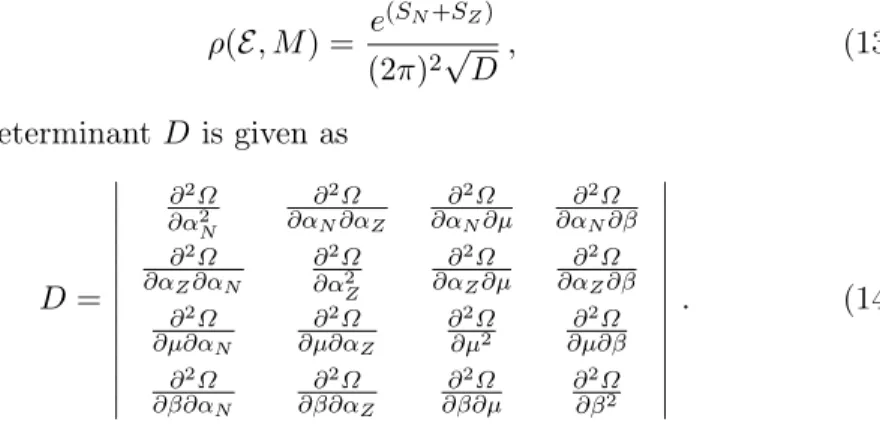
Laplace transformation of the grand-partition function (10). It reads
ρ(E, M) = e
(SN+SZ)
(2π)2√D, (13)
where the determinantD is given as
D=
∂2Ω ∂α2
N
∂2Ω
∂αN∂αZ
∂2Ω
∂αN∂µ
∂2Ω
∂αN∂β
∂2Ω
∂αZ∂αN
∂2Ω ∂α2
Z
∂2Ω
∂αZ∂µ
∂2Ω
∂αZ∂β
∂2Ω
∂µ∂αN
∂2Ω
∂µ∂αZ
∂2Ω
∂µ2 ∂
2Ω
∂µ∂β ∂2Ω
∂β∂αN
∂2Ω
∂β∂αZ
∂2Ω ∂β∂µ
∂2Ω ∂β2 . (14)
The total NLDρ(E) is calculated based on the sum of allJ-dependent NLD
ρ(E) =P
J(2J + 1)ρ(E, J) [10], whereρ(E, J) is obtained by differentiating
ρ(E, M), namelyρ(E, J) =ρ(E, M =J)−ρ(E, M =J+ 1)[11].
3. Results
The numerical calculations are carried out for 104Pd nucleus, whose
single-particle spectra are taken from the axially deformed Woods–Saxon potential including the spin-orbit and Coulomb interactions [12]. The
pair-ing interaction parametersGN,Z are adjusted so that the neutron and proton
gaps obtained within the FTBCS (FTBCS1) atT = 0 match those given by
the empirical odd–even mass differences [13]. The quadrupole deformation
parameter β2 of the Woods–Saxon potential is adjusted so that the NLD
-0.2 -0.1 0.0 0.1 0.2
0 5 10 15 20 25 30
β
J ( )_h
2
Fig. 1. Quadrupole deformation parameter β2 of the Woods–Saxon potential as
obtained at different values of J fit best the empirical ones, which are used
in the CASCADEcode to fit the experimental proton spectra [9], especially
in the region where the enhancement of NLD is observed. The variation of
β2 withJ is plotted in Fig. 1. This figure clearly shows that104Pd nucleus
undergoes a shape transition from the prolate shape (β2>0) to the oblate
one (β2<0) at aroundJ = 20~. This transition seems to be reasonable in
this mass region because of an alignment of protons ing9/2 and neutrons in
h11/2 orbits [14].
10 20 30 J = 0_h
(a)N 0.4 0.8 1.2 1.6 (Me V) ∆
0 5 10 15
E* (MeV)
0 5 10 15 20
(b) Z
Exp FTBCS FTBCS1 10 10 10 10 10 10 10 ρ (Me V ) -1 0 2 4 6 8 10 12
J = 0
(c) h_ (d)J = 10_h
10 10 10 10 10 10 ρ (Me V ) -1 0 2 4 6 8 10
J = 20
(e) _h (f)J = 30h_
5 10 15 20 25 30
E* (MeV)
5 10 15 20 25 0
E* (MeV)
0
β = 0.222 β = 0.22
β = −0.0152 β = −0.2052
Fig. 2. Level-weighted pairing gaps ∆¯ ≡P
k∆k/NL with NL being the number
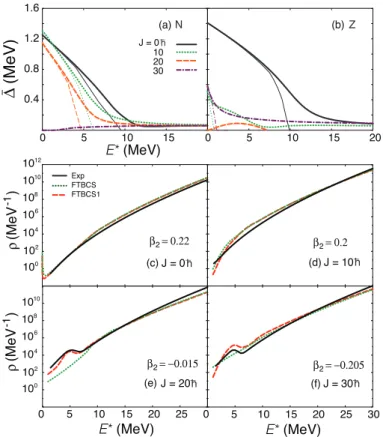
of single-particle levelsk for neutrons (N) (a) and protons (Z) (b) and total NLD (c)–(f) as functions of excitation energy E∗ obtained within the FTBCS and FT-BCS1 at different values ofJ andβ2. The thin and thick lines in (a) and (b) denote
the FTBCS and FTBCS1 results, respectively, whereas the dotted and dashed lines in (c)–(f) respectively stand for the FTBCS and FTBCS1 total level densities. The solid lines in (c)–(f) are the empirical NLD employed in theCASCADEcode to fit the experimentally extracted proton spectra in the reaction12C +93Nb→105Ag∗
Shown in Fig. 2are the pairing gaps and NLD as functions of excitation
energy. The latter is defined asE∗ =E(T, M)−E(0, M), which are obtained
within the FTBCS and FTBCS1 at different values ofJ and β2. It is clear
from Figs. 2(a) and2(b) that the neutron and proton gaps obtained within
the FTBCS (thin lines) decrease with increasingE∗ at allJ, and collapse at
some critical valuesEc∗. At the same time, because of the QNF, the pairing
gaps, predicted by the FTBCS1, do not collapse but monotonically decrease
with increasing E∗, and remain finite even at E∗ = 20 MeV, except the
proton gap at J = 20~ [dashed lines in Fig. 2 (b)]. The latter is zero at
E∗ = 0, increases with increasing E∗ to reach a maximum atE∗ ≈3 MeV,
and then decreases to vanish atE∗ ≈7 MeV. This feature is caused by the
change of the shell structure, which takes place in the shape transition from
prolate to oblate at thisJ value. The pairing reentrance is therefore present
in the FTBCS1 gaps at J = 20~ for protons and J = 30~ for neutrons
[dash-dotted lines in Fig. 2 (a)], whereas no signature of this effect is seen
in the pairing gaps obtained within the FTBCS. As a result, there is no
enhancement of the NLD obtained within the FTBCS [dotted lines in Fig.2
(c)–(f)], whereas two local enhancements are seen in the FTBCS1 NLD in
good agreement with the empirical ones at exactly two values of J = 20
and 30~, where the pairing reentrance takes place for neutrons and protons,
respectively.
4. Conclusions
This work studies the pairing reentrance phenomenon in a warm
rotat-ing104Pd nucleus by analyzing the pairing gaps and NLD obtained within
the FTBCS and FTBCS1 theories including finite angular momentum. The results obtained show that the pairing reentrance takes place only in the
pairing gaps obtained within the FTBCS1 (e.g., for protons atJ = 20~and
neutrons at J = 30~), whereas this effect does not appear in the FTBCS
gaps. This leads to the local enhancements of the NLD obtained within the FTBCS1 at low excitation energy and high angular momentum in agree-ment with the empirical NLD. This agreeagree-ment indicates that the observed enhancement of the NLD might be the first experimental detection of the pairing reentrance in a finite nucleus.
REFERENCES
[1] T. Kammuri,Prog. Theor. Phys. 31, 595 (1964). [2] L.G. Morreto,Nucl. Phys. A 185, 145 (1972).
[3] F. Levy, I. Sheikin, B. Grenier, A.D. Huxley,Science 309, 1343 (2005). [4] H.J. Mang, O. Rasmussen, M. Rho,Phys. Rev.141, 941 (1966);
L.G. Moretto,Phys. Lett. B 40, 1 (1972); A.L. Goodman, Phys. Rev. C29, 1887 (1984); N. Dinh Dang, V. Zelevinsky,Phys. Rev. C 64, 064319 (2001); N. Dinh Dang,Nucl. Phys. A 784, 147 (2007); V. Zelevinsky, B.A. Brown, N. Fazier, M. Horoi,Phys. Rep. 276, 85 (1996).
[5] S. Frauendorf, N.K. Kuzmenko, V.M. Mikhajlov, J.A. Sheikh,Phys. Rev. B 68, 024518 (2003).
[6] J.A. Sheikh, R. Palit, S. Frauendorf,Phys. Rev. C72, 041301(R) (2005). [7] N. Dinh Dang, N. Quang Hung,Phys. Rev. C77, 064315 (2008); N. Quang
Hung, N. Dinh Dang,Phys. Rev. C78, 064315 (2008); 84, 054324 (2011). [8] D.J. Dean, K. Langanke, H.A. Nam, W. Nazarewicz,Phys. Rev. Lett.105,
212504 (2010).
[9] A. Mitraet al., J. Phys. G 36, 095103 (2009); A. Mitra et al.,EPJ Web of Conf.2, 04004 (2010); V.M. Datar, A. Mitra, D.R. Chakrabarty,
Proceedings of the DAE Symposium on Nuclear Physics, University of Delhi, Dec 3–7, 2012, Vol. 57, p. 184 (2012).
[10] A. Gilbert, A.G.W. Cameron,Can. J. Phys. 43, 1446 (1965). [11] T. Ericson,Adv. Phys. 9, 425 (1960).
[12] S. Cwioket al., Comput. Phys. Commun.46, 379 (1987).
[13] P. Ring, P. Schuck,The Nuclear Many-Body Problem, Springer, Heidelberg 2004.