M A J O R A R T I C L E
Open Forum Infectious Diseases
Received 22 April 2019; editorial decision 24 June 2019; accepted 28 June 2019.
aEqual contribution
Correspondence: D. Saunders MD, MPH 1425 Veterans Drive, Fort Detrick, MD, 21702, USA
Open Forum Infectious Diseases®
Published by Oxford University Press on behalf of Infectious Diseases Society of America 2019. This work is written by (a) US Government employee(s) and is in the public domain in the US. DOI: 10.1093/ofid/ofz314
Atovaquone-Proguanil in Combination With Artesunate
to Treat Multidrug-Resistant
P. falciparum
Malaria in
Cambodia: An Open-Label Randomized Trial
Mariusz Wojnarski,1,a Chanthap Lon,1,a Pattaraporn Vanachayangkul,1 Panita Gosi,1 Somethy Sok,2 Agus Rachmat,3 Dustin Harrison,3 Catherine M. Berjohn,3 Michele Spring,1,4 Suwanna Chaoratanakawee,1,5 Mali Ittiverakul,1 Nillawan Buathong,1 Soklyda Chann,1
Saowaluk Wongarunkochakorn,1 Andreea Waltmann,4 Worachet Kuntawunginn,1 Mark M. Fukuda,1 Hana Burkly,1 Vireak Heang,3 Thay Keang Heng,6 Nareth Kong,6 Threechada Boonchan,1 Bolin Chum,3 Philip Smith,1 Andrew Vaughn,3 Satharath Prom,2 Jessica Lin,7 Dysoley Lek,6 and David Saunders1,8
1US Army Armed Forces Research Institute of Medical Sciences, Bangkok, Thailand; 2Department of Health, Ministry of National Defense, Phnom Penh, Cambodia; 3Naval Medical Research Unit-2,
Phnom Penh, Cambodia; 4Henry M. Jackson Foundation, Bethesda, Maryland; 5Faculty of Tropical Medicine, Mahidol University, Bangkok, Thailand; 6National Center for Parasitology, Entomology
and Malaria Control, Phnom Penh, Cambodia; 7Division of Infectious Diseases, University of North Carolina, Chapel Hill, North Carolina; 8US Army Medical Materiel Development Activity, Fort
Detrick, Maryland
Background. Recent artemisinin-combination therapy failures in Cambodia prompted a search for alternatives. Atovaquone‐ proguanil (AP), a safe, effective treatment for multidrug-resistant Plasmodium falciparum (P.f.), previously demonstrated additive effects in combination with artesunate (AS).
Methods. Patients with P.f. or mixed-species infection (n = 205) in Anlong Veng (AV; n = 157) and Kratie (KT; n = 48), Cambodia, were randomized open-label 1:1 to a fixed‐dose 3-day AP regimen +/-3 days of co‐administered artesunate (ASAP). Single low-dose primaquine (PQ, 15 mg) was given on day 1 to prevent gametocyte-mediated transmission.
Results. Polymerase chain reaction–adjusted adequate clinical and parasitological response at 42 days was 90% for AP (95% confidence interval [CI], 82%–95%) and 92% for ASAP (95% CI, 83%–96%; P = .73). The median parasite clearance time was 72 hours for ASAP in AV vs 56 hours in KT (P < .001) and was no different than AP alone. At 1 week postprimaquine, 7% of the ASAP group carried microscopic gametocytes vs 29% for AP alone (P = .0001). Nearly all P.f. isolates had C580Y K13 propeller artemisinin resistance mutations (AV 99%; KT 88%). Only 1 of 14 treatment failures carried the cytochrome bc1 (Pfcytb) atovaquone resistance mutation, which was not present at baseline. P.f. isolates remained atovaquone sensitive in vitro but cycloguanil resistant, with a triple
P.f. dihydrofolate reductase mutation.
Conclusions. Atovaquone-proguanil remained marginally effective in Cambodia (≥90%) with minimal Pfcytb mutations observed. Treatment failures in the presence of ex vivo atovaquone sensitivity and adequate plasma levels may be attributable to cycloguanil and/or artemisinin resistance. Artesunate co-administration provided little additional blood-stage efficacy but reduced post-treatment gametocyte carriage in combination with AP beyond single low-dose primaquine.
Keywords. atovaquone-proguanil; artesunate; drug resistance; malaria; primaquine.
Treatment failures of multiple Plasmodium falciparum drugs have accelerated over the past decade in Cambodia. Most recently, substantial rates of clinical dihydroartemisinin-piperaquine combination therapy failures emerged within just 3 years of introduction [1], with confirmed resistance to both components [2]. In response, health authorities issued guidelines reinstating artesunate-mefloquine combinations as firstline agents in affected areas [3]. These were based on ex vivo surveillance data indicating inverse resistance patterns between
piperaquine and mefloquine [4, 5] attributed to Pfmdr1 muta-tions [6]. This was intended as a stop-gap public health measure pending more effective therapies.
malaria with AP is rapid in-host selection of cytochrome-bc1 parasite mutations conferring clinical resistance, though resist-ance without bc1 mutations has also been described [12].
A prior study in Thailand indicated that the combination of artesunate with atovaquone-proguanil (ASAP) (Atlantic Laboratories Corp., Ltd., Bangkok, Thailand) is more effec-tive than AP alone while also reducing subsequent gametocyte carriage [13]. In addition to added efficacy, it is possible that the combination may delay or prevent further development of resistance to the individual agents, given varying mechan-isms of action. We tested the efficacy of AP with and without AS and evaluated the effects of single low-dose primaquine (15 mg) (The Government Pharmaceutical Organization (GPO), Bangkok, Thailand) paired with the 2 combinations on gametocyte carriage post-treatment.
METHODS
Study Design and Participants
Cambodian volunteers with uncomplicated P.f. or mixed
P. falciparum/P. vivax malaria aged 18–65 years were enrolled in a 2-arm open label treatment trial at Anlong Veng Referral Hospital, Oddar Meanchey Province, and Kratie Provincial Referral Hospital. Patients with 100–200 000 parasites/μL of blood were included, whereas patients with severe malaria, al-lergy, contraindication to study drugs, use of antimalarials in the previous 7 days (or atovaquone-proguanil in the previous 30), and pregnant or lactating women were excluded. Participants provided written informed consent in Khmer. The study pro-tocol was approved by US and Cambodian regulatory author-ities as study WR2115 (ClinicalTrials.gov NCT02297477).
Procedures
Patients were treated in-hospital under directly observed therapy. Volunteers were randomly assigned to 3 days of atovaquone-proguanil (AP; 1000 mg/400 mg) with or without 200 mg of artesunate (ASAP) daily with 1:1 allocation using time-blocked randomization with a block size of 4. Volunteers selected treatment assignment codes from a collection of sealed envelopes to mask allocation. Based on published international and local guidance by the WHO at the time, all volunteers re-ceived 15 mg of primaquine on day 1, regardless of G6PD status. Microscopists were blinded to each other’s readings and to study drug regimen.
All investigational products met quality standards for weight and content uniformity by UPLC-MS analysis before the study [14]. Volunteer glucose-6-phosphate-dehydrogenase (G6PD) activity was evaluated by a fluorescence spot test (R&D Diagnostics Ltd., Greece).
Vital signs were taken at 0, 4, and 8 hours after the first dose, then every 8 hours until discharge. Giemsa-stained thick and thin malaria smears [15] were performed at 4 and 8 hours after first study drug dose, then every 8 hours until 2 consecutive negative
smears. Gametocytemia was evaluated per 2000 white blood cell count (WBC) on thin smear, whereas asexual-stage parasit-emia was per 500 WBC [16]. Real-time polymerase chain reac-tion (PCR) detecreac-tion of malaria was performed at 0, 24, 48, and 72 hours, then weekly and at recurrence [17]. Atovaquone levels were collected at 0, 4, 24, 48, and 72 hours, weeks 1 and 2, and recurrence. An ultraperformance liquid chromatography (UPLC) coupled with tandem mass spectrometry (MS/MS) method in human plasma with carboxymefloquine as an internal standard was developed, optimized, and validated based on US Food and Drug Administration guidance. Plasma atovaquone concen-tration was measured using a Waters Acquity UPLC BEH C18, 2.1×50 mm, 1.8-µm column with a gradient mobile phase of 5 mM of ammonium acetate in water (pH 7.0) and 5 mM of am-monium acetate in acetonitrile at a flow rate of 0.4 mL/min over 5 minutes. Plasma samples were extracted by acetonitrile protein precipitation with known concentrations of carboxymefloquine. Clear supernatants were transferred to UPLC vials after vortexing and centrifugation for 10 minutes. Selective mass/charge (m/z) transitions were monitored for atovaquone (365.04 to 337.02) and carboxymefloquine (307.94 to 223.93).
Volunteers were monitored throughout the study for adverse events using Common Terminology Criteria for Adverse Events [18], including performance of complete blood count and renal and liver function tests at 0, 48, and 72 hours. After discharge, outpatient clinical follow-up continued for 42 days, with weekly malaria smears. Females had urine pregnancy tests at baseline, recurrence, and weeks 2, 4, and 6. Recurrent malaria was treated following current national treatment guidelines.
In cases of malaria recurrence, recrudescence was determined by P.f. msp1, msp2, and glurp genotyping [19]. Molecular markers of resistance were assessed at baseline and recurrence, including the K13 propeller marker for artemisinins [1], the cytochrome bc1 atovaquone mutation [10], and dihydrofolate reductase (DHFR) mu-tations associated with cycloguanil resistance, an active metabolite of proguanil [20]. Sequencing for AS-resistant Pf Kelch 13 variants covered the entire pfk13 propeller domain, including previously de-scribed mutations at R561H, N537I, P553L, G449A, and C580Y. In these Cambodian isolates, Pf kelch mutation was only found at posi-tion C580Y. Addiposi-tionally, the entire mitochondrial cytochrome b gene was sequenced by amplifying a 2.7-kb mtDNA fragment using the Sanger method with 8 different sequencing primers (Supplementary Table 1). Immediate ex vivo drug susceptibility of fresh P.f. isolates to commonly used antimalarials was measured as 50% inhibitory concentration (IC50) [1] based on histidine-rich protein 2 (HRP-2) enzyme-linked immunosorbent assay (ELISA) [10, 21].
Outcomes
Statistical Analysis
Prior efficacy point estimates from a large (n = 1596) compara-tive study conducted in Thailand a decade earlier [13] were 97% for AP and 99% for ASAP. Sample size of 100 in each treatment arm was calculated to determine 95% confidence intervals for each treatment arm independently around a 90% 42-day per-protocol efficacy for AP and 95% for ASAP. These were con-sidered to be acceptable thresholds to support ongoing use as tertiary regimens in the national treatment program. Data were double-entered into Microsoft Access 2007, with random 20% reverification by the clinical study monitor, and analyzed using STATA, version 15.0 (Stata Corp, College Station, TX), and GraphPad Prism, version 6.07. All patients receiving at least 1 dose of study drug were included in the intention-to-treat anal-ysis, whereas per-protocol analysis excluded all withdrawn or censored volunteers.
Cumulative risk of treatment failure was assessed with Kaplan-Meier survival over 42 days using log-rank comparison tests. Cox proportional hazards models were used to assess clin-ical and molecular covariates and recrudescence. Comparisons of categorical variables were made with the Fisher exact test, whereas continuous variables were compared with the Student
t test or Wilcoxon rank-sum test (for non–normally distrib-uted data). A 2-sided P value of less than 0.05 was considered significant.
RESULTS Study Population
Of 221 patients screened with acute P.f. or mixed malaria infection, 205 (93%) were enrolled and randomized, with 95% completing 42-day follow-up (Figure 1). One hundred
Withdrawn (n = 2) Lost to FU (n = 3) Missed W4 (n = 2) Censored ≤D28
P.v recurrence (n = 15) P.f. reinfection (0)
93 completed follow-up on D28 AV Site: 72 KT Site: 21
95 completed follow-up on D28 AV Site: 73 KT Site: 22
98 completed follow-up on d42
AV Site: 77 KT Site: 21 97 completed follow-up on d42AV Site: 75 KT Site: 22 Censored
D28 to <D42
P.v. recurrence (11) P.f. reinfection (1)
Missed W4 but had follow-up on W6 (n = 5)
Censored D28 - <D42 P.v. recurrence (10) P.f. reinfection (2)
Lost to FU (n = 2**) Withdrawn (n = 2)
Lost to FU (n = 3) Missed W4 (n = 5) 103 assigned to AP
[AV 79; KT 24]
Censored ≤D28 P.v. recurrence (n=16) P.f. reinfection (0)
102 assigned to ASAP [AV 78; KT 24] All treated with 15 mg of PQ
205 patients enrolled and randomized 221 patients screened with P.f malaria
Excluded (n = 16)* Severe Malaria (n = 6)
Recent use of antimalarial (n = 3) Acute comorbidity (n = 1) Pregnant (n = 1) Other (n = 11)
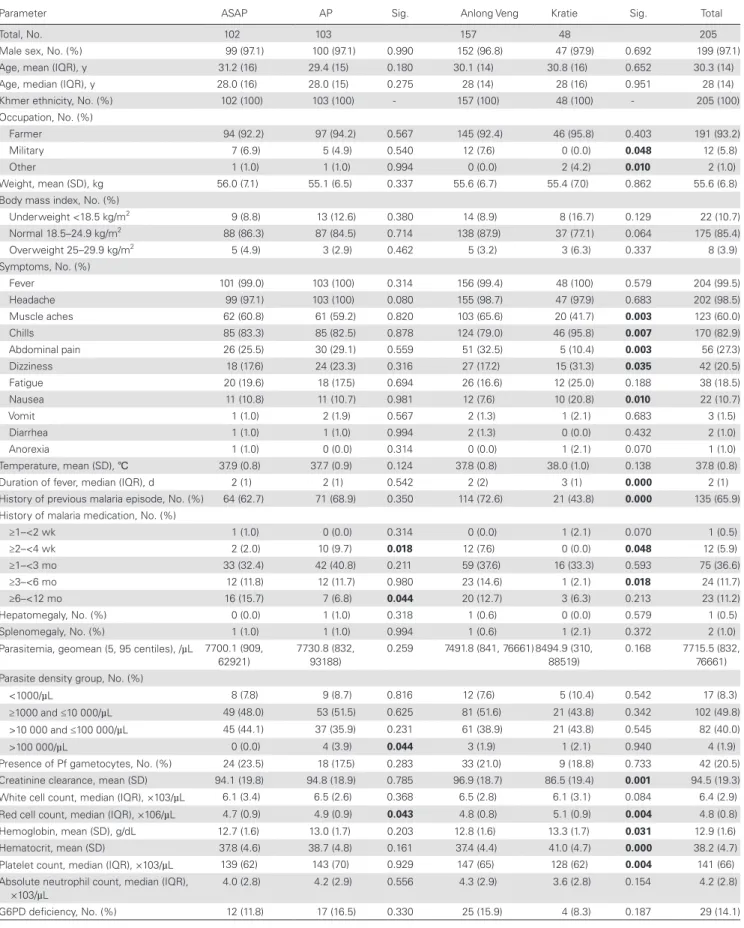
fifty-seven volunteers were enrolled in northern Cambodia (Anlong Veng) and 48 in eastern Cambodia (Kratie), mostly symptomatic adult males. Patient baseline characteristics were similar between treatment arms and study sites (Table 1). Less than 8% had preexisting plasma antimalarial activity detected at baseline (Table 2).
Safety
AP combined with AS was well tolerated, with only 2 serious ad-verse events. One ASAP volunteer had asymptomatic obstructive jaundice, with elevated bilirubin, alkaline phosphatase, and as-partate aminotransferase all >4× upper limit of normal by day 7 and normalizing by week 2 with normal alanine aminotransferase throughout. The volunteer suffered no permanent injury, and al-though a relationship to the study drug was unexpected, it could not be definitively ruled out. One AP volunteer presented with gingival bleeding 1 month after treatment and was diagnosed with idiopathic thrombocytopenic purpura (ITP), which was assessed as unlikely to be related to treatment due to normal blood counts 1 week post-treatment and delayed symptom presentation.
Clinical Outcomes
PCR-adjusted ACPR against blood-stage malaria infection was sim-ilar for the 2 regimens at 42 days: 90% for AP (95% confidence in-terval [CI], 82%–95%) vs 92% for ASAP (95% CI, 83%–96%; P = .617 by Kaplan-Meier analysis) (Table 2, Figure 2A–C). There were 17
P.f. malaria recurrences by microscopy, nearly all occurring at the AV site (16/17), with 14 PCR-confirmed recrudescences. Thus, al-though 28-day per-protocol efficacy was at or near 100% at both sites, 42-day efficacy of both regimens was lower at the AV site (Table 2). Treatment outcomes did not differ by baseline parasitemia. Twenty-five percent of volunteers were excluded from per-protocol analysis during follow-up for receiving blood-stage P. vivax treatment.
Parasite Clearance
The median parasite clearance time (PCT) in AV was 72 hours for both treatment arms, but was shorter in KT (ASAP 56 hours vs AP 68 hours; P < .001) (Figure 3A, Table 2). At day 3 post-treatment, 42% at the AV site remained microscopy-positive compared with 10% at the KT site (Table 2). However, when measuring parasite clearance half-lives (PCT1/2), there were not significant differences
between sites or intervention arms (Figure 3B).
The majority of treatment failures (12/14) occurred in pa-tients infected with artemisinin-resistant phenotype parasites with PCT >72 hours and PCT1/2 >5 hours (Table 2, Figure 3).
Despite faster parasite clearance and fewer treatment failures in Kratie, nearly all isolates at both sites carried the C580Y K13 mutation (AV 99% [168/169] vs KT 90% [38/43]) (Figure 3), with the remaining isolates having K13 wild-type. All treatment failures were C580Y positive, with C580Y parasites cleared more slowly than non-C580Y parasites (median PCT1/2, 5.3 in
C580Y vs 3.4 hours in non-C580Y infections; P = .003).
Parasite Drug Sensitivity
Fresh patient P.f. isolates retained comparable resistance pat-terns to recent studies at the Anlong Veng site by HRP2 ELISA (Figure 4A) [4]. Notably, isolates retained ex vivo atovaquone sensitivity at both sites, with geometric mean pretreatment IC50 of 4.8 nM (95% CI, 3.8–6.0) in AV and 3.5 nM (95% CI, 2.4–5.0) in KT (P = .02). ATQ IC50 was evaluable in 5/14 recrudescent samples (36%), with a geometric mean IC50 similar to base-line (4.2 nM; P = .51). All isolate IC50 were far below that of the ATQ-resistant C2B clone (11 368 nM) (Figure 4B) [22]. Sanger sequencing did not detect a mutation at cytb Y268 associated with ATQ resistance in any baseline isolates. Only 1 volunteer (ASAP-90) harbored the Y268C mutation at recrudescence (1/14), though IC50 was unevaluable. Sequencing across the en-tire mitochondrial cytochrome b gene was successful in 14 re-crudescent isolates, but no previously reported [23–25] or new single nucleotide polymorphisms (SNPs) were found.
Parasites displayed high-level cycloguanil (CYC) resistance (geometric mean pretreatment IC50, 2204 nM), though only 29% of isolates were successfully evaluated ex vivo (Figure 4B). No cycloguanil-specific dihydrofolate-reductase (DHFR) mu-tations (S108T and A16V) were detected in any of the tested isolates. All 14 recrudescent samples had 4 parasite DHFR gene SNPs (S108N, N51II, C59R, and I164L) associated with pyri-methamine resistance and were thought to confer cycloguanil cross-resistance [26, 27]. A randomly sampled subset of 46 baseline AV samples were also quadruple pyrimethamine mu-tants, consistent with fixation of this DHFR genotype.
Gametocyte Carriage After Treatment
At screening, 22% of volunteers treated with AP had gametocytemia by microscopy vs 26% for ASAP (n.s.) (Figure 5A). ASAP-treated volunteers had faster gametocyte decline than AP, reaching statis-tical significance by day 3 (P = .0009) and remaining significantly lower in the ASAP arm through week 2, despite universal base-line 15-mg primaquine treatment (Figure 5). Median gameto-cyte densities normalized for baseline values revealed more rapid clearance for the ASAP group (Figure 5B and C).
Pharmacology
Mean atovaquone levels were not significantly different between treatment groups (Figure 6A) or treatment outcomes (Figure 6B). Mean atovaquone levels on day 7 in those with ACPR were not different than in those who recrudesced (Figure 6C).
DISCUSSION
Implications for Implementation of Rescue Therapies in Areas of Severe Multidrug Resistance
Table 1. Baseline Characteristics of Study Subjects
Baseline Characteristics
Parameter ASAP AP Sig. Anlong Veng Kratie Sig. Total
Total, No. 102 103 157 48 205
Male sex, No. (%) 99 (97.1) 100 (97.1) 0.990 152 (96.8) 47 (97.9) 0.692 199 (97.1)
Age, mean (IQR), y 31.2 (16) 29.4 (15) 0.180 30.1 (14) 30.8 (16) 0.652 30.3 (14)
Age, median (IQR), y 28.0 (16) 28.0 (15) 0.275 28 (14) 28 (16) 0.951 28 (14)
Khmer ethnicity, No. (%) 102 (100) 103 (100) - 157 (100) 48 (100) - 205 (100)
Occupation, No. (%)
Farmer 94 (92.2) 97 (94.2) 0.567 145 (92.4) 46 (95.8) 0.403 191 (93.2)
Military 7 (6.9) 5 (4.9) 0.540 12 (7.6) 0 (0.0) 0.048 12 (5.8)
Other 1 (1.0) 1 (1.0) 0.994 0 (0.0) 2 (4.2) 0.010 2 (1.0)
Weight, mean (SD), kg 56.0 (7.1) 55.1 (6.5) 0.337 55.6 (6.7) 55.4 (7.0) 0.862 55.6 (6.8)
Body mass index, No. (%)
Underweight <18.5 kg/m2 9 (8.8) 13 (12.6) 0.380 14 (8.9) 8 (16.7) 0.129 22 (10.7)
Normal 18.5–24.9 kg/m2 88 (86.3) 87 (84.5) 0.714 138 (87.9) 37 (77.1) 0.064 175 (85.4)
Overweight 25–29.9 kg/m2 5 (4.9) 3 (2.9) 0.462 5 (3.2) 3 (6.3) 0.337 8 (3.9)
Symptoms, No. (%)
Fever 101 (99.0) 103 (100) 0.314 156 (99.4) 48 (100) 0.579 204 (99.5)
Headache 99 (97.1) 103 (100) 0.080 155 (98.7) 47 (97.9) 0.683 202 (98.5)
Muscle aches 62 (60.8) 61 (59.2) 0.820 103 (65.6) 20 (41.7) 0.003 123 (60.0)
Chills 85 (83.3) 85 (82.5) 0.878 124 (79.0) 46 (95.8) 0.007 170 (82.9)
Abdominal pain 26 (25.5) 30 (29.1) 0.559 51 (32.5) 5 (10.4) 0.003 56 (27.3)
Dizziness 18 (17.6) 24 (23.3) 0.316 27 (17.2) 15 (31.3) 0.035 42 (20.5)
Fatigue 20 (19.6) 18 (17.5) 0.694 26 (16.6) 12 (25.0) 0.188 38 (18.5)
Nausea 11 (10.8) 11 (10.7) 0.981 12 (7.6) 10 (20.8) 0.010 22 (10.7)
Vomit 1 (1.0) 2 (1.9) 0.567 2 (1.3) 1 (2.1) 0.683 3 (1.5)
Diarrhea 1 (1.0) 1 (1.0) 0.994 2 (1.3) 0 (0.0) 0.432 2 (1.0)
Anorexia 1 (1.0) 0 (0.0) 0.314 0 (0.0) 1 (2.1) 0.070 1 (1.0)
Temperature, mean (SD), ℃ 37.9 (0.8) 37.7 (0.9) 0.124 37.8 (0.8) 38.0 (1.0) 0.138 37.8 (0.8)
Duration of fever, median (IQR), d 2 (1) 2 (1) 0.542 2 (2) 3 (1) 0.000 2 (1)
History of previous malaria episode, No. (%) 64 (62.7) 71 (68.9) 0.350 114 (72.6) 21 (43.8) 0.000 135 (65.9)
History of malaria medication, No. (%)
≥1–<2 wk 1 (1.0) 0 (0.0) 0.314 0 (0.0) 1 (2.1) 0.070 1 (0.5)
≥2–<4 wk 2 (2.0) 10 (9.7) 0.018 12 (7.6) 0 (0.0) 0.048 12 (5.9)
≥1–<3 mo 33 (32.4) 42 (40.8) 0.211 59 (37.6) 16 (33.3) 0.593 75 (36.6)
≥3–<6 mo 12 (11.8) 12 (11.7) 0.980 23 (14.6) 1 (2.1) 0.018 24 (11.7)
≥6–<12 mo 16 (15.7) 7 (6.8) 0.044 20 (12.7) 3 (6.3) 0.213 23 (11.2)
Hepatomegaly, No. (%) 0 (0.0) 1 (1.0) 0.318 1 (0.6) 0 (0.0) 0.579 1 (0.5)
Splenomegaly, No. (%) 1 (1.0) 1 (1.0) 0.994 1 (0.6) 1 (2.1) 0.372 2 (1.0)
Parasitemia, geomean (5, 95 centiles), /µL 7700.1 (909,
62921)
7730.8 (832, 93188)
0.259 7491.8 (841, 76661) 8494.9 (310,
88519)
0.168 7715.5 (832,
76661) Parasite density group, No. (%)
<1000/µL 8 (7.8) 9 (8.7) 0.816 12 (7.6) 5 (10.4) 0.542 17 (8.3)
≥1000 and ≤10 000/µL 49 (48.0) 53 (51.5) 0.625 81 (51.6) 21 (43.8) 0.342 102 (49.8)
>10 000 and ≤100 000/µL 45 (44.1) 37 (35.9) 0.231 61 (38.9) 21 (43.8) 0.545 82 (40.0)
>100 000/µL 0 (0.0) 4 (3.9) 0.044 3 (1.9) 1 (2.1) 0.940 4 (1.9)
Presence of Pf gametocytes, No. (%) 24 (23.5) 18 (17.5) 0.283 33 (21.0) 9 (18.8) 0.733 42 (20.5)
Creatinine clearance, mean (SD) 94.1 (19.8) 94.8 (18.9) 0.785 96.9 (18.7) 86.5 (19.4) 0.001 94.5 (19.3)
White cell count, median (IQR), ×103/µL 6.1 (3.4) 6.5 (2.6) 0.368 6.5 (2.8) 6.1 (3.1) 0.084 6.4 (2.9)
Red cell count, median (IQR), ×106/µL 4.7 (0.9) 4.9 (0.9) 0.043 4.8 (0.8) 5.1 (0.9) 0.004 4.8 (0.8)
Hemoglobin, mean (SD), g/dL 12.7 (1.6) 13.0 (1.7) 0.203 12.8 (1.6) 13.3 (1.7) 0.031 12.9 (1.6)
Hematocrit, mean (SD) 37.8 (4.6) 38.7 (4.8) 0.161 37.4 (4.4) 41.0 (4.7) 0.000 38.2 (4.7)
Platelet count, median (IQR), ×103/µL 139 (62) 143 (70) 0.929 147 (65) 128 (62) 0.004 141 (66)
Absolute neutrophil count, median (IQR),
×103/µL 4.0 (2.8) 4.2 (2.9) 0.556 4.3 (2.9) 3.6 (2.8) 0.154 4.2 (2.8)
G6PD deficiency, No. (%) 12 (11.8) 17 (16.5) 0.330 25 (15.9) 4 (8.3) 0.187 29 (14.1)
Table 2.
Efficacy Outcomes for Atovaquone-Proguanil vs Artesunate-Atovaquone-Proguanil in Cambodia
Treatment Arm
Northern Cambodia (Anlong
Veng
, Oddar Meanc
he
y P
ro
vince)
Eastern Cambodia (Kratie P
ro vince) AP (n = 1 03) A SAP (n = 1 02) P AP (n = 79) A SAP (n = 78) AP (n = 24) A SAP (n = 24) Pr eexisting antimalar
ial activity bef
or e tr eatment e 8 (7 .77) [3.41–1 4.7]
4 (3.9) [1
.08–9.7
4]
.241
7 (8.9) [3.64–1
.7
4]
4 (5.1) [1
.41–1
2.6]
1 (4.2) [0.1
0–21
.1]
0 (0) [0–1
4.3] Mix ed P.f ./P .v . inf
ection at enr
ollment
6 (5.8) [2.1
6–1 2.2] 8 (7 .8) [3.44–1 4.9] .567
4 (5.1) [1
.40–1
2.5]
6 (7
.7) [2.87–1
6.0]
2 (8.3) [1
.03–27
.0]
2 (8.3) [1
.03–27
.0]
K13 pr
opeller C580Y mutation
99/1
01 (98) [93.0–99.8]
95/99 (96) [90.0–99.0]
.443 79 (1 00) 77 (99) 20/22 (91) 18/21 (86) Par asit emia positiv
e on D3
Positiv
e b
y micr
oscop
y
37 (36) [26.7–46.0]
34 (33) [24.3–43.4]
.70 0 33 (42) 33 (42) 4 (1 7) 1 (4) Positiv e b y quantitativ e PCR 74 (71 .8) [62.1–80.3]
77 (75.5) [66.0–83.5]
.554 54 (68) 60 (77) 20 (83) 17 (7 4) Par asit e clear ance time, median (IQR), h 72 (32–1 04) 64 (1 6–1 04) .250 72 (32–1 04) 72 (1 6–1 04) 68 (32–88) 56 (32–96)
Median time t
o PCT 50 17 (0.8–47) 9.5 (0.4–38) <.0 00 1 18 (0.8–47) 9.6 (0.4–38) 15 (3.6–36) 9.4 (1 .2–23)
Median time t
o PCT 90 31 (1 2–63) 22 (3.2–55) <.0 00 1 33 (1 2–63) 23 (3.2–55) 29 (1 6–44) 18 (1 2–35)
Median time t
o PCT 95 37 (1 6–71) 29 (4.4–62) <.0 00 1 39 (1 6–71) 29 (4.4–62) 35 (20–47) 23 (6–41) Recr
udescence PCT <72 h & PCT
1/2 <5 h 2/8 (25) 0/6 (0) .473 2/1 3 (1 5) 0/1 (0) Recr
udescence PCT ≥72 h & PCT
1/2 ≥5 h f 6/8 (75) 6/6 (1 00) .473 11/1 3 (85) 1/1 (1 00) Ther apeutic outcomes Ear ly tr eatment f ailur e r equir ing r escue 0 b 0 b 0 0 0 0 Lat
e clinical f
ailur e 2 (1 .9) 0 2 (2.5) 0 0 0 Lat e par asit ological f ailur e 7 (6.8) 8 (7 .8) 7 (8.9) 7 (9.0) 0 1 (4.2) Post-tr eatment blood-stag e P. viv ax emer -gence 25 (24) 22 (21 .6) 19 (24.1) 6 (7 .7) 18 (75) 4 (1 6.7) PCR-adjust ed tr eatment ef
ficacy at 28 d,
% Per pr ot ocol 98.8 [93.5–1 00] 10 0 [95.6–1 00] 1 98.5 [91 .8–1 00] 10 0 [94.3–1 00] 10 0 [80.5–1 00] 10 0 [81 .5–1 00] Int ention t o tr eat b 80.6 [71 .6–87 .7] 79.4 [70.3–86.8] .834 82.3 [72.1–90.0] 80.8 [70.3–88.8] 70.8 [48.9–87 .4] 75 [53.3–90.2] Cumulativ e P. f alcipar um ef ficacy b y K-M analysis c 98.9 [92.5–99.8] 10 0 .31 7 90.3–99.8 10 0 10 0 10 0 PCR-adjust ed tr eatment ef
ficacy at 42 d,
% Per pr ot ocol 88.7 [79.0–95.0] 91 .4 [82.3–96.8] .593 86.0 [73.8–93.6] 90.6 [79.34–96.87] 10 0 [78.2–1 00] 94 [69.8–99.8] Int ention t o tr eat b 62.1 [52.0–71 .5] 63.7 [53.6–73.0] .81 4 62.0 [50.4–72.7] 64 [52.44–7 4.66] 62.5 [40.6–81 .2] 63 [40.6–81 .2] Modifi ed IT T d 87 .4 [79.4–93.1] 89.2 [81 .5–94.5] .683 87 .3 [78.0–93.8] 89.7 4 [80.8–95.5] 87 .5 [67 .6–97 .3] 87 .5 [67 .6–97 .3] Cumulativ e P. f alcipar um ef ficacy b y K-M analysis c 90.4 [81 .6–95.1] 92.0 [82.9–96.3] .61 7 87 .8 [77 .1–93.8] 91 .4 [80.5–96.3] 10 0 93.8 [63.2–99.1] Dat
a are median (IQR), n/N (%) [95% CI], or No. (%).
A
dequate clinical and parasitological response w
as defined as the absence of parasitemia b
y the specifi
ed end date (28 or 42
da
ys). P
er
-protocol analy
sis e
xcluded patients who had withdra
wn or w
ere lost to f
ollo
w
-up or who had
P. v. recur rence. Late treatment f ailures w
ere defined as parasitemia bet
w
een da
ys 4 and 42 and included late clinical f
ailures with symptoms plus parasitemia present and late parasitologic f
ailures with parasitemia only
.
Abbre
viations:
A
CPR, adequate clinical and parasitological response;
AP , ato vaquone-proguanil; A SAP , artesunate-ato
vaquone-proguanil; CI, confidence inter
val; IQR, interquartile range; I
TT
, intention to treat; K-M, Kaplan-Meier; PCR, polymerase c
hain reaction; PCT
1/2
, parasite clearance half-lif
e; PCT
50
, 50%
parasite clearance; PCT
90
, 90% parasite clearance; PCT
95
, 95% parasite clearance.
aSubject 048 (AP) met the definition f
or early treatment f
ailure of ongoing parasitemia and f
ev
er at 72 hours but w
as not counted due to concomit
ant illness e
xplaining f
ev
er
.
bIntention-to-treat analy
sis included an
y patient who had 1 dose of st
udy medication and then withdre
w (includes 2 serious adv
erse e
vents), met a secondar
y end point (ne
w P. f alcipar um or P. viv ax inf
ection), or w
as lost to f
ollo
w
-up as the
y did not complete treatment.
cKaplan-Meier sur
viv
al analy
sis included subjects with
P.
f.
only and subjects censored on the da
y of a ne
wly acquired
P.
f.
inf
ection based on PCR adjustment,
P.
v.
recur
rence, loss to f
ollo
w
-up, or withdra
w
al.
dModifi
ed intention to treat where
P.
v.
recur
rence w
as not classifi
ed as f
ailure.
eB
ased on an e
x viv
o assa
y of patient plasma activit
y against the
W2 Indoc hina laborator y P. f. strain [ 47 ]. The lo w
er limit of quantification w
as 1
7.58 nM DHA equiv
alents; an
y participant with activit
y greater than the lo
w
er limit of quantification of DHA activit
y w
as deemed positiv
e.
fArtesunate resist
ant parasite phenot
ype with parasite clearance time ≥72 hours and parasite clearance half-lif
0
0.50 A
B
C
Day ASAP
AP 0
102 102 101 101 100 99 99 97 91 78 71
103 103 103 103 102 101 100 99 91 82 70
1 2 3 4 7 14 21 28 35 42
0.60 0.70 0.80 0.90 1.00
Pr
oportion recrudescence free
0.50 0.60 0.70 0.80 0.90 1.00
Pr
oportion recrudescence free
12 3 4 7 14 21
Day of follow up
Artesunate+Atovaquone+proguanil Atovaquone+proguanil
Artesunate+Atovaquone+proguanil Atovaquone+proguanil
Artesunate+Atovaquone+proguanil Atovaquone+proguanil
28 35 42
0 12 3 4 7 14 21
Day of follow up 28 35 42
0.50 0.60 0.70 0.80 0.90 1.00
Pr
oportion recrudescence free
0 12 3 4 7 14 21
Day of follow up 28 35 42
Figure 2. Clinical efficacy. Kaplan-Meier survival analysis of artesunate-atovaquone-proguanil (ASAP) efficacy over 42 days vs atovaquone-proguanil (AP) alone at 2 sites
in Cambodia based on number of volunteers remaining malaria free at each interval (inset). A, Overall (log-rank P value for difference = .617). B, Anlong Veng site. C, Kratie
hovered at 90% by day 42. Findings here are consistent with pre-vious observations that AP treatment failures before day 28 are rare [28] and thought to be due to poor drug absorption. AP was administered with food under the study protocol to ensure sufficient absorption. Low dropout rates (<5%) lend confidence to the efficacy findings.
Given recent failures of firstline treatment drugs [1, 7], it was hoped that the ASAP combination might preserve drug efficacy. There has been a measurable shift in antimalarial resistance pat-terns in the past 17 years since van Vugt et al. published their original report in 2002 [13]. At that time, artemisinin resistance had yet to be clearly defined. Atovaquone-proguanil had not yet been deployed in Western Cambodia to mitigate emerging re-sistance, and it was 12 years before clinical dihyrdroartemisinin-piperaquine failures were reported in Cambodia. Recent claims
of malaria “superbugs” in Cambodia and elsewhere [29] under-score the urgent need for alternative regimens using therapies in hand, as was attempted in the present trial. We sought to de-termine whether AP remains a deployable option and whether AS might help to boost its efficacy. Given the resultant 90%– 92% efficacy estimate here compared with 97%–99% previously observed in neighboring Thailand, there is reason to believe this approach would be suboptimal in Cambodia. High rates of mi-croscopic gametocytemia, even in combination with low-dose primaquine, also raise concerns regarding the utility of ASAP as a firstline regimen in an elimination campaign.
Atovaquone Resistance
Despite a nearly 10% treatment failure rate, measurable atovaquone resistance was not observed, with adequate Anlong Veng
P-value = .69
72 hrs
150
12
10
8
6
4
2
0
AP
5.60 5.86 5.60 5.25
5 hrs
AP
ASAP ASAP
A)
B)
125
100
75
Parasite Clearance Time (hr)
50
25
0
AP
72 72 64 56
ASAP AP ASAP
Kratie
P-value = .04
Anlong Veng
P-value = .97
Parasite Clearance half-life (hr)
Kratie
P-value = .29
Figure 3. Parasite clearance times (A) and parasite clearance half-life (B) in Northern (Anlong Veng) and Eastern (Kratie) Cambodia by treatment regimen. All patients with
treatment failure assigned to ASAP had a parasite clearance half-life (PCT1/2) >5 hours. Red dots represent parasite recrudescence based on genotyping with msp1, msp2,
and glurp polymorphisms. Clear dots represent parasites with the K13 propeller C580Y mutation, green dots represent K13 wild-type parasites, and blue dots represent K13
propeller status unknown. The orange error bars represent medians and interquartile ranges for the variables presented. Comparison of parasite clearance time by t test with
Mann-Whitney test revealed significantly faster parasite clearance time for the ASAP treatment vs AP in Eastern Cambodia only (P = .04). There were no significant
differ-ences in parasite clearance half-life overall. The median PCT1/2 was significantly higher at 5.34 nM for parasites with the K13 propeller C580Y mutation vs 3.42 for parasites
drug levels well above baseline parasite IC50 and absent
cyto-chrome bc1 mutations in all but 1 volunteer detected at week 5. Interestingly, this single mutation was not detected at base-line, suggesting that it may have arisen de novo or existed as a minority variant that was selected through treatment. De novo mutations refer to cytb Y268 found at recrudescence, but not at baseline, before treatment. Despite rare de novo mutations, AP resistance appears to be an all-or-none rather than gradual phenomenon [30]. In prior studies, most clinical failures attrib-utable to cytb mutations occurred beyond 28 days. However,
only 1 failure here among 14 was potentially attributable to cytb mutation. This was unexpected and argues against atovaquone resistance as the cause of treatment failures. As genotyping was performed here, based on PCR amplification and Sanger sequencing (capturing the majority genotype), this does not preclude that cytb Y268 mutations might have been present as minority variants at baseline. Preserved ex vivo atovaquone sensitivity was found among isolates from a 2013 clinical study at the AV site despite >50% clinical dihydroartemisinin-piperaquine failure rates [10], and again here 2 years later.
ATQ PPQ CQ QN 2014
MQ AS
DHA
8.4 5.8 57.6 128 103 30.9 6.2 nM
ATQ susceptibility at < 30 nM
W2
W2
D6
W2
10 000
100 000
10 000
1000
100
10
1
0.1
0.01
0.001 1000
100
10
1
0.1
0.01
IC50
, nM
IC50
, nM
(N = 62 ) (62 ) (54) (54) (52) (19) (52)
D0 (N = 93) DR (N = 5)
Atovaquone Cycloguanil
D0 (N = 44) DR (N = 4)
C2B C2B
GMean
4.58 4.23 2147 4015
A)
B)
Figure 4. Immediate ex vivo Plasmodium falciparum (P.f.) parasite resistance. A, Overall ex vivo P.f. parasite sensitivity to commonly used antimalarial drugs in 2014 from
field surveillance stations in Cambodia. Red bars represent geometric mean values, whereas green dashed lines represent values for the W2 Indochina P.f. clone. B. Ex vivo
parasite sensitivity by histidine-rich protein 2 enzyme-linked immunosorbent assay to atovaquone and cycloguanil for evaluable isolates on the day of study screening before treatment (D0) and day of recrudescence (DR). Baseline assays were interpretable for only 93 of 202 isolates for atovaquone (46%) and 46 of 160 (29%) for cycloguanil. Clear dots represent parasites with the cytb atovaquone resistance gene wild-type, and blue dots represent K13 propeller status unknown. Red bars in each column represent
geometric mean 50% inhibitory concentration (IC50) values, whereas dashed green lines represent mean values for the chloroquine-resistant W2 Indochina clone run
simulta-neously for each assay. Dashed blue lines represent geometric mean values for the atovaquone-resistant C2B clone. Dashed orange lines represent geometric mean values
for the chloroquine-sensitive D6 clone. Geometric mean atovaquone IC50 for parasites with the C580Y mutation was significantly higher (4.57 nM; n = 94) than for non-C580Y
Atovaquone-proguanil was used in WHO-sponsored malaria containment efforts along the Thai border beginning in 2006 [9], making the lack of apparent atovaquone resistance sur-prising. This could be due to apparent loss of parasite fitness in the presence of cytb mutations, with parasites developing cytb mutations being less likely to persist in the population [31].
Short-Acting Agent Resistance
Insufficient short-acting blood-stage agent activity may have contributed to reduced clinical efficacy. In vitro cycloguanil IC50 were elevated in the presence of PfDHFR mutations, which were previously associated with pyrimethamine re-sistance and thought to be associated with cycloguanil cross-resistance [28]. This suggests, though it does not confirm, that cycloguanil resistance may have played a role in the clinical failures seen here. Although parasites assayed displayed high levels of cycloguanil resistance, this finding is tempered by the fact that less than one-third of isolates yielded interpretable ex vivo cycloquanil sensitivity results. The lack of cycloguanil-specific dihydrofolate-reductase (DHFR) mutations (S108T and A16V) in any of the isolates tested further calls poten-tial resistance into question. The strongest evidence appears to be the presence of 4 parasite DHFR gene SNPs (S108N, N51II, C59R, and I164L) in all of the 14 recrudescent samples. Although associated with pyrimethamine resistance, prior work has indicated that they may confer cycloguanil cross-resistance [26, 27]. These quadruple pyrimethamine mutants
were found to be at fixation for this DHFR genotype. This suggests high-level DHFR resistance, likely due to persistant resistance genotypes from parasites exposed to antimalarials and other drugs operating through the DHFR mechanism. The use of trimethoprim-sulfamethoxazole and other DHFR inihibitors as antibiotics is common in the region and has led to high levels of bacterial resistance [32].
Unlike the prior study in Thailand [13], there was no added benefit of AS on blood-stage efficacy or PCT1/2. It was previ-ously suggested that AS should be added to AP well before AP resistance develops, but in the present study longstanding AS resistance may have rendered this issue moot. The C580Y K13 artemisinin-resistance mutation approached fixation, sug-gesting contributions of both cycloguanil and artesunate re-sistance (ART-R) to declining efficacy. The majority of clinical failures for both regimens occurred at the Along Veng site, where longstanding ART-R has contributed to rapidly developing arte-misinin combination therapy (ACT) failures [1, 33]. AP had not been used, nor has significant ART-R been previously reported, at the Kratie site. Blood-stage ASAP efficacy was well preserved despite high rates of K13 C580Y in Kratie (>85%), supporting previous evidence that additional mutations may be needed to confer clinically apparent ART-R [34]. Unfortunately, there is only limited evidence here that artesunate and/or cycloguanil resistance genotypes may have contributed to the modest de-cline in efficacy. Study design precludes distinguishing the rela-tive contributions of each.
ASAP (N = 21)
AP (N = 19) ASAP (N = 6)
D0 200
150
100
50
0
D1 D2 D3 W1 W2
D0 200
Anlong Veng Kratie
B A
C
% Gametocyte Densities % Gametocyte Densities 150
100
50
0
D1 D2 D3 W1 W2
AP (N = 4) Gametocytes
positive on microscopy n/N, (%)
D0 D1 D2 D3 W1 W2 W3 W4 W5 W6
ASAP
p value
AP 23/103 (22%)
20/103 (19%)
26/103 (25%)
31/103 (30%)
27/101 (27%)
6/100 (6%)
1/100 (1%)
0/98 (0%)
0/98 (0%)
0/98 (0%)
27/102
(26%) 22/102(22%) 16/101(16%) 14/101(14%) 6/99(6%) 1/99(1%) 0/98(0%) 0/97(0%) 0/97(0%) 0/97(0%)
0.873 0.732 0.119 0.007 <0.001 0.119 N/A N/A N/A N/A
Implications for the Addition of Low-Dose Primaquine to AP-Containing Regimens
To date, primaquine has been the only clinically available drug shown to effectively kill mature P.f. gametocytes, preventing on-going transmission [35]. Current WHO guidelines for treatment of P.f. malaria recommend single low-dose primaquine with blood-stage ACT treatment, particularly in low-transmission areas where untreated gametocyte carriers maintain trans-mission [36]. A recent meta-analysis concluded that malaria
control is limited by poor estimation of the gametocyte reser-voir, with significant underestimates by light microscopy [37]. However, higher transmission risk has been demonstrated for microscopically patent infections [38]. Pre- and post-treatment microscopic gametocytemia were higher in both treatment arms here compared with a prior study at the same site [39] that used dihydroartemisinin-piperaquine as the blood-stage agent [1, 16] along with a higher 45-mg dose of primaquine (PQ). Though clinical data remain sparse, lower post-treatment
100 000 A
AP (N = 103)
Treatment success (N = 135) Pf recrudescence (N = 14) Baseline IC50ASAP= 6.97
1829 940.1 Baseline IC50AP= 6.42
Baseline IC50treatmentsuccess= 6.97 Baseline IC50pf recrudescence= 6.97
ASAP (N = 101)
Ato
vaquone
, nM
10 000
1000
100
10
1
0 3 6 9
Time (day)
12 15
100 000
Ato
vaquone
, nM
10 000
1000
100
10
1
0 3 6 9
Time (day) 12 15
100 000
Ato
vaquone
, nM
10 000
1000
100
10
1
Treatment success
(N = 135) Pf Recrudescence(N = 13) B
C
Figure 6. Atovaquone levels after drug administration. A, Atovaquone levels in nanomoles (nM) per milliliter (mL) of plasma in patients with uncomplicated malaria dosed with atovaquone-proguanil (AP) or artesunate-atovaquone-proguanil (ASAP) for 3 days. Horizontal lines represent mean parasite atovaquone 50% inhibitory concentration
(IC50) values in nM at baseline for the respective treatment groups. Dashed horizontal lines represent mean parasite atovaquone IC50 values at baseline for the respective
study groups. B, Atovaquone levels in patients who were cured (ACPR) and those who had a malaria recurrence. Horizontal lines represent mean parasite atovaquone IC50
gametocytemia seen in the ASAP arm was similar to previous findings in Thailand [13], suggesting added benefit of AS to eliminate sexual-stage parasites, and presumably reduce trans-mission. Lack of a PQ control arm here limits conclusions regarding the efficacy of low-dose PQ to treat gametocytes. Despite this limitation, the data suggest both higher baseline microscopic gametocytemia and lower sexual-stage efficacy than previously observed at the Anlong Veng site. In a 2013 ran-domized trial, pre-enrollment microscopic gametocytemia was roughly 10%, whereas the number carrying microscopically detectable gametocytemia at 1 week was significantly lower in those randomized to 45-mg single-dose PQ compared with untreated patients [16]. Evaluating potential drug–drug inter-actions between AP and PQ as a possible cause of higher-than-expected post-treatment gametocytemia may be useful.
Despite earlier in vitro and animal evidence, AP does not appear to have been an effective transmission-blocking agent on its own. High rates of microscopic gametocytemia despite single low-dose primaquine administration were seen here, with 30% still positive at day 3, suggesting increased malaria transmission risk [38]. Although concerning, the clinical sig-nificance of apparently increased gametocytemia on trans-mission of atovaquone-resistant malaria remains uncertain. Atovaquone-resistant P. berghei parasites were not transmis-sible to mosquitoes in animal models [28] and had reduced
P.f. gametocytemia in vitro [40]. Rapid in-host propagation of Y268S cytb atovaquone resistance mutation has also been attributed to mitochondrial heteroplasmy [29]. Heteroplasmy may lead to clinical resistance in the presence of lower IC50 values than previously proposed for clinical resistance (29 nM) [28].
Implications for P. vivax Treatment and Malaria Elimination
High rates of post-treatment blood-stage P.v. were consistent with limited evidence of AP’s poor efficacy against blood-stage [28] and tissue-stage P.v. [41]. Concerns over rapid develop-ment of blood-stage Pf resistance and cost have limited AP use to high-risk areas in Southeast Asia. Mathematical modeling suggests that it may be a poor option for elimination if used alone [42]. Although AP remains a rational choice for rescue therapy in Cambodia, its utility as a firstline agent outside areas of severe multidrug resistance remains unclear. In a recent re-port by the WHO, to delay resistance onset it was recommended that AP be tested in combination with ACTs [43]. Although use of AP in combination with ACTs had been suggested as a treatment for MDR P.f., it requires consideration of potential of drug–drug interactions and evidence of improved efficacy [44]. There may also be implications for the use of AP as a chemopro-phylaxis agent. However, these are less clear, as AP is thought to act primarily in the liver on pre-erythrocytic parasite stages (sometimes referred to as causal activity) [11]. To date, there have been only limited reports of AP failures when used as
chemoprophylaxis. The recent approval of tafenoquine for both the radical cure of P. vivax and antimalarial chemoprophylaxis offers a compelling new alternative where screening for G6PD deficiency exists [45].
Study Limitations
Although there is an insufficient number of samples to make strong conclusions about mutation prevalence, the re-sults provide useful information to develop a greater under-standing of AP resistance in the setting of ART-R. In an area with no discernable atovaquone resistance mutations or other clear explanations for failure rates, AP efficacy is declining nonetheless. This finding is challenging to explain given near universal K13 C580Y ART-R mutations but negligible rates of cytochrome bc1 mutations conferring ATQ resistance. The population studied was overwhelmingly male. Although this may compromise the generalizability of results to women and children to some extent, malaria risk in Cambodia is largely occupational. With men making up the bulk of security and forestry workers in these at-risk professions, this may be an accurate representation of overall malaria risk. Another im-portant limitation is an imbalance in sample size between KT and AV that proved unavoidable. AP efficacy was higher at the Kratie site, despite a lack of differences in bc1 mutations, though the study was not powered to detect site-specific dif-ferences. Lower enrollment in Kratie limits definitive con-clusions on both asexual- and sexual-stage efficacy by site. The sample size difference was governed as much by lo-gistical as scientific considerations and is one of the chal-lenges of executing clinical trials in austere settings. The AV site was well established before study inception, but several months were spent getting the KT site online after study in-itiation. Establishing qualified sites capable of carrying out well-regulated clinical trials in remote areas is essential for conducting effective and informative clinical research in this region. Although definitive proof of different resist-ance patterns between the two sites cannot be established in the present study, important qualitative differences were observed, and the resistance patterns were not unexpected. From a statistical standpoint, the study was intended to de-fine differences in effectiveness of the 2 regimens across both sites.
CONCLUSIONS
in Northwestern Cambodia, with cycloguanil resistance being a possible contributor. AP remains a reasonable rescue drug but cannot be recommended as a firstline agent in Cambodia. Co-administration of artesunate may reduce post-treatment gametocyte carriage, despite little added blood-stage effi-cacy. Single low-dose primaquine administered with AP for this purpose appeared relatively ineffective compared with other blood-stage regimens [46] and higher doses of prima-quine [16]. Given the findings, nonpharmacologic approaches to containing antimalarial resistance in Cambodia should be pursued.
Supplementary Data
Supplementary materials are available at Open Forum Infectious Diseases online. Consisting of data provided by the authors to benefit the reader, the posted materials are not copyedited and are the sole responsibility of the authors, so questions or comments should be addressed to the corre-sponding author.
Acknowledgments
The authors would like to thank Dr. Krisada Jongsakul for his leader-ship, support and dedication to the study. The authors would also like to acknowledge Dr. Charlotte Lanteri, Ms. Emily Cisney, Dr. Jessica Manning, Dr. Ilin Chuang, Dr. Carrie Gregory, Mr. Mok Rangseay, Dr. Paktiya Teja-isavadharm, Dr. Sathit Pickyangkul and Ms. Nitima Chanarat. Above all, we would like to thank the volunteers and their families who participated in the study, and the staff of the Anlong Veng and Kratie Referal Hospitals and Provincial Health Departments. We would finally like to thank the Royal Cambodian Armed Forces for their steadfast support of the study throughout.
Financial support. This work was supported by the Naval Advanced
Medical Development Program, Washington, DC. The funding source had no role in the analysis or interpretation of data, preparation of the manu-script or the decision to publish.
Disclaimer. Material has been reviewed by the Walter Reed Army Institute
of Research. There is no objection to its presentation and/or publication. The opinions or assertions contained herein are the private views of the author, and are not to be construed as official, or as reflecting true views of the Department of the Army or the Department of Defense. The investigators have adhered to the policies for protection of human subjects as prescribed in AR 70–25.
Potential conflicts of interest. The authors have no conflicts of interest
to declare. All authors: No reported conflicts of interest. All authors have submitted the ICMJE Form for Disclosure of Potential Conflicts of Interest. Conflicts that the editors consider relevant to the content of the manuscript have been disclosed.
Author contributions. Conceptualization: D.S., C.L., J.T.L., D.H., A.R.,
L.D., S.P. Data curation: C.L., A.R., B.C., S.C., S.Ch., M.I., N.B., T.B., W.K., K.T., K.N., P.G., J.T.L., P.V., M.W. Formal analysis: J.T.L., T.B., S.C., S.Ch., M.I., N.B., W.K., P.V., P.G., M.W., C.L., D.S. Funding acquisition: D.S., D.H., J.T.L., C.L., L.D. Investigation: D.S., C.L., S.S., J.T.L., D.H., C.B., M.W., K.J., S.C., S.Ch., M.I., N.B., M.D.S., W.K., K.T., K.N., V.H., P.V., P.G., L.D. Methodology: D.S., C.L., J.T.L., W.K., A.R., D.H., S.Ch., V.H., T.K.H., K.N., K.J., S.C., N.B., M.I. Project administration: D.S., A.V., D.H., J.T.L., C.L., M.W., C.B., S.C., M.I., W.K., K.T., K.J., A.R., V.H., P.G., R.U., M.M.F., P.S., L.D., S.S., S.P. Supervision: D.S., A.V., D.H., C.B., J.T.L., C.L., M.W., P.S., M.M.F., K.J., L.D. Validation: T.B., A.R., B.C., J.T.L., S.C., N.B., M.I., W.K., K.T., P.G. Visualization: P.V., J.T.L., M.W., A.R., T.B., P.G., D.S. Writing ± original draft: D.S., M.W., J.T.L., C.L., P.V., P.G., H.B., T.B. Writing ± review & editing: D.S., M.W., J.T.L., C.L., P.V., P.G., H.B., T.B., M.D.S.
References
1. Spring MD, Lin JT, Manning JE, et al. Dihydroartemisinin-piperaquine failure associated with a triple mutant including kelch13 C580Y in Cambodia: an
obser-vational cohort study. Lancet Infect Dis 2015; 15:683–91.
2. Amaratunga C, Lim P, Suon S, et al. Dihydroartemisinin-piperaquine resistance in Plasmodium falciparum malaria in Cambodia: a multisite prospective cohort
study. Lancet Infect Dis 2016; 16:357–65.
3. Kingdom of Cambodia. National Treatment Guidelines for Malaria in the
Kingdom of Cambodia. Phnom Penh, Cambodia: Kingdom of Cambodia; 2012.
4. Chaorattanakawee S, Saunders DL, Sea D, et al. Ex vivo drug susceptibility
testing and molecular profiling of clinical Plasmodium falciparum isolates
from Cambodia from 2008 to 2013 suggest emerging piperaquine resistance.
Antimicrob Agents Chemother 2015; 59:4631–43.
5. Parobek CM, Parr JB, Brazeau NF, et al. Partner-drug resistance and population
substructuring of artemisinin-resistant Plasmodium falciparum in Cambodia.
Genome Biol Evol 2017; 9:1673–86.
6. Amato R, Lim P, Miotto O, et al. Genetic markers associated with
dihydroartemisinin-piperaquine failure in Plasmodium falciparum malaria in
Cambodia: a genotype-phenotype association study. Lancet Infect Dis 2017;
17:164–73.
7. Saunders D, Lon C. Combination therapies for malaria are failing—what next?
Lancet Infect Dis 2016; 16:274–5.
8. Manning JE, Satharath P, Gaywee J, et al. Fighting the good fight: the role of
militaries in malaria elimination in Southeast Asia. Trends Parasitol 2014;
30:571–81.
9. Hoyer S, Nguon S, Kim S, et al. Focused Screening and Treatment (FSAT): a
PCR-based strategy to detect malaria parasite carriers and contain drug resistant
P. fal-ciparum, Pailin, Cambodia. PLoS One 2012; 7:e45797.
10. Saunders DL, Chaorattanakawee S, Gosi P, et al. Atovaquone-proguanil remains
a potential stopgap therapy for multidrug-resistant Plasmodium falciparum in
areas along the Thai-Cambodian border. Antimicrob Agents Chemother 2015;
60:1896–8.
11. Boggild AK, Parise ME, Lewis LS, Kain KC. Atovaquone-proguanil: report from the CDC expert meeting on malaria chemoprophylaxis (II). Am J Trop Med Hyg
2007; 76:208–23.
12. Wichmann O, Muehlen M, Gruss H, et al. Malarone treatment failure not
associ-ated with previously described mutations in the cytochrome b gene. Malar J 2004;
3:14.
13. van Vugt M, Leonardi E, Phaipun L, et al. Treatment of uncomplicated multidrug-resistant falciparum malaria with artesunate-atovaquone-proguanil. Clin Infect
Dis 2002; 35:1498–504.
14. US Pharmacopeia. Uniformity of dosage units (905). Available at: https://www.
usp.org/harmonization-standards/pdg/general-methods/uniformity-dosage-units. Accessed 1 December 2011.
15. Bethell D, Se Y, Lon C, et al. Artesunate dose escalation for the treatment of un-complicated malaria in a region of reported artemisinin resistance: a randomized
clinical trial. PLoS One 2011; 6:e19283.
16. Lin JT, Lon C, Spring MD, et al. Single dose primaquine to reduce gametocyte
carriage and Plasmodium falciparum transmission in Cambodia: an open-label
randomized trial. PLoS One 2017; 12:e0168702.
17. Rougemont M, Van Saanen M, Sahli R, et al. Detection of four Plasmodium
spe-cies in blood from humans by 18S rRNA gene subunit-based and spespe-cies-specific
real-time PCR assays. J Clin Microbiol 2004; 42:5636–43.
18. US Department of Health and Human Services. Common Terminology Criteria
for Adverse Events (CTCAE), Version 4.03. 2010. Available at: https://www.
eortc.be/services/doc/ctc/CTCAE_4.03_2010-06-14_QuickReference_5x7.pdf. Accessed 10 October 2017.
19. Gosi P, Lanteri CA, Tyner SD, et al. Evaluation of parasite subpopulations and genetic diversity of the msp1, msp2 and glurp genes during and following
artesunate monotherapy treatment of Plasmodium falciparum malaria in Western
Cambodia. Malar J 2013; 12:403.
20. Taylor SM, Parobek CM, Aragam N, et al. Pooled deep sequencing of Plasmodium
falciparum isolates: an efficient and scalable tool to quantify prevailing malaria
drug-resistance genotypes. J Infect Dis 2013; 208:1998–2006.
21. Rutvisuttinunt W, Chaorattanakawee S, Tyner SD, et al. Optimizing the HRP-2 in vitro malaria drug susceptibility assay using a reference clone to improve
com-parisons of Plasmodium falciparum field isolates. Malar J 2012; 11:325.
22. Fivelman QL, Adagu IS, Warhurst DC. Modified fixed-ratio isobologram method for studying in vitro interactions between atovaquone and proguanil
or dihydroartemisinin against drug-resistant strains of Plasmodium falciparum.
Antimicrob Agents Chemother 2004; 48:4097–102.
23. Talundzic E, Plucinski MM, Biliya S, et al. Advanced molecular detection of
malarone resistance. Antimicrob Agents Chemother 2016; 60:3821–3.
24. Plucinski MM, Huber CS, Akinyi S, et al. Novel mutation in cytochrome b of
Plasmodium falciparum in one of two atovaquone-proguanil treatment failures
in travelers returning from same site in Nigeria. Open Forum Infect Dis 2014;
XXX(X):XXX –XX.
25. Korsinczky M, Chen N, Kotecka B, et al. Mutations in Plasmodium falciparum
cy-tochrome b that are associated with atovaquone resistance are located at a putative
26. Mharakurwa S, Kumwenda T, Mkulama MA, et al. Malaria antifolate
resist-ance with contrasting Plasmodium falciparum dihydrofolate reductase (DHFR)
polymorphisms in humans and Anopheles mosquitoes. Proc Natl Acad Sci U S A
2011; 108:18796–801.
27. Wongsrichanalai C, Pickard AL, Wernsdorfer WH, Meshnick SR. Epidemiology
of drug-resistant malaria. Lancet Infect Dis 2002; 2:209–18.
28. Staines HM, Burrow R, Teo BH, et al. Clinical implications of Plasmodium
re-sistance to atovaquone/proguanil: a systematic review and meta-analysis. J
Antimicrob Chemother 2018; 73:581–95.
29. Arie S. Researchers and WHO clash over global threat of drug resistant malaria.
BMJ 2017; 359:j5127.
30. White NJ. Preventing antimalarial drug resistance through combinations. Drug
Resist Updat 1998; 1:3–9.
31. Goodman CD, Siregar JE, Mollard V, et al. Parasites resistant to the antimalarial
atovaquone fail to transmit by mosquitoes. Science 2016; 352:349–53.
32. Meng CY, Smith BL, Bodhidatta L, et al. Etiology of diarrhea in young children
and patterns of antibiotic resistance in Cambodia. Pediatr Infect Dis J 2011;
30:331–5.
33. Saunders DL, Vanachayangkul P, Lon C; US Army Military Malaria Research Program; National Center for Parasitology, Entomology, and Malaria Control (CNM); Royal Cambodian Armed Forces. Dihydroartemisinin-piperaquine
failure in Cambodia. N Engl J Med 2014; 371:484–5.
34. Miotto O, Amato R, Ashley EA, et al. Genetic architecture of artemisinin-resistant
Plasmodium falciparum. Nat Genet 2015; 47:226–34.
35. Ashley EA, Recht J, White NJ. Primaquine: the risks and the benefits. Malar J
2014; 13:418.
36. World Health Organization. Updated WHO Policy Recommendation (October
2012): single dose Primaquine as a gametocytocide in Plasmodium falciparum
malaria. Available at:
http://www.who.int/malaria/pq_updated_policy_recom-mendation_en_102012.pdf. Accessed 20 May 2016.
37. Okell LC, Ghani AC, Lyons E, Drakeley CJ. Submicroscopic infection in
Plasmodium falciparum-endemic populations: a systematic review and
meta-analysis. J Infect Dis 2009; 200:1509–17.
38. Lin JT, Saunders DL, Meshnick SR. The role of submicroscopic parasitemia in
malaria transmission: what is the evidence? Trends Parasitol 2014; 30:183–90.
39. Lin JT, Ubalee R, Lon C, et al. Microscopic Plasmodium falciparum gametocytemia
and infectivity to mosquitoes in Cambodia. J Infect Dis 2016; 213:1491–4.
40. Fleck SL, Pudney M, Sinden RE. The effect of atovaquone (566C80) on the
mat-uration and viability of Plasmodium falciparum gametocytes in vitro. Trans R Soc
Trop Med Hyg 1996; 90:309–12.
41. Povinelli L, Monson TA, Fox BC, et al. Plasmodium vivax malaria in spite of
atovaquone/proguanil (malarone) prophylaxis. J Travel Med 2003; 10:353–5.
42. Maude RJ, Nguon C, Dondorp AM, et al. The diminishing returns of
atovaquone-proguanil for elimination of Plasmodium falciparum malaria: modelling mass
drug administration and treatment. Malar J 2014; 13:380.
43. Global Malaria Program. Reports of the Technical Expert Group on Drug Efficacy
and Response. Geneva, Switzerland: World Health Organization;2017.
44. Schwartz E, Lachish T. Artemisinin-based combination therapy (ACT) versus atovaquone-proguanil: do not choose between but, rather, combine them. Evid
Based Med 2016; 21:64.
45. Lacerda MVG, Llanos-Cuentas A, Krudsood S, et al. Single-dose tafenoquine
to prevent relapse of Plasmodium vivax malaria. N Engl J Med 2019;
380:215–28.
46. Eziefula AC, Bousema T, Yeung S, et al. Single dose primaquine for clearance of
Plasmodium falciparum gametocytes in children with uncomplicated malaria in Uganda: a randomised, controlled, double-blind, dose-ranging trial. Lancet Infect
Dis 2014; 14:130–9.
47. Teja-Isavadharm P, Peggins JO, Brewer TG, et al. Plasmodium falciparum
-based bioassay for measurement of artemisinin derivatives in plasma or serum.