.
,. I,
1
~
,.
l
:
(
.
.
'• •
..
,.
.
.
'·-... ,I
...
.
'..
REF ID:
A56~1.,f3
:;...,...;_ ...~··.
. CONFIDENTIAL
'~I' ·.7 ,,,.·
.
.
'(.
~I' l•
. WAR m:P.AR'!)ll!m'··
5·}1
OJ'IICE OF
THE
CBIEJ.P SIGNAL OFFICER-·
.
...
.
..-..
.
,
,
.." " I I ...
.
r. - ..--
--
~· ..--. R ... P T i\--
...
_
1'1...
·.'l ! _....
v .__.. S ~--
S,\"RT IV
Principal Cr,yptaml \ \, 1;,
SI~ INTELLIGENCE : • '"ICE
Prepared under the direction of the 'Chie~ Sip~ Off'ict>r.
(P.RELIIIHARr EDITION)
NOTE: Stu4ents are earnestly requested to make not.3
ot
all.err ....
<-
Blli.l-
obscure points in this t.__xt m:d to advise the instructor, so th2t... .
~or-rections DIBJ" be made in the printed edition.
•
*
*
*
•
*
WWWild8'f.l!IB
'Notice. - This document contains information affecting the national dflf'anse of the Uni tad Sta.tea 111 thin the me.aD.1.DJ of the Espionage Act
(t1.S.c.
SQ:31, 32).
The tranm.ission of thia docume:q.t or the revelation of its oontents in &Jl7 maDD.Br to &Jl7 unautho:rized person is prohibited.,-l
-30 April 1959
This document is re-graded "e0NPIBE!fifltL'' UP
of DOD Directive 5200.l dated 8 July 1957,
and by authority of the Director, National Security Agency.
/bLf.1/~
Paul S. Willard
REF ID:A56913
CONFIDENTIAL
MILITARY CRYPT.ANALYSIS, PART IV TRAl.\JSPOSITION Ai.'ID FRACTIONATING &YSTEJ.{S
CONT:ENrS
Section Pa1•agi•aphs
I. General
••••••••••••••••••••••••••••••••••••
1-3 II. Solution of sL~ple trans~osition ciyhers ••• 4-11 III. Incompletely-filled rect~r..g]es ••••••••••••• 12-16IV. Op~ortunities afforded by studying errors
and blunders ;nade by enemy cryptographers •• 17-19 V. Special solutions for transposition ciphers 20-29 VI. Miscellaneous transposition ciphers •••••••• 30-34 VII. Combined substitution-transposition systems 35-36
VIII. Solution or the ~"X system ••••••••••••••
37-43
IX. Solution of the bifid fractionating system •
44-51
Analytical key Index
Pages
1-5
6-27
28-48
49-54
55-92
93-108 109-113
114-177
SECTICN I.
GENERAL
Paragraph Introductory remarks concerning transposition ciphers ••••• l Basic mechanism of transposition ciphers... 2 Monophase nnd polyphaso transposition···~··· 3
1. Introductory ~emarks concerning transposition ciphers. - !:
As stated in a previous text, transposition ciphers are roughly analogous to "Jig-saw puzzles" in that all the pieces of which the original is composed are present but are merely diaarran~ed. The pieces into which the picture forming the basis of _a Jig-saw puzzle may be divided are usually quite irregular in size and shape, the
greater the amount of irregu.larity, as a rule, the greater the dit-ficulty in reassembling the pieces in proper order. In this respect, too, transposition ciphers are analogous to jig-snv1 puzzles, for the greater the fJJnount cf distortion to which the plaln text is subjected in the transposition process, the morn difficult becomes the solution.
b. In jig-saw puzzles there is usually no regularity about the size of the individual pieces into which the original picture has been cut, and this feature, of course, mateI•ially contributes to the difficulty in reconstructing tho picture. There arc, to be sure, limits (dictated by considerations of practicability) which sorve to proven~ ~he pieces being ll'J.~de too small, for then they would bocome umnanagcable; on tho other hand, theru are also
limits which must be observed in·ros~oct to the up~cr ina.gnitude of the
-REF ID-: A56913
.. .,. -
-· pieces, for if they are made too large the puzzle becomes too easy to solve. These features of jig-saw puzzles also have their
analogies in tranaposit1on methods. In the latter, if the textual
unit~ to be subjected to transposition are made quite large, say entire sentences, the difficulties a cryptaDalyst will have in
re-!
constructing the text are practically nil; on the other hand, if these textual units are made quite small, even smaller than single lctters1 , then the reconst;ruction of the trans~osit1on text by a cryptanalyst often becomes a very difficult matter. In between
.
these two extremes there may bo va::.·1ous degrees of frasmentation, limited only by considerations of ?racticability.
c. It is fortunate, however, thnt the cryptanalyst does not, as a rulo, have to contend w1 tl1 problems in which the size of the textual units varies within tho same message, as is the case in Jig-saw puzzles. It ia pr.rhaps possiblo to devise a transposition system in which the text is divided up in such a manner that entire
'
.
sentences, whole words, syllables. individual letters, and fractions
ot letters form the units for transposition; but lt is not difficult
to imagine how impractical such a scheme would be tor regular com-munication1 and it may be takon tor granted that such irregul.a:t"ity
in sizo ot textual units will not be encountered in such communication.
'•
d. The days when the si.111.i,.le ~ethods of' word or l~tter trans-position were sufficient-tor military purpo3es have long since
'"·
1Roference is her~made to so-called fractionating systoms. See Special Text No. 166, Advanced Military Cryptogra;phy, Sect. XI.
•
i
•
•
passed by, and it is hardly to be e:xpeci;ed that cryptograms of such ineffectual nai;ure wiJ.J be encountered in the ntili tary communications of' even the SJll.a.ller armies of today. HoweYer, in time of' emergency, when a counter-espionage censorship is exercised over internal com-munications, it is possible that isolated instances of simple
transposition may be encountered. The solution of such caaes ~hould
present no difficulties, unless numerous code names and nulls are also usad in the cryptograms. Me.re oxperimentation with the crnto-gl'ams, trying various sizes of' Toctangles, will usually disclose the secret text. If code names are usod and the context gives no clue to the identity of' the persons or places applicable, it may be necesso.ry to wait until additional messases become available, or, lacking such a possibility, there is usually sufficient justification, under the exigencies of war, to com;iol the corracpondents to reveal tho meaning of' those code names.
e. Although transposition ciphers, as a general rulu, are much less complex in thair mechanics than arc substitution ciphers,
the cryptanalyst usually cxpariances a reeling of distnste and dismay
) when con1'ronted with unknown ci:phora of this category. There ara
several reasons tor his aisliko for them. In the first ~lace,
although transposition ciphers are admittedly lose intricate than substitution cipl1ors, as a general rule there are not 21ea1·ly so many cryptanalytic tools and "tricks" to be used in the solution of tho former as there are in the lnttor, and therefore the montal st1nulus and satisfaction which the cryptanc.lyst usuol~y derives and regards as part of the reward for his h~rd labor in solving a cipher is often
---~~~~~~---
... ..
I
REF ID:A56913
missing in the case ~t transposition ciphers. In the second place, despite their lack'of complexity, ~he solution of tran.~position
ciphers often involves a tremendous amount of time and labor most of which commonly turns out -to be fruitless experimentation. Thirdly, in modern military communication transposition methods are usually not
employed alone but in conjunction with substitution methods -- and then the problems may become difficult indeed, tor usually before the substitution can be solved it is necessary to uncover the substitutive text by first removing the tra.nsposi tion. Finally 1 in working vii th
' I
-tranoposi tion ciphers a n1uch higher degree of accuracy in mere mechanical operations is re~uired th!ln in working with substitution
ciphers, becouso the accidental omission or addition of a single letter vrill usually necessitate rewrittng entire messages and start-ing afresh. Thus, this sort of work calls for a constant state of concentrated attentioL., with its resultin::; ot.::.1.o of mento.l. tension, which takes its toll in mental wear and toar.
2. Basic mecha~ism or trensposition ciphers. - a. B~sically
all transposition ciphers iilvol ve a~ le!l.st two processes: ( l} ·writing the plain-text units (usually single letters) within
a
ep~cificregular or irregular two-dimenstonal dcsisn,I 1 in such a prearn:inged
I
~annor that the said units ~re distributed regulnrly or irregularly throughout the varioua Jolls or 'subsoctions of th~t design; (2) re-moving the plain-text units from the design ln such a prearranged manner as to cliange the original sequence in \vhich they followed one
another in the plain text, thus p.1."0ducing cipher t'oxt. Since the first process consis~s of inscribing tho text within tile design, it is
4
-·•
..
·-•
•
technically refarred to as the process of inscripr.ion; and since the second process consists of transcr~bing the text from the design, it is technically referred to a~. that of transcription. Either or both processes may be repetitive, by prearrangement of course, in which case the intermediate steps
may
be referred ~o as processes of rescription, or rescript1ve processes •b. It is hardly necessary at this point to give the student any
indications as to how to differentiate a transposition from a sub-stitution ciph~r. I t a review is nocessary, however, he is referred to Section IV of Military Cryptanalysis, Part I.
3.
Monophnse and polyp~ase transposition. - a. As may be inferred from the forogo1ng dofinitions, when a tI'B.nsposition system involvds but a single process of inscription, followed by a single process of transcription, the systmn. may be referred to as monophase transposition, c01mnonly called sing].o transposition. When one or morerescri~tive processes intervene between tho original inscription and the final transcription the system may be referred to as polyphaae transuosition. As a general rule, the solution of the latter typo is much more difficult than the former, especially whon tho trans-positions are theoretically correct in principle.
b. July system which is suited tor monophasa transposition 1s
also uoually suited for polyphase transposition, the processes of inscription, roscrjption and transcription being accomplished with the samo or with different koys.
-REF ID:A56913
fil~CTIO~~ II
SOtUl'ION OF S:r..!L.>J:.E TRAJ.'!SJ:>OSITIQ?j CIPHEI<S
Paragraph Sl.D!.ple types of transposition••••••••••••••••••••••••••••••••••
4
The principles of solution of uniliteral route trwis~osition
cjphers •••
5
Keyed colur.nar transposition with conpletely-1'illed rectangles • 6 E:x1J111ple of solution ... \ •••••••••••••••••
7
The probable-word method of solution•••••••••••••••••••••••••~• 8
General rem.arks on solution ••••••••••••••••••••••••••••••••••••
9
R3construction of literal key •••••••••••••••••••••••••••••••••• 10 Col1lll1D. and roi.v transposit1on ••••••••••••••••••••••••••••••••••• ll
4.
SL~pla types of transposition. -!.•
Tho Sim~lo cases of reversed writing, vertical writing,OJ'
ra.i.J. fonce writing hardly \ require serious attentio~, since thay may bo solved almost by inopoc-tion. Theac mot.11.ods c.ro included h.J!'e only because they :may be en-countered in censorship opdrations.b. Tho lo'V', dc,~ee of cr:!tPtCfrar:hic s.:curity afforded by those mothads may be incraao~d to a ~libht dogrec by addir.g nulls or by dis-guising the original yrord 1 ong~b.s, and regr'.>uping into fnlse \"lOrds or into groups of rebular longth.
c. Some CXclDlplos of theao simplest types of ~ranspoaition
follow. Lot the mcssago bo: BRIDGE DFBTROYED Al' :&.EVEN PM.
lengths:
lengths:
(1)
Revdraing only the uorda and rutaining original wordCipher • • E 0. D I R B D E Y 0 R T S E D T A N E V E L E M P ( 2) Revorsi11..g only tha wordQ and. regrouping into fe..Lso word
Ciphor • •\E G D ! R B D E Y 0 R T S E D T A N E V E L E M P
(3)
R~vorsing tho whole tu:x:t nnd regroupir.g into fives:Cipher •• M P N ji~ V E L Ji. T A D E Y 0 R ':' S E D E G D I R B
6
-.
...
i
•
I
r
(4)
Reversing the whole text,l.'egl"Ouping into fives, and inserting a null in every fifth position:Cipher • • T R I M M P N E V P E L E T A A D E Y R 0 R T S L
EDEGU DIRBM
(5)
Writing the text vertically in two columns and taking the res~ting digraphs for the cipher text, as shown at tho side. The cipher message becomes:BSRTI RDOGY EEDDE .~
BIGDS RYDRD EETOE
BS
RT
IR
DO
GY
EE
DD
E
These simple types can be solved merely by inspection.
BR
I D
GE DEs
'I' RO YE1)
5.
The principles of solutionor
uniliteral route transposition The so-called uniliteral route transposition methods1 ciphers. - a.-are next to be e:xemined. The solution or cryptograms anciphered by these methods is a matter of experimenting Vlith rectangles ot various
dimensions suggested by the total number of letters in the messago, then inspect~ng these rectangles, searching for whole words or the fragments of words by reading horizontally, diagonally, vertically, spirally, and so on.
b. The amount ot experimentation that must bo parformcd in the
solution ot ciphers of this type may be materially shortened by means
of formulae eJ.ld tablas constructed for the purpose. But because ciphers of this type are or in1'requont occurrence today, these
1
See Special Text No.
165
1 Elementar-1 Military CrYEtograuhy,1935,
Pars.20, 21.
-REF~
ID:A56913
formulae and tables are only occasionally useful and hence they have been placed in an appendix to ~his volmne.2
6.
Keyed columnar transposition with completely-filled rectangles. -!.•
In
practical cryptography, the dimensions or theI
transposition rectangle, as a general rule, cannot vary between large limits; that is, it can be assumed in_ practice that rectangles based
I
upon lines of writing oontaining less than
5
letters or more than25
letters will not commonly be encountered. If the width, that is, the number of columns, is determined by a key, ~hen the number of rows
becomes a fUn.ction of the length ot the message to ba enciphered. If the
~ I
latter is very long, longer than can be conveniontly handled without too many errors, it is a common practtco to break up a message into two or more parts and treat each part as though i~ wer& a separate communication.
b. When the last row ot a transposition rectangle is completely tilled, the solution of the resulting cryptogrFJDl is considerably more simple than when this is not tha caso.3 Consequently, this will be the first case to be studied.
c. In solving a cryptogr&""'l of this type the first step taken by the cryptBllal.yst is to ascertain the_dimensions of the rectangle. for this are usually afforded by finding the factors of the total
2
See Appendix 1.
3see
Special Text No.165,
Elementary Milita!l Cryptography,1935,
Sec.
v.
8
-\
Clues
'
i
;;
•
!
..
number of letters in the cryptogra.'D.. Suppose the cryptogram contains 152 letters. The dimensions of the transposition rectangle may be
4 :x: ,38, 8 x 19, by wl;dch is meant that four hypotheses may be made with respect to its dimensions. The rectangle may consist of:
(1)
4
columns with ,38 rows, or (2)38
col"lmms with4
rows, or( 3)
(4)
8 columns with 19 rows, or
19 colmnns with 8 rows.
In practical work it is rather unlikely to encounter a rectangle that con:t"o:rms to hypothesis
(1)
or (2), and for the present these may be discarded. As to choosing between hypotheses(3)
and(4)
1 a rathersimple test will disclose which ia the more likely to be true.
d. It is obvious that if the cryptogi-em is transcribed within a rectangle of the correct dimensions, tha letters in oach row will be the ones which actually were in those rows in the original transposition rectangle and formed good plain te:xt therein. In tact, the rows of letters in the correctly-dimensioned rectangle would read plain text were itrnot for tho transposition which they have undergone within the
!:2!!!,• Therefore, the rows of a correctly-dimensioned rectangle are more likely to manifest the expected vowel-consonant proportions of normal plain text than are the rows of an incorrectly-d1mens1oned rectangle, because in the latter case thero aro brought into some of the rows lettera which belong to other rows and which are likely to disturb tho normal vowel-consonant proportions of plain text. That is, in an incorrectly-dimensioned rectangle some or the rows will have too
many consonants and not enough vowels, in othor rows this relationship
-REF•ID:A56913
1,
vrill be reversed; whereas in a correctly-dimensioned rectangle each
row will have the proper number of vowels and consonants. Hence in
solving an unknown cryptogram of this type, if' a. count is made of' the
~/
vowels and consonants in the rows of rectaDgl.es of various probable
•
dimensions, that rectangle in which the rows show the best distribution
of' vowels and consonants is most likely to be the correctly-dimensioned • one, and the one that should be tried first.
!.· Having ascertained the correct dimensions of' the rectangle by
the foregoing procedure, the next step is to experiment with the
-~ ~
columns or the rectangle, trying to bring toge~her several which will show good digraphs, trigrap~s, or polygraphs in the rows thereof.
This process of' combining or matching colunms in order to build- up
these fragments of' plain text will heroin be referred to as anagramm.ing.4
4..riie
Standard Dictionary- defines the word anagram as follows: "(noun) 1. The letters of a word or phrase so transposed as to make a dif-ferent word or phrase; as, •time' and •mite' are anagrams of •emit•. 2. A transposition; intorchan8e.11 As a verb, it is defined as "toanagramma.tize; to make an anagram of; mako anagrams." (The construc-tion ~f anagrmo.s was a very widespread pastime in previous centuries. See Wheatley• s _Of .Anagrams, London, 1862.) A strict i-nterpretation of the word would therefore confine it to cases wherein the letters to be rearranged already form bona.fide words or intelligible ~hrases. How-ever, this would hardly be broad eD.Ollgb_ for cryptanalytic purposes.
As used in cryptanalysis the word is commonly employed as a verb to
t J
refer to the process of rearranging the disordered letters of cipher text so as to roconstruct the original plain tart.
- 10
=
!
...
i
!
..
The procedure is to select a column which has a good assortment of high-frequency letters and find another column which may be added before or after the selected col1unn to build up high-frequency
digraphs; when such a pair of columns has been found, attempt is made to add another colmnn before or after this pair to build up
high.-frequency trigraphs, and so on, gradually building up longer and longer polygraphs until entire words begin to appear in the various rows of the rectangle. In this process of anagramming advantage may be taken of such simple mathematical considerations as adding the normal plain-tart frequency values of the digraphs in the columns to assist in dis-carding combinations which are on the borderline of choice. Once a set ot tour or five columns has been correctly assembled it is usually the case that the process may be completed very quickly, for with the placement of each column the number of remaining columns possible for selection diminishes; tO'V'ra.rd the close of the process, when only two or three columns remain, their placement is almost automatic.
f. It is deairnble as a final step to try to reconstruct, if possible, the liternl key from which the numerical transposition key was derived.
7.
Example of solution. - a. Given the following cryptogram, the steps in solution will be set forth in detail:CR!Pl'OGRAM
(126
letters)ILHHD TIEOE UDHTS ONSOO EEEEI OEFTR
RHNEA TNNVU
R I V N L R N R \'l E
UPOLR SOMTN
RTGET A
TLBFA EDFOY CAPDT RRIIA
TUTCU VRAUO OOFDA ONAJI
REF . ID :'A56913
b. The cryptogram contains 126 letters and the factors or 126 are 21
3, 7, 9,
21, auggesting rectangles7
::r: 18 or9
x 14. I:t'1
the former dimensions are taken, the rectangle may have 7 colmnns and 18 rows or 18 columns and
7
ro-n; it the latter dimensions 6.l'e taken, it may have 9 columns and 14 rows or 14 columns and 9 rows. In making thevowel-consonant test described in Par.
5,!
1 it is advisable to make the' .
count on the columns as well as tho rows of a'rectaIJgle, since it is possible that the cryptogram We.a pregared by inscribing the plain text in rows and transcribing the text from the collDllJlS, or vice versa •
.
Arter examining a rectangle both hori.zontally and vertically, it is '
o:t'ten possible to discard various nrraD.gements without further tests. For example, Fig. la shows a rectangle of
7
columns und 18 rows. Now in12
;
!
No. of vowels
No. of vowels
7
x 181 2 6 •
i
1 ONT TU 3 18 x 7
2 ONRCP 2
~
3 EV RU OS 3 4 EUIVL 4
5
ET IRR 2 l6
.E L A A S 4 27 IIBRUOT 4 3
8 0 FI 0 M
5
'·
9 EAVOT 5 5
10 FEN ONO 3 6
11 TDLFFF 1
12 RFRDR 0 No. Of 13 -RONAAR 3 vowels 14 HYRONT 2
15 NCWNF 0
16 EAEAM 6
17 APTJNT 1 18 TDUID 3
7 ll. D47
a
-9 x 14
1 2
lISTBRTAT 2
2 ORFIUON 5
3 N R A I 'I N F T 2
4 SHEACAR 4
5DONDRUJA
4
6 OEFIVINC4
7IEAOVRUFF5
8
ETYNAPM4
90ENCLUON L.
10 E E N A R 0 L D T 4
11 I V P N 0 R M 3 12 D 0 U D R 0 S A 5
13 E T T W F 0 S T 2
14 F L R E D 1'4 A 3
D3557735
c
.!?.
14 x 9
1 FOFMETNTOUNt.i
2 UOTNDRLCFPFA
3 D ]. R V F R R U D 0 R 'S
4
HERUOINVALAA5 TEHTYIRRORNF
6 SE?-TLCAViANSFA
7IOIEBAREU.AOMT
8 NOAFPITOJivINY
90SETADVU01TDE
No. 4 3 9 2 2 4 4 2 5 5 3 1 5 2
of
vowels d
FIGURE 1.
13
-6 3 3 7 4 4 10 6 8
~ rll Or-I
. i
L
REF ID:A56913
a row or
7
letters there should be(7
x f/) ~=
2.8) either 2 or3
.
vowels; but 'l"Owa 12 and 15 contain no vowels at all and rows 8 and 9 contain
5
vowels, row16, 6
vowels. It is concluded at once that this arrangement is highly improbable. If tho plain text·had been inscribed vertically in this same 'rectangle, and then the rows had been trans-posed in forming the cipher text, thon in each column (18 letters) there should be (18 x 40 ,& : 7.2) abou"t 7 vowels; but column 2 contains ll'vowels o.nd column6
only4.
This likew.i.se indicates that it is'
highly llD.probable that the massage was inscribed vertically and the
• I
cryptogram formed by transposing the rows. But lvhen the arrangement in Fig. l]?. is studied, it is not so easy to say at once that it is improbablo. For in 18 letters there should be about 7 vowels'and none ot the rows or this arr~ngemant shows too great n departure from this expected nmnber. This possibility lvi.l:-1 1'10.ve to be explored further and
it is tor the moment put aside. Ir it bo aesUl'led that the message' was inscribed vert~cally in the rectangle 18 x 7 and the rows -subjected to transposition, there should be
(7
i
40
% :
2.8) 2
or3
vowels in each. . '
column. But sinco .several or the columns show r~ther conside:eable departures from this expected number, it may be concluded that a vertical inscription and horizontal trnnsposition is not probable and this assl.Dl'lption :mo.y bo eliminated. Then the arrangements in Fig. 1.£. I
and dare studied fn"tho same manner, with the result tha.t at the end of the study the situnt1on as regards the various assumptions is
sum-marized as follows:
14
"
•
I
•
,,.
RectBJlgl.e
7
x18
7
columns and18
rows:(1)
Horizontal inscription, colUJllilar transcription •••• Very Improbable (2) Vertical inscription, horizontal transcription •••• Very Improbable18
columns and7
rows:(3)
Horizontal inscription, columnar transcription ••••• Possible(4)
Ver~ical inscription, horizontal transcription ••••• ImprobableRectangle 9 x 14 9 columns and
14
rows:(5)
Horizontal inscription, columnar transcription ••••• Possible(6}
Vertical inscription, horizontal transcription ••••• Ilnprobable14
columns and 9 rows:(7)
Horizontal inscription, columnar transcription ••••• Improbable (8) Vertical inscription, hori~ontal transcription •••• Very Improbable.5!_· Discarding all assumptions except
(3)
and(5),
the latter are subjected to turther scrutiny. suppose the o.verogo amount of deviationfrom the expected nmnber of vowels in each row is cmlcula.ted by finding
the difference botwoan the actual and expected numbers in each row,
adding these differences (neglecting signs), and dividing by the total
number of rows. For assumptions
(3)
and(5)
the results ~e as 1'ollov1s:r-1
J
~
.\i
•
13 x 7 ... 0 ~
Cl)'i
' "
~4ll
• p 0
l 2
l
lt
~ 67
8 9 10 11 12 13 14 15 16 17 18:i
,!IH&
1 I E
s
E T T B y R .i.li.,
't AA
1'T
!•1.
Fx
6 1.2L 0 0 E R N F
c
I Tu
'O 0 0 N M a\R 'J 1.8
....
3 H E N E R N A A I P. T 0 N L I'' D 'i' 1· 6 1.2
4 H
u
s
I llv
E p A ?-1c
0 A R R !i y G 7 .25 D D 0 0 N ll' D D R R
u
0 js
A A E E 9 1.86 'l' lI 0 E E "' ~ ]!" 'l I
w
v
F I 0 Ns
c
T 6 l.2 7 I T ], F A L 0 Rv
E R Du
M F A F ..a\ 8 .8Total deviation
=
8.2Average deviation
=
1.2FIGURE lb.
-REF! ID: A56913
m
~i
r-t
~
~ s:I 'tS
0 CD
2
x l~ 4-ci1
g
0
•
gi
1 2 ~ ~
s
67
8 9i
1 I
s
T B R T A T F 2 1.62 L 0 R F I
u
0 .N A 5 1.43 H N R A I T N F T 2 1.6 4 H
s
H E A 0 A R y 4 .4s
D 0 N D Ru
J A E 4.4
6
T 0 E .F Iv
I Nc
4.4
7 I E A 0
v
Ru
F F5
1.48 E E T y N A p M
x
4 .49 0 E N
c
Lu
0 N R 4.4
10 E E N A R 0 -L D T 4
.4
11
u
Iv
p M 0 R M G 3.6
12 D 0
u
D R 0s
A E5
1.413
H E T Tw
F 0s
T 2 1.614 T F L R E D M A A 3 .6 Total deviation
=
12.6Average deviation
=
.9
FIGURE le.
The average amount of' deviation for assumption
(5)
is only.9
as againat 1.2 for asaum.ption(3);
therefore the former ass~ption is considered to be SQJD.ewhat better than the latter and it will be tried first.d. The columns ot the rectangle shown in Fig. 1.£ are now to
be cut apart and the proceduro of' ana.graming applied. (For this it is best to have the cryptogram written on cross-section paper preferably with 1/2-inch squares tor ease in handling.) Consider co1umn'7, with
- 16-:
•
;
..
..
'!
I
..
be followed by a vowel, which eliminates columns 11 3~
4,
and5
aspossibilities for placement on the right of column
7.
Here are the digraphs formed by combining column7
with 2,6
18
and9
1 and thetotals obtained by adding the frequency values of the digraphs:5
t'
g..
l>tg.
0
(l)R ~ (2)R ~ (3)~ ~ (4) ~ ~
!~
!~
&~&'at
~ !:> 7-6
t
:> 7-8 ~:>1::.2
~ t>Ei:c
A S -
41
AT -47
A T -47
AF- 40 0 - 6 0
u -
37 0 N - 77 0 A - 7NN- 8 N T - 82 NF - 9 N T - S2
AS -
41
A C - 14 AR-M. A Y - 12J 0 - 2 JU- 2 JA- 1 J E - 2
I 0 -
41
IV -25
IN - 75 I C - 22U E - 11 UR - 31 U F - 1 U F - l P E - 23 PA -
14
PM- 4 px -
00 E - 3 0
u -
37 0 N - 77 0 R -64
LE - 37 L 0 - 13 L D - 9 LT - 8
R I -
30
R 0 - 28 RM- 9 RG- 7s
0 - 15s
0 - 15 SA - 24 S E - 490 E - 3 0 F - 25 0
s -
14 0 T - 19MF- 1 MD - 1 1.t A -_12. M A
--22,
Totals 262 371 427 313
FIGURE 2.
Combination
(3)
gives the hiGlJ.est freQ.Uency value for the di~o.phs and an attempt is made to ~dd a column to it. Here arc some of the combinations tried:5The frequencies shovm are as given in Table
6,
Appendix to Militarz Cryptanalysis, Part I. The totals obtained by addition of the fre-quency values of the digraphs should be cousidered only- as rough approximations or guides in welghing probabilities in tavor of -0ne hypothesis against another, fer theoretically the probability of thesimultaneous occurrences of two o~ more independent events is the product, and 11ot the awn, ot their respective :p.robabili ties. Howover1 in this case the calculntion of tho produoto would involve an amount oi' lnbor entirely unwo.rranted by the results to be expectod, so that a simpla addtion of the probabilities is considered sui'i'ioient.
-..
REF ID:A56913
7-8-1 7-8-2
7-8-3
7-S-9
ATI ATS ATT ATF
ONL C N•O ONR ONA
NFH ~l F N NFR N l!' T
ARB ARS -- AR H ARY
J
A D
.J A 0 JANJAE
I N
!.I'INO
I N-E
INCUFI UFE UFA UFF
PME
PME
PMT PMXONO
ONE ONN ONRLDE LDE LDN L D
•r
R M U
R
1lI
RMV
RUGSAD SAO
SAU
SAE
osn
OSE
0 ST LSTMAT MAF MAL
MAA
FIGURE
3e. Each of these combinations shows at lenst one "impossible" trigraph ,and several 11poor11 ones.
6
Arter r.iore or less work alone;these lines, the cryptanalyst begins to get the feeling that "something is wrong," tor, as a rule, once a correct st~rt has been made in cases of this kind, solution comes rather quickly. Hence, the cryptanalyat
'
decides here that possibly his first ~cice of combination
(3)
was a bad one, even though it gave the greatest total when frequency values for the digraphs were summed. The secend greatest total vra.s forcombination (2), in which columns 7 and 6 were put together.' The in-f'requent digraph JU suggests a vrord such as JUST or jCJNCTION. If i t
'
were the former there should be a column containing an S in the 5th row, and there is no such column. If the word is JUNCTION, there should be a column containing an N in the
5th
row, and there is only one such~allowing
the steps taken in subparngraJ.)h ,!, frequency weights may be .given the various trigraphs in Fig ... 3 and the sums obtained taken as indications ot the relative probability ot each of the tour t~ials. These steps are here omitted, for they are obvious.18
•
•
..
column, the 3d. Placing column
3
after column7-6
gives the trigraphs shown in Fig.4.
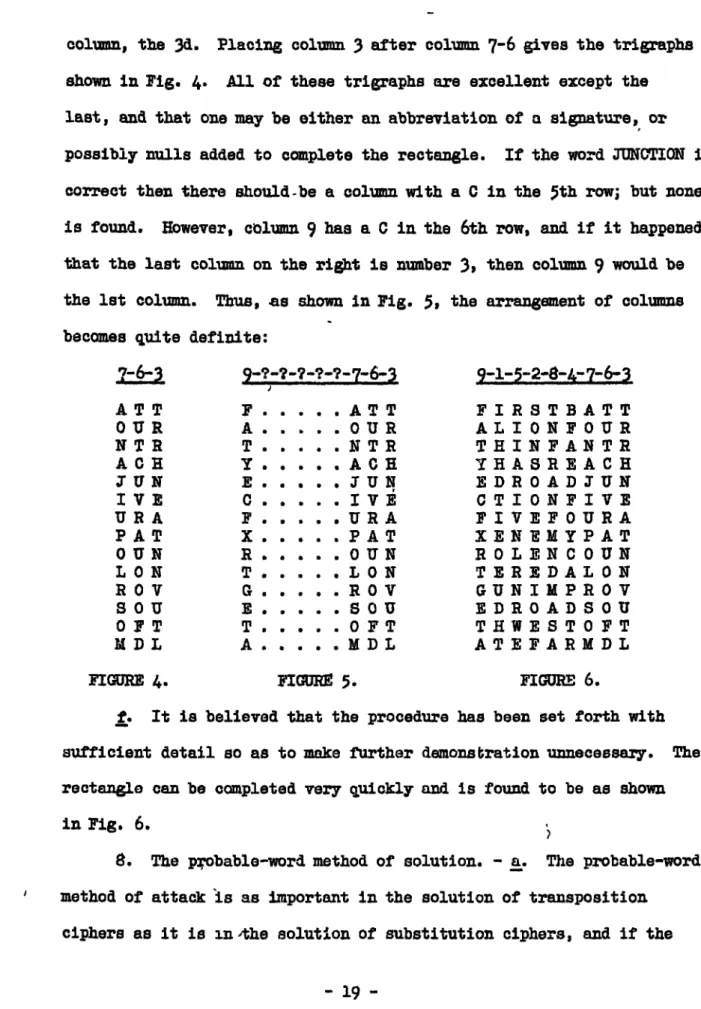
All or these trigraphs are excellent except thelast, and that one may be either an abbreviation of a signature,, or possiblJ nulls added to complete the rectangle. If the word JUNCTION is correct then there should-be a column with a C in the 5th row; but nono is found. However, column
9
has a C in the 6th row, and it it happened that the last column on the right is number3,
then column9
would be the lat column. Thus, .as shown in Fig. 5, the arrangement of columns becomes quite definite:7-6-J
2-?-?-?-?-?-1-6-J
2-1-~-2-s-~-1-6-JJ
ATT F •
.
.
.
.ATT FIRSTBATTOUR A •
.
.OUR ALIONFOURNTR T •
.
.
.
.NTR THINFANTRACR y • •
.
•• AC H YHASREACH:r
U N E • • • •• Ju~ EDROADJ"UNIVE 0 • • .IVE CTIONFIVE
URA F • •
. .
.URA FIVEFOURAPAT
x .
.
•.
.PAT XEN'EMYPATOUN R • • •
.
.OUN ROLENCOUNLON T •
.
.LON TEREDALONROV G • •
.
.
.
ROV GUNIMPROVsou
E •. .
.
.sou
EDROADSOU0 FT
T •
.
•.
.OFTT
liW E S T O F
TMDL
A • •
.
•• MDL ATEFARMDLFIGURE 4. FIGURE 5. FIGURE 6.
1.·
It is believed that the procedure has been set forth withauf'f'icient detail so as to moke i'urther demonstration unnecessary. The rectangle can be completed very quickly and is found to be as shown
in Fig. 6. ' )
8. The pJiObabla-word method of solution. - a. Tlle probable-word method of attack
is
as important in the solution of transpositionciphers as it is in-the solution of substitution ciphers, and if the
-REF·ID:A56913
cryptanalyst is able to assume the presence or such probable words as are usually encountered in military communications, the solution, as a rule, comes very quickly.
J!.•
As an illustration, looking at the first row of letters inthe rectangle ahOl'VD. in Fig. le, the letters I S T B R T A T F almost
at once suggest
FIRST BATT.AI.ION
as the initial words of the massage.A
rearrangement ot' the columns of the cryptogram to bring the necessary letters into Jurtaposition at once discloses the key. Thus:
-9-1-5-2-8-4-7-6-3
FIRSTBATT
ALI ON
It will be noted that this assmnption requires that there be a column headed by FA, another headed by IL, another headed by RI, and so on.
•
Had such columns not been found, than the word BA'rl.1.ALION would not be , ... possible. In that case the word FIRST would still remain as a point
of departure for further experimentation.
o. In the foregoing illustration, the probable word was assmned to appear in the first line of te:xt in the rectangle. I t the probable
•
word being sought is in tho interior of tha message, the steps must be
modified somewhD.t but the basic principle remains unchanged. The modifications are of course obvious.
9.
General remarks on solution. - a. In solving transposition ciphers advantage should bd taken ot' all the characteristics andidiosyncrasies which are peculiar to the language of the enemy, because they often afford clues of,considerable assistance to the cryptanalyst. In all lElllgUB.ges there are certain letters, usually of medimn or low
-..
frequency, which combine with other letters to form digraphs
or
high frequency. For instance, in English the letter H is of mediumfrequency, but it combines ilrith
•r
to form tho digraph T".d, which is o:r high.est frequency in literary text; it also combines with C, n letter of medium frequency, to form the i'airl7 frequent digraph CR. 't'he lotter V is almost in the low-frequency category yet it combines with E to fonn the digraph VE, which in military text is the 14th infrequency. The low-frequency lettar K often combines with C to form the digraph CK. Consequently, in working ,rd.th transposition ciphers in English, when there is an H, .attempts should be made to combine it first withia T, or with a C; a V should be combined first ~1th an E; a K should be combined first with a C; and so on.
~· There is usually in evory,language at least one letter
which can be followed by only a cei•tain other lettar, for.ming Ylhat may
be termed an obligatory sequence, or an invariable digraRh· In all languages having the letter Q, the cClllb1na.tion QU ccnstitutes such an
invariable digraph. 7 In genuine words 01· the Ga1"l!lall la.nguage the
letter C is nevor used by' it.self, when present the lotter C is
invariably tollowod by an H, except on rare occasions vmon the digraph
CK is employed. In English, the letter J can be frJJ.J.owod only by a vowel; tho lotter X can only bD pracoded by a vowel and, except at the and of a word, can only ba succeeded by a vm•el, an.a. so on. Letters
7
The letter ~ may, of course, be part of an abbrevia~1on, such as SQ,
for "square", or 1 t may be used as .. ,., null, or a.a a sign of punctuation • However, unless there are good reusons for believing that this lotter is used for these PU...""POses, Q.U may be considered to be an 1nvari•1ble
digraph.
-REF ID:A56913
which behave in this mmmer, that isJ letters which have what :r.i.a.y be called a limited affinity in combining with ot~er letters to fo:cm digraphs, constitute good points of departure for solution and are therefore of sutficient importance to warrant their being designated
by the more or less descriptive name of pilot letters •
.!:.• Tho presence of pilot letters in a transposition cipher often fo:rms the basis for the assumption of probable words. Obviously, a special lookout should be kept tor words of' rather high frequency (inmilit&.ry' correspondence) which contain letters of low or medium frequency. The frequent word CAVALRY, fa:- example, would suggest it-self if' the cryptogram has the lotters C, V, L, and Y, vmich are all of medium frequency. The important ·ROrd A'rl'ACK suggests itself if the cryptogram. has a K, a letter of low frequenC"'J and a C, one of medium frequency; and so on •
.!•
The mechanics of simple columnar transposition make possible the production of rather long sequepces of vowels and long sequences of consonants in the text of the cryptogram. Note, for example, in theI
cryptogram on p. 11, the sequence or vowel$ O O E E E E I O E, and the sequence of consonant-a V N L R N R W. If tho enciphering or plain-text rectangle is consulted, it will ba seen ~hat these two sequences
-,
belong together, that is, thay are in adjacent columns in that rectangle. It is a characteristic of plain tart that consonant-vowel or
vowel-consonant digraphs are much more frequent than vowel-consonant-conaono.nt or vowel-vowel digraphs,8 and ~herefore when long soquences of consonants
8.rb.e CV and VC digraphs constitute about 62 per cent at all digraphs.
22
and of vowels are found in transposition ciphers, a good start toward solution may result from assumiDg that such sequences come from
adjacent columns.
e. It should, however,-be noted in connection with tell-tale letters such as Q (entering into the composition of Q.U) and C (entering
I
into the composition of CH),that astute cryptographers who realize the clues which such letters afford often replace the invariable sequences they form by a single character, usually one that is rarely used in the language in question. For example, CH in Ger.man may be replaced by
Q., QU in French, by K, and so on. When this is done, solution is made more difficult; but only in those cases whore it is dependent upon finding letters forming obligator; sequdnces in plain text does this sort of subterfuge become a factor of l.Ill.portence.
f. The presence vf many Q•s, or K•s, or X's in a transposition cipher should not, however, be taken as prima facle evidence ot the
type ot replacement noted in the preceding subparagraph. It is possible that such letters may be used as sentence separators or other punctua-tion, or possibly they may be nulls, although the alert cryptographer would either use nulls not at all or, if he had to, would use letters of medilllll or high frequency tor this purpose.
S.• Because it is important that the cryptanalyat take advantage Of every peculiarity specifically applicable to a cryptogram to be
.
sol~ed, especially as regards the ~resence of low-troquency 11tters1 it
is advisable that a lllllliteral i'requancy distribution be prepared, just as though he were going to decl. with a substitution ciphor. Thie is probably the ~uickost W9:1 ot cringing to light the peculiarities
REF ID:A56913
10. Reconstruction of' literal key. - a. The reconstruction or recovery of the literal key trom whioh tho numerical transpbsition key was derived is naturally the last step in the solution of cryp:tograms
ot
this type. It is often of more than merely academic interest, because if' it is found that the e~ID1Y·is employiJ18 tor this purpose words or phrases of a simple nature associated with the locale of operations this tact may be of 1m~ortance in subsequent work.b. In this process there are only a f'ew guidill8 principles to be noted and much must be left to the ingenuity and imaginative powers of the cryptanalyst. Taking ..a.s an example the numerical key uncovered in the solution of tho cryptogram. in Par.
_7,
the procedure will be set forth below.c. The numerical key ref'el!red to was found to be
9-1-5-2-8-4-7-6-3.
)
Assuming that this sequence was derived in the usual manner, by assigning numbers to the letters of' a keyword in accordo.nce with their relative positions in the normal alphabet~ the~ it is likely that the digit 1 in the foregoing numerical key represents a letter at or at least close to the beginning of' the alphabet. Since the digits 2 and 3 are to the right of',l in the key, it is likely
(i)
that the letter represented byl occurs two more times in the k~10rd, or ( 2) that they represent an-other letter, also near the begiDning ot the alphabet, and repeated, or
(3)
that they represent two different letters both near the beginningot the alphabet. The digit
4
must represent a letter beyond the letter represented by the digit3;_the
digit5
must represent one beyond the letter represented by the digit 4, and so ... on. Assuming that the letters com.posing the keyword ar~ fairly wall distributed over the entire-•
•
..
alphabet the digit
7
must represent a letter near or slightly beyondthe middle of the alphabet, the digit
8
must represent one further toward the end of the alphabet than does the digit7,
and so on. As-signing several values to the digits, in accordance with the foregoing principle, the results are as follows:1-2-3-4-5-6--7-8-9
9-1-5-2-8-4-7-6-3
RAKAMFLKA SBLBMGMLB
TCMCOHNMC UDNDPIOND
VEOERJPOE
w
x
y
z
FIGUP.E 7.
!•
Mow comes tho trying procoss of finding a "good" word in this assemblage of letters. The beginning and end of the word are theeasiest points of attack, and it is use:f'ul to keep in mind the relative frequency order of letters as initial o.nd final letters of the lBDgUa.ge in question.
For English, the data are as follows:9
As
Initial
Letters • : • T S A F C O R D. N P E MI
W B H L U G Y V J Q. K Z XAs Final Letters • • • • • E T D S N Y R 0 H L A F G P M X C K \'i U B I Z Q, J V
Stud1"1ng the lie~ of letters at the end of the key, it is seen that E
l
is one of the possibilities. ,
It
thnt is correct, then n good ending would be one or tho ty-~o V-C-V, with E as the final letter. There is9
Taken trcmi Tables2-D (2)
and2-E (2),
p.111, Military
Cmtmialysis,Part I.
-REF ID:A56913
but one vowel in the column under the digit
7,
the lettero.
Tl~isgives OKE, OLE, CME, ONE as possible ending trigraphs, the best of
whic~ from a frequency standpoint is
ONE.
Seeing the lettersP
andH in columns
5
and6,
the ending PHONE and then the word TELEPHONEsuggests itself. Checking to see if there are any inconsistencies, none is found &Ad the solution is:
Column number ••••• l-2~3-4-5-6-7-8-9
Numerical key •••••
9-1-5-2-8-4-7-6-3
Literal key •••••••TELEP H 0 NE
!.•
In fUture studies cases will be encountered wherein the re-construction of the numerical key is an essential or at least use:rul. element after the solution of one or more cryptogrmns has beenachieved by cryptanalysis; this is done in order that subsequent crypto-grams in the same key can be read directly without crypt8llLllysis. The reconstruction of the numerical key is, however, a different process than tho one illustrated in this parogrnph, wherein the p~oblam is solely one of building up a literal key from its numerical equivalent.
11. Column and row transposition. - It should be obvious that when the rows as well as the columns of a completely-filled rectangle undergo transposition the 1ncrdase in security is hardly ~'Orth mention, since the underlying procedure in solution aims simply at assembling a few columns on the basis of "good" di~aphs and trigraphs brought to light by JuxtaposiDG columns. After three or four columns have been properly juxtaposed, the placement of additional col'Ull"&IlS becomes easier and easier, merely by continuing to build upon the fraE91J.ents
9t
words in the rows. Hence, the cryptanalyst is, during a large part or the proceJS• not ~e.rticularly interested in the intelligibility of the text..
!
•
..
•
i
he is building up; only at i;he ond of the procoss doos tr.is become a ta.ctor. Jlli.an c.ll of the columns mve been asse:lblet!. in proper order,
then the text v1ill rcQd continuously UL the nomul wmner. (left to'
.
right, i;op to bottom) • If' :I. t does not, t.11on it is W!ue.lly c. very
simple matter to rearrange the row<J of the rectangle to bring this about, since the letters at the ends and beginnings of the rows give
the necessary clues for continuity •
-REF ID:A56913
SECTION III.
INCOMPLErELY-FILLED RECTAHGLF.S
General principle~ underlying solution••••••••••••••••••••• Construction of diagram •••••••••···~··•••••••••••••••••••••
Solution of example •••••••••••••••••••••••••••••••••••••••• Alternative method of' solution ••••••••••••••••••••••••••••• Example -of' solution by alternative method •••••••••••••••• , ••
Paragraph 12
13
14
15
16
12. General principles underlying solution. - .!.· In the system designated keyed columnar transposition the feature which diff'eren-tiates an incompletely-filled rectangle trom one that is completely filled is a ver,r simple one from the cryptographic point of view: the
,.
bottom row of the rectangle in the f~rmer case merely lacks one or more letters, a feature which only very slightly complicates the system in practical operation. But the consequences of' this simple difference between the two types are, from the crr1ptanalytic point of vio\o;, quite profound, and the cryptanalytic uffoct of this small change in crypto-graphic proc~dur~ is s~am.ingl.y all out of proportion with the simpli-city of the difference.
b. Cryptograms involving completaly-fillod rectangles arc
rnthor dasy to solve because of two circumstances. In the first placo, since tho rectangle is compldtely fillod, tho various possible
dL~en-sions of the rectangle can bo ascertained by noting the factors of the
total nun.bar of letters. Usunlly only a f~w yoss1bil1ties are indicated
and therefore this materially reduces the amount of e:xpc~imentation
that would bo required in the absence of this situation, since it is obvious that when working with incompletely-tilled rectanslea a good
ma.Dy rectangles of various dimensions become poss1b1lit~es tor trial.
28
-..
i
•
..
•
In the second place, the columns in a completely-filled rectangle all contain the srune numba1· cf' letters, and therefore the anagramming process (matchil'.g and assembling of columns) can be perfomed without any mental reserv~tions such ns must be me.de in working with incompletely-:f'iLled rectangles because of' uncert11inty as to whether the letters which are juxtaposed to :f'o:rm digraphs and trigraphs really came :f'rom the same row in the Illa.in-text rectangle. The latter statcm~nt calls :f'or a bit more explsr~~tion.
c. The columns of an incompletoly-:f'illod rectangle are of' two sorts which may convenitlntly ba design.<J.ted. as
12!!&
and short. The long columns are nt tbe lof~ of' the rectangle and each ono contains just one more letter than the short col'IE'.ns, \'r~lich are at tho right. Thisfollows, of' course, from. the fact that it is only the le.st row in such a rectangle which lacks one or more letters to complete the rectllllgl.e. The term width, .as ·1pplied to a tr::mspcaition rectangle, -r1ill be con-venient to desigl'.ate ti1~ numbo:r of colur~.ns, which is, of' course,
detemined by tllo lengtl:
o:r
tho nur.ieric~ll key or the number of' letters in the litera.1 key. Given the width of the rectangle and the total number of' letters in the cryptogrtun, the length and numbor of tho long a.nd the short columns mny bo found by a. slmple calcultttion: Multiply the width or tho rectcngl.e by the E1IO.O.llast number wl4ich will yiold a product greate!' than the tot°:'ll number of' lettors in the cryptogram. The multiplier gives tho langt?! of' tho loni~ eolu."'llls; this multiplier minus1 gives the length of the short columns; the oxcess over the total number or letters gives tho number of short columns, the latter
dPducted from the width gives the number of long columns. Thus, with a
-REF ID:A569i3
cryptogram. 01' 287 letters ~ a rectangle. 15 columns in width: [15 x 20) - 13
=
281) i the long columns will have 20 letters, the short ones, 19 letters; th~re,\{111be13 short columns and 2 long ones.d. Now if the cryptanalyst were able to cut up the text of a cryptogram produced from an incompletely-filled rectangle into sec-tions corresponding in length ?'1.th the actual long and short columns, he could handle those columns in exactly the same ma:iµier that he handles the equal-length columns in the solution of a cryptogram pro-duced from a completely-filled rectangle. In fact, tho solution would be easier because he
-
knO\YS that all the short columns fall at the right,)
all the long col\JlllD.s at the left of tho transposit~on rectangle, and
...
therefore the amount of oxparimentation he must undertake in his
'
attempts to juxtapose columns in the anagramming process is considerably reduced. But, 11Ilfortunatoly, there is usually no way in which, at tho initial stage of solution, the cryptanal.yst can find out, from a
single cryptogram, whi,ch are tha long columns and which the i:ihort. This is obvioualy a matter directly coDJlocted with tho specific transposition key, and the latter io the solo unknown factor in the \vb.Ole problem.
e. If it were practicable to trc.nscribe a Cl"'JPtogram of thia type according to
.!!!,
the possible transposition keys for a given width or. rectangle, solution would obviously merely consist in scanning the various rectSDgles to find the one which is co1'":'ect - for there will be only one such :-actangle-. A roctar..glo 15 columns in vddth may have b~enenciphered by any ono ot factorial 15 ~ransposition k~ys.1 11Jh1te it is
17actorial 15, or 15 x 14 x 13 x ••• x 1, equals 1,369,944,576,000 different transposition koys.
•
•
!
•
'
conceivable that machinery might be devised tor this purpose, so that the production of' the millions of' possible rectangles could be effected in a relatively short time, in the present state of' the art no such machinery has yet been devised. Furthermore, it is problematical whether a solution by such means could be achieved in a reasonable length of' time even if the machinery were available, because of' the immensity of' the task it would have to perform..
!·
However, this question may be asked: Given a cryptogram of' T letters and a rectangle orA
columns in width, is it possible totran-scribe the text within a single rectangle so that the latter will show what letters will constitute the respective columns for all possible transposition keys of'
A
elements? If so, then such a rectangle would be useful in trying to solve the cryptogram, because the rect8llgle would then limit the amount o:f' expe:rllllentation that would have to be performed by the anagramming process, since it vrould show whether or not two letters which are brought together in that process to fo:nn a digraph could possibly have been in the same row in the plain-text rectangle. If not, then of course there would be no use in forming such digraphs, and thus the number of trials bec':>Dles much reduced.An-other way of indicating what is meant is to say that such a rectangle would show the maximum amount that one column may be shifted up or down in trying to match it with another colmnn in the anagramming process. This will be made clearer in G subsequent paragraph. At this point it
will merely be stated that it is easy to prepare a rectangle of tho nature indicated above, for any keyed columnar transposition cryptogram.
1-~
#
r
;
I
}
T
r
f#
1~T
1 __ .. :_
, I
#~II
..lz;
;:t~L/:11-=11#I--11J::_:J
ABCDEFGHIJKLMNO~QRSTUVWXYZ
!!.•
A cryptogram of224
letters and a rectangle of 12 columns[(12 x 19) - 4 : 221J indicates 4
~hort
columns of 18 letters and 8 long'
columns of 19 letters. The outlines of a rectangle of this specification
are drawn on a sheet of cross-section paper and the text is transcribed
within it, tor the moment assuning merely that the transposition key
consists merely of the straight sequence of numbers l to 12. Thus:
.32
•
"
'
123456789l>ll.l2
O N M C
:M:H Y T 0 A F A
DIATIBONOIIT NENRAVIOTITS NTLMITKTHEAO PGNSTBNREANA TNOCEEKAATLL IWELASTACENO RTBCIRNVNEND NTOSJSDRSAt"I TMUONYAIHLAR DEHESLHREAC,O· TDEFOXISEELR USNCIRRTVNRY B.TLFVOHGTEEN 0 EE FF R Q, SR E N.N
E 0 S T 1l U I E E M: R R
XIEEBMEFSYTG ATAEIETERTRY LDAEETEA
FIGURE 8.
..£•
The rectangle shown in Fig. 8 is the same as though it had been assumed that the key numbers9,
10, 11, and 12 happened to fall at the extreme right in the numerical
.
transposition key. Column~ 1 to 8, inclusive, would then be long columns, and columns
9,
10, 11, and 12 would be short columns. But suppose that the key nmnbers on the extreme right happened to be 1, 2,3,
and4,
instead of9,
10, 11, and 12. Then columns 1, 2,3,
and4
would be the short columns,5
lio 12 the loDg ones. In this case, making reference to Fig. 8, the final lettllr of colmr.n 1 would pass to the top of column 2; the final two letters of column 2 would pass to the top ot column 3; the final3
letters of column3
would pass to the top of column4;
the final4
lettors of columns4, 5, 6, 7,
and 8 vrould pass to the top of columns5, 6, 7,
8, and9;
the final3
letters of column 9 would pass to the top of col'UI'ln 10; the final 2 letters of column 10 would pass to the top of column 11; und the final letter of column 11 i.vould pass to the top of column l?. 'rhe results ot
the foregoing reasoning are indicated in Fig.
9.
.!·
Now the capital letters in Fig. 9 represent the letters which are in the columns in case the first :tw"pothesis (key numbers 91 10, 11,,12 at the extreme right) is true. ,Tho capital letters above the heavy
-REF ID:A56913
1 12J~~6zs2Dnl? t mu i e
-
- --
...2 e e b m e f e
'
t a e 1 e t e s y4 1 d a e e t e a r t r
5 ONMCl!RYTOAFA
•
6 D!ATIBONOIIT
7 NENRAVIOTITS
8 NTLMITKTHEAO
9
PGNSTBNREANA :::10 TNOCEEKAATLL
11 IWELASTJ\CENO
12 RTBCIRNVNEND
13 NTOSJSDRSAUI-
,-14 TUUONYAIHLAR
15 DEHESLRREAC,O
16
TDE'FOXISEELR17 USNCIRRTVNRY
18 RTLFVOHGTEEN
19
OEEFFR BRENN20 EO.STMUIEEMRR
21 XIEEBMEFSY 1rG
22 ATAEIETERTRY
23 LDAEET.EA
t FIGURE
9.
•
1
34
-•
..
..
black line together with the small letters at the top of ~he diagram (the latter forming what may be termed the crown) represent the letters which are in the columns in case the second hypothesis (key numbers 11 2,
3, 4
at the extreme right~ is true. Therefore, Fig.9,
since it covers the two possible extremes with reference to the positions occupied by the short columns, embraces all possible intermediate con-ditions and shows what lettersma;r
be in the respective columns under!!!l_ possible arrangement of long and short columns 1 and hence this
diagram is applicable to any possible nllillerical key tor the cr;yptosr8m in question and tor the assumed width of recta.ngle. Therefore, in the anagramming process such a diagrmn shows the maximum possible amount th.at any colmrm may be shifted up or down in juxtaposing two columns to f'om digraphs of' letters assumed to come from the same row in the plain-text rectangle. This is because all the letters of the let row of the aatual enciphering rectangle will be found in rows 1 to
5,
inclusive, of Fig.9;
al...1. the lcttors of the 2d row of the rectangle will be found in rows 2 to6,
inclusive, and so on, as indicated by the braces at the right in Fig.9.
e. Thus there arises the following important principle: Desig-nating the number of short columns in a specific diagram by E.• only such letters as fall within (a_ i"" 1) consecutive rows, will be letters that may have appeared in the same row in the actual transposition rectangle. Or, another way of stating the principle is this: both members of any pair of letters actually in the same rov1 in the transposition rectaDgle will be found only among the letters appearing in (E.