STAGE 1 COMPETENCY STANDARD FOR PROFESSIONAL ENGINEER
ROLE DESCRIPTION - THE MATURE, PROFESSIONAL ENGINEER
The following characterises the senior practice role that the mature, Professional Engineer may be expected to fulfil and
has been extracted from the role portrayed in the
Engineers Australia - Chartered Status Handbook
.
Professional Engineers are required to take responsibility for engineering projects and programs in the most far-reaching
sense. This includes the reliable functioning of all materials, components, sub-systems and technologies used; their
integration to form a complete, sustainable and self-consistent system; and all interactions between the technical system
and the context within which it functions. The latter includes understanding the requirements of clients, wide ranging
stakeholders and of society as a whole; working to optimise social, environmental and economic outcomes over the full
lifetime of the engineering product or program; interacting effectively with other disciplines, professions and people; and
ensuring that the engineering contribution is properly integrated into the totality of the undertaking. Professional
Engineers are responsible for interpreting technological possibilities to society, business and government; and for
ensuring as far as possible that policy decisions are properly informed by such possibilities and consequences, and that
costs, risks and limitations are properly understood as the desirable outcomes.
Professional Engineers are responsible for bringing knowledge to bear from multiple sources to develop solutions to
complex problems and issues, for ensuring that technical and non-technical considerations are properly integrated, and
for managing risk as well as sustainability issues. While the outcomes of engineering have physical forms, the work of
Professional Engineers is predominantly intellectual in nature. In a technical sense, Professional Engineers are primarily
concerned with the advancement of technologies and with the development of new technologies and their applications
through innovation, creativity and change. Professional Engineers may conduct research concerned with advancing the
science of engineering and with developing new principles and technologies within a broad engineering discipline.
Alternatively, they may contribute to continual improvement in the practice of engineering, and in devising and updating
the codes and standards that govern it.
Professional Engineers have a particular responsibility for ensuring that all aspects of a project are soundly based in
theory and fundamental principle, and for understanding clearly how new developments relate to established practice and
experience and to other disciplines with which they may interact. One hallmark of a professional is the capacity to break
new ground in an informed, responsible and sustainable fashion.
Professional Engineers may lead or manage teams appropriate to these activities, and may establish their own
companies or move into senior management roles in engineering and related enterprises.
STAGE 1 COMPETENCIES
The three Stage 1 Competencies are covered by 16 mandatory Elements of Competency. The Competencies and
Elements of Competency represent the profession's expression of the knowledge and skill base, engineering application
abilities, and professional skills, values and attitudes that must be demonstrated at the point of entry to practice.
The suggested indicators of attainment in Tables 1, 2 and 3 provide insight to the breadth and depth of ability expected
for each element of competency and thus guide the competency demonstration and assessment processes as well as
curriculum design. The indicators should not be interpreted as discrete sub-elements of competency mandated for
individual audit. Each element of competency must be tested in a holistic sense, and there may well be additional
indicator statements that could complement those listed.
STAGE 1 COMPETENCIES and ELEMENTS OF
COMPETENCY
1. KNOWLEDGE AND SKILL BASE
1.1.
Comprehensive,
theory based understanding
of the underpinning natural and
physical sciences and the engineering fundamentals applicable to the engineering
discipline.
1.2.
Conceptual understanding
of the, mathematics, numerical analysis, statistics, and
computer and information sciences which underpin the engineering discipline.
1.3.
In-depth understanding
of specialist bodies of knowledge within the engineering
discipline.
1.4.
Discernment
of knowledge development and research directions within the
engineering discipline.
1.5.
Knowledge
of contextual factors impacting the engineering discipline.
1.6.
Understanding
of the scope, principles, norms, accountabilities and bounds of
contemporary engineering practice in the specific discipline.
2. ENGINEERING APPLICATION ABILITY
2.1.
Application
of established engineering methods to complex engineering problem
solving.
2.2.
Fluent application
of engineering techniques, tools and resources.
2.3.
Application
of systematic engineering synthesis and design processes.
2.4.
Application
of systematic approaches to the conduct and management of engineering
projects.
3. PROFESSIONAL AND PERSONAL ATTRIBUTES
3.1.
Ethical conduct and professional accountability
3.2.
Effective oral and written communication in professional and lay domains.
3.3.
Creative, innovative and pro-active demeanour.
3.4.
Professional use and management of information.
3.5.
Orderly management of self, and professional conduct.
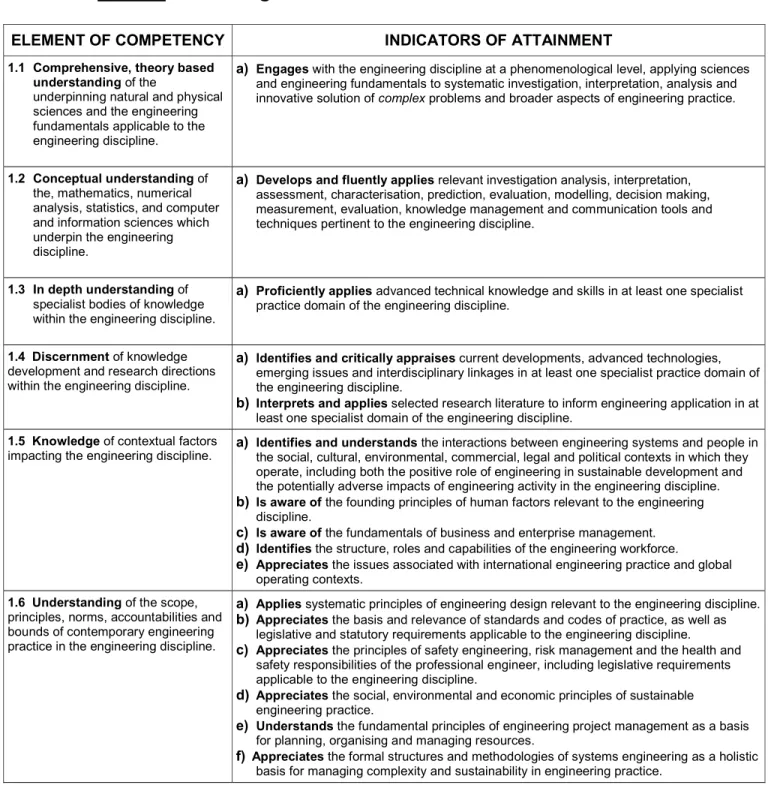
Table 1 Knowledge and Skill Base: Elements and Indicators
ELEMENT OF COMPETENCY
INDICATORS OF ATTAINMENT
1.1 Comprehensive, theory based understanding of the
underpinning natural and physical sciences and the engineering fundamentals applicable to the engineering discipline.
a)
Engages with the engineering discipline at a phenomenological level, applying sciences and engineering fundamentals to systematic investigation, interpretation, analysis and innovative solution of complex problems and broader aspects of engineering practice.1.2 Conceptualunderstanding of the, mathematics, numerical analysis, statistics, and computer and information sciences which underpin the engineering discipline.
a)
Develops and fluently applies relevant investigation analysis, interpretation, assessment, characterisation, prediction, evaluation, modelling, decision making, measurement, evaluation, knowledge management and communication tools and techniques pertinent to the engineering discipline.1.3 In depthunderstanding of specialist bodies of knowledge within the engineering discipline.
a)
Proficiently applies advanced technical knowledge and skills in at least one specialist practice domain of the engineering discipline.1.4 Discernment of knowledge development and research directions within the engineering discipline.
a)
Identifies and critically appraises current developments, advanced technologies, emerging issues and interdisciplinary linkages in at least one specialist practice domain of the engineering discipline.b)
Interprets and applies selected research literature to inform engineering application in at least one specialist domain of the engineering discipline.1.5 Knowledge of contextual factors impacting the engineering discipline.
a)
Identifies and understands the interactions between engineering systems and people in the social, cultural, environmental, commercial, legal and political contexts in which they operate, including both the positive role of engineering in sustainable development and the potentially adverse impacts of engineering activity in the engineering discipline.b)
Is aware of the founding principles of human factors relevant to the engineering discipline.c)
Is aware of the fundamentals of business and enterprise management.d)
Identifies the structure, roles and capabilities of the engineering workforce.e)
Appreciates the issues associated with international engineering practice and global operating contexts.1.6 Understanding of the scope, principles, norms, accountabilities and bounds of contemporary engineering practice in the engineering discipline.
a)
Applies systematic principles of engineering design relevant to the engineering discipline.b)
Appreciates the basis and relevance of standards and codes of practice, as well as legislative and statutory requirements applicable to the engineering discipline.c)
Appreciates the principles of safety engineering, risk management and the health and safety responsibilities of the professional engineer, including legislative requirements applicable to the engineering discipline.d)
Appreciates the social, environmental and economic principles of sustainable engineering practice.e)
Understands the fundamental principles of engineering project management as a basis for planning, organising and managing resources.f)
Appreciates the formal structures and methodologies of systems engineering as a holistic basis for managing complexity and sustainability in engineering practice.Notes:
1.
‘engineering discipline’ means the broad branch of engineering (civil, electrical, mechanical, etc.) as typically represented
by the Engineers Australia Colleges.
2.
‘specialist practice domain’ means the specific area of knowledge and practice within an engineering discipline, such as
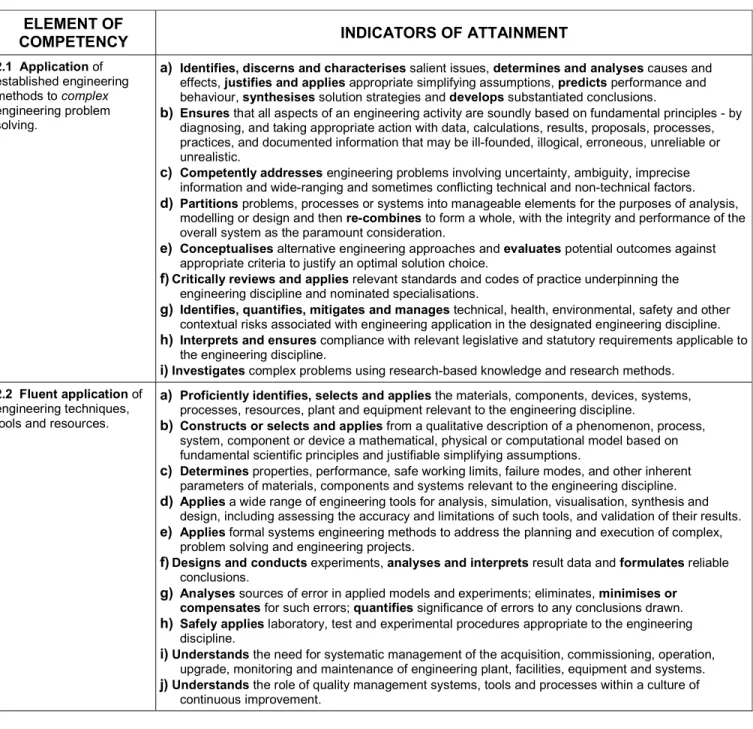
Table 2 Engineering Application Ability: Elements and Indicators
ELEMENT OF
COMPETENCY
INDICATORS OF ATTAINMENT
2.1 Application of established engineering methods to complex
engineering problem solving.
a)
Identifies, discerns and characterises salient issues, determines and analyses causes and effects, justifies and applies appropriate simplifying assumptions, predicts performance and behaviour, synthesises solution strategies and develops substantiated conclusions.b)
Ensures that all aspects of an engineering activity are soundly based on fundamental principles - by diagnosing, and taking appropriate action with data, calculations, results, proposals, processes, practices, and documented information that may be ill-founded, illogical, erroneous, unreliable or unrealistic.c)
Competently addresses engineering problems involving uncertainty, ambiguity, imprecise information and wide-ranging and sometimes conflicting technical and non-technical factors.d)
Partitions problems, processes or systems into manageable elements for the purposes of analysis, modelling or design and then re-combines to form a whole, with the integrity and performance of the overall system as the paramount consideration.e)
Conceptualises alternative engineering approaches and evaluates potential outcomes against appropriate criteria to justify an optimal solution choice.f)
Critically reviews and applies relevant standards and codes of practice underpinning the engineering discipline and nominated specialisations.g)
Identifies, quantifies, mitigates and manages technical, health, environmental, safety and other contextual risks associated with engineering application in the designated engineering discipline.h)
Interprets and ensures compliance with relevant legislative and statutory requirements applicable to the engineering discipline.i)
Investigates complex problems using research-based knowledge and research methods.2.2 Fluent application of engineering techniques, tools and resources.
a)
Proficiently identifies, selects and applies the materials, components, devices, systems, processes, resources, plant and equipment relevant to the engineering discipline.b)
Constructs or selects and applies from a qualitative description of a phenomenon, process, system, component or device a mathematical, physical or computational model based on fundamental scientific principles and justifiable simplifying assumptions.c)
Determines properties, performance, safe working limits, failure modes, and other inherent parameters of materials, components and systems relevant to the engineering discipline.d)
Applies a wide range of engineering tools for analysis, simulation, visualisation, synthesis and design, including assessing the accuracy and limitations of such tools, and validation of their results.e)
Applies formal systems engineering methods to address the planning and execution of complex, problem solving and engineering projects.f)
Designs and conducts experiments, analyses and interprets result data and formulates reliable conclusions.g)
Analyses sources of error in applied models and experiments; eliminates, minimises or compensates for such errors; quantifies significance of errors to any conclusions drawn.h)
Safely applies laboratory, test and experimental procedures appropriate to the engineering discipline.i)
Understands the need for systematic management of the acquisition, commissioning, operation, upgrade, monitoring and maintenance of engineering plant, facilities, equipment and systems.j)
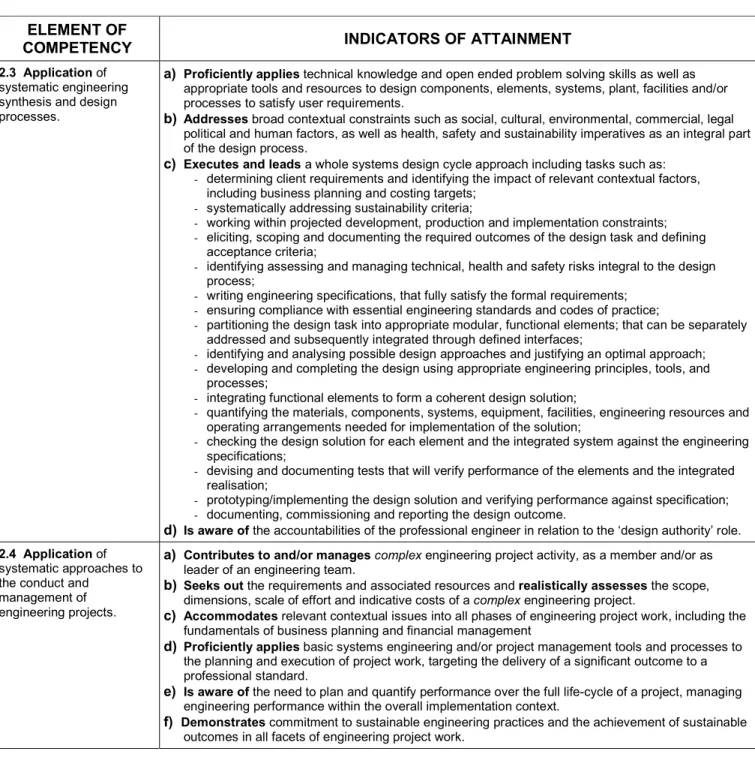
Understands the role of quality management systems, tools and processes within a culture of continuous improvement.Table 2 (cont.) Engineering Application Ability: Elements and Indicators
ELEMENT OF
COMPETENCY
INDICATORS OF ATTAINMENT
2.3 Application of systematic engineering synthesis and design processes.
a)
Proficiently applies technical knowledge and open ended problem solving skills as well as appropriate tools and resources to design components, elements, systems, plant, facilities and/or processes to satisfy user requirements.b)
Addresses broad contextual constraints such as social, cultural, environmental, commercial, legal political and human factors, as well as health, safety and sustainability imperatives as an integral part of the design process.c)
Executes and leads a whole systems design cycle approach including tasks such as:- determining client requirements and identifying the impact of relevant contextual factors, including business planning and costing targets;
- systematically addressing sustainability criteria;
- working within projected development, production and implementation constraints;
- eliciting, scoping and documenting the required outcomes of the design task and defining acceptance criteria;
- identifying assessing and managing technical, health and safety risks integral to the design process;
- writing engineering specifications, that fully satisfy the formal requirements;
- ensuring compliance with essential engineering standards and codes of practice;
- partitioning the design task into appropriate modular, functional elements; that can be separately
addressed and subsequently integrated through defined interfaces;
- identifying and analysing possible design approaches and justifying an optimal approach; - developing and completing the design using appropriate engineering principles, tools, and
processes;
- integrating functional elements to form a coherent design solution;
- quantifying the materials, components, systems, equipment, facilities, engineering resources and operating arrangements needed for implementation of the solution;
- checking the design solution for each element and the integrated system against the engineering specifications;
- devising and documenting tests that will verify performance of the elements and the integrated realisation;
- prototyping/implementing the design solution and verifying performance against specification; - documenting, commissioning and reporting the design outcome.
d)
Is aware of the accountabilities of the professional engineer in relation to the ‘design authority’ role.2.4 Application of systematic approaches to the conduct and
management of engineering projects.
a)
Contributes to and/or managescomplex engineering project activity, as a member and/or as leader of an engineering team.b)
Seeks out the requirements and associated resources and realistically assesses the scope, dimensions, scale of effort and indicative costs of a complex engineering project.c)
Accommodates relevant contextual issues into all phases of engineering project work, including the fundamentals of business planning and financial managementd)
Proficiently applies basic systems engineering and/or project management tools and processes to the planning and execution of project work, targeting the delivery of a significant outcome to a professional standard.e)
Is aware of the need to plan and quantify performance over the full life-cycle of a project, managing engineering performance within the overall implementation context.f)
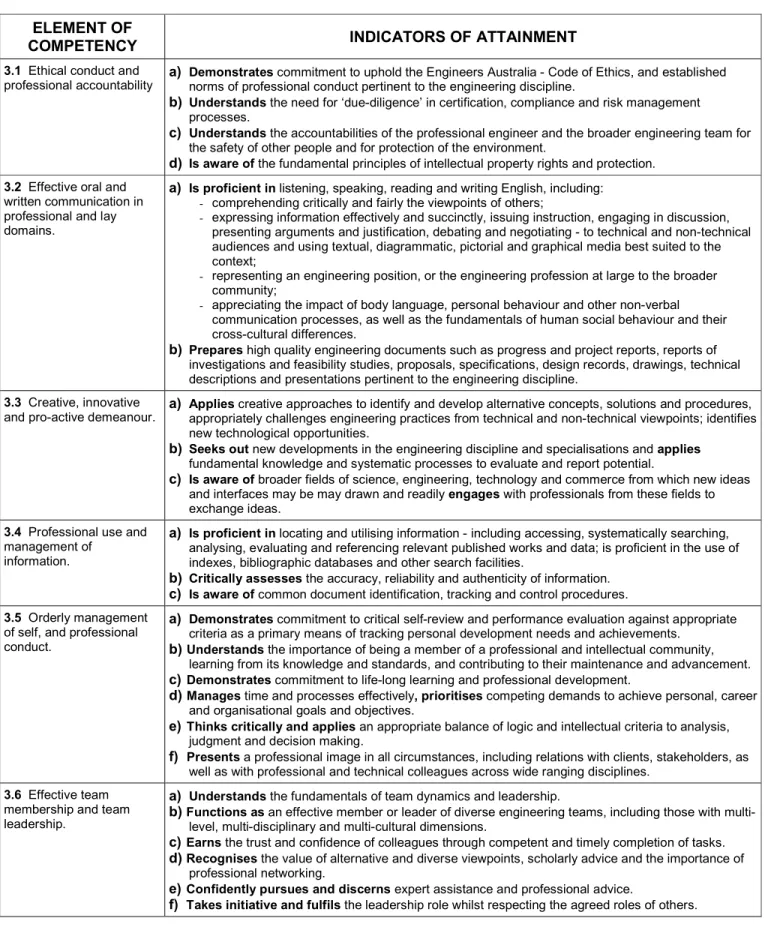
Demonstrates commitment to sustainable engineering practices and the achievement of sustainable outcomes in all facets of engineering project work.Table 3 Professional and Personal Attributes: Elements and Indicators
ELEMENT OF
COMPETENCY
INDICATORS OF ATTAINMENT
3.1 Ethical conduct and professional accountability
a)
Demonstrates commitment to uphold the Engineers Australia - Code of Ethics, and established norms of professional conduct pertinent to the engineering discipline.b)
Understands the need for ‘due-diligence’ in certification, compliance and risk management processes.c)
Understands the accountabilities of the professional engineer and the broader engineering team for the safety of other people and for protection of the environment.d)
Is aware of the fundamental principles of intellectual property rights and protection.3.2 Effective oral and written communication in professional and lay domains.
a)
Is proficient in listening, speaking, reading and writing English, including:- comprehending critically and fairly the viewpoints of others;
- expressing information effectively and succinctly, issuing instruction, engaging in discussion, presenting arguments and justification, debating and negotiating - to technical and non-technical audiences and using textual, diagrammatic, pictorial and graphical media best suited to the context;
- representing an engineering position, or the engineering profession at large to the broader
community;
- appreciating the impact of body language, personal behaviour and other non-verbal communication processes, as well as the fundamentals of human social behaviour and their cross-cultural differences.
b)
Prepares high quality engineering documents such as progress and project reports, reports of investigations and feasibility studies, proposals, specifications, design records, drawings, technical descriptions and presentations pertinent to the engineering discipline.3.3 Creative, innovative and pro-active demeanour.
a)
Applies creative approaches to identify and develop alternative concepts, solutions and procedures, appropriately challenges engineering practices from technical and non-technical viewpoints; identifies new technological opportunities.b)
Seeks out new developments in the engineering discipline and specialisations and appliesfundamental knowledge and systematic processes to evaluate and report potential.
c)
Is aware of broader fields of science, engineering, technology and commerce from which new ideas and interfaces may be may drawn and readily engages with professionals from these fields to exchange ideas.3.4 Professional use and management of
information.
a)
Is proficient in locating and utilising information - including accessing, systematically searching, analysing, evaluating and referencing relevant published works and data; is proficient in the use of indexes, bibliographic databases and other search facilities.b)
Critically assesses the accuracy, reliability and authenticity of information.c)
Is aware of common document identification, tracking and control procedures.3.5 Orderly management of self, and professional conduct.
a)
Demonstrates commitment to critical self-review and performance evaluation against appropriate criteria as a primary means of tracking personal development needs and achievements.b)
Understands the importance of being a member of a professional and intellectual community, learning from its knowledge and standards, and contributing to their maintenance and advancement.c)
Demonstrates commitment to life-long learning and professional development.d)
Manages time and processes effectively, prioritises competing demandsto achieve personal, career and organisational goals and objectives.e)
Thinks critically and applies an appropriate balance of logic and intellectual criteria to analysis, judgment and decision making.f)
Presents a professional imagein all circumstances, including relations with clients, stakeholders, as well as with professional and technical colleagues across wide ranging disciplines.3.6 Effective team membership and team leadership.