This conference edition of the EJEL contain a selection of papers which were presented at
Glasgow Caledonian University in November 2003.
The keynote address of Gilly Salmon, from the Open University in the UK, spoke to a
variety of possibilities as to how the future of e-Learning might unfold. The main thrust of
this message was that it is important is to remember the very old adage from instructional
technology - learning is first of all about interaction between people, and the technology
must serve that interaction, and not try to drive the process in a different direction.
On the other hand the power of the technology should to be fully utilised, as it does offer
unprecedented opportunities for interaction and for linking people, ideas, texts and
resources. This leads to the notion of e-publishing. This new idea requires the
reconceptualisation of the term 'e-paper' which will mean something different to simply
publishing "conventional papers" on the Web.
What does that mean, and how can it be done? First of all, a new emphasis on connected
texts is required. Wherever it is appropriate, include links to Internet resources and sites:
websites, blogs, discussion forums etc. These papers of course still need to retain
academic substance in their own right, but they should also link into the much larger virtual
conversation, which is out there on the other side of the web browser.
Of course much of the detail of how this will be achieved is yet to be determined but the
idea is certainly in interesting one and it offers a clear challenge to the academic
community.
It is clear that there is much work to be done in developing a new e-Learning world and
that we have only just begun to have a glimpse of the new and exciting ways in which
learning will eventually be transformed.
Roy Williams
Editor
Combining Traditional And Virtual Teaching Techniques In
Cross-Border Higher Education
Satu Alaoutinen and Jan Voracek
Lappeenranta University of Technology, Finland [email protected]
Abstract: Our paper describes the important role of virtual education in the process of building a unique cross-border educational environment between Finland and Russia. Against a background of the latest trends in international virtual education, we propose a realistic solution for equal collaboration between two different systems. The final model strives at combining the directly applicable features of both academic sectors into an innovative educational structure that offers attractive study programs and provides a wide range of educational services worldwide.
Keywords: cross-border education, equal partnership, common study programs, semi-virtual course
1. Introduction
The challenging idea of sharing students and courses on a virtual basis through international partnership networks is of widespread interest nowadays (International Institute for Educational Planning 2003, Commonwealth of Learning 2002, Hawkridge 2003b). A recent literature survey (International Association of Universities 2003) shows that the amount of titles published in this area is continuously increasing and that authors are widening the scope from rather technical topics to the institutional or qualitative aspects of these processes. One can find various features of virtual education (in this paper we consider the term virtual education as being a synonym to e-Learning) at many educational levels, starting from individual virtual teaching units, such as lectures, through fully virtual courses and study programs to specialized virtual institutions that deal with education on a commercial basis.
Thompson (2000), Hayes et al. (2001) and Latchman et al. (2001) present the structure and experience from their own experimental virtual courses. Uskov (2000) describes the prototype of a US-Russian Web-based educational project. Miller (2001) reviews and classifies the research hitherto performed into distance education. According to Harper et al. (2000), virtual learning environments should be authentic and support constructivist learning. He illustrates these conclusions using two practical examples. Powers (1999), Heck et al. (2000), Sala (2001) and Hokanson et al. (2000) discuss various combinations of teaching methods and computers. Lee (2001) profiles students’ adaptation styles in Web learning. She groups students into model learners, disenchanted learners, fanatic learners and maladaptive learners. Beaudoin
(2002) analyses the level and structure of knowledge, obtained through the Internet. Hawkridge (2003a) documents the important role of the education and training of teachers, involved in open and distance learning.
Many universities have their own educational technology centres that cooperate with national coordinators. For example, the Finnish Virtual University (2003) offers and maintains virtual courses provided by local universities. In January 2004, the Finnish Virtual University offered 73 active courses.
Starr (1998) has studied the current trends and future directions in virtual education. For example, she describes the Western Governors University, which is a regional virtual university that was piloted in 1997. She also introduces some design issues for virtual courses and discusses the institutional aspects of future virtual universities. Kullenberg (2002) presents a working model for an international virtual university. The Virtual University of the International Ocean Institute offers a Master’s Degree program for students who already hold bachelor-level degrees. Thiriet et al. (2002) describe a European-wide effort to define the core curriculum for electrical and information engineering. Their article also includes student assessments for two experimental courses for students in Denmark or France and Morocco, respectively. A summary, published by the Commonwealth of Learning (2001), collects comprehensive data and case studies concerning the institutional, international and networking aspects of future virtual education. There are also working cross-border projects, like an "open higher education space" between the border regions of the Netherlands and Germany (Huisman 1998) and the Baltic Sea Virtual Campus (2003) around the Baltic
countries, or a model used at the University of Adelaide (Field 1999).
Azadegan et al. (2001) also deals with academic international virtual teams. Students from the Towson University (Maryland, USA) and the Evry University (France), formed cross-cultural virtual teams and carried out a software development project. Interaction took place via websites, Internet Relay Chat and email. Although the students were acquainted with collaborative learning and group dynamics, it was finally discovered that the interaction between the team members, as well as their English skills, was not sufficient. Also, Last et al. (2000) reported communication and time-management difficulties in a virtual international study environment, established between Sweden and US universities.
The Department of Clinical Nursing at the University of Adelaide takes advantage of multimodal learning at their international education project. The students have Internet access to the university library, regular e-mail contact with their coordinator, a chat capability and material on CD-ROM and on the Web. In addition, students have periods of intensive contact teaching. The University of Adelaide sees two major limitations in this kind of co-operation. The first one is students' access to Internet in areas where the telecommunication infrastructure is not up-do-date and the second is the cultural background of the students.
Systematic cooperation with Russia in the area of higher education is one of the priorities of the Ministry of Education of Finland (Ministry of Education of Finland 2001, 2003). Since Lappeenranta University of Technology (LUT) is close to St.Petersburg and has traditionally enjoyed good contacts with universities in St. Petersburg, it was a natural choice to implement this governmental strategy between LUT and universities in St. Petersburg and, subsequently, also in other neighbouring Finnish universities. Our aim was to find a model of mutual virtual cooperation that would be convenient for both Finnish and Russian partners, applicable in the short-term and that would allow Russian teachers to be involved actively. In the following chapters, we present the experience that has been accumulated so far and propose a feasible local solution. Finland and Russia are countries with different
cultural backgrounds, which must, naturally, also influence joint educational activities (O’Loughlin 1992). Numerous related practical findings from other cross-cultural educational projects are already available. The University of North Carolina at Wilmington and the Digital Communities of Japan initiated a virtual university experiment in 1997 (Thompson 2000). Its pilot phase, implemented in 1999, included three courses, four seminars, and a professorial symposium. The whole experiment ended in 2001 and revealed four facts. Firstly, the researchers found collaborative learning to be an efficient technique for virtual education. Secondly, the national differences in semester scheduling caused problems. Thirdly, the Japanese students requested face-to-face interaction with the teacher. Fourthly and finally, these students requested the course material in their native language instead of in English.
2. Expertise in cross-border and
virtual education
Our know-how in the area of international education is based primarily on extensive personal experience with tens of Russians, who have studied and graduated from the International Masters’ Program in Information Technology (IMPIT) at LUT since 1999. We collected another portion of this significant knowledge during the continuous development of this program while searching for optimal bilateral conditions with several partner universities from Northwest Russia. Finally, our extensive experience with different technologies in virtual education helped us to successfully realize and evaluate a regular semi-virtual course in several universities in Finland and Russia.
Vogel et al. (2001) studied virtual groups from the perspective of the socio-cultural learning theory. The City University of Hong Kong and the Eindhoven University of Technology, Netherlands organized a common course with 73 participants who were divided into 10 multicultural (international) groups. The group members had seven weeks to finish assigned projects and communicated via email, videoconferencing and a Group Support System. The students involved found this kind of collaborative, experimental learning to be a meaningful method. This study, however, identified several cultural-dependent features concerning time management, the establishment of virtual trust and team communication.
Satu Alaoutinen & Jan Voracek 3
2.1 International Masters’ Program
in Information Technology
IMPIT instruction uses mostly conventional (face-to-face) teaching techniques. Some courses also have virtual features (videolecturing, WebCT), but their scope is limited to Finland only. The involvement of Russian teachers is minimal.
This program was established in 1998 at LUT and is currently being run at the other Eastern Finnish universities of Joensuu and Kuopio. It has the following two main goals:
1. To internationalise education at the host
universities, The program handles students’ employment matters and follows their professional careers also after graduation.
2. To provide more information technological (IT) experts for the local
industry, The total intake between 1998 and 2003 was
142 students, and the total number of graduates so far is 92; both numbers are from January 2004. The remaining students are still studying at Lappeenranta, Joensuu and Kuopio as the rejection rate from IMPIT is very low.
and includes several specific features:
It focuses primarily on Russia but also accepts students from other countries, It lasts for two years, and successful students graduate with Finnish Master’s degrees in IT,
Applicants must already hold a
bachelor-level degree, Our main experience is related to the study morale and work attitudes of Russians; we also learned a lot about their cultural habits. The current core network of three Finnish and seven Russian universities in two towns, St. Petersburg and Petrozavodsk, is shown in Figure 1.
If necessary, it provides scholarships that cover the living expenses of Russians in Finland during the first two years of study,
All IMPIT courses belong to the standard university curriculum,
Lappeenranta Kuopio
St.Petersburg Petrozavodsk
190 130
420 390
240 220 Joensuu
Figure 1. IMPIT network.
2.2 Cultural aspects of international education
We found that during the construction of a firm cross-border educational environment, cultural differences must definitely be taken into account. As a result of extensive qualitative and quantitative research in this domain, we concluded that there are significant behavioural differences between our Finnish and Russian students. The most obvious indications of these differences are their understanding and interpretation of academic honesty, learning and working practices, their communication skills or capabilities to work independently or in teams.
Consequently, it would be a mistake to believe that only the motivation and enthusiasm of
foreigners helps them to joining standard processes abroad and accommodating the different nature of these processes. Especially in the initial phases of “becoming international”, students need extensive personal guidance and exceptional administrative arrangements. The final solution that guarantees constructive cross-border coexistence, partnership on many platforms and continuously increasing involvement, consists of a bilaterally open and deterministically designed educational structure that equally incorporates the specifics of all the nationalities involved. The details concerning this matter will be published later.
2.3 Virtual education in the St. Petersburg region
One of the significant side-effects of the IMPIT program was the local availability of skilled Russian students and their interest in performing supervised research tasks related to the status of virtual education in the St. Petersburg region. Such collaboration was natural, inexpensive and produced excellent results. Zakharova (2002) and Kuzivanov (2003) summarized the following data concerning the preparedness of Northwest Russia to collaborate in international educational projects:
Advantages:
A large amount of excellent professionals, who are interested in joining an international environment and capable of producing virtual courses. Existing experience from local forms of virtual and international education (Ministry of Education of the Russian Federation, State Institute of Information Technologies and Telecommunications 1999).
The increasing importance of education in the Russian labour market, the need for lifelong education, specialized vocational training and transfer education there.
The need to access education, also outside major centres.
Limitations:
The overall shortage of funds in the educational system.
A general lack of computers and advanced networking technologies.
Unreliable and expensive Internet connections.
Educational conservativeness, a lack of motivation, and distrust towards modern teaching technologies in the older school of academic society.
Overall language problems.
Institutional and legal limitations (the certification of courses, the internal status of virtual students, military service issues, the local approach to academic honesty etc.).
A lack of general standards, coordination and quality control mechanisms for virtual education.
Before designing the first prototype of the cross-border virtual educational unit, we performed a related risk analysis. To identify possible future bottlenecks, the following three main components were identified and
separately analysed from the functional and financial standpoints:
I: the Institutional component that incorporates legal and institutional limitations, the current status of internationalisation or educational and cultural differences.
T: the Teaching component, incorporating the content, presentation and language issues of the delivered courses.
V: the Virtual component, connected mostly with teaching technologies and the technical aspects of distant education.
In our opinion, in a properly working system all the components should be equally important and mutually balanced, i.e. I = T = V.
We found, however, that the current situation in Russia is different. Concerning the overall process risks, it holds that T > I > V, which means the following:
a) The highest risk is connected with the teaching component, T, particularly because of the language skills of local teachers, their minimal experience in the application of computers in education, their difficulties in giving presentations if there is no audience and other personal and social limitations. It is evident that in the case of a teacher’s unclear message, the whole concept fails even if the remaining two components are properly established.
b) The influence of the institutional component, I, is significant, especially in the later stages of building common programs, where a strong legal background (double-degree issues, exchange of credits, the mutual recognition of courses or certification and recognition of certification) is needed.
c) We assigned the lowest weight of the risk to the virtual component, V, as it includes mainly concrete, deterministic and easily verifiable entities (course material) and related technical arrangements (methods of transferring the course material to distant learners). From the financial point of view, the relationship among T, V and I is rather different, particularly T > V > I. This finding can be justified as follows:
a) In the initial stages of implementation, it is not so important to invest in the institutions (I), but rather to concentrate on content production and the
Satu Alaoutinen & Jan Voracek 5
motivation of the course designers (T), because only they are able to produce immediate results and influence the subsequent stages.
b) Investments in the technical infrastructure of Russian universities (V) are also crucial, although for the prototype building stage, we do not consider them to be important as direct investments in human resources.
2.4 Semi-virtual education on a
cross-border platformA semi-virtual course on Artificial Intelligence, which corresponded to 6 ECTS credits, was lectured by a single teacher for students from
two Finnish and two Russian universities during the autumn semester of the academic year 2002-03. By the term “semi-virtual”, we want to emphasize the regular personal contacts between teachers and students, which were carefully maintained throughout the whole teaching period.
Our experimental course was divided into five blocks that included audiovisual lectures, numerical exercises, Web-based homework and quizzes, as illustrated in Figure 2.
LECTURE audio on CD
Block 1
HOMEWORK practical tasks
EXERCISE audio on CD
QUIZ theoretical tasks
DISCUSSION oral
Block 2
Block 3
Block 4
Block 5
LECTURE audio on CD LECTURE audio on CD
Block 1
HOMEWORK practical tasks HOMEWORK
practical tasks EXERCISE audio on CD EXERCISE audio on CD
QUIZ theoretical tasks
QUIZ theoretical tasks
DISCUSSION oral DISCUSSION
oral
Block 2
Block 3
Block 4
Block 5
Figure 2: The internal structure of our semi-virtual course. Students had to make notes of all the tasks
they completed in their own study records by given deadlines. Only those students, who completed all the tasks in the current block, could move onto the next one. There was also a single course project, and the course ended with a written examination. In the final classification, we strived to suppress the importance (leading role) of the examination and to award students for continuous learning, creativity and teamwork.
The lecturer visited the students at the end of each block and discussed all the matters of interest. Moreover, by talking to the students he could immediately assess the level of some particular knowledge for a certain group and correct the original schedule or content, if necessary. The meetings were necessary also because the Russian students are used to being guided by the teacher. These sessions were theoretically time-unlimited but, in
practice, took between three and five hours per group per block.
The majority of the course material was available off-line on CD. Students could access their personal study record over the Internet, and all impersonal communication took place via email. These technical arrangements were acceptable for both Russian and Finnish students. More information on the course structure can be found in (Alaoutinen et al. 2003a). All the materials and teaching was in English.
The significant differences between the Finnish and Russian educational systems required, however, special technical and administrative arrangements for the smooth implementation of shared courses in the both countries to keep the quality of education and the level of achieved knowledge on the highest possible level. For our research, this meant that we
developed, tested and optimized the expected semi-virtual technology initially only with the Finnish students and just after the local satisfaction extended its scope internationally. Details about these experiments will be published elsewhere.
At least some of the students have noticed that they need to change their learning styles and to take responsibility for their own learning.
"It was actually more demanding for a student to make his own time for listening to the lectures". In principle, our final model is similar to an old
method called the Keller Plan (Keller 1968). The Keller Plan also divided the course material into smaller units and the students had to study the material by themselves. There were no meetings with the teacher. When a student felt that (s)he mastered the subject, (s)he took a unit test. After passing the test, (s)he could start the next unit. What we have done differently is that we have deadlines for the blocks but no unit tests and the teacher meets the students in every block. This method is in use in contact teaching, for example, at the University of Texas, Austin, and the Australasian Legal Information Institute
The same teacher had lectured the course also the two previous times and the final exam has been of the same type; therefore, we could compare the exam results to those of the previous exams to see if there was any differences in the results. Table 1 lists the exam results. LUT ’98 and LUT ’00 are the two old courses we used for comparison. The numbers show a clear improvement in the averages and according to a t-test, the difference is significant (95 %). These results are also in accordance with those obtained by Tyree on the Keller Plan (Tyree 1997). According to Tyree, the Keller Plan had been studied a lot and the results showed that it improved the learning results.
At the end of the course, we asked the students to answer a Web questionnaire, where we asked about their opinions about the realisation of the course. We got 90 answers, which is about two thirds of the number of the active participants.
The majority of the students who quit the course (the difference between the registered and passed columns) did this during the first teaching block in reaction to the unusual teaching system, because they had overestimated their own language skills or due to conflicts in their schedules. For the Russians, the course was a demanding extra effort on top of their already fixed timetable, while at our university, students can enrol onto a course without being obliged to actually take it the same year.
Over half of the students felt that the use of blocks and deadlines helped them. One student made the following comment:
" I liked ... increased number of deadlines ... applies sufficient pressure evenly accross the whole course timespan ".
They also liked the combination of audio files and printable lecture notes:
" The best learning situation for me is when I have written material (slides like here are enough) with me when I listen to the lectures so that I can add my own notes to them ".
Russians felt that the contact sessions were of some help. 60 % of the Russian students replied that it helped a lot and 10 % could not have managed without it. Half of them did not have enough personal contact with the teacher and were not willing either to move the meetings onto the Web or have the meetings more seldom. 75 % of the Russian students did have technical problems while listening to the material. Their biggest problem was access to the Internet. They got the CDs only at the end of the course. At the beginning, they had an access to the material only via the Internet.
Satu Alaoutinen & Jan Voracek 7
Table 1: The data concerning the realized prototype of the experimental semi-virtual international course
Students Registered Passed
Final classification (5:best, 0:failed) University
- - [%] Average Median
LUT1‘98 112 32 29 2.5 3
LUT ‘00 146 66 45 2.7 3
LUT 149 89 60 3.9 4
UJOE2 28 8 29 4.6 5
STU3 49 11 22 4.7 5
LETI4 26 17 65 4.6 5
1
Lappeenranta University of Technology, Finland, Department of Information Technology. AI was the mandatory course there.
2
University of Joensuu, Finland, Department of Computer Science, optional course. 3
St.Petersburg State University, Russia, Departments of “Applied Mathematics” and “Mathematics and Mechanics”, optional course.
4
St.Petersburg State Electrotechnical University, Russia, various departments, optional course.
3. Conclusions
We found, that currently there is a real possibility to establish a new type of international educational institution on the Finnish-Russian border. The IMPIT program helped us to establish an international, motivating and positively competitive environment in IT department of LUT. Through this, more or less traditionally oriented study program, we established relationships with several leading universities from St. Petersburg region, accommodated cultural background and working habits of Russian students. Another important IMPIT consequence is that we succeeded to include our international students to Finnish industry and found that, if managed properly, Russians are not only successful students and talented researchers, but also good employees.
IMPIT students did also a significant work as our research assistants in various Russia-oriented projects; especially when discovering the overall level of local virtual education. Based on these conclusions we implemented the first international semi-virtual course and learned numerous specifics of Russian higher education.
As the result of the continuous development of IMPIT, we succeeded in moving from a set of courses, taught in a conventional manner for foreign students in a host country, to the prototype of a semi-virtual international course, accepted by participants and recognized by
the academic authorities in two countries. It is important to realize that the proposed prototype is something more than a heterogeneous package of audio files and lecturing materials distributed among students. It is a course with flexible study arrangements and improved level of internal communication. Such course can be delivered in a defined quality, when single teacher can serve many students in different places.
In this way, we also proved that it is possible to replace student mobility with the exchange of teachers. Such a model is less expensive and overcomes the multiple legal and administrative limitations between Russia and Finland. The students also felt that the meetings with the teacher were important and supported their learning. Students should not be dependent on the Internet connections and have all the study material available offline from the beginning of the course. Also the timetable and study arrangements were fixed, which made the studies deterministic and students were able to plan their activities in advance.
The exam results just support the statements above showing, that a group of good Russian students managed better than the average Finnish students and also that the exam results of the Finnish students, participating in the semi-virtual course, have improved.
In the future experiments with cross-border education we are planning to include also
shorter but intensive events such as summer or winter schools. Distant students, knowing each other only from the web newsgroup or through the teacher’s interpretation, would meet there and learn how to practically cooperate in the international environment. Because of the short geographical distances, the best students from both sides of the border could join research or industrial projects instantly on demand. Such a system is motivating, emphasizes quality over quantity and minimizes cultural shocks and brain drain. The region of St. Petersburg area has all the basic prerequisites for the successful implementation of virtual international education. In accordance with our investigation in several Russian universities, we believe that the design of a future cross-border educational environment should start from the bottom, i.e. with the main investments being made in designers and semi-virtual courses. Once several such courses are properly underway, there will be more reliable evidence on the technical and institutional background needed in the future.
Although the cross-border education between Finland and Russian has many specific features, we believe that our results include also generally applicable conclusions, useful for every academic institution, interested in an immediate cooperation with Russian partners.
References
Alaoutinen, S., Voracek, J. (2003a) “Virtual cross-border education: technical and teaching arrangements” Proceeding of the “Kolin Kolistelut”, University of Joensuu, Finland.
Alaoutinen, S., Voracek, J. (2003b) “From isolated international educational projects towards the unifying concept of the cross-border university” World Transactions on Engineering and Technology Education, Vol 2, No.3, pp425-429.
Azadegan, S. Lu, C. (2001) “An international common project: implementation phase” Proceedings of the 6th annual conference on Innovation and
technology in computer science education. Canterbury, United Kingdom. pp. 125-128.
The Baltic Sea Virtual Campus (2003), [online], http://134.102.65.100/bsvc/index.php Beaudoin, M.F. (2002) “Learning or lurking?:
Tracking the invisible online student”
The Internet and Higher Education, Vol 5, No.2, pp147-155.
Commonwealth of Learning (2001) [COL] “The Changing Faces of Virtual Education” Farrel, G. (editor), [online], COL, http://www.col.org/virtualed/index2.htm Commonwealth of Learning (2002)
“Perspectives On Distance Education. Skills Development through Distance Education” Mishra, A.K., Bartram, J. (editors), [online], COL,
http://www.col.org/skills/index.htm. Field, J. (1999) “Multimodal learning and
international projects” LearnIT -future directions for learning with technology at the University of Adelaide,
University of Adelaide, [online], http://online.adelaide.edu.au/LearnIT.n sf/URLs/Multimodal_learning.
Harper, B., Hedberg, J.G., Wright, R. (2000) “Who benefits from virtuality?”
Computers & Education, Vol 34, No.3-4, pp163-176.
Hawkridge, D. (2003a) “Models for open and distance learning. Part 1: Teacher education and training”[online], COL, http://www.col.org/irfol/2003_MODL_T eacherEd.pdf.
Hawkridge, D. (2003b) “Models for open and distance learning. Part 2:
Globalisation, education and distance education”[online], COL,
http://www.col.org/irfol/2003_MODL_G lobalisation.pdf.
Hayes, M.H., Mayercik, M.J. (2001)” Distance learning across the Atlantic”, IEEE Transactions on Education, Vol 44, No.2, pp11.
Heck, B.S., Poindexter, S.E., Garcia, R.C. (2000) “Integrating the Web into traditional teaching methods” in American Control Conference, Chicago, IN, USA, pp3444-3448. Hokanson, B., Hooper, S. (2000) “Computers
as cognitive media: examining the potential of computers in education” Computers in Human Behavior, Vol 16, No.5, pp537 - 552.
Huisman, J., Schrier, E., Vossensteyn, H. (1998) “Breaking Fresh Ground: Regional Co-operation in Higher Education” Higher Education In Europe, Vol 23, No.2, pp253-262. International Association of Universities (2003)
“Internationalisation and Globalization in Higher Education. A Selected Bibliography 1998-2003”, [online], UNESCO
Satu Alaoutinen & Jan Voracek 9
ingabroad/highlights/global_forum/bibli ography.doc.
International Institute for Educational Planning (2003) “The Virtual University: Models and Messages. Lessons from case studies” Susan d’Antoni (editor), [online], UNESCO
http://www.unesco.org/iiep/eng/focus/e learn/webpub/index.html.
Keller, F.S. (1968) “Good-bye, teacher....” Journal of Applied Behavior Analysis, No.1, pp79-89.
Kullenberg, G. (2002) “The Virtual University approach” Ocean & Coastal
Management, Vol 45, No.9-10, pp709-718.
Kuzivanov, I. (2003) “The State of the Art in Russia, particularly in St.Petersburg Area”. IT project, LUT, 31 p.
Last, M.Z., Daniels, M., Almstrum, V. L., Erickson, C., Klein, B. (2000) “An international student/faculty
collaboration: the Runestone project”. in The 5th annual SIGCSE/SIGCUE ITiCSE conference on Innovation and technology in computer science education. Helsinki, Finland, pp128-131.
Latchman, H., Salzmann, C., Gillet, D., Kim, J. (2001) “Learning on demand-a hybrid synchronous/asynchronous approach” IEEE Transactions on Education, Vol 44, No.2, pp17.
Lee, M. (2001) “Profiling students' adaptation styles in Web-based learning”
Computers & Education, Vol 36, No.2, pp121-132.
Miller, S.K. (2001) “A review of research on distance education in computers and composition” Computers and
Composition, Vol 18, No.4, pp423-430. Ministry of Education of Finland (2001) “An
International Strategy for Higher Education. 2001”, [online], Ministry of Education of Finland,
http://www.minedu.fi/julkaisut/pdf/strat egy.pdf.
Ministry of Education of Finland (2003) “The Ministry of Education of Finland Strategy 2015”, [online], Ministry of Education of Finland,
http://www.minedu.fi/julkaisut/hallinto/2 003/opm35/opm35.pdf.
O'Loughlin, M. (1992) “Rethinking Science Education: Beyond Piagetian
Constructivism Toward a Sociocultural Model of Teaching and Learning”
Journal of Research in Science Teaching, Vol 29, No.8, pp791-820. Powers, K.D., Powers, D.T. (1999) “Making
sense of teaching methods in computing education” in Frontiers in Education Conference, San Juan, Puerto Rico, pp11b3-30.
Sala, N. (2001) “The Internet and the "learning by doing" strategy in the educational processes: a case of study” in IEEE International Conference on Advanced Learning Technologies, pp103-104. Starr, D. (1998) “Virtual Education: Current
Practices and Future Directions” The Internet and Higher Education, Vol 1, No.2, pp157-165.
State Institute of Information Technologies and Telecommunications (1999), [online], http://www.informika.ru/eng/
The Ministry of Education of the Russian Federation, [online],
http://www.ed.gov.ru/eng/
Thiriet, J.-M., Robert, M., Lappalainen, P., Hoffmann, M.H.W., Martins, M.J.M., Seoane, A. (2002) “Toward a Pan-European virtual university in electrical and information engineering” IEEE Transactions on Education, Vol 45, No.2, pp152-160.
Thompson, H.E. Jr (2000) “Global virtual university: an experiment between the University of North Carolina at
Wilmington and the Digital Communities of Japan” Computer Software and Applications Conference, pp. 288-289.
Tyree, A.L. (1997) “The Keller Plan at Law School” ,[online],
http://austlii.edu.au/~alan/j_leged.html. Uskov, V. (2000) “"UC-Russia" globalization
educational initiative” in 30th Annual Frontiers in Education Conference, Kansas City, MO, USA, ppT3F-12. Finnish Virtual University, [online],
http://www.virtuaaliyliopisto.fi/index.ph p?pageref=kurssitarjonta&profile=kurs sitarjonta
Vogel, D. R., Van Genuchten, M., Lou, D., Verveen, S., Van Eekout, M., Adams, A. (2001) “Exploratory research on the role of national and professional cultures in a distributed learning project” IEEE Transactions on Professional Communication, Vol 44, No2, pp114-125.
Zakharova, A (2002) “International Virtual Teaching in St.Petersburg area”. IT project, LUT, 20 p.
The Use of Templates to Manage On-line Discussion
Forums
Shafqat Ali and Graeme Salter
University of Western Sydney, Australia [email protected]
Abstract: In higher education, online discussions are an integral part of collaborative based e-Learning systems. However, there can be problems associated with current online discussion models. For example, it can be easy to set open-ended discussions which attract little participation and assessing contributions can be difficult or time-consuming. Students may not achieve the expected learning outcomes without proper structure and management in online discussions. This paper proposes a web-based environment for online discussions where the facilitator can structure each discussion according to its nature and learning requirements using already designed templates. Features include setting mandatory sections to address, assessment weighting, release dates and archiving options. Students can prepare and post their messages and responses using the discussion forum interface. The facilitator may assess students’ messages, mark them and release them to other responders for review. The discussion can be automatically archived for further discussion or reference. Students should find the proposed structured online discussion model easier to follow, while the facilitator will have more control over the activity and find it easier to assess and re-use. Templates can help in structuring this process.
Keywords: Collaboration, Discussion Forum, CMC, Asynchronous Communication, e-Learning, Higher Education, Templates, Collaborative Learning
1. Introduction
e-Learning is rapidly becoming mainstream in higher education. Computer-mediated communication is a key element of e-Learning systems and strategies. Online discussions are one of the most important applications of computer-mediated communication in e-Learning environments (Kearsley 2000). They provide an asynchronous collaborative learning environment where interaction takes place between group members (Dillenbourg 1999) and have been included in almost all courses or learning management systems. Online discussions offer a number of potential benefits that can help engage students in activities that contribute to their intellectual growth (MacKnight 2000). For example, composing a response in online discussions often requires greater reflection than in face-to-face discussions (Harasim 1995). Other benefits include promotion of team building, promotion of critical thinking (Muilenburg & Berge 2002) and support for collaborative work (Salter 2000).
The facilitator may actively control the discussion through means such as selectively releasing responses, limiting who can view them or by active participation in the forum. On the other hand, the facilitator may take a more hands off approach and leave the students to themselves after posting a question or task. Unfortunately, simply asking students to respond to an instructor’s given topic or question is not likely to generate an effective
collaborative learning environment. It may help students to interact with information but not with the instructor or other students.
This paper will examine some of the problems associated with current discussion models and then propose a model that aims to encourage greater collaboration and makes it easier to structure, manage and assess online discussion activities.
2. Limitations in existing online
forum models
There are only a few models for online discussions with limited variation. The discussion area provides a platform where participants can share ideas by posting a message to initiate a discussion or to respond to already posted questions or messages of ongoing discussion. One variation is whether the messages can be viewed in a linear or threaded fashion.
In a learning environment, the facilitator that moderates the process may be a tutor, instructor or teacher. The facilitator explains the purpose and sets up the protocols such as discussion cycle, duration and assessment weight. The facilitator often starts the discussion by posting a question. Students answer the question in the form of a discussion posting and may be required to comment on other responders posting as well (Rossman 1999, Laurillard 2002).
The following problems can be associated with such model(s).
2.1 Open-ended discussion topics
Open-ended discussions may result in non-productive learning activity. Students are likely to lose interest where there is an overload of information that doesn’t have direct application or use (Harasim 1995).
If there is assessment associated with the discussion question students may be tempted to copy text from different sources to perform the activity rather than engage with the question. This does not help students to enhance their analytical and critical thinking. At the same time long unstructured responses can result in a greater information burden for other responders.
2.2 Low participation or problem of “lurking”
Lurking is another big problem that is often a lack of participation by students particularly where it is a new communication medium (Harasim 1995). Another common observation is that active students take an interest in discussion based learning whereas passive students tend to find it less attractive. This may be because it is a text-based, self-initiated learning environment.
Research proposes a number of strategies to hold students interest and to enhance their critical thinking (Muilenburg & Berge 2002) but current technologies and models do not necessarily support them. Students become confused or lose their interest when a discussion is ill-structured or there is no process designed to enhance their critical thinking (MacKnight 2000).
Low participation in discussion forums may also be linked with students’ own learning styles. Some students strongly believe in individual learning. In that case, the existing discussion forum model, based on a collaborative approach, may not be appropriate. (Sae-Chin & Resta 2003).
2.3 Ill-described discussions
Students find it hard to initiate their response to them where the task is not well described. In contrast, it has been observed that students find those learning activities more interesting where the task is specifically well defined and easier to follow (Muilenburg & Berge 2002). Similarly, the job of assessing the student
responses is more time consuming and subjective when the task is not well defined (Burford & Cooper 2003).
2.4 Discussion management
Current discussion models do not include many management features that can assist in an educational setting. Features useful in educational settings include access control, discussion availability duration, assessment weight, and archive options.
For example, a facilitator may want to release discussion responses only after he or she has added feedback and the last student has responded. After this the activity may continue where the students are required to compare their responses. This can be a difficult process with current available software and tools. Typically there are no start or stop controls available and the facilitator does this by informing the students or closing the discussion topic manually. The H20 project (H2OProject 2003) allows facilitators to set some deadlines for submission of posting but it does not have the other features discussed in this paper. It is freely available at
http://h2o.law.harvard.edu.
2.5 Discussion assessment
A continuing research problem is how to assess discussion contributions (Mochizuki et al 2003). Assessment was not included in most of earlier discussion models. Typically, they have been used to share ideas and helping out each other. Many were not formally linked to learning activities, outcomes and finally to assessment. However, messages in discussion forums can be useful for assessing collaborative learning (Mochizuki et at 2003). Assessing a contributor is very hard and time consuming (Laurillard 2002) as there are few techniques available. A common one is to count the number of postings (Salter 2000). This strictly quantitative approach does not necessarily correlate with learning or effort. Indeed, it may encourage students to simply post frequent and/or large messages but without making a serious attempt.
In fully online courses, the volume of posting may be huge to read and assess. In this case assessment may be done by the contributors themselves or by peers. The ‘Peer and Self Assessment System (PSAS), suggests ways in which this might be done (Resta 2003) see
http://dl.aace.org/14156. However, this kind of
Shafqat Ali & Graeme Salter
13
can be biased, time consuming and difficult to integrate into the main assessment system. Peer grading can provide strong motivation to do quality work, but students are often uncomfortable grading one another (Salter, 2000). A simple rating system (eg. excellent, good, fair, poor) can be used or students may be required to make only positive critiques (leaving the negative comments to the instructor).
Another assessment technique is text mining (Fujitani & et al 2003). However this example is used for self assessment and only to see over-all discussion patterns but it is not linked to actual student assessment. Other assessment methods are provided in Salter (2000).
However, whichever technique is chosen, greater management by the discussion model can make marking easier, particularly given the volume of responses generated by most discussions.
3. Template based discussion
system
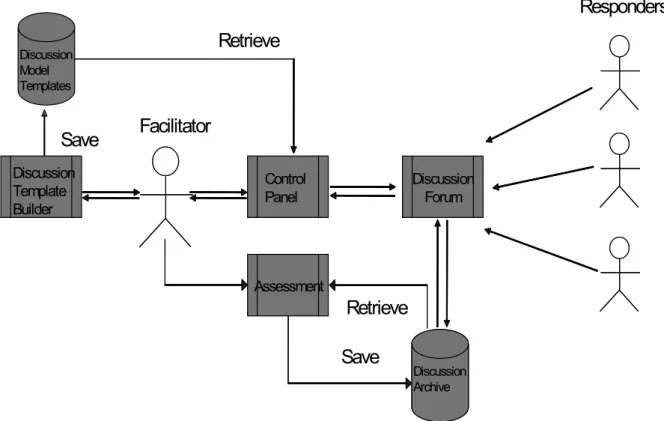
The structure of online discussions is an important aspect involved with encouraging collaborative learning. It requires planning and management (Mason 1998, Laurillard 2002). To assist in this the following web-based online discussion model (Figure 1) is proposed.
Responders
Save
Facilitator
Retrieve
Discussion Forum Control
Panel Discussion
Template Builder
Assessment
Discussion Model Templates
Discussion Archive Discussion Archive
Save
Retrieve
Figure 1: Proposed online discussion model
3.1 System: Actors & components
1. Facilitator: the instructor or moderator who controls the online discussion as controller. 2. Responders: students who responds to facilitator’s question/task or other students’ postings.
3. Discussion Template: discussion questions and stored settings from the control panel.
4. Control Panel: allows the facilitator to configure each discussion.
5. Discussion Forum: a password protected web interface where responders post their messages. On submission each message is automatically saved.
6. Assessment: allows the facilitator to access different responses and mark them.
3.2 Process
Figure 2: Application homepage
A facilitator starts the activity by either creating or choosing an online discussion template stored in the Discussion Model Templates database.
Figure 3: Discussion template builder
The Discussion Template Building environment allows the facilitator to specify the elements required for a particular online discussion and then save it as an online discussion template.
Shafqat Ali & Graeme Salter
15
Figure 4: Discussion control panel
The control panel component allows the facilitator to set parameters for the discussion such as release and finish time, anonymity, assessment weight, public/private, attachment options, archive options and whether the discussion is threaded or unthreaded.
Figure 5: Discussion forum for students
Figure 6: Discussion assessment panel If there is an assessment weighting associated with that particular discussion activity the facilitator is able to grade the response. If requested the discussion will automatically be saved in the Discussion Archive.
For example, suppose a lecturer wants the students to explore some free web resources available for automatic website testing. The work needs to meet a deadline and will be marked. The postings should be available to other students to avoid repetition of the same testing tools. Finally, the work will be reused in another activity where students will rate and categorise the web site testing tools listed. Using existing discussion models, the lecturer would have to put in considerable effort moderating the discussion to check the deadline, manually marking the students’ postings and creating a usable discussion archive at the end.
Using the proposed system (Discussion Corner) a template is created:
Web Site Testing Tool
!" Name: (mandatory) !" URL : (mandatory)
!" Features: [maximum 250 words]
(mandatory)
!" Comments
After that, other options are set using the Control Panel:
!" Archive: Yes (the work will be re-used) !" Selective Release to: None (discussion
is for whole class)
!" Available Date: 30-11-03 12:00 (when
student can see it)
!" Due Date: 07-12-03 00:00 (student
submission date)
!" Release Date: 07-12-03 (student only
can see others' posting after release date, as the lecturer does not want students to see others postings before this.)
!" Anonymous: No (Students posting will
be personalised)
!" Comments: Allowed (After release date
students can annotate comments to others postings)
!" Threaded: No (Students can not
respond to students postings, as this is not on-going threaded discussion)
4. Expected benefits
The proposed system should provide the following benefits -
4.1 Structured discussion objectives
In online discussions, the nature and structure of discussion questions is very important
Shafqat Ali & Graeme Salter
17
(Muilenburg & Berge 2002). The proposed model will help enforce this by providing a template-building environment for the facilitator. Rather than settle for questions that concentrate on recall (eg. give a definition of X?), more creative examples can be built into the templates. These might include -
!" Rating alternative information sources !" Evaluating a list of alternatives based on
multiple criteria.
!" Electronic Brainstorming for a specific
question or issue. (Salter, 2002)
!" Group outlining to generate or group
ideas into a familiar hierarchical structure. (GroupSystems.com, 2002)
!" Providing an annotated bibliography !" Voting and survey questions
In particular, this will assist those teachers who are new to online discussions to set meaningful discussion questions that encourage evaluation and/or deep learning.
4.2 Students’ interest and reusability of their work
Specific and well-structured discussions questions are more likely to hold students’ interest especially when there is some assessment weighting attached to it. Student work is not necessarily discarded when the semester is over. With permission, this work can be analysed or built upon by students in future semesters. By supplying samples of good quality previous work the authors have noted anecdotally that the standard for subsequent semesters continues to increase. In other cases, students have analysed the previous work in a new manner. For example, student ratings on an issue from a previous discussion can be collated and graphed.
4.3 Well managed discussions
Discussion management is a challenging aspect of online discussions, especially in an educational environment (Burford & Cooper, 2003). It is also a very time consuming job (Laurillard, 2002). For example, without a set ending date, discussions can be viewed as ‘never-ending’ and the purpose can be lost. Having set opening and closing times for a discussion helps avoid information overload and keeps students focused on the task (Salter, 2000). The proposed system allows the facilitator to have much more control over the management of the discussion.
4.4 Assessment
Assessment in discussion forums is gaining importance (Mochizuki, 2003). In educational environments, assessment is linked to learning outcomes which in turn are linked to learning activities (Burford & Cooper, 2003). The proposed system assists teachers if they want to include assessment weightings and provides a facility for marking. Rather than simply using a quantitative system for marking (eg. number of posts) a more qualitative approach can be taken. For example, students may have to submit a draft version for others to critique before producing a final version (Salter, 2000). Using the system both the final version and the critiques could easily be marked.
5. Future research
This paper focuses on a work in progress. The real test will come when the proposed model is applied in a higher education environment. Using an action research model, the following questions will be answered -
!" Do students find the forum easier to use
and follow? Does it support and enhance their level of collaboration? Does it improve the quality of their work?
!" Do staff prefer the forum to create and
manage online discussions? Does it minimize their effort in managing online discussions?
!" Is reusability of discussion templates
good idea in practical sense? Will it save time and effort?
!" What is the best framework to reuse the
outcomes of students’ postings?
6. Conclusion
There are some problems associated with the current models of online discussions in higher education. Discussions can end up as an open-ended, non-productive learning activity, there may be a lack of students’ participation, discussions may not be well structured or easy to initiate and assess by staff. The proposed system has been designed to help overcome these problems. This may lead to better outcomes for both students and staff. These expectations are going to be tested through action research where the proposed system will be tested by faculty and students.
References
Burford, S., & Cooper (Accessed on 28th August, 2003), L "FAQs: Collaborative Learning Online” , [online],
http://www.ssn.flinders.edu.au/innovati
ons/faq.shtml#grade.
Dillenbourg, P. (1999) Collaborative learning : cognitive and computational
approaches: Pergamon, pp9. Eastmond, D. V. (1995) Alone but together :
adult distance study through computer conferencing: Cresskill, N.J. : Hampton Press.
Fujitani, S., Mochizuki, T., Kato, H., Isshiki, Y., & Yamauchi, Y. (2003). "Development of Collaborative Learning Assessment Tool with Multivariate Analysis Applied to Electronic Discussion Forums", Paper presented at the World Conference on E-Learning in Corp., Govt., Health., & Higher Ed.
(ELEARN), Phoenix, Arizona USA, pp 200-203.
GroupSystems.com. (2002) " GroupSystems Interactive Tools." ,[online],
http://www.groupsystems.com/demos/t ools.htm
H2OProject. (2003). "H2O Project". [online] Retrieved 26 January, 2004, from http://h2oproject.law.harvard.edu/index .html
Harasim, L. M. (1995) Learning networks : a field guide to teaching and learning online, MIT Press.
Kearsley, G. (2000) "Learning and Teaching in Cyberspace" ,[online],
http://home.sprynet.com/~gkearsley/ch apts.htm
Laurillard, D. (2002). Rethinking university teaching : a conversational framework for the effective use of learning technologies (2nd ed.):
RoutledgeFalmer.
MacKnight, C. B. (2000) "Teaching Critical Thinking through Online Discussions."
EDUCAUSE QUARTERLY(Number 4), 38-41.
Mason, R. (1998) "Models of Online Courses",
[online],
http://www.aln.org/publications/magazi ne/v2n2/mason.asp
Muilenburg, L., & Berge, Z. L. (2002) "A Framework For Designing Questions For Online Learning”, [online],
http://www.ssn.flinders.edu.au/innovati ons/teacherresources.shtml
Mochizuki, T., Fujitani, S., Isshiki, Y., Yamauchi, Y., & Kato, H. (2003). "Assessment of Collaborative Learning for Students: Making the State of Discussion Visible for their Reflection by Text Mining of Electronic Forums." Paper presented at the World
Conference on E-Learning in Corp., Govt., Health., & Higher Ed.
(ELEARN), Phoenix, Arizona USA, pp 285-288.
Resta, P., Menchaca, M., & Adams, W. (2003). "Peer and Self Assessment Systems for Students and Instructors in On-line Collaborative Learning." Paper
presented at the World Conference on E-Learning in Corp., Govt., Health., & Higher Ed. (ELEARN), Phoenix, Arizona USA, pp-2379-2381. Rossman, M. H. (1999) "Successful Online
Teaching Using An Asynchronous Learner Discussion Forum", Journal of Asynchronous Learning Networks, 3(2), 91-97.
Sae-Chin, J., & Resta, P. E. (2003). Student Expectations of a Web-Based Collaborative Learning Environment. Paper presented at the World Conference on E-Learning in Corp., Govt., Health., & Higher Ed.
(ELEARN), Phoenix, Arizona USA. Salter, G. (2000) "Making use of online
discussion groups", Journal Of The Australian Council For Computers In Education, 15(No 2), 5-10.
Salter, G. (2002) "Strategies for the use of synchronous computer-mediated communication in education",
Proceedings of the International Conference on Computers in Education, New Zealand.
Navigation and Ownership for Learning in Electronic Texts:
An Experimental Study
Ursula Armitage and Stephanie Wilson
Centre for HCI Design, City University, London, UK [email protected]
[email protected] Helen Sharp
The Open University, Milton Keynes, UK (Visiting fellow at City University)
Abstract: Feelings of ownership for learning are an important part of the learning process and should be encouraged in e-Learning environments. This paper presents two experimental studies investigating the effects of navigation aids on ownership for learning with electronic texts. Experimental findings revealed that designers should not assume that allowing learners greater control over their navigation through higher navigational freedom, or the ability to create their own navigation aids, will increase feelings of ownership for learning with electronic texts. The results of these studies have implications for those designing navigation in educational electronic texts.
Keywords: ownership for learning, navigation aids, electronic text.
1. Introduction
Electronic texts are an essential component of any e-Learning environment. The way that the user interface is designed to support navigation in electronic texts is critical since it determines the way that the texts can be traversed and it is vital that navigation problems, such as ‘feelings of lostness’ (e.g. Conklin 1987), are avoided. In e-Learning environments, a key question is how navigation affects learning, and one important aspect of the learning process is that learners feel ownership for their learning (e.g. Cunningham et al 1993).
Previous research has demonstrated that navigation aids affect the way users interact with educational electronic texts and this, in turn, influences the achievement of learning outcomes (e.g. McDonald and Stevenson 1999). We extend this by hypothesising that different navigation aids will also impact upon users’ feelings of ownership for learning and we present two experiments designed to investigate these effects. The first experiment examined the effects of the level of navigational freedom offered by a navigation aid on feelings of ownership for learning. The second experiment examined the effects of allowing learners the opportunity to create their own navigation aids on feelings of ownership for learning.
‘Electronic text’ is used here as a generic term to refer to any text presented in an electronic medium. These texts may be presented in a
variety of ways including WWW and stand-alone CD-ROMs. Examples include hypertext documents (nodes of text connected by embedded links), text organised in menu structures, or linear text organised as a set of sequential nodes or as a single scrollable document. We define ‘navigation aids’ as elements of an interface that allow the user to access and traverse electronic texts; examples include embedded links, menus, interactive maps, and bookmarks.
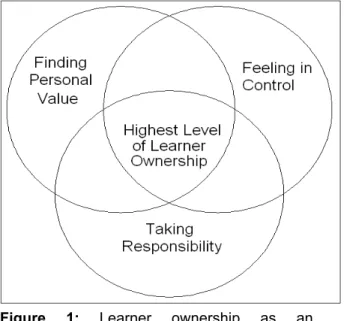
1.1 What is ownership for learning? Milner-Bolotin’s (2001) working definition of ownership is employed in this research. In this definition, learner ownership is broken down into three interacting components of the learning process: finding personal value, feeling in control, and taking responsibility (see figure 1). Finding personal value is about understanding how the knowledge and skills developed during learning might be useful in situations outside the original learning environment. High feelings of control occur when the learner makes decisions and is a proactive rather than reactive learner. Responsibility in learning, on the other hand, refers to the learner taking responsibility, or feeling accountable, for the process of learning as well as the results of learning. The highest levels of ownership occur when all three components overlap. Situations where only one or two components overlap result in lower feelings of overall ownership.
In terms of ownership, Milner-Bolotin (2001) proposed that learning environments that allow students higher control over their learning, allow them to choose topics of investigation which are more relevant for them, and allow them to be more responsible for their learning, provide more opportunities for students to develop a sense of ownership. In digital technology many authors have interpreted this learner control as control over pace and sequencing (Dillon and Gabbard 1998; for a detailed review see Lunts 2002). We propose that one way this control and choice is realised in electronic texts is as the extent to which learners are able to explore the texts in a way they see fit.
Figure 1: Learner ownership as an interactional effect of feelings of personal value, control and responsibility. Adapted from Milner-Bolotin (2001).
In order to investigate control and choice in electronic texts we define ‘navigational freedom’ as the degree of choice a user has when deciding which page to visit. This equates to the number of outgoing links a learner has to choose between on any one page of the texts. The type of navigation aid(s) employed determines the level of navigational freedom offered. For example, an A-Z index, that allows the learner to choose between every page in an electronic text, represents a navigation aid with higher navigational freedom than paging buttons where the learner only has the choice of going to the next or previous page in a predefined sequence. We hypothesise that navigation aids that offer higher navigational freedom will lead to higher feelings of ownership for learning than navigation aids that offer lower navigational freedom. Experiment 1 was designed to measure these predicted effects.
1.2 Why is ownership important in learning?
Learner ownership is promoted as illustrating the student-centredness of constructivist learning (Honebein 1996) and has been proposed to be important in terms of motivation to learn (e.g. Biggs 1999). Gross (1997) reported that attempts to encourage ownership in a classroom setting had positive effects on learning. By stressing student input, students came to feel responsible for their learning and in turn it was found that they grasped material more firmly, exhibited higher levels of inquiry and pursued tasks independently.
1.3 Background and experimental
hypotheses 1.3.2 Learner control and creating
navigation aids 1.3.1 Learner control and navigational
freedom Giving learners the opportunity to create their
own navigation aids can be seen as another way of offering the learner control over their learning with electronic texts. Through creating their own navigation aid, such as a map, the learner can exercise control when they make choices and decisions about the content, structure and layout of the navigation aid. The learner has the control to tailor the navigation aid to their own needs and make decisions about how they will access materials and in what order.
Supporters of constructivism propose that learners should be given responsibility and control over their learning (Honebein 1996; Duffy and Cunningham 1996), and educationalists have argued for some time that providing appropriate levels of learner control benefits learning (Eveland and Dunwoody 2001). In the context of e-Learning, learner control can be used to refer the extent to which learners are able to make choices and decisions when they use a piece of educational technology. It should also be noted that learner control is distinct from feelings of control, because even if control is offered to the learner, it is not always the case that they will feel and recognise this control.
Recent developments in navigation aids allow the user to adapt the aid and use it to represent ideas in the electronic text. For example, Nestor Navigator (e.g. Zeiliger et al 1997; Zeiliger et al 1999; Nestor is available