
GRADE 8: MODULE 4: OVERVIEW
Sustainability of the US Food Supply Chain
In this module, students analyze arguments and the evidence used to support arguments to determine whether sufficient evidence has been used and whether the evidence is relevant in support of the claim an author or speaker is making. They then research to gather evidence to make their own spoken and written arguments. Students will read Michael Pollan’s The Omnivore’s Dilemma (930L), a literary non-fiction text about where food comes from and about making decisions about what food to buy and eat. They build background knowledge about what happens to food before it gets to the consumer, and the different choices the consumer can make when buying food while analyzing Michael Pollan’s arguments and the evidence he uses to support his claims. In Unit 2, students engage in a robust research project in which they further investigate the consequences of each of the food chains and the stakeholders affected in those food chains. To help students
grapple with this issue, they use a decision-making process called “Stakeholder Consequences Decision-Making” (see the end of this document for details). This process will help students understand the implications of various choices, and will scaffold their ability to determine, based on evidence and their own values, to take a position on which food chain they would choose if they were trying to feed everyone in the US. Students finish the module by writing a position paper explaining which of Michael Pollan’s food chain they would choose to feed the US and why, and creating a poster stating their position. This task addresses NYSP12 ELA Standards RI.8.1, W.8.1, W.8.1a, W.8.1b, W.8.1c, W.8.1d, W.8.1e and W.8.9.
Guiding Questions And Big Ideas
• Which of Michael Pollan’s food supply chains would best feed the US? • How do we make decisions about what we eat?
• What journey does food take before it gets to your plate?
• Has the author or speaker used sufficient relevant evidence and sound reasoning to support his or her claim?
• The food we buy comes to us from various different routes and processes. We can make more informed decisions about what food to buy when we understand those
processes and the stakeholders affected by the food choices we make.
Performance Task
This performance task gives students a chance to share their best reading, writing, and thinking about the question: “Which of Michael Pollan’s food supply chains would best feed the United States?” Students will use a powerful excerpt of their position paper, visual components, and text features to create a poster that shows their claim as well as the evidence they used to support their claim. These posters will be displayed around the classroom, with students having the opportunity to do a Gallery Walk of one another’s work. This task addresses NYSP12 ELA Standards RI.8.1, W.8.1, W.8.9, and W.8.9b.
GRADE 8: MODULE 4: OVERVIEW
Sustainability of the US Food Supply Chain
Content Connections
This module is designed to address English Language Arts standards as students read literature and informational text about the Second Sudanese Civil War. However, the module intentionally incorporates Social Studies Practices and Themes to support potential interdisciplinary connections to this compelling content.
These intentional connections are described below.
Big ideas and guiding questions are informed by the New York State Common Core K-8 Social Studies Framework: Unifying Themes (pages 6–7)
• Theme 4: Geography, Humans, and the Environment: The relationship between human populations and the physical world (people, places, and environments); impact of human activities on the environment; interactions between regions, locations, places, people, and environments.
• Theme 9: Science, Technology, and Innovation: Applications of science and innovations in transportation, communication, military technolo agriculture and industrialization.
Social Studies Practices, Geographic Reasoning, Grades 5–8:
• Descriptor 2: Describe the relationships between people and environments and the connections between people and places (page 58).
• Descriptor 3: Identify, analyze, and evaluate the relationship between the environment and human activities, how the physical environment is modified by human activities, and how human activities are also influenced by Earth’s physical features and processes.
Social Studies Practices, Gathering, Using, and Interpreting Evidence, Grades 5-8:
• Descriptor 1: Define and frame questions about events and the world in which we live and use evidence to answer these questions.
• Descriptor 2: Identify, describe, and evaluate evidence about events from diverse sources (including written documents, works of art, photographs, charts and graphs, artifacts, oral traditions, and other primary and secondary sources).
• Descriptor 4: Describe and analyze arguments of others.
GRADE 8: MODULE 4: OVERVIEW
English Language Arts Outcomes
CCS Standards: Reading—Informational Texts Long-Term Learning Targets
• RI.8.2. Determine a central idea of a text and analyze its development over the course of the text, including its relationship to supporting ideas; provide an objective summary of the text.
a. Self-select text to develop personal preferences.
b. Establish and use criteria to classify, select, and evaluate texts to make informed judgments about the quality of pieces.
• I can determine a theme or the central ideas of an informational text. • I can analyze the development of a theme or central idea throughout the text
(including its relationship to supporting ideas). • I can objectively summarize informational text.
• RI.8.4. Determine the meaning of words and phrases as they are used in a text, including figurative, connotative, and technical meanings; analyze the impact of specific word choices on meaning and tone, including analogies or allusions to other texts.
• I can determine the meaning of words and phrases in text (figurative, connotative, and technical meanings).
• I can analyze the impact of word choice on meaning and tone (analogies or allusions).
• RI.8.6. Determine an author’s point of view or purpose in a text and analyze how the author acknowledges and responds to conflicting evidence or viewpoints.
• I can determine an author’s point of view or purpose in informational text. • I can analyze how the author acknowledges and responds to conflicting evidence
or viewpoints. • RI.8.8. Delineate and evaluate the argument and specific claims in a text,
assessing whether the reasoning is sound and the evidence is relevant and sufficient; recognize when irrelevant evidence is introduced.
• I can identify the argument and specific claims in a text.
• I can evaluate the argument and specific claims in a text (assessing whether the reasoning is sound and the evidence is relevant and sufficient to support the claims).
• I can identify when irrelevant evidence is used. • RI.8.9a. Read, annotate, and analyze informational texts on topics related to
diverse and non-traditional cultures and viewpoints.
• I can read, annotate, and analyze informational texts on topics related to diverse and non-traditional cultures and viewpoints.
GRADE 8: MODULE 4: OVERVIEW
English Language Arts Outcomes
CCS Standards: Writing Long-Term Learning Targets
• W.8.1. Write arguments to support claims with clear reasons and relevant evidence.
a. Introduce claim(s), acknowledge and distinguish the claim(s) from alternate or opposing claims, and organize the reasons and evidence logically.
b. Support claim(s) with logical reasoning and relevant evidence, using accurate, credible sources and demonstrating an understanding of the topic or text.
c. Use words, phrases, and clauses to create cohesion and clarify the relationships among claim(s), counterclaims, reasons, and evidence. d. Establish and maintain a formal style.
e. Provide a concluding statement or section that follows from and supports the argument presented.
• I can write arguments to support claims with clear reasons and relevant evidence.
a. I can introduce claim(s), acknowledge and distinguish the claim(s) from alternate or opposing claims, and organize the reasons and evidence logically.
b. I can support claim(s) with logical reasoning and relevant evidence, using accurate, credible sources and demonstrating an understanding of the topic or text.
c. I can use words, phrases, and clauses to create cohesion and clarify the relationships among claim(s), counterclaims, reasons, and evidence. d. I can establish and maintain a formal style.
e. I can provide a concluding statement or section that follows from and supports the argument presented
• W.8.4. Produce clear and coherent writing in which the development,
organization, and style are appropriate to task, purpose, and audience. (Grade-specific expectations for writing types are defined in standards 1–3 above.)
• I can produce clear and coherent writing that is appropriate to task, purpose and audience.
• W.8.5. With some guidance and support from peers and adults, develop and strengthen writing as needed by planning, revising, editing, rewriting, or trying a new approach, focusing on how well purpose and audience have been
addressed.
• With support from peers and adults, I can use the writing process to ensure that purpose and audience have been addressed.
• W.8.7. Conduct short research projects to answer a question (including a self-generated question), drawing on several sources and generating additional
• I can conduct short research projects to answer a question (including a self-generated question).
GRADE 8: MODULE 4: OVERVIEW
English Language Arts Outcomes
CCS Standards: Writing Long-Term Learning Targets
• W.8.8. Gather relevant information from multiple print and digital sources, using search terms effectively; assess the credibility and accuracy of each source; and quote or paraphrase the data and conclusions of others while avoiding plagiarism and following a standard format for citation.
• I can gather relevant information from a variety of sources. • I can use search terms effectively.
• I can evaluate the credibility and accuracy of each source.
• I can quote and paraphrase others’ work while avoiding plagiarism. • I can use a standard format for citation.
• W.8.9. Draw evidence from literary or informational texts to support analysis, reflection, and research.]
b. Apply grade 8 Reading standards to literary nonfiction (e.g., “Delineate and evaluate the argument and specific claims in a text, assessing whether the reasoning is sound and the evidence is relevant and sufficient; recognize when irrelevant evidence is introduced”).
• I can use evidence from informational texts to support analysis, reflection and research.
GRADE 8: MODULE 4: OVERVIEW
English Language Arts Outcomes
CCS Standards: Speaking and Listening Long-Term Learning Targets
• SL.8.2. Analyze the purpose of information presented in diverse media and formats (e.g., visually, quantitatively, orally) and evaluate the motives (e.g., social, commercial, political) behind its presentation.
a. Use their experience and their knowledge of language and logic, as well as culture, to think analytically, address problems creatively, and advocate persuasively.
• I can analyze the purpose of information presented in different media and formats.
• I can evaluate the motives behind a presentation.
a. I can use their experience and their knowledge of language and logic, as well as culture, to think analytically, address problems creatively, and advocate persuasively.
• SL.8.3. Delineate a speaker’s argument and specific claims, evaluating the soundness of the reasoning and relevance and sufficiency of the evidence and identifying when irrelevant evidence is introduced.
• I can determine a speaker’s argument and specific claims.
• I can evaluate the reasoning and evidence presented for soundness and relevance.
• I can identify when irrelevant evidence is introduced. • SL.8.4. Present claims and findings, emphasizing salient points in a focused,
coherent manner with relevant evidence, sound valid reasoning, and well-chosen details; use appropriate eye contact, adequate volume, and clear pronunciation.
• I can present claims and findings in a focused, coherent manner (use relevant evidence, sound reasoning and well-chosen details).
• I can use effective speaking techniques (appropriate eye contact, adequate volume and clear pronunciation).
• SL.8.5. Integrate multimedia and visual displays into presentations to clarify information, strengthen claims and evidence, and add interest.
• I can integrate multimedia components and visual displays in a presentation to clarify information, strengthen claims and to add emphasis.
• SL.8.6. Adapt speech to a variety of contexts and tasks, demonstrating command of formal English when indicated or appropriate.
• I can adapt my speech for a variety of contexts and tasks, using formal English when indicated or appropriate.
GRADE 8: MODULE 4: OVERVIEW
English Language Arts Outcomes
CCS Standards: Language Long-Term Learning Targets
• L.8.4. Determine or clarify the meaning of unknown and multiple-meaning words or phrases based on grade 8 reading and content, choosing flexibly from a range of strategies.
b. Use common, grade-appropriate Greek or Latin affixes and roots as clues to the meaning of a word (e.g., precede, recede, secede).
c. Consult general and specialized reference materials (e.g., dictionaries, glossaries, thesauruses), both print and digital, to find the pronunciation of a word or determine or clarify its precise meaning or its part of speech. d. Verify the preliminary determination of the meaning of a word or phrase
(e.g., by checking the inferred meaning in context or in a dictionary).
• I can use a variety of strategies to determine the meaning of unknown words or phrases.
• L.8.6. Acquire and use accurately grade-appropriate general academic and domain-specific words and phrases; gather vocabulary knowledge when considering a word or phrase important to comprehension or expression.
• I can accurately use 8th grade academic vocabulary to express my ideas.
• I can use resources to build my vocabulary.
Central Texts
1. Michael Pollan, Young Readers Edition: The Omnivores Dilemma (New York: The Penguin Group (USA) Inc., 2009), ISBN: 978-0-8037-3500-2. 2. Students conduct internet research. See Unit 2 overview for details.
GRADE 8: MODULE 4: OVERVIEW
Week at a Glance
Week Instructional Focus Long-Term Targets Assessments
Unit 1: Analyzing Author’s Purpose and Evaluating Claims in The Omnivore’s Dilemma Weeks 1-3 • Begin The Omnivore’s Dilemma
• Analyze The Omnivore’s Dilemma for author’s purpose and for how the author responds to conflicting viewpoints and evidence
• I can determine a theme or the central ideas of an informational text (RI.8.2)
• I can determine the meaning of words and phrases in text (figurative, connotative, and technical meanings). (RI.8.4)
• I can determine an author’s point of view or purpose in informational text. (RI.8.6) • I can analyze how the author acknowledges
and responds to conflicting evidence or viewpoints. (RI.8.6)
• I can analyze the purpose of information presented in different media and formats. (SL.8.2)
• I can evaluate the motives behind a presentation. (SL.8.2)
• Mid-Unit Assessment: Analyzing Author’s Purpose in Speech and Text (RI.8.6, SL.8.2)
• Evaluate Michael Pollan’s claims in The
Omnivore’s Dilemma for sound reasoning
and relevant and sufficient evidence. • Practice advocating persuasively and
speaking and listening skills.
• I can determine a theme or the central ideas of an informational text (RI.8.2)
• I can determine the meaning of words and phrases in text (figurative, connotative, and technical meanings). (RI.8.4)
• I can determine an author’s point of view or
• End of Unit 1 Assessment: Evaluating Claims and Advocating Persuasively (RI.8.8, RI.8.9a, W.8.9b, SL.8.2, SL.8.3)
GRADE 8: MODULE 4: OVERVIEW
Week at a Glance
Week Instructional Focus Long-Term Targets (continued) Assessments
Weeks 1-3, continued
• I can identify the argument and specific claims in a text. (RI.8.8)
• I can evaluate the argument and specific claims in a text (assessing whether the reasoning is sound and the evidence is relevant and sufficient to support the claims). (RI.8.8)
• I can identify when irrelevant evidence is used. (RI.8.8)
• I can read, annotate, and analyze informational texts on topics related to diverse and nontraditional
cultures and
viewpoints (RI.8.9a)
• I can apply grade 8 Reading standards to literary nonfiction (e.g., “Delineate and evaluate the argument and specific claims in a text, assessing whether the reasoning is sound and the evidence is relevant and sufficient; recognize when irrelevant evidence is introduced”) (W.8.9a)
• I can think analytically, address problems creatively, and advocate persuasively (Sl.8.2a)
• I can determine a speaker’s argument and specific claims. (SL.8.3)
• I can evaluate the reasoning and evidence presented for soundness and relevance. (SL.8.3)
• I can identify when irrelevant evidence is introduced. (SL.8.3)
GRADE 8: MODULE 4: OVERVIEW
Week at a Glance
Week Instructional Focus Long-Term Targets Assessments
Unit 2
:
Researching Consequences and Stakeholders of Michael Pollan’s Four Food Chains Weeks 3-5 • Analyze each of Michael Pollan’s foodchains for consequences.
• Research further the consequences of each of Michael Pollan’s food chains using other resources than The
Omnivore’s Dilemma and determine the
stakeholders.
• I can conduct short research projects to answer a question (including a self-generated question). (W.8.7)
• I can use several sources in my research. (W.8.7) • I can generate additional research questions for
further exploration. (W.8.7)
• I can gather relevant information from a variety of sources. (W.8.8)
• I can use search terms effectively. (W.8.8) • I can evaluate the credibility and accuracy of each
source. (W.8.8)
• I can quote and paraphrase others’ work while avoiding plagiarism. (W.8.8)
• I can use a standard format for citation. (W.8.8)
• Mid-Unit 2 Assessment: Research Simulation (W.8.7, W.8.8)
• Practice speaking and listening skills in preparation for a presentation.
• I can present claims and findings in a focused, coherent manner (use relevant evidence, sound reasoning and well-chosen details). (SL.8.4) • I can use effective speaking techniques (appropriate
eye contact, adequate volume and clear pronunciation). (SL.8.4)
• I can integrate multimedia components and visual displays in a presentation to clarify information,
• End of Unit 2 Assessment: Position Speech: Which of Michael Pollan’s four food chains would best feed the United States? (SL.8.4, SL.8.5, SL.8.6)
GRADE 8: MODULE 4: OVERVIEW
Week at a Glance
Week Instructional Focus Long-Term Targets Assessments
Unit 3: Writing a Position Paper: Which of Michael Pollan’s Food Chains Would You Choose to Feed the US? Weeks 6-8 • Analyzing a model position paper to
determine criteria.
• Building a draft position paper, piece by piece, in which a claim is made to answer the question: Which of Michael Pollan’s food chains would you choose to feed the US?
• I can cite text-based evidence that provides the strongest support for an analysis of an informational text. (RI.8.1)
• I can determine a theme or the central ideas of an informational text (RI.8.2)
• I can write arguments to support claims with clear reasons and relevant evidence. (W.8.1) • I can introduce claim(s), acknowledge and
distinguish the claim(s) from alternate or opposing claims, and organize the reasons and evidence logically. (W.8.1a)
• I can support claim(s) with logical reasoning and relevant evidence, using accurate, credible sources and demonstrating an understanding of the topic or text. (W.8.1b)
• Mid-Unit Assessment: Draft Position Paper (RI.8.1, W.8.1, W.8.1a, W.8.1b, W.8.1e, W.8.9, L.8.4, L.8.4b, L.8.4c, L8.4d)
GRADE 8: MODULE 4: OVERVIEW
Week at a Glance
Week Instructional Focus Long-Term Targets (continued) Assessments
Weeks 6-8, continued
• I can provide a concluding statement or section that follows from and supports the argument presented. (W.8.1e)
• I can produce clear and coherent writing that is appropriate to task, purpose and audience. (W.8.4)
• With support from peers and adults, I can use the writing process to ensure that purpose and audience have been addressed. (W.8.5)
• I can gather relevant information from a variety of sources. (W.8.8)
• I can use search terms effectively.
• I can evaluate the credibility and accuracy of each source. (W.8.8)
• I can quote and paraphrase others’ work while avoiding plagiarism. (W.8.8) • I can use a standard format for citation.
(W.8.8)
• I can use evidence from informational texts to support analysis, reflection and research. (W.8.9)
GRADE 8: MODULE 4: OVERVIEW
Week at a Glance
Week Instructional Focus Long-Term Targets (continued) Assessments
Weeks 6-8, continued
• I can use common, grade-appropriate Greek or Latin affixes and roots as clues to the meaning of a word (e.g., precede, recede, secede). (L.8.4b)
• I can consult general and specialized reference materials (e.g., dictionaries, glossaries, thesauruses), both print and digital, to find the pronunciation of a word or determine or clarify its precise meaning or its part of speech. (L.8.4c)
• I can verify the preliminary determination of the meaning of a word or phrase (e.g., by checking the inferred meaning in context or in a dictionary). (L.8.4d)
• I can accurately use 8th grade academic
vocabulary to express my ideas. (L.8.6) • I can use resources to build my vocabulary.
(L.8.6) • Revise and edit draft position paper ready to
publish.
• I can cite text-based evidence that provides the strongest support for an analysis of an informational text. (RI.8.1)
• I can use words, phrases, and clauses to create cohesion and clarify the relationships among claim(s), counterclaims, reasons, and evidence. (W.8.1c)
• I can establish and maintain a formal style. (W.8.1d)
• End of Unit 3 Assessment: Final Draft of Position Paper and Reflection on Writing the Position Paper (RI.8.1, W.8.1c, W.8.1d) • Final Performance Task: Published Position
Paper: Which of Michael Pollan’s food chains would you choose to feed the US? Why? (RI.8.1, W.8.1, W.8.1a, W.8.1b, W.8.1c, W.8.1d, W.8.1e, W.8.9).
GRADE 8: MODULE 4: OVERVIEW
Week at a Glance
Preparation and Materials
In advance, read the article about the SCDM (Stakeholder Consequences Decision-Making) process to build your own background knowledge about it. You can download the article, “Learning to Make Systematic Decisions,” at the following URL:
http://education.nationalgeographic.com/education/media/learning-make-systematic-decisions/?ar_a=1
This article is not used with students during the module, but it provides some examples of how students have used this process in a science curriculum. Also, note that in this module students are not using the entire SCDM process; they will be learning only the Cascading Consequences and Stakeholders charts.
Grade 8: Module 4:
GRADE 8: MODULE 4: ASSESSMENT OVERVIEW
Final Performance Task Visual Representation of Position Paper
This performance task gives students a chance to share their best reading, writing, and thinking about the question: “Which of Michael Pollan’s food supply chains would best feed the United States?” Students will use a powerful excerpt of their position paper, visual components, and text features to create a poster that shows their claim as well as the evidence they used to support their claim. These posters will be displayed around the classroom, with students having the opportunity to do a Gallery Walk of one another’s work. This task addresses NYSP12 ELA Standards RI.8.1, W.8.1, W.8.9, and W.8.9b.
Mid-Unit 1 Assessment Analyzing Author’s Purpose in Speech and Text
This assessment centers on NYSP12 ELA CCLS L.8.4, L.8.4b, L.8.4c, L.8.4d, RI.8.6, and SL.8.2. There are two parts to this assessment. In Part 1, students analyze the speaker’s purpose in a speech and the motives behind the medium the speech is presented in. In Part 2, students determine the meaning of words and analyze Michael Pollan’s purpose in a new excerpt of
The Omnivore’s Dilemma. They also identify conflicting viewpoints put forward in the excerpt and describe how Michael
Pollan responds to those viewpoints. In both Parts 1 and 2 of the assessment, students record their thinking on graphic organizers.
End of Unit 1 Assessment Evaluating Claims and Advocating Persuasively
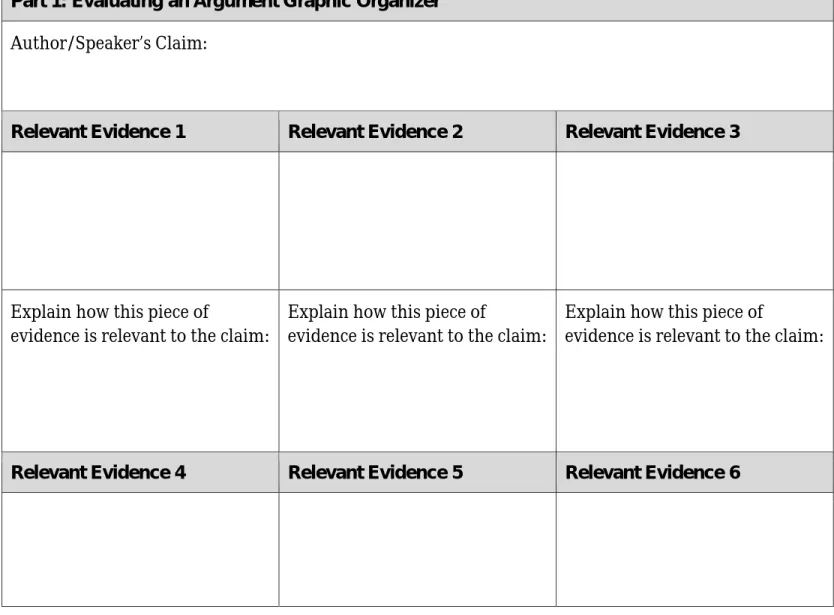
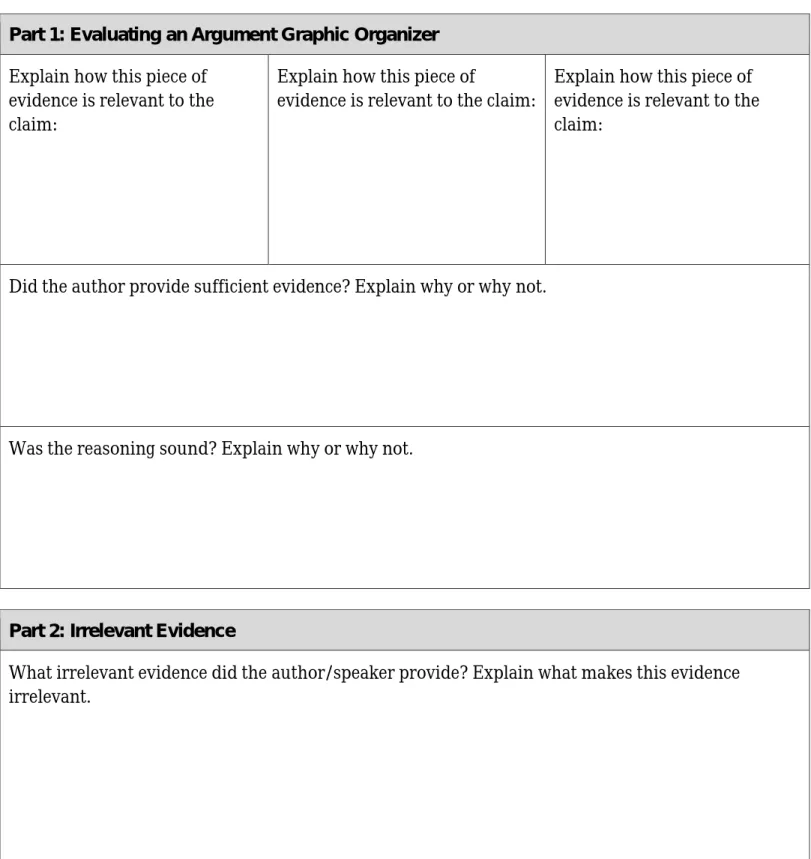
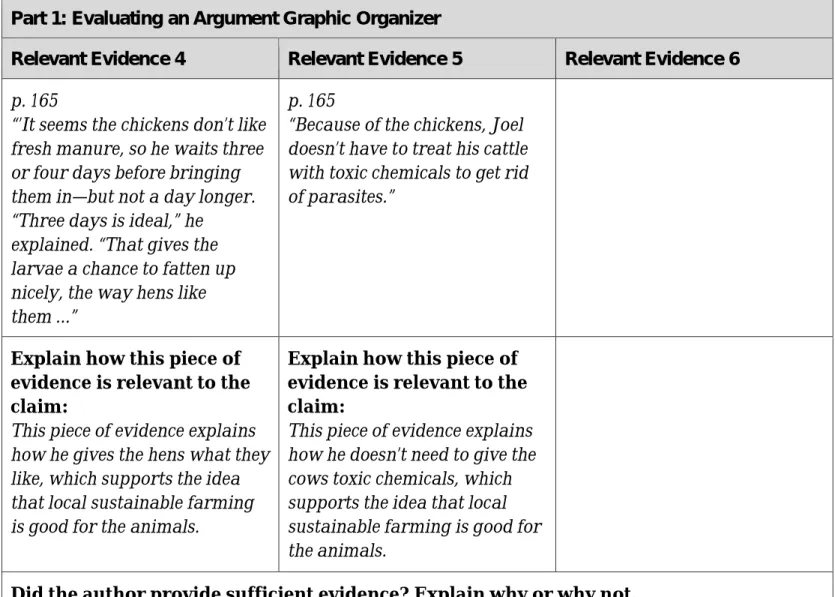
This assessment centers on NYSP12 ELA CCLS RI.8.8, RI.8.9a, W.8.9b, SL.8.2, and SL.8.3. There are two parts to this assessment. In Part 1, students evaluate the claims in a speech and a new excerpt of The Omnivore’s Dilemma for sound reasoning, relevant evidence, and irrelevant evidence. Students record their thinking for this part of the assessment on graphic organizers. In Part 2 of the assessment, students advocate persuasively to answer this question in a Fishbowl: Which of the four meals you were invited to choose from at the beginning of the unit would you choose to feed your family? Why? Students prepare notes using what they have learned about each of Michael Pollan’s food chains and the four meals so far to help them advocate persuasively and respond to a counterclaim made by another student as they advocate persuasively.
GRADE 8: MODULE 4: ASSESSMENT OVERVIEW
Mid-Unit 2 Assessment Research Simulation
This assessment centers on NYSP12 ELA CCLS W.8.7 and W.8.8. In this assessment, students apply the research skills they have been learning throughout the unit to answer research questions about two new research texts. They paraphrase research, choose search terms, cite sources, and determine the credibility and accuracy of research sources.
End of Unit 2 Assessment Position Speech: Which of Michael Pollan’s four food chains would best feed the United States?
This assessment centers on NYSP12 ELA CCLS SL.8.4, SL.8.5, and SL.8.6. Students present a position speech to answer the question: Which of Michael Pollan’s four food chains would best feed the United States? They state a claim and provide two reasons for making that claim based on the consequences and affected stakeholders they have identified for each food chain throughout the unit. They select evidence to support their reasons, and they provide a counterclaim and respond to it.
Mid-Unit 3 Assessment Draft Position Paper: Which of Michael Pollan’s four food chains would best feed the United States?
This assessment centers on NYSP12 ELA CCLS W.8.1, W.8.1a, W.8.1b, and W.8.1e. Students draft a position paper to answer the question: Which of Michael Pollan’s four food chain would you choose to feed the United States? Their position paper should contain a claim, two reasons for making that claim, and evidence supporting each of the reasons. It should also include a counterclaim and a response to that counterclaim. Students use their position speech from the End of Unit 2 Assessment as a basis for their position paper.
End of Unit 3 Assessment Final Position Paper: Which of Michael Pollan’s four food chains would you choose to feed the United
States?
This assessment centers on NYSP12 ELA CCLS RI.8.1, W.8.1, W.8.1c, W.8.1d, and W.8.9. Students write a final draft of their position paper to answer the question: Which of Michael Pollan’s four food chains would you choose to feed the United States?
GRADE 8: MODULE 4: PERFORMANCE TASK
Visual Representation of Position Paper
Summary of Task
• This performance task gives students a chance to share their best reading, writing, and thinking about the question: “Which of Michael Pollan’s food supply chains would best feed the United States?” Students will use a powerful excerpt of their position paper, visual components, and text features to create a poster that shows their claim as well as the evidence they used to support their claim. These posters will be displayed around the classroom, with students having the opportunity to do a Gallery Walk of one another’s work. This task addresses NYSP12 ELA Standards RI.8.1, W.8.1, W.8.9, and W.8.9b.
Format
A visual representation of position paper on large paper or poster board.
Students will include their claim, reasons, and evidence from their position paper. Students will plan their visual representation using a template.
Final visual presentations will be shared in a Gallery Walk.
Standards Assessed through This Task
• R1.8.1. Cite the textual evidence that most strongly supports an analysis of what the text says explicitly as well as inferences drawn from the text. • W.8.1. Write arguments to support claims with clear reasons and relevant evidence.
a. Introduce claim(s), acknowledge and distinguish the claim(s) from alternate or opposing claims, and organize the reasons and evidence logically. b. Support claim(s) with logical reasoning and relevant evidence, using accurate, credible sources and demonstrating an understanding of the topic or text. c. Use words, phrases, and clauses to create cohesion and clarify the relationships among claim(s), counterclaims, reasons, and evidence.
d. Establish and maintain a formal style.
e. Provide a concluding statement or section that follows from and supports the argument presented. • W.8.9. Draw evidence from literary or informational texts to support analysis, reflection, and research.
b. Apply grade 8 Reading standards to literary nonfiction (e.g., “Delineate and evaluate the argument and specific claims in a text, assessing whether the reasoning is sound and the evidence is relevant and sufficient; recognize when irrelevant evidence is introduced”).
GRADE 8: MODULE 4: PERFORMANCE TASK
Visual Representation of Position Paper
Student-Friendly Writing Invitation/Task Description
• Your task is to create a visual representation of your argument from your position paper. To do so, you will use your claim, your reasons, and at least three of your pieces of evidence. You will then select images that represent your key pieces of evidence and organize them on a page or poster, using either chart paper and markers or a computer. You will share your performance task with the rest of the class in a classroom Gallery Walk at the end of this unit.
Key Criteria for Success (Aligned with NYSP 12 ELA CCLS)
Below are key criteria students need to address when completing this task. Specific lessons during the module build in opportunities for students to understand the task, plan their visual representation, and share their final product.
Your visual representation of the position paper will include: • Your claim that you made in your position paper
• The reasons you used to support your claim
• Evidence from your position paper that supports your reasons and claim • Images to support your argument
• An organizational structure that is easy to read and makes it easy to follow your argument • Domain-specific vocabulary
GRADE 8: MODULE 4: PERFORMANCE TASK
Visual Representation of Position Paper
Options for Students
• Students will create their posters individually. They will primarily base their visual representation on their position paper; however, they may also look back at their researcher’s notebooks, Cascading Consequences charts, and Stakeholder charts.
• Students might have a partner to assist as they work on their visual representations, but the final version will be an individual’s product. • Student visual representations might be laid out differently.
• Students may draw their images rather than use existing images.
• Students could participate in a Hosted Gallery Walk, in which they move around the room in a group and, when they come to their visual representation, explain it to other students in their group.
Options for Teachers
• Students may share their visual representations with their own class, with other classes in the school, or with parents or other adults in a community center or public library.
• Students may create a digital visual representation. These could be posted on an internal school Web site or, with parental permission, on a publicly accessible Web site.
GRADE 8: MODULE 4: PERFORMANCE TASK
Visual Representation of Position Paper
Resources and Links
• http://search.creativecommons.org/ (a site to search for images with licenses to reuse)
Central Text and Informational Texts
Michael Pollan, The Omnivore’s Dilemma, Young Readers Edition (New York: The Penguin Group, 2009), ISBN: 978-0-8037-3500-2. Various research sources.
Grade 8: Module 4:
GRADE 8: MODULE 4: RECOMMENDED TEXTS
The list below includes texts with a range of Lexile® text measures about food sustainability. It is imperative that students read a high volume of texts at their reading level in order to continue to build the academic vocabulary and fluency demanded by the CCLS. Note that districts and schools should consider their own community standards when reviewing this list. Some texts in particular units or modules address emotionally difficult content.
It is imperative that students read a high volume of texts at their reading level in order to continue to build the academic vocabulary and fluency demanded by the CCLS.
Where possible, texts in languages other than English are also provided. Texts are categorized into three Lexile measures that correspond to Common Core Bands: below grade band, within band, and above band. Note, however, that Lexile measures are just one indicator of text complexity, and teachers must use their professional judgment and consider qualitative factors as well. For more information, see Appendix 1 of the Common Core State Standards. Common Core Band Level Text Difficulty Ranges:
(As provided in the NYSED Passage Selection Guidelines for Assessing CCSS ELA) • Grade 4–5: 740–1010L
• Grade 6–8: 925–1185L
Title Author And Illustrator Text Type Lexile Measure
Lexile text measures in Grade 4–5 band level (<740L-925L)
Food Alexandra Fix (author) Informational 630*
Avoiding Hunger and Finding Water Andrew Langley (author) Informational 720
Seeds of Change Jen Cullerton Johnson (author) Informational 820
GRADE 8: MODULE 4: RECOMMENDED TEXTS
Title Author And Illustrator Text Type Lexile Measure
Lexile text measures within Grade 6 band level (925L-1070L)
Word of Mouth: The Food You Eat Nancy Rogers Bontempo (author) Informational 960
Food Paul Mason (author) Informational 970*
Do you Know Where Your Food Comes
From? Neil Morris (author) Informational 980*
Dairy: From the Farm to Your Table Brian Hanson Harding (author) Informational 1060*
Lexile text measures within Grade 6–8 band level (925L–1185L)
Feeding Relationships Ann Fullick (author) Informational 930*
From Farm to Table Richard Spilsbury (author) Informational 1120*
What’s Cooking? The History of
American Food Silvia Whitman (author) Informational 1120
Feeding the World Anne Rooney (author) Informational 1120*
GRADE 8: MODULE 4: RECOMMENDED TEXTS
Title Author And Illustrator Text Type Lexile Measure
Lexile text measures above band level (over 1185L)
Food: Ethical Debates in What We Eat Jim Kerr (author) Informational 1190*
Food and Farming Jen Green (author) Informational 1240
Suggested Web Sites for Research
http://www.fao.org/news/story/en/item/117568/icode/
http://www.amnh.org/exhibitions/past-exhibitions/water-h20-life http://www.challengebasedlearning.org/challenge/view/13
http://www.ted.com/talks/mark_bittman_on_what_s_wrong_with_what_we_eat.html http://www.gracelinks.org/264/genetic-engineering
http://www.un.org/en/sustainablefuture/food.shtml
http://www.un.org/en/sustainablefuture/sustainability.shtml
Suggested Articles for Research
Stephen Ornes, “For Kids: Greener Diet,” in Science News for Kids, Feb. 23, 2009. Gretchen Noyes, “Global Groceries,” in Faces (Vol. 23, Issue 2), Oct. 2006.
“Food around the World,” In Junior Scholastic (Vol. 113, Issue 15), May 9, 2011.
“The Critical Role of Global Food Consumption Patterns in Achieving Sustainable Food Systems and Food for All,” United Nations Environment
Programme, 2012.
Grade 8: Module 4: Unit 1:
GRADE 8: MODULE 4: UNIT 1: OVERVIEW
Analyzing Author’s Purpose and Evaluating Claims in The Omnivore’s
Dilemma
Unit 1: Analyzing Author’s Purpose and Evaluating Claims in The Omnivore’s Dilemma In this unit, students analyze authors’ and speakers’ purposes and evaluate the
claims they make. Students begin reading the Young Readers Edition of Michael Pollan’s The Omnivore’s Dilemma (930L), a high-interest literary nonfiction text about where food comes from and how it gets to our plate. As they read the text, they are involved in a study of the author’s purpose and how to determine what that
is. At the same time, they analyze videos of speeches and interviews on the same topic of food and how it gets to our plate in order to analyze a speaker’s purpose. In the second half of the unit, students move on to analyze authors’ and speakers’ claims and whether they use relevant and sufficient evidence and sound reasoning to support their claims. They also read and listen for the use of irrelevant evidence.
Guiding Questions and Big Ideas
• What journey does food take before it gets to your plate? • What is the author’s purpose? Why did they write that?
• Has the author or speaker used sufficient relevant evidence and sound reasoning to support his or her claim? • Understanding diverse points of view helps us live in an increasingly diverse society.
GRADE 8: MODULE 4: UNIT 1: OVERVIEW
Analyzing Author’s Purpose and Evaluating Claims in The Omnivore’s
Dilemma
Mid-Unit 1 Assessment Analyzing Author’s Purpose in Speech and Text
This assessment centers on NYSP12 ELA CCLS L.8.4, L.8.4b, L.8.4c, L.8.4d, RI.8.6, and SL.8.2. There are two parts to this assessment. In Part 1, students analyze the speaker’s purpose in a speech and the motives behind the medium the speech is presented in. In Part 2, students determine the meaning of words and analyze Michael Pollan’s purpose in a new excerpt of
The Omnivore’s Dilemma. They also identify conflicting viewpoints put forward in the excerpt and describe how Michael
Pollan responds to those viewpoints. In both Parts 1 and 2 of the assessment, students record their thinking on graphic organizers.
End of Unit 1 Assessment Evaluating Claims and Advocating Persuasively
This assessment centers on NYSP12 ELA CCLS RI.8.8, RI.8.9a, W.8.9b, SL.8.2, and SL.8.3. There are two parts to this assessment. In Part 1, students evaluate the claims in a speech and a new excerpt of The Omnivore’s Dilemma for sound reasoning, relevant evidence, and irrelevant evidence. Students record their thinking for this part of the assessment on graphic organizers. In Part 2 of the assessment, students advocate persuasively to answer this question in a Fishbowl: Which of the four meals you were invited to choose from at the beginning of the unit would you choose to feed your family? Why? Students prepare notes using what they have learned about each of Michael Pollan’s food chains and the four meals so far to help them advocate persuasively and respond to a counterclaim made by another student as they advocate persuasively.
GRADE 8: MODULE 4: UNIT 1: OVERVIEW
Analyzing Author’s Purpose and Evaluating Claims in The Omnivore’s
Dilemma
Content Connections
This module is designed to address English Language Arts standards as students read about the topic of food sustainability in The Omnivore’s Dilemma. However, the module intentionally incorporates Social Studies practices and themes to support potential interdisciplinary connections to this compelling content. These intentional connections are described below.
Big ideas and guiding questions are informed by the New York State Common Core K–8 Social Studies Framework: Unifying Themes (pages 6–7)
• Theme 4: Geography, Humans, and the Environment: The relationship between human populations and the physical world (people, places, and environments); impact of human activities on the environment; interactions between regions, locations, places, people, and environments.
• Theme 9: Science, Technology, and Innovation: Applications of science and innovations in transportation, communication, military technology, navigation, agriculture, and industrialization.
Social Studies Practices, Geographic Reasoning, Grades 5–8:
• Descriptor 2: Describe the relationships between people and environments and the connections between people and places (page 58).
• Descriptor 3: Identify, analyze, and evaluate the relationship between the environment and human activities, how the physical environment is modified by human activities, and how human activities are also influenced by Earth’s physical features and processes.
Social Studies Practices, Gathering, Using, and Interpreting Evidence, Grades 5–8:
• Descriptor 1: Define and frame questions about events and the world in which we live and use evidence to answer these questions.
• Descriptor 2: Identify, describe, and evaluate evidence about events from diverse sources (including written documents, works of art, photographs, charts and graphs, artifacts, oral traditions, and other primary and secondary sources).
• Descriptor 4: Describe and analyze arguments of others.
GRADE 8: MODULE 4: UNIT 1: OVERVIEW
Unit-at-a-Glance
This unit is approximately 3 weeks or 15 sessions of instruction.
Lesson Lesson Title Long-Term Learning Targets Supporting Targets Ongoing Assessment
Anchor Charts & Protocols
Lesson 1 Building Background Knowledge: What IS the Omnivore’s Dilemma Anyway?
• I can cite text-based evidence that provides the strongest support for my analysis of literary text. (RI.8.1)
• I can determine a theme or the central ideas of an informational text. (RI.8.2) • I can read grade-level literary texts
proficiently and independently. (RI.8.10)
• I can find the gist of pages 1–4 of The
Omnivore’s Dilemma.
• I can use context clues to determine the meaning of “omnivore’s dilemma.” • I can participate in discussions about
the text with a partner, small group, and the whole class.
• Gist annotated on sticky notes
• Answers to text-dependent questions
• Exit ticket
• Things Close Readers Do • Teammates Consult
protocol
GRADE 8: MODULE 4: UNIT 1: OVERVIEW
Unit-at-a-Glance
Lesson Lesson Title Long-Term Learning Targets Supporting Targets Ongoing Assessment
Anchor Charts & Protocols
Lesson 2 Reading for Gist and
Answering Text-Dependent Questions: Industrial Food Chain
• I can cite text-based evidence that provides the strongest support for my analysis of literary text. (RI.8.1)
• I can determine a theme or the central ideas of an informational text. (RI.8.2) • I can determine the meaning of words and
phrases in text (figurative, connotative, and technical meanings). (RI.8.4) • I can use a variety of strategies to
determine the meaning of unknown words or phrases. (L.8.4)
b. I can use common, grade-appropriate Greek or Latin affixes and roots as clues to the meaning of a word (e.g., precede, recede, secede).
c. I can consult general and specialized reference materials (e.g., dictionaries, glossaries, thesauruses), both print and digital, to find the pronunciation of a word or determine or clarify its precise meaning or its part of speech. d. I can verify the preliminary
determination of the meaning of a word or phrase (e.g., by checking the inferred meaning in context or in a dictionary).
• I can find the gist of pages 22–25 of The
Omnivore’s Dilemma.
• I can read closely to answer questions about pages 22–25 of The Omnivore’s
Dilemma.
• Gist annotated on sticky notes
• New vocabulary on word-catcher
• Answers to text-dependent questions
• Teammates Consult protocol
GRADE 8: MODULE 4: UNIT 1: OVERVIEW
Unit-at-a-Glance
Lesson Lesson Title Long-Term Learning Targets Supporting Targets Ongoing Assessment
Anchor Charts & Protocols
Lesson 3 Analyzing Author’s Purpose:
Industrial Food Chain
• I can determine an author’s point of view or purpose in informational text. (RI.8.6) • I can analyze how the author acknowledges
and responds to conflicting evidence or viewpoints. (RI.8.6)
• I can identify the argument and specific claims in a text. (RI.8.8)
• I can describe Michael Pollan’s purpose on page 25 of The Omnivore’s Dilemma. • I can identify the conflicting evidence
and viewpoints Michael Pollan has used on page 25 and explain how he responds to them.
• Food Chain graphic organizer
• Author’s Purpose graphic organizer
• Author’s Purpose • Teammates Consult
GRADE 8: MODULE 4: UNIT 1: OVERVIEW
Unit-at-a-Glance
Lesson Lesson Title Long-Term Learning Targets Supporting Targets Ongoing Assessment
Anchor Charts & Protocols
Lesson 4 Reading for Gist, Answering
Text-Dependent Questions, and Determining Author’s Purpose: Industrial Food Chain
• I can determine a theme or the central ideas of an informational text. (RI.8.2) • I can determine the meaning of words and
phrases in text (figurative, connotative, and technical meanings). (RI.8.4) • I can determine an author’s point of view
or purpose in informational text. (RI.8.6) • I can analyze how the author acknowledges
and responds to conflicting evidence or viewpoints. (RI.8.6)
• I can use a variety of strategies to determine the meaning of unknown words or phrases. (L.8.4)
b. I can use common, grade-appropriate Greek or Latin affixes and roots as clues to the meaning of a word (e.g., precede, recede, secede).
c. I can consult general and specialized reference materials (e.g., dictionaries, glossaries, thesauruses), both print and digital, to find the pronunciation of a word or determine or clarify its precise meaning or its part of speech. d. I can verify the preliminary
determination of the meaning of a word or phrase (e.g., by checking the inferred meaning in context or in a dictionary).
• I can find the gist of pages 47–49 of The
Omnivore’s Dilemma.
• I can read closely to answer questions about pages 47–49 of The Omnivore’s
Dilemma.
• I can describe the purpose of Michael Pollan in the excerpt from The
Omnivore’s Dilemma.
• I can identify the conflicting evidence and viewpoints Michael Pollan has used and explain how he responds to them.
• Gist annotated on sticky notes
• New vocabulary on word-catcher
• Answers to text-dependent questions
• Author’s Purpose graphic organizer
• Teammates Consult protocol
GRADE 8: MODULE 4: UNIT 1: OVERVIEW
Unit-at-a-Glance
Lesson Lesson Title Long-Term Learning Targets Supporting Targets Ongoing Assessment
Anchor Charts & Protocols
Lesson 5 Reading for Gist, Answering
Text-Dependent Questions, and Determining Author’s Purpose: Industrial Organic Food Chain
• I can determine a theme or the central ideas of an informational text. (RI.8.2) • I can determine the meaning of words and
phrases in text (figurative, connotative, and technical meanings). (RI.8.4) • I can determine an author’s point of view
or purpose in informational text. (RI.8.6) • I can analyze how the author acknowledges
and responds to conflicting evidence or viewpoints. (RI.8.6)
• I can identify the argument and specific claims in a text. (RI.8.8)
• I can find the gist of pages 112–115 of
The Omnivore’s Dilemma.
• I can read closely to answer questions about pages 112–115 of The Omnivore’s
Dilemma.
• I can describe the purpose of Michael Pollan in the excerpt from The
Omnivore’s Dilemma.
• I can identify the conflicting evidence and viewpoints Michael Pollan has used and explain how he responds to them.
• Gist annotated on sticky notes
• New vocabulary on word-catcher
• Answers to text-dependent questions
• Author’s Purpose graphic organizer
• Teammates Consult protocol
Lesson 6 Analyzing a Speaker’s Purpose and Motives of a Media Excerpt
• I can analyze the purpose of information presented in different media and formats. (SL.8.2)
• I can evaluate the motives behind a presentation. (SL.8.2)
• I can describe the purpose of a speaker. • I can evaluate the motives of a media
presentation.
• Food Chain graphic organizer
• Speaker’s Purpose graphic organizer
• Teammates Consult protocol
GRADE 8: MODULE 4: UNIT 1: OVERVIEW
Unit-at-a-Glance
Lesson Lesson Title Long-Term Learning Targets Supporting Targets Ongoing Assessment
Anchor Charts & Protocols
Lesson 7 Mid-Unit Assessment:
Analyzing Author’s Purpose in Speech and Text
• I can determine an author’s point of view or purpose in informational text. (RI.8.6) • I can analyze how the author acknowledges and
responds to conflicting evidence or viewpoints. (RI.8.6)
• I can analyze the purpose of information presented in different media and formats. (SL.8.2)
• I can evaluate the motives behind a presentation. (SL.8.2)
• I can use a variety of strategies to determine the meaning of unknown words or phrases. (L.8.4)
b. I can use common, grade-appropriate Greek or Latin affixes and roots as clues to the meaning of a word (e.g., precede, recede, secede).
c. I can consult general and specialized reference materials (e.g., dictionaries, glossaries, thesauruses), both print and digital, to find the pronunciation of a word or determine or clarify its precise meaning or its part of speech.
d. I can verify the preliminary determination of the meaning of a word or phrase (e.g., by checking the inferred meaning in context or in a dictionary).
• I can describe the purpose and motives of the speech by Birke Baehr and Michael Pollan on pages 73–75 of The Omnivore’s Dilemma. • I can identify the conflicting
evidence and viewpoints in pages 73–75 of The Omnivore’s Dilemma and explain how Michael Pollan responds to them.
GRADE 8: MODULE 4: UNIT 1: OVERVIEW
Unit-at-a-Glance
Lesson Lesson Title Long-Term Learning Targets Supporting Targets Ongoing Assessment
Anchor Charts & Protocols
Lesson 8 Reading for Gist and
Answering Text-Dependent Questions: Local Sustainable Food Chain
• I can determine a theme or the central ideas of an informational text. (RI.8.2)
• I can determine the meaning of words and phrases in text (figurative, connotative, and technical meanings). (RI.8.4)
• I can find the gist of pages 161–166 of The Omnivore’s Dilemma. • I can read closely to answer
questions about pages 161–166 of
The Omnivore’s Dilemma.
• Food Chain graphic organizer
• Gist annotated on sticky notes
• New vocabulary on word-catcher
• Answers to text-dependent questions
• Teammates Consult protocol
Lesson 9 Evaluating an Argument: The Polyface Local Sustainable Farm
• I can determine a speaker’s argument and specific claims. (SL.8.3)
• I can evaluate the reasoning and evidence presented for soundness and relevance. (SL.8.3) • I can identify when irrelevant evidence is
introduced. (SL.8.3)
• I can identify the argument and specific claims in a text. (RI.8.8)
• I can evaluate the argument and specific claims in a text (assessing whether the reasoning is sound and the evidence is relevant and sufficient to support the claims). (RI.8.8)
• I can identify when irrelevant evidence is used. (RI.8.8)
• I can evaluate two arguments for the same claim to identify which is the strongest.
• I can evaluate Michael Pollan’s argument on pages 161–166 of The
Omnivore’s Dilemma for sound
reasoning and sufficient relevant evidence to support the claim. • I can identify irrelevant evidence in
a text.
• Evaluating an Argument graphic organizer for pages 161–166
• Teammates Consult protocol
• Think-Pair-Share protocol
Lesson 10 Reading for the Gist and Answering Text-Dependent Questions: Hunter-Gatherer Food Chain
• I can determine a theme or the central ideas of an informational text. (RI.8.2)
• I can determine the meaning of words and phrases in text (figurative, connotative, and technical meanings). (RI.8.4)
• I can find the gist of pages 240–245 of The Omnivore’s Dilemma. • I can read closely to answer
questions about pages 240–245 of
The Omnivore’s Dilemma.
• Food Chain graphic organizer
• Gist annotated on sticky notes
• New vocabulary on word-catcher
• Answers to text-dependent questions
• Teammates Consult protocol
GRADE 8: MODULE 4: UNIT 1: OVERVIEW
Unit-at-a-Glance
Lesson Lesson Title Long-Term Learning Targets Supporting Targets Ongoing Assessment
Anchor Charts & Protocols
Lesson 11 Evaluating an Argument:
The Joy of Hunting
• I can identify the argument and specific claims in a text. (RI.8.8)
• I can evaluate the argument and specific claims in a text (assessing whether the reasoning is sound and the evidence is relevant and sufficient to support the claims). (RI.8.8)
• I can identify when irrelevant evidence is used. (RI.8.8)
• I can evaluate Michael Pollan’s argument on pages 240–245 of The
Omnivore’s Dilemma for sound
reasoning and sufficient relevant evidence to support the claim. • I can identify irrelevant evidence in
a text.
• Food Chain graphic organizer
• Evaluating an Argument graphic organizer for pages 240–245
• What Makes a Strong Argument? • Teammates Consult
protocol
Lesson 12 Making a Claim and Advocating Persuasively: Preparing for the Practice Fishbowl
• I can use my experiences and my knowledge of language and logic, as well as culture, to think analytically, address problems creatively, and advocate persuasively. (SL.8.2a)
• I can use my experiences and my knowledge of language and logic, as well as culture, to think analytically, address problems creatively, and advocate persuasively. (RI.8.9a)
• I can develop a claim about which food chain I would choose to feed my family—local sustainable or hunter-gatherer—and support it with evidence.
• I can advocate persuasively about my claim.
• Evaluating an Argument graphic organizer for excerpt of Give (Frozen)
Peas a Chance—and Carrots Too
• Students’ comments regarding how to develop a claim
• Developing a Claim graphic organizer
• Advocating Persuasively Criteria
Lesson 13 Advocating Persuasively in a Fishbowl: Practice
• I can use my experiences and my knowledge of language and logic, as well as culture, to think analytically, address problems creatively, and advocate persuasively. (SL.8.2a)
• I can use my experiences and my knowledge of language and logic, as well as culture, to think analytically, address problems creatively, and advocate persuasively. (RI.8.9a)
• I can advocate persuasively for either local sustainable or hunter-gatherer to feed my family.
• Developing a Claim graphic organizer
• Advocating Persuasively Checklist
• Advocating Persuasively Criteria
• Peer Critique protocol • Fishbowl protocol
GRADE 8: MODULE 4: UNIT 1: OVERVIEW
Unit-at-a-Glance
Lesson Lesson Title Long-Term Learning Targets Supporting Targets Ongoing Assessment
Anchor Charts & Protocols
Lesson 14 End of Unit Assessment
Parts 1 and 2: Evaluating Arguments and Claims
• I can determine a speaker’s argument and specific claims. (SL.8.3)
• I can evaluate the reasoning and evidence presented for soundness and relevance. (SL.8.3) • I can identify when irrelevant evidence is
introduced. (SL.8.3)
• I can identify the argument and specific claims in a text. (RI.8.8)
• I can evaluate the argument and specific claims in a text (assessing whether the reasoning is sound and the evidence is relevant and sufficient to support the claims). (RI.8.8)
• I can identify when irrelevant evidence is used. (RI.8.8)
• I can use my experiences and my knowledge of language and logic, as well as culture, to think analytically, address problems creatively, and advocate persuasively. (RI.8.9a)
• I can determine the speaker’s argument and claims and evaluate the reasoning and evidence she has used to support her claim in the interview clip.
• I can identify irrelevant evidence that the speaker has used in the interview clip.
• I can evaluate Michael Pollan’s argument on pages 73–75 of The
Omnivore’s Dilemma for sound
reasoning and sufficient, relevant evidence to support the claim. • I can identify irrelevant evidence.
• End of Unit 1 Assessment Part 1: Evaluating the Argument, Reasoning, and Evidence in a Speech • End of Unit 1 Assessment
Part 2: Evaluating the Argument, Reasoning, and Evidence in an Excerpt of
The Omnivore’s Dilemma
Lesson 15 Assessment Part 3: Advocating Persuasively in a Fishbowl
• I can use my experiences and my knowledge of language and logic, as well as culture, to think analytically, address problems creatively, and advocate persuasively. (SL.8.2a)
• I can use my experiences and my knowledge of language and logic, as well as culture, to think analytically, address problems creatively, and advocate persuasively. (RI.8.9a)
• I can advocate persuasively for one of the four meals Michael Pollan introduces in The Omnivore’s
Dilemma.
• End of Unit 1 Assessment, Part 3: Developing a Claim (from homework) • Advocating Persuasively
Checklist Rubric
GRADE 8: MODULE 4: UNIT 1: OVERVIEW
Preparation and Materials
Optional: Experts, Fieldwork, and Service
Experts:
• Invite local farmers to discuss their farming methods and how the issues that Michael Pollan discusses affects their food production and their livelihood with the students.
• Invite representatives from grocery stores, including organic and health food stores, to share with students how the issues that Michael Pollan discusses affect their stores and consumers.
• Invite hunters who hunt to feed their families to share their perspective on hunting with the students. Fieldwork:
• Arrange for a visit to a local grocery store to look at where the produce comes from and the ingredients in different foods. • Arrange for a visit to a food processing plant to look at what happens to food in a factory.
• Arrange for a visit to farms—for example, a local sustainable farm and an industrial farm—to see how food is produced and to compare the different ways things are done.
Optional: Extensions
• Grow a class garden of basic vegetables and herbs and discuss the different ways to grow food—with or without fertilizers and chemicals. If you have the space and time available, students could grow two gardens—one with and one without fertilizers and chemicals—to compare how those things change how food grows.
GRADE 8: MODULE 4: UNIT 1: OVERVIEW
Preparation and Materials
Preparation and Materials
This unit includes a number of routines that involve stand-alone documents.
In Lessons 1–13, students read chapters of the text The Omnivore’s Dilemma for homework. As they read, they add to a Food Chain graphic organizer.
1. Reading Calendar
• Students read The Omnivore’s Dilemma for homework for Lessons 1–13. Each night, they read either a chapter or part of a chapter.
• Consider providing a reading calendar to help students, teachers, and families understand what is due and when. See stand-alone document.
2. Food Chain Graphic Organizer
Students will do a “first read” of chapters of The Omnivore’s Dilemma each night. They are given a Food Chain graphic organizer for each of Michael Pollan’s four food chains and each night add to the relevant sections of the relevant Food Chain graphic organizer based on the information they have read and the evidence they find.
GRADE 8: MODULE 4: UNIT 1: OVERVIEW
Reading Calendar:
The Omnivore’s Dilemma
The calendar below shows what is due on each day.
You may modify this document to include dates instead of lessons. Due at
Lesson chapter/pages Read the below:
Homework and Vocabulary
2 Pages 4–6 and
9–25 Read pages 4–6 and 9–25 (“Introducing Corn”) of The Omnivore’s Dilemma. Use the strongest evidence from the text to answer the questions: * Which of Michael Pollan’s food chains does the meal you chose at the beginning of the lesson best match?
* Why do you think that?
Key vocabulary: industrial, fertilizers, processed, high-fructose, molecules, carbohydrates, maize, grain, industry, agriculture, agribusiness
3 Chapter 3 Read Chapter 3 of The Omnivore’s Dilemma. Continue filling in your Food Chain graphic organizer for the industrial food chain. Remember to record any new vocabulary on your word-catcher.
Key vocabulary: government, chemical, pesticide, hybrid, ecological, fossil fuels, calorie, efficient, subsidies, policy
4 Chapter 5 Read Chapter 5 of The Omnivore’s Dilemma. Continue to add to your Food Chain graphic organizer for Michael Pollan’s industrial food chain.
Key vocabulary: feedlot, manure, steer, CAFOs (Concentrated Animal Feeding Operations), bacteria, evolved, rumen, protein, forage, antibiotics
5 Pages 76–82
and Chapter 10 Read pages 76–82 and finish filling in the Food Chain graphic organizer for the industrial food chain. Read Chapter 10. Remember to record any new vocabulary on your word-catcher.
Key vocabulary (pages 76–82): obese, diabetes, abundant, consume, supersized Key vocabulary (Chapter 10): organic, synthetic, counterculture, corrupt, immoral, environmental, ecology, corporations, principles, monoculture, additives, hippie commune, executive, cooperative, GMO (genetically modified), preservatives, conventional
6 Chapter 11 Read Chapter 11 of The Omnivore’s Dilemma and fill in your Food Chain graphic organizer for the industrial organic food chain based on what you have read in Chapters 10 and 11. Remember to record any new vocabulary on your word-catcher.
Key vocabulary: free-range, automated, ammonia, hormones, nutrients, polyphenols, sustainable
GRADE 8: MODULE 4: UNIT 1: OVERVIEW
Reading Calendar:
The Omnivore’s Dilemma
8 Chapter 14 Read Chapter 14 of The Omnivore’s Dilemma and continue adding to your Food Chain graphic organizer for the local sustainable food chain.
Key vocabulary: broiler, parasites, larvae, organism, compost, biological system 9 Pages 161–166
and Chapter 16 Reread pages 161–166 of The Omnivore’s Dilemma and identify the claim Michael Pollan makes and the evidence he uses to support his claim. Write the claim on a sticky note and use evidence flags to mark the claim and supporting evidence.
Read Chapter 16 of The Omnivore’s Dilemma and continue to fill in your Food Chain graphic organizer for the local sustainable food chain. Remember to record any new vocabulary on your word-catcher.
Key vocabulary: economy, society, regulations, humane, diversity
10 Chapter 20 Read Chapter 20 of The Omnivore’s Dilemma. Begin filling in the Food Chain graphic organizer for Michael Pollan’s hunter-gatherer food chain.
Key vocabulary: trophy hunter, sow, sorrow, remorse, organs 11 Pages 240–245
and Chapter 21 Reread pages 240–245 of The Omnivore’s Dilemma and identify a claim Michael Pollan makes and any relevant evidence he uses to support his claim. Write the claim on a sticky note and use evidence flags to mark the claim and supporting evidence.
Read Chapter 21 of The Omnivore’s Dilemma and continue to fill in your Food Chain graphic organizer for the hunter-gatherer food chain. Remember to record any new vocabulary on your word-catcher.
Key vocabulary: chanterelle, fungi, decay, morel
12 None Read Give (Frozen) Peas a Chance—and Carrots Too by Dr. Mehmet Oz. Complete the Evaluating an Argument graphic organizer.
13 None Finish your Developing a Claim ticket and be ready to advocate persuasively in the next lesson’s Fishbowl.
14 Pages 279-283 (Vote with Your
Fork)
Read the Afterword, “Vote with Your Fork” (pages 279—283). Answer this question: * Name one way you can you “vote with your fork.”
Key vocabulary: consumer, consciously, CSA (Community Supported Agriculture), mandatory
GRADE 8: MODULE 4: UNIT 1: OVERVIEW
Food Chain Graphic Organizer
F
OOD
C
HAIN FOR
____________________________________________
1. Start: Where does
the chain start? Planted
seed?In the wild?
2. Farm: How does it grow? What
happens once it is grown? Who does
what? How?
3. After the farm: Where does it go next? Under what
conditions?
5. Outputs: What is produced?
![[Göran_Therborn]_The_Ideology_of_Power_and_the_Po(b-ok.org).pdfView Download](data:image/gif;base64,R0lGODlhAQABAIAAAP///wAAACH5BAEAAAAALAAAAAABAAEAAAICRAEAOw==)