MBA 8125
Information technology Management Professor Duane Truex III
Day 7
Architecture and Infrastructure
(Pearlson Ch 6)
Today’s Learning Objectives
• Articulate the difference between
infrastructure and architecture
• Understand the role that each plays in
realizing a business strategy
• Articulate the mechanisms by which
business strategy is transformed into
tangible information systems
Professor Truex MBA 8125
Informatioon Technology management
FROM VISION TO
IMPLEMENTATION
IS Architecture
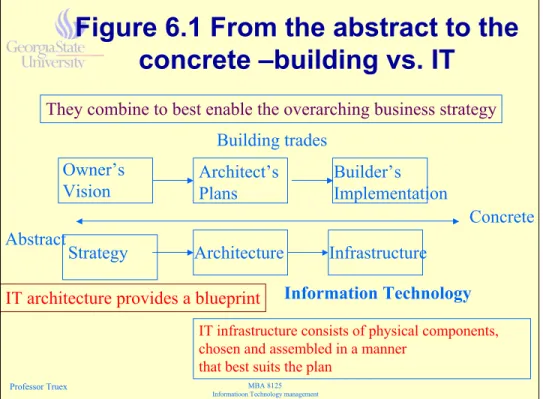
• like the architectural plans for a building
– unchangeable in some areas, but subject to interpretation in others.
• Architectural plans are used by builders to
select materials and use construction
techniques based on past experience and
industry standards.
Professor Truex MBA 8125
Informatioon Technology management
Figure 6.1 From the abstract to the
concrete –building vs. IT
Owner’s
Vision Architect’sPlans
Builder’s Implementation Abstract
Concrete Strategy Architecture Infrastructure
Information Technology Building trades
IT architecture provides a blueprint
IT infrastructure consists of physical components, chosen and assembled in a manner
that best suits the plan
They combine to best enable the overarching business strategy
The Manager’s Role
• The manager needs to communicate with the IT
architects and implementers to ensure that the
resulting architecture meets the firm’s business
strategy.
• Lack of managerial involvement can result in a
poorly directionless, inefficient infrastructure
that may even present obstacles to achieving
with business goals.
Professor Truex MBA 8125
Informatioon Technology management
THE LEAP FROM STRATEGY TO
ARCHITECTURE TO
INFRASTRUCTURE
From strategy to business
requirements
Strategy Goal Goal Goal Biz. Req. Biz. Req.The manager’s role is to first set business requirements for the desired IS
Professor Truex MBA 8125
Informatioon Technology management
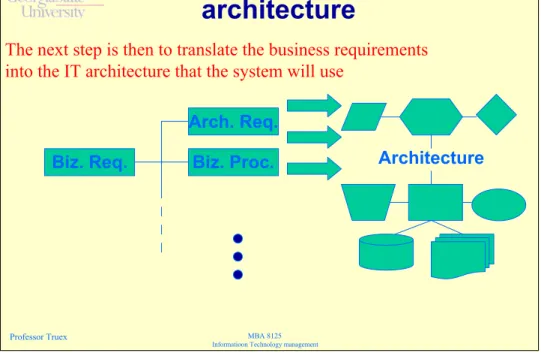
From business requirements to
architecture
Biz. Req. Biz. Proc.
Arch. Req.
Architecture
The next step is then to translate the business requirements into the IT architecture that the system will use
Figure 6.4 From architecture to
infrastructure
Interface Spec. Data Protocol Func. Spec. Func. Spec. SW Spec. HW Spec. ArchitectureThe next step is to translate architecture into infrastructure. This entails adding the actual hardware and software that will be used
Professor Truex MBA 8125
Informatioon Technology management
Information System Components
• Hardware: physical components that handle the computation, storage and transmission of data.
• Software: programs that run on hardware and enable work to be performed
• Network: hardware and software components
connected according to a common protocol to create a shared computing environment.
• Data: numbers and text that the IT infrastructure performs work on.
A Framework for the translation of
architecture to infrastructure
• Begins with a simple overview of the current
IS components, asking “what, who and where”
for each.
• hardware example
– What hardware does the firm have? – Who manages, uses and owns it? – Where is it located? Where is it used?
• Similar questions apply to the software,
network and data components of the system.
Professor Truex MBA 8125
Informatioon Technology management
A Framework for translation (cont.)
• The next step is to ask questions about the future IT architecture and infrastructure for the components of the system under development:
• Hardware example
– Arch.: Does our strategy require thick or thin clients? – Infra.: What hard drives to we use on the thick clients? – Arch.: Who knows most about servers in the the firm? – Infra.: Who will operate the sever?
– Arch.: Does out architecture require centralized or decentralized servers?
– Infra.: Must we hire a server administrator for the Tokyo office?
Examples of Architectures:
Client-server
vs
mainframe
• Client/server architecture is an example of a type of architecture that is growing in use.
– Because it is modular, it is easy to add additional servers to a client/server architecture.
• Mainframe architecture has a central computer and is easier to manage in some ways because of this.
Professor Truex MBA 8125
Informatioon Technology management
OTHER MANAGERIAL
CONSIDERATIONS
Understand the existing architecture
• Understanding the existing architecture
– evaluate the IT requirements of an evolving business strategy vs. current IT.
• Compare the current architecture with plans
for the architecture of the future
– to help identify which components of the current system can for the system being developed.
Professor Truex MBA 8125
Informatioon Technology management
Relevant questions for managers:
• What IT architecture is already in place?
• Is the company developing the IT architecture
from scratch?
• Is the company replacing an existing
architecture?
• Does the company need to work within the
confines of an existing architecture?
• Is the company expanding an existing
architecture?
Legacy systems
• Managers usually must deal with adapting
existing architectures as part of planning
their new systems.
• In so doing they encounter both:
– Opportunity: to leverage the existing architecture and infrastructure and
– Challenge: to overcome or within the old system’s shortcomings.
Professor Truex MBA 8125
Informatioon Technology management
Conversion of legacy systems:
1. Objectively analyze the existing architecture
and infrastructure
2. Objectively analyze the strategy served by
the existing architecture.
3. Objectively analyze the ability of the
existing architecture and infrastructure to
further the current strategic goals.
Current vs. Future Requirements
• defining an architecture that addresses an organization’s current needs may find that by installation time those needs have changed.
– Common sources of change:
• changes in the business environment, organization, IT requirements and technology.
• Issues to consider in IT planning include:
– Strategic Time Frame and
– Technological Advances,
Professor Truex MBA 8125
Informatioon Technology management
Issues to consider:
Strategic time frame
• The point: to gauge the life-span of IT architecture and infrastructure. Relevant questions on this topic include:
– How far into the future does the strategy extend? – How long can the architecture and its associated
infrastructure fulfill strategic goals? – What issues could arise and chance these
assumptions?
Strategic time frame (cont.)
• depends on industry factors such as:
– level of commitment to fixed resources, industry maturity, cyclicality and barriers to entry.
• hypercompetition has increased the rate of change
– any strategic decision must be viewed as temporary.
• IT architecture must include the ideas of flexibility and scalability.
Professor Truex MBA 8125
Informatioon Technology management
Issues to consider:
Technological Advances
• IT architecture needs to be capable of
supporting technological change.
• At a minimum, the architecture should be
able to handle expected technological
advances
• An exceptional IT architecture will also
have the ability to absorb unexpected
technological leaps as well.
Technological advances (cont.)
• The following guidelines are suggested for planning adaptable IT architecture and infrastructure:
– Plan for applications and systems that are independent and loosely coupled rather than monolithic
– Boundaries between infrastructure components should be clear.
– When designing a network architecture, strive to provide access to all users when it makes sense to do so.
Professor Truex MBA 8125
Informatioon Technology management
Issues to consider:
Growth Requirements
• What will be the rate of growth in use of the information system
• What are the projected increases in the capacity of its components.
• Relevant questions to consider include: – What’s the company’s project growth?
– What does the architecture have to do to support that expansion?
– How will it respond if the company greatly exceeds its growth goals? (overcapacity)
Assessing the return on IT
infrastructure
• STEPS
– Quantify costs
– Determine the anticipated life cycles of system components
– Quantify benefits – Quantify risks
Professor Truex MBA 8125
Informatioon Technology management
FROM STRATEGY TO
INFRASTRUCTURE: AN
EXAMPLE
BluntCo. fictitious case
• The process includes four steps:
– Step 1: Defining the Strategic Goals
– Step 2: Define Related Architectural Goals – Step 3: Apply Strategy-to-Infrastructure
Framework
Professor Truex MBA 8125
Informatioon Technology management
Step 1: Defining the Strategic Goals
• Blunt Cos. business strategy is to respond to possible changes in demand by outsourcing clipper
manufacturing.
• The company’s strategic goals are as follows: – To lower costs by outsourcing manufacturing – To lower costs by clipper distribution
– To improve market responsiveness by outsourcing clipper manufacturing
– To improve market responsiveness by outsourcing clipper distribution
Step 2: Define Related Architectural Goals
• Consider the first goal: outsourcing clipper manufacturing. How can the company’s IT architecture support this goal?
• It must provide the following interfaces to its new manufacturing partners:
– Sales to mfg. partners: send forecasts, confirm orders received
– Mfg. partner to sales: send capacity, confirm orders shipped
– Mfg. partner to accounting: confirm orders shipped, electronic invoices, various inventory levels, returns – Accounting to mfg. partners: transfer funds for orders
Professor Truex MBA 8125
Informatioon Technology management
Step 3: Apply Strategy to Infrastructure
Framework
• Translating the strategic goals to the architectural and infrastructural framework means asking the what, who and where questions discussed before.
• For example, for the network:
– Arch.: What is the anticipated volume of transactions between BluntCo and its manufacturing partners?
– High volume may require leased lines to carry transaction data, dial-up connections may suffice for low volume (I.e., what’s the best leased line to use?).
• See figure 6.7 presents a detailed list of questions.
Step 4: Evaluate Additional Issues
• The last step is to compare managerial considerations such as strategic time frame, technological advances, etc., with the architectural goals listed in step 2. • For example, regarding HR compatibility:
– Arch.: The new model will displace some current human resources. BluntCo must analyze costs and the effect on morale.
– Infra.: Current staff not familiar with EDI; must be trained, some new staff hired. BluntCo must analyze associated costs.
Professor Truex MBA 8125
Informatioon Technology management
FOOD FOR THOUGHT: TOTAL
COST OF OWNERSHIP
Total Cost of Ownership (TCO)
• TCO measures the annual cost to operate a
component. It is fast becoming a standard.
• TCO looks beyond capital (acquisition)
costs to include technical support,
administration and training.
• TCO estimates provide the best investment
numbers to use in financial return
Professor Truex MBA 8125
Informatioon Technology management
TCO as a Management Tool
• TCO can also help managers understand how
infrastructure costs break down by providing a
fuller picture of where IT dollars are spent.
• It may be possible to evaluate TCO results
against industry standards.
• Even if there is no comparison data, TCO
values can be helpful with decisions about
budgeting, resource allocation and
organizational structure.
Wrap Up
• Strategy, is to architecture is to infrastructure
– As plans are to blueprints are to buildings
• IT planning requires an assessment of:
– Strategic Time Frame, – Technological Advances,
– Growth Rates
• The cost of IS/IT ownership is greater than that of the cost of acquisition
Professor Truex MBA 8125
Informatioon Technology management