Introduction to MIMO
Application Note
Products:
|R&S SMU200A
|R&S AMU200A
|R&S SMATE200A
|R&S TS8980
|R&S TS8970
|R&S TS8975
|R&S CMW270
|R&S CMW500
|R&S FSQ
|R&S FSG
|R&S FSV
Modern radio communication systems have
to provide higher and higher data rates. As
conventional methods like using more
bandwidth or higher order modulation types
are limited, new methods of using the
transmission channel have to be used.
Multiple antenna systems (Multiple Input,
Multiple Output – MIMO) gives a significant
enhancement to data rate and channel
capacity.
This application note gives an introduction to
basic MIMO concepts and terminology and
explains how MIMO is implemented in
different radio communications standards.
A pp lic at io n N o te Sc hi nd le r, Sc hu lz 07 .2 00 9-1M A1 42 _0 e
Table of Contents
Table of Contents
1
Introduction... 3
2 MIMO ... 3
2.1 Conventional Radio System (SISO) ...3
2.2 Multiple Antenna Systems ...4
2.2.1 Spatial Diversity ...6
2.2.1.1 RX Diversity...6
2.2.1.2 TX Diversity ...7
2.2.2 Spatial Multiplexing ...8
2.2.3 Beamforming...9
3 MIMO in Radio Communications Systems ... 9
3.1 3GPP UMTS ...10 3.1.1 HSPA+ (3GPP Release 7/8) ...10 3.1.2 LTE (3GPP Release 8)...11 3.2 WiMAXTM (802.16e-2005) ...12 3.3 WLAN (802.11n)...13 3.4 Outlook ...15
4 Rohde & Schwarz Solutions ... 15
4.1 Signal Generators ...15
4.2 Signal Analyzers ...17
4.3 Mobile Radio Testers ...17
4.4 Systems ...18
5 Appendix ... 20
5.1 References...20
5.2 Additional Information ...21
Introduction
1 Introduction
All radiocommunications systems, regardless of whether mobile radio networks like 3GPP UMTS or wireless radio networks like WLAN, must continually provide higher data rates. In addition to conventional methods, such as introducing higher modulation types or providing larger bandwidths, this is also being achieved by using multiple antenna systems (Multiple Input, Multiple Output – MIMO).
This application note gives an introduction to basic MIMO concepts and terminology and explains how MIMO is implemented in the different radiocommunications
standards. The solutions offered by Rohde & Schwarz are presented in the conclusion. The MIMO terminology refers to the channel, thus the transmitter is the channel input and the receiver the channel output.
2 MIMO
Several different diversity modes are used to make radiocommunications more robust, even with varying channels. These include time diversity (different timeslots and channel coding), frequency diversity (different channels, spread spectrum, and OFDM), and also spatial diversity. Spatial diversity requires the use of multiple antennas at the transmitter or the receiver end. Multiple antenna systems are typically known as Multiple Input, Multiple Output systems (MIMO). Multiple antenna technology can also be used to increase the data rate (spatial multiplexing) instead of improving
robustness.
In practice, both methods are used separately or in combination, depending on the channel condition.
2.1 Conventional Radio System (SISO)
Conventional systems use one transmit and one receive antenna. In MIMO terminology, this is called Single Input, Single Output (SISO) (Figure 1).
Figure 1: SISO antenna configuration
Shannon-Hartley theorem
MIMO
Formula 1: Shannon-Hartley theorem for SISO
2.2 Multiple Antenna Systems
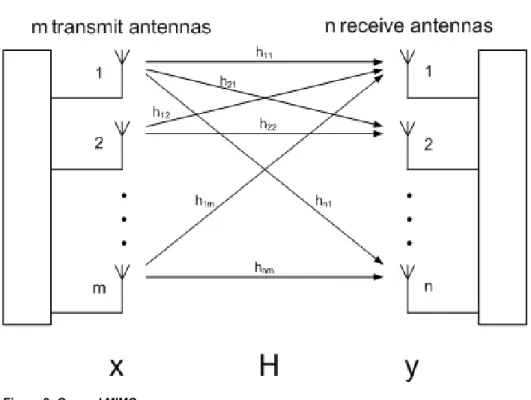
A MIMO system typically consists of mtransmit and nreceive antennas (Figure 2). By using the same channel, every antenna receives not only the direct components intended for it, but also the indirect components intended for the other antennas. A time-independent, narrowband channel is assumed. The direct connection from antenna 1 to 1 is specified with h11, etc., while the indirect connection from antenna 1
to 2 is identified as cross component h21, etc. From this is obtained transmission matrix
Hwith the dimensions n x m.
Formula2: Matrix H
Figure 2: General MIMO
The following transmission formula results from receive vector y, transmit vector x, and noise n:
MIMO
y =
Hx + n .
Formula 3: MIMO transmission
Data to be transmitted is divided into independent data streams. The number of streams M is always less than or equal to the number of antennas; in the case of asymmetrical (m En) antenna constellations, it is always smaller or equal the minimum number of antennas. For example, a 4x4 system could be used to transmit four or fewer streams, while a 3x2 system could transmit two or fewer streams.
Theoretically, the capacity C increases linearly with the number of streams M.
Formula 4: Shannon-Hartley theorem for MIMO
Single User MIMO (SU-MIMO)
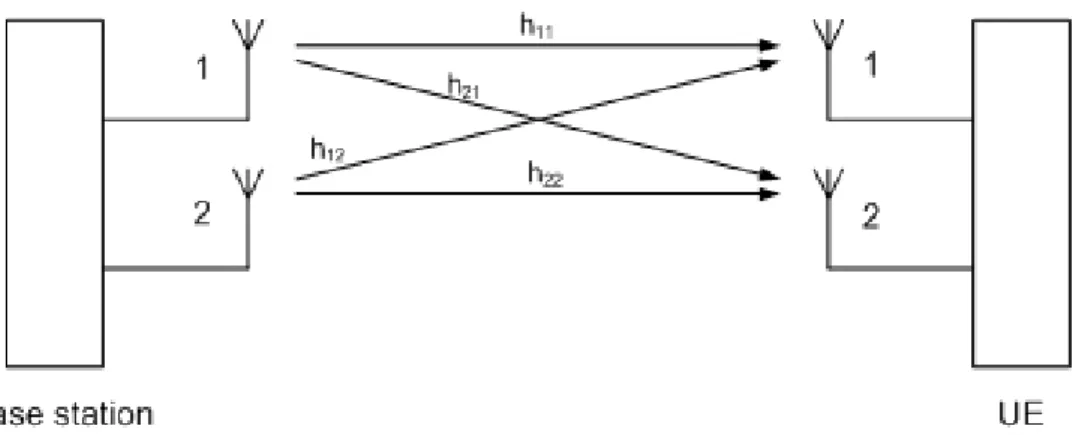
When the data rate is to be increased for a single UE, this is called Single User MIMO (SU-MIMO)
Figure 3: SU-MIMO
Multi User MIMO (MU-MIMO)
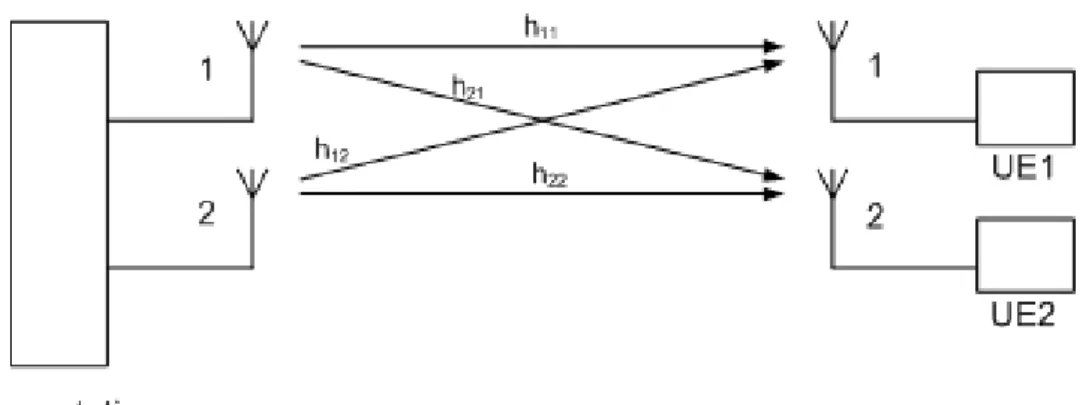
When the individual streams are assigned to various users, this is called Multi User MIMO (MU-MIMO). This mode is particularly useful in the uplink because the complexity on the UE side can be kept at a minimum by using only one transmit antenna. This is also called 'collaborative MIMO'.
MIMO
Figure 4: MU-MIMO
Cyclic delay diversity (CDD)
CDD introduces virtual echoes into OFDM-based systems. This increases the
frequency selectivity at the receiver. In the case of CDD, the signals are transmitted by the individual antennas with a time delay. Because CDD introduces additional diversity components, it is particularly useful as an addition to spatial multiplexing.
2.2.1 Spatial Diversity
The purpose of spatial diversity is to make the transmission more robust. There is no increase in the data rate. This mode uses redundant data on different paths.
2.2.1.1 RX Diversity
RX diversity uses more antennas on the receiver side than on the transmitter side. The simplest scenario consists of two RX and one TX antenna (SIMO, 1x2).
Figure 5: SIMO antenna configuration
Because special coding methods are not needed, this scenario is very easy to implement. Only two RF paths are needed for the receiver.
MIMO
Figure 6: RX diversity
Because of the different transmission paths, the receiver sees two differently faded signals. By using the appropriate method in the receiver, the signal-to-noise ratio can now be increased. Switched diversity always uses the stronger signal, while maximum ratio combining uses the sum signal from the two signals (see Figure 6).
2.2.1.2 TX Diversity
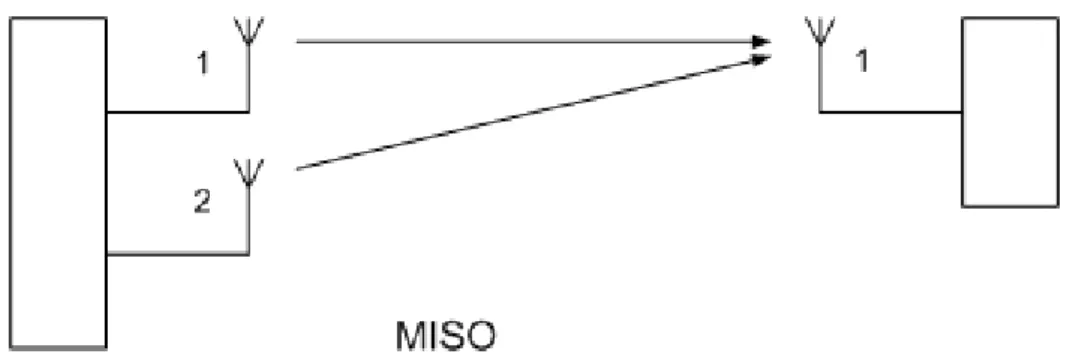
When there are more TX than RX antennas, this is called TX diversity. The simplest scenario uses two TX and one RX antenna (MISO, 2x1).
Figure 7: MISO antenna configuration
In this case, the same data is transmitted redundantly over two antennas. This method has the advantage that the multiple antennas and redundancy coding is moved from the mobile UE to the base station, where these technologies are simpler and cheaper to implement.
To generate a redundant signal, space-time codes are used. Alamouti developed the first codes for two antennas.
MIMO
Space-time codes additionally improve the performance and make spatial diversity usable. The signal copy is transmitted not only from a different antenna but also at a different time. This delayed transmission is called delayed diversity. Space-time codes combine spatial and temporal signal copies as illustrated in Figure 8. The signals s1
and s2are multiplexed in two data chains. After that, a signal replication is added to
create the Alamouti space-time block code.
Figure 8: Alamouti coding
Additional pseudo-Alamouti codes were developed for multiple antennas [14][15]. The coding can also be handled in the frequency domain. This is called Space-frequency coding.
2.2.2 Spatial Multiplexing
Spatial multiplexing is not intended to make the transmission more robust; rather it increases the data rate. To do this, data is divided into separate streams; the streams are transmitted independently via separate antennas.
Because MIMO transmits via the same channel, transmissions using cross components not equal to 0 will mutually influence one another.
Figure 9: MIMO 2x2 antenna configuration
If transmission matrix H is known, the cross components can be calculated on the receiver.
In the open-loop method, the transmission includes special sections that are also known to the receiver. The receiver can perform a channel estimation.
In the closed-loop method, the receiver reports the channel status to the transmitter via a special feedback channel. This makes it possible to respond to changing
MIMO in Radio Communications Systems
2.2.3 Beamforming
Antenna technologies are the key in increasing network capacity. It started with
sectorized antennas. These antennas illuminate 60 or 120 degrees and operate as one cell. In GSM, the capacity can be tripled, by 120 degree antennas. Adaptive antenna arrays intensify spatial multiplexing using narrow beams. Smart antennas belong to adaptive antenna arrays but differ in their smart direction of arrival (DoA) estimation. Smart antennas can form a user-specific beam. Optional feedback can reduce complexity of the array system.
Beamforming is the method used to create the radiation pattern of an antenna array. It can be applied in all antenna array systems as well as MIMO systems.
Smart antennas are divided into two groups:
- Phased array systems (switched beamforming) with a finite number of fixed predefined patterns
- Adaptive array systems (AAS) (adaptive beamforming) with an infinite number of patterns adjusted to the scenario in realtime
Figure 10: Switched beamformer and adaptive beamformer
Switched beamformers electrically calculate the DoA and switch on the fixed beam. The user only has the optimum signal strength along the center of the beam. The adaptive beamformer deals with that problem and adjusts the beam in realtime to the moving UE. The complexity and the cost of such a system is higher than the first type.
3 MIMO in Radio Communications Systems
Various mobile radio and network standards use MIMO. This section provides a brief overview of the various implementations. In principle, all standards use TX diversity and spatial multiplexing.
More detailed explanations for the individual standards are provided in the dedicated sections.
MIMO in Radio Communications Systems
3.1 3GPP UMTS
The 3GPP mobile radio standard (UMTS) has undergone numerous phases of development. Starting with WCDMA, various data acceleration methods have been introduced, including HSDPA and HSUPA. The newest releases cover HSPA+ and Long Term Evolution (LTE).
3.1.1 HSPA+ (3GPP Release 7/8)
A transmit diversity mode had already been introduced in Release 99 (WCDMA). Release 7 of the 3GPP specification (HSPA+) expanded this approach to MIMO and again increased the data rate with respect to Release 6 (HSDPA). The introduction of 64QAM modulation and MIMO in the downlink makes a peak data rate of 28 Mbps (Rel. 7) possible. In Rel. 7 MIMO and 64QAM can not be used simultaneously. Since Rel. 8 the simultaneous use is possible which leads to peak data rates up to 42 Mbps. Uplink MIMO is not provided.
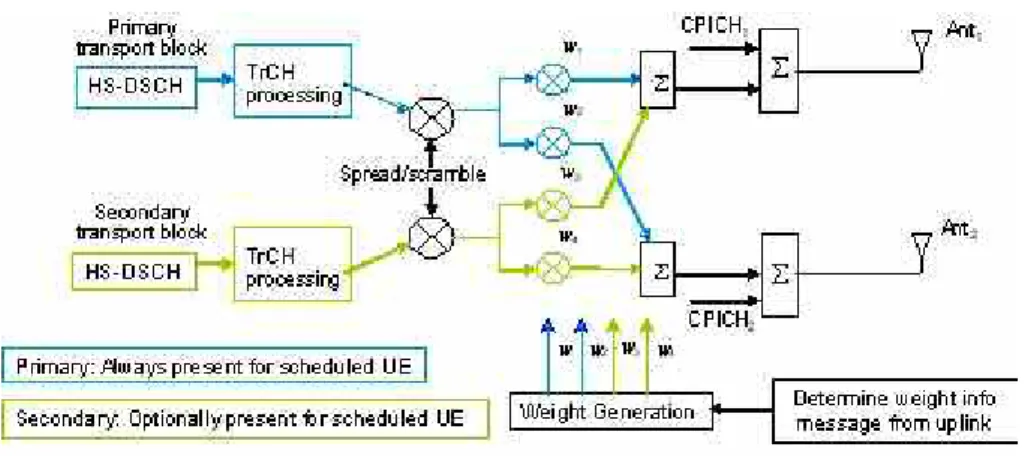
MIMO was introduced in the form of a double transmit antenna array (D-TxAA) for the high speed downlink shared channel (HS-DSCH).
Figure 11: HSPA+ MIMO
With D-TxAA, two independent data streams can be transmitted simultaneously over the radio channel using the same WCDMA channelization codes. The two data streams are indicated with blue and green color in Figure 11. After spreading and scrambling, precoding based on weight factors is applied to optimize the signal for transmission over the mobile radio channel. Four precoding weights w1 to w4 are available. The first stream is multiplied with w1and w2, the second stream is multiplied
MIMO in Radio Communications Systems
Formula 5
Note that w1is always fixed, and only w2can be selected by the base station. Weights
w3and w4are automatically derived from w1and w2, because they have to be
orthogonal. The base station selects the optimum weight factors based on proposals reported by the UE in the uplink.
In addition to the use of MIMO in HS-DSCH, the weight information must be transmitted to the UE via the HS-SCCH control channel. Although MIMO is not provided in the uplink, MIMO-relevant information still does have to be transmitted in the uplink. The UE sends a precoding control indication (PCI) and a channel quality indication (CQI) in the HS-DPCCH, which allows the base station to adapt the modulation, coding scheme, and precoding weight to the channel conditions. For more information on HSPA+, refer to [7].
3.1.2 LTE (3GPP Release 8)
UMTS Long Term Evolution (LTE) was introduced in 3GPP Release 8. The objective is a high data rate, low latency and packet optimized radio access technology. LTE is also referred to as E-UTRA (Evolved UMTS Terrestrial Radio Access) or E-UTRAN (Evolved UMTS Terrestrial Radio Access Network).
The basic concept for LTE in downlink is OFDMA (Uplink: SC-FDMA), while MIMO technologies are an integral part of LTE. Modulation modes are QPSK, 16QAM, and 64QAM. Peak data rates of up to 300 Mbps (4x4 MIMO) and up to 150 Mbps (2x2 MIMO) in the downlink and up to 75 Mbps in the uplink are specified.
For an introduction to LTE, refer to [2] [3] [4]. For more information on MIMO in LTE, refer to [6].
Downlink
The following transmission modes are possible in LTE: N Single antenna transmission, no MIMO
N Transmit diversity
N Open-loop spatial multiplexing, no UE feedback required N Closed-loop spatial multiplexing, UE feedback required
N Multi-user MIMO (more than one UE is assigned to the same resource block) N Closed-loop precoding for rank=1 (i.e., no spatial multiplexing, but precoding is
used)
MIMO in Radio Communications Systems
Figure 12: LTE downlink
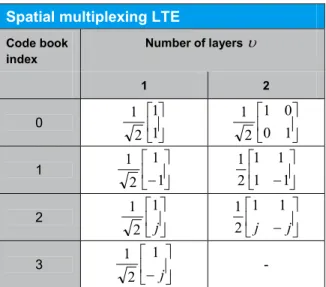
In LTE, one or two code words are mapped to one to four layers ("layer mapper" block). To achieve multiplexing, a precoding is carried out ("precoding" block). In this process, the layers are multiplied by a precoding matrix Wfrom a defined code book and distributed to the various antennas. This precoding is known to both the transmitter and the receiver. In the specification, code books are defined for one, two, and four antennas, as well as for spatial multiplexing (with and without CDD) and transmit diversity. Table 1 shows the code book for spatial multiplexing with two antennas as an example. Code books for four antennas are also defined.
Spatial multiplexing LTE
Code book index Number of layers 1 2 0 1 1 2 1 1 0 0 1 2 1 1 1 1 2 1 1 1 1 1 2 1 2 j 1 2 1 j j 1 1 2 1 3 j 1 2 1
-Table 1: LTE precoding matrix for a maximum of two layers
Uplink
In order to keep the complexity low at the UE end, MU-MIMO is used in the uplink. To do this, multiple UEs, each with only one Tx antenna, use the same channel.
3.2 WiMAX
TM(802.16e-2005)
WiMAXTM promises a peak data rate of 74 Mbps at a bandwidth of up to 20 MHz. Modulation types are QPSK, 16QAM, and 64QAM.
MIMO in Radio Communications Systems
Downlink
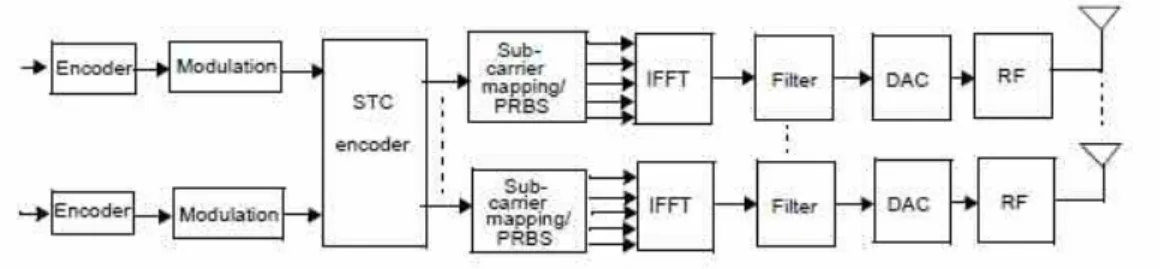
The WiMAXTM 802.16e-2005 standard specifies MIMO in WirelessMAN-OFDMA mode. This standard defines a large number of different matrices for coding and distributing to antennas. In principle, two, three or four TX antennas are possible. For all modes, the matrices A, B, and C are available. In the "STC encoder" block, the streams are multiplied by the selected matrix and mapped to the antennas (Figure 13).
Figure 13: WiMAXTM downlink
In actual systems typically only matrices A and B are implemented:
Formula 6: WiMAXTM matrices A and B for two antennas
Matrix A corresponds to TX diversity, while matrix B corresponds to spatial multiplexing (known in the literature as "True MIMO").
Corresponding matrices also exist for three and four antennas. Uplink
In Uplink-MIMO only different pilot patterns are used. Coding and mapping is the same like in non-MIMO case. In addition to single user MIMO (SU-MIMO) two different user can use the same channel (collaborative MIMO, MU-MIMO).
For more information on WiMAXTM, refer to [10] [11].
3.3 WLAN (802.11n)
WLAN as defined by the 802.11n standard promises a peak data rate of up to 600 Mbps at a bandwidth of 40 MHz. Modulation types are BPSK,QPSK,16QAM, and 64QAM. It is backward compatible with the previous standards 802.11 a/b/g. With up to four streams, it supports up to a maximum of four antennas. For more information on WLAN, refer to [12] [13].
MIMO in Radio Communications Systems
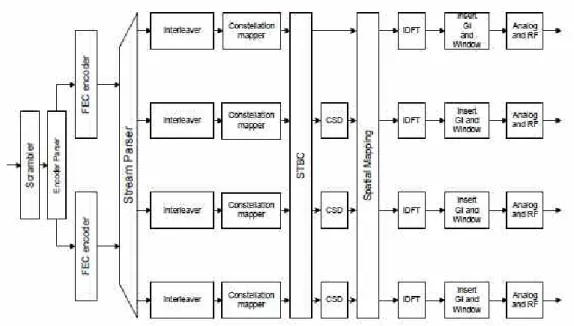
WLAN differentiates between spatial streams (SS) and space-time streams (STS). If NSS < NSTS, then a space-time block encoder ("STBC") distributes the SS to the STS
and adds transmit diversity by means of coding (Downlink block diagram Figure 14).
Figure 14: WLAN downlink
Figure 15 shows the matrix for NSS = 1 and NSTS = 2 as an example.
Figure 15: Coding for SS -> STS (NSS = 1, NSTS = 2)
In the "spatial Mapping" block, the STS is mapped to the transmit chains (NTX). Three
different methods are provided: N Direct mapping
– 1-to-1 mapping from STS to TC. N Spatial expansion
– Additional multiplication with a matrix. Figure 16 gives an example of two STS and three TX antennas.
Figure 16: Example matrix for two STS and three TX
N Beamforming
Rohde & Schwarz Solutions
3.4 Outlook
Future standards will continue to use MIMO technology. At present, the following standards with MIMO are being worked on:
N LTE Advanced
The goal is to provide 1 Gbps at 100 MHz bandwidth in downlink direction. N 1xEV-DO Rev. C
The goal is to provide 18 Mbps at 1.25 MHz bandwidth in forward link. N WiMAXTM 802.16m
The goal is to provide 300 Mbps at 20 MHz bandwidth in downlink direction.
4 Rohde & Schwarz Solutions
Rohde & Schwarz offers various instruments and systems for the individual radio communications standards that use MIMO.
Signal generators are able to perform receiver test in MIMO conditions for up- and downlink in non-signaling. Signal analyzers are used to test the transmitter side. Mobile radio testers provide additionally signaling tests for RF testing or protocol testing. RF test systems provide full RF conformance tests.
4.1 Signal Generators
SMU200A vector signal generator
The UE receiver tests can be performed using SMU signal generators from Rohde & Schwarz. The SMU can generate the individual antennas for all MIMO standards (802.11n, 802.16e-2005, and 3GPP Rel. 7 and Rel. 8).
In addition, the SMU performs the channel simulation (MIMO), whereby the individual correlations can be modified. In addition, the SMU realtime fading is available with predefined profiles for all standards. AWGN can be added for both channels.
Rohde & Schwarz Solutions
Figure 17: SMU overview
In a single instrument, two antennas can be generated with fading and MIMO for the individual standards. By connecting two instruments together, up to four antennas can be simulated.
By adding the "Phase Coherence" option (SMU-B90), precise phase relationships can be ensured for up to four antennas for beamforming.
AMU200A baseband signal generator and fading simulator
In addition to the baseband generation of various radiocommunications standards, the AMU provides MIMO fading via digital inputs/outputs for the CMW as well as for the SMATE. The combination of AMU and SMATE has the same functionality like a two channel SMU but provides additionally full frequency range up to 6 GHz on both channels.
Rohde & Schwarz Solutions
4.2 Signal Analyzers
For the transmitter test, the FSQ, FSG, and FSV signal/spectrum analyzers are
available. They can carry out both the SISO measurements for the individual standards as well as most of the MIMO measurements.
In addition to the SISO measurements, a single FSx can also complete certain MIMO measurements, such as TX diversity and special spatial multiplexing modes. By connecting multiple FSx instruments together (maximum four), up to four antennas can be measured or demodulated simultaneously. A lot of the MIMO measurements anyhow can be performed by a single instrument.
Rohde & Schwarz Solutions
CMW500 wideband radio communication tester
The CMW500 wideband radio communication tester is a scalable tester for all stages of UE testing from R&D up to conformance. As an LTE protocol tester, it allows verification of all protocol layers up to the user plane. Signaling test scenarios can be flexibly created via powerful programming interfaces. CMW500 supports MIMO testing as well.
CMW270 WiMAX™ communication tester
The CMW270 is the first all-in-one test solution for WiMAXTMmobile stations: from realistic mobile station test in full signaling mode to high-speed, low-cost test in non-signaling mode for RF alignment. In addition, the CMW270 supports WiMAX™ MIMO tests, including matrix A and matrix B verification with two antennas.
4.4 Systems
Complex RF test scenarios need to be covered to thoroughly verify MIMO handsets. MIMO also plays an important role in RF conformance testing and UE certification. Rohde & Schwarz provides custom-tailored RF test systems for WiMAX™ and LTE, addressing test applications from R&D up to conformance.
R&S®TS8980 LTE RF test system
The TS8980 supports LTE mobile phone development with fully automatic RF transmitter and receiver tests. It has a modular design and can be configured to support precompliance through conformance tests and is MIMO-ready.
Rohde & Schwarz Solutions
R&S®TS8970 mobile WiMAXTM RCT
The TS8970 RCT was developed in response to a call for proposals from the WiMAX Forum®. The system includes BS and MS radio certification test cases for Mobile WiMAXTM, including MIMO tests, adaptive modulation/coding, and beamforming
verification. With its scalability and outstanding measurement accuracy, the TS8970 is optimally suited for applications in R&D, quality assurance, precompliance and, of course, for the certification testing of WiMAXTM devices.
R&S®TS8975 WiMAX™ RF preconformance test system
The TS8975 handles most of the tests offered by the TS8970 and is the cost-effective solution for quality assurance and precompliance testing.
Appendix
5 Appendix
5.1 References
LTE
[1] 3GPP TS 36.211 V8.4.0; Physical Channels and Modulation (Release 8)
[2] Rohde & Schwarz: UMTS Long Term Evolution (LTE) Technology Introduction, Application Note 1MA111, September 2008
[3] Rohde & Schwarz: LTE Measurement Guide, Application Note RSI004, August 2007
[4] Rohde & Schwarz: RF Chipset Verification for UMTS LTE with SMU200A and FSQ, Application Note 1MA138, November 2008
[5] Rohde & Schwarz: E-UTRA Base Station Testing acc. to 3GPP TS 36.141, Application Note 1MA134, December 2008
[6] Rohde & Schwarz: LTE Downlink MIMO Verification with R&S®SMU200A and R&S®FSQ, Application Note 1MA143, June 2009
HSPA+
[7] Rohde & Schwarz: HSPA+ Technology Introduction, Application Note 1MA121, March 2008
[8] 3GPP TS 25.212; Multiplexing and Channel Coding (FDD), Release 8
WiMAXTM
[9] IEEE: Std 802.16e™-2005 and Std 802.16™-2004/Cor1-2005, February 2006 [10] Rohde & Schwarz: WiMAX - General information about the standard 802.16, Application Note 1MA96, June 2006
[11] Rohde & Schwarz: WiMAX - Generating and analyzing 802.16-2004 and 802.16e-2005 signals, Application Note 1MA97, July 2006
WLAN
[12] IEEE: 802.11n™/D8.0: Wireless LAN Medium Access Control
(MAC) and Physical Layer (PHY) specifications, Amendment 5. Enhancements for Higher Throughput, January 2009
[13] Rohde & Schwarz: WLAN Tests According to Standard 802.11a/b/g, Application Note 1MA121, July 2004
Appendix
MIMO
[14] H. Jafarkhani: “Space-Time Coding Theory and Practice”, Cambridge, 2000 [15] M. Jankiraman: “Space-Time Codes and MIMO Systems” Artech House, (2004)
5.2 Additional Information
Please send your comments and suggestions regarding this application note to [email protected]
Ordering Information
6 Ordering Information
Please visit our website www.rohde-schwarz.comand contact your local Rohde & Schwarz sales office for further assistance.
Ordering Information
Vector Signal Generator
SMU200A Vector Signal Generator 1141.2005.02 SMATE200A Vector Signal Generator 1400.7005.02 AMU100A Baseband Signal Generator 1402.4090.02
Signal Analyzers, Spectrum Analyzers
FSQ Up to 3, 8, 26, 31 or 40 GHz 1155.5001.xx
FSG Up to 8 or 13 GHz 1309.0002.xx
FSV Up to 3 or 7 GHz 1307.9002.0x
xx stands for the different frequency ranges (e.g. 1155.5001.26 up to 26 GHz)
Note: Available options are not listed in detail.
Please contact your local Rohde & Schwarz sales office for further assistance. Radio Communication Tester
CMW270 WiMAXTM Communication
Tester 1201.0002K75
CMW500 Wideband Radio
Communication Tester 1201.0002.50
Systems
TS8990 LTE RF Test System 1510.6002.02
TS8970 WiMAXTM RCT 1162.0001.02
TS8975 WiMAXTM RF Preconformance
About Rohde & Schwarz
Rohde & Schwarz is an independent group of companies specializing in electronics. It is a leading supplier of solutions in the fields of test and measurement, broadcasting, radiomonitoring and radiolocation, as well as secure communications. Established 75 years ago, Rohde & Schwarz has a global presence and a dedicated service network in over 70 countries. Company headquarters are in Munich, Germany.
Regional contact
Europe, Africa, Middle East
+49 1805 12 42 42* or +49 89 4129 137 74 [email protected] North America 1-888-TEST-RSA (1-888-837-8772) [email protected] Latin America +1-410-910-7988 [email protected] Asia/Pacific +65 65 13 04 88 [email protected]
This application note and the supplied programs may only be used subject to the conditions of use set forth in the download area of the Rohde & Schwarz website.