PHILOSOPHICAL BACKGROUND OF ADULT AND LIFELONG LEARNING 31
3
AJAY KUMAR
P
HILOSOPHICAL BACKGROUND OF
ADULT AND LIFELONG LEARNING
Structure
3.1 Introduction
3.2 Adult Education and Lifelong Learning
3.2.1 Assumptions about Adult Learning Behavior 3.2.2 Lifelong Learning: An Educational Movement 3.3 Philosophy of Education
3.3.1 Fundamental Purposes of Education 3.3.2 Various Philosophical Traditions 3.4 Philosophies of Adult Education 3.5 Conclusion
3.6 Apply What You Have Learnt
Learning Objectives
After going through Unit 3, it is expected that learners will be able to
Understand (adult) educational theories and practices in different contexts, Apply creatively their understanding of (adult) educational practices to support the empowerment of group of adult learners – linguistically, socially,economically, culturally and politically, and
Understand the role of adult education in social movements, community development and mobilization.A
fter Unit 1 about global, regional and national scenario on literacy and reading Unit 2 about international and national policy discourse, Unit 3 introduces PALDIN learners to an understanding of educational problems and issues in a broader framework. This exposure would make it easier for them to conceptualize educational theories and ideas of some of the great thinkers. In addition, it would enable them tointerpret research data and findings as applicable to their professional work in adult learning. The contents of Unit 3 and Unit 4 provide PALDIN learners an opportunity not only to critically analyze educational theories and apply them in real life contexts, to be able to identify the nature of educational phenomena and but also relate them, their application and development in adult education.
32
AJAY KUMAR During ancient times, education was
part of natural learning process in response to the struggle for survival. Older generations of matured adults trained the younger members of their community or group about the knowledge and skills, which they needed and were deemed, fit to be passed on. In pre-literate societies (before the invention of the written, standardized and codified script), much of the knowledge and skills were transmitted by ‘oral’ means and through imitation. Later, written scripts were developed and preservation and transmission of knowledge became highly structured and organized. This process of transmission of knowledge and skills gave rise to making of society, culture and institutions. Schooling as a formal and organized institution of knowledge transmission came into existence during 3000 to 500 B.C. in Egypt and India. However, modern schooling and education, which is more dominant today, is largely of European origin and can be dated back to 1770.
Adult education and lifelong learning is all around us as long as we try to make a living, whether individually or collectively. Whenever we are engaged with each other in doing one thing or the other, one can see many examples of the ways people teach and learn. Learning is an act or process of gaining experience, knowledge and skills. In contrast, memory consists of an individual’s capacity to store, retrieve, and act further on that knowledge. We become novices to experts based on our capacity to learn and gain new skills and knowledge. Our brain makes new pathways and connections based on reliability and predictability of our experiences (see Conner: 1995). Thus learning is an act or process, which
3.2 Adult Education and Lifelong
Learning
Reflection
Consider the following quotations and construct your own one-liner on what you consider to be the essence of adult education.
‘Reflection without action is mere verbalism. Action without reflection is pure activism’.
– Paulo Freire (1972:60) ‘Theory without practice leads to an empty idealism, and action without philosophical reflection leads to mindless activism.’
– Elias and Merriam (1980: 4) Adult Education is based on the ‘belief that people can take hold of their lives, can make changes, that they are not helpless in the face of structural forces’.
– M.K. Smith (1994:119) ‘You must be the change you see in the world’. —Mahatma Gandhi (Unsourced) —Mahatma Gandhi(Unsourced)
The term ‘education’ usually refers more to mean ‘formal education’ based on organized and structured systems of curriculum-based classroom teaching and periodic evaluation at different levels. However, more broadly it also refers to all kinds of ‘experiences’ which help an individual grow wisely and become enlightened and empowered members of a society. In this latter sense, the process of education is ‘lifelong’. Here lifelong learning embodies self-directed growth. From early times, self-education has been the main device of people of all nations and civilizations to cope with the world around them.
PHILOSOPHICAL BACKGROUND OF
ADULT AND LIFELONG LEARNING
33
involves switching from our most fundamental assumptions to the complex ones. According to Conner (1995) learning entails:
An increase in knowledge based on meaningful experience and information Storing or memorization of information or data consisting of our experience Making practical use of the acquired knowledge Abstraction or theorization which involves codification of meanings of things that we do or we have experienced Comprehension, application and understanding them in different contexts.Rote learning frustrates us because the brain resists meaningless stimuli. Learning is interesting when it is based on felt needs and perceived interests and when it is based on comprehension, critical and analytical understanding, and its contextual application.
Adult education is a highly developed sub-discipline of education where people ‘whose major social roles are characteristic of adult status undertake systematic and sustained learning activities for the purposes of bringing about changes in knowledge, attitudes, values, or skills’ (Darkenwald and Merriam 1982: 9). A fundamental purpose of adult education is to facilitate growth of persons toward understanding of their self, leading to maturity. Thus self-knowledge is one of the main aims of adult education, which consists of awareness of one’s own skills, abilities, attitudes, assets and responsibilities. Today adult education includes basic adult education, continuing professional education, adult literacy training, education for basic skills, vocational
training, education for sustainable development, education for community development and transformation, etc. In India, traditionally adult education mainly refers to training and education of adults who have had no opportunity to formal education in their early years. Adult education is the practice of teaching and educating adults. It is imparted at the workplace or otherwise in classrooms, through ‘extension’ or ‘continuing education’ courses organized at senior secondary or college and university levels, more generally by adult education professionals. Adult education is also referred to as ‘popular education and training for transformation’ or ‘education for community mobilization’ or ‘education for sustainable development’. It has also been referred to as andragogy to distinguish it from pedagogy. Pedagogy literally means the art and science of educating children and often is used as a synonym for all formal classroom based teaching. More commonly, pedagogy signifies a teacher-centered education. Andragogy, in contrast, is defined as ‘the art and science of helping adults learn’. Its usage now is more broadened to include learner-centered education for people of all ages.
Adult education differs from children’s education in many ways. One very significant difference is that adults already have a fairly large amount of accumulated knowledge and experience with them. This knowledge and experience of adults coupled with their deep-seated attitudes can either add value to their learning experience or hinder it. Another significant difference is that adults often seek practical applications and uses of knowledge, which they wish to learn effectively.
34
AJAY KUMAR They need to foresee a goal orientation
to their learning with a reasonable expectation that the new knowledge will help them further that goal.
3.2.1 Assumptions about Adult
Learning Behavior
In order to understand how adults learn and foresee their goal orientation, Malcolm Knowles (1980) has given us four assumptions about their learning behavior as they think through instructional strategies and programming needs
i) Every person has some conception or idea of his/ her own self, which may be called ‘self-concept’. This self-concept of an individual adult moves from that of being a dependent person toward being an independent, self-directed person. This change comes along with one’s process of maturity although different people exhibit different scale and rate of this change. This differential change implies that teachers also have a responsibility for nurturing such change in the adult learner. Matured and emotionally balanced adults generally have a tendency to work or proceed under self-direction; however, there are those who at times exhibit a tendency for dependency.
ii) During the growth and maturation process, every individual accumulates vast life experiences, which can become a rich potential resource for learning. For adult education, its implication is that teachers should be able to use that as a resource to make gains out of such an experience, while discussing a text (in adult literacy case) or a problem-solving issue related to their livelihoods and trying to seek a
solution. Using such a resource during a learning exercise provides the adult learner confidence, empowering him/her to be more articulate, communicative and assertive.
iii) Adult learner’s willingness to learn more is strengthened when resources for learning are related to real life problems and to personal developmental goals. Such an assumption implies that adult educators or facilitators need to adopt and facilitate problem-solving methods and self-discovery techniques based on true assessment of their needs. This can be identified through a listening survey and listing of various ‘generative’ themes. Adult learners learn better and faster when they apply their learning efforts in context of real problems and their current developmental needs. Thus, the context of time and place of a learning text (subject) is an important input in any organized learning setting.
iv. In this sense, the starting point for an adult learner is a desire first to develop communicative competence based on problem-solving methods and solutions. In such a case, adult learners first seek immediate information and/or satisfaction, which may be either helpful or empowering (or even enjoyable, as in case of texts of humor and fun) for them during their learning efforts. The implication here is that adult education and lifelong learning needs to address the perceived needs of learners. Both the adult educator and the adult learner together should be able to diagnose learner’s needs and further develop related learning objectives or goals.
PHILOSOPHICAL BACKGROUND OF
ADULT AND LIFELONG LEARNING
35
These assumptions about adult learning behavior help us in understanding the adult learners well. These assumptions also provide us the direction in which the learners’ thinking could be developed to facilitate them to become more self-directed learning individuals. Adult learners as self-directed learners can become more active learners by being able to diagnose their desires and needs. Thus by possessing and enhancing a strong self-image (self-concepts) about themselves, with positive and strong self-esteem, the adult learners can develop a personal ownership of the learning programme, from beginning to end, and from planning stage to its final successful implementation
3.2.2 Lifelong Learning: An
Educational Movement
Lifelong learning denotes a continuous process of learning both in formal and informal situations; it embodies an add-on experience from everyday life. It has also evolved as a contingent concept implying that “it’s never too soon or too late to learn”, an educational philosophy that has become a favorite of professional organizations and rapidly changing and modernizing societies. Lifelong learning implies an attitudinal change, which holds that ‘one can and should be open to new ideas, decisions, skills or behaviors’. Lifelong learning is now an educational movement within institutions and organizations (both national and international organizations like the national education policy of India and the UNESCO). UNESCO and other national governments find it necessary to provide their citizens with learning opportunities at all ages so that it is useful for them in numerous contexts, e.g. at their workplaces, in the market, in exercising their consumer rights
against unfair trade practices, support for good governance, raising of quality of public life, at home and in their leisure activities. These learning opportunities need to be provided not only through formal educational institutions like the schools, colleges and universities but also through provision of non-formal institutions of lifelong learning.
Lifelong education as imparted institutionally by organizations like universities and colleges (including some non-governmental organizations like Nirantar, Bharat Gyan Vigyan Samiti, and Sewa) is based on assumptions and philosophy of self-directed learning. Lifelong learning is also a form of pedagogy which is imparted institutionally through channels like correspondence courses offered by universities, distance learning or e-learning, continuing education, home schooling, etc. It includes graduate and postgraduate adult education programs for those adults who wish to improve their qualifications, bring their skills up to date or retrain themselves for a new line of work. Many in-service trainings and internal corporate organizations’ training programme for their workforce have similar goals. In the West, even after retirement people opt for life-long learning programs to satisfy their inner urge for enlightenment, which often takes diverse forms, crossing traditional academic boundaries. Growth of scientific and technological progress in the more modernized and globalized world of recent decades has necessitated the institutionalization of lifelong education. Despite the expansion of institutions like schools, colleges and universities, formal educational institutions alone cannot cover the entire population, especially the adult population’s desire to equip
36
AJAY KUMAR
we do or would like to do and over our decision-making powers.
3.3.1 Fundamental Purposes of
Education
In a broad cultural context, education can be seen to perform two main basic functions in a society. The first is to conserve and transmit useful, practical, cognitive skills and knowledge along with the cultural heritage of one’s received tradition to the next generation. The second is to simultaneously enable a positive critique of one’s heritage so as to provide, and create, a more adequate response for further changes. In both cases education, whether adult education (literacy) or lifelong learning has to be critical and creative. Whatever the future may hold for a community (or the nation), educational and literacy practices will always be a means to an end or desired goal whose visions are generated by changing forms of politics. The future of a nation-state (e.g. the Indian nation-state) and its civil society depends on education of its younger generation as responsible, thoughtful, and democratic citizens. This is a complex and challenging task requiring deep understanding of the social, cultural, economic, and political identities in terms of its organizing principles, including an understanding of who the learners are, both as individuals as well as collective members of the society. This can be achieved by a sophisticated system of cultural education and value transmission. Here themselves with latest technological
knowledge needed at their workplace. The knowledge and skills acquired by an adult population through the formal
3.3 Philosophy of Education
W
hy do we need philosophy? Many scholars and thinkers have suggested that while implementing an educational programme the question of ‘why’ must precede the questions of ‘what’ or ‘how’ things are to be done. This means that before we decide about the content (referring to ‘what’) or the process (referring to ‘how’), we first need to ask as to ‘’why’ (referring to ‘philosophy’) we would like to do such a thing, and what would be the advantages or disadvantages of doing such a thing. The question of ‘why’ related to ‘philosophy’ behind an action or an idea can help us to understand phenomena critically. In an adult and lifelong learning context, for example, the ‘why’ question provides us alternative approaches to programme planning, curriculum designing, teaching, budgeting, evaluation, etc. It makes us aware of how values, ethics and aesthetics can enrich a lifelong learning programme. It highlights the importance of our individual histories and the ways they influence our actions as adult educators. It also helps us to develop our own working philosophy and free us from any kind of dependence on somebody else’s principles and ideologies in a dogmatic manner. A ‘working philosophy’ refers to ‘an individual adult educator’s system of beliefs, which is an outgrowth of the sum of our personal values, experiences and lifestyles and it is related to the way we do things. A working philosophy also gives us greater control and deeper interest in things thateducation would usually not be sufficient for an ever-growing professional and technological environment.
PHILOSOPHICAL BACKGROUND OF
ADULT AND LIFELONG LEARNING
37
the emphasis with regard to role and purposes of education is more on social and cultural reproduction.
A nation’s progress in every practical field depends on its capacity to provide for its citizens every opportunity for learning, whether it is in the sphere of technical and higher education and research, medical education, human rights education, elementary and primary education, adult education or lifelong learning, etc. Hence education is a tool to promote well being, prosperity and future development of the individual, society, the nation-state and the entire human civilization. In this regard, role of education is primarily seen as one, which is related to economic growth, production and reproduction.
A formal and universal primary and secondary education provides for better childhood socialization and it further enables the individual fullest development of his/her potential. Development of this potential depends much on adequate preparation in childhood. A good quality and critical education provides firm foundation for personal development and satisfaction. ‘The better the foundation that is built, the more successful the learner will be’. Thus an educational investment in adolescence reaps dividends in the distant future (10-15 years), whereas an educational investment in adults reaps dividends immediately.
3.3.2 Various Philosophical
Traditions
We can consider five major philosophical traditions found in the literature of philosophy of education that also have relevance in the adult education and lifelong learning field. Each of these philosophies is based on certain
assumptions about human nature, the purpose of education, and the role of the adult educator (or facilitator) and the learner.
i) Liberal tradition: This tradition believes that freedom comes through a liberated mind and all human beings are endowed with a reasoning ability to liberate themselves. It stresses the development of intellectual power of the mind as the individual learner is believed to be a ‘renaissance’ (liberated) person who is quite cultured and keen to learn. Based on this liberal view about human nature, it focuses on the role of organized knowledge (curriculum) and evaluation in the intellectual development of the learner. It emphasizes mastery of the content with the educator viewed as an expert/ authority, and where information (knowledge) flows in one direction, which is ‘top-down’, i.e. from the ‘expert’ to the ‘learner’ and not vice versa. The ‘expert’ is the transmitter of knowledge; he/she is the ‘know-all’, an ‘authoritative master’, who directs the entire learning process.
ii) Progressive tradition: It developed out of the ideas of John Dewey in the United States during 1920s and 1930s. Even earlier, one can find many similar resonating assumptions and views of progressive education in Gandhian scheme of education of three Hs – heart, hand and head. The progressive tradition stresses an experiential, problem-solving approach to learning and emphasizes experience of learner as the main determining factor in seeking solutions and change and thus believes in the social reform role of education. The teacher’s role, in this tradition, is that of an ‘organizer’ who guides the learner through his/her experiences that are educative. The teacher is one who
38
AJAY KUMAR mainly stimulates, instigates and
evaluates the direction of learner’s learning process. This tradition emphasizes problem solving, experience-based education, lifelong learning, democracy and democratic training, pragmatic knowledge, needs assessment of the learner and social responsibility. iii) Behaviorist tradition: This tradition focuses more on behavior modification and controlled environment for the learner. It believes that human behavior is tied to prior conditioning, that external forces control all human behavior. The teacher is considered as the manager, controller who predicts and controls the learning outcomes and desired behavior. Teaching methods include behavioral conditioning, feedback, drill and practice. The learner is supposed to take an active role only in a ‘packaged learning’ called curriculum based on systematic instructional design models.
iv) Humanist tradition: This tradition is based on a romantic view of human nature. It considers human nature as essentially positive with virtually unlimited potential. It believes that it is the intellect that distinguishes humans from animals. Human beings have potential/ innate goodness. It places emphasis on individual’s personal growth and self-direction in learning. This philosophy practically caters more to privileged sections of society and facilitates self-actualization of the individual learner who is by nature intellectually gifted. Here the privileged learner is also supposed to reform the society as a benevolent and gifted member of the society. The teacher, in this case is only a facilitator and /or a helper who promotes but does not direct learning. This tradition also emphasizes
experiential learning, freedom, individuality, self-directedness, openness and cooperation.
v) Radical tradition: This tradition believes that people themselves collectively create meaning, and that knowledge leads to an understanding of reality and, ultimately, helps to bring about the necessary change. The fundamental role or purpose of education is to bring about radical social, political and economic changes in society through critical knowledge, training and education. Its emphasis is on human agency, which can act towards a particularly desired change or goal; it emphasizes particularly the transformative role of education and radical social change. It emphasizes equality between the teacher and the learner in the learning process and emphasizes personal autonomy for both the learner and the teacher. Its basic belief is that people create history and culture by combining reflection with action. This tradition only suggests but does not determine the direction for learning and it is left open for negotiation between the teacher and the learner. It emphasizes critical pedagogy with dialectical unity between thinking and action in the transformative role of education. Critical pedagogy is a teaching and learning approach, which attempts to help learner question and challenge domination, and the beliefs and practices that dominate. In other words, it is a theory and practice of helping learners achieve critical consciousness. The main criticism of radical tradition is that its goal exceeds its own desire to instill creativity and exploration as it encourages detrimental disdain for traditions, hierarchy (such as parental control over children), and self-isolation.
PHILOSOPHICAL BACKGROUND OF
ADULT AND LIFELONG LEARNING
39
To have a little more and better understanding of what these different traditions hold in terms of individual learning and his/her role as an active
or passive member of his/her society, we present in Figure 3.1 these traditions on a continuum.
Attention of the learners is drawn to the fact that some of these philosophical traditions have overlapping assumptions about the purposes of education, roles of the learner and the teacher, sources of authority, methods and practices. Fortunately, learners can find a way of dealing with all the various models and traditions. One way to deal with it is to critically and analytically examine the relationship of theory and practice in each model and compare them by their historical outcomes or significance. One may agree with certain assumptions of a particular model or tradition, and disagree with the other. So one can choose and try to develop a holistic model, which is comprehensive and politically correct. This is called
‘eclecticism’. Eclecticism is not a philosophical system or model but it is an integrative approach towards synthesizing personal interpretations of various models to draw out the best components for themselves. So it is possible to pull out the best from various models in order to build one’s personal philosophy. For example, I would choose partly the liberal perspective as far as its assumptions and beliefs in ‘nature of human beings’ are concerned. I will wholly borrow and follow the progressive perspective but also try to integrate it with some elements of the radical perspective, which emphasizes structural imbalances and thus advocates active agency for social change. What would you choose to be?
Activity 3.1
At this stage it is possible for you to carry out an exercise of articulating your own views, in 500 words, on philosophy of education in the light of what you have read so far in Unit 3.
S
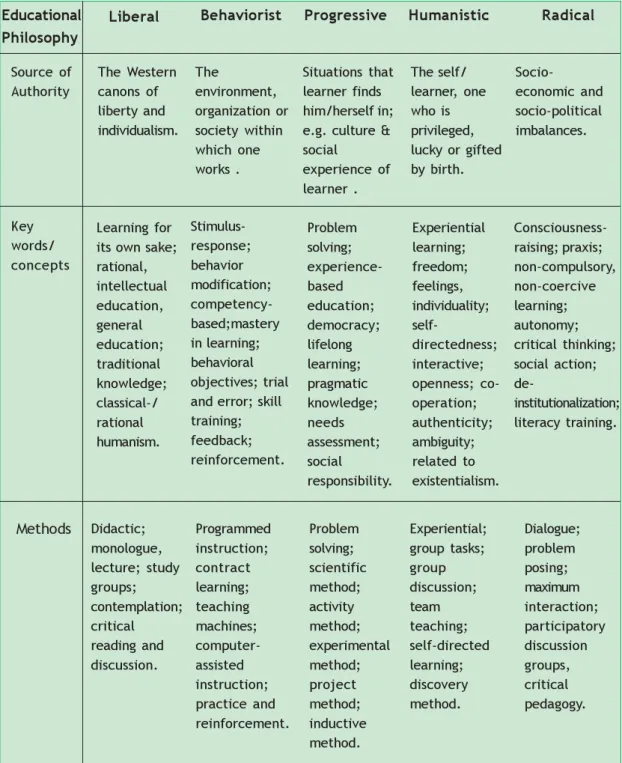
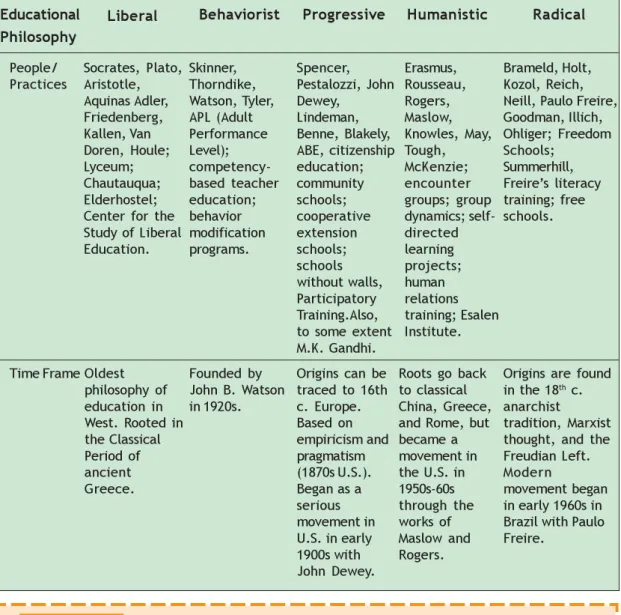
ee the following three tables, which compare five major educational philosophies (Liberal, Behaviorist, Progressive, Humanistic, and Radical). These tables are based on presentationsby Lorraine Zinn (1990). The tables have been slightly edited and expanded as per the understanding of the author in order to remove certain confusions and overlappings.
3.4 Philosophies of Adult Education
Behaviorist Liberal Humanistic Progressive Radical Learner as a machine Learner as a brain Learner as a living being Learner as an active agent
40
AJAY KUMAR Table 3.1: Adult Education - Purpose, Learner, and Teacher
Purpose
Educational Philosophy
Liberal(Classical, Traditional)
Behaviorist Progressive Humanistic Radical
To develop intellectual powers of the mind; to make a person literate in the broadest sense— intellectually, morally, and spiritually. It is a politically correct and legitimate belief but romanticizes about unlimited intellectual powers of the mind. To control the behavior of an individual within an organization; to bring about behavior change through systems of reward and punishment and self-training to ensure survival of human species, societies, & individuals. To transmit culture and societal structure to promote social change; to give learner practical knowledge and problem-solving skills, to reform society To develop (selected / privileged) people open to change and continued learning; to enhance personal growth and development; to facilitate self-actualization, to reform society. To bring about fundamental, social, political & economic changes in society through education; to change culture & its structure in order to eliminate various inequalities, dominations and exploitations. Learner “Renaissance person”; who is cultured & always a keen learner; who seeks knowledge rather than just information; s/he has cognitive capacity for conceptual & theoretical understanding. Learner takes an active role in ‘packaged’ and programmed learning, practicing new behavior, and receiving feedback; strong environmental influence to control his/ her learning achievements. Learner needs, interests, and experiences are key elements in learning; people have unlimited potential to be developed through problem-solving education based on experience. Learner is highly motivated and self-directed; assumes responsibility for learning and self-development. Equality with teacher in learning process; personal autonomy; people create history and culture by combining reflection with action
Teacher The teacher is
an “expert” who is the transmitter of knowledge, one who is authoritative & clearly directs the learning outcome. It is top-down, one-way vertical communication used in teaching and instruction. The teacher is the manager & controller who predicts and directs learning outcomes, who shapes learning environment and desired behavior. It is also top-down, one-way vertical approach in teaching communication. The teacher is an organizer who guides learning through experiences that are educative; stimulates, instigates, evaluates learning process. (Horizontal, both way, top-down and bottom-up approach in teaching communication.) Facilitator; helper; partner; promotes, but does not direct learning, sets mood for learning, acts as a flexible resource for learners. (Horizontal and both way, top-down and bottom-up approach in teaching communication) Provocateur; suggests but does not determine direction for learning; equality between teacher and learner. (Dialogical, horizontal and both way, top-down and bottom-up communication approach)
PHILOSOPHICAL BACKGROUND OF ADULT AND LIFELONG LEARNING 41 Learning for its own sake; rational, intellectual education, general education; traditional knowledge; classical-/ rational humanism. Stimulus-response; behavior modification; competency-based;mastery in learning; behavioral objectives; trial and error; skill training; feedback; reinforcement. Problem solving; experience-based education; democracy; lifelong learning; pragmatic knowledge; needs assessment; social responsibility. Experiential learning; freedom; feelings, individuality; self-directedness; interactive; openness; co-operation; authenticity; ambiguity; related to existentialism. Consciousness-raising; praxis; non-compulsory, non-coercive learning; autonomy; critical thinking; social action; de-institutionalization; literacy training. Methods Didactic; monologue, lecture; study groups; contemplation; critical reading and discussion. Programmed instruction; contract learning; teaching machines; computer-assisted instruction; practice and reinforcement. Problem solving; scientific method; activity method; experimental method; project method; inductive method. Experiential; group tasks; group discussion; team teaching; self-directed learning; discovery method. Dialogue; problem posing; maximum interaction; participatory discussion groups, critical pedagogy. Source of Authority The Western canons of liberty and individualism. The environment, organization or society within which one works . Situations that learner finds him/herself in; e.g. culture & social experience of learner . The self/ learner, one who is privileged, lucky or gifted by birth. Socio-economic and socio-political imbalances.
Table 3.2: Adult Education–Source of Authority, Key Words, Concepts and Methods
Educational Philosophy
Liberal Behaviorist Progressive Humanistic Radical
Key words/ concepts
42 AJAY KUMAR Oldest philosophy of education in West. Rooted in the Classical Period of ancient Greece. Origins can be traced to 16th c. Europe. Based on empiricism and pragmatism (1870s U.S.). Began as a serious movement in U.S. in early 1900s with John Dewey. Roots go back to classical China, Greece, and Rome, but became a movement in the U.S. in 1950s-60s through the works of Maslow and Rogers.
Origins are found in the 18th c.
anarchist
tradition, Marxist thought, and the Freudian Left. Modern
movement began in early 1960s in Brazil with Paulo Freire.
Activity 3.2
Study Table 3.1, Table 3.2 and Table 3.3 and highlight in one paragraph all the points of overlap among the various philosophies of education. Then in another short paragraph, write your own impression of the kind of adult education you think exists today in India.
3.5 Conclusion
U
nit 3 has explained the concepts of adult education and lifelong learning and discussed assumptions about adult learning behavior. It has described lifelong learning as an educational movement and elaborated onfundamental purposes of education. Unit 3 has also compared the various philosophical traditions and has endeavored to bring through activity exercises your own ideas into open
3.6 Apply What You Have learnt
D
iscuss in 800 words the philosophy ofyour learning PALDIN courses and try to
People/ Practices Socrates, Plato, Aristotle, Aquinas Adler, Friedenberg, Kallen, Van Doren, Houle; Lyceum; Chautauqua; Elderhostel; Center for the Study of Liberal Education. Skinner, Thorndike, Watson, Tyler, APL (Adult Performance Level); competency-based teacher education; behavior modification programs. Spencer, Pestalozzi, John Dewey, Lindeman, Benne, Blakely, ABE, citizenship education; community schools; cooperative extension schools; schools without walls, Participatory Training.Also, to some extent M.K. Gandhi. Erasmus, Rousseau, Rogers, Maslow, Knowles, May, Tough, McKenzie; encounter groups; group dynamics; self-directed learning projects; human relations training; Esalen Institute. Brameld, Holt, Kozol, Reich, Neill, Paulo Freire, Goodman, Illich, Ohliger; Freedom Schools; Summerhill, Freire’s literacy training; free schools.
Table 3.3: Adult Education – People Practices and Time Frame
Educational Philosophy
Liberal Behaviorist Progressive Humanistic Radical
Time Frame Founded by John B. Watson in 1920s.
bring out the educational philosophy of Course 1 of PALDIN.