Red Hat Documentation Group
JBoss Enterprise Application
Platform 4.3
Transactions Programmers Guide
for Use with JBoss Enterprise Application Platform 4.3
Edition 4.3.10
JBoss Enterprise Application Platform 4.3 Transactions Programmers
Guide
for Use with JBoss Enterprise Application Platform 4.3
Edition 4.3.10
Copyright © 2011 Red Hat, Inc.
This document is licensed by Red Hat under the Creative Commons Attribution-ShareAlike 3.0 Unported License. If you distribute this document, or a modified version of it, you must provide attribution to Red Hat, Inc. and provide a link to the original. If the document is modified, all Red Hat trademarks must be removed.
Red Hat, as the licensor of this document, waives the right to enforce, and agrees not to assert, Section 4d of CC-BY-SA to the fullest extent permitted by applicable law.
Red Hat, Red Hat Enterprise Linux, the Shadowman logo, JBoss, MetaMatrix, Fedora, the Infinity Logo, and RHCE are trademarks of Red Hat, Inc., registered in the United States and other countries. Linux ® is the registered trademark of Linus Torvalds in the United States and other countries. Java ® is a registered trademark of Oracle and/or its affiliates.
XFS ® is a trademark of Silicon Graphics International Corp. or its subsidiaries in the United States and/or other countries.
MySQL ® is a registered trademark of MySQL AB in the United States, the European Union and other countries.
Node.js ® is an official trademark of Joyent. Red Hat Software Collections is not formally related to or endorsed by the official Joyent Node.js open source or commercial project.
The OpenStack ® Word Mark and OpenStack Logo are either registered trademarks/service marks or trademarks/service marks of the OpenStack Foundation, in the United States and other countries and are used with the OpenStack Foundation's permission. We are not affiliated with, endorsed or
sponsored by the OpenStack Foundation, or the OpenStack community. All other trademarks are the property of their respective owners.
Abstract
This book is the JBoss TS Programmers Guide for use with JBoss Enterprise Application Platform 4.3 and its patch releases.
. . . . . . . . . . . . . . . . . . . .
Table of Contents
Preface 1. Document Conventions 1.1. Typographic Conventions 1.2. Pull-quote Conventions 1.3. Notes and Warnings2. Getting Help and Giving Feedback 2.1. Do You Need Help?
2.2. Give us Feedback
Chapter 1. Overview
1.1. Introduction
1.2. TxCore – the transaction engine 1.2.1. Saving object states
1.2.2. The object store
1.2.3. Recovery and persistence
1.2.4. The life-cycle of a Transactional Object for Java 1.2.5. The concurrency controller
1.2.6. The transaction protocol engine 1.2.7. Example
1.2.8. The class hierarchy
Chapter 2. Using TxCore
2.1. Introduction
2.2. State management 2.2.1. Object States 2.2.2. The object store
2.2.3. Selecting an object store implementation 2.2.4. StateManager
2.2.5. Object Models 2.2.6. Summary 2.2.7. Example
2.3. Lock management and concurrency control 2.3.1. Selecting a lock store implementation 2.3.2. LockManager
2.3.3. Locking policy
2.3.4. Object construction and destruction
Chapter 3. General Transaction Issues
3.1. Advanced transaction issues with TxCore 3.1.1. Checking transactions
3.1.2. Statistics gathering
3.1.3. Last resource commit optimisation 3.1.4. Nested transactions
3.1.5. Asynchronously committing a transaction 3.1.6. Independent top-level transactions
3.1.7. Transactions within save_state and restore_state 3.1.8. Example
3.1.9. Garbage collecting objects 3.1.10. Transaction timeouts
Chapter 4 . Hints and tips
4.1. General
4.1.1. Using transactions in constructors
4 4 4 5 6 6 6 7 8 8 8 8 9 9 11 12 13 13 14 16 16 16 16 18 19 19 21 23 24 26 26 27 29 30 32 32 32 32 33 34 34 35 35 35 36 36 38 38 38 Table of Contents
. . . . . . . . . . . . . . . . . . . . . . . . 4.1.2. More on save_state and restore_state
4.1.3. Packing Objects
4.2. Direct use of StateManager
Chapter 5. Tools
5.1. Introduction
5.2. Starting the Transaction Service tools 5.3. Using the Performance Tool
5.4. Using the JMX Browser
5.4.1. Using Attributes and Operations 5.4.2. Using the Object Store Browser 5.4.3. Object State Viewers (OSV)
Chapter 6. Constructing a Transactional objects for Java application
6.1. Application construction
Chapter 7. Configuration options
7.1. Options
Object store implementations
A.1. The ObjectStore
A.2. Persistent object stores
Class definitions B.1. Introduction B.2. Class library Revision History 38 39 39 4 1 41 41 42 43 44 45 46 51 51 59 59 61 61 63 67 67 67 72
Preface
1. Document Conventions
This manual uses several conventions to highlight certain words and phrases and draw attention to specific pieces of information.
In PDF and paper editions, this manual uses typefaces drawn from the Liberation Fonts set. The
Liberation Fonts set is also used in HTML editions if the set is installed on your system. If not, alternative but equivalent typefaces are displayed. Note: Red Hat Enterprise Linux 5 and later include the Liberation Fonts set by default.
1.1. Typographic Conventions
Four typographic conventions are used to call attention to specific words and phrases. These conventions, and the circumstances they apply to, are as follows.
Mono-spaced Bold
Used to highlight system input, including shell commands, file names and paths. Also used to highlight keys and key combinations. For example:
To see the contents of the file m y_next_bestselling_novel in your current working directory, enter the cat m y_next_bestselling_novel command at the shell prompt and press Enter to execute the command.
The above includes a file name, a shell command and a key, all presented in mono-spaced bold and all distinguishable thanks to context.
Key combinations can be distinguished from an individual key by the plus sign that connects each part of a key combination. For example:
Press Enter to execute the command.
Press Ctrl+Alt+F2 to switch to a virtual terminal.
The first example highlights a particular key to press. The second example highlights a key combination: a set of three keys pressed simultaneously.
If source code is discussed, class names, methods, functions, variable names and returned values mentioned within a paragraph will be presented as above, in m ono-spaced bold. For example:
File-related classes include filesystem for file systems, file for files, and dir for directories. Each class has its own associated set of permissions.
Proportional Bold
This denotes words or phrases encountered on a system, including application names; dialog box text; labeled buttons; check-box and radio button labels; menu titles and sub-menu titles. For example:
Choose System → Preferences → Mouse from the main menu bar to launch Mouse
Preferences. In the Buttons tab, select the Left-handed m ouse check box and click
Close to switch the primary mouse button from the left to the right (making the mouse suitable for use in the left hand).
Character Map from the main menu bar. Next, choose Search → Find… from the Character Map menu bar, type the name of the character in the Search field and click
Next. The character you sought will be highlighted in the Character T able. Double-click this highlighted character to place it in the T ext to copy field and then click the Copy
button. Now switch back to your document and choose Edit → Paste from the gedit menu bar.
The above text includes application names; system-wide menu names and items; application-specific menu names; and buttons and text found within a GUI interface, all presented in proportional bold and all distinguishable by context.
Mono-spaced Bold Italic or Proportional Bold Italic
Whether mono-spaced bold or proportional bold, the addition of italics indicates replaceable or variable text. Italics denotes text you do not input literally or displayed text that changes depending on
circumstance. For example:
To connect to a remote machine using ssh, type ssh username@ domain.name at a shell prompt. If the remote machine is exam ple.com and your username on that machine is john, type ssh john@ exam ple.com.
The m ount -o rem ount file-system command remounts the named file system. For example, to remount the /hom e file system, the command is m ount -o rem ount /hom e. To see the version of a currently installed package, use the rpm -q package command. It will return a result as follows: package-version-release.
Note the words in bold italics above — username, domain.name, file-system, package, version and release. Each word is a placeholder, either for text you enter when issuing a command or for text displayed by the system.
Aside from standard usage for presenting the title of a work, italics denotes the first use of a new and important term. For example:
Publican is a DocBook publishing system.
1.2. Pull-quote Conventions
Terminal output and source code listings are set off visually from the surrounding text. Output sent to a terminal is set in m ono-spaced rom an and presented thus:
books Desktop documentation drafts mss photos stuff svn books_tests Desktop1 downloads images notes scripts svgs
Source-code listings are also set in m ono-spaced rom an but add syntax highlighting as follows:
package org.jboss.book.jca.ex1;
import javax.naming.InitialContext;
public class ExClient {
public static void main(String args[]) throws Exception
{
InitialContext iniCtx = new InitialContext();
Object ref = iniCtx.lookup("EchoBean"); EchoHome home = (EchoHome) ref;
Echo echo = home.create(); System.out.println("Created Echo");
System.out.println("Echo.echo('Hello') = " + echo.echo("Hello")); }
}
1.3. Notes and Warnings
Finally, we use three visual styles to draw attention to information that might otherwise be overlooked.
Note
Notes are tips, shortcuts or alternative approaches to the task at hand. Ignoring a note should have no negative consequences, but you might miss out on a trick that makes your life easier.
Important
Important boxes detail things that are easily missed: configuration changes that only apply to the current session, or services that need restarting before an update will apply. Ignoring a box labeled 'Important' will not cause data loss but may cause irritation and frustration.
Warning
Warnings should not be ignored. Ignoring warnings will most likely cause data loss.
2. Getting Help and Giving Feedback
2.1. Do You Need Help?
If you experience difficulty with a procedure described in this documentation, visit the Red Hat Customer Portal at http://access.redhat.com. Through the customer portal, you can:
search or browse through a knowledgebase of technical support articles about Red Hat products. submit a support case to Red Hat Global Support Services (GSS).
Red Hat also hosts a large number of electronic mailing lists for discussion of Red Hat software and technology. You can find a list of publicly available mailing lists at https://www.redhat.com/mailman/listinfo. Click on the name of any mailing list to subscribe to that list or to access the list archives.
2.2. Give us Feedback
If you find a typographical error, or know how this guide can be improved, we would love to hear from you. Submit a report in Bugzilla against the product JBoss Enterprise Application Platform 4 and the component doc-T ransactions_Program m ers_Guide. The following link will take you to a pre-filled bug report for this product: http://bugzilla.redhat.com/.
Fill out the following template in Bugzilla's Description field. Be as specific as possible when describing the issue; this will help ensure that we can fix it quickly.
Document URL:
Section Number and Name: Describe the issue:
Suggestions for improvement: Additional information:
Be sure to give us your name so that you can receive full credit for reporting the issue.
Chapter 1. Overview
1.1. Introduction
This chapter contains a description of the use of the T xCore transaction engine and the Transactional
Objects for Java classes and facilities. The classes mentioned in this chapter are the key to writing
fault-tolerant applications using transactions. Thus, after describing them we shall apply them in the construction of a simple application. The classes to be described in this chapter can be found in the
com .arjuna.ats.txoj and com .arjuna.ats.arjuna packages.
1.2. TxCore – the transaction engine
In keeping with the object-oriented view, the mechanisms needed to construct reliable distributed
applications are presented to programmers in an object-oriented manner. Some mechanisms need to be inherited, for example, concurrency control and state management; while other mechanisms, such as object storage and transactions, are implemented as T xCore objects that are created and manipulated like any other object.
Note
When the manual talks about using persistence and concurrency control facilities it assumes that the Transactional Objects for Java (TXOJ) classes are being used. If this is not the case then the programmer is responsible for all of these issues.
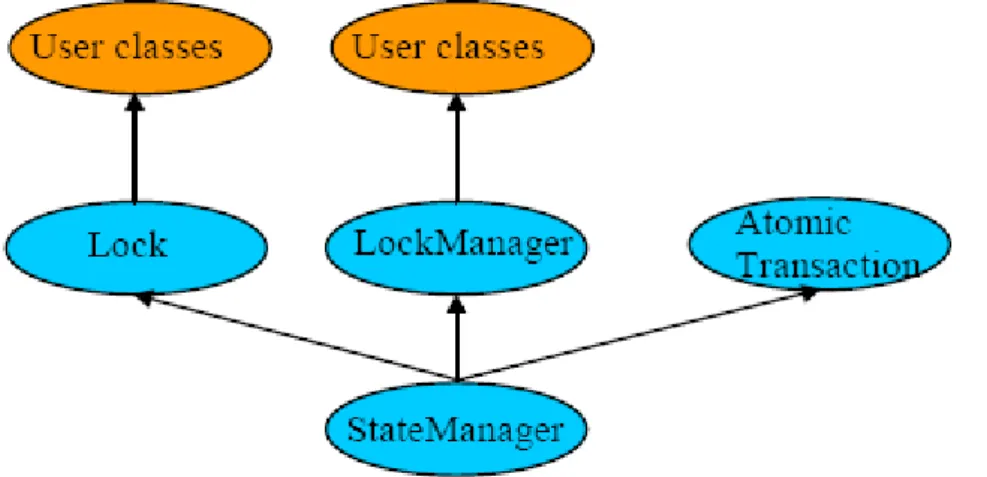
T xCore exploits object-oriented techniques to present programmers with a toolkit of Java classes from which application classes can inherit to obtain desired properties, such as persistence and concurrency control. These classes form a hierarchy, part of which is shown below and which will be described later in this document.
Figure 1: Txcore class hierarchy
Apart from specifying the scopes of transactions, and setting appropriate locks within objects, the application programmer does not have any other responsibilities: T xCore and Transactional Objects for
Java (TXOJ) guarantee that transactional objects will be registered with, and be driven by, the
appropriate transactions, and crash recovery mechanisms are invoked automatically in the event of failures.
T xCore needs to be able to remember the state of an object for several purposes, including recovery (the state represents some past state of the object) and persistence (the state represents the final state of an object at application termination). Since these requirements have common functionality they are all implemented using the same mechanism: the classes InputObjectState and
OutputObjectState. The classes maintain an internal array into which instances of the standard types can be contiguously packed (unpacked) using appropriate pack (unpack) operations. This buffer is automatically resized as required should it have insufficient space. The instances are all stored in the buffer in a standard form (so-called network byte order) to make them machine independent. Any other architecture independent format (such as XDR or ASN.1) could be implemented simply by replacing the operations with ones appropriate to the encoding required.
1.2.2. The object store
Implementations of persistence can be affected by restrictions imposed by the Java SecurityManager. Therefore, the object store provided with T xCore is implemented using the techniques of
interface/implementation. The current distribution has implementations which write object states to the local file system or database, and remote implementations, where the interface uses a client stub (proxy) to remote services.
Persistent objects are assigned unique identifiers (instances of the Uid class), when they are created, and this is used to identify them within the object store. States are read using the read_com m itted
operation and written by the write_(un)com m itted operations.
1.2.3. Recovery and persistence
At the root of the class hierarchy is the class StateManager. This class is responsible for object activation and deactivation and object recovery. The simplified signature of the class is:
public abstract class StateManager {
public boolean activate ();
public boolean deactivate (boolean commit); public Uid get_uid (); // object’s identifier. // methods to be provided by a derived class public boolean restore_state (InputObjectState os); public boolean save_state (OutputObjectState os); protected StateManager ();
protected StateManager (Uid id); };
Objects are assumed to be of three possible flavours. They may simply be recoverable, in which case
StateManager will attempt to generate and maintain appropriate recovery information for the object. Such objects have lifetimes that do not exceed the application program that creates them. Objects may be recoverable and persistent, in which case the lifetime of the object is assumed to be greater than that of the creating or accessing application, so that in addition to maintaining recovery information
StateManager will attempt to automatically load (unload) any existing persistent state for the object by calling the activate (deactivate) operation at appropriate times. Finally, objects may possess none of these capabilities, in which case no recovery information is ever kept nor is object activation/deactivation ever automatically attempted.
If an object is recoverable or recoverable and persistent then StateManager will invoke the operations
save_state (while performing deactivate), and restore_state (while performing activate) at
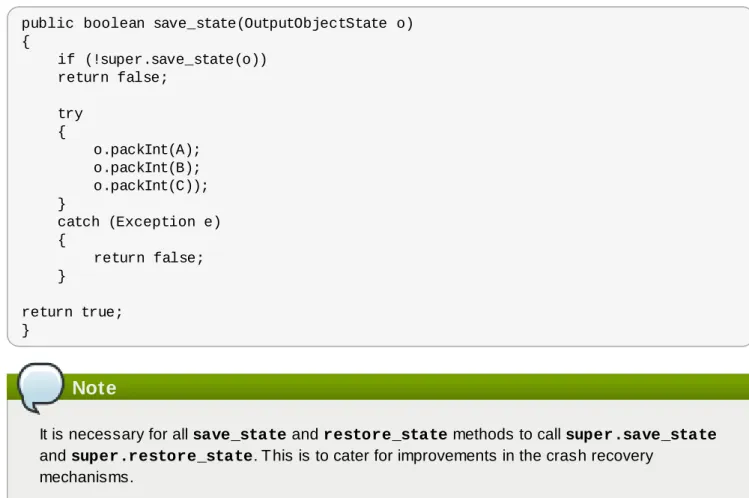
various points during the execution of the application. These operations must be implemented by the programmer since StateManager cannot detect user level state changes. (We are examining the automatic generation of default save_state and restore_state operations, allowing the programmer to override this when application specific knowledge can be used to improve efficiency.) This gives the programmer the ability to decide which parts of an object’s state should be made persistent. For example, for a spreadsheet it may not be necessary to save all entries if some values can simply be recomputed. The save_state implementation for a class Exam ple that has integer member variables called A, B and C could simply be:
public boolean save_state(OutputObjectState o) { if (!super.save_state(o)) return false; try { o.packInt(A); o.packInt(B); o.packInt(C)); } catch (Exception e) { return false; } return true; }
Objects are assumed to be of three possible flavours. They may simply be recoverable, in which case
StateManager will attempt to generate and maintain appropriate recovery information for the object. Such objects have lifetimes that do not exceed the application program that creates them. Objects may be recoverable and persistent, in which case the lifetime of the object is assumed to be greater than that of the creating or accessing application, so that in addition to maintaining recovery information
StateManager will attempt to automatically load (unload) any existing persistent state for the object by calling the activate (deactivate) operation at appropriate times. Finally, objects may possess none of these capabilities, in which case no recovery information is ever kept nor is object
activation/deactivation ever automatically attempted.
If an object is recoverable or recoverable and persistent then StateManager will invoke the operations
save_state (while performing deactivate), and restore_state (while performing activate) at various points during the execution of the application. These operations must be implemented by the programmer since StateManager cannot detect user level state changes. (We are examining the automatic generation of default save_state and restore_state operations, allowing the programmer to override this when application specific knowledge can be used to improve efficiency.) This gives the programmer the ability to decide which parts of an object’s state should be made persistent. For example, for a spreadsheet it may not be necessary to save all entries if some values can simply be recomputed. The save_state implementation for a class Exam ple that has integer member variables called A, B and C could simply be:
public boolean save_state(OutputObjectState o) { if (!super.save_state(o)) return false; try { o.packInt(A); o.packInt(B); o.packInt(C)); } catch (Exception e) { return false; } return true; }
Note
It is necessary for all save_state and restore_state methods to call super.save_state
and super.restore_state. This is to cater for improvements in the crash recovery mechanisms.
1.2.4. The life-cycle of a Transactional Object for Java
A persistent object not in use is assumed to be held in a passive state with its state residing in an object store and activated on demand. The fundamental life cycle of a persistent object in TXOJ is shown in figure 2.
Figure 2: The lifecycle of a persistent object.
The object is initially passive, and is stored in the object store as an instance of the class
OutputObjectState.
When required by an application the object is automatically activated by reading it from the store
using a read_com m itted operation and is then converted from an InputObjectState instance into a fully-fledged object by the restore_state operation of the object.
When the application has finished with the object it is deactivated by converting it back into an
OutputObjectState instance using the save_state operation, and is then stored back into the object store as a shadow copy using write_uncommitted. This shadow copy can be committed, overwriting the previous version, using the com m it_state operation. The existence of shadow copies is normally hidden from the programmer by the transaction system. Object de-activation normally only occurs when the top-level transaction within which the object was activated commits.
Note
During its life time, a persistent object may be made active then passive many times.
1.2.5. The concurrency controller
The concurrency controller is implemented by the class LockManager which provides sensible default behaviour while allowing the programmer to override it if deemed necessary by the particular semantics of the class being programmed. As with StateManager and persistence, concurrency control
implementations are accessed through interfaces. As well as providing access to remote services, the current implementations of concurrency control available to interfaces include:
local disk/database implementation, where locks are made persistent by being written to the local file system or database.
a purely local implementation, where locks are maintained within the memory of the virtual machine which created them; this implementation has better performance than when writing locks to the local disk, but objects cannot be shared between virtual machines. Importantly, it is a basic Java object with no requirements which can be affected by the SecurityManager
The primary programmer interface to the concurrency controller is via the setlock operation. By default, the runtime system enforces strict two-phase locking following a multiple reader, single writer policy on a per object basis. However, as shown in figure 1, by inheriting from the Lock class it is possible for programmers to provide their own lock implementations with different lock conflict rules to enable type
specific concurrency control.
Lock acquisition is (of necessity) under programmer control, since just as StateManager cannot determine if an operation modifies an object, LockManager cannot determine if an operation requires a read or write lock. Lock release, however, is under control of the system and requires no further
intervention by the programmer. This ensures that the two-phase property can be correctly maintained.
public abstract class LockManager extends StateManager {
public LockResult setlock (Lock toSet, int retry, int timeout); };
The LockManager class is primarily responsible for managing requests to set a lock on an object or to release a lock as appropriate. However, since it is derived from StateManager, it can also control when some of the inherited facilities are invoked. For example, LockManager assumes that the setting of a write lock implies that the invoking operation must be about to modify the object. This may in turn cause recovery information to be saved if the object is recoverable. In a similar fashion, successful lock acquisition causes activate to be invoked.
public class Example extends LockManager {
public boolean foobar () {
AtomicAction A = new AtomicAction; boolean result = false;
A.begin();
if (setlock(new Lock(LockMode.WRITE), 0) == Lock.GRANTED) {
/*
* Do some work, and TXOJ will * guarantee ACID properties. */
// automatically aborts if fails if (A.commit() == AtomicAction.COMMITTED) { result = true; } } else A.rollback(); return result; } }
1.2.6. The transaction protocol engine
The transaction protocol engine is represented by the Atom icAction class, which uses
StateManager in order to record sufficient information for crash recovery mechanisms to complete the transaction in the event of failures. It has methods for starting and terminating the transaction, and, for those situations where programmers require to implement their own resources, methods for registering them with the current transaction. Because TxCore supports subtransactions, if a transaction is begun within the scope of an already executing transaction it will automatically be nested.
Note
TxCore is multi-threaded aware, allowing each thread within an application to share a transaction
or execute within its own transaction. Therefore, all TxCore classes are also thread safe.
1.2.7. Example
The simple example below illustrates the relationships between activation, termination and commitment:
{
. . .
O1 objct1 = new objct1(Name-A);/* (i) bind to "old" persistent object A */ O2 objct2 = new objct2(); /* create a "new" persistent object */
OTS.current().begin(); /* (ii) start of atomic action */
objct1.op(...); /* (iii) object activation and invocations */ objct2.op(...);
. . .
OTS.current().commit(true); /* (iv) tx commits & objects deactivated */ } /* (v) */
The execution of the above code involves the following sequence of activities:
Creation of bindings to persistent objects; this could involve the creation of stub objects and a call to remote objects. In the above example we re-bind to an existing persistent object identified by Nam e-A, and a new persistent object. A naming system for remote objects maintains the mapping between object names and locations and is described in a later chapter.
Start of the atomic transaction.
Operation invocations: as a part of a given invocation the object implementation is responsible to ensure that it is locked in read or write mode (assuming no lock conflict), and initialised, if necessary, with the latest committed state from the object store. The first time a lock is acquired on an object within a transaction the object’s state is acquired, if possible, from the object store.
Commit of the top-level action. This includes updating of the state of any modified objects in the object store.
Breaking of the previously created bindings.
1.2.8. The class hierarchy
The principal classes which make up the class hierarchy of TxCore are depicted below.
StateManager // Basic naming, persistence and recovery control
LockManager // Basic two-phase locking concurrency control service
User-Defined Classes
Lock // Standard lock type for multiple readers/single writer User-Defined Lock Classes
AbstractRecord // Important utility class, similar to Resource RecoveryRecord // handles object recovery LockRecord // handles object locking
RecordList // Intentions list other management record types
AtomicAction // Implements transaction control abstraction TopLevelTransaction
Input/OutputBuffer // Architecture neutral representation of an objects’ state
Input/OutputObjectState // Convenient interface to Buffer ObjectStore // Interface to the object storage services
Programmers of fault-tolerant applications will be primarily concerned with the classes LockManager,
Lock and Atom icAction. Other classes important to a programmer are Uid, and ObjectState. Most TxCore classes are derived from the base class StateManager, which provides primitive
facilities necessary for managing persistent and recoverable objects. These facilities include support for the activation and de-activation of objects, and state-based object recovery. The class LockManager
the current implementation) required for implementing the serialisability property of atomic actions. The implementation of atomic action facilities is supported by Atom icAction and
T opLevelT ransaction.
Most TxCore system classes are derived from the base class StateManager, which provides primitive facilities necessary for managing persistent and recoverable objects. These facilities include support for the activation and de-activation of objects, and state-based object recovery. The class LockManager
uses the facilities of StateManager and provides the concurrency control required for implementing the serialisability property of atomic actions.
Consider a simple example. Assume that Exam ple is a user-defined persistent class suitably derived from the LockManager. An application containing an atomic transaction Trans accesses an object (called O) of type Exam ple by invoking the operation op1 which involves state changes to O. The serialisability property requires that a write lock must be acquired on O before it is modified; thus the body of op1 should contain a call to the setlock operation of the concurrency controller:
public boolean op1 (...) {
if (setlock (new Lock(LockMode.WRITE) == LockResult.GRANTED) {
// actual state change operations follow ...
} }
The operation setlock, provided by the LockManager class, performs the following functions in this case:
Check write lock compatibility with the currently held locks, and if allowed:
Call the StateManager operation activate that will load, if not done already, the latest persistent state of O from the object store. Then call the StateManager operation modified which has the effect of creating an instance of either RecoveryRecord or PersistenceRecord for O
depending upon whether O was persistent or not (the Lock is a WRIT E lock so the old state of the object must be retained prior to modification) and inserting it into the RecordList of T rans. Create and insert a LockRecord instance in the RecordList of Trans.
Now suppose that action T rans is aborted sometime after the lock has been acquired. Then the
rollback operation of Atom icAction will process the RecordList instance associated with T rans by invoking an appropriate Abort operation on the various records. The implementation of this operation by the LockRecord class will release the WRIT E lock while that of
RecoveryRecord/PersistenceRecord will restore the prior state of O.
It is important to realise that all of the above work is automatically being performed by TxCore on behalf of the application programmer. The programmer need only start the transaction and set an appropriate lock; TxCore and Transactional Objects for Java take care of participant registration, persistence, concurrency control and recovery.
Chapter 2. Using TxCore
2.1. Introduction
In this section we shall describe TxCore and Transactional Objects for Java in more detail, and show how it can be used to construct transactional applications.
2.2. State management
2.2.1. Object States
TxCore needs to be able to remember the state of an object for several purposes, including recovery
(the state represents some past state of the object), and for persistence (the state represents the final state of an object at application termination). Since all of these requirements require common
functionality they are all implemented using the same mechanism - the classes
Input/OutputObjectState and Input/OutputBuffer.
OutputBuffer
public class OutputBuffer {
public OutputBuffer ();
public final synchronized boolean valid (); public synchronized byte[] buffer();
public synchronized int length ();
/* pack operations for standard Java types */
public synchronized void packByte (byte b) throws IOException; public synchronized void packBytes (byte[] b) throws IOException; public synchronized void packBoolean (boolean b) throws IOException; public synchronized void packChar (char c) throws IOException;
public synchronized void packShort (short s) throws IOException; public synchronized void packInt (int i) throws IOException; public synchronized void packLong (long l) throws IOException; public synchronized void packFloat (float f) throws IOException; public synchronized void packDouble (double d) throws IOException; public synchronized void packString (String s) throws IOException; };
public class InputBuffer {
public InputBuffer ();
public final synchronized boolean valid (); public synchronized byte[] buffer();
public synchronized int length ();
/* unpack operations for standard Java types */
public synchronized byte unpackByte () throws IOException; public synchronized byte[] unpackBytes () throws IOException; public synchronized boolean unpackBoolean () throws IOException; public synchronized char unpackChar () throws IOException;
public synchronized short unpackShort () throws IOException; public synchronized int unpackInt () throws IOException; public synchronized long unpackLong () throws IOException; public synchronized float unpackFloat () throws IOException; public synchronized double unpackDouble () throws IOException; public synchronized String unpackString () throws IOException; };
The Input/OutputBuffer class maintains an internal array into which instances of the standard Java types can be contiguously packed (unpacked) using the pack (unpack) operations. This buffer is
automatically resized as required should it have insufficient space. The instances are all stored in the buffer in a standard form (so-called network byte order) to make them machine independent.
OutputObjectState
class OutputObjectState extends OutputBuffer {
public OutputObjectState (Uid newUid, String typeName); public boolean notempty ();
public int size ();
public Uidpublic class InputBuffer {
public InputBuffer ();
public final synchronized boolean valid (); public synchronized byte[] buffer();
public synchronized int length ();
/* unpack operations for standard Java types */
public synchronized byte unpackByte () throws IOException; public synchronized byte[] unpackBytes () throws IOException; public synchronized boolean unpackBoolean () throws IOException; public synchronized char unpackChar () throws IOException;
public synchronized short unpackShort () throws IOException; public synchronized int unpackInt () throws IOException; public synchronized long unpackLong () throws IOException; public synchronized float unpackFloat () throws IOException; public synchronized double unpackDouble () throws IOException; public synchronized String unpackString () throws IOException; };
The Input/OutputBuffer class maintains an internal array into which instances of the standard Java
types can be contiguously packed (unpacked) using the pack (unpack) operations. This buffer is automatically resized as required should it have insufficient space. The instances are all stored in the buffer in a standard form (so-called network byte order) to make them machine independent.
OutputObjectState
class OutputObjectState extends OutputBuffer {
public OutputObjectState (Uid newUid, String typeName);
public boolean notempty (); public int size ();
public Uid stateUid (); public String type (); };
InputObjectState
class InputObjectState extends InputBuffer {
public OutputObjectState (Uid newUid, String typeName, byte[] b);
public boolean notempty (); public int size ();
public Uid stateUid (); public String type (); };
The class Input/OutputObjectState provides all the functionality of Input/OutputBuffer
(through inheritance) but adds two additional instance variables that signify the Uid and type of the object for which the Input/OutputObjectState instance is a compressed image. These are used when accessing the object store during storage and retrieval of the object state.
2.2.2. The object store
The object store provided with TxCore deliberately has a fairly restricted interface so that it can be implemented in a variety of ways. For example, object stores are implemented in shared memory; on the Unix file system (in several different forms); and as a remotely accessible store. More complete
information about the object stores available in TxCore can be found in the Appendix.
Note
As with all TxCore classes the default object stores are pure Java implementations; to access the shared memory and other more complex object store implementations it is necessary to use native methods.
All of the object stores hold and retrieve instances of the class Input/OutputObjectState. These instances are named by the Uid and Type of the object that they represent. States are read using the
read_com m itted operation and written by the system using the write_uncom m itted operation. Under normal operation new object states do not overwrite old object states but are written to the store as shadow copies. These shadows replace the original only when the com m it_state operation is invoked. Normally all interaction with the object store is performed by TxCore system components as appropriate thus the existence of any shadow versions of objects in the store are hidden from the programmer.
public class ObjectStore {
public static final int OS_COMMITTED; public static final int OS_UNCOMMITTED; public static final int OS_COMMITTED_HIDDEN; public static final int OS_UNCOMMITTED_HIDDEN; public static final int OS_UNKNOWN;
/* The abstract interface */
public abstract boolean commit_state (Uid u, String name) throws ObjectStoreException;
public abstract InputObjectState read_committed (Uid u, String name) throws ObjectStoreException;
public abstract boolean write_uncommitted (Uid u, String name, OutputObjectState os) throws ObjectStoreException;
. . . };
When a transactional object is committing it is necessary for it to make certain state changes persistent in order that it can recover in the event of a failure and either continue to commit, or rollback. When using
Transactional Objects for Java, TxCore will take care of this automatically. To guarantee ACID properties,
these state changes must be flushed to the persistence store implementation before the transaction can proceed to commit; if they are not, the application may assume that the transaction has committed when in fact the state changes may still reside within an operating system cache, and may be lost by a
subsequent machine failure. By default, TxCore ensures that such state changes are flushed. However, doing so can impose a significant performance penalty on the application. To prevent transactional object state flushes, set the com .arjuna.ats.arjuna.objectstore.objectStoreSync variable to OFF.
2.2.3. Selecting an object store implementation
TxCore comes with support for several different object store implementations. The Appendix describes
these implementations, how to select and configure a given implementation (using the
com .arjuna.ats.arjuna.objectstore.objectStoreT ype property variable) on a per object basis, and indicates how additional implementations can be provided.
2.2.4. StateManager
The TxCore class StateManager manages the state of an object and provides all of the basic support mechanisms required by an object for state management purposes. StateManager is responsible for creating and registering appropriate resources concerned with the persistence and recovery of the transactional object. If a transaction is nested, then StateManager will also propagate these resources between child transactions and their parents at commit time.
Objects in TxCore are assumed to be of three possible basic flavours. They may simply be recoverable, in which case StateManager will attempt to generate and maintain appropriate recovery information for the object (as instances of the class Input/OutputObjectState) . Such objects have lifetimes that do not exceed the application program that creates them. Objects may be recoverable and persistent, in which case the lifetime of the object is assumed to be greater than that of the creating or accessing application so that in addition to maintaining recovery information StateManager will attempt to automatically load (unload) any existing persistent state for the object by calling the activate
(deactivate) operation at appropriate times. Finally, objects may possess none of these capabilities in which case no recovery information is ever kept nor is object activation/deactivation ever automatically attempted. This object property is selected at object construction time and cannot be changed thereafter. Thus an object cannot gain (or lose) recovery capabilities at some arbitrary point during its lifetime.
public class ObjectStatus {
public static final int PASSIVE; public static final int PASSIVE_NEW; public static final int ACTIVE; public static final int ACTIVE_NEW; public static final int UNKNOWN_STATUS; };
public class ObjectType {
public static final int RECOVERABLE; public static final int ANDPERSISTENT; public static final int NEITHER;
};
public abstract class StateManager {
public synchronized boolean activate ();
public synchronized boolean activate (String storeRoot); public synchronized boolean deactivate ();
public synchronized boolean deactivate (String storeRoot, boolean commit);
public synchronized void destroy ();
public final Uid get_uid ();
public boolean restore_state (InputObjectState, int ObjectType); public boolean save_state (OutputObjectState, int ObjectType); public String type ();
. . .
protected StateManager ();
protected StateManager (int ObjectType, ObjectName attr); protected StateManager (Uid uid);
protected StateManager (Uid uid, ObjectName attr); . . .
protected final void modified (); . . .
};
public class ObjectModel {
public static final int SINGLE; public static final int MULTIPLE; };
If an object is recoverable (or persistent) then StateManager will invoke the operations save_state
(while performing deactivation), restore_state (while performing activate) and type at various points during the execution of the application. These operations must be implemented by the
programmer since StateManager does not have access to a runtime description of the layout of an arbitrary Java object in memory and thus cannot implement a default policy for converting the in memory version of the object to its passive form. However, the capabilities provided by
Input/OutputObjectState make the writing of these routines fairly simple. For example, the
save_state implementation for a class Exam ple that had member variables called A, B and C could simply be the following:
public boolean save_state ( OutputObjectState os, int ObjectType ) { if (!super.save_state(os, ObjectType)) return false; try { os.packInt(A); os.packString(B); os.packFloat(C); return true; } catch (IOException e) { return false; } }
In order to support crash recovery for persistent objects it is necessary for all save_state and
restore_state methods of user objects to call super.save_state and super.restore_state.
Note
The type method is used to determine the location in the object store where the state of
instances of that class will be saved and ultimately restored. This can actually be any valid string. However, you should avoid using the hash character (#) as this is reserved for special directories that TxCore requires.
The get_uid operation of StateManager provides read only access to an object’s internal system name for whatever purpose the programmer requires (such as registration of the name in a name server). The value of the internal system name can only be set when an object is initially constructed -either by the provision of an explicit parameter or by generating a new identifier when the object is created.
The destroy method can be used to remove the object’s state from the object store. This is an atomic operation, and therefore will only remove the state if the top-level transaction within which it is invoked eventually commits. The programmer must obtain exclusive access to the object prior to invoking this operation.
Since object recovery and persistence essentially have complimentary requirements (the only difference being where state information is stored and for what purpose) StateManager effectively combines the management of these two properties into a single mechanism. That is, it uses instances of the class Input/OutputObjectState both for recovery and persistence purposes. An additional argument passed to the save_state and restore_state operations allows the programmer to determine the purpose for which any given invocation is being made thus allowing different information to be saved for recovery and persistence purposes.
2.2.5. Object Models
TxCore supports two models for objects, which as we shall show affect how an objects state and
concurrency control are implemented:
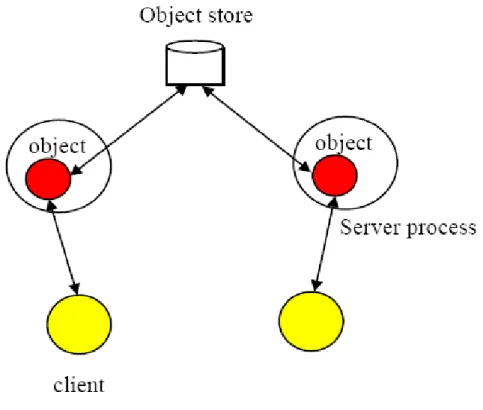
SINGLE: only a single copy of the object exists within the application; this will reside within a single
JVM, and all clients must address their invocations to this server. This model provides better performance, but represents a single point of failure, and in a multi-threaded environment may not protect the object from corruption if a single thread fails.
Figure 3: Single Object Model
MULTIPLE: logically a single instance of the object exists, but copies of it are distributed across different JVMs; the performance of this model is worse than the SINGLE model, but it provides better failure isolation.
Figure 4: Multiple Object Model
The default model is SINGLE. The programmer can override this on a per object basis by providing an appropriate instance of the com .arjuna.ats.arjuna.gandiva.ObjectNam e class at object construction.
Note
The model can be changed between each successive instantiation of the object, i.e., it need not be the same during the object's lifetime.
To provide a suitable ObjectNam e class, it is necessary to perform the following steps: create a new instance of ObjectNam e.
set the object model attribute using the
com .arjuna.ats.arjuna.ArjunaNam es.StateManager_objectModel() name. For example:
{
ObjectName attr = new ObjectName(“SNS:myObjectName”);
attr.setLongAttribute(ArjunaNames.StateManager_objectModel(), ObjectModel.SINGLE);
AtomicObject obj = new AtomicObject(ObjectType.ANDPERSISTENT, attr); }
2.2.6. Summary
In summary, the TxCore class StateManager manages the state of an object and provides all of the basic support mechanisms required by an object for state management purposes. Some operations must be defined by the class developer. These operations are: save_state, restore_state, and
type.
boolean save_state (OutputObjectState state, int ObjectT ype)
Invoked whenever the state of an object might need to be saved for future use - primarily for recovery or persistence purposes. The ObjectT ype parameter indicates the reason that
save_state was invoked by TxCore. This enables the programmer to save different pieces of information into the OutputObjectState supplied as the first parameter depending upon whether the state is needed for recovery or persistence purposes. For example, pointers to other TxCore objects might be saved simply as pointers for recovery purposes but as Uid’s for persistence purposes. As shown earlier, the OutputObjectState class provides convenient operations to allow the saving of instances of all of the basic types in Java. In order to support crash recovery for persistent objects it is necessary for all save_state methods to call
super.save_state.
Note
save_state assumes that an object is internally consistent and that all variables saved have valid values. It is the programmer's responsibility to ensure that this is the case.
boolean restore_state (InputObjectState state, int ObjectT ype)
Invoked whenever the state of an object needs to be restored to the one supplied. Once again the second parameter allows different interpretations of the supplied state. In order to support
crash recovery for persistent objects it is necessary for all restore_state methods to call
super.restore_state.
String type ()
The TxCore persistence mechanism requires a means of determining the type of an object as a string so that it can save/restore the state of the object into/from the object store. By convention this information indicates the position of the class in the hierarchy. For example,
“/StateManager/LockManager/Object”.
Note
The type method is used to determine the location in the object store where the state of instances of that class will be saved and ultimately restored. This can actually be any valid string. However, you should avoid using the hash character (#) as this is reserved for special directories that TxCore requires.
2.2.7. Example
Consider the following basic Array class derived from the StateManager class (in this example, to illustrate saving and restoring of an object’s state, the highestIndex variable is used to keep track of the highest element of the array that has a non-zero value):
public class Array extends StateManager {
public Array ();
public Array (Uid objUid);
public void finalize ( super.terminate(); };
/* Class specific operations. */
public boolean set (int index, int value); public int get (int index);
/* State management specific operations. */
public boolean save_state (OutputObjectState os, int ObjectType); public boolean restore_state (InputObjectState os, int ObjectType); public String type ();
public static final int ARRAY_SIZE = 10;
private int[] elements = new int[ARRAY_SIZE]; private int highestIndex;
};
/* Ignore ObjectType parameter for simplicity */
public boolean save_state (OutputObjectState os, int ObjectType) { if (!super.save_state(os, ObjectType)) return false; try { packInt(highestIndex); /*
* Traverse array state that we wish to save. Only save active elements */
for (int i = 0; i <= highestIndex; i++) os.packInt(elements[i]); return true; } catch (IOException e) { return false; } }
public boolean restore_state (InputObjectState os, int ObjectType) { if (!super.restore_state(os, ObjectType)) return false; try { int i = 0; highestIndex = os.unpackInt(); while (i < ARRAY_SIZE) { if (i <= highestIndex) elements[i] = os.unpackInt(); else elements[i] = 0; i++; } return true; } catch (IOException e) { return false; } }
public String type () {
return "/StateManager/Array"; }
2.3. Lock management and concurrency control
Concurrency control information within TxCore is maintained by locks. Locks which are required to be shared between objects in different processes may be held within a lock store, similar to the object store facility presented previously. The lock store provided with TxCore deliberately has a fairly restricted interface so that it can be implemented in a variety of ways. For example, lock stores are implemented in shared memory; on the Unix file system (in several different forms); and as a remotely accessible store. More information about the object stores available in TxCore can be found in the Appendix.
Note
As with all TxCore classes the default lock stores are pure Java implementations; to access the shared memory and other more complex lock store implementations it is necessary to use native methods.
public class LockStore {
public abstract InputObjectState read_state (Uid u, String tName) throws LockStoreException;
public abstract boolean remove_state (Uid u, String tname); public abstract boolean write_committed (Uid u, String tName, OutputObjectState state);
};
2.3.1. Selecting a lock store implementation
TxCore comes with support for several different object store implementations. If the object model being
used is SINGLE, then no lock store is required for maintaining locks, since the information about the object is not exported from it. However, if the MULTIPLE model is used, then different run-time
environments (processes, Java virtual machines) may need to share concurrency control information. The implementation type of the lock store to use can be specified for all objects within a given execution environment using the com .arjuna.ats.txoj.lockstore.lockStoreT ype property variable. Currently this can have one of the following values:
BasicLockStore
This is an in-memory implementation which does not, by default, allow sharing of stored information between execution environments. The application programmer is responsible for sharing the store information.
BasicPersistentLockStore
This is the default implementation, and stores locking information within the local file system. Therefore execution environments that share the same file store can share concurrency control information. The root of the file system into which locking information is written is the
LockStore directory within the TxCore installation directory. This can be overridden at runtime by setting the com .arjuna.ats.txoj.lockstore.lockStoreDir property variable accordingly, or placing the location within the CLASSPAT H:
java -D com .arjuna.ats.txoj.lockstore.lockStoreDir=/var/tm p/LockStore m yprogram
java –classpath $CLASSPAT H;/var/tm p/LockStore m yprogram
If neither of these approaches is taken, then the default location will be at the same level as the
etc directory of the installation.
2.3.2. LockManager
The concurrency controller is implemented by the class LockManager which provides sensible default behaviour while allowing the programmer to override it if deemed necessary by the particular semantics of the class being programmed. The primary programmer interface to the concurrency controller is via the setlock operation. By default, the TxCore runtime system enforces strict two-phase locking following a multiple reader, single writer policy on a per object basis. Lock acquisition is under programmer control, since just as StateManager cannot determine if an operation modifies an object, LockManager
cannot determine if an operation requires a read or write lock. Lock release, however, is normally under control of the system and requires no further intervention by the programmer. This ensures that the two-phase property can be correctly maintained.
The LockManager class is primarily responsible for managing requests to set a lock on an object or to release a lock as appropriate. However, since it is derived from StateManager, it can also control when some of the inherited facilities are invoked. For example, if a request to set a write lock is granted, then LockManager invokes modified directly assuming that the setting of a write lock implies that the invoking operation must be about to modify the object. This may in turn cause recovery information to be saved if the object is recoverable. In a similar fashion, successful lock acquisition causes activate to be invoked.
Therefore, LockManager is directly responsible for activating/de-activating persistent objects, and registering Resources for managing concurrency control. By driving the StateManager class, it is also responsible for registering Resources for persistent/recoverable state manipulation and object recovery. The application programmer simply sets appropriate locks, starts and ends transactions, and extends the save_state and restore_state methods of StateManager.
public class LockResult {
public static final int GRANTED; public static final int REFUSED; public static final int RELEASED; };
public class ConflictType {
public static final int CONFLICT; public static final int COMPATIBLE; public static final int PRESENT; };
public abstract class LockManager extends StateManager {
public static final int defaultTimeout; public static final int defaultRetry; public static final int waitTotalTimeout; public synchronized int setlock (Lock l);
public synchronized int setlock (Lock l, int retry);
public synchronized int setlock (Lock l, int retry, int sleepTime); public synchronized boolean releaselock (Uid uid);
/* abstract methods inherited from StateManager */
public boolean restore_state (InputObjectState os, int ObjectType); public boolean save_state (OutputObjectState os, int ObjectType); public String type ();
protected LockManager ();
protected LockManager (int ObjectType, ObjectName attr); protected LockManager (Uid storeUid);
protected LockManager (Uid storeUid, int ObjectType, ObjectName attr); . . .
};
The setlock operation must be parameterised with the type of lock required (READ / WRIT E), and the number of retries to acquire the lock before giving up. If a lock conflict occurs, one of the following scenarios will take place:
If the retry value is equal to LockManager.waitT otalT im eout, then the thread which called
setlock will be blocked until the lock is released, or the total timeout specified has elapsed, and in which REFUSED will be returned.
If the lock cannot be obtained initially then LockManager will try for the specified number of retries, waiting for the specified timeout value between each failed attempt. The default is 100 attempts, each attempt being separated by a 0.25 seconds delay; the time between retries is specified in micro-seconds.
If a lock conflict occurs the current implementation simply times out lock requests, thereby preventing deadlocks, rather than providing a full deadlock detection scheme. If the requested lock is obtained, the setlock operation will return the value GRANT ED, otherwise the value REFUSED is returned. It is the responsibility of the programmer to ensure that the remainder of the code for an operation is only executed if a lock request is granted. Below are examples of the use of the setlock operation.
res = setlock(new Lock(WRITE), 10); // Will attempt to set a
// write lock 11 times (10 // retries) on the object // before giving up.
res = setlock(new Lock(READ), 0); // Will attempt to set a read // lock 1 time (no retries) on // the object before giving up.
res = setlock(new Lock(WRITE); // Will attempt to set a write // lock 101 times (default of // 100 retries) on the object // before giving up.
The concurrency control mechanism is integrated into the atomic action mechanism, thus ensuring that as locks are granted on an object appropriate information is registered with the currently running atomic action to ensure that the locks are released at the correct time. This frees the programmer from the burden of explicitly freeing any acquired locks if they were acquired within atomic actions. However, if locks are acquired on an object outside of the scope of an atomic action, it is the programmer's responsibility to release the locks when required, using the corresponding releaselock operation.
2.3.3. Locking policy
Unlike many other systems, locks in TxCore are not special system types. Instead they are simply instances of other TxCore objects (the class Lock which is also derived from StateManager so that locks may be made persistent if required and can also be named in a simple fashion). Furthermore,
LockManager deliberately has no knowledge of the semantics of the actual policy by which lock requests are granted. Such information is maintained by the actual Lock class instances which provide operations (the conflictsWith operation) by which LockManager can determine if two locks conflict or not. This separation is important in that it allows the programmer to derive new lock types from the basic Lock class and by providing appropriate definitions of the conflict operations enhanced levels of concurrency may be possible.
public class LockMode {
public static final int READ; public static final int WRITE; };
public class LockStatus {
public static final int LOCKFREE; public static final int LOCKHELD; public static final int LOCKRETAINED; };
public class Lock extends StateManager {
public Lock (int lockMode);
public boolean conflictsWith (Lock otherLock); public boolean modifiesObject ();
public boolean restore_state (InputObjectState os, int ObjectType); public boolean save_state (OutputObjectState os, int ObjectType); public String type ();
. . . };
The Lock class provides a m odifiesObject operation which LockManager uses to determine if granting this locking request requires a call on modified. This operation is provided so that locking modes other than simple read and write can be supported. The supplied Lock class supports the traditional multiple reader/single writer policy.
2.3.4. Object construction and destruction
Recall that TxCore objects can be recoverable; recoverable and persistent; or neither. Additionally each object possesses a unique internal name. These attributes can only be set when that object is
constructed. Thus LockManager provides two protected constructors for use by derived classes, each of which fulfils a distinct purpose:
LockManager ()
This constructor allows the creation of new objects, that is, no prior state is assumed to exist.
LockManager (int ObjectT ype, ObjectNam e attr)
As above, this constructor allows the creation of new objects, that is, no prior state is assumed to exist. The ObjectT ype parameter determines whether an object is simply recoverable (indicated by RECOVERABLE); recoverable and persistent (indicated by ANDPERSIST ENT) or neither (NEIT HER). If an object is marked as being persistent then the state of the object will be stored in one of the object stores. The shared parameter only has meaning if it is
RECOVERABLE; if attr is not null and the object model is SINGLE (the default behaviour) then the recoverable state of the object is maintained within the object itself (i.e., it has no external representation), otherwise an in-memory (volatile) object store is used to store the state of the object between atomic actions.
Constructors for new persistent objects should make use of atomic actions within themselves. This will ensure that the state of the object is automatically written to the object store either when the action in the constructor commits or, if an enclosing action exists, when the
appropriate top-level action commits. Later examples in this chapter illustrate this point further.
LockManager(Uid objUid)
This constructor allows access to an existing persistent object, whose internal name is given by the objUid parameter. Objects constructed using this operation will normally have their prior state (identified by objUid) loaded from an object store automatically by the system.
LockManager(Uid objUid, ObjectNam e attr)
As above, this constructor allows access to an existing persistent object, whose internal name is given by the objUid parameter. Objects constructed using this operation will normally have their prior state (identified by objUid) loaded from an object store automatically by the system. If the attr parameter is not null, and the object model is SINGLE (the default behaviour), then the object will not be reactivated at the start of each top-level transaction.
The destructor of a programmer-defined class must invoke the inherited operation terminate to inform the state management mechanism that the object is about to be destroyed otherwise unpredictable results may occur.
Because LockManager inherits from StateManager, it will pass any supplied ObjectNam e
instance to the StateManager class. As such, it is possible to set the StateManager object model as described earlier.
Chapter 3. General Transaction Issues
3.1. Advanced transaction issues with TxCore
Atomic actions (transactions) can be used by both application programmers and class developers. Thus entire operations (or parts of operations) can be made atomic as required by the semantics of a
particular operation. This chapter will describe some of the more subtle issues involved with using transactions in general and TxCore in particular.
3.1.1. Checking transactions
In a multi-threaded application, multiple threads may be associated with a transaction during its lifetime, i.e., the thread’s share the context. In addition, it is possible that if one thread terminates a transaction other threads may still be active within it. In a distributed environment, it can be difficult to guarantee that all threads have finished with a transaction when it is terminated. By default, TxCore will issue a warning if a thread terminates a transaction when other threads are still active within it; however, it will allow the transaction termination to continue. Other solutions to this problem are possible, e.g., blocking the thread which is terminating the transaction until all other threads have disassociated themselves from the transaction context. Therefore, TxCore provides the
com .arjuna.ats.arjuna.coordinator.CheckedAction class, which allows the
thread/transaction termination policy to be overridden. Each transaction has an instance of this class associated with it, and application programmers can provide their own implementations on a per transaction basis.
public class CheckedAction {
public CheckedAction ();
public synchronized void check (boolean isCommit, Uid actUid, BasicList list);
};
When a thread attempts to terminate the transaction and there are active threads within it, the system will invoke the check method on the transaction’s CheckedAction object. The parameters to the check method are:
isCommit
Indicates whether the transaction is in the process of committing or rolling back.
actUid
The transaction identifier.
list
a list of all of the threads currently marked as active within this transaction.
When check returns, the transaction termination will continue. Obviously the state of the transaction at this point may be different from that when check was called, e.g., the transaction may subsequently have been committed.