Medium-term Debt Management
Strategy 2011 - 2014
1. Executive Summary . . . 5
2. Debt Management Objectives . . . 6
2.1 Goals of the MTDS . . . 6
3. Guidelines for Debt Management . . . 6
3.1 Overall Composition of the Debt Portfolio . . . 6
3.2 Guidelines for Borrowing . . . 7
3.3 Quantitative Targets . . . 7
4. Domestic Issuance Plan . . . 8
4.1 Financing needs . . . 8
4.2 Deposits . . . 8
4.3 Structure of government securities . . . 8
4.3.1 Structure of marketable series . . . 8
4.3.2 Issuance of Treasury bonds as of 2011 . . . 9
4.3.3 Redemption profile . . . 10
4.3.4 Average time to maturity . . . 10
5. Foreign Borrowing . . . 11
6. Debt portfolio. . . 12
6.1 Government debt. . . 12
6.1.1 Domestic borrowing . . . 13
6.1.2 Foreign borrowing . . . 13
6.1.3 IMF and Bilateral loans to the Central Bank . . . 13
6.1.4 Composition of the Treasury’s borrowing . . . 14
6.1.5 Redemption profile . . . 14
6.2. Investor base . . . 15
7. Risk Management . . . 16
7.1 Market risk . . . 16
7.1.1 Interest rate risk . . . 16
7.1.2 Currency risk . . . 16
7.1.3 Inflation risk . . . 16
7.2 Refinancing risk . . . 17
7.3 Contingent liabilities. . . 18
7.3.1 State guarantees . . . 18
7.3.1.1 Housing Financing Fund . . . 18
7.3.1.2 Landsvirkjun . . . 19
7.3.2 Icesave . . . 19
7.3.3 Local governments. . . 21
8.1 Ministry of Finance . . . 22
8.2 Agreement with the Central Bank of Iceland . . . 22
8.3 Debt Management Consultative Committee . . . 22
9. Market Communication . . . 23
9.1 Medium-term Debt Management Strategy . . . 23
9.2 Annual Borrowing Plan . . . 24
9.3 Quarterly Financing Announcement . . . 24
9.4 Auction announcements . . . 24
9.5 Auction calendar . . . 24
9.6 Market information . . . 24
9.7 Government Debt Website . . . 25
9.8 Primary dealers . . . 25
The Medium-term Debt Management Strategy (MTDS) lays down the Government’s debt financing plans for the next four years, i.e. during the 2011 – 2014. The key objec-tive in the strategy is to ensure that the Government’s financing needs and payment obligations are met at the lowest possible cost over the medium to long-term, consistent with a prudent degree of risk. Also, to promote the maintenance and further develop-ment of efficient primary and secondary markets for domestic governdevelop-ment securities.
The structure of the marketable Treasury bonds will be designed so that each series is big enough to ensure active price formation in the secondary market. Each year the benchmark Treasury bond series will be issued with maturities of 2, 5 and 10 years. To reduce the refinancing risk, the Treasury aims to maintain the redemption profile of gov-ernment securities as smooth as possible over time. Also, the average time to maturity of the debt portfolio should be at least 4 years.
The government’s foreign currency borrowings are done to strengthen foreign reserves. Going forward, the foreign currency borrowing strategy is aimed at securing regular access to international capital markets and to maintain a well diversified inves-tor base.
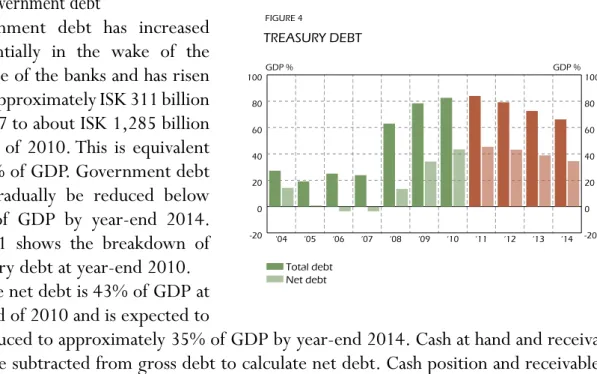
The central government’s total debt at year-end 2010 was equivalent to 83% of GDP. Government debt will gradually be reduced below 70% of GDP by year-end 2014. The net debt was 43% of GDP at the end of 2010 and is expected to be reduced to approximately 35% of GDP by year-end 2014.
The MTDS includes a description of the composition of the debt portfolio, inher-ent risk factors and continginher-ent liabilities. The institutional structure regarding debt management is also described in the MTDS. The Ministry of Finance is responsible for the central government’s debt management, sets the strategy and makes all decisions regarding debt issues. A special section within the Central Bank, Government Debt Unit, is responsible for the implementation of the Treasury’s debt management policies.
Finally, communication with market participants will be increased through publica-tion and meetings.
2. Debt Management Objectives
The Government’s overall main debt management objectives are fourfold:
1. To ensure that the Government’s financing needs and payment obligations are met at the lowest possible cost over the medium to long-term, consistent with a prudent degree of risk;
2. To establish a sustainable debt service profile consistent with the Government’s me-dium-term payment capacity;
3. To promote the maintenance and further development of efficient primary and sec-ondary markets for domestic government securities;
4. To broaden the Government’s investor base and diversify funding sources.
2.1 Goals of the MTDS
The Medium-term Debt Management Strategy (MTDS) lays down the Government’s debt financing plans for the next four years, i.e. during the 2011 – 2014. It is intended to be a working policy document that will be updated and revised annually.
The strategy has been formulated to establish clear debt management guidelines and quantitative targets, as well as to support the creation of analytical tools to identify, moni-tor, and mitigate potential risk factors inherent in the portfolio.
The MTDS provides a policy framework for undertaking liability management opera-tions aimed at minimising the Government’s interest expense consistent with a prudent degree of risk.
Communication with market participants will be increased. The Government will increase its visibility, e.g. through regular meetings with primary dealers and investors.
3. Guidelines for Debt Management
This chapter describes the guidelines for active management of the central government’s debt portfolio in the medium-term.
In order to meet the demand for new government securities issues and to increase the liquidity of marketable series, endeavours will be made to exchange non-marketable Treasury debt with marketable securities as market conditions will permit. A precondi-tion for paying off non-marketable Treasury debt with marketable securities is to ensure that it remains compatible with the objective of minimising the Treasury’s interest costs in the long-run, consistent with a prudent degree of risk.
3.1 Overall Composition of the Debt Portfolio
The following discussion regarding the composition of the debt portfolio excludes loans to strengthen foreign currency reserves. These loans are not actively managed in the same portfolio, but they are included in the discussion on refinancing of foreign bor-rowing, see chapter 5.
The composition of the debt portfolio is designed to address the above-defined debt management objectives, namely to minimise overall risk and to promote the develop-ment of a well-functioning market that appeals to a broad range of investors and to establish pricing benchmark for financial markets.
The Government will mainly issue nominal debt, as nominal Treasury bonds form a base for an efficient bond market. Inflation-linked Treasury bonds will also be issued, targeted towards long-term investors who have traditionally invested in such assets. There is also flexibility to borrow in foreign currencies. The proportion of foreign currency debt will though be low, to make management of the debt portfolio respond effectively to volatility in foreign exchange markets.
The guidelines for the composition of the Treasury’s debt portfolio are as follows:
Nominal 60–80%
Inflation-linked 20–40%
Foreign currency 0–20%
Figure 1 shows the composition of the debt portfolio excluding the cur-rency reserve loans in December 2010.
3.2 Guidelines for Borrowing
The Ministry of Finance, on the basis of the provisions of an act on national debt management, have set the guidelines to be applied to debt management. The main guidelines for the debt portfolio are:
1. The redemption profile:
The redemption profile of government securities should be as smooth as possible over time, with similar final size of individual issuances.
2. Benchmark series:
To establish liquid benchmark issues of Treasury bonds by taking into account the Treasury’s outstanding domestic liabilities when determining the number and size of new issues.
3. Proportion of short-term financing:
To limit the proportion of the Treasury’s short-term debt, (i.e. debt maturing within a twelve-month period), less any undrawn credit facilities, to a maximum of 30% of the entire Treasury’s total outstanding debt.
4. Duration:
The average time to maturity of the debt portfolio should be at least 4 years.
3.3 Quantitative Targets
The Government recognizes the importance of clear and measurable quantitative targets, by which it can evaluate its debt sustainability. The targets are based on Iceland’s economic programme and macroeconomic assumptions. The medium-term baseline projections show that between 2011-14:
FIGURE 1
DEBT PORTFOLIO COMPOSITION EXCL. CURRENCY RESERVE LOANS
Foreign currency 6% Inflation-linked 29% Nominal 65%
1. Debt to GDP will be below 70% by 2014 and below 60% in the long-term; 2. Redemption to GDP will be below 6%;
3. The deposit on Treasury Single Account will amount to at least ISK 80 billion. These targets are subject to revision in the macro and fiscal assumptions. The govern-ment will update them as circumstances require.
4. Domestic Issuance Plan
The financing needs of the Treasury will be funded through issuance of government securities in the domestic market and a decrease in the Treasury’s deposits at the Central Bank of Iceland. This chapter discusses the Treasury’s financing needs, the Treasury’s deposits and structure of government securities, including strategy regarding structure, issuance, redemption profile and average time to maturity.
4.1 Financing needs
The Treasury´s financing needs are based on budget assumptions made by the Ministry of Finance in relation to its economic programme. Net borrowing requirement is the sum of net cash provided by operating activities and financial transactions.
Table 1 presents the net borrowing requirements according to the fiscal budget for 2011-2014. The deficit on the fiscal budget will decline radically in 2011-2012. In 2013-2014 there is expected surplus which will be used to pay down Treasury debt.
Table 1
Net borrowing requirements
2011 2012 2013 2014
-57,400 -11,300 30,500 32,900
4.2 Deposits
The Treasury’s deposits at the Central Bank of Iceland amounted to approximately ISK 130 billion at year-end 2010. The present stock is sufficient to cover the maturities of Treasury bonds and bills in 2011. At any given time, the Treasury aims to hold deposits in its account at the Central Bank amounting to at least ISK 80 billion.
4.3 Structure of government securities
Gross borrowing requirement is the sum of net borrowing requirement and debt repay-ments. This section deals with the structure and setup of government securities.
4.3.1 Structure of marketable series
The structure of the marketable series will be designed so that each series is big enough to ensure active price formation in the secondary market. The aim is to issue a relative-ly stable amount of Treasury bonds through the year and to tap a number of benchmark points on the yield curve. To fulfil these aims, each year the benchmark Treasury bond series will be issued with maturities of 2, 5 and 10 years.
The 10-year series will be first offered with 11 years to maturity, and subsequently re-offered during the following two years with 10 and 9 years to maturity. The bond is reopened 6 years to maturity and re-offered with 5 and 4 years to maturity. Finally the bond is reopened 2 years to maturity.
Longer-term nominal bonds and medium to long-term inflation-linked bonds will be issued irregularly, depending on the Treasury’s financing needs.
The objective is for the final size of each issue series to be in the range of ISK 40-100 billion. Initially, the series will be built up relatively fast to a sufficient size to facilitate normal price formation in the secondary market. Table 2 shows the series that are scheduled to be issued.
Table 2
Series Maturity Issuing amount Frequency of issue
Treasury bills 3 and 6 months ISK 5-50 billion Monthly
Treasury bonds 2 years ISK 40-100 billion Annually
Treasury bonds 5 years ISK 40-100 billion Annually
Treasury bonds 10 years ISK 40-100 billion Annually
Treasury bonds Long-term ISK 40-100 billion Irregular
Inflation-linked Treasury bonds Long-term ISK 30-100 billion Irregular
In the beginning of 2011, changes were made to the issuance setup of Treasury bills. Issuance of Treasury bills will mainly be focused on maturities of 3 and 6 months, instead of issuance of 4 months bills. The 3 months Treasury bills will be offered monthly and the 6 months bill will be issued every second month. The 6 months Treasury bills will first be offered 6 months before maturity and then reoffered 3 months before maturity. The issuing amount will be flexible, in order to meet the Treasury’s financing require-ments.
4.3.2 Issuance of Treasury bonds as of 201
Issuance of Treasury bonds in 2011 will be ISK 120 billion. Issuance is expected to be reduced to below ISK 100 billion in the period 2012-2014.
An indication of issuance of Treasury bonds for the next years is demonstrated in table 3. The table is only for demonstrative purposes. In the table the government secu-rities that have already been issued are marked with their identification number, i.e. RB 12 0824 (nominal bond maturing August 24th 2012). For Treasury bonds that have not been issued the numbers before the dash indicate the maturity year and the numbers after the hyphen indicate the length of the bond, i.e. 2, 5 or 10 year benchmark series. The coloured-in cells show when the series are open. Issuance in series with other maturities will be irregular, depending on financing needs and investors´ demand.
Table 3
Example of Issuance Plan
Ár 2011 2012 2013 2014 2015 2016 2017 2018 2019 2020
TB TB TB TB TB TB TB TB TB TB
0 11 0722 12 0824 13 0517 14-2 year 15-2 year 16 1013 17-2 year 18-2 year 19 0226 20-2 year 1 12 0824 13 0517 14-2 year 15-2 year 16 1013 17-2 year 18-2 year 19 0226 20-2 year 21-2 year 2 13 0517 14-2 year 15-2 year 16 1013 17-2 year 18-2 year 19 0226 20-2 year 21-2 year 22-2 year
3 16 1013 19 0226 22-5 y
4 16 1013 19 0226 22-5 y
5 16 1013 19 0226 22-5 y 25 0612
6 19 0226 22-5 y 5 0612
7 19 0226 22-10 y 25 0612
8 19 0226 22-10 y 25 0612 28-10 y
9 22-10 y 25 0612 28-10 y
10 22-10 y 25 0612 28-10 y
11 22-10 y 25 0612 28-10 y 31-10 y
4.3.3 Redemption profile
One of the objectives of debt management, as discussed above, is to ensure that the redemption profile of the Treasury bonds is as even as possible in the long run. The tar-get range for the maturity of domestic Treasury bonds each year is ISK 40-100 billion. This reduces the repayment risk at the same time as liquidity in each series is supported. Figure 2 shows the redemption profile of the domestic liabilities at year-end 2010, excluding Treasury bills. For those years where redemptions exceed the target range, measures will be taken to reduce the redemption amount. If necessary, the Treasury will make buyouts and hold switch auctions to maintain the annual redemptions within the target range.
4.3.4 Average time to maturity
The average time to maturity of domestic Treasury securities is set to be at least 4 years. The Treasury has targeted efforts towards lengthening the dura-tion of its portfolio and has, among other things, issued 15-year Treasury bond in 2009 and 10-year inflation-linked Treasury bond in 2010 for that purpose. 0 50,000 100,000 150,000 200,000 250,000 0 50,000 100,000 150,000 200,000 250,000 ‘25 ‘24 ‘23 ‘22 ‘21 ‘20 ‘19 ‘18 ‘17 ‘16 ‘15 ‘14 ‘13 ‘12 ‘11 FIGURE 2
DOMESTIC REDEMPTION PROFILE
ISK million ISK million
Treasury Bonds
Refinancing of financial institutions Refinancing of CBI
State guarantees taken over Other domestic liabilities
The Treasury will manage the average time to maturity of the debt portfolio through issuance of Treasury securities over the coming years. If domestic market conditions per-mit, the Treasury will also avail of interest rate swap agreements, make buyouts and/or hold switch auctions to maintain the average time to maturity within the defined guidelines.
5. Foreign Borrowing
The government’s foreign currency borrowings are mainly done to strengthen foreign reserves.
Going forward, the foreign currency borrowing strategy is aimed at securing regular access to international capital markets and to maintain a well diversified investor base. In order to do so the Government aims at a regular issuance of marketable bonds. The main purpose of this strategy is to refinance already outstanding marketable bonds and over time to replace non-marketable, i.e. IMF programme related, with marketable instruments. A regular issuance of marketable instruments in the international capital markets is further intended to insure name recognition of the Republic of Iceland as an attractive investment option.
The Central Bank manages the reserves and uses the profile of foreign currency treasury debt as a benchmark for currency composition and duration of reserve assets. The aim is to minimize fluctuations in the value of the Central Bank’s net assets in for-eign currencies. This is in broad terms an asset and liability strategy where the govern-ment’s and Central Bank’s balance sheets are looked at on consolidated basis.
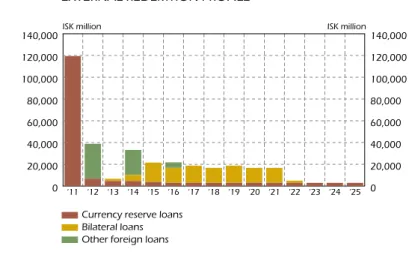
Figure 3 shows all out-standing foreign currency obligations of the Treasury.
Debt, totalling EUR 921 million, falls due in the medium-term: a Eurobond for EUR 638 million in December 2011, a syndi-cated loan for EUR 75 mil-lion in September 2011, and another Eurobond for EUR 208 million in April 2012.
At the beginning of 2010 the amount of external debt
maturing in 2011 and 2012 used to be larger. During 2010, the Government bought back part of the external debt. The buy-backs applied to Eurobonds as well as the syn-dicated loan. At year-end 2010, the buy-backs amounted to approximately EUR 629 million of the EUR 1,550 million external debt maturing in 2011 and 2012.
Part of external debt is related to the Government’s economic programme which is supported by the IMF. The aim of the Icelandic authorities is not to use the programme related liquidity sources for funding the fiscal deficit but to stabilize the foreign
cur-0 20,000 40,000 60,000 80,000 100,000 120,000 140,000 0 20,000 40,000 60,000 80,000 100,000 120,000 140,000 ‘25 ‘24 ‘23 ‘22 ‘21 ‘20 ‘19 ‘18 ‘17 ‘16 ‘15 ‘14 ‘13 ‘12 ‘11 FIGURE 3
EXTERNAL REDEMTION PROFILE
ISK million ISK million
Currency reserve loans Bilateral loans Other foreign loans
6. Debt portfolio
This chapter describes the total government debt portfolio including loans to strengthen foreign currency reserves, the composition, repayment profile and the investor base of government securities. The chapter also includes information on the Central Bank’s borrowing to strengthen foreign currency reserves. Figure 4 shows the development of Government debt from 2004-2010 and expected development to the year 2014.
6.1 Government debt
Government debt has increased substantially in the wake of the collapse of the banks and has risen from approximately ISK 311 billion in 2007 to about ISK 1,285 billion in end of 2010. This is equivalent to 83% of GDP. Government debt will gradually be reduced below 70% of GDP by year-end 2014. Table 1 shows the breakdown of Treasury debt at year-end 2010.
The net debt is 43% of GDP at the end of 2010 and is expected to
be reduced to approximately 35% of GDP by year-end 2014. Cash at hand and receiva-bles are subtracted from gross debt to calculate net debt. Cash position and receivareceiva-bles amounted to ISK 644 billion at the end of 2010.
Table 4
Treasury debt at the end of December 2010
Domestic ISK million
Marketable securities
Treasury bills 72,000
Treasury bonds inflation-linked 74,000
Treasury bonds nominal 350,000
Refinancing of financial institutions 226,200
Non-Marketable debt
Refinancing of CBI 163,500
State guarantees taken over 22,500
Other domestic liabilities 35,300
Total 943,500
External borrowing
Currency reserve loans
Bilateral loans 114,000
Other currency reserve loans 167,400
Other loans
Foreign loans 60,000
Total 341,400 Total 1,284,900
-20 0 20 40 60 80 100 -20 0 20 40 60 80 100 ‘14 ‘13 ‘12 ‘11 ‘10 ‘09 ‘08 ‘07 ‘06 ‘05 ‘04 FIGURE 4 TREASURY DEBT
GDP % GDP %
Total debt Net debt
6.1.1 Domestic borrowing
Marketable securities comprise Treasury bonds, Treasury bills and marketable bond to refinance financial institutions. At the end of 2010, total outstanding marketable securi-ties amounted to approximately ISK 722 billion, having increased from ISK 126 billion since 2007.
The Treasury issued a special government bond to finance capital contributions and subordinated loans to financial institutions. The series´ maturity is in 2018. Outstanding amount at year-end 2010 is ISK 226 billion. This series is with variable interest rate in order to hedge some of the interest rate risks on the banks liabilities side. This series is marketable and is listed on the NASDAQ OMX Nordic Stock Exchange.
Non-marketable debt consists of bond issued to refinance the Central Bank of Iceland and other domestic liabilities. In 2008, the government issued a 5-year inflation-linked bond to recapitalize the Central Bank of Iceland after the collapse of the banks. At year-end 2010, outstanding amount is ISK 164 billion. Other non-marketable debt is mostly attributable to the Treasury’s acquisition of the municipalities of Reykjavík and Akureyri’s stakes in Landsvirkjun. These are inflation-linked annuity loans with a maturity in 2034.
6.1.2 Foreign borrowin
Loans, which are contracted within the framework of the Government’s IMF supported economic programme, will be used to strengthen the currency reserves of the Central Bank. The bilateral loans, which are from Denmark, the Faroe Islands, Finland, Poland and Sweden, amount to ISK 228 billion (EUR 1,750 million) and will be disbursed
directly to the Central Bank of Iceland.1 The Faroese loan has already been fully
dis-bursed equivalent to ISK 6 billion (DKK 300 million), but the other loans will be paid in stages, as the IMF reviews Iceland’s economic programme. Currently, approximately half of the Nordic loans and approximately third of the loan from Poland have been drawn. Further drawdowns will be made as financing gap require. At year-end 2010, the Treasury’s borrowings in realation to the economic programme amounted to ISK 114 billion.
Other foreign currency loans to strengthen the foreign currency reserves amount to ISK 202 billion. These loans are a Eurobond issue of EUR 638 million, a syndicated loan of EUR 75 million and a Eurobond issued this year of EUR 373 million.
The Treasury has contracted other foreign loans to finance itself in previous years, which now amount to approximately ISK 60 billion. The proportion they make up of the total debt portfolio has been steadily decreasing.
6.1.3 IMF and Bilateral loans to the Central Bank
The loans from the IMF at the amount of ISK 250 billion (SDR 1,400 million) are part of government‘s economic plan and are paid directly to the Central Bank of Iceland. The bilateral loan from Norway amounting to ISK 74 billion (EUR 480 million) is also
paid to the Central Bank. These loans are used to strengthen the currency reserves of the bank and are not part of central government debt.
The Executive Board of the International Monetary Fund approved on September 29th 2010 the third review of the economic programme which opens access for Iceland to SDR 105 million from IMF and EUR 497 million through the third instalment of the bilateral loans. The fourth review was approved on January 11th 2010. That approval opens access to further SDR 105 million from IMF and EUR 497 million of the bilateral loans. In January 2011, no drawdowns have been made on the loans available following approval of the third and the fourth review of the economic programme.
6.1.4 Composition of the Treasury’s borrowins
Figure 5 below shows the marketable and the non-marketable debt of the Treasury includ-ing foreign currency reserves loans, divided into three main categories: nominal debt, inflation-linked debt, and foreign currency-denominated debt.
6.1.5 Redemption profil
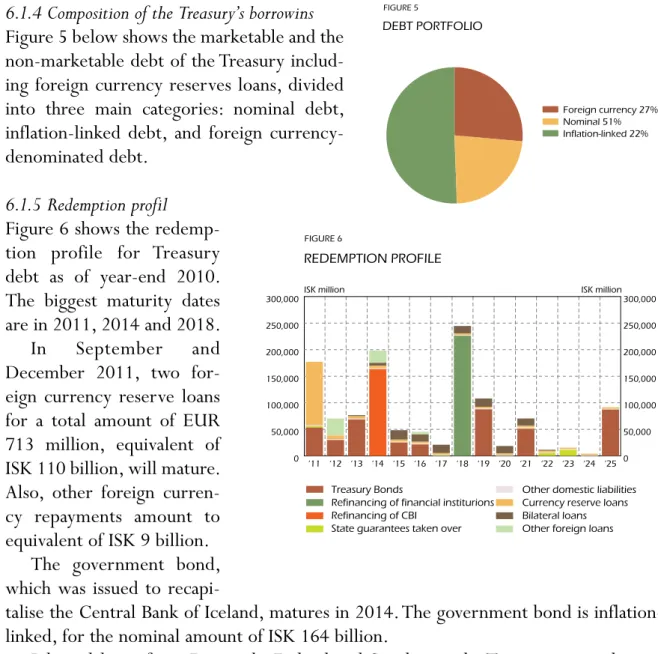
Figure 6 shows the redemp-tion profile for Treasury debt as of year-end 2010. The biggest maturity dates are in 2011, 2014 and 2018.
In September and December 2011, two for-eign currency reserve loans for a total amount of EUR 713 million, equivalent of ISK 110 billion, will mature. Also, other foreign curren-cy repayments amount to equivalent of ISK 9 billion.
The government bond, which was issued to
recapi-talise the Central Bank of Iceland, matures in 2014. The government bond is inflation-linked, for the nominal amount of ISK 164 billion.
Bilateral loans from Denmark, Finland and Sweden to the Treasury are re-lent to the Central Bank. At the end of 2014, the repayment of bilateral loans will commence and will be paid in equal instalments over a period of 7 years. The loan from the Faroe Islands will be repayed with three isntalments in years 2014-2016. The figure doesn’t include the redemption profile of undrawn bilateral loans.
0 50,000 100,000 150,000 200,000 250,000 300,000 0 50,000 100,000 150,000 200,000 250,000 300,000 ‘25 ‘24 ‘23 ‘22 ‘21 ‘20 ‘19 ‘18 ‘17 ‘16 ‘15 ‘14 ‘13 ‘12 ‘11 FIGURE 6 REDEMPTION PROFILE
ISK million ISK million
Treasury Bonds
Refinancing of financial institurions Refinancing of CBI
State guarantees taken over
Other domestic liabilities Currency reserve loans Bilateral loans Other foreign loans
FIGURE 5
DEBT PORTFOLIO
Foreign currency 27% Nominal 51% Inflation-linked 22%
The government bond that was issued to recapitalise the new banks matures in October 2018. The current value of the bond is ISK 226 billion but it is expected that the amount will increase to ISK 246 billion. Assets against the bond are shares in finan-cial institutions and loans to finanfinan-cial institutions.
The summary of the redemption profile does not take into account obligations that may fall on the state as a result of Icesave; these will be discussed in greater detail in section 7.3.2.
6.2. Investor base
The Treasury endeavours to offer a broad range of securities with varying maturities. The objective is to appeal to a broad base of investors and limit financing costs.
Figure 7 gives a breakdown of the hold-ers of domestic Treasury bonds and bills as of year-end 2010.
Financial institutions are the largest investors of Treasury securities. They hold ISK 238 billion which is 32% of outstanding Treasury securities. The large ownership of financial institutions is mainly because the new banks where capitalized with a special Treasury bond issue, RIKH 18 1009, for
ISK 193 billion.
Foreign investors are the second largest group of holders of Treasury securi-ties and are estimated to hold 29% of the securities, in the amount of ISK 212 billion.2 Most of their
hold-ings are in securities which mature in 2011-2013.
Pension funds are the third largest group of inves-tors of Treasury securities. The pension funds hold 13% of outstanding Treasury securities.
2. In the Icelandic Securities Depository system, foreign investors are defined as legal entities with for-eign ID numbers, however, it should be noted that some of these forfor-eign ID numbers may belong to foreign investment companies owned by Icelanders.
FIGURE 7
OWNERS OF TREASURY SECURITIES
Source: Icelandic Securities Depository.
Financial Institutions 33% Mutual and Inv. Fund 15% Pension Funds 13% Others investors 11% Foreign investors 29%
0 500,00 100,000 150,000 200,000 250,000 0 500,00 100,000 150,000 200,000 250,000 FIGURE 8
OWNERS OF TREASURY SECURITIES
ISK million ISK million
Source: Icelandic Securities Depository.
Financial Institutions Mutual and Inv. Fund Pension Funds Others Foreign investors RIKS 21 0414 RIKH 18 1009 RIKB 25 0612 RIKB 19 0226 RIKB 13 0517 RIKB 12 0824 RIKB 11 0722 RIKB 10 1210 TREASURY BILLS
Mutual and investment funds are the fourth largest holders of Treasury securities. Investment and mutual funds have increase their investment in Treasury securities as their investors have become more risk averse. Also, the stock market has yet to recover and investment in foreign markets is not possible because of capital control.
7. Risk Management
The debt portfolio has certain inherent risks related to market volatility, such as changes in the interest rate, foreign exchange rate and inflation, as well as the additional risks related to contingent liabilities. There is also a substantial refinancing risk in the current portfolio. The management of these various risks is covered in this chapter.
7.1 Market risk
Volatility of the financial markets – be it due to fluctuations in interest rates, foreign exchange rates, or changes in inflation – results in increased volatility of the debt port-folio. These risks are generally termed “market risks” and are discussed in more detail in the chapters below.
Effective risk management aims to minimise risk while simultaneously minimising costs. This goal can be achieved through proper management of the portfolio and issu-ance programme, and partly through the targeted use of derivative products.
7.1.1 Interest rate risk
One of the main goals of Government debt management is to minimize interest rate cost of Treasury’s debt with acceptable risk. Interest rate risk can be reduced through interest rate swap agreements.
Figure 9 shows the interest rate composition of the debt port-folio, a part of about 32% of the total debt portfolio bears variable rates and is therefore exposed to interest rate changes.
7.1.2 Currency risk
Currency risk is defined as the in-creased volatility in the portfolio due to changes in the foreign
ex-change rate of the ISK to other currencies. The Treasury’s direct currency risk is limited, because the Treasury re-lends the external loans to the Central Bank to strengthen the currency reserves.
The currency reserves of the Central Bank of Iceland are actively managed between various currencies, according to set guidelines. One of the objectives of the Central Bank is to minimize the exchange rate risk of the currency reserves.
FIGURE 9
INTEREST RATE COMPOSITION - DECEMBER 2010
Fixed foreign 13% Variable foreign 13% Variable domestic 19% Fixed domestic 32% Inflation-link domestic 23%
7.1.3 Inflation risk
Changes in the inflation rate have a direct impact on the Treasury’s financing costs, as a significant and growing proportion of the debt portfolio is in inflation-linked securities. The Treasury’s inflation-linked loans reached ISK 295 billion at the end of 2010.
Inflation risk can also be managed with derivatives, however, at this time the deriva-tive market is not functional in Iceland. Treasury will be able to manage inflation risk as soon as the markets are functioning normally. In the meantime, the Treasury is exposed to inflation risk. However, it is also important to take into account that the Treasury has many inflation-linked assets, such as the loan to the Student Loan Fund, which will in part mitigate some of the inflation risk.
7.2 Refinancing risk
One of the greatest risks of the debt portfolio is the refinancing of the debt. To reduce the refinancing risk, the Treasury aims to maintain the redemption profile of govern-ment securities as smooth as possible over time, with similar final size of individual issuances.
The following summarises the largest maturities, and therefore the potential risks, in the portfolio:
(a) 2011 Currency reserve loans ISK 119 billion
(b) 2014 Refinancing of CBI ISK 164 billion
(c) 2018 Refinancing of the banks ISK 226 billion
(a) Foreign currency reserve loans, totalling ISK 135 billion and maturing in 2011, have been re-lent by the Treasury to the Central Bank. At year-end 2010, the size of foreign currency reserves cover maturing debt in foreign currencies until 2015.
(b) In December 2008, the Treasury issued an inflation-linked bond of ISK 164 bil-lion maturing in 2014 to the Central Bank of Iceland to strengthen its capital position. The Treasury will refinance this loan by issuing marketable bonds before the maturity.
(c) The government bond, amounting to ISK 226 billion, that was issued as an equity capital contribution and subordinated loans to the banks matures in 2018. It is expected that the outstanding amount will increase to ISK 246 billion. The net refinancing risk of this bond is lower as ISK 54 billion will be repaid with the subordinated loans to the banks.
One of the challenges to refinancing the portfolio is the significant holdings of for-eign investors and the possibility that they may choose not to reinvest in government securities. It is the Treasury’s task to minimize the impact that lifting of capital controls might have on the central government’s debt management.
At year-end 2010 the Government will hold approximately ISK 130 billion deposit on treasury single account in Central Bank of Iceland, which can fund the redemption on Treasury bonds and bills in 2011 and reduce the refinancing risk.
7.3 Contingent liabilities
Contingent liabilities are the fiscal risks the state has to bear, due to State guarantees or government decisions to intervene in the management of municipalities or companies that play a key role in the society. A discussion of the magnitude of the risk is covered in sections 7.3.1 - 7.3.4.
7.3.1 State guarantees
State guarantees are governed by Act no. 121/1997. The Icelandic Althingi issues State guarantees upon receiving requests from the Ministry of Finance.
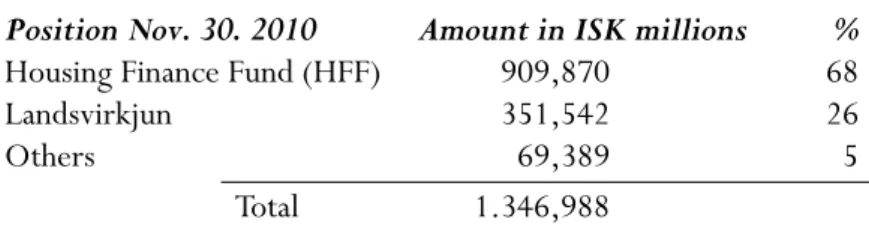
The State Guarantee Fund handles State guarantees and receives information from the companies that benefit from them. The administration of State guarantees is han-dled by the Central Bank, under the terms of a special agreement with the Ministry of Finance. The State Guarantee Fund notifies the Ministry of Finance if a guarantee is likely to fall on the Treasury. Table 5 shows the position of State guarantees at end of November 2010.
Table 5 State Guarantees
Position Nov. 30. 2010 Amount in ISK millions %
Housing Finance Fund (HFF) 909,870 68
Landsvirkjun 351,542 26
Others 69,389 5
Total 1.346,988
State guarantees amount to ISK 1,347 billion, which equals approximately 86% of GDP. State guarantees have mainly been granted to two entities: the Housing Financing Fund and Landsvirkjun. The Housing Financing Fund and Landsvirkjun hold State guar-antees for a value of ISK 910 billion and ISK 352 billion, respectively.
7.3.1.1 Housing Financing Fund
Pursuant to Housing Act no. 44/1998, the Housing Financing Fund (HFF) has the role of offering loans to finance house purchases in Iceland and is monitored by the Financial Supervisory Authority. According to interim financial statements at end June 2010, assets balanced against HFF Treasury guarantees amounted to ISK 833 billion and the capital stock was ISK 8.4 billion, while the capital adequacy ratio (CAD) is therefore around 2.1%.
The capital adequacy ratio target for the HFF is 5.0%. The Fund has to report to the Ministry of Social Affairs and Social Security if the capital adequacy ratio is below 4.0% and propose solutions to fulfil the target of 5.0%. In the second half of 2010, a special committee with members from the Ministry of Social Affairs and the Ministry of Finance has estimated the HFF’s capital need based on the Fund’s business plan and estimated development of its loan portfolio. In December 2010, the Althingi author-ised the Treasury to strengthen HFF’s equity by an amount that is to maintain its capital adequacy ratio above target in the medium term, based on HFF’s business plan.
The lending risk of the HFF has increased as a result of the economic recession. There has been a rising trend in the incidence of defaults and seizures of residential property. It should be noted that the lending risk of general HFF loans is less than it is with banks because the lending rules of the HFF were more stringent, since the maxi-mum loan was ISK 20 million with an 80% loan to value (LTV) ratio, according to the assessment of Land Registry of Iceland. All HFF loans are nominated in ISK.
The outstanding HFF bond series are four with final maturities in 2014, 2024, 2034 and 2044. At year-end 2010 outstanding HFF bonds amounted to ISK 808 billion. 7.3.1.2 Landsvirkjun
Landsvirkjun’s funding going forward is mainly in US dollar as most of its income is USD denominated. The principal risk factors in the financial management of Landsvirkjun are refinancing and development of aluminium prices. The corporate has an active hedging program to mitigate aluminium price risk. Further more, Landsvirkjun has renegoti-ated a power sales agreement with Rio Tinto Alcan where aluminium price linkage is replaced with US CPI linkage, reducing aluminium price risk.
In 2010, Landsvirkjun became the first Icelandic entity to issue Eurobonds after the financial crisis in 2008. The largest debt maturities in the short to medium-term are in 2011 and 2012. Liquidity position is strong, cash and undrawn revolving credit facilities ensure that the company can meet all its financial obligations well into the year 2013. Cash flow from operations will also be used to lower debt levels in the coming years according to Landsvirkjun’s management. Therefore the risk that the State guarantee will be called is limited in the medium-term.
7.3.2 Icesave
Icesave was an online retail bank operating in the UK and Netherlands as a branch of Landsbanki, a privately owned Icelandic bank. The bank operated under EU/EEA finan-cial regulations. As a branch of the Landsbanki, Icesave was subject to surveillance by the Icelandic Financial Supervisory Authority (FME).
Following the collapse of the Icelandic banking system, including Landsbanki and Icesave, the Icelandic government has not acknowledged a liability to cover an amount equal to the minimum deposit guarantees (EUR 20,887 per depositor) according to the EU Deposit Guarantee Directive. However, the governments of Iceland, Netherlands and UK have had formal negotiations on settlement of the minimum deposit guarantees paid by the Netherlands and the UK, EUR 1.33 billion and GBP 2.35 billion respec-tively.
The negotiating committees of the three governments initiated an agreement on the level of negotiators on 8 December 2010. The agreement will not come into effect unless the Althingi has given its authorisation for the government to undertake the obli-gations according to the agreement.
The results of the negotiations provide for the conclusion of Reimbursement and Indemnity Agreements involving the states concerned and the respective Depositors’ and Investors’ Guarantee Funds (TIFs).The agreements provide for the Icelandic TIF
to reimburse to the UK and Dutch authorities the amounts which they advanced for this purpose, and to receive in return the corresponding portion of their claims against the bank’s estate and handle their collection. Before this is effected, the Icelandic TIF is expected to utilise the funds it already possesses for reimbursement. Thereafter, pay-ments will be made following distributions from Landsbanki’s estate until the end of June 2016.
Liability of the state is limited as far as possible and in fact solely limited to (a) pay-ment of interest as it accrues until June 2016, and (b) the portion which has not been recovered from the bank’s estate after that time (the shortfall).
The interest provisions of the new agreements are in two phases. Firstly, the interest rate is fixed until mid-2016. Interest on the Dutch portion of the loan is 3.0% and 3.3% on the UK portion. The average interest rate is approximately 3.2%. Under the agree-ments no interest is calculated on the obligations until after 1 October 2009 (equivalent to a 9-month interest holiday as compared to the previous agreement). Accrued interest for 2009 and 2010 is paid at the beginning of 2011. Interest is paid quarterly from the beginning of 2011 until mid-2016. In the second phase, under the agreement the inter-est on any outstanding principal on the loans after mid-2016 will be the appropriate Commercial Interest Reference Rates (CIRR).
The negotiating committee has estimated the cost which Iceland can be expected to incur in implementing the agreement. This estimate is based on an assessment by Landsbanki’s Resolution Committee of recovery of the estate’s assets, the outlook for distributions to creditors, as estimated by the bank’s Winding-up Board, and assump-tions of the Central Bank of Iceland concerning exchange rate developments.
The conclusion of this estimate is that the cost which will be borne by the Treasury will be less than ISK 50 billion, or approximately 3% of GDP. This is assuming that some ISK 20 billion of the current assets of the TIF have been utilised for the obligations.
Risk factors in the agreements are primarily three and concern the recovery of the assets of the Landsbanki’s estate, the timing of payment of claims and exchange rate developments.
The agreement includes two macroeconomic provisons, which on the one hand place a ceiling on annual payments from the Treasury and on the other hand extend the term of the loan automatically if the outstanding principal remaining of the TIF’s obli-gations is higher than a specified amount, in proportion to the amount remaining. The provisions are to ensure categorically that repayments of Icesave obligations will always be within quite manageable limits.
Ceiling on annual payments by the state after 2016 is 5% of Treasury revenue of the preceding year. Should the amount equivalent to this proportion of the state’s revenue prove to be lower than 1.3% of GDP, the maximum repayment shall be based on this percentage of GDP (1.3% of GDP is currently equivalent to around ISK 20 billion).
If the residual of the principal of the TIF’s obligations amounts to less than the equiv-alent of ISK 45 billion, this is to be paid in full within 12 months, i.e. in the latter half of 2016 and the first half of 2017. In the event that the outstanding obligation is higher, the repayment period is lengthened by one year for each ISK 10 billion, although with
the limit that the amount outstanding must be paid by the end of a 30-year repayment period beginning in 2016.
7.3.3 Local governments
Local governments play an important role in Icelandic society. The economic recession has had negative impact on the municipalities’ revenues. Debt levels are also higher as a result of a weaker ISK as some of the municipalities financed investments by foreign currency loans. The redemption profile of local government debt is front loaded with significant refinancing need in 2011 - 2013.
The Ministry of Transport, Communication and Local Government oversees and closely monitors the financial positions of the municipalities. The Ministry is now revis-ing the current legislation on local governments. A new legislation will be presented to the parliament in 2011, which includes new fiscal rules for local government. According to the new fiscal rules, operations should generate surplus over each 3 year period. Also, the fiscal rules limit how much debt municipalities are allowed to have as a proportion of revenues. Debt ratios should not exceed 150% of revenues.
7.3.4 Public-private partnership
Public-private partnership (PPP) is governed by regulation no. 343/2006 on the making of servicing contracts. The purpose of the regulation is to define the role and respon-sibilities of those entities that manage long-term projects for individual ministries and public institutions.
The preparation of agreements is articulated in three stages. The first stage involves a preliminary examination of the cost-effectiveness and premises of the project that must be approved by the Ministry of Finance. In the following stage the agreements are draft-ed with a more detaildraft-ed definition of the project. In the third stage the parties to the agreement are selected in compliance with the rules governing public procurement.
The State Trading Centre is the central agency that handles procurement for public institutions and provides assistance and guidelines on agreements of this kind. The fi-nancial objective of these agreements is to boost the cost-effectiveness of procurement in such a way that it strengthens and maintains competition in the market and builds up markets where they don’t exist.
According to the Government Financial Reporting Act, agreements of this kind have to be approved by the Althingi. The Ministry of Finance has also issued guidelines on the making of service and PPP contracts.
8. Institutional Structure
The Althing authorises the Ministry of Finance to borrow and issue State guarantees each year according to national budget. The Act on the National Debt Management stipulates that the Ministry of Finance is responsible for and implements debt manage-ment and State guarantees. The Act also gives the responsibility of liability managemanage-ment to the Ministry of Finance, which in turn has made an agreement with the Central Bank
of Iceland on the provision of advice and the execution of the Treasury’s debt manage-ment. The agreement ensures that the Central Bank of Iceland’s monetary policy has no impact on the Treasury’s debt management.
8.1 Ministry of Finance
A special division within the Financial Management Department of the Ministry of Finance deals with debt management. The Ministry of Finance decides on the volume of issuance, proposed bond auctions and liquidity management. Furthermore, the Ministry determines the yield and amounts on accepted bids in auctions of Treasury instruments, as well as the structure, maturity, and characteristics of individual debt issues, and approves any buybacks and/or swap agreements.
8.2 Agreement with the Central Bank of Iceland
The Ministry of Finance has made an agreement with the Central Bank of Iceland on the
provision of advice and the implementation of Treasury debt management.3 The purpose
of this Agreement is to promote a more economical, efficient and effective debt admin-istration for the Treasury, based on the Ministry of Finance’s debt management strategy. Under the terms of the agreement, the Central Bank is responsible for the provision of advice and execution of the Treasury’s debt management.
A special section within the Central Bank of Iceland, administers debt affairs and debt implementation with the authorisation of the Ministry of Finance and in accord-ance with guidelines set by the Ministry. The Bank’s Government Debt Unit is respon-sible for ensuring that borrowing and liability management are in harmony with the policies set by the Ministry.
The Government Debt Unit also handles the administration of State guarantees and assesses the Treasury’s risk due to such guarantees. The Unit provides the Ministry with opinions on State guarantees and grants such guarantees, on the basis of parliamentary decisions.
The Unit, on behalf of the Ministry of Finance, handles the regular disclosure of information on the Treasury’s domestic and foreign loan stock to market participants, and publishes information on auction days and planned volume of issuance for the year on the basis of the Government’s estimated borrowing requirement. It also issues press releases on behalf of the Ministry of Finance.
8.3 Debt Management Consultative Committee
The Minister of Finance appoints a Consultative Committee on Debt Management, which comprises representatives from the Ministry and the Central Bank of Iceland.
The Consultative Committee acts as a forum for the exchange of opinions on the position and prospects of financial markets, and the Treasury’s debt management and
borrowing plans, both domestically and abroad. The committee is also intended to facili-tate enhancements to the domestic credit market, where necessary.
The committee submits proposals to the Minister of Finance concerning the form of individual series of government securities, maturities, size, proposed market-making and auction arrangements. The committee also submits the proposed criteria for the risk management of the Treasury’s debt portfolio in domestic and international markets. The committee discusses and processes the proposed Treasury’s Issuance Calendar for the domestic and international markets. The calendar specifies the volume of issuance for the year, issuance dates and the measures that are being envisaged for the credit mar-ket that year. The calendar needs to be endorsed by the Ministry of Finance and is later announced to market participants. The committee meets monthly or more frequently if necessary.
9. Market Communication
The Ministry of Finance and the Government Debt Unit will increase communication with market participants through publication and meetings. Annual borrowing plan is presented to the market by the Ministry of Finance after the fiscal budget has been approved by Althingi. Furthermore, meetings will be held with primary dealers and end-investors.
The Ministry of Finance and Government Debt Unit will publish following docu-ments regarding Government Debt Management:
• Medium-term Debt Strategy (MTDS)
• Annual Borrowing Plan (ABP)
• Quarterly Financing Announcement (QFA)
• Auction Preview (AP)
All press announcements are published on the NASDAQ OMX Icelandic Stock Exchange, Bloomberg and are distributed to the media and market participants. The NASDAQ OMX use GlobeNewsWire newswire distribution company to broadcast all the press announcements to the media and market participants globally.
9.1 Medium-term Debt Management Strategy
The Ministry of Finance produces the MTDS which is reviewed and published yearly. Presentation to the market participant will include following subjects:
• Government debt strategy
• Emphasis in issuing strategy
• Structure in government securities issuance
• Average time to maturity
9.2 Annual Borrowing Plan
The ABP is published as soon as the fiscal budget has been approved by the Parliament and contains the following information:
• Total issuing amount for the year
• Emphasis in issuing strategy for the year
• Buybacks
• Exchange auctions
The ABP aims to give market participants general information about the Government debt for the coming year.
9.3 Quarterly Financing Announcement
At the end of each quarter the Government Debt Unit will publish QFA. The QFA will contain detailed information about issuance of individual Treasury securities in the quarter.
• Treasury bond issuance
• Treasury bill issuance
9.4 Auction announcements
Auction Preview (AP) is published few days before each auction. The results of the auc-tion are published in a subsequent press announcement after the aucauc-tion.
9.5 Auction calendar
In December each year auction calendar is published on the website of the Government Debt Unit and distributed to market participants. The auction calendar contains sched-uled auctions for Treasury bonds and bills.
9.6 Market information
The Central Bank’s Government Debt Unit publishes a monthly newsletter entitled Market Information. The bulletin provides the main information about Government debt and State guarantees. Market Information is distributed to the media and market participants. It is also available on the website of the Government Debt Unit. The bul-letin contains the following information:
• Results of government auctions
• Government debt
• The position on marketable debt
• Composition of the debt portfolio
• Redemption profile
9.7 Government Debt Website
The Government Debt Unit has a website, www.lanamal.is, with information on Government debt. The website includes all publications regarding Government Debt Management, information about market price, yields and historical data on government securities and registration statements on government bonds and also:
• Medium-term Debt Mangement Strategy
• Annual Borrowing Plan
• Qquarterly Financing Announcement
• Auction Preview
• Market Information
• Press announcements
• Credit rating
Information on government debt can also be attained on the Ministry of Finance website, www.ministryoffinance.is.
9.8 Primary dealers
The Government Debt Unit oversees the daily business of primary dealers and meets with them at least quarterly and more often if necessary. A representative from the Ministry of Finance attends also these meetings.
9.9 End investors
Communication channels with end investors will be enhanced. Representatives from the Government Debt Unit and the Ministry of Finance will have meetings with end investors to get their feedback on the issuing strategy.