* Corresponding author. E-mail: [email protected]
Copyright © 2019 The Author(s). Published by RTU Press
This is an Open Access article distributed under the terms of the Creative Commons Attribution
ELASTIC FOUNDATION
DISPLACEMENT APPROXIMATIONS
VYTAUTAS KARGAUDAS1, NERIJUS ADAMUKAITIS2*,
MYKOLAS ŽMUIDA3,ALGIS PAKALNIS4,
SAULIUS ZADLAUSKAS5
1,2,3,5Civil Engineering and Architecture Competences Centre,
Kaunas University of Technology, Kaunas, Lithuania
4Dept of Transport Engineering, Kaunas University of Technology,
Kaunas, Lithuania Received 10 April 2018; accepted 07 September 2018
Abstract. Interaction of an elastic foundation and structures like beams, plates and frames plays an essential role in investigating soil media in contact and impact mechanics. The solution to this interaction problem is complicated even the foundation is assumed as a linear elastic medium. E. Winkler suggested the fair representation of the foundation in 1867, and then, to bring it closer to reality, an interaction between the spring elements was introduced. In this paper, a relatively simple membrane-spring system is investigated, where an ideal gas is added under or above the membrane. In many cases, this constant pressure in the cavity modifies the solution and accuracy of the approximation is significantly increased. The cases of concentrated normal force and uniform distributed load are examined. The results of elastic half-space line displacements and the membrane displacements are presented.
20 19/14 (2 )
Introduction
The interaction between a foundation and supporting soil media is essential for structures and soil behaviour. The natural complexity of the problem has led to the development of many idealised models of soil, based on the classical theories of elasticity and plasticity (Vasani, 2003). Elastic models assume soil media as a linear elastic continuum. In Winkler (1867) model, surface displacement of the soil at every point is directly proportional to the stress applied. A similar model has also been used in the aerospace analysis to represent the effect of the air pressure of supersonic gas stream flow (Ashley, 1956). The real deflection at a surface point depends on the pressure at this point and also on the entire pressure distribution. The next grades are Filonenko-Borodich and Pasternak models. Initially, a generalisation of the Winkler model has been proposed introducing a shear layer at the top of the Winkler bed of linear springs (Filonenko-Borodich, 1940). This model is equivalent to dispose of a stretched wire at the top of the foundation columns (Pasternak, 1954). Several other kinds of extensions of the Winkler model are found in the specialised scientific literature to overcome unrealistic edge effects observed with the use of simplified models (Kerr, 1964; Kerr & Coffin, 1991; Reissner, 1958; Vlassov, 1966). Some other studies have been devoted to the time evolution of the
foundation response (Omurtag & Kadıoḡlu, 1998) often focus on the
structural response (Kneifati, 1985; Sironic, Murray, & Grzebieta, 1999) or to stability studies of columns on foundations of various kind (Lin & Adams, 1987). The Hetenyi (1950) model is also a two-parameter elastic model. Kerr (1984) outlines the presentation and comparison of the elastic models.
Furthermore, Di Paola, Marino, & Zingales (2009) showed that elastic foundation models might be referred to as gradient models, which involve some nonlocality. By the variation formulation of the Reissner model, Challamel, Meftah, & Bernard (2010) investigated the buckling of an axially loaded Euler-Bernoulli model supported on an elastic nonlocal medium. Nobili (2012) presents the Hamiltonian variation formulation of the contact problem for a Euler-Bernoulli beam on Pasternak foundation. Horvath & Colasanti (2011) investigate another one subgrade model with spring coupling called the modified Kerr-Reissner model. Worku (2014) develops Pasternak or Filonenko-Borodich models. The simplest continuum model of Vlahos (1966) is compared and parameters evaluated.
Algis Pakalnis, Saulius Zadlauskas Elastic Foundation Displacement Approximations
perfect gas pressure between the membrane and the rigid foundation is proposed. Modification of the solution and a significant increase in accuracy is investigated.
1.
Concentrated normal force
An elastic half-space is loaded one-dimensionally over a narrow strip (the line loading), a state of plane strain is assumed. The concentrated force of intensity P per unit length, distributed along the y-axis, causes a surface displacement (Johnson, 1987):
w P
E x
x
J o
2
*log (1)
where E* 1 E 2 and E is Young modulus, MPa; – Poisson ratio rxvx kv T
(Figure 1). When x → ∞ the displacements wJ → –∞ if elastic half-space
has no limits. The distance x0, where displacements wJ = 0, depends on
the real sizes of the elastic body l and h. The Winkler model is unsuitable for the concentrated force, but when a membrane is placed over the distributed spring system, the displacements wm are bounded on the whole surface –∞ < x < +∞.
Equilibrium of the membrane yields is: T d w
dx2 kw 2
, (2)
Fz = –kw, (3)
Where T− the tension force per unit length, N/m; Fz− the spring force
component, N/m2.
Note: the concentrated force P is distributed along the y-axis.
20 19/14 (2 )
The solution to the Eq. (2)is
w C e rxC erx
1 2 , r
k T
= (4)
bounded when C2 = 0. The total force applied to the whole membrane
when x ≥ 0 is
Fz P k wdx
2 0 0
. (5)
The constant C rP k
12 and solution Eq. (4) is
wm rP ek rx
2 . (6)
Let deflection line Eq. (6) of the membrane has to be approximated to the solution Eq. (1) inside the interval [–xv, + xv]. If x
xv
ξ ,
xv
ξ x0 then the
difference w w P E
J m
2
* , where
log 0 S e
m (7)
and
S E
kT
m *
4 , rxvx kv T . (8)
The constants Sm and rx x k T
v v
, which minimise the integral (Eq. (9))
Sm,0 1 2(9)
need to be estimated. The tension force and the spring constant follows from Eq. (8) T x E
S
v m
*
4 , and k E x Sv m
*
4 . Does the problem be what real
possibilities of approximation of the logarithm function by exponentials are? The ratio x
xv 0
0 in Eq. (7) is specified by the elastic body.
The integral Eq. (9) is
2 2 2 1 1
2 2 0
0 0 2
2
log log Sm e Sm e Sm (10)
where the function 01e log d 1 01e 1d . This function presented by the series
j j
j j
1 1
Algis Pakalnis, Saulius Zadlauskas Elastic Foundation Displacement Approximations
convergent for all α < ∞. Nevertheless, if � α > 4.7 it is better to apply �
asymptotic approximation (Prudnikov, 2018):
2 j0 j
e
j! log C , (12)
which is deduced substituting exponential integral E x e
x dx i x x
,Ce = 0.577216 is the Euler constant. If the terms with j > 14. (Eq. (11)) and
with j > 9 (Eq. (12)) are neglected, the error for both series < 0.00009% or
0.023% as 4 7. 0 45246. .
From the Eq. S
m
, the solution for Sm, like a function of rx x k T
v v
, is deduced, and then the function
SmSm , depends only on rx x kT
v v
.
In Figure 2, the deflections wJ and wm are displayed when the
interval of interest is [–xv, +xv], xv =2x0. When x → ∞ the membrane
displacements Eq. (6) are positive, but displacements of the elastic half-space surface line, if x = xv, are negative. Therefore the relative error
0 1 2 0 1 2 100 m
% of the best approximation (Sm = 2.40, when
rx x k
T
v v
= 1.004) is
0 1 2 0 1 2 100 m % ≈ 58.8%,mS em . If 01, xv= x0, = 1.004, rxv x kvSm = 3.50 and T
relative error
0 1 2 01 2 100
m
%
= 17.3%. When the concentrated normal force is applied,
Figure 2. Deflections
log 0g0 S e m
J and
log 0g0 S e m
m as functions of the relative distance
log 0
0
S em S
when log 0 0
S em S
= 0.5 and concentrated force P is applied
20 19/14 (2 )
deflections of the elastic body wJ→ ∞ if x→ 0, whereas deflection of the
membrane at x = 0 is w rP k
S P E
m m
2 2
* ,
m m m
E w
P S
*
2 ; consequently,
a substantial error is caused by the principle presumptions of these two models.
2. Ideal gas under the membrane
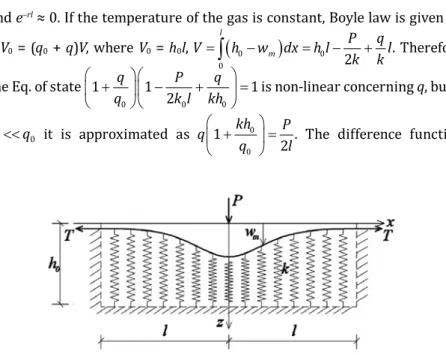
A significant correction in the membrane model is achieved if an ideal gas is added under the membrane (Figure 3). The pressure of the gas is assumed q0 when the force P = 0and the pressure is q0 + q, if P is
applied. The resultant force component now is Fz=–kw – q, and solution
Eq. (6) is w rP k
2 e
q k
m rx . Equilibrium condition Eq. (5) is
Fz P k wdx ql
l
2 0 0, where l is the horizontal size of the body and the
membrane shown in Figures1 and 3. It is assumed that l is sufficiently large and e–rl ≈ 0. If the temperature of the gas is constant, Boyle law is given by
q0V0 = (q0 + q)V, where V0 = h0l, V h w dx h l Pk qkl
l
m
0
0 0
2 . Therefore
the Eq. of state 1 1
2 1
0 0 0
q q
P k l
q
kh is non-linear concerning q, but if
qq0 it is approximated as q kh q
P l 1
2
0
0
. The difference function
Algis Pakalnis, Saulius Zadlauskas Elastic Foundation Displacement Approximations
Eq. (7) now is
log 0
0
S em S, (13)
where
S E
kl kh
q
0
0
0
4
1
1
*
. (14)
The dimensionless number S0 = logg0 in Figure 3 is positive, but if
the cavity for the ideal gas is above the membrane, the volume of S0 is
negative. Eq. (13) reduced to
log 0g0 S e
m , 0 < g0< ∞. Selecting the
value of hq
0
0 in Eq. (14), vary the product 0g0 0
*
. Mostly the value of 0g00*
for which error of membrane approximation is minimal, then calculate the constants g0 S
0
0
0
*
exp and qh
0
0 is calculated. If the gas pressure
is included, the displacements wm are negative for x > x0, as it is for the
elastic bodies (Figure 1).
When concentrated normal force is applied, 0g00*
= 20 is determined and then parameters rx x k
T
v v
= 1.004, Sm = 5.834 calculated. The integral
Eq. (9) for these values 0 188. and a relative error is only 9 9. %
(Figure 4).
Figure 4. Deflections
log 0g0 S e m
J and
log 0g0 S e m
m as functions of
log 0
0
S em S
when
log 0
0
S em S
= 20 and concentrated force F is applied.
1.0 0.8
0.6 0.4
20 19/14 (2 )
3. Distributed load
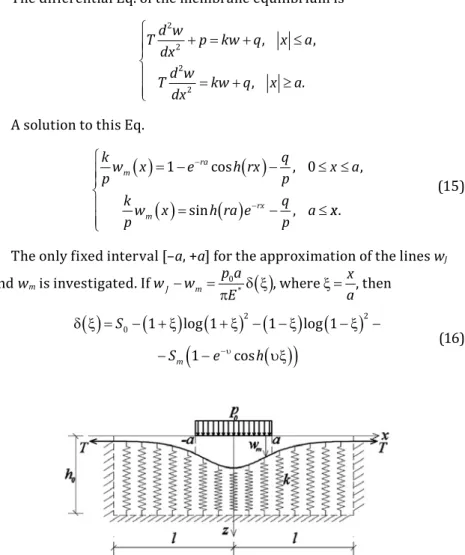
The action of a distributed load generates moderate surface deflection line of the elastic body (Johnson, 1987)
w p
E
aC a x a x
a x a x
J
s
0
2
2 *
log
log , where p0 is load per square unit,
2a – width of the load belt (Figure 5), Cs – the constant, similar to logx0
in Eq. (1). The constant Cs depends on the sizes l and h of the elastic
body.
The differential Eq. of the membrane equilibrium is
T d w
dx p kw q x a
T d w
dx kw q x a
2
2
2
2
, ,
, .
A solution to this Eq.
k
pw x e h rx
q
p x a
k
pw x h ra e
q
p a
m ra
m rx
1 cos , 0 ,
sin , xx.
(15)
The only fixed interval [–a, +a] for the approximation of the lines wJ
andwm is investigated. If w w p a E
J m0* , where
x a, then
S
S e hm 0
2 2
1 log 1 1 log 1 1 cos
(16)
Algis Pakalnis, Saulius Zadlauskas Elastic Foundation Displacement Approximations
Figure 6. Deflections
log 0g0 S e m
J and
log 0g0 S e m
mas functions of
log 0
0
S em S
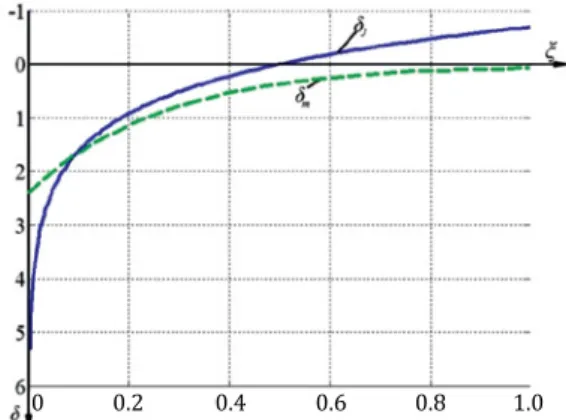
when SS = 3.5 for the uniform
distributed load
In Eq. (16) S C E ka
q p
s 0
0
* , S E
ka
m
, ra. The integral Eq. (9) is deduced applying Eq. (15). The constants Sm( ) and ra that minimise ra
the integral Eq. (9) then are found. If CS = S0 = 3.5 the values = 2.802ra ,
Smmin = 3.378, the relative error ≈ 12.0%9 9. %. The constant CS(l, h) is dependent
on the size of the elastic body. The values of J J
p a
E w
0
* , m m
p a
E w
0
* are
displayed in Figure 6. When S
S e h m0
2 2
1 log 1 1 log 1 1 cos
increases, the line J intersects the
lineJ = 0� and becomes negative, while the wm is positive for all S0
Sm e h2 2
1 log 1 1 log 1 1 cos
and
approaches zero when S
S e h m0
2 2
1 log 1 1 log 1 1 cos
→ ∞ Eq. (15).
Figure 7. Deflections
log 0g0 S e m
J and
log 0g0 S e m
mas functions of
log 0
0
S em S
when SS = 6.0 for uniform
distributed load and ideal gas pressure
1.5 1.0
0.5 0
1.5 1.0
20 19/14 (2 )
In Figure 7, the displacements are displayed when S0 = 6.0. If Cs = 3.5,
the negative ideal gas pressure have to be added:
q p
E
ka C Ss o
0 *
. (17)
Parameters of the membrane are rx x k T
v v
min = 2.13, Smmin = 6.80 and relative error ≈9 90.31%. Relative error is minimal because of large values of the . %
displacement mJ.�
Conclusions
1. Solving elastic continuum equations presents well-known mathematical problems. A solution of the Filonenko-Borodich model with a membrane or the Pasternak model with shear interaction between the spring elements is relatively simple. The accuracy of the solution is significantly increased by adding an ideal gas pressure, linearly dependent on the external load.
2. A more complicated and most likely better solution has the Hettenyi or Reissner models. Additional pressure can be used for these models. 3. Adding the ideal gas pressure improves the accuracy of the
approximate solution for all elastic foundation models.
REFERENCES
Ashley, H. (1956). Piston theory-a new aerodynamic tool for the aeroelastician.
Journal of the Aeronautical Sciences, 23(12), 1109-1118. https://doi.org/10.2514/8.3740
Challamel, N., Meftah, S. A., & Bernard, F. (2010). Buckling of elastic beams on non-local foundation: A revisiting of Reissner model. Mechanics Research Communications, 37(5), 472-475.
https://doi.org/10.1016/j.mechrescom.2010.05.007
Di Paola, M., Marino, F., & Zingales, M. (2009). A generalized model of elastic foundation based on long-range interactions: Integral and fractional model.
International Journal of Solids and Structures, 46(17), 3124-3137. https://doi.org/10.1016/j.ijsolstr.2009.03.024
Filonenko-Borodich, M. M. (1940). Some approximate theories of elastic foundation. Uchenyie Zapiski Moskovkogo Gosudarstuennogo Universiteta Mekhanika, Moscow, 46, 3-18.
Algis Pakalnis, Saulius Zadlauskas Elastic Foundation Displacement Approximations Horvath, J. S., & Colasanti, R. J. (2011). Practical subgrade model for improved
soil-structure interaction analysis: model development. International Journal of Geomechanics, 11(1), 59-64.
https://doi.org/10.1061/(ASCE)GM.1943-5622.0000070
Johnson, K. L. (1987). Contact mechanics. Cambridge university press.
Kerr, A. D. (1964). Elastic and viscoelastic foundation models. Journal of Applied Mechanics, 31(3), 491-498. https://doi.org/10.1115/1.3629667
Kerr, A. D. (1984). On the formal development of elastic foundation models.
Ingenieur-Archiv, 54(6), 455-464. https://doi.org/10.1007/BF00537376 Kerr, A. D., & Coffin, D. W. (1991). Beams on a two-dimensional Pasternak base
subjected to loads that cause lift-off. International Journal of Solids and Structures, 28(4), 413-422. https://doi.org/10.1016/0020-7683(91)90057-M Kneifati, M. C. (1985). Analysis of plates on a Kerr foundation model. Journal of
Engineering Mechanics, 111(11), 1325-1342.
https://doi.org/10.1061/(ASCE)0733-9399(1985)111:11(1325)
Lin, L., & Adams, G. G. (1987). Beam on tensionless elastic foundation. Journal of Engineering Mechanics, 113(4), 542-553.
https://doi.org/10.1061/(ASCE)0733-9399(1987)113:4(542)
Nobili, A. (2012). Variational approach to beams resting on two-parameter tensionless elastic foundations. Journal of Applied Mechanics, 79(2), 021010. https://doi.org/10.1115/1.4005549
Omurtag, M. H., & Kadıoḡlu, F. (1998). Free vibration analysis of orthotropic
plates resting on Pasternak foundation by mixed finite element formulation.
Computers & structures, 67(4), 253-265.
https://doi.org/10.1016/S0045-7949(97)00128-4
Pasternak, P.L. (1954). On a new Method of Analysis of an Elastic Foundation by Means of Two Foundation Constants. Gosuderevstvennae Izdatlesva Literaturi po Stroitelstvu i Arkihitekture, Moscow, USSR (in Russian)
Prudnikov, A. B. (2018). Integrals and series. Routledge.
Reissner, E. (1958). A note on deflections of plates on a viscoelastic foundation.
J. Appl. Mech., ASME, 25, 144-145.
Sironic, L., Murray, N. W., & Grzebieta, R. H. (1999). Buckling of wide struts/ plates resting on isotropic foundations. Thin-walled structures, 35(3), 153-166. https://doi.org/10.1016/S0263-8231(99)00029-4
Vasani, P. C. (2003). Interactive analysis models for soil and structures.
Structural Engineering Foru of India.
Vlasov, V. Z. (1966). Beams, plates and shells on elastic foundation. Israel Program for Scientific Translation.
Winkler, E. (1867). Die Lehre von der Elastizität und Festigkeit. Dominicus, Prague.