www.ijemst.com
Determining the Factors That Affect the
Objectives
of
Pre-Service
Science
Teachers to Perform Outdoor Science
Activities
Ersin Karademir1, Sinan Erten2
1Eskişehir Osmangazi University 2Hacettepe University
To cite this article:
Karademir, E. & Erten, S. (2013). Determining the factors that affect the objectives of
pre-service science teachers to perform outdoor science activities.
International Journal of
Education in Mathematics, Science and Technology, 1(4), 270-293.
This article may be used for research, teaching, and private study purposes.
Any substantial or systematic reproduction, redistribution, reselling, loan, sub-licensing,
systematic supply, or distribution in any form to anyone is expressly forbidden.
Authors alone are responsible for the contents of their articles. The journal owns the
copyright of the articles.
Volume 1, Number 4, October 2013, 270-293
ISSN: 2147-611X
Determining the Factors That Affect the Objectives of Pre-Service Science
Teachers to Perform Outdoor Science Activities
Ersin Karademir1*, Sinan Erten2
1Eskişehir Osmangazi University 2Hacettepe University
Abstract
The purpose of this study is to determine whether pre-service teachers have an aim to perform outdoor education activities within the scope of science and technology course; by which factors this aim is affected, through The Theory of Planned Behaviour and the opinions of pre-service teachers. Accordingly, the study was designed as mixed research method. With the aim of defining the factors that affect the objectives of pre-service teachers to perform outdoor education activities within the scope of science courses, ‘Outdoor Science Activities Performing Scale’, improved by Karademir (2013) was used. The eventual scale was applied to 1513 pre-service teachers studying at science teaching department. Additionally, qualitative data obtained from pre-service teachers through structured interview forms were evaluated together with quantitative data. Providing diversity in method, this enhanced the explanatory features of the data.
Key words: Outdoor science education, the theory of planned behaviour
Introduction
A teaching programme, expected to have a dynamic form, is a process including evaluation and it should not only be limited within the school but should also be used out of school (Pehlivan, 1998). In realizing the course objectives; as well as in-school education, regular learning activities that are expected to be accomplished must be conducted in order to enhance the learning experiences of individuals. These learning activities called as ‘outdoor education activities’ refer to all planned, organized activities that are helpful in achieving the course objectives, organized within the context of the course and applied out of school (Karademir, 2013). According to Binbaşıoğlu (2000), outdoor activities are described as planned, programmed and regular studies carried out within the guidance of the teacher and the information of school management in order to develop students’ personality in relation to their interests and wishes and to the objectives of the in- school and out-school education. The aim of outdoor education is to change learning environment and by this way to improve the interest and success of students’ in science (Dori & Tal, 2000; Laçin-Şimşek, 2011). Besides positive effects of outdoor education activities, there are various factors to carry out activities (Karademir, 2013). Although experimental studies related to outdoor education are many, it is also essential to determine the variables that carrying out these activities depend on (Peleg & Baram-Tsabari, 2009; Siegel, 2007; Kısa-Tekkumru, 2008; Bozdoğan, 2007; Güler, 2011). Therefore, by using the theory of planned behaviour, it is aimed to determine how and depending on what outdoor education activities will come out. According to the theory of planned behaviour; in order for behaviour to come out, the intention towards behaviour should occur first (Ajzen, 1991; Knabe, 2012). The intention is under control of attitude towards behaviour, subjective norms and perceived behaviour control. That is, when an outdoor activity is desired to be performed in this way, the reasons of this will be defined. It is also important that relations of factors appeared with the theory of planned behaviour are in accordance with teachers’ opinions.
*
The Theory of Planned Behaviour
The theory of planned behaviour is a theory introduced by Ajzen (1985) and it has been used in various disciplines for long years. The purpose of the theory of planned behaviour (TPB) is to predict to what extent a particular behaviour will be performed or not. According to TPB, behaviours of individuals are under control of some factors and in order for a behaviour to come out, the intention towards that behaviour should be formed (Ajzen, 1991). And the intention is due to the difficulty or ease that the person concerning to perform the behaviour attributed to it; to his attitudes; and to the persons or institutions of importance for him (Teo & Lee, 2010). In short, according to this theory; if an individual evaluates a behaviour positively and thinks that social pressures of importance will support him to do that behaviour, he will have an aim to perform that behaviour and this aim will be effective in describing his behaviours (Ajzen, 1985; Kocagöz-Sayın, 2010).
In ‘ beliefs’ part of the model are behavioral, normative and control beliefs; in ‘base’ are attitude, subjective norm and perceived behavioral control, which form the basic part (core). Behavioral, normative and control beliefs help us to understand what directs the behaviour and what can support it. (von Haeften, Fishbein, Kasprzyk & Montano, 2001; Fishbein & Cappella, 2006).
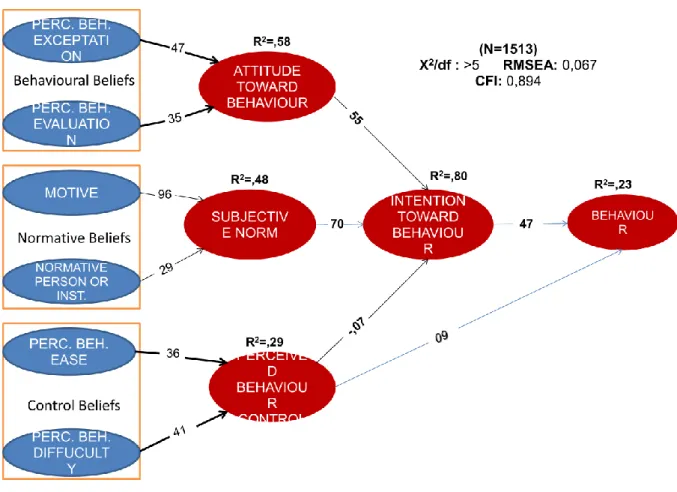
Behavioral beliefs consists a combination of perceived behavioral expectancy and assessment, and effective together in emerge of the attitude towards behaviour. Expressing the social pressure of external environment on the individual, normative beliefs are under control of personal motives and normative person, institution or organization; and these two express subjective norms. Control beliefs are the combination of the difficulty or ease of behaviour perceived by individual. These two together describe perceived behaviour control (Ajzen, 2006). Attitude towards behaviour, subjective norms and perceived behavioral control, affected by ‘beliefs’ part of the model, explain together the intention towards behavior and also the behaviour itself, indirectly. When TPB model in figure 1 is closely examined, it is seen that peoples’ social behaviours are under control of certain factors, they stem from some certain causes and they come out in a planned way (Erten, 2000, 2002; Karademir, 2013).
In order for behaviour to be performed by one, first “Intention Towards Behaviour” must be formed. Factors that affect “Intention Towards Behaviour” are “Attitude Towards Behaviour”, “Subjective Norms” and “Perceived Behavioral Control” (Bamberg & Schmidt, 1993). And these factors are influenced by “Behavioral (attidual) Beliefs”, “Normative Beliefs” and “Control Beliefs”. At the same time, these beliefs form the results of the behaviour- to- be- performed. With the effect of “Intention Toward Behaviour”, behaviours may be formed or change. That is, the behaviour is directly under control of “Intention Towards Behaviour”. Another factor that can directly affect the behaviour is “Perceived Behavioral Control”, but this is not true for every time or case. “Intention Towards Behaviour” is described by “Attitudes Towards Behaviour”, “Subjective Norms” and “Perceived Behavioral Control”. These factors are under the influence of beliefs as well (Erten, 2000).
Explanatory Dimensions of the Theory of Planned Behaviour
Attitude Towards Behaviour, in the theory of planned behaviour, the term “attitude” is seen as attitude towards behaviour. When looked at the context of related attitude, it is described with the personal evaluations of the outcomes mentioned in beliefs regarding the behaviour. Individuals believe that performing the related behaviour will lead them to some outputs or results (Fishbein & Ajzen, 1975; Ajzen, 1988, 1991; Ajzen, Timko & White, 1982). So, attitude is in relation to the outcome of the behaviour. The individual may adapt a positive attitude if he/she believes that the behaviour will produce a positive result or vice versa (Glanz, Rimer & Viswanath, 2008). In other words, it is the probable result of the behaviour that determines the behaviour. That is, the outcome feeds the behaviour (Baltaş, 2009).
Subjective Norm describes the social pressure perceived towards behaviour. It is the combination of the expectations of people who are important for him and his desire to fulfill these expectations. Subjective norms , in short, reflect the socio-psychological evaluation of individuals to perform a behaviour and expresses the social pressure the individual feels on himself whether or not to perform a behaviour. That is, how the behaviour will be met by individual’s social milieu is called subjective norm. If a person believes that reference groups which are important for him expect him to perform behaviour, he will feel a social pressure on himself to do so (Fishbein & Ajzen, 1975; Ajzen 1985, 1991).
Perceived Behavior Control expresses how easy or difficult behaviour is for an individual. It is the estimation of individual’s internal and external efficacy to perform a specific behaviour, and is also the combination of this competence and belief. Perceived behavioral control variable has a separate place in the model, therefore the route that perceived behavioral control follows towards behaviour emerges in a several different ways. The first of these, perceived behavioral control, describes the behaviour through the intention towards behaviour; and the second directly describes the behaviour without the mediation of intention towards behaviour (Ajzen 1985, 1991).
Relationship Between the Theory of Planned Behaviour and Outdoor Science Education
To gain awareness in science teaching, to increase students’ interests in science, to provide enriched science environments are among the primary tasks of science and technology teachers. Possible outdoor activities that can be carried out with this purpose have great importance in helping students to discover nature, to have social and concrete experiences (Griffin, 2004; Tal, Bamberger & Morag, 2005). It is essential to query due to what realization of these highly important outdoor activities are. Outdoor activities in science education depends so many factors; like difficulty of activities, their effects on students, the attitude and role of the person to do the activity , who demands the activities , etc. (Karademir, 2013).What factors are effective in determining these factors and outdoor learning activities can be identified through the theory of planned behaviour. Besides, it is very important to find out factors which play role in performing a behaviour and the factors that affect behaviour in pre-service teachers who will carry out activities must be put forward at first. Therefore, it is highly important to determine what factors are effective in this regard before performing outdoor learning activities. The theory of planned behaviour that will be used in identifying these factors emphasizes the importance of attitudes in performing behaviour; to what extent it is easy or difficult, how the person gets influenced by the people, institutions or organizations in performing activities (Karademir, 2013).
The purpose of this study is to examine pre-service teachers’ behavioral purposes in performing outdoor activities by using the theory of planned behaviour and through the opinions of teachers. Accordingly, the prior purpose is to define pre-service teachers’ attitude towards the purpose of the behaviour, subjective norms and what perceived behavioral control variables are. The relations of these variables with behavioral purposes are evaluated together in order to determine the possibility of this behaviour to come out. In addition, through the opinions of pre-service teachers’, factors that are effective in the occurrence of this behavioral purpose are defined. With regard to this purpose, following questions were searched for answers:
1. How, within the scope of science and technology lesson, should factors that affect pre-service teachers’ intentions to perform outdoor activities be defined through the use of the theory of planned behaviour? 2. How is the relation between pre-service teachers’ intentions to perform outdoor learning activities and
subjective norm; perceived behavioral control and attitude towards behaviour? And what level these relations should be explained?
Method
Research Model
This study was designed as mixed research method. Mixed research model is a method applied in collecting, analyzing and using data ‘to mix with’ each other. And to figure out a research problem, qualitative and quantitative techniques are used together (Creswell, 2011; Creswell & Plano-Clark, 2011). Mixed research is a highly popular method in social sciences and is known itself as a research method (Hanson, Creswell, Creswell, Plano-Clark & Petska, 2005). In mixed method, in a single study that data is obtained synchronically or sequentially, qualitative and quantitative data is evaluated together both in collecting and analyzing data, and is related to each other (Creswell, Plano Clark, Guttmann & Hanson, 2003). In this study, a combination of data was applied by evaluating qualitative data with quantitative ones. From mixed patterns, “Explanatory Sequential Design” was preferred in this study. At this pattern, qualitative data is used as following and explaining quantitative data (Creswell, 2011). Through the use of evaluation scale developed regarding the theory of planned behaviour, quantitative data was obtained. Additionally, in order for practicality and results of outdoor activity to be determined constructed interview form was applied. The data obtained from this part was used in explaining qualitative data.
Data Collection Tools
1. Outdoor science activities performing scale
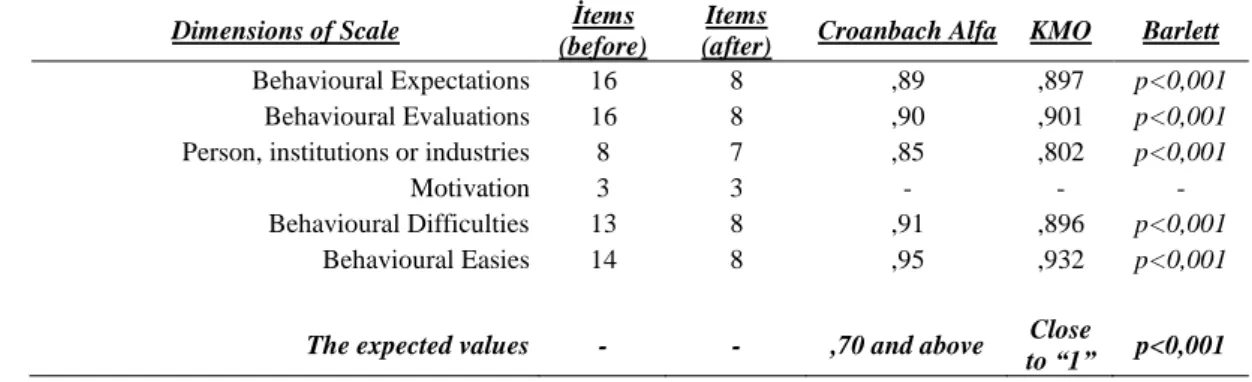
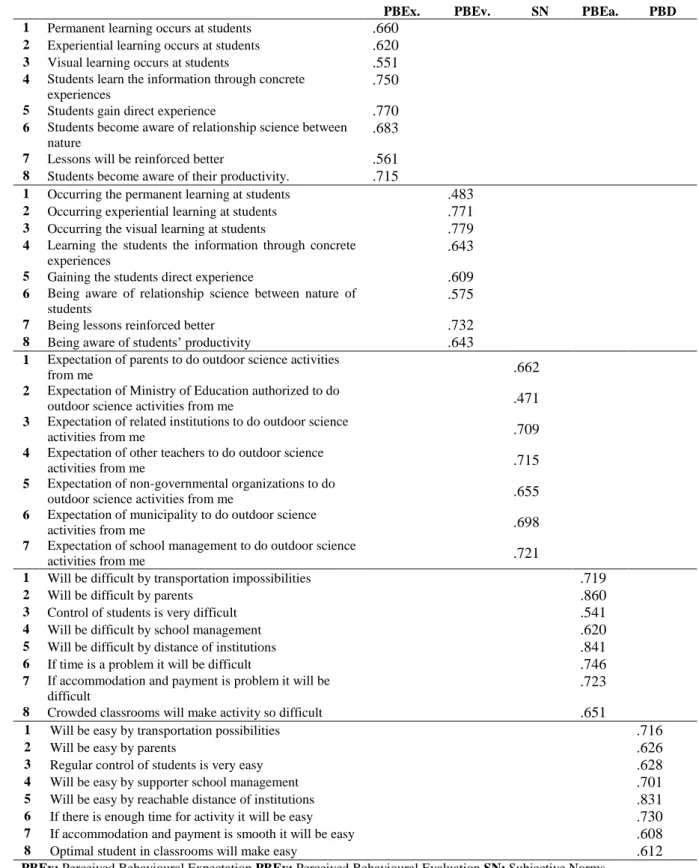
Within the context of the theory of planned behaviour, in order to determine pre-service teachers’ behaviour of performing outdoor activities, Outdoor science activities performing scale, developed by Karademir (2013) was used (see: Appendix-1). This scale is developed by certain rules of TPB. According to TPB; dimensions of scale is certain. Pre-studies for items are performed for each dimension of scale. In related scale, there are 50 items concerning both beliefs and basic part of model. Items about the basic part of model (attitude toward behaviour, subjective norm, perceived behavioral control and intention) are the same with pilot study and these dimensions have three item. So, reliability and validity studies are performed for beliefs part of model. For reliability; Croanbach alpha coefficient of the scale was determined as 0,897. While preparing the outline of the scale, three expert opinions were taken into consideration to provide validity. One of the experts is science educator and experienced on the TPB. Another expert is assessment specialist. Third one is science educator. After expert opinions, scale was arranged with Turkish Language expert. With factor analysis carried out during pilot study, the construct validity was provided and inappropriate clauses were eliminated. Factor weights of items that is under [0,30] are removed from scale. Remaining items and factor weights are given at the table 2. The scatter of items according to dimensions, during and following pilot study, is presented in table 1. It is seen at table 1; KMO and Bartlett’s values are acceptable for analysis. KMO values between 0,80-0,90 is known as very good and acceptable for analysis (Akgül & Çevik, 2003).
Table 1. KMO, Barlett and croanbach alpha values of each dimension during pilot study
Dimensions of Scale İtems (before)
Items
(after) Croanbach Alfa KMO Barlett Behavioural Expectations 16 8 ,89 ,897 p<0,001
Behavioural Evaluations 16 8 ,90 ,901 p<0,001
Person, institutions or industries 8 7 ,85 ,802 p<0,001
Motivation 3 3 - - -
Behavioural Difficulties 13 8 ,91 ,896 p<0,001
Behavioural Easies 14 8 ,95 ,932 p<0,001
The expected values - - ,70 and above Close
to “1” p<0,001
2. Constructed Interview Form
Table 2. Dimensions and factor values of the scale
Factors of scale
PBEx. PBEv. SN PBEa. PBD
1 Permanent learning occurs at students .660
2 Experiential learning occurs at students .620
3 Visual learning occurs at students .551
4 Students learn the information through concrete experiences
.750
5 Students gain direct experience .770
6 Students become aware of relationship science between nature
.683
7 Lessons will be reinforced better .561
8 Students become aware of their productivity. .715
1 Occurring the permanent learning at students .483
2 Occurring experiential learning at students .771
3 Occurring the visual learning at students .779
4 Learning the students the information through concrete experiences
.643
5 Gaining the students direct experience .609
6 Being aware of relationship science between nature of students
.575
7 Being lessons reinforced better .732
8 Being aware of students’ productivity .643
1 Expectation of parents to do outdoor science activities
from me .662
2 Expectation of Ministry of Education authorized to do
outdoor science activities from me .471
3 Expectation of related institutions to do outdoor science
activities from me .709
4 Expectation of other teachers to do outdoor science
activities from me .715
5 Expectation of non-governmental organizations to do
outdoor science activities from me .655
6 Expectation of municipality to do outdoor science
activities from me .698
7 Expectation of school management to do outdoor science
activities from me .721
1 Will be difficult by transportation impossibilities .719
2 Will be difficult by parents .860
3 Control of students is very difficult .541
4 Will be difficult by school management .620
5 Will be difficult by distance of institutions .841
6 If time is a problem it will be difficult .746
7 If accommodation and payment is problem it will be difficult
.723
8 Crowded classrooms will make activity so difficult .651
1 Will be easy by transportation possibilities .716
2 Will be easy by parents .626
3 Regular control of students is very easy .628
4 Will be easy by supporter school management .701
5 Will be easy by reachable distance of institutions .831
6 If there is enough time for activity it will be easy .730
7 If accommodation and payment is smooth it will be easy .608
8 Optimal student in classrooms will make easy .612
Universe- Sample
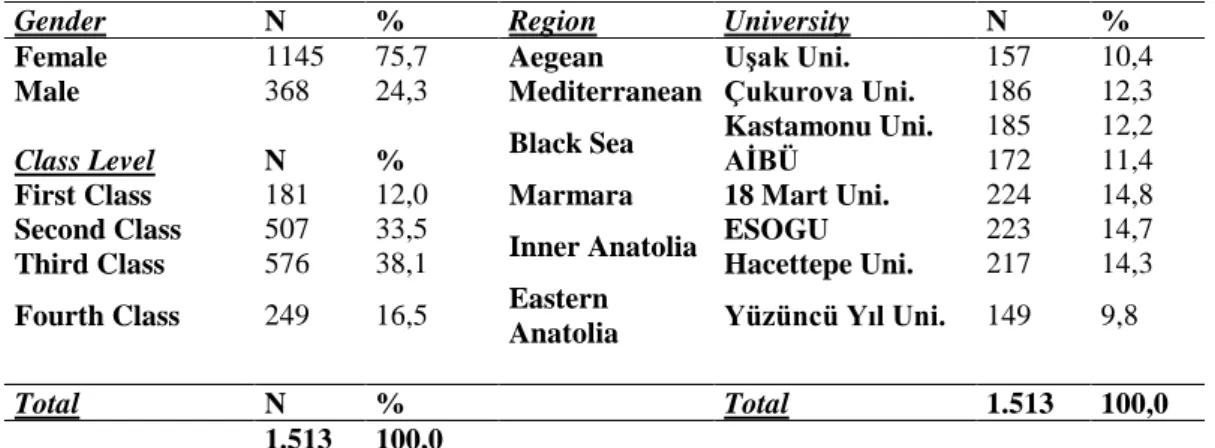
Sample Group (Pre-service teachers): Since this study has been conducted in all regions of our country, ‘pre-service teacher universe’ consists of all pre-‘pre-service science teachers studying at all faculty of educations. Sample group, on the other hand, is formed out of 1513 pre-service teachers selected randomly from the universe. In related sample method, every unit in universe has equal and independent chance to be chosen as sample (Büyüköztürk et. all, 2010). Demographic features of the sample group are given at the table 3.
Table 3. Demographic features of pre-service teachers
Gender N % Region University N %
Female 1145 75,7 Aegean Uşak Uni. 157 10,4
Male 368 24,3 Mediterranean Çukurova Uni. 186 12,3
Black Sea Kastamonu Uni. 185 12,2
Class Level N % AİBÜ 172 11,4
First Class 181 12,0 Marmara 18 Mart Uni. 224 14,8
Second Class 507 33,5
Inner Anatolia ESOGU 223 14,7
Third Class 576 38,1 Hacettepe Uni. 217 14,3
Fourth Class 249 16,5 Eastern
Anatolia Yüzüncü Yıl Uni. 149 9,8
Total N % Total 1.513 100,0
1.513 100,0
Study Group:
It is the group of 26 senior students studying at science teaching programme to whom constructed interview forms was applied in order to determine pre-service teachers’ perceptions of outdoor science activities and intentions towards behaviour. 26 pre-service teachers involved in this group study at a state university in Inner Anatolia Region. 16 of the students in the group are female and the remaining 10 are male.
Analysis of Data
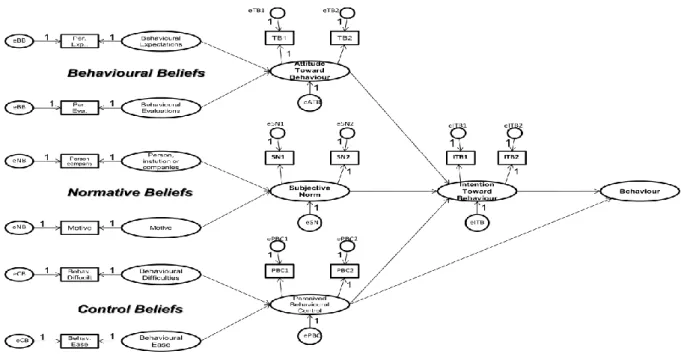
Figure 2. AMOS Input of structural equation modeling formed according to TPB
Figure 2 shows structured equation modeling formed according to TPB. In the context of this structure, data were uploaded to AMOS programme for structured equation modeling. In this model, there are six endogenous and five exogenous variables. Endogenous variables are normative, control and behavioral beliefs. That is, exogenous variables in beliefs part of the model are; the difficulty of behaviour, the ease of behaviour, motive toward subjective norm, persons- institution or organizations, behavioral expectation and behavioral evaluation. Each of these dimensions is measured with scale. Exogenous variables are explained through endogenous variables. These exogenous variables are perceived behavioral control, attitude towards behaviour, subjective norm, intention towards behaviour and behaviour. Path analysis technique was used with data uploaded to AMOS.
Findings
In this study, data has been collected from pre-service science teachers in two different ways. In the first part, by using the scale, quantitative data has been collected and analyzed. And in the second part, qualitative data has been collected from pre-service teachers by using interview forms. Both qualitative and quantitative data will be shared separately in this part.
Quantitative Findings of Pre-service Teachers
institutions [0,54]” under normative beliefs. It depends on school management’s and related institution’s demands whether or not pre-service teachers intend to carry out outdoor activities in the future.
Table 4. Pre-service teachers’ structural equation model findings
That the effect of attitude on behaviour is [r=0,55] means; “ I ‘ highly approve’ to carry our outdoor science activities with my students when I am appointed”; “it has a mid-level effect on intending to do outdoor activities in science courses when I am appointed as a teacher”. In other words, pre-service teachers approve of performing outdoor activities as well as intending to do these activities. That is, they show the intention of behaviour both through their own attitudes and through the persons, institutions and organizations that are important for them. That means pre-service teachers show intention towards behaviour under control of both attitudes and expectations of references. Additionally, no relation was detected between behavioral intention which is seen as the combination of the ease or difficulty of behaviour and both the intention and behaviour [rintention= - 0,07; rbehaviour= 0,09; p> 0,05]. When examined within this respect, it is seen that behaviour is related only with the intention towards behaviour[ r= 0,47] and only a little part of the behaviour is explained[ R2=0,23]. In other words, pre-service teachers are under effect of both reference persons and personal attitudes considering performing outdoor science activities. But, it is seen that the probability of the intention towards behaviour to change into behaviour is low[ R2intention = 0,80; R2behaviour= 0,23].
Qualitative Findings of Pre-service Teachers
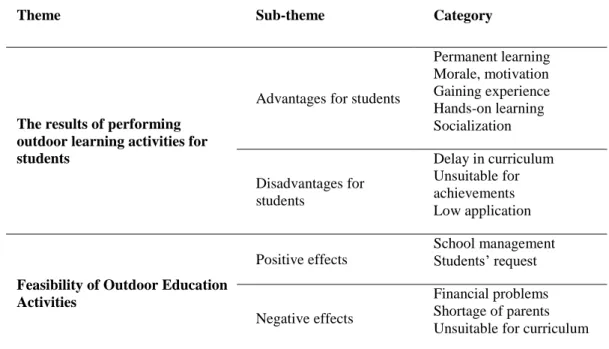
Table 5. Themes, sub-themes and categories of qualitative findings
Theme Sub-theme Category
The results of performing outdoor learning activities for students
Advantages for students
Permanent learning Morale, motivation Gaining experience Hands-on learning Socialization
Disadvantages for students
Delay in curriculum Unsuitable for achievements Low application
Feasibility of Outdoor Education Activities
Positive effects
School management Students’ request
Negative effects
Financial problems Shortage of parents Unsuitable for curriculum
Findings of “The results of performing outdoor learning activities for students” Theme
According to data obtained from pre-service teachers, the theme called “the results of performing outdoor learning activities for students” comes out under two sub-themes. According to these sub-themes, when pre-service teachers want to do an outdoor activity, this has both “advantages” and “disadvantages” for students. Some of participants’ opinions concerning these advantages and disadvantages are as in following:
Researcher: What kind of advantages will an outdoor science activity provide for you or your students? Participant 13: I think outdoor activity will increase student’s curiosity and also will make permanent learning possible.
Researcher: What kind of problems can you or your students have in carrying out an outdoor science activity?
Participant 13: In my opinion, the main problem is the lack of time and to fail to make sure that every student takes part in activities.
Researcher: What kind of advantages will an outdoor science activity provide for you or your students? Participant 23: Since it provides students to get information through direct experiences, teaching-learning process becomes more efficient. It gives students the opportunity for a more enjoyable teaching-learning process. When considered for teachers, seeing that they take part in student’s efficient learning will make them happy and peaceful.
Participant 19: Of course I would like to organize such activities. I find them very useful. The reason is that the more activities are related to courses, the better subjects are learnt and objectives are realized. Apart from their contribution to me and my students about courses; they also provide motivation, interest in subjects and consciousness of organization.
Researcher: What kind of problems can you or your students have in carrying out an outdoor science activity?
Participant 23: In remote villages, besides transportation and financial burden, the attitudes of families may be problem as well. But, none of these is an obstacle for a good and idealistic teacher. For instance, if desired, photos and video records taken at previous experiences may help us to overcome this trouble.
Findings of “Feasibility of Outdoor Education Activities” Theme
Researcher: What kind of positive or negative conditions can you encounter if you want to realize an outdoor science activity? What can support or hinder you in this regard?
Participant 13: Although they help in-school activities, my school may not be in favour of organizing such activities as they don’t want to take responsibility for outdoor activities. I think, my own efforts and insistence will be determining in this regard.
Participant 17: The school that I appointed to and its conditions are important at first. Therefore, transportation may be a problem. Also there may be trouble with school management, too.
Discussion
When looked at under which variables the purpose towards behaviour is, that pre-service teachers’ self -attitudes towards their own ‘trues’ is close to the effects of subjective norms may stem from that they trust themselves more and that they can’t still leave subjective norms. Their desire to organize outdoor education activities depends on their own attitudes. According to the result of the study, one of the important highlights is to increase the efficiency of pre-service teachers’ (individuals) attitudes. One of the important reasons of this may be pre-service teachers’ attitudes towards science and teaching profession. In many research, that pre-service teachers’ attitude towards teaching profession, science or environment is high supports it (Saracoğlu et.all, 2004; Terzi & Tezci, 2007; Kahyaoğlu & Yangın, 2007; Sadık & Sarı, 2010). Both in their opinions and quantitative data, pre-service teachers stated that with outdoor activities, students will develop socially, and learning through experiences will be more effective. Studies emphasizing that students discover information easily when they are socialized and learn better through direct experiences seem to support this conclusion (Türkmen, 2010; Griffin, 2004; Chin, 2004). It has come out that while performing outdoor science activities, teachers may face some difficulties. Such factors as transportation problems, school’s conditions, etc. may cause trouble for these activities. In this study, Tanrıverdi (2009) deals with similar results and he emphasizes that in order to realize environmental- contented objectives, appropriate time, place and activities must be provided. Şimşekli (2004) states that in realizing environmental objectives, parents and school management is also influential. And this is in line with the findings about the effects of students’ parents and school management on teacher. According to Erten (2001), that a person is thoroughly integrated to a group, in other words feels him under a high social pressure, shows that hinders the development of his attitude and thus will make his attitude free from purpose.
Conclusion
Pre-service science teachers wish to carry out outdoor science activities in the future. Their intention towards this behaviour stems both from their own attitude (attitude towards behaviour) and from the people, institution and organizations (subjective norm) they take as credentials. That the behaviour is easy or difficult (perceived behaviour control) has no effect on the behaviour. If, in the future, pre-service science teachers want to perform outdoor science activities, they will do this mostly as the people, institutions and organizations want them to do so. Besides, their own attitudes will be effective on this. The ease or difficulty of the outdoor science activity they would like to carry out does not affect the intention of the behaviour. Pre-service science teachers emphasized that beyond their difficulty to be carried out; outdoor learning activities can only be performed if they wish. They described the difficulties of performing outdoor learning activities as financial problems and troubles with transportation. Pre-service science teachers also stated that realizing an outdoor science activity will make permanent learning possible, will increase students’ curiosity and will provide socialization. They stated that these activities have positive effects on students’ learning experiences and that learning can be permanent by doing so. However, according to pre-service teachers, “transportation facilities”, “crowded classes”, “accommodation problems” decreases the possibility of ‘performing outdoor activity’ behaviour. Also their answers to the related interview questions support these results. According to Pre-service teachers’ point of opinion, it is seen that outdoor science activities will be useful for students. But their prospective school’s facilities and managements are among the factors that can make it hard to carry out these activities.
Acknowledgement
This study is derived from the PhD thesis of Karademir (2013) prepared in the supervision of Assoc. Prof. Dr. Sinan Erten.
References
Ajzen, I. (1985). From intentions to actions: A theory of planned behavior. In J. Kuhl & J. Beckman (Eds.), Action-control: From cognition to behavior (pp. 11- 39). Heidelberg, Germany: Springer.
Ajzen, I. (2006). Constructing a TPB questionnaire: conceptual and methodological considerations. Retrieved from http://www.people.umass.edu/aizen/pdf/tpb.measurement.pdf
Ajzen, I. (1991). The theory of planned behaviour, Organization Behaviour and Human Decision Process, 50, 179-211.
Ajzen, I. (1988), Attitudes, personality and behaviour, Milton Keynes: Open University.
Ajzen, I., Timko, C., & White, J. B. (1982). Self-monitoring and the attitude- behavior relation, Journal of Personality and Social Psychology, 42, 426-435.
Akgül, A. & Çevik, Ç. (2003). İstatistiksel analiz teknikleri. Ankara: Emek Ofset Baskı.
Altunışık, R., Coşkun, R., Bayraktaroğlu, S. & Yıldırım, E. (2007). Sosyal bilimlerde araştırma yöntemleri. (5.bs.). Adapazarı: Sakarya.
Baltaş, Z. (2009). Davranışın sağlığa etkisi. Hemşirelik ve Ebelikte Kültürlerarası Yaklaşım Sempozyumu içinde (s.5-14). Çanakkale: Onsekiz Mart Üniversitesi.
Bamberg, S., & Schmidt, P. (1993). Verkehrsmittelwahl-eine anwendung der theorie des geplanten verhaltens. Zeitschrift für Sozialpsychologie , 24, 25-37.
Binbaşıoğlu, C. (2000). Okulda ders dışı etkinlikler. Ankara: Milli Eğitim.
Bozdoğan, A. E. (2007). Bilim ve teknoloji müzelerinin fen öğrenimindeki yeri ve önemi (Yayımlanmamış Doktora tezi). Gazi Üniversitesi Eğitim Bilimleri Enstitüsü, Ankara.
Büyüköztürk, Ş., Çakmak, E.K., Akgün, Ö. E., Karadeniz, Ş. & Demirel, F. (2010). Bilimsel araştırma yöntemleri. Ankara: Pegem Akademi.
Chin, C. C. (2004). Museum experience: A resource for science teacher education. International Journal of Science and Mathematics Education, 2, 63-90.
Creswell, J. W. (2011). Educational research: Planning, conducting, and evaluating quantitative and qualitative research. Boston, MA: Pearson.
Creswell J. W., & Plano Clark, V. L. (2011). Designing and conducting mixed methods research. Thousand Oaks, CA: Sage Publications, Inc
Creswell, J. W., Plano Clark, V. L., Gutmann, M. L., & Hanson, W. E. (2003). Advanced mixed methods research designs. In A. Tashakkori & C. Teddlie (Eds.), Handbook of mixed methods in social and behavioral research (pp. 209–240). Thousand Oaks, CA: Sage.
Dori, Y. J. & Tal, R. T. (2000). Formal and informal collaborative projects: Engaging in industry with environmental awareness. Science Education, 84, 95-113.
Erten, S. (2002). Planlanmış davranış teorisi ile uygulamalı ders işleme öğretim metodu. Hacettepe Üniversitesi Eğitim Fakültesi Dergisi, 19(2), 217-233.
Erten, S. (2001). Çevre eğitiminde planlanmış davranış teorisinin kullanılması. Hacettepe Üniversitesi Eğitim Fakültesi Dergisi, 20, 73-79.
Erten, S. (2000). Empirische untersuchungen zu bedingungen der umwelterziehung – ein interkultureller vergleich auf der grundlage der theorie des geplanten Verhaltens (Theory of Planned Behavior) (Yayınlanmamış Doktora tezi). Justus-Liebig Üniversitesi, Almanya.
Fishbein, M., & Ajzen, I. (1975). Belief, attitude, intention and behavior: An introdictionlion theory. MA: Reading. .Addison-Wesley.
Fishbein, M., and Cappella, J. N. (2006). The role of theory in developing effective health communications. Journal of Communication, 56, 1-17.
Glanz, K., Rimer, K. B., & Viswanath, K. (2008). Health behavior and health education, theory, research and practice. San Fransisco: Wiley.
Griffin, J. (2004). Research on students and museums: Looking more closely at the students in school groups. Science Education, 81, 763-779.
Güler, A. (2011). Planlı bir müze gezisinin ilköğretim öğrencilerinin tutumuna etkisi. İlköğretim Online, 10(1), 169-179.
Karademir, E. (2013). Öğretmen ve öğretmen adaylarının fen ve teknoloji dersi kapsamında okul dışı öğrenme etkinliklerini gerçekleştirme amaçlarının planlanmış davranış teorisi yoluyla belirlenmesi (Yayınlanmamış Doktora Tezi). Hacettepe Üniversitesi Sosyal Bilimler Enstitüsü, Ankara.
Kahyaoğlu, M & Yangın, S. (2007). İlköğretim sınıf öğretmenliği, fen bilgisi ve matematik öğretmen adaylarının fen bilgisi öğretimine yönelik tutumları. ZKÜ Sosyal Bilimler Dergisi, 3(6), 203–220. Kısa-Tekkumru, M. (2008). Bir okul dışı fen ortamında öğrenci kazanımlarını arttırmak için tasarlanan "bilim
merkezi öğrenme paketi"nin geliştirilmesi ve uygulanması (Yayınlanmamış yüksek lisans tezi). Boğaziçi Üniversitesi Fen Bilimleri Enstitüsü, İstanbul.
Knabe, A. (2012). Applying Ajzen's theory of planned behavior to a study of online course adoption in public relations education. (Doctorate Dissertation). Marquette University, Milwaukee.
Kocagöz-Sayın, E. (2010). Kadınların makyaj malzemelerini satın alma davranışlarının incelenmesi: Planlanmış davranış teorisinin bir uygulaması (Yayınlanmamış Doktora tezi). Erciyes Üniversitesi Sosyal Bilimler Enstitüsü, Kayseri.
Laçin-Şimşek, C. (2011). Fen öğretiminde okul dışı öğrenme ortamları. Ankara: Pegem Akademi.
Pehlivan, Z. (1998). Ders dışı okul spor etkinlikleri ve yeniden örgütlenmesi. Spor Bilimleri Dergisi Hacettepe J. of Sport Sciences, 9( 3), 11-31.
Peleg, R. & Baram-Tsabari, A. (2009). Atom surprise: using science drama to teach basic science. In M.F. Taşar & G. Çakmakçı (Eds.), Contemporary science education research: international perspectives (pp. 369-377). Ankara, Turkey: Pegem Akademi.
Sadık, F. & Sarı, M. (2010). Student teachers’ attitudes towards environmental problems and their level of environmental knowledge. Çukurova Üniversitesi Eğitim Fakültesi Dergisi, 3(39), 129-141.
Saracaloğlu, A. S., Serin, O., Bozkurt, N., Serin, U. (2004). Öğretmen adaylarının mesleğe yönelik tutumlarını etkileyen faktörler. Çağdaş Eğitim, 29(311), 16–27.
Siegel, H. R. A. (2007). People on the move: An examination of significant life experiences of outdoor education instructors. Yayımlanmış yüksek lisans tezi. (UMI number: 1451212).
Şimşekli, Y. (2004). Çevre bilincinin geliştirilmesine yönelik çevre eğitimi etkinliklerine ilköğretim okullarının duyarlılığı. Uludağ Üniversitesi Eğitim Fakültesi Dergisi, 17(1), 83-92.
Tal, R., Bamberger, Y., & Morag, O. (2005). Guided school visits to natural history museums in Israel: Teachers‘ roles. Science Education, 89, 920- 935.
Tanrıverdi, B. (2009). Sürdürülebilir çevre eğitimi açısından ilköğretim programlarının değerlendirilmesi. Eğitim ve Bilim, 34(151), 89-103.
Teo, T. & Lee, C. B. (2010). Examining the efficacy of the theory of planned behavior (TPB) to understand pre-service teachers’ intention to use technology. In C.H. Steel, M.J. Keppell, P. Gerbic & S. Housego (Eds.), Curriculum, technology & transformation for an unknown future. Proceedings ascilite Sydney 2010 (pp.968-972).
Terzi, A. R. & Tezci, E. (2007). Necatibey Eğitim Fakültesi öğrencilerinin öğretmenlik mesleğine ilişkin tutumları. Kuram ve Uygulamada Eğitim Yönetimi, 32, 593-614.
Tüfekçi, N. ve Tüfekçi, Ö. (2006). Bankacılık sektöründe farklı olma üstünlüğünün ve müşteri sadakatinin yarattığı değer: Isparta ilinde bir uygulama. Süleyman Demirel Üniversitesi Sosyal Bilimler Enstitüsü Dergisi , 2(4), 170-183.
Türkmen, H. (2010). İnformal (sınıf-dışı) fen bilgisi eğitimine tarihsel bakış ve eğitimimize entegrasyonu. Çukurova Üniversitesi, Eğitim Fakültesi Dergisi, 3(39), 46-49.
Appendix 1: The English Version of Scale
Dear pre-service teacher,
Please, carefully read the items and answer in scale named “
Outdoor science activities
performing scale
” Purpose of this scale is to determine the factors affecting the realization
of outdoor activities. Each part of the scale is different and intended for a particular purpose.
Thank you for your contribution and sincere answers.
Res. Asst. Ersin KARADEMİR
Have you ever been in outdoor activity throughout your education life? If your answer is “yes”, please write the blank below.
Yes No
Gender Female Male
Class 1 2 3 4
Department Science
Teaching
Primary Teaching
University (write to blank)
……….
Mother’s education level
Elementar y
Secondar y
High
school University
Father’s education level
Elementar y
Secondar y
High
school University
Family income
status 0–500 501–1000
1001– 1500
1501 and above
Living place
Outdoor science activities performing scale
Imp
o
ss
ibl
e
Ver
y
po
ss
ibl
e
K1 –In the future when I am assigned as a teacher; If I want to perform outdoor activity at science and technology lesson with my students; this (will make)
1 2 3 4 5 6 7
1 Permanent learning occurs at students
2 Experiential learning occurs at students
3 Visual learning occurs at students
4 Students learn the information through concrete experiences
5 Students gain direct experience
6 Students become aware of relationship science between nature
7 Lessons will be reinforced better
8 Students become aware of their productivity.
No
t
imp
o
rt
a
nt
Ver
y
imp
o
rt
a
nt
K2-In the future when you are assigned as a teacher; If you want to perform outdoor activity at science and technology lesson with your students, what you'll find an extremely important following outcomes?
1 2 3 4 5 6 7
1 Occurring the permanent learning at students
2 Occurring experiential learning at students
3 Occurring the visual learning at students
4 Learning the students the information through concrete experiences
6 Being aware of relationship science between nature of students
7 Being Lessons reinforced better
8 Being aware of students’ productivity
Imp
o
ss
ibl
e
Ver
y
po
ss
ibl
e
K3 – In the future when I am assigned as a teacher; If I want to perform outdoor activity at science and technology lesson with my students, that (will be);
1 2 3 4 5 6 7
1. Will be difficult by transportation impossibilities
2. Will be difficult by parents
3. Control of students is very difficult
4. Will be difficult by school management
5. Will be difficult by distance of institutions
6. If time is a problem it will be difficult
7. If accommodation and payment is problem it will be difficult
8. Crowded classrooms will make activity so difficult
Imp
o
ss
ibl
e
Ver
y
po
ss
ibl
e
K4 –In the future when I am assigned as a teacher; If I want to perform outdoor activity at science and technology
lesson with my students, that (will be); 1 2 3 4 5 7
1. Will be easy by enough transportation possibilities 2. Will be easy by parents’ allow
4. Will be easy by supporter school management 5. Will be easy by reachable distance of institutions
6. If there is enough time for activity it will be easy 7. If accommodation and payment is smooth it will be easy
8. Optimal student in classrooms will make easy
Imp
o
ss
ibl
e
Ver
y
po
ss
ibl
e
K5 – Mark the most suitable one in the following.
1 2 3 4 5 6 7
1. Expectation of parents to do outdoor science activities from me
2. Expectation of Ministry of Education authorized to do outdoor science activities from me
3. Expectation of related institutions to do outdoor science activities from me
4. Expectation of other teachers to do outdoor science activities from me
5. Expectation of non-governmental organizations to do outdoor science activities from me
6. Expectation of municipality to do outdoor science activities from me
7. Expectation of school management to do outdoor science activities from me
Imp
o
ss
ibl
e
Ver
y
po
ss
ibl
Va ry ba d B a d A litt le ba d N eit her good no r ba d A litt le g o o d G o o d Ver y g o o d K7
When I am assigned as a teacher; to perform outdoor activity at science and technology lesson with my students;
When I am assigned as a teacher; to perform lesson with book at science and technology lesson with my students;
When I am assigned as a teacher; to perform laboratory activity at science and technology lesson with my students; Va ry ea sy E a sy A litt le ea sier N eit her ea sy no r diff icult A litt le diff icult Dif ficult Ver y diff icult K8
In the future when I am assigned as a teacher, if I perform outdoor activity at science and technology courses, this will be;
In the future when I am assigned as a teacher, if I perform lessons with books at science and technology courses, this will be;
In the future when I am assigned as a teacher, if I perform laboratory activity at science and technology courses, this will be;
Imp o ss ibl e Ver y po ss ibl e
1 2 3 4 5 6 7
K9
Expectation of the people that is important for me, to perform outdoor science activities from me
Expectation of the people that is important for me to perform lessons with book from me
Expectation of the people that is important for me to perform laboratory activities from me
Imp
o
ss
ibl
e
Ver
y
po
ss
ibl
e
1 2 3 4 5 6 7
K10
When I am assigned as a teacher I purpose to perform
outdoor science activity at science and technology
courses
When I am assigned as a teacher I purpose to perform the lessons with books at science and technology courses When I am assigned as a teacher I purpose to perform laboratory activity at science and technology courses
Nev
er
Seldo
m
O
cc
a
sio
na
lly
F
re
qu
ent
ly
Ver
y
o
ft
en
1 2 3 4 5
K11 My teachers performed outdoor activities at science courses when I was a student.
Nev
er
Seldo
m
O
cc
a
sio
na
ll
y Fre
qu
ent
ly
Ver
y
o
ft
en
1 2 3 4 5
Appendix 2: The Turkish Version of Scale (Original Form)
Sevgili Öğretmen Adayı,
Fen ve teknoloji dersinde “Okul Dışı Öğrenme Etkinliklerini Gerçekleştirme Ölçeği” olarak hazırlanan bu ölçekte bulunan maddeleri lütfen dikkatlice okuyarak cevaplayınız. Bu ölçekte amaç sizlerin verdiği cevaplar doğrultusunda okul dışı etkinliklerin gerçekleşmesini etkileyen faktörleri belirlemektir. İlgili bölümlerden her biri birbirinden ayrı ve belirli bir amaca yöneliktir. Vereceğiniz samimi cevaplar ve çalışmama olan katkılarınızdan dolayı size teşekkür ederim.
Araş. Gör. Ersin KARADEMİR
Öğrenim
hayatınızda
fen
derslerinizde
hiç okul dışı etkinlik
yaptınız mı?
Evet, ise aşağıda belirtilen boşluğa
isimlerini yazınız.
Evet HayırCinsiyet Bayan Erkek
Sınıf 1 2 3 4
Bölüm Fen Bilg. Öğrt. Sınıf Öğrt.
Üniversite (yazınız)
……….
Anne eğitim
durumu İlkokul Ortaokul Lise Üniversite
Baba eğitim
durumu İlkokul Ortaokul Lise Üniversite
Aile gelir
durumu 0–500 501–1000
1001–
1500 1501 ve üstü
289 IJEMST (International Journal of Education in Mathematics, Science and Technology)
Okul Dışı Öğrenme Etkinlikleri Gerçekleştirme Ölçeği
H iç mü mk ün değ il M üm kü n değ il B ira z mü mk ün değ il Ne mü mk ün Ne mü m kü n değ il B ira z mü m kü n M üm kü n O ldu kça mü mk ü n
K1 –Öğretmen olarak atandığımda fen ve teknoloji dersinde öğrencilerime okul dışı etkinlik yaptıracak
olursam; 1 2 3 4 5 6 7
1 Öğrencilerde kalıcı öğrenme gerçekleşir.
2 Öğrencilerde yaşantı yoluyla öğrenme gerçekleşir.
3 Öğrencilerin görerek öğrenmeleri sağlanır.
4 Öğrenciler bilgileri somut yaşantılar yoluyla öğrenir.
5 Öğrenciler doğrudan tecrübe kazanır.
6 Öğrenciler fenin doğayla olan ilişkilerinin farkına varır.
7 Dersler daha iyi pekiştirilmiş olur.
8 Öğrenciler üretkenliklerinin farkına varır.
H iç önemli değ il Ö nems iz B ira z önems iz Ne önemli ne önem siz B ira z önemli Ö nemli Ço k ö nemli
K2-Öğretmen olarak atandığınızda öğrencilerinizle fen ve teknoloji dersinde okul dışı etkinlik yapacak olursanız bu durumda ortaya çıkabilecek aşağıdaki sonuçlardan
hangilerini ne derece önemli bulursunuz? 1 2 3 4 5 6 7
1 Öğrencilerde kalıcı öğrenmenin gerçekleşmiş olmasını
2 Öğrencilerde yaşantı yoluyla öğrenme olacağını 3 Öğrencilerin görerek öğrenmelerini sağlamasını
4 Öğrencilerin somut yaşantılar yoluyla öğrenmesini 5 Öğrencilerin doğrudan tecrübe kazanmalarını
7 Derslerin daha iyi pekiştirilmesini sağlamasını 8 Öğrencilerin üretkenliklerinin farkına varmasını
H iç mü mk ün değ il M üm kü n değ il B ira z mü mk ü n değ il Ne mü m kü n Ne mü mk ün değ il B ira z mü m kü n M üm kü n O ldu kça mü mk ü n
K3 – Öğretmen olarak atandığımda öğrencilerimle fen ve teknoloji dersinde okul dışı etkinlik yapmak istediğimde, bu;
1. Ulaşım imkânsızlıklarından dolayı zor olacaktır
2. Velilerin izin verme sıkıntısından dolayı zor olacaktır
3. Öğrencilerin kontrolünü zorlaştıracaktır 4. Okul idaresi sorun çıkaracağından zor olacaktır.
5. Kurumların uzak olmasından dolayı zor olacaktır.
6. Zaman konusunda sıkıntı yaşanırsa zor olacaktır. 7. Konaklama ve ücret sıkıntısı yaşanacağından zor
olacaktır
8. Sınıfların kalabalık olması etkinliği zorlaştıracaktır. H iç mü mk ün değ il M üm kü n değ il B ira z mü m kü n değ il Ne mü m kü n Ne mü m kü n değ il B ira z mü m kü n M üm kü n
K4 –Öğretmen olarak atandığımda öğrencilerinizle fen ve teknoloji dersinde okul dışı etkinlik yapmak istediğinizde,
bu; 1 2 3 4 5 6
1. Ulaşım imkânlarının yeterli olmasından dolayı daha kolay olacaktır
2. Velilerin izin vermesinden dolayı daha kolay olacaktır
4. Okul idaresinin destek olmasından dolayı daha kolay olacaktır
5. Kurumların ulaşabilir uzaklıkta olmasından dolayı daha kolay olacaktır
6. Etkinliğe yeterince zaman ayrılmasından dolayı daha kolay olacaktır
7. Konaklama ve ücret sıkıntısının çözülmüş olmasından dolayı daha kolay olacaktır
8. Sınıfların ideal sayıda öğrenciye sahip olmasından dolayı daha kolay olacaktır
H
iç
mü
mk
ün
değ
il
M
üm
kü
n
değ
il
B
ira
z
mü
m
kü
n
değ
il
Ne
mü
m
kü
n
Ne
mü
m
kü
n değ
il
B
ira
z
mü
m
kü
n
M
üm
kü
n
O
ldu
kça
mü
mk
ü
n
K5 – Aşağıda bulunan ifadelerden size en uygun olanını
işaretleyiniz 1 2 3 4 5 6 7
1.
Velilerin, öğretmen olarak atandığımda derslerine
girdiğim öğrencilere fen ve teknoloji derslerinde okul dışı etkinlik yaptırmamı beklemeleri
2.
Milli Eğitim yetkililerinin, öğretmen olarak atandığımda derslerine girdiğim öğrencilere fen ve teknoloji derslerinde okul dışı etkinlik yaptırmamı beklemeleri
3.
İlgili kurumların, öğretmen olarak atandığımda derslerine girdiğim öğrencilere fen ve teknoloji derslerinde okul dışı etkinlik yaptırmamı beklemeleri
4.
Diğer öğretmenlerin, öğretmen olarak atandığımda derslerine girdiğim öğrencilere fen ve teknoloji derslerinde okul dışı etkinlik yaptırmamı beklemeleri
5.
Sivil Toplum Kuruluşlarının, öğretmen olarak atandığımda derslerine girdiğim öğrencilere fen ve teknoloji derslerinde okul dışı etkinlik yaptırmamı beklemeleri
6.
Belediyelerin, öğretmen olarak atandığımda derslerine
girdiğim öğrencilere fen ve teknoloji derslerinde okul dışı etkinlik yaptırmamı beklemeleri
7.
292 Karademir & Erten H iç mü mk ün değ il M üm kü n değ il B ira z mü mk ü n değ il Ne mü mk ü n Ne mü m kü n değ il B ira z mü m kü n M üm kü n O ldu kça mü mk ü n
K6- Önem verdiğim kişilerin benden olan beklentilerini genelde yapmaya hazırım.
Ço k kö tü bul ur um K öt ü B ira z kö tü Ne iy i ne kö tü B ira z iy i İy i Ço k iy i bulu ru m K7
Öğretmen olarak atandığımda derslerine girdiğim öğrencilere fen ve teknoloji dersinde okul dışı etkinlik düzenlemeyi;
Öğretmen olarak atandığımda derslerine girdiğim öğrencilere fen ve teknoloji dersini ders kitabı destekli yürütmeyi;
Öğretmen olarak atandığımda derslerine girdiğim öğrencilere fen ve teknoloji dersinde laboratuar uygulamaları yaptırmayı; Ço k ko la y o la ca k K o la y B ira z ko la y Ne ko la y ne zo r B ira z zo r Z o r Ço k z or o la ca k K8
Okulda derslerine girdiğim öğrencilere gelecek dönemlerde fen ve teknoloji dersinde okul dışı etkinlik yaptıracak olursam: bu;
Okulda derslerine girdiğim öğrencilere gelecek dönemlerde fen ve teknoloji dersini ders kitabı destekli yürütecek olursam: bu;
Okulda derslerine girdiğim öğrencilere gelecek dönemlerde fen ve teknoloji dersinde laboratuar uygulamaları yaptıracak olursam: bu;
1 2 3 4 5 6 7
K9
Önem verdiğim kişilerin öğretmen olarak atandığımda fen ve teknoloji dersinde okul dışı etkinlik yaptırmamı benden beklemeleri;
Önem verdiğim kişilerin öğretmen olarak atandığımda fen ve teknoloji dersini ders kitabı destekli yürütmemi benden beklemeleri;
Önem verdiğim kişilerin öğretmen olarak atandığımda fen ve teknoloji dersinde laboratuar uygulamaları yaptırmamı benden beklemeleri; H iç mü mk ün değ il M üm kü n değ il B ira z mü m kü n değ il Ne mü mk ün Ne mü m kü n değ il B ira z mü m kü n M üm kü n O ldu kça mü mk ü n
1 2 3 4 5 6 7
K10
Öğretmen olarak atandığımda derslerine girdiğim öğrencilere fen ve teknoloji dersinde okul dışı etkinlik yaptırmayı amaçlıyorum;
Öğretmen olarak atandığımda derslerine girdiğim öğrencilere fen ve teknoloji dersinde ders kitabı destekli ders yürütmeyi amaçlıyorum;
Öğretmen olarak atandığımda derslerine girdiğim öğrencilere fen ve teknoloji dersinde laboratuar uygulamaları yaptırmayı amaçlıyorum; H iç Ço k a z Ara s ıra Sık Ço k sı k
1 2 3 4 5
K11 Öğrenci olduğum yıllarda derslerime giren öğretmenlerim fen ve teknoloji derslerinde okul dışı etkinlik yaptırdı.
H iç Ço k a z Ara s ıra Sık Ço k sı k
1 2 3 4 5