Vrushali Uttarwaret al IJSRE Volume 06 Issue 08 August 2018 Page 8014 Volume||06||Issue||08||August-2018||Pages-8004-8022||ISSN(e):2321-7545 Website: http://jsae.in
Index Copernicus Value- 76.10 DOI: http://dx.doi.org/10.18535/ijsre/v6i7.04
A Survey To Improve Quality Of Service For Mobile Ad Hoc Networks
Author
Vrushali Uttarwar1, Ekta Choudhari2, Pooja Deshpande3, Priyanka Chaudhary4
Department of Computer Engineering, D.Y. Patil College of Engineering, Akurdi, Pune.
Email- [email protected], [email protected], [email protected], [email protected]
ABSTRACT
Mobile Adhoc Network (MANET) into Wireless Communication categories has become a booming interest over last few decades, due to the increasing data rate and coverage in digital form as well as emerging growth need to organize them for communication purpose. Wireless communication has information transfer without any physical connection between points. Due to absence of „physical infrastructure‟, wireless communication has certain advantages. This would include collapsing distance or space. Wireless communication has several advantages like Cost effectiveness, Flexibility, Convenience, Speed etc. It leads to several types out of which one is Mobile Adhoc Network. To deal with big challenge of QoS for MANET being very important. There are various routing approaches that are addressed well in literature. This paper surveys existing literature about Qos approaches to MANET.
Index Terms—MANET, Quality of Service, Wireless Communication , Routing Protocols, Security, Performance metrics, ACO, DSR, AODV, TORA
1. INTRODUCTION
Wireless Communication is most important part of today‟s life. Nowadys each and every device are communicating without any physical connection. Mobile Adhoc Network (MANET) is one of the category through which individuals are working. MANET consists of number of devices which communicate with each other wirelessly. These devices are known as nodes so source device/node send the information to destination node.
MANET is nothing but is a continuously self-configuring, infrastructure-less network of mobile devices connected wire- lessly. It is also known as wireless ad hoc network or ad hoc wireless network. MANETs are like wireless ad hoc network (WANET) has a routable networking environment on top of a Link Layer ad hoc network. MANETs consist of a peer-to-peer, self-forming, and self-healing network. MANETs communicate at radio frequencies of 30 MHz to 5 GHz.
Vrushali Uttarwaret al IJSRE Volume 06 Issue 08 August 2018 Page 8015
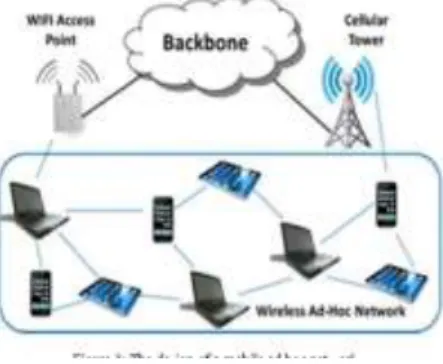
Fig. 1. MANET Example.
to the larger internet. It contain one or multiple and different transceivers between nodes. It gives highly dynamic, autonomous topology.
Figure 1 shows MANET example in which number of different nodes communicate with each other. For transfering data wifi assess point,cellular tower and wireless network are required. MANET comes in infrastructureless wireless network.Each node acts as a router which can move freely and configure thenselves. The main challenge on wireless MANETs is a development of dynamic protocols that can efficiently find routes between communication mobile nodes. This type of routing protocol should be able to keep up with high degree of the nodes mobility that is frequently changed into the network topology. The combination for the quality of the links differs with the use of broadcasting nature of the Wireless channels.
Mobile Ad Hoc Networks (MANETs) have enormous net- work flexibility and node mobility which makes MANET routing very challenging. Since MANET assumes a friendly environment, it is vulnerable to attacks and malicious nodes. In such a dynamic network, it is difficult to use multimedia and other advanced applications without quality-ofservice (QoS) constraint. QoS can be defined as a set of service requirement that a given network should satisfy while transmitting packets from source to destination. It is difficult to design a path with multiple QoS constraints as there can be conflicting parameters and race conditions among various parameters[10].
Fig. 2. Challeges of MANET [13] 1.1. Problems of MANET
Many routing algorithms have been proposed in the literature which achieved promising results. Even though after many research the approaches faces many problems which are as follows:
Vrushali Uttarwaret al IJSRE Volume 06 Issue 08 August 2018 Page 8016 Dynamic network topology
Speed
Frequency of updates or network overhead Mobile agent based routing
Energy efficient/Power aware routing
Different layers of MANET faces many problems as shown in Figure 2. It shows layered structure and approach to adhoc networks. Within different challeges paper mainly consisting to improve Quality of Service (QoS) at MANET. QoS are essential because of rapid development in mobile technology and real time applications like multimedia, voice. Providing QoS in ad hoc network is necessary to maintain best -effort- of service. The QoS metric are bandwidth, latency, jitter and delivery guarantee.
2. REVIEW OF LITERATURE
MANET is the subcategory in wireless communication and has become a popular research topic because of increased growth in communication. In this section,different papers are reviewed to improve QoS for MANET.
The problem of QoS routing in ad-hoc networks has in- trigued researchers for some time now, and several solutions have been suggested to guarantee end-to-end quality for flows. The initial solutions considered the bandwidth on an ad-hoc link individually and attempted to find paths that satisfied the quality requirements [1],[2]. Such solutions did not consider the interference between neighboring links, or between mul- tiple hops of the same flow. A novel adaptive load balancing routing algorithm is proposed in Ad hoc networks based on a gossiping mechanism (ALBR-G) in [3]. This algorithm combines gossip-based routing and the idea of load balancing effectively. It can adaptively adjust the forwarding probability of RREQ messages according to the distribution and load status of nodes in route discovery phase. In [4] have presented a new multipath QoS routing protocol for MANET with load balancing mechanism. The two important contributions in this work are one is load balancing mechanism to fairly distribute the traffic on different active routes, the other is the route discovery mechanism based on QoS parameters such as delay and throughput.
In[5]the ad hoc QoS routing protocol with load balancing scheme is presented. For MANETs, load balancing can be ad- vantageous for increasing reliability and network throughput. The approach relies on modifications of AODV protocol on which they make an extension to utilize the nodes reservable bandwidth and load information to distribute the network loads, which can prevent network from getting into the sate of congestion, and avoid the power of congested node to be exhausted. In [6] enhancements to the AODV protocol to provide QoS and load balancing features by adding two extensions to the messages used during route discovery is shown. A detailed packet-layer simulation model with media access control (MAC) and physical layer models is used to study the performance of both the AODV and the QoS- AODV protocols. Important performance measures such as average delay, packet delivery fraction and normalized routing load are used in the comparison. In this paper [7], proposes a multi-path routing for load balancing since it minimizes the maximum utilization while supporting the same traffic demands. Initially, a Route Discovery is initiated when the source node attempts to discover routes to the destination by flooding request packets (RREQs).
Vrushali Uttarwaret al IJSRE Volume 06 Issue 08 August 2018 Page 8017 neighboring Base Stations. Based on the gained knowledge a basic Resource Utilization based load balancing algorithm tailored for Mobile WiMAX was designed and three enhancement proposals were made. The first de- fined a framework to automatically tune the load balancing triggering threshold and the second a framework to enable BS controlled load balancing for Best Effort Mobile Stations [8]. In [9], the cross layer based algorithm introduced which was used to enhance the performance of TCP of the ad hoc network as well as to minimize the packet drop rate. However with this approach a repeated disconnection of mobile node can cause some packet losses and delays in some scenarios. The practical simulation results were shown in terms of throughput, jitter and packet delivery ratio.
MANET routing is critical and routing decision should be made sooner before the node leaves the network. propose a QoS constrained fault tolerant ant lookahead routing algorithm which attempts to identify valid route and look-ahead route pairs which might help in choosing the alternate path in case of valid route failure. The results prove that the proposed algorithm takes better routing decisions with 20-30 percent improvement compared with existing ant colony algorithms [10].
MANET is temporary network and does not require any framework. The communication in MANET is held through routing protocols such as AODV, DSR, and DSDV etc.[11] There are various routing protocols existing for efficient com- munication with the goal of improving QoS parameters such as throughput, Packet Delivery Ratio (PDR) and reducing delay and packet loss.In[11] present an efficient opportunis- tic MANET routing protocol to overcome the problem of opportunistic data transfer. At first we introduced existing CORMAN protocol, which is showing better performance against existing one
3. ROUTING PROTOCOL
There are many popular routing protocol which are used in MANET. Some of them posses QoS whereas some are not. The following routing protocol gives various functions and results which are as follows: Ad hoc On-Demand Distance Vector (AODV)
The Ad hoc On-Demand Distance Vector routing protocol is casted by mobile nodes in ad hoc network.. It uses destination sequence numbers to ensure loop freedom at all times, avoiding problems associated with classical distance vector protocols. Route requests, route replies and route errors are the message types defined by AODV. These message types are received via UDP and normal IP header processing applies, the requesting node is expected to use its IP address as the Originator IP address for the messages[14]. 3.1 AODV uses the following fields with table entries:
Destination IP Address
Destination Sequence Number
Valid Destination Sequence Number flag
Other state and routing flags (e.g., valid, invalid, re- pairable, being repaired) Network Interface
Hop Count (number of hops needed to reach destination) Next Hop
List of Precursors
Lifetime (expiration or deletion time of the route) The main steps of AODV are as follows: Route Discovery
Expanding Ring Search Technique Setting up of Forward Path
Route Maintenance Advantages of AODV
- It supports both unicast and multicast
Vrushali Uttarwaret al IJSRE Volume 06 Issue 08 August 2018 Page 8018 It answers very quickly to the topological changes that affects the active.
AODV does not put extra overheads on data packets as it does not make use of source routing. Limitations of AODV
It expects/requires nodes in broadcast medium can detect each others broadcasts.
Not good for attacks as it based on the assumption that all nodes must cooperate and without their cooperation no route can be established.
3.2 Temporary Ordered Routing Protocol (TORA)
TORA is routing protocol designed to operate in a dynamic multi hop network. TORA uses height parameter to determine the direction of link between any two nodes for a given destination. Number of multiple routes often present for a given destination but none of them are necessarily the shortest route. To initiate a route, the node broadcasts a QUERY packet to its neighbors. This QUERY is rebroadcasted through the network until it reaches the destination or an intermediate node that has a route to the destination. The recipient of the QUERY packet then broadcasts the UPDATE packet which lists its height with respect to the destination. When same packet propagates in network, each node that receives the UPDATE packet sets height to a value which is greater than the height of neighbour from which the UPDATE was received. Effect of creating a series of directed links from the original sender of the QUERY packet to the node that initially generated the UPDATE packet. When found through node the route to a destination is not valid, then have to adjust its height so that it will be a local maximum with respect to its neighbours and then transmits an UPDATE packet. If the node has no neighbors of finite height with respect to the destination, then the node will attempt to discover a new route as described above. When node detects network partition, it generate a CLEAR packet which results in reset of routing over the ad hoc network[13].
The key steps of protocol algorithm of TORA are as follows: Route creation
Route maintenance Route erasure. Advantages of TORA
The multiple routes between any source destination pair are supported.
Failure or removal of any nodes is quickly resolved without source intervention by switching to an al- ternate route.
Limitations of TORA
It depends on synchronized clocks among nodes. 3.3 Dynamic Source Routing (DSR)
Vrushali Uttarwaret al IJSRE Volume 06 Issue 08 August 2018 Page 8019 same route request packet. When the route is discovered, the required packets will be transmitted by the sender on the discovered route. Also an entry in the cache will be inserted for the future use. The node will maintain the age information of the entry to know if the cache is fresh or not. When a data packet is received by any intermediate node, it first checks whether the packet is meant for itself or not. If it is meant for itself (i.e. the intermediate node is the destination), the packet is received otherwise the same will be forwarded using the path attached on the data packet. Since in Ad hoc network, any link might fail anytime. Therefore, route maintenance process will constantly monitors and will also notify the nodes if there is any failure in the path. Consequently, the nodes will change the entries of their route cache.
Advantages of DSR
There is no need to keep routing table so as to route a given data packet as the entire route is contained in the packet header.
Limitations of DSR
It is not scalable to large networks and even requires significantly more processing resources than most other protocols.
3.4Fault-Tolerant and Secure Routing
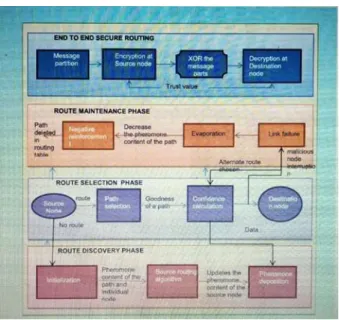
Vrushali Uttarwaret al IJSRE Volume 06 Issue 08 August 2018 Page 8020 Fig. 3. System Architecture for fault tolerant and secure routing
The key phases of ACO algorithm are as follows: Route Discovery Phase,
Route Selection Phase Route Maintenance Phase. Advantages Of ACO
Ant colony approach with fault tolerant routing has a better packet delivery ratio than AODV.
4 PERFORMANCE METRICS
There are many performance metrics availble to calculate quality of approaches. They can be qualitative and qunatitative. The comparison can be made on the basis of these metrices.
A. Routing overhead
Routing overhead is how many routing packets for route discovery and route maintenance need to be sent so as to propagate the data packets.
B. Average Delay
Average Delay gives average end-to-end delay and shows how long it took for a packet to travel from the source to application layer of the destination. It is measured in seconds.
C. Throughput
Throughput is the total number of bits forwarded to higher layers per second. It is measured in bps. It can also be defined as the total amount of data a receiver actually receives from sender divided by the time taken by the receiver to obtain the last packet.
D. Media Access Delay
The time a node takes to access media for starting the packet transmission is called as media access delay. The delay is recorded for each packet when it is sent to the physical layer for the first time.
E. Packet Delivery Ratio
The ratio between amount of incoming data packets and actually received data packets. F.Path optimality
Vrushali Uttarwaret al IJSRE Volume 06 Issue 08 August 2018 Page 8021 5. RESULT ANALYSIS
Fig. 4. Throughput for 20 nodes [10] Fig. 5. Throughput for 40 nodes [10]
In Figures 4 and 5, the throughput of fault tolerant ant colony protocol is comparable to AODV. The higher through- put of fault tolerant ant colony algorithm is attributed to the fast convergence of fault-tolerant path and data routing depends purely on that fault tolerant path. When the percentage of the faulty nodes increases, the throughput of fault tolerant ant colony algorithm decreases considerably, as it becomes increasingly difficult to find a full confidence path for the source node. But considering the performance with respect to AODV protocol, the performance in terms of throughput is still significantly higher for our fault tolerant ant colony algorithm [10].
6. SUMMARY
The rapid developments in the field of ad hoc networking allows the nodes to form a creating, self-organizing and self-administering wireless network. Its intrinsic flexibility, lack of infrastructure, ease of deployment, auto configuration, low cost and potential applications makes it an essential part of future pervasive computing environments. This review aims to discover ad hoc network architecture, advantages,key steps and also mentions about various challenging issues and provides the feasible solution based on new technology.
The working of a quality of service based multipath routing in Mobile Ad hoc Networks (MANETs) based on Ant Colony Optimisation (ACO) look-ahead approach. The approach uses bandwidth, hop count and delay to calculate multiple disjoint paths between source and destination to satisfy given QOS constraints. The best path(s) gets strengthened by deposition of pheromone substances on that link. Thus as the routes are selected completely satisfying stability and QoS constraints, it fully complies with Q0S objectives. Simulations performed with network simulator 2 shows that the proposed algorithm performs better with 20-30% improvement compared to the other existing non-ant colony algorithms [10].
ACKNOWLEDGMENT
The authors would like to thank the researcher as well as publishers for making their resources available and the teach- ers for their guidance. We also thank the college authorities for providing the required infrastructure and support. Finally, we would like to extend a heartfelt gratitude to all friends and family members.
REFERENCES
1. S. Chen and K. Nahrstedt, “Distributed quality-of-service routing in adhoc networks,” IEEE Journal Selected Areas in Communication, vol. 17 no. 8, pp. 14881505, Aug 1999.
Vrushali Uttarwaret al IJSRE Volume 06 Issue 08 August 2018 Page 8022 3. Zhu Bin, “A Novel Adaptive Load Balancing Routing Algorithm in Adhoc Networks” Journal of
Convergence Information Technology Volume 5, Number 5, July 2010.
4. Mohamed Tekaya, “Multipath Routing with Load Balancing and QoS in Ad hoc Network” IJCSNS International Journal of Computer Science and Network 280 Security, VOL.10 No.8, August 2010. 5. Chengyong Liu, “Research of QoS-aware Routing Protocol with Load Balancing for Mobile Ad hoc
Networks” 2008 IEEE.
6. Dr. B.S Pradeep, “A New Method for Load Balancing and QOS in On demand ProtocolsIn the MANETs Perspective” Int. J. of Advanced Networking and Applications Volume: 01, Issue: 04, Pages: 275-281 (2010).
7. S.Venkatasubramanian, N.P.Gopalan, “Multi-path QoS Routing Protocol for Load Balancing in MANET”, International Journal of Networking & Parallel Computing Volume 1, Issue 3, Dec2012-Jan2013
8. P. Elayarasu, Mr. V.Saravanan, “IMPROVED QOS AND EFFICIENT RESOURCE ALLOCATION FOR MOBILE LOAD BALANCING IN WIMAX NETWORK AND MANET”, International Journal of Wireless Communications and Networking Technologies, 2013.
9. Mr.M.D.Nikose, Dr.S.S.Salankar, “Comparative Analysis and Design Study of Cross Layer Scheme Based Algorithm to Increase the Qos performances in Wireless Communication”, IEEE International Conference on Recent Advances and Innovations in Engineering (ICRAIE-2014), May 09-11, 2014. 10.Surendran. S, Prakash. S, “An ACO Look-Ahead Approach to QOS Enabled Fault-Tolerant Routing
in MANETs”, China Communications ( Volume: 12, Issue: 8, August 2015 ), IEEE
11.Sandhya Onkar Ahire, Dr. D. K. Shedge, “ECORMAN: Extended Cooperative Opportunistic Routing Scheme (CORMAN) with Efficient MAC Base Channel Reuse Technique for Mobile Ad Hoc Network (MANET)”, 2015 IEEE UP Section Conference on Electrical Computer and Electronics (UPCON).
12.Taneja, Sunil, and Ashwani Kush, “A survey of routing protocols in mo- bile ad hoc networks.” International Journal of innovation, Management and technology 1.3 (2010): 279.
13.S.Venkatasubramanian and Dr.N.P.Gopalan “A QoS-Based Robust Multipath Routing Protocol for Mobile Adhoc Networks” IACSIT International Journal of Engineering and Technology Vol.1,No.5,December,2009.