141 TECHNICAL UNIVERSITY OF CLUJ-NAPOCA
ACTA TECHNICA NAPOCENSIS
Series: Applied Mathematics, Mechanics, and Engineering Vol. 62, Issue I, March, 2019
BUILDING A PROJECT TEAM ACCORDING TO THE TIME ALLOCATED
AND THE NUMBER OF RELATIONSHIPS FOR THE SUCCESSFUL
COMPLETION OF A PROJECT
Daniel FILIP, Florin COVACIU, Anca SARB, Sanda TIMOFTEI
Abstract: This paper highlights the main elements of the decision-making process in building a project team, depending on the time allocated and the number of relationships to be managed within the team. As is well known, more and more organizations adopt work through projects, which justifies the purpose of this work. Any Project Manager has to justify his decisions based on mathematical models and his own experience. From the simulations made in this paper, the Project Manager can choose the most efficient structure for the project team to ensure the successful completion of an assumed project.
Key words: Mathematical Methods, Project Manager, Decision, Projects.
1. INTRODUCTION
The notion of the Project has become a basic element in the business environment regardless of the activity branch to which the enterprise belongs. This is because we are meeting a blast of projects both at the country and world level.
Projects can be a way for organizations to operate, develop, innovate to survive or compete in maintaining or winning a market segment.
The project is a set of elements that are interconnected to each other after a certain plan (with rules and conditions) that interact within a certain determined time period at an estimated cost to achieve the objectives. The results can be: products or services.
The shortest definition of a Project may be: a set of temporary efforts to create a product or provide a service. This is the definition of "PMBOK" - Project Management Body of Knowledge Guide. [1]
The project is a set of time-bound activities through a start (Begin) and a finish (End), to which limited resources are allocated to achieve the established goals. [1]
A project can be characterized by:
• is a temporary effort (with a start and an end) with limited resources;
• creates a unique result in relation to the firm's activity;
• is unique in how resources are approached
relative to other enterprises. Time (Duration)
Buget (Cost)
Goals (Results) Project size
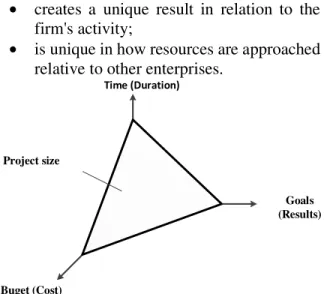
Fig. 1.1 Graphic representation of a project In conclusion, a project represents a set of activities, ordered in time, with a predetermined duration and with limited consumption of resources (human, material, financial, etc.) in order to obtain the proposed results, respecting the scope of the project (conditions and restrictions).
efficient use of available resources for each activity within a set time frame.
In most specialist books, where "Project History" is presented, most of them feature the world's first projects that have been realized as: The Cheops Pyramid, The Colosseum of Rhodes, The Colosseum of Rome, The Great Wall, The Mayan Temples Central America etc.
Fig. 1.2 Unique results
If we make an analogy to the project definition, we find that only one essential element of a project is fulfilled, namely unique results. The other elements are still remaining a paradox today. Who could tell us how much was the budget (cost) of each project? Who could say what was the duration of each project, start date and completion for each? How many resources have been involved?
The answer we all know, everything that exists is only assumptions and not concrete data. A clear statement that we can express about project and project management is that it was around the 1940s and 1950s and here we can mention a few more relevant projects at that time, such as the Manhattan Project.
A very important aspect is to make the difference between operational work and work within the project. Operational work is the daily or periodic activity of repetitive character and the same consumption of resources. We can mention that most of the activities in an enterprise are repetitive (most of them are operational). Project work meets with new challenges each time.
For example: maintenance activities are also operational activities, where we want to improve a product or service become part of a project work.
Project management represents both the science and the art of combining knowledge,
skills and tools through specific methods to achieve the proposed objectives.
Project management has the following
component phases: initiation, planning,
execution, monitoring and control, project closure, pursuing the proposed objectives with respecting the level of using resources and budget available.
The purpose of project management is to make it possible to meet the objectives by respecting the conditions and constraints imposed by the project.
2.THE CONCEPTS OF PROJECT,
PROGRAM AND PORTFOLIO
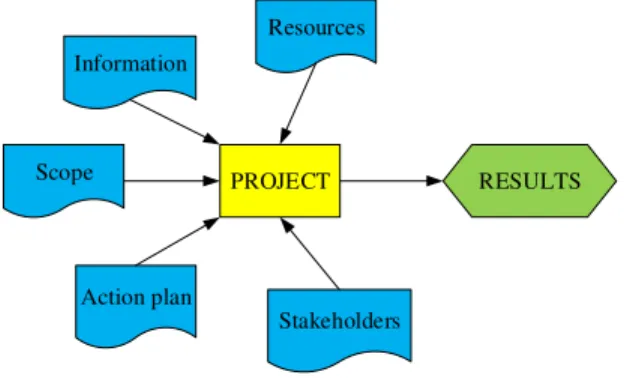
The project is a temporary effort with limited resources to achieve the expected results. The project is carried out after a rigorous action plan to achieve the proposed objectives, within one project there may be one or more objectives depending on the scale of the project.
Generally, the duration of the projects ranges from a few months to a few years, depending on the scope of the project. Also, the number of objectives proposed and the expected results are directly proportional to the time and budget allocated. The decision maker within a project is the Project Manager, having full powers over all resources within the project.
PROJECT Resources Information
Stakeholders Scope
Action plan
RESULTS
Fig. 2.1 The elements of a project
The program mainly has the same criteria as a project but it is larger than the project. the program implies more quantitative objectives and results, as well the duration and the budget. It is worth mentioning that a program may include one or several of the projects, but all contribute to the objectives of the program.
143 project managers in that program and the
program management team.
Generally, a program runs a few years, but the period is limited. we know exactly the start and end date of the program, the allocated budgets and the resources available. Furthermore, we can say that programs are generated by strategies adopted by organizations.
The portfolio consists of all the results achieved so far by an organization through its
work. It should be noted that the portfolio does not have a defined timeframe and no well-established budget, it is based on the mission and values adopted by the organization. An organization's portfolio may include several programs that are interrelated or not, but contribute to the same strategic goal of the organization (Figure 2.2).
0 Time Project 1
Project 3 Project 2
Project n-2 Project n
Project n-1
Program 1 Program n
Portfolio
Fig. 2.2 Graphic representation for Portfolio, Program, and Project 3. PROJECT MANAGER VS. THE
RESPONSIBLE PROJECT
The project manager is the person designated by the organization to handle the project with the full authority for which it was proposed. Among the main responsibilities we can mention: to harmonize the project objectives with the organization, to form the project team, to share the responsibilities, to monitor and control of activities and implicitly the objectives, the risk anticipation and the validation of the results according to the technical specifications of the project.
In most projects, the project manager participates (is involved) in all phases of a project (Figure 1.4), from the writing of the project proposal to the closure of the project.
Depending on the size of the project, this can be divided into sub-projects, which can be done by an only organization or in partnership (several organizations). Divided the project is automatically involving a one responsible person on each subproject.
The team leader falls under the direct authority of the project manager and is given
authority only on the resources he manages for to obtain the established results. He will only answer for the results of the activities he manages with full authority. It is worth mentioning that in the case of partnerships the
authority and responsibilities are well
established before the project starts and are assumed by the leadership of each organization directly involved in the project.
Any project manager must have the following skills to successfully manage a project at the finish, namely:
Knowledge - to know the methods, techniques and tools specific to project management and to apply for efficient resource management;
Experience - is an important "asset" for applying into practice all the data and information available to successfully complete a project;
Behavior - is highlighted by the manager's leadership / attitude throughout the life cycle of the project.
manager to which he belongs, if there are no implemented programs then the project manager is directly subordinated to the general manager, who may be the portfolio manager.
All these rules are established through the organization chart. With her help, each constituent entity is clear from who gets responsibilities and to whom it reports.
Tabel 3.1 Responsabilități vs. Atribuții
Responsibilities Attributions
Complete the project on time Harmonizes the objectives of the project with
those of the organization
Expenditure in the project to fit into the proposed budget
Imposes the way of organizing, sharing and using of the resources
The results obtained correspond to the established technical specifications.
Identifies, analyzes and monitors the potential risks to the activities during of the project
Motivating and stimulating the project team
Contributes to the professional development of the project team members
A professional project manager should have several types of skills to succeed in completing a project with successful, of the most important being:
• the way he builds his team;
• communication mode;
• power of influence;
• choosing the best variants (decision);
• cultural and political awareness;
• negotiating power;
• building trust;
• conflict mediation,
• etc.
In conclusion, there is no clearly defined typology for a professional project manager, but it can be mentioned that the manager needs to adapt and respond according to the needs of all the entities involved both in the internal and external environment of the project.
4. A MATHEMATICAL SOLUTION FOR THE DIMENSION OF THE PROJECT TEAM ON THE TIME ALLOCATED
The most common question in Project Management courses is "How many people can manage a project manager directly?" Most of the answers found in specialized books are 6 or 7 people. In some situations, the answer it is good and in others not. Everything depends on the time the project manager has to allocate to each subordinate member directly. So far, I have not
encountered in the literature I have read any mathematical model by which a manager can determine a solution according to time.
A proposed solution for determining the optimal number of subordinates directly to the project manager requires the following steps:
Step 1:
• determining the manager's working time;
0; 12 (1)
where:
- Tm = manager's working time;
- n = number of hours worked per day;
- zi = the number of working days with the
same program;
- k = number of days with different
program.
Step 2
• determining the maximum number of
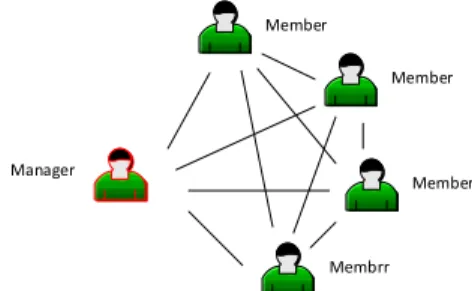
interpersonal relationships that the project manager should manage in terms of information, training, monitoring and control, negotiation, conflict mediation, evaluation, etc.
(2)
where:
- Nr = number of relationships;
145
Member
Member
Member
Manager
Membrr
Fig. 1.7 Identifying the number of relationships
Step 3:
• it is very important to determine exactly
the time required for all direct
subordinates. The length of the
dimensions varies according to the project field, the level of professionalism of the subordinates and the characteristics of the information (concise, relevant, accurate, timely and accessible) to be provided to each subordinate member. At this step, the manager has to decide what time frame has to assign to the team (e.g.: 25%, 50%, 80% of his time). For the value of 50% the formula is as follows:
2 (3)
where:
- Tm = manager's working time;
- Ttp = the time allocated to the project team;
• the value resulting from relationship 1.3 is
divided as required by subordinate directly members. In case it is necessary to allocate more time then the project manager can
decide that some subordinate directly members can be appointed responsible for certain areas or team leader who will train their own team.
• the second half of the project manager's working time is allocated to analyze the planned and missed situations, identifying potential new risks, monitoring activities,
evaluating results, centralizing
deliverables and other activities needed for the project to run under the best possible conditions.
Step 4:
• determining a safety margin for each
relationship
∗ 1 ∗ 1% (4)
where:
• ts= safety margin
• n = number of team
• Tm = manager's working time
Several simulations have been performed to validate the product solution using Excel.
The input variables for the proposed model are:
• the number of hours worked per day
• number of working days per month (with
the same program: 8h per day)
• number of team members (including
manager)
According to the above, the manager's available working time and the maximum number of team members will be calculated automatically.
In this scenario, it is assumed that 10% of the manager's total time should be allocated to training each member of the team, assigning tasks, responsibilities and evaluating the results
It should be mentioned that the percentage of 10% was taken as an example from the
experience. This percentage may vary
depending on the type of activities being carried out and the needs of each member of the team. Needs are influenced by experiences from other similar projects, the level of uncertainty in the data, potential conflict risks, and more. There are situations when not all members of the team need the same percentage and then can be a percentage sum of the team project
1.5
where:
- Te = time allocated to the training,
evaluation team, etc.;
- mi =time allocated to each member of the
team;
- k = număr de membrii.
From experience and statistics resulted a percentage of 1% for each relationship from the manager's total time, which may vary according to the typology of team or group members. If
there is a sympathy and mutual help between the team members this percentage may be less than 1%, if there is antipathy or rivalry between the members the percentage is higher. All of the above are set by the manager based on the team selected.
Following the simulation according to the proposed assumptions, was obtained the data (figure 4.1), which the project manager can distribute on the working schedule as necessary. For a five-member project team, there are 10 identified relationships and the time left to the manager's activities is 94 hours (i.e. 56% of the total project time).
In the second scenario, the team consists of 7
members, consequently the relationships
between them are many, namely 21
relationships. As a result, the manager must allocate more time for training, task division, conflict assessment and mediation, resulting in a shorter time for the project manager's own activities.
By comparing the graphs of the two simulations, it can be seen how much increased the time for training, assignment, evaluation, mediation of conflicts in rapport with the manager's time.
Fig. 4.2 The second simulation In conclusion, as the project team is bigger
the time allotted must be increased. That's why an effective solution for large project teams it is recommended to be called a team leader on specific objectives / areas / directions.
147
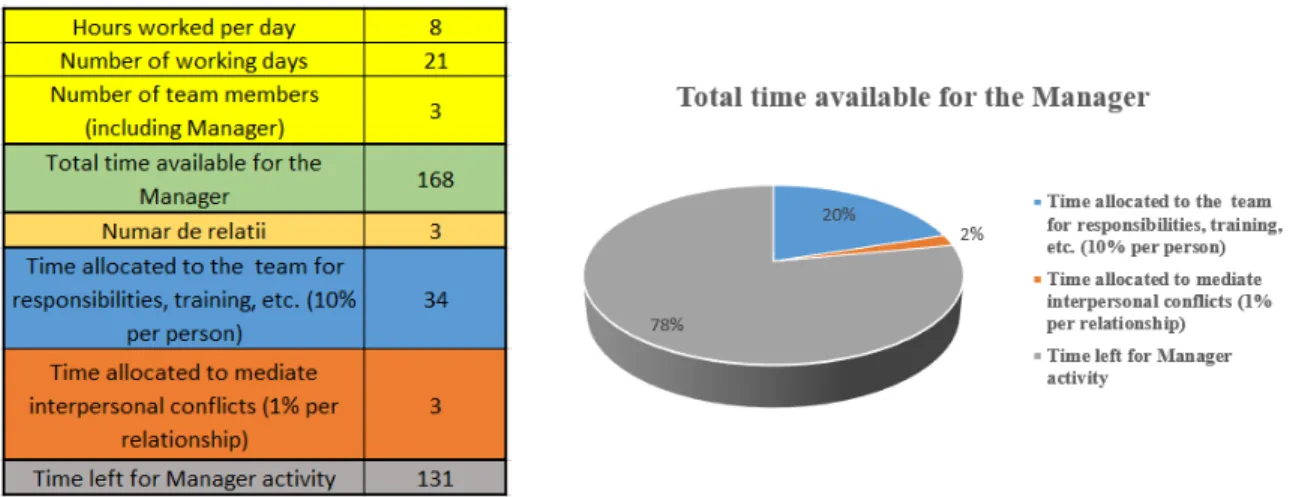
Fig. 4.3 The third simulation From the simulation data, it can be concluded
that the project manager is involved in the management of the team with 23% of the time and in the project activities by 77%, which means dedicating a longer time to the project activities and not the team.
5. CONCLUSIONS
According to specialized studies published, more and more organizations adopt the activity through projects. The project activity brings a very important advantages for the competitive economic environment, among the most important can be mentioned:
• SMART goals defined
• a concrete action plan
• better control of resources
• better control over costs
• monitoring of activities and risks
• etc.
Successfully completing a project requires efficient management of the resource. Managing resources in a project is in the responsibility of the project manager according to the established action plan.
An essential condition for efficient resource management is to allocate sufficient time and information to the project manager. This paper attempted to provide a mathematical solution for dimensioning a project team on based the time allocated to each subordinate directly, team size and safety margin to eliminate the conflicts.
From the results obtained on the three simulations and the authors' experience, it can be
said that the model offers very good solutions if all the elements presented in the mathematical model are identified as accurately as possible.
6. REFERENCES
[1] A guide to the project management body
of knowledge (PMBOK guide) - 5th ed, Publishing Newtown Square, PA: Project Management Institute, 2013, ISBN 978-1-935589-67-9 .
[2] F. Buşe, Aurelian Simionescu, Nicolae
Bud, Managementul proiectelor, Editura,
Bucureşti : Editura Economică, 2008, ISBN 978-973-709-404-9
[3] V. Firescu, R. Vlad, N. Toderici, The
Application of the Lean Management Principles and Methods - Opportunities and Hedges from the Romanian Employees,
Proceedings of the 1st Management
Conference: Twenty Years After - How Management Theory Works, Cluj-Napoca, 2010, pp. 73-89.
[4] C. Feniser, A. Sadeh, J. Bilbao, F. Lungu,
A. Solovastruv, Innovative perceived conduct
of industrial firms, ACTA TECHNICA
NAPOCENSIS, Series: Applied
Mathematics, Mechanics, and Engineering Vol. 61, No3, Issue Special, September, 2018.
[5] Ucenic, Camelia Ioana; Ratiu, Claudiu,
Cluj Napoca, ROMANIA Date: OCT 12-13, 2017
[6] M. Bogdan, A. Sava, Supply chain
finance, a solution to improve business
efficiency, ACTA TECHNICA
NAPOCENSIS Series: Applied
Mathematics, Mechanics, and Engineering Vol. 61, Issue IV, November, 2018
[7] F. Covaciu, Actuation and control of a
serial robotic arm with four degrees of
freedom, ACTA TECHNICA NAPOCENSIS
Series: Applied Mathematics, Mechanics,
and Engineering Vol. 61, Issue III, September, 2018.
[8] R. C. Vlad., An integrated planning and scheduling model for wiring systems
assembly, ACTA TECHNICA
NAPOCENSIS, Series: Applied
Mathematics, Mechanics, and Engineering Vol. 61, Issue Special, September, 2018 [9]
https://www.pmi.org/pmbok-guide-standards/foundational/pmbok
[10] http://suncoastpmi.org/images/downloads/ BusinessAnalysis/pmbok_5th_edition.pdf
CONSTRUIREA UNEI ECHIPE DE PROIECT ÎN FUNCȚIE DE TIMPUL ALOCAT SI
NUMĂRUL DE RELAȚII PENTRU FINALIZAREA CU SUCCES A UNUI PROIECT
Rezumat: Această lucrare scoate în evidență principalele elemente ale procesului decizional în construirea unei echipe de proiect, în funcție de timpul alocat și numărul de relații care trebuie gestionate în cadrul echipei. După cum se cunoaște, tot mai multe organizații adoptă activitatea prin proiecte, ceea ce justifică scopul acestei lucrări. Orice manager de proiect trebuie să își argumenteze deciziile pe baza unor modele matematice și a experienței proprii. Din simulările efectuate în această lucrare se poate alege de către Managerul de proiect, cea mai eficientă structură pentru echipa de proiect care să
asigure finalizarea cu succes a unui proiect asumat.
Daniel FILIP, Ph.D., Lecturer, Technical University of Cluj-Napoca, Management end Economical Engineering, [email protected], Phone: 0749042915.
Florin COVACIU, Ph.D., Lecturer, Technical University of Cluj-Napoca, Department of Design Engineering and Robotics, [email protected], Phone: +40 -264-401684.
Anca SARB, Ph.D., Technical University of Cluj-Napoca, Design Engineering and Robotics Department, [email protected].