UDC 656.25
M. KYCKO
1*1*Quality and Certificicatio Division, Railway Institute, Chłopickiego Józefa St., 50, Warsaw, Poland, 04-275, tel. +48 (84) 473 10 71, e-mail [email protected], ORCID 0000-0002-8447-2472
COMMAND – CONTROL AND SIGNALING SYSTEM
DOCUMENTATION AND ITS SAFETY
Purpose. The publication presents the importance and influence of railway traffic control system documentation on its safety. Furthermore, it presents certain selected issues of formal and semi-formal descriptions. Methodology. Development of correct and complete descriptions of the informal, semi-formal and formal becomes important in terms of safety requirements. Background documentation and forms of command-control and signaling system de-scription are the base documents of safety proof. It seems necessary to implement the analysis of the design, manu-facture process and operation of safety-related equipment into the work of the Polish railways. Firstly it is applied to traffic control devices. Findings. This publication also shows the importance of risk analysis, which is essential when deciding on the implementation of signaling systems to operate, which are required both in the regulations and making rational decisions about the implementation of the systems. Originality. The presented a problem changes the approach to certain data and makes us aware of their validity. Practical value. The presented problems can help understand certain legal requirements.
Keywords: control systems; formal description; risk; safety; informal description
Introduction
Safety is the basis of any rail transport and sig-naling system. Risk analysis is a key element of safety management systems in rail transport. The method used, good practices, practical and diligent approach to risk analysis largely determine the ef-ficiency of activities and effectiveness of measures designated to improve railway safety. The impor-tance of safety may be analyzed in terms of a wide range of factors.
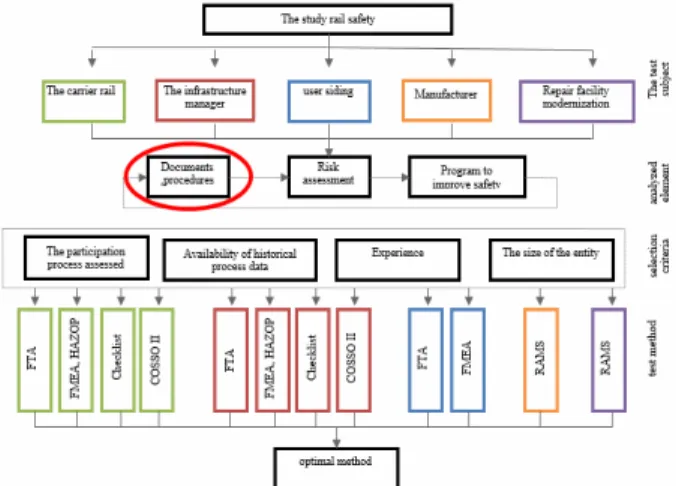
Fig. 1. Safety components and test methods for rail transport
The diagram (Fig. 1) shows that documentation is an important element of the safety components.
Within the RTC systems, safety is the key factor which qualifies a particular system for release to service. Following Poland’s accession to the EU structures within the area of safety, the following standards have become applicable: PN-EN 50126, EN 50128 and EN 50129]. PN-EN 50126 standard determines the reliability, availability, maintain-ability and safety (RAMS), as a process based on the system life-cycle. This process defines particu-lar stages of the system and procedures for ap-proval before moving on to the next stage (re-quirement specification, design, implementation, etc.). Standard EN 50128 specifies the procedures and technical requirements for designing software for secure electronic system of railway control and security [8]. It should be noted that this standard is not fully obligatory. Standard EN 50129 defines the requirements for the design, testing, commis-sioning and approval of electronic systems, subsys-tems and related signaling devices with security in railway applications.
Purpose
de-fined. The fact that they are in use means that the ail-safe principle is applied at the system function or module levels, and at the hardware lever, an analysis is carried out concerning the security measures preventing random and systemic damage, where the occurrence of random damage is associ-ated with defects of memory, processors, etc. and the occurrence of systemic damage is associated with human errors throughout the entire system life cycle, which means that these also include, among other things, its design and maintenance.
Neither the fail-safe principle nor a high level of SIL, usually SIL4, which are interpreted as a guarantee of full security, do not ensure complete elimination of accidents and events in rail trans-port. According to the Community law, security means the absence of unacceptable risk (i.e. no hazard). In order to achieve security, according to the prevailing approach, in accordance with the Community law, it is necessary to manage security through security monitoring following respective risk management. Risk management involves scheduled application of management policies, procedures and practices in the field of risk analy-sis, risk valuation and hazard recording by infra-structure managers and railway carriers. Security monitoring is the systematic application of man-agement strategies, priorities and plans by the same managers and carriers in order to maintain security.
Methodology
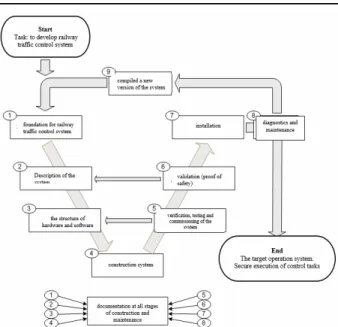
The process of designing, manufacturing, de-ployment and operation of computerized control-command and signalling systems due to the com-plexity and compliance with the safety require-ments while maintaining the conditions of integrity of the structure of hardware and software SIL 4 requires application of specific rules and proce-dures. In the area of knowledge relating to this process, there are a number of different standards developed by individual centres, academic and in-dustrial societies which develop their own stan-dards and do not meet the mutual compatibility requirements. Regardless of any individually de-veloped methods, the process of control-command and signalling system development may proceed methodically based on the recommended scheme called the V cycle, taking into account the assump-tions of the RAMS analysis.
Fig. 2. Cycle V signaling system construction The diagram (Fig. 2) shows the scheme of the control-command and signalling system implemen-tation process which lists each step of the process and shows that it is important to create records of every stage of the system development. Creation of the said records at every stage is intended to miti-gate the number of errors committed in the course of the system development, thus increasing the level of security of such systems. The system de-sign and development begin with the control-command and signalling system assumptions de-velopment which include informal description documents. In the Polish design and investment reality, these may include documents prepared at the stage of orders, e.g. Specification of Material Terms and Conditions of Order, Ordered Item De-scription and other informal documents, including an informal analysis of the specifications or docu-ments specifying additional control-command and signalling system requirements completed a de-tailed formulation of principles of the control-command and signalling system. Documents such as the Specification of Material Terms and Condi-tions of Order, Ordered Item Description form the basis of performed tasks, which is why it is important that they contain clear and accurate in-formation.
the basis of the formal specifications algorithms and software are developed. The process of creat-ing the semi-formal and formal descriptions may also be automated by use of information systems. A sample description of the sequential formation of the specifications related to the drivers, confirm-ing the adopted principle of applyconfirm-ing the subse-quent stages of design, was presented e.g. in [3], in accordance with IEC 61131 standard. In the proc-ess of creating a control system involves engineers and experts of different specialties including spe-cialists who prepare the informal descriptions in natural language, specialists in control technique and technology as well as IT specialists and pro-grammers. The knowledge and experience of the people involved in the system development is es-sential, otherwise confusion or errors may arise, which ultimately has material adverse impact on the safety level.
The informal control-command and signalling system description documents include, but are not limited to:
− the above-said Specification of Material Terms and Conditions of Order, Ordered Item De-scription ;
− instructions, e.g. [4] and other specific doc-uments, depending on the specific requirements and objectives for which the control-command and signalling system is developed;
− station work description (station work tech-nology)
− control-command and signalling equipment scheme.
The formal and semi-formal documents in-clude, but are not limited to conduct ways specifi-cation within the station area with the demonstra-tion of the way objects and safety facilities;
− dependency table and/or other related docu-ments;
− scheme and table of inter-relations of
a station track scheme (so-called track system model)
− conducts runs cards; − contradictory runs table.
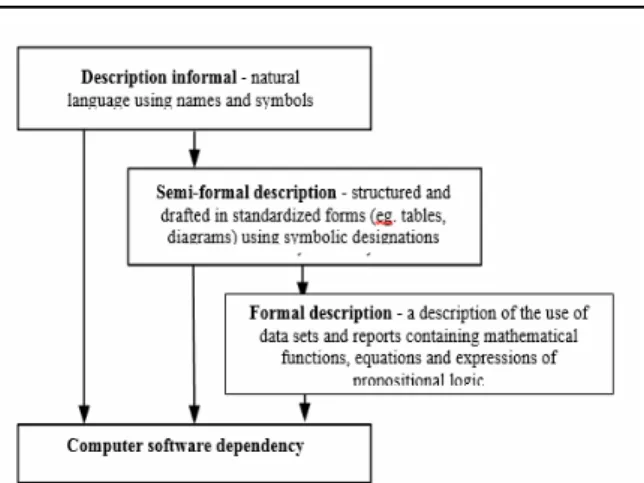
The formal description documents are collec-tions of data and relacollec-tions expressed, depending on the accepted standards, by more or less advanced syntactic and editorial forms. The sequence of de-velopment of the control-command and signalling system descriptions is shown in Fig. 3.
Fig. 3. Descriptions of the control-command and signalling system
Development of informal, semi-formal and formal (i-s-f) descriptions, and consequently the system designing should be in particular consistent with the assumptions and guidelines of many doc-uments and regulations. The beginning of the de-sign process is determined by the informal descrip-tion documentadescrip-tion underlying the semi-formal description, which in turn becomes the basis for a formal description, which, as the only form of de-scription, enables algorithmization and develop-ment of dependency computer software. This means that any errors committed or not detected at the first stage of the process, i.e. in the course of development of informal records, are usually re-produced in subsequent process stages. All forms of «i-s-f» description are mandatory documents also used i.a. for the purposes of validation, i.e. conformity (consistency) verification, assumptions and testing review. However, despite the clearly formulated guidelines for the design principles, in practice, there is no indication of all the substan-tive description elements. This enables the design-ers to achieve the various control-command and signalling system concepts. Certain conditions that should be fulfilled by any «i-s-f» descriptions were indicated. These conditions include clarity of in-formation, completeness of documentation and the principle of generation of the subsequent document on the basis of algorithmization he previously de-veloped documents.
un-der Directive 2008/57/EC of 17 June 2008, and the technical specifications for interoperability (TSI). In accordance with the above Directive, in order to be put into service, each subsystem or interopera-bility constituent shall receive an EC verification certificate, which is issued by the notified body. The notified body selected by the project contrac-tor will be able to issue the certificate of EC verifi-cation after it has checked and confirmed that the subsystem or interoperability constituent meet all relevant Technical Specifications for Interoperabil-ity. The TSI requirements are checked at various stages of investment, i.e. at the design, construc-tion and final testing stages.
Fig. 4. Stages of the process of obtaining approval to be put to service [5]
In order to be put to service, the documentation of a given control-command and signaling system must be complete and in accordance with the re-quirements and standards cited in the TSI (Deci-sion 2012/88/EU, as amended), namely also with the safety standards, i.e. PN-EN 50126, BS EN 50128 and BS EN 50129 standards.
The control-company subsystem must be built and installed in accordance with the Community law, and at the same time it must be compatible with the existing railway system to which it is acti-vated. The notified bodies are responsible for the examination of the subsystem conformity with the essential requirements of the Community. On the other hand, the bodies authorized by the Member State of the European Union where the subsystem is to be placed in service, perform the tasks related to verification of compliance of the subsystem with the national regulations.
The certification process is based largely on an assessment of the correctness and consistency of documentation which is not always so obvious. The certification process is designed to increase
safety, or to exclude unacceptable risks in the manufactured command-control and signaling sys-tem.
Findings
The approach to the safety of rail transport in Poland and in Europe undergoes significant modification. These changes were initiated in 2004 under the provisions of the Directive on rail safety. This Directive makes it clear that all operators of railway systems, infrastructure managers and railway carriers should bear full liability for the security of the system, each one to their respective extent. This issue is a novelty in the rail industry and causes a lot of confusion of interpretation disputes, in particular due to the fact that it falls within the overlaping areas of technical and management sciences. The units assessing the adequacy of the risk management process in railway transport were forced to undertake activitied under the Commission Regulation (EC) No 352/2009 [10] on the adoption of a common safety method on risk evaluation and assessment, and the Commission Implementing Regulation (EU) No 402/2013 on the common safety method for risk evaluation and repealing Regulation (EC) No 352/2009. The introduction of the provisions of these regulations created the need for a systematic approach to risk management processes, including risk evaluation and assessment, which apply to all changes of the railway system considered significant. Risk analysis and risk are inherently connected to the security of the system, therefore they are one of the important elements in deciding on the application of the system.
The provisions of Polish and European standards require that the risk analysis be carried out not only with respect to the safety analysis, but also require that the risk analysis be a mandatory part of the decision-making process concerning the implementation of the system into service. The command-control and signaling system docu-mentation should be prepared at every stage of the manufacturing, implementation or operation process. With the development of appropriate documentation, especially at the stage of the concept and design, the system can be considered safe.
analysis, or analysis of the types and effects of un-fitness. The IEC 60300-3-9 standard recommends a risk analysis in the following order:
− scope delineation (area);
− identification of hazards and their conse-quences;
− risk assessment (impact and frequency); − review
− documentation; − updated analysis.
Originality
The infrastructure managers and railway carri-ers, by making changes in their activities, and ac-cepting changes in subcontractors, regardless of whether these changes are of a technical nature, whether operational or organizational, are obliged to perform risk valuation, which is assessing the acceptability of risk introduced by the amendment. Such an assessment it is also required from the contracting entities and producers and contractors if they engage a notified body to carry out the EC verification procedure of the subsystem. This re-quirement means a commitment of contracting en-tities, manufacturers and contractors to carry out the assessment of the acceptability of risk intro-duced by the construction, modernization, renewal of the subsystem. Based on the criteria of risk ac-ceptability, the acceptability of a specific risk is assessed; these criteria are used to determine whether the level of risk is low enough not to make it necessary to take immediate action to reduce it. The risk assessment resulting from a significant change, is carried out by verification of application of codes of practice or by comparison with similar systems or by open risk estimation. The choice of method is left to the infrastructure manager, the carrier, the contracting entity, manufacturer or con-tractor who conducts evaluation of the acceptabil-ity of risks arising from the significant changes and cannot be imposed by an independent Assessment Unit. In the event of any significant change it is required to carry out an independent assessment of the adequacy of the risk management process and its results, conducted by the Assessment Unit. With each change into the system or of any risk analysis must be created by appropriate documen-tation, which would later be assessed by the com-petent assessment bodies.
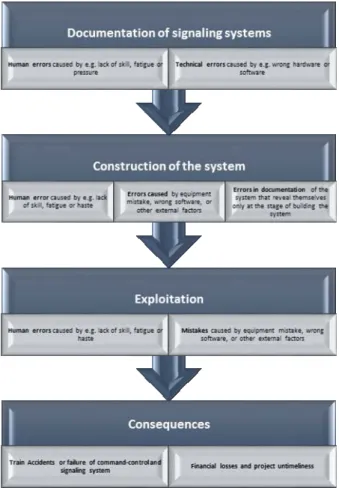
At each stage of creating a command-control and signaling system errors may occur, which then affect the proper operation of the system or its safety. The diagram (Fig. 5) shows an example of the cause of errors which, at a certain stage of de-velopment of the system, may cause a decrease the level of security.
Fig. 5. Scheme of errors and their causes during the construction of the command-control
and signaling system
The main factor in reducing the level of secu-rity is the human factor. Often at the first stage of the creation of the system documentation errors arise due to lack of knowledge and training among the staff, which at the later stages can lead to seri-ous financial losses, and more. The organization of the competence of personnel of all stakeholders is certainly a difficult challenge.
Conclusion
demon-strates the importance of correct documentation created in the process of release to service. Prepa-ration of informal and semi-formal description documents is obligatory, but nevertheless they must comply with the relevant requirements and should be analyzed in terms of risk assessment. The formal description documents enable algo-rithmization by developing a series of tools rele-vant to the design documentation for the com-mand-control and signaling system of under safe conditions, that is, i.a. the development of the safe-ty confirmation. The question of formalizing the description of signaling systems, although a number of secure computer systems have been developed, is still valid. The search for new forms of standardization of documentation – descriptions of signaling systems, and including the formaliza-tion of the descripformaliza-tion, is used to minimize the risk to preserving the condition of the integrity of the system-level design process. When creating infor-mal or forinfor-mal documents it is crucial that they are prepared by competent personnel which have a large impact on the correctness of these docu-ments, which of course also results in an increase in the level of security of the system.
LIST OF REFERENCE LINKS
1. Białoń, A. Problemy certyfikacji urządzeń srk na przykładzie ERTMS / A. Białoń, P. Gradowski, A. Toruń // Problemy kolejnictwa. – 2011. – Z. 152. – P. 77–88.
2. Białoń A.Bezpieczeństwo i ryzyko na przykładzie urządzeń sterowania ruchem kolejowym / A. Bia-łoń, M. Pawlik // Problemy kolejnictwa. –2014. – Z. 163. – P. 27–28.
3. Dyrektywa 2008/57/WE Parlamentu Euro-pejskiego i Rady z dnia 17 czerwca 2008 r. w sprawie interoperacyjności systemu kolei we Wspólnocie. – P. 8–14.
4. Dyrektywa Parlamentu Europejskiego i Rady 2008/110/WE z dnia 16 grudnia 2008 r. zmieniająca dyrektywę 2004/49/WE w sprawie bezpieczeństwa kolei wspólnotowych.
5. Fischer, S. Systematic Specification of a Logic Controller for a Delayed Coking Drum / S. Fischer, H. Teixeira, S. Engell // Proc. of the 11th Intern. Symposium on Process Systems Engi-neering. – Singapore, 2012. – Vol. 31. – P. 355– 359. doi:10.1016/B978-0-444-59507-2.50063-9. 6. Gradowski, P. Aktualne problem certyfikacji
ur-ządzeń sterowania ruchem kolejowym /
P. Gradowski, A. Białoń // Logistyka. – 2014. – № 3.– P. 2183–2184.
7. Instrukcja o prowadzeniu ruchu pociągów Ir-1 (R-1), tekst ujednolicony przyjęty uchwałą Nr 176/2008 oraz zarządzeniami Nr 3/2011 i Nr 13/2014 Zarządu PKP Polskie Linie Kolejowe S.A. – Warszawa: PKP Polskie Linie Kolejowe S.A., 2008. – 326 р.
8. Kycko, M. Koncepcja metody oceny i wyboru rozwiązania ERTMS/ETCS dla linii kolejowej o zadanych parametrach ruchowo – przewo-zowych, praca magisterska / M. Kycko. – Politechnika Warszawska, Wydział Transportu, Warszawa, 2015. – P. 39–58.
9. Maciejewski, W. Basis of the Formalization and the Algorithmization of the Control Functions in ATC Systems / M. Maciejewski, W. Zabłocki // Communications in Computer and Information Science. Transport Systems Telematics. – 2010. – Vol. 104. – P. 253–262. doi: 10.1007/978-3-642-16472-9_28.
10. PN EN 50129:2007. Railway applications – Communication, signalling and processing sys-tems – Safety related electronic syssys-tems for sig-naling. – P. 20–27.
11. PN EN 50128:2011. Railway applications – Communication, signalling and processing sys-tems – Software for railway control and protec-tion systems. – P. 15–16.
12. PN EN 50126:2002. Railway applications – The Specification and Demonstration of Reliabil-ity, AvailabilReliabil-ity, Maintainability and Safety. – P. 7–10.
13. Rozporządzenie Komisji (WE) nr 352/2009 w sprawie przyjęcia wspólnej metody oceny bez-pieczeństwa w zakresie wyceny i oceny ryzyka. – P. 10–17.
14. Rozporządzenie wykonawcze Komisji (UE) nr 402/2013 w sprawie wspólnej metody oceny bez-pieczeństwa w zakresie oceny i wyceny ryzyka i uchylające rozporządzenie nr 352/2009. – P. 13–15.
15. Wymagania bezpieczeństwa dla urządzeń stero-wania ruchem kolejowym – DG PKP KA nr KA2b-5400-01/98 z dnia 06.02.1998 r.
16. Wytyczne techniczne budowy urządzeń stero-wania ruchem kolejowym Ie-4 (WTB-E10), Załącznik do zarządzenia Nr 1/2014 Zarządu PKP Polskie Linie Kolejowe S.A. z dnia 14 stycznia 2014. – P. 100–107.
М
.
КІЦКО
1*1*Відділякостітасертифікації, Залізничнийінститут, вул. ХлопіцькогоЮзефа, 50, Варшава, Польща, 04-275, тел. +48 (84) 473 10 71, ел. пошта [email protected], ORCID 0000-0002-8447-2472
УПРАВЛІННЯ
,
КОНТРОЛЬ
,
ДОКУМЕНТАЦІЯ
СИСТЕМИ
СИГНАЛІЗАЦІЇ
ТА
ЇЇ
БЕЗПЕКА
Мета. Внауковійстаттінеобхіднорозглянутиважливістьвикористаннядокументаціїсистемиуправлін -нярухомпоїздівтаїївпливнабезпекуруху. Крімтого, требависвітлитипевнівиборчіпитанняформально -гоінапівофіційногоописуцієїдокументації. Методика. Розробкаправильних таповних неофіційних, на -півофіційних іофіційних описів стає важливоюз точкизорувимог безпеки. Пояснювальнадокументація, форми управління-контролю та опису системи сигналізації є основними документами доказу її безпеки. Необхіднимєздійсненняаналізупроектування, процесувиробництватаексплуатаціїобладнання, пов'язано -гозбезпекоюрухувроботіпольськихзалізниць. Першзавсе, цевідноситьсядопристроївуправліннядо -рожнімрухом. Результати. Данапублікаціяпоказуєважливістьаналізу ризику, який маєсуттєвезначення дляприйняття рішеннящодовпровадженнясистемсигналізаціїуроботу. Цірезультатипотрібнітакождля нормативних актів. Наукова новизна. Вирішення представлених проблем змінює підхід допевних даних і доводить до відомапро їх дійсність. Практична значимість. Розглянуті в статті питання допомагають зрозумітипевніюридичнівимоги.
Ключовіслова: системиуправління; формальнийопис; ризик; безпека; неформальнийопис
М
.
КИЦКО
1*1*Отделкачестваисертификации, Железнодорожныйинститут, ул. ХлопицкогоЮзефа, 50, Варшава,
Польша, 04-275, тел. +48 (84) 473 10 71, эл. почта [email protected]., ORCID 0000-0002-8447-2472
УПРАВЛЕНИЕ
,
КОНТРОЛЬ
,
ДОКУМЕНТАЦИЯ
СИСТЕМЫ
СИГНАЛИЗАЦИИ
И
ЕЕ
БЕЗОПАСНОСТЬ
Цель. В научной статье необходимо рассмотреть важность использования документации системы управлениядвижениемпоездовиеевлияниенабезопасностьдвижения. Крометого, надоосветитьопреде -ленныеизбирательныевопросыформальногоиполуофициальногоописанияэтойдокументации. Методика. Разработкаправильных иполныхнеофициальных, полуофициальных иофициальныхописанийстановится важнойсточкизрениятребованийбезопасности. Пояснительнаядокументация, формыуправленияконтро -ля и описания системы сигнализацииявляются основными документами доказательства ее безопасности. Необходимо проведение анализа проектирования, процесса производства и эксплуатации оборудования, связанного с безопасностью движения в работе польских железных дорог. Прежде всего, это относится к устройствам управления дорожным движением. Результаты. Данная публикация показывает важность анализариска, которыйимеетсущественноезначениедляпринятиярешенияповнедрениюсистемсигнали -зациив работу. Эти результатынужны также для нормативных актов. Научная новизна. Решениепред -ставленныхпроблем меняетподход копределеннымданным идоводитдо сведения об ихдейственности.
Практическаязначимость. Рассмотренныевстатьевопросыпомогаютпонятьопределенныеюридические
требования.
Ключевыеслова: системыуправления; формальное описание; риск; безопасность; неформальноеописа
-ние
REFERENCES
1. Białoń A., Gradowski P., Toruń A. Problemy certyfikacji urządzeń srk na przykładzie ERTMS. Problemy kolejnictwa, 2011, no. 152, pp. 77-88.
3. Dyrektywa 2008/57/WE Parlamentu Euro-pejskiego i Rady z dnia 17 czerwca 2008 r. w sprawie interoperacy-jności systemu kolei we Wspólnocie. pp. 8-14.
4. Dyrektywa Parlamentu Europejskiego i Rady 2008/110/WE z dnia 16 grudnia 2008 r. zmieniająca dyrektywę 2004/49/WE w sprawie bezpieczeństwa kolei wspólnotowych.
5. Fischer S., Teixeira H., Engell S. Systematic Specification of a Logic Controller for a Delayed Coking Drum. Proc. of the 11th Intern. Symposium on Process Systems Engineering, 2012, vol. 31, pp. 355-359. doi:10.1016/B978-0-444-59507-2.50063-9.
6. Gradowski P., Białoń A. Aktualne problem certyfikacji urządzeń sterowania ruchem kolejowym. Logistyka, 2014, no. 3, pp. 2183-2184.
7. Instrukcja o prowadzeniu ruchu pociągów Ir-1 (R-1), tekst ujednolicony przyjęty uchwałą Nr 176/2008 oraz zarządzeniami Nr 3/2011 i Nr 13/2014 Zarządu PKP Polskie Linie Kolejowe S.A.
8. Kycko M. Koncepcja metody oceny i wyboru rozwiązania ERTMS/ETCS dla linii kolejowej o zadanych parametrach ruchowo – przewozowych, praca magisterska. Politechnika Warszawska, 2015, pp. 39-58.
9. Maciejewski W., Zabłocki W. Basis of the Formalization and the Algorithmization of the Control Functions in ATC Systems. Communications in Computer and Information Science. Transport Systems Telematics, 2010, vol. 104, pp. 253-262. doi: 10.1007/978-3-642-16472-9_28.
10. PN EN 50129:2007. Railway applications – Communication, signalling and processing systems – Safety related electronic systems for signaling. pp. 20-27.
11. PN EN 50128:2011. Railway applications – Communication, signalling and processing systems – Software for railway control and protection systems. pp. 15-16.
12. PN EN 50126:2002. Railway applications – The Specification and Demonstration of Reliability, Availabil-ity, Maintainability and Safety. pp. 7-10.
13. Rozporządzenie Komisji (WE) nr 352/2009 w sprawie przyjęcia wspólnej metody oceny bezpieczeństwa w zakresie wyceny i oceny ryzyka. pp. 10-17.
14. Rozporządzenie wykonawcze Komisji (UE) nr 402/2013 w sprawie wspólnej metody oceny bezpieczeństwa w zakresie oceny i wyceny ryzyka i uchylające rozporządzenie nr 352/2009. pp. 13-15.
15. Wymagania bezpieczeństwa dla urządzeń sterowania ruchem kolejowym. DG PKP KA nr KA2b-5400-01/98 z dnia 06.02.1998 r.
16. Wytyczne techniczne budowy urządzeń sterowania ruchem kolejowym Ie-4 (WTB-E10), Załącznik do zar-ządzenia Nr 1/2014 Zarządu PKP Polskie Linie Kolejowe S.A. z dnia 14 stycznia 2014. pp. 100-107.
17. Zabłocki W. Podstawy opisu formalnego zależności stacyjnych. TRANSPORT: Prace naukowe. Politechnika Warszawska, 2007, no. 62, pp. 2-6.
Prof. V. G. Sychenko, D. Sc. (Tech.) (Ukraine) recommended this article to be published
Accessed: Feb., 29. 2016 Received: May, 31. 2016
![Fig. 4. Stages of the process of obtaining approval to be put to service [5]](https://thumb-us.123doks.com/thumbv2/123dok_us/7981634.2117798/4.892.111.423.446.634/fig-stages-process-obtaining-approval-service.webp)