0
Journal of Algebra Combinatorics Discrete Structures and Applications
Betweenness centrality in convex amalgamation of
graphs
∗
Research Article
Sunil Kumar Raghavan Unnithan
, Kannan Balakrishnan
Abstract: Betweenness centrality measures the potential or power of a node to control the communication over the network under the assumption that information flows primarily over the shortest paths between pair of nodes. The removal of a node with highest betweenness from the network will most disrupt communications between other nodes because it lies on the largest number of paths. A large network can be thought of as inter-connection between smaller networks by means of different graph operations. Thus the structure of a composite graph can be studied by analysing its component graphs. In this paper we present the betweenness centrality of some classes of composite graphs constructed by the graph operation called amalgamation or merging.
2010 MSC:05C75, 05C76, 05C85
Keywords: Betweenness centrality, Central vertex, Extreme vertex, Convex subgraph, Vertex amalgamation, Edge amalgamation, Path amalgamation, Subgraph amalgamation.
1.
Introduction
A large network can be thought of as inter-connection between smaller networks by means of different graph operations. Graph operations are important for constructing new classes of composite graphs and many of the structural properties of larger graphs can be derived from their component graphs. There are many operations on two graphsG1andG2 which result in a larger graphG.
In this paper we define some betweenness centrality concepts, and derive the betweenness centrality for some classes of composite graphs constructed by the graph operationsubgraph-amalgamation.
∗ This work was supported by the University Grants Commission (UGC), Government of India under the scheme
of Faculty Development Programme (FDP) for colleges.
2.
Some betweenness centrality concepts
The concept of betweenness centrality of a vertex was first introduced by Bavelas in 1948 [1].
Definition 2.1. [3]. Let Gbe a graph andx∈V(G), then the betweenness centrality ofxinG, denoted by BG(x)or simplyB(x) is defined as
BG(x) =
∑
s,t∈V(G)\{x}
σst(x)
σst
where σst(x)denotes the number of shortest s-t paths in Gpassing through xandσst, the total number
of shortest s-t paths inG. The ratio σst(x)
σst is called pair dependency or partial betweenness of (s, t)on x, denoted byδG(s, t, x).
Betweenness centrality of some well known graphs has been studied in [7] and we use the following definitions [8].
2.1.
Betweenness centrality of a vertex in a subgraph
Definition 2.2. LetGbe a graph andH a subgraph ofG. Letx∈V(H), then the betweenness centrality of xinH denoted byBH(x)is defined as
BH(x) =
∑
s,t∈V(H)\{x}
σH st(x)
σH st
whereσH
st(x)andσHst denotes the number of shortests-tpaths passing through xand the total number of
shortests-tpaths respectively, lying in H.
2.2.
Betweenness centrality of a vertex induced by a subgraph
Definition 2.3. LetGbe a graph andH a subgraph ofG. Letx∈V(G), then the betweenness centrality of xinduced byH denoted byB(x, H)is defined as
B(x, H) = ∑
s,t(̸=x)∈V(H) σst(x)
σst
where σst(x)andσst denotes the number of shortests-tpaths passing throughxand the total number of
shortests-tpaths respectively inG.
The betweenness centrality of a vertex induced by a subset S⊂V(G)is defined likewise.
2.3.
Betweenness centrality of a vertex induced by a subset
Definition 2.4. LetGbe a graph andS a subset ofV(G). Letx∈V(G), then the betweenness centrality of xinduced byS denoted byB(x, S)is defined as
B(x, S) = ∑
s,t(̸=x)∈S
σst(x)
σst
where σst(x)andσst denotes the number of shortests-tpaths passing throughxand the total number of
2.4.
Betweenness centrality of a vertex induced by another vertex
Definition 2.5. Let Gbe a graph ands, x, t∈V(G), then the betweenness centrality of x induced by s in G, denoted byBG(x, s)or simplyB(x, s) is defined by
BG(x, s) =
∑
t∈V(G)\x
σst(x)
σst
.
It can be easily seen that in any graph G, the betweenness centrality induced by a vertex on its extreme vertex or an end vertex is zero. Consider the following examples.
B(xi, xj) = 0forxi, xj∈Kn. LetPn be a path onnvertices{x1, . . . , xn}, then
B(xi, xj) =
{
i−1, ifi < j, n−i, ifj < i.
IfCn is a cycle onnvertices{x0, . . . , xn−1}, then ifnis even,
B(xi, x0) =
{
n−1−2i
2 , if1≤d(xi, x0)< n/2,
0, ifd(xi, x0) =n/2,
ifnis odd,
B(xi, x0) =
n−1−2i
2 , if1≤d(xi, x0)≤
n−1
2 .
For a star Sn with central vertexx0,
B(xi, x0) = 0, B(x0, xi) =n−2and (1)
B(xi, xj) = 0fori, j̸= 0. (2)
For a wheelWn, n >5with central vertexx0,
B(xi, x0) = 0, B(x0, xi) =n−5.
Fori, j̸= 0,
B(xi, xj) =
{
1/2, ifd(xi, xj) = 1,
0, ifd(xi, xj) = 2.
It can be easily seen that forxi∈V(G),BG(xi) = 12
∑
j̸=iBG(xi, xj).
2.5.
Betweenness centrality donated by a vertex
Definition 2.6. Let Gbe a graph andx0∈V(G), then the betweenness centrality donated by x0 in G, denoted by DBG(x0)or simplyDB(x0), is defined as the sum of betweenness values induced byx0on all other vertices in G, i.e.,
DBG(x0) =
∑
x∈V(G)\x0
BG(x, x0).
2.6.
Betweenness centrality of a vertex induced by two disjoint subsets
Definition 2.7. Let G be a graph and x∈ V(G). Let S, T be two disjoint subsets of V(G), then the betweenness centrality of xinduced by S andT denoted byB(x, S, T)is defined as
B(x, S, T) =B(x, S) +B(x, T).
2.7.
Betweenness centrality of a vertex induced by two disjoint subsets, one
against the other
Definition 2.8. Let G be a graph and x ∈ V(G). Let S, T be two disjoint subsets of V(G) where s(̸= x) ∈ S and t(≠ x) ∈ T, then the betweenness centrality of x induced by S against T, denoted by B(x, S|T) is defined as
B(x, S|T) = ∑
s∈S, t∈T
σst(x)
σst
where σst(x)andσst denotes the number of shortests-tpaths passing throughxand the total number of
shortests-tpaths respectively inG.
In metric graph theory, a convex subgraph of an undirected graph G is a subgraph that includes every shortest path inGbetween two of its vertices. A subgraphH of a graphGis an isometric subgraph, ifdH(u, v) =dG(u, v)for allu, v ∈V(H). Clearly, a convex subgraph is an isometric subgraph, but the
converse need not be true.
3.
Subgraph-amalgamation
One method of constructing composite graphs is merging or pasting two or more graphs together along a common subgraph. For any finite collection of graphsGi, each with a fixed isomorphic subgraph
H as common, the subgraph-amalgamation is the graph obtained by taking the union of all theGi and
identifying their fixed subgraphsH’s. The simplest one isvertex-amalgamation orvertex-merging.
Theorem 3.1. LetGbe the graph obtained by merging the graphs {Gi}ni=1 alongncopies of isomorphic induced common convex subgraph H where H ⊂Gi ∀i. LetSi =V(Gi−H)∀i. Then, for x∈H and
u∈Gk−H,
BG(x) = n
∑
i=1
BGi(x)−(n−1)BH(x) +
∑
i<j
B(x, Si|Sj),
BG(u) = BGk(u) +
∑
i̸=k
B(u, Si|Sk).
Proof. Consider the graphs {Gi}ni=1. Let Gbe the graph obtained by merging Gi along n copies of
isomorphic induced common convex subgraph H where H ⊂Gi ∀i. See Figure 1. Now the subgraphs
Gi−H and H form a partition of G. Any path joining a vertex of Gi −H and a vertex of Gj−H
for i ̸= j passes through at least one vertex of H. Let x∈ H, then its betweenness centrality BG(x)
in G is due to the contribution of possible pairs of vertices from each Gi and from different pairs of
Gi −H. Since H is convex, BH(x) is repeated n times in
∑n
i=1BGi(x) and hence we get BG(x) =
∑n
i=1BGi(x)−(n−1)BH(x) +
∑
i<jB(x, Si|Sj). Let u ∈ Gk −H. To find BG(u), consider a pair
of vertices s, t ∈ G which contributes to BG(u), then s ∈ Sk, and t may be either in Gk or in its
complement G′k. Those t ∈ GK gives BGk(u) and those t ∈ G′k gives B(u, Si|Sk) for i ̸= k. Hence
BG(u) =BGk(u) +
∑
H
Gk−H G1
G2
Gn
Gk
Figure 1. Subgraph-amalgamation
Algorithm 3.2. Algorithm for Betweenness Computation of a Vertex x∈V(H) in Subgraph Amalga-mation
Require: Graphs G1, G2, . . . , Gn, convex common subgraphH, vertexx∈H
Ensure: Betweenness of vertex x,BG(x)
1: Si=V(Gi−H)fori= 1, . . . , n.
2: Compute betweenness of x in Gi, BGi(x) fori = 1, . . . , n. Add all these betweenness values to get BComponentSum(x)
3: Compute betweenness ofxin H,BH(x).
4: Compute betweenness ofxin Si,BSi(x)fori= 1, . . . , n.
5: Find B(x, Si|Sj) =
∑
s∈Si, t∈Sj
σst(x)
σst for all i < j, i= 1, . . . , n. Add all these betweenness values to getBSubsetSum(x)
6: Determine BG(x) =BComponentSum(x)−(n−1)∗BH(x) +BSubsetSum(x)
Theorem 3.3. LetGbe the graph obtained by merging the graphs {Gi}ni=1 alongncopies of isomorphic induced common convex subgraph H where H ⊂ Gi∀i. Then Algorithm 3.2 correctly computes the
betweenness value of vertex x∈H inO(n′m′)time wheren′ is the order of the largest component graph Gi and m′ the number of edges inGi.
Proof. Proof ofAlgorithm3.2follows from Theorem3.1.
The efficient algorithm by Brandes [2] compute betweenness centrality of all vertices in an unweighted graph in O(nm) time and O(m+n) space where m is the number of edges in the graph and n is the number of vertices. Here we compute the betweenness centrality of a vertex using partial betweenness of different components of the amalgamation. Therefore, the complexity gets reduced toO(n′m′)wheren′ is the order of the largest component graphGi andm′ the number of edges inGi.
Algorithm 3.4. Algorithm for Betweenness Computation of Vertex uin Gk−H in a Subgraph
Amal-gamation
Require: Graphs G1, G2, . . . , Gn, convex common subgraphH, vertexu∈V(Gk)−V(H)
Ensure: Betweenness of vertex x,BG(x)
1: Si=V(Gi−H)fori= 1, . . . , n
2: Compute betweenness ofuin Gk,BGk(u).
4: Find B(u, Si|Sk) =
∑
s∈Si, t∈Sk
σst(u)
σst for all i ̸= k. Add all these betweenness values to get BSubsetSum(u)
5: Determine BG(u) =BGk(u) +BSubsetSum(x)
Theorem 3.5. LetGbe the graph obtained by merging the graphs {Gi}ni=1 alongncopies of isomorphic induced common convex subgraph H where H ⊂Gi∀i. Then Algorithm 3.4 correctly computes the
be-tweenness value of vertexuinGk−H inO(nkmk)time where nk is the order ofGk andmk the number
of edges in Gk.
Proof. Proof ofAlgorithm3.4follows from Theorem3.1.
3.1.
Path-amalgamation of graphs
Two cycles connected by merging along a common subgraph
Proposition 3.6. Let G be the graph obtained by merging two cycles Cm and Cn along a common
path Pp = {x1, . . . , xp} as common subgraph where p < min{⌈m2⌉,⌈n2⌉} and U = {u1, . . . , um−p} and
V ={v1, . . . , vn−p}, be the vertex sets ofCm−PpandCn−Pp respectively, then the betweenness centrality
of Cmin Gis given by
BG(xr) =BCm(xr) +BCn(xr)−(r−1)(p−r) +B(xr, U|V), forxr∈Pp, BG(ur) =BCm(ur) +B(ur, U|V), forur∈U,
where B(xr, U|V)andB(ur, U|V)are given by
Case 1: WhenCmandCn are even
B(xr, U|V) =
{
mn/2−(m+n)(p−1/2) + 2(p2−p+ 1/3), for1< r < p,
3mn/4−(m+n)(p−1/4) + (9p2−6p+ 2)/6, forr= 1, p.
B(ur, U|V) =
(n−p)(m−p−2r)/2, for1≤r≤ m
2 −p, n(2p−3)/4−(3p2−3p−2)/6, forr=m
2 −p+ 1,
k(k−p+ 1) + (n−p)(p−2)/2 + 1/6, forr=m2 −p+ 1 +k, 1≤k≤p−2.
Case 2: WhenCmandCn are odd
B(xr, U|V) =
{
2[(m+ 1)/2−p][(n+ 1)/2−p], for1< r < p,
3mn/4−(m+n)(p−1/4) + (6p2−4p+ 1)/4, forr= 1, p.
B(ur, U|V) =
(n−p)(m−p−2r)/2, for1≤r≤ m+12 −p,
(p−2)(n−p−1)/2, forr=m2+1−p+ 1,
k(k−p+ 2) + (p−2)(n−p−1)/2, forr=m2+1−p+ 1 +k, 1≤k≤p−2.
Case 3: WhenCmis even and Cn is odd
B(xr, U|V) =
{
(m−2p+ 1)(n−2p+ 1)/2, for1< r < p,
3mn/4−(m+n)(p−1/4) + (6p2−4p+ 1)/4, forr= 1, p.
B(ur, U|V) =
(n−p)(m−p−2r)/2, for1≤r≤m2 −p,
1/2[(n−p)(p−2) + (n+ 1)/2−p], forr= m
2 −p+ 1,
k(k−p+ 1) + (n−p)(p−2)/2, forr= m2 −p+ 1 +k, 1≤k≤p−2.
B(vr, U|V) =
(m−p)(n−p−2r)/2, for1≤r≤n+12 −p,
1/2[m(p−2)−p2+p+ 2], forr= n+1
2 −p+ 1, k(k−p+ 2) + (p/2)(m−p+ 1)−m+ 1, forr= n+1
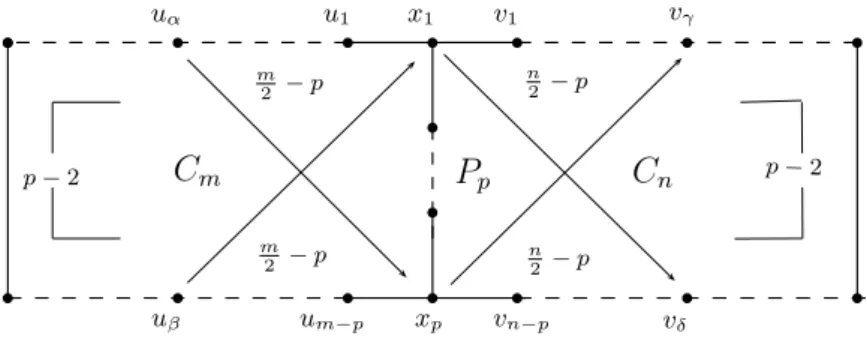
Proof. LetCmandCnbe two cycles merged along a common pathPpinduced by the common vertices
X ={x1, . . . , xp} where p <min{⌈m2⌉,⌈
n
2⌉}. Let U ={u1, . . . , um−p} and V = {v1, . . . , vn−p} be the
remaining vertices inCmandCn respectively. Consider the three cyclesCm,Cn andC′, whereC′ is the
cycle induced byU, V,{x1} and{xp}. By symmetry, the vertices in each of the setsX, U, V from either
ends have the same betweenness centrality in G.
b
b
b
b b
b
b b b
b
b b b b b b b
u1
uα x1 v1
xp
vγ
uβ um−p vn−p vδ
C
mP
pC
np−2 p−2
m
2 −p
n
2 −p
m
2 −p n2 −p
Figure 2. Two even cycles merged along a common subgraph
Case 1: Both Cm andCn are even.
Letuα, uβ be the eccentric vertices of xp and x1 respectively inCm and vδ, vγ be their eccentric
vertices inC′ whereα= m2 −p+ 1, β= m2,γ= n2 −p+ 1andδ= 2n. See Figure2. Letxr∈X.
By Theorem3.1,BG(xr) =BCm(xr) +BCn(xr)−BP(xr) +B(xr, U|V). Let us findB(xr, U|V)as the others are known. Consideru∈U andv∈V, then for each(u, v)pair there are at most three shortestu−vpaths and in the case of(uα, vδ)and(uβ, vγ)there are three shortestu−v pathsP1, P2 andP3passing through the end verticesx1,xp and the whole pathP.
(a) Consider the vertexxr for1< r < p, then those pairs (ui, vj)for1≤i≤α, δ≤j ≤n−p, or
(ui, vj)for β≤i≤m−p, 1≤j ≤γ contribute betweenness centrality
(m
2 −p
)(n
2 −p
)
+12(m2 −
p+n
2 −p
) +1
3 toxr. Thus by Theorem3.1we get, BG(xr) = 18
[
(m−2)2+ (n−2)2]−(r−1)(p−r) + 2[(m
2 −p
)(n
2−p
) +1
2
(m
2 −p+
n
2 −p
) +1
3
]
. (b) Consider the vertex x1, then the pairs (ui, vj) for 1 ≤ i < α, 1 ≤ j ≤ n−p contributes
(m2 −p)(n−p); Now fori=α, the pairs for1 ≤j < β contributes n2 −1, j =β contributes 2/3, β < j≤n−pcontributes12(n2−p)giving the sum 121(9n−6p−4)tox1. The vertices lying between uα and uβ contribute 12(n−p)(p−2). Consider uβ, it makes pairs with vj, 1 ≤j ≤γ and gives
n
2 −p+ 2
3. Again the vertices on the right ofuβ with the same set give (
m
2 −p)
[
(n2 −p) +12]. Summing all these contributions, we getB(x1, U|V).
(c) Consider the vertexur for 1 ≤r < α, now the vertices lying between ur and uα make pairs
with all vertices ofV giving the contribution(m
2 −p−r)(n−p). Againuα and the vertices lying betweenuα anduβ contribute the sum as earlier. But uβ makes pairs withvj for 1≤j ≤γ and
gives 12(n2 −p) + 13 and the right of uβ has no contribution. Summing all the above values gives
B(ur, U|V)for1≤r < α.
(d) Consider the vertexuα, now the verticesuiforα < i≤β give the sum 12(n−p)(p−2) +12(n2−
p) +1 3.
(e) Considerur forα < r≤ ⌈m2−p⌉. Letr=α+k where1≤k≤ ⌈p2⌉ −1. Nowuα anduβ gives
uα+k the same contribution as 12(n2 −p) + 13. The vertices lying between uα and uα+k gives the
sum(k−1)(n2−p+12) +k(k2−1) and betweenuα+k anduβ gives 12(n−k−p)(p−k−2). The total
of these contribution gives the expression forB(ur, U|V)forr > α.
Consider uα and uβ, a pair of extreme vertices of the end vertices xp and x1 of P where α = m+1
2 −p+ 1 and β =
m−1
2 and vδ and vγ be their eccentric vertices in C′ where δ = n−21, γ = n+1
2 −p+ 1. Ifui ∈ U and vj ∈V, then for xr ∈P where 1 < r < p, {(ui, vj) : 1≤i < α, δ < j≤n−p}or{(ui, vj) :β < i≤m−p,1≤j < γ}contributes the sum
(m+1
2 −p
)(n+1
2 −p
)
. Since there exists no more pair,B(xr, U|V) = 2
(m+1
2 −p
)(n+1
2 −p
)
. Consider the vertexx1. Now the pairs
{(ui, vj) : 1≤i < α,1≤j≤n−p} contributes the sum
(m+1
2 −p
)
(n−p). The vertices{ui:α≤
i≤β}contributes the sum12(n−p)(p−1)and the pairs{(ui, vj) :β < i≤m−p,1≤j≤ n+12 −p}
contributes the sum(m2+1−p)(n+12 −p). HenceB(x1, U|V) =(m2+1−p)(n+12 −p)+(n−p)(m+2p−p). Consider the vertex ur,1 ≤ r < α, the vertices lying between ur and uα contributes the sum
(α−r−1)(n−p), vertices from uα to uβ as given above and no vertex from the right. Hence
B(ur, U|V) =
(m+1
2 −p−r
)
(n−p) + 12(n−p)(p−1) for 1 ≤ r < α. For uα, the vertices
from uα+1 to uβ contributes 12(p−2)(n−p−1). Hence B(uα, U|V) = 12(p−2)(n−p−1).
Consider a vertex on the left ofuα, sayuα+k, then no vertex on the right ofuαis considered. The
vertices from uα to uα+k−1 contributes 12k(n+k−2p+ 1) and the vertices from uα+k+1 to uβ
contribute 12(p−k−2)(n−p−k−1)and no more vertex from the right. Hence,B(uα+k, U|V) =
1
2k(n+k−2p+ 1) + 1
2(p−k−2)(n−p−k−1).
b
b
b
b b
b
b b b
b
b b b b b b b
u1
uα x1 v1
xp
vγ
uβ um−p vn−p vδ
C
mP
pC
np−2 p−3
m
2 −p
n+1
2 −p
m
2 −p n+12 −p
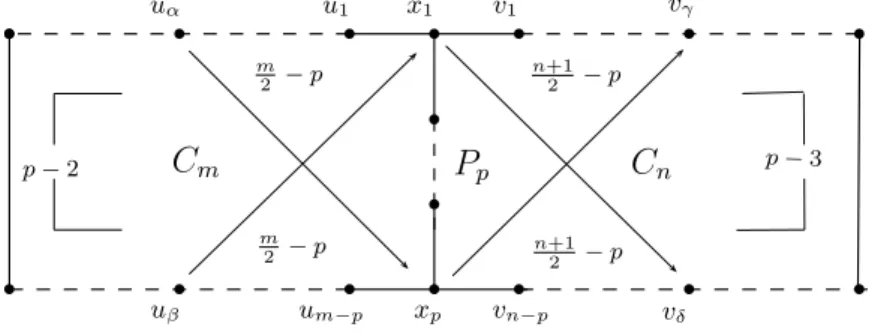
Figure 3. Even and odd cycles merged along a common subgraph
Case 3: Cmis even and Cn is odd.
Letuα anduβ whereα= m2 −p+ 1, β = m2 be the eccentric vertices inCm for the end vertices
xp, x1 ofP and vδ andvγ be their eccentric vertices inC′ whereδ= n−21, γ= n+12 −p+ 1. See
Figure3.
Considerxr∈P such that1< r < p. Ifui ∈U andvj∈V, then for each pair{(ui, vj) : 1≤i < α,
δ < j ≤ n−p orβ < i ≤ m−p, 1 ≤ j < γ} there exists a geodesic passing through xr and
contributes the sum(m2 −p)(n+12 −p)and 12(n+12 −p)fori=α. Since there exists no such other pair,B(xr, U|V) = 12(m−2p+ 1)(n−2p+ 1).
Consider the vertexx1. Now{(ui, vj) : 1≤i < α,1≤j≤n−p}contributes the sum(m2−p)(n−p).
{(uα, vj) : 1 ≤ j ≤ δ} and {(uα, vj) : δ < j ≤ n−p} contributes the sum n−21 + 12
(n+1
2 −p
)
.
{(uβ, vj) : 1 ≤ j ≤ γ−1} contributes the sum n+12 −p. The vertices lying between uα and uβ
contributes the sum 12(n−p)(p−2)and each vertex on the right ofuβ gives the sum n+12 −p. The
total of these sums givesB(x1, U|V)which is 14
[
3mn−(4p−1)(m+n) + 6p2−4p+ 1].
Consider the vertex ur, for 1 ≤ r < α. Now the vertices lying between ur and uα contributes
the sum (α−r−1)(n−p). Again uα and the vertices lying between uα and uβ have the same
contribution as mentioned above,uβ gives 12
(n+1
2 −p
)
. For the vertex uα, vertices fromuα+1 to uβ−1 and then uβ contributes to it as earlier. Consider a vertex on the right of uα, say uα+k.
Againuα and uβ contributes the same as 12
(n+1
2 −p
)
. The vertices lying between uα and uα+k
contribute (k−1)(n+12 −p)+ 21k(k−1). The vertices lying between uα+k and uβ contribute
1
1≤r < γ. The vertices lying betweenvrandvγoffers(n+12 −p−r)(m−p)and the vertices fromvγto
vδoffers(p−1)(m−p)/2givingB(vr, U|V) = (m−p)(n−p−2r)/2. Forvγ, the vertices fromvγ+1to vδgivesB(vγ, U|V) = 1/2[m(p−2)−p2+p+2]. Forvγ+k,1≤k≤p−2, the vertices fromvγ+k+1to vδoffers12(p−k−2)(m−p−k−1)and vertices fromvγtovγ+k−1offersk2(m+k−2+1)so that vertices symmetric fromvγandvδoffers the same givingB(vγ+k, U|V) =k(k−p+2)+(p/2)(m−p+1)−m+1.
Corollary 3.7. Let G be the graph obtained by merging m copies of cycle Cn along a common path
Pp = {x1, . . . , xp} as common subgraph where p < ⌈2n⌉ and U = {u1, . . . , un−p} be the vertex sets of
Cn−Pp. Then the betweenness centrality ofCn inGis given by
BG(xr) = mBCn(xr)−(m−1)(r−1)(p−r) +
(
m
2 )
B(xr, U|V), forxr∈Pp,
BG(ur) = BCn(ur) + (m−1)B(ur, U|V), forur∈U. where B(xr, U|V)andB(ur, U|V)are given by
Case 1: If Cn is even, then
B(xr, U|V) =
{
n2/2−2n(p−1/2) + 2(p2−p+ 1/3), for1< r < p,
3n2/4−2n(p−1/4) + (9p2−6p+ 2)/6, forr= 1, p.
B(ur, U|V) =
(n−p)(n−p−2r)/2, for1≤r≤ n2−p, n(2p−3)/4−(3p2−3p−2)/6, forr=n
2 −p+ 1,
k(k−p+ 1) + (n−p)(p−2)/2 + 1/6, forr=n2 −p+ 1 +k, 1≤k≤p−2.
Case 2: If Cn is odd, then
B(xr, U|V) =
{
2[(n+ 1)/2−p]2, for1< r < p,
3n2/4−2n(p−1/4) + (6p2−4p+ 1)/4, forr= 1, p.
B(ur, U|V) =
(n−p)(n−p−2r)/2, for1≤r≤n+12 −p,
(p−2)(n−p−1)/2, forr= n+12 −p+ 1,
k(k−p+ 2) + (p−2)(n−p−1)/2, forr= n+12 −p+ 1 +k, 1≤k≤p−2.
Proposition 3.8. Let Gbe the graph obtained by merging both ends of m copies of pathsPn together
where V(Pn) ={1,2, . . . , n}. Then the betweenness centrality ofGis given by
B(r) = {1
4m(m−1)(n−2)
2, forr= 1, n,
1
2(n−1)(n−3) + 1
m+
(m−2) 2
[
(n−1−r)2+ (r−2)2 ]
, for1< r < n.
Proof. Since the ends of m copies of path Pn are separately merged, any two copies of Pn form an
even cycle C2n−2 inG. Since there are
(m
2
)
such cycles,B(r) =(m2)BC2n−2(r) =
1
4m(m−1)(n−2) 2 for r= 1, n. Consider an internal vertex of any pathPn sayP
(i)
n . NowPn(i)andPn(j) fori̸=j form a cycle
of 2n−2vertices inG, where the pair of end vertices gives the centrality m1 instead of 12. Consider the pathPn(k) wherek̸=j̸=i. LetUi andUk denotes the vertex sets ofP
(i)
n−2and P (k)
n−2 respectively where the merged end vertices 1 andnare deleted. Therefore, for any internal vertexrofPn,
BG(r) = BC2n−2(r)−
1 2+
1
m+
∑
k̸=i̸=j
B(r, Ui|Uk)
= 1
2(n−1)(n−3) + 1
m+
(m−2) 2
[
since,
B(r, Ui,|Uk) =
[
n−(r+ 1)]2
2 +
1
2[1 + 3 +. . .(r−2)terms]
= 1
2 [
(n−1−r)2+ (r−2)2].
3.2.
Edge-amalgamation of graphs
The edge amalgamation of {Gi}ni=1 is the graph obtained by taking the union of all the Gi and
identifying their fixed edges. An amalgamation of two edges e1=u1v1of a graphG1 ande2=u2v2of a graph G2 is a graph created by identifying u1 with u2 andv1 with v2 and then deleting one of the two edges corresponding to e1or e2. The other edge will be called theamalgamated edge.
The edge amalgamation of cycles are calledgeneralized books [5].
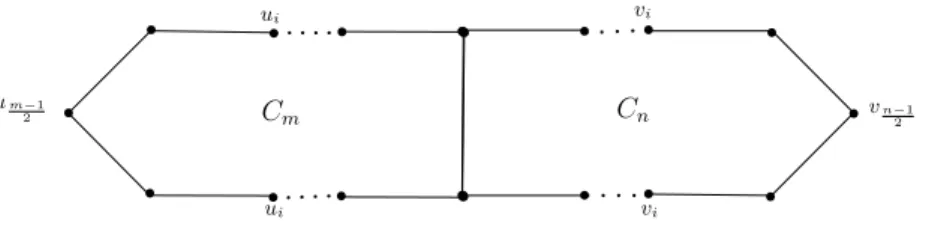
Proposition 3.9. Let two cyclesCmandCn are connected by merging a pair of edges. Letui,vi be any
vertices on Cm andCn respectively at a distancei from the merged edge. Then betweenness centrality of
the resulting graph is given by
Case 1: If bothCm andCn are even, then
B(ui) =
(m−2)2
8 +
(n−2)2
8 +
(m−3)(n−3)
4 +
(m−2)(n−2)
2 +
1
12, fori= 0, (m−2)2
8 +
(n−2)(m−2−2i)
2 , for1≤i <
m
2 −1, (m−2)2
8 +
n
4 − 2
3, fori=
m
2 −1.
B(vi)are obtained on interchangingmandn.
Case 2: If bothCm andCn are odd (See Figure 4), then
B(ui) =
(m−1)(m−3)
8 +
(n−1)(n−3)
8 +
(m−3)(n−3)
4 +
(m−2)(n−2)
2 , fori= 0, (m−1)(m−3)
8 +
(n−2)(m−2−2i)
2 , for1≤i <
m−1 2 , (m−1)(m−3)
8 , fori=
m−1 2 .
B(vi)are obtained on interchangingmandn.
Case 3: If Cm is even andCn is odd, then
B(ui) =
(m−2)2
8 +
(n−1)(n−3)
8 +
(m−3)(n−3)
4 +
(m−2)(n−2)
2 , fori= 0, (m−2)2
8 +
(n−2)(m−2−2i)
2 , for1≤i <
m
2 −1, (m−2)2
8 +
n
4 − 2
3, fori=
m
2 −1.
B(vi) =
{(n
−1)(n−3)
8 + (m−2)(n−2−2i)/2, for1≤i <
n−1 2 , (n−1)(n−3)
8 , fori=
b
b
b b b
b
b
b
b
bb b
b b b b b b b b b b ui ui
um−1
2 vn−21
vi
vi
Cm Cn
Figure 4. Two odd cyclesCm and Cn identifying a pair of edges
Proof. Consider a merged vertex. Since the merged vertex lies on both cyclesCm andCn, each cycle
induces a value for its betweenness centrality. Cm against Cn also induces a value. The betweenness
centrality of merged vertex is their sum. For any other vertexu, it lies on one of the cycle and betweenness centrality is the sum of the betweenness centrality induced by that cycle and the other one on it.
Corollary 3.10. Let the odd cyclesCn1, . . . , Cnm share a common edge. Then, for u0, an end vertex of the common edge and ui, a vertex in Cnk at a distance ifrom the common edge, we have
B(u0) =1 8
∑
i
(ni−1)(ni−3) +
1 4
∑
i<j
(ni−3)(nj−3) +
1 2
∑
i<j
(ni−2)(nj−2),
B(ui) =
{(n
k−1)(nk−3)
8 + (
nk
2 −1−i)
∑
i̸=k(ni−2), for1≤i < nk2−1, (nk−1)(nk−3)
8 , fori=
nk−1 2 .
Corollary 3.11. If m copies ofn-cycles, each are merged at an edge, then for u0, an end vertex of the common edge andui, a vertex at a distanceifrom the common edge in anyn-cycle (See Figure5), then
we have
Case 1: If nis even
B(ui) =
m(n−2)2
8 +
(m
2
)[(n−2)2
2 +
(n−3)2
4 +
1 12
]
, wheni= 0, (n−2)2
8 + (m−1)(n−2)(
n
2−1−i), when1≤i <
n
2 −1, (n−2)2
8 + (m−1)(
n
4 − 2
3), wheni=
n
2−1.
Case 2: If nis odd
B(ui) =
m(n−1)(n−3)
8 +
(m
2
)[(n−2)2
2 +
(n−3)2 4
]
, wheni= 0, (n−1)(n−3)
8 + (m−1)(n−2)(
n
2 −1−i), when1≤i <
n−1 2 , (n−1)(n−3)
8 , wheni=
b
b
b
b
b
b
b
b
b
b
b
b
b
b
b
b
b
b
b
b
b
b
b
b
u0
u0
Figure 5. Four 7-cycles sharing a common edge
3.3.
Vertex-amalgamation of graphs
Definition 3.12. [6] A graphGin which a vertex is distinguished from other vertices is called a rooted graph and the vertex is called a root (or terminal) of G.
Identifying the terminal vertices of two graphs is known as vertex-amalgamation and the new graph obtained by vertex-amalgamation ofG1andG2 is denoted byG1·G2 [4].
Proposition 3.13. Let G1, . . . , Gk be vertex disjoint graphs of order n1, . . . , nk respectively and G, the
graph obtained by identifying the verticesvi∈Gi, ∀i; ifv0 denotes the merged vertex andv(̸=vi)∈Gi,
then
BG(v0) = k
∑
i=1
BGi(vi) +
∑
i<j
(ni−1)(nj−1) and
BG(v) =BGi(v) +BGi(v, v0)
∑
j̸=i
(nj−1).
Proof. Consider the graph Gobtained by identifying the vertices vi ∈Gi. Ifv0 denotes the merged vertex, i.e,vi =v0for alli,v0is a cut vertex (See Figure6) and the removal ofv0disconnects the graphG
intokcomponents. The betweenness centrality ofv0inGis calculated over all pairs of vertices and each pair belongs to the same component or different ones. The pairs of vertices lying in the same component give the sum∑ki=1BGi(vi)and the pairs of vertices lying in different components give
∑
i<j(ni−1)(nj−1).
Now their sum gives the result. For v ∈Gi, v ̸=vi, a pair of vertices in G provides a contribution to
the centrality of v, if one of which belongs to Gi. If BGi(v, v0) denotes the betweenness centrality of v induced by v0 inGi, then clearlyBG(v) =BGi(vi) +BGi(v, v0)
∑
j̸=i(nj−1).
Algorithm 3.14. Algorithm for Betweenness Computation of Merged Vertexv0 in a Vertex Amalgama-tion
Require: Vertex disjoint graphsG1, G2, . . . , Gk of ordern1, n2, . . . , nk, andv0 the merged vertex
Ensure: Betweenness of vertex v0,BG(v0)
1: Compute betweenness of vi in Gi,BGi(vi) fori= 1, . . . , k. Add all these betweenness values to get BComponentSum
2: Find BContribution=
∑
i=1,...,k−1(ni−1)∗(nj−1) fori < j.
G1
G2
Gi
Gk
b
v0
n1
n2
ni
nk
Figure 6. Vertex amalgamation ofGi’s
Theorem 3.15. Let G be the graph obtained by merging graphs{Gi}ki=1, on a common root vertex v0. Then Algorithm 3.14 correctly computes the betweenness value of merged vertex v0 in O(n′m′) times where n′ is the order of the largest component graphGi andm′ the number of edges inGi.
Proof. Proof ofAlgorithm3.14 follows from Proposition3.13.
Algorithm 3.16. Algorithm for Betweenness Computation of Non-terminal Vertex v inGi in a Vertex
Amalgamation
Require: Vertex disjoint graphs G1, G2, . . . , Gk of order n1, n2, . . . , nk,v0 the merged vertex, vertexv a non-terminal vertex in Gi.
Ensure: Betweenness of vertex v,BG(v)
1: Compute betweenness ofv inGi,BGi(v).
2: Compute betweenness ofv induced byv0 inGi BGi(v, v0).
3: Find BContribution=
∑
j=1,...,k;j̸=i(nj−1).
4: Determine BG(v) =BGi(v) +BGi(v, v0)∗BContribution
Theorem 3.17. Let G be the graph obtained by merging graphs{Gi}ki=1 on a common root vertex v0. Then Algorithm3.16correctly computes the betweenness value of non-terminal vertexvinO(nimi)times
where ni is the order of the component graph Gi andmi the number of edges inGi.
Proof. Proof ofAlgorithm3.16 follows from Proposition3.13.
Proposition 3.18. Let G1, . . . , Gk be vertex disjoint graphs of order n1, . . . , nk. Consider the graph G
obtained on joining the vertices vi ∈Gi to a single vertexv0 by means of edges and v(̸=vi)∈Gi, then
BG(v0) =
∑
i<j
ninj,
BG(vi) = BGi(vi) + (ni−1)
( ∑
j̸=i
nj+ 1
)
and
BG(v) = BGi(v) +BGi(v, v0)
∑
j̸=i
The above result is significant in view of the fact that networks are often connected by joining to a common node.
If Gis a rooted graph, the graphG(n) obtained on identifying the root ofn-copies of Gis called a one-point union ofn copies ofG[9]. We consider the following examples.
1. Windmill graph
The windmill graph Kn(m)is the one - point union ofmcopies of the complete graph Kn;K
(m)
n has
(n−1)m+ 1 vertices andm(n2)edges. For example,K5(4) is given in Figure7.
Theorem 3.19. The betweenness centrality of windmill graph Kn(m)is given by
B(v) =
(n−1)2 (
m
2 )
, for central vertex,
0, for any other vertex.
Proof. The central vertex ofKn(m)is a cut vertex and the removal of which disconnects intom
compo-nents ofKn−1. Therefore, by Proposition3.13, the betweenness centrality of the central vertex is given byC(n−1, n−1, . . . mtimes) = (n−1)2(m2)whereC(n1, n2, . . . , nk) =
∑
i<j
ninj. Since other vertices are
vertices of the induced subgraph Kn−1, their betweenness centrality is zero.
b
b
b
b
b
b
b b
b
b b
b b
b b
b b
Figure 7. Windmill graph K5(4)
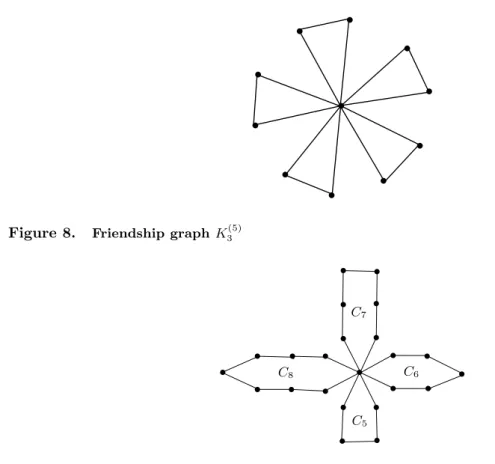
The graphK3(t)is called afriendship graphorDutch t-windmill graph. For example,K3(5) is given in Figure 8. Every pair of vertices in K3(t)has exactly one common neighbour. K3(2) is the butterfly graph andK2(n) is the starS1,n.
Corollary 3.20. The betweenness centrality of friendship graphK3(n)is given by
B(v) = 4
(
n
2 )
, for central vertex,
0, for any other vertex.
2. Vertex-amalgamation of cycles
b
b
b
b
b
b
b
b
b
b
b
Figure 8. Friendship graph K3(5)
b
b b
b b
b b
b b
b b
b
b b
b
b
b
b
b
b
b
b
b
C5
C6
C7
C8
Figure 9. One point union of different cycles
Proposition 3.21. Let the graphGbe the union of m1 copies of odd cycle Cn1 and m2 copies of even
cycle Cn2 with a common vertex v0. In any cycle C, let vi denotes the vertex such that d(vi, v0) = i,
then,
B(v0) =
m1(n1−1)(n1−3)
8 +
m2(n2−2)2
8 + (n1−1)
2
(
m1
2 )
+ (n2−1)2
(
m2
2 )
+(n1−1)(n2−1)m1m2, and
B(vi) =
(n1−1)(n1−3)
8 +
(
n1−1−2i
2
) [
(m1−1)(n1−1) +m2(n2−1) ]
, forvi∈Cn1,1≤i≤
n1−1
2 , (n2−2)2
8 +
(
n2−1−2i
2
) [
m1(n1−1) + (m2−1)(n2−1) ]
, forvi∈Cn2,1≤i <
n2
2, (n2−2)2
8 , forvi∈Cn2, i=
n2
2.
Proof. Sincem1copies of odd cyclesCn1 andm2copies of even cyclesCn2have a common vertexv0,v0
is a cut vertex ofGand each cycle contributes its own betweenness centrality tov0. Againv0 lies on the path joining vertices of different cycles. Each pair of cycles contributes a betweenness centrality(ni−1)2
and there are(mi 2
)
pairs of such cycles giving(ni−1)2
(mi
2
)
to the centrality. Considering the three possible combinations odd-odd, even-even and odd-even pairs of cycles, we get the centrality of v0 as their sum. Letvidenotes the vertices at a distanceifromv0. Ifvi∈Cn1, an odd cycle, fori≤
n1−1
2 then from each vertex lying between vi and vn1−1
2
, there is a path passing through vi to each vertex of the remaining
cycles and consequently there is an increase of (n1−1−2i
2
)
[(m1−1)(n1−1) +m2(n2−1)] forB(vi). If
b b b b b b b b b b b b b b b b b b b b b C6 C6 C6 C6 b b b b b b b b b b b b b b b b b C5 C5 C5 C5
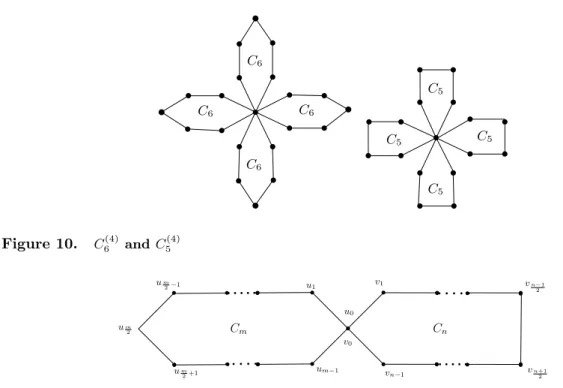
Figure 10. C6(4) andC5(4)
b b b b b b b b b b bb b b b b b b b b u0 v0 um 2 u1
um−1
v1
vn−1
vn−1 2
vn+1 2 um
2−1
um 2+1 b b b b b bbb b b b b
Cm Cn
Figure 11. An even cycleCm and an odd cycleCn merged at a vertex
vito each vertex of the remaining cycles and from the extreme vertexvn
2 there are two paths and one of
which passes throughvi. Hence there is an increase of centrality
(n 2−1−2i
2
)
[m1(n1−1) + (m2−1)(n2−1)]
forB(vi). Since there is no path passing through the extreme vertexvn2
2 , its centrality remains the same
as that ofCn2, that is,
(n2−2)2
8 .
Corollary 3.22. Let Cn(m)be the one point union ofmcopies ofCn. See Figure10. Ifv0 is the common
vertex and vi∈C
(m)
n such thatd(vi, v0) =i, then the betweenness centrality ofC
(m)
n is given by
Case 1: WhenCn is even
B(vi) =
m(n−2)2
8 +
(
m
2 )
(n−1)2, wheni= 0,
(n−2)2
8 +
(m−1)(n−1)(n−1−2i)
2 , when1≤i <
n
2, (n−2)2
8 , wheni=
n
2.
Case 2: WhenCn is odd
B(vi) =
m(n−1)(n−3)
8 +
(
m
2 )
(n−1)2, when i= 0,
(n−1)(n−3)
8 +
(m−1)(n−1)(n−1−2i)
2 , when 1≤i≤
n−1
2 .
Corollary 3.23. Let G be the graph obtained by merging the vertices u0 ∈ Cm and v0 ∈ Cn and let
ui ∈Cm andvj ∈Cn such that d(ui, u0) =i andd(vj, v0) =j. Then the betweenness centrality ofG is
Case 1: If bothCm andCn are even, then
B(ui) =
(m−2)2
8 +
(n−2)2
8 + (m−1)(n−1), wheni= 0, (m−2)2
8 +
(n−1)(m−1−2i)
2 , when1≤i <
m
2, (m−2)2
8 , wheni=
m
2.
B(vi)are obtained by interchangingm andn.
Case 2: If bothCm andCn are odd, then
B(ui) =
{
(m−1)(m−3)
8 +
(n−1)(n−3)
8 + (m−1)(n−1), wheni= 0, (m−1)(m−3)
8 +
(n−1)(m−1−2i)
2 , when1≤i≤
m−1 2 .
B(vi)are obtained by interchangingm andn.
Case 3: If Cm is even andCn is odd (see Figure11), then
B(ui) =
(m−2)2
8 +
(n−1)(n−3)
8 + (m−1)(n−1), wheni= 0, (m−2)2
8 +
(n−1)(m−1−2i)
2 , when1≤i <
m
2, (m−2)2
8 , wheni=
m
2.
B(vj) =
(n−1)(n−3)
8 +
(m−1)(n−1−2j)
2 , when1≤j ≤
n−1
2 .
Note: If the two cycles are identical, then
Case 1: m=nan even number.
B(ui) = B(vi), where
B(ui) =
(m−2)2
4 + (m−1)
2, wheni= 0, (m−2)2
8 +
(m−1)(m−1−2i)
2 , when1≤i <
m
2, (m−2)2
8 , wheni=
m
2.
Case 2: m=n=an odd number.
B(ui) = B(vi), where
B(ui) =
{(m
−1)(m−3)
4 + (m−1)
2, wheni= 0, (m−1)(m−3)
8 +
(m−1)(m−1−2i)
2 , when1≤i≤
m−1 2 .
4.
Conclusion
References
[1] A. Bavelas, A mathematical model for group structures, Human Organization 7, Appl. Anthropol.
7(3) (1948) 16–30.
[2] U. Brandes, A faster algorithm for betweenness centrality, J. Math. Sociol. 25(2) (2001) 163–177.
[3] L. C. Freeman, A set of measures of centrality based on betweenness, Sociometry 40(1) (1977) 35–41.
[4] R. Frucht, F. Haray, On the corona of two graphs, Aequationes Math. 4(3) (1970) 322–325.
[5] J. A. Gallian, A dynamic survey of graph labeling, Electron. J. Combin. (2009) 1–219.
[6] F. Harary, The number of linear, directed, rooted, and connected graphs, Trans. Amer. Math. Soc.
78(2) (1955) 445–463.
[7] S. Kumar, K. Balakrishnan, M. Jathavedan, Betweenness centrality in some classes of graphs, Int. J.
Comb. 2014 (2014) 1–12.
[8] S. Kumar, K. Balakrishnan, On the number of geodesics of Petersen graphGP(n,2), Electronic Notes
in Discrete Mathematics 63 (2017) 295–302.
[9] S.-C. Shee, Y.-S. Ho, The cordiality of one-point union ofncopies of a graph, Discrete Math. 117(1–3)