1.0 INTRODUCTION
Purpose
Ohio’s Drinking Water Supply Emergency Plan establishes a framework for Ohio EPA operations in emergency situations involving public water systems and is designed to meet Federal state emergency plans. The Drinking Water Supply Emergency Plan
serves as a link between Ohio’s Emergency Plan and public water system contingency plans. Implementation of this plan will result in continuing communication and
coordination between State agencies and public water systems in preparing for, responding to, and recovering from emergencies that disrupt public water system operations.
This revision of the Drinking Water Supply Emergency Plan is designed to be practical, and easy to use and understand. It provides direction to Ohio EPA staff in preparing for, responding to, and recovering from emergency situations and includes new guidance on preventing and responding to malicious activities or catastrophic attacks against public water system assets. This document also provides guidance to public water systems on preparing their own contingency plans.
Document Structure
Ohio EPA’s Drinking Water Supply Emergency Plan consists of two volumes. Volume I covers Ohio EPA’s role and actions in response to an emergency situation affecting one of Ohio’s public water systems. Volume II covers a community public water system’s requirements for developing a contingency plan and provides guidance on contingency plan development and the actions a public water system should take to prepare for an emergency situation.
The introduction to Volume II contains background information that describes how the contingency planning process fits into the federal and state regulatory framework. The topics covered include details of the contingency planning process: Vulnerability
Analysis; Vulnerability Assessment; and developing a contingency plan based on this information. Additional topics include community water needs during emergencies, communication, and homeland security considerations for public water systems. Authorities
Section 1413 of the Safe Drinking Water Act permits a state to assume the primary enforcement responsibility for public water systems within that state. The United States Environmental Protection Agency (U.S. EPA) was granted the authority to delegate this responsibility to the states. For a state to receive this delegated responsibility, it must meet requirements established in the National Interim Primary Drinking Water
Regulations - Implementation (40 Code of Federal Regulations, Part 142). Subpart B, Primary Enforcement Responsibility, establishes five criteria for granting primary
enforcement responsibility to a state. One condition requires a state to demonstrate it has the authority to adopt and can implement a plan for providing safe drinking water under emergency circumstances.
The State of Ohio has assumed primary enforcement responsibility for public drinking water systems within the State. This responsibility has been delegated to the Director of Ohio EPA by the Ohio Legislature under Section 6109 of the Ohio Revised Code. Exercise of authority has been assigned to the Division of Drinking and Ground Waters by the Director.
Minimum Requirements for Public Water System Contingency Plans
Ohio Administrative Code Section 3745-85-01 requires each of Ohio’s community public water systems to prepare a contingency plan. At a minimum, the contingency plan must meet the following requirements:
Content - The plan must contain specific information, including a map of the distribution system, information on budgets for emergency use, a determination of the most likely emergencies that will affect the water system, a description of the procedures to provide service during the emergencies, information on alternate water sources, water users having critical needs for a continuous supply of water, emergency notification methods, the procedure to re-pressurize the system to normal service, and key twenty-four hour telephone numbers.
Location of Copies - Copies of a public water systems contingency plan must be kept in specific locations, including the water treatment plant, and the water system administrator's office. If a public water system serves more than 250 people, three additional copies of the plan need to be kept at various accessible, secure locations in the service area. A copy of the contingency plan must also be made available for inspection by representatives of the director and to the county emergency
management agency upon its request.
Revisions - The contingency plan must be revised and updated at least annually, but should be revised to reflect the present status of the system. Copies of the revisions must be distributed promptly to holders of the plan. Community public water
systems that identify hazardous chemical contamination as one of their most likely emergencies must also consult with the county emergency management agency regarding participation in a hazardous spill exercise.
A copy of Ohio Administrative Code Section 3745-85-01 can be found in Attachment A. Agency Structure
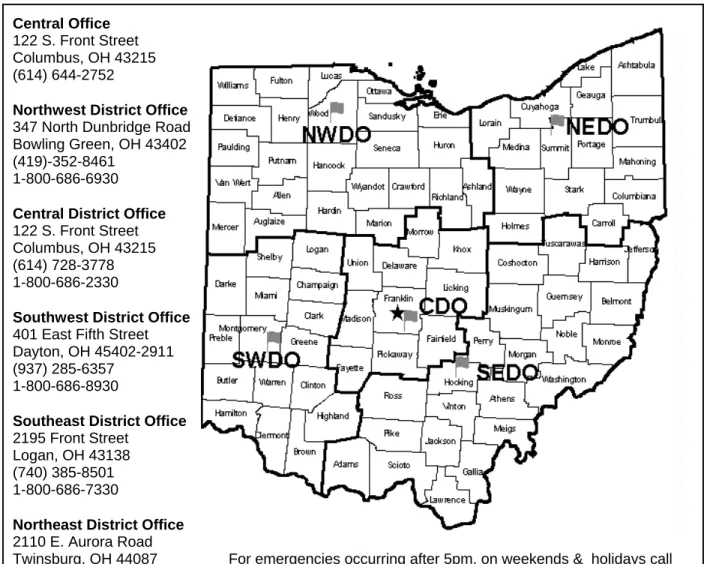
Ohio EPA headquarters, Central Office, is located in Columbus. Five District Offices are located throughout the State: Northwest District Office (NWDO) in Bowling Green;
Central Office
122 S. Front Street Columbus, OH 43215 (614) 644-2752
Northwest District Office
347 North Dunbridge Road Bowling Green, OH 43402 (419)-352-8461
1-800-686-6930
Central District Office
122 S. Front Street Columbus, OH 43215 (614) 728-3778 1-800-686-2330
Southwest District Office
401 East Fifth Street Dayton, OH 45402-2911 (937) 285-6357
1-800-686-8930
Southeast District Office
2195 Front Street Logan, OH 43138 (740) 385-8501 1-800-686-7330
Northeast District Office
2110 E. Aurora Road
Twinsburg, OH 44087 For emergencies occurring after 5pm, on weekends & holidays call (330) 963-1200 Ohio EPA’s 24- hour Emergency Contact Number
1-800-686-6330 1-800-282-9378
Figure 1 - Ohio EPA District Offices
Central District Office (CDO) in Columbus; Southwest District Office (SWDO) in Dayton; Southeast District Office (SEDO) in Logan; and Northeast District Office (NEDO) in Twinsburg. Figure 1 shows the location of these offices, with their respective addresses and telephone numbers. These offices will be able to provide help in obtaining outside sources of assistance when a public water system requires outside help. Ohio EPA recommends that public water systems always contact the appropriate District Office. The District Office will assume the responsibility of notifying the Central Office in
Columbus as described later in this document. With this in mind, it is important for local water utilities to know or have ready access to phone numbers of their respective
CONTINGENCY PLANNING
Planning for emergencies can lessen the impact of most emergency situations. The contingency plan is a guide for public water system staff and other local officials to follow in an emergency to ensure public health is protected during and services are restored after the emergency. Preparing an effective contingency plan is a fairly structured process that will involve coordination of staff from the public water system and other key organizations. An effective plan incorporates the natural or man-made emergencies a system can reasonably expect and should incorporate information from the system’s vulnerability analysis and vulnerability assessment.
Vulnerability Analysis
Public water systems need to prepare a system vulnerability analysis to adequately develop a water system contingency plan. A vulnerability analysis is intended to indicate how well the system would operate in emergency or disaster situations. A vulnerability analysis will disclose how well the particular utility provides service to its customers under normal operating conditions and more particularly under abnormal or emergency conditions. Since each system has its own distinctive components, a vulnerability analysis must be individually tailored for each system. In order to be
effective, the vulnerability analysis must be done in a detailed, structured manner. The primary results of the analysis will be an identification of points of system vulnerability, a prioritized schedule for elimination of major points of system vulnerability, estimates of the reduced system capability (quality and quantity) caused by emergency situations, and the time required to return the system to normal operation after the occurrence. The analysis would best be accomplished in three steps:
1. The first step is to inventory and characterize seven water system components which should be analyzed for failures that might incapacitate the system. These include the source of water, the treatment facilities, the transmission and distribution lines, storage facilities, water system personnel, records (plans, operating manuals, etc.), and indirect components. Indirect components include electric power, supplies and materials, communications including telemetry and facility and personnel
security. (The last two indirect components may also be classified as direct
components depending upon the individual system.) The analysis should go into a good deal of detail about the system, such as identifying valve locations and
spacing, spare pumps, storage capacity, stocks of expendable materials and spare parts, operator training, and system records.
The inventory should also identify existing weak spots within the system, such as corroded valves, severely corroded chlorination equipment, defective electrical wiring, severely pitted pump impellers. This first step serves two functions – it creates a detailed portrait of the entire system and it identifies potential weak spots within a system which, for one reason or another, cannot be easily rectified within a short time span. Apparently minor items may increase the severity of a problem
during an emergency situation. Once potential problem areas are identified, corrective measures should be prioritized and steps taken to correct these deficiencies. Time-tables for implementation, including time and funding commitments should be established.
2. The next step in the vulnerability analysis process is to estimate service capability during emergency conditions. The idea is to anticipate as many potential system breakdowns as possible. Breakdowns should be categorized as the results of natural disasters, man-made crises, or operational failures. For example, the emergency condition may be distribution system leaks caused by earth movements (a natural disaster), treatment plant shut down caused by vandalized controls (a man-made crisis), or an inactive flocculation basin caused by the breakdown of an intake pump (an operational failure). The extent of the emergency condition should include the probable severity of the event, such as the severity of the earthquake, the amount of damage to system controls, or the severity of the problems
encountered with broken pumps. After identifying all possible failures, estimate the quality and/or quantity of water available under the conditions created by each identifiable failure. These estimates will permit the water utility to predetermine the water quality and/or quantity that would be available for customer service during all conceivable emergency situations. All estimates should be made for the system as it exists (including known weak spots) and for the system after remedial measures have been taken (which will improve the system’s reliability). Seven water system components should be analyzed for failures that might incapacitate the system. These include the source of water, treatment facilities, transmission and distribution lines, storage facilities, water system personnel, records (plans, operating manuals, etc.), and indirect components (electric power, supplies and materials,
communications including telemetry and facility and personnel security).
3. One last step is required to complete the analysis – estimate how long the system would have to operate on a reduced basis under each emergency situation. This estimate needs to include anything that will impact how long it will take to return to normal service, including the time needed for procuring any materials, parts, and outside services, the time needed to repair damaged system components, the time necessary to sterilize contaminated components, or the availability of trained
personnel. This portion of the analysis allows the utility to estimate potential down time and to develop a plan for alternate water supplies when a significant loss of capability occurs over an extended period of time.
A. Inventory the system’s seven components and identify any “soft spots:” i. Water Source
ii. Treatment Facilities
iii. Transmission and Distribution System iv. Storage Facilities
v. System Personnel
vii. Indirect Components
B. Assume a potential disaster or emergency condition has occurred, including probable severity (depth of flood waters, wind velocities, length of drought). C. Estimate the effects of the "Design Emergency" upon each of the system
components, direct or indirect.
D. Estimate available system output resulting from potential reductions in capability as determined in step 2.
E. Estimate restoration time.
F. Act on the prioritized schedule for elimination of major points of system vulnerability.
Vulnerability Assessment
Vulnerability assessments help water systems evaluate susceptibility to potential threats and identify corrective actions that can reduce or mitigate the risk of serious
consequences from adversarial actions (e.g., vandalism, insider sabotage, terrorist attack, etc.). Such an assessment for a water system takes into account the vulnerability of the water supply (both ground and surface water), transmission, treatment, and distribution systems. It also considers risks posed to the surrounding community related to attacks on the water system. An effective vulnerability
assessment serves as a guide to the water utility by providing a prioritized plan for security upgrades, modifications of operational procedures, and/or policy changes to mitigate the risks and vulnerabilities to the utility’s critical assets. The vulnerability assessment provides a framework for developing risk reduction options and associated costs. Water systems should review their vulnerability assessments periodically to account for changing threats or additions to the system to ensure that security objectives are being met. Preferably, a vulnerability assessment is "performance-based,” meaning that it evaluates the risk to the water system based on the
effectiveness (performance) of existing and planned measures to counteract adversarial actions.
In response to terrorist attacks on September 11, 2001, the U.S. Congress passed the Public Health Security and Bio-terrorism Preparedness and Response Act. This Act amended the Safe Drinking Water Act to require each community public water system serving more than 3,300 persons as of July 1, 2002 to conduct a vulnerability
assessment and update their emergency response (contingency) plan based on this information. This differs from a vulnerability analysis in that it focuses on malicious actions intended to damage the systems capability to provide safe drinking water or to use the system’s infrastructure to harm the public. The vulnerability assessment also identifies areas that can be addressed through improved security, helping prevent malicious actions. Ohio EPA recommends community public water systems serving less than 3,300 persons and systems reaching a population of 3,300 after July 1, 2002 take the same actions. These provisions of the Safe Drinking Water Act require that each system submit its assessment to U.S. EPA by the dates listed in Table 1. In addition, each system must certify to U.S. EPA that it has completed its contingency
plan update within 6 months of completing the vulnerability assessment. Table 1 - Vulnerability assessment completion dates.
Population Served Assessment must be submitted by: 100,000 or more March 31, 2003
50,000 - 99,999 December 31, 2003 3,300 - 49,999 June 30, 2004
A vulnerability assessment focuses on the threat of malicious acts against the system and consists of six steps:
1. Characterize the water system, describing nine specific portions of the system: pipes and constructed conveyances; physical barriers; water collection;
pretreatment; treatment; storage and distribution facilities; electronic, computer or other automated systems which are utilized by the public water system; the use, storage, or handling of various chemicals; and the operation and maintenance of such system.
2. Identify and prioritize the adverse consequences to be avoided.
3. Determine the critical assets that might be subject to malevolent acts that could result in the undesired consequences.
4. Assess the likelihood of such malevolent acts.
5. Evaluate the existing security measures already in place.
6. Analyze the current risks and develop a prioritized plan for risk reduction.
Although this process was developed specifically to address threats from terrorists, the system-wide analysis supports the vulnerability analysis process. Since each system has its own distinctive components, a vulnerability assessment must be individually tailored for each system.
Contingency Plans
The primary role in preparing for, responding to, and recovering from emergencies will, by necessity, fall on each public water system. In order to be of benefit during an emergency, all information pertinent to a water system must be organized and
coordinated into a usable contingency plan. The contingency plan is tailored for each individual water utility based to its unique characteristics. A drinking water supply contingency plan will provide each water utility with the means to successfully address an emergency efficiently in the most cost effective manner.
The contingency plan provides many benefits to a public water system. The plan provides a road map for providing relief to the stricken area while maintaining high levels of public health and safety. The plan helps provide the highest possible level of
emergency service and facilitates the return to normal service as rapidly and safely as possible. Finally, the contingency plan will ease decision making during an emergency when stress levels are highest. Briefly stated, the contingency plan describes who does what during an emergency, when they do it, and with what resources.
A well-formulated contingency plan will meet several important objectives. The contingency plan will concisely describe each possible emergency situation and the means and methods to be utilized in preparing for, responding to, and recovering from the situation. The plan defines the duties, responsibilities, and functions of all water system personnel with respect to each specific emergency condition. The plan enables a utility to respond promptly and efficiently to crisis conditions without wasting time on futile or unnecessary efforts or spending funds unnecessarily. It is an inventory of the resources available to the utility, providing a guide that allows personnel to provide the highest level of service possible under a given set of circumstances.
A contingency plan is not a static document. Once the initial plan is formulated, it will require periodic revisions. Portions of the plan may quickly become outdated as a community public water system expands, it may render relief measures currently in place useless when a crisis arises. Contacts, addresses and phone numbers for personnel, suppliers, repair facilities, contractors, and government agencies are all subject to changes. This information must be kept current if the contingency plan is to be effective. The plan must be corrected to complement any system modifications which take place after the plan's initial formulation. Many systems change operational procedures as personnel are added to or subtracted from the system's work force. A contingency plan must be based on those resources actually available to the utility. Resource availability must be carefully checked before it is included in the plan. The availability of such resources also varies over time. The plan must stay current with such changes.
Preparing a Contingency Plan
The development of the contingency plan is the single most important task in preparing for an emergency situation. Accordingly, the plan must be developed with great care. It must also be explicit about the actions that will be taken. In most instances
responsibility for plan development will rest upon a key water system supervisor appointed by the local government. This person will oversee and coordinate all
planning activities. He or she will utilize the help of other staff and external participants to facilitate greater detail and better perspective. Limited funding and persons available for planning and the type of system itself will determine the number of people involved. In order to assist community public water systems prepare their contingency plans, a template is provided in Attachment B.
The staff preparing the plan should make use of "Committee Meetings" in order to achieve the best possible input. Input should be solicited from a broad and
members of the water system staff, local fire and emergency response personnel, legal staff, local health authorities, local industries, communications system representatives, power companies, and contractors. As these key individuals and groups are identified, public water system administrators should make arrangements to allot time to meet with them. Meetings may be held during normal business hours or at specially arranged times to accommodate the committee members. Resource materials are available to assist the work of the committee. A list of these documents is included in Attachment E. The contingency plan will essentially become an operations schedule for each particular emergency situation. The plan must be based on the existing resources of the water system and not on idealized resources which the utility would like to acquire. Only those outside resources which have been pre-arranged for are valid for inclusion in the plan. An emergency operations plan should be developed for each assumed
emergency condition through the following steps:
1. Estimate the effect of the particular event on each major component of the system. 2. Estimate system capability to deliver potable water under the reductions determined
in Step 1.
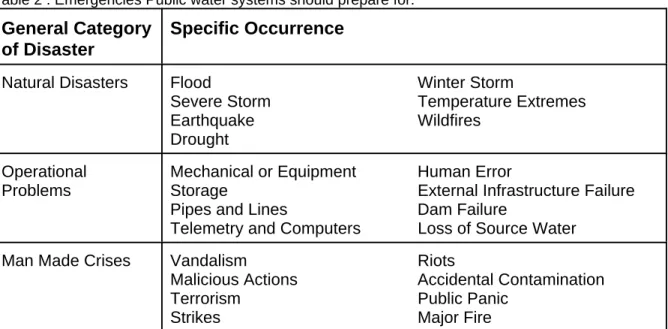
Steps 1 and 2 are, in effect, a vulnerability analysis of the system and its resources relative to each identifiable situation. Table 2 contains some potential emergency or disaster situations that should be considered. Additional information about these situations can be found in Attachment C. Table 3 contains an example of the potential effects that should be considered for each occurrence in Table 2. These comparisons need to be made for each component of the water system.
Table 2 . Emergencies Public water systems should prepare for. General Category
of Disaster
Specific Occurrence
Natural Disasters Flood Winter Storm
Severe Storm Temperature Extremes Earthquake Wildfires
Drought Operational
Problems
Mechanical or Equipment Human Error
Storage External Infrastructure Failure Pipes and Lines Dam Failure
Telemetry and Computers Loss of Source Water
Man Made Crises Vandalism Riots
Malicious Actions Accidental Contamination
Terrorism Public Panic
Strikes Major Fire
System Component Potential Effects to Consider
Water Supply Drought - Insufficient volume to meet demand. Treatment Facilities Severe Storm -Lightning burns out chlorinator
electronics.
Transmission/distribution Temperature Extremes - Multiple main breaks due to freezing weather.
System Storage Vandalism / Malicious Actions - Doors to tanks found open.
Water Personnel Strike - All staff call in with the “blue flu.”
Communications System(s) Infrastructure Failure - All telephone land lines and cellular towers are down.
Mutual-aid Agreements And/or Interconnections
Major Fire - Neighboring village with cross connection seeing high demand to fight a major fire.
Power Supply Human Error - Contractor accidentally rips out overhead lines to plant.
Materials and Supplies Human Error - Supplier ships off-spec chemicals. 3. Estimate potable water requirements under emergency conditions and determine
level of service which would be required to meet these needs.
4. Compare the reduced system capabilities to the potable water requirements and if there is a shortfall from desired service levels determine the additional volume of water required.
Steps 3 and 4 estimate of the amount of potable water which would be required by the community at various times during the particular emergency. A balance between minimum community requirements and the quantity of water available from the system derived from this estimate will indicate whether excess water is available and a higher level of service is possible or whether a deficiency exists and water would have to be obtained from an alternate source.
5. Establish priorities for use of the available water.
Step 5 establishes the system’s priorities for delivering the available water during the emergency and recovery period. This allows the utility to coordinate the most
beneficial uses of available water. Important issues to be considered include: What are the State and Federal minimum water quality standards?
What is the minimum level of service the public will tolerate considering their health and safety?
What is the maximum time period needed to increase the level of service? Additional information on this topic can be found in the next section, Community Water Needs During Emergencies.
6. Devise a plan to meet these priorities and requirements.
Step 6 helps determine the source or sources to be used to deliver the amount of potable water previously determined to be necessary. This step in the process is an analysis of all available sources of water, not just those used under conditions of normal operation. These sources might include both new intakes or wells, public or private ponds, reservoirs, swimming pools, interconnections with other water utilities, water stored within building water systems (hot water tanks, etc.), water provided in bottles or tank trucks from outside sources of potable water, local dairies or bottling plants. This step will also describe the procedures needed for temporary treatment and emergency pumping of non-potable water sources with portable equipment. It will determine any guidelines for water rationing required to meet a given level of service. This might include dispensing water from tank trucks into containers
provided by each consumer to meet the minimum level of service, isolating portions of the distribution system by selective valving, or limiting the uses of water (i.e., watering bans) through public orders.
7. Assign specific tasks to water system personnel and establish utilization of outside services and/or auxiliary work forces as necessary.
Step 7 ensures that trained staff are available to perform all tasks necessary for the delivery of potable water at the desired level of service. Assignments must backup personnel so no important function is left undone in the absence of one individual. Each assignment must be made with full awareness of the ability, training, and capability of the individual involved. Each person assigned a task or tasks should be trained to automatically perform his assigned function under the emergency
condition. This will require the public water system to establish a table of
organization, with a clear delineation of responsibility and area of concern for each person. Planning needs to provide for protection of personnel during the course of an emergency. Such items as food, housing, rest, and personal security must be considered – especially if work to relieve the emergency will occur around the clock. Planning needs to determine the availability of other potential sources of personnel within/outside the water utility department. If available, assignments must be consistent with their training and capabilities. Public water systems within a county or planning district should consider coordinating with each other to ease recovery operations. The contingency plans for these systems can then identify the common resources – labor, parts, equipment, and expendable materials – each can provide in the event a public water system requires outside assistance. If possible, establish mutual-aid agreements with surrounding communities, industries, contractors, and related utilities. These agreements could provide for assistance in the form of
personnel, equipment, or materials. This step also needs to establish proper training of all personnel included in response and recovery operations – from the public water system, other local government staff, volunteers, and other utilities, industries, and contractors providing emergency assistance.
Following these steps will result in a well-organized plan that results in the shortest disruption of normal service while providing the highest possible level of protection of public health and safety.
Public water systems required to conduct a vulnerability assessment will also be
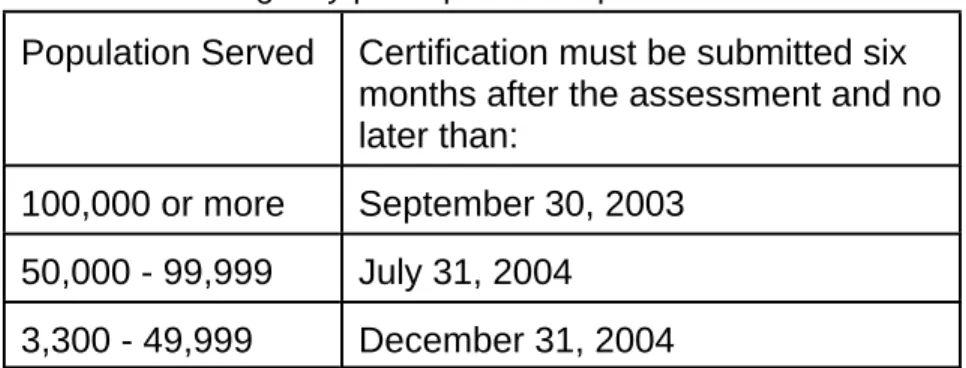
required to update their contingency plans based on this information. The updates must be completed within six months of the date the vulnerability assessment is submitted to U.S. EPA. The public water system must certify to U.S. EPA that the updates have been completed. Do not submit a copy of the contingency plan to U.S. EPA. The certification must be made not later than the dates indicated in the following table:
Table 4 - Contingency plan update completion dates.
Population Served Certification must be submitted six months after the assessment and no later than:
100,000 or more September 30, 2003 50,000 - 99,999 July 31, 2004
3,300 - 49,999 December 31, 2004
Ohio Administrative Code 3741-85-01(E) requires a community public water system update its contingency plans annually. The updates discussed above are applicable to this requirement.
Contingency Plan Training and Exercises
If a public water system does not conduct staff training and exercises on its contingency plan, the plan may not work when it is most needed – during a disaster. Every staff member should review the contingency plan annually. This provides an ideal
mechanism for identifying and correcting out-of-date or missing material. These annual reviews can also be used to identify portions of the plan that require additional training or practice to implement when needed. Any training or exercise needs to include all levels of the public water system’s organization; not just the field staff.
Training may involve either a review of all or part of the contingency plan to attending classes on emergency procedures. Public water systems should take full advantage of the expertise and training resources available from their local emergency management
agencies, local fire department, and state agencies. Training should not be limited to the contents of the contingency plan; it should include refresher training on sampling procedures, health effects of contaminants, and hands-on training on the use of equipment.
Exercises test the ability of a public water system to implement its contingency plan. The complexity of these exercises vary and include:
- live simulations involving the full mobilization of personnel and equipment; - role-playing to respond as realistically as possible to a simulated incident and involving mobilization of selected personnel; and
- a table-top exercise focusing on discussion between selected teams and individuals dealing with a specific scenario.
Exercises like these serve as a test of critical personnel’s knowledge of the contingency plan, not just for system staff, but for those external individuals and groups a public water system relies on for support – fire service, law enforcement, other utilities, and contractors. Exercises also help all participants identify and correct problems in the procedures in the plan. These short comings can be corrected as part of the annual review process.
Ohio EPA’s Role in an Emergency Situation
Ohio EPA serves as an advisor to the Governor in the event of a major water utility emergency or disaster situation. Any request for aid from the State, such as the use of the Ohio Emergency Management Agency or the National Guard, must be reviewed and evaluated by Ohio EPA before the Governor will consider granting the aid requested. The local community must exhaust all resources before making such a request. Although Ohio EPA can provide assistance and coordination for relief in emergency conditions, it must be stressed that the local utility experiencing the emergency must make immediate notification to Ohio EPA in order to initiate
appropriate action. Without this cooperation between the utility and Ohio EPA, valuable time could be lost, potentially increasing the severity of the situation. It must also be made clear that the sole responsibility for reaction to an emergency situation rests with the local utility and the political subdivisions governing the service area.
Due to limitations in number of staff, the Ohio EPA may not be able to provide direct state assistance to a local utility in the event of an emergency situation. Agency staff have the experience and background to offer constructive advice on proper remedial measures during and recovery efforts after emergencies. During an emergency Ohio EPA can provide advisory assistance to any water system. Ohio EPA’s primary role will be to provide technical assistance to the affected public water system. Ohio EPA is also able to provide the following services in emergency situations:
Coordination of Relief Efforts - Agency staff have experience dealing with a wide variety of emergency situations from floods to chemical spills and have worked closely with many federal, state, and local agencies. These experiences have given Ohio EPA practical knowledge of the capabilities of a number of organizations. Agency staff can provide assistance to a public water system seeking outside assistance during disaster recovery operations.
Laboratory Backup - Ohio EPA has developed a means of providing chemical and
microbiological laboratory testing assistance to all public water systems within the state. This service will enable systems to test for water purity beyond their individual capability and identify the nature of their problems in minimal time.
Emergency Response - Ohio EPA’s Division of Emergency and Remedial Response (DERR) is capable of providing expertise and assistance related to prevention, containment, and clean-up of chemical spills.
Notifying Ohio EPA of an Emergency Situation
Public water system operators need to notify the appropriate District Office during an emergency situation. Notification by the local utility should be made during normal business hours at the first opportunity following the onset of the emergency. If public water system staff feel they are dealing with a health or severe health hazard, or the incident involves potential tampering with the system outside normal business hours, they should contact Ohio EPA’s 24-hour emergency line 1-800-282-9378.
Ohio EPA Plan Review
Ohio EPA can assist local utilities by evaluating the general adequacy of local emergency plans. In addition, the current contingency plan is to be available for
evaluation by Ohio EPA personnel at the time of the sanitary survey. These evaluations serve to keep a public water systems’s contingency plan up to date and usable, and reinforces the plan's contents and procedures in the minds of those who will implement them.
COMMUNITY WATER NEEDS DURING EMERGENCIES
Regardless of the severity of the emergency, the people and businesses in a
community will require a definable minimum quantity of potable water to sustain life and sanitation. These requirements differ greatly from normal circumstances; therefore, a determination of these needs must be made. Before individual needs can be
discussed, water requirements under emergency conditions must be identified for a better understanding of the situation. Emergency conditions may be broken into four stages of recovery, each of which require a differing level of water service. Each level provides more water to more people for more uses than the previous one, ranging from basic survival needs to normal operational conditions.
The U.S. Department of Defense has published guidance containing practical data on individual water requirements after a nuclear attack. These figures may be readily adapted to determine the needs at each of the previously mentioned four levels of service.
Level 1 - Potable water for human consumption, drinking and cooking and sanitation of hospital equipment are the only permitted uses. Requirements have been established as follows:
Table 5 - Service Level 1 Water Needs.
Group Water Needs
Individuals 0.5-5.0 gallons per capita per day (gpcpd) Hospitals and care centers 5-15 gpcpd
Mass shelters 3 gpcpd
Level 1, survival condition, is the most primitive and basic. Potable water is provided in the bare minimum quantities necessary for the essentials of existence – human
consumption and cooking purposes. Hospitals, care centers, relief stations, and mass shelters will also require water for the same two purposes plus additional amounts necessary for sanitation purposes in connection with surgical procedures and bed care of patients.
Level 2 - Potable water for human consumption and general sanitation. Requirements are as follows:
Table 6 - Service Level 2 Water Needs.
Group Water Needs
Individuals 25 gpcpd
Hospitals and care centers 25-40 gpcpd
Mass shelters 25 gpcpd
Level 2 service must be provided within two days to safeguard public health. Primary needs at this level include level one quantities plus potable water for general sanitation purposes of all persons within the service area. Such requirements include sufficient water to service toilets and to permit washing and bathing by individuals.
Level 3 - Increased usage for human consumption and general sanitation plus reserves for fire defense. Requirements are as follows:
Table 7 - Service Level 3 Water Needs.
Group Water Needs
Individuals 40 gpcpd
Hospitals and care centers 40 gpcpd
Mass shelters 25 gpcpd
Fire defense reserves Based upon past experience of the community's fire fighting demands and the system’s ability to produce or obtain additional water.
Level 3 service begins after the Level 2 requirements have been increased to near normal levels for drinking, cooking, and sanitation and when additional volumes of water become available. Fire protection is now possible in order to minimize property
destruction and safeguard citizens. Potable water reserves will have to be built up substantially or an alternate source of non-potable water obtained to provide for this added demand.
Level 4 - Conditions are near normal relative to the systems production capability and selected industrial, commercial, and agricultural usage is permitted. This level of service is possible as system capabilities increase due to the continued application of remedial measures and near normal service is possible. This allows for at least partial service to be provided to industrial, commercial, and agricultural consumers. Level 4 service should be phased in, with the selection of non-essential customers based on community requirements for production of daily essentials and quantity of water available.
Determining a community’s water requirements at each of the four levels enables a comparison with the data compiled for the various water system components. These comparisons will be very important in estimating the water available under an
emergency condition regarding the requirements at each level of service. In addition, this comparison enables the utility to determine the type and duration of service(s) which need to be available, the amount of shortfall and the amount of potable water which may have to be obtained from alternate sources.
COMMUNICATION
Communications in emergency planning has two completely different definitions. First, communication involves the positive transmission of commands, requests, or directions by and between water system personnel and others associated with disaster or
emergency response. Second, but no less important, communication involves transmitting notifications, warnings, or general information to the general public, and more particularly the system’s customers, concerning water system status in an
emergency. This type of communication is directed towards enlisting the cooperation of the citizens, and to answer questions, lessen fears, and prevent confusion or panic. Internal Communication - During an emergency, it is essential that all personnel involved in the direction or the completion of remedial work be in close contact with each other. Close contact will permit the highest level of cooperation of all parties involved and expedite the completion of all required tasks. Those persons in charge will be informed on the status of recovery operation and will be able to base decisions on up-to-date information.
Certain types of emergencies may negate the use of normal operational
communications – downed lines may interrupt telephone service or power loss at the base may disrupt radio communication. Provisions need to be made for a secondary form of communication available during emergencies or when normal communication means are not be available. The following are several communication alternatives which might be considered:
1. Mobile/Cellular Phones.
2. Emergency battery power or generating equipment to power base-station controlled radio systems.
3. Mobile battery-powered radios installed in all vehicles and at emergency command posts. These radios should have access to a frequency compatible with the local fire department, sheriff's department, police department, public health officials, other local government departments, and utilities, services, or consultants included in response and recovery.
4. Citizens band radio or the local REACT organization.
5. Local amateur radio (Ham) operators can contact counterparts in other communities for assistance, if desired.
6. Radio equipment carried by local or State police or the Sheriff's department. In the event of a wide spread disaster, this equipment may not be available
because law enforcement agencies may be required to perform other services. 7. Ohio EPA maintains mobile/cellular phones in each of the districts and central
office.
Communications with the Public - Communication with the general public, and more particularly the system’s customers, serves several purposes. Open discussion of the system’s preparedness will help assure the public of the utility's ability to cope with
emergency conditions. This will also help system staff and news media prepare for the day an actual crisis strikes. Prompt dissemination of information about the status of the water system at the beginning of an emergency will help prevent public confusion, misinformation, or panic. Requests, suggestions, and recommendations as well as instructions are often needed by the public to safeguard health or prevent deterioration of the situation.
Rapid communications may be established with the citizens through several media outlets. A public water system should identify and use:
1. Commercial Radio Stations
2. Commercial or Educational Television Stations 3. Computer Bulletin Boards
4. Newspapers with local distribution
5. Bulletin boards in libraries, post offices, or other high traffic public buildings 6. Vehicles with public address (PA) systems
7. Recorded messages on the answering service and/or water utility telephone number
8. Public information bulletins
9. Hand-delivered newsletters or circulars
An on-going liaison should be established between the water system or local government and the various area media to ensure that notices or press releases reported to the public are accurate. This needs to be accomplished well before
communication becomes necessary. It is advisable to designate someone authorized to provide information to the media. There should be an understanding between the utility, the local government, and the media on the types of problems which might occur, their importance in maintaining public health and safety, and the types of information suitable for public release.
Public notification in an emergency will serve to accomplish the following items: 1. Inform the public on the nature and expected duration of the emergency. 2. Define the geographical area affected by the emergency.
3. Publicize limits on water consumption, if necessary.
4. Alert consumers about drinking water disinfection procedures required in the case of system contamination.
5. Establish distribution locations and procedures for alternate supplies of potable water.
6. Air information and progress reports about the recovery process and schedule. 7. Provide information about potable water potentially already stored in individual
homes – water heaters, ice cubes.
8. Issue warnings to turn off heat sources for hot water tanks in the event of system depressurization.
on the general public, and commercial and industrial facilities.
Pre-emergency information sharing about the water system’s ability to respond to a crisis is an important public relations tool. The assistance of a media relations expert may be beneficial in producing this type of material. The American Water Works
Association also has material available (for purchase) which may prove to be of value in preparing an information campaign.
Emergency notification of the public should be accomplished rapidly and must involve all possible local media to ensure the widest possible distribution. Local radio and/or television stations should be given first consideration due to the speed with which news can be disseminated. Local newspapers should receive news releases at the same time; however, publication of the items will depend on the papers deadline for its next edition. Posting notices on bulletin boards (computer or stationary) and using vehicles with public address systems will provide information quickly to those persons not
immediately exposed to the other media. Recordings containing up-to-date information can be used in connection with the water system's normal telephone service.
Four types of news releases are used to notify and solicit the cooperation of the general public during emergency response and recovery activities - initial notification, progress reports, explanatory news releases, and the “all clear. “ All releases should be
submitted to pre-established contacts (i.e., the radio/TV station manager, the managing editor of a local newspaper) by those the water system staff authorized to make such releases. This pre-authorization is necessary if the news is to be released immediately without the media outlet having to check on the validity of the information.
The initial notice should be brief and factual, not unnecessarily alarming, and should include information on the nature of the emergency, its expected duration, level of water service which is available, necessity for home disinfection of drinking water, extent of the service area affected and sources to contact for more detailed information. The news release should be filed as rapidly as possible to reduce adverse effects upon public health and safety. Some information may not be immediately available if time is critical in alerting the public, missing information can be provided in subsequent news releases.
Progress reports should be issued at regular intervals after recovery operations begin. These reports should contain updated information about schedules, affected areas, permitted water uses, disinfection requirements, location of alternate sources of drinking water, repair progress, or appeals for volunteer labor or speciality trades and services. These reports will inform the public and help to assure their cooperation in water
conservation efforts.
The explanatory news release will contain full details about the cause of the crisis, its effects, the type or types of repairs which have been undertaken and why, the use of outside services or agencies, statements by local or State Health authorities, or “Thank
You’s” to the public for their cooperation.
Typical news releases, especially those giving initial notice of "boil water" or water conservation orders, should be prepared in advance to ensure their rapid publication when the emergency strikes. Several people should be authorized to prepare and release such news items to ensure at least one person will be available to authorize publication. Preparation of these news releases may require the cooperative efforts of the mayor, or city manager, water system superintendent, service director, or engineer, and representatives of the local health authority. Assistance may also be available from persons associated with the local media. Having templates for commonly used
releases available before the emergency strikes may save hours and prevent serious health/safety problems for the community.
HOMELAND SECURITY AND PUBLIC WATER SYSTEMS
The Homeland Security Advisory System (HSAS) was implemented in 2002 to improve counter-terrorism coordination and communication between all levels of government and the public. The HSAS is designed to be the foundation of a national framework for comprehensive communications between government officials regarding the nature and degree of terrorist threats. Threat Conditions are used to characterize the risk of
terrorist attack. The Advisory System outlines the level of vigilance, preparedness and readiness appropriate at each of five Threat Conditions:
Low Condition - Green - Low risk of terrorist attacks. Guarded Condition - Blue - General risk of terrorist attack. Elevated Condition - Yellow - Significant risk of terrorist attacks. High Condition - Orange - High risk of terrorist attacks.
Severe Condition - Red - Severe risk of terrorist attacks.
The Secretary of the Department of Homeland Security, in consultation with the U.S. Attorney General and other members of the Homeland Security Council, assigns Threat Conditions. A variety of factors may be used to assess the threat, including:
Is the threat credible? Is the threat corroborated?
Is the threat specific and/or imminent? How grave is the threat?
Threat Conditions can be applied nationally, regionally, by infrastructure sector, or to a specific potential target. Advisories and alerts may also be used to help deter terrorist activity, notify law enforcement and government officials of threats, inform the public about government preparations, and provide information needed to respond to the threat.
Protective Measures, steps to be taken to reduce vulnerabilities to terrorist attack, should be developed for each Threat Condition. Based on the Threat Condition, Federal, State, and local agencies will implement appropriate Protective Measures. Each public water system is strongly encouraged to develop and implement its own Protective Measures it will take to help counter and respond to terrorist activity. Suggested response actions for public water systems can be found in Attachment D.