YOUNG WOMEN’S WORK-FAMILY ORIENTATIONS IN THE TRANSITION TO ADULTHOOD
Bo Hyeong Jane Lee
A dissertation submitted to the faculty at the University of North Carolina at Chapel Hill in partial fulfillment of the requirements for the degree of Doctor of Philosophy in the Department
of Sociology at the University of North Carolina at Chapel Hill.
Chapel Hill 2018
Approved by:
Jacqueline Hagan
S. Philip Morgan
Ted Mouw
Lisa D. Pearce
ABSTRACT
Bo Hyeong Lee: Young Women’s Work-Family Orientations in the Transition to Adulthood (Under the direction of Lisa Pearce)
Young women in the transition to adulthood carry with them various sets of ideas about
“what makes a meaningful or worthwhile life” (Damaske 2011). Among these ideas are schemas
that frame young women’s expectations about how their family, education, and work lives are to
unfold. While studies have often focused on these realms of life separately, many young women
in fact jointly consider work and family matters in forming their aspirations and making critical
decisions. A wealth of research detailing work and family attitudes and behaviors that treat these
as independent from one another, therefore, may fail to empirically represent advancements in
theory that argue individuals’ ideas about education, work, and family as being pieced
together—particularly in competing and sometimes conflicting ways (Johnson-Hanks et al. 2011;
Miles 2014). Moreover, this dissertation examines (a) how young women combine different
ideas about parenting, partnering, education, and work; (b) how these configurations of schema
influence educational outcomes; and (c) how configurations of schema change over time
ACKNOWLEDGEMENTS
I would first like to thank the members of my dissertation committee for their feedback
and support in the completion of my dissertation. In particular, I am most grateful to my chair
and advisor, Lisa Pearce. With her encouragement at the most critical times and constructive
guidance throughout the research and writing process, I could not have asked for a better mentor
during my graduate career.
I would also like to thank Jack Fleer, Jessica Pearlman, Chay Wan Song, and Soo Jin Lee
Tan for their help in reviewing my drafts and analyses. I truly appreciate their generosity and
patience. Finally, all of my studies would not have been possible without the constant love, faith,
and support of my family—Shinyeong, Yoomee, Dongwon, David, Ernie, Heeyeong, Chay,
TABLE OF CONTENTS
LIST OF TABLES……….………...viii
LIST OF FIGURES………...ix
INTRODUCTION………...1
CHAPTER 1. WORK-FAMILY ORIENTATIONS IN THE TRANSITION TO ADULTHOOD: HOW YOUNG WOMEN ENVISION COMBINING PARTNERING, PARENTING, EDUCATION, AND WORK………...5
Introduction………...5
Defining Schemas and Types of Schemas………...7
Correlates of Work-Family Orientations………...11
Data and Methods………...13
Schematic Indicators………..14
Analytic Strategy………...17
Results……….17
Description of Latent Class Profiles………..18
Personal Background Characteristics as Covariates………..21
Conclusion………..22
References………..33
CHAPTER 2. THE RELATIONSHIP BETWEEN YOUNG WOMEN’S WORK-FAMILY ORIENTATIONS AND EDUCATIONAL TRANSITIONS IN EARLY ADULTHOOD…...37
Introduction……….37
Description of Work-Family Orientations………...41
This Study………..43
Data and Methods………...45
Independent Measure……….45
Dependent Measure………...46
Personal Background Factors….………...47
Analytic Strategy………...47
Results……….48
Conclusion………..53
References………...63
CHAPTER 3. HOW AND WHY YOUNG WOMEN’S WORK-FAMILY ORIENTATIONS SHIFT IN THE TRANSITION TO ADULTHOOD: ASSESSING THE EFFECT OF ROMANTIC RELATIONSHIP EXPERIENCE.………...66
Introduction……….66
Young Women’s Schemas and Conjunctures Over Time.………...69
Changes in Romantic Relationship Status as Conjunctures……….………...70
Intimate Partner Violence as Conjunctures………..………...72
Data and Methods………...74
Measurement of Work-Family Orientations…….……….74
Measures of Romantic Relationship Experience………...75
Analytic Strategy………...76
Results……….77
Description of Work-Family Orientations………...77
Shifts in Work-Family Orientation Over Time………..79
LIST OF TABLES
Table 1 – Descriptive Statistics of Personal Background Measures (RDSL Baseline)………...25
Table 2 – Descriptive Statistics of Schematic Indicators (RDSL Baseline)………26
Table 3 – Fit Statistics of Latent Class Models (RDSL)………..27
Table 4 – Model Comparisons using Bootstrap Likelihood Ratio Tests (RDSL)………...28
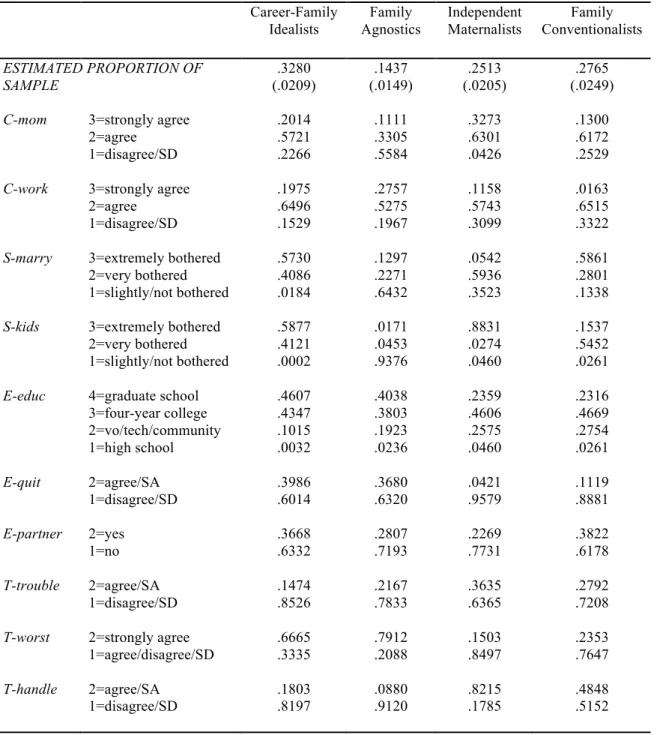
Table 5 – Proportions and Conditional Probabilities of Responses for Four Latent Class Work-Family Orientations (RDSL)………...29
Table 6 – Latent Class Prevalences and Log-Likelihoods of Latent Class Models by Personal Background Characteristics (RDSL)………...………...30
Table 7 – Covariate Analysis of Membership in Latent Classes by Personal Background Characteristics (RDSL)………...………31
Table 8 – Survey Measures Included in Latent Class Analysis of Work-Family Orientations (RDSL)….56 Table 9 – Proportions and Conditional Probabilities of Responses for Four Latent Class Work-Family Orientations at Baseline (RDSL)..……….………..57
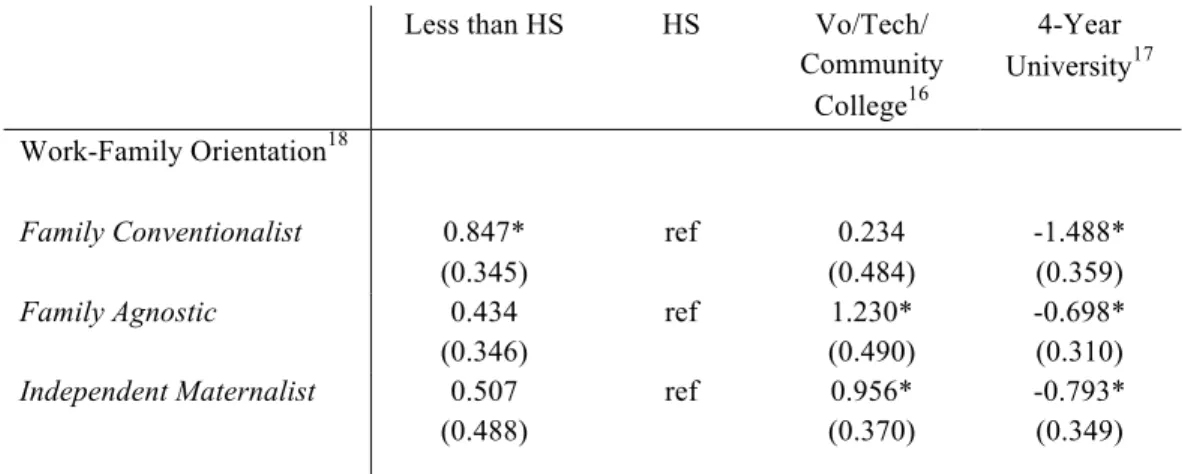
Table 10 – Multinomial Logistic Regression Coefficients of Young Women’s Educational Attainment by Work-Family Orientations at Baseline (RDSL).…..………...……...58
Table 11 – Multinomial Logistic Regression Coefficients of Educational Attainment by Baseline Personal Background Variables (RDSL)..………..………59
Table 12 – Multinomial Logistic Regression Coefficients of Educational Attainment by Baseline Work-Family Orientations and Personal Background Variables (RDSL)..…………..…………..60
Table 13 – Multinomial Logistic Regression Coefficients of Educational Attainment by Baseline Schematic Measures (RDSL, Additive Model)..………61
Table 14 – Survey Measures in Latent Class Analysis of Work-Family Orientations (RDSL)…………..86
Table 15 – Fit Statistics for Latent Transition Analyses (RDSL)...……….87
Table 16 – Initial Proportions and Conditional Probabilities in Latent Class Analysis of Work-Family Orientations (RDSL)..……….……….88
Table 17 – Status Membership Probabilities and Transition Probabilities in Latent Transition Analysis of Work-Family Orientations (RDSL)..……….………..89
LIST OF FIGURES
Figure 1 – Bar Graphs Summarizing Significant Mediating Effects of Work-Family Orientations
on Educational Attainment (RDSL)..………..62 Figure 2 – Summary of Significant Romantic Relationship Measures in the Latent Transition
INTRODUCTION
The Theory of Conjunctural Action (Johnson-Hanks et al. 2011) is a unique framework
that conceptualizes the negotiation among multiple schemas, as well as the interplay between
schemas and materials, in shaping the course of individuals’ decisions and outcomes throughout
the life course. Schemas, which are learned primarily through social interactions, refer to
underdetermined ways of perceiving and acting through which individuals make sense of the
world around them (e.g. ideas, values, habits of the mind). Materials, on the other hand, consist
of the physical objects and conditions that may reinforce existing schemas or instill new ones in
individuals’ perceptions and experiences (e.g. socioeconomic resources, situational constraints,
organizational or institutional structures). Applying this theoretical framework to particularly
young women in the transition to adulthood, this dissertation explores how schemas and
materials together contribute to the unequal experiences of how young women navigate their
relationships and identities at this life stage. I focus on the transition to adulthood not only as a
time of developing identities and perspectives, but also as a critical period influencing future
trajectories of socioeconomic status and well-being (Arnett 2000; Shanahan 2000).
For my research, I use longitudinal survey data from the Relationship Dynamics and
Social Life study (RDSL), an innovative study intended to follow the relationship patterns and
social contexts of young women between the ages of 18 and 20 from one county in Michigan
(N=1003). (The specific county is not named to protect the anonymity of respondents.) These
who were selected from the state driver’s license and personal identification card databases. The
principal investigators note that the target county was chosen specifically because of the racial,
ethnic, and socioeconomic diversity of its residents (Barber et al. 2011). A significant number of
African American residents and substantial variation in economic circumstances within this
county allow researchers to compare across poor African Americans, poor Whites, middle class
African Americans, and middle class Whites within a single geographic area. Moreover, with
repeated measures of respondents’ relationships, education, and a wide range of attitudes and
schemas, the RDSL is a unique dataset that allows researchers to focus particularly on the
complex and dynamic nature of young women’s changing attitudes and relationships during the
transition to adulthood.
In my first paper, I explore different patterns in the combinations of schemas young
women hold about pregnancy, marriage, education, and work. Schemas about these and other
aspects of life can reinforce, compete, or conflict with each other (Johnson-Hanks et al. 2011).
Prior research on education, work, and family schema often measure each with separate
attitudinal measures, missing variations in how individuals package these different schemas in
their minds. For example, research suggests that educational expectations are positively
associated with educational attainment, but some women combine high educational aspirations
with high desires to be a mother, and others do not. We may expect different educational
outcomes for these women with differing schemas about motherhood, but according to current
research, we rarely learn about how combinations of various work and family schemas look or
matter. By using latent class analysis (LCA), I identify and describe four distinct work-family
orientations that reflect interesting ways in which young women combine their attitudes,
using covariate analyses within LCA, I examine how personal background characteristics, such
as family SES and religion, are associated in varying distributions across work-family
orientations. Understanding these four types of configurations, their distributions in the
population, and sociodemographic characteristics unique to each group will give family,
education, work, and gender scholars a useful framework for the ways in which young women
come to view their lives and prioritize various roles and opportunities.
In my second paper, I use the work-family orientations developed in the first paper to
examine the links between these schematic configurations and young women’s educational
attainment. Particularly in the transition to adulthood, education is an important contributing
factor to setting the pathways for future socioeconomic status (Buchmann and Diprete 2006).
This study further brings to question the links between culture and action (Johnson-Hanks et al.
2011; Miles 2014). That is, under what conditions and in what contexts might the links between
work-family orientations and educational outcomes be more or less significant, or more or less
substantial? I use multinomial logistic regressions to examine these statistical relationships, and
further assess the extent to which young women’s work-family orientations may mediate or help
to explain the effect of personal background characteristics on educational attainment in early
adulthood.
Having examined the significance of young women’s work-family orientations upon
educational attainment, I focus my final chapter on exploring the patterns of how young
women’s schematic configurations shift over time, and the extent to which experiences of
romantic relationships may be significantly associated with these schematic shifts.Among the
factors that are likely to influence the stability or change of schemas over time are conjunctures,
require a form of response by the individual (Johnson-Hanks et al. 2011). As young women pass
through the transition to adulthood, varied experiences of romantic relationships are particularly
likely to give rise to these conjunctures, during which individuals draw upon existing schemas or
adopt new schemas to shape their response to unfolding circumstances. Using longitudinal data
from the Relationship Dynamics and Social Life study, I conduct a latent transition analysis in
this final paper to estimate the likelihoods that young women shift from one work-family
orientation to another, and further investigate how young women’s conjunctural experiences of
romantic relationships—specifically, getting engaged to marry, separating from a romantic
partner, or experiencing verbal or physical intimate partner violence (IPV)—may play a role in
these schematic changes.
Altogether, the three papers in this dissertation speak to the complex combinations of
schema that young women hold in the transition to adulthood, how their educational attainment
is affected by work-family orientations, and further, how work-family orientations may shift over
time based on various experiences of romantic relationships. These papers contribute to
contemporary conversations about the socialization of young women, the impact of romantic
relationships and intimate partner violence, and sources of inequality in education in the
CHAPTER 1. WORK-FAMILY ORIENTATIONS IN THE TRANSITION TO ADULTHOOD: HOW YOUNG WOMEN ENVISION COMBINING PARTNERING,
PARENTING, EDUCATION, AND WORK
Introduction
The period of the transition to adulthood is a unique stage in the life course that can allow
for heightened flexibility in the exploration of identities and relationships (Arnett 2000;
Shanahan 2000). During this time, young adults’ considerations about the future are intertwined
in a complex web of schemas which inform the multiple layers of meaning and expectations that
individuals hold with regards to marriage, childrearing, work, and other social markers of
“adulthood.” More generally consisting of underdetermined ways in which individuals perceive
and make sense of the world around them (Johnson-Hanks et al. 2011), schemas that are
developed and adjusted during the transition to adulthood address such critical questions as:
What is to hold salience in an individual’s life—advancement in one’s career, parenthood,
happiness and self-fulfillment? What is the meaning or purpose of marriage? What is the ideal
context in which to raise children? How central are the roles and relationships within family to
an individual’s identity?
Drawing from Sewell’s model of structure as the recurrent patterning of social life
(1992), the Theory of Conjunctural Action framework describes structures of family as being
shaped and sustained through the interplay of schematic and material elements (Johnson-Hanks
ideas, values, habits of the mind). Materials, which are distinct from but interdependent with
schemas, consist of the physical objects and conditions that instill and reinforce schemas in an
individual’s perceptions and experiences (e.g. socioeconomic resources, situational constraints,
organizational and institutional structures). Individuals have access to multiple schemas that may
be partially contradictory, competing with one another, or mutually reinforcing. Such
combinations of schemas often have significant implications for shaping actions and choices at
specific conjunctures, or specific sets of circumstances that require a response through which
action can occur. Material conditions and constraints may require individuals to adjust available
schemas or to develop new ones, but new and existing schemas can also influence how material
structures develop and change over time (Johnson-Hanks et al. 2011).
While the Theory of Conjunctural Action (TCA) framework effectively orients the
discourse of cultural and cognitive schemas within the context of family research, it remains a
challenge to discern empirically “whether and how some cultural elements control, anchor, or
organize others” (Bail 2014; Miles 2014; Swidler 1986, 2001). In other words, while the breadth
of available and accessible schemas is certainly vast, not all schemas are equally influential, and
individuals may choose to employ some schemas in certain situations and not others (Lamont
and Thevenot 2000). As individuals develop and draw upon complex sets of schemas,
transferring what they might consider as ideals into realities that are more specific to their own
lives, the period of the transition to adulthood stands out as a particularly important and engaging
time during which young people face both the burden and opportunity of combining attitudes and
expectations that concern their future decisions and trajectories (Furstenberg 2010).
Applying the TCA framework to the study of young women in the transition to
such significant milestones in the life course as education, work, parenting, and marriage. Thus,
in an effort to respond to and bridge the scholarly literatures of family, work, and culture, I
examine the unique combinations of schemas that young women construct about parenting,
partnering, education,and work, and what schemas they are likely to adopt, reject, or combine to
shape their outlooks upon the future. In order to do so, I use survey data from the Relationship
Dynamics and Social Life study to conduct a latent class analysis (LCA) of these combinations
of young women’s schemas, which hereafter I will refer to as work-family orientations.
This paper essentially builds on prior work from the life course literature that examines
the timing and sequencing of transitional events in early adulthood (e.g. education, marriage,
family formation). Using latent class and cluster analyses, these studies have effectively
demonstrated how individuals are probabilistically distributed across unique sets of intersecting
role configurations and life paths (Barban and Billari 2012; Macmillan and Eliason 2003; Oxford
et al. 2005; Shanahan 2000). Borrowing this person-oriented methodological approach, I will use
LCA in the present analysis to highlight common patterns in how various schemas about work
and family are combined as configurations in the transition to adulthood. By doing so, I will
identify a distinct set of profiles that reflect the most representative work-family orientations of
young women in the United States, and examine the extent to which these work-family
orientations vary by personal background correlates.
Defining Schemas and Types of Schemas
Schemas—a term used broadly throughout the social sciences, but in this case, specific to
the Theory of Conjunctural Action (TCA)—refer to a range of cultural and cognitive phenomena
through which individuals perceive the world around them and are motivated to action. The TCA
1973), may be partial, overlapping, and often contradictory. All schemas, which function as tools
that individuals can use to simplify and make sense of recurring exposure to information, are
virtual; thus, they cannot be measured directly. However, the effects of schemas on perception
and decision-making can indeed be observed by posing questions to individuals that require them
to rely on these schemas to discern what is good, appropriate, probable, etc. (Johnson-Hanks et
al. 2011). Because schemas are underspecified, they are applicable in different social domains
and transferrable from one situation to another. For example, schemas about organizational
hierarchy in the military may be transposed onto the family, making the male adult the “captain”
or “general” of the household, as is consistent with the perspective observed among some
Evangelical Christian families (Bartkowski 2001). As individuals hold multiple schemas within
and across social domains, schemas are likely to be acquired and altered in a piecemeal fashion,
and further shaped by ongoing interactions with materials and conjunctures over time.
Schemas can be distinguished according to three basic characteristics: categorical,
procedural, and evaluative (Johnson-Hanks et al. 2011). Categorical schemas define types and
shape individuals’ expectations for what things are (e.g. What makes a family? What is the
purpose of work?). Procedural schemas, in contrast, define the sequence in which events occur
and how to do things (e.g. Marriage occurs after dating and cohabitation. People find jobs after
graduating from school.). Lastly, evaluative schemas define what is good, desirable, shameful, or
disagreeable, and thus frame individuals’ perspectives about how things should or should not be
(e.g. A good employee is _______. It is wrong for politicians to _______.).1 Schemas may, in
!!!!!!!!!!!!!!!!!!!!!!!!!!!!!!!!!!!!!!!!!!!!!!!!!!!!!!!!!!!!!
fact, have more than one of these characteristics. For instance, in Willoughby et al.’s conceptual
framework for understanding how individuals think about marriage (2014, 2015), scholars
identify several examples of schemas that are jointly categorical and evaluative, and procedural
and evaluative. Contextual schemas about the conditions in which individuals expect to be ready
for marriage or to get married, and timing schemas about the ideal or expected timing of events
related to marriage are examples of procedural-evaluative schemas. Centrality schemas about the
expressed importance of an individual’s spousal role to that individual’s overall identity, and
salience schemas about the relative significance of constructs like marriage and its related
identities in relation to other identities are examples of categorical-evaluative schemas. While
Willoughby et al. (2015) use these distinctions to describe specifically the marital paradigms of
young people in the United States, the TCA framework emphasizes the interconnectedness of
social structures, and therefore builds on this research to explore how schemas about marriage
coexist, or not, with related schemas in such social domains as work and education.
Given the multidimensionality of different types and characteristics of schemas, it is
important to note that a variable-based approach for studying attitudes about family and work as
an average or index measure would oversimplify the combinations or unique configurations of
schema to a single continuum (e.g. “traditional” to “modern”) (Carroll et al. 2007; Mosko and
Pistole 2010; Wilcox and Dew 2010). However, an alternative approach that can be used to
differentiate among schemas and describe systematically distinct sets of schemas that are held
together is the person-centered or person-oriented approach, which estimates latent subgroups of
individuals as types, with unique configurations of schema. Common methods of applying this
approach in sociological research have been to develop typologies within a certain population
through qualitative analysis of interviews and ethnographies, cluster analysis, and less often
using latent class analysis (Pearce et al. 2013).
Particularly in the family literature, the person-centered approach has been used
effectively to describe schemas related to the subjective meaning of marriage. Drawing from a
series of in-depth interviews, Kefalas et al. (2011) identify two groups of individuals as Planners
and Naturalists. The authors find that many young Americans consider being able to afford
higher costs of living, completing higher education degrees, and becoming established in their
careers as important factors of marriage. Planners with this perspective consider these milestones
of adulthood as prerequisites for marriage and expect to delay marriage until these requirements
are fulfilled. In contrast, Naturalists, who comprise about one-fifth of the study sample, view
marriage as a “natural” outcome or next step in romantic relationships that last for a certain
period of time; therefore, an expectation to delay marriage is not evident in the Naturalists’
rhetoric about family. In related studies, Willoughby and Hall (2014) identify three groups of
college students – Enthusiasts, Delayers, and Hesitants – who express varying commitments to
marriage based on their beliefs about its importance, permanence, and appropriate contexts,
while Halpern-Meekin (2012) presents distinctions among Believers, Skeptics, and Unlikely
Optimists in the extent to which individuals embrace the normative timing and ordering of
marriage and childbearing, particularly in light of the respondents’ own family experiences as
adolescents. (See also Hall 2006; Kay 2012.) While such qualitative and person-oriented studies
address important questions about the changing and varied meanings of marriage, there has not
yet been extensive exploration of how young women in the transition to adulthood come to
By focusing on young women’s work-family orientations, the present research does not
constrain the relationship between work and family as independent or unidirectional, but instead,
applying the Theory of Conjunctural Action, recognizes the interplay between schemas and
materials that involve parenting, partnering, education, and work as part of a reciprocal and
iterative process (Johnson-Hanks et al. 2011). Highlighting the transition to adulthood as a
particularly significant period for young women’s family formation as well as development of
the self (Arnett 2000; Shanahan 2000), this paper will disentangle the distinct work-family
orientations held by young women who are faced with the challenge of bridging their ideals with
what begins to unfold as real conjunctures and material constraints.
In light of existing bodies of literature about family formation patterns and their related
cultural schemas, one may expect there to be one type of work-family orientation that largely
prioritizes work, and another that prioritizes family. Ethnographic studies like Edin and Kefalas
(2005) suggest that some women may in fact value marriage in ways that are not immediately
achievable, and as a result, may be more likely to put their roles as mothers first. It is, therefore,
the exploration of unique combinations in young women’s schemas, the examination of different
types of individuals who are likely to hold and express these combinations of schemas about
parenting, partnering, education, and work, and the specification of how prevalent these
combinations of schemas are in the population that are of primary objective to this project, and
the scholarly contribution of this research.
Correlates of Work-Family Orientations
Across studies, researchers consistently find that personal background factors such as
socioeconomic status, race, and gender, as well as family and religious characteristics, are
Socioeconomic characteristics like lower parental education and parents’ educational
expectations for their children are found to be positively associated with adolescents’ earlier
anticipated age for marriage and parenthood (Fan and Marini 2000; Manning et al. 2007).
Considering how race/ethnicity is often closely interrelated with socioeconomic characteristics,
studies also show that black adolescents are more likely than white adolescents to view
childbearing, as opposed to marriage, as the primary pathway for family formation (Trent 1994;
Kane 2000; Landale et al. 2010).
In addition to such socioeconomic characteristics which shape the resources available to
young people’s family formation processes, studies indicate that personal experiences of
religious participation can further influence young people’s expectations about work and family.
Specifically, considering religion to be personally “very important” and identifying as
evangelical predict less egalitarian gender ideologies, as people with these religious
identifications are likely to espouse family values which prescribe separate roles related to work
and family for men and women (Hayford and Morgan 2008; Pearce and Thornton 2007). As
certain schemas within various contexts of family and religion are enacted more often than
others, social identities are created and sustained (Johnson-Hanks et al. 2011). Schemas are given
material form through patterned behaviors which give rise to identities that reflect and embody
the social structures present in young people’s personal background characteristics.
Previously discussed person-centered approaches also reveal similar patterns with regards
to the significance of personal background characteristics. Kefalas et al. (2011) find that
socioeconomic conditions surrounding young adults, such as economic independence and
financial support, critically shape the obstacles and opportunities for marriage—especially among
Willoughby et al. (2014) find that religiosity is a significant correlate of marital paradigms, with
Delayers reporting the lowest levels of religiosity and the Enthusiasts reporting the highest
religiosity. Halpern-Meekin (2012) highlights that not only family structure but also family
experiences, such as parental conflict and mother’s work, significantly shape young people’s
perspectives about their future family relationships. Overall, young women’s perspectives about
marriage and family are consistently found to vary by SES (Gibson-Davis et al. 2005; Kefalas et
al. 2011), religion (Carroll et al. 2007; Mosko and Pistole 2010), and family background
characteristics (Halpern-Meekin 2012; Larson et al. 1998). Young people are likely to draw upon
their parents’ attitudes and family experiences, both directly and indirectly, when forming their
own perspectives and expectations about marriage and family (Willoughby et al. 2012).
Therefore, I expect the work-family orientations in this paper to be correlated with such personal
background measures.
My analyses in this paper explore the following central questions: (a) what are young
women’s configurations of schema about parenting, partnering, education, and work, and how do
they cohere together into work-family orientations in the transition to adulthood; (b) how do
distributions of these work-family orientations vary within the population by personal background
characteristics; and (c) which personal background characteristics are predictive of women’s
work-family orientations?
Data and Methods
To answer my research questions, I use data from the Relationship Dynamics and Social
Life (RDSL) study, which comes from a population-based sample of 1003 young women ages
18-20, residing in a county in Michigan (Barber et al. 2011). The first component of the study,
aspects of family background; demographic information; a wide range of attitudes, values, and
beliefs; current and past friendship and romantic relationships; education; and career trajectories.
Following the baseline survey, all respondents were invited to participate in a journal-based
mixed methods follow-up survey (by Internet or phone) for approximately the next two years. Of
the initial sample of young women, 95% agreed to participate in the follow-up journal study.
Each weekly journal collected updates about respondents’ relationships, and every twelve weeks,
the journal collected updates about respondents’ education, employment, and attitudes.2
More specifically, this paper takes a person-centered approach to examine more
holistically the configurations of schema that give perspective to young women’s family
processes. Building upon prior research that points to variations in such cultural frames (Harding
2007; Willoughby and Hall 2014), I will conduct a latent class analysis (LCA) to highlight
common patterns in how young women combine various schemas about parenting, partnering,
education, and work (Collins and Lanza 2010). Using LCA will allow me to identify a set of
profiles that reflect the most representative schematic configurations that young women possess
in the transition to adulthood. Taking into account the covariation of multiple attitudinal
measures, LCA is essentially a data reduction technique that will suggest a well-fitting number
of latent classes in the population and use patterns of individual survey responses to assign the
probabilities that each case or person belongs to one of these classes.
Schematic Indicators
Drawing from Willoughby et al.’s (2015) conceptualization of different types of schemas
related to marriage, I have selected ten schematic indicators for the latent class analysis of
work-!!!!!!!!!!!!!!!!!!!!!!!!!!!!!!!!!!!!!!!!!!!!!!!!!!!!!!!!!!!!!
family orientations. These schematic indicators are measures of centrality, salience, context, and
timing related to young women’s perspectives on parenting, partnering, education, and work. The
survey items used as centrality schemas of motherhood and work, which represent frames about
the general importance of these roles, are measured by the extent to which respondents agree or
disagree with the following:
C-mom: Being a mother and raising children is the most fulfilling experience a woman can have.
C-work: You expect work to be a major source of satisfaction in life.
The items used as measures for the salience of “mother” and “spouse” as expected identities,
which capture the respondents’ perceptions about the perceived significance of marriage and
childbearing to their sense of self, are:
S-marry: Suppose that your life turned out so that you never married, how much would that bother you?
S-kids: Suppose your life turned out so that you never had children, how much would that bother you?
The items used as young women’s contextual schemas concerning education, pregnancy, and
marriage capture the expectations about specific contexts in which respondents anticipate certain
events to occur; these measures are:
E-educ: How far do you think you will go in school?
E-quit: If you get pregnant, you would have to quit school.
E-partner: If you get pregnant, would you get married to your partner?
Lastly, the items used as young women’s schemas about the timing of pregnancy and parenting,
which capture respondents’ attitudes about the sequencing of present and future events, consist
of the following:
T-trouble: If a woman waits for the perfect time to have a baby, she will probably have trouble getting pregnant.
T-handle: If you got pregnant now, you could handle the responsibilities of parenting.
These schematic indicators together measure the configurations of schemas that young
women hold about their present and future work-family lives. Although the present analyses may
not encapsulate the complexity of TCA’s implications for multidimensional and dynamic
schemas (Johnson-Hanks et al. 2011), this study will provide a critical snapshot of the broader
underlying schematic configurations that young women are most likely to draw from during the
transition to adulthood. While some individual schemas may shift over time3, the deeper
schematic configurations possess an underlying stability and enduring quality that hold
significance for shaping actions in various conjunctures (Davis and Pearce 2007). In other words,
these schematic configurations are a reflection of the underlying identities of young women,
which have the capacity to change over time when faced with new experiences, but have an
overall sense of inertia as a result of the mutual reinforcement of virtual and material
components of people’s identities (Johnson-Hanks et al. 2011).
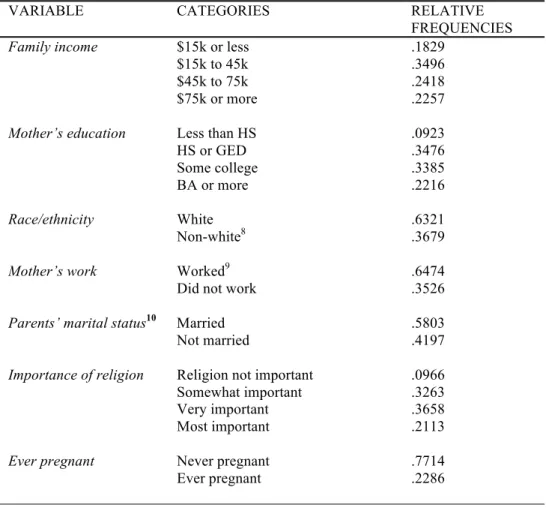
In addition to identifying and describing latent classes of young women’s work-family
orientations, I will consider variations across personal background characteristics. (See Table 1
for details.) These additional measures include the respondent’s family income4, mother’s
highest level of education completed, respondent’s race/ethnicity, whether the respondent’s
mother worked5, whether the respondent’s biological parents are married6, personal importance
of religion, and whether the respondent has ever been pregnant.
!!!!!!!!!!!!!!!!!!!!!!!!!!!!!!!!!!!!!!!!!!!!!!!!!!!!!!!!!!!!!
3 With regards to age, the overall distribution of work-family orientations remains fairly consistent for young women ages 20-22, compared to ages 18-20. See Appendix 1 for details.
4 Don’t Know or Refused coded as missing 5 Most of the time and full time
Analytic Strategy
The components of my analyses will proceed as follows: I first conduct a latent class
analysis of the schematic configurations of young women, using ten schematic indicators related
to parenting, partnering, education, and work. To ensure reliability and reproducibility of the
model results, I test the latent class models using different seeds—or starting values—and
conduct resampling through bootstrap likelihood ratio tests which examine the relative
explanatory power of models with different numbers of latent classes (Huang et al. 2016). On the
basis of these findings, I then conduct a series of multi-group latent class analyses to explore
how the distributions across work-family orientations may vary by personal background
characteristics. Lastly, I examine the statistical significance of these personal background
characteristics in predicting membership in each of the latent classes.
Results
I tested for the best-fitting number of latent classes and assessed models using different
seed values, in order to estimate the most parsimonious model that accurately predicts the
variations and distribution of work-family orientations in this representative sample of young
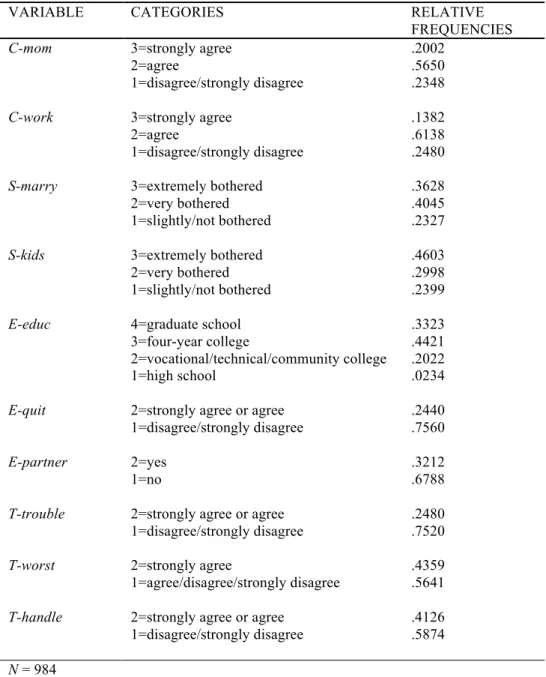
women. The survey items included in the model were recoded as shown in Table 2.
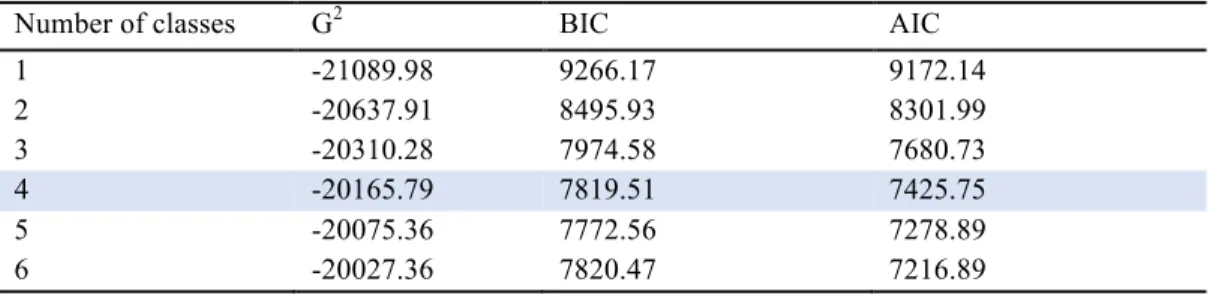
As shown in Table 3’s statistical output, model fit improves substantially from two to
three latent classes. From the four-class model onward, improvements in model fit become more
gradual. After the five-class model, the Bayesian information criterion (BIC) increases to
indicate weaker fit. Although the five-class model technically has a lower BIC, the information
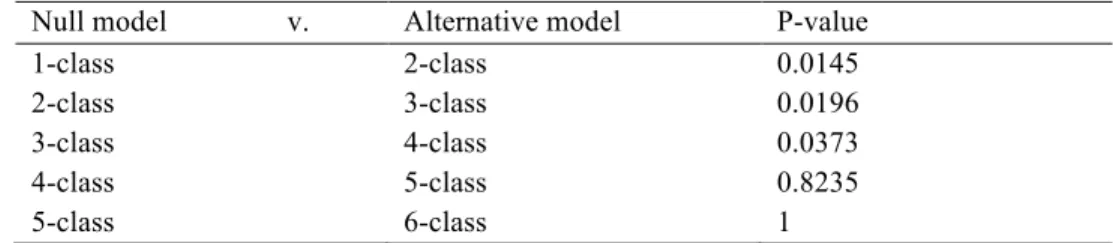
matrix of the five-class model could not consistently be inverted. Furthermore, results from
resampling using the bootstrap likelihood ratio tests (in Table 4) suggest that the explanatory
support again to the reliability of the four latent classes of work-family orientations. In fact,
further evaluation of the conditional probabilities in each LCA model actually suggests that the
latent classes in the five-class model resemble those of the four-class model, with the exception
of one latent class which appears to have been split into two (i.e. similar conditional
probabilities, but one latent class with lower magnitudes). Following Collins and Lanza’s (2010)
guidelines for taking into consideration both parsimony and interpretability in determining best
fit, I have selected the four-class LCA model to estimate and examine the types of work-family
orientations that young women hold in the transition to adulthood.
Based on the unique combinations of conditional probabilities in the four-class LCA
model, I have evaluated and compared the distinct characteristics in each of the latent classes of
young women’s work-family orientations. More specifically, I identify these latent classes of
schematic configurations as Career-and-Family Idealists, Family Agnostics, Independent
Maternalists, and Family Conventionalists—each of which I describe in more detail in the
following section. Table 5 shows the estimated proportions of each class within the population
(gamma estimates), and conditional probabilities of responses to each of the schematic indictors
within the four latent classes (rho estimates).7
Description of Latent Class Profiles
The first class, Career-and-Family Idealists (CFI), which comprise about 33% of the
sample, are most likely to give the highest response for educational expectations (graduate
school rho=.4607) and are also likely to “agree” that work is a major source of satisfaction in life
!!!!!!!!!!!!!!!!!!!!!!!!!!!!!!!!!!!!!!!!!!!!!!!!!!!!!!!!!!!!!
(rho=.6496). In addition, they are likely to respond that they’d be “extremely bothered” if they
never got married (rho=.5730) and if they never had children (rho=.5877). While CFIs are likely
to “agree” that motherhood is one of the most fulfilling experiences in life (rho=.6496), this
schema for the centrality of motherhood is not quite as high for CFIs relative to some of the other
latent classes. If CFIs “get pregnant now,” they are likely to strongly agree that this would be the
“worst thing,” and that they are not yet prepared to handle the responsibilities of parenting. If
pregnant, CFIs are most likely to agree that they would have to quit school (rho=.3986). CFIs are
also least likely to agree that one may have trouble getting pregnant if one waits for the perfect
time (rho=.8526). In other words, CFIs appear to hold schemas about the centrality of parenting,
marriage, education, and work not only simultaneously, but optimistically and with little
compromise. CFI’s likely response that they would have to quit school if pregnant suggests an
implicit sequence of expecting motherhood to follow after education.
The second class, Family Agnostics (FA), about 14% of the sample, are most likely to
report their educational expectations as attending a 4-year college (rho=.3803) or graduate school
(rho=.4038). FAs are most likely to “strongly agree” that they view work to be a major source of
satisfaction in life (rho=.2757). They are most likely to respond that they would be “slightly or
not bothered at all” if they never got married (rho=.6432), and especially if they never had
children (rho=.9376). FAs are least likely to agree that motherhood is the most fulfilling
experience in a woman’s life (disagree, rho=.5584). If FAs were to become pregnant at the
present time, they are likely to respond that they would have to quit school (rho=.3680), that
getting pregnant would be the “worst thing” (rho=.7912), and that they are not prepared for the
responsibilities of parenting (rho=.0880). FAs are likely to disagree that they would marry their
present time are relatively similar to those of CFIs (i.e. quit school if pregnant now, marry
partner if pregnant, worst thing if pregnant, could not handle responsibilities of parenting), FA’s
schemas about parenting and marriage reveal that these aspects of adulthood are far from most
central to this group’s overall work-family orientations.
The third class, Independent Maternalists (IM), about 25% of the sample, are most likely
to expect to attend a 4-year college (rho=.4606) or a vocational/technical/community college
(rho=.2575), and most likely to consider motherhood as one of the most fulfilling experiences
(agree rho=.6301; strongly agree rho=.3273). IMs are most likely to respond that they would be
“extremely bothered” if they never have children (rho=.8831), but least likely to respond that
they would be “extremely bothered” if they never get married (rho=.0542). Relative to
previously mentioned classes, IMs are not as likely to view work as a major source of
satisfaction, although more likely than the final latent class. If IMs became pregnant at the
present time, they would not consider getting pregnant to be the “worst thing” (rho=.8497), are
likely to respond that they would not quit school (rho=.9579), and are most likely to expect not
to marry their partner (rho=.7731). IMs are also most likely to believe they are prepared to
handle the responsibilities of parenting (rho=.8215), and are most likely to agree that it is
difficult to wait for the perfect time to be become pregnant (rho=.3635). It is notable that IM’s
responses to questions about how they would handle getting “pregnant now” are distinctly
different from the responses given by both CFIs and FAs. However, IMs appear to hold a similar
perspective about marriage as FAs, while holding an even stronger schema about the centrality
of motherhood compared to CFIs.
Lastly, Family Conventionalists (FC), who comprise about 28% of the sample, are most
(rho=.2754), and are least likely to “strongly agree” that they view work as a major source of
satisfaction in life (rho=.0163). FCs are likely to report that they would be “extremely bothered”
if they never married (rho=.5861), and “very bothered” if they never had children (rho=.5452).
FCs “agree” that motherhood is one of the most fulfilling experiences (rho=.6172), and are most
likely to expect to marry their partners if they become pregnant (rho=.3822). If FCs became
pregnant at the present time, they are not nearly as likely as CFIs and FAs to respond that this
would be the “worst thing” (rho=.2353), but rather, agree that they could handle the
responsibilities of parenting (rho=.4848). These responses to questions about getting “pregnant
now” are generally similar to those of IMs; however, it is clear that FCs consider marriage to be
much more central to their work-family orientations than all other latent classes.
Personal Background Characteristics as Covariates
Table 6 presents variations in the distribution of individuals across work-family
orientations by personal background characteristics, and Table 7 summarizes the statistical
significance of these personal background measures in predicting membership in the four latent
classes of work-family orientations. These findings suggest that family income, mother’s
education, whether the respondent’s mother worked, whether the respondent’s biological parents
were married, personal importance of religion, and whether the respondent has ever been
pregnant are all statistically significant in estimating membership in latent classes of work-family
orientations. Controlling for all other covariates, race/ethnicity is moderately significant in
predicting latent class membership.
While estimates in the multi-group LCA models (Table 6) indicate notable variations in
how young women are distributed across latent classes based on personal background
reference category of Family Conventionalists, personal importance of religion is significantly
lower among Family Agnostics; family income is significantly higher among Career-and-Family
Idealists; and non-white individuals are significantly more likely to be members of the
Independent Maternalists latent class. As for family background characteristics,
Career-and-Family Idealists and Career-and-Family Agnostics are significantly more likely to have mothers with higher
educational degrees, mothers who worked full time, and parents who were married, when
compared to Independent Maternalists, as well as Family Conventionalists.
In addition to identifying and estimating the four distinct combinations of young
women’s family and work schemas, the present analyses serve as a critical snapshot of the
interconnectedness between young women’s work-family orientations and various personal
background characteristics. Overall, the personal importance of religion (or the lack thereof) is
found to be most significant in distinguishing Family Agnostics and Family Conventionalists,
while family background characteristics are most notable in contributing to Career-and-Family
Idealists and Independent Maternalists.
Conclusion
As this study illustrates, using latent class analysis (LCA) to explore young women’s
work-family orientations not only extends the understanding of how young women view
marriage, but critically examines how young women’s multiple schemas may interact to inform
unique configurations of expectations for future family and work. This person-oriented approach
juxtaposes Career-and-Family Idealists and Family Agnostics who, on one hand, express very
high educational expectations and consider that getting pregnant is not compatible with
continuing in school, with Independent Maternalists and Family Conventionalists, whose
or end to their education. The LCA approach, moreover, highlights that young women’s
work-family orientations which emphasize the centrality of career may, or may not, be paired with
strong aspirations related to motherhood and marriage (i.e. CFI and FA); in contrast,
work-family orientations which are much less centered around career may, or may not, emphasize
marriage as requisite to future work and family (i.e. IM and FC). Not only are the present
analyses descriptive of these notable and unique differences across combinations of schemas, but
the latent class analyses furthermore contribute to prior literature by estimating how these
work-family orientations are distributed at the population level and across various personal background
characteristics.
In light of the Theory of Conjunctural Action framework (Johnson-Hanks et al. 2011),
the schematic configurations identified and explored in this study are expected to interact in
meaningful ways with the material elements of young women’s lives to shape the structure of
their family and work experiences. For example, if the material context of young women were to
include changes in paid maternity leave policies, the combinations of schemas that result from
such material conditions may be likely to appear differently from the work-family orientations in
the present paper. Given this ongoing interplay between schemas and materials, one limitation of
this paper may be that it represents the configurations of schema at one specific point in time, as
a snapshot of schematic configurations in the transition to adulthood. The present discussion of
different work-family orientations, however, contributes to broader scholarly literature by
clarifying specifically which schemas are most likely to be combined in the experiences of young
women during this critical window of time between ages 18 and 20. As young women are faced
with the challenge of evaluating the significant milestones that shape and define adulthood, the
assumptions and expectations in young women’s decisions and actions. Therefore, the present
study in fact benefits from being able to closely examine this specific period of transition among
young women, and may challenge broader conceptual notions of viewing adulthood through an
extended lens into the late twenties (Arnett 2007).
Responding to the overarching theoretical question of how cultural elements are
organized in relation to one another (Swidler 1986), the findings in this paper provide an initial
framework for delineating how schematic elements about work, family, and education are
organized among young women in the transition to adulthood. Consistent with the TCA’s
description of how schemas are not evenly distributed throughout the population (Johnson-Hanks
et al. 2011), the multi-group analyses in particular reveal significant variations among
work-family orientations based on personal background factors, such as work-family socioeconomic status
and personal importance of religion. Future research that builds on the present work should
examine the significance of these work-family orientations that young women have begun to
develop in early adulthood for actual outcomes of marriage, childbearing, educational
attainment, and women’s participation in the workforce. Given a longitudinal perspective,
scholars may further explore changes in work-family orientations throughout the life course,
both as prospective and retrospective ways of organizing cultural elements about work and
TABLE 1: Descriptive Statistics of Personal Background Measures (RDSL Baseline)
VARIABLE CATEGORIES RELATIVE
FREQUENCIES
Family income $15k or less $15k to 45k $45k to 75k $75k or more
.1829 .3496 .2418 .2257
Mother’s education Less than HS HS or GED Some college BA or more
.0923 .3476 .3385 .2216
Race/ethnicity White
Non-white8 .6321 .3679
Mother’s work Worked9 Did not work
.6474 .3526
Parents’ marital status10 Married
Not married
.5803 .4197
Importance of religion Religion not important Somewhat important Very important Most important .0966 .3263 .3658 .2113
Ever pregnant Never pregnant Ever pregnant
.7714 .2286
N = 984
TABLE 2: Descriptive Statistics of Schematic Indicators (RDSL Baseline)
VARIABLE CATEGORIES RELATIVE
FREQUENCIES
C-mom 3=strongly agree 2=agree
1=disagree/strongly disagree
.2002 .5650 .2348
C-work 3=strongly agree 2=agree
1=disagree/strongly disagree
.1382 .6138 .2480
S-marry 3=extremely bothered 2=very bothered 1=slightly/not bothered
.3628 .4045 .2327
S-kids 3=extremely bothered 2=very bothered 1=slightly/not bothered
.4603 .2998 .2399
E-educ 4=graduate school 3=four-year college 2=vocational/technical/community college 1=high school .3323 .4421 .2022 .0234
E-quit 2=strongly agree or agree 1=disagree/strongly disagree
.2440 .7560
E-partner 2=yes 1=no
.3212 .6788
T-trouble 2=strongly agree or agree 1=disagree/strongly disagree
.2480 .7520
T-worst 2=strongly agree
1=agree/disagree/strongly disagree
.4359 .5641
T-handle 2=strongly agree or agree 1=disagree/strongly disagree
.4126 .5874
TABLE 3: Fit Statistics of Latent Class Models (RDSL)
Number of classes G2 BIC AIC
1 -21089.98 9266.17 9172.14
2 -20637.91 8495.93 8301.99
3 -20310.28 7974.58 7680.73
4 -20165.79 7819.51 7425.75
5 -20075.36 7772.56 7278.89
TABLE 4: Model Comparisons using Bootstrap Likelihood Ratio Tests (RDSL)
Null model v. Alternative model P-value
1-class 2-class 0.0145
2-class 3-class 0.0196
3-class 4-class 0.0373
4-class 5-class 0.8235
TABLE 5: Proportions and Conditional Probabilities of Responses for Four Latent Class Work-Family Orientations (RDSL)
Career-Family Idealists Family Agnostics Independent Maternalists Family Conventionalists
ESTIMATED PROPORTION OF SAMPLE .3280 (.0209) .1437 (.0149) .2513 (.0205) .2765 (.0249)
C-mom 3=strongly agree 2=agree 1=disagree/SD .2014 .5721 .2266 .1111 .3305 .5584 .3273 .6301 .0426 .1300 .6172 .2529
C-work 3=strongly agree 2=agree 1=disagree/SD .1975 .6496 .1529 .2757 .5275 .1967 .1158 .5743 .3099 .0163 .6515 .3322
S-marry 3=extremely bothered 2=very bothered 1=slightly/not bothered .5730 .4086 .0184 .1297 .2271 .6432 .0542 .5936 .3523 .5861 .2801 .1338
S-kids 3=extremely bothered 2=very bothered 1=slightly/not bothered .5877 .4121 .0002 .0171 .0453 .9376 .8831 .0274 .0460 .1537 .5452 .0261
E-educ 4=graduate school 3=four-year college 2=vo/tech/community 1=high school .4607 .4347 .1015 .0032 .4038 .3803 .1923 .0236 .2359 .4606 .2575 .0460 .2316 .4669 .2754 .0261
E-quit 2=agree/SA 1=disagree/SD .3986 .6014 .3680 .6320 .0421 .9579 .1119 .8881
E-partner 2=yes 1=no .3668 .6332 .2807 .7193 .2269 .7731 .3822 .6178
T-trouble 2=agree/SA 1=disagree/SD .1474 .8526 .2167 .7833 .3635 .6365 .2792 .7208
T-worst 2=strongly agree 1=agree/disagree/SD .6665 .3335 .7912 .2088 .1503 .8497 .2353 .7647
T-handle 2=agree/SA 1=disagree/SD .1803 .8197 .0880 .9120 .8215 .1785 .4848 .5152
SE in parentheses
l = -20165.79, entropy = 0.71
TABLE 6: Latent Class Prevalences and Log-Likelihoods of Latent Class Models by Personal Background Characteristics (RDSL)
Career-Family Idealists Family Agnostics Independent Maternalists Family Conventionalists Log-likelihood
Baseline model .3280 (.0209) .1437 (.0149) .2513 (.0205) .2765 (.0249) -20165.79 Multi-group models
$15k or less .1371 .0870 .3258 .4501 -19037.96
$15k-45k $45k-75k $75k or more
.3664 .2770 .5641 .1659 .1750 .1445 .2391 .2509 .1229 .2286 .2971 .1686
Mother less than HS .0366 .1084 .5114 .3437 -19414.16
Mother HS or GED Mother some college
.2227 .1122 .2229 .2273 .3945 .4021 .1599 .2584
Mother BA or more .4086 .2101 .2254 .1558
White .3866 .1674 .1959 .2501 -20149.85
Non-white .2750 .1350 .3173 .2727
Mother did not work .3093 .1436 .2861 .2610 -20163.67
Mother worked .3528 .1493 .2418 .2560
Parents married .4159 .1677 .2201 .1963 -19964.06
Not married .1939 .1128 .3209 .3723
Religion not important .1991 .3490 .3068 .1451 -20119.51
Somewhat important Very important Most important .3183 .3367 .4107 .1279 .1034 .1482 .2832 .2934 .2001 .2706 .2665 .2411
Never pregnant .4643 .3989 .0628 .0740 -17538.19
Ever pregnant .1954 .0532 .3070 .4444
TABLE 7: Covariate Analysis of Membership in Latent Classes by Personal Background Characteristics (RDSL)
Career-Family Idealists
Family Agnostics
Independent Maternalists
Family Conventionalists
Intercept
β0 .0551 -.1894 -6.3899 ref
Odds 1.0567 .8275 .0017 ref
Family income (p=.0002)
β1 .3786* .0892 .2130 ref
Odds 1.4602 1.0933 1.2374 ref
Mother education (p=.0143)
β2 .2216* .2757* .1469 ref
Odds 1.2480 1.3175 1.1583 ref
Non-white (p=.0530)
β3 -.1908 -.0158 .8098* ref
Odds .8263 .9843 2.2475 ref
Mother worked (p=.0152)
β4 .4073* .4532* .5136 ref
Odds 1.5128 1.5734 1.6712 ref
Parents not married (p<.0001)
β5 -1.3039* -.6933* .0980 ref
Odds .2715 .4999 1.1030 ref
Importance of religion (p<.0001)
β6 .1200 -.5576* .3617 ref
Odds 1.1275 .5726 1.5116 ref
Ever pregnant (p<.0001)
β7 -2.6493* -1.5265* .5243+ ref
Odds .0707 .2173 1.5917 ref
Appendix 1: Latent Class Prevalences Estimated Over Time, by Respondents’ Age (RDSL at Baseline and Two Years after Baseline)
Career-Family Idealists
Family Agnostics
Independent Maternalists
Family
Conventionalists Log-likelihood
Age 18-20 .3280
(.0209)
.1437 (.0149)
.2513 (.0205)
.2765 (.0249)
-20165.79
Age 20-22 .2875
(.0212)
.1542 (.0160)
.2579 (.0246)
.3004 (.0274)
REFERENCES
Arnett, JJ. 2000. Emerging adulthood: A theory of development from the late teens through the twenties. American Psychologist 55(5): 469-80.
Bail, CA. 2014. The cultural environment: measuring culture with big data. Theory and Society
43(3): 465-82.
Barban, N, and F Billari. 2012. Classifying life course trajectories: a comparison of latent class and sequence analysis. Journal of the Royal Statistical Society 61(5): 765-84.
Barber, JS, Y Kusunoki, and HH Gatny. 2011. Design and implementation of an online weekly journal to study unintended pregnancies. Vienna Yearbook of Population Research 9:327-334.
Bartkowski, JP. 2001. Remaking the godly marriage: Gender negotiation in Evangelical families. Rutgers University Press.
Carroll, JS, B Willoughby, S Badger, LJ Nelson, CM Barry, and SD Madsen. 2007. So close, yet so far away: The impact of varying marital horizons on emerging adulthood. Journal of Adolescent Research 22: 219-47.
Collins, LM, and ST Lanza. 2010. Latent Class and Latent Transition Analysis. Hoboken: Wiley.
Davis, SN, and LD Pearce. 2007. Adolescents’ Work-Family Gender Ideologies and Educational Expectations. Sociological Perspectives 50(2):249-271.
Edin, K, and M Kefalas. 2005. Promises I can keep. Berkeley, CA: University of California.
Fan, PL, and MM Marini. 2000. Influences on gender-role attitudes during the transition to adulthood. Social Science Research 29(2): 258-83.
Furstenberg, FF. 2010. On a new schedule: Transition to adulthood and family change. The future of children 20(1): 67-87.
Geertz, C. 1973. The Interpretation of Cultures. New York: Basic Books.
Gibson-Davis, CM, K Edin, and S McLanahan. 2005. High hopes but even higher expectations: The retreat from marriage among low-income couples. Journal of Marriage and Family
67:1301-12
Hall, SS. 2006. Marital meaning: Exploring young adults’ belief systems about marriage.
Halpern-Meekin, S. 2012. Unlikely Optimists, Skeptics, Believers: Understanding Adolescents’ Prospective Relationship Views. Journal of Adolescent Research 27(5): 606-31.
Harding, D. 2007. Cultural Context, Sexual Behavior, and Romantic Relationships in Disadvantaged Neighborhoods. American Sociological Review 72:341-64.
Hayford, SR, and SP Morgan. 2008. Religiosity and fertility in the United States: The role of fertility intentions. Social Forces 86(3):1163-88.
Huang, L, JJ Dziak, AT Wagner, and ST Lanza. 2016. LCA bootstrap Stata function users’ guide
(Version 1.0). University Park: The Methodology Center, Penn State. Retrieved from http://methodology.psu.edu.
Johnson-Hanks, JA, CA Bachrach, SP Morgan, and HP Kohler. 2011. Understanding Family Change and Variation: Toward a Theory of Conjunctural Action. New York: Springer.
Kane, EW. 2000. Racial and ethnic variations in gender-related attitudes. Annual Review of Sociology 26:419-39.
Kaufman, J. 2004. Endogenous explanation in the sociology of culture. Annual Review of Sociology 30:359-93.
Kay, NM. 2012. The changing meaning of marriage: An analysis of contemporary marital attitudes of young adult. All Theses and Dissertations. Paper 2969.
http://scholarsarchive.byu.edu.libproxy.lib.unc.edu/etd/2969
Kefalas, MJ, FF Furstenberg, PJ Carr, and L Napolitano. 2011. Marriage is more than being together: The meaning of marriage for young adults. Journal of Family Issues: 1-31.
Lamont, M, and ML Small 2008. How culture matters for poverty: Thickening our
understanding. The Colors of Poverty: Why Racial and Ethnic Disparities Exist. New York: Russell Sage Foundation.
Lamont, M, and L Thévenot. 2000. Rethinking Comparative Cultural Sociology: Repertoires of Evaluation in France and the United States. Cambridge: Cambridge University Press.
Landale, NS, R Schoen, and K Daniels. 2010. Early family formation among White, Black, and Mexican American women. Journal of Family Issues 31(4): 445-74.
Macmillan, R, and S Eliason. 2003. Characterizing the life course as role configurations and pathways. Handbook of the life course, ed. JT Mortimer and MJ Shanahan, pp. 529-44. New York: Springer.
Manning, WD, MA Longmore, and PC Giordano. 2007. The changing institution of marriage: Adolescents’ expectations to cohabit and to marry. Journal of Marriage and Family
69(3): 559-75.
Manski, CF. 2004. Measuring Expectations. Econometrica 72:1329-76.
Miles, A. 2014. Addressing the Problem of Cultural Anchoring: An Identity-Based Model of Culture in Action. Social Psychology Quarterly 77(2): 210-27.
Mosko, JE, and MC Pistole. 2010. Attachment and religiousness: Contributions to young adult marital attitudes and readiness. Family Journal 18:127-35.
Oxford, M, et al. 2005. Life course heterogeneity in the transition from adolescence to adulthood among adolescent mothers. Journal of Research Adolescence 15(4): 479-504.
Pearce, LD, EM Foster, and JH Hardie. 2013. A person-centered examination of adolescent religiosity using latent class analysis. Journal for the Scientific Study of Religion 52(1): 57-79.
Pearce, LD, and A Thornton. 2007. Religious identity and family ideologies in the transition to adulthood. Journal of Marriage and Family 69(5): 1227-43.
Sewell, WH. 1992. A Theory of Structure: Duality, Agency, and Transformation. American Journal of Sociology 98(1): 1-29.
Shanahan, M. 2000. Pathways to adulthood in changing societies: Variability and mechanisms in life course perspective. Annual Review of Sociology 26: 667-92.
Swidler, A. 1986. Culture in Action: Symbols and Strategies. American Sociological Review
51:273-86.
Swidler A. 2001. Talk of Love: How Culture Matters. Chicago: University of Chicago Press.
Trent, K. 1994. Family context and adolescents’ expectations about marriage fertility and nonmarital childbearing. Social Science Quarterly 75(2):319-39.
Vaisey, S. 2009. Motivation and Justification: A Dual-Process Model of Culture in Action.
Vaisey, S. 2010. What People Want: Rethinking poverty, culture, and educational attainment.
Annals of the American Academy of Political and Social Science 629:75-101.
Wilcox, WB, and J Dew. 2010. Is love a flimsy foundation? Soul-mate versus institutional models of marriage. Social Science Research 39:687-99.
Willoughby, BJ, JS Carroll, JM Vitas, and LH Hill. 2012. When are you getting married?: The intergenerational transmission of attitudes regarding marital timing and marital
importance. Journal of Family Issues 33(2): 223-45.
Willoughby, BJ, and SS Hall. 2014. Enthusiasts, Delayers, and the Ambiguous Middle: Marital paradigms among emerging adults. Emerging Adulthood 3(2):123-35.
CHAPTER 2. THE RELATIONSHIP BETWEEN YOUNG WOMEN’S WORK-FAMILY ORIENTATIONS AND EDUCATIONAL TRANSITIONS IN EARLY ADULTHOOD
Introduction
Educational expectations are often considered to be among the most significant factors
related to an individual’s educational attainment and eventual socioeconomic status (Sewell et al.
1969; Haller and Portes 1973; Sewell and Hauser 1980). However, as young people’s future
goals about work and career are not always considered separately from their attitudes and
expectations about family (Eccles 1994; Greene and DeBacker 2004; Johnson-Hanks et al. 2011;
Marini et al. 1996), research has shown that gender ideologies related to family and work are
also significant to educational outcomes, especially for young women (Kimmel 2000; Marini
1984; Padavic and Reskin 2002). While studies consistently show that young women generally
hold more egalitarian gender ideologies compared to their male counterparts (Bolzendahl and
Myers 2004; Davis and Greenstein 2004; Fan and Marini 2000), young women’s attitudes about
work and family are found to be more closely related and significantly more influential to their
educational expectations, compared to the impact of these attitudes among young men (Davis
and Pearce 2007). This greater significance of gendered ideologies about work and family on
young women’s future trajectories thus warrants further examination of specifically how young
women’s various attitudes about family and work may be related to the education they obtain in