EFFICIENT DESIGN, ANALYSIS, AND IMPLEMENTATION OF
COMPLEX MULTIPROCESSOR REAL-TIME SYSTEMS
Cong Liu
A dissertation submitted to the faculty of the University of North Carolina at Chapel Hill in partial fulfillment of the requirements for the degree of Doctor of Philosophy in the Department of Computer Science.
Chapel Hill 2013
©2013 Cong Liu
ABSTRACT
CONG LIU: Efficient Design, Analysis, and Implementation of Complex Multiprocessor Real-Time Systems
(Under the direction of Prof. James H. Anderson)
The advent of multicore technologies is a fundamental development that is impacting software
design processes across a wide range of application domains, including an important category of such applications, namely, those that have real-time constraints. This development has led to much
recent work on multicore-oriented resource management frameworks for real-time applications.
Unfortunately, most of this work focuses on simple task models where complex but practical runtime
behaviors among tasks do not arise. In practice, however, many factors such as programming
methodologies, interactions with external devices, and resource sharing often result in complex
runtime behaviors that can negatively impact timing correctness. The goal of this dissertation is to
support such more realistic and complex applications in multicore-based real-time systems. The
thesis of this dissertation is:
Capacity loss (i.e., over provisioning) can be significantly reduced on multiprocessors
while providing soft and hard real-time guarantees for real-time applications that
exhibit complex runtime behaviors such as self-suspensions, graph-based precedence
constraints, non-preemptive sections, and parallel execution segments by designing
new real-time scheduling algorithms and developing new schedulability tests.
The above thesis is established by developing new multiprocessor scheduling algorithms and
schedulability tests that are sufficient to provide real-time guarantees for task systems containing
each of the above mentioned complex runtime behaviors individually and in combination.
First, we present several efficient multiprocessor schedulability tests for both soft and hard
real-time sporadic self-suspending task systems. For the past 20 years, the unsolved problem of
research topics such as analyzing and implementing I/O-intensive applications in multiprocessor
systems. The impact of this work is demonstrated by the fact that it provides a first set of practically
efficient solutions that can fundamentally solve this problem.
To better handle graph-based precedence constraints, we propose a scheduling algorithm that can
achieve no capacity loss for scheduling general task graphs on a multiprocessor while providing soft
real-time correctness guarantees. We also extend this result to support task graphs in a distributed
system containing multiple multiprocessor-based clusters. The impact of this work is demonstrated
by the fact that we closed a problem that stood open for 12 years. By achieving no capacity loss, our research results can provide a set of analytically correct and practically efficient methodologies to
designers of real-time systems that execute task graphs, such as signal processing and multimedia
application systems.
Furthermore, besides handling runtime behaviors such as self-suspensions and graph-based
precedence constraints independently, we also investigate how to support sophisticated real-time task
systems containing mixed types of complex runtime behaviors. Specifically, we derive a sufficient
schedulability test for soft real-time sporadic task systems in which non-preemptive sections,
self-suspensions, and graph-based precedence constraints co-exist. We present a method for transforming such a sophisticated task system into a simpler sporadic task system with only self-suspensions.
The transformation allows maximum response-time bounds derived for the transformed sporadic
self-suspending task system to be applied to the original task system.
Finally, we present schedulability analysis for sporadic parallel task systems. The proposed
analysis shows that such systems can be efficiently supported on multiprocessors with bounded
response times. In particular, on a two-processor platform, no capacity loss results for any parallel
task system. Despite this special case, on a platform with more than two processors, capacity loss
is fundamental. By observing that capacity loss can be reduced by restructuring tasks to reduce
ACKNOWLEDGEMENTS
My dissertation and graduation as a Ph.D would not have been possible without the help of many
people.
I am deeply grateful to my advisor, Jim Anderson, for educating, guiding, and helping me over
the past five years. First of all, I am indebted to Jim for supporting me as an RA and working with
me when I first came to UNC. Ever since, it has been a great pleasure working with Jim and learning
from him. His thoroughness, sharpness of intellect, genuine care and concern for his students are
admirable. I also greatly appreciate Jim for many of his impromptu discussions over half-baked ideas
and fresh insights. I would like to thank Jim in particular for being patient with some of my sloppy
writing, getting those fixed, and teaching me to write in the process. For every paper Jim writes with
his students, he always spends a great amount of time providing careful and prompt feedback on
drafts. That is perhaps the reason why papers submitted by his students to various conferences and journals consistently get high review scores in the category of presentation. Last but not the least, I
want to thank Jim for pointing out and reminding me my weakness in doing research: always having
a tendency to go too fast and publish more papers. Jim, I will always keep your counsel in mind. In
my upcoming academic career as an independent researcher, I promise, I will not let you down!
I would also like to thank my dissertation committee: Sanjoy Baruah, Kevin Jeffay, Ketan
Mayer-Patel, Jasleen Kaur, and Steve Goddard. I learned quite a lot from Sanjoy on how to be a good
presenter, and I am indebted to Steve for his valuable comments on my research work, particularly
my work on PGM graph scheduling. I want to thank Kevin and Don Smith for performing mock
faculty interviews with me. They reposed a lot of confidence (which is very much needed) in me during that tough period of time.
I also owe much to many colleagues in the real-time systems group: Andrea Bastoni, Aaron
Block, Bjorn Brandenburg, John Calandrino, Ben Casses, Bipasa Chattopadhyay, Glenn Elliott,
Jeremy Erickson, Zhishan Guo, Jonathan Herman, Haohan Li, Chris Kenna, Alex Mills, Mac
on my job talk, and Hennadiy and Alex for sharing their insights on my research. I also want to thank
Zhishan for driving me to the airport many times during the past few months.
I would like to take this opportunity to extend my thanks to the administrative and technical
staff of the Computer Science Department. Special thanks go to Janet Jones, Dawn Andres, Jodie
Turnbull, and Tim Quigg for their help and kindness to me over the past five years.
I would also like to thank people at places where I did my two summer internships in 2010 and
20011: IBM research T. J. Watson center and IBM research Austin Laboratory. My collaborators
Jian Li, Wei Huang, and Even Speight at IBM research Austin lab deserve a large amount of credit for working with me on interesting projects over the summer, 2011. I hope I will have collaboration
opportunities with you again in the near future.
Foremost, I thank my parents for their unwavering support and utmost care. Mom, although I
have never had the courage to say this to you, you are the greatest mother in this universe, and I love
you! I promise some day soon I will make you proud!
Finally, I want to thank QianWen, for all her love, for her patience, for her positive, optimistic,
and happy attitudes, for her enormous support during the dark times of my life. Without you, I would
not be able to finish this dissertation and find a job. Although I feel fortunate enough, I would be more pleased if I had met you much earlier in my life! I love you so much and I will be loving you
TABLE OF CONTENTS
LIST OF TABLES . . . xiii
LIST OF FIGURES . . . xiv
LIST OF ABBREVIATIONS . . . xxi
1 Introduction . . . 1
1.1 What is a Real-Time System? . . . 2
1.2 Classical Real-Time System Model . . . 3
1.2.1 Sporadic Task Model . . . 3
1.2.2 Hard and Soft Temporal Constraints . . . 6
1.2.3 Resource Model . . . 7
1.3 Real-Time Scheduling Algorithms and Schedulability Tests . . . 8
1.3.1 Concepts and Metrics . . . 9
1.4 The Divergence of Theory and Practice . . . 10
1.4.1 Limitations of the Sporadic Task Model . . . 10
1.4.2 Limitations of the State-of-the-Art. . . 12
1.5 Research Overview . . . 13
1.6 Thesis Statement . . . 14
1.7 Contributions . . . 14
1.7.1 SRT Schedulability Test for Globally-Scheduled Suspending Task Systems . . 15
1.7.1.1 The First SRT Suspension-Aware Global Schedulability Test . . . 15
1.7.1.2 An Improved Utilization Constraint . . . 16
1.7.2 Multiprocessor HRT Schedulability Tests for Suspending Task Systems . . . 17
1.7.3 Multiprocessor Scheduling of SRT Task Graphs . . . 17
1.7.3.1 Supporting PGM Task Systems on Multiprocessors . . . 18
1.7.3.2 Supporting PGM Task Systems in a Distributed System. . . 18
1.7.4 Multiprocessor SRT Scheduling of Complex Task Systems . . . 19
1.7.5 A Tardiness Bound for Multiprocessor Real-Time Parallel Tasks . . . 19
1.8 Organization . . . 20
2 Background and Prior Work . . . 21
2.1 Real-Time Task Models . . . 21
2.1.1 The Non-Recurrent Task Model . . . 21
2.1.2 The Non-Recurrent Self-Suspending Task Model. . . 22
2.1.3 The Sporadic Task Model . . . 24
2.1.4 The Sporadic Self-Suspending Task Model . . . 24
2.1.5 The RB Task Model . . . 25
2.1.6 The DAG-based RB Task Model . . . 27
2.1.6.1 The Processing Graph Method . . . 29
2.1.7 The DAG-based RB Self-Suspending Task Model . . . 31
2.1.8 The Parallel Task Model . . . 31
2.2 Common Definitions . . . 33
2.3 Prior Work . . . 35
2.3.1 Real-Time Scheduling of Sporadic Task Systems . . . 35
2.3.1.1 Uniprocessor Scheduling . . . 35
2.3.1.2 Multiprocessor Scheduling . . . 38
2.3.1.3 Clustered Scheduling . . . 44
2.3.2 Real-Time Self-Suspending Task Scheduling. . . 44
2.3.2.1 Negative Results . . . 44
2.3.3 Real-Time Task Graph Scheduling . . . 50
2.3.3.1 Uniprocessor PGM Scheduling . . . 50
2.3.3.2 Other Prior Work on Real-Time Task Graph Scheduling . . . 52
2.3.4 Dealing with Non-Preemptive Sections . . . 53
2.3.5 Real-Time Parallel Task Scheduling . . . 54
2.4 Summary . . . 55
3 Scheduling SRT Self-Suspending Tasks . . . 56
3.1 System Model . . . 56
3.2 First SRT Schedulability Test . . . 58
3.2.1 Upper Bound . . . 60
3.2.2 Lower Bound . . . 64
3.2.3 Determiningx. . . 72
3.2.4 A Counterexample. . . 73
3.2.5 Experimental Evaluation . . . 74
3.3 An Effective Technique to Improve Schedulability . . . 81
3.3.1 Linear Programming Approach. . . 83
3.3.2 An Optimal Polynomial-Time Algorithm . . . 84
3.3.3 Tardiness Bound. . . 87
3.3.4 Experimental Evaluation . . . 87
3.4 An O(m) Schedulability Test . . . 99
3.4.1 Schedulability Analysis . . . 100
3.4.2 NewO(m)Analysis Technique . . . 101
3.4.3 Lower Bound . . . 110
3.4.4 Upper Bound . . . 111
3.4.5 Determiningx. . . 114
3.4.6 Theoretical Dominance over Prior Tests . . . 114
3.5 Chapter Summary . . . 120
4 Scheduling HRT Self-Suspending Tasks . . . 121
4.1 GTFP. . . 122
4.2 GEDF . . . 133
4.2.1 Upper-BoundingPτi∈τW(τi). . . 135
4.2.2 Finding Values ofξlandsl,j . . . 140
4.2.3 Schedulability Test . . . 141
4.2.4 Experiments. . . 142
4.3 Chapter Summary . . . 146
5 Multiprocessor Scheduling of PGM Graphs . . . 148
5.1 Supporting PGM-Specified Systems on Multiprocessors. . . 150
5.1.1 Representing PGM Graphs by DAG-based RB Task Systems . . . 150
5.1.2 TransformingτRBtoτ . . . 154
5.1.3 Tardiness Bound forτRB. . . 157
5.1.4 Improving Job Response Times by Early-Releasing . . . 163
5.1.5 Case Study . . . 163
5.1.6 Summary . . . 166
5.2 Scheduling SRT PGM in a Distributed System . . . 167
5.2.1 System Model . . . 168
5.2.2 Algorithm CDAG . . . 169
5.2.3 Assignment Phase . . . 170
5.2.4 Scheduling Phase . . . 177
5.2.5 Tardiness Bound. . . 179
5.2.6 Improving Job Response Times . . . 185
5.2.7 Experiments. . . 185
5.3 Chapter Summary . . . 190
6.1 System Model . . . 192
6.2 Transformation. . . 193
6.2.1 TransformingτNGStoτGS. . . 193
6.2.2 TransformingτGStoτS . . . 195
6.3 A Tardiness Bound . . . 195
6.4 Chapter Summary . . . 196
7 A Response Time Bound for Parallel Tasks . . . 197
7.1 System Model and Notation . . . 198
7.2 Response Time Bound . . . 199
7.2.1 Upper Bound . . . 201
7.2.2 Lower Bound . . . 203
7.2.3 Determiningx. . . 211
7.2.4 A Case with No Utilization Loss . . . 212
7.2.5 Cases with Utilization Loss . . . 212
7.2.6 Optimization . . . 213
7.2.7 Experimental Evaluation . . . 219
7.3 Chapter Summary . . . 225
8 Conclusions and Future Work . . . 226
8.1 Summary of Results . . . 226
8.1.1 Schedulability Tests for Globally-Scheduled Self-Suspending Task Systems . 227 8.1.2 Multiprocessor Scheduling of SRT PGM Task Systems . . . 229
8.1.3 Multiprocessor SRT Scheduling of Complex Task Systems . . . 229
8.1.4 A Tardiness Bound for Multiprocessor Real-Time Parallel Tasks . . . 230
8.2 Future Work . . . 230
8.2.1 General Results on Scheduling Complex Real-Time Task Systems . . . 230
8.2.2 Improved Schedulability Tests for HRT Suspending Task Systems . . . 231
8.2.4 Supporting DAGs with Mixed Timing Constraints on Multiprocessors . . . 232
8.2.5 Scheduling Heterogeneous Multiprocessor DAG-based Systems . . . 233
8.2.6 Reducing the Magnitude of Tardiness Bounds . . . 233
8.2.7 Innovations in Many-Core Real-Time Systems . . . 234
8.2.8 Supporting Data-Intensive Workloads in Networked Real-Time Systems . . . . 234
LIST OF TABLES
2.1 Summary of our notation and the sporadic task models constraints. . . 24
3.1 Per-job suspension-length ranges. . . 75
3.2 Per-job suspension-length ranges. . . 88
3.3 Average tardiness bounds under O(m), SC, and LA whenm = 4. The labels “u-L” /“u-M”/“u-H” indicate light/medium/ heavy task utilizations, respectively. Within the row “O(m),” the three sub-rows “n-O(m)” /“n-SC”/“n-LA” represent the average tardiness bound achieved by O(m) as computed for all task sets that can be successfully scheduled under O(m)/SC/LA, respectively. The rows “SC”/“LA” represent the average tardiness bound achieved by SC/LA as computed for all task sets that can be successfully scheduled under SC/LA, respectively. All time units are inms. . . 119
5.1 Summary of notation. . . 151
5.2 Case study results. . . 165
5.3 Total communication cost. . . 189
5.4 Runtime performance. . . 189
LIST OF FIGURES
1.1 Illustration of a constrained-deadline sporadic taskτi. The jobτi,jis
pre-empted twice by higher-priority jobs (which are not depicted). Therefore,τi,j
migrates twice: it first migrates from processor 1 to processor 2, and then
back to processor 1. . . 4
1.2 Illustration of symmetric multiprocessor architecture(a)without and(b) with a shared cache. . . 8
1.3 Pervasive self-suspension behaviours. . . 12
1.4 Example real-time video processing system. . . 12
2.1 Illustration of real-time task models considered in this dissertation. For each pair of connected task models, the successor (lower) generalizes its predecessor (upper). For example, the sporadic task model generalizes the non-recurrent task model. . . 22
2.2 An example non-recurrent taskτ1with a release time at time 2, a deadline at time 10, and a WCET of five time units. . . 23
2.3 Illustration of the non-recurrent self-suspending task model. . . 23
2.4 Illustration of the sporadic self-suspending task model. . . 25
2.5 (a)Sporadic and(b)RB releases. . . 26
2.6 (a)Example DAG-based RB task system and(b)GEDF schedule of this example system. . . 28
2.7 Example PGM graph. . . 30
2.8 Example parallel taskτi. It has five segments where the second and fourth segments are parallel segments and contain three and two threads, respectively. This task has a WCET of 23 time units, a period of 10 time units, and thus a utilization of 2.3. . . 32
2.9 Illustration of Definitions 2.1-2.3. . . 33
2.10 Uniprocessor schedules under (a) EDF, (b) RM, and (c) LLF for an example task system with two sporadic tasks τi(e1 = 3, p1 = 5) and τ2(e2 = 4, p2 = 10). . . 38
2.12 Example two-processor G-EDF schedule of the task set that consists of five sporadic tasks: τ1(3,10), τ2(2,7), τ1(1,5), τ1(3,9)andτ1(5,13), where
the notationτi(ei, pi)is used. As we can observe in the schedule, jobs are
allowed to be preempted and migrate among processors at any time due to GEDF. . . . 41
2.13 A counterexample showing that SRPTF is not competitive for the non-recurrent self-suspending task model. The example task set containsn+ 1 task. The first taskτ1releases a job that arrives at time 0 and has a deadline at timeD−1, whereDis an arbitrary large number. It contains only one computation phase of one time unit. For each other taskτi (2≤i≤n), it releases a job that has a release time ati−1, an absolute deadline at D+i−2. Each jobτi first executes for one time unit, then self-suspends forD−2time units, and finally executes for another time unit. As seen in inset(a),nout ofn+ 1deadlines are missed under SRPTF, while all deadlines are met under an optimal scheduling algorithm. IfDbecomes large enough, this task set has an arbitrarily small utilization. Therefore, we have an instance with an arbitrarily small utilization such that SRPTF is not competitive to minimize the number of tardy tasks if they are allowed to self-suspend at most once. Nevertheless, an optimal schedule exists for this tast set, as shown in inset(b). . . 47
2.14 A counterexample showing that EDF is not optimal for scheduling non-recurrent suspending task systems even with ak-speed processor, for any positive integer k. The non-recurrent task set contains two tasks that release jobs both arriving at time 0. τ1 executes for2ktime units, and has an absolute deadline at4k−1. τ2 first executes for one time unit, then self-suspend for4k−2time units, and finally executes for another time unit. τ2 has an absolute deadline at4k. Inset(a)shows a feasible schedule of this task set under a 1-speed processor. Inset(b)shows the corresponding EDF schedule, but under ak-speed processor, wherekcan be arbitrarily large. As seen, the deadline ofτ2is missed under EDF even with such ak-speed processor due to self-suspensions. . . 49
3.1 Subcase 2.2. . . 67
3.2 Subcase 2.3. . . 68
3.3 Presence intervals within[ts, tp]. . . 69
3.4 Tardiness growth rates in counterexample. . . 74
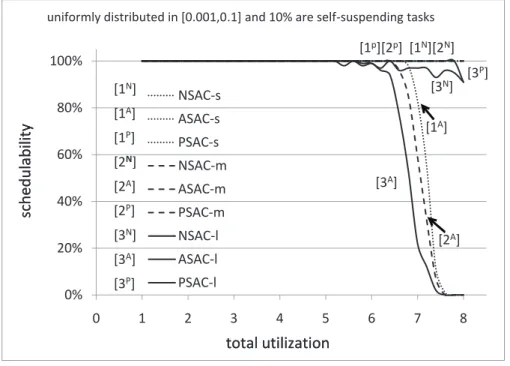
3.5 Light per-task utilizations, relatively infrequent suspensions . . . 76
3.6 Light per-task utilizations, moderately frequent suspensions . . . 76
3.7 Light per-task utilizations, frequent suspensions . . . 77
3.8 Medium per-task utilizations, relatively infrequent suspensions . . . 77
3.10 Medium per-task utilizations, frequent suspensions . . . 78
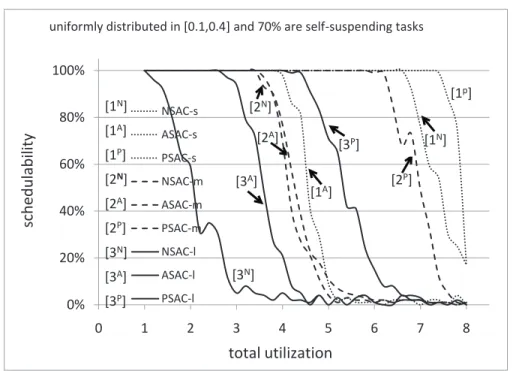
3.11 Heavy per-task utilizations, relatively infrequent suspensions . . . 79
3.12 Heavy per-task utilizations, moderately frequent suspensions . . . 79
3.13 Heavy per-task utilizations, frequent suspensions . . . 80
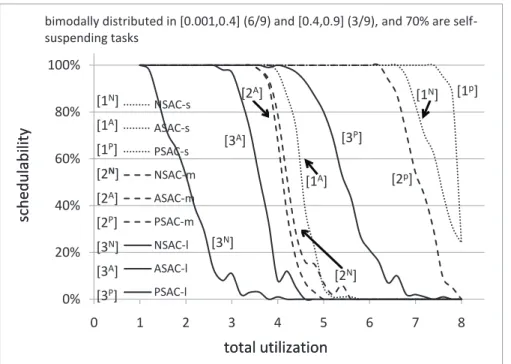
3.14 Soft real-time schedulability results for uniform light task utilization dis-tributions. Relatively infrequent suspensions are assumed.. . . 90
3.15 Soft real-time schedulability results for uniform light task utilization dis-tributions. Moderately frequent suspensions are assumed. . . 90
3.16 Soft real-time schedulability results for uniform light task utilization dis-tributions. Frequent suspensions are assumed. . . 91
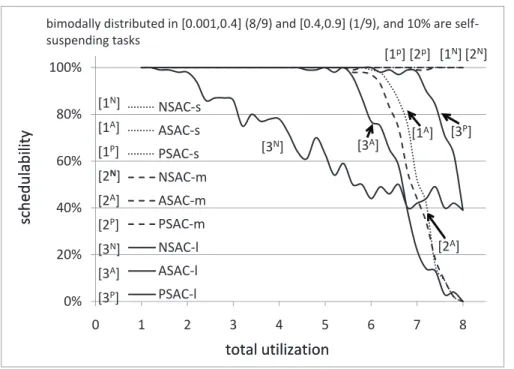
3.17 Soft real-time schedulability results for bimodal light task utilization dis-tributions. Relatively infrequent suspensions are assumed.. . . 91
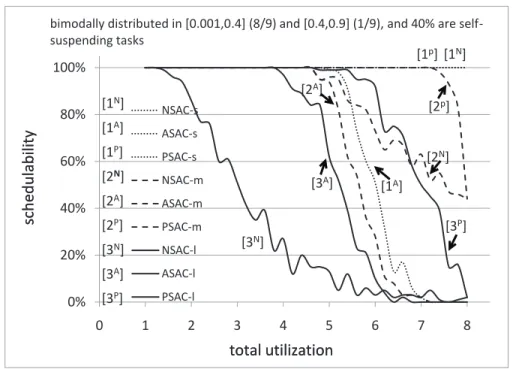
3.18 Soft real-time schedulability results for bimodal light task utilization dis-tributions. Moderately frequent suspensions are assumed. . . 92
3.19 Soft real-time schedulability results for bimodal light task utilization dis-tributions. Frequent suspensions are assumed. . . 92
3.20 Soft real-time schedulability results for uniform medium task utilization distributions. Relatively infrequent suspensions are assumed. . . 93
3.21 Soft real-time schedulability results for uniform medium task utilization distributions. Moderately frequent suspensions are assumed. . . 93
3.22 Soft real-time schedulability results for uniform medium task utilization distributions. Frequent suspensions are assumed. . . 94
3.23 Soft real-time schedulability results for bimodal medium task utilization distributions. Relatively infrequent suspensions are assumed. . . 94
3.24 Soft real-time schedulability results for bimodal medium task utilization distributions. Moderately frequent suspensions are assumed. . . 95
3.25 Soft real-time schedulability results for bimodal medium task utilization distributions. Frequent suspensions are assumed. . . 95
3.26 Soft real-time schedulability results for uniform heavy task utilization distributions. Relatively infrequent suspensions are assumed. . . 96
3.27 Soft real-time schedulability results for uniform heavy task utilization distributions. Moderately frequent suspensions are assumed. . . 96
3.29 Soft real-time schedulability results for bimodal heavy task utilization
distributions. Relatively infrequent suspensions are assumed. . . 97
3.30 Soft real-time schedulability results for bimodal heavy task utilization distributions. Moderately frequent suspensions are assumed. . . 98
3.31 Soft real-time schedulability results for bimodal heavy task utilization distributions. Frequent suspensions are assumed. . . 98
3.32 Transformation intervals with respect toMk. . . 102
3.33 Definingth andri,v−cin the transformation method. . . 103
3.34 Switch:switch the computation ofτioriginally executed onMk0 toMk. . . 103
3.35 Move: move the computation of tasks other thanτifromMkto some idle processorMk0. . . 104
3.36 Convert:convert the suspensions of all jobs ofτithat are enabled within [Aqk, Bkq)(i.e.,τi,v−c, ..., τi,v) into computation within all non-busy time intervals onMkin[Aqk, Bkq). . . 106
3.37 Example schedule transformation.. . . 108
3.38 An example task system containing three tasks,τ1 andτ2 of utilization 0.5, andτ3 of utilization 0.6. All three tasks have a period of 10 time units. (a) shows the PS schedule P S for this system where each task executes according to its utilization rate when it is active. Assume that in the transformed scheduleSfor this system, three time units of suspensions ofτ3,2are turned into computation, which causes the utilization ofτ3to increase to 0.9 inτ3,2’s job execution window[r3,2, d3,2) = [10,20). (b) shows the corresponding scheduleP Safter this transformation. As seen, inP S, taskτ3executes with a rate of 0.9 in[10,20). . . 109
3.39 GEDF schedule of the counterexample. . . 115
3.40 m= 4and light per-task utilizations are assumed. . . 116
3.41 m= 8and light per-task utilizations are assumed. . . 117
3.42 m= 4and medium per-task utilizations are assumed. . . 117
3.43 m= 8and medium per-task utilizations are assumed. . . 118
3.44 m= 4and heavy per-task utilizations are assumed. . . 118
3.45 m= 8and heavy per-task utilizations are assumed. . . 118
4.2 Computingωnc(τ
i, L). . . 124
4.3 Computingωc(τ i, L).. . . 125
4.4 A jobτl,jof taskτlbecomes eligible atteand misses its deadline attdby more thanλl.tois the earliest time instant at or beforetesuch that there is no idleness in[to, te). . . 134
4.5 DBF for self-suspending tasks. . . 136
4.6 ComputingWc(τi).. . . 139
4.7 HRT results.ui ∈[0.01,0.3],di ∈[max(0.7·pi, ei+si), pi].. . . 144
4.8 SRT results.ui∈[0.01,0.3],di∈[max(0.7·pi, ei+si), pi]. . . 145
4.9 HRT results compared with BC.. . . 146
4.10 HRT results compared with GY.. . . 147
5.1 Example DAG. . . 149
5.2 Roadmap.. . . 150
5.3 RB counterpart of the PGM graph in Figure 2.7. . . 153
5.4 Extended snapshot sequence of releases.. . . 153
5.5 Redefining job releases according to (5.18) – (5.5). . . 155
5.6 Three cases in Theorem 5.5. . . 160
5.7 Early-releasing example. . . 164
5.8 Case study. . . 165
5.9 Example system used throughout this section. . . 170
5.10 Psuedocode of the assignment algorithm. . . 174
5.11 Example worst-case scenario where all edges ofϕ−1DAGs contribute to the total communication cost. . . 177
5.12 Illustrating various ideas on redefining job releases for DAGτ2in Figure 5.9. . . 180
5.13 Schedulability results: light per-task utilization distribution. . . 187
5.14 Schedulability results: medium per-task utilization distribution.. . . 187
5.15 Schedulability results: heavy per-task utilization distribution. . . 188
6.1 Example NGS task system. . . 193
6.2 Modeling NP-blocking as suspension. . . 194
7.1 PS schedule for a task system containing two tasks. Taskτ1has a period of 10 time units and a utilization of 1.5. Taskτ2has a period of 20 time units and a utilization of 0.5. As seen in the PS schedule, intra-task parallelism is not considered and each job completes exactly at its deadline. . . 200
7.2 Definition oftn. . . 201
7.3 Illustration of a preemption. Jobτ1,1has one segment with three parallel threads, executed on two processors. In inset(a), althoughτ11,,13is enabled but does not execute at timet,τ1,1is not preempted attsince both proces-sors are executing threads ofτ1,1. In inset(b),τ1,1 is preempted byτ2,1at t. . . 204
7.4 Subcase 2.1 . . . 206
7.5 Subcase 2.2 . . . 208
7.6 Subcase 2.3 . . . 209
7.7 The worst-case parallel task set. . . 213
7.8 AlgorithmQ-Optimization. . . 216
7.9 FunctionSPLIT.. . . 217
7.10 FunctionCombine. . . 217
7.11 Illustration of the optimization algorithm.. . . 218
7.12 Schedulability: m = 4, low parallelism. . . 221
7.13 Schedulability: m = 6, low parallelism. . . 221
7.14 Schedulability: m = 8, low parallelism. . . 221
7.15 Schedulability: m = 4, high parallelism. . . 222
7.16 Schedulability: m = 6, high parallelism. . . 222
7.17 Schedulability: m = 8, high parallelism. . . 222
7.18 Schedulability: m = 4, random parallelism. . . 223
7.19 Schedulability: m = 6, random parallelism. . . 223
7.20 Schedulability: m = 8, random parallelism. . . 223
7.22 Response time bounds: high parallelism. . . 224
LIST OF ABBREVIATIONS
DAG Directed Acyclic Graph
DBF Demand Bound Function
DM Deadline Monotonic
EDF Earliest-Deadline-First
FIFO First-In-First-Out
GEDF Global Earliest-Deadline-First
GEPPF Global Earliest-Priority-Point-First
GFIFO Global First-In-First-Out
GPU Graphics Processing Unit
GSA Generic Scheduling Algorithm
GTFP Global Task-level Fixed-Priority
HRT Hard Real-Time
I/O Input/Output
ILP Integer Linear Programming
JDP Job-level Dynamic-Priority
JFP Job-level Fixed-Priority
LASM Logical Application Stream Model
LHS Left Hand Side
LLF Least-Laxity-First
LP Linear Programming
MAD Monotonic Absolute Deadline
PDM Partitioned Deadline Monotonic
PGM Processing Graph Method
PS Processor Sharing (schedule)
RB Rate-Based
RBE Rate-Based Execution
RHS Right Hand Side
RTA Response-Time Analysis
SDF Synchronous DataFlow
SMP Symmetric (shared-memory) MultiProcessor
SRPTF Shortest-Remaining-Processing-Time-First
SRT Soft Real-Time
S.W.A.P. Size, Weight, and Power
TFP Task-level Fixed-Priority
CHAPTER 1
Introduction
Given the need to achieve higher performance without driving up power consumption and
heat, most chip manufacturers have shifted to multicore architectures. Current in-market systems
commonly contain chips with four, ten, and even 32 cores. Per-chip core counts are expected to
further increase significantly in the near future. Indeed, Intel and Tilera have both recently released
chips with 80 and 100 cores [33, 47].
With the growing prevalence of multicore platforms, software design processes across a wide range of application domains are being impacted. One important category of such applications is
real-time applications that must satisfytemporal constraintsin order to be deemed correct; examples
include stock trading, avionics, real-time scoring of bank transactions, live video processing, real-time
sensing, etc. Such applications range from desktop-level systems to systems that require significant
computational capacity. As an example of the latter, systems processing time-sensitive business
transactions have been implemented by Azul Systems [94] on top of the highly-parallel Vega3
platform, which consists of up to 864 cores.
These developments have spurred much recent research on multiprocessor real-time systems.
Unfortunately, to a large extent, existing research has been limited to systems supporting simple tasks that do not exhibit complex runtime behaviors; this limits the practical applicability of such research.
In practice, real-time applications often exhibit rather complex runtime behaviors besides performing
computation on a CPU. For example, an application might be suspended by the operating system
while waiting for some interaction to occur, such as interactions with humans or external devices.
Also, many applications such as multimedia and signal processing applications are implemented
dependencies exist among stages of such applications. Other complex runtime behaviors include
those due to resource sharing and the use of parallel programming paradigms.
Recently, this limitation of existing research has become even more evident and significant, due
to the emerging embedded system design trend towards building complex cyber-physical systems
(CPSs). Such systems often integrate and coordinate multiple networked computational and physical
elements. Examples include self-driving vehicles, high-confidence healthcare devices, smart power
grids, and autonomous military combat systems. Different types of runtime behaviors often arise
in CPSs. For instance, many CPSs such as self-driven vehicles have multiple dependent network-connected components, each of which implements a specific functionality. Moreover, CPSs are
expected to actively interact with the environment, human beings, and other external devices. These
properties often result in complex runtime behaviors. For example, consider two common tasks
in driving an autonomous vehicle: environmental sensing and navigation control. Data/logical
dependencies exist between these two tasks: the navigation control task can execute only after
receiving needed data from the environmental sensing task.
Unfortunately, inherent limitations and assumptions existing in today’s theoretical foundations
for real-time systems (i.e., the inability to efficiently handle complex runtime behaviors) cause many such systems to be built and supported in an inefficient way. In practice, these runtime behaviors are
currently dealt with by over-provisioning systems, which is an economically wasteful practice. The
goal of this dissertation is thus aimed at bridging this gap between practice and theory. Specifically,
the goal of the research discussed herein is to enable multiprocessor real-time systems that support
real-world applications with common types of complex runtime behaviors to be efficiently designed
and built. To further motivate this research, we provide an introduction to real-time systems below.
This is followed by an overview of this dissertation.
1.1 What is a Real-Time System?
Different from non-real-time systems, the distinguishing characteristic of areal-time systemis the
inclusion of temporal constraints in its specification. That is, the correctness of a real-time system
depends not only on the correctness of the logical results produced by the system, but also on the
applications and produce correct results within specific time frames. Real-time systems are pervasive
often without being noticed. Such systems range from portable devices such as heart rate monitors,
to large stationary installations like traffic lights, to systems controlling nuclear power plants.
Temporal constraints of activities in real-time systems are often specified asdeadlines. The key
requirement for building a real-time system is to guarantee that all temporal constraints are satisfied.
In other words, programs must complete their execution by specified deadlines. For instance, for
an anti-lock braking system, if the driver presses the brake pedal, the car must respond within a
specific time frame (e.g., within ten milliseconds). Since many real-time systems are safety-critical, designers also need to guarantee that all required temporal constraints can be satisfied at runtime in
a predictable manner. This notion ofpredicatabilityas it pertains to temporal correctness defines
another important characteristic of real-time systems and is the subject of concentration of this
dissertation. Predicability can be ensured by proving at design time that all temporal constraints are
alwaysmet subject to any permitted runtime scenario.
Guaranteeing the temporal correctness of a real-time system is typically achieved by (i) formally
modeling the system, (ii) selecting an appropriate real-time scheduling algorithm, and (iii) deriving
schedulability tests to validate temporal correctness at design time. The next two sections explain these three steps in detail.
1.2 Classical Real-Time System Model
To predictably guarantee the temporal correctness of a real-time system, a prioriknowledge of
applications (i.e., tasks) running in the system and available resources is necessary. Real-time task models are designed to mathematically describe real-time applications and their associated temporal
constraints, while a resource model is used to formally describe available hardware resources. In this
section, we describe the widely studied sporadic task model as well as the categories of temporal
constraints and the resource model considered in this dissertation.
1.2.1 Sporadic Task Model
Thesporadic task model[88] is a well-studied and simple recurrent task model. Under the sporadic
Towards Efficient Real-Time Multicore Computing Systems
sporadic
1
migration
Time Ƭi
preempted
ri,j fi,j di,j ri,j+1
Ri,j di
pi
release deadline completion scheduled on processor 1 scheduled on processor 2
Figure 1.1: Illustration of a constrained-deadline sporadic taskτi. The jobτi,j is preempted twice by
higher-priority jobs (which are not depicted). Therefore,τi,jmigrates twice: it first migrates from
processor 1 to processor 2, and then back to processor 1.
events such as device interrupts or expiring timers. When a task is invoked in response to an event, it
releases ajobto process the event. Note that a recurrent task can be invoked an infinite number of times, i.e., can generate jobs indefinitely. Next, we provide a detailed definition of the sporadic task
model; later, in Chapter 2, more sophisticated and practical real-time task models are considered
that are based upon the sporadic task model defined here. An example sporadic task is shown in
Figure 1.1. Note that the symbols shown at the top of this figure will be used in subsequent figures
throughout this dissertation to denote job releases, deadlines, and completions, respectively. We will
omit some of these legends in later figures.
A real-time system can be sometimes modeled as a set ofnsporadic tasksτ ={τ1, τ2, ..., τn}.
Each sporadic task τi is characterized by three parameters(ei, di, pi), whereei > 0 denotes its
per-job worst-case execution time (WCET),di ≥eidenotes itsrelative deadline, andpi≥ei(often
called the task’speriod) denotes itsminimumjob inter-arrival time. That is,τican release its first job
at any time, but can release any two consecutive jobs only at leastpitime units apart. Each released
job executes for at mostei time units, and each job should complete no more thandi time units
In contrast,eidepends upon characteristics of the underlying hardware platform such as processor
speeds.
The sporadic task model was introduced by Mok in 1983 [88]. It generalizes the earlierperiodic
task model[84]. For aperiodic task, its period parameter defines theexactseparation between any two
consecutive job releases. A periodic task thus releases jobs on a more regular basis. The motivation
behind the sporadic task model is to allow tasks to experience inter-arrival delays so that scenarios
where tasks might become inactive in the absence of triggering events can be accommodated.
Thejthreleased job of taskτ
iis denotedτi,j. Each jobτi,j is eligible to execute at or after its
release timeri,j, whereri,j ≥0. As constrained by the task period,ri,j+1≥ri,j+piholds for any
consecutive jobsτi,jandτi,j+1. Each jobτi,jexecutes for at mosteitime units andfinishesat time fi,j. Sporadic tasks are sequential, that is, jobτi,j+1 can start execution only after the finish time of τi,j, even ifri,j+1 ≤fi,j. Jobτi,jhas aresponse timeRi,j =fi,j−ri,j, which defines the duration
from its release to its finish time. A taskτi’s response timeRiequals the maximum job response
time among all of its released jobs. Note thatRimight not be well-defined in cases where response
times ofτi’s jobs grow unboundedly.
Therelative deadlineparameterdispecifies the temporal constraint of taskτi. Specifically, it
defines the range of acceptable response times for a task. Each jobτi,j has anabsolute deadline di,j=ri,j+di. If a jobτi,jfinishes later than timedi,j, then it istardy. A jobτi,j’stardinessis the
extent of the deadline miss, which is given bymax(0, fi,j−di,j). Depending on the relationship
betweendiandpi, there are three categorizes of sporadic tasks. A taskτiis said to be an
implicit-deadlinesporadic task ifdi =pi, aconstrained-deadlinesporadic task ifdi ≤pi, or an
arbitrary-deadlinesporadic task ifdi may be of any value (e.g., different frompi). In this dissertation, we
assume implicit-deadline tasks unless noted otherwise.
Utilizations. Another important parameter pertaining to a sporadic task is itsutilization, which defines the task’s required long-term processor demand. Specifically, a taskτi’s utilization is given
byui = ei
pi, which describes the fraction of one processor
τi requires. The utilization parameter is
meaningful because it quantitatively defines the maximum rate of execution required for a task to
receive enough processor capacity to execute its released jobs in the long-term. It also provides a
Usum =Pτi∈τui. A system is said to be overloaded if the total utilization of all tasks exceeds the
number of available processorsm. For a constrained-deadline sporadic taskτi, a useful parameter
is its density, which is given by δi = ei
di. The total density of a task set
τ is thus defined as δsum = Pτi∈τδi. As a notational convenience, we let umax and δmax denote the maximum
utilization and density of tasks inτ, respectively.
1.2.2 Hard and Soft Temporal Constraints
There are mainly two categories of real-time temporal constraints: hard real-time(HRT) andsoft
real-time(SRT). A task is referred to as aHRT task if none of its released jobs may ever miss
its deadline, that is,fi,j ≤ di,j must hold for any jobτi,j. AHRT systemsolely consists of HRT
tasks. On the other hand, forSRT tasks, deadline misses are allowed. However, any such deadline
misses must be bounded by aconstant, that is,fi,j−di,j ≤Cmust hold for any jobτi,j, for some
constantC. Similarly, aSRT systemsolely consists of SRT tasks. This notion of a SRT constraint is
well-studied [25, 39, 76] and the one considered in this dissertation. Note that other notions of SRT
constraints exist, including: a specified percentage of deadlines must be met [57], andxout of every yconsecutive jobs of each task must meet their deadlines [54, 67, 116].
In practice, both HRT and SRT systems widely exist in many application-specific domains. In
general, a HRT system is one whose violation may lead to catastrophic consequences such as loss of
life. Military combat, industrial process-control, automotive control, and air-traffic control systems
are some examples of HRT systems. In contrast, a SRT system is less critical, as deadline misses may
lead to degraded quality of service, but not system failure. Multimedia systems, computer vision and image processing systems, and mobile computing systems are some examples of systems with SRT
constraints. Moreover, in many systems, HRT and SRT constraints co-exist in different components.
For instance, in an avionics system, the flight management system has HRT constraints while the
on-board entertainment system only requires SRT constraints.
Temporal correctness. Constrained by either HRT or SRT requirements, a real-time task’s temporal correctness essentially depends upon its maximum response time. Since a job’s response time
respect to a given scheduling algorithm. The following definitions formally define HRT and SRT
correctness.
Definition 1.1. A task setτ isHRT schedulableunder a scheduling algorithmAiffRi≤diholds
for eachτi ∈τ.
Definition 1.2. A task setτ isSRT schedulableunder a scheduling algorithmAiff there exists a constantCsuch thatRi≤di+Cholds for eachτi ∈τ.
1.2.3 Resource Model
In this dissertation, we consider real-time task systems running on an identical multiprocessor
platform comprised of a set ofm ≥ 1identical unit-speed processors. As its name suggests, all
processors of an identical multiprocessor have the same characteristics. For example, in the absence
of contention, they have uniform access times to memory. To realize uniform memory access times, a multiprocessor architecture with a centralized memory that is shared among processors
is often implemented. This architecture is commonly referred to as asymmetric (shared-memory)
multiprocessor(SMP).
Figure 1.2 illustrates example SMP architectures. As shown in Figure 1.2 (a), each processor
can have one or more private caches to reduce memory access times. In this dissertation, we assume
that each job is allowed to execute on any processor except that it can occupy at most one processor
at any point of time (except for the parallel task model given in Chapter 7). We say that a job (task)
migratesif it executes on different processors. A job migration may incur migration overheads due
to the reloading of job-related instructions and data into a local cache. Techniques exist that can lower or eliminate migration overheads. For example, one technique is to restrict the execution of a
task or a job to one or a subset of processors. Moreover, for current multicore architectures, different
cores on the same die often share a cache at some level, as illustrated in Figure 1.2 (b). Such shared
caches are able to reduce migration overheads in many cases, e.g., when task-related instructions are
not loaded from memory after a migration.
Accounting for overheads. Besides migration overheads, task preemptions and context switches, and the act of scheduling may also incur system overheads that take processor time from tasks.
Processor . . . Processor Processor
Multi-level cache: L1, L2, ...
Memory bus interconnect Multi-level
cache: L1, L2, ...
Multi-level cache: L1, L2, ...
Memory
Processor . . . Processor Processor
L1
Memory bus interconnect
Memory
(a) (b)
L1
Shared L2 cache
L1
Figure 1.2: Illustration of symmetric multiprocessor architecture(a)without and(b)with a shared cache.
processor time lost due to overheads. To account for overheads, a common approach is to charge
each extrinsic activity (e.g., preemptions, migrations, or scheduler invocations) to each job. This is
achieved by inflating each task’s WCET by the maximum total time required for all such extrinsic
activities charged to any of its released jobs. Throughout this dissertation, we will assume that all
system overheads are included in the WCETs of tasks using efficient charging methods [25, 39].
Therefore, the WCET of a task depends on the implementation platform, application characteristics,
and the scheduling algorithm.
1.3 Real-Time Scheduling Algorithms and Schedulability Tests
As mentioned in Section 1.1, after formally modeling a real-time system as described in the
previ-ous section, we need to utilize real-time scheduling algorithms and derive schedulability tests to
validate temporal correctness. (A detailed review of existing real-time scheduling algorithms and
schedulability tests designed for the real-time sporadic task model is presented in Chapter 2.) A scheduling algorithm determines when to execute which task on which processor. It determines the
specific execution-time intervals and processors for each job while considering any restrictions, such
as precedence constraints among jobs and tasks. Different from other non-real-time systems where
performance optimization is a major concern, in a real-time system, algorithmic design pertaining to
processor-allocation strategies is mainly driven by the need to guarantee temporal correctness. Before
key concepts and metrics that are commonly used in describing properties of real-time scheduling
algorithms and in comparing different algorithms.
1.3.1 Concepts and Metrics
As defined in Definitions 1.1 and 1.2, a real-time task system is schedulable iff its temporal constraints
will always be satisfied (either in a HRT or SRT sense). Two concepts of importance arefeasibility
andoptimality, which are both defined in terms of schedulability. Intuitively, a task set is feasible if
there is a possibility to schedule it and a scheduling algorithm is optimal if all feasible task sets are
schedulable under it. These concepts are formally defined as follows.
Definition 1.3. A task setτis HRT (respectively, SRT)feasibleiff there exists at least one scheduling
algorithmAsuch thatτ is HRT (respectively, SRT) schedulable underA.
Definition 1.4. A scheduling algorithmAisoptimaliff every task setτ that is HRT (respectively, SRT) feasible is HRT (respectively, SRT) schedulable underA.
To check whether a given real-time sporadic task system is feasible, a straightforward feasibility
test is given by the system’s total utilization. As defined in Section 1.2, a taskτi’s utilizationui
specifies the fraction of a processor the task requires. Therefore, this implies that the total utilization of a task set cannot exceed the total number of processors, for otherwise the total processor demand
could exceed the available supply, which causes tasks to violate their temporal constraints.
Lemma 1.1. A real-time sporadic task set is feasible onmprocessors only ifUsum ≤m.
The above lemma formally gives a necessary utilization-based feasibility condition for sporadic task sets. In the context of a set of non-recurrent tasks, a necessary feasibility condition that implies
Lemma 1.1 was proven by Horn [55].1Leung and Merrill [79] showed thatU
sum≤mis a necessary
feasibility condition for implicit-deadline periodic task sets. For sporadic tasks, a formal proof of
Lemma 1.1 for the casem = 1was given by Baruahet al. [14], which can easily be generalized
tom > 1. Note that Lemma 1.1 can be applied equally to HRT and SRT feasibility. For HRT
implicit-deadline sporadic task sets, Lemma 1.1 can be strengthened to an equivalence, as given by
the following lemma.
Lemma 1.2. [11, 79, 84] A real-time implicit-deadline sporadic task set is HRT feasible on m processors iffUsum ≤m.
Capacity loss. The above constraint on total utilization (given our focus on implicit deadlines) implies that any task set with total utilization not exceeding the total processor capacitymshould be schedulable. In practice, fully allocating all processor capacity to real-time tasks is not always
possible, i.e., task systems with total utilization less thanmmay not be schedulable onmprocessors.
One primary cause of such capacity loss is due to the choice of scheduling algorithm. If a non-optimal
scheduling algorithm is used, then a feasible task set may not be schedulable due to algorithmic
capacity loss. In this dissertation, our goal is to design new scheduling algorithms and derive better
schedulability tests (as described below) to minimize capacity loss for scheduling complex real-time
task systems on multiprocessors.
Schedulability tests. A schedulability test serves the purpose of determining a prioriwhether a real-time task set will be schedulable under a scheduling algorithmA, either in a HRT or SRT sense.
Many existing schedulability tests are onlysufficientbut notnecessary(i.e., are notexacttests). This
implies that such sufficient tests can be pessimistic, that is, they may incorrectly consider a task set
to be unschedulable while the task set is in fact schedulable.
1.4 The Divergence of Theory and Practice
As will be discussed in Chapter 2, real-time scheduling under the sporadic task model on both
uniprocessors and multiprocessors has received much attention over the past 40 years. Although
significant research progress on this topic has been made, the practical applicability of such research
is quite limited due to limitations of the sporadic task model, which we discuss next.
1.4.1 Limitations of the Sporadic Task Model
As defined in Section 1.2, an application that is modeled as a sporadic task triggers a piece of
computation recurrently. Unfortunately, several inherent limitations make it inappropriate for
modeling many real-world applications. We identify four major limitations of the sporadic task
1. Tasks are computation-only and do not self-suspend: released jobs of a task only request
processor (CPU) capacity and are always ready to execute when allocated a processor by the
scheduler; no interaction between the task and external devices such as disks could exist.
2. Tasks are totally independent: no precedence constraint exists among tasks.
3. Tasks are purely sequential: a job is completely sequential and thus can only be executed on
one processor at any point of time.
4. Tasks are fully preemptive: released jobs do not access any critical sections that must be
accessed non-preemptively.
However, in practice, tasks may incur complex runtime behaviours that violate these assumptions.
For example, a task may need to access external devices during its execution, such as to read/write data, wait for keyboard input, or access graphics processing units (GPUs). Such interactions with
external devices cause the execution of tasks to be suspended (i.e., blocked) by the operating system
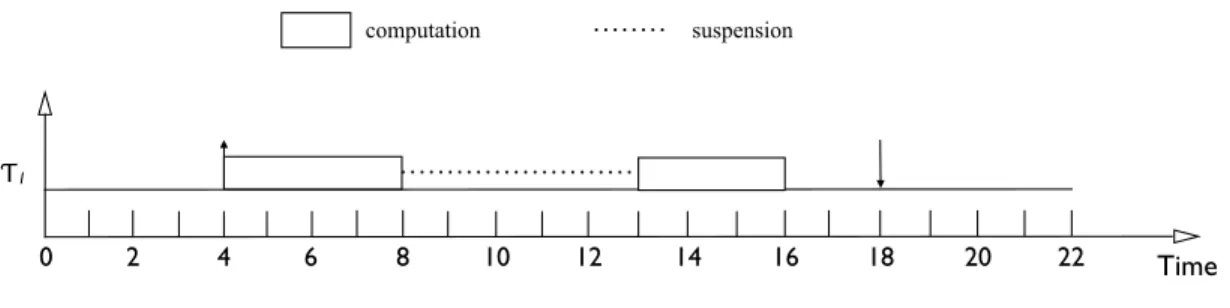
on CPUs, as illustrated in Figure 1.3. A task is said toself-suspendwhen it incurs such interactions.
Task execution on a CPU may be resumed only after the suspending interval ends. The duration
of a suspension interval of a task is often calledsuspension delay. Such suspension delays could
range from a few nanoseconds to several seconds depending on task characteristics. For instance,
delays introduced by disk I/O range from 15ns (for NAND flash) to 15ms (for magnetic disks) per
read [63, 74]. Even longer delays are possible when accessing special-purpose devices such as
digital signal processors or GPUs [44]. Tasks that may self-suspend cannot be accurately modeled as sporadic tasks.
Besides self-suspensions, tasks may exhibit other types of runtime behaviours, including
inter-task data communications, critical section accesses, and parallel code execution segments. Consider
a simple real-time video processing system that decodes incoming video streams and then displays
them.2 This system thus naturally consists of two real-time tasks: video decoder and video display,
as illustrated in Figure 1.4. Different types of runtime behaviors may be incurred in this system. For
instance, graph-based precedence constraints exist between these two tasks because the video display
When accessing external devices, the task is
suspended (blocked) by operating system on CPU
ComputationCPU
Computationself-suspension
Let’s take a look at an example system where various application runtime behaviors may arise.
Here shows an Unmanned aerial vehicle built by Northrop Grumman. Much of my research work is
in fact motivated by the joint work between our research group at UNC and Northrop Grumman on
this UAV. Real-time performance must be guaranteed in this system because an UAV is expected
to autonomously gather environmental data, perform route planning and even combating actions,
all in a real-time fashion.
Figure 1.3: Pervasive self-suspension behaviours.
UNC Chapel Hill C. Liu Supporting Complex Time-Sensitive Applications with Dependencies in Multicore-based Systems
Sensors
Sensors
Video decode
Display
Fra
me
queue
An example: video processing
31 Suspensions due to disk I/O
for the video file
Suspensions due to synchronization with the graphical display
Figure 1.4: Example real-time video processing system.
task cannot start execution until receiving decoded video frames from the video decoder task. Also,
both tasks may self-suspend at runtime due to disk I/O for the video file and synchronization with
the graphical display, respectively. Obviously, the sporadic task model, which assumes that such complex runtime behaviors do not arise, is incapable of modeling such tasks.
Due to the limitations of the sporadic task model as discussed above, current research on the
real-time scheduling of sporadic tasks on multiprocessors cannot be applied to efficiently support
many real-world applications in real-time systems. In the rest of this section, we discuss how
various complex runtime behaviors are currently supported by applying state-of-the-art scheduling
techniques, and the resulting pessimism.
1.4.2 Limitations of the State-of-the-Art
The general problem of supporting real-time task systems containing complex runtime behaviors
segments) on multiprocessors is known to be hard and remains largely open. Some prior work has
been done on scheduling and analyzing task systems containing different complex runtime behaviors.
However, such analysis [22, 65, 73, 96, 97, 101, 107, 108, 114, 119] is rather pessimistic and only
applies to uniprocessor platforms. We will review such work in detail in Section 2. In the context of
multiprocessor scheduling, not much work has been done on supporting real-time task systems with
complex runtime behaviors. In practice, such behaviors are currently dealt with by over-provisioning
systems, which may cause significant capacity loss. Over-provisioning implies that in order to
guarantee temporal correctness, system designers have to utilize more hardware components (e.g., CPUs) than necessary, largely due to the inefficiency and pessimism of current real-time scheduling
algorithms and schedulability tests. System over-provisioning is also an economically wasteful
practice. With each added component, overall system complexity as well as size, weight, and power
consumption (S.W.a.P.) of the system can grow significantly. Moreover, in many safety-critical
real-time domains such as avionics, systems have stringent space and energy constraints and thus
over-provisioning is problematic. With the rising complexity of networked real-time embedded
systems, over-provisioning has led to an increasingly unmanageable proliferation of such systems,
to the effect that some modern cars contain over one hundred processors. Therefore, reducing the number of hardware components is highly desirable. Instead of embedding hundreds of networked
uniprocessors inside a car, it would be much more desirable to use fewer, but more powerful multicore
processors that are highly utilized.
1.5 Research Overview
This dissertation is thus aimed at bridging this gap between practice and theory in the design of
multiprocessor real-time systems. Specifically, our goal is to enable practical real-time applications
with common types of complex runtime behaviors to be efficiently supported on multiprocessors. By
designing new real-time scheduling algorithms and schedulability tests for such applications, this
dissertation seeks to avoid over-provisioning systems and to reduce the number of needed hardware
components to the extent possible while providing temporal correctness guarantees. Motivated by
limitations seen in current research, this dissertation specifically addresses the problem of efficiently
1. Self-suspensions: Self-suspensions usually occur when a task is blocked, waiting for some
interaction to occur, such as interactions with humans or external devices, resources sharing,
etc.
2. Graph-based precedence constraints: Many tasks such as multimedia and signal processing
tasks are implemented using processing graph implementation methodologies, where data
communications or logical dependencies exist between stages of such tasks.
3. Mixed types of complex runtime behaviors: In practice, many applications may have several mixed types of complex runtime behaviors, including self-suspensions, graph-based precedence
constraints, and non-preemptivity. For example, consider a pipelined real-time computation
where some tasks may require disk accesses and non-preemptivity arises due to system calls or
critical sections
4. Parallel execution segments: Parallel programming techniques such as OpenMP [28] and
MapReduce [36] are commonly used to explicitly express parallelism for certain program
segments (i.e., allowing multiple threads to exist within the context of a single job).
1.6 Thesis Statement
The main thesis to be supported by this dissertation is the following.
Capacity loss can be significantly reduced on multiprocessors while providing SRT
and HRT guarantees for real-time applications that exhibit complex runtime
behav-iors such as self-suspensions, graph-based precedence constraints, non-preemptive
sections, and parallel execution segments by designing new real-time scheduling
algorithms and developing new schedulability tests.
1.7 Contributions
1.7.1 SRT Schedulability Test for Globally-Scheduled Suspending Task Systems
The first set of contributions we discuss is two multiprocessor global earliest-deadline-first (GEDF)
(defined in Section 2.3.1.2 of Chapter 2) schedulability tests proposed in [81, 83] for SRT
self-suspending task systems. The approach presented in [83] was the first to be proposed for dealing with
self-suspensions on globally-scheduled (defined in Section 2.3.1.2 of Chapter 2) SRT multiprocessors.
1.7.1.1 The First SRT Suspension-Aware Global Schedulability Test
Prior work showed that suspension delays quite negatively impact schedulability in real-time
sys-tems if deadline misses cannot be tolerated [105]. Thus, we focus on investigating whether, on
multiprocessor platforms, such negative impacts can be ameliorated if task deadlines are soft.
Perhaps the most commonly used approach for dealing with suspensions is the suspension-oblivious analysis [86], which simply integrates suspensions into per-task WCET requirements.
However, unless the number of tasks is small and suspension delays are short, this approach may
sacrifice significant system capacity. The alternative is to explicitly consider suspensions in the task
model and corresponding schedulability analysis; this is known assuspension-awareanalysis. To
improve upon the oblivious approach, we present the first multiprocessor
suspension-aware analysis for globally scheduled SRT sporadic self-suspending task systems.
Specifically, we show in Section 3.2 that GEDF’s ability to guarantee bounded tardiness in such
systems hinges upon a task parameter that we call the “maximum suspension ratio,” denotedξmax,
with range [0,1]. (A task’s suspension ratio represents the ratio of its suspension length divided by the sum of its suspension length and execution length.) We present a general tardiness bound, which
is applicable to GEDF, that expresses tardiness as a function ofξmaxand other task parameters. This
bound shows that task systems consisting of both self-suspending tasks and ordinary computational
tasks that do not suspend can be supported with bounded tardiness if
ξmax <1− Us
sum+ULc
m , (1.1)
whereUsums is the total utilization of all self-suspending tasks in the system, andULc is the total
1.7.1.2 An Improved Utilization Constraint
Using the above approach [83], significant capacity loss may occur whenξmaxis large. Unfortunately,
it is unavoidable that many self-suspending task systems will have largeξmax values. Thus, the
utilization bound can be improved if the value ofξmaxcan be decreased. Motivated by this, we show
in Section 3.3 thatξmaxcan be effectively decreased by treatingpartialsuspensions as computation.
That is, we consider intermediate choices between the two extremes of treating all(as is done
in suspension-oblivious analysis) orno(using the analysis in [83]) suspensions as computation.
Our technique can find the amount of the suspension time of each task that should be treated
as computation in order for the task system to satisfy the utilization constraint and thus become schedulable.
1.7.1.3 An O(m) Analysis Technique
Although the above suspension-aware schedulability test (as presented in Section 3.2) can improve
upon the suspension-oblivious approach for many task systems, it may still cause significant capacity loss. A main reason is because this analysis does not fully address the root cause of pessimism due
to suspensions. A key step in this suspension-aware analysis involves bounding the number of tasks
that have ready jobs (i.e., eligible for executing or suspending) at a specifically defined non-busy
time instantt(i.e., at least one processor is idle att). For ordinary task systems without suspensions,
this number of tasks can be safely upper-bounded bym−1, wheremis the number of processors,
for otherwise,twould be busy. For self-suspending task systems, however, non-busy instants can
exist due to suspensions even ifmor more tasks have ready jobs. The worst-case scenario that serves
as the root source of pessimism in prior analysis is the following:allnself-suspending tasks have jobs that suspend at some timetsimultaneously, thus causingtto be non-busy.
By exploiting this observation, we derive a much improved schedulability test in Section 3.4 that
shows that any given sporadic self-suspending task system is schedulable under GEDF scheduling
with bounded tardiness ifUsum+Pmi=1vj ≤mholds, wherevj is thejthmaximum ratio of a task’s
suspension length over its period among all tasks (formal defintions of these terms can be found in
Section 2.1). We show that our derived schedulability test theoretically dominates the
the system is a self-suspending task. Moreover, we show via a counterexample that task systems that
violate our utilization constraint may have unbounded tardiness. As demonstrated by experiments,
our proposed test significantly improves upon prior methods with respect to schedulability, and is
often able to guarantee schedulability with little or no capacity loss while providing low predicted
tardiness.
1.7.2 Multiprocessor HRT Schedulability Tests for Suspending Task Systems
Although the analysis presented in Chapter 3 can handle the SRT case, how to support HRT
self-suspending task systems on multiprocessors (other than using the suspension-oblivious approach)
remains as an open issue. As the first attempt at solving this problem, we present in Chapter 4 global
suspension-aware multiprocessor schedulability analysis techniques for HRT arbitrary-deadline
sporadic self-suspending task models under both GEDF and global task-level fixed-priority (GTFP)
(defined in Section 2.3.1.2 of Chapter 2) scheduling (note that this analysis can also be applied to
uniprocessors). Our analysis is based upon identifying sufficient conditions for ensuring that each
task in any given task system cannot miss any deadlines. These conditions must be checked for each
task in the task system. Our analysis shows that schedulability is much less impacted by suspensions than computation on multiprocessors (which is seen in prior uniprocessor analysis [86]). For any job,
suspensions of jobs with higher priorities donotcontribute to the competing work that may prevent
the job from executing (while computation does). Indeed, as shown by experiments, schedulability
tests based on our new analysis proved to be superior to the suspension-oblivious method of treating
all suspensions as computation.
1.7.3 Multiprocessor Scheduling of SRT Task Graphs
Another major contribution of this dissertation is a new (also the first) global scheduling algorithm and corresponding schedulability test for supporting SRT acyclic processing graph method (PGM)
graphs on multiprocessors. PGM [69] is a particularly expressive and widely used graph-based
formalism that captures graph-based precedence constraints in a general way. One unique property
of PGM is that it allows data communications among graph nodes to be specifically modeled. A
producing node produces and transports a certain amount of data to a consuming node. In 1998,
such prior work in Chapter 2 in detail). In the 12 years that followed, the problem of supporting
PGM graphs in multiprocessor systems remained unsolved, due to the additional complexities that
arise in that setting.
1.7.3.1 Supporting PGM Task Systems on Multiprocessors
Goddard and Jeffay showed that on a single processor, PGM graphs can be supported by EDF with
no capacity loss. Motivated by this, in Section 5.1, we propose a variant of EDF that can be used on
multiprocessor platforms as the underlying scheduling algorithm. The associated analysis shows that
the main complicating factor in supporting graph-based dependencies in a multiprocessor setting
is workload burstiness, which may cause deadline burstiness. (Deadline burstiness also serves as
a complicating factor in the uniprocessor case, as shown in [51].) Thus, we propose a technique
that effectively postpones deadlines of certain tasks to avoid such burstiness without affecting SRT
correctness. We show that the proposed solution is able to achieve no capacity loss for executing PGM task graphs in multiprocessor systems while providing SRT guarantees. That is, any PGM task
systemτ is SRT schedulable ifUsum ≤mholds.
1.7.3.2 Supporting PGM Task Systems in a Distributed System
We also show in Section 5.2 how to extend the above PGM approach for application in distributed systems comprised of clusters of processors, where scheduling within each cluster is global. Our
main contribution in that work is to develop a method for assigning tasks to clusters so as to minimize
the amount of data movement across clusters. Once tasks are so assigned, those in each cluster can be
scheduled globally as described above (with some slight adjustments due to potential dependencies
across clusters). Note that this same task-assignment method can be applied in a fully partitioned
system (where each cluster is just one processor), in which case Goddard and Jeffay’s original work
(with some slight modifications) can be applied on each processor. Although our focus in this work is
![Figure 3.5: Light per-task utilizations, relatively infrequent suspensions 100% [1][2][3]uniformly distributed in [0.001,0.1] and 40% are self‐suspending tasks 80% 100% LA [1][2][3][1][2']uniformly distributed in [0.001,0.1] and 40% are self‐suspending t](https://thumb-us.123doks.com/thumbv2/123dok_us/8300721.2198356/98.918.200.718.141.504/utilizations-relatively-infrequent-suspensions-distributed-suspending-distributed-suspending.webp)
![Figure 3.11: Heavy per-task utilizations, relatively infrequent suspensions 100% uniformly distributed in [0.3,0.8] and 40% are self‐suspending tasks 80%100% LA‐s SC‐s [1][2] [1] [1'] uniformly distributed in [0.3,0.8] and 40% are self‐suspending tasks 6](https://thumb-us.123doks.com/thumbv2/123dok_us/8300721.2198356/101.918.200.720.140.504/utilizations-relatively-infrequent-suspensions-distributed-suspending-distributed-suspending.webp)