Economic Globalization and Income Inequality Upswings Within 25 Industrial Countries Over 1990-2009: Did the Welfare State Make a Difference?
Daniel Auguste
A thesis submitted to the faculty at the University of North Carolina at Chapel
Hill in partial fulfillment of the requirements for the degree of Master of Arts in the Department of Sociology in the College of Arts and Sciences
Chapel Hill 2013
Approved by:
François Nielsen
Ted Mouw
ii
ii ABSTRACT
Daniel Auguste: Economic Globalization and Income Inequality Upswings Within 25 Industrial Countries Over 1990-2009: Did the Welfare State Make a Difference?
(Under the direction of François Nielsen)
Previous research is divided over whether globalization had an effect on income
inequality upswings observed in many advanced economies in recent decades, and whether the
welfare state is redistributive in this era of economic globalization. This paper, using income
inequality and globalization indicators from 25 industrial countries over 1990 to 2009, found
that globalization had differential effects on income inequality depending on the method of
analysis (i.e., fixed-effect versus random-effects estimation), as well as on whether income
inequality is measured before or after taxes and income transfers. The results also showed that
the welfare state is still redistributive, and attenuated the effects of globalization on
within-country income inequality in the 25 countries over the period under study. Reassessing the
liberal economics claim that the welfare state is counterproductive and retards economic
growth, this study found no evidence that the welfare state hindered economic productivity
1 INTRODUCTION
The world’s economies have become increasing interconnected in recent decades
(Greider 1998; Kapstein 1996). Alongside this economic globalization, social scientists have
documented a growing income inequality between the world’s citizens1, on one hand, and
between individuals within countries, on the other (Bhalla 2002; Sala-i-Martin and Kolpin 2002;
Wade 2001). Consequently, there has been a heightened debate among policy makers and
scholars regarding the role that globalization might have played in this income inequality
upswing. For example, research documenting the rise of income inequality in advanced
industrial countries has implicated retrenchment of the welfare state (Beckfield 2006a; Room
1999), and other domestic factors, such as labor market structures and institutional changes, in
the income inequality upswings observed in recent decades. It has been argued that
globalization has weakened the distributive power of the welfare state relative to market forces
and, consequently, exacerbated within-country income inequality (Beckfield 2006b; Jutila
2011). Contrastingly, others have argued that the welfare state has remained influential and
has shaped national economies, stratification, poverty and inequality (Geyer 1998; Wang 2006).
This paper will review the debate regarding the relationship between globalization and income
2
inequality upswings observed in advanced industrial countries in recent decades, and will
reassess some of the mechanisms through which globalization has been suggested to affect
within-country income inequality. Moreover, the paper will investigate whether the
relationship between income inequality and globalization may vary by measures of income
inequality and by method of analysis. In addition, this study will analyze the effect of
globalization on both posttax-and-transfer, and pretax-and-transfer income inequality to
reevaluate the claim that the welfare state might have lost its redistributive power in the face
of heightened economic globalization. Finally, the paper will reassess the liberal economics
argument that reductions in income inequality and poverty due to welfare state programs can
only happen at the expense of economic productivity and growth (Lue 2001). That is, the
welfare state cannot alleviate poverty or decrease income inequality without causing economic
stagnation and underdevelopment.
THEORETICAL BACKGROUND AND HYPOTHESES
The following review highlights some of the debate from both the economic and the
sociology literatures regarding the relationship between globalization and within-country
income inequality. While globalization may be expressed in many forms, the globalization
concept used in this paper is restricted to economic globalization. And similar to previous
scholarship (Alderson and Nielsen 2002; Brady 2009), this study operationalizes economic
globalization as the increase in international trade, increase in capital mobility and movement
3
International trade and within-country income inequality
Some research from both the economic and sociology literatures has argued that
international trade had no effect on within-country income inequality upswings observed in
recent decades in industrial countries (Babones and Vonada 2009; Bussmann, de Soysa, and
Oneal 2005; Dollar and Kraay 2002; Lundberg and Squire 2003). As a result, some research has
argued that international trade policies should have no impact on within-country income
inequality (Smeeding 2002). Investigating the effects of imports from less industrial countries
on the US labor market, Collins argued that there were no clear relationships between
international trade and wage differentials in the US (Collins 1998). While some scholars
dismissed international trade as an explanation for the income inequality upswings observed in
advanced industrial countries in recent decades, others argued that international trade had
some effects on within-country income inequality, but concluded that these effects were very
small or negligible (Burtless 1995; Katz and Murphy 1992; Krugman, Cooper, and Srinivasan
1995; Krugman and Lawrence 1993; Lawrence, Slaughter, Hall, Davis, and Topel 1993; Lindert
and Williamson 2003; Richardson 1995). Not only it has been argued that international trade
did not increase income inequality, some scholars have argued that international trade
increased economic growth, and benefited the poor (Dollar and Kraay 2002). The argument is
that international trade tends to increase economic productivity, which tends to benefit the
whole society, including the poor [emphasis added]. Moreover, international trade tends to
increase market competition, which tends to lower prices of goods; lower prices of goods
would tend to benefit the poor because low income individuals tend to spend a larger portion
4
Bhagwati and Dehejia 1993). Furthermore, research has argued that not only did international
trade not increase within-country income inequality, one should expect international trade to
decrease within-country income inequality (Krueger 1974). The expected decrease would occur
through the freeing of local economies from local monopolies, which tend to favor the rich at
the expense of the poor (Krueger 1974).
Scholars who have dismissed international trade as an explanation for increase in
income inequality in advanced industrial countries have implicated domestic factors, such as
changes in social policies, wage distributions, time worked, social and labor market institutions
and demographic changes, in income inequality upswings observed in industrial countries in
recent decades (Dollar and Kraay 2002; Smeeding 2002). For example, as opposed to
globalization forces, increase in single-parent household (Krugman 1997), changes in tax laws
and monetary policies that favored the rich at the expense of the poor, and changes in
minimum wage laws in detriment of workers (Danziger and Gottschalk 1993) have been
suggested as contributing factors in the increase in income inequality observed in the United
States in recent decades. It has also been argued that political changes, such as the
strengthening of the power of right wing political parties, accompanied with the decline of
labor unions (unions tends to protect workers against wages and jobs loses), have contributed
to income inequality upswings across industrial societies (Freeman 1991; Hicks and Swank
1992). Moreover, skill biased technological change has also been implicated in income
inequality upswings observed in recent decades. It has been argued that technological
advancements increased the demand for high-skill workers relative to that of low-skill workers,
5
workers (Collins 1998; Gottschalk and Joyce 1995). More extreme critics of international trade
as an explanation for the increase in income inequality dismissed any possible relationships
between international forces and national economies (Bussmann, de Soysa, and Oneal 2005;
Qureshi and Wan 2008). For example, Gordon argued that states maintain full control over
their national economies, and that national institutions are primary drivers of national markets,
and stated that there has been no evidence that the world has become more economically
integrated (Gordon 1994b). Contrasting Gordon’s view, other scholars describe the world as a
global capitalist market that creates winners and losers where, in advanced economies, owners
of capital and high-skill workers win, while low-skill workers lose, all of which have resulted in
growing income inequality within-countries (Greider 1998; Kapstein 1996).
Contrasting the argument that trade had negligibly low or insignificant effects on
income inequality in advanced industrial societies, a large body of research from the economic
literature argued that international trade had large and significantly effects on income
inequality upswings observed in advanced industrial countries in recent decades (Atkinson
2003; Borjas, Freeman, and Katz 1997; Hurrell and Woods 1995; Leamer 1992; Leamer 1994;
Murphy and Welch 1992; Wood 1991a; Wood 1991b; Wood 1995). These studies argued that
international trade of goods and services between advanced and less advanced countries put
workers in advanced industrial countries in direct competition with workers in less industrial
countries, where wages are relatively low. The economic argument regarding the mechanism
through which international trade may have increased income inequality in advanced
economies is that countries that have relatively high endowment in technology would tend to
6
countries that have relative low endowment in technology would tend to export low-skill
intensive goods (i.e., goods that used low-skill labor intensively). Advanced economies are
high-skill abundant, while less industrial countries are low-high-skill abundant. International trade
requires countries to specialize in goods with which they have relative competitive advantage.
Thus, advanced economies would tend to specialize in high-skill intensive goods, while less
advanced countries would tend to specialize in low-skill intensive goods. Consequently, the
demand for high-skill workers would tend to increase in advanced economies at the expense of
the demand for low-skill workers. As a result, employment rates and wages of low-skill workers
would decrease, all of which would increase within-country income inequality. Moreover, it has
been argued that trade between less advanced and advanced economies has increased
deindustrialization in advanced economies—that is, international trade has increased service
jobs at the expense of manufacturing jobs, which used to provide good wages to low-skill
workers (Wood 1995).
In addition, sociological research on international stratification has found a similar
relationship between international trade and within-country income inequality. Using pooled
time-series data from 16 Organization for Economic Co-operation and Development (OECD)
countries over 1967-1992, Alderson and Nielsen found that international trade has increased
within-country income inequality (2002). Using data from 12 western European countries over
1973-1997, Beckfield (2006b) found that international trade increased within-country income
inequality, but also that the effect of international trade on income inequality was negative as
international trade intensified. Other studies found similar effects of import from less industrial
7
Fluckiger, Ramirez, Deutsch, and Silber 2002; Gustafsson and Johansson 1999). Using
unbalanced panel data from 18 post-industrial democracies over 1961-2004, Brady found that
international trade increased within-country earning inequality. He found that every standard
deviation increase in international trade was related to 1/5 to 2/5 standard deviation increase
in earnings (2009). Other research on stratification and poverty in the US has found similar
effects of international trade on poverty. For example, Moller et al found that international
trade was positively related to increase in poverty rate in the US (2003).
As the above literature suggests, scholars have come to divergent conclusions regarding
the relationship between international trade and within-country income inequality. However,
most previous research has analyzed the effect of globalization on posttax-and-transfer income
inequality (Alderson and Nielsen 2002; Beckfield 2006b; Gustafsson and Johansson 1999;
Nollmann 2006). It is fair to assume that the effect of globalization on income inequality may
vary by measures of income inequality. Given that labor market institutions tend to affect
pretax-and-transfer earnings, and that international trade tends to affect labor market
institutions, such as unions (Baldwin 2003; Brady 2009; Lee 2005; Morris and Western 1999),
while government programs tend to correct the negative impacts of markets on social welfare
(Henley and Tsakalotos 1993), one could expect globalization to have differential effects on
pretax-and-transfer and posttax-and-transfer income inequality. Similar to previous scholarship,
the present study will investigate the effect of international trade on posttax-and-transfer
income inequality. Unlike previous studies, however, this paper will also investigate the
relationship between international trade and pretax-and-transfer income inequality. Since
8
distributive outcomes of the market, investigating the effect of globalization on both
posttax-and-transfer, and pretax-and-transfer income inequality may shed light on the extent to which
the welfare state might have attenuated the effect of globalization on within-country income
inequality. That is, assessing the effects of international trade on both measures of income
inequality may enhance our understanding of how much the welfare state might have mattered
for the impact of globalization on within-country income distribution in advanced economies in
recent decades.
Capital mobility and within-country income inequality
Increasing capital mobility has been identified as an important feature of economic
globalization (Bradley, Huber, Moller, Nielsen, and Stephens 2003) and as one of the factors
affecting income inequality upswings observed in advanced industrial societies in recent
decades (Alderson and Nielsen 1999; Mahutga and Bandelj 2008). However, some scholars
have argued that the effects of capital mobility, such as foreign direct investment on
within-country income inequality, depend on a within-country’s level of development (Milanovic 2005). At
low initial levels of economic development foreign direct investment may increase income
inequality, but it may decrease income inequality at high initial levels of development
(Milanovic 2005). Foreign direct investment may increase income share of the rich faster than
that of the poor at low initial levels of economic development (measured as GDP per capita);
however, as GDP per capita increases, foreign direct investment may increase the income share
of the poor faster than the income share of the rich (Milanovic 2005). Other research has found
9
(Bussmann, de Soysa, and Oneal 2005; Qureshi and Wan 2008). Contrastingly, research on the
relationship between globalization and income distribution in Korea has found a positive
relationship between inflow of foreign direct investment and income inequality (Mah 2002).
Others have found foreign direct investment to be positively related to longitudinal trends in
income inequality in advanced industrial countries (Alderson and Nielsen 2002; Bluestone and
Harrison 1982; Esping-Andersen 1999; Wood 2001). It has been argued that capital mobility
may increase income inequality by strengthening the power of capital owners at the expense of
the state (Alderson and Nielsen 2002; Moller et al. 2003; Sklair 2002). The ability of firms to
move capital abroad easily may increase the leverage of firms to negotiate tax exemptions from
the state. Capital mobility has also been argued to increase inequality by weakening labor
unions, which protect workers against job and wage losses (Alderson and Nielsen 2002). Capital
mobility may increase the power of capital owners at the expense of workers, where firms may
receive wage concessions from labor organizations to prevent the shipping of jobs overseas
where wages are lower (Brady and Wallace 2000; Moller et al. 2003; Sklair 2002). As a result,
research on US labor market found that outflow of foreign direct investment was related to
union decline (Lee 2005; Slaughter 2007). It has also been argued that capital mobility may
increase competition between domestic and international firms, which diminish bargaining
position of workers and their ability to support unions (Slaughter 2007). Capital mobility may
also decrease unions by increasing mulitinationality of firms, which may fragment workers and
render it difficult for workers to organize since unions tend to be stronger at the local level
(Alderson and Nielsen 2002; Western 1997). Further, it has been argued that capital mobility
10
as capital mobility increases the likelihood that firms may move their industries overseas where
wages and taxes might be relatively low (Alderson 1999; Bluestone and Harrison 1982).
Deindustrialization shifts employment from the industrial sector—which used to provide good
wages to low skill workers—to the service sector where demand for low-skill workers is low
(Moller et al. 2003).
Given contrasting conclusions regarding the relationship between foreign direct
investment and income inequality, using a comparatively larger sample of countries (N=25) and
more recent income inequality data (1990-2009) than previous studies, this paper will reassess
previous findings regarding the relationship between foreign direct investment and
posttax-and-transfer income inequality. The present study will also contribute to the literature by
investigating the relationship between foreign direct investment and pretax-and-transfer
income inequality.
Immigration and within-country income inequality
The increasing interconnectivity of the world’s citizens has been accompanied by
increasing spread of new communication and transportation technology. The spread of new
communication and transportation technologies has been argued to lower the cost of
transportation and render it easier for people to move across borders, which has been
implicated in the increase of foreign born populations across countries (Castles 2002). Scholars
and policy makers have questioned whether the increase in foreign born populations was
related to income inequality upswings observed in advanced economies in the recent decades.
11
countries would require understanding of the mechanisms through which immigration may
have affected within-country income distribution. The type of people who migrate, the context
in which they migrate, and how they fare in the receiving countries may be important in
understanding the relationship between immigration and within-country income inequality.
Early research investigating the relationship between immigration and income
inequality in the US, for example, has mainly been focused on explaining how immigration
affects wages for low-skill natives (Borjas 1994; Chiswick 1977; Chiswick 1978), but scholars
have yet to reach a consensus. Studies using census data on relatively small localities in the US
have found no significant effect of immigration on earning inequality in these localities (Altonji
and Card 1991; LaLonde and Topel 1991b). On the other hand, using aggregate data from the
US census over 1980-1995, other research has found that immigration accounted for a
significant portion of earning inequality between individuals with less than a high school degree
and those with more than a high school degree in the US (Borjas, Freeman, and Katz 1992). It
has also been found that immigration had negligible or no effect on earnings of high school and
post high school graduates (Borjas, Freeman, and Katz 1992). The rationale for this insight is
that immigrants tend to have, on average, lower skill relative to native born Americans, so
immigration would tend to increase the supply of low-skill worker, and consequently would
cause wages for low-skill workers to decrease (Borjas 1992; Borjas 1994). Moreover, the effect
of immigration on income inequality in advanced industrial countries may be a function of time.
Research has found that at initial time of immigration, foreign born individuals tend to
experience low economic mobility relative their natives born counterparts, then foreign-borns
12
and Regets 1997). Research using Australian census data has found that immigrants earned on
average less than natives when they first arrived to Australia, but earnings converged to that of
natives as time spent in Australia increased (Chiswick, Lee, and Miller 2005). Other studies using
US census data found that immigrants’ earnings converged with US born workers after 10 to 15
years spent in the US (Chiswick 1978). Other research comparing second generation white
immigrants with native-born whites found that second generation foreign-born-whites
experienced greater economic mobility than their native-born white counterparts (Chiswick
1977).
In addition, it has been argued that time points of analysis may also influence estimates
of the relationship between immigration and income inequality (Borjas, Freeman, and Katz
1996; Borjas, Freeman, Katz, DiNardo, and Abowd 1997). Changes in immigration laws may
affect the type of people who immigrate. Some immigration policies recruit immigrants based
on their level of skill, while others recruit immigrants based on family ties or based on
humanitarian grounds. For example, employment based policies tend to favor high-skill
immigrants and immigrants with work experience, while family reunification immigration
policies favor family ties and refugee based policies recruit based on humanitarian reasons
(Bleakley and Chin 2004; Green 1999; Kossoudji 1988; LaLonde and Topel 1991a; Lobo and
Salvo 1998a; Lobo and Salvo 1998b). It has been found that immigrants with
employment-based visas tend to experience higher economic mobility than those with humanitarian and
family reunification visas (Chiswick, Lee, and Miller 2005; Smith and Edmonston 1997). Thus,
because immigration policies tend to vary across time the relationship between immigration
13
Immigration policies also vary across countries, so one could expect the relationship
between immigration and income inequality to vary across countries. For example, Canadian
immigrant policies tend to favor high-skill workers, and as a result it has been found that most
immigrants in Canada tend to have a college degree, while most immigrants in the US tend to
have less than a high school degree (Aydemir and Borjas 2007). Thus, international migration
would tend to lower wages for low-skill workers in the US, while it would tend to decrease
wages for high-skill workers in Canada. That is, international migration would tend to increase
income inequality in the US, while it would tend to decrease income inequality in Canada
(Aydemir and Borjas 2007).
The above literature on immigration and within-country income inequality suggests that
institutional factors, labor market forces and time may matter for the effect of immigration on
within-country income inequality. Thus, estimates of the relationship between immigration and
within-country income inequality may produce different results based on the type of method
used. Methods that fail to control for institutional, labor market forces and time may produce
biased estimates of the effects of immigration on income inequality. Some studies, controlling
for country-specific time invariant factors and factors varying across countries, have found
negligible or no effect of immigration on longitudinal trends in income inequality in advanced
industrial countries, but they have found a significant effect of international trade on national
income inequality (Alderson and Nielsen 2002; Brady 2009). Given contrasting conclusions
regarding the relationship between immigration and income inequality, this study will reassess
previous findings regarding the effect of immigration on posttax-and-transfer income
14
pretax-and-transfer income inequality. Most research on the relationship between
international migration and income inequality seems to argue that immigration affects income
inequality mainly through the labor market, such as by displacing low-skill natives, by lowering
wages for low-skill natives (Borjas 1994; Chiswick 1977; Chiswick 1978), and by weakening labor
unions (Baldwin 2003; Lee 2005). Investigating the relationship between immigration and
pretax-and-transfer income inequality (commonly referred to as market income inequality)
could increase our understanding of the mechanisms through which immigration may have
affected within-country income inequality in recent decades or whether immigration had any
effects on within-country income inequality at all.
The welfare state and within-country income inequality
It has been argued that government policies shape poverty and stratification (Alderson
and Nielsen 2002; Brady 2005; Kenworthy 1999; Korpi and Palme 1998; Moller et al. 2003).
Through programs, such as unemployment benefits and skills development training, the
welfare state may protect workers against misfortunes of the labor market (Katzenstein 1985).
Skills-training may help both those who lose their jobs due to skill mismatch to gain new skills
relevant to labor market demand, and can help workers to improve their skills in order to avoid
job or wage losses due to labor market competition. Through these mechanisms, the welfare
state may directly shape pretax-and-transfer income inequality. Furthermore, the welfare state
may control income inequality through programs, such as unemployment benefits, cash
transfer, family benefits, old-age, and incapacity benefits (Casper, McLanahan, and Garfinkel
15
might reduce transfer income inequality. It has been found that
posttax-and-transfer poverty and income inequality tends to be relatively low in societies where the welfare
state is relatively generous (Kenworthy 1999; Kim 2000; Korpi and Palme 1998; McFate,
Lawson, and Wilson 1995; Smeeding, Rainwater, and Burtles 2001). That is, because large
welfare states tend to redistribute more income (Goodin 1999; Kenworthy 1999; Kim 2000).
Given the redistributive power of the welfare state, one could expect the welfare state to have
attenuated the effects of globalization on within-country income inequality. As a result,
research has found that the size of the welfare state mattered for the effect of globalization on
within-country income inequality. Lee, Nielsen and Alderson have found that foreign direct
investment had a positive effect on national income inequality at low and medium level of the
welfare state, while foreign direct investment reduced income inequality at large level of the
welfare (2007). Although research has found a significant effect of the size of the welfare state
on income inequality and poverty reduction, other scholars have argued that the quality of the
welfare state programs matters more than the magnitude for income inequality and poverty
reduction (Esping-Andersen 1990; Korpi and Palme 1998). It has been argued that less targeted
welfare state programs tend to have larger effects on inequality and poverty reduction than
targeted programs (Korpi and Palme 1998). On the other hand, other research claimed that
targeted welfare state programs are more efficient in term of poverty and inequality reduction.
It has been argued that, using targeted social protection programs, some OECD countries that
had relatively low social protection spending have achieved similar level of poverty reduction as
16
Despite a growing body of research showing that the welfare state shapes poverty,
stratification and inequality, some scholars remain skeptical regarding the ability of the welfare
state to reduce poverty and income inequality (Cantillion ; Freeman 1999). For example,
Krugman, analyzing US social policy programs in the 1990s, argued that US social policy
programs have failed to lift poor Americans out of poverty (Krugman 1997). More extreme
critics of the welfare state have argued that poverty and inequality reduction can only be
achieved through economic growth, liberal capitalist market and labor market demand driven
by workers’ productivity (Gordon 1972; O'Connor 2001). It has been argued that it is economic
performance of a society that determines its level of poverty and inequality (Ellwood and
Summers 1985; Freeman 2001). Economic prosperity accompanied with a high employment
rate should increase the employment rate of the poor, and consequently should decrease
poverty and income inequality (O'Connor 2001). Critics have also argued that welfare state
generosity may be counterproductive as it may encourage unemployment, and may decrease
labor supply by encouraging people to retire early (Danziger, Haveman, and Plotnick 1981;
Moffitt 2000). Furthermore, it has been argued that the welfare state is inefficient, and
undermines economic productivity by creating the disincentive (Murray 1994). For example,
some scholars suggest that generosity of the welfare state has created economic inefficiency
and has undermined economic productivity of Western European economies (Alesina and
Perotti 1997; Freeman, Topel, and Swedenborg 1997; Lindbeck 1994). Moreover, it has been
argued that through programs, such as income transfer and unemployment benefits, welfare
17
employment (Banfield 1970; Gilder 2012; Glazer 1988; Lindbeck 1995; Mead 1986; Murray
1994).
Given the controversy regarding the relationship between the welfare state, economic
development, labor productivity and income inequality, the present study will assess the effect
of the welfare state on both pretax-and-transfer income inequality, and posttax-and-transfer
income inequality. That is, to assess the claim that the welfare state lacks the capacity to
reduce poverty and inequality. This study will also test the hypothesis that the welfare state
hinders economic prosperity and productivity.
HYPOTHESES
H1: International trade (i.e., exports plus imports as a percent of real gross domestic product
(GDP)) should have a positive effect on pretax-and-transfer income inequality.
H2: International trade should have no effect on posttax-and-transfer income inequality.
H3: The effect of international trade on pretax-and-transfer income inequality may be stronger
in societies where the welfare states and/or wage bargaining institutions are relatively weak.
H3: Capital outflow (i.e., foreign direct investment) may have a positive effect on
pretax-and-transfer income inequality, but no effect on posttax-and-pretax-and-transfer income inequality.
H5: Immigration (i.e., foreign born population as percent of native population) should have no
18
H6: The welfare state (i.e., social protection spending as percent of GDP) should have a
negative effect on posttax-and-transfer income inequality, but should have no effect on
pretax-and-transfer income inequality.
H7: Unions should have negative effects on both pretax-and-transfer and posttax-and-transfer
income inequality.
H8: The welfare state should have no effect on either economic productivity (measured as labor
productivity) or on economic development (measured as real GDP per capita).
DATA, VARIABLES, MEASUREMENT AND METHODS
DATA, VARIABLES AND MEASUREMENT
The dependent variables are two measures of income inequality: pretax-and-transfer
Gini coefficient, and post-tax-and-transfer Gini coefficient. The Gini coefficient is a commonly
used measure of income inequality in the income inequality and stratification literature. The
Gini coefficient ranges from 0 to 1, where zero means complete equality and 1 means complete
inequality (Firebaugh 2003). The posttax-and-transfer Gini coefficient measures the income gap
between individuals after taxes and income transfers, which captures the effect of government
welfare policies, such as taxation and social protection policies on income distribution. The
pretax-and-transfer Gini coefficient measures the income gap between individuals before taxes
and income transfers. It is an appropriate measure of income inequality caused by labor market
dynamics, such as wage competition, decrease in collective bargaining and economic
restructuring. The Gini coefficient data for this study come from the Standardized World
19
data using a custom missing-data algorithm, which increases the validity of cross-country
income inequality comparisons.
Independent Variables
The independent variables are three aspects of globalization: international trade (i.e.,
exports plus imports as a percent of real GDP), capital flow (i.e., outflow of foreign direct
investments as a percent of real GDP) and immigration (i.e., foreign born population as a
percent of native population), and two other variables, social protection spending (measured as
a percent of GDP) and union density (i.e., the ratio of wage and salary earners who are trade
union members to the total number of wage and salary earners) that measure the size of the
welfare state and wage bargaining institutions, respectively. International trade has been
commonly used in the comparative sociology and international economic literatures as a
measure of economic globalization (Babones and Vonada 2009; Beckfield 2006b; Brady,
Beckfield, and Seeleib-Kaiser 2005; Pereira, Jalles, and Andresen 2012; Reuveny and Li 2003).
Increased international trade across countries would indicate greater economic openness. The
international trade data are drawn from the Penn World Table (Heston, Summers and Aten
2012). The capital flow variable is measured as outflows of foreign direct investments, and the
data are drawn from the OECD’s globalization statistic (various years). Data for the immigration
variable (i.e., foreign born population as a percent native born population) are drawn from
OECD’s Demographic and Population Statistics (various years). Data for the wage bargaining
institutions variable (i.e., union density: the ratio of wage and salary earners who are trade
20
Force Statistics (various years). Data for the welfare state variable (i.e., government social
protection spending as percent of GDP) are drawn from OECD’s Social Policy Statistics (various
years). Social protection spending (SPS) has been used as a measure of welfare state strength
and generosity (Fligstein and Stone Sweet 2002; Caporaso 1976; Frankel 1997; Nye 1968; Sapir
1992). SPS contains public spending on old age, health, family and housing; it also includes
unemployment, and survivor-and-incapacity-related benefits (OECD 2011). However, due to
unavailability of data, SPS data used in this study do not include government spending on
activities, such as skill training and other education programs. Since SPS is a function of income,
social protection spending as a percentage of gross domestic products is used here instead of
social protection spending per head (i.e., total social spending divided by total population) in
order to control for the effect of income differentials across countries. In addition, three
control variables were added: real GDP per capita measured at purchasing power parity, labor
productivity measured as GDP per hour worked, and labor productivity annual growth rate.
GDP per capita data are drawn from the Penn World Table. Labor productivity and labor
productivity annual growth rate data are drawn from OECD Labour productivity statistics
(various years).
DATA STRUCTURE AND METHOD
Data structure
The data set is an unbalanced panel data set composed of a total of 329 observations
distributed between 25 countries, and observed during 1990-2009 (comprising a total of 20
21
1), resulting in the unbalanced nature of the data set. While the Gini coefficient data used in
this study was standardized in order to improve comparability across nations (Solt 2009), it is
fair to assume that there will remain significant incompatibility of income inequality across
nations due to differences in how income is measured and how taxes are calculated across
countries, and because definitions of income and household vary across countries (income
inequality calculation is based on household income). Errors resulting from variation in
measurement of income inequality across countries will reflex in the regression error term and
will cause the regression errors of a particular country to be correlated across time. Regarding
this panel data set, the inconsistency in the measurement of income across countries causes
heterogeneity in the data. That is, errors related to a particular country are correlated across
time. This makes ordinary least squares (OLS) regression, which assumes independence
between regression errors, inappropriate for this type of data. Using OLS for this type of data
would underestimate the standard error of the model (Greene 2003; Hsiao 2003). In addition to
variation in measurement of income across countries, country-specific time invariant factors
can also bias income inequality estimates. Some factors that are unique to countries, and that
are constant or that vary little over time (e.g., welfare state policies and labor market
institutions) can affect income inequality in a specific country at any point in time. Failure to
control for country-specific and time invariant components could cause the regression errors
22 Estimation techniques
The random-effects and fixed-effects methods are two common estimation techniques
that have been used to correct for unmeasured country-specific and time invariant factors
(Brady 2009; Gustafsson and Johansson 1999; Kollmeyer 2009; Nielsen and Alderson 1995).
Both the random-effects model and the fixed-effects model estimate time-invariant factors as
country-specific intercepts. The fixed effects method estimates a time-invariant intercept and
assigns all between-country variations to that intercept, while keeping within-country variation.
The fixed-effects method does not estimate effects of variables that do not change over time
for a given country because they are correlated with the country specific intercepts (Alderson
and Nielsen 2002). Consequently, the fixed-effects model only estimates the effects of variables
that vary both across countries and across time (Alderson and Nielsen 2002). On the other
hand, the random-effects model treats the time-invariant intercepts as random factors (Nielsen
and Alderson 1995). The random-effects estimation is similar to OLS estimation after
subtracting from the data set a portion of country-specific means as opposed to subtracting the
entire country specific means, as the fixed-effects estimation does (Nielsen and Alderson 1995).
Consequently, the random-effects throws out fewer country specific data than the fixed-effects
does. Moreover, the random-effects method also estimates time invariant variables. In this
study, some of the key explanatory variables (e.g., the welfare state and wage bargaining
institutions) tend to vary across countries, but tend to vary little across time.
Moreover, it has been argued that across-country variations in income inequality are
23
(DiPrete 2005; Morris and Western 1999; Rueda and Pontusson 2000; Western and Healy
1999). Other research has argued that variations in within-country income inequality between
various OECD member countries, for example, were due to economic productivity differences
(Chan-Lee, Coe, and Prywes 1987; Glyn 1994; Harrison and Bluestone 1988). It has also been
suggested that generosity of Western European welfare states has been accompanied with low
productivity (Alesina and Perotti 1997; Freeman, Topel, and Swedenborg 1997; Lindbeck 1994).
Since the random-effects model estimates both within and between-country variation in
addition to controlling for time invariant factors, such as institutions and country’s experience
with income inequality, the random-effects estimation will enable this study to assess the
importance of cross-country variation in globalization and domestic factors for cross-country
variation in income inequality. Controlling for cross-country variation in domestic factors will
help to evaluate the claim that cross-country variation in income inequality might have been
due to economic productivity differences across countries. The fixed-effects will permit
estimation of changes over time. And, since it drops between-country variation, it will allow
assessment of the importance of globalization for longitudinal changes in within-country
income inequality. As a result, estimates from both fixed-effects and random-effects models
are presented here. Following is the model to be estimated: 𝑌𝑖𝑡 = 𝛼 + ∑𝑘𝑘=1𝛽𝑘𝒳𝑘𝑖𝑡+ 𝛼𝑖 + 𝜀𝑖𝑡.
Y is the dependent variable(s), such as pretax-and-transfer, and posttax-and-transfer Gini
coefficient. 𝛼 is the general intercept of the model, and 𝛼𝑖 captures country specific factors that
do not change with time. The ᵢ and ᵼ identify the country and time of the observation,
24
while the letter t stands for number of years of observation and varies from 1 to T (i.e., t = 1, …,
Ti).
RESULTS
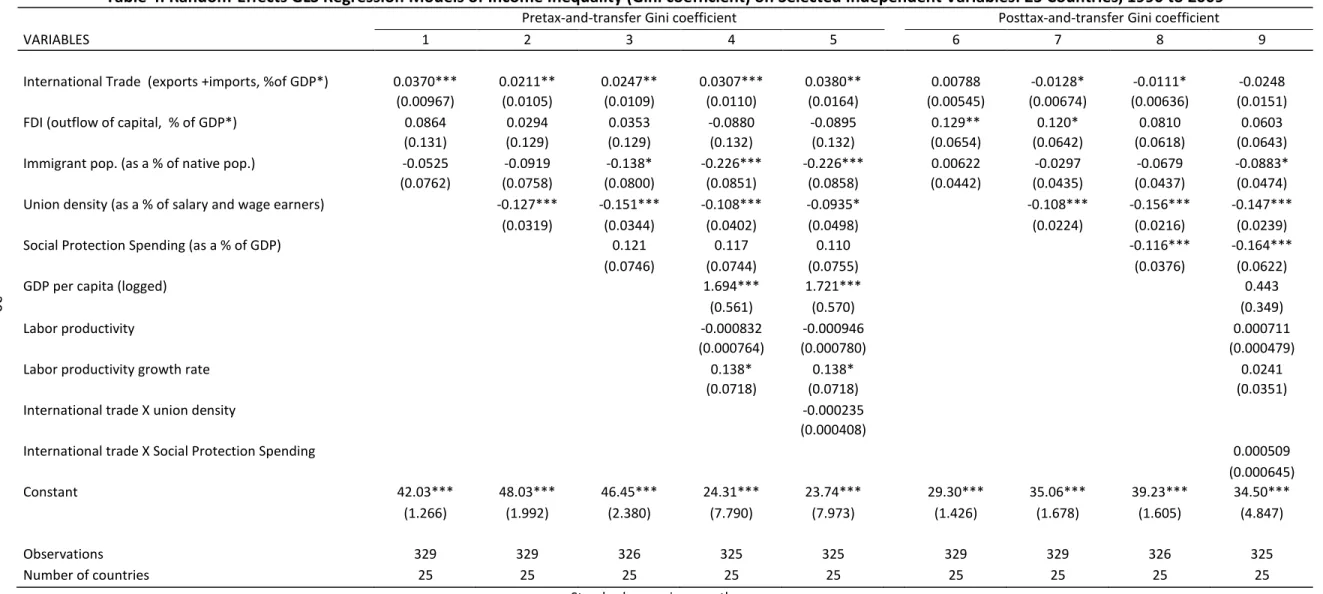
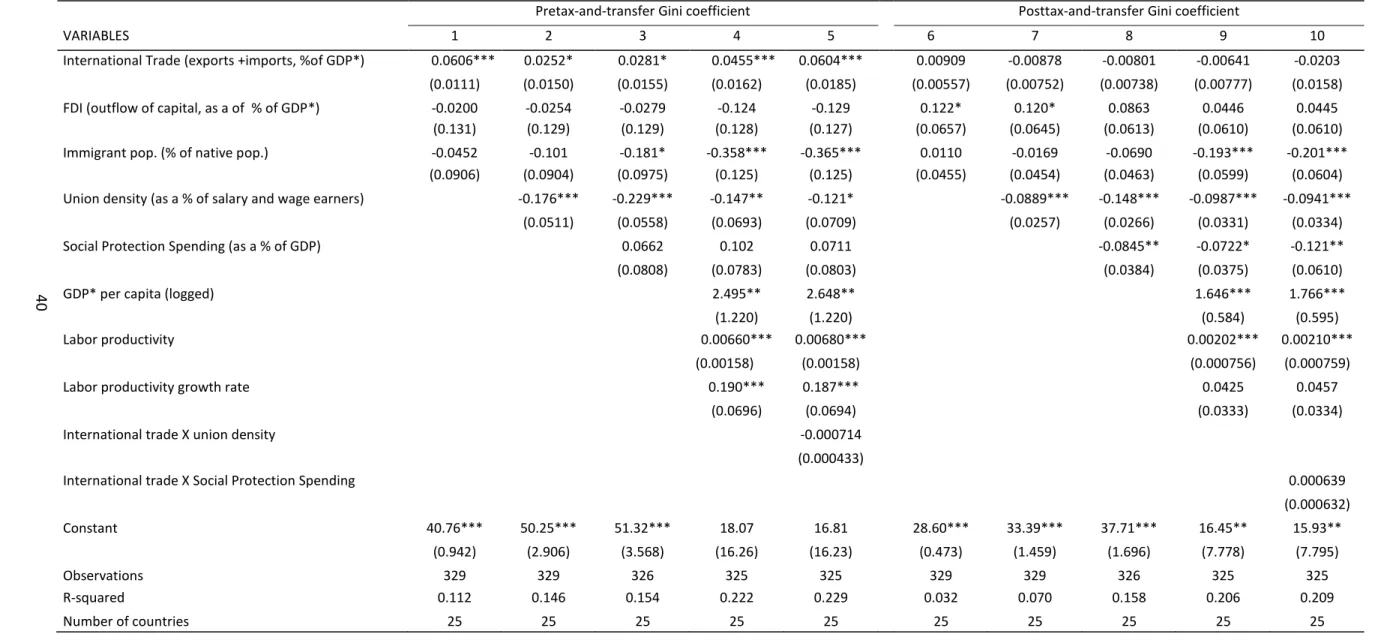
Tables 4 and 5 present the random-effects and fixed-effects models of the
pretax-and-transfer and posttax-and-pretax-and-transfer Gini coefficients on three measures of globalization and other
selected control variables. Results from both the fixed-effects and the random-effects models
in Table 4 and 5 show that international trade and immigration had no effects on the
posttax-and-transfer Gini coefficient. Outflows of foreign direct investment showed some effect on the
posttax-and-transfer Gini coefficient, but this effect disappeared when social protection
spending was controlled for (Table 4 & 5, models 6 & 8). These results are consistent with the
hypothesized effect of globalization on posttax-and-transfer income inequality and suggest that
the welfare state might have attenuated the effects of globalization on within-country income
inequality. Model 1 in Table 4 and 5 shows estimates for the three measures of globalization:
international trade, outflows of foreign direct investment and immigration on
pretax-and-transfer income inequality. Neither immigration nor foreign direct investment had an effect on
pretax-and-transfer income inequality. However, international trade has a significant and
positive effect on pretax-and-transfer income inequality (p<0.01). These results suggest that
international trade might have affected within-country income distribution primarily through
the labor market. Moreover, results from both the random-effects and the fixed-effects models
showed that unions had a negative and significant effect on both the pretax-and-transfer and
25
effects of unions on the pretax-and-transfer and posttax-and-transfer Gini coefficients. These
results are also consistent with previous research that has found negative effects of unions on
the posttax-and-transfer Gini coefficient. The results support the argument that institutional
variation, such wage bargaining institutions, may have affected cross-country variation in
income inequality (see RE results) (Alderson and Nielsen 2002; Brady 2009; DiPrete 2005;
Moller et al. 2003; Rueda and Pontusson 2000; Wallerstein 1999; Western and Healy 1999).
Unions have also affected longitudinal changes in income inequality (see FE results, Table 5). As
hypothesized, SPS had no effect on pretax-and-transfer Gini coefficient, but it had a negative
effect on posttax-and-transfer Gini coefficient. SPS data used in this analysis did not include
government spending on programs, such as labor market skill building programs, and other
educational programs, that are likely to affect pretax-and-transfer income distribution (i.e.,
market income distribution). Pretax-and-transfer Gini coefficient was calculated using
pretax-and-transfer income. The absence of data on government spending (e.g., spending on
education and labor market skill development programs) that are likely to have direct effects on
the labor market income may explain why the results showed no effects of SPS on
pretax-and-transfer income inequality.
In model 5, Table 4, international trade and union density interaction was estimated to
test whether the effect of international trade on pretax-and-transfer Gini coefficient varied by
cross-country variation in union level. The estimated interaction was non-significant, which
suggests that the effect of international trade on within-country income inequality did not
change with cross-national variation in union density (Table 4, model 3). The international trade
26
state does not explain differential effects of international trade on within-country income
inequality. GDP per capita and labor productivity were also controlled for. Results from
random-effects showed that GDP per capita has a positive effect on pretax-and-transfer Gini
coefficient (Table 4, model 4), but it has no effect on posttax-and-transfer Gini coefficient
(Table 4, model 9). Results from the fixed-effects estimations (Table 5, model 4 & 9) showed
that GDP per capita had positive effects on both pretax-and-transfer, and posttax-and-transfer
Gini coefficients. These results are consistent with previous research arguing that income
inequality tends to increase with economic development (Alderson and Nielsen 2002; Babones
and Vonada 2009). The results also show that the effect of economic development on income
inequality varied by measure of income inequality and estimation techniques. While GDP per
capita is positively related to pretax-and-transfer and posttax-and-transfer income inequality,
the magnitude of the effect of GDP per capita is about 1.52 times greater for
pretax-and-transfer income inequality than it is for posttax-and-pretax-and-transfer income inequality (Table 5, model
4 & 9). The difference in the size of the effect of GDP per capita on the two measures of Gini
coefficient suggests that the welfare state may have attenuated the effect of economic
development on income inequality. Labor productivity was also controlled for in order to test
the claim that income inequality upswings observed in recent decades were due to changes in
labor market structures, such as labor productivity as opposed to globalization forces (Bhagwati
and Kosters 1994; Gordon 1994a). Results from the random-effects estimation (Table 4, model
4) showed that labor productivity had no effects on either pretax-and-transfer Gini coefficient
or on posttax-and-transfer Gini coefficient (Table 4, model 4 & 9). However, results from the
27
pretax-and-transfer, and posttax-and-transfer Gini coefficient. The random-effects estimations,
while correcting for possible heterogeneity inherent to the type of data structure used in this
study (i.e., panel data), controlled for variation within and between units. Regarding the
present study, the random-effects model controlled for effects of cross-country variation in
labor productivity on cross-country variation in within-country income inequality. The
insignificance of the estimates of labor productivity in the random-effects modeling indicates
that cross-country variation in labor productivity had no effect on cross-country differences in
within-country income inequality. Thus, these results provide no support for the claim that
cross-country variation in economic productivity accounted for cross-country variation in
within-country income inequality. As opposed to the random-effects estimation (Table 4, model
4), the fixed-effects estimations (Table 5, model 6) showed that labor productivity had an effect
on both pretax-and-transfer, and posttax-and-transfer Gini coefficient. Similar to the
random-effects estimation, the fixed-random-effects model corrected for heterogeneity inherent to the type of
data used in this study. However, the fixed-effects technique estimates changes within unit
over time (i.e., changes within-country over time), while dropping between-units variation (i.e.,
between-country variation). Thus, the estimates of labor productivity presented in model 6
(Table 5) show the effects of within-country longitudinal changes in labor productivity on
longitudinal changes in within-country income inequality. The significance of the estimate of
labor productivity (Table 5, model 4) indicates that within-country variation in labor
productivity mattered for within-nation variation in income inequality. This suggests that
variation in labor productivity between individuals country might have affected
28
productivity had no effect on cross-country variation in within-country income inequality,
suggesting that economic productivity differentials were not the reasons for within-country
income inequality differentials between the countries under study.
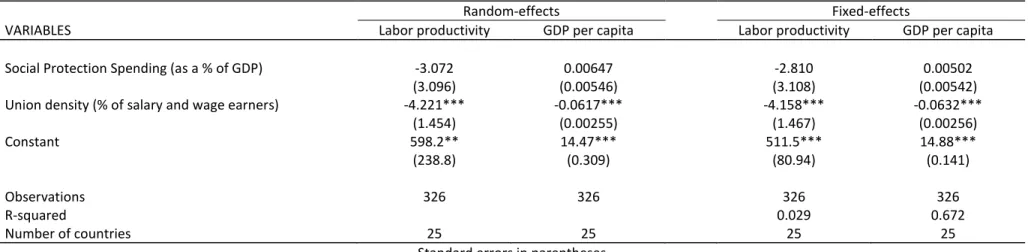
Table 6 presents results for fixed-effects and random-effects models testing the claim
that the welfare state is counterproductive, and the claim that the welfare state retards
economic growth by hindering economic productivity. It has been argued that, through
programs, such as unemployment and cash transfer, welfare state generosity might have
exacerbated poverty and inequality by discouraging people to seek employment and by
encouraging those who worked to retire early (Danziger, Haveman, and Plotnick 1981; Moffitt
2000). Contrasting the above argument, both the fixed-effects and random-effects models
show that social protection spending, which included unemployment benefit and cash transfer
among others, had no effects on either labor productivity or GDP per capita. In other words, the
results suggest that the welfare state did not hinder economic prosperity or hamper economic
efficiency over the period under review in this study.
DSCUSSION AND CONCLUSION
This paper revisited some of the claims regarding the relationship between
within-country income inequality and three aspects of globalization: international trade, foreign direct
investment and immigration. Most studies investigating the relationship between
within-country income inequality and globalization have used posttax-and-transfer income inequality.
Some of those studies have concluded that globalization had no effect on income inequality
29
income inequality upswings observed in advanced industrial economies in recent decades (see
above review). Unlike previous studies, this study investigated the effect of globalization on
both pretax-and-transfer, and posttax-and-transfer income inequality. Consistent with some
research (Nollmann 2006), the results showed that globalization had no effect of on
posttax-and-transfer income inequality. This relationship is the same regardless of the estimation
method used (fixed-effects or random-effect methods). However, the relationship between
globalization and income inequality changed when pretax-and-transfer Gini coefficient was
considered. The results showed that international trade affected both cross-country variations
(see random-effects estimates, Table 4, models 1-5) and longitudinal changes (see fixed-effects
estimate, Table 5, models 1-6) in income inequality. The fact that international trade had an
effect on pretax-and-transfer income inequality, but did not have any effects on
posttax-and-transfer income inequality highlights the extent to which the welfare state might have
attenuated the effects of globalization on within-country income inequality in industrial
countries. The results also suggest that conclusions regarding the relationship between
globalization may depend on measures of income inequality. Research may find effects of
globalization on income inequality or no effects of globalization on income inequality
depending upon whether pretax-and-transfer Gini coefficient or posttax-and-transfer Gini
coefficient is considered. Moreover, the argument that cross-country variation in
within-country income inequality was due to cross-within-country variation in economic productivity seemed
to depend on methods of estimation. Random-effects estimations show no effects of
cross-country variation in economic productivity on cross-cross-country variation in within-cross-country income
30
individuals within-country had an effect on longitudinal changes in within-country income
inequality.
Furthermore, this study tested the claim that any reduction of income inequality by the
welfare state programs happens at the expense of economic prosperity, productivity and
growth. The results showed no evidence that the welfare state hindered economic productivity
and economic growth in the 25 countries over the period under study. An implication of these
findings is that a society does not have to forgo economic growth in order to reduce income
inequality.
Moreover, this study provides no support for the argument that cross-national variation
in within-country income inequality may have been due to cross-country variation in economic
productivity. For example, it has been argued that income inequality has been greater in the US
than it has been in some European countries because the US has had on average higher
economic productivity than these European countries. Results from random-effects modeling
showed that cross-country variation in labor productivity had no effect on cross-country
variation in income inequality during the period under study. Although the results reject the
claim that the welfare state is counterproductive and the claim that the welfare state retards
economic development, one could expect the welfare state to stimulate economic
development and economic growth through labor market skill training and other educational
programs. Unfortunately, due to unavailability of data on government spending on education
and skill training programs, this paper could not measure whether the welfare state had
31
period. When such data become available, further research may shed light on the full extent of
the effect of the welfare state on economic development and productivity and income
inequality. Moreover, the results have shown no effect of immigration on income inequality,
which is consistent with previous studies that have found small or insignificant effects of
immigration on posttax-and-transfer income inequality (Alderson and Nielsen 2002; Brady
2009). However, the insignificance of the estimate of immigration might have been due to
unmeasured factors, such as variation in skill set of immigrants and cross-country difference in
immigrant recruitment methods that could not be captured from cross-sectional time series
data and aggregate measures of immigration. Since immigration policies tend to affect the type
of people who migrate (Bleakley and Chin 2004; Green 1999; Kossoudji 1988; LaLonde and
Topel 1991a; Lobo and Salvo 1998a; Lobo and Salvo 1998b), further study could investigate how
the effect of immigration on within-country income inequality might have changed in industrial
countries in recent decades due to changes in immigration policies. Finally, a surprising finding
of this study is that unions had a negative effect on economic productivity and development
32
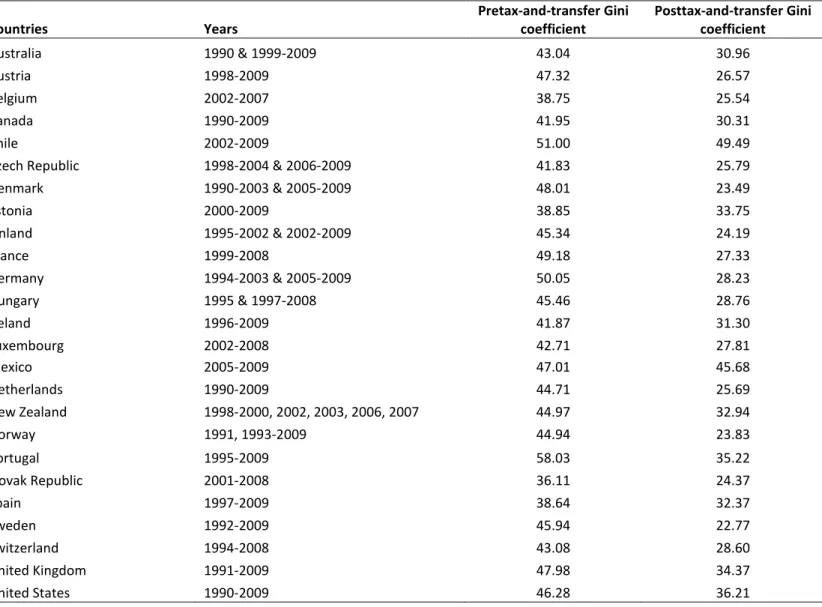
Table 1: Mean pretax-and-transfer, and posttax-and-transfer Gini coefficient and number of years by countries, 1990-2009
Countries Years
Pretax-and-transfer Gini coefficient
Posttax-and-transfer Gini coefficient
Australia 1990 & 1999-2009 43.04 30.96
Austria 1998-2009 47.32 26.57
Belgium 2002-2007 38.75 25.54
Canada 1990-2009 41.95 30.31
Chile 2002-2009 51.00 49.49
Czech Republic 1998-2004 & 2006-2009 41.83 25.79
Denmark 1990-2003 & 2005-2009 48.01 23.49
Estonia 2000-2009 38.85 33.75
Finland 1995-2002 & 2002-2009 45.34 24.19
France 1999-2008 49.18 27.33
Germany 1994-2003 & 2005-2009 50.05 28.23
Hungary 1995 & 1997-2008 45.46 28.76
Ireland 1996-2009 41.87 31.30
Luxembourg 2002-2008 42.71 27.81
Mexico 2005-2009 47.01 45.68
Netherlands 1990-2009 44.71 25.69
New Zealand 1998-2000, 2002, 2003, 2006, 2007 44.97 32.94
Norway 1991, 1993-2009 44.94 23.83
Portugal 1995-2009 58.03 35.22
Slovak Republic 2001-2008 36.11 24.37
Spain 1997-2009 38.64 32.37
Sweden 1992-2009 45.94 22.77
Switzerland 1994-2008 43.08 28.60
United Kingdom 1991-2009 47.98 34.37
33
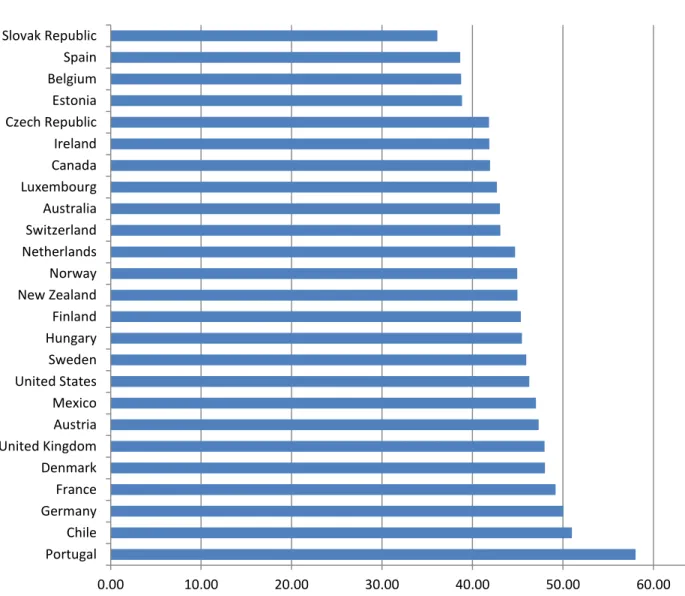
Figure 1: Mean pretax-and-transfer Gini coefficient multiplied by 100, 1990-2009.
0.00 10.00 20.00 30.00 40.00 50.00 60.00
Portugal Chile Germany France Denmark United Kingdom Austria Mexico United States Sweden Hungary Finland New Zealand Norway Netherlands Switzerland Australia Luxembourg Canada Ireland Czech Republic Estonia Belgium Spain Slovak Republic
34
Figure 2: Mean social protection spending as a percent of GDP, 1990-2009.
0 5 10 15 20 25 30 35
Sweden France Denmark Austria Finland Germany Belgium Norway Netherlands Luxembourg Hungary Spain Portugal United Kingdom Czech Republic New Zealand Switzerland Canada Slovak Republic Australia Ireland United States Estonia Chile Mexico
35
Figure 3: Mean union density as a percent of total wage and salary earners, 1990-2009.
0 10 20 30 40 50 60 70 80
Sweden Finland Denmark Norway Belgium Luxembourg Ireland Austria Canada United Kingdom Australia Germany Slovak Republic Hungary Czech Republic Netherlands Portugal New Zealand Switzerland Spain Mexico Chile United States Estonia France
36
Figure 4: Mean posttax-and-transfer Gini coefficient multiplied by 100, 1990-2009.
0 10 20 30 40 50
Chile Mexico United States Portugal United Kingdom Estonia New Zealand Spain Ireland Australia Canada Hungary Switzerland Germany Luxembourg France Austria Czech Republic Netherlands Belgium Slovak Republic Finland Norway Denmark Sweden
37
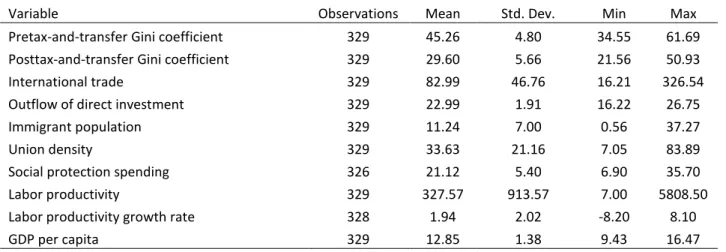
Table 2: Descriptive Statistics
Variable Observations Mean Std. Dev. Min Max
Pretax-and-transfer Gini coefficient 329 45.26 4.80 34.55 61.69
Posttax-and-transfer Gini coefficient 329 29.60 5.66 21.56 50.93
International trade 329 82.99 46.76 16.21 326.54
Outflow of direct investment 329 22.99 1.91 16.22 26.75
Immigrant population 329 11.24 7.00 0.56 37.27
Union density 329 33.63 21.16 7.05 83.89
Social protection spending 326 21.12 5.40 6.90 35.70
Labor productivity 329 327.57 913.57 7.00 5808.50
Labor productivity growth rate 328 1.94 2.02 -8.20 8.10
Table 3: Variable descriptions, Data Sources and Hypothesized Effects
Hypothesized impact on:
Variables Description Sources
Pretax-and-transfer Gini coefficient
Posttax-and-transfer Gini coefficient
Dependent Variables
Pretax-and-transfer Gini coefficient Calculated from pretax-and-transfer household income, using custom missing-data algorithm SWID (Solt 2009)
Posttax-and-transfer Gini coefficient Calculated from posttax-and-transfer household income, using custom missing-data algorithm SWID (solt 2009)
Labor productivity Measured as GDP per hour worked OECD
GDP per capita GDP divided per population size Penn World Table
Independent Variables
International trade exports plus imports of goods in PPP price as a percent of real GDP Penn World Table + N/A
Outward of direct investment Total direct investment abroad as a percent of real GDP OECD + +
immigrant population foreign born population as percent of native population OECD + +
social protection spending Government social spending as a percent of GDP OECD N/A -
Union density Union membership as a percent of total wage and salary earners OECD - -
Labor productivity Measured as GDP per hour worked OECD - -
Labor productivity growth rate Percent change in labor production per year OECD - -
GDP per capita GDP divided per population size Penn World Table + +
Table 4: Random-Effects GLS Regression Models of Income Inequality (Gini coefficient) on Selected Independent Variables: 25 Countries, 1990 to 2009
Pretax-and-transfer Gini coefficient Posttax-and-transfer Gini coefficient
VARIABLES 1 2 3 4 5 6 7 8 9
International Trade (exports +imports, %of GDP*) 0.0370*** 0.0211** 0.0247** 0.0307*** 0.0380** 0.00788 -0.0128* -0.0111* -0.0248 (0.00967) (0.0105) (0.0109) (0.0110) (0.0164) (0.00545) (0.00674) (0.00636) (0.0151)
FDI (outflow of capital, % of GDP*) 0.0864 0.0294 0.0353 -0.0880 -0.0895 0.129** 0.120* 0.0810 0.0603
(0.131) (0.129) (0.129) (0.132) (0.132) (0.0654) (0.0642) (0.0618) (0.0643)
Immigrant pop. (as a % of native pop.) -0.0525 -0.0919 -0.138* -0.226*** -0.226*** 0.00622 -0.0297 -0.0679 -0.0883*
(0.0762) (0.0758) (0.0800) (0.0851) (0.0858) (0.0442) (0.0435) (0.0437) (0.0474)
Union density (as a % of salary and wage earners) -0.127*** -0.151*** -0.108*** -0.0935* -0.108*** -0.156*** -0.147***
(0.0319) (0.0344) (0.0402) (0.0498) (0.0224) (0.0216) (0.0239)
Social Protection Spending (as a % of GDP) 0.121 0.117 0.110 -0.116*** -0.164***
(0.0746) (0.0744) (0.0755) (0.0376) (0.0622)
GDP per capita (logged) 1.694*** 1.721*** 0.443
(0.561) (0.570) (0.349)
Labor productivity -0.000832 -0.000946 0.000711
(0.000764) (0.000780) (0.000479)
Labor productivity growth rate 0.138* 0.138* 0.0241
(0.0718) (0.0718) (0.0351)
International trade X union density -0.000235
(0.000408)
International trade X Social Protection Spending 0.000509
(0.000645)
Constant 42.03*** 48.03*** 46.45*** 24.31*** 23.74*** 29.30*** 35.06*** 39.23*** 34.50***
(1.266) (1.992) (2.380) (7.790) (7.973) (1.426) (1.678) (1.605) (4.847)
Observations 329 329 326 325 325 329 329 326 325
Number of countries 25 25 25 25 25 25 25 25 25
Standard errors in parentheses *** p<0.01, ** p<0.05, * p<0.1 * GDP = real GDP
3
Table 5: Fixed-Effects GLS Regression Models of Income Inequality (Gini coefficient) on Selected Independent Variables: 25 Countries, 1990 to 2009
Pretax-and-transfer Gini coefficient Posttax-and-transfer Gini coefficient
VARIABLES 1 2 3 4 5 6 7 8 9 10
International Trade (exports +imports, %of GDP*) 0.0606*** 0.0252* 0.0281* 0.0455*** 0.0604*** 0.00909 -0.00878 -0.00801 -0.00641 -0.0203 (0.0111) (0.0150) (0.0155) (0.0162) (0.0185) (0.00557) (0.00752) (0.00738) (0.00777) (0.0158)
FDI (outflow of capital, as a of % of GDP*) -0.0200 -0.0254 -0.0279 -0.124 -0.129 0.122* 0.120* 0.0863 0.0446 0.0445
(0.131) (0.129) (0.129) (0.128) (0.127) (0.0657) (0.0645) (0.0613) (0.0610) (0.0610)
Immigrant pop. (% of native pop.) -0.0452 -0.101 -0.181* -0.358*** -0.365*** 0.0110 -0.0169 -0.0690 -0.193*** -0.201***
(0.0906) (0.0904) (0.0975) (0.125) (0.125) (0.0455) (0.0454) (0.0463) (0.0599) (0.0604) Union density (as a % of salary and wage earners) -0.176*** -0.229*** -0.147** -0.121* -0.0889*** -0.148*** -0.0987*** -0.0941***
(0.0511) (0.0558) (0.0693) (0.0709) (0.0257) (0.0266) (0.0331) (0.0334)
Social Protection Spending (as a % of GDP) 0.0662 0.102 0.0711 -0.0845** -0.0722* -0.121**
(0.0808) (0.0783) (0.0803) (0.0384) (0.0375) (0.0610)
GDP* per capita (logged) 2.495** 2.648** 1.646*** 1.766***
(1.220) (1.220) (0.584) (0.595)
Labor productivity 0.00660*** 0.00680*** 0.00202*** 0.00210***
(0.00158) (0.00158) (0.000756) (0.000759)
Labor productivity growth rate 0.190*** 0.187*** 0.0425 0.0457
(0.0696) (0.0694) (0.0333) (0.0334)
International trade X union density -0.000714
(0.000433)
International trade X Social Protection Spending 0.000639
(0.000632)
Constant 40.76*** 50.25*** 51.32*** 18.07 16.81 28.60*** 33.39*** 37.71*** 16.45** 15.93**
(0.942) (2.906) (3.568) (16.26) (16.23) (0.473) (1.459) (1.696) (7.778) (7.795)
Observations 329 329 326 325 325 329 329 326 325 325
R-squared 0.112 0.146 0.154 0.222 0.229 0.032 0.070 0.158 0.206 0.209
Number of countries 25 25 25 25 25 25 25 25 25 25
Standard errors in parentheses
*** p<0.01, ** p<0.05, * p<0.1; *GDP = real GDP
41
Table 6: Random-Effects and Fixed-Effects GLS Regression Models of Labor Productivity and GDP per Capita on Selected Independent Variables: 25 Countries, 1990-2009
Random-effects Fixed-effects
VARIABLES Labor productivity GDP per capita Labor productivity GDP per capita
Social Protection Spending (as a % of GDP) -3.072 0.00647 -2.810 0.00502
(3.096) (0.00546) (3.108) (0.00542)
Union density (% of salary and wage earners) -4.221*** -0.0617*** -4.158*** -0.0632***
(1.454) (0.00255) (1.467) (0.00256)
Constant 598.2** 14.47*** 511.5*** 14.88***
(238.8) (0.309) (80.94) (0.141)
Observations 326 326 326 326
R-squared 0.029 0.672
Number of countries 25 25 25 25