IMPLEMENTATION OF A CHILD CARE + HOME INTERVENTION TO IMPROVE CHILDREN’S NUTRITION AND PHYSICAL ACTIVITY: ASSESSMENT OF FIDELITY,
PARENT ENGAGEMENT, AND ENHANCED IMPLEMENTATION
Courtney Tiemann Luecking
A dissertation submitted to the faculty at the University of North Carolina at Chapel Hill in partial fulfillment of the requirements for the degree of Doctor of Philosophy in the Department
of Nutrition in the Gillings School of Global Public Health.
Chapel Hill 2019
ii © 2019
ABSTRACT
Courtney Tiemann Luecking: Implementation of a Child Care + Home Intervention to Improve Children’s Nutrition and Physical Activity: Assessment of Fidelity, Parent Engagement, and
Enhanced Implementation
(Under the direction of Dianne S. Ward)
Early care and education (ECE) centers are important targets for influencing children’s dietary and physical activity behaviors, but effects of innovations are often mixed. Measures of intervention fidelity are needed to identify barriers to implementation and strategies are needed to diminish barriers. To address these gaps, the Healthy Me, Healthy We (HMHW) program, an 8-month intervention promoting parent involvement to support healthier eating and activity habits for 3-4-year-old children attending ECE, was critically evaluated. Using process evaluation data from 48 ECE centers in the hybrid type I cluster randomized control trial of HMHW, we created a 35-item fidelity index to measure implementation by ECE providers and parents. Overall, HMHW was implemented with low fidelity (50%), with a notable decrease between ECE providers (67%) and parents (39%).
iv
To support bi-directional communication between ECE providers and parents about HMHW, an enhanced implementation approach was developed. A quasi-experimental study with 42 ECE centers was used to evaluate the effect of the enhanced implementation approach
compared to the standard implementation of HMHW on parent engagement. Parent engagement was measured by interview responses from ECE providers and surveys from parents. No
To the early care and education providers and parents who participated in this research. Thank you for inviting me in to your everyday experiences and imparting a wealth of knowledge and
vi
ACKNOWLEDGEMENTS
I will be forever grateful to all the individuals who guided me and provided steadfast support and encouragement during this transformative experience. To my dissertation chair, mentor, and confidant Dr. Dianne Ward, I will never be able to truly express my gratitude for your investment in my professional and personal development. Thank you for reading all my long sentences and terrible first drafts, gently pushing me to do better while reminding me to be a person, fitting in meetings that I failed to actually schedule with you, encouraging me to “make no apologies”, and seeing the value for what I was doing when I couldn’t. I hope to one day emulate your interactions with students of my own. I would also like to express deep
appreciation to my dissertation committee – Drs. Alice Ammerman, Byron Powell, Deborah Tate, and Kimberly Truesdale – for your prompts to think deeper, and broadly, about the implications of this work and to improve the clarity with which I write and speak about it.
also like to extend my gratitude to the Department of Nutrition in the Gillings School of Global Public Health for an exceptional training experience. The professors challenged me to have clear research questions and the camaraderie among students was of genuine support, curiosity, and excellence.
viii
TABLE OF CONTENTS
LIST OF TABLES ... xiv
LIST OF FIGURES ... xvi
LIST OF ABBREVIATIONS AND SYMBOLS ... xvii
CHAPTER 1: INTRODUCTION ... 1
Background ... 1
Specific aims ... 3
CHAPTER 2: LITERATURE REVIEW ... 5
Young children are not achieving healthy eating or physical activity recommendations ... 5
Early care and education centers are an important setting to influence eating and activity behaviors ... 5
Implementation science can help us understand what, why, and how innovations work in the real world ... 6
Understanding why an innovation was, or was not, successful will inform translation and scaling up... 9
Without adequate implementation, children’s eating and activity behaviors will not improve ... 10
Implementation strategies can support use of evidence-based innovations... 11
There is a need to identify effective implementation strategies for the ECE setting ... 12
Involving parents could be a key, but challenging implementation strategy ... 13
CHAPTER 3: METHODS ... 15
Healthy Me, Healthy We Intervention ... 15
Intervention components ... 17
Kick-off event ... 17
Unit activities ... 18
Celebration event ... 19
Implementation strategy... 19
Determinant and evaluation frameworks ... 20
Aims 1 and 3 ... 20
Aim 2 ... 25
Study population and protocols ... 26
Aim 1 ... 26
Aim 2 ... 27
Aim 3 ... 29
Implementation strategies ... 31
Measures ... 34
Process evaluation and implementation outcomes ... 34
Recruitment and attendance logs ... 34
Training evaluations... 34
Observations ... 35
ECE provider surveys ... 35
Parent survey ... 36
Semi-structured interviews ... 37
Fidelity ... 38
x
Organizational characteristics ... 46
Identification of center-level implementation strategies ... 46
Semi-structured interviews ... 47
Aim 1 ... 47
Aim 2 ... 48
Aim 3 ... 48
Demographic information ... 49
Analysis... 49
Aim 1 ... 49
Aim 2 ... 50
Quantitative data analysis ... 50
Qualitative data analysis ... 51
Aim 3 ... 51
Primary outcome ... 51
Demographics and secondary outcomes ... 52
CHAPTER 4: EVALUATION OF FIDELITY AND CONTEXTUAL FACTORS INFLUENCING IMPLEMENTATION OF HEALTHY ME, HEALTHY WE ... 54
Overview ... 54
Background ... 55
Methods... 58
HMHW program ... 58
Study population and recruitment ... 59
Measures and data collection procedures ... 60
Implementation support provided by the research team ... 60
Fidelity of ECE providers and parents ... 61
Data analysis ... 62
Results ... 63
Implementation support provided by the research team ... 64
Fidelity of ECE providers and parents ... 65
Factors influencing implementation ... 66
Discussion ... 67
Conclusion ... 71
CHAPTER 5: NAVIGATING CHALLENGES OF PARENT ENGAEMENT WITH HEALTH PROMOTION EFFORTS: A MIXED METHODS APPROACH TO IDENTIFYING BARRIERS AND FACILITATORS IN CHILD CARE SETTINGS ... 77
Overview ... 77
Background ... 78
Methods... 80
Study design... 80
Healthy Me, Healthy We intervention ... 81
Sample selection and case identification ... 81
Recruitment and participation ... 82
Frameworks ... 83
Measures ... 83
Data analysis ... 84
Results ... 85
Presence at child care centers or “being involved with everything” ... 86
Parents ... 87
xii
Family-specific knowledge ... 89
Demands of job ... 89
Communication ... 90
Communication with parents ... 90
Communication styles ... 91
Messaging around nutrition and physical activity ... 92
Operationalizing ongoing parent engagement efforts ... 93
Volunteering ... 93
Supporting healthy habits at home ... 94
Context of child care center ... 96
Center culture ... 96
Organizational goals and priorities ... 97
Internal communication and implementation processes ... 98
Discussion ... 99
Conclusion ... 102
CHAPTER 6: EFFICACY OF AN ENHANCED IMPLEMENTATION STRATEGY TO INCREASE PARENT ENGAGEMENT WITH A HEALTH PROMOTION PROGRAM IN CHILD CARE ... 109
Overview ... 109
Background ... 110
Methods... 112
Research design ... 112
Participants and recruitment ... 113
Measures and data collection procedures ... 113
Parent engagement ... 114
Analyses ... 116
Results ... 116
Discussion ... 118
Conclusions ... 120
CHAPTER 7: SYNTHESIS ... 128
Overview of findings ... 128
Limitations and strengths ... 131
Limitations ... 131
Strengths ... 133
Future research directions ... 135
Implementation processes and strategies ... 135
Further explorations into parent engagement ... 137
Public health impact and summary ... 138
APPENDIX 1: MODIFIED EARLY CHILDHOOD ORGANIZATIONAL READINESS MEASURE COMPLETED BY DIRECTORS AND TEACHERS ... 140
APPENDIX 2: SURVEY TO IDENTIFY DISCRETE IMPLEMENTATION STRATEGIES COMPLETED BY DIRECTORS AND TEACHERS ... 149
APPENDIX 3: SEMI-STRUCTURED INTERVIEW GUIDES FOR DIRECTORS AND TEACHERS (AIM 1)... 158
APPENDIX 4: SEMI-STRUCTURED INTERVIEW GUIDES FOR DIRECTORS, TEACHERS, AND PARENTS (AIM 2) ... 168
APPENDIX 5: SEMI-STRUCTURED INTERVIEW GUIDE FOR DIRECTORS AND TEACHERS (AIM 3) ... 185
xiv
LIST OF TABLES
Table 1. Functions of mixed methods designs ... 8 Table 2. Discrete implementation strategies96 to support adoption and
implementation of the HMHW intervention among ECE providers and parents of
3 – 4-year-old children ... 21 Table 3. Elements of Epstein’s framework for school-family-community
partnerships34 ... 25 Table 4. Additional implementation strategies96 selected for the enhanced
implementation approach for ECE providers (actors) to use with parents of 3 – 4-year-old children (target) to support adoption and implementation of the HMHW
intervention ... 33 Table 5. Post-intervention surveys completed by ECE providers and parents in
Aim 3 ... 37 Table 6. Components of fidelity index to measure intervention and
implementation fidelity of HMHW among ECE providers and parents... 39 Table 7. Data sources and sample items contributing to parent engagement score
(Aim 2) ... 44 Table 8. Characteristics of ECE centers randomized to implement HMHW (n=48) ... 73 Table 9. Demographic characteristics of ECE directors, teachers, and parents
randomized to implement HMHW ... 74 Table 10. Fidelity to implementation of HMHW by ECE providers and parents (n
= 48 ECE centers) ... 75 Table 11. Barriers and facilitators of implementing HMHW experienced by ECE
providers (n = 133) ... 76 Table 12. Characteristics of child care centers representing low and high parent
engagement with the Healthy Me, Healthy We intervention (n=7)a ... 104 Table 13. Demographic characteristics of child care directors (n=7), teachers
(n=9), and parents (n=12) representing low and high parent engagement with the
Healthy Me, Healthy We interventiona ... 105 Table 14. Key differences between low and high parent engagement centers that
serve as barriers or facilitators of parent engagement ... 106 Table 15. Missed opportunities to support parent engagement with promoting
Table 16. Discrete implementation strategies96 selected for early care and education providers (actors) to use with parents of 3-4-year-old children (target) to support adoption and implementation of the Healthy Me, Healthy We
intervention ... 122 Table 17. Characteristics of 42 early care and education centers implementing
Healthy Me, Healthy We ... 124 Table 18. Demographic characteristics of early care and education providers
(n=173) and parents (n=313) implementing the Healthy Me, Healthy We
intervention ... 125 Table 19. Early care and education providers’ (n=54) fidelity to the enhanced
xvi
LIST OF FIGURES
Figure 1. Conceptual model for HMHW ... 16 Figure 2. Overview of structure of HMHW... 17 Figure 3. Family Teacher/Provider Relationship Quality sub-scale scores (mean ±
standard deviation) for teachers (n=9) and parents (n=12) representing low and high parent engagement. Median (dotted line) and lower and upper quartile range (grey shaded box) from a larger field study are provided as reference for
interpretation.166 ... 108 Figure 4. Acceptability, appropriateness, and feasibility ratings of the Healthy Me,
Healthy We intervention by early care and education (ECE) providers (n=57) and parents (n=114) in Cohort 2 (enhanced). Differences in proportion of responses by
LIST OF ABBREVIATIONS AND SYMBOLS BCT Behavior change techniques
CACFP Child and Adult Care Food Program
CFIR Consolidated Framework (for) Implementation Research ECE Early care and education
EPAO Environment and Policy Assessment and Observation FPTRQ Family Provider/Teacher Relationship Quality
HMHW Healthy Me, Healthy We
ID Identifier
NC North Carolina
NC Pre-K North Carolina Pre-kindergarten
1
CHAPTER 1: INTRODUCTION Background
Early care and education (ECE) settings are important targets for translational research due to the potential for widespread public health impact for improving children’s eating and physical activity behaviors.1,2 A variety of policies, programs, and practices (i.e., innovations) within ECE settings have been shown to positively influence what or how much children eat, increase their minutes of physical activity, and/or decrease screen time.3 However, low adoption and/or insufficient implementation of these evidence-based innovations has yielded mixed or moderate effects in pragmatic conditions.4–10 To consistently achieve positive changes in
children’s eating and physical activity behavior, it is imperative to better understand how health promotion innovations in ECE work, for whom they work, and under what conditions the
innovation produced successful changes.11,12 In addition, strategies are needed to facilitate uptake and enhance implementation of innovations in ECE,13,14 because without adequate
implementation, desired behavior or health outcomes will not be realized.15
Commonly used implementation strategies to support the adoption or implementation of evidence-based health promotion innovations in ECE include offering training workshops for ECE providers, supplying resources (e.g., materials, activities), and providing technical
assistance.16 Involving parents with implementation of ECE center-based innovations can be an effective implementation strategy,17,18 but engaging parents is a commonly cited barrier19–22 and previous efforts to engage parents have had limited success.23 Healthy Me, Healthy We
involvement with efforts to support healthier eating and physical activity for 3-4-year-old children attending ECE.24 However, preliminary results from the first wave of intervention indicated limited success in involving parents. In order to achieve the benefits of engaging parents in health promotion efforts through ECE, a better understanding of both the successes and failures of the implementation of complex, multicomponent innovations like HMHW is necessary.25,26 In particular, a more in-depth understanding of barriers and facilitators of parent engagement with health promotion efforts is needed.27–29 Applying comprehensive frameworks that prompt consideration of how an innovation was implemented (i.e., fidelity) and contextual factors influencing the implementation process can allow researchers to unpack the “black box” of complex innovations like HMHW and inform future dissemination and implementation efforts.30,31 However, few studies have applied theoretical or practical frameworks to explore contextual factors or guide evaluation efforts around engaging parents in health promotion efforts in ECE centers.
The overall aim of this dissertation was to increase parent engagement with the HMHW intervention through applying practical and determinant frameworks to identify barriers and facilitators of parent engagement and to evaluate strategies that would be generalizable to other health promotion interventions delivered through ECE centers. To accomplish this, the
3
comparative case study among 28 directors, teachers, and parents at ECE centers who
demonstrated low and high levels of parent engagement with HMHW. Epstein’s framework for school-family-community partnerships34 and the Consolidated Framework for Implementation Research35 were used to structure exploration of similarities and differences among centers identified to have low or high engagement. Results highlighted key barriers and facilitators of parent engagement in health promotion programs and missed opportunities that can be addressed using appropriate implementation strategies. Results from Aims 1 and 2 informed the design of an enhanced implementation strategy that included prompting ECE providers to solicit ongoing feedback about parents’ experiences with HMHW and to identify barriers to participation at home. In Aim 3, we tested the efficacy of this enhanced implementation strategy to increase parent engagement with HMHW using a quasi-experimental design that compared 29 ECE centers that used the standard implementation strategy to 13 ECE centers who used the enhanced implementation strategy.
Specific aims
Aim 1: Develop a fidelity index to assess implementation of the Healthy Me, Healthy We intervention, and evaluate the external validity of the intervention according to the RE-AIM framework.
Aim 2: Characterize barriers and facilitators of parent engagement with the Healthy Me, Healthy We intervention and identify strategies to promote and support parent engagement with health promotion efforts in ECE centers.
• Hypothesis: ECE centers who use the enhanced implementation strategy will have higher scores of parent engagement at the end of the 8-month Healthy Me, Healthy We
5
CHAPTER 2: LITERATURE REVIEW
Young children are not achieving healthy eating or physical activity recommendations Early childhood is a critical period of rapid growth and development that lays the foundation for future physical, emotional, social, and cognitive health.36 Dietary and physical activity behaviors during this period influence cognitive outcomes 37,38 and future risk for chronic diseases, such as cancer and type 2 diabetes.39 In addition, dietary preferences and physical activity habits in early childhood track into adolescence and adulthood and will continue to influence energy balance and overall health.40–42 However, young children are not developing healthy habits.7,43,44 A majority of children aged 2 – 5 years do not consume enough fruit, vegetables, whole grains, or dairy foods to meet recommendations from the Dietary Guideline for Americans,45 and nearly all (>98%) children exceed recommendations for solid fats and added sugars.44,46 It is estimated that nearly 60% of children aged 3 – 5 do not meet the National Academy of Medicine guideline for at least 15 minutes of physical activity per
hour.47,48 Furthermore, young children average 3 hours of screen time per day,49 which exceeds the recommended 1 – 2 hour limit.50 As such, national and international organizations have prioritized policies to support healthy lifestyle behaviors in early childhood.48,51
Early care and education centers are an important setting to influence eating and activity behaviors
public health impact.2 Intervening at ECE centers to promote healthy eating and physical activity habits is a rapidly growing area of research.3 A variety of policies, programs, and practices (i.e., innovations) have proven effective for positively influencing what or how much children eat, increasing children’s minutes of physical activity, and decreasing sedentary or screen time.3,53,54 These evidence-based innovations have influenced guidelines and recommendations for how to structure ECE environments to promote healthy eating and physical activity (e.g., types of foods served and amount of time allotted for physical activity) and how ECE providers should interact with children (e.g., model and teach children about healthy behaviors).48,51,55 But, there has been low adoption and/or insufficient implementation of these guidelines and recommendations.4–9,56– 59 For example, it has been found that ECE centers do not consistently provide healthier foods or beverages, such as whole grains or water,4,8,57,59 nor do they consistently provide sufficient time or resources to support active play.4,5,56This evidence denotes a gap in translating innovations efficacious under carefully controlled research settings to more pragmatic, community contexts like ECE settings.10,12
Implementation science can help us understand what, why, and how innovations work in the real world
Since the commencement of the evidence-based medicine and practice movement, there has been concern regarding the quality gap between what we know works and what is carried out in everyday practice.12 Implementation science, the study of methods or strategies to promote the adoption and integration of evidence-based innovations within specific settings,2 aims to
7
taxonomy includes acceptability, adoption, appropriateness, cost, feasibility, fidelity, penetration, and sustainability. These outcomes may be more, or less, appropriate during various phases of implementation, including early (i.e., adoption), mid (i.e., penetration), or late (i.e.,
sustainability) implementation.
Implementation science places more emphasis on external validity than traditional efficacy research,62,63 and there is ongoing debate as to whether the randomized design that is so valuable for efficacy and effectiveness research is the most appropriate design for
implementation research.60 A wide variety of study designs and analytic approaches atypical for traditional efficacy-effectiveness research are being used in implementation research.64 Some approaches gaining popularity include hybrid designs, mixed methods, and case studies. Hybrid designs involve combining design elements of effectiveness and implementation research.65 These study designs allow for various combinations of assessing the effectiveness of an
intervention on the targeted outcome and the accompanying implementation strategy, meaning both implementation- and participant-level outcomes are collected and assessed. A type I hybrid emphasizes testing the effects of an innovation on relevant outcomes but also gathers
information on implementation, whereas a type II hybrid puts equal emphasis on testing the innovation and the implementation strategy. A type III hybrid has a primary focus of testing the implementation strategy but also collects information about the innovation’s effect on targeted outcomes. Advantages of hybrid trials include stronger, expedited translational gains, more effective implementation strategies, and more useful information for decision makers.2,65
that the combination of quantitative and qualitative data is synergistic and will provide a more in-depth understanding and synthesis than either method individually.67 Quantitative and qualitative methods may be used sequentially or in tandem to answer a research question. The sequential approach utilizes one method to inform the next phase of research that will use the other method, while the tandem approach uses both methods at the same time. Furthermore, the methods can be given equal weight or one method may carry more prominence for analysis and interpretation.66 Mixed methods may function in several capacities, including convergence, complementarity, expansion or explanation, development, or sampling (Table 1). An advantage of mixed methods is that triangulating results is an approach to address limited statistical power, which is often a limitation of implementation research.64
Table 1. Functions of mixed methods designs
Function Definition
Convergence Using both methods to answer the same research question, either comparing results to see if they offer the same conclusion (triangulation) or by converting one data set to another
(transformation)
Complementarity Using each method to answer a related question regarding evaluation or elaboration (e.g., one method evaluates study outcomes and another evaluates process)
Expansion or Explanation Using one method to answer questions raised by the other Development Using one method to answer questions that will enable the
other method to answer questions (e.g., developing a measure for data collection)
Sampling Using one method to identify a sample of participants for use of the other method
9
had the observed outcomes.68,70 Comparative case studies are particularly useful when there is a need to understand how contextual factors influence implementation or to understand dynamic processes of change.69 For example, when cases are selected based on the results of an
intervention, they can provide the opportunity to identify similarities or differences across cases that may be linked with the outcome.71 Leaders in implementation research have acknowledged the importance of case studies and other mixed methods designs to develop a richer
understanding of implementation that can be framed within theoretical context.66,72–76
Understanding why an innovation was, or was not, successful will inform translation and scaling up
In order to successfully scale innovations up or out, we need to unpack the “black box” of complex, multicomponent innovations to identify the mechanisms of change and clearly
explicate how something works.30,77 There is also a need for more transparent reporting about the external validity of innovations.78,79 To enhance translation of research findings in community settings, any new innovation should offer: 1) a clear description of the context for the program, 2) a clear description of core components and the active ingredients that further operationalize core components, and 3) a practical assessment of the performance of those who deliver the innovation.25
context.81,82 Context and fidelity are particularly informative for allowing researchers to explain the success, or failure, of an innovation.
Fidelity, the degree to which an innovation was delivered as planned or intended by the program developers,80 is one of the most commonly assessed implementation outcomes.61
Fidelity is a high priority when translating efficacious innovations to real world settings, because high fidelity is associated with more successful outcomes.15 Fidelity can be conceptualized with three elements: adherence, competence, and exposure. Adherence measures the extent to which innovation components were delivered as prescribed, and competence measures the quality with which components were delivered.83 Exposure identifies the dose delivered and dose received and includes participants’ satisfaction with specific components.84
In addition, it is becoming increasingly important to distinguish intervention fidelity from implementation fidelity.85 Intervention fidelity focuses on the extent and quality with which the innovation was delivered as planned,80 while implementation fidelity focuses on the degree to which the implementation strategy to support execution of the innovation was delivered.86,87 Measuring fidelity is a critical element of program evaluation because it can assess internal validity and support, or refute, that an innovation was responsible for the observed change.88 More specifically, it can help distinguish inadequate implementation (“Type III error”), a theoretical design flaw of the innovation, or perhaps some combination of the two. Without adequate implementation, children’s eating and activity behaviors will not improve
11
they may have poor penetration throughout the organization, low fidelity, or not prove
sustainable due to organizational structure or lack of support to deliver the innovation. Any of these scenarios may explain the lack of anticipated or desired outcomes regarding the adoption or implementation of health promotion innovations in ECE centers.61,90–94Research is needed to understand how to enhance adoption, implementation, and sustainability of evidence-based innovations,2,95 particularly within the context of highly-regulated, resource-strained ECE centers.13
Implementation strategies can support use of evidence-based innovations
There is a need to identify effective implementation strategies for the ECE setting Several interventions conducted in the ECE setting in Australia have investigated the effects of implementation strategies on the ability of ECE centers to execute evidence-based innovations,102–107 and others have examined the acceptability and feasibility of implementation strategies.105,108,109 Implementation interventions in Australia have aimed to promote the
adoption and/or implementation of healthy eating and physical activity policies and practices consistent with Australian guidelines. Implementation support was mostly provided by an implementation support officer (i.e., research team member) or in one trial, a public health department.107 Commonly used implementation strategies included: provision of resources (e.g., policy toolkit, menu planner), monitoring (or audit) and feedback, follow-up/ongoing support, provision of staff training, and securing executive support. Other strategies tested included: incentives (e.g., educational toys and resources),106,107 employment of consensus process and a communications strategy (e.g., bimonthly newsletters),102 and connecting teachers with each other and community resources.105 Effects of implementation strategies were mixed. A package of implementation strategies (i.e., staff training, resources, incentives, follow-up support, and performance monitoring and feedback) lead to significant differences between intervention and control groups regarding the proportion of centers having a specific healthy eating or physical activity policy,110 while others did not find significant changes between groups102 or had mixed results depending on the outcome.105,107 Several studies are still being conducted and results have yet to be reported.103,106
13
targeting behavior change and that they also enhance the design and interpretation of
implementation-focused research.112–114 Applying theories and/or frameworks to implementation research can augment the chance of success115 and provide the opportunity to generalize findings and contribute to a broader evidence base for determinants of implementation, selecting and tailoring implementation strategies, and the expansion or refinement of implementation theory.116 Another potential limitation is that strategies are multicomponent. While multicomponent
implementation strategies seem to be more effective,101,117–119 caution is warranted because of the parallel with the “black box” of intervention research. When multicomponent implementation strategies are tested as a package, it is unclear what is working or perhaps what could work but is masked by the combination of strategies.77 Research into the effects of implementation strategies on adoption and implementation of innovations should aim to distinguish individual and
synergistic effects of discrete strategies so that minimally burdensome, yet effective, strategies can be selected for future use.
Involving parents could be a key, but challenging implementation strategy
When ECE center-based innovations involve parents, they have greater effects on targeted eating, physical activity, and/or obesity prevention outcomes,17 yet few studies have specifically tested strategies to involve parents with implementation.120Health promotion
innovations initiated in ECE centers have aimed to involve parents in a variety of ways,23 but the most valuable efforts are those that facilitate ongoing, reciprocal interactions between parents and ECE providers.121 Some innovations have attempted to more actively engage parents through home activities, informational sessions, family events, goal setting, or motivational phone
Parent engagement can be approached in a variety of ways, but the real challenge for ECE centers lies in finding effective ways to initiate and sustain shared responsibility for health promotion.121ECE providers often express general concerns or dissatisfaction with a perceived lack of parent engagement, particularly from families of diverse or low-income
backgrounds,138,139 and frequently cite lack of parent engagement as a central barrier to
promoting healthier habits.19–22,140,141 However, few studies have explicitly investigated barriers or facilitators for parent engagement around health promotion efforts,27–29 and rarely have parents’ perceptions about barriers to parent engagement in health promotion efforts, or ideas for addressing barriers, been solicited.28This highlights an important limitation in that parent
15
CHAPTER 3: METHODS
This dissertation uses process evaluation data and participants from a National Institutes of Health-funded cluster randomized control trial of the Healthy Me, Healthy We (HMHW) intervention conducted between 2015 and 2017. HMHW is an 8-month social marketing campaign delivered over a school year that was designed to foster partnership between ECE providers and parents to consistently promote healthy eating and active play among 3 – 4-year-old children.143 The intervention was recently evaluated for effectiveness (Clinical Trials ID: NCT02330354) to improve the quality of children’s dietary intake, as defined by the Healthy Eating Index 2015,144 and increase children’s minutes of non-sedentary physical activity.24 The cluster randomized control trial included two waves of recruitment in which ECE centers were randomized to either deliver HMHW or to a delayed intervention control group. Preliminary analyses of process evaluation from Wave 1 of the trial indicated parent engagement did not reach the desired levels, thus warranting further investigation into implementation of HMHW as well as barriers and facilitators encountered by ECE providers to engage parents with the
intervention.
Healthy Me, Healthy We Intervention
Intervention development and conceptual model
conceptual model and concept testing initial ideas with ECE providers and parents, (4) program development that involved pilot testing intervention materials and implementation strategies, (5) implementation at scale, and (6) monitoring and evaluation of the process and outcomes.24
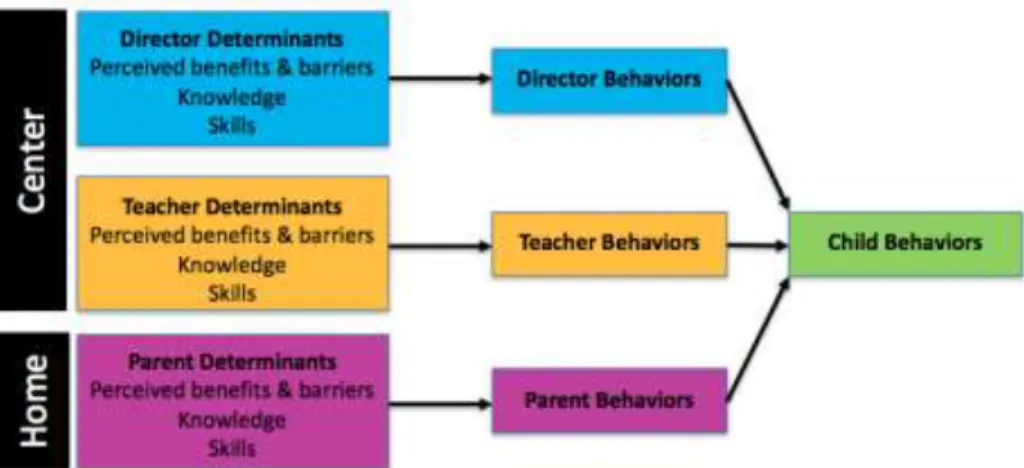
Development and implementation of the HMHW intervention was informed by the Social Ecological Framework, Exchange Theory, and Social Cognitive Theory. These theories and frameworks helped identify appropriate levels of intervention, downstream and midstream audiences, and specific constructs to intervene upon in order to initiate behavior change (Figure 1). HMHW is a multilevel intervention that targeted children (individual), caregivers
(interpersonal), and ECE centers (organizational). The Exchange Theory prompted identification of perceived benefits and barriers that would influence desired behaviors of ECE providers (directors and teachers) and parents. Knowledge and skills were two constructs prioritized from Social Cognitive Theory.
17 Intervention components
HMHW begins with a kick-off event, followed by four six-week units, and concludes with a celebration event (Figure 2).
Figure 2. Overview of structure of HMHW
Kick-off event
Unit activities
The intervention includes four, six-week units that involve activities in the classroom and at home. Unit themes include: (1) Play More, Get Thirsty (an emphasis on increasing active play each day and refueling with the right beverages), (2) Together is Better (an emphasis on getting family together for healthy food and physically active fun), (3) Let’s Move and Find our
Snacking Groove (an emphasis on reducing screen time and fueling up with healthy snacks), and (4) Try a New Thing in Spring (an emphasis on trying new physical activities and healthy foods). All classroom and home components are available in paper format and online.
Classroom. Classroom components are designed to support teachers to encourage and model healthy eating and physical activity habits in the classroom. They are also designed to promote communication between ECE providers and parents and prompt continued learning and practice of habits at home. Classroom components include a Unit Poster and Activity Cue Cards. Unit Posters are displayed in the classroom for the duration of each unit and serve as a visual reminder of the unit goals and prompt to complete and track classroom activities. The Activity Cue Cards provide 16 classroom activities (eight nutrition, eight physical activity) to teach children the knowledge and skills needed to attain the unit goals. To encourage use, activities were designed to align with curriculum standards and, where appropriate, reference specific standards.
19
from formative work with parents.148 For each of the unit goals, the magazine presents a detailed description of the desired target behavior, benefits of the behavior, strategies for changing behavior, and tips for overcoming common barriers. The magazine also offers at-home versions of the classroom activities. When activities are done in the classroom, Our Turn Cards are sent home to prompt parents to do the corresponding at-home version of the activity. The Activity Tracker can be used to track activities completed at home and is designed to be posted as a visual prompt.
Celebration event
The objectives of the celebration event are to (1) model healthy and fun parties, (2) honor progress toward healthy habits, and (3) enjoy time with families. As part of the celebration event, centers are required to promote the event to parents via newsletter article, e-mail, or flyer,
display a certificate of completion, have teachers wear Healthy We buttons, post pictures of work completed during the program, have children perform the HMHW song, and award children Healthy We ribbons.
Implementation strategy
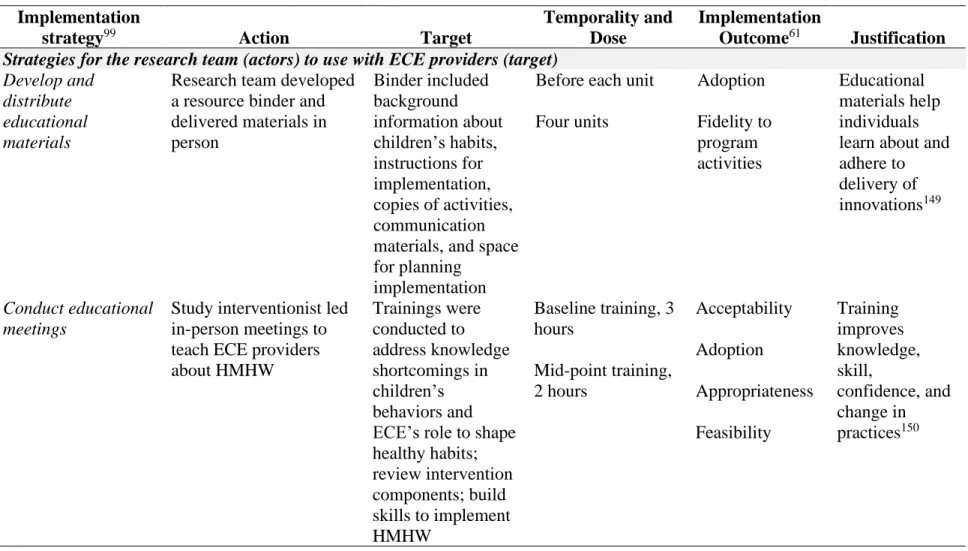
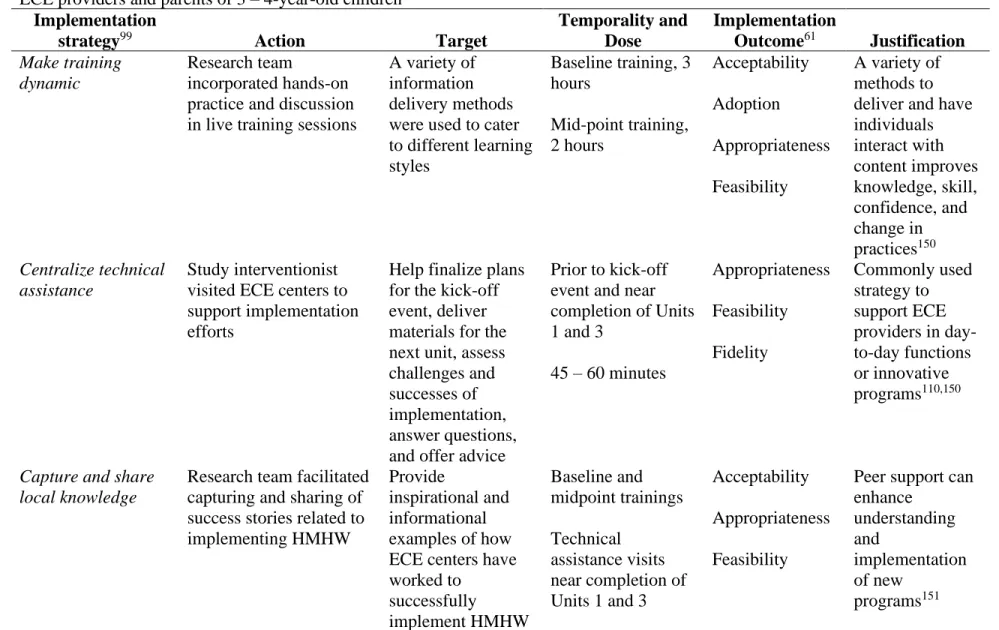
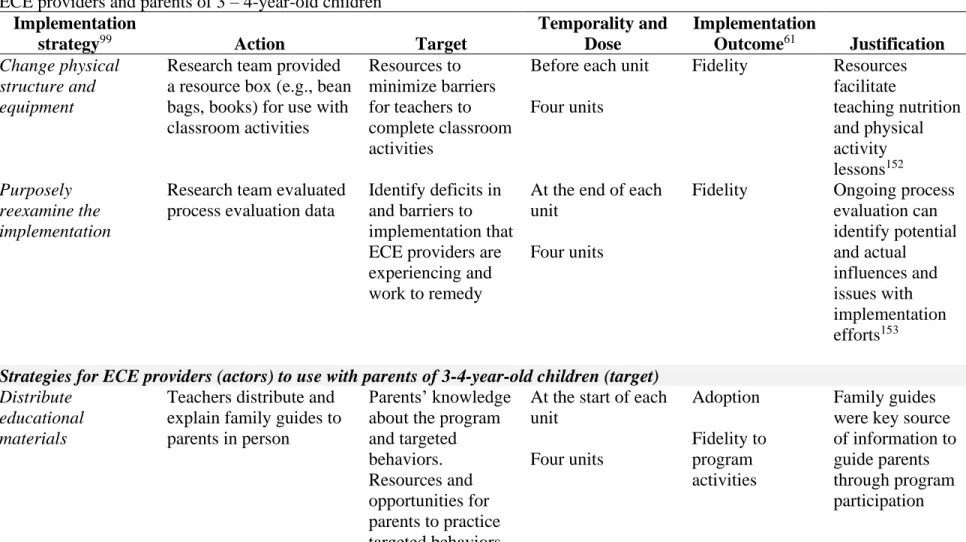
providers provided intervention materials, prompted participation at home, and invited parents to participate in events at the ECE center (Table 2).
Determinant and evaluation frameworks Aims 1 and 3
The RE-AIM32 framework (reach, effectiveness, adoption, implementation, maintenance), one of the most frequently used planning and evaluation frameworks for
community settings,33 guided evaluation efforts of HMHW. Reach is an individual-level measure to identify the absolute number and proportion of individuals willing to participate in a specific innovation and how well they represent the targeted population. Efficacy or Effectiveness is another individual-level measure that describes the impact of an innovation, both positive and negative, including physiological, behavioral, and economic outcomes. Adoption is an
organizational-level measure to identify the absolute number and proportion of settings and intervention agents willing to adopt an innovation and how representative they are of the targeted population. Implementation is an organizational-level measure of the extent to which the
21
Table 2. Discrete implementation strategies96 to support adoption and implementation of the HMHW intervention among ECE
providers and parents of 3 – 4-year-old children Implementation
strategy99 Action Target
Temporality and Dose
Implementation
Outcome61 Justification
Strategies for the research team (actors) to use with ECE providers (target)
Develop and distribute educational materials
Research team developed a resource binder and delivered materials in person Binder included background information about children’s habits, instructions for implementation, copies of activities, communication materials, and space for planning
implementation
Before each unit Four units Adoption Fidelity to program activities Educational materials help individuals learn about and adhere to delivery of innovations149
Conduct educational meetings
Study interventionist led in-person meetings to teach ECE providers about HMHW Trainings were conducted to address knowledge shortcomings in children’s behaviors and ECE’s role to shape healthy habits; review intervention components; build skills to implement HMHW
22
Table 2 continued. Discrete implementation strategies96 to support adoption and implementation of the HMHW intervention among ECE providers and parents of 3 – 4-year-old children
Implementation
strategy99 Action Target
Temporality and Dose
Implementation
Outcome61 Justification Make training
dynamic
Research team
incorporated hands-on practice and discussion in live training sessions
A variety of information delivery methods were used to cater to different learning styles
Baseline training, 3 hours Mid-point training, 2 hours Acceptability Adoption Appropriateness Feasibility
A variety of methods to deliver and have individuals interact with content improves knowledge, skill, confidence, and change in practices150 Centralize technical assistance Study interventionist visited ECE centers to support implementation efforts
Help finalize plans for the kick-off event, deliver materials for the next unit, assess challenges and successes of implementation, answer questions, and offer advice
Prior to kick-off event and near completion of Units 1 and 3
45 – 60 minutes
Appropriateness Feasibility Fidelity Commonly used strategy to support ECE providers in day-to-day functions or innovative programs110,150
Capture and share local knowledge
Research team facilitated capturing and sharing of success stories related to implementing HMHW
Provide
inspirational and informational examples of how ECE centers have worked to
Baseline and midpoint trainings Technical
assistance visits near completion of
Acceptability Appropriateness Feasibility
Peer support can enhance
understanding and
23
Table 2 continued. Discrete implementation strategies96 to support adoption and implementation of the HMHW intervention among ECE providers and parents of 3 – 4-year-old children
Implementation
strategy99 Action Target
Temporality and Dose
Implementation
Outcome61 Justification Change physical
structure and equipment
Research team provided a resource box (e.g., bean bags, books) for use with classroom activities
Resources to minimize barriers for teachers to complete classroom activities
Before each unit Four units
Fidelity Resources facilitate teaching nutrition and physical activity lessons152 Purposely reexamine the implementation
Research team evaluated process evaluation data
Identify deficits in and barriers to implementation that ECE providers are experiencing and work to remedy
At the end of each unit
Four units
Fidelity Ongoing process evaluation can identify potential and actual influences and issues with implementation efforts153
Strategies for ECE providers (actors) to use with parents of 3-4-year-old children (target)
Distribute educational materials
Teachers distribute and explain family guides to parents in person
Parents’ knowledge about the program and targeted behaviors. Resources and opportunities for parents to practice targeted behaviors
24
Table 2 continued. Discrete implementation strategies96 to support adoption and implementation of the HMHW intervention among ECE providers and parents of 3 – 4-year-old children
Implementation
strategy99 Action Target
Temporality and Dose
Implementation
Outcome61 Justification Remind families Teachers distribute Our
Turn cards to parents in person
Prompt families to do program activities at home
Send home the same day a
classroom activity is completed At least 32 times: eight or more times during each of the four units Fidelity to program activities Prompts/cues and reminder systems have been shown to promote adherence and engagement154
Involve parents or other family members
Directors and teachers invite parents to attend or otherwise support (e.g., sending food for tasting events) kick-off,
celebration, or other classroom activities
Knowledge about the intervention, sharing child’s excitement, and realizing effect of intervention will increase parents’ understanding of their role and motivation to implement program at home
During the 8-month intervention period At least twice (for kick-off and celebration events) Adoption Fidelity to program activities Knowledge and skills for new practices or programs can support buy-in and
25 Aim 2
Two frameworks – Epstein’s framework for school-family-community partnerships34 and the Consolidated Framework for Implementation Research (CFIR)35 – were used to structure exploration into determinants of engaging parents in the implementation of HMHW. Epstein’s framework for school-family-community partnerships offers six types of involvement and suggested practices to help educators foster and develop partnerships (i.e., engagement) between the school organization and families. The six types of involvement include parenting,
communicating, volunteering, learning at home, decision making, and collaborating with community (Table 3). This framework provides practical guidance for educators aiming to develop more comprehensive partnership programs. It also helps researchers frame research questions and results in a way that will ultimately improve practice and thus has translational implications for the results generated.
Table 3. Elements of Epstein’s framework for school-family-community partnerships34
Element Definition
Parenting Helping all families establish home environments to support children as students
Communicating
Designing effective forms of school-to-home and home-to-school communication about home-to-school programs and
children’s progress
Volunteering Recruiting and organizing parents to help and support Learning at home
Providing families information and ideas about how to help students at home with homework and other curriculum-related activities, decisions, and planning
Decision making Including parents in school decisions and developing parent leaders and representatives
Collaborating with community
CFIR is a meta-theory that consists of 38 constructs encapsulated in five domains.35 Constructs within each domain were identified from existing theories and based on their association with effective implementation. The domains are classified as: characteristics of the intervention (e.g., evidence strength and quality, adaptability), the inner setting (e.g., culture, implementation climate), the outer setting (e.g., external policy and incentives), characteristics of individuals involved (e.g., self-efficacy, individual stage of change), and the implementation process (e.g., planning, executing). Although domains are hypothesized to interact in complex ways, the framework does not specify the mechanisms of interaction. Instead, this extensive framework is designed to be used in a manner most relevant to the research question at hand. The menu of constructs approach allows researchers to systematically and comprehensively think about implementation while simultaneously minimizing participant burden by selecting the most relevant constructs.156 The focus of this aim will be on the inner setting and process domains. The outer setting (i.e., external policies and incentives) is outside the scope of this project, and the cluster randomized control trial extensively evaluated the complexity and design quality and packaging of HMHW (i.e., characteristics of the intervention) as well as the knowledge and beliefs ECE providers and parents had about the intervention (i.e., characteristics of individuals). Study population and protocols
Aim 1
Data for Aim 1 were collected as part of the two-arm, cluster randomized control
27
(exempt from quality rating), provided lunch, and did not exclusively serve children with special needs. Potentially eligible ECE centers were identified through a publicly available database of licensed programs in the state that is maintained by the North Carolina Division of Child Development. Recruitment was a multi-phase process that first targeted center directors, followed by teachers and then parents. Invitations to participate in the research study were mailed and e-mailed to directors, and a member of the research team followed up with phone calls and in-person meetings with directors, teachers, and parents to review details of study participation, screen for eligibility, and obtain signed informed consent.
Data collection occurred in two waves from July 2015 to June 2017. A series of measures including observation and self-report surveys were collected from directors, teachers, parents and children at baseline and after the 8-month intervention period. Process evaluation was collected throughout the intervention period among ECE centers randomized to the intervention group (n = 48). Process evaluation efforts were developed based on the RE-AIM framework (described above) to assess reach, effectiveness, adoption, implementation fidelity, intervention fidelity, maintenance, and context.32,82,84 Process measures included self-report surveys, observations, and semi-structured interviews. Parents and ECE providers received cash incentives for completing and returning measures. All protocols were approved by the Institutional Review Board at the University of North Carolina at Chapel Hill.
Aim 2
providers, and ~300 parents randomized to the intervention group in the second of two waves of the HMHW trial. Participants completed the intervention during the 2016 – 2017 school year and represented a mix of suburban and rural settings in central North Carolina. The Institutional Review Board at the University of North Carolina at Chapel Hill approved all study protocols.
An extreme case purposeful sampling approach157 was used to identify and recruit 10 centers that represented low and high levels of parent engagement with the HMHW intervention. A comprehensive, center-level measure of parent engagement was developed using process evaluation data from the cluster randomized control trial. Sources of data for this comprehensive measure included the research team, center directors, teachers, and parents. After parent
engagement scores were generated, centers were ranked from lowest to highest. Centers
representing the five lowest and five highest scores were contacted for interest in this study, with a goal of having at least three low engagement and three high engagement centers participate.158 Recruitment occurred in July and August 2017. Directors were contacted via phone and e-mail, and once interest in the study was expressed, they facilitated connection with teachers and parents who participated in HMHW. In total, seven ECE centers, three representing low engagement and four representing high engagement, and 28 individuals, evenly split across groups, agreed to participate.
29
Directors and teachers also completed an organizational characteristics survey. Semi-structured interviews were conducted by a single, experienced member of the research team and were audio recorded for later transcription. Interviews lasted approximately 60 minutes, range 45 – 75 minutes. Participants received $30 compensation for time and effort to complete all measures. Aim 3
This aim used a quasi-experimental design to evaluate the efficacy of an enhanced implementation strategy, compared to a historical control group, to increase parent engagement with HMHW. This convenience sample included ECE centers that participated in the second wave of the cluster randomized control effectiveness trial and represented a mix of rural and suburban areas in central North Carolina.24 The overarching eligibility criteria were previously described as part of Aim 1. The 29 ECE centers randomized to deliver HMHW during the 2016 – 2017 school year were designated cohort 1 (i.e., standard implementation) and 22 ECE centers in the delayed intervention group were eligible to participate in cohort 2 (i.e., enhanced
implementation) during the 2017 – 2018 school year.
Upon completion of the main trial, ECE center directors eligible for cohort 2 were contacted via phone and e-mail about the opportunity to implement HMHW and participate in this follow-up study. All centers that expressed interest in delivering HMHW also agreed to participate in the study (n=13). ECE providers signed informed consent. Only parents who completed and returned an anonymous survey were considered to have consented to participate in this research study. The Institutional Review Board at the University of North Carolina at Chapel Hill approved the study protocol.
collection for cohort 2-enhanced occurred during the 2017 – 2018 school year. Prior to the intervention period, trained and blinded data collectors completed observations to document evidence of policies pertaining to parent engagement around nutrition, physical activity, screen time, and outdoor play and learning. Observations and brief semi-structured interviews were conducted by the study’s interventionist at the technical assistance visits near the completion of Units 1 and 3. Upon entry to the study, all participants completed a demographic survey and center directors also provided demographic information about their ECE center. At the end of the intervention period, ECE providers and parents completed surveys about general program
implementation.
31 Implementation strategies
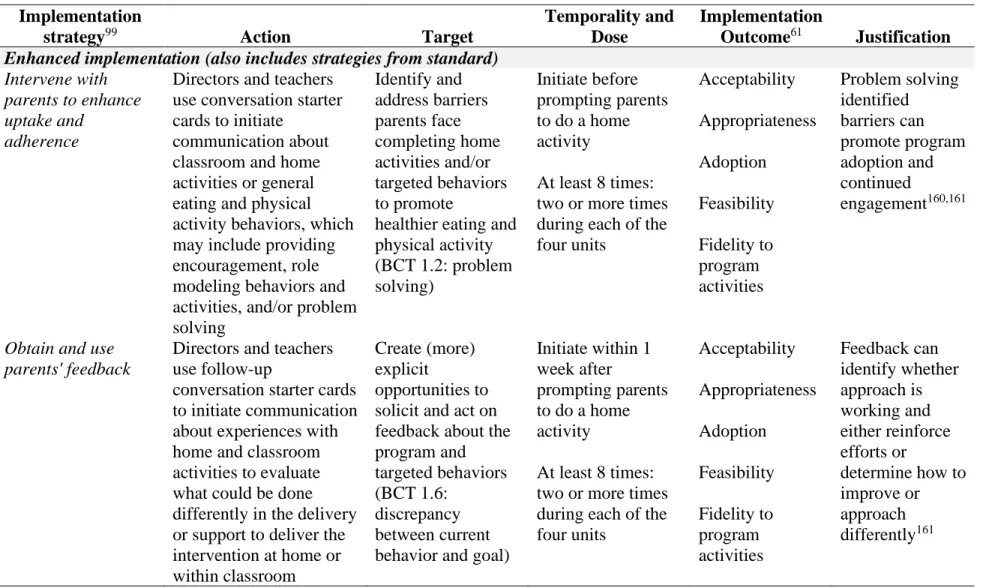
The standard implementation strategy employed by ECE providers in Wave 2 of the main trial (cohort 1) were previously described in detail in Table 2. This standard implementation approach included delivering intervention materials to parents, prompting them to participate, and inviting them to attend events at the center. The enhanced implementation strategy used by ECE providers in cohort 2 was developed based on results from Aims 1 and 2, leading to the incorporation of two additional strategies (Table 4). Activities aimed to promote two-way communication through obtaining and using family feedback about experiences with HMHW at home and identifying and collaboratively addressing barriers to participation. These included conversation starter cards to facilitate conversation about specific activities within the program as well as more general conversation about a child’s eating and physical activity habits. Halfway through the intervention, however, actually seeing parents face-to-face proved to be a common barrier. As a result, the conversation starter cards were converted to a format that could be sent to parents via various media (e.g., paper, social media, e-mail).
The research team used the same strategies to support ECE providers in both groups (Table 2), but content of trainings and technical assistance for cohort 2 added more about communication with families. At each of the in-person trainings, the research team’s
interventionist discussed tips for communicating with families (Behavior Change Technique (BCT)159 4.1: instruction on how to perform a behavior), demonstrated communication
techniques (BCT 6.1: demonstration of the behavior), had ECE providers practice pitching the program (BCT 8.1: behavioral practice/rehearsal), and provided feedback on practice
participate in program-related events at the center or send resources for activities; obtain and use feedback from families about HMHW, or; develop strategies to increase feedback on the
33
Table 4. Additional implementation strategies96 selected for the enhanced implementation approach for ECE providers
(actors) to use with parents of 3 – 4-year-old children (target) to support adoption and implementation of the HMHW intervention
Implementation
strategy99 Action Target
Temporality and Dose
Implementation
Outcome61 Justification
Enhanced implementation (also includes strategies from standard)
Intervene with parents to enhance uptake and
adherence
Directors and teachers use conversation starter cards to initiate
communication about classroom and home activities or general eating and physical activity behaviors, which may include providing encouragement, role modeling behaviors and activities, and/or problem solving Identify and address barriers parents face completing home activities and/or targeted behaviors to promote
healthier eating and physical activity (BCT 1.2: problem solving)
Initiate before prompting parents to do a home activity
At least 8 times: two or more times during each of the four units Acceptability Appropriateness Adoption Feasibility Fidelity to program activities Problem solving identified barriers can promote program adoption and continued engagement160,161
Obtain and use parents' feedback
Directors and teachers use follow-up
conversation starter cards to initiate communication about experiences with home and classroom activities to evaluate what could be done differently in the delivery or support to deliver the intervention at home or within classroom
Create (more) explicit
opportunities to solicit and act on feedback about the program and targeted behaviors (BCT 1.6:
discrepancy between current behavior and goal)
Initiate within 1 week after
prompting parents to do a home activity
At least 8 times: two or more times during each of the four units Acceptability Appropriateness Adoption Feasibility Fidelity to program activities Feedback can identify whether approach is working and either reinforce efforts or
Measures
Process evaluation and implementation outcomes
In Aims 1 and 3, process evaluation and implementation outcomes were collected to assess factors influencing implementation, the fidelity of implementation, and other indicators of external validity according to the RE-AIM framework. Details of all measures are provided below.
Recruitment and attendance logs
The research team tracked the flow of potentially eligible centers approached for participation and included reasons for exclusion if not randomized. After randomization, the research team tracked all baseline and midpoint training opportunities offered, the settings in which they were offered, and ECE providers’ attendance.
Training evaluations
35 Observations
The research team’s interventionist conducted two observations at each center during the intervention period. Visits occurred near the end of Units 1 and 3. An observation checklist documented fidelity of materials delivered, visibility of the banner, display and use of posters in participating classrooms, and if a classroom activity was being delivered, the ability of teachers to deliver an activity, and interest of children in the activity. There was also space for notes to provide context about anything that may have affected how ECE providers implemented the program (e.g., insufficient space to display banner/poster or comments from providers). ECE provider surveys
In Aim 1, ECE providers completed surveys at the end of the intervention regarding the acceptability and feasibility of HMHW. Directors completed a 28-item survey, and teachers completed a 52-item survey. All ECE providers rated the acceptability of individual intervention components (e.g., Please rate the following materials: activity cue cards) using a 3-point scale (i.e., works well as is to needs lots of improvement). They also rated the program as a whole (e.g., The Healthy Me, Healthy We program provided useful resources that helped teachers promote healthy eating) using a 5-point scale (i.e., strongly disagree to strongly agree). ECE providers used the same 5-point scale to evaluate the feasibility of HMHW to address targeted behaviors and beliefs to support healthier eating and active play for 3-4-year-old children (e.g., The program helped me communicate with families about the importance our center places on active play) .143 HMHW targeted more behaviors and beliefs specific to teachers and this contributed to the difference in the number of survey items for teachers and directors.
from the Aim 1 teacher survey were added to the director survey regarding the feasibility of HMHW to address targeted behaviors of interacting with parents about healthy eating or physical activity (4 items) and confidence communicating with parents (2 items). Other items,
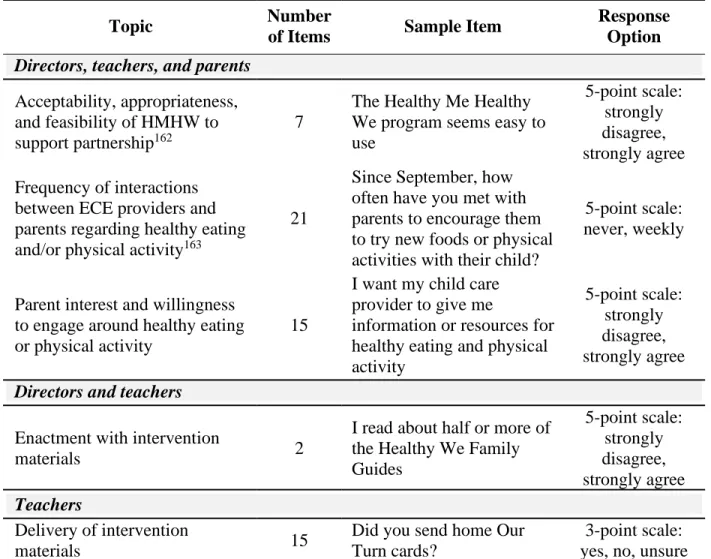
summarized in Table 5, were added to evaluate acceptability, appropriateness, and feasibility of HMHW to support partnership between ECE providers and parents,162 frequency of interactions between ECE providers and parents around healthy eating and/or physical activity,163 and parent interest and willingness to engage around healthy eating or physical activity content or activities. Parent survey
In Aim 1, parents completed a 74-item survey at the end of the intervention regarding the implementation, acceptability, and feasibility of HMHW. Parents reported their exposure and enactment with intervention components (18 items) (e.g., Did you receive the Unit 1 Family Guide?). Parents rated the acceptability of individual intervention components (5 items) (e.g., My family enjoyed the Home Activities) using a 5-point scale (i.e., strongly disagree to strongly agree). They used the same 5-point scale to evaluate the feasibility of HMHW to address targeted behaviors and beliefs to support healthier eating and active play for 3-4-year-old children (50 items) (e.g., The Healthy Me, Healthy We program helped me use praise and encouragement to support my child’s healthier food choices).143
37
Table 5. Post-intervention surveys completed by ECE providers and parents in Aim 3
Topic Number
of Items Sample Item
Response Option
Directors, teachers, and parents
Acceptability, appropriateness, and feasibility of HMHW to support partnership162
7
The Healthy Me Healthy We program seems easy to use
5-point scale: strongly disagree, strongly agree Frequency of interactions
between ECE providers and parents regarding healthy eating and/or physical activity163
21
Since September, how often have you met with parents to encourage them to try new foods or physical activities with their child?
5-point scale: never, weekly
Parent interest and willingness to engage around healthy eating or physical activity
15
I want my child care provider to give me
information or resources for healthy eating and physical activity
5-point scale: strongly disagree, strongly agree
Directors and teachers
Enactment with intervention
materials 2
I read about half or more of the Healthy We Family Guides 5-point scale: strongly disagree, strongly agree Teachers
Delivery of intervention
materials 15
Did you send home Our Turn cards?
3-point scale: yes, no, unsure
Semi-structured interviews
additional focus was placed on quality of implementation, communication and partnership with parents (e.g. how and what of communication), and follow-up regarding goals and expectations. Fidelity
For Aim 1, a fidelity index was created to evaluate the adherence, competence,83
39
Table 6. Components of fidelity index to measure intervention and implementation fidelity of HMHW among ECE providers and parents
Component Item Data Source Characteristic of
fidelity Scoring
Intervention fidelity of ECE providers (delivering intervention components)
Attendance at training Director attended both training sessions Training attendance Exposure 0/1 Proportion of classrooms in which teachers
attended both training sessions Training attendance Exposure 0 – 1 Center banner Present during first half of the program Unit 1 observation
checklist Adherence 0/1
Moderately, very, or extremely visible during first half of the program
Unit 1 observation
checklist Competence 0/1
Present during second half of the program Unit 3 observation
checklist Adherence 0/1
Moderately, very, or extremely visible during second half of the program
Unit 3 observation
checklist Competence 0/1
Promise poster Present during first half of program: proportion of all classrooms
Unit 1 observation
checklist Adherence 0 – 1
Signed during first half of program: proportion of all classrooms
Unit 1 observation
checklist Competence 0 – 1
Present during second half of program: proportion of all classrooms
Unit 3 observation
checklist Adherence 0 – 1
Signed during second half of program: proportion of all classrooms
Unit 3 observation
checklist Competence 0 – 1
Unit posters Unit 1 poster present: proportion of all classrooms
Unit 1 observation
checklist Adherence 0 – 1
Unit 1 poster used to track completed activities: proportion of all classrooms
Unit 1 observation
40
Component Item Data Source Characteristic of
fidelity Scoring Unit 3 poster present: proportion of all
classrooms
Unit 3 observation
checklist Adherence 0 – 1
Unit 3 poster used to track completed activities: proportion of all classrooms
Unit 3 observation
checklist Competence 0 – 1
Classroom activities Proportion of classrooms that completed at least 6 activities for Unit 1a
Unit 1 observation
checklist Adherence 0 – 1
Proportion of classrooms that completed at least 6 activities for Unit 3a
Unit 3 observation
checklist Adherence 0 – 1
Implementation fidelity (implementation support provided to parents by ECE providers)
Delivery of materials Proportion of parents who received the Unit
1 Family Guide Parent survey Exposure 0 – 1
Proportion of parents who received the Unit
2 Family Guide Parent survey Exposure 0 – 1
Proportion of parents who received the Unit
3 Family Guide Parent survey Exposure 0 – 1
Proportion of parents who received the Unit
4 Family Guide Parent survey Exposure 0 – 1
Proportion of parents who received the Unit
1 Activity Tracker Parent survey Exposure 0 – 1
Proportion of parents who received the Unit
2 Activity Tracker Parent survey Exposure 0 – 1
Proportion of parents who received the Unit
3 Activity Tracker Parent survey Exposure 0 – 1
41
Component Item Data Source Characteristic of
fidelity Scoring Proportion of parents who received at least
25 Our Turn cards Parent survey Exposure 0 – 1
Invitation for parents to participate
Proportion of parents aware that a kick-off
event was held Parent survey Competence 0 – 1
Proportion of parents aware that a
celebration event was held Parent survey Competence 0 – 1
Intervention fidelity of parents (participating in or using intervention components)
Parent participation Proportion of parents who understood the
program adequately, well, or very well Parent survey Competence 0 – 1 Proportion of parents who understood their
role in the program adequately, well, or very well
Parent survey Competence 0 – 1 Proportion of parents who attended kick-off
event Parent survey Adherence 0 – 1
Proportion of parents who attended
celebration event Parent survey Adherence 0 – 1
Proportion of parents who read at least half
of the Family Guides Parent survey Exposure 0 – 1
Proportion of parents who tried at least 25
activities at home Parent survey Adherence 0 – 1
Proportion of parents who tried the Just Try
It suggestions Parent survey Adherence 0 – 1